Most of us spend years pursuing education, careers, financial security, family life, and personal ambitions. Beneath all of them sits a quieter question: Why am I here?
For Muslims, the Quran gives a direct answer. That answer, however, raises further questions. What does worship really mean? Does Allah need our prayers? Can work, parenting, and kindness carry religious meaning? Why does life contain hardship? This final article in our foundational series explores these questions through the Quran, authentic Hadith, and classical commentary.
The short answer: According to the Quran, Allah created jinn and human beings to worship Him (Quran 51:56). In Islam, worship includes sincere devotion, such as prayer and other religious duties, and living by His guidance through honesty, justice, and responsible conduct. The Quran also describes earthly life as a test of deeds. Allah does not need human worship; the verses that follow affirm His complete self-sufficiency.
The Purpose of Life at a Glance
Question | Short answer |
|---|---|
Why did Allah create us? | To worship Him, according to Quran 51:56. |
Does Allah need our worship? | No. Quran 51:57–58 affirms His independence. |
Is worship only prayer? | No. It includes prescribed devotions and, under the right conditions, wider obedience. |
Why is life a test? | Quran 67:2 describes death and life as a test of deeds. |
Do our choices matter? | Yes. Divine knowledge and human responsibility are both affirmed. |
Is worldly success forbidden? | No. Lawful worldly activity has a place in Islamic life. |
What happens after death? | Islam teaches resurrection and accountability, together with Allah’s mercy. |
Why Did Allah Create Us According to the Quran?
What Quran 51:56 Actually Says
وَمَا خَلَقْتُ الْجِنَّ وَالْإِنسَ إِلَّا لِيَعْبُدُونِ
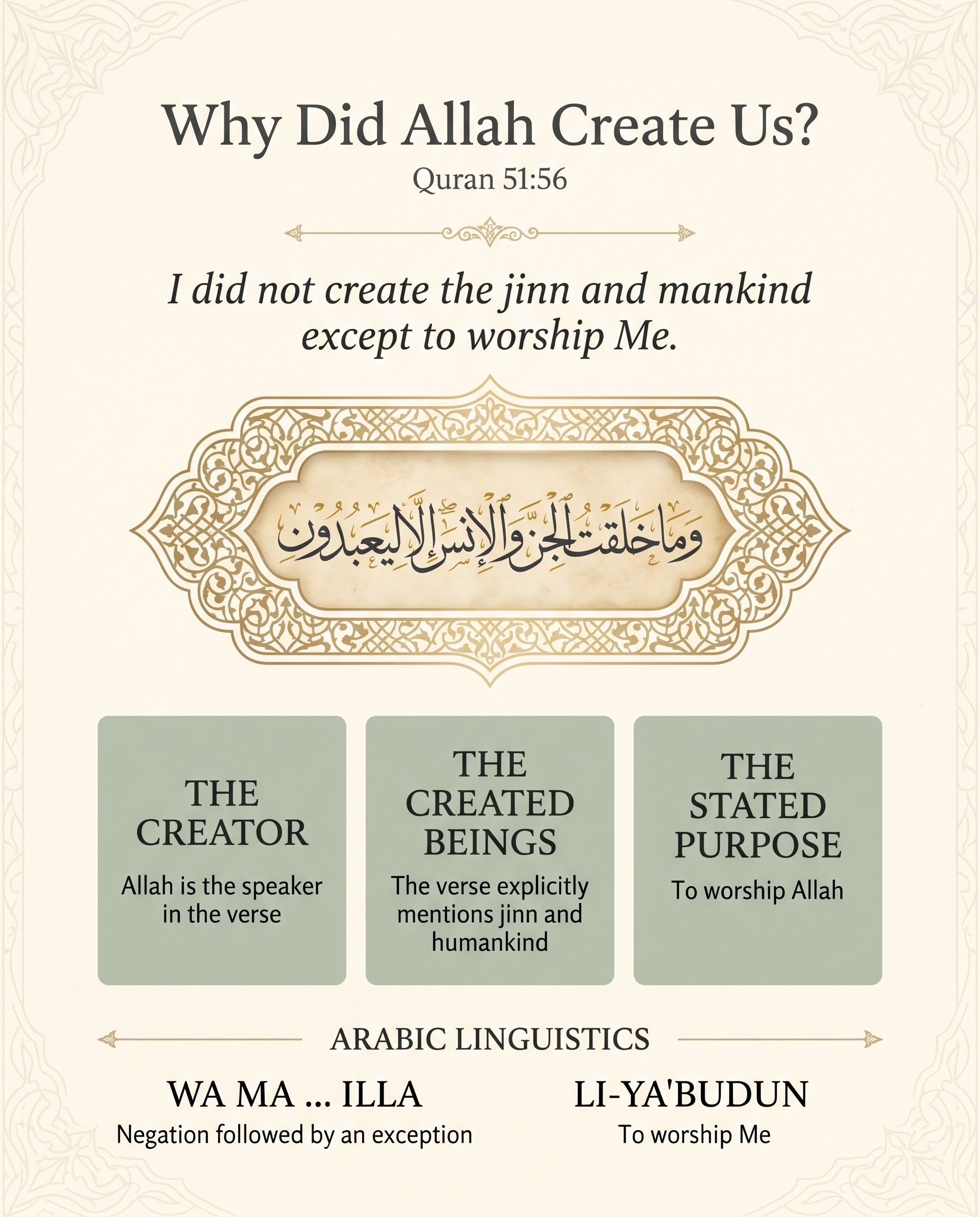
“And I did not create the jinn and mankind except to worship Me.” (Quran 51:56)
The verse is short, so each part matters. The speaker is Allah; the created beings are “the jinn and mankind”; the stated purpose is worship. The mention of jinn reminds us that Islam teaches an unseen creation alongside humanity, also answerable to Allah. Revelation tells us little about their lives, so we do not speculate.
Classical commentators such as al-Tabari, Ibn Kathir, and al-Qurtubi explain li-ya‘budun as “to worship Me.” Some early commentators, as these works report, also linked worship with affirming Allah’s oneness or knowing Him, since sincere worship depends on both. Those are explanations of the verse, not replacements for its wording. For the same reason, the popular saying “I was a hidden treasure and loved to be known” should not be quoted as revelation: it is not established as an authentic Hadith and cannot serve as evidence.
The verse also states a purpose and a command; it does not claim that everyone fulfils it. The Quran itself says that many reject it, which is why choice and accountability matter later in this article.
Arabic | Transliteration | Meaning |
|---|---|---|
وَمَا | wa ma | “and not” |
خَلَقْتُ | khalaqtu | “I created” |
الْجِنَّ | al-jinna | “the jinn” |
وَالْإِنسَ | wal-insa | “and mankind” |
إِلَّا | illa | “except” |
لِيَعْبُدُونِ | li-ya‘budun | “to worship Me” |
The negation followed by an exception gives the statement emphasis: worship is the purpose Allah names.
What Does Ibadah Mean?
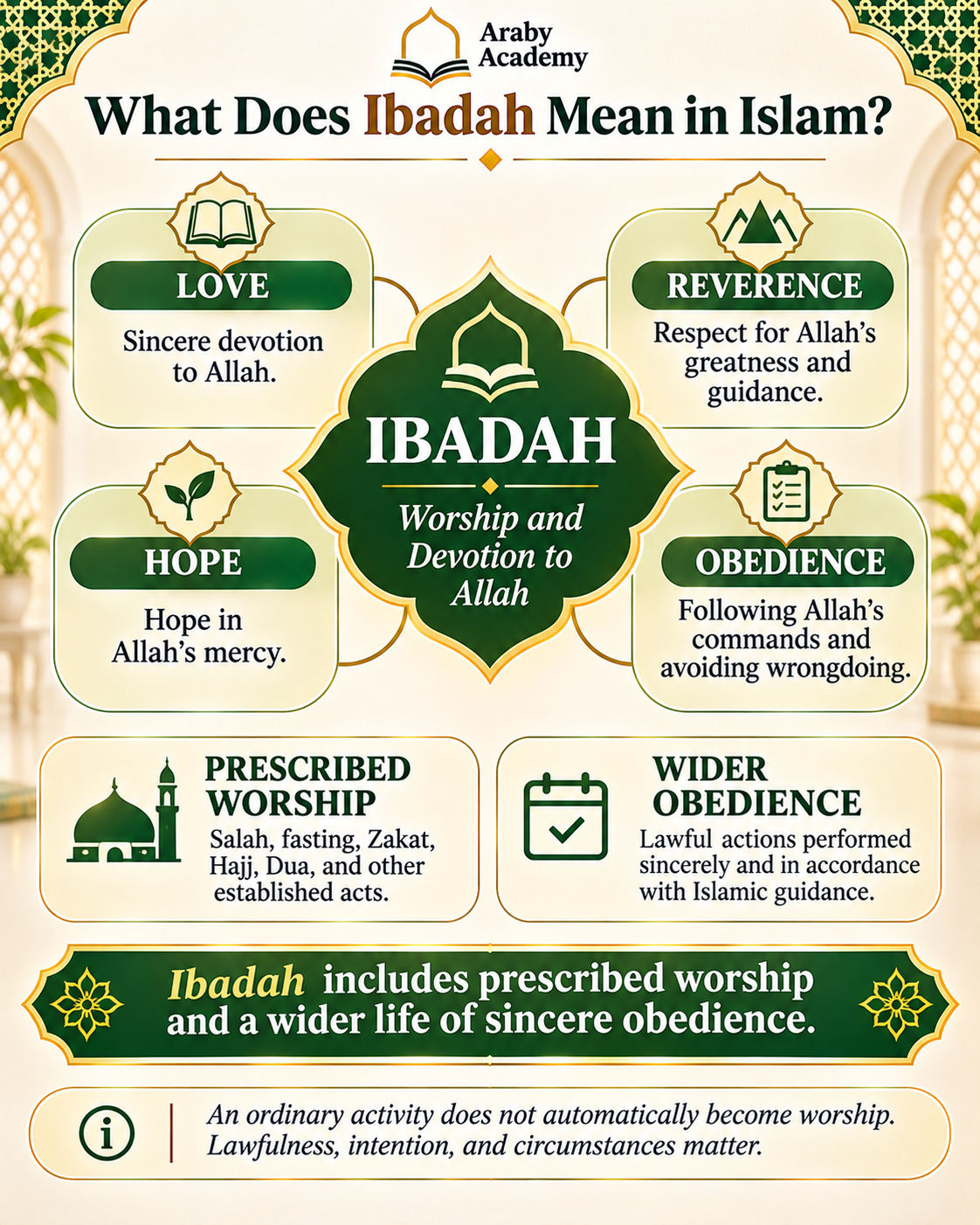
Ibadah (عِبَادَة) comes from the root ع-ب-د (‘-b-d), which Arabic lexicons connect with servitude, submission, and devotion. Related words include ‘abd (servant) and ‘ubudiyyah (الْعُبُودِيَّة), the state of being Allah’s servant. No single English word captures all of this: “worship” sounds ritual, while “obedience” sounds merely legal. Ibadah combines love, reverence, hope, and obedience.
This servitude differs from human oppression. Human masters can be unjust, needy, and limited. Allah is the Merciful, the Wise, and the Self-Sufficient, and Islam presents devotion to Him as freeing a person from servitude to anything else.
Does Allah Need Human Worship?
The Quran answers in the very next verses:
مَا أُرِيدُ مِنْهُم مِّن رِّزْقٍ وَمَا أُرِيدُ أَن يُطْعِمُونِ إِنَّ اللَّهَ هُوَ الرَّزَّاقُ ذُو الْقُوَّةِ الْمَتِينُ
“I do not want any provision from them, nor do I want them to feed Me. Indeed, Allah is the All-Provider, the Possessor of strength, the Firm.” (Quran 51:57–58)
Allah’s Independence and Self-Sufficiency
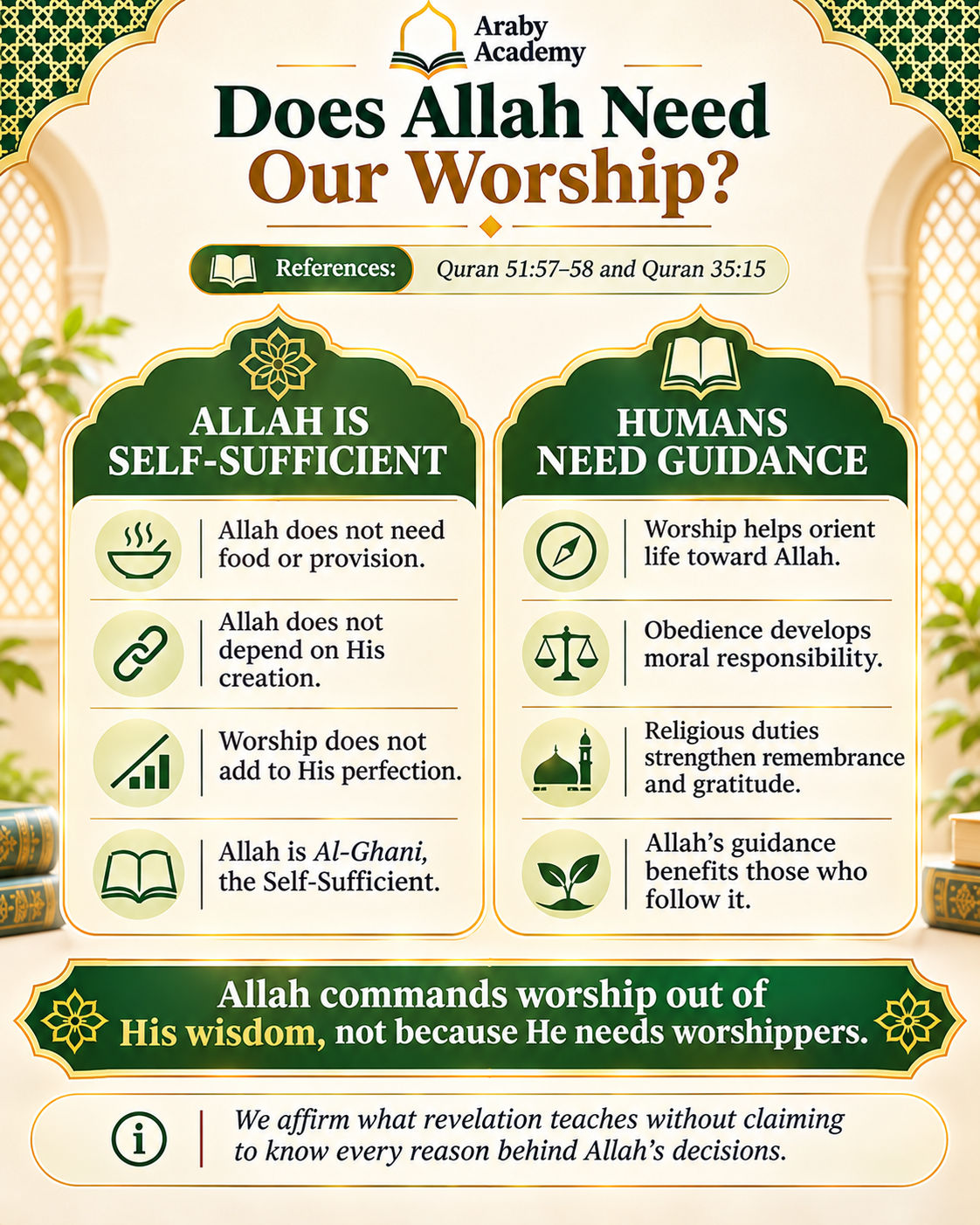
The answer is no. Allah does not need food, help, or benefit from creation; He provides and they receive. He is Al-Ghani, the Self-Sufficient: “O people, you are the ones in need of Allah, while Allah is the Self-Sufficient, the Praiseworthy” (Quran 35:15). In a Hadith Qudsi narrated by Abu Dharr and recorded in Sahih Muslim, Allah says that His servants will never reach harming Him so as to harm Him, nor benefiting Him so as to benefit Him. (A Hadith Qudsi conveys meaning from Allah in the Prophet’s words; it is not Quran.)
So Allah did not create out of loneliness, boredom, or incompleteness. Such ideas project human limits onto the Creator. Understanding why humans worship Allah begins with learning [ who Allah is according to Islamic teaching], rather than imagining Him as a being with human needs. The Quran introduces Him as One, Merciful, All-Knowing, and Wise, and we do not speculate about His essence beyond what He has told us.
Why Command Worship if Allah Needs Nothing?
Independence and command do not contradict each other. A Creator who needs nothing can still guide, command, and hold His creatures accountable, and the benefit of obedience returns to the one who obeys. The Quran points to some of these benefits: remembrance of Allah, God-consciousness, moral restraint, gratitude, community responsibility, and hope in His mercy. Muslims affirm Allah’s wisdom without claiming to know every reason behind His commands. The Quran does not promise that worship brings immediate comfort, wealth, or health.
Why Is Tawhid Central to Our Purpose?
The Quranic purpose of worship is inseparable from [ believing in the oneness of Allah through Tawhid], the foundation of Islamic faith. Many people accept that a Creator exists; Islam’s call goes further, asking that worship be directed to Allah alone. Surah Al-Ikhlas states His uniqueness and independence:
قُلْ هُوَ اللَّهُ أَحَدٌ اللَّهُ الصَّمَدُ لَمْ يَلِدْ وَلَمْ يُولَدْ وَلَمْ يَكُن لَّهُ كُفُوًا أَحَدٌ
“Say: He is Allah, [who is] One. Allah, the Self-Sufficient Master. He neither begets nor was born, and there is none comparable to Him.” (Quran 112:1–4)
In a Hadith narrated by Mu‘adh ibn Jabal (al-Bukhari and Muslim), the Prophet ﷺ explained that Allah’s right over His servants is that they worship Him and associate nothing with Him, and that the servants’ right, which Allah has made certain by His own promise and mercy, is that He will not punish whoever does so. This describes the shape of the relationship; it is not a verdict on the fate of any named individual.
Is Worship Only Prayer and Fasting?
No. Islam has prescribed acts of worship and a wider life of obedience, and the two belong together.
The Five Pillars
Ibn ‘Umar reported that the Prophet ﷺ said Islam is built on five: the testimony that none has the right to be worshipped except Allah and that Muhammad ﷺ is His Messenger, establishing prayer, giving zakat, Hajj to the House, and fasting Ramadan (al-Bukhari and Muslim). The practical foundations of worship are organized through [ the Five Pillars of Islam], which help believers translate faith into essential religious responsibilities.
The first pillar is a testimony of faith; the others are acts. They are the core of Islam, not the whole of it. Salah is tied to remembrance: “Worship Me and establish prayer for My remembrance” (Quran 20:14). Fasting aims at taqwa, “that you may become mindful of Allah” (Quran 2:183), which is a purpose beyond hunger or empathy. Zakat makes wealth a shared responsibility, and Hajj is a duty for those who have the means and ability. Prayer never excuses mistreating people.
Quran, Dua, and Dhikr
The Quran is where Muslims learn what Allah commands, how creation points to Him, what responsibility means, and what lies ahead. A person need not be fluent in Arabic to begin worshipping Allah, but learning to read and understand His words deepens that worship. Reading the Quran regularly helps keep this larger purpose in view, and [ building a daily Quran habit that actually lasts] makes that learning more sustainable.
Dua is itself worship, an expression of need before the One who needs nothing: “When My servants ask you about Me—indeed I am near; I respond to the call of the caller when he calls upon Me” (Quran 2:186). Allah responds in His wisdom, which may not match our timing or request. Dhikr, remembrance of Allah, keeps the heart attentive; no invented numerical routine is required to discover one’s purpose.
Honest Work, Family Care, and Good Deeds
Can ordinary life become worship? ‘Umar ibn al-Khattab reported that the Prophet ﷺ said actions are judged by intentions, and each person will have what they intended (al-Bukhari and Muslim). Niyyah (intention) and ikhlas (sincerity) matter: people were commanded to worship Allah “being sincere to Him in religion” (Quran 98:5). Two conditions follow. The act must be lawful, because a good intention never makes a forbidden act permissible. And sincerity does not mean anxiety: a passing wish for approval does not erase a person’s faith.
Within those limits, lawful everyday life can carry religious meaning. Earning halal income to meet one’s duties, studying beneficial knowledge, raising children, and helping neighbours can all be part of a life directed toward Allah. The Prophet ﷺ told Sa‘d ibn Abi Waqqas that whatever he spends seeking Allah’s pleasure is rewarded, even the morsel he places in his wife’s mouth (al-Bukhari and Muslim). Specific rewards, however, require specific evidence, and not every job or pleasure is automatically worship.
Islam does not ask everyone to become a scholar. Teachers, nurses, engineers, parents, business owners, and caregivers all fill needed roles, and we should not invent a ranking of occupations. Nor does Islam separate worship from character. Allah “commands justice and good conduct” (Quran 16:90), and the Quran urges fairness even toward those we dislike (Quran 5:8). The Prophet ﷺ said that Allah is not merciful to the one who is not merciful to people (al-Bukhari and Muslim). Good character cannot replace prescribed duties, and ritual cannot excuse injustice.
None of this means every waking moment must be a ritual or an intense spiritual experience. Sleep, meals, rest, and lawful recreation have a place. When Salman admonished Abu al-Darda’ for neglecting his family through excessive worship, the Prophet ﷺ affirmed that the body, the Lord, and the family each have a right (al-Bukhari). Quran 6:162, “Say: indeed my prayer, my sacrifice, my living, and my dying are for Allah, Lord of the worlds,” expresses wholehearted devotion; it does not mean every personal preference is a divine command.
Why Does Islam Describe Life as a Test?
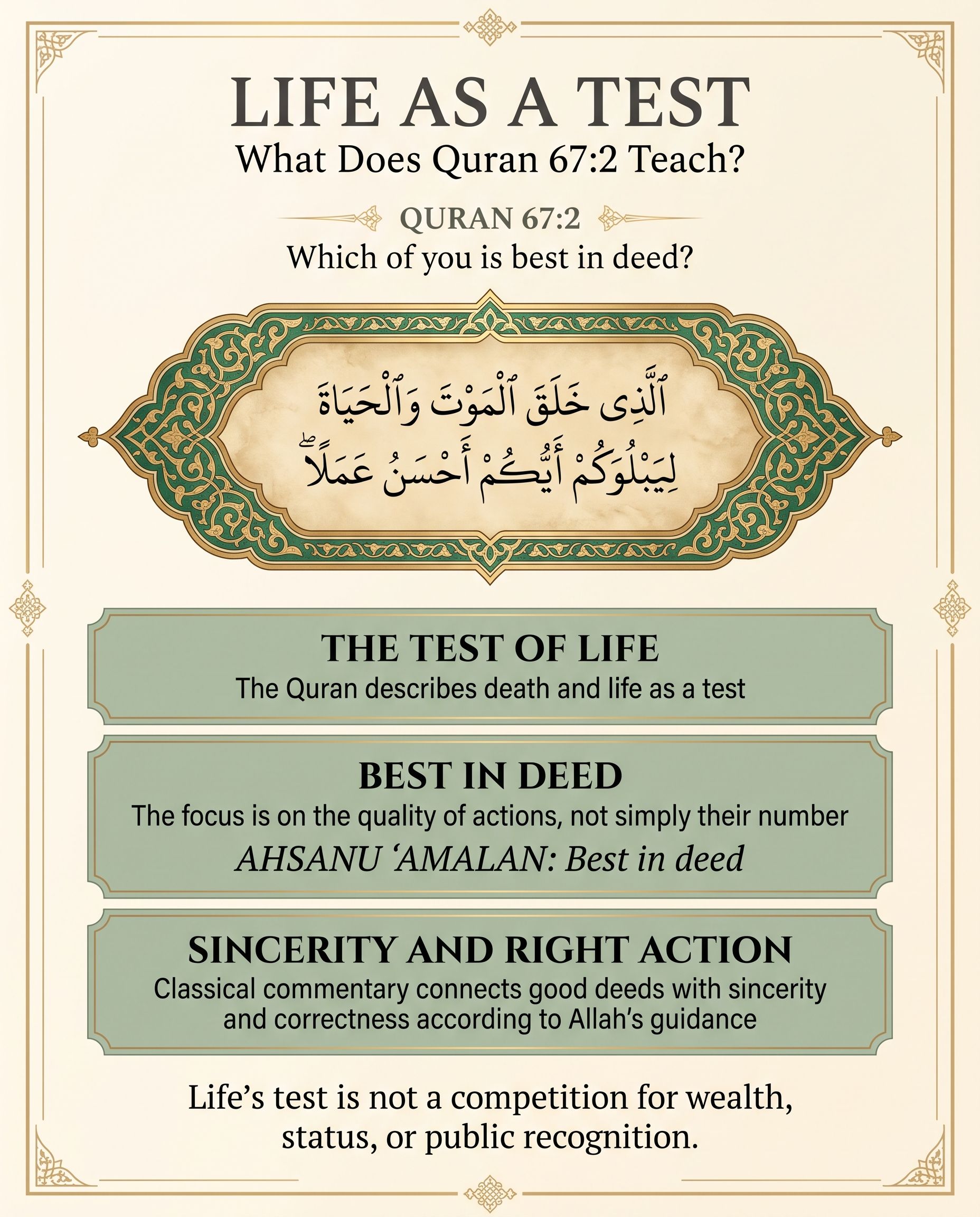
Quran 67:2
الَّذِي خَلَقَ الْمَوْتَ وَالْحَيَاةَ لِيَبْلُوَكُمْ أَيُّكُمْ أَحْسَنُ عَمَلًا ۚ وَهُوَ الْعَزِيزُ الْغَفُورُ
“[He] who created death and life to test you [as to] which of you is best in deed—and He is the Almighty, the Forgiving.” (Quran 67:2)
The key phrase ahsanu ‘amalan (أَحْسَنُ عَمَلًا) pairs the superlative ahsan (“best”) with the noun ‘amal (“deed”), which specifies what is being compared: “best in deed.” The verse does not say “most deeds,” richest, or happiest. Quality matters. Al-Fudayl ibn ‘Iyad, as reported in classical commentary, explained “best” as the most sincere and the most correct, meaning done for Allah and in line with His guidance.
Why test if Allah already knows everything? Sunni scholarship answers that Allah’s knowledge is complete and eternal, so the test is not for Him to learn something new. It brings deeds into actual existence and makes people’s choices the basis of accountability. The Quran asks, “Did you think that We created you in vain and that you would not be returned to Us?” (Quran 23:115), and asks whether man thinks he will be left unaccountable (Quran 75:36). These verses affirm that creation has meaning and answerability; they are not meant to shame someone struggling with existential distress.
Why Hardship Does Not Automatically Mean Punishment
The Quran says, “We will surely test you with something of fear, hunger, and loss of wealth, lives, and fruits, but give good tidings to the patient, who say, when disaster strikes, ‘Indeed we belong to Allah, and indeed to Him we will return’” (Quran 2:155–156). It also asks, “Do people think they will be left to say ‘We believe’ without being tested?” (Quran 29:2). These verses teach that trials are part of worldly life. They do not tell us why a particular person is suffering, and they do not tell anyone to seek danger to prove faith.
Hardship is not always punishment, and it is not always a sign of special rank. We cannot see the hidden reason behind an individual tragedy, so we avoid statements such as “Allah made you ill to teach you patience.” A deeper discussion of [ why Allah tests people through hardship] helps distinguish the Quran’s general teachings from unsupported claims about the hidden reason for any individual’s suffering.
If Allah Knows Everything, Why Do Our Choices Matter?
Mainstream Sunni teaching affirms that Allah knows all things, has recorded them, wills what occurs, and is the Creator of all. It equally affirms that human beings genuinely choose and act, and that they answer for it. The Quran says, “We guided him to the path, whether he be grateful or ungrateful” (Quran 76:3), and “Let whoever wills believe, and whoever wills disbelieve” (Quran 18:29). It also teaches that “man will have only what he strives for” (Quran 53:39) and that Allah “does not burden a soul beyond its capacity” (Quran 2:286).
Knowing what someone will choose is not the same as choosing for them. Responsibility rests on intention, knowledge, ability, and choice, and Islamic law recognizes compulsion, ignorance, and incapacity. Scholars have expressed the details of Qadr in different theological formulations, and no short article can settle every philosophical question. Questions about Allah’s knowledge and human choice require an understanding of [ Divine Decree and free will in Islam] rather than assuming that foreknowledge makes responsibility meaningless.
How Do Tawakkul and Responsible Action Fit Together?
Belief in Qadr is not a reason to do nothing. Abu Hurayrah reported that the Prophet ﷺ said: strive for what benefits you, seek Allah’s help, and do not give up; and if something befalls you, do not say “if only I had,” because “if” opens the door to Satan’s whispering (Sahih Muslim). Studying, seeking work, taking medicine, protecting family, and helping others are all consistent with trust in Allah. The Prophet ﷺ taught that Allah sent down no disease without sending a cure (al-Bukhari).
A Hadith recorded by al-Tirmidhi, graded hasan, compares true reliance on Allah to birds that leave in the morning hungry and return full. The birds go out. Living with purpose also requires [ trusting Allah without becoming passive], since faith does not remove the need for planning, effort, and responsible decisions. Tawakkul accepts the limits of our control and does not promise that every effort yields the result we want. The outcome belongs to Allah; the effort is ours.
Do Humans Have Responsibilities Toward the Earth?
In Quran 2:30 Allah tells the angels, “I will place upon the earth a khalifah.” Commentators discuss the word. Some understand it as Adam and his descendants succeeding one another on earth, some relate it to earlier inhabitants, and others to carrying out Allah’s rulings. No single definition is unanimous, and the term does not mean unlimited authority or that Allah is absent. Quran 11:61 says Allah “produced you from the earth and settled you in it” (ista‘marakum fiha), a phrase translators and commentators render in several ways.
Other verses forbid spreading corruption on earth after it has been set right (Quran 7:56) and note that corruption appears through human actions (Quran 30:41). Together they support an ethic of care and avoiding harm, which reasonably includes the natural world, though stewardship is not the only purpose of creation. The Quran also affirms human dignity: “We have honored the children of Adam” (Quran 17:70). That honor is a statement about humanity, not about anyone’s final outcome.
Does Islam Tell Us to Reject Worldly Life?
Dunya and Akhirah
Dunya is worldly life and akhirah is the Hereafter. Islam makes neither material success the ultimate purpose nor requires everyone to reject lawful blessings. Quran 28:77 says: “Seek, through that which Allah has given you, the home of the Hereafter, and do not forget your share of this world; and do good as Allah has done good to you, and do not seek corruption in the land.” The verse balances religious purpose, lawful worldly responsibilities, generosity, and integrity. It is not a promise that pursuing wealth is always praiseworthy.
The well-known supplication joins both concerns:
رَبَّنَا آتِنَا فِي الدُّنْيَا حَسَنَةً وَفِي الْآخِرَةِ حَسَنَةً وَقِنَا عَذَابَ النَّارِ
“Our Lord, give us good in this world and good in the Hereafter, and protect us from the punishment of the Fire.” (Quran 2:201)
The supplication recognizes both worldly and eternal good.
Work, Family, and Lawful Ambitions
Can a Muslim have career goals? Yes, when they are lawful, honest, and compatible with one’s duties, relationships, and circumstances. Not every ambition is automatically worship, but lawful ambition has a place. Quran 62:10 speaks, in the context of Friday prayer, of dispersing in the land and seeking Allah’s bounty afterward; it does not say work is recommended at every possible time. Quran 7:32 asks who has forbidden the adornment and good provisions Allah brought forth for His servants, so lawful enjoyment, rest, and beauty are not against Islam, although specific entertainments are judged individually.
Wanting money or success is not wrong in itself; its sources, uses, and obligations matter. Wealth is not proof of divine favor, and poverty is not proof of divine anger. The overarching purpose is shared by everyone: worship Allah and follow His guidance. Each person’s opportunities, talents, and duties differ and may change with age, illness, family, or career, and no one needs a single hidden “mission” to have a purposeful life. Personal missions change; the greater purpose remains.
Can Life Have Meaning During Suffering or Failure?
Yes. Illness, bereavement, unemployment, loneliness, disability, and disappointment do not erase a person’s dignity or worth. A meaningful life is not measured by salary, titles, or followers, and no one can calculate another person’s standing before Allah. If someone can no longer work because of illness, age, or hardship, their dignity and relationship with Allah remain, and Islam recognizes concessions suited to a person’s capacity.
Grief and faith coexist. The Quran describes Prophet Ya‘qub’s eyes whitening from sorrow over Yusuf while he held to beautiful patience (Quran 12:84). When the Prophet ﷺ’s son Ibrahim died, he wept and said the eyes shed tears and the heart grieves, and we say only what pleases our Lord (al-Bukhari). Sabr is not passive resignation or tolerating abuse. When life becomes painful or uncertain, understanding [ Sabr as active patience and steadfastness] can help readers separate faithful endurance from harmful passivity. Seeking medical care, counselling, and support from family and community is not a failure of faith or of tawakkul.
If you feel your life has no purpose. Difficult feelings and religious questions are not automatically signs of disbelief, and you do not need to hide them. Keep the prayers you can, keep learning, speak with a trusted and qualified teacher, and seek professional mental-health support if distress persists. Increasing rituals alone is not a cure-all. If you feel you might harm yourself, contact local emergency services or a crisis line right away. Sincere questions asked in order to learn are welcome; intrusive whispers are ignored and shared with someone trustworthy; stubborn denial is a different matter. Allah’s wisdom exceeds our knowledge, so we separate what revelation states from speculation.
If you feel far from Allah, or have made mistakes. Islam does not require a perfect life. Allah says, “Do not despair of Allah’s mercy” (Quran 39:53). Tawbah (repentance) means returning to Him, ceasing the wrong, and, where required, restoring people’s rights and making up missed obligations. New Muslims can begin now: the call to worship Allah is universal, and particular obligations are learned gradually without shame.
How Does Taqwa Help Us Live with Purpose?
Living purposefully is closely connected to [ Taqwa as God-consciousness that shapes everyday choices], not merely to completing a list of outward activities. Taqwa combines reverence for Allah, awareness of Him, and careful, responsible obedience; it is more than fear alone. Surah Al-‘Asr gathers the major themes:
وَالْعَصْرِ إِنَّ الْإِنسَانَ لَفِي خُسْرٍ إِلَّا الَّذِينَ آمَنُوا وَعَمِلُوا الصَّالِحَاتِ وَتَوَاصَوْا بِالْحَقِّ وَتَوَاصَوْا بِالصَّبْرِ
“By time, mankind is in loss, except those who believe, do righteous deeds, and advise one another to truth and to patience.” (Quran 103:1–3)
Faith, righteous action, truth, and patience are linked, and the surah is a reminder, not a formula for worldly success.
Why Does Belief in the Hereafter Matter?
Islam teaches that life leads to death, resurrection, and judgment, with Allah’s mercy and justice both in view. “So whoever does an atom’s weight of good will see it, and whoever does an atom’s weight of evil will see it” (Quran 99:7–8). Even small deeds matter, though their unseen reward cannot be calculated by us. Quran 18:46 reminds us that wealth and children are adornments of worldly life, while enduring righteous deeds are better in reward and hope; the verse does not call lawful family life worthless.
The Quran connects everyday choices to [ accountability and the Day of Judgment in Islam], giving moral responsibility a significance beyond immediate worldly results. This is not meant to frighten but to give choices weight. Nor is Paradise a points system: Abu Hurayrah reported that the Prophet ﷺ said no one enters Paradise by his deeds alone, not even himself, unless Allah covers him with His mercy (al-Bukhari and Muslim). Deeds still matter; mercy, sincerity, and accountability work together.
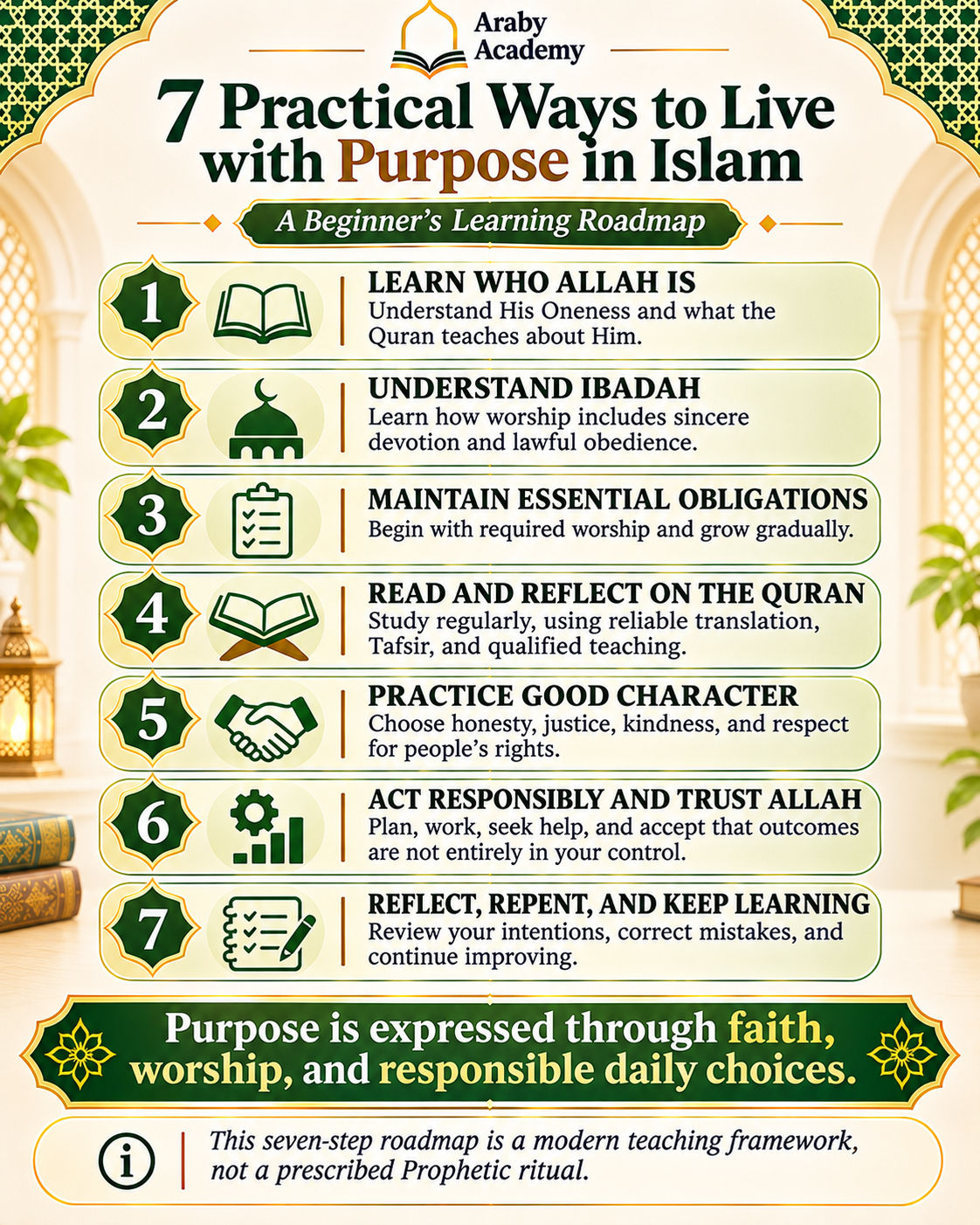
7 Practical Ways to Live with Purpose in Islam
Purpose is expressed through small, repeated choices. The framework below is modern educational guidance, not a prescribed Prophetic seven-step ritual.
Learn who Allah is. Knowledge of Him corrects false ideas about worship.
Understand what worship means. It includes devotion and lawful, ethical living.
Maintain essential obligations. Start with what is required, such as prayer, and grow gradually.
Read and reflect on the Quran. Even a little, consistently, with translation or a teacher.
Practice honesty, justice, and kindness. Treat people’s rights as part of your faith.
Take responsible action while trusting Allah. Plan, work, seek help, and accept limits.
Review intentions, repent, and keep learning. Ask: Is it lawful? Am I neglecting a duty? Does it harm anyone? What is my intention? What responsible step can I take?
A simple optional reflection, not a Sunnah requirement: in the morning, name one responsibility for the day; after prayer, ask how to remember Allah and improve your conduct; at work or study, check that your means are lawful and honest; in the evening, note one thing to improve tomorrow.
How to Explain the Purpose of Life to Children
A child-friendly paraphrase, not a Quran quotation, might be: “Muslims believe Allah created us to know His guidance, worship Him, and try to do what is right.” Teach through mercy, honesty, kindness, responsibility, and gentle learning. Avoid saying that Allah created us only to punish mistakes, that a child is worthless unless they pray perfectly, or that every difficult feeling means Allah is angry. Teenagers’ questions about identity, friendships, social media, and faith are usually sincere, not rebellion, and deserve patient answers. With non-Muslims, say simply that Islam teaches human beings were created to worship Allah; this says nothing against anyone’s dignity, ethics, or capacity for meaningful life.
15 Arabic Words About the Purpose of Life
These terms are connected to the theme; not all appear in Quran 51:56.
Arabic | Transliteration | Meaning | Root / note |
|---|---|---|---|
خَلْق | khalq | Creation | خ-ل-ق; khalaqtu in 51:56 |
عِبَادَة | ibadah | Worship | ع-ب-د |
عَبْد | ‘abd | Servant | ع-ب-د |
تَوْحِيد | tawhid | Affirming Allah’s oneness | و-ح-د; a theological term |
إِخْلَاص | ikhlas | Sincerity | خ-ل-ص; see 98:5 |
نِيَّة | niyyah | Intention | ن-و-ي; Hadith term |
اِبْتِلَاء | ibtila’ | Testing, trial | ب-ل-و; cf. 67:2 |
عَمَل | ‘amal | Deed | ع-م-ل |
عَمَل صَالِح | ‘amal salih | Righteous deed | 103:3 |
تَقْوَى | taqwa | God-consciousness, reverent obedience | و-ق-ي; 2:183 |
تَوَكُّل | tawakkul | Reliance upon Allah | و-ك-ل |
صَبْر | sabr | Patience, steadfastness | ص-ب-ر |
قَدَر | qadr | Divine Decree | ق-د-ر |
دُنْيَا | dunya | Worldly life | 28:77 |
آخِرَة | akhirah | The Hereafter | 28:77 |
Common Misconceptions About Why Allah Created Us
These corrections address the most common confusions about life’s purpose.
Myth | Reality |
|---|---|
Allah created us because He needs worshippers, or was lonely. | Quran 51:57–58 affirms His independence; human need is not attributed to Him. |
The purpose of life is only prayer. | Worship includes prescribed acts and wider lawful, ethical obedience. |
Every ordinary activity automatically becomes worship. | Lawfulness, intention, and conditions matter. |
The “hidden treasure” saying is an authentic Hadith. | It is not established as an authentic Prophetic report. |
Quran 51:56 mentions only humans. | It explicitly mentions jinn and mankind. |
Allah’s knowledge cancels responsibility. | Islam affirms both Divine knowledge and human accountability. |
A meaningful life requires wealth or fame. | Religious purpose is not public achievement. |
Ordinary lawful work contradicts devotion. | Lawful work can be part of a purposeful life. |
Islam requires rejecting every worldly blessing. | The Quran recognizes lawful worldly good and the Hereafter. |
Hardship proves Allah is punishing someone. | We cannot assume the hidden reason for individual suffering. |
Illness or disability means less purpose. | Dignity is not measured by productivity. |
Sadness means lost purpose. | Grief and faith can coexist. |
Tawakkul means refusing to plan. | Trust and responsible action go together. |
Asking questions means disbelief. | Sincere learning differs from chosen denial. |
Frequently Asked Questions
1. Why did Allah create us according to Islam? To worship Him (Quran 51:56). This includes sincere devotion and living by His guidance, while Allah Himself needs nothing from creation.
2. What does Quran 51:56 mean? Allah created jinn and mankind for worship. Classical commentators explain worship as devotion and obedience, often linked with affirming His oneness and knowing Him.
3. Why does it mention jinn? Islam teaches that jinn are part of the unseen creation and are also accountable. Revelation gives limited details, so we avoid speculation.
4. Does Allah need us to worship Him? No. Quran 51:57–58 and 35:15 affirm that He is self-sufficient and the Provider.
5. Why create us if He needs nothing? Creation and command are acts of His will and wisdom, not need. Obedience benefits us; we do not claim to know every reason.
6. What does Ibadah mean? It is worship and devotion to Allah, from the root ‘-b-d, covering servitude, obedience, love, and reverence.
7. Is worship only prayer and fasting? No. Prescribed acts are central, and lawful, sincere, ethical conduct can also be part of a life of worship.
8. Can ordinary work become worship? Lawful work done honestly, with sincere intention and without neglecting duties, can carry religious meaning. Unlawful earnings cannot.
9. Why does Allah test people? The Quran says life and death are a test of who is best in deed (67:2), linking choices with accountability.
10. If Allah knows everything, why are we tested? His knowledge does not force our choices. The test makes deeds real and the basis of accountability.
11. Do Muslims believe in free will? Muslims affirm real human choice and responsibility together with Allah’s complete knowledge and decree; scholars formulate the details differently.
12. How does Qadr relate to purpose? Qadr does not make effort pointless. We act responsibly and trust Allah with outcomes.
13. Does hardship mean Allah is angry? Not necessarily. Trials are part of worldly life, and we cannot assume the hidden reason for any individual’s suffering.
14. Are humans caretakers of the Earth? The Quran’s teachings on khalifah, settlement, and avoiding corruption support responsible care, though scholars discuss the term’s meaning.
15. Is enjoying worldly life against Islam? No. Lawful enjoyment is permitted (7:32), balanced with the Hereafter and obligations.
16. Can Muslims pursue careers and success? Yes, through lawful, ethical means that do not neglect duties. Success is not proof of Allah’s favor.
17. How do life and the Hereafter relate? Worldly choices carry accountability, and Allah’s mercy and justice both shape the outcome.
18. What if I feel my life has no purpose? Your feelings are not automatically disbelief. Keep learning, speak with a trusted teacher, and seek professional support if distress persists.
19. How can Muslims live with purpose daily? Maintain obligations, be honest and kind, learn, plan responsibly, trust Allah, and repent and improve.
20. How can parents explain this to children? Use gentle, age-appropriate language centered on Allah’s mercy, guidance, and doing what is right.
Conclusion — Living for Allah Gives Our Choices Lasting Meaning
Why are we here? The Quran identifies worship of Allah as the central purpose of human creation. Allah does not need our worship; we need His guidance and mercy. That worship is expressed in core religious duties and, where appropriate, in morally responsible daily conduct. Life involves testing, choice, uncertainty, and accountability, and human worth is not limited to worldly achievement.
According to Islam, the purpose of life is not simply to achieve more, own more, or be admired by more people. It is to worship Allah, follow His guidance, and live with sincerity and responsibility—so that even ordinary choices can become part of a life directed toward Him.
If you would like to keep learning, Araby Academy offers Quran, Tajweed, Quranic Arabic, and Islamic Studies lessons with qualified teachers for learners of all levels.