If Everything Is Written, Why Should I Try?
A student thinks: "If my grade is written, why study?"
A job seeker thinks: "If my Rizq is already decreed, why apply?"
Someone hoping to marry thinks: "If my spouse is written, why search?"
Someone making Dua wonders: "If Allah already decreed everything, can my Dua change anything?"
And someone who has sinned says: "If Allah already knew I would do it, how can I be responsible?"
These are not shallow questions. They touch one of the foundations of Islamic belief: Al-Qadr (القدر), Divine Decree.
Misunderstanding Qadr tends to produce one of two opposite errors:
Error 1: "I control outcomes independently of Allah." This forgets that nothing exists or happens outside His knowledge, power, and will.
Error 2: "Everything is written, so my choices are meaningless." This erases responsibility, effort, Dua, and moral accountability, all of which the Quran and Sunnah constantly affirm.
Islam rejects both. This guide to Qadr in Islam is built around one question:
If everything is already written, do my choices still matter?
Yes, they do. We will see why from revelation itself, without pretending that Qadr reduces to a simple formula. Some of it remains part of the unseen, and revelation tells us what we need to know and act upon.
What Does Qadr Mean?
The Arabic word القدر (al-Qadr), also pronounced al-Qadar, comes from the root ق-د-ر. Arabic lexicons and Quranic usage connect this root to ideas such as:
measure and proportion, as in "We created everything in due measure" (54:49)
determining and ordaining, as in "He created everything and ordained it precisely" (25:2)
power, as in Allah's name al-Qadir, "the All-Powerful"
restricting or straitening, used in the Quran for provision that Allah "expands and restricts" (13:26)
No single English word captures all of this. You will see Qadr translated as fate, destiny, predestination, or Divine Decree. Each can mislead. "Fate" often implies a blind, impersonal force. "Destiny" suggests a script that unfolds regardless of us. "Predestination" brings in debates from other theological traditions.
In Islam, Qadr is the decree of the All-Knowing, All-Wise, All-Powerful Lord. It does not cancel commands, accountability, or the meaning of human action. This article prefers Divine Decree, with the caveat that no translation is perfect.
Qadr Is One of the Six Pillars of Iman
In the famous Hadith of Jibril (Gabriel), narrated by Umar ibn al-Khattab in Sahih Muslim (no. 8), the angel asks the Prophet ﷺ about Iman (faith). He replies:
أَنْ تُؤْمِنَ بِاللَّهِ وَمَلَائِكَتِهِ وَكُتُبِهِ وَرُسُلِهِ وَالْيَوْمِ الْآخِرِ، وَتُؤْمِنَ بِالْقَدَرِ خَيْرِهِ وَشَرِّهِ
"That you believe in Allah, His angels, His Books, His Messengers, and the Last Day, and that you believe in the Divine Decree, its good and its evil."
So the six pillars of Iman are belief in:
Allah
His angels
His revealed Books
His Messengers
The Last Day
Divine Decree (Qadr)
Belief in Qadr is part of faith itself, not an optional philosophical idea.
A note on "its good and its evil." Scholars explain that "evil" (sharr) here refers to what appears harmful or painful from the human perspective, such as illness, loss, and hardship. It does not mean Allah's actions are evil. In the Prophet's ﷺ night prayer he said, "…and evil is not attributed to You" (Sahih Muslim, 771). Allah's decree is rooted in wisdom, even when its wisdom is hidden from us. This point returns later when we discuss human wrongdoing.
The Four Levels of Qadr
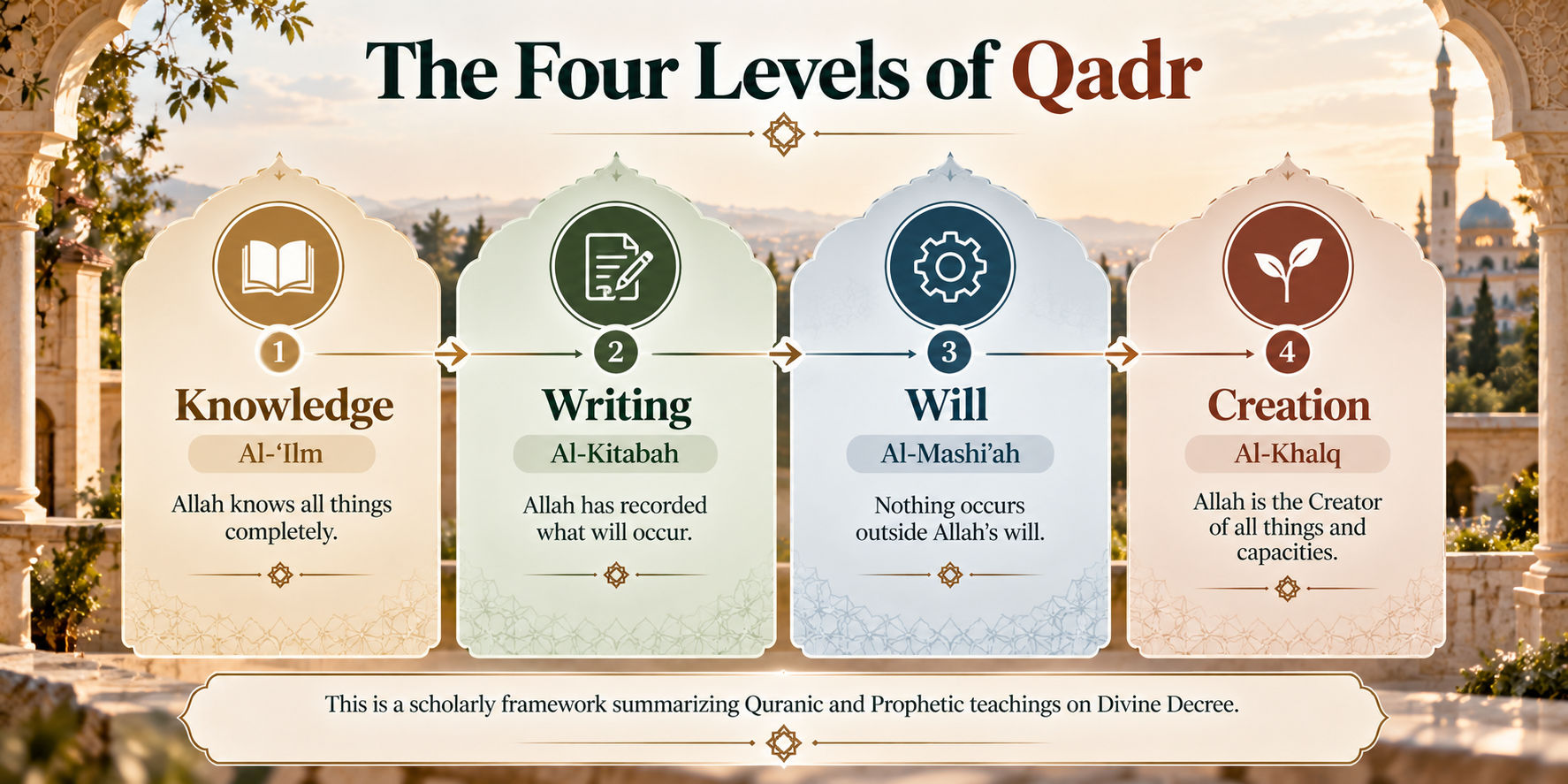
Classical Sunni scholars, including Ibn Taymiyyah, Ibn al-Qayyim, and Ibn Abi al-Izz in his commentary on al-Aqidah al-Tahawiyyah, summarize the Quran and Sunnah's teachings on Qadr in four levels. These levels are an organizing framework drawn from the texts, not a diagram revealed by name. They help beginners see the whole picture.
1. Knowledge, العلم (al-Ilm)
Allah's knowledge is complete, eternal, and encompasses everything: past, present, future, and what would happen under any circumstance.
"Allah has encompassed all things in knowledge." (65:12)
"With Him are the keys of the unseen; none knows them but He." (6:59)
"Does He who created not know? And He is the Subtle, the All-Aware." (67:14)
Allah does not learn anything through events. His knowledge is not acquired. Events do not add to it.
2. Writing, الكتابة (al-Kitabah)
Allah has recorded all things. The Quran says:
"Do you not know that Allah knows what is in heaven and earth? Indeed, it is all in a Record. That is easy for Allah." (22:70)
"No calamity strikes the earth or yourselves except that it is in a Register before We bring it into being." (57:22)
This record is commonly called اللوح المحفوظ (al-Lawh al-Mahfuz), the Preserved Tablet, a term the Quran uses in 85:21–22. The Prophet ﷺ said, as narrated by Abdullah ibn Amr in Sahih Muslim (2653): "Allah recorded the decrees of creation fifty thousand years before He created the heavens and the earth."
We affirm what revelation states. We do not speculate about what this record looks like, where it is, or how it functions, because revelation does not tell us.
3. Will, المشيئة (al-Mashi'ah)
Nothing happens in creation outside Allah's will. This is the meaning of verses such as "You do not will except that Allah wills" (76:30; 81:29), discussed below.
But there is a crucial distinction. Scholars speak of two kinds of will:
Universal / creational will (irada kawniyya qadariyya) | Legislative / religious will (irada shar'iyya diniyya) | |
|---|---|---|
Meaning | What Allah permits to exist and occur in creation | What Allah commands, loves, and is pleased with |
Includes | Everything that happens, including sin and disbelief | Obedience, justice, faith, good deeds |
Linked to love? | No | Yes |
So the fact that something occurs does not mean Allah loves or approves of it. The Quran says: "He does not approve of disbelief for His servants" (39:7), and "Allah does not love corruption" (2:205). Disbelief and corruption occur in the world, yet Allah does not love or command them.
The dangerous idea "if Allah allowed it, He must approve of it" is false.
4. Creation, الخلق (al-Khalq)
Allah is the Creator of all things: "Allah is the Creator of everything" (39:62). This includes human beings and their capacities. The Quran also says: "Allah created you and what you do" (37:96).
Yet the same Quran attributes actions to people and holds them responsible. Human beings are not independent creators, and they are also not morally meaningless puppets. Their will and actions are real, created by Allah, and attributed to them for accountability.
If Allah Already Knows What I Will Do, Am I Really Free?
This is the heart of the matter.
Start with what knowledge is not. Knowing something is not the same as forcing it. When we say Allah knows what a person will choose, we do not mean the person experiences being dragged against their will. Human beings choose, deliberate, intend, and act, and they experience this as real.
A common analogy compares this to a teacher who knows a student will fail but did not cause the failure. Be careful with it. Allah's knowledge and decree are unlike human prediction, and Allah is the Creator of everything, which no teacher is. Use it only to show that knowing is not automatically coercing, never as a full explanation of Qadr.
Revelation addresses us as responsible agents. The Quran commands, forbids, praises obedience, condemns wrongdoing, invites repentance, and warns of accountability:
"Say: The truth is from your Lord, so whoever wills, let him believe, and whoever wills, let him disbelieve." (18:29)
"Every soul is held in pledge for what it has earned." (74:38)
"Allah does not burden a soul beyond its capacity." (2:286)
"Whoever does an atom's weight of good will see it, and whoever does an atom's weight of evil will see it." (99:7–8)
These commands and warnings presuppose real human responsibility.
But human will exists within Allah's will. Two passages say this explicitly:
وَمَا تَشَاءُونَ إِلَّا أَن يَشَاءَ اللَّهُ ۚ إِنَّ اللَّهَ كَانَ عَلِيمًا حَكِيمًا
"And you do not will except that Allah wills. Indeed, Allah is ever All-Knowing, All-Wise." (76:30)
لِمَن شَاءَ مِنكُمْ أَن يَسْتَقِيمَ وَمَا تَشَاءُونَ إِلَّا أَن يَشَاءَ اللَّهُ رَبُّ الْعَالَمِينَ
"For whoever among you wills to take the straight path. And you do not will except that Allah, Lord of all worlds, wills." (81:28–29)
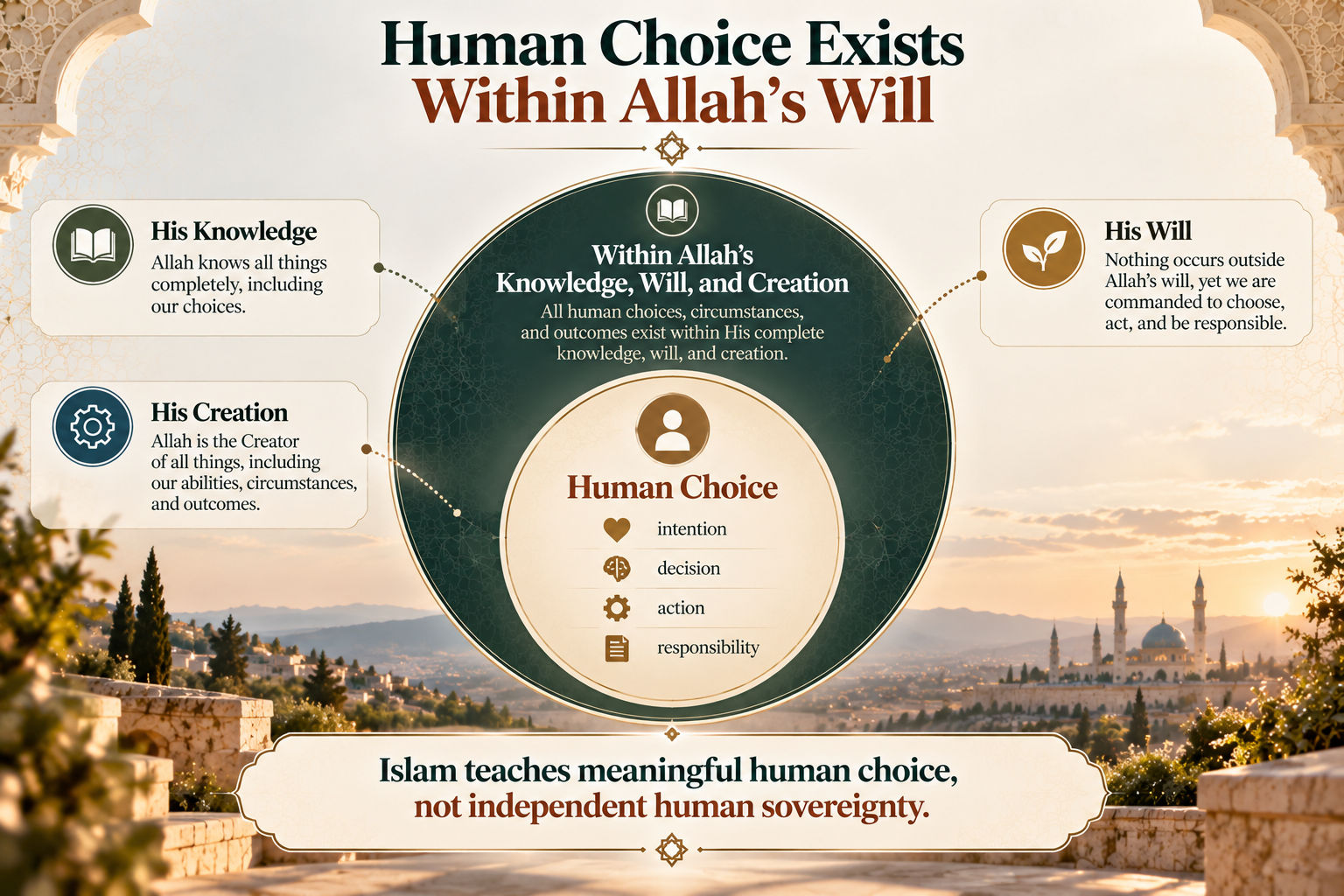
Notice that the first half of each passage affirms that people will ("whoever wills"), and the second half places that will within Allah's will. Mainstream Sunni commentators read these verses together this way: they establish a real human will, and they establish that it is not independent of Allah. We hold both because revelation holds both. We do not need to resolve the mystery by denying one side.
Does Islam Believe in Free Will?
It depends on what "free will" means.
If it means that humans have meaningful choice and are responsible for their voluntary actions, then yes, revelation clearly affirms this.
If it means that human will operates completely independently of Allah, outside His knowledge, will, and creation, then no, that is not Islamic doctrine.
A helpful beginner formulation is:
Islam teaches meaningful human choice, not independent human sovereignty.
Because the term "free will" carries different baggage in different philosophical traditions, many scholars prefer to speak of the human will (mashi'a), choice (ikhtiyar), and capacity (istita'a), all created and sustained by Allah.
Why Does Allah Test Us If He Already Knows the Result?
Allah does not test people to find out information. His knowledge is already complete.
Why, then, the tests? Mainstream commentary points to several ideas:
Actions must actually occur in the real world before reward or punishment. Allah does not hold people accountable for what He knows they would do, but for what they do.
Tests make faith visible and lived, not merely claimed: "Do people think they will be left to say 'We believe' and not be tested?" (29:2)
Tests are part of the purpose of life: "He created death and life to test you, as to which of you is best in deed." (67:2)
Some translations render verses such as 3:142 or 47:31 as "so that Allah may know…". Classical Tafsir scholars explain that this refers to knowledge becoming manifest in actual events, so that the known reality is displayed and made the basis of accountability. It does not mean Allah acquires new knowledge. Avoid saying "Allah tests you to see what you'll do" without that clarification.
For more on hardship, see Why Does Allah Test Us? Understanding Trials and Hardship in Islam.
If Everything Is Written, Why Should I Work?
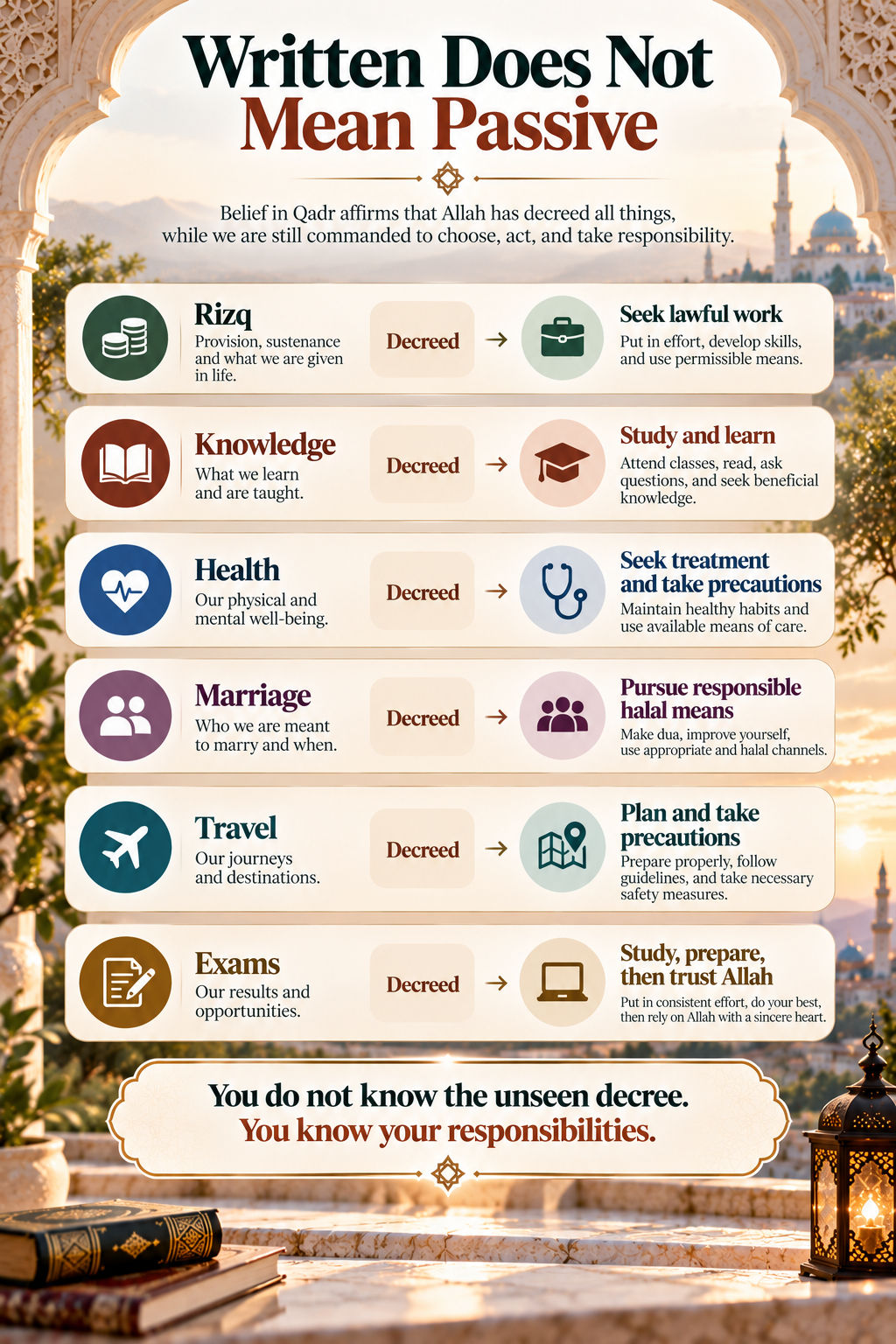
Because we do not know the unseen decree. We know commands, means, and responsibilities. We never see the written outcome in advance, so we act according to what Allah has revealed and the means He placed in the world.
Area | What is true | What we are still commanded to do |
|---|---|---|
Provision (Rizq) | It is decreed | Seek lawful earnings: "Disperse in the land and seek Allah's bounty" (62:10) |
Knowledge | Outcomes are decreed | Study and learn |
Health | Life, illness, and recovery are decreed | Take precautions and seek treatment |
Marriage | Allah knows and decrees what occurs | Pursue marriage through responsible, halal means |
Travel | What happens is within Qadr | Plan routes, take precautions |
Exams | The result is within Allah's decree | Study, then trust Allah |
Saying "it's all written" before acting is not faith. It misuses Qadr.
The Prophet ﷺ Rejected Fatalism
The Prophet ﷺ was asked directly about this. In the narration of Ali ibn Abi Talib (Sahih al-Bukhari 4949; Sahih Muslim 2647), he said that everyone's place, in Paradise or in the Fire, has been written. The Companions asked: "O Messenger of Allah, should we not then rely on what is written and abandon action?" He replied:
اعْمَلُوا فَكُلٌّ مُيَسَّرٌ لِمَا خُلِقَ لَهُ
"Act, for everyone is made easy for that for which he was created."
He then recited: "As for him who gives and fears Allah and believes in the best reward, We will ease him toward ease; and as for him who is stingy and considers himself self-sufficient and denies the best reward, We will ease him toward hardship." (92:5–10)
Notice the response. He did not say "relax, it's settled." He said act. The Companions were told to work, and that Allah makes the path easy for each. Scholars explain that the decree is hidden from us, our deeds are the means through which Allah's decree unfolds, and each person moves along the path of what they choose and Allah facilitates.
Islam's answer to "should I just rely on what is written?" is: act.
Qadr and Tawakkul
These two concepts are related but different.
Qadr concerns Allah's decree and its reality.
Tawakkul (توكل) concerns the believer's reliance on Allah while acting.
Here is how they fit together:
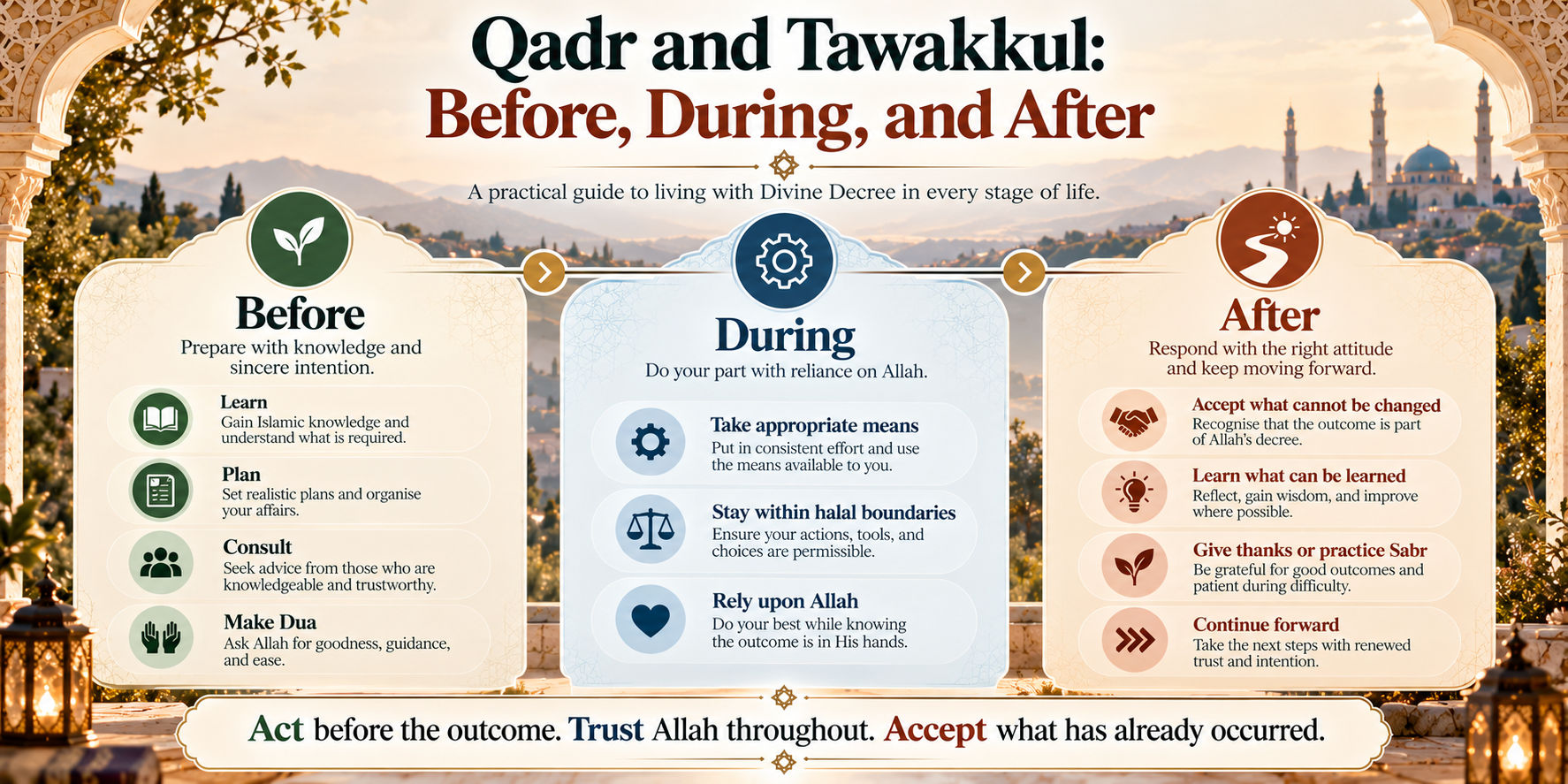
Before acting: learn, plan, consult, make Dua.
While acting: take appropriate means and rely on Allah. "When you have decided, then rely upon Allah." (3:159)
After the outcome: accept what cannot be changed, learn what should be learned, and continue.
The Prophet ﷺ said that if people relied on Allah as He deserves, He would provide for them as He provides for birds, which leave in the morning hungry and return full (Tirmidhi 2344, graded hasan sahih). The birds go out. Tawakkul is not sitting still.
See What Is Tawakkul? How to Trust Allah Without Becoming Passive.
Qadr and Taking the Means
Islam calls this الأخذ بالأسباب (al-akhdh bil-asbab), "taking the means."
Medicine, food, study, work, consultation, and Dua are all causes and means that Allah Himself created and decreed. A Muslim neither worships the means (as if they work independently of Allah) nor abandons them (as if Allah's decree makes them pointless).
A beautiful example: during the plague in Sham, Umar ibn al-Khattab turned back from entering the afflicted land. When asked, "Are you fleeing from Allah's decree?" he replied, "We flee from Allah's decree to Allah's decree" (Sahih al-Bukhari 5729; Sahih Muslim 2219). Avoiding danger is part of Qadr.
Likewise, when a man asked whether remedies and ruqya avert Allah's decree, the Prophet ﷺ answered that they are themselves part of Allah's decree (Tirmidhi 2065, graded hasan). And he told people to seek treatment, "for Allah has not made a disease except that He made a cure for it" (Abu Dawud 3855; Tirmidhi 2038).
Can Dua Change Qadr?
This question deserves precision. Neither of these simple answers is satisfactory:
❌ "Yes, Dua changes destiny", which can sound as if human beings alter Allah's eternal knowledge.
❌ "No, nothing can change anything", which can make Dua seem pointless.
The Quran tells us: "Call upon Me; I will respond to you" (40:60). The Prophet ﷺ said, in a narration of Salman al-Farisi, that nothing repels the decree except Dua, and nothing increases lifespan except righteousness (Tirmidhi 2139, which Tirmidhi called hasan gharib; scholars such as al-Albani graded it hasan).
How do scholars understand such texts? Without claiming a single uncontested model, the main points are:
Allah's eternal knowledge never changes. He knew from eternity every Dua, every response, and every outcome. Dua does not inform Him of anything.
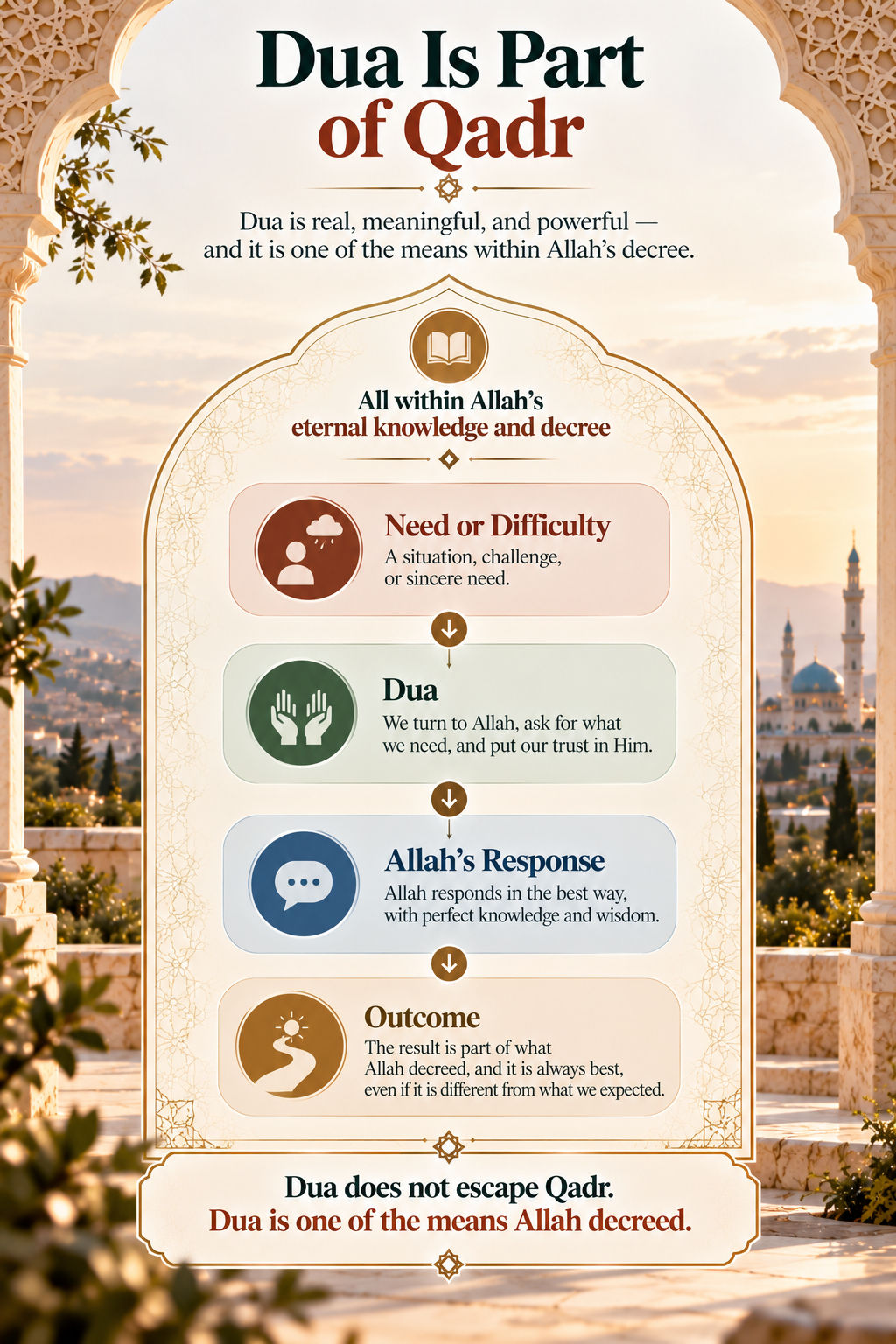
From our perspective, Dua is a real means. Allah decreed the outcome through the Dua. The Dua, its acceptance, and the result are all within Qadr.
Some scholars explain such texts through the records known to angels, where what is written can be conditional on a cause, while Allah's knowledge and the Umm al-Kitab remain unchanged. Others explain that Dua repels a harm that would otherwise have reached a person, or brings relief or something better. These are explanations of the texts, not additional revelation.
The beginner-level takeaway is:
Dua is not outside Qadr. Dua is part of Qadr.
See How to Make Dua: A Beginner's Guide.
Does Allah Change What Is Written?
The Quran says:
يَمْحُو اللَّهُ مَا يَشَاءُ وَيُثْبِتُ ۖ وَعِندَهُ أُمُّ الْكِتَابِ
"Allah erases what He wills and confirms, and with Him is the Mother of the Book." (13:39)
The classical commentators discuss several explanations, and they do not all say the same thing. A widely cited view, reported from Ibn Abbas and others, is that Umm al-Kitab refers to what is with Allah, His fixed and unchanging knowledge and decree, while "erasing and confirming" concerns what is recorded or known to the angels and what Allah abrogates or establishes. In every explanation, Allah's knowledge does not change.
For a beginner, this is enough. We affirm the verse, we affirm that Allah's knowledge is perfect and unchanging, and we avoid building elaborate diagrams of heavenly records beyond what revelation states.
Laylat al-Qadr and Qadr: Are They Related?
English readers often wonder whether ليلة القدر (Laylat al-Qadr), the Night of Power, relates to القدر (al-Qadr), Divine Decree.
They share a root. Scholars such as al-Qurtubi and Ibn Kathir mention more than one understanding of the name: the night of great honor and status (a sense of qadr as "worth"), and the night in which matters are decreed and detailed, as the Quran says in 44:4: "In it every wise matter is made distinct." There is no single uncontested explanation, and both meanings are discussed in Tafsir.
For more, see What Is Laylat al-Qadr? A Beginner's Guide to the Night of Power.
Is My Rizq Already Written?
According to the Prophet ﷺ, an angel is commanded to write a person's provision, lifespan, deeds, and whether they will be wretched or fortunate (Sahih al-Bukhari 3208; Sahih Muslim 2643). The Quran says: "There is no creature on earth except that its provision is upon Allah" (11:6).
But written Rizq is not permission for laziness. The same revelation commands us to seek lawful provision (62:10). The Prophet ﷺ said: "Fear Allah and be moderate in seeking, for no soul will die until it has completed its provision" (Ibn Majah 2144, graded sahih by al-Albani). The narration asks us to be moderate in seeking. It does not say "do not seek."
A Muslim still works, learns skills, pursues lawful opportunities, budgets, makes Dua, gives charity, and avoids haram income.
Be careful of viral claims. No authentic evidence says a specific Dhikr or Surah guarantees wealth, or that when one door closes a richer one must immediately open.
Is My Spouse Already Written?
Allah knows and decrees what will occur, including marriage. But the popular idea that "there is exactly one soulmate created for you, so nothing you do matters" is not an Islamic doctrine established by the Quran or Sunnah. Note that the hadith of the angel writing in the womb (above) lists provision, lifespan, deeds, and wretchedness or happiness, but does not mention a spouse.
What the Prophet ﷺ taught is responsible action:
He told a man seeking marriage to look at the woman he intended to marry (Tirmidhi 1087, graded hasan).
He advised Fatimah bint Qays about proposals she had received, which shows consultation (Sahih Muslim 1480).
Marriage requires the consent of both parties.
So Muslims evaluate compatibility, ask questions, involve appropriate family or trusted people, consult, make Istikhara, decide, respect another person's choice, and accept rejection.
Qadr is never a justification for stalking, obsession, refusing to accept a "no", or insisting that someone "must be written for me."
Is My Death Already Written?
Yes. The Quran says: "When their term comes, they can neither delay it by an hour nor advance it" (7:34), and the Prophet ﷺ taught that appointed terms are fixed (Sahih Muslim 2663).
But this does not justify recklessness. Muslims are commanded to protect life, avoid unnecessary danger, seek medical care, and follow safety measures. "Do not throw yourselves into destruction with your own hands" (2:195). The Prophet ﷺ himself guarded against harm, and Umar's example above shows that avoiding a plague is a legitimate part of Qadr.
What about the narration that maintaining family ties increases lifespan (Sahih al-Bukhari 5986; Sahih Muslim 2557)? Scholars give several explanations, including that it refers to blessing (barakah) in one's time, or to what is recorded with the angels, while Allah's knowledge remains perfect and unchanged. We take the narration seriously, we encourage keeping family ties, and we avoid inventing an explanation beyond what scholars say.
If I Sin, Can I Say "Allah Decreed It"?
Qadr is not an excuse for sin.
The Quran rebukes exactly this argument. Those who associated partners with Allah said, "If Allah had willed, we would not have associated anything" (6:148). The Quran answers that they follow only conjecture and are only guessing. Similar reasoning is rejected in 16:35.
In a Hadith Qudsi (Sahih Muslim 2577), Allah says: "O My servants, it is only your deeds that I record for you and then repay you for. Whoever finds good, let him praise Allah, and whoever finds other than that, let him blame no one but himself."
When we sin, we chose it. No one experiences being forced. The right response is repentance, not an alibi.
The key distinction is this:
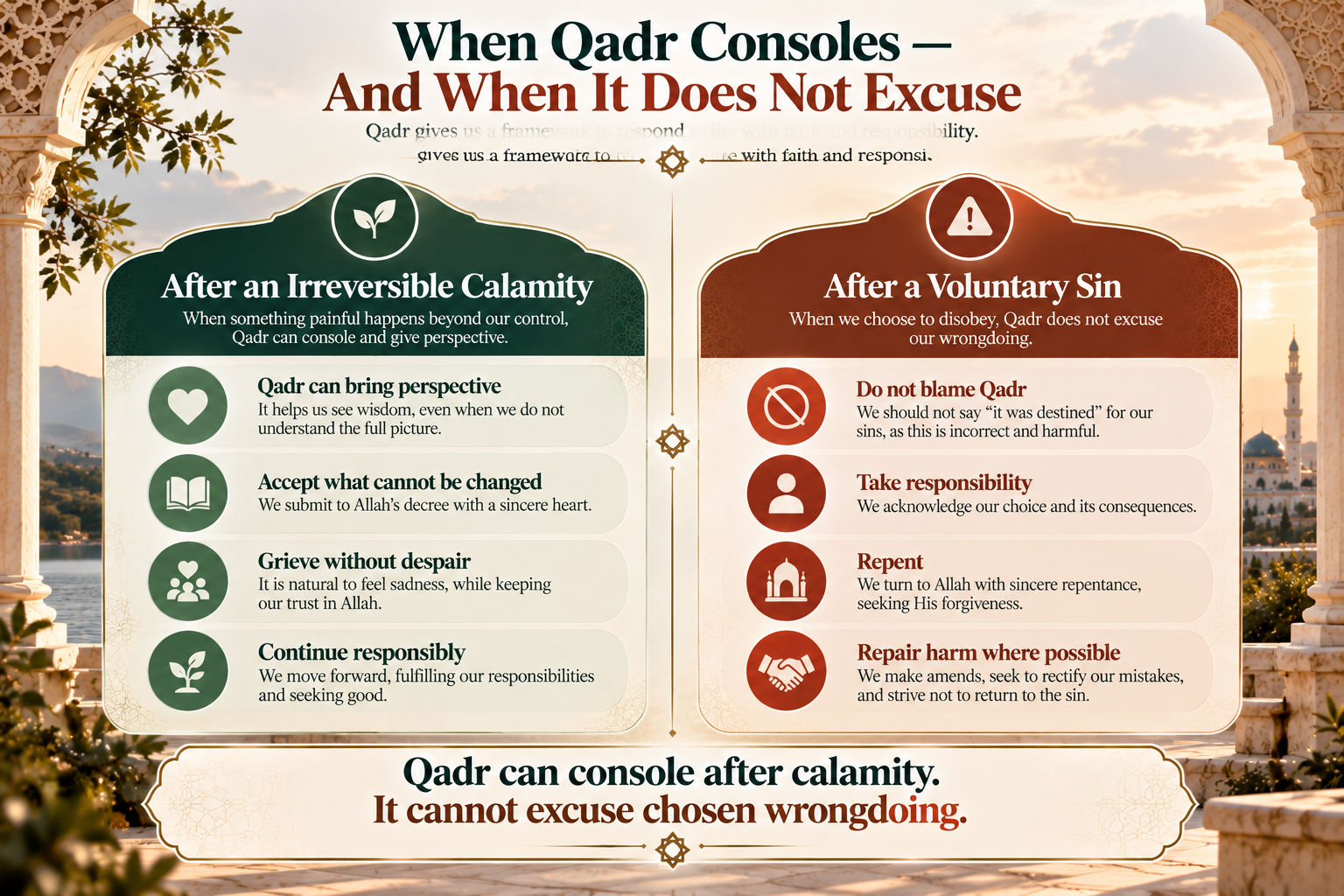
Using Qadr to understand an irreversible calamity is valid. It is a source of consolation.
Using Qadr to excuse a voluntary moral failure is invalid. It denies responsibility.
Adam and Musa: Understanding the Famous Hadith
In a famous hadith (Sahih al-Bukhari 6614; Sahih Muslim 2652, narrated by Abu Hurayrah), Musa (Moses) confronted Adam: "You are Adam, whom Allah created with His hand… why did you bring us out of Paradise?" Adam replied: "Do you blame me for something that Allah had decreed for me before He created me?" The Prophet ﷺ said: "Adam defeated Musa."
This hadith is often misused to claim that Qadr excuses sin. Scholars including Ibn Taymiyyah and Ibn al-Qayyim explain it differently:
Adam had already repented, and Allah had forgiven him (2:37).
Musa was blaming Adam for the consequence, the calamity of leaving Paradise, not for the sin.
Referring to Qadr to understand a calamity that has already happened is permitted. Referring to Qadr to justify continuing a sin is not.
So Adam was not saying "Allah wrote it, so I'm not responsible." The hadith does not contradict the principle that we repent from sin.
Does Qadr Mean Allah Approves of Everything That Happens?
No.
Murder, oppression, theft, disbelief, and abuse all occur in the world. They exist within Allah's universal will, since nothing escapes His knowledge and permission. But they are not within His legislative will. He forbids them, dislikes them, and will hold the wrongdoers accountable.
"Allah has permitted it to occur" never means "Allah loves it."
Qadr and Human Evil
"If Allah decrees everything, what about crimes and injustice?"
A Muslim holds all of these together:
Human beings choose wrongdoing and are accountable for it.
Allah's sovereignty is not defeated by human sin.
Allah does not command injustice. In the Hadith Qudsi: "O My servants, I have forbidden oppression for Myself and made it forbidden among you, so do not oppress one another." (Sahih Muslim 2577)
We do not need to solve the entire philosophical "problem of evil." We stay with what revelation tells us.
And here is something important: victims should never be told, "It was Qadr, so just accept it." Belief in Qadr does not remove accountability, justice, protection, restitution, or lawful action against wrongdoing. The Prophet ﷺ said to help an oppressed person, and also to stop an oppressor by preventing them from oppressing (Sahih al-Bukhari 2444). He also said that whoever sees a wrong should change it as they are able (Sahih Muslim 49).
Qadr and Hardship
After something painful happens, belief in Qadr helps a believer say: "This did not happen outside Allah's knowledge."
But that does not mean:
I cannot grieve.
I cannot seek justice.
I cannot seek treatment.
I cannot change my circumstances.
I cannot make Dua for relief.
The Quran says: "No calamity strikes except by Allah's permission. And whoever believes in Allah, He guides his heart." (64:11) Guidance of the heart is a promise of support, not a promise of numbness.
See Why Does Allah Test Us? for a fuller discussion.
"If Only I Had…": Qadr and Regret
In Sahih Muslim (2664), Abu Hurayrah narrates that the Prophet ﷺ said:
الْمُؤْمِنُ الْقَوِيُّ خَيْرٌ وَأَحَبُّ إِلَى اللَّهِ مِنَ الْمُؤْمِنِ الضَّعِيفِ وَفِي كُلٍّ خَيْرٌ، احْرِصْ عَلَى مَا يَنْفَعُكَ وَاسْتَعِنْ بِاللَّهِ وَلَا تَعْجَزْ، وَإِنْ أَصَابَكَ شَيْءٌ فَلَا تَقُلْ لَوْ أَنِّي فَعَلْتُ كَذَا وَكَذَا، وَلَكِنْ قُلْ قَدَرُ اللَّهِ وَمَا شَاءَ فَعَلَ، فَإِنَّ لَوْ تَفْتَحُ عَمَلَ الشَّيْطَانِ
In meaning: "The strong believer is better and more beloved to Allah than the weak believer, though there is good in both. Strive for what benefits you, seek Allah's help, and do not give up. If something befalls you, do not say, 'If only I had done such and such,' but say, 'Allah decreed, and what He willed He did,' for 'if only' opens the door to Satan's work."
This text teaches the practical heart of Qadr. It begins with action: strive, seek help, don't give up. And it ends with acceptance after the event.
It does not forbid learning from mistakes. Compare:
Useful reflection: "I made a poor decision. What can I learn?"
Destructive counterfactual obsession: "If only I had done X, I could have guaranteed a different outcome."
The first is wisdom. The second is the kind of "if only" that traps a person in an alternate past that cannot be rewritten.
Qadr Does Not Mean "Never Plan"
Planning is not an attempt to defeat Qadr. Your planning is itself occurring within Qadr.
The Quran commands preparation: "Prepare against them whatever force you can" (8:60). Yaqub (Jacob) advised his sons to enter the city through different gates, and the Quran adds that this "would not avail them against Allah at all," while it was still a need in his heart that he fulfilled (12:67–68). He planned and relied on Allah in the same breath.
The Hijrah is a vivid example. The Prophet ﷺ and Abu Bakr arranged a guide, prepared riding camels, hid in the cave of Thawr, and arranged for information and supplies (Sahih al-Bukhari 3905, in Aisha's narration). They planned thoroughly, and they relied on Allah completely.
Qadr and Istikhara
Istikhara does not reveal "what Allah secretly wrote." It is a prayer asking Allah to facilitate what is good for you and turn away what is harmful.
The Prophet ﷺ taught Istikhara in a hadith narrated by Jabir (Sahih al-Bukhari 1162): pray two non-obligatory rak'ahs and then make the Dua, which includes asking Allah, by His knowledge and power, to decree good for you if it is good for your religion, livelihood, and the end of your affair.
Common myths to correct:
A dream is not required.
A color or sign is not the answer.
A strong feeling is not necessarily guidance.
Istikhara does not replace investigation or consultation.
Istikhara does not eliminate decision-making.
A helpful sequence:
Information → Consultation → Istikhara → Decision → Tawakkul
Qadr When Something Has Already Happened
After an irreversible event, belief in Qadr protects against the thought that reality escaped Allah's control. But acceptance does not eliminate emotion. A Muslim may cry, grieve, seek support, make Dua, and take corrective action where possible, all while believing in Qadr.
Qadr Is Not the Same as "Everything Happens for a Reason"
This English phrase can express a sincere trust in Divine wisdom. But it is vague, and problems arise when people use it to say: "I know the reason this happened to you."
Islam teaches that Allah is Wise (al-Hakim). But we do not necessarily know the particular wisdom behind an individual event. A more careful statement:
"Nothing occurs outside Allah's knowledge and decree, even when we do not understand the wisdom behind it."
And we should not promise that every painful event will make sense to us in this world.
Qadr and Mental Health
Belief in Qadr can offer spiritual perspective, but it is not a clinical treatment. A person experiencing depression, anxiety, trauma, or obsessive thoughts may need professional support. Do not tell someone "just accept Qadr" as a replacement for care.
Seeking treatment is itself compatible with Qadr. The Prophet ﷺ taught that Allah has sent down a cure for every disease (Sahih al-Bukhari 5678), and he commanded seeking treatment (Abu Dawud 3855). If you are struggling, please speak to a qualified healthcare professional, alongside any spiritual support you value.
Can I Be Sad About Something Allah Decreed?
Yes.
When the Prophet's ﷺ infant son Ibrahim died, his eyes filled with tears. He said, in the narration of Anas (Sahih al-Bukhari 1303; Sahih Muslim 2315): "The eyes shed tears, the heart grieves, and we say only what pleases our Lord. O Ibrahim, we are grieved by your parting."
Prophets experienced grief and fear. Yaqub wept until his eyes turned white with grief for Yusuf (12:84), yet he said, "I only complain of my suffering and grief to Allah" (12:86). Grief and acceptance can coexist.
Qadr Should Produce Humility, Not Arrogance
When things go well, Qadr reminds us: "My effort mattered, but I did not independently create every condition that made success possible." Intelligence, health, teachers, opportunities, timing, and resources all came from Allah. This leads to gratitude and humility, not "I succeeded because I am better than others."
Qadr Should Produce Resilience, Not Passivity
When something fails despite responsible effort, Qadr lets a believer say: "I will learn what I can, correct what I should, and not destroy myself trying to rewrite what has already happened."
The Quran puts it this way: "…so that you do not grieve over what you missed, nor exult over what He has given you" (57:23).
This is entirely different from "Nothing matters, so I won't try again." The first is resilience, the second is passivity, and only the first is Islamic.
7 Common Misunderstandings About Qadr
"Qadr means humans have no choice." Incorrect. Revelation addresses people as responsible agents (18:29; 74:38).
"If everything is written, there's no point trying." Incorrect. The Prophet ﷺ answered "Act" (Bukhari 4949).
"Qadr means Allah approves of everything that happens." Incorrect. What occurs by universal will is not necessarily loved or commanded (39:7).
"Dua is pointless because everything is written." Incorrect. Dua is itself part of Qadr (Tirmidhi 2139).
"I can blame Qadr for my sins." Incorrect. This argument is rebuked in 6:148.
"Istikhara reveals my written destiny." Incorrect. It is a request for good and facilitation, not fortune-telling (Bukhari 1162).
"Believing in Qadr means I should never feel sad." Incorrect. The Prophet ﷺ wept for Ibrahim (Bukhari 1303).
Practical Examples of Qadr in Everyday Life
Situation | Wrong understanding | Islamic response |
|---|---|---|
Exam | "If passing is written, studying doesn't matter." | Study, make Dua, take the exam, trust Allah, respond appropriately to the result. |
Job | "My Rizq is written, so I don't need to apply." | Seek lawful work while recognizing provision ultimately comes from Allah. |
Marriage | "If someone is written for me, I don't need to evaluate compatibility." | Take responsible halal steps, consult, make Istikhara, decide, trust Allah. |
Illness | "If recovery is written, treatment is unnecessary." | Seek appropriate care and trust Allah. |
Mistake | "I hurt someone because Allah decreed it." | Take responsibility, repent, repair the harm where possible, then accept the past cannot be undone. |
Rejection | "I must discover the secret reason Allah rejected this for me." | Learn what is useful, accept what you cannot know, continue responsibly. |
A Simple Qadr Framework for Beginners
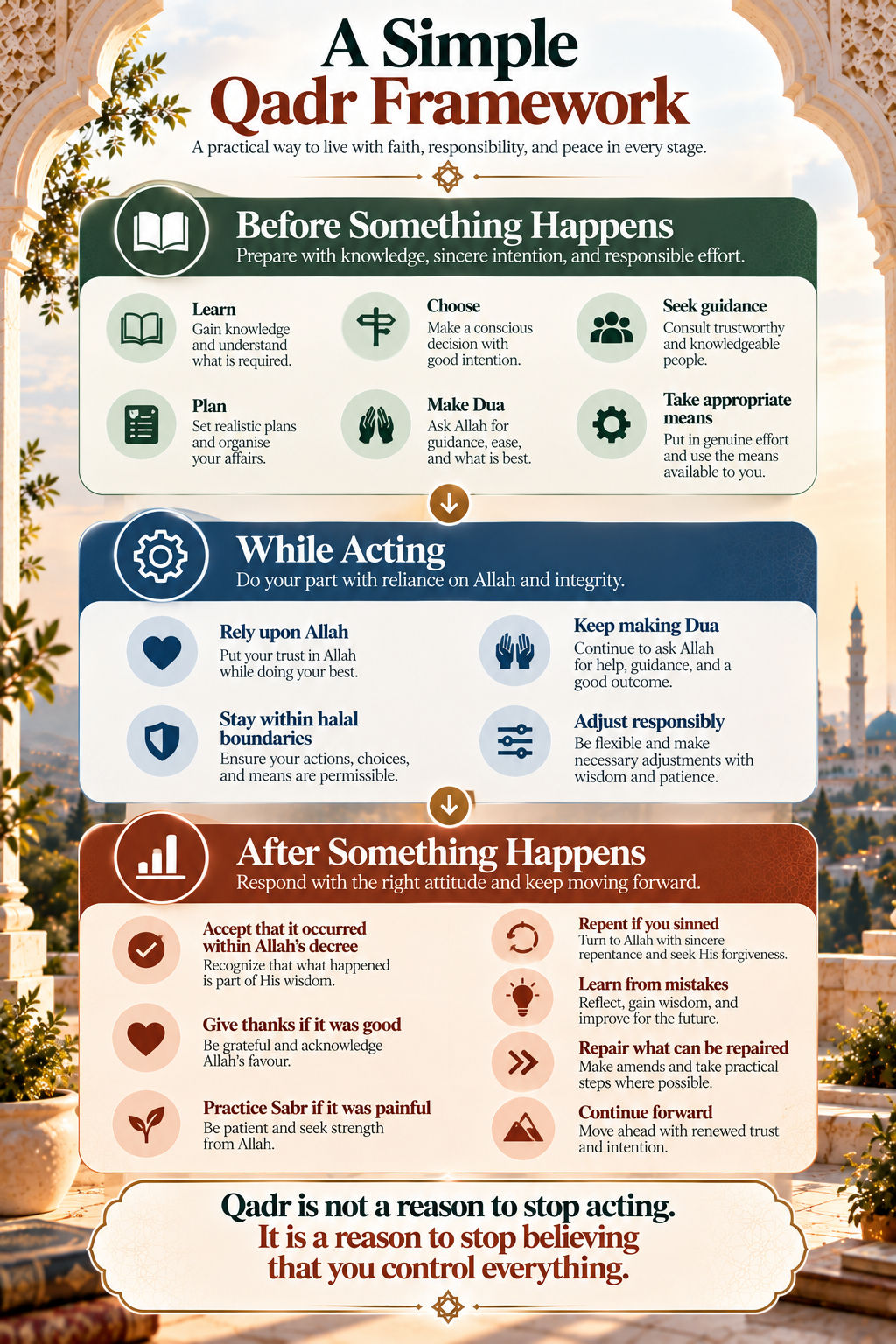
Before Something Happens: you do not know Qadr. So:
learn, plan, choose
make Dua
take appropriate means
seek guidance and consult
act responsibly
↓
While Acting:
rely upon Allah
stay within halal boundaries
keep making Dua
adjust as you learn more
↓
After Something Happens:
accept that it occurred within Allah's decree
give thanks if it was a blessing
practice Sabr if it was painful
repent if you sinned
learn if you made a mistake
repair what can be repaired
don't obsess over an impossible alternate past
continue forward
What Qadr Should Change in Your Daily Life
Belief in Qadr should encourage:
Humility in success
Patience in difficulty
Courage to act, since you are not responsible for controlling the unseen
Less obsession with controlling outcomes
Repentance after wrongdoing
Gratitude for blessings
Tawakkul, genuine reliance on Allah
Hope, since Allah is Wise and Merciful
Responsibility for your choices
Acceptance of what cannot be changed
Belief in Qadr does not automatically eliminate anxiety or grief. It gives them a framework, not an instant cure.
Understanding Qadr Through Quranic Arabic
Learning Quranic Arabic lets you meet these concepts directly in the Quran. Consider these six words:
قدر (Qadr): Depending on context, it can mean measure (54:49), power (qadir), or restriction. "He expands provision for whom He wills and yaqdir, restricts it" (13:26).
شاء (Sha'a): "to will," as in "whoever wills, let him believe" (18:29), and "you do not will except that Allah wills" (76:30).
كتب (Kataba): literally "to write," and in context it can mean to prescribe or decree. Compare "Fasting is prescribed (kutiba) for you" (2:183) with "Nothing will befall us except what Allah has written (kataba) for us" (9:51).
توكل (Tawakkul): reliance on Allah, as in "Whoever relies on Allah, He is sufficient for him" (65:3).
صبر (Sabr): patient perseverance, as in "Indeed Allah is with the patient" (2:153).
رزق (Rizq): provision, as in "Indeed, it is Allah who is the Provider" (51:58).
The same root can carry different meanings in different contexts, which is why context matters.
Vocabulary knowledge is not a substitute for Tafsir or Aqidah scholarship. Knowing what a word can mean does not by itself tell us how to understand a theological question. That requires the commentary of qualified scholars.
Conclusion: You Do Not Need to Know the Unseen to Move Forward
We began with: "If everything is written, why should I try?"
Because Allah did not give you access to the unseen decree. He gave you commands, choices, responsibilities, opportunities, Dua, guidance, and means. Your task is not to discover the hidden script of your future before acting. It is to respond faithfully to what is in front of you.
Before an event: choose, plan, work, make Dua, and rely upon Allah.
After an event: give thanks, practice Sabr, repent where necessary, learn what can be learned, and accept what cannot be rewritten.
Qadr is not a reason to stop acting. It is a reason to stop believing that you control everything.
You may not know what Allah has written for your future. You do know what He asks of you now: choose responsibly, take the means, make Dua, trust Him, and remember that whatever finally occurs was never outside His knowledge or sovereignty.
Continue learning with Araby Academy. Many Muslims first meet words like Qadr, Tawakkul, Sabr, Rizq, and Dua through translations or social media. Structured study can help you understand them in their Quranic context. Araby Academy supports non-Arabic-speaking Muslims through Quran reading, Tajweed, memorization, Quranic Arabic, Arabic for non-native speakers, Islamic Studies, and one-to-one instruction.
Related reading: Why Does Allah Test Us?, What Is Tawakkul?, How to Make Dua, What Is Laylat al-Qadr?, What Does Islam Say About Anxiety, Worry, and Trusting Allah?, Learn Arabic Through the Quran, 100 Most Common Words in the Quran, New Muslim Guide.
Frequently Asked Questions
1. What does Qadr mean in Islam?
Qadr is Divine Decree: Allah's complete knowledge, recording, will, and creation of all things. It does not cancel human responsibility.
2. Is Qadr one of the six pillars of Iman?
Yes. The Hadith of Jibril (Sahih Muslim 8) lists belief in Divine Decree, "its good and its evil," as the sixth pillar.
3. Does Islam believe in free will?
Islam affirms meaningful human choice and responsibility, but not independent human sovereignty. Human will exists within Allah's will (76:29–30).
4. If Allah knows everything, do humans really have a choice?
Yes. Knowledge is not coercion. Revelation commands and holds people accountable, and also teaches that human will is within Allah's will. Both are affirmed.
5. If everything is written, why should we try?
Because we do not know the decree, and we are commanded to act. When asked, the Prophet ﷺ answered, "Act" (Bukhari 4949).
6. Can Dua change Qadr?
Dua is a real means within Qadr. Allah eternally knew the Dua and its response. It does not change His knowledge.
7. Is Rizq already written?
Yes, provision is within Allah's decree, but we are still commanded to seek lawful provision (62:10).
8. Is marriage already written?
Allah knows and decrees what will occur, but we are still responsible for seeking marriage through halal means. "Exactly one soulmate" is not established doctrine.
9. Is the time of death already written?
Yes (7:34). But Muslims are still commanded to protect life and avoid harm.
10. Can Qadr be used as an excuse for sin?
No. The Quran rejects this argument (6:148). We repent from sin, not excuse it.
11. What is the difference between Qadr and Tawakkul?
Qadr is Allah's decree. Tawakkul is the believer's reliance on Allah while taking the means.
12. Does Allah approve of everything He decrees?
No. Allah's universal will includes what He does not love or command, such as disbelief and oppression (39:7).
13. Why does Allah test us if He already knows what we will do?
Tests make actions real and manifest, so accountability is just and faith is lived, not merely claimed. They do not give Allah new knowledge.
14. Does Istikhara reveal what is written for me?
No. It is a prayer asking Allah for good and facilitation, not a method for discovering the unseen.
15. Can I be sad about something Allah decreed?
Yes. The Prophet ﷺ wept for his son Ibrahim and said, "The heart grieves" (Bukhari 1303).