Every day, Muslims around the world declare their faith, stand for prayer, share wealth with people in need, fast through the days of Ramadan, and, when they are able, travel to Makkah for Hajj.
These actions look very different from one another. One is a declaration. One returns several times a day. One concerns money. One concerns hunger and self-restraint. One is a journey to a sacred place. Yet Islam binds all five together as the Five Pillars of Islam: foundational obligations that give structure to a Muslim's worship and life.
So what are the Five Pillars of Islam, and why does each one matter?
What Are the Five Pillars of Islam?
The Five Pillars of Islam are Shahada (the testimony of faith), Salah (the five daily prayers), Zakat (obligatory almsgiving for eligible Muslims), Sawm (fasting during Ramadan), and Hajj (pilgrimage to Makkah for those who are able). Established in authentic Prophetic teaching, these five acts form the foundations of Islamic religious practice.
That is the quick answer. The rest of this guide is about understanding it. The Five Pillars are not five disconnected rituals. Together they establish the foundations of a Muslim's worship, relationship with Allah, personal discipline, generosity, and connection to the Muslim community. Each pillar has a distinct purpose, but all five express one thing: submission to Allah.
Two cautions belong at the start. First, the Five Pillars are the foundations of Islamic practice, not an exhaustive list of everything Islam teaches. The same religion that commands worship also teaches sincerity, mercy, justice, honesty, responsibility, and good character. Second, the pillars do not all apply in the same way to every person at every moment. Some are daily, some yearly, one is once in a lifetime, and several depend on conditions such as wealth, health, and ability.
The Five Pillars at a Glance
Pillar | Arabic | English meaning | Basic practice | Frequency / condition |
|---|---|---|---|---|
1. Shahada | الشَّهَادَة | Testimony, bearing witness | Declaring that there is no deity worthy of worship except Allah and that Muhammad ﷺ is His Messenger | The entry point to Islam; its meaning shapes all worship for life |
2. Salah | الصَّلَاة | Ritual prayer | Five prescribed prayers at set times of day, facing the Qibla | Daily, for accountable Muslims, with rulings for illness, travel, and menstruation |
3. Zakat | الزَّكَاة | Obligatory almsgiving; purification and growth | Giving a defined portion of qualifying wealth to eligible recipients | When wealth reaches the Nisab and other conditions are met; rates vary by type of wealth |
4. Sawm | الصَّوْم | Fasting | Abstaining from food, drink, and other invalidators from true dawn to sunset | Each Ramadan, for those accountable and able, with recognized exemptions |
5. Hajj | الحَجّ | Pilgrimage | Performing the prescribed rites in and around Makkah | Once in a lifetime, for those who meet the conditions, including ability |
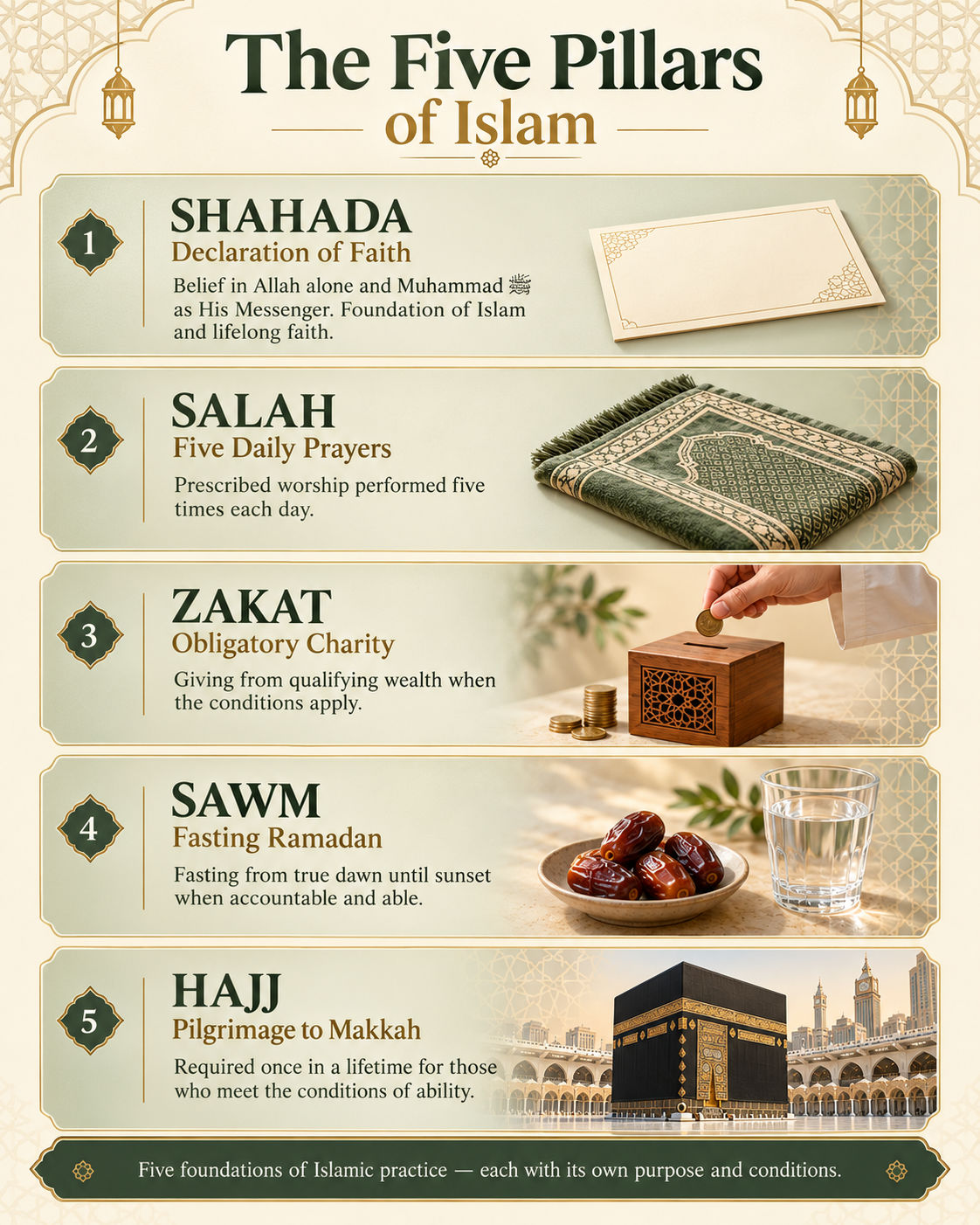
Notice what this table avoids saying. It does not say everyone pays 2.5% of everything they own, that everyone performs Hajj every year, or that everyone must fast regardless of illness. The pillars are real obligations, and Islam also defines carefully who they apply to and when.
Where Do the Five Pillars Come From?
The best-known source is a Hadith narrated by Abdullah ibn Umar (may Allah be pleased with him), recorded in Sahih al-Bukhari and Sahih Muslim. The Prophet Muhammad ﷺ said:
بُنِيَ الْإِسْلَامُ عَلَى خَمْسٍ
"Islam has been built upon five."
The Hadith then lists them: testifying that there is no deity but Allah and that Muhammad is the Messenger of Allah, establishing the prayer, giving Zakat, Hajj, and fasting Ramadan.
You may notice that in Bukhari's wording Hajj is mentioned before fasting. In a narration in Sahih Muslim, a man repeats the list with Hajj before fasting, and Ibn Umar corrects him, saying he heard it from the Prophet ﷺ with fasting Ramadan before Hajj. This is simply a difference in how the narration was reported and corrected, not a theological contradiction. Teachers conventionally use the order Shahada, Salah, Zakat, Sawm, Hajj, and so does this guide.
Are the Five Pillars in the Quran?
Yes, in the sense that matters most, but not in one verse. The Quran establishes each underlying obligation, while the authentic Sunnah gathers them together in the famous "Islam has been built upon five" formulation. There is no single Quranic verse that lists all five in this order, and it is worth being accurate about that.
Pillar | Quranic reference | What it teaches |
|---|---|---|
Shahada | 47:19; 3:18; 48:29 | Knowing there is no deity but Allah; Allah's own testimony to His oneness; Muhammad is the Messenger of Allah |
Salah | 2:43; 4:103 | Establish the prayer; prayer is prescribed for believers at specified times |
Zakat | 2:43; 9:103; 9:60 | Give Zakat; wealth taken to purify and cleanse; the categories of recipients |
Sawm | 2:183; 2:185 | Fasting prescribed so that believers may attain Taqwa; Ramadan and the Quran |
Hajj | 3:97; 22:27 | Pilgrimage to the House is owed to Allah by those able; the call to proclaim Hajj |
Quranic verses are given here as translations of meaning; the Arabic text of the Quran is the revelation itself.
Why Are They Called the Pillars of Islam?
The Arabic word is أَرْكَان (arkan), the plural of رُكْن (rukn). A rukn is a foundational support or essential component, the kind of thing something stands upon or cannot be complete without. The word is related to the root ر ك ن, which carries the sense of leaning on or relying upon something firm.
English speakers say "pillars" because an architectural image fits the Hadith's own wording: Islam is "built upon" five. A building needs foundations before walls and a roof. But treat this as a helpful metaphor, not a literal theology. The pillars are not stone columns, and they do not make up all of the building. They are the foundations of Islamic practice around which the rest of a Muslim's life is arranged.
Five Pillars, Six Articles of Faith, and Ihsan
Beginners often confuse the Five Pillars with the Six Articles of Faith. They are related, but different.
The Five Pillars are foundational acts and commitments of Islam. The Six Articles of Faith are the foundational beliefs of Iman (faith): belief in Allah, His angels, His revealed Books, His Messengers, the Last Day, and divine decree (Qadr).
Both lists appear in the famous Hadith of Jibril, narrated by Umar ibn al-Khattab in Sahih Muslim (and in a version from Abu Hurayrah in Sahih al-Bukhari). A man in white clothing, who the Companions later learned was the angel Jibril (Gabriel), asked the Prophet ﷺ about Islam, Iman, and Ihsan. The Prophet ﷺ answered:
Islam: to testify that there is no deity but Allah and that Muhammad is the Messenger of Allah, to establish the prayer, to give Zakat, to fast Ramadan, and to perform Hajj if you are able.
Iman: to believe in Allah, His angels, His Books, His Messengers, the Last Day, and to believe in divine decree, its good and its bad.
Ihsan: to worship Allah as though you see Him, and if you do not see Him, then know that He sees you.
In simple terms: Islam is foundational submission and practice, Iman is faith and conviction, and Ihsan is excellence and sincerity in worship. These categories are not sealed compartments. Belief without practice is incomplete, and practice without belief is empty. Even the Quran distinguishes between outward submission and inward faith in one verse (49:14), which shows that these ideas are meant to be understood carefully, not mixed up. Dedicated guides explore Iman and Qadr further, including [What Is Qadr in Islam? A Beginner's Guide to Divine Decree and Free Will]
The Five Pillars Are Not All of Islam
This point should be unmistakable. A person cannot conclude, "I pray and fast, so honesty, kindness, justice, and good conduct no longer matter." Islam includes belief, worship, ethics, family responsibilities, and justice.
The Quran makes this connection in a single verse. Verse 2:177 says righteousness is not merely a matter of turning your face in a direction, but of believing in Allah, the Last Day, the angels, the Book, and the Prophets; giving wealth out of love for Allah to relatives, orphans, the needy, travelers, and those in need; establishing prayer and giving Zakat; fulfilling promises; and being patient in hardship. Worship and moral responsibility sit together there.
Elsewhere the Quran commands justice and excellence in conduct (16:90), honoring parents (17:23), good treatment of neighbors (4:36), and returning trusts to their rightful owners (4:58). The Prophet ﷺ taught that the believers with the most complete faith are those with the best character (reported by al-Tirmidhi and others). So the pillars are foundations, and a life of faith is built upon them.
1. Shahada: The Declaration of Faith
الشَّهَادَة (Ash-Shahadah) means testimony: bearing witness to something you know and affirm. It is the first pillar and the doorway into Islam.
The Shahada in Arabic
أَشْهَدُ أَنْ لَا إِلَٰهَ إِلَّا اللَّهُ وَأَشْهَدُ أَنَّ مُحَمَّدًا رَسُولُ اللَّهِ
Transliteration: Ash-hadu an la ilaha illallah, wa ash-hadu anna Muhammadan rasulullah.
Meaning: "I bear witness that there is no deity worthy of worship except Allah, and I bear witness that Muhammad is the Messenger of Allah."
The Two Testimonies
The Shahada has two parts. The first, "there is no deity worthy of worship except Allah," affirms Tawhid: the oneness of Allah and His exclusive right to be worshipped. The second, "Muhammad ﷺ is the Messenger of Allah," affirms that Allah chose Muhammad ﷺ to deliver His final revelation and that his authentic guidance is to be followed.
Muslims do not worship Muhammad ﷺ. They worship Allah alone, and they love and honor Muhammad ﷺ because he is Allah's servant and Messenger. The Quran describes him that way in 48:29, in the very same affirmation that the Shahada echoes. To learn more about the first half of the Shahada, see [What Is Tawhid? A Beginner's Guide to Believing in One God in Islam]
Why Is Shahada the First Pillar?
Faith establishes the foundation on which every other pillar is practiced. A prayer, a fast, or a journey to Makkah means something because the worshipper believes in Allah alone and follows His Messenger's guidance. Shahada is not a mechanical phrase detached from belief. It is the spoken expression of conviction, which is why the Quran tells us to know that there is no deity but Allah (47:19).
How Does Someone Become Muslim?
A person enters Islam by sincerely believing in the meaning of the Shahada and declaring it. Then begins the lifelong path of learning and practice. There is no requirement of perfect Arabic, special clothing, a mosque ceremony, a certificate, or complete knowledge of Islamic law. A person can declare it in a language they understand, and many people then learn the Arabic words over time. Many mosques and communities welcome new Muslims warmly, but the declaration itself does not depend on a ceremony.
Is the Shahada Said Only Once?
Its formal role as the entry into Islam is the central significance of the Shahada. But the words of Tawhid are also repeated throughout Muslim worship, including within the call to prayer and the prayer itself, and in daily remembrance (Dhikr). This is part of how belief stays alive. It is not a reason to repeat a "re-conversion" out of anxiety after intrusive or unwanted thoughts; a person struggling with persistent doubts should speak with a trusted, qualified teacher.
What Does the Shahada Teach, and How Does It Shape Daily Life?
The Shahada teaches that faith must be sincere, that worship belongs to Allah, that Prophetic guidance matters, and that a person is responsible for how they live. In daily life, a Muslim prays to Allah, makes Dua to Allah, looks to the Quran and authentic Sunnah for guidance, and tries to live sincerely. Avoiding worship of any created being does not mean refusing ordinary human help; asking a friend for a ride or a doctor for treatment is not Shirk.
Common mistakes about the Shahada include the ideas that "Muslims worship Muhammad," that it means merely believing some Creator exists, that someone needs perfect Arabic before entering Islam, or that it is only a slogan. For a deeper study of its meaning and pronunciation, read [What Is the Shahada? The Meaning of "La Ilaha Illallah, Muhammadur Rasulullah"]
Everything begins with a declaration of faith. But faith is not expressed only at the moment a person becomes Muslim. Salah brings worship into the rhythm of every day.
2. Salah: The Five Daily Prayers
الصَّلَاة (As-Salah) is the Islamic ritual prayer, a prescribed act of worship with set words and movements. It is different from Dua (supplication), which is personal asking and speaking to Allah in any language at any time. Salah includes Dua, but Dua is not the same as Salah. See [How to Make Dua: A Beginner's Guide to Asking Allah]
Why Is Salah Central?
Salah is the pillar that returns again and again. It keeps the rhythm of remembrance and obedience running through ordinary life, from morning to night. The Quran commands believers to establish the prayer (2:43) and describes prayer as prescribed for believers at fixed times (4:103). It also ties prayer to remembrance of Allah: "Establish prayer for My remembrance" (20:14).
Why Five Daily Prayers?
The obligation of five daily prayers is established in the Quran and the authentic Sunnah. According to narrations in Sahih al-Bukhari and Sahih Muslim, the prayers were prescribed on the night of the Isra and Mi'raj, the Prophet's ﷺ night journey and ascent. They were originally fifty, and after the Prophet ﷺ went back several times to ask for ease for his community, they were reduced to five in number while keeping the reward of fifty. Scholars discuss many wisdoms in prayer's frequency, but the foundation is simple: Allah prescribed it.
What Are the Five Daily Prayers?
The five prayers are Fajr, Dhuhr, Asr, Maghrib, and Isha. Their times follow the sun, so they shift with the season and location. For that reason, Muslims use local prayer timetables or apps rather than fixed clock times. The general descriptions below follow the broad, shared understanding. Schools of Fiqh have some differences in exact boundaries, especially for the start of Asr.
Prayer | General time | Obligatory rak'ahs |
|---|---|---|
Fajr | From true dawn until sunrise | 2 |
Dhuhr | After the sun passes its zenith, into the afternoon | 4 |
Asr | Afternoon, until sunset | 4 |
Maghrib | After sunset, while the evening twilight remains | 3 |
Isha | From the end of twilight, into the night | 4 |
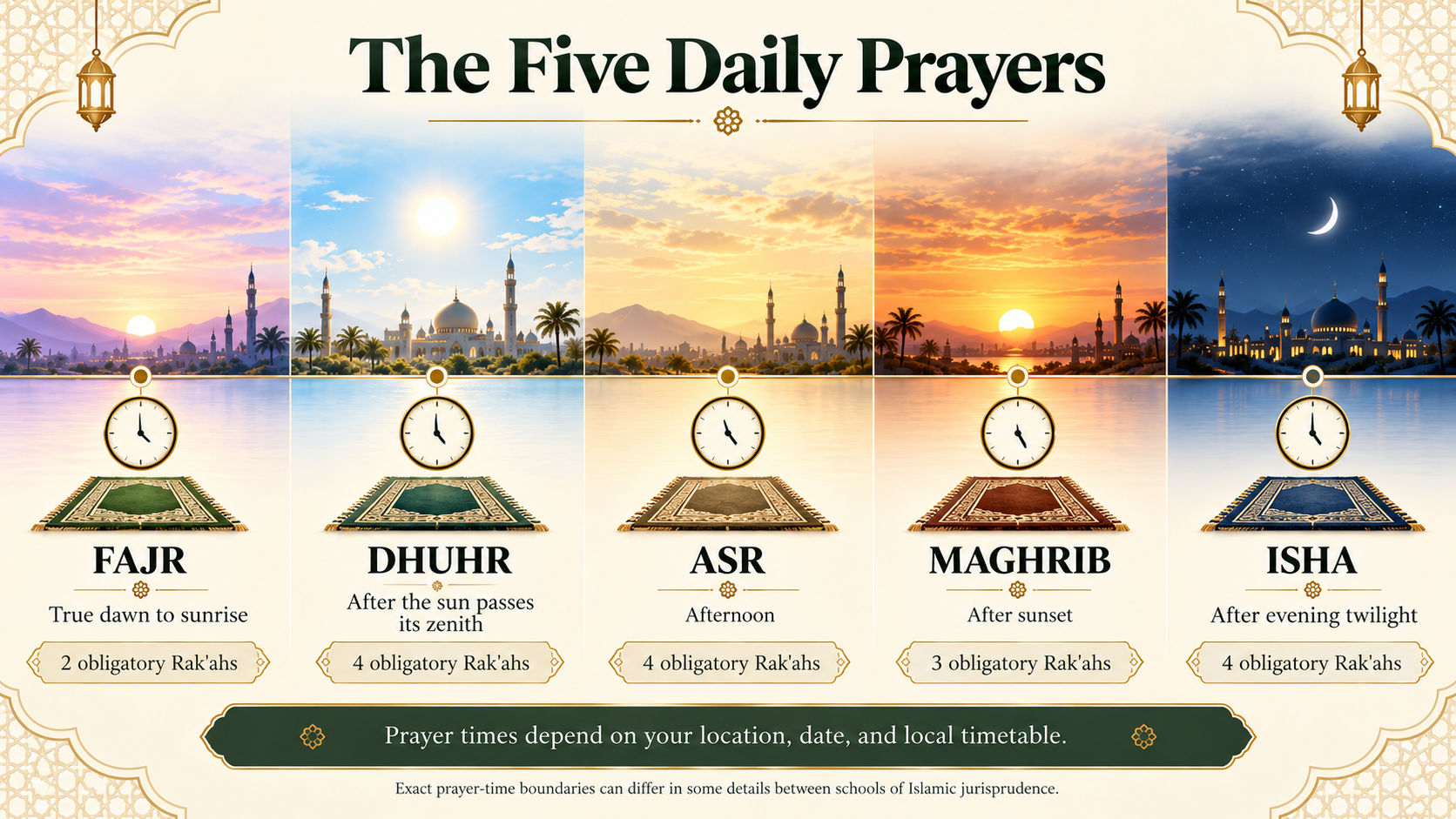
A rak'ah (رَكْعَة) is the basic unit of ritual prayer. In its prescribed form it includes standing, recitation, bowing (ruku'), and prostration (sujud). The full rules of how it is done fall under Fiqh and are best learned from a teacher.
A prayer that is fard (obligatory) differs from Sunnah or Nafl prayers, which are additional and voluntary or recommended depending on the type. Not all Sunnah prayers have the same status; some are strongly emphasized, others are simply encouraged. (The distinction between fard and wajib is made in the Hanafi school, while other schools treat them as one category. This guide uses obligatory for both.)
Before praying, a Muslim performs wudu (الوُضُوء), ritual washing described in Quran 5:6: washing the face and arms to the elbows, wiping the head, and washing the feet. This guide won't make wudu a tutorial, but it belongs with the idea of coming to Allah in a state of purity.
Salah and the Qibla
Muslims face the Kaaba in Makkah during prayer, as Allah commanded in Quran 2:144. This direction is called the Qibla. The Kaaba is a direction that unites worshippers, not an object of worship. Muslims worship Allah alone.
Salah, Accommodations, and Who Prays
Islam adapts the form of prayer to a person's circumstances. In a narration in Sahih al-Bukhari, the Prophet ﷺ told Imran ibn Husayn to pray standing, and if he could not, sitting, and if he could not, on his side. This means illness or disability changes how someone prays, not usually whether they pray, and nobody is asked to harm themselves to reach a posture. Travelers may shorten certain prayers.
The five daily prayers are obligations upon accountable Muslim women as well as men. Women are exempt from prayer during menstruation and postpartum bleeding, and they do not make up those prayers afterward. Women are not required to attend the mosque for each prayer. Congregational prayer (Jama'ah) is strongly encouraged, and scholars differ on how to rank its legal status; a prayer prayed alone remains a prayer. For Friday, see [Why Is Friday Special in Islam? A Complete Guide to Jumu'ah]
Children learn prayer before they reach religious accountability. In a Hadith reported by Abu Dawud, the Prophet ﷺ advised parents to instruct their children to pray at the age of seven. Scholars understand this as gradual, patient education. It does not license harsh or harmful treatment, which Islam forbids, and parenting that frightens a child away from prayer works against the purpose.
Salah and Quranic Arabic
Prayer introduces Muslims to repeated Quranic words and phrases: Allahu Akbar (اللَّهُ أَكْبَر, "Allah is the Greatest"), Alhamdulillah (الْحَمْدُ لِلَّهِ, "all praise is for Allah"), Iyyaka na'budu wa iyyaka nasta'in (إِيَّاكَ نَعْبُدُ وَإِيَّاكَ نَسْتَعِينُ, "You alone we worship and You alone we ask for help," from Al-Fatihah), and Subhana Rabbiyal-'Azim (سُبْحَانَ رَبِّيَ الْعَظِيمِ, "Glory to my Lord, the Magnificent," said in bowing). Understanding these words changes what a worshipper hears when reciting them.
What Does Salah Teach?
Salah teaches discipline, humility, remembrance, consistency, obedience, and gratitude. It places a person before Allah repeatedly through the day. The Quran says prayer restrains from immorality and wrongdoing (29:45), which shows that prayer is meant to affect conduct. But praying does not automatically make a person ethical, and every Muslim remains responsible for their behavior. Salah is meant to work on the heart over time.
What If Someone Misses Salah?
The obligation is serious, and it is to be approached with both gravity and compassion. Scholars distinguish between forgetting or oversleeping, valid excuses, and deliberate neglect. The Prophet ﷺ taught that someone who sleeps through or forgets a prayer should pray it when they remember (Sahih Muslim and Sahih al-Bukhari). Questions about making up missed prayers and the status of deliberate abandonment involve scholarly differences, and a beginner article is not the place to pass judgment on any individual. Nobody should casually declare another Muslim an unbeliever.
What If a New Muslim Doesn't Know How to Pray?
Start promptly, and start simply: learn wudu, learn the movements, begin with Al-Fatihah, then add the other prescribed recitations, and find a patient teacher. A temporary difficulty in learning is not a reason to delay indefinitely. A simple version prayed honestly is better than waiting to perfect everything. See [How to Learn Salah When You Don't Speak Arabic: A Beginner's Guide] and [The 5 Daily Prayers Explained: Why Muslims Pray Throughout the Day]
Prayer shapes the Muslim's relationship with time. Zakat extends religious responsibility into wealth and the rights of others.
3. Zakat: Purifying Wealth and Supporting Those in Need
الزَّكَاة (Az-Zakah) comes from the root ز ك و, associated with growth, purity, and blessing. Scholars of the language discuss these senses, and it would be too much to claim a single meaning explains everything. In the Quran, Zakat is both an act of worship and a way of purifying wealth: "Take from their wealth a charity by which you purify them and cause them to grow" (9:103).
What Is Zakat?
Zakat is an obligatory financial act of worship upon Muslims who meet the relevant conditions. It involves giving a specified amount of qualifying wealth to eligible recipients. It is not merely optional charity. The Prophet ﷺ described it, in the instructions to Mu'adh ibn Jabal when sending him to Yemen, as an obligation taken from those who are wealthy and given to those who are poor among them (Sahih al-Bukhari and Sahih Muslim).
Zakat vs Sadaqah
Zakat | Sadaqah | |
|---|---|---|
Status | Obligatory when conditions apply | Voluntary charity (in common usage) |
Amount | Defined by rules for each type of wealth | No fixed amount |
Recipients | Defined categories (Quran 9:60) | Anyone in need, and many good causes |
Form | Financial | Can include money, kindness, time, and good deeds |
In the Quran and Hadith, the word sadaqah can also be used more broadly, and the Prophet ﷺ taught that even a kind word or a smile can be charity. In everyday usage today, Zakat is the obligatory form and Sadaqah the voluntary.
Why Does Islam Require Zakat?
Zakat is first an act of obedience to Allah. Its wisdoms include purifying wealth, building social responsibility, caring for those in need, reducing harmful neglect, and reminding people that wealth is a trust from Allah. These are wisdoms and purposes, not guarantees. Zakat alone does not automatically eliminate poverty, and no one should promise guaranteed worldly wealth in return for giving it. The Quran frequently pairs it with prayer: "Establish prayer and give Zakat" (2:43).
Who Pays Zakat?
At a beginner level, Zakat generally becomes due when a Muslim owns qualifying wealth that reaches the Nisab, owns it fully, and holds it for a Hawl (full lunar year), where that condition applies. Not every type of wealth follows identical rules, which is why scholarly guidance matters.
Nisab (نِصَاب) is the minimum threshold of qualifying wealth at which Zakat becomes due. It is traditionally measured in gold or silver, and scholars and fatwa bodies differ in which basis is used today. For that reason this guide gives no dollar figure; any amount would need a date, a metal basis, and a methodology.
Hawl (حَوْل) means one lunar year, the usual waiting period for Zakat on qualifying savings. It does not apply in the same way to every kind of wealth. For example, agricultural produce is due at harvest.
Is Zakat Always 2.5%?
No. For many common categories, including qualifying cash and monetary assets, gold and silver, and trade goods, the standard annual rate is 2.5%. But agricultural produce, livestock, and some other categories have different rules and rates. For instance, the Prophet ﷺ taught that crops watered by rain are subject to a tenth, and those irrigated with effort, a twentieth (Sahih al-Bukhari). So it is wrong to teach that Islam commands everyone to give 2.5% of everything they own.
Zakat on Salary, Jewelry, Investments, and Business Assets
An ordinary salary is not always subject to a simple, immediate 2.5% deduction on the day it is received. What matters is what a person retains in savings and qualifying assets over time, and scholars discuss different methods. Personal jewelry is a matter of real scholarly difference: some jurists consider ordinary worn jewelry exempt, while others hold that Zakat is due on gold and silver jewelry that reaches the Nisab. Business inventory, shares, investments, retirement funds, and debts each require specialized calculation, and no single universal formula covers them all. For complex situations, consult a qualified scholar or a reputable Zakat authority. This guide does not give personalized financial, tax, or legal advice.
Who Receives Zakat?
Quran 9:60 names eight categories of recipients. They are not all "the poor," and each has a technical meaning in Fiqh.
Category | Arabic | General meaning |
|---|---|---|
The poor | الفقراء (al-fuqara') | Those with very little or insufficient means |
The needy | المساكين (al-masakin) | Those in need whose means do not cover essentials |
Zakat administrators | العاملون عليها | Those appointed to collect and distribute it |
Those whose hearts are to be reconciled | المؤلفة قلوبهم | Those whose support or affinity for Islam is to be encouraged, discussed in Fiqh |
Freeing captives | في الرقاب | Freeing people from bondage; scholars discuss modern applications |
Those in debt | الغارمون | People burdened by debt, under conditions |
In the cause of Allah | في سبيل الله | A category scholars define in different ways |
The traveler | ابن السبيل | A stranded traveler in need |
Not every good cause automatically qualifies for Zakat. A school, hospital, mosque, or fundraising campaign may be a wonderful charity, but whether Zakat can go to it depends on how scholars understand these categories. When in doubt, ask.
Zakat is also not the same as taxes. It is a religious obligation, a tax is a government requirement, and Sadaqah is voluntary. Taxes are not condemned as un-Islamic in themselves, but paying them does not automatically satisfy Zakat. Separately, Zakat al-Fitr is a different obligation connected to the end of Ramadan, given before the Eid prayer, and it differs from annual Zakat on wealth.
Finally, the Quran stresses dignity in giving. Charity should not be followed with reminders or injury (2:264), and sincere givers do not use charity to control or humiliate anyone. Zakat teaches generosity, responsibility, gratitude, solidarity, and humility. It never teaches that poverty is a personal failure: What Is Zakat? A Beginner's Guide to Islam's Obligatory Charity
Where Zakat asks the believer to give from wealth, Ramadan fasting asks the believer to restrain even normally permitted appetites in obedience to Allah.
4. Sawm: Fasting During Ramadan
الصَّوْم (As-Sawm), also called الصِّيَام (As-Siyam), comes from the root ص و م, with the sense of refraining. In Islamic law it means abstaining, with the intention to worship, from specific things during specific times.
What Is Ramadan Fasting?
An eligible Muslim fasts from true dawn (Fajr) until sunset (Maghrib) during Ramadan, abstaining from food, drink, and other fasting invalidators. Intention (niyyah) matters, which means fasting is not merely skipping meals. The pre-dawn meal is Suhoor and the meal that breaks the fast is Iftar. The Quran describes the start of the fast as when the white thread of dawn becomes distinct from the black thread of night (2:187). Fasting begins at true dawn, not at sunrise, and times change by location and date, so Muslims follow local timetables.
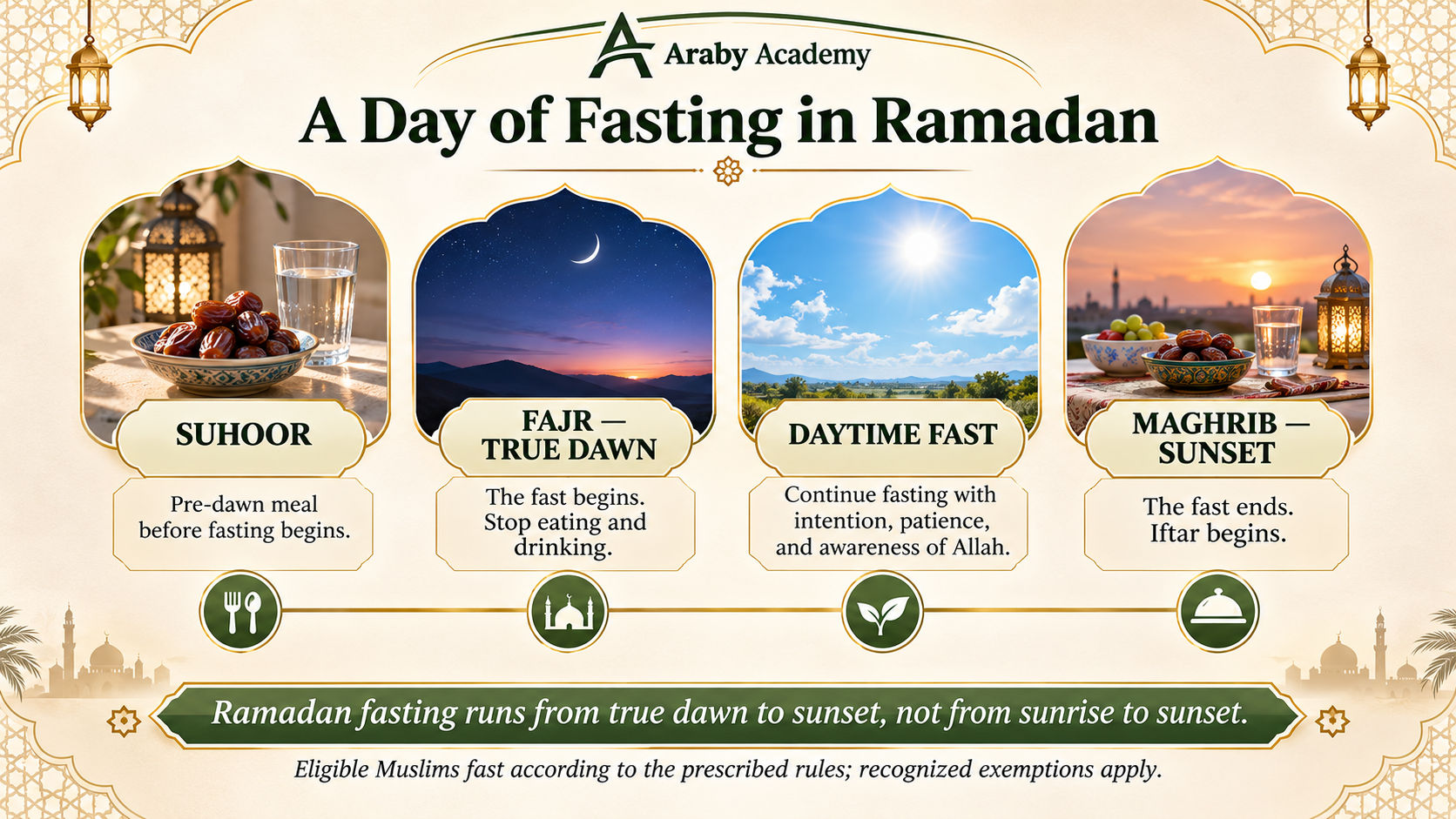
Why Do Muslims Fast?
Allah says in Quran 2:183 that fasting was prescribed for believers as it was for those before them, so that they may attain Taqwa. التَّقْوَى (At-Taqwa) is God-consciousness, reverence, and moral awareness: guarding oneself from disobedience out of awareness of Allah. It is not only terror of punishment.: What Is Taqwa? The Quranic Idea That Is Much Bigger Than "Fear of Allah"
Fasting is more than hunger. It builds self-discipline, patience, gratitude, and awareness of blessings. The Prophet ﷺ taught that whoever does not give up false speech and acting upon it, Allah has no need of his giving up food and drink (Sahih al-Bukhari). He also taught that whoever fasts Ramadan out of faith and seeking reward will have previous sins forgiven (Sahih al-Bukhari and Sahih Muslim).
Ramadan is also the month of the Quran. Quran 2:185 says it is the month in which the Quran was sent down as guidance. Scholars have discussed how the revelation came to the Prophet ﷺ, including its first descent and its gradual revelation over years, and it is enough here to say that Ramadan is linked to the Quran's revelation. For the Night of Power, see [What Is Laylat al-Qadr? A Beginner's Guide to the Night of Power]
Ramadan is a lunar month, so it lasts 29 or 30 days, and its dates move earlier through the Gregorian calendar each year.
Who Must Fast, and Who May Be Excused?
Fasting is obligatory for a Muslim who is religiously accountable and capable, and not covered by an exemption. Recognized exemptions include illness, travel, menstruation, postpartum bleeding, pregnancy or breastfeeding in some circumstances, and chronic inability. Quran 2:184-185 grants the sick and travelers the option to make up missed days later and mentions a ransom (fidya) for those who cannot fast.
These exemptions do not all carry identical rules:
Qada (قضاء): making up a missed fast later.
Fidya (فدية): feeding a poor person in place of fasting, for those permanently unable.
Kaffarah (كفارة): an expiation for specific serious violations, such as deliberate intercourse during a fasting day. It does not apply to ordinary missed fasts.
Scholars differ on details, such as the rulings for pregnant and breastfeeding women. Not every fasting mistake invalidates the fast. Eating or drinking by forgetfulness does not break it, and the Prophet ﷺ said to complete the fast, since Allah fed and gave drink to that person (Sahih al-Bukhari and Sahih Muslim). Intentional invalidation, genuine inability, mistaken timing, and medical situations are treated differently.
For people with health conditions, the Quranic principle is allowance, not hardship. Nobody should ignore real medical risk or stop medication without professional advice. Complicated cases call for both a qualified scholar and a healthcare professional. Children who have not reached puberty are generally not obligated to fast. Families can encourage gradual, safe practice, without pressuring a child into harm.
Fasting teaches Taqwa, discipline, gratitude, patience, empathy, obedience, and remembrance. It does not guarantee permanent character change, and it is no cure-all. Ramadan is also not only about fasting: it includes the Quran, prayer, Dua, Dhikr, charity, night prayer, and repentance, though fasting itself is the obligatory pillar and the rest is recommended worship.
For Muslims in the West, Ramadan may mean long school days, work schedules, community Iftars, different daylight lengths, and travel. Planning ahead and community support help. In regions with extreme daylight differences, timing rulings need qualified guidance rather than a universal rule. See [Ramadan in the West: Fasting, Faith, and Community Far from Muslim Lands]and [How to Prepare for Ramadan Months in Advance: A Practical Muslim Family Guide]And for those with the ability, Hajj brings a lifetime obligation that connects individual worship with the history of Ibrahim and the wider Muslim community.
5. Hajj: The Pilgrimage to Makkah
الحَجّ (Al-Hajj) is the pilgrimage to the sacred sites in and around Makkah, performed according to prescribed rites. Lexicographers connect the word with setting out toward or aiming for something.
What Is Hajj?
Hajj is a major act of worship performed during specified days of Dhul Hijjah, the twelfth month of the Islamic calendar. It involves rites connected to the Kaaba, Mina, Arafat, Muzdalifah, and other places. It is not simply "visiting the Kaaba." The Quran calls people to it: "Proclaim to the people the Hajj" (22:27).
Who Is Required to Perform Hajj?
Quran 3:97 states that pilgrimage to the House is a duty owed to Allah by people who are able to find a way. Hajj is obligatory once in a lifetime for those who meet its conditions. In a Hadith in Sahih Muslim, when a man asked whether Hajj is required every year, the Prophet ﷺ was silent and then said that if he said yes it would become obligatory, and they would not be able to do it. Additional Hajj is voluntary.
Ability includes financial capacity, physical capacity, safety and access, and practical or legal ability. Specific rulings differ among schools. Nobody should go into reckless debt or neglect dependents' needs merely to travel, and not being able is not a spiritual failure. Allah does not impose Hajj on those who do not meet the conditions.
For women's travel, classical schools and contemporary authorities differ about the role of a mahram (close male relative) versus a safe group of trustworthy companions. Some Hadith discuss women and travel with a mahram, and scholars understand and apply them differently. Women should follow qualified scholarship and official pilgrimage regulations. If someone is permanently unable to perform Hajj, there are Fiqh rules for Hajj on their behalf in certain circumstances (a narration in Sahih al-Bukhari mentions a woman asking about this for her elderly father), but these are conditional and shouldn't be assumed.
Hajj and Prophet Ibrahim
The Quran connects the Kaaba and pilgrimage to Prophet Ibrahim (peace be upon him), who was commanded to purify the House for worshippers (22:26-27; 2:125-127). Several rites commemorate events in the lives of Ibrahim and his family, and the Quran itself mentions the Safa and Marwah among the symbols of Allah (2:158). Some details of the surrounding history come from Hadith and later tradition, and it is wise to distinguish what the Quran states directly from what later sources add. Read more at [The Story of Prophet Ibrahim: Faith, Sacrifice, and Trust in Allah]
The Kaaba is the sacred House and direction of prayer. Muslims worship Allah, not the building. Circling it is worship in obedience to Allah.
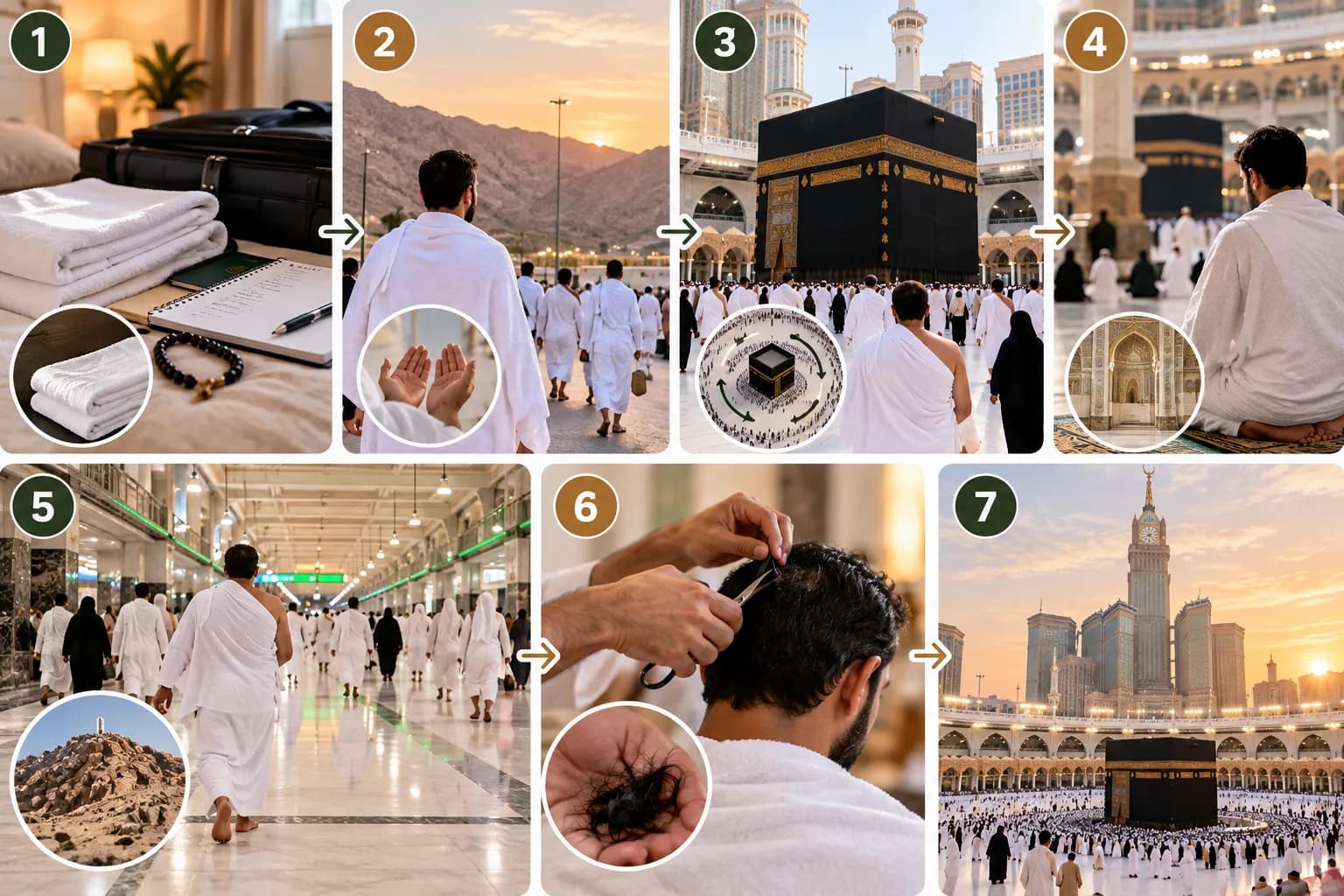
What Happens During Hajj?
A simplified overview of Hajj rites follows. The order, necessity, and application of each rite vary by type of Hajj (Tamattu', Qiran, or Ifrad) and by circumstances, so this is not a step-by-step manual.
Ihram (الإِحْرَام): a state of ritual consecration entered with intention at a designated boundary, with its own rules. It is more than the two white garments men wear; the clothing and the state are different things.
Tawaf (الطَّوَاف): circling the Kaaba seven times in the prescribed manner.
Sa'i (السَّعْي): walking between Safa and Marwah, a rite linked to Quran 2:158 and to the narration about Hajar in Sahih al-Bukhari.
Mina, Arafat, and Muzdalifah: the days of Hajj move between these sites. Standing at Arafat is central. The Prophet ﷺ said, "Hajj is Arafah" (reported by Abu Dawud and al-Tirmidhi, among others, and graded authentic by scholars), meaning that missing it means missing Hajj, though Arafat is one rite among several essential ones.
Rami: throwing pebbles at the designated pillars in Mina.
Sacrifice (where applicable), shaving or trimming the hair, and the farewell Tawaf for those who need to perform it.
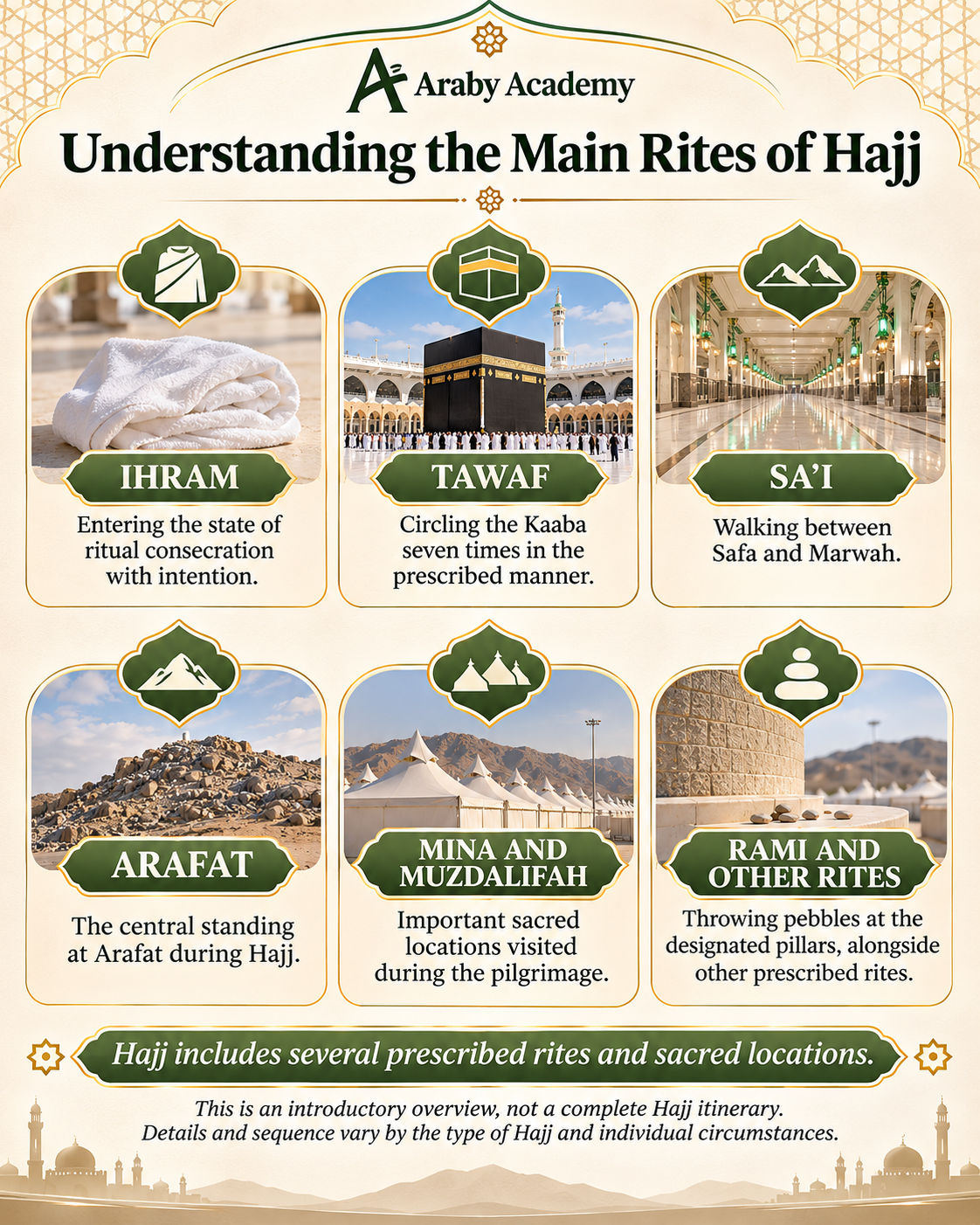
The Prophet ﷺ taught that whoever performs Hajj without obscenity or wrongdoing returns as on the day his mother bore him (Sahih al-Bukhari and Sahih Muslim). Scholars understand this as forgiveness for sins, but no one can claim to know whether another person's Hajj is accepted.
Hajj vs Umrah
Hajj | Umrah | |
|---|---|---|
Timing | Specific days of Dhul Hijjah | Can be performed at many times of the year |
Status | Fifth Pillar, for those able | Lesser pilgrimage; scholars differ on its legal status |
Rites | Includes Arafat, Mina, Muzdalifah, and other rites | Ihram, Tawaf, Sa'i, and hair trimming or shaving |
On Umrah, the Hanafi and Maliki schools generally consider it a strongly emphasized Sunnah, while the Shafi'i and Hanbali schools generally consider it obligatory once in a lifetime for those able. See [How to Perform Umrah: First-Timer's Step-by-Step Guide]
Hajj teaches submission, humility, shared worship, remembrance, sacrifice, patience, and connection to Ibrahim's legacy. Pilgrims from every country and language stand in the same acts of worship, which reveals the unity of the Muslim community. That doesn't mean every real-world difficulty disappears, and Hajj is not romantic simplicity, but it does show equality in devotion before Allah. See also [The First 10 Days of Dhul Hijjah: A Practical Worship Plan for Every Muslim] and [Why Millions Cry When They See the Kaaba for the First Time]
Seen together, the pillars are not competing rituals. They teach different dimensions of submission to Allah.
How Do the Five Pillars Work Together?
Shahada is the foundation of belief and worship. Salah is regular remembrance and devotion. Zakat is obedience through financial responsibility. Sawm is obedience through fasting and self-restraint. Hajj is pilgrimage and submission when able. They have psychological and social benefits, but these are not the point. The pillars are first of all acts of worship prescribed by Allah.
Pillar | When it appears in life | What it requires | Spiritual lesson |
|---|---|---|---|
Shahada | At entry, and in ongoing testimony | Belief and declaration | Faith and sincerity |
Salah | Daily | Five prayers | Remembrance and discipline |
Zakat | When financial conditions apply | Giving from qualifying wealth | Generosity and responsibility |
Sawm | Ramadan, when accountable and capable | Fasting from dawn to sunset | Taqwa and self-restraint |
Hajj | Once in a lifetime, when able | The prescribed rites | Submission and unity |
The pillars have different rhythms: Salah is daily, Ramadan fasting and many Zakat obligations are yearly, and Hajj is once in a lifetime when able. They are also not required of every person in the same way. Faith is foundational for everyone; the other pillars depend on religious accountability and conditions: Hajj requires ability, Zakat requires financial conditions, fasting has recognized exemptions, and Salah has accommodations according to ability.
This reflects Allah's mercy. Quran 2:286 says Allah does not burden a soul beyond its capacity. That verse explains the principle of mercy in Islamic law. It is not a tool for inventing exemptions from clear obligations, since determining real capacity requires evidence and sound Fiqh.
What If Someone Cannot Perform a Pillar?
Situation | General principle | When to seek qualified guidance |
|---|---|---|
Cannot afford Hajj | Hajj is only required of those with the means and ability | If you are unsure whether you meet the conditions |
Illness affecting fasting | Allowances exist; make up fasts or offer fidya depending on the case | When illness is long-term or medication is involved |
Disability affecting prayer posture | Pray standing, sitting, or lying down as able | To learn the right adjustments |
Low wealth relative to the Nisab | Zakat is not due below the threshold | When assets are mixed or complicated |
Convert still learning prayer | Learn promptly and pray what you can | To find a teacher and a plan |
Does Missing One Pillar Make Someone Non-Muslim?
This requires care. Scholars distinguish between denying an established obligation, failing to do it through sin or neglect, and being genuinely excused. Some issues, notably the deliberate abandonment of prayer, carry significant scholarly differences. A beginner's guide should not issue blanket judgments or declare anyone an unbeliever. What is clear is that the pillars are serious obligations, that sin calls for repentance and effort, and that no one should be made to despair of Allah's mercy.
Worship, Intention, and Character
Worship and character belong together. The Prophet ﷺ described a "bankrupt" person who arrives on the Day of Judgment with prayer, fasting, and Zakat, but who also insulted, slandered, and wronged others, so their good deeds are given to those they harmed (Sahih Muslim). The lesson is that prayer and fasting do not give anyone permission to harm others. It is not a claim that worship is worthless whenever someone behaves badly.
Intention matters too. The Prophet ﷺ said, "Actions are by intentions" (إنما الأعمال بالنيات), narrated by Umar in Sahih al-Bukhari and Sahih Muslim. A pillar performed to show off is not what Allah asks for. Sincerity connects the outward act to the inward heart.
Can the pillars become empty habits? Sometimes. Anyone may pray or fast mechanically at times. Understanding the meanings helps nurture attentiveness, but obligatory worship is not abandoned because concentration is imperfect. Keep praying, and work on presence.
Seven Lessons the Five Pillars Teach
Faith needs meaning. The Shahada is a testimony to be understood, not only recited.
Worship needs consistency. Salah returns daily.
Wealth brings responsibility. Zakat treats wealth as a trust.
Discipline can deepen Taqwa. Fasting is prescribed so believers may attain it (2:183).
Obedience may require sacrifice. Hajj asks for time, money, and effort.
Community matters. Zakat, congregational prayer, Iftar, and Hajj connect individuals to others.
Sincerity connects the outer and the inner. Actions are by intentions.
Five Pillars vs Five Daily Prayers
These are often confused. The Five Pillars are five foundations of Islam. The five daily prayers are the obligatory prayers within Salah, the second pillar. They are not interchangeable.
Five Pillars vs Six Articles of Faith
The Five Pillars concern foundational acts; the Six Articles concern foundational beliefs. The distinction doesn't mean faith and action are unrelated.
Five Pillars of Islam | Six Articles of Iman |
|---|---|
Shahada | Belief in Allah |
Salah | Belief in the angels |
Zakat | Belief in the revealed Books |
Sawm | Belief in the Messengers |
Hajj | Belief in the Last Day |
Belief in Qadr (divine decree) |
The Five Pillars in the Modern World
Muslims practice the pillars while working, studying, parenting, managing money, and traveling. In the West, that might mean finding a quiet space to pray at work or school, discussing schedule needs respectfully with an employer, using a reputable Zakat calculator or scholar for assets, explaining Ramadan to colleagues, supporting converts through community, and planning Hajj early. Laws and accommodations differ by country, so no single approach applies everywhere. For building a routine, see [How to Build a Daily Islamic Routine When You Live a Busy Life]and [What Is Dhikr? A Beginner's Guide to Remembering Allah Every Day]
How New Muslims Can Start Learning the Five Pillars
The Shahada begins the journey. Salah should be learned promptly. Zakat applies if its conditions are met. Ramadan fasting applies according to accountability and exemptions. Hajj applies when able, and a new Muslim should not feel pressure to perform it right away.
A helpful learning order (a suggestion, not a prescribed Prophetic program):
Understand the Shahada.
Learn basic wudu.
Begin learning and performing Salah.
Learn the basic beliefs of Islam.
Understand Ramadan fasting.
Learn whether Zakat applies to you.
Understand Hajj as a future obligation, if able.
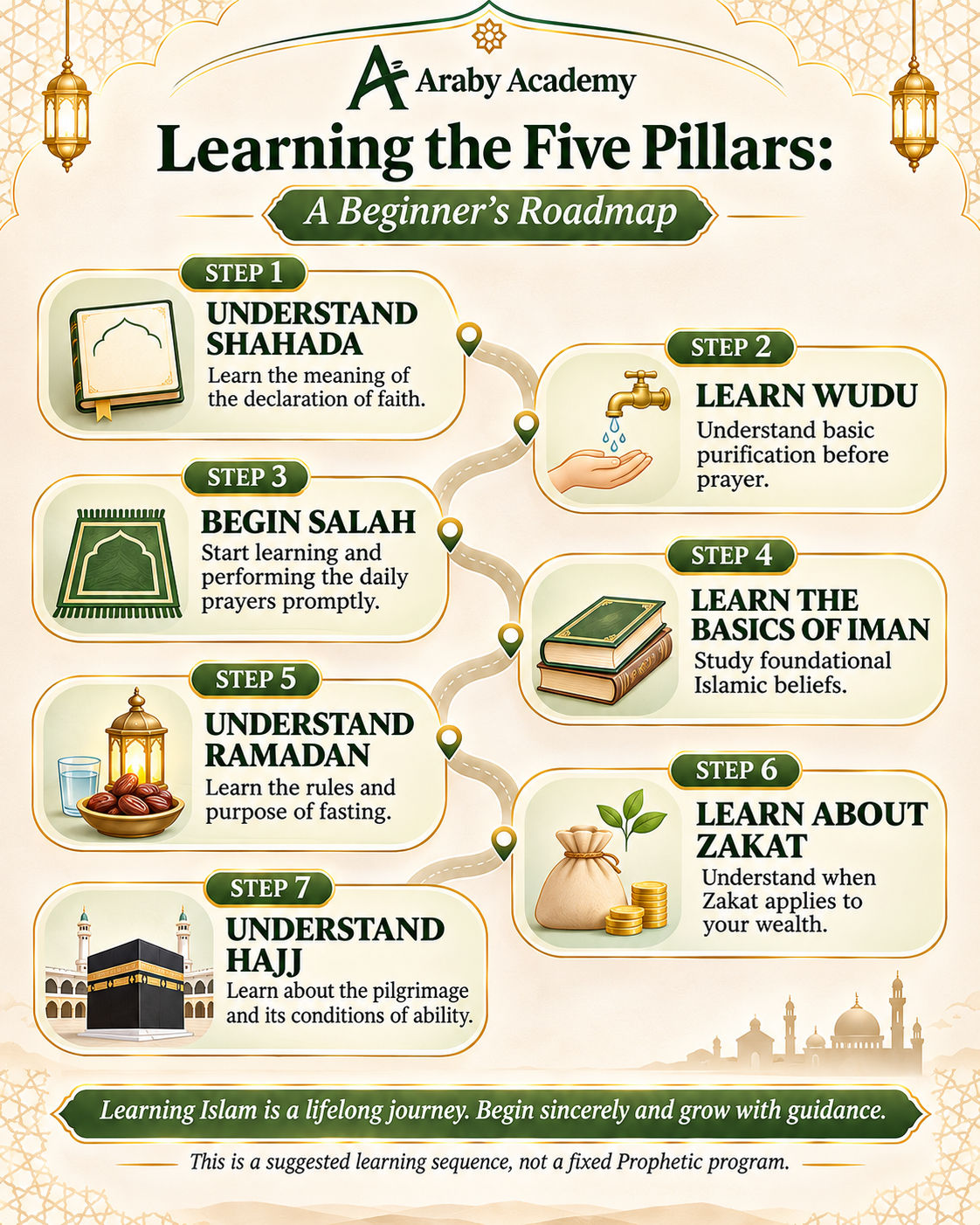
Be patient with yourself, find a teacher, and join a community. Learning to read the Quran gradually is part of this. See [How to Start Learning Quran and Arabic from Zero (Step-by-Step Guide for Beginners)]
How Parents Can Teach the Five Pillars to Children
With younger children, use picture cards, short vocabulary, stories, prayer observation, and gentle charity activities. With older children, add Quranic evidence, Fiqh basics, reflection questions, and practice. Avoid pressure, guilt, or fear. See [Raising Muslim Children in the West: 10 Ways to Build a Strong Islamic Identity]
Seven learning activities (these are educational activities, not the prescribed rituals themselves):
Match each pillar's name to its meaning.
Make a daily prayer timetable with local times.
Keep a charity jar to introduce generosity (this is not a substitute for actual Zakat rules).
Learn Ramadan vocabulary such as Suhoor and Iftar.
Study a Hajj map and learn the place names.
Practice saying the Shahada with its meaning.
Read a Quran verse connected to each pillar together.
What parents should avoid teaching: that poor people must pay Zakat no matter what; that Allah stops loving a child who misses a fast; that children must fast dangerously long hours; that everyone must visit Makkah by a certain age; or that prayer is useless unless you are perfect. Teach with compassion and accuracy.
Common Misconceptions About the Five Pillars
Myth | Reality |
|---|---|
All five are listed in one Quran verse. | The obligations appear in the Quran; the famous collective list comes from authentic Sunnah. |
Muslims worship Muhammad ﷺ. | Muslims worship Allah alone and affirm Muhammad ﷺ as His Messenger. |
Salah is the same as Dua. | Salah is prescribed ritual prayer; Dua is supplication. |
Prayer doesn't count outside a mosque. | Rulings on congregational prayer vary; prayer alone still counts. |
Muslims worship the Kaaba. | It is the direction of prayer, not the object of worship. |
Every Muslim pays 2.5% of all possessions. | Zakat has asset-specific rules, thresholds, and conditions. |
Zakat and Sadaqah are identical. | Zakat is obligatory; Sadaqah is generally voluntary. |
Paying taxes replaces Zakat. | They are distinct obligations. |
Every Muslim must fast even if seriously ill. | Islam recognizes defined exemptions. |
Ramadan is always 30 days. | A lunar month is 29 or 30 days. |
Fasting is only about food. | It is worship tied to Taqwa and moral discipline. |
Hajj is required every year. | It is once in a lifetime, when conditions are met. |
Every Muslim must borrow to perform Hajj. | Ability is a condition. |
Hajj and Umrah are identical. | They differ in rites, timing, and legal discussion. |
Islam is only five rituals. | Islam includes belief, worship, ethics, family duties, and justice. |
New Muslims must perfect the pillars before the Shahada. | Sincere entry begins the journey of learning. |
Missing any pillar for any reason makes someone an unbeliever. | Denial, neglect, excuses, and specific rulings must be distinguished. |
The pillars have nothing to do with character. | Authentic teaching ties worship to moral responsibility. |
Essential Arabic Words Behind the Five Pillars
Learning even a few Arabic terms helps students notice meanings and patterns when they read and recite the Quran. This does not mean a person needs Arabic fluency to practice basic Islam. It means that understanding words such as Salah, Zakat, Sawm, Hajj, and Taqwa deepens appreciation.
Arabic | Transliteration | Meaning | Note |
|---|---|---|---|
أَرْكَان | Arkan | Pillars | Plural of rukn; root ر ك ن |
الإِسْلَام | Al-Islam | Submission to Allah | Root س ل م, related to peace and submission |
الشَّهَادَة | Ash-Shahadah | Testimony | Root ش ه د |
التَّوْحِيد | At-Tawhid | Allah's oneness | Root و ح د |
الصَّلَاة | As-Salah | Ritual prayer | Prayer five times daily |
الوُضُوء | Al-Wudu | Ablution | Washing before prayer (5:6) |
الزَّكَاة | Az-Zakah | Obligatory almsgiving; purification | Root ز ك و |
الصَّدَقَة | As-Sadaqah | Charity | Root ص د ق, related to truthfulness |
الصَّوْم | As-Sawm | Fasting | Root ص و م |
التَّقْوَى | At-Taqwa | God-consciousness | The aim of fasting (2:183) |
الحَجّ | Al-Hajj | Pilgrimage | To Makkah, when able |
الإِحْرَام | Al-Ihram | Ritual consecration | Root ح ر م, related to what is made sacred or restricted |
One striking pattern in the Quran is the phrase أَقِيمُوا الصَّلَاةَ وَآتُوا الزَّكَاةَ ("Establish prayer and give Zakat"), as in 2:43. The pairing appears frequently, reflecting that worship of Allah includes both personal devotion and responsibility toward others. It does not appear alongside every mention of prayer, but the pattern is clear and worth noticing.
At Araby Academy, students of Quranic Arabic often find that words like these begin to stand out in recitation, which makes Quran study richer. This is a helpful path, not a prerequisite for practicing Islam.
Frequently Asked Questions
1. What are the Five Pillars of Islam? Shahada (testimony of faith), Salah (five daily prayers), Zakat (obligatory almsgiving), Sawm (fasting in Ramadan), and Hajj (pilgrimage to Makkah for those able). They are the foundations of Islamic practice, taken from authentic Prophetic teaching.
2. What are the Five Pillars in order? The conventional teaching order is Shahada, Salah, Zakat, Sawm, Hajj. Some narrations of the Hadith mention Hajj before fasting, but this is a difference in narration, not a disagreement about what the pillars are.
3. Why are they called pillars? The Arabic is arkan (singular rukn), meaning foundational supports. The Hadith says Islam is "built upon" five. The image is a metaphor for foundations, not a claim that these are all of Islam.
4. Are the Five Pillars mentioned in the Quran? Each pillar's obligation appears in the Quran, but no single verse lists all five. The famous collective list comes from the authentic Hadith narrated by Abdullah ibn Umar.
5. What is the first pillar of Islam? Shahada, the testimony that there is no deity worthy of worship except Allah and that Muhammad ﷺ is His Messenger. It is the entry into Islam and the foundation for all worship.
6. What does Shahada mean? Shahada means testimony or bearing witness. It affirms Tawhid, the oneness of Allah, and the Prophethood of Muhammad ﷺ. It should be said with understanding and sincere belief.
7. Why do Muslims pray five times a day? Because Allah prescribed it, as established in the Quran and authentic Sunnah. The prayers keep remembrance of Allah present throughout the day, shaping a Muslim's relationship with time and worship.
8. What is the difference between Salah and Dua? Salah is the prescribed ritual prayer with set words and movements. Dua is personal supplication, which can be made anytime in any language. Salah includes moments of Dua, but they are not the same.
9. What is Zakat, and who has to pay it? Zakat is obligatory almsgiving from qualifying wealth. It is due on Muslims whose wealth meets the Nisab and other conditions, and it is given to the categories of recipients in Quran 9:60.
10. Is Zakat always 2.5%? No. 2.5% is the standard annual rate for many monetary assets, gold, silver, and trade goods. Agriculture, livestock, and other categories have different rules and rates.
11. What is the difference between Zakat and Sadaqah? Zakat is obligatory when conditions apply, with defined rules and recipients. Sadaqah is voluntary charity in common usage, and it can include kindness and good deeds as well as money.
12. Why do Muslims fast Ramadan? Because Allah prescribed it so that believers may attain Taqwa (Quran 2:183). Fasting is an act of obedience that builds discipline, gratitude, and God-consciousness.
13. Who is excused from fasting Ramadan? Those who are ill, traveling, menstruating, in postpartum bleeding, chronically unable, or covered by other recognized circumstances, with differing rules for making up fasts or giving fidya. Children before puberty are not generally obligated.
14. What is Hajj? Hajj is the pilgrimage to Makkah and the sacred sites around it during specific days of Dhul Hijjah, performed through prescribed rites including Ihram, Tawaf, standing at Arafat, and more.
15. Does every Muslim have to perform Hajj? Every Muslim who meets the conditions, including financial and physical ability and safety, must perform it once in a lifetime. Those who lack the ability are not obligated.
16. What is the difference between Hajj and Umrah? Hajj happens on specific days and includes Arafat and other rites. Umrah can be done at many times and has fewer rites. Scholars differ on the legal status of Umrah.
17. Are all Five Pillars obligatory? Yes, each is an obligation, but the conditions differ. Shahada is the foundation for all; Salah is daily; Zakat, Sawm, and Hajj depend on wealth, ability, and exemptions.
18. What if someone cannot fulfill one of the pillars? Islam recognizes valid circumstances, such as illness, poverty, or lack of ability, and Allah does not burden a soul beyond its capacity (2:286). Specific rulings vary, so consult a qualified scholar.
19. What is the difference between the Five Pillars and Six Articles of Faith? The pillars are foundational acts; the Six Articles are foundational beliefs: Allah, angels, Books, Messengers, the Last Day, and divine decree. They are different but connected.
20. How should a new Muslim begin learning the Five Pillars? Understand the Shahada, learn wudu, begin Salah promptly, learn basic beliefs, then learn about Ramadan, Zakat, and Hajj. Be patient, find a teacher, and take obligations seriously while growing steadily.
21. How can parents teach the Five Pillars to children? With age-appropriate stories, picture cards, shared prayer, charity activities, and Quran verses for older children. Avoid pressure, guilt, or harm, and never push a child to fast unsafely.
22. Do the Five Pillars include all of Islam? No. They are the foundations of practice. Islam also includes beliefs, ethics, family responsibilities, justice, honesty, and mercy. Worship and character belong together.
Five Pillars, One Foundation: A Life of Worship
Return to the beginning. A Muslim declares that Allah alone deserves worship. Then that belief appears again and again across a life: in prayer through Salah, in money through Zakat, in personal discipline through fasting Ramadan, and in pilgrimage through Hajj when able.
The pillars are not all performed with the same frequency, and they are not all required in the same circumstances. But all belong to the foundational structure of Islamic worship. Learning their names is a beginning, understanding their meanings is the next step, and practicing them sincerely is a lifelong responsibility.
"The Five Pillars of Islam are not simply five things Muslims do. They are five foundations that help organize a life of worship and submission to Allah."
From the Shahada to Salah, from Zakat to Ramadan fasting, and from ordinary daily responsibilities to the extraordinary journey of Hajj, Islam teaches believers to remember Allah through both their devotion and their actions.
If this guide has raised questions, take them to trustworthy teachers. Learning to recite the Quran, understanding the Arabic behind the words, and studying the fundamentals of Islam will keep deepening your understanding. Understand the Shahada. Establish Salah. Learn your Zakat responsibilities. Fast Ramadan according to your ability and obligations. Perform Hajj when able. And let these foundations shape your character and your relationship with Allah.