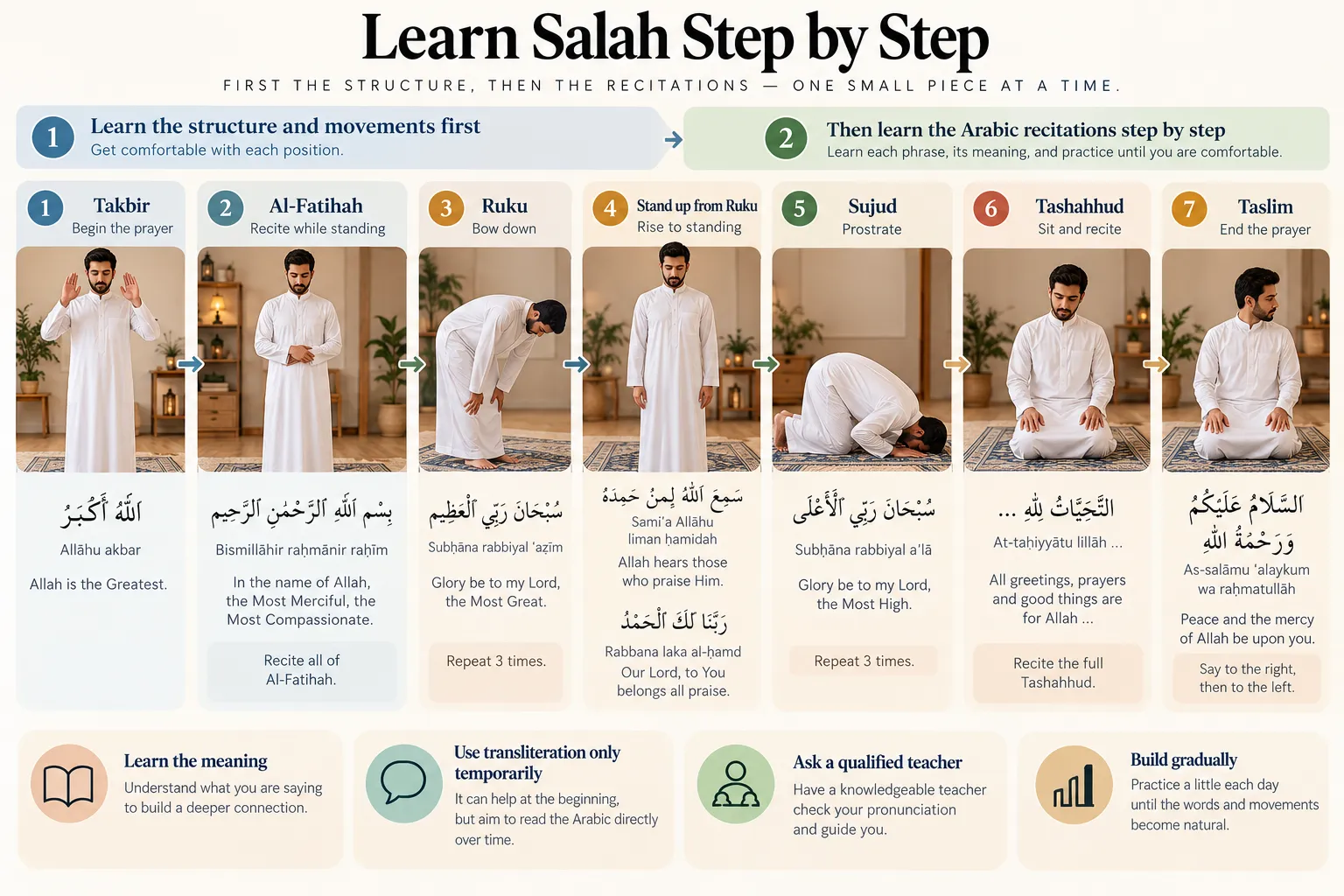
You watch someone pray. They stand. They bow. They stand again. They go down to the floor, sit up, go down again, and say more Arabic words in a quiet voice. Then they stand and do it all over again.
If you have recently become Muslim, or you are a Muslim who never had the chance to learn, this can look very complicated. You may be thinking: "How am I supposed to remember all of this when I don't even speak Arabic?"
Here is the good news. You do not need to become fluent in Arabic before you begin learning Salah. Salah is learned through repetition. Muslims who have prayed for years do not think about every movement and phrase, because the pattern has become familiar. You will get there too, one small step at a time.
This guide shows you how to learn Salah in a calm, practical way. You will learn the structure of the prayer, the Arabic words with their meanings, how to practise, and where to ask for help. One thing to say clearly from the start: Salah is an act of worship with rulings, so this article gives you a learning path, not a replacement for a teacher who can hear you recite.
Do You Need to Speak Arabic to Pray Salah?
Muslims around the world pray using the same Arabic recitations. Most of them are not native Arabic speakers. Muslims in Indonesia, Nigeria, Pakistan, Turkey, Bosnia, the UK and the US all learn the same words of Salah, usually starting as children or new learners.
So the honest answer has two parts:
You do not need to speak Arabic fluently to learn the Arabic used in Salah.
You do need to learn the prescribed Arabic recitations. Understanding an English translation does not replace them.
The Arabic in Salah is small compared with the whole language. The same short phrases repeat many times a day. You can learn:
what each phrase sounds like
how to pronounce it
what it means
where it comes in the prayer
That is a much smaller task than "learning Arabic," and it is achievable.
Allah says: "Allah does not burden a soul beyond its capacity" (Quran 2:286). Learning Salah is a duty, and it is also something Allah makes possible step by step for sincere learners.
Before You Learn the Words, Understand the Structure of Salah
Start with a map. Once you can see the shape of the prayer, the words have a place to sit.
Here are the key terms. You will see them again and again.
Salah: the prescribed Muslim prayer.
Rak'ah: one unit or cycle of prayer.
Qiyam: standing.
Ruku: bowing.
Sujud: prostration, with the forehead on the ground.
Jalsa: sitting between the two prostrations.
Tashahhud: the testimony of faith and greetings, said while sitting.
Taslim: the closing greeting that ends the prayer.
Every prayer is built from Rak'ahs. Once you learn the pattern of one Rak'ah, you can build any prayer from it.
The Prophet ﷺ said: "Pray as you have seen me praying" (Sahih al-Bukhari 631). This is why learning from a real person, and from reliable teaching, matters so much.
The Five Daily Prayers
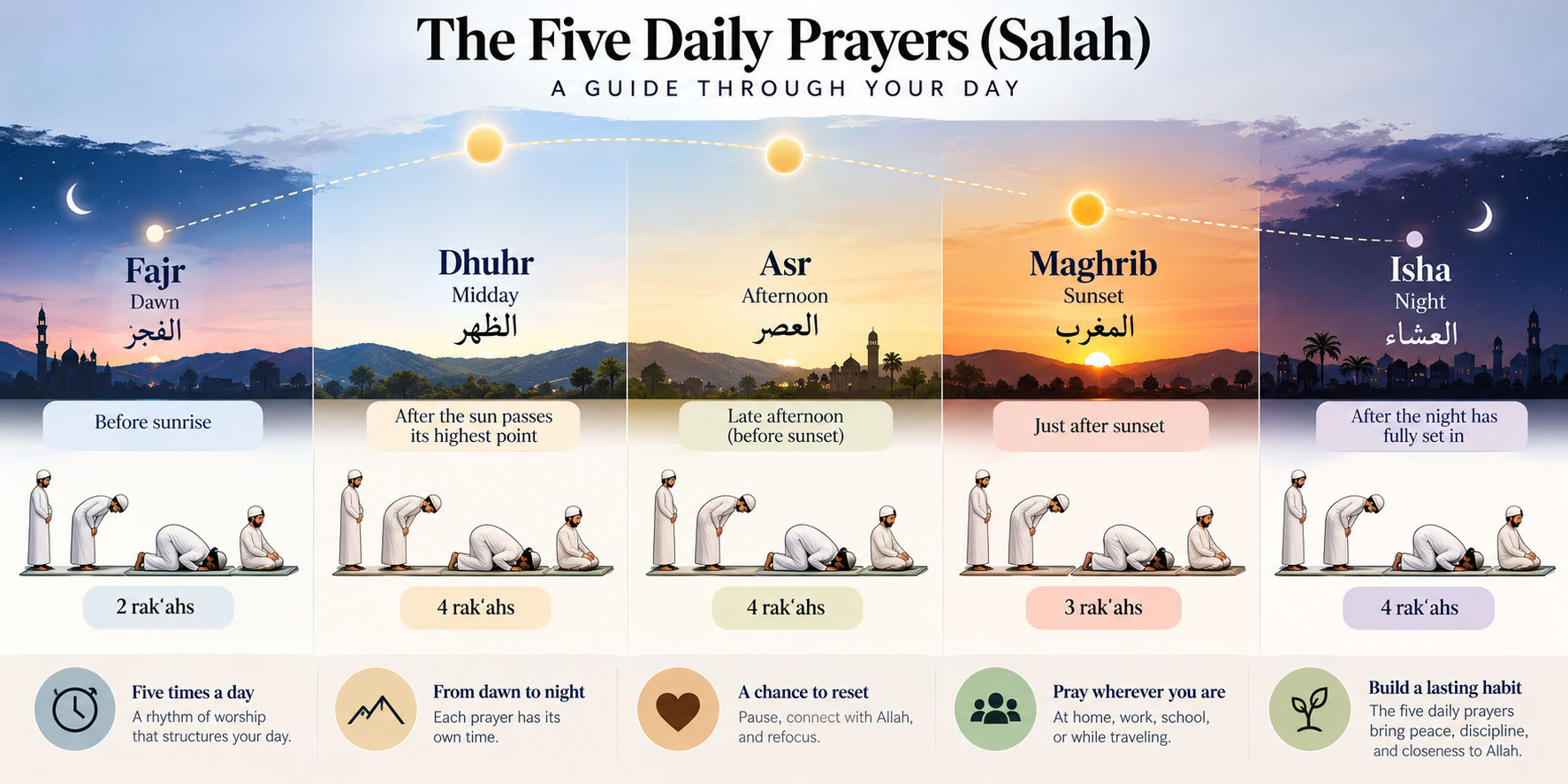
Muslims pray five times a day. The times are set in the Quran: "Prayer has been decreed upon the believers at specified times" (Quran 4:103).
Prayer | General Time | Obligatory (Fard) Rak'ahs |
|---|---|---|
Fajr | Dawn | 2 |
Dhuhr | After midday | 4 |
Asr | Afternoon | 4 |
Maghrib | After sunset | 3 |
Isha | Night | 4 |
These numbers are the obligatory Rak'ahs only. There are also Sunnah and voluntary prayers before or after some of them. Do not worry about those yet. Learn the obligatory prayers first.
Prayer times follow the sun, so they change by date and location. Use a trusted prayer-times app or your local mosque's timetable. (On Fridays, the Friday congregational prayer, Jumu'ah, takes the place of Dhuhr for those who attend. Your teacher can explain this when you are ready.)
What Do You Actually Need to Learn?
Here is your core checklist. It looks long, but most items are one short phrase.
☐ Takbir: Allahu Akbar
☐ Al-Fatihah: the opening chapter of the Quran
☐ A short Surah (or some other Quran) in the standing part of the prayer
☐ Words in Ruku
☐ Words when rising from Ruku
☐ Words in Sujud
☐ A short supplication between the two prostrations
☐ Tashahhud
☐ Salawat upon the Prophet ﷺ (in the final sitting)
☐ Taslim: the closing greeting
A note on rulings. Scholars of the four main schools agree on the overall shape of the prayer, but they classify some parts differently. For example, a part may be a pillar (rukn) in one school, wajib in another, and Sunnah in a third. This article points out where that matters and does not argue between schools. As a beginner, you should follow one reliable teacher or school consistently. If you do not have one yet, ask the imam or a teacher at your local mosque or online academy.
How to Learn Salah Step by Step
Step 1: Learn the Movements First
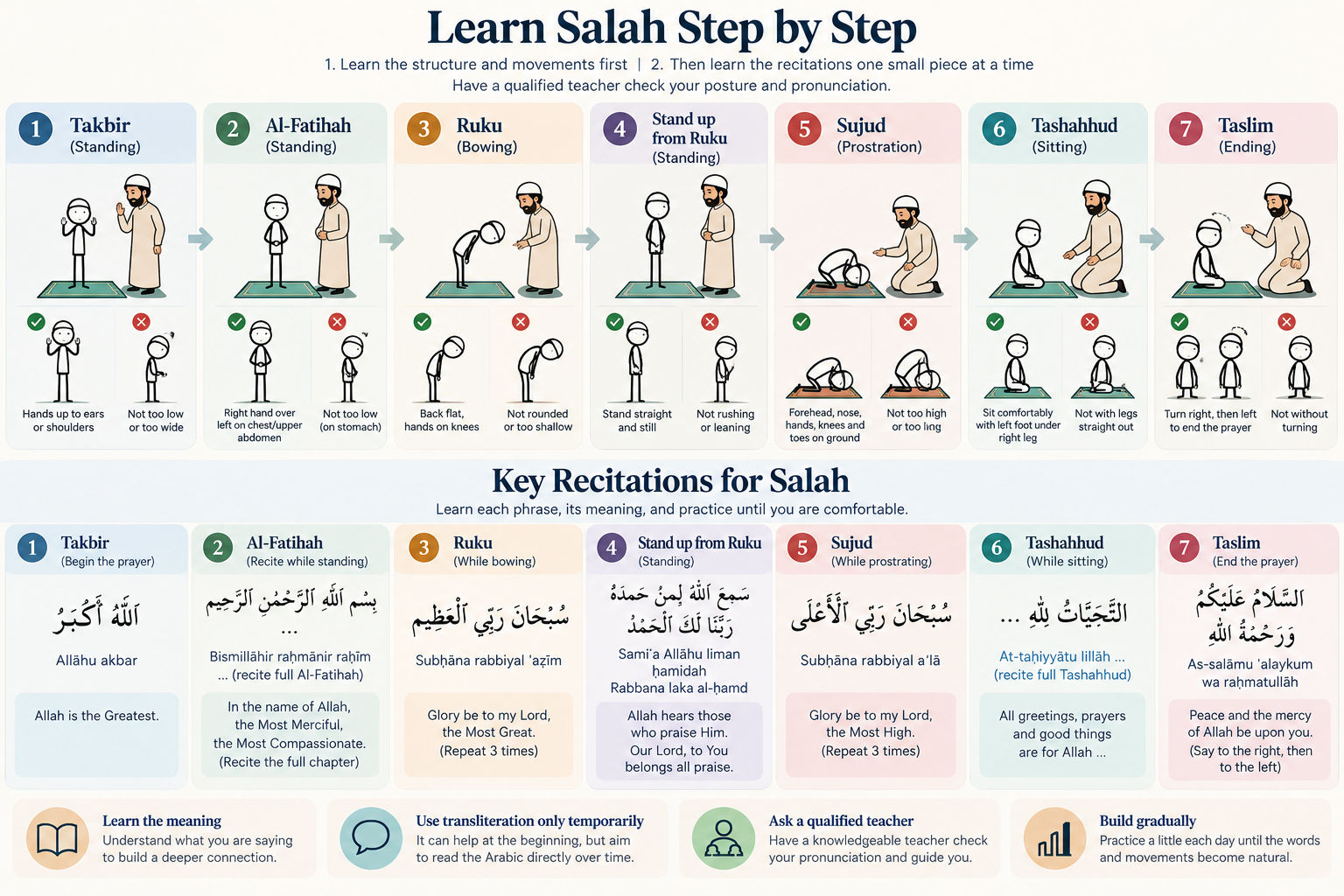
Learn the physical sequence of one Rak'ah:
Stand → Bow → Stand → Prostrate → Sit → Prostrate
Watch a reliable teacher or a trusted video. Then practise slowly, without words, just to learn the order. This is only the framework. A valid prayer needs the required recitations too, but knowing the order first makes everything else easier to place.
Step 2: Learn the Takbir
The prayer begins with the Takbir, said as you raise your hands and stand facing the Qiblah (the direction of the Kaaba in Makkah). It is also said when moving between many positions.
اللَّهُ أَكْبَرُ
Transliteration: Allahu Akbar
Meaning: Allah is the Greatest.
Pronunciation tips: Say "Al-lah" with a clear double l. In "Akbar," the k is a clear k and the r is lightly tapped, not rolled hard. Say it calmly, not rushed.
This is not a meaningless sound. It says: whatever occupied my mind a moment ago, Allah is greater. Let that meaning arrive as you say it.
Step 3: Learn Surah Al-Fatihah
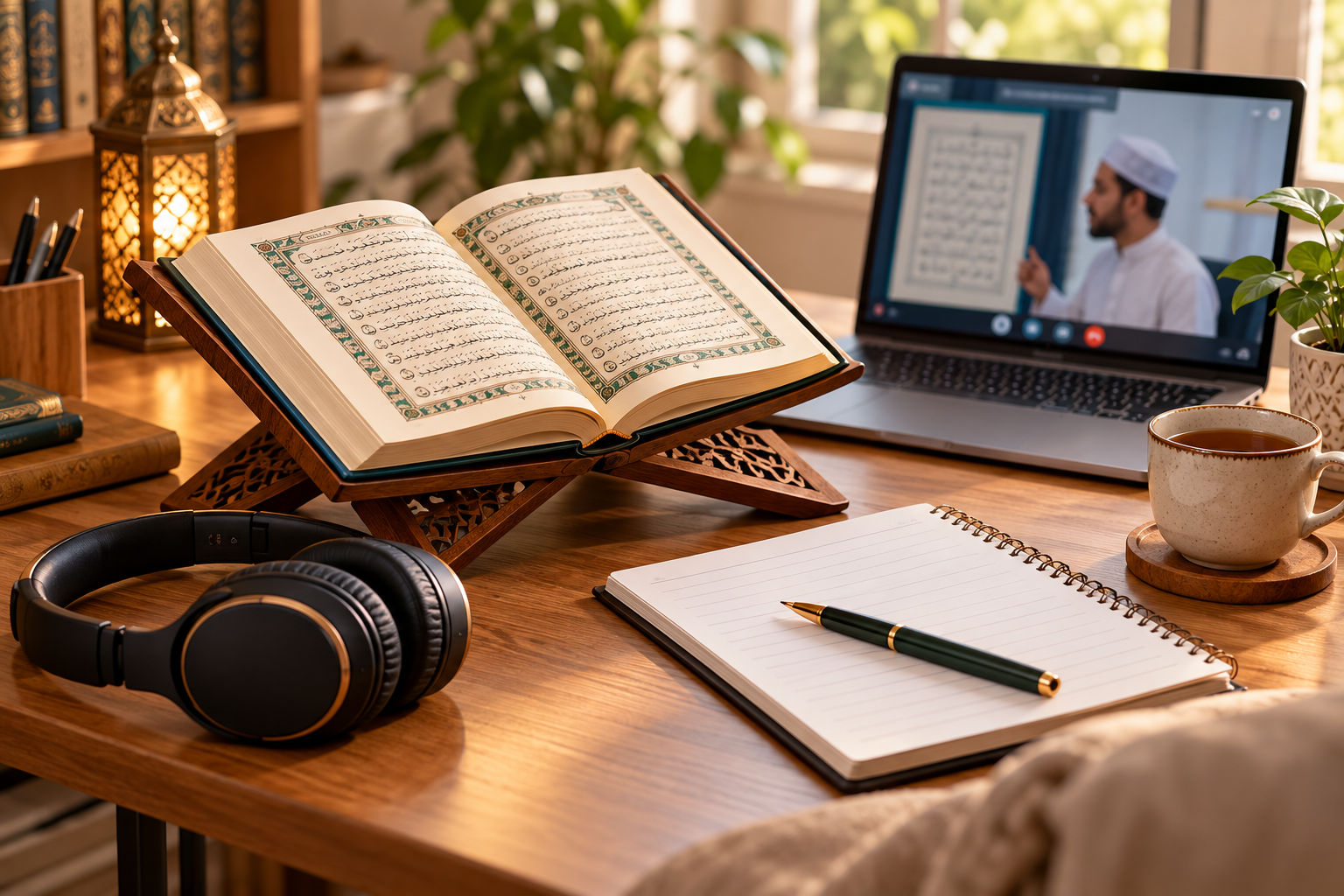
Al-Fatihah ("The Opening") is the heart of the prayer. It is recited in every Rak'ah. The Prophet ﷺ said: "There is no prayer for the one who does not recite the Opening of the Book" (Sahih al-Bukhari 756; Sahih Muslim 394).
Here it is, verse by verse. In the standard Hafs Mushaf, the Basmalah is counted as verse 1. (Schools differ on whether and how it is recited in prayer, so follow your teacher.)
Important: The transliteration below is a temporary learning aid. English letters cannot fully show Arabic sounds. Ask a qualified teacher to listen to you as soon as you can.
1. بِسْمِ اللَّهِ الرَّحْمَٰنِ الرَّحِيمِ Bismillahir-Rahmanir-Rahim In the name of Allah, the Most Gracious, the Most Merciful. Note: The h in "Rahman" and "Rahim" is ح, a soft breathy sound from the throat, not the English h.
2. الْحَمْدُ لِلَّهِ رَبِّ الْعَالَمِينَ Al-hamdu lillahi Rabbil-'alamin All praise is for Allah, Lord of all the worlds. Note: "hamd" also uses ح. The apostrophe in "'alamin" stands for ع, which has no English equivalent (more on this below).
3. الرَّحْمَٰنِ الرَّحِيمِ Ar-Rahmanir-Rahim The Most Gracious, the Most Merciful.
4. مَالِكِ يَوْمِ الدِّينِ Maliki yawmid-din Master of the Day of Judgment. Note: Read carefully: Maliki (with a long "a" in the first syllable).
5. إِيَّاكَ نَعْبُدُ وَإِيَّاكَ نَسْتَعِينُ Iyyaka na'budu wa iyyaka nasta'in You alone we worship, and You alone we ask for help. Note: Say the doubled y in "Iyyaka" clearly. It is two sounds held together.
6. اهْدِنَا الصِّرَاطَ الْمُسْتَقِيمَ Ihdinas-siratal-mustaqim Guide us to the straight path. Note: ص (in "sirat") is a heavier "s" than the English one. ق (in "mustaqim") comes from further back in the throat than an English k.
7. صِرَاطَ الَّذِينَ أَنْعَمْتَ عَلَيْهِمْ غَيْرِ الْمَغْضُوبِ عَلَيْهِمْ وَلَا الضَّالِّينَ Siratal-ladhina an'amta 'alayhim, ghayril-maghdubi 'alayhim wa lad-dallin The path of those You have blessed, not of those who earned anger, nor of those who went astray. Note: This is the hardest verse for most learners, with ع, غ, ض and a doubled l. Take it slowly and learn it with a teacher.
Learn one verse at a time. Do not try to memorize all seven in one sitting.
Understand What Al-Fatihah Means
Memorizing sounds is a beginning. Understanding turns those sounds into conversation. Here is the flow of Al-Fatihah in plain language:
Praise (verse 2): You begin by thanking and praising Allah, the Lord who created and looks after everything.
Mercy (verse 3): You remember that His lordship is full of mercy.
The Day of Judgment (verse 4): You remember that you will return to Him, so your choices matter.
Worship and help (verse 5): You say that worship belongs to Him alone, and that you turn to Him alone for help.
Guidance (verses 6 and 7): You ask for the thing you need most: guidance on the straight path, the way of those Allah has favoured.
A well-known hadith qudsi explains that Allah responds to His servant verse by verse as they recite the Fatihah (Sahih Muslim 395). Even at a beginner's level, knowing the meaning changes how you stand in prayer: you are asking, not just repeating. For deeper explanation, use a reliable Tafsir such as Ibn Kathir or As-Sa'di, or ask a teacher.
Learn a Short Surah
After Al-Fatihah, in the first two Rak'ahs, you recite some additional Quran. Many beginners start with Surah Al-Ikhlas (Quran 112) because it is short and clear.
١. قُلْ هُوَ اللَّهُ أَحَدٌ Qul huwa Allahu ahad Say: He is Allah, the One.
٢. اللَّهُ الصَّمَدُ Allahus-Samad Allah, the Eternal Refuge, the One everything depends on.
٣. لَمْ يَلِدْ وَلَمْ يُولَدْ Lam yalid wa lam yulad He has not fathered anyone, nor was He born.
٤. وَلَمْ يَكُنْ لَهُ كُفُوًا أَحَدٌ Wa lam yakun lahu kufuwan ahad And there is none comparable to Him.
This Surah is a short, powerful statement of who Allah is. The Prophet ﷺ described it as equal to a third of the Quran in meaning (Sahih al-Bukhari 5013).
Note that no single Surah is required after Al-Fatihah. You may recite others, such as Al-Kawthar (108), Al-Asr (103) or An-Nas (114). Schools classify the additional recitation differently (Sunnah in some, wajib in the Hanafi school), and it is normally recited in the first two Rak'ahs of the obligatory prayers, not in the third and fourth. Your teacher can guide you.
What to Say in Ruku
Ruku is the bowing position: back straight, hands on knees. The most common remembrance is:
سُبْحَانَ رَبِّيَ الْعَظِيمِ
Transliteration: Subhana Rabbiyal-'Azim
Meaning: Glory be to my Lord, the Magnificent.
It is usually said three times, and it is reported in Sahih Muslim 772.
Word by word:
Subhana: Glory be to Him; He is far above any fault or weakness.
Rabbi: my Lord (the One who created, owns and cares for me).
Al-'Azim: the Magnificent, the Great.
Pronunciation: ع in "'Azim" is a deep sound from the throat. ظ in "'Azim" is like a heavy "th" as in "the." Both take practice. It is fine to start with an approximation and improve with listening.
Think about the posture. You are bending down in humility, and your words are praising Allah's greatness. Body and words agree.
What to Say When Rising From Ruku
As you rise, the Sunnah phrases are:
سَمِعَ اللَّهُ لِمَنْ حَمِدَهُ Sami'a Allahu liman hamidah Allah hears the one who praises Him.
رَبَّنَا وَلَكَ الْحَمْدُ Rabbana wa lakal-hamd Our Lord, and all praise is Yours.
Who says what? This is a case where the schools have small differences. In general, the imam says the first phrase as he rises, and those following him respond with the second. For someone praying alone, most scholars say to say both. Some Hanafi scholars describe it differently. Follow your teacher's school. In all cases, stand up straight and calm before going down to Sujud.
What to Say in Sujud
Sujud is the lowest position, with your forehead, nose, palms, knees and toes on the ground.
سُبْحَانَ رَبِّيَ الْأَعْلَى
Transliteration: Subhana Rabbiyal-A'la
Meaning: Glory be to my Lord, the Most High.
This too is usually said three times (reported in Sahih Muslim 772).
Notice the meaning. Your head is at its lowest, and you say "the Most High." The Prophet ﷺ said: "The closest a servant is to his Lord is when he is in prostration, so make plenty of supplication (dua) in it" (Sahih Muslim 482). Sujud is a special place for personal dua. Scholars differ on how much personal dua is best in the obligatory prayer versus voluntary prayers, so ask your teacher; for now, learn the prescribed phrase first.
What to Say Between the Two Prostrations
You sit briefly (the Jalsa) between the two Sujuds. A short dua taught in the Sunnah is:
رَبِّ اغْفِرْ لِي
Transliteration: Rabbighfir li
Meaning: My Lord, forgive me.
It is reported from Hudhayfah in the collections of Abu Dawud and Ibn Majah, where it is said twice. There is also a longer version reported from Ibn Abbas that you can learn later.
Three words, and a complete request. Beginners often find this the easiest phrase to learn.
How to Learn the Tashahhud
The Tashahhud is longer, so break it into four small chunks. The version below is the one from Ibn Mas'ud, reported in Sahih al-Bukhari 831 and Sahih Muslim 402, and it is widely taught. Other authentic wordings exist (for example, from Ibn Abbas). They are also correct, so if you meet someone who says it slightly differently, this does not mean either of you is wrong.
Chunk 1 التَّحِيَّاتُ لِلَّهِ وَالصَّلَوَاتُ وَالطَّيِّبَاتُ At-tahiyyatu lillahi was-salawatu wat-tayyibat All greetings, prayers and good things belong to Allah.
Chunk 2 السَّلَامُ عَلَيْكَ أَيُّهَا النَّبِيُّ وَرَحْمَةُ اللَّهِ وَبَرَكَاتُهُ As-salamu 'alayka ayyuhan-nabiyyu wa rahmatullahi wa barakatuh Peace be upon you, O Prophet, and the mercy of Allah and His blessings.
Chunk 3 السَّلَامُ عَلَيْنَا وَعَلَى عِبَادِ اللَّهِ الصَّالِحِينَ As-salamu 'alayna wa 'ala 'ibadillahis-salihin Peace be upon us and upon the righteous servants of Allah.
Chunk 4 (the testimony) أَشْهَدُ أَنْ لَا إِلَٰهَ إِلَّا اللَّهُ وَأَشْهَدُ أَنَّ مُحَمَّدًا عَبْدُهُ وَرَسُولُهُ Ash-hadu an la ilaha illallah, wa ash-hadu anna Muhammadan 'abduhu wa rasuluh I bear witness that there is no god but Allah, and I bear witness that Muhammad is His servant and Messenger.
Learn one chunk per day if needed. The last chunk is the same testimony you said when you became Muslim, so it may already feel familiar.
Schools classify the Tashahhud differently: the final Tashahhud is a pillar in some schools, wajib in another, and the first Tashahhud is wajib or Sunnah depending on the school. For a beginner, the simple rule is: learn it and pray with it, and ask your teacher for your school's detail.
Salawat Upon the Prophet ﷺ
In the final sitting, after the Tashahhud, Muslims send blessings on the Prophet ﷺ. The most commonly taught form is the Salat Ibrahimiyyah, reported by Ka'b ibn Ujrah in Sahih al-Bukhari 3370 and Sahih Muslim 406.
Part 1 اللَّهُمَّ صَلِّ عَلَىٰ مُحَمَّدٍ وَعَلَىٰ آلِ مُحَمَّدٍ، كَمَا صَلَّيْتَ عَلَىٰ إِبْرَاهِيمَ وَعَلَىٰ آلِ إِبْرَاهِيمَ، إِنَّكَ حَمِيدٌ مَجِيدٌ Allahumma salli 'ala Muhammadin wa 'ala ali Muhammad, kama sallayta 'ala Ibrahima wa 'ala ali Ibrahim, innaka Hamidun Majid O Allah, send prayers upon Muhammad and the family of Muhammad, as You sent prayers upon Ibrahim and the family of Ibrahim. You are Praiseworthy and Glorious.
Part 2 اللَّهُمَّ بَارِكْ عَلَىٰ مُحَمَّدٍ وَعَلَىٰ آلِ مُحَمَّدٍ، كَمَا بَارَكْتَ عَلَىٰ إِبْرَاهِيمَ وَعَلَىٰ آلِ إِبْرَاهِيمَ، إِنَّكَ حَمِيدٌ مَجِيدٌ Allahumma barik 'ala Muhammadin wa 'ala ali Muhammad, kama barakta 'ala Ibrahima wa 'ala ali Ibrahim, innaka Hamidun Majid O Allah, bless Muhammad and the family of Muhammad, as You blessed Ibrahim and the family of Ibrahim. You are Praiseworthy and Glorious.
Some schools consider the Salawat in the final sitting a required part of the prayer, while others consider it a strongly recommended Sunnah. If it feels like a lot, learn it after the earlier items on your list, and ask your teacher where it fits in your learning order.
Ending the Prayer
The prayer ends with the Taslim. Turn your face to the right and say:
السَّلَامُ عَلَيْكُمْ وَرَحْمَةُ اللَّهِ As-salamu 'alaykum wa rahmatullah Peace be upon you, and the mercy of Allah.
Then turn to the left and say it again. The Prophet ﷺ was seen turning right and left until the whiteness of his cheek could be seen (Sahih Muslim 582).
You now know the whole journey:
Standing → Quran → Bowing → Standing → Prostration → Sitting → Prostration → Repetition → Tashahhud → Taslim
A Complete Two-Rak'ah Prayer at a Glance
Here is Fajr (or any two-Rak'ah prayer) from start to finish:
Intention in the heart. No special spoken Arabic formula is required; the intention is what you know and decide in your heart, that you are praying this prayer for Allah.
Opening Takbir: Allahu Akbar, raising the hands.
Standing recitation: Al-Fatihah, then a short Surah. (Many people also say the opening supplication and seek refuge first; your teacher will show you.)
Takbir and Ruku: Subhana Rabbiyal-'Azim
Rise from Ruku: Sami'a Allahu liman hamidah / Rabbana wa lakal-hamd
Takbir and first Sujud: Subhana Rabbiyal-A'la
Takbir and sit briefly: Rabbighfir li
Takbir and second Sujud: Subhana Rabbiyal-A'la
Stand for the second Rak'ah and repeat: Al-Fatihah, a Surah, Ruku, rising, two Sujuds with the sitting between.
After the second Sujud, sit and recite the Tashahhud.
Salawat upon the Prophet ﷺ.
Taslim to the right, then to the left.
Three- and four-Rak'ah prayers add more Rak'ahs before the final sitting. That is a step for later, once this pattern feels natural.
How to Memorize Salah When Arabic Feels Difficult
Learn in small pieces, and review often.
Stage 1: Learn Allahu Akbar and understand it.
Stage 2: Learn Al-Fatihah, one verse at a time.
Stage 3: Learn the phrases for Ruku and Sujud.
Stage 4: Learn one short Surah.
Stage 5: Learn the Tashahhud.
Stage 6: Add the remaining recitations and keep improving your pronunciation.
This order is a general study path. What you must have in place to pray validly at a given moment depends on your circumstances and the school you follow, so ask a teacher which items to prioritize first. (See the next sections.)
A 7-Day Salah Learning Plan
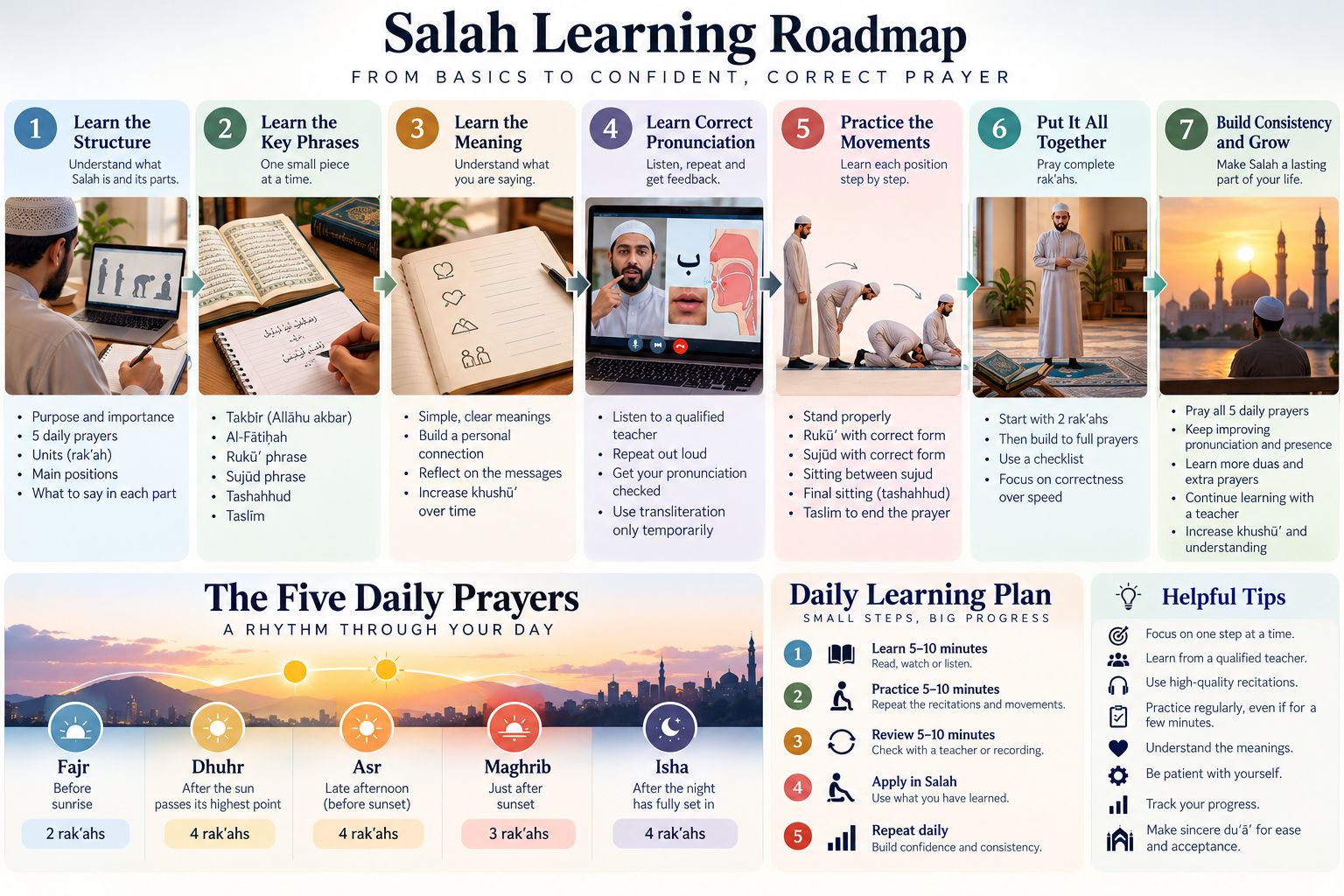
This is a study plan, not a claim that every beginner will master Salah in seven days. Many people need weeks for Al-Fatihah pronunciation, and that is perfectly normal.
Day 1: Understand the structure and the five daily prayers.
Day 2: Learn the movements and the Takbir.
Day 3: Begin Al-Fatihah (verses 1–3).
Day 4: Continue Al-Fatihah (verses 4–7) and review pronunciation.
Day 5: Learn the Ruku and Sujud phrases.
Day 6: Begin the Tashahhud and review the whole sequence.
Day 7: Put the pieces together, slowly, in a two-Rak'ah practice prayer.
If a day feels too much, repeat it. Progress matters more than speed.
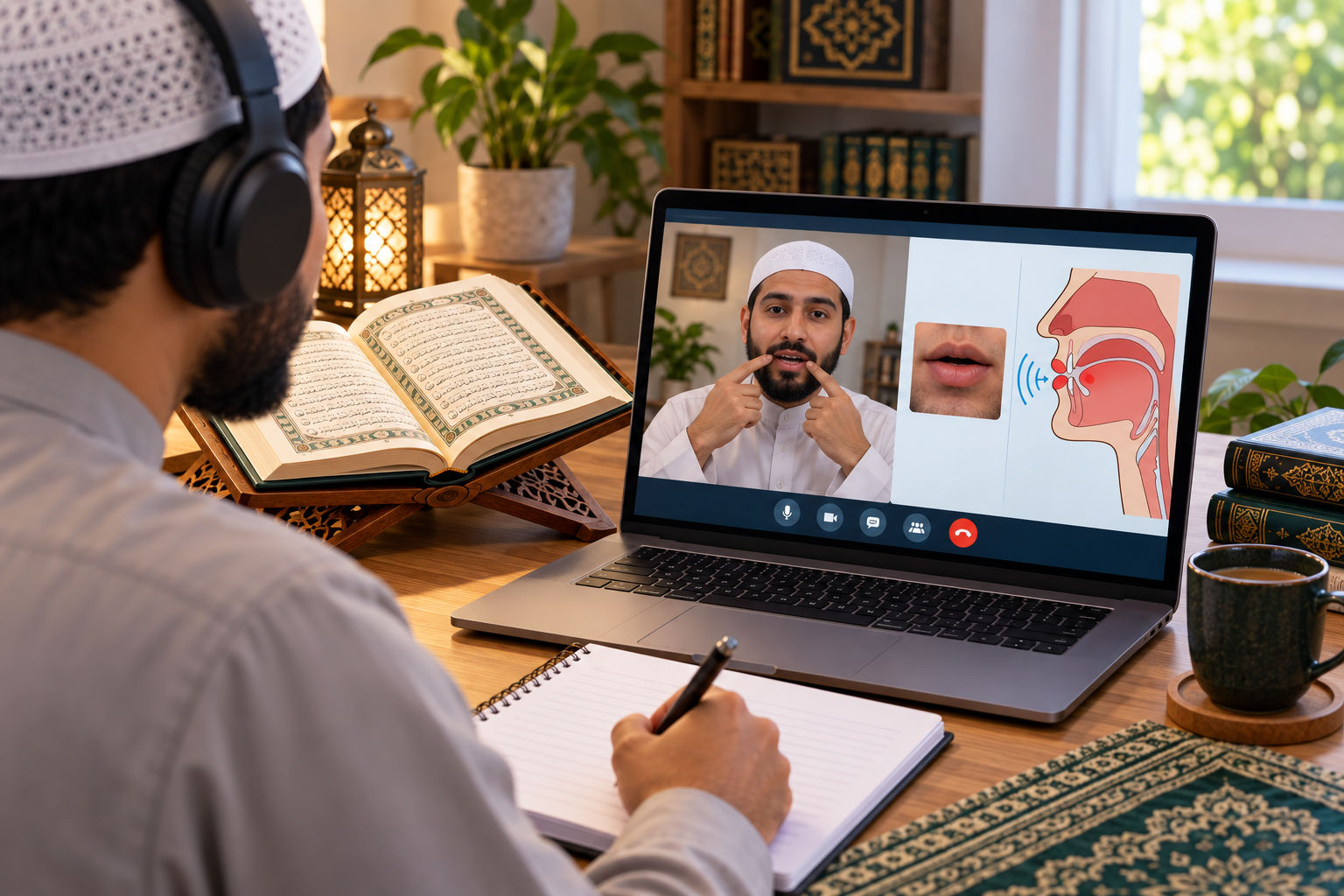
How to Pronounce Arabic Words in Salah
Arabic has sounds that English does not. You will meet these letters in Salah:
ح خ ع غ ق ص ض ط ظ
Do not expect to master them all at once. These sounds come from different places in the mouth and throat (the makharij), and they are learned mainly by listening and repeating after a qualified teacher.
This is why transliteration has limits. Writing kh for خ or ' for ع gives you a hint, but not the real sound. Your ear and a teacher's correction do the rest.
A helpful path is:
English transliteration → Arabic script + listening → direct Arabic reading
You do not need to leave the first stage in a hurry. But keep moving forward. Learning the Arabic alphabet takes most learners only a few weeks, and it opens the door to everything else. (See How to Read the Quran in Arabic, Arabic Pronunciation for Beginners and Tajweed for Beginners.)
Is My Salah Invalid If My Arabic Pronunciation Isn't Perfect?
This is a very common fear, and it deserves a calm and careful answer.
There is no single yes-or-no ruling, because pronunciation mistakes are not all the same:
Accent differences. Every non-native speaker has some accent. This is normal.
Difficulty with a specific sound. Many learners, at first, cannot yet make certain sounds properly.
Small mistakes that do not change the meaning.
Mistakes that do change the meaning. For example, saying an'amtu ("I bestowed") instead of an'amta ("You bestowed") in Al-Fatihah changes the meaning. Scholars take mistakes like this seriously, especially in Al-Fatihah.
Inability despite sincere effort. Scholars treat a person who truly cannot say something differently from a person who is careless.
Scholars generally distinguish between obvious errors that change the meaning and subtle Tajweed refinements, which are handled differently. The details vary by school and by the person's ability.
So please do not spiral into worry. Two things are true at once: keep learning and getting corrected, and do not become paralyzed. For a specific question like "is my recitation of this verse acceptable?", ask a qualified teacher or scholar who can actually hear you. A general article cannot judge that.
What If I Haven't Memorized Al-Fatihah Yet?
If you have just become Muslim, you may be wondering what to do right now. Please read this section slowly.
First: do not skip prayer, and do not delay starting to learn. Begin learning Al-Fatihah as soon as reasonably possible, and pray while you are learning.
Second: scholars have discussed exactly this situation, and the answer depends on the school and on what the person can currently recite. Here is a simple summary of the main approaches, without going into technical detail:
Many scholars, especially in the Shafi'i and Hanbali schools, rely on a hadith in which a man told the Prophet ﷺ that he could not yet learn the Quran and asked for something to say instead. The Prophet ﷺ taught him a phrase of praise and remembrance: Subhanallah, walhamdulillah, wa la ilaha illallah, wallahu akbar, wa la hawla wa la quwwata illa billah (reported by Abu Dawud and an-Nasa'i, from Abdullah ibn Abi Awfa). These scholars say a person who truly cannot yet recite Al-Fatihah says remembrances like this in its place while learning, and keeps learning.
Other schools, including the Hanafi and the Maliki, have their own rules on the required recitation and on what to do when someone genuinely cannot recite it. The Hanafi school, for instance, classifies the required recitation differently from the majority.
These are summaries, not a personal fatwa. Because this is an obligatory act of worship, please ask a qualified imam or teacher what applies to you during your learning period. Most imams have helped many new Muslims through this exact stage and will not judge you.
Allah says: "So fear Allah as much as you are able" (Quran 64:16). Doing what you can, while sincerely working to learn more, is the path.
Can I Pray Salah in English?
This is a common question, so let's be careful and separate the pieces:
The prescribed recitations of Salah (Al-Fatihah, Ruku and Sujud phrases, Tashahhud and so on) are in Arabic. The overwhelming position among Muslim scholars is that those able to learn them should recite them in Arabic. Some early opinions in the Hanafi school allowed other languages, but the widely relied-upon position of the school today is that Arabic is required for those who can learn it, and that a person who truly cannot is treated according to their inability. Scholars discuss this in detail, so ask your teacher for your school's position.
Personal dua (your own words asking Allah for things) can be made in any language, including English, in the appropriate places outside the fixed recitations and in Sujud according to the scholarly discussion above.
Learning translations is highly encouraged. Knowing what the Arabic means makes your prayer deeper.
Temporary inability is a separate case, covered in the section above.
So, understanding the English translation is valuable, but it does not remove the need to learn the prescribed Arabic recitations.
Transliteration: Helpful Tool or Bad Habit?
Both, depending on how you use it.
Why it helps: It lets a complete beginner start hearing and saying approximate sounds before they can read Arabic.
Why it has limits: English letters cannot show every Arabic sound. Different websites also use different spelling systems for the same word, which can confuse you.
The best approach: Use it as a temporary bridge. At the same time, learn the Arabic letters, listen to a good reciter or teacher, and slowly begin reading the Arabic itself. Over time, rely on transliteration less and less.
Learn the Meaning, Not Just the Sounds
Here is a small Salah vocabulary to start with:
Arabic | Transliteration | Meaning |
|---|---|---|
الله | Allah | Allah (God) |
أكبر | Akbar | Greater / Greatest |
رب | Rabb | Lord |
الحمد | Al-hamd | The praise |
الرحمن | Ar-Rahman | The All-Merciful / Most Gracious |
الرحيم | Ar-Rahim | The Especially Merciful |
يوم | Yawm | Day |
اهدنا | Ihdina | Guide us |
الصراط | As-Sirat | The path |
سبحان | Subhana | Glory be to (Him) |
العظيم | Al-'Azim | The Magnificent |
الأعلى | Al-A'la | The Most High |
Notice how many of these words repeat. Salah is a natural first classroom for Quranic Arabic.
From Memorizing Salah to Understanding Arabic
Here is the path many students follow:
Step 1: Memorize the necessary Arabic.
Step 2: Understand each phrase.
Step 3: Learn the individual words.
Step 4: Start recognizing patterns (for example, how Rabb, Rabbi and Rabbana are related).
Step 5: Learn Quranic Arabic step by step.
You do not have to go all the way. But if you want to, Salah is already giving you a head start. (See 50 Essential Arabic Words Every Muslim Should Know, 100 Most Common Words in the Quran and Quranic Arabic vs Modern Standard Arabic.)
Common Mistakes Beginners Make When Learning Salah
1. Trying to memorize everything in one night. Your brain learns better in short, repeated sessions. Small steps stick.
2. Depending only on written transliteration. It is a bridge, not a destination. Add listening and Arabic letters.
3. Copying random videos without checking their reliability. Choose teachers and sources that follow recognized scholarship, and stay with one approach so you do not get confused.
4. Focusing on movements but ignoring meaning. The movements are important, but the words are what connect your heart to what you are doing.
5. Becoming obsessed with perfect pronunciation immediately. Aim to improve steadily. Perfection is a long journey, and Allah knows your effort.
6. Never asking someone to check your Al-Fatihah. You cannot hear your own small mistakes. Ask a teacher to listen.
7. Learning detailed optional matters before the core prayer. Sunnah details are valuable, but the foundation comes first.
8. Giving up because progress feels slow. Almost every learner feels this at some point. Slow progress is still progress.
How Long Does It Take to Learn Salah?
There is no universal timeline. You can understand the physical sequence fairly quickly. Learning and pronouncing Al-Fatihah and the other recitations well usually takes longer.
What affects your pace:
whether you can already read Arabic
how much Salah you have seen before
your memorization style
your pronunciation background
how often you have lessons
how often you practise
whether you have a teacher
Aim for consistency, not speed. Ten minutes a day for a month will usually take you further than one long session once a week.
Learning Salah as a New Muslim
If you have recently become Muslim, welcome. You may feel that there is a mountain to climb: Salah, Wudu, the Quran, Arabic, halal and haram, beliefs, community customs, and lots of new words.
Please take a breath. You do not have to become an expert quickly. Learn the foundations well before trying to absorb hundreds of details. Salah and Wudu are a strong place to begin. Then build slowly.
Connect with reliable teachers and a supportive community, whether at a local mosque or online. Ask questions freely. No one who understands Islam expects a new Muslim to know everything. (See I Just Converted to Islam: What Should I Learn First?)
How Parents Can Teach Salah to Children
Let young children imitate you. They learn by watching.
Pray together when you can.
Teach one phrase at a time.
Explain the meaning in simple words.
Use visual sequences (like movement cards) where helpful.
Correct gently. Encouragement works better than pressure.
Build a routine around prayer times.
Praise effort and consistency.
Salah should feel like a warm part of family life, not just a rule or a punishment. As children grow older, parents can also teach the seriousness of Salah, and still keep that warmth.
Salah Learning Checklist
☐ I know the five daily prayers.
☐ I understand what a Rak'ah is.
☐ I know the basic prayer movements.
☐ I know the opening Takbir.
☐ I am learning (or have learned) Al-Fatihah.
☐ Someone knowledgeable has checked my Al-Fatihah pronunciation.
☐ I know what I say in Ruku.
☐ I know what I say in Sujud.
☐ I am learning (or have learned) the Tashahhud.
☐ I understand the basic meanings of the words I recite.
☐ I am gradually reducing my dependence on transliteration.
☐ I know who to ask when I have a specific Fiqh question.
Tick what you can, and be kind to yourself about the rest. Every box is a step forward.
A Simple Daily Practice Routine
Fifteen minutes a day is enough to make real progress.
5 minutes, Listen: Play a clear recitation of the phrase or verse you are learning.
5 minutes, Repeat: Say it slowly after the reciter, and focus on the sounds.
3 minutes, Understand: Review the meaning of each word.
2 minutes, Recall: Try saying it without looking.
Short and regular practice usually works better than a long session now and then.
Why a Teacher Makes Such a Difference
You can learn a lot from articles, apps and videos. But a teacher can do things a page cannot. A teacher can:
listen to your Al-Fatihah and correct it
teach you the Arabic sounds directly
help you begin reading the Quran
introduce Tajweed step by step
explain Arabic vocabulary
give you a structured plan
adjust to your level
If you are learning Salah and want help improving Al-Fatihah, Quran reading, or Arabic pronunciation, Araby Academy's one-to-one lessons can give you direct feedback from a qualified teacher at your current level.
Frequently Asked Questions
1. How do beginners learn Salah?
Start with the structure and movements, then learn the Takbir, Al-Fatihah, the phrases for Ruku and Sujud, a short Surah, the Tashahhud and the Taslim. Learn in small pieces, understand the meanings, and ask a teacher to check your recitation.
2. Can I pray if I don't speak Arabic?
Yes. Most Muslims in the world are not native Arabic speakers. You learn the Arabic recitations of Salah without needing to speak the language in general, and you learn their meanings so you know what you are saying.
3. Do I need to understand Arabic to pray Salah?
You do not need fluent Arabic. It is very helpful to understand the meaning of what you recite, and that is strongly encouraged, but understanding is not the same as learning the required recitations.
4. Can a new Muslim pray before memorizing Al-Fatihah?
Scholars discuss this situation, and the details differ by school. Many rely on the hadith of Abdullah ibn Abi Awfa (remembrance in place of what one cannot yet recite). Begin learning Al-Fatihah as soon as you can, and ask a qualified imam or teacher what applies to you in the meantime.
5. Can I pray Salah in English?
The prescribed recitations are in Arabic, and the mainstream scholarly position is that those who are able should recite them in Arabic. Personal dua can be in any language. Ask your teacher about your school's position and about your situation if you are still learning.
6. How long does it take to learn Salah?
It varies. The sequence can be learned in days, while pronouncing and memorizing the recitations well may take weeks or months. Consistency matters more than speed.
7. What should I memorize first for Salah?
Most teachers begin with the Takbir and Al-Fatihah, then the phrases for Ruku and Sujud, a short Surah, and the Tashahhud. Your teacher may adjust the order to your circumstances.
8. Is transliteration okay when learning Salah?
It is a helpful temporary tool, but it cannot fully show Arabic sounds. Use it alongside listening and learning the Arabic letters, and rely on it less over time.
9. How can I learn Al-Fatihah correctly?
Listen to a good reciter, repeat slowly one verse at a time, learn the meaning, and have a qualified teacher listen and correct you.
10. What if I make Arabic pronunciation mistakes during Salah?
Not all mistakes are equal. Accent differences and subtle Tajweed points are treated differently from errors that change meaning, and there is consideration for someone who truly cannot yet pronounce something. Do not panic. Keep learning, and ask a qualified teacher who can hear you.
11. How many Rak'ahs are in the five daily prayers?
The obligatory Rak'ahs are: Fajr 2, Dhuhr 4, Asr 4, Maghrib 3 and Isha 4, making 17 in total.
12. Do I need to learn Arabic to become Muslim?
No. Becoming Muslim means sincerely declaring that there is no god but Allah and that Muhammad is His Messenger. You can then learn Arabic and the prayer gradually.
Conclusion: From Unfamiliar Words to a Familiar Conversation With Allah
Think back to the person watching others pray, seeing only a chain of unfamiliar words and movements.
Then something changes. You recognize the movements. You remember Al-Fatihah. You understand what Alhamdulillahi Rabbil-'alamin means. You recognize the word Rabb. You know what Ihdina is asking for. You know what you are saying when you bow and when you prostrate.
Slowly, what once felt foreign becomes part of the rhythm of your day.
The goal is not to memorize a script. It is to worship Allah with growing knowledge, presence and confidence. So if you are wondering how to learn Salah, start where you are, keep going, and do not wait for perfection before you take your learning seriously.
If you would like personal help with Al-Fatihah, Quran reading, Tajweed or Arabic pronunciation, Araby Academy's one-to-one lessons are there to support you, whatever your level today.