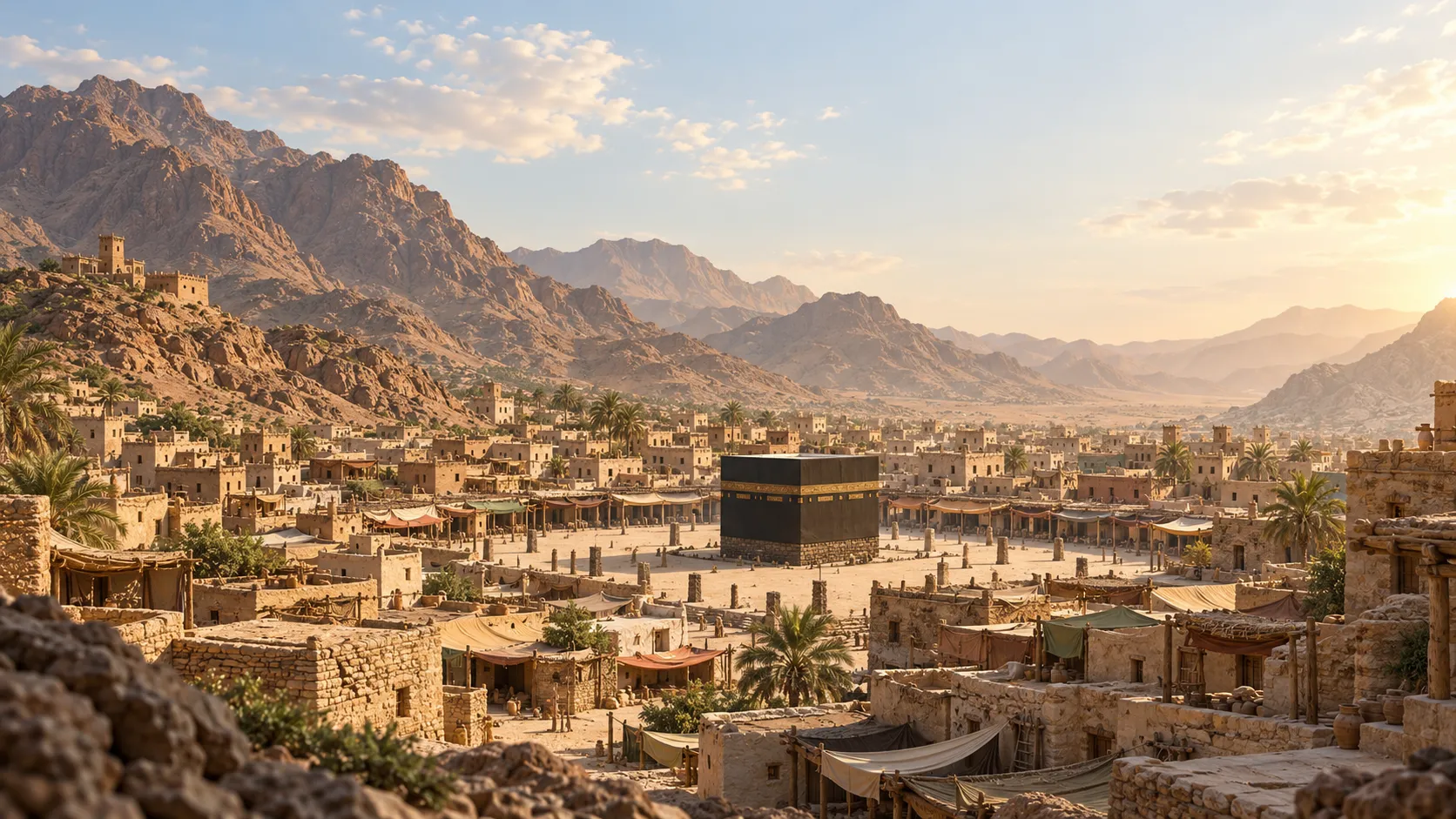
A new Muslim stands in a supermarket aisle, wondering whether an ingredient is Halal. A student hears that a favorite habit is Haram. A parent calls a family custom a religious duty. Someone else scrolls past two videos that give opposite answers about the same everyday activity.
Every question seems to have only two possible answers: Halal or Haram. But Islamic jurisprudence uses a richer vocabulary. Scholars commonly teach five categories of rulings: obligatory, recommended, permissible, disliked, and forbidden. Knowing them prevents both careless permissiveness and unnecessary restriction. It also shows that Islamic law is not arbitrary, because rulings are derived from revelation through established methods.
What is the difference between Halal and Haram in Islam? Halal means lawful or permissible under Islamic teaching, while Haram means prohibited. However, Islamic rulings are commonly explained through five categories: obligatory, recommended, permissible, disliked, and forbidden. These distinguish what Muslims must do, are encouraged to do, may freely do, should preferably avoid, and must not do. Specific rulings are derived from the Quran, authentic Sunnah, and recognized juristic methods.
What Do Halal and Haram Mean in Islam?
Halal (حَلَال) comes from the root ح ل ل (h-l-l), whose core sense in classical Arabic dictionaries involves untying or release from restriction. In religious usage, it means what Allah’s law permits. Haram (حَرَام) comes from ح ر م (h-r-m) and means what is prohibited or inviolable. The same root appears in words of sanctity, such as al-Masjid al-Haram (the Sacred Mosque) and ihram (the sacred state of pilgrimage), so not every word from this root means “sinful.”
Three clarifications help. First, Halal is not the same as a “halal-certified” product; certification is an institution’s claim about a product, not the definition of the term. Second, Halal does not mean “best in every situation,” since a permitted act may be wise, unwise, or neutral depending on circumstances. Third, Halal does not mean healthy. A permitted food can still be harmful in excess or unsuitable for someone’s medical needs, and those are questions for medicine and nutrition as well as Fiqh.
The Quran often pairs Halal with Tayyib (طَيِّب), meaning good, pure, or wholesome:
يَا أَيُّهَا النَّاسُ كُلُوا مِمَّا فِي الْأَرْضِ حَلَالًا طَيِّبًا
“O mankind, eat from what is lawful and good on the earth.” (Quran 2:168)
Classical commentators generally understand halal as what is permitted and tayyib as what is pure and wholesome, and Quran 16:114 repeats the pairing. Together they suggest that Islamic guidance cares about both the legitimacy and the quality of what we consume. No single English word captures every shade of tayyib.
The Five Categories of Islamic Rulings
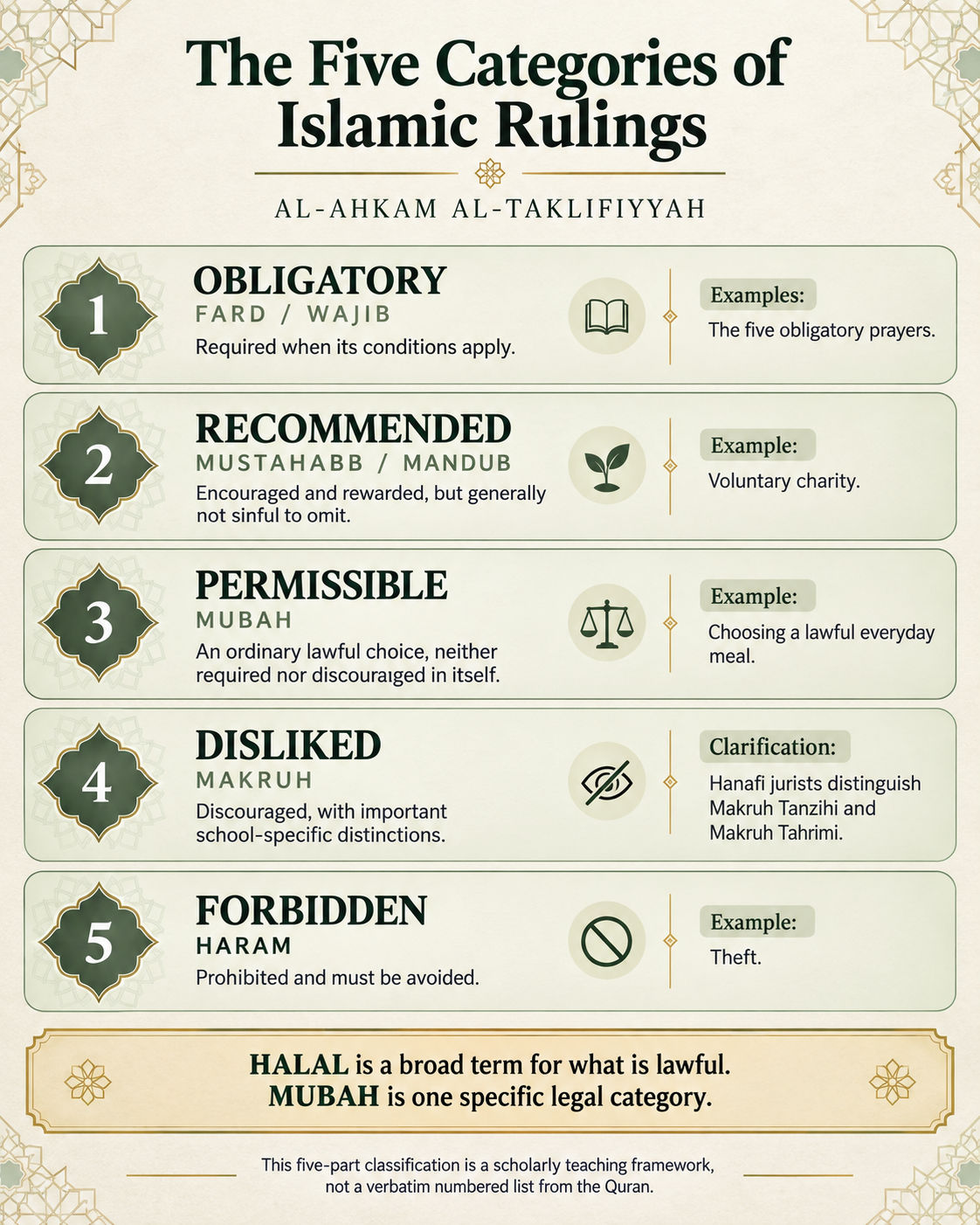
Scholars call this framework al-ahkam al-taklifiyyah (الأَحْكَامُ التَّكْلِيفِيَّة), “the rulings addressed to a responsible person.” It is a scholarly classification drawn from the texts, not a numbered list found verbatim in the Quran.
Category | Arabic | Meaning | Basic Practical Rule |
|---|---|---|---|
Obligatory | فَرْض / وَاجِب | Required | Rewarded when done; blameworthy to neglect without excuse |
Recommended | مُسْتَحَبّ / مَنْدُوب | Encouraged | Rewarded when done; not sinful to omit |
Permissible | مُبَاح | Neither commanded nor discouraged | Free choice |
Disliked | مَكْرُوه | Discouraged | Better to avoid; generally not treated like Haram |
Forbidden | حَرَام | Prohibited | Must be avoided |
Different schools may distinguish some technical subcategories, particularly Fard/Wajib and types of Makruh. Halal is not a sixth category above these; it is a broader term for what is not prohibited.
Fard and Wajib — Obligatory
Fard (فَرْض) and Wajib (وَاجِب) describe acts a Muslim is required to perform. The clearest everyday example of an obligatory act is performing [ the five daily prayers], which form a central part of Muslim worship. Fasting in Ramadan for those who are obligated and able, and Zakat for those who meet its conditions, are further examples.
Most jurists use fard and wajib as synonyms. The Hanafi school distinguishes them. A fard is established by definitive evidence, so denying it is a matter of faith. A wajib is established by evidence open to interpretation and is binding in practice, though denying it carries different consequences. So the terms are neither universally identical nor universally separate; it depends on the school.
Obligatory does not mean exceptionless. Obligations apply to those who are responsible and capable. Illness, travel, age, and other recognized excuses can change how a duty applies, and being excused is different from neglecting.
Mustahabb and Mandub — Recommended
Mustahabb (مُسْتَحَبّ) and Mandub (مَنْدُوب) describe acts the texts encourage without requiring them, such as voluntary charity (sadaqah), certain voluntary prayers, and other practices established by authentic evidence. Doing them is rewarded; omitting them is not sinful.
The word Sunnah needs care. It can mean the Prophet’s ﷺ guidance and practice as a source of law (as in “Quran and Sunnah”), or a recommended legal category. Some schools make finer classifications, such as emphasized Sunnah. It does not automatically mean “optional,” and the status of a particular act depends on the evidence for it.
Mubah — Permissible
Mubah (مُبَاح) covers acts that are neither commanded nor discouraged: choosing an ordinary lawful meal, traveling for lawful reasons, or taking up a lawful hobby. A permissible act can still change status through circumstances. It may earn reward through good intention, or become wrong if it causes harm or crowds out an obligation.
Is Mubah the same as Halal? They overlap. Mubah is a specific category in the five-part chart, while Halal is the broader term for what is lawful, which also includes obligatory and recommended acts.
Makruh — Disliked
Makruh (مَكْرُوه) is discouraged conduct that falls short of prohibition. In many standard presentations, leaving a makruh act is encouraged and rewarded, while doing it is not treated like committing a Haram act.
The Hanafi school adds two sub-types. Makruh tahrimi (مَكْرُوه تَحْرِيمِي) is “disliked near prohibition”: it rests on evidence open to interpretation, and doing it is treated as sinful. Makruh tanzihi (مَكْرُوه تَنْزِيهِي) is “disliked for purity or preference”: avoiding it is better, but it is not treated as sinful in the same way. Other schools use these labels differently, and some jurists use “makruh” loosely. So “makruh is never sinful” and “makruh always means Haram” are both inaccurate, and no example should be assumed to be classified identically by all schools.
Haram — Forbidden
Haram acts must be avoided. Clear Quranic examples include theft, unlawful killing, intoxicants, fraud, riba (interest-based gain), and specified foods such as pork. The Quran states the principle, and Fiqh works out detailed applications. Not every Haram act is treated as equally severe. Scholars discuss degrees of wrongdoing, such as major and minor sins, which is why careful teaching avoids both exaggeration and complacency.
What Is the Difference Between Halal, Haram, and Makruh?
Halal is the umbrella for everything lawful, and Haram is its opposite. Makruh sits between them. It is generally not prohibited yet is discouraged, and in Hanafi terminology its stronger form (tahrimi) is close to Haram. The practical lesson is to ask which category applies, not only “is this allowed?”
Where Do Islamic Rules Come From?
The Quran and Authentic Sunnah
The authority to define obligations and prohibitions belongs to Allah. The Quran is the primary source, and the Sunnah (the Prophet’s ﷺ sayings, actions, and approvals) explains and applies it. The Quran itself directs believers to obey Allah and the Messenger (4:59). Scholars study these sources through established methods rather than inventing rules from personal preference. Not every modern issue is named in the Quran, which is why those methods exist.
Authenticity matters. An unsupported quotation cannot establish an obligation or prohibition merely because it sounds religious, so hadith scholars examine chains and narrators. Even an authentic report requires interpretation of its context, wording, and relation to other texts. The Sunnah should also not be confused with cultural habits casually attributed to the Prophet ﷺ.
Ijma’ and Qiyas
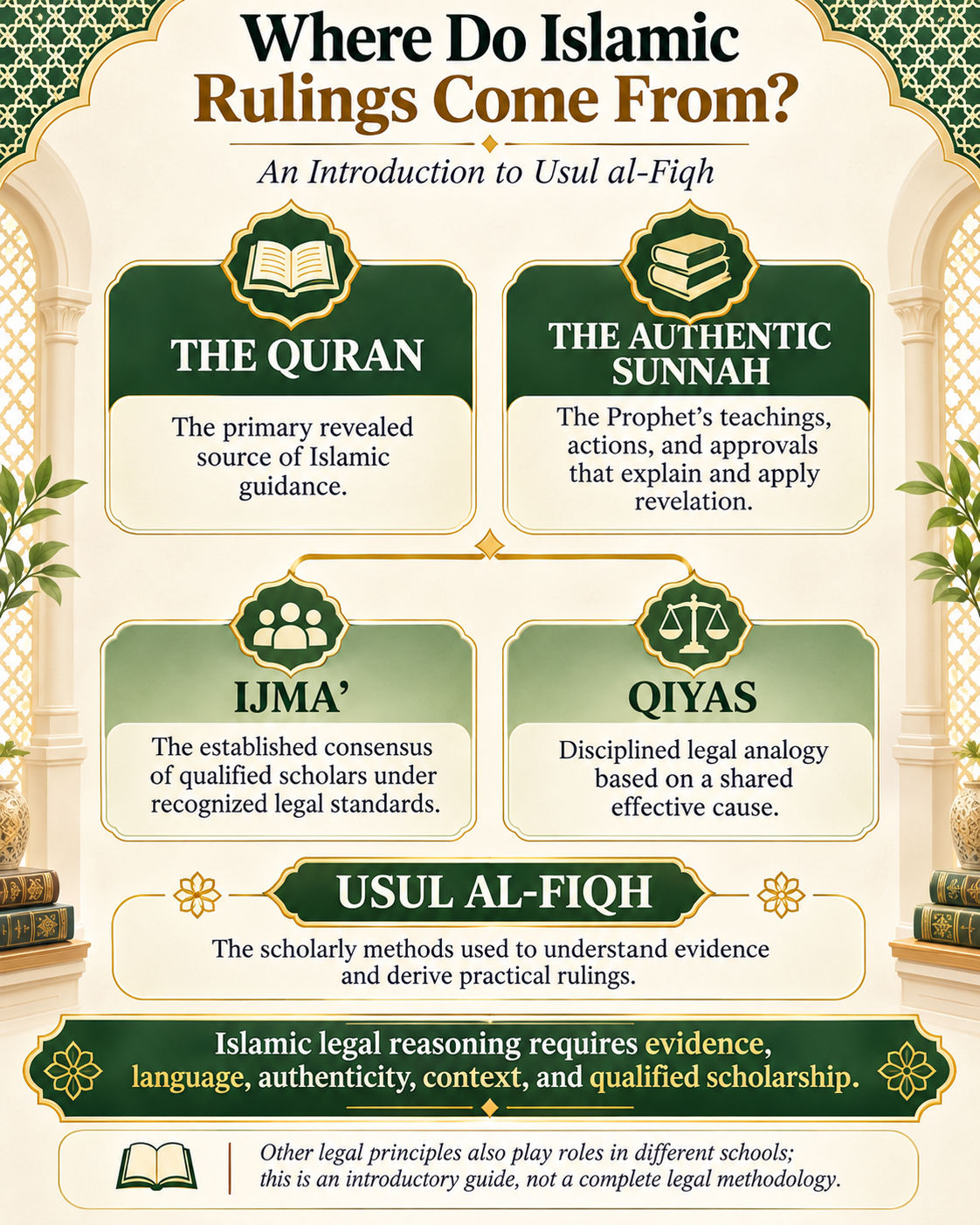
Ijma’ (الإِجْمَاع) is the agreement of qualified scholars on a ruling. It is a technical standard, not “most websites say so.” Qiyas (الْقِيَاس) is analogy: extending a ruling to a new case that shares the same effective cause as an established one. For example, jurists ask whether a new substance shares the quality that led a text to prohibit an intoxicant. This is disciplined reasoning, not guesswork. Other recognized principles, such as istihsan, maslahah, ‘urf, sadd al-dhara’i’, and istishab, play different roles in different schools.
The field that studies these methods is Usul al-Fiqh (أُصُولُ الْفِقْه). Think of it as learning how a legal system reasons rather than memorizing isolated verdicts. (This is an analogy to help learners, not a revealed teaching.)
Sharia vs Fiqh
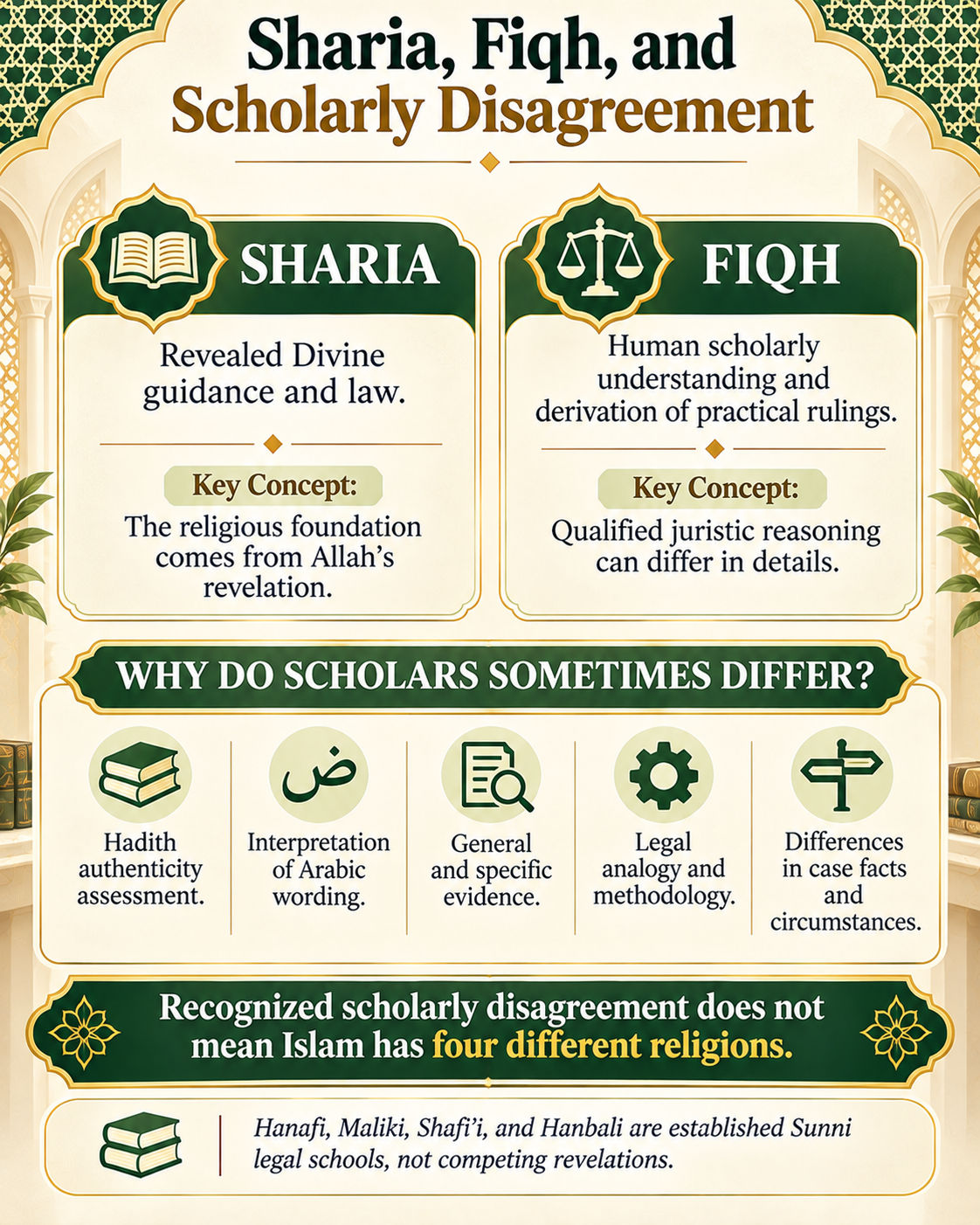
Sharia (شَرِيعَة), in its broad conception, is the revealed guidance and divine law. Fiqh (فِقْه) is the human scholarly understanding and derivation of practical rulings from it. They are related but not identical. Sharia is divine guidance, while a juristic conclusion is human effort that may be mistaken, which is one reason qualified scholars can differ.
Why Do Muslim Scholars Sometimes Disagree?
Disagreement usually comes from method, not weak faith. Scholars may differ about the grading of a hadith, the meaning of a word, whether a text is general or specific, how an analogy applies, or which facts are involved. A difference does not automatically mean one side is careless or following desire.
The four Sunni madhhabs (schools of law) are Hanafi, Maliki, Shafi’i, and Hanbali. They are established legal traditions with their own methodologies, not four religions. They share core beliefs and major obligations and prohibitions while differing on some details. Following a school does not mean rejecting the Quran, because each school’s jurists derive rulings from the Quran and Sunnah through their methodology.
A fatwa (فَتْوَى) is a qualified legal opinion given by a mufti (مُفْتٍ) in response to a question. It is not a Quran verse, a hadith, a court judgment, an internet comment, or a personal preference. A large social-media following does not make someone a qualified mufti.
Fatwas may legitimately change when facts, necessity, custom, or technology change the case. Clearly established prohibitions, however, cannot be dropped simply because society changes.
Why You Should Not Declare Something Haram Without Evidence
The key Quranic passage is 16:116:
وَلَا تَقُولُوا لِمَا تَصِفُ أَلْسِنَتُكُمُ الْكَذِبَ هَٰذَا حَلَالٌ وَهَٰذَا حَرَامٌ لِتَفْتَرُوا عَلَى اللَّهِ الْكَذِبَ
“And do not say, about what your tongues assert of falsehood, ‘This is lawful and this is unlawful,’ to invent falsehood about Allah.” (Quran 16:116)
Classical commentators connect the verse with pre-Islamic practices of declaring certain animals lawful or forbidden without divine authorization. The warning is against falsely attributing classifications to Allah, not against qualified scholarship. Intent and competence matter. Deliberate fabrication, confident speech without knowledge, an honest scholarly mistake, and a learner asking a question are very different situations.
The Quran also warns in the opposite direction: “Do not forbid the good things Allah has made lawful for you” (5:87), and “Who has forbidden the adornment of Allah which He brought forth for His servants?” (7:32). Commentators mention companions who wished to renounce lawful pleasures out of zeal. These verses do not cancel established prohibitions; they require that restrictions have evidence.
This leads to a major distinction. Scholars commonly teach that acts of worship need religious authorization, so a new ritual requires evidence. Ordinary customs and transactions carry a presumption of permissibility (al-asl fi al-ashya’ al-ibahah, الأَصْلُ فِي الأَشْيَاءِ الإِبَاحَة) unless evidence indicates otherwise. Choosing a lunch does not need a hadith naming the sandwich, and a new technology is not Haram merely because it is new. But this does not mean “everything is permitted unless the Quran names it.” Sunnah, consensus, analogy, and conditions on contracts still apply, and formulations differ among scholars.
Are Cultural Traditions the Same as Islamic Rules?
Culture shapes food, dress, weddings, and manners, and much of it is harmless and valuable. But family customs and personal preferences do not create divine prohibitions. Fiqh does recognize ‘urf (الْعُرْف), socially established custom, when applying rulings, for example in what counts as normal commercial practice. Valid custom cannot override clear religious texts.
Not every Arab tradition is Sunnah. The Arabic language, the Prophet’s ﷺ Sunnah, regional food, clothing styles, and wedding customs are different things. Likewise, a family that avoids a dish or a parent who dislikes a clothing color is expressing a preference, though parental responsibility and local law may still matter.
Religious expressions show the difference well. Understanding [ why Muslims say Insha’Allah, Alhamdulillah, and SubhanAllah] can help beginners distinguish meaningful religious expressions from unsupported rules about everyday speech.
Halal and Haram Food: What Beginners Should Know
The Quran explicitly prohibits carrion, flowing blood, pork, and meat dedicated to other than Allah (2:173, 5:3), as well as intoxicants (5:90). Necessity exceptions exist and are discussed below. Beyond these texts, many questions depend on details, so no single verse works as a complete certification manual.
Meat and slaughter: Permitted animals must be slaughtered under recognized conditions, including mentioning Allah’s name, and animal welfare matters. Scholars and certifiers differ on some modern industrial methods.
People of the Book: Quran 5:5 permits their food. Scholars differ on applying this to modern food systems. It neither makes everything automatically permissible nor makes all non-Muslim-prepared food automatically Haram.
Seafood: The Sunni schools differ. The Hanafi school is traditionally narrower, while the others permit a broader range.
Alcohol: Intoxicating drinks are prohibited. Trace alcohol, fermentation, processing, medicine, and non-beverage uses raise separate Fiqh questions, and “alcohol” is a chemical family, not one substance.
Gelatin and additives: Source and processing matter, and jurists differ on whether transformation changes a substance’s ruling. Without source information, no status should be invented.
Certification tries to verify ingredients and processes, but certifiers use different standards. Check who certifies and what standard they follow. Cross-contact on shared surfaces, utensils, or production lines depends on the details and recognized standards, and it should not become a compulsion to check every invisible trace.
A simple label routine: read the ingredients, look for credible certification, identify clearly prohibited items, research genuinely uncertain additives, and ask reasonable questions. A consumer cannot always judge a complex ingredient from its name, and that is acceptable.
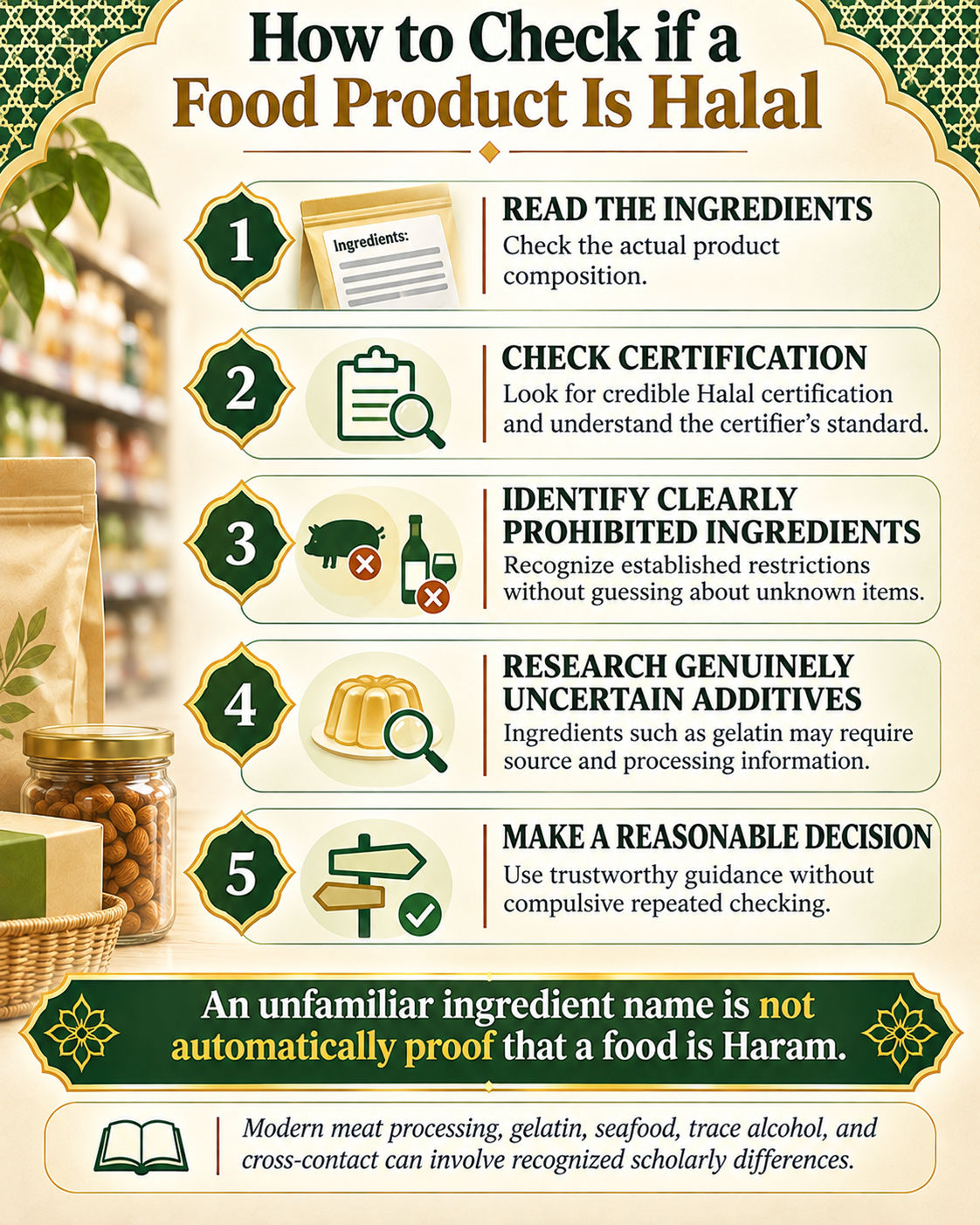
For Muslims navigating supermarkets, workplaces, and social invitations, [ practical challenges of Halal living in the West] deserve thoughtful guidance rather than rushed assumptions.
Halal and Haram Beyond Food: Money, Work, and Everyday Life
Halal living covers income, contracts, and conduct. The Quran says that Allah “has permitted trade and forbidden riba” (2:275), and forbids consuming one another’s wealth unjustly while permitting trade by mutual consent (4:29). Profit itself is not suspect.
Riba is clearly prohibited as a principle, but modern financial products can be complex and need qualified examination. This article gives no rulings on any specific loan or product. Maysir (الْمَيْسِر), gambling, is prohibited (5:90), yet ordinary business risk is not automatically gambling. On deception, Abu Hurayrah reported that the Prophet ﷺ said, “Whoever deceives us is not one of us” (Sahih Muslim). This applies to false advertising, false invoices, and misleading contracts.
Whether a job is permissible depends on the actual role, the nature of the business, direct involvement in prohibited activity, and contractual obligations. A job is not Haram merely because the employer is non-Muslim, and a whole sector should not be condemned without examining the specific role.
Clothing is addressed by modesty guidance with some specific rules, but details, gender-specific rulings, and scholarly views differ, and no single national style is required. Entertainment and technology are judged by content, behavior, effect on obligations, and potential harm. Some topics, such as music, involve legitimate disagreement. Technology is not Haram for being modern, though fraud, harassment, or neglecting duties through it can be wrong. In all of this, avoid humiliating people over their choices.
Choosing lawful work and making responsible decisions are compatible with [ trusting Allah without becoming passive], even when finding the right option takes time.
What Are Doubtful Matters in Islam?
Al-Nu’man ibn Bashir reported that the Prophet ﷺ said (Sahih al-Bukhari 52, Sahih Muslim 1599), in translated excerpt: “The lawful is clear and the unlawful is clear, and between them are doubtful matters that many people do not know.” The hadith adds that whoever guards against doubtful matters has protected his religion and honor, and it ends by stressing the state of the heart.
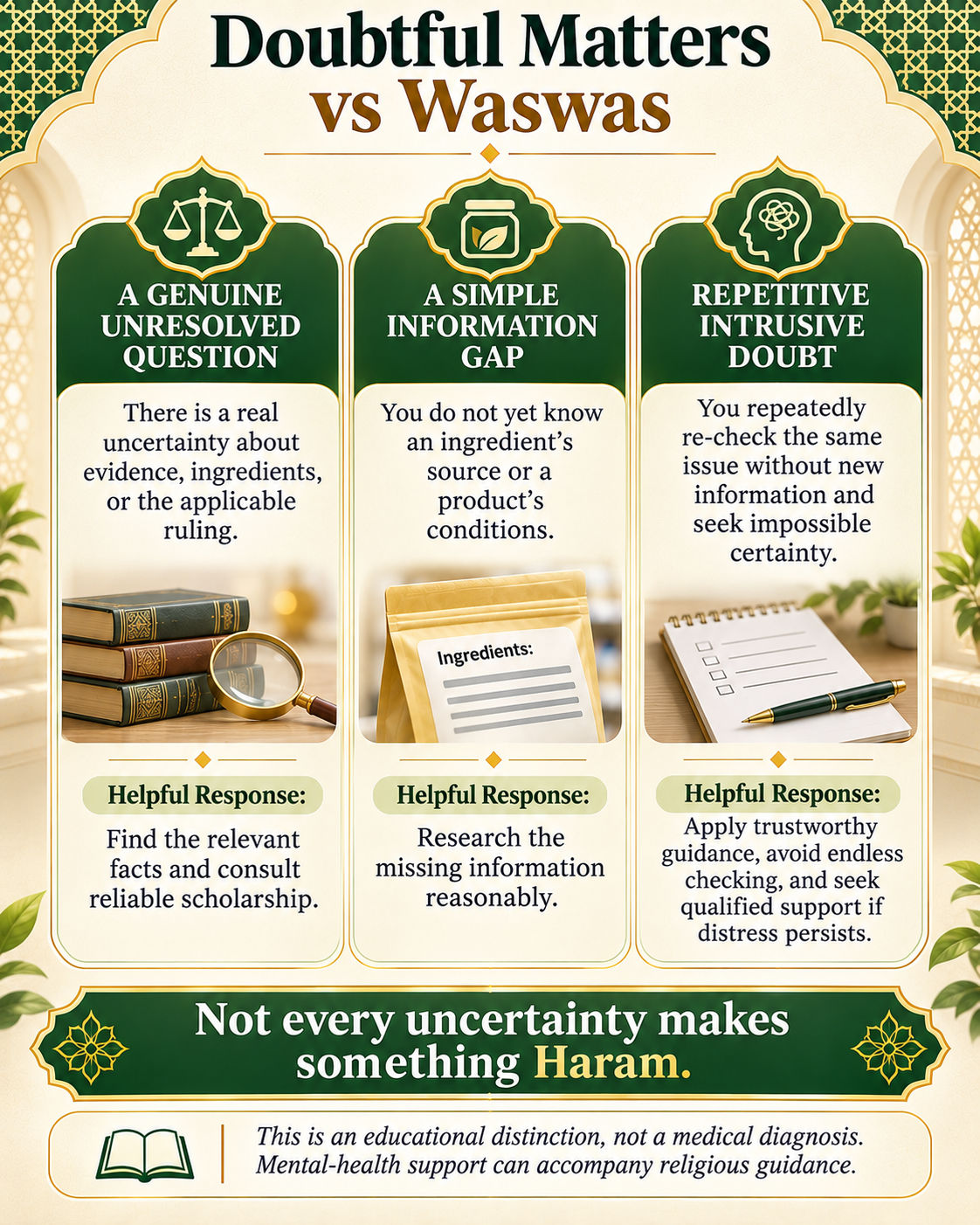
Shubuhat (الشُّبُهَات) are matters where the evidence or classification is genuinely unclear. Distinguish three situations: a legitimate unresolved question, which calls for qualified guidance; a personal lack of information, which calls for finding the facts; and an intrusive worry, discussed below. Caution can be wise where evidence is unclear, but uncertainty is not automatically prohibition. Consider the quality of the evidence and scholarly guidance.
How Do Necessity and Personal Circumstances Affect Rulings?
Darurah (الضَّرُورَة), genuine necessity, is recognized in the Quran: prohibited foods become permitted for one compelled by need, “without desiring it or exceeding the limit” (2:173, 16:115). Necessity has limits. It covers what is needed, not convenience or preference, and intention alone never makes a forbidden act permissible. Hajah (الْحَاجَة), need, is discussed in some Fiqh contexts but does not always receive the same treatment as necessity.
Rukhsah (الرُّخْصَة) is a recognized concession, such as shortening prayers while traveling or postponing fasting during illness (see 2:185). Using an established concession is not weak faith. Maqasid al-Sharia (مَقَاصِدُ الشَّرِيعَة), the higher objectives of the law such as protecting religion, life, intellect, lineage, and wealth, help scholars understand rulings, but they do not cancel explicit texts. Never refuse necessary medicine or delay emergency care over an ingredient question. Consult both a doctor and a qualified scholar.
What Should You Do When You Find Conflicting Fatwas?
Ask: Who is the scholar? What is the evidence? Does the ruling cover my exact circumstances? Is it a recognized school position? Is a key fact missing? Is this a genuine disagreement, and do I need personal guidance?
Do not search endlessly for the easiest or harshest answer. “Fatwa shopping,” choosing opinions only to excuse a preferred action, is a genuine concern. But sincerely following an established alternative opinion with qualified advice is not misconduct. Questions of school consistency, necessity, and personal circumstances are best put to a qualified teacher.
If you did something Haram without knowing, responsibility depends on knowledge, intention, circumstances, and any rights owed to others. Ignorance does not automatically remove every consequence. The response is to learn, stop, correct, and make tawbah (sincere repentance): regret, resolve not to return, and restoring others’ rights. It does not require confessing private sins publicly, and guilt alone is not the same as repentance.
When facing a difficult religious question, learning [ how to make Dua according to Islamic teachings] can accompany seeking reliable knowledge and advice.
Divine decree (Qadr) is never an excuse for knowingly ignoring a prohibition. Islamic rules are addressed to responsible human choices, which also connects this discussion to [Divine Decree and human responsibility].
Learning Halal and Haram as a New Muslim
New Muslims can learn gradually and need not master all of Fiqh before practicing. Priorities are understanding Tawhid, learning the obligatory prayer, grasping the basics of Halal and Haram, knowing the clearly established major prohibitions, asking qualified people, and building sustainable study habits. Avoid drowning in obscure debates, and never let rulings become a source of shame.
Teaching Halal and Haram to Children
Teach by age: truthfulness, not stealing, kindness, learning prayer, and the idea that some actions are encouraged and others prohibited. Welcome respectful questions, and avoid reducing parenting to threats. Help children hear the difference between “Islam teaches this,” “our family prefers this,” “this may be unsafe,” “this is a school rule,” and “this is a personal choice.”
Helping children distinguish religious obligations from family preferences is part of [ raising Muslim children with a strong Islamic identity] through knowledge rather than fear.
How to Avoid Excessive Worry About Religious Rules
Reasonable caution is healthy. Waswas (الْوَسْوَاس), persistent intrusive doubt, is different. Warning signs include re-reading labels dozens of times, assuming every unseen trace is prohibited, repeating identical questions without new evidence, and avoiding ordinary safe meals over hypothetical contamination. Careful consumers are not mentally ill, and this article cannot diagnose anyone.
The hadith on doubtful matters should never be used against people suffering intrusive doubts. Take reliable guidance, apply the ruling, and stop searching for certainty beyond what the law requires. The harshest answer is not automatically the most pious. If distress persists or disrupts daily life, seek mental-health support alongside religious guidance.
Readers who find themselves repeatedly fearing that ordinary choices are forbidden may benefit from learning about [ anxiety, worry, and trusting Allah] alongside appropriate scholarly support.
A Simple Decision-Making Checklist for Everyday Life
This is an educational framework, not a prescribed Sunnah ritual.
Identify the exact action or product.
Check whether a clear religious rule applies.
Distinguish worship from an ordinary worldly activity.
Look for evidence from reliable scholarship.
Identify whether recognized differences exist.
Consider real circumstances, safety, and obligations.
Apply the ruling without endless second-guessing.
Learning one reliable principle at a time can be easier through [building a sustainable daily Islamic routine] than through constantly reacting to alarming online claims.
15 Arabic Words About Islamic Rulings
Arabic | Transliteration | Meaning | Learning Note |
|---|---|---|---|
حَلَال | ḥalāl | lawful | Root ح ل ل |
حَرَام | ḥarām | forbidden; sacred by context | Root ح ر م |
فَرْض | fard | obligatory | Hanafi: definitive proof |
وَاجِب | wājib | obligatory | Hanafi: distinct from fard |
مُسْتَحَبّ | mustaḥabb | recommended | Not sinful to omit |
مَنْدُوب | mandūb | recommended | Common synonym |
سُنَّة | sunnah | Prophetic way; legal category | Check context |
مُبَاح | mubāḥ | permissible | Neutral category |
مَكْرُوه | makrūh | disliked | School sub-types |
طَيِّب | ṭayyib | good, wholesome | Pairs with ḥalāl |
فِقْه | fiqh | understanding; jurisprudence | Human derivation |
شَرِيعَة | sharī’ah | revealed way, law | Divine guidance |
فَتْوَى | fatwā | legal opinion | Not revelation |
إِجْمَاع | ijmā’ | consensus | Root ج م ع |
قِيَاس | qiyās | analogy | Root ق ي س |
Halal, haram, and tayyib appear in the Quran, while many other entries are technical juristic terms. Understanding familiar legal expressions becomes easier when students begin [learning common Quranic Arabic words] and studying how vocabulary changes meaning across contexts. Arabic fluency alone does not qualify anyone to issue fatwas.
Mini-lesson (Quran 16:116): In هَٰذَا حَلَالٌ وَهَٰذَا حَرَامٌ, hādhā means “this,” wa means “and,” and ḥalālun and ḥarāmun are the predicates, with the tanwin endings marking them as indefinite. It is a simple sentence: “this [is] lawful and this [is] forbidden.”
Common Halal and Haram Misconceptions
“Islam has only two rulings.” The familiar classification has five categories.
“Makruh equals Haram.” They are distinguished, with school-specific nuance.
“Sunnah always means optional.” Its meaning depends on context.
“Halal means healthy.” Permissibility and nutrition are different questions.
“Tradition is Sunnah.” Culture and prescribed worship are distinct, though they can interact.
“All scholars agree on everything.” Legitimate disagreement exists, though some rulings are clear.
“Darurah excuses anything inconvenient.” Necessity has defined limits.
“Caution means the harshest verdict.” Follow guidance accurately, not compulsively.
Frequently Asked Questions
What does Halal mean? Halal means lawful or permitted under Islamic teaching. It is a broad term and can include obligatory, recommended, and permissible acts.
What does Haram mean? Haram means prohibited. In other contexts the same root conveys sacredness, as in al-Masjid al-Haram.
What are the five Islamic legal rulings? Obligatory, recommended, permissible, disliked, and forbidden. Schools may use further technical subcategories.
What is the difference between Fard and Wajib? Most jurists treat them as synonyms. The Hanafi school distinguishes them by the certainty of the evidence and related consequences.
Is Sunnah the same as Mustahabb? Not always. Sunnah can mean the Prophet’s guidance as a source of law, or a recommended category, depending on context.
Does Makruh mean Haram? No. Makruh is generally distinct from Haram, though Hanafi makruh tahrimi is close to prohibition.
What is the difference between Sharia and Fiqh? Sharia is the revealed guidance; Fiqh is scholars’ human understanding and derivation of practical rulings from it.
Why do scholars sometimes disagree? Usually because of hadith grading, interpretation, language, analogy, methodology, or differing facts, not necessarily weak scholarship.
Can culture make something Haram? No. Custom can inform how a ruling is applied but does not independently create divine prohibitions.
What should I do if two scholars give different fatwas? Ask about the evidence, your exact circumstances, and whether it is a recognized difference. Consult a qualified teacher rather than choosing by convenience.
Learning Halal and Haram with Knowledge, Balance, and Responsibility
Islamic law is not merely a two-column list of allowed and forbidden behaviors. Its categories distinguish what believers must do, are encouraged to do, may ordinarily do, should preferably avoid, and must not do. Culture, social media, or personal preference does not automatically establish a religious rule, yet legitimate scholarly differences do not make every question subjective.
Understanding Halal and Haram is not about making everyday life unnecessarily complicated. It is about learning Allah’s guidance carefully, respecting established boundaries, recognizing genuine scholarly differences, and making responsible choices with knowledge rather than fear. If you would like to study Quranic Arabic and Islamic Studies with qualified teachers, Araby Academy welcomes you to begin at your own pace.