Three Arabic Expressions You Hear Everywhere
Spend a few days around Muslims and you will notice a pattern. Someone talks about tomorrow: “I’ll see you at class, Insha’Allah.” Then something good happens: “Alhamdulillah.” Later someone sees a remarkable sunset, and says, quietly, “SubhanAllah.”
To a non-Arabic speaker, these may sound like ordinary vocabulary. They are more than that. They carry belief, worship, Quranic language, gratitude, divine will, and remembrance of Allah.
They are also not limited to Arabic speakers. A Muslim in Britain, Nigeria, Indonesia, Pakistan, Turkey, America, Malaysia, or France may say exactly the same Arabic words while speaking a completely different language at home. Why? That is what this article explains.
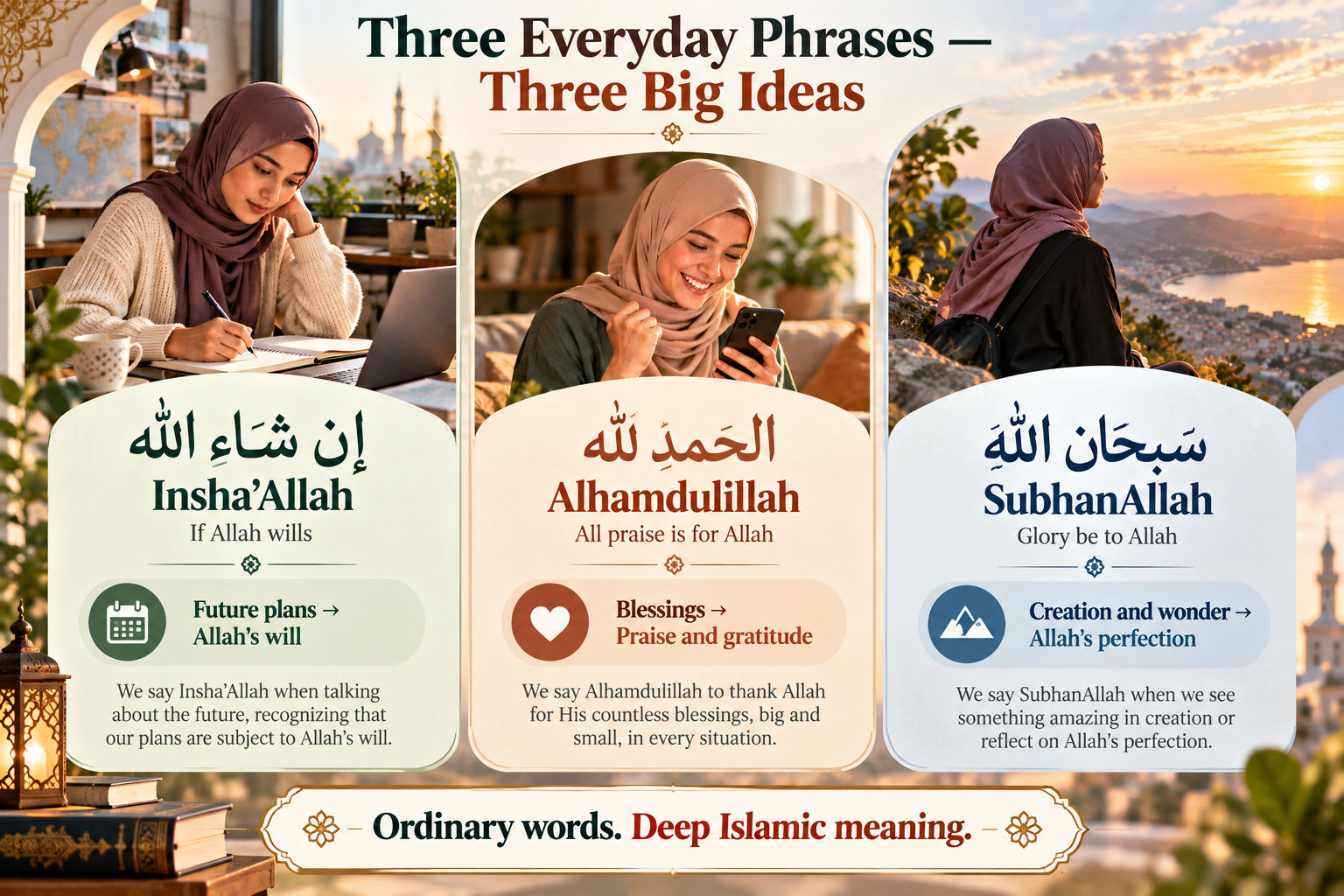
The central idea is simple: these common Islamic phrases compress major Islamic beliefs into everyday language. One connects plans with Allah’s will. One connects blessings with praise. One declares Allah’s perfection.
A caution before we begin. We are not claiming that every Muslim reflects on the full theology of each phrase every time they say it. Habit and culture are real. So throughout this article we separate the phrase’s Islamic meaning from how people casually use it.
Are These Arabic Phrases or Islamic Phrases?
Both, with nuance.
They are Arabic expressions, built from ordinary Arabic grammar and vocabulary. Arabic-speaking Christians and other Arabic speakers also use phrases that mention Allah, and in practice phrases like Insha’Allah and Alhamdulillah are common across Arabic-speaking communities, depending on region and speaker.
At the same time, these three expressions have especially important roles in the Quran and in Muslim devotion. So the fairest answer is that they are Arabic by language and Islamic by devotional weight. Nobody owns ordinary Arabic words, but Islam gave these particular phrases a rich life.
What Does “Allah” Mean?
الله — Allah is the Arabic word for God. It is the word Arabic-speaking Christians use for God in worship and in Arabic Bibles, and Arabic speakers used it before Islam. The Quran even notes that people who rejected the Prophet ﷺ still acknowledged Allah as Creator (Quran 29:61).
Grammarians have discussed the word’s origin, for example whether it relates to al-ilāh (“the god”) or is best treated as a proper name. We do not need to settle that. What matters here is theology: in Islam, Allah is the One God, as Surah Al-Ikhlas (112) states. This is the core of Tawhid. So Allah is not “a separate Muslim god.” It is simply what Muslims, and many Arabic speakers, call God in Arabic.
Part One: Insha’Allah
What Does Insha’Allah Mean?
إن شاء الله
Transliteration: In shā’ Allāh. You will see it spelled InshaAllah, Inshallah, In sha Allah, and InshAllah. These are different transliteration choices for the same Arabic, not different phrases.
The three components are:
إن (in): “if”
شاء (shā’a): “willed” (a past-tense verb, used here in a conditional sense)
الله (Allah): God
Together: “If Allah wills.” In English, “God willing.”
But the translation is only a starting point. The phrase expresses a way of looking at the future.
Why Do Muslims Say Insha’Allah?
Because Muslims believe human beings can intend and plan, but do not independently control what happens next. You can say “I will travel tomorrow,” yet health, weather, traffic, and countless other things can intervene.
Islam encourages planning. It also asks us to remember that outcomes ultimately depend on Allah’s will. So Insha’Allah does not mean “I won’t bother planning.” It means: “I intend this, while recognizing that its happening depends ultimately on Allah’s will.”

Insha’Allah in the Quran
The key passage is Surah Al-Kahf, verses 23–24:
وَلَا تَقُولَنَّ لِشَيْءٍ إِنِّي فَاعِلٌ ذَٰلِكَ غَدًا إِلَّا أَن يَشَاءَ اللَّهُ ۚ وَاذْكُر رَّبَّكَ إِذَا نَسِيتَ وَقُلْ عَسَىٰ أَن يَهْدِيَنِ رَبِّي لِأَقْرَبَ مِنْ هَٰذَا رَشَدًا
“And never say of anything, ‘I will do that tomorrow,’ except [with], ‘If Allah wills.’ And remember your Lord when you forget, and say, ‘Perhaps my Lord will guide me to what is closer to right conduct than this.’” (Quran 18:23–24)
Classical commentators such as Ibn Kathir discuss a reported background in which the Prophet ﷺ, asked about the youths of the cave, said he would answer “tomorrow” without adding “if Allah wills,” and revelation was delayed. Note that this background comes through Tafsir reports whose chains scholars discuss, so it is best presented as “reported,” not as settled fact. The verse’s lesson stands on its own: do not speak about the future as if you hold it in your hand.
Another Quranic reflection of the same idea is 76:30: “And you do not will except that Allah wills.” A well-known hadith in Sahih al-Bukhari and Sahih Muslim also tells of Prophet Sulayman (peace be upon him) resolving to do something with great confidence without saying “if Allah wills,” and the outcome not being as he hoped, which scholars cite as a lesson in this etiquette.
Insha’Allah and Qadr
Saying Insha’Allah reflects three things at once: humans form intentions, humans act, and outcomes remain under Allah’s decree (Qadr). But it does not eliminate human responsibility. You cannot make a promise, make no effort to keep it, and then say “Insha’Allah” as your excuse. For the fuller picture, see our guide to What Is Qadr in Islam? A Beginner’s Guide to Divine Decree and Free Will.
Does Insha’Allah Mean “Maybe”?
Here is a real cultural phenomenon: in some places, “Insha’Allah” is used in ways listeners understand as “maybe,” “probably not,” “we’ll see,” or a polite way of avoiding a direct no. Anyone who has waited for a “Insha’Allah, I’ll be there at five” knows the joke.
But that is pragmatic usage, not meaning. Insha’Allah does not linguistically mean “maybe.” It means “if Allah wills.” Speakers who use it as a soft refusal are borrowing a religious phrase for a social purpose, and many Muslims themselves consider that a misuse.
Should You Say Insha’Allah When Making a Promise?
Yes, you may, but it never replaces honesty or commitment. The Quran commands fulfilling covenants (5:1; 17:34) and criticizes saying what you do not do (61:2–3). A well-known hadith in Bukhari and Muslim lists breaking a promise among the signs of hypocrisy. If you sincerely intend to do something, take the steps to do it. “Insha’Allah” acknowledges Allah’s will; it is not a religious escape clause.
Insha’Allah vs Tawakkul
Insha’Allah acknowledges Allah’s will regarding future events. Tawakkul (توكل) is broader: relying on Allah while taking appropriate means. The Quran says, “when you have decided, then rely upon Allah” (3:159), meaning decide and act first, then rely.
Example: “I will prepare carefully for my exam, Insha’Allah.” That is study + preparation + dua + tawakkul. See What Is Tawakkul? How to Trust Allah Without Becoming Passive.
Part Two: Alhamdulillah
What Does Alhamdulillah Mean?
الحمد لله
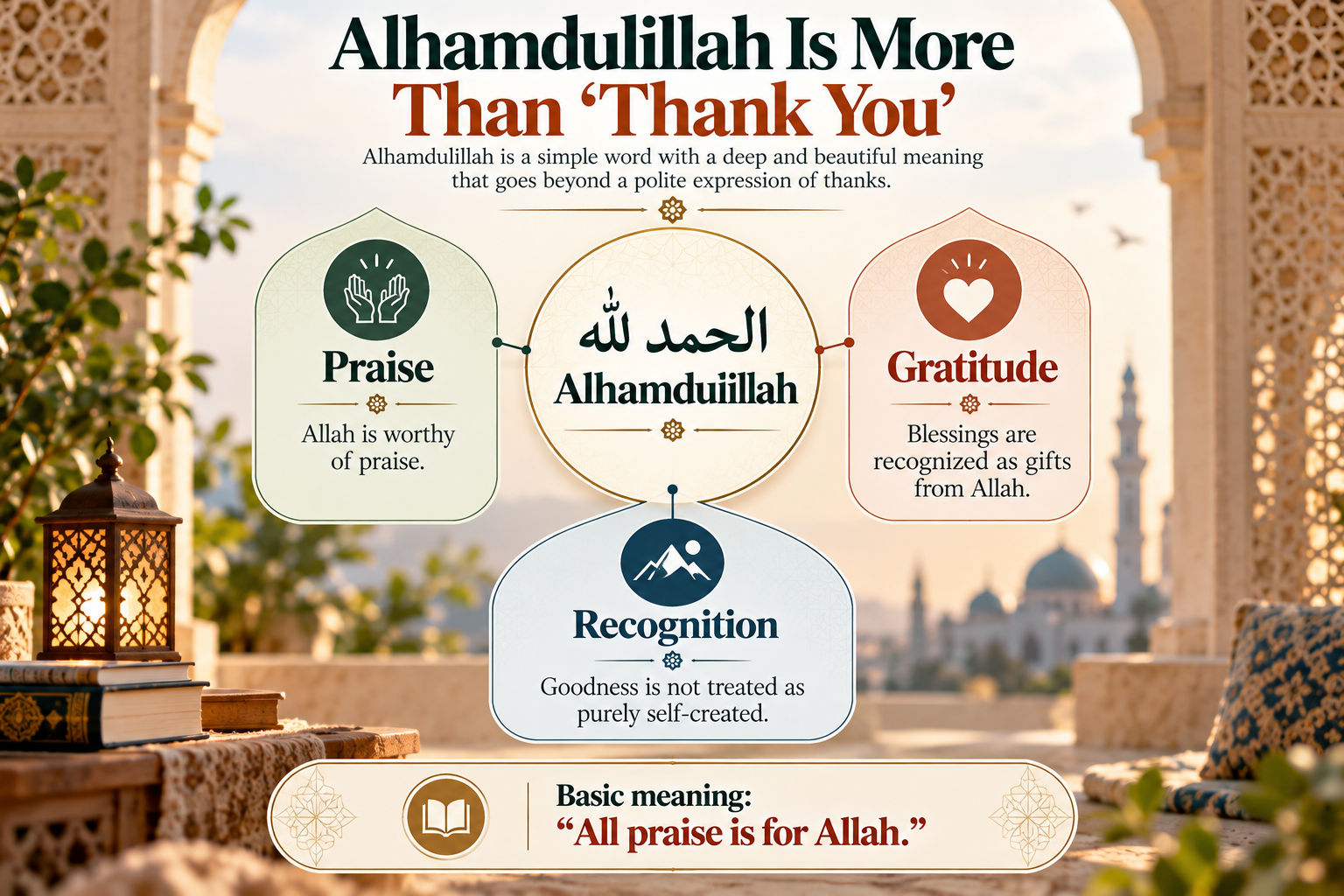
Transliteration: Al-ḥamdu lillāh (commonly written Alhamdulillah). Basic translation: “All praise is for Allah” or “Praise belongs to Allah.”
The common rendering “Thank God” captures only part of it. It points to gratitude but leaves out the larger idea that Allah is worthy of praise in Himself, whether or not a specific favor has just arrived.
Understanding the Arabic of Alhamdulillah
الـ (al): “the.” Commentators discuss that here it conveys comprehensiveness, hence “all praise.”
حمد (ḥamd): praise
لله (li-llāh): “for Allah” or “belonging to Allah”
The root ح-م-د also gives Muhammad, Ahmad, mahmūd (praised), and the divine name Al-Ḥamīd (the Praiseworthy, e.g., 14:8).
Ḥamd is not an exact synonym for English “thanks.” In classical discussions, it involves extolling someone for their qualities and acts, with gratitude being closely related. We should not claim it is one precise formula, such as “praise plus gratitude plus love,” because scholars describe it in several ways.
Alhamdulillah and Surah Al-Fatihah
The Quran’s opening chapter begins:
الْحَمْدُ لِلَّهِ رَبِّ الْعَالَمِينَ
Al-ḥamdu lillāhi Rabbil-‘ālamīn
“All praise is for Allah, Lord of all worlds.” (Quran 1:2)
Because Surah Al-Fatihah is recited in every unit (rak‘ah) of the prayer, a Muslim who prays the five daily prayers says this phrase many times each day. In a hadith recorded by Muslim, Allah says the prayer is divided between Him and His servant, and when the servant says Alhamdulillahi Rabbil-‘ālamīn, Allah says, “My servant has praised Me.” So Alhamdulillah is not just conversation; it is embedded in worship. (See also how Quran 10:10 ends the supplication of the people of Paradise.)
When Do Muslims Say Alhamdulillah?
Good news: “I passed my exam, Alhamdulillah.”
Recovery: “I’m feeling much better, Alhamdulillah.”
Being asked how you are: “Alhamdulillah, I’m well.” This is widely practiced as everyday etiquette; it is a pious habit rather than a specific commanded wording.
After eating: The Prophet ﷺ taught several wordings. One, in Bukhari, is: الْحَمْدُ لِلَّهِ حَمْدًا كَثِيرًا طَيِّبًا مُبَارَكًا فِيهِ (“Alhamdulillah, abundant, pure, blessed praise”). Another, recorded by Abu Dawud and al-Tirmidhi (graded hasan), is: الْحَمْدُ لِلَّهِ الَّذِي أَطْعَمَنِي هَذَا وَرَزَقَنِيهِ مِنْ غَيْرِ حَوْلٍ مِنِّي وَلَا قُوَّةٍ. Muslim also reports that Allah is pleased with a servant who praises Him after eating or drinking.
After sneezing: In Sahih al-Bukhari, the Prophet ﷺ said that the one who sneezes should say Alhamdulillah; his companion says Yarḥamuk Allāh (يَرْحَمُكَ اللَّهُ, “May Allah have mercy on you”); and he replies Yahdīkumu Allāhu wa yuṣliḥu bālakum (يَهْدِيكُمُ اللَّهُ وَيُصْلِحُ بَالَكُمْ, “May Allah guide you and set your affairs right”).
Does Alhamdulillah Mean “Thank You Allah”?
It can express gratitude, but it is broader than a personal thank-you. Classical scholars, including commentators such as Ibn Kathir, discuss ḥamd (حمد) and shukr (شكر). A common formulation is that ḥamd is praise expressed by the tongue for Allah’s perfect attributes and acts, whether or not you personally benefited, while shukr is gratitude for received favor and can be shown by heart, tongue, and action. These categories overlap in everyday usage, so do not treat the distinction as rigid. For a beginner, the useful takeaway is: Alhamdulillah praises Allah, and gratitude is inside that praise but not all of it.
Saying Alhamdulillah During Hardship
Muslims sometimes say Alhamdulillah even in difficulty. That does not mean “I enjoy this pain,” “nothing is wrong,” or “I’m not sad.” It can express that Allah remains worthy of praise regardless of circumstances.
But grief is not a failure of faith, and nobody should pressure a grieving person into performed positivity. When the Prophet’s ﷺ infant son Ibrahim died, he wept, and said that the eyes shed tears and the heart grieves, and that we say only what pleases our Lord (Bukhari and Muslim).
You may hear Alhamdulillahi ‘alā kulli ḥāl (“Praise be to Allah in every circumstance”). A report in Ibn Majah says the Prophet ﷺ said it when he saw something he disliked, and several hadith scholars have graded it acceptable. Because gradings and exact wordings of such reports are discussed, it is best described as “reported” and not casually labeled as an unquestioned Sunnah.
Alhamdulillah and Gratitude
Islamic gratitude is more than saying a phrase. It involves recognizing blessings as gifts, praising Allah, using blessings responsibly, and obedience. The Quran says: “If you are grateful, I will surely increase you [in favor]” (14:7). Commentators understand the “increase” broadly, including increase in blessings and in nearness to Allah, and it should not be read as a promise of specific worldly riches. Gratitude is not a prosperity technique.
Part Three: SubhanAllah
What Does SubhanAllah Mean?
سبحان الله
Transliteration: Subḥān Allāh (commonly SubhanAllah). The usual English is “Glory be to Allah.” That is a respectable translation, but to a modern English reader “glory” may sound like praise of greatness only, and miss the idea of freeing Allah from imperfection.
Understanding the Arabic Meaning of SubhanAllah
Subḥān is a verbal noun in the root س-ب-ح, which relates to swift movement and, in Quranic usage, to tasbīḥ (تسبيح): declaring Allah free from every imperfection, deficiency, or anything unworthy of Him. Classical commentators often describe it as tanzīh, exalting Allah above what is unfitting. A helpful beginner definition: SubhanAllah declares Allah’s absolute perfection and freedom from imperfection.
SubhanAllah in the Quran
The Quran uses tasbīḥ in several settings. In each, notice the meaning:
Allah’s greatness: Subḥāna alladhī asrā bi-‘abdihi… “Glory be to the One who took His servant by night” (17:1). Glorification frames a mighty event.
Correcting false claims about Allah: after rejecting the claim that Allah has a son, 23:91 says Subḥāna Allāhi ‘ammā yaṣifūn, “Exalted is Allah above what they describe.”
Creation: “The seven heavens and the earth and all within them glorify Him” (17:44).
Reflection and worship: believers who ponder creation say Rabbanā mā khalaqta hādhā bāṭilan, subḥānak (3:191), and Prophet Yunus (peace be upon him) says Lā ilāha illā Anta subḥānak, innī kuntu mina aẓ-ẓālimīn (21:87). We are also told, “Glorify the name of your Lord, the Most High” (87:1).
So in the Quran, tasbih is both worship and correction: it keeps our picture of Allah free from human limitations.
When Do Muslims Say SubhanAllah?
Muslims say it when reflecting on creation, hearing something remarkable, expressing amazement, performing dhikr, affirming Allah’s perfection, or reacting to something unexpected. We should distinguish established devotional use (in prayer and the prescribed adhkar) from modern conversational use, where it is often an expression of awe. Not every spontaneous use is a specific prescribed Sunnah for that exact moment.
Is SubhanAllah Just the Muslim Version of “Wow”?
No. People do say it when amazed, but its meaning is theological. It is a declaration about Allah, not an interjection. Translating it as “wow” loses the point: the amazement is being directed to Allah’s perfection, not merely to the sight.

SubhanAllah as Dhikr
SubhanAllah, Alhamdulillah, and Allahu Akbar are central forms of dhikr. Some key reports:
Sahih Muslim: the most beloved words to Allah are four: SubhanAllah, Alhamdulillah, La ilaha illa Allah, Allahu Akbar.
Bukhari and Muslim: two phrases light on the tongue, heavy on the scale: SubhanAllahi wa bi-ḥamdihi, SubhanAllahil-‘Aẓīm.
After prayer: the main report (Bukhari and Muslim) is 33 times each of SubhanAllah, Alhamdulillah, Allahu Akbar; Muslim also records completing the hundred with La ilaha illa Allah wahdahu…. Other authentic variants with different counts exist (for example, 33, 33, and 34 in Muslim). Do not blend them into a single invented formula; ask a qualified teacher which you follow.
Tasbih Fatimah
In Bukhari and Muslim, ‘Ali (may Allah be pleased with him) reports that Fatimah (may Allah be pleased with her) suffered from grinding grain by hand and asked the Prophet ﷺ for a servant. He taught them instead to say, when going to bed, SubhanAllah 33 times, Alhamdulillah 33 times, and Allahu Akbar 34 times, and said it was better for them than a servant. Narrations differ in the order, so do not insist on one sequence. The hadith does not specify worldly or medical effects, and we should not add any.
Part Four: Putting the Three Together
Insha’Allah vs Alhamdulillah vs SubhanAllah
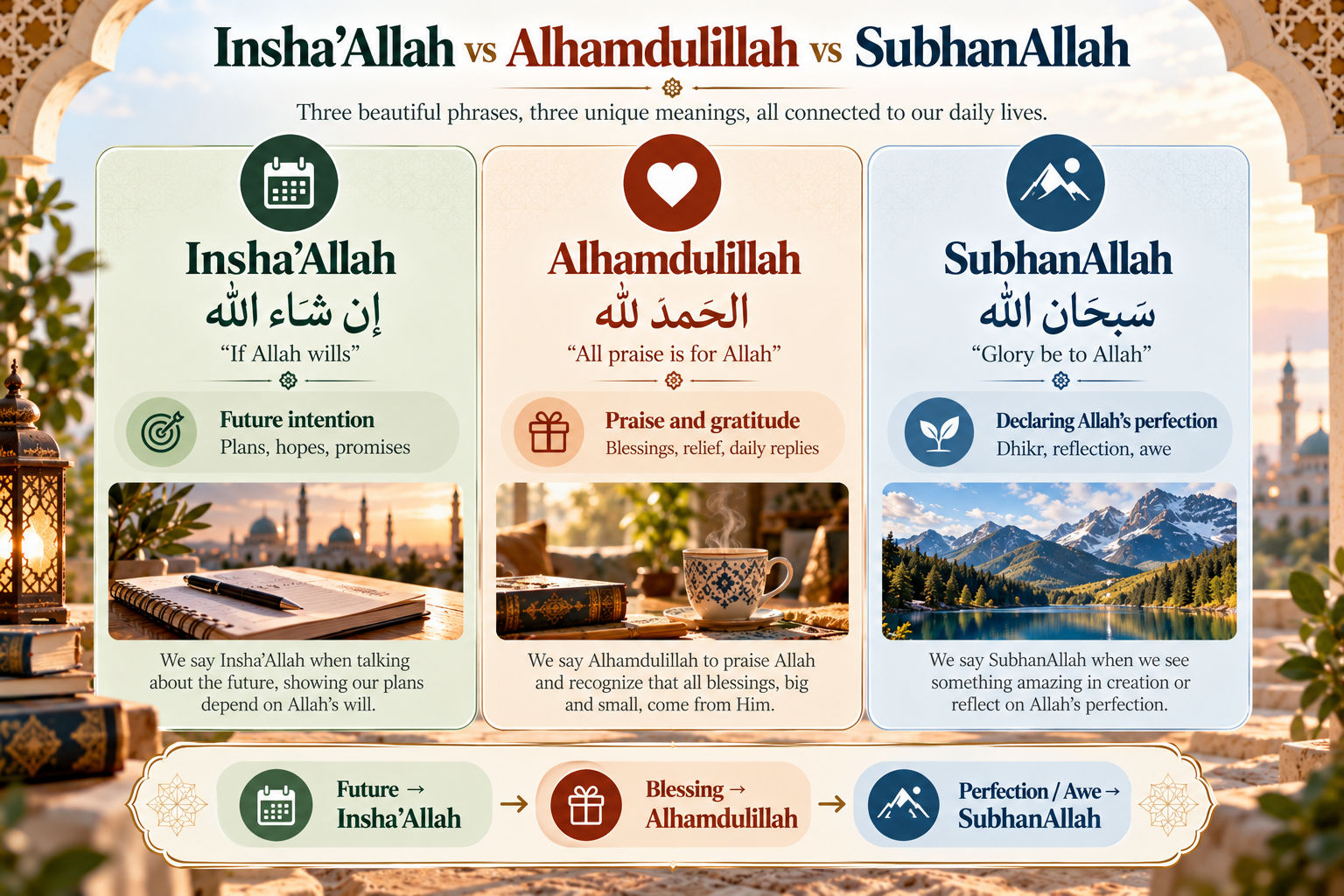
Expression | Arabic | Basic Meaning | Main Idea | Common Use |
|---|---|---|---|---|
Insha’Allah | إن شاء الله | If Allah wills | Future intention → Allah’s will | Plans, promises, hopes |
Alhamdulillah | الحمد لله | All praise is for Allah | Praise and gratitude → recognizing Allah | Blessings, relief, daily replies |
SubhanAllah | سبحان الله | Glory be to Allah (He is free of imperfection) | Tasbih → declaring Allah’s perfection | Dhikr, awe at creation |
One Ordinary Day Using All Three
Morning: “Are you coming to class tonight?” “Yes, Insha’Allah.” That says: I intend to, and I know tonight is not fully in my hands.
Later, the student receives good news. “Alhamdulillah!” That says: this is a blessing, and Allah is praised for it.
In the evening, they see a striking sunset. “SubhanAllah.” That says: the beauty of creation points beyond itself to its Creator’s perfection.
In that one day, three ordinary moments connect to Qadr, gratitude, and dhikr, respectively, without becoming sentimental. They are just speech.
Are These Phrases Dhikr?
SubhanAllah and Alhamdulillah are clearly central forms of dhikr, with strong textual support. Insha’Allah has a different immediate function, acknowledging Allah’s will, though mentioning Allah and remembering His will naturally involves remembrance. We should not flatten every Islamic expression into the same category without scholarly support. See What Is Dhikr? A Beginner’s Guide to Remembering Allah Every Day.
Do You Get Reward for Saying These Phrases?
There are authentic reports about the virtue of specific dhikr in specific forms. For instance, Bukhari and Muslim report that whoever says SubhanAllahi wa bi-ḥamdih one hundred times in a day has his sins forgiven even if they are like the foam of the sea. Muslim also reports that Alhamdulillah fills the scale. But these are tied to exact wordings and practices. We should not invent a general reward formula (“say it once, get X”) for every casual use of a phrase, and we should not claim reward figures that are not established.
Related Expressions Beginners Often Ask About
Allahu Akbar — الله أكبر
Literally “Allah is greater,” usually rendered “Allah is the Greatest.” Scholars note that akbar is a comparative form, understood as greater than everything else. It is said in the adhan, in the movements of salah, in dhikr, and in daily speech. We will cover it in a future article on common Islamic expressions.
Bismillah — بسم الله
“In the name of Allah.” It is said at the start of actions. In Bukhari and Muslim, the Prophet ﷺ taught a young boy to say Bismillah before eating, eat with the right hand, and eat from what is near him.
Masha’Allah vs Insha’Allah
Beginners often confuse these.
إن شاء الله (Insha’Allah) is conditional and usually looks forward: “If Allah wills.”
ما شاء الله (Masha’Allah) uses a different structure. Mā is “what,” so the phrase means “What Allah has willed (has come to be).” It is commonly said about something that has already happened or is admired, acknowledging that it exists by Allah’s will and blessing.
The Quranic reference is 18:39: لَوْلَا إِذْ دَخَلْتَ جَنَّتَكَ قُلْتَ مَا شَاءَ اللَّهُ لَا قُوَّةَ إِلَّا بِاللَّهِ, “If only, when you entered your garden, you had said, ‘What Allah has willed [has occurred]; there is no power except with Allah.’” The lesson is that you should connect what you have, or admire, to Allah, not to yourself. So it is not only an “anti-evil-eye” phrase. The evil eye is a separate topic with its own evidence (including reports encouraging us to pray for blessing on what we admire), and deserves its own treatment.
A Quick Guide
Future plan? Insha’Allah
Receiving or recognizing a blessing? Alhamdulillah
Admiring something, recognizing what Allah has willed? Masha’Allah, depending on context
Declaring Allah’s perfection? SubhanAllah
Natural language depends on context. These are not mechanical buttons.
Culture, Language, and Belonging
Can Non-Muslims Say Insha’Allah or Alhamdulillah?
These are Arabic expressions that refer to Allah, and they are part of Islamic vocabulary. A non-Muslim may use Arabic words in conversation, respectfully, and many Arabic-speaking non-Muslims do. We are not aware of textual evidence for a prohibition, and gatekeeping is not helpful. For Muslims, though, these phrases often carry devotional meaning beyond mere vocabulary, which is worth knowing when you use them.
Do Only Arabs Say These Phrases?
No. Islam is not an ethnic religion. Only a minority of the world’s Muslims (around one in five, according to Pew’s estimates) live in the Middle East and North Africa, and that region includes non-Arab countries such as Iran and Turkey. Indonesia has the largest Muslim population of any country.
A Muslim may speak English, Urdu, Turkish, Malay, Indonesian, Hausa, Bengali, or French and still say Alhamdulillah, Insha’Allah, and SubhanAllah. That is not the same as speaking conversational Arabic.
Why Does Islam Preserve Arabic Expressions?
The Quran was revealed in Arabic. Formal prayer includes Arabic Quran recitation, and many Prophetic duas and adhkar are preserved in Arabic. So Arabic has a special place in worship and scholarship.
But Islam is for everyone. A Muslim does not have to become culturally Arab, and fluency is not a condition of being a good Muslim. Understanding Arabic can deepen access to the Quran and worship, which is where Araby Academy comes in. See How to Learn Salah When You Don’t Speak Arabic.
Pronunciation Guide
Arabic | Say it like | Notes |
|---|---|---|
إن شاء الله | in-shā-Al-lāh | shā’ has a long “aa”; the ’ is a brief catch in the throat, like the pause in “uh-oh” |
الحمد لله | al-ḥam-du lil-lāh | ḥ is a soft, breathy “h” from the throat, like fogging a mirror |
سبحان الله | sub-ḥān Al-lāh | long ā after the ḥ |
Don’t worry about sounding native. Sincere effort is a good start, and a teacher can help with the ḥ sound over time.
Does Spelling Matter in English?
Not in the way people sometimes think. Arabic is the original language, and English spellings (InshaAllah, Inshallah, In Sha Allah, Alhamdulillah, Al-Hamdu Lillah, SubhanAllah, Subhanallah) are transliterations. Different systems represent Arabic sounds differently, and none of them is sacred Arabic orthography.
Do Not Turn Transliteration Into Superstition
Some social media posts claim that writing “Inshallah” as one word secretly means something terrible, such as “Allah created.” We could not find linguistic support for this. There is a separate Arabic noun inshā’ (إنشاء, “creating, composing”), but it is a different word in Arabic writing, and nobody reads English “Inshallah” as that word. Roman letters do not alter the Arabic phrase إن شاء الله. What matters is the intended phrase, its real meaning, your pronunciation, and your understanding. No one needs to be anxious about Roman letters.
Are These Phrases Magic Words?
No. They are expressions of remembrance, belief, praise, and acknowledgment of Allah.
Insha’Allah does not guarantee your plan happens.
Alhamdulillah is not a prosperity technique.
SubhanAllah is not a manifestation formula.
Dhikr is worship, not the law of attraction, “raising vibrations,” or magical thinking. The point is to turn to Allah, not to extract outcomes from words.
When Habit Loses Meaning
After hundreds of repetitions, these phrases can become automatic. Habit is not necessarily bad, and it does not make speech worthless. But learning the meaning can renew awareness. Occasionally pause and ask:
Alhamdulillah: What am I praising Allah for?
Insha’Allah: Am I recognizing that I do not control tomorrow?
SubhanAllah: Am I remembering Allah’s perfection?
Learning More
Understanding These Expressions Through Quranic Arabic
A few words can open a large Quranic vocabulary network:
شاء (will): yashā’u, “he wills,” as in 76:30 above.
حمد (praise): ḥamd, Al-Ḥamīd, Muhammad.
سبح (glorify): sabbiḥ, yusabbiḥ, tasbīḥ, as in 87:1 and 17:44.
Once you recognize these, you begin spotting them when you read the Quran. (This is vocabulary recognition, which helps study but does not by itself qualify anyone to interpret the Quran; that requires proper training.) See 100 Most Common Words in the Quran and What They Mean and Learn Arabic Through the Quran.
A 7-Day Islamic Expressions Challenge
Educational practice—not a prescribed Sunnah program. No repetition counts are assigned.
Day | Expression | Focus | Quran/Hadith connection |
|---|---|---|---|
1 | Insha’Allah | Arabic, pronunciation, meaning | Quran 18:23–24 |
2 | Alhamdulillah | Praise vs thanks | Quran 1:2 |
3 | SubhanAllah | Tasbih | Quran 17:44 |
4 | Bismillah | Starting in Allah’s name | Hadith on eating |
5 | Astaghfirullah | Seeking forgiveness | Hadith (Bukhari) that the Prophet ﷺ sought forgiveness over seventy times a day |
6 | Allahu Akbar | Prayer and adhan | Salah transitions |
7 | Review | Find each in worship or Quran/Sunnah | Your own notes |
Teaching These Phrases to Children
Instead of “Say Alhamdulillah because Muslims say it,” say: “Alhamdulillah means we praise and thank Allah.”
Instead of “Say Insha’Allah because you have to,” say: “We make plans, but only Allah knows exactly what tomorrow will bring.”
Instead of “Say SubhanAllah when something looks cool,” say: “SubhanAllah reminds us that Allah is perfect and free from imperfection.”
Meaning first, repetition after.
Common Mistakes and Misunderstandings
“Insha’Allah means maybe.” Not literally. It means “if Allah wills.”
“Alhamdulillah just means thank you.” Incomplete; it is praise, including gratitude.
“SubhanAllah means wow.” Misleading; it declares Allah’s perfection.
“Only Arabs use these phrases.” False.
“Allah is a different God worshipped only by Muslims.” Allah is the Arabic word for God, used by Arabic-speaking Christians too.
“Using Arabic makes a statement more religious.” Not necessarily; sincerity and meaning matter.
“Insha’Allah removes responsibility for promises.” False.
“One English transliteration is the only valid spelling.” Usually an oversimplification.
“These are magical formulas.” False.
“You must speak Arabic fluently to understand them.” False; a little study goes a long way.
Quick Reference: 10 Everyday Muslim Expressions
Arabic | Transliteration | Meaning | When You Hear It |
|---|---|---|---|
إن شاء الله | In shā’ Allāh | If Allah wills | Plans and hopes |
الحمد لله | Al-ḥamdu lillāh | All praise is for Allah | Blessings, relief, replies |
سبحان الله | Subḥān Allāh | Glory be to Allah | Dhikr, awe |
ما شاء الله | Mā shā’a Allāh | What Allah has willed | Admiring something |
بسم الله | Bismillāh | In the name of Allah | Before eating, starting tasks |
الله أكبر | Allāhu Akbar | Allah is greater | Adhan, prayer |
أستغفر الله | Astaghfiru Llāh | I seek Allah’s forgiveness | After mistakes, after prayer |
لا إله إلا الله | Lā ilāha illā Allāh | There is no god but Allah | Core declaration of faith, dhikr |
السلام عليكم | As-salāmu ‘alaykum | Peace be upon you | Greeting |
جزاك الله خيراً | Jazāka Llāhu khayran | May Allah reward you with good | Thanking someone |
A related phrase is Bāraka Llāhu fīk (بارك الله فيك), “May Allah bless you.” For a woman, jazāki and fīki are used.
Araby Academy: From Words You Say to a Language You Understand
You can start with three expressions: Insha’Allah, Alhamdulillah, SubhanAllah. Each opens a door into Quranic Arabic. Words such as شاء, حمد, سبح, رب, رحمة, رزق, صبر, and توكل help students begin recognizing the language of Quran and worship.
Araby Academy supports non-Arabic-speaking students with Quran reading, Tajweed, memorization, Quranic Arabic, Arabic language, Islamic Studies, and one-to-one online lessons.
You do not need to speak fluent Arabic to begin understanding the language of your faith. Start with the words you already hear and use, learn what they mean, and gradually connect them to the Quran.
Related Reading
What Is Tawakkul? How to Trust Allah Without Becoming Passive
What Is Qadr in Islam? A Beginner’s Guide to Divine Decree and Free Will
How to Make Dua: A Beginner’s Guide to Asking Allah
What Is Dhikr? A Beginner’s Guide to Remembering Allah Every Day
How to Learn Salah When You Don’t Speak Arabic
100 Most Common Words in the Quran and What They Mean
Learn Arabic Through the Quran
How to Understand the Quran Without Speaking Fluent Arabic
Arabic Grammar for Beginners
New Muslim Guide
What Does Islam Say About Anxiety, Worry, and Trusting Allah?
Frequently Asked Questions
1. What does Insha’Allah mean? It means “if Allah wills.” It acknowledges that plans for the future depend ultimately on Allah’s will.
2. Why do Muslims say Insha’Allah? Because the Quran (18:23–24) teaches not to speak of tomorrow as if it were certain, without mentioning Allah’s will.
3. Does Insha’Allah mean maybe? No. Some people use it that way in conversation, but the meaning is “if Allah wills,” and it does not excuse breaking promises.
4. What does Alhamdulillah mean? “All praise is for Allah.” It includes gratitude but is broader than “thank you.”
5. When should Muslims say Alhamdulillah? On receiving blessings, recovering, after eating, after sneezing, in daily replies, and in worship, such as the recitation of Al-Fatihah.
6. What does SubhanAllah mean? It declares Allah free from all imperfection, often translated “Glory be to Allah.”
7. When do Muslims say SubhanAllah? In dhikr, in prayer, and when reflecting on creation or marveling at something.
8. What is the difference between SubhanAllah and Alhamdulillah? SubhanAllah declares Allah’s perfection; Alhamdulillah praises Allah and acknowledges His blessings.
9. What is the difference between Insha’Allah and Masha’Allah? Insha’Allah is “if Allah wills” (future); Masha’Allah is “what Allah has willed” (something that has come to be or is admired).
10. Can non-Muslims say Insha’Allah? There is no known textual prohibition on respectful use. For Muslims, the phrases carry devotional meaning.
11. Do only Arabs say Alhamdulillah? No. Most Muslims are not Arabs, and Muslims worldwide use it.
12. Is Allah the Arabic word for God? Yes. Arabic-speaking Christians also use it.
13. How do you pronounce them? In shā’ Allāh, Al-ḥamdu lillāh, Subḥān Allāh. The ḥ is a soft breathy “h” from the throat.
14. Does the English spelling matter? English spellings are transliterations. No single one is sacred.
15. Are these expressions forms of dhikr? SubhanAllah and Alhamdulillah are central forms of dhikr. Insha’Allah acknowledges Allah’s will and involves remembrance, but serves a different function.
Conclusion: Three Small Phrases, Three Big Ideas
Insha’Allah reminds the believer: I can plan, but I do not control the future independently of Allah.
Alhamdulillah reminds the believer: Allah deserves praise, and the blessings I experience are not simply self-created.
SubhanAllah reminds the believer: Allah is perfect and free from imperfection.
Together, they show how ordinary speech can bring the believer back to remembrance of Allah. They become even more meaningful when understood, not just repeated.
Learning Arabic does not begin only with grammar textbooks. Sometimes it begins with understanding the words you already say every day. If you would like to take that next step toward Quranic Arabic and Islamic Studies, Araby Academy is here to help.