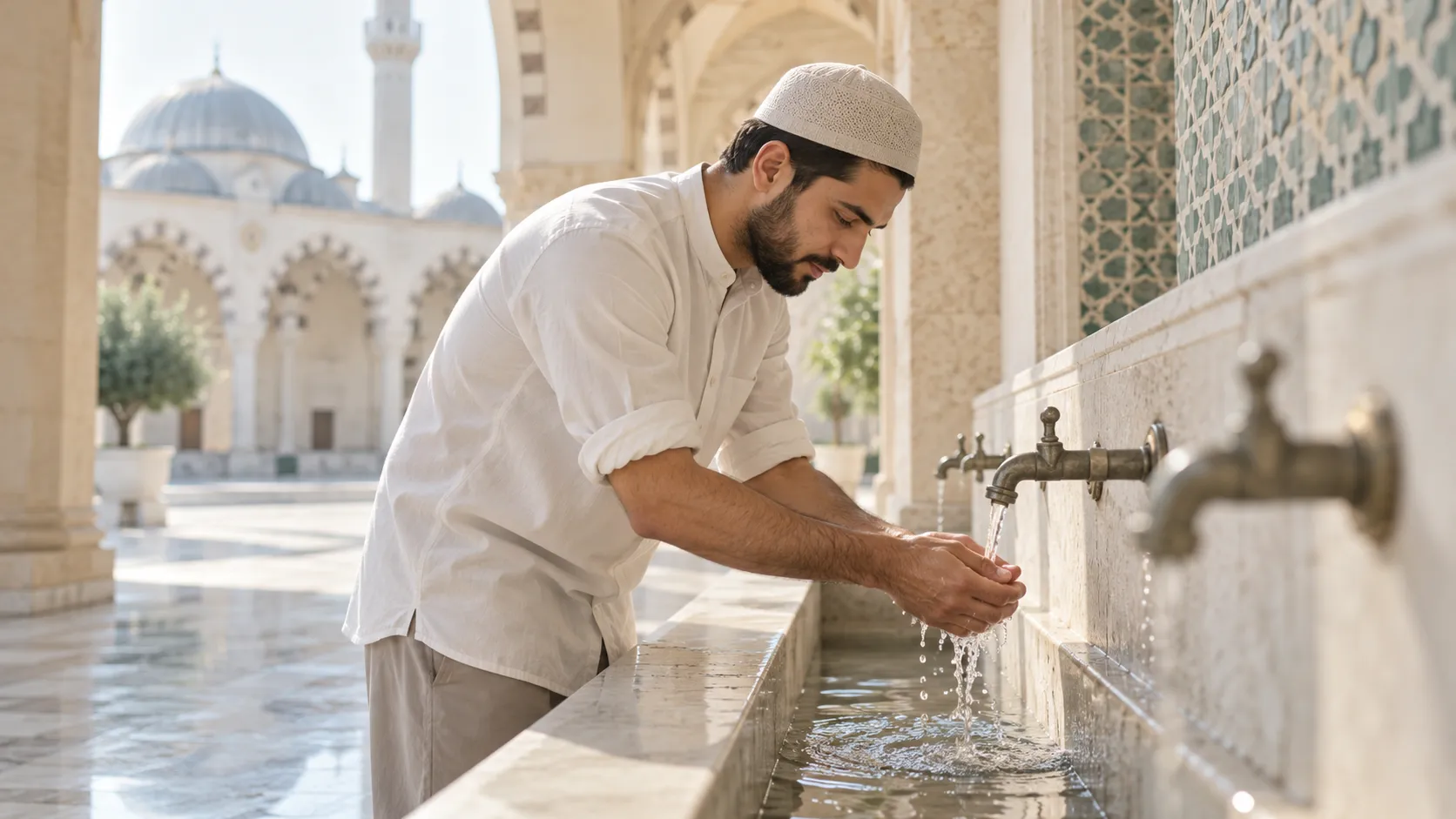
You are about to stand for Salah. You know prayer matters, but the questions pile up. Do I wash my hands first? What about my mouth? How much of my head do I wipe? Do my feet get washed three times? What if I make a mistake? How do I know it counts?
For a convert, the unfamiliar sequence can feel overwhelming. For someone raised Muslim, the questions often arrive after years of copying a family habit, when a video or a friend suddenly does it differently.
This guide explains how to make Wudu in the order the Quran and Sunnah teach. It also shows which details are required, which are recommended, and where the four Sunni schools differ. Wudu combines obedience, cleanliness, ritual purification, and preparation for prayer. Ritual purity is not the same as feeling clean: a person can be physically spotless and still need Wudu, and a person with slightly damp hands can be fully pure.
Two principles guide the article. Wudu is an act of worship, not a test of whether a beginner can perform every optional detail perfectly. And where recognized schools differ, those differences are not a sign that your worship is invalid.
What Is Wudu in Islam?
Wudu is the ritual ablution Muslims perform to enter a state of purity for Salah and certain other acts of worship. It involves washing the face and arms, wiping the head, and washing the feet, as commanded in Quran 5:6 and shown in the Sunnah of Prophet Muhammad ﷺ. It is not required before every dhikr or dua.
Some terms you will meet:
Taharah (الطَّهَارَة): ritual and physical purification.
Hadath (الحَدَث): a state of ritual impurity. Minor hadath requires Wudu; major hadath requires Ghusl.
Najasah (النَّجَاسَة): physical impurity such as urine, which is removed from body or clothes.
Fard / Wajib: obligatory. Schools differ on whether they distinguish the two (the Hanafi school does).
Sunnah / Mustahabb: recommended, rewarded, but not required for validity.
Masah (مَسْح): wiping with a wet hand.
Madhhab: a school of Islamic jurisprudence (Hanafi, Maliki, Shafi’i, Hanbali).
Istinja: cleaning oneself after using the toilet. It is separate from Wudu.
Niyyah (النِّيَّة): intention.
How to Make Wudu: The Quick Step-by-Step Guide
Here is the commonly taught complete method, based on the Prophetic descriptions. Details and evidence follow below.
Intend in your heart to purify yourself for prayer.
Say “Bismillah” (in the name of Allah).
Wash both hands up to the wrists, three times.
Rinse your mouth, then spit the water out.
Rinse your nose by drawing water in gently and blowing it out.
Wash your face fully, hairline to chin, ear to ear.
Wash your arms, right then left, including the elbows.
Wipe your head with wet hands.
Wipe your ears with wet fingers.
Wash your feet, right then left, including the ankles and heels.
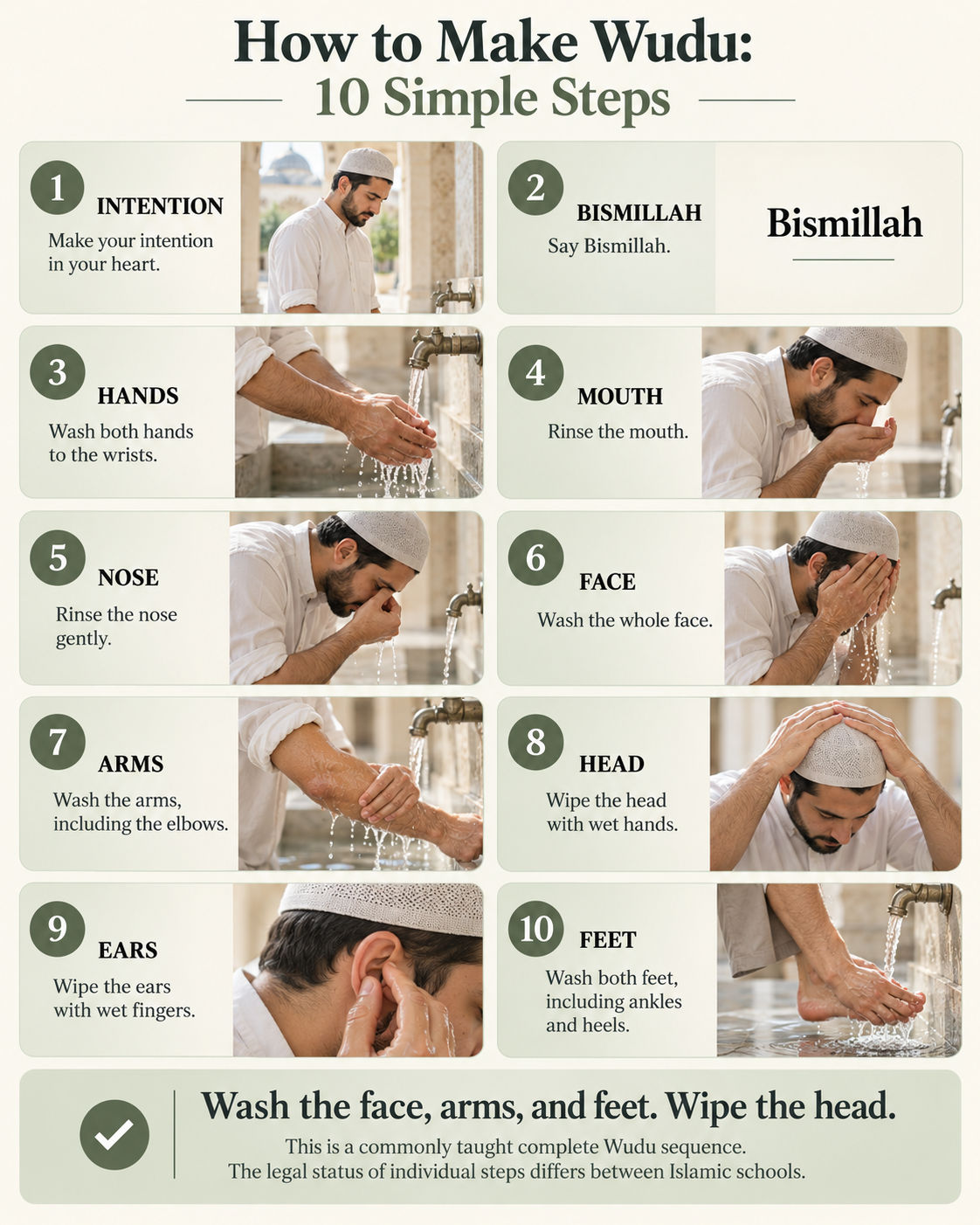
Washing and wiping are different actions. Face, arms, and feet are washed. Head and ears are wiped.
This is a teaching sequence, not a claim that all ten steps are independently obligatory in every school. The Quran names four actions; the Sunnah adds more; the schools classify some of these details differently. Treat this list as a teaching sequence rather than ten separate obligations. The next sections give the evidence, and the later table shows exactly where the four Sunni schools differ.
What Does the Quran Say About Wudu?
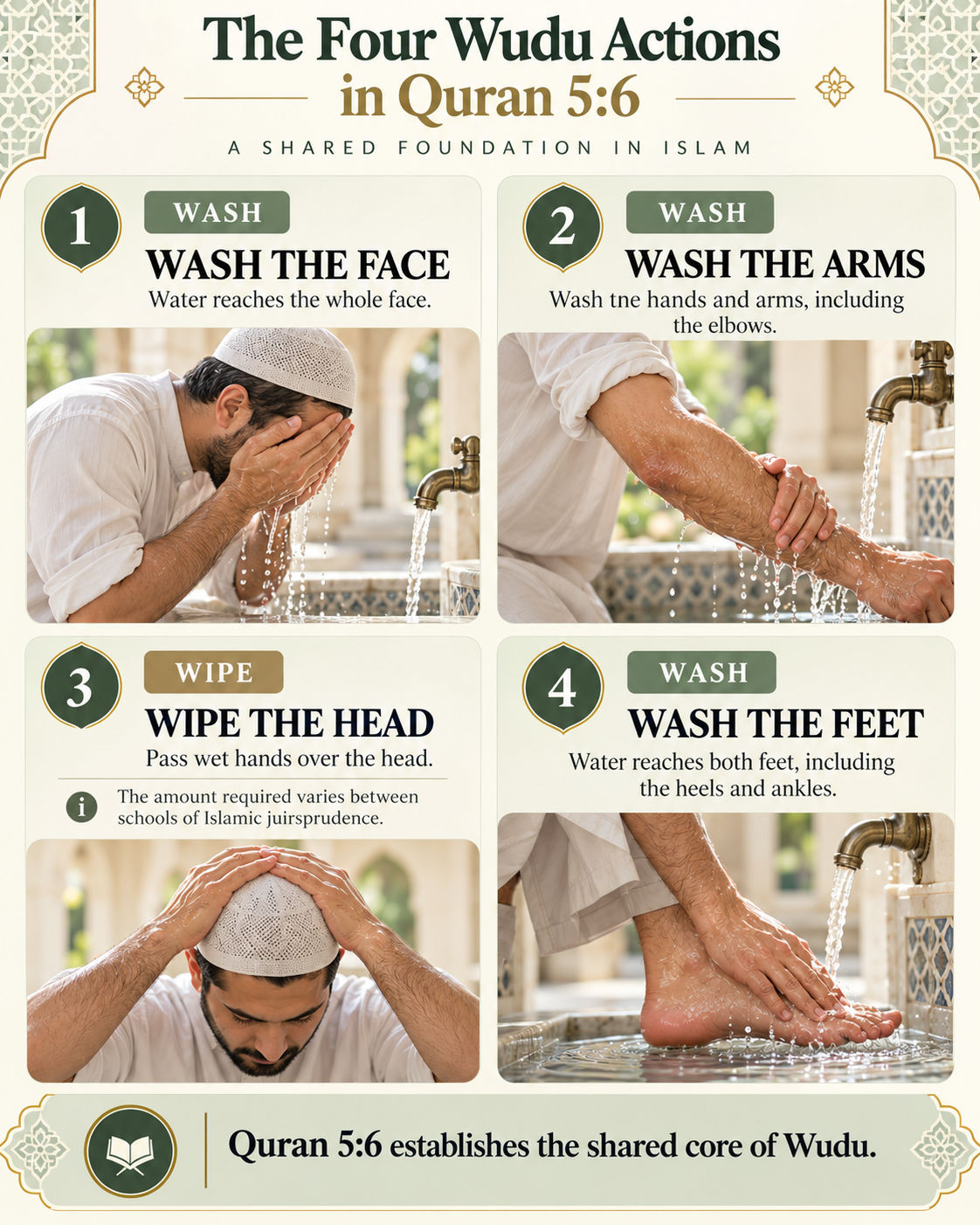
The foundation is Quran 5:6:
يَا أَيُّهَا الَّذِينَ آمَنُوا إِذَا قُمْتُمْ إِلَى الصَّلَاةِ فَاغْسِلُوا وُجُوهَكُمْ وَأَيْدِيَكُمْ إِلَى الْمَرَافِقِ وَامْسَحُوا بِرُءُوسِكُمْ وَأَرْجُلَكُمْ إِلَى الْكَعْبَيْنِ
In meaning: “O you who believe, when you rise for prayer, wash your faces and your hands up to the elbows, wipe your heads, and [wash] your feet up to the ankles.” The verse goes on to mention Ghusl after janabah and Tayammum when water is unavailable or harmful. Quran 4:43 gives related rulings, and Quran 2:222 reminds us that Allah loves those who purify themselves.
The Arabic of the command
Word | Meaning | Note |
|---|---|---|
فَاغْسِلُوا | So wash | Command to wash |
وُجُوهَكُمْ | your faces | |
وَأَيْدِيَكُمْ | your hands/arms | “Up to the elbows” (إِلَى الْمَرَافِقِ) defines the limit |
وَامْسَحُوا | and wipe | Command to wipe |
بِرُءُوسِكُمْ | your heads | The ب (bi-) is central to the head-wiping discussion |
وَأَرْجُلَكُمْ | and your feet | Read with fatha (أَرْجُلَكُمْ) in Hafs; other recitations read kasra (أَرْجُلِكُمْ) |
Note the exact text: it is بِرُءُوسِكُمْ with the preposition bi-. Some jurists read this as implying “part of the head,” others as “the whole head with the wiping hand.”
The feet are the one place where the grammar sparks discussion. Different Qira’at read the word with either nasb or jarr. The mainstream Sunni understanding, supported by authentic Prophetic practice, is that the feet are washed. The jarr reading is explained through grammatical adjacency and through the wiping allowance for leather socks. This is a point of Quranic Arabic study, not a contradiction in the Quran.
Why washing and wiping differ
To wash (ghasl) means water flows over and reaches the area. To wipe (masah) means a wet hand passes over the area. The Quran never gives a universal minimum amount of water for wiping, and no one should invent one. The way the Quran changes the verb from “wash” to “wipe” and back to “wash” shows that these are different acts. Wiping is a lighter action than washing, and the Quran never treats the two as interchangeable.
How to Perform Wudu Step by Step
The Prophet’s method is preserved in detailed reports. Uthman ibn Affan رضي الله عنه described it in Sahih al-Bukhari and Sahih Muslim: hands, mouth and nose, face, arms to the elbows, head, then feet to the ankles. Abdullah ibn Zayd رضي الله عنه gave another description, including the way the head was wiped. These are separate narrations, and this article does not merge them into one text.
Authentic reports show variation: the limbs were washed once, twice, or three times on different occasions (Bukhari). Variation is not contradiction. It shows the flexibility of the Sunnah.
Step 1: Make Your Intention
النِّيَّة (An-Niyyah). Intention is an act of the heart. You simply mean, “I am doing this to purify myself for prayer.” The foundation is the hadith “Actions are by intentions” (Bukhari, Muslim).
The schools differ on its legal status. The Hanafi school treats Niyyah as Sunnah for water Wudu. The Maliki, Shafi’i, and Hanbali schools treat it as required for Wudu to be valid. Whichever school you follow, no spoken formula is required. Popular phrases like “Nawaytu an atawadda’a…” are not established as Prophetic wording, and a beginner does not need to memorize any special Arabic statement. Turning up at the sink with the aim of preparing for Salah is itself the intention.
Step 2: Say Bismillah
بِسْمِ اللَّهِ, “In the name of Allah.” The relevant hadith is “There is no Wudu for the one who does not mention Allah’s name over it” (Abu Dawud, Tirmidhi, Ibn Majah). Its chain is debated. Imam Ahmad reportedly said he knew no sound hadith on the subject, while later scholars strengthened it through its multiple routes.
The schools differ here as well. Hanafis, Malikis, and Shafi’is treat Bismillah as Sunnah. In the Hanbali school the well-known position is that it is required but is excused if forgotten. If you forget it, do not panic. Under every school’s reasoning, forgetting it does not put a beginner’s Wudu in doubt. If you follow a particular school, learn its position consistently from a teacher.
Step 3: Wash Your Hands
Wash both hands up to the wrists, ideally three times, before putting them into any water vessel. This initial washing is described in Uthman’s narration. It is separate from the later obligatory washing of the arms to the elbows. The Hanbali school treats washing the hands after waking from night sleep as obligatory before dipping them into a container, based on the hadith of Abu Hurayrah (Bukhari, Muslim).
Which hand first? The Prophet ﷺ liked to begin with the right in purification (Bukhari, Muslim, from Aisha). Starting with the left is a missed Sunnah, not an invalidation.
Step 4: Rinse Your Mouth
المَضْمَضَة (Al-Madmadah). Take water into your mouth, move it around, and spit it out. Do not swallow it, and do not force water down your throat, especially if you are fasting.
Is it obligatory? The Hanafi, Maliki, and Shafi’i schools treat it as Sunnah. The Hanbali school treats rinsing the mouth and nose as obligatory, since they count them as part of the face. So do not say “all scholars agree it is only Sunnah.” They do not.
Step 5: Rinse Your Nose
الاسْتِنْشَاق (Al-Istinshaq) is drawing water gently into the nose. الاسْتِنْثَار (Al-Istinthar) is blowing it out. Do this gently. Forceful sniffing can hurt, and the Sunnah is gentle thoroughness.
The classification follows the same pattern as the mouth: Sunnah for three schools, obligatory for the Hanbalis. Authentic reports describe rinsing mouth and nose from a single handful of water, and reports with separate handfuls also exist. Both methods are acceptable, so use whichever is practical.
Step 6: Wash Your Face
The face runs from the usual hairline on the forehead to the bottom of the chin, and from ear to ear (the schools differ slightly on the exact edge near the ears). A vague splash is not enough. Water must reach the whole area.
Beards. If the beard is thin and the skin shows through, water must reach the skin. If the beard is thick, washing the outer hair is the basic requirement, and running wet fingers through it is a recommended Sunnah (Abu Dawud). Some schools are stricter here, so details vary by school.
Eyebrows and eyelashes are washed on the outside. Do not rub or wash inside your eyes.
Can I wash my face only once? Yes. One complete wash fulfills the washing requirement. Two or three washes follow the Sunnah, but triple washing is not universally compulsory.
Step 7: Wash Your Arms, Including the Elbows
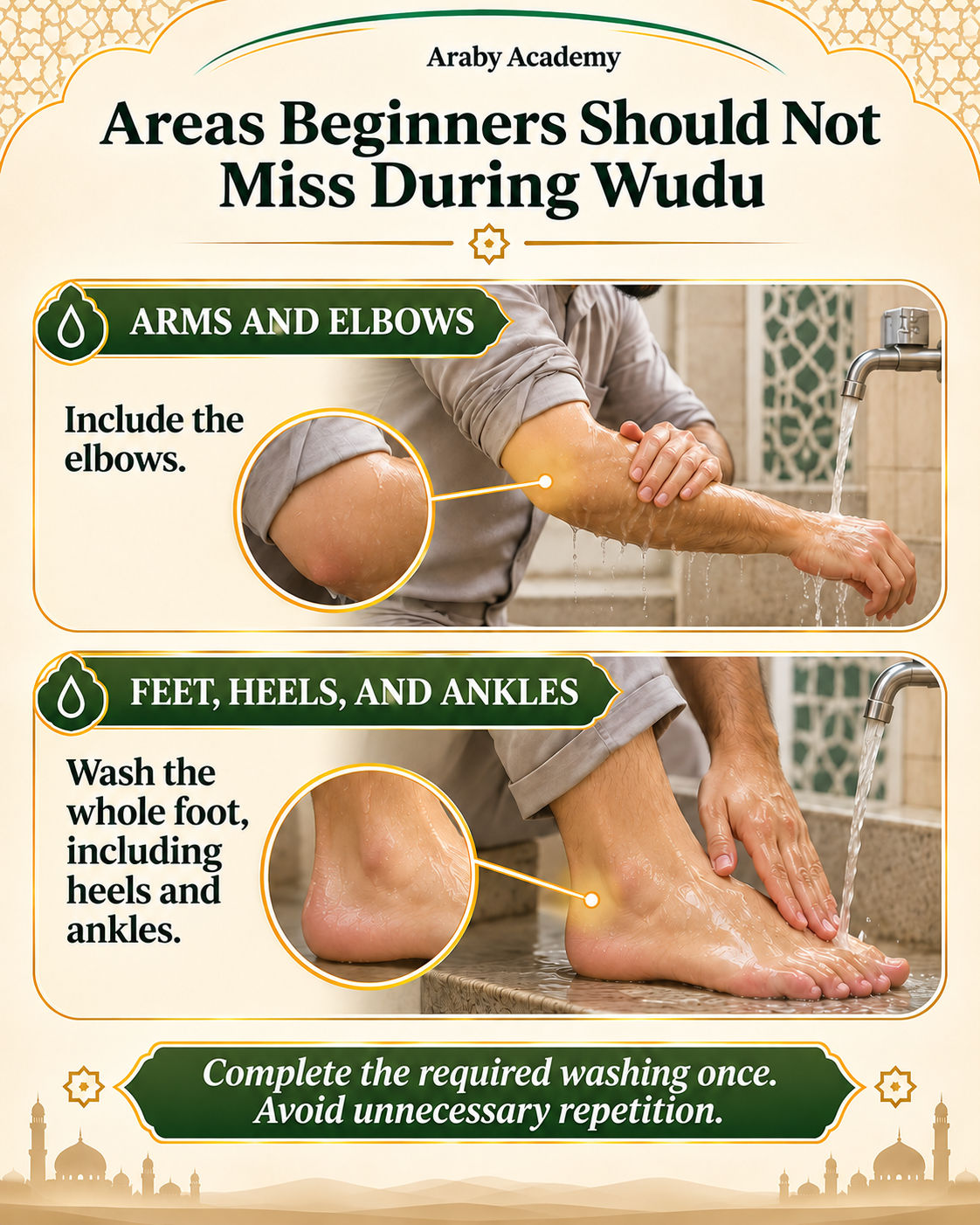
Wash the right arm from the fingertips up to and including the elbow, then the left. Yes, the elbow counts. The verse says “up to the elbows” (إِلَى الْمَرَافِقِ), and the mainstream understanding includes them. Uthman’s narration states the arms are washed “up to the elbows.”
Watches, bracelets, and rings. If an item stops water reaching the skin, move or remove it. If it is loose and water flows under it, you do not need to take it off. Tight rings should be shifted or turned so water reaches the skin beneath.
Check the elbow and the outer edge of the forearm, where beginners most often leave a dry strip.
Step 8: Wipe Your Head
مَسْح (Masah). Wet your hands and pass them over your head. Do not wash your hair with shampoo and do not pour water over it. Wiping is the instruction.
How much of the head? The schools differ, and this is one of the major differences:
Hanafi: at least a quarter of the head.
Maliki: the whole head.
Shafi’i: any part, even a few hairs.
Hanbali: the whole head.
For a simple beginner demonstration, wiping the whole head avoids most worries about the minimum. The legal minimum still varies by school.
How did the Prophet ﷺ do it? Abdullah ibn Zayd described that he passed his hands from the front of the head to the back of the neck line and returned them to where he began (Bukhari, Muslim). Other authentic descriptions of the head wipe exist, and not every authentic description requires an identical hand motion.
How many times? The common Sunnah is once. Head wiping is not equal in status to the three washes of the limbs, although some Shafi’is recommend three.
Step 9: Wipe Your Ears
Wipe the inner part of each ear with your index fingers and the outer part with your thumbs, using the same wet hands from the head wipe (the method is commonly taught from the hadith of Ibn Abbas in Tirmidhi and others).
The schools differ on the status of the ears. Hanafi, Maliki, and Shafi’i scholars treat wiping them as Sunnah. The Hanbali school counts the ears as part of the head. Some Shafi’i and Maliki scholars recommend fresh water for the ears, while Hanafi and Hanbali scholars say the head water suffices. Do not turn this into a worry. It is one of the finer details.
The neck. Many communities teach wiping the neck. There is no sound Prophetic report establishing it as a Wudu step, and scholars such as al-Nawawi rejected it as an established Sunnah. Some jurists mention it as merely recommended. It is not one of the Quranic actions or an obligatory step. If it is your family’s habit, there is no need to mock it, but do not present it as obligatory.
Step 10: Wash Your Feet, Including the Ankles
Wash the right foot, then the left. Include the whole foot, the heel, and the ankle bones. Wash between the toes: the Sunnah is to pass the little finger between them (Abu Dawud, Tirmidhi). One simple method is to let water run over the foot while the fingers of the left hand pass between the toes. The finger movement itself is not obligatory in every school.
Why the heels matter. The Prophet ﷺ warned: “Woe to the heels from the Fire” (Bukhari, Muslim). The context was people hurrying and leaving their heels dry. It is a warning against leaving required areas unwashed. It is not meant to push anyone toward obsessive washing.
Washing versus wiping footwear. Bare feet are washed. Wiping over qualifying leather socks is a concession covered below. Not any sock qualifies.
Use the warning as motivation to be thorough once, not to wash a fourth or fifth time.
Which Parts of Wudu Are Obligatory?
A report showing that the Prophet ﷺ did something establishes it as Sunnah. Whether it is also obligatory depends on wider evidence and juristic method. The four actions in Quran 5:6 (face, arms, head, feet) are the shared core. The schools differ on additions.
Item | Hanafi | Maliki | Shafi’i | Hanbali |
|---|---|---|---|---|
Niyyah | Sunnah | Fard | Fard | Required (shart) |
Bismillah | Sunnah | Sunnah | Sunnah | Required, excused if forgotten |
Mouth and nose | Sunnah | Sunnah | Sunnah | Obligatory |
Face, arms, feet | Fard | Fard | Fard | Fard |
Head wipe | ¼ of head | Whole head | Any part | Whole head |
Ears | Sunnah | Sunnah | Sunnah | Part of the head |
Order (tartib) | Sunnah | Sunnah | Fard | Fard |
Continuity (muwalah) | Sunnah | Fard (if able/remembering) | Sunnah (preferred view) | Fard |
Rubbing (dalk) | Sunnah | Fard | Sunnah | Sunnah |
Details vary. This table summarizes the main positions and cannot capture every internal exception, so see the explanation above and ask a teacher.
Learn one school’s list well, and treat the rest as recommended details.
Order (التَّرْتِيب, At-Tartib). Following the sequence of the verse and of the Prophet ﷺ is always wise. If you accidentally wash your arms before your face, do not conclude that your Wudu is invalid in every school. The Hanafi and Maliki schools treat order as Sunnah. The Shafi’i and Hanbali schools require it.
Continuity (المُوَالَاة, Al-Muwalah). This means moving through the steps without a long gap. Pausing to answer a short question is fine. Schools define the allowed gap differently: for example, the Hanbali approach looks at whether a washed limb would have dried in normal conditions.
How Many Times Should Each Part Be Washed?
Body part | Normal minimum | Common Sunnah practice | Note |
|---|---|---|---|
Hands (to wrists) | Not separately required | Three times | Arms are washed later |
Mouth | Once (Sunnah in 3 schools; Hanbali: obligatory) | Three | Single handful or separate |
Nose | Same as mouth | Three | Gently |
Face | Once, complete | Two or three | Complete coverage |
Arms (with elbows) | Once, complete | Two or three | Right then left |
Head (wipe) | Once | Once | Wiping, not washing |
Ears (wipe) | Once | Once | With head wipe |
Feet (with ankles) | Once, complete | Two or three | Right then left |
A complete wash once fulfills the washing requirement. The Sunnah is repetition; the Prophet ﷺ is reported to have washed once, twice, and three times (Bukhari).
Excess. A hadith reported by Abu Dawud and Ibn Majah says that whoever adds to or subtracts from this has done wrong. Scholars discuss its chain and its precise wording. The practical lesson is to avoid deliberate excess. An accidental extra splash does not invalidate Wudu.
Water quantity. The Prophet ﷺ performed Wudu with about one mudd of water (Bukhari, Muslim, from Anas). Modern estimates of a mudd vary, roughly between half a liter and three-quarters of a liter, so no single modern figure is certain. The point is moderation. Do not leave the tap running while you do other steps, but do not let conservation reduce the required washing to symbolic drops. A weak report about wastefulness “even at a flowing river” circulates widely; do not rely on it. Quran 7:31 gives a general warning against excess.
What Should You Say After Wudu?
Umar رضي الله عنه narrated that the Prophet ﷺ said that whoever performs Wudu well and then says the following has the eight gates of Paradise opened for him (Sahih Muslim):
أَشْهَدُ أَنْ لَا إِلَٰهَ إِلَّا اللَّهُ وَحْدَهُ لَا شَرِيكَ لَهُ وَأَشْهَدُ أَنَّ مُحَمَّدًا عَبْدُهُ وَرَسُولُهُ
“I bear witness that there is no god but Allah, alone, without partner, and I bear witness that Muhammad is His servant and Messenger.”
Tirmidhi’s version adds اللَّهُمَّ اجْعَلْنِي مِنَ التَّوَّابِينَ وَاجْعَلْنِي مِنَ الْمُتَطَهِّرِينَ (“O Allah, make me among those who repent and among those who purify themselves”). Tirmidhi himself commented on the chain, and scholars differ on its grading, so keep it separate from the Muslim wording.
Is there a special dua for each limb? Popular lists give different words for the face, arms, head, and feet. No reliable Prophetic evidence supports them, so do not present them as Sunnah. Quiet remembrance of Allah is welcome, but an unsupported formula is not a prescribed ritual.
What Breaks Wudu?
A beginner should know the most common nullifiers first, then the disputed ones.
Possible nullifier | General ruling | Scholarly difference | Practical note |
|---|---|---|---|
Urine, stool | Breaks | Agreed | Clean with Istinja, then renew Wudu |
Passing gas | Breaks | Agreed | Requires certainty |
Deep sleep / loss of consciousness | Breaks | Agreed for deep sleep and fainting | See sleep below |
Light sleep | Depends | Schools differ by posture | See below |
Touching private parts | Disputed | Hanafi: no. Maliki: with desire. Shafi’i/Hanbali: yes, direct touch | Details vary |
Touching one’s spouse | Disputed | Hanafi: no. Maliki/Hanbali: with desire. Shafi’i: skin contact | Details vary |
Bleeding | Disputed | Hanafi: flowing blood. Maliki/Shafi’i: no. Hanbali: if excessive | Details vary |
Vomiting | Disputed | Hanafi: a mouthful. Maliki/Shafi’i: no. Hanbali: if excessive | Details vary |
Camel meat | Disputed | Hanbali: yes (hadith in Muslim). Others: no | Details vary |
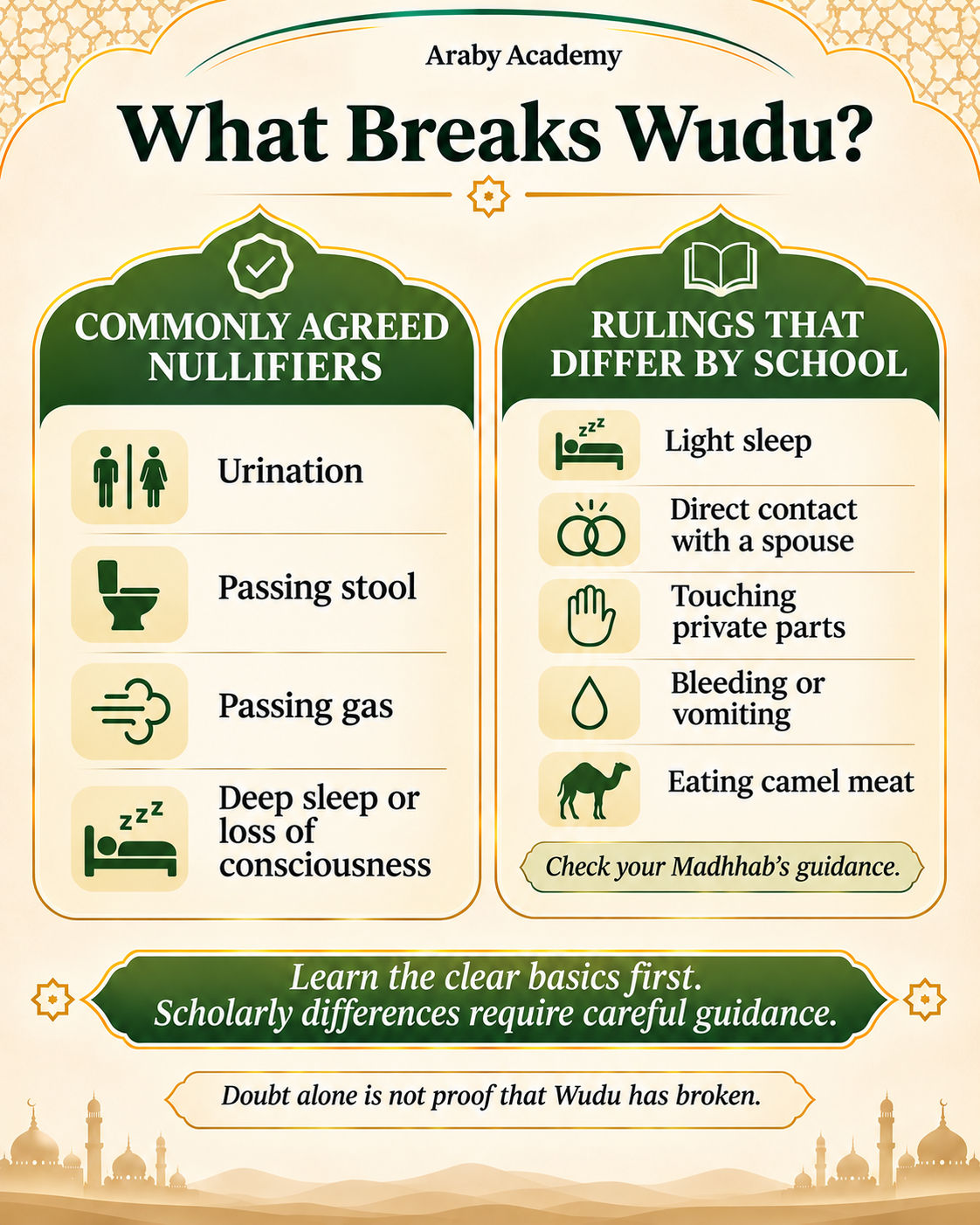
Details vary, so do not treat any single row as a universal ruling.
Gas and the sound-or-smell hadith. Abdullah ibn Zayd narrated that a man felt something in prayer, and the Prophet ﷺ said he should not leave unless he hears a sound or smells an odor (Bukhari, Muslim). Scholars understand this to mean he should act on certainty, not on doubt. It does not mean gas must be audible or smelly to count. A rumbling stomach or a vague feeling is not certainty.
Sleep. Safwan ibn Assal reported that the Prophet ﷺ listed sleep with urine and stool as things that require renewing purity (Tirmidhi, Nasa’i). Yet Anas reported that the Companions dozed while waiting for Isha and prayed without new Wudu (Muslim). Scholars reconcile these by distinguishing deep from light sleep and by posture. In summary: Hanafis say sleep breaks Wudu when lying or leaning in a way that would make you fall if the support were removed. Malikis and Hanbalis say deep sleep breaks it, and light sleep does not. Shafis say it breaks it unless you sit with your buttocks firmly on the ground. A short nod is not the same as deep sleep.
Touching a woman. Quran 4:43 and 5:6 mention lamastum al-nisa’. Some scholars read this as skin contact; others as intimate relations. Schools therefore differ, as the table shows. Marital affection is not sinful or shameful, and the answer depends on the school you follow. The same applies to kissing a spouse.
Private parts. The hadith of Busrah bint Safwan says those who touch their private part should perform Wudu (Abu Dawud, Tirmidhi, Nasa’i). The hadith of Talq ibn Ali says it is only a part of the body (Abu Dawud, Tirmidhi, Nasa’i). Hanafis prefer Talq’s report; others interpret Busrah’s report as general or as dependent on desire. Differences remain.
Laughing. Ordinary laughing outside Salah does not break Wudu. The Hanafi school holds that loud laughter inside a prayer with bowing and prostration breaks both the prayer and Wudu. Others say it breaks only the prayer.
Details vary, so a student should ask a teacher about the school they follow.
What Does NOT Break Wudu?
Crying. Ordinary tears are not a nullifier.
Sweating.
Eating or drinking. (Camel meat is separately discussed above.)
Perfume. Applying it does not break Wudu.
Showering or swimming. Water contact itself does not break Wudu.
Sinning. Sin needs repentance but is not a ritual nullifier. Wudu does not replace Tawbah.
Listening to music. Whatever the separate discussion of its permissibility, it is not a Wudu nullifier.
Touching something dirty. Najasah is a physical impurity to be removed from the body or clothes before prayer. Touching it does not automatically cancel Wudu.
Changing a diaper. Touching urine or stool is distinct from nullifying Wudu. Direct touching of the private part may matter in some schools, so wash your hands and, if you follow such a school, consider renewing.
Do I need new Wudu for every prayer? No. If your Wudu remains valid, you may pray several prayers with it. Renewing is recommended but not required. There is no time limit for ordinary Wudu, and it does not expire when a new prayer time begins.
When is Wudu required? Before Salah, certainly. Most scholars also require it for Tawaf and for touching a physical Mushaf, though a minority differ. Reading the Quran from memory, making dhikr or dua, or reading a translation on a phone does not generally require it.
Wudu With Socks, Makeup, and Nail Polish
Wiping over socks
The Prophet ﷺ wiped over his khuffayn (خُفَّان, leather footwear) (Bukhari, Muslim, from Mughira ibn Shu’ba). Not every modern sock qualifies automatically:
Maliki: traditionally leather only.
Shafi’i: water-resistant, durable footwear covering the ankles.
Hanafi and Hanbali: thick, durable socks that stay on may qualify.
Contemporary scholars have also discussed ordinary socks, with differing conclusions. Ask a qualified teacher about your socks.
The usual condition is wearing them after a complete Wudu. The time limit reported by Ali is one day and night for a resident and three for a traveler (Muslim). The Maliki school allows without a time limit; the other schools start the clock from the first nullifier after wearing the socks. Wiping stops if you remove the footwear or if you need Ghusl. Wipe the top of the foot with wet fingers, not the sole, as Ali narrated (Abu Dawud). Full rulings belong in a dedicated article.
Hijab
Some women ask whether they can wipe over a headscarf. The Hanbali school allows it under certain conditions in need. Other schools do not. Do not assume either.
Makeup, skincare, and barriers
The principle is simple: water must reach the skin that must be washed. Waterproof mascara, heavy foundation, and thick film-forming products may block water. Thin skincare, lotion, and permeable cosmetics generally do not. If you are unsure, take a small test: does water bead and run off, or soak in? Do not guess about chemistry.
Nail polish and gel or acrylic nails
Conventional polish forms a waterproof layer and blocks water from the nail. Polish applied after Wudu does not break existing Wudu. The problem arises when you renew Wudu. “Breathable” or “halal” labels are marketing claims, and scholars assess them differently. Gel and acrylic nails, similarly, cover the natural nail. Practical options include removing them, or consulting a trusted scholar about your product.
Henna and hair dye
Stains are not barriers. Henna that has left color on the skin, once the paste is removed, does not block water. Thick paste still on the skin does. The same goes for hair dye: a stain is fine, a coating is not.
Ask what physically sits between the water and the skin, not what the label promises.
Wudu for Illness, Disability, and Special Circumstances
Islamic obligations take ability into account. Do not feel ashamed if you need help.
Casts, bandages, and wounds. Do not remove a cast or dressing that medical staff have placed. Scholars permit wiping over bandages and casts, sometimes with Tayammum for the unwashable part, depending on school and case. Do not wash an open wound if water would harm it. Consult both a doctor and a scholar if the case is complicated.
Disability. Wheelchair users, people with one hand, and others with limited mobility can use a basin, a handheld sprayer, or a seat. Someone else may pour water or help wash, and independence is not a condition of validity.
Continuous incontinence. A person with ongoing leakage is considered excused in the schools, with different rulings on when to renew Wudu: for example, Hanafis require Wudu for each prayer time, while Hanbalis require it after the prayer time enters. There is no single treatment plan, so ask a scholar.
Pregnancy. Pregnancy does not nullify Wudu. Use a seat or a basin if swelling or balance makes standing difficult.
Discharge, menstruation, and postpartum bleeding. Ordinary discharge is treated differently by scholars depending on its type, so use respectful, specific questions. Menstruation and Nifas have their own rulings: a woman does not pray during them and does not become spiritually unclean. She may make Wudu for dhikr or other reasons if she wishes, but Wudu does not replace the Ghusl required when bleeding ends.
Cold water. Use warm water if possible. Painful cold exposure is not a sign of stronger faith, and harm can lead to concessions.
Travel. On a plane or train, use the lavatory sink safely. Wiping over qualifying footwear or Tayammum may apply in specific situations, so ask a qualified person about complicated cases.
At work or school. Locate a washing area, plan your prayer breaks, use water responsibly, avoid flooding the floor, and be considerate of others. A public restroom is a valid place for Wudu. Foot-washing in a sink is not a requirement of Wudu. A small water container is an alternative if the sink is unsafe.
Wudu vs Ghusl vs Tayammum
Wudu | Ghusl | Tayammum | |
|---|---|---|---|
What it is | Minor ritual purification with water | Full-body ritual washing | Dry purification with clean earth |
When | After minor hadath | After janabah, end of menstruation, end of Nifas | When water is unavailable or harmful |
Main source | Quran 5:6 | Quran 5:6 and 4:43 | Quran 4:43 and 5:6 |
Specific procedures and conditions require reliable Fiqh guidance.
Does Ghusl replace Wudu? A valid obligatory Ghusl generally suffices, subject to the school’s conditions. A casual shower does not automatically count as Wudu.
Tayammum (التَّيَمُّم, At-Tayammum) is allowed when water is unavailable, when using it would harm you because of illness, or in other valid cases. Inconvenience alone does not count. In brief, based on Ammar’s hadith (Bukhari): strike the clean earth, wipe the face and hands. The number of strikes and the extent of wiping differ by school.
Whichever applies, the aim is the same: to enter prayer in a state of purity without hardship.
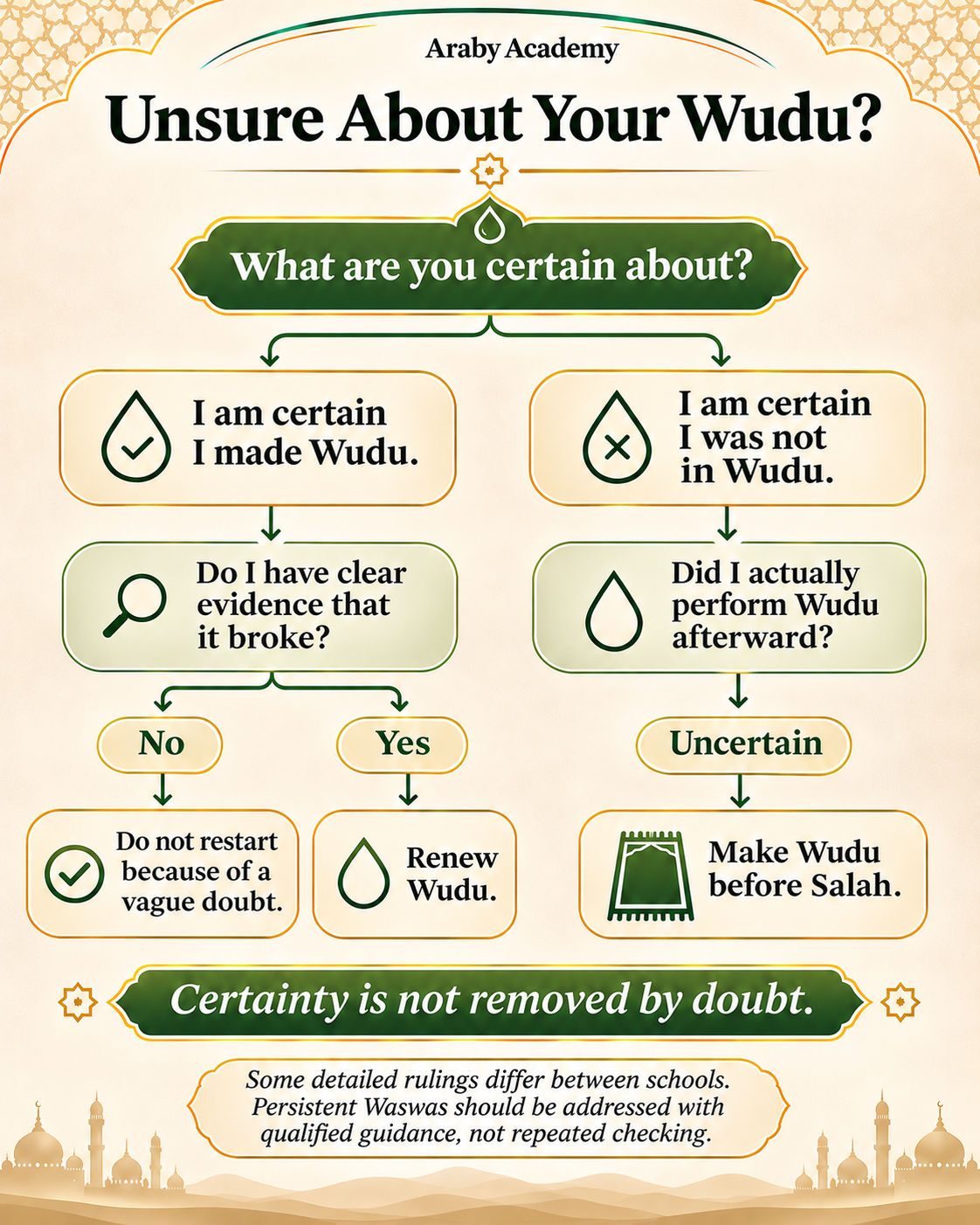
What If You Are Unsure Whether Your Wudu Is Valid?
Some people struggle more with doubt than with water. The maxim is اليقين لا يزول بالشك: certainty is not removed by doubt.
If you are certain you made Wudu, then doubt whether you passed gas: your Wudu stands. This applies the sound-or-smell hadith. (The Maliki school has a stricter treatment of doubt about a nullifier, but exempts people with waswas.)
If you are certain you were not in Wudu, then doubt whether you made it: you are still treated as not having it, so make Wudu.
Do not inspect every limb repeatedly or hunt for drops. If you know you left an obligatory part dry, wash that part (and in some schools what follows it). That is certainty. A vague feeling that you “might have” is not.
Waswas (الوَسْوَاس). Intrusive religious doubts are real. Normal care in performing Wudu well is good. Compulsive repeating, long delays, and anxiety are not what the religion asks for. If you cannot stop restarting Wudu, do not “wash everything again to be safe.” That feeds the cycle. Speak to a qualified scholar and consider a mental-health professional experienced with scrupulosity. This article is education, not a diagnosis.
If you forget a step. First ask whether it was obligatory or recommended in your school. If a recommended act was missed, your Wudu is valid. If you realize you missed an obligatory part, go back and wash it, then repeat what came after it if your school requires order or continuity. The answer differs by case and school, so ask your teacher.
A dry area. If you are sure part of your foot stayed dry, wash it. If you are only unsure, do not repeat.
Repeating a completed act again and again does not make worship stronger; it usually feeds the doubt.
10 Common Wudu Mistakes to Avoid
Dry heels. Why: rushing. Matters: the heel is part of the foot. Fix: let water run over the heel and ankle.
Missing elbows. Why: stopping at the forearm. Matters: the verse says “to the elbows.” Fix: check the elbow.
Missing part of the face. Why: splashing. Matters: the whole face must be washed. Fix: know the boundaries.
A waterproof barrier. Why: nails or cosmetics. Matters: water must reach the skin. Fix: remove it or ask a scholar.
Treating one Sunnah omission as invalidation. Why: strict online rules. Matters: it creates fear. Fix: learn Fard vs Sunnah.
Wasting water. Why: running tap. Matters: moderation is Sunnah. Fix: turn it off between steps.
Confusing wiping with washing. Why: mixing the verbs. Matters: they are different actions. Fix: wipe head and ears, wash the rest.
Rushing without covering the area. Why: time pressure. Matters: speed doesn’t replace completeness. Fix: slow down once.
Repeating Wudu because of doubts. Why: waswas. Matters: it harms peace and worship. Fix: apply the certainty principle.
Following conflicting videos without knowing the school. Why: different schools. Matters: confusion. Fix: learn from one teacher.
Most of these mistakes disappear once the steps become familiar and the worshipper is calm.
How to Teach Wudu to Children and New Muslims
Children
The Prophet ﷺ told Muslims to instruct children in prayer at seven (Abu Dawud, hasan). Wudu comes first. Our guide on When Should My Child Start Praying? covers the broader picture.
Demonstrate slowly and let them copy you.
Use step cards or a picture chart.
Practice in short, happy sessions, and praise effort.
Correct gently, one detail at a time.
Do not threaten or frighten.
Seven mistakes parents make: treating every Sunnah as obligatory (teach the basics first); correcting harshly (use encouragement); rushing (go slowly); skipping demonstration (show, don’t tell); never explaining why (connect to Salah); encouraging repeated washing (once is enough); making children anxious about validity (reassure them).
New Muslims
A convert does not need perfect Arabic to perform Wudu. Learn the movements first, then the terms. Distinguish essentials from recommended acts, and start praying instead of waiting to master every detail. Our guide How to Learn Salah When You Don’t Speak Arabic is a good companion.
An editorial three-stage path (not a prescribed ritual): Stage one: learn the essential physical actions. Stage two: learn the recommended Sunnah details. Stage three: learn the nullifiers and Fiqh differences.
Wudu, hygiene, and spiritual meaning
Ritual purity and medical hygiene are not identical. Wudu does not replace soap handwashing when medically needed, bathing, or dental care. This article makes no medical claims. The established purpose of Wudu is worship.
The Sunnah mentions great virtues. When a believer washes the face, sins “leave with the water” (Muslim), and the Prophet ﷺ said his community will come marked with brightness from Wudu (Bukhari, Muslim). He also taught that Allah does not accept prayer without purification (Muslim). These virtues are real, but major sins require sincere Tawbah, and rights owed to people require redress. Wudu is not an alternative to repentance and justice.
Wudu is also not a secular mindfulness exercise. It is worship, though it does invite deliberate attention before prayer. To avoid turning it into a rushed habit, learn the sequence, complete the washing, and remember why you are preparing for Salah. For daily structure, see How to Build a Daily Islamic Routine When You Live a Busy Life and The 5 Daily Prayers Explained.
A note on differing schools
Differences among the four Sunni schools come from interpreting the Quran and authenticated reports. They are not mere personal opinion, and no school is “doing Wudu wrong.” Beginners should not mix and match isolated concessions without understanding them, since a combination can be invalid under every school involved. Learning with a qualified teacher resolves this.
15 Essential Arabic Words for Wudu
Arabic | Transliteration | Meaning | Root / context |
|---|---|---|---|
الوُضُوء | Al-Wudu | Ablution | و-ض-أ (cleanliness, brightness) |
الطَّهَارَة | At-Taharah | Purification | ط-ه-ر; Quran 2:222 |
النِّيَّة | An-Niyyah | Intention | ن-و-ي; heart act |
الغَسْل | Al-Ghasl | Washing | غ-س-ل; face, arms, feet |
المَسْح | Al-Masah | Wiping | م-س-ح; head, ears |
المَضْمَضَة | Al-Madmadah | Mouth rinsing | Fiqh term |
الاسْتِنْشَاق | Al-Istinshaq | Drawing water into the nose | Fiqh term |
الاسْتِنْثَار | Al-Istinthar | Blowing nasal water out | Fiqh term |
الوَجْه | Al-Wajh | Face | و-ج-ه; Quran 5:6 |
الْيَد | Al-Yad | Hand/arm | Quran 5:6 |
الرَّأْس | Ar-Ra’s | Head | ر-أ-س; Quran 5:6 |
الرِّجْل | Ar-Rijl | Foot/leg | ر-ج-ل; Quran 5:6 |
الْكَعْب | Al-Ka’b | Ankle | ك-ع-ب; Quran 5:6 |
التَّرْتِيب | At-Tartib | Order | ر-ت-ب; Fiqh term |
التَّيَمُّم | At-Tayammum | Dry purification | ي-م-م; Quran 4:43, 5:6 |
Also useful: الغُسْل (Al-Ghusl, full ritual bath), الحَدَث (Al-Hadath, ritual impurity), النَّجَاسَة (An-Najasah, physical impurity). Terms like madmadah and tartib are Fiqh vocabulary, not exact Quranic words. Learning them is a bridge to Quranic Arabic: see 100 Most Common Words in the Quran and How to Start Learning Quran and Arabic from Zero.
Before Salah: My Wudu Checklist
☐ Intention ☐ Bismillah (per your school’s guidance) ☐ Hands ☐ Mouth ☐ Nose ☐ Face ☐ Arms to elbows ☐ Head ☐ Ears ☐ Feet to ankles
This checklist follows a commonly taught complete Sunnah method. Not all listed details have identical legal status in every Madhhab. Check only when there is a real reason, not repeatedly due to doubts.
Frequently Asked Questions
1. What is Wudu in Islam? Wudu is the ritual ablution that puts a Muslim in a state of purity for Salah and some other worship. It consists of washing the face, arms, and feet and wiping the head, based on Quran 5:6 and the Sunnah.
2. How do you perform Wudu step by step? Intend, say Bismillah, wash hands, rinse mouth and nose, wash face, wash arms to the elbows, wipe the head and ears, and wash the feet to the ankles. See the quick guide above.
3. What are the obligatory acts of Wudu? Washing the face, arms to the elbows, and feet to the ankles, and wiping the head are shared across schools. Intention, order, continuity, and mouth and nose rinsing are classified differently by school.
4. What does the Quran say about Wudu? Quran 5:6 commands washing the faces and arms to the elbows, wiping the heads, and the feet to the ankles when rising for prayer. Quran 4:43 mentions related rulings.
5. Is washing each part once enough? Yes. A complete wash once fulfills the requirement. The Prophet ﷺ is reported to have washed once, twice, and three times, and three is the common Sunnah.
6. Do you have to say Bismillah? The Hanafi, Maliki, and Shafi’i schools treat it as Sunnah. The Hanbali school treats it as required but excused if forgotten. Do not worry if you forget.
7. Do you have to say your intention aloud? No. Intention is in the heart, and no spoken formula is established as required.
8. Do you have to rinse your mouth and nose? The Hanafi, Maliki, and Shafi’i schools consider it Sunnah. The Hanbali school considers it obligatory. Doing it covers all views.
9. How much of your head must be wiped? The Hanafi school requires at least a quarter. The Maliki and Hanbali schools require the whole head. The Shafi’i school accepts any part. Wiping the whole head is a safe beginner practice.
10. Do you have to wipe your ears? Three schools treat ear wiping as Sunnah. The Hanbali school counts the ears as part of the head. Wiping them is the normal practice.
11. Is wiping the neck part of Wudu? No sound Prophetic report establishes it, and it is not an obligatory step. Some jurists mention it as merely recommended.
12. What breaks Wudu? Urine, stool, and gas break it, as does deep sleep or loss of consciousness. Touching private parts, skin contact with a spouse, bleeding, vomiting, and camel meat are disputed among schools.
13. Does sleeping break Wudu? Deep sleep breaks it. Light sleep and posture are treated differently by each school, so a short nod is not the same as deep sleep.
14. Does touching your spouse break Wudu? It depends on the school. Hanafis say no. Malikis and Hanbalis say it does with desire. Shafi’is say direct skin contact does.
15. Does bleeding break Wudu? Hanafis say flowing blood does. Malikis and Shafi’is say no. Hanbalis say only if excessive. Menstruation is a separate matter.
16. Does touching private parts break Wudu? The Hanafi school says no. The Maliki school says with desire. The Shafi’i and Hanbali schools say direct touch does, based on the reports of Busrah and Talq.
17. Does eating break Wudu? Ordinary eating and drinking do not. Camel meat is the exception in the Hanbali school.
18. Does crying break Wudu? No. Ordinary tears are not a nullifier.
19. Does nail polish prevent Wudu? Conventional polish blocks water, so it must be removed before renewing Wudu. Polish applied after Wudu does not break existing Wudu.
20. Can you make Wudu while wearing makeup? Yes, if water reaches the skin. Waterproof or heavy products may block it, while thin products generally do not.
21. Can you wipe over socks? Only qualifying footwear, with conditions that differ by school. Not every sock qualifies.
22. What if you forget a step? Missing a recommended act does not invalidate Wudu. Missing an obligatory act requires doing it, and the details depend on your school.
23. What if you are unsure whether your Wudu broke? Certainty is not removed by doubt. If you are sure you had Wudu, assume it remains.
24. Does Ghusl replace Wudu? A valid obligatory Ghusl generally suffices, but a casual shower does not automatically count.
25. When is Tayammum allowed? When water is unavailable, or when using it would harm you. Inconvenience alone does not qualify.
26. How can a beginner learn Wudu easily? Learn the physical steps first using the quick guide, practice with a teacher or family member, and add the details gradually.
Learn Wudu Correctly, and Prepare for Salah With Confidence
We began with someone at the sink wondering whether their Wudu counts. The answer is calmer than it first appears. The Quran gives the foundation. The Sunnah shows the Prophetic example. Fiqh explains the details. Understand what is required, learn the recommended Sunnah, wash the required areas thoroughly, avoid wasting water, know the genuine nullifiers, and respect recognized scholarly differences. Do not restart because of unsupported doubts.
“Wudu is meant to prepare you for prayer, not prevent you from reaching it through confusion.”
Every time a Muslim performs Wudu, ordinary water and simple physical actions connect to a much larger purpose: standing before Allah in worship. If you want to keep learning, a qualified teacher can guide you through Salah, Tajweed, and Quranic Arabic at your own pace. See How to Learn Quran Online and Tajweed for Beginners.