Why Five Times Every Day?
Picture a few ordinary scenes. A colleague quietly steps away from their desk at midday. A student looks for a quiet corner of the campus library. Passengers at an airport gate lay a jacket or a mat on the floor. A family pauses their dinner preparations as the sun sets. Somewhere nearby, a phone shows a prayer-time app.
If you are unfamiliar with Islam, the question is natural: why does this happen five times every day?
If you are a Muslim beginner, the question may be more personal: how am I supposed to organize my entire day around five prayers?
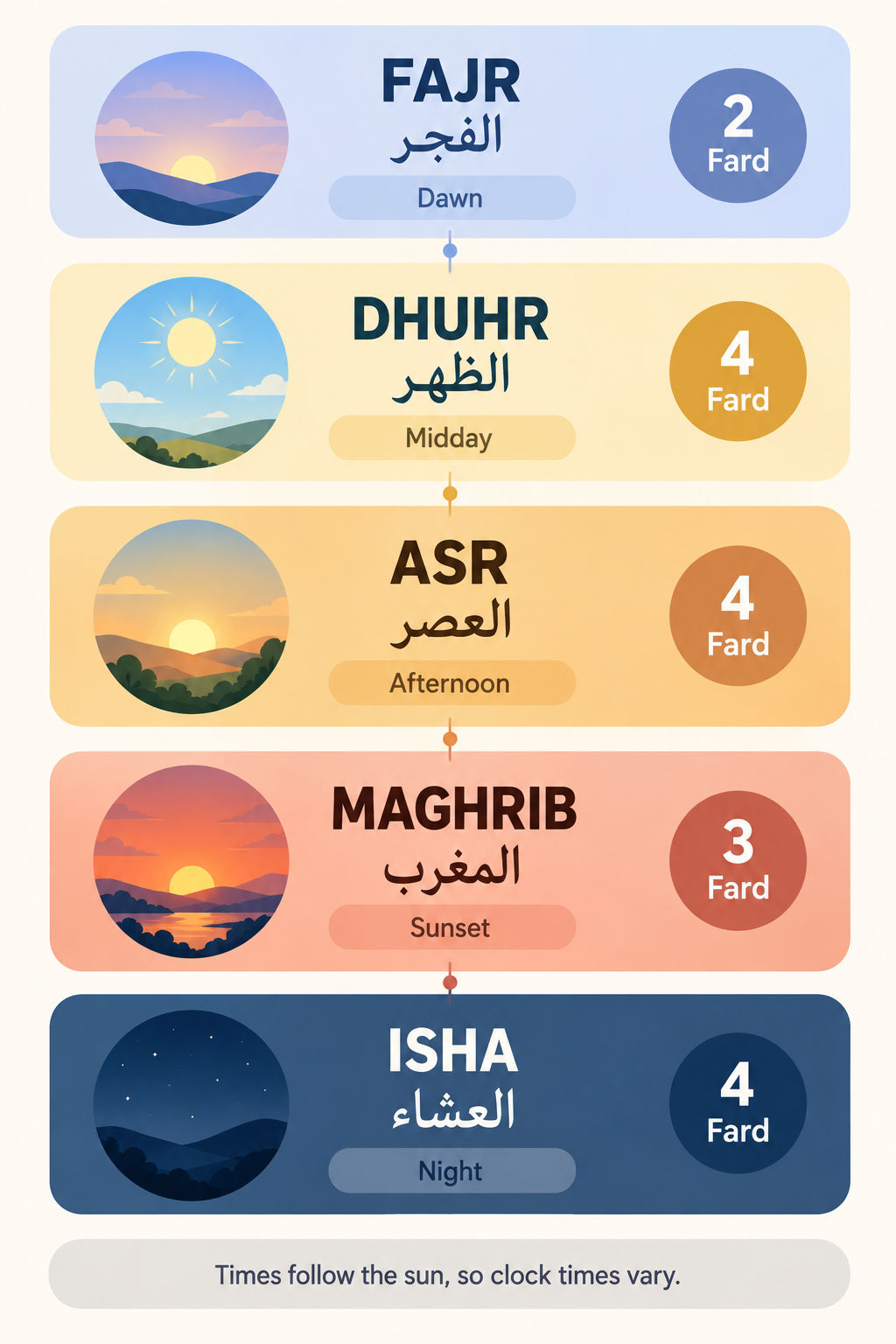
The five prayers are not random interruptions added on top of Muslim life. They are among the central acts around which that life is organized. They are called Fajr (dawn), Dhuhr (midday), Asr (afternoon), Maghrib (sunset) and Isha (night).
This guide explains why Muslims pray, why there are five obligatory prayers, when each one occurs, what actually happens inside the prayer, and how Muslims fit it into ordinary life. It is written for new Muslims, for Muslims who never properly learned Salah, for parents, for students and for anyone curious. No prior knowledge is assumed.
One note on method. Throughout, we separate what revelation teaches (the Quran and authentic Sunnah) from helpful reflection (practical observations that may help us appreciate the prayer, but which are not claimed as divine explanations). Where scholars differ on a detail, we say so rather than pretend there is one answer.
What Is Salah?
Salah (الصلاة, as-salah) is the formal, prescribed act of worship in Islam. It is usually translated as "prayer," but that word can be misleading. In English, "prayer" often means speaking to God and asking for something. Salah is more specific: it has set times, a defined sequence of standing, Quran recitation, bowing, prostration, remembrance and supplication, and it is directed toward a common direction.
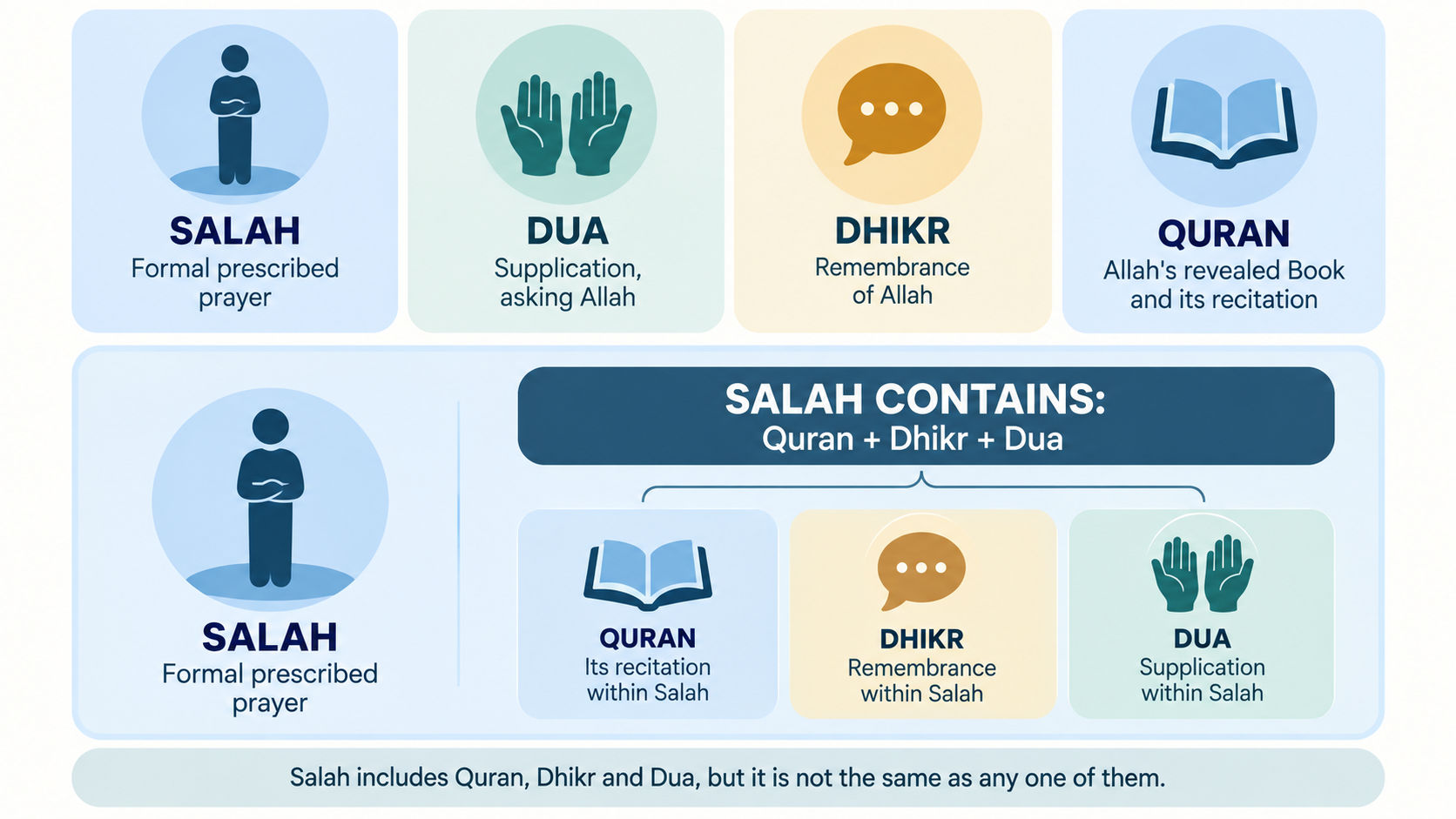
Dua (دعاء) is different. It means calling upon Allah and asking Him, and it can be done anytime, in any language, in your own words. Salah contains Dua, along with Quran recitation and Dhikr (remembrance of Allah), but Salah and Dua are not interchangeable terms.
So when a Muslim says "I'm going to pray," they usually mean Salah. When they say "I made dua for you," they mean they asked Allah on your behalf.
Why Is Salah So Important in Islam?
Salah is one of the five pillars of Islam. In a famous narration in Sahih al-Bukhari and Sahih Muslim, the Prophet Muhammad ﷺ said that Islam is built upon five: testifying that there is no god but Allah and that Muhammad is His messenger, establishing the prayer, giving zakat, performing Hajj, and fasting in Ramadan.
The Quran repeatedly commands it. A short example is Quran 2:43: "And establish the prayer, give zakat, and bow with those who bow."
Notice the wording: Muslims are told to establish the prayer. The Arabic is أقيموا الصلاة (aqimu as-salah). Commentators on the Quran generally understand "establishing" to mean more than going through motions once: performing the prayer properly, in its times, with its conditions and with sincerity, and keeping it up consistently. We do not need elaborate word analysis to see the point. Across the Quran, Salah is presented as a defining practice of the believers.
Why Do Muslims Pray Five Times a Day?
The direct answer is that Allah prescribed it, and the Prophet ﷺ taught how and when to perform it. Muslims pray five times because that is what revelation established. But that answer should not stop there, because the Quran and Sunnah also tell us a great deal about what the prayer is for.
Worship and obedience. The believer prays first because it is a command from their Creator, an expression of servanthood.
Remembrance of Allah. In Quran 20:14, Allah says to Musa (Moses): "Indeed, I am Allah. There is no god but Me, so worship Me and establish the prayer for My remembrance." The Arabic phrase is وَأَقِمِ الصَّلَاةَ لِذِكْرِي. Remembrance is stated as a purpose of Salah.
Scheduled return to worship. Quran 4:103 says that prayer is prescribed for believers "at specified times" (كِتَابًا مَّوْقُوتًا). Salah is tied to times, which means it recurs.
Quran recitation, Dhikr and Dua. Every prayer includes all three.
Beyond this, we can offer a practical reflection, labelled clearly as such: human life constantly pulls attention toward work, study, money, family demands, entertainment and problems. Five recurring prayers interrupt long stretches of activity with worship. That is an observation about how the practice functions in daily life. It is not offered as the sole or primary reason Allah prescribed Salah, and it is not a replacement for the revealed reasons above.
Equally, we do not claim that each prayer time has a specific revealed "meaning," such as that one prayer exists because of a particular human weakness at that hour. Those statements have no sound evidence behind them, so we leave them out.
The Five Prayers and the Night Journey
Muslims learn that the five daily prayers were prescribed around the event of Al-Isra' wal-Mi'raj, the Night Journey and ascension of the Prophet ﷺ.
The Quran refers to the Night Journey at the beginning of Surah Al-Isra (17:1), mentioning the journey from the Sacred Mosque to the Farthest Mosque. The details about the prayers come from authentic hadith, especially those in Sahih al-Bukhari and Sahih Muslim. According to these narrations, prayer was first prescribed as fifty daily prayers. After the Prophet ﷺ returned several times at the advice of Musa and asked for reduction, it was reduced to five. In the narration, Allah says that they are five in performance and fifty in reward, and that His word is not changed.
That is the extent of what we can responsibly say. We do not describe the unseen mechanics of the event, and we leave aside embellished popular retellings that are not found in authentic narrations. The key points for a learner: the obligation of five daily prayers is established, and the reward of the original number is preserved.
Are All Five Prayers Named in the Quran?
Not in one single verse. A claim such as "the Quran lists Fajr, Dhuhr, Asr, Maghrib and Isha together" would be inaccurate.
What the Quran does is this:
It commands Salah repeatedly and ties it to times (4:103).
It refers to prayer times and, in places, names specific prayers.
Quran 24:58 mentions salat al-fajr and salat al-isha by name.
Quran 2:238 says: "Guard strictly the prayers, and the middle prayer, and stand before Allah devoutly obedient." (حَافِظُوا عَلَى الصَّلَوَاتِ وَالصَّلَاةِ الْوُسْطَىٰ). Scholars have discussed which prayer is the "middle prayer"; many point to Asr on the basis of Sahih hadith, while others have held other views.
Quran 17:78 says: "Establish the prayer from the decline of the sun until the darkness of the night, and the recitation of dawn. Indeed, the recitation of dawn is witnessed." (أَقِمِ الصَّلَاةَ لِدُلُوكِ الشَّمْسِ إِلَىٰ غَسَقِ اللَّيْلِ وَقُرْآنَ الْفَجْرِ).
Quran 11:114 says: "Establish the prayer at the two ends of the day and at the approach of the night." (طَرَفَيِ النَّهَارِ وَزُلَفًا مِّنَ اللَّيْلِ).
Quran 30:17–18 calls on believers to glorify Allah when they reach the evening and the morning, in the afternoon and at midday.
Classical commentators connect these verses to the prayer times in various ways, and they do not always map them one-to-one. The full five-prayer structure, with its exact timings, number of units and method, is established through the Quran together with the Sunnah. This is why Muslims learn Salah from the Prophet's ﷺ teaching and practice, passed down by the community, not from a verse-by-verse reconstruction.
One narration in Sunan Abi Dawud and Jami' at-Tirmidhi describes Jibril teaching the Prophet ﷺ the times of the prayers over two days, which scholars rely on when discussing time boundaries. Another, in Sahih Muslim, gives a detailed description of the beginning and end of each time.
The Five Daily Prayers at a Glance
Prayer | Arabic | General Time | Obligatory Rak‘ahs |
|---|---|---|---|
Fajr | الفجر | Dawn, before sunrise | 2 |
Dhuhr | الظهر | After solar noon | 4 |
Asr | العصر | Afternoon | 4 |
Maghrib | المغرب | After sunset | 3 |
Isha | العشاء | Night | 4 |
These are the obligatory (Fard) units. They are not the same as the additional Sunnah prayers that often accompany them, which we explain below. Notice that the times are described by the sun and sky, not by clock hours.
Fajr: The Dawn Prayer
Fajr (الفجر) means "dawn." The time begins at true dawn (the horizontal light spreading across the horizon) and ends at sunrise. True dawn is not the same as sunrise: it comes earlier, when the sky begins to lighten, and Fajr must be completed before the sun actually rises.
Fajr has 2 obligatory rak‘ahs. Many Muslims also pray two Sunnah rak‘ahs before it. In Sahih Muslim, the Prophet ﷺ said that the two rak‘ahs of Fajr are better than this world and all it contains. Fajr as a whole is also highlighted in a hadith in Sahih al-Bukhari and Sahih Muslim, in which the Prophet ﷺ said that whoever prays the two cool prayers (Fajr and Asr) will enter Paradise.
Dhuhr: The Midday Prayer
Dhuhr (الظهر) begins after the sun passes its highest point in the sky (solar noon) and continues into the afternoon until the time of Asr begins. It has 4 obligatory rak‘ahs.
Dhuhr is not always at 12 p.m. Its clock time shifts with the date, your longitude and location, and daylight-saving conventions where they apply. Dhuhr has associated Sunnah prayers before and after it; the exact number that is emphasized differs somewhat among the schools of law, so a student should follow a qualified teacher on this.
Asr: The Afternoon Prayer
Asr (العصر) is the afternoon prayer, with 4 obligatory rak‘ahs.
This is the one prayer where beginners often notice a difference in timetables. Recognized schools of Islamic law use different methods to determine when Asr begins. The majority (Maliki, Shafi‘i and Hanbali) begin Asr when an object's shadow equals its length (in addition to the shadow it had at noon). The Hanafi school begins it later, when the shadow is twice the object's length. Both are established positions within Islamic law; neither is a "mistake." Many apps let you choose the method, and many mosques follow the school common in their community.
Maghrib: The Sunset Prayer
Maghrib (المغرب) begins after the sun has set and has 3 obligatory rak‘ahs. Sunset is not the same as full darkness: Maghrib begins when the sun's disc has gone below the horizon, and the time continues through the evening twilight. Like every prayer, it does not occur at the same clock time every day. Two Sunnah rak‘ahs are commonly prayed after it.
Isha: The Night Prayer
Isha (العشاء) is the night prayer with 4 obligatory rak‘ahs. It begins after the evening twilight has disappeared. The Fiqh definition of which twilight matters differs: most scholars say the red glow, while the Hanafi position of Abu Hanifa refers to the white glow that follows. Prayer apps also use different twilight angles to estimate this, which is why Isha times can vary slightly between timetables.
As for how late Isha can be delayed, scholars discuss a preferred time (commonly up to around the middle of the night) and a time of necessity beyond it. If this matters to you, ask a qualified local teacher instead of relying on a general rule.
The Muslim Day, Organized Around Five Prayers
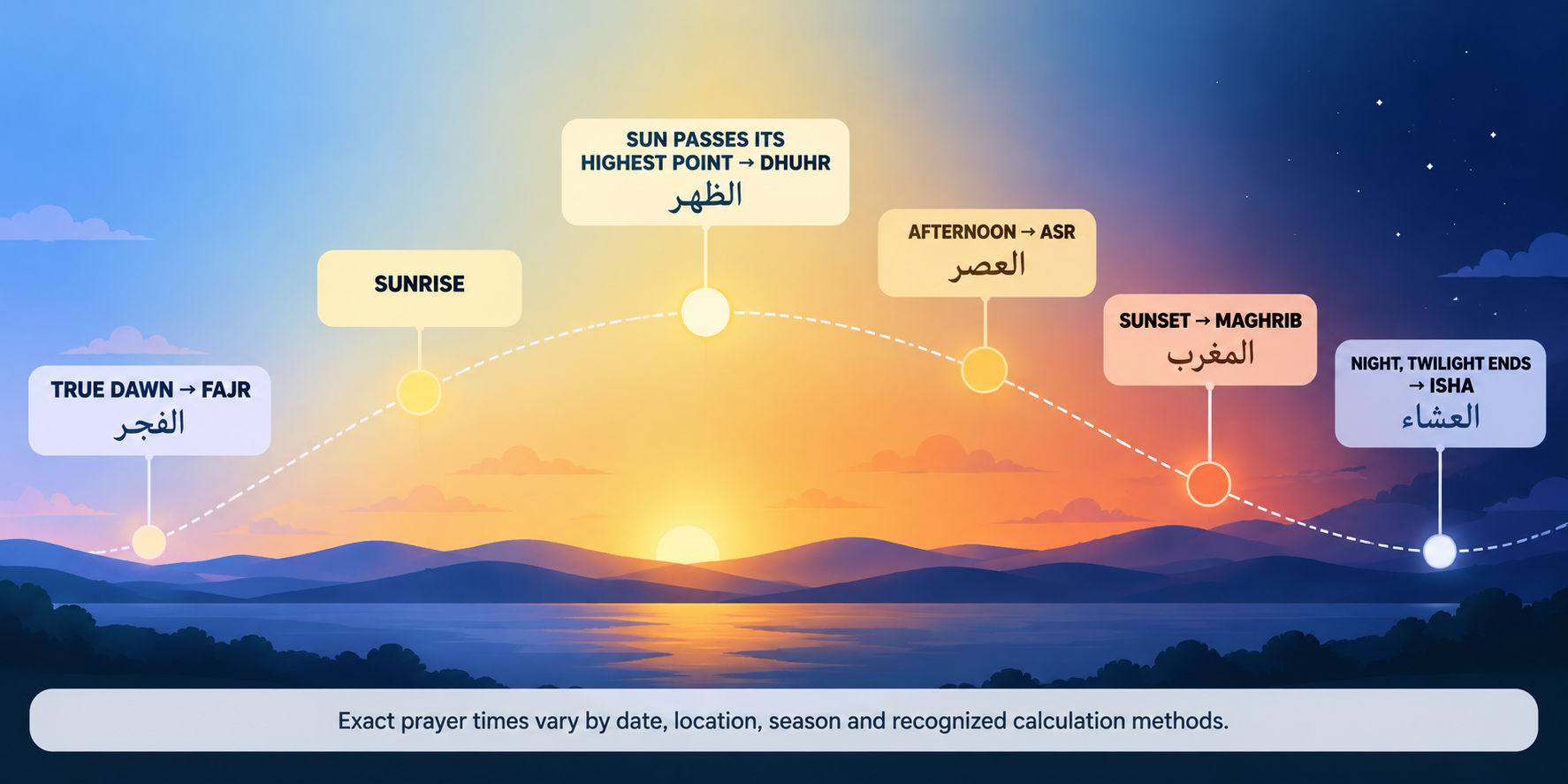
Here is the rhythm of the day, with no clock times:
True dawn → Fajr Sunrise Sun passes its highest point → Dhuhr Afternoon → Asr Sunset → Maghrib Twilight ends, night → Isha
The day is marked by the sun, and the prayers are fixed to those markers.
Why Do Muslim Prayer Times Change Every Day?
Prayer times are linked mainly to solar events, not to a fixed appointment on the clock. The sun's position changes with the date and with where you are on Earth. So times change with:
the date and season
latitude and longitude
the calculation method used
This is why London, Cairo, New York, Lagos, Jakarta and Sydney will not share the same prayer times on any given day, and why times in a single city drift slowly across the year. A prayer app calculates the sun's position for your coordinates and applies a recognized method.
Why Can Two Mosques Have Slightly Different Times?
Differences between timetables are usually not conflicts. They can come from:
the calculation convention or twilight angle used for Fajr and Isha
the Asr method (explained above)
local mosque scheduling
the difference between Adhan time and Iqamah time
That last point is useful. The Adhan (call to prayer) signals that the time has begun. The Iqamah is the second call that signals that the congregation is about to start, often some minutes later. "Prayer time begins" is not the same as "the congregational prayer starts."
What About Extreme Northern and Southern Latitudes?
In places very far from the equator, twilight may last a very long time, or the night may nearly disappear in summer, while winter days may be extremely short. Scholars and Islamic authorities have recognized approaches for these situations. Do not improvise. Follow a qualified local scholar or a reliable mosque authority.
What Is a Rak‘ah?
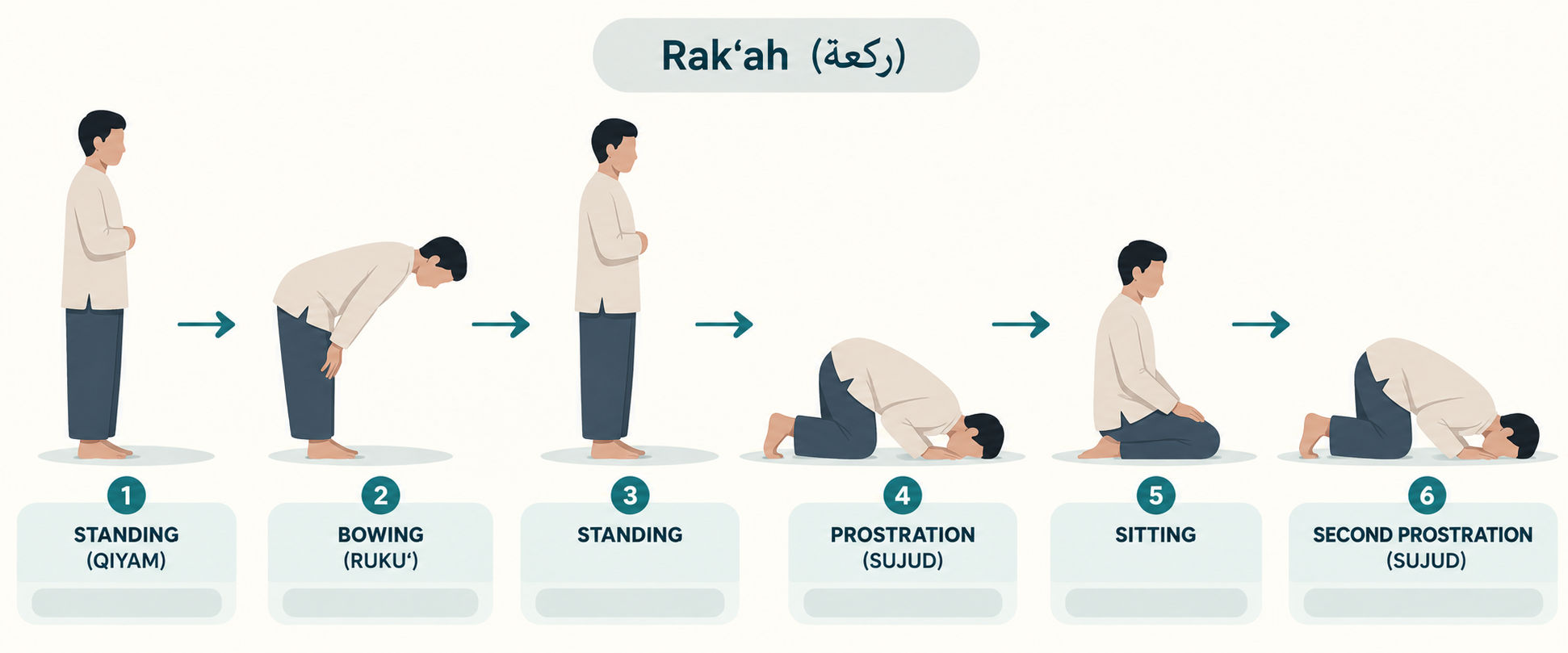
A rak‘ah (ركعة, plural ركعات, rak‘at) is one unit or cycle within the prayer. It consists of prescribed positions and recitations: standing, recitation, bowing, standing again, two prostrations and a sitting between them.
A rak‘ah is not "one prayer." A prayer like Fajr is made of two rak‘ahs, and Dhuhr is made of four. A simple way to picture it is that a rak‘ah is the repeating building block, and each prayer is a certain number of blocks.
How Many Rak‘ahs in Each Obligatory Prayer?
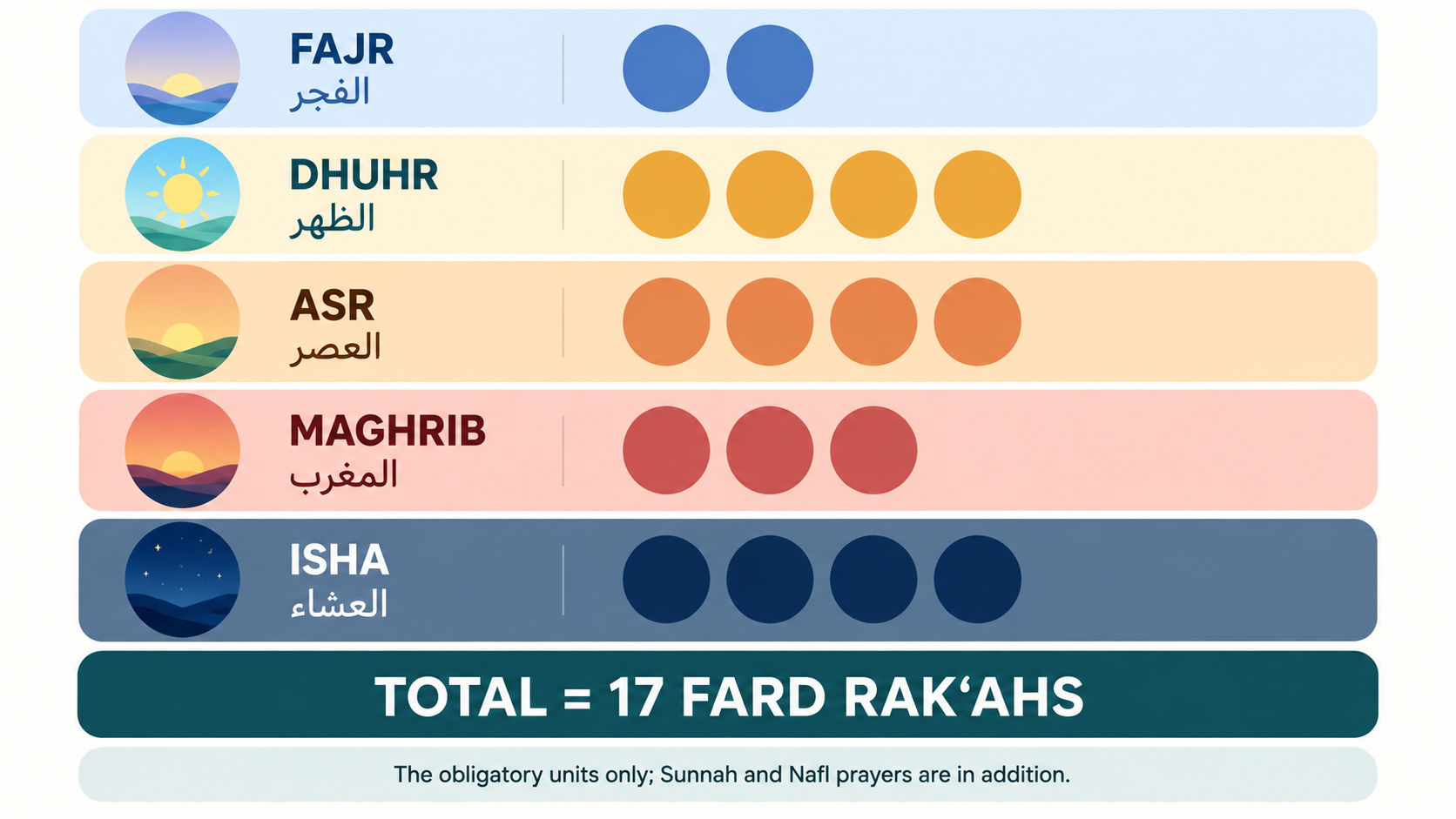
Fajr: 2 Fard
Dhuhr: 4 Fard
Asr: 4 Fard
Maghrib: 3 Fard
Isha: 4 Fard
That gives 17 obligatory rak‘ahs on an ordinary day (2 + 4 + 4 + 3 + 4).
Muslims also pray additional rak‘ahs: Sunnah prayers, voluntary (Nafl) prayers, and Witr. Beginners should not assume every associated rak‘ah has the same legal status. The 17 are the baseline obligation.
Fard, Sunnah and Nafl
Fard means obligatory. Neglecting it is a serious matter.
Sunnah here refers to prayers practiced by the Prophet ﷺ. It is not as simple as "optional." Scholars distinguish levels, such as emphasized Sunnah (Sunnah mu'akkadah) that the Prophet ﷺ rarely left, and less emphasized ones, and the schools classify some of them differently.
Nafl means voluntary additional prayer, done for extra closeness and reward.
As a beginner, learn the Fard first, then add Sunnah prayers gradually with a teacher.
What Actually Happens During Salah?
Here is a simplified overview. It is educational and does not capture every Fiqh detail:
Niyyah (intention)
Takbir (saying "Allahu Akbar" to begin)
Qiyam (standing)
Al-Fatihah and further recitation
Ruku‘ (bowing)
Returning to standing
Sujud (first prostration)
Sitting
Second sujud
The next rak‘ah (repeat)
Tashahhud (sitting recitation)
Taslim (ending the prayer with salaam)
Niyyah: Intention
Intention is in the heart. A hadith in Sahih al-Bukhari and Sahih Muslim says that actions are judged by intentions. Many printed prayer guides teach a spoken formula such as "I intend to pray four rak‘ahs for Allah." Scholars discuss whether such verbal formulas are recommended, merely permissible, or unnecessary, and many hold that the intention itself is in the heart. Do not treat a printed formula as universally required Sunnah. If you know which prayer you stood up for, your intention is present.
Takbir
You begin by raising your hands and saying الله أكبر (Allahu Akbar), usually translated "Allah is the Greatest." A narration in Abu Dawud and at-Tirmidhi says the prayer's opening is the takbir and its closing is the taslim.
Qiyam: Standing
Muslims stand while able. If someone cannot stand, adaptations are given below.
Al-Fatihah
Surah Al-Fatihah ("The Opening") is recited in every rak‘ah. A hadith in Sahih al-Bukhari and Sahih Muslim says there is no prayer for the one who does not recite it (scholars discuss details of how this applies in different situations, and the schools differ on how to classify it). Its opening verse is الحمد لله رب العالمين, "Praise be to Allah, Lord of the worlds."
This is where Salah and Quran learning meet directly: every rak‘ah is built on a Surah you can study, understand and improve.
Ruku‘: Bowing
In ruku‘ you bow and say سُبْحَانَ رَبِّيَ الْعَظِيمِ (Subhana Rabbiyal-‘Azim), "Glory be to my Lord, the Most Great." This wording is reported in Sahih Muslim. We do not attach unsupported symbolic meanings to the posture. It is a form of reverence toward Allah.
Sujud: Prostration
In sujud, the forehead, nose, palms, knees and toes touch the ground. The worshipper says سُبْحَانَ رَبِّيَ الْأَعْلَىٰ (Subhana Rabbiyal-A‘la), "Glory be to my Lord, the Most High." Between the two prostrations, a supplication reported in the Sunan is رَبِّ اغْفِرْ لِي (Rabbighfir li), "My Lord, forgive me."
The Prophet ﷺ said, in Sahih Muslim, that the closest a servant is to his Lord is when he is prostrating, so increase supplication. Scholars explain this nearness in a way that suits Allah's majesty: it refers to the servant's spiritual closeness and Allah's response, not to Allah being physically located in front of the worshipper. Sujud is worship of Allah alone.
Tashahhud and Taslim
In the sitting at the end of two rak‘ahs, and at the end of the prayer, Muslims recite the Tashahhud, which includes the testimony of faith and greetings of peace. The prayer concludes with the Taslim: turning the head to each side and saying السلام عليكم ورحمة الله (As-salamu ‘alaykum wa rahmatullah), "Peace be upon you and the mercy of Allah."
Why Do Muslims Face the Ka‘bah?
The Qiblah (قِبْلَة) is the direction Muslims face in prayer. Quran 2:144 instructs: "So turn your face toward the Sacred Mosque." (فَوَلِّ وَجْهَكَ شَطْرَ الْمَسْجِدِ الْحَرَامِ). The Ka‘bah is at the center of the Sacred Mosque in Makkah.
Muslims do not worship the Ka‘bah. They worship Allah alone. The Ka‘bah is a shared direction of prayer. Islam does not teach that Allah lives inside it or is physically represented by it.
Why one direction? The central reason is obedience to the command. The visible consequence is that Muslims all over the world pray in a common orientation, which many describe as a sign of unity. That unity is an observable result. We do not claim it is the only reason Allah established the Qiblah.
What Is Wudu?
Wudu (الوضوء) is the ritual washing before prayer. Quran 5:6 describes it: when you rise for prayer, wash your faces and your forearms to the elbows, wipe your heads, and wash your feet to the ankles. In practice it is a short sequence, and the schools differ on some details such as ordering and certain recommended acts. Learn it from a teacher in the tradition you follow.
Do You Need Wudu Before Every Prayer?
No. If your Wudu is still valid, you do not need to repeat it just because a new prayer time has begun. The Prophet ﷺ is reported in the authentic collections to have prayed several prayers with one Wudu. Certain things break Wudu, such as using the toilet or passing wind or sleeping deeply, and the exact list is discussed in detail in Fiqh. A full Wudu guide is the right place for that.
What If Water Cannot Be Used?
Islamic law provides Tayammum, a dry purification using clean earth, in situations such as unavailability of water or harm from using it. The conditions are specific. Do not self-diagnose broad exceptions; ask a qualified person.
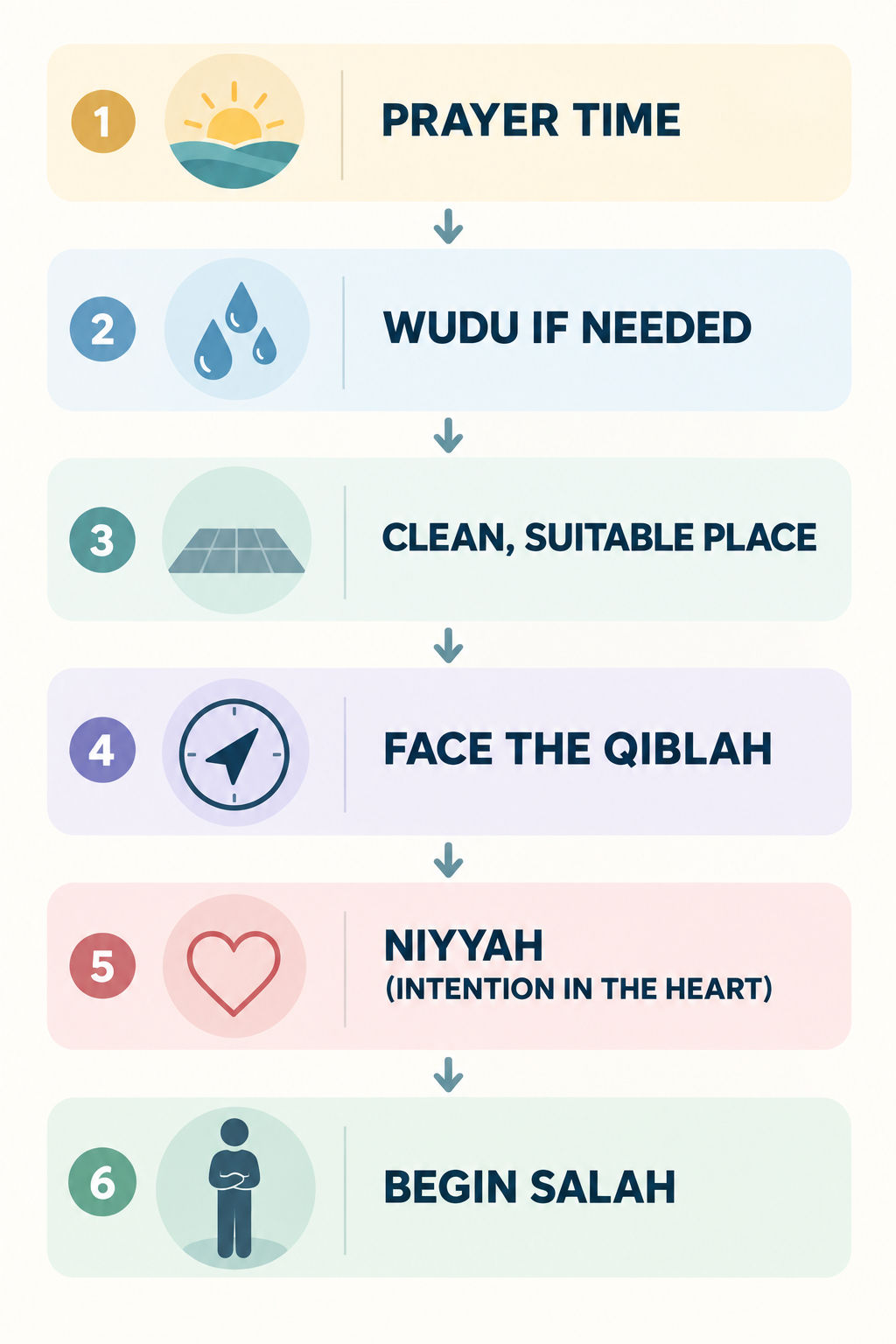
Before Salah, in short: prayer time begins → make Wudu if needed → find a clean, suitable place → face the Qiblah → form your intention → begin.
Do You Need a Prayer Mat?
No. A prayer mat is not a condition of Salah. It is simply a convenient way to keep a clean surface. Muslims can pray on any clean, suitable place. A mat has no special religious power of its own.
Why Is Salah in Arabic?
The core recitations of Salah are in Arabic because the Quran was revealed in Arabic and the Prophet ﷺ taught the prayer's wording in Arabic. Al-Fatihah is Quran, and the transmitted phrases of ruku‘, sujud, tashahhud and others are Prophetic wording. This also gives Muslims across the world a shared prayer. A Nigerian, a Brit, an Indonesian, a Brazilian, a Turk and an American can stand in the same row and recite the same words.
That does not mean a Muslim must speak conversational Arabic. It means learning specific recitations. Whether a translation can stand in for Quranic Arabic in the prayer is a matter treated carefully in Fiqh, so do not assume the two are interchangeable.
What If I Do Not Speak Arabic?
You do not need to become fluent in Arabic before beginning to learn Salah. Here is a gradual path:
Understand the structure of the prayer.
Learn the essential Arabic in small sections.
Learn Al-Fatihah carefully.
Learn the basic Dhikr phrases.
Learn meanings alongside pronunciation.
Improve gradually over time.
A brand-new Muslim who genuinely cannot yet recite the required Arabic has concessions in Fiqh, and the schools discuss the details. Please ask a qualified teacher about your specific situation instead of making up a substitution rule.
Should I Understand What I Say?
Yes, strive to. Understanding is encouraged, and it can deepen your attentiveness. But a prayer is not considered automatically invalid just because someone does not yet understand the Arabic. Learning meaning is about growth, not about a condition of validity.
What Is Khushu‘?
Khushu‘ (خشوع) is often translated as "concentration," but it is wider: humility, reverence and attentiveness before Allah. Quran 23:1–2 describes successful believers as those who are khashi‘un in their prayer. Nobody should expect perfect concentration every time.
What If My Mind Wanders?
It happens to almost everyone, so do not despair. A wandering mind does not automatically invalidate a prayer. Validity and quality are separate: the prayer is valid if its requirements are met, while khushu‘ affects its depth and reward. To improve:
learn what you recite
reduce distractions before you begin
prepare, make Wudu calmly and don't rush in
slow down appropriately
focus on one part at a time, such as just the meaning of Al-Fatihah
How Long Does Each Prayer Take?
There is no universal minute count. A simple obligatory prayer may take only several minutes, but length varies with the length of recitation, your pace, whether you add Sunnah or Nafl prayers, and whether you pray in congregation. Don't expect "five minutes exactly." The obligatory prayer is practical enough to fit into ordinary life.
Do Muslims Have to Pray in a Mosque?
Not necessarily, and the answer involves recognized Fiqh distinctions. For men, congregational prayer is strongly emphasized, and scholars differ on its classification: some consider it obligatory on individuals, some a communal obligation, others a strongly emphasized Sunnah. A hadith in the authentic collections says congregational prayer is rewarded far more than praying alone.
For women, scholars teach that women may attend the mosque, and the Prophet ﷺ said not to prevent the female servants of Allah from the mosques of Allah (Sahih Muslim). A narration in Sunan Abi Dawud also says that their homes are better for them. Women are not forbidden from mosques as a general statement, and their attendance is not obligatory in the way some state for men.
So the claim "every Muslim must perform every prayer in a mosque" is not accurate, and neither is its opposite. Prayer at home is valid, and for women it is common and fully rewarded.
Praying at Work, School or University
At work: know the prayer windows in advance, find a clean quiet space, plan Wudu, talk to your employer professionally if needed, and use breaks. When circumstances require, you can keep the obligatory prayer concise while still fulfilling its requirements. Workplace rights vary by country, so we do not make legal guarantees here.
At school or university: check the timetable against prayer windows, look for a campus prayer room, use a quiet clean area where permitted, connect with a Muslim student society, and plan Wudu. Where scheduling can reasonably work, don't skip classes irresponsibly.
Praying While Traveling
Islamic law gives travelers concessions: Qasr (shortening four-rak‘ah prayers to two) and, in some cases, combining prayers. The details, including what distance counts as travel, are discussed among scholars with different conclusions, so we do not give one universal number. Please consult qualified Fiqh guidance for your journey.
Can Muslims Combine Prayers?
Combining is not a convenience that turns five prayers into three on ordinary days. Scholars recognize situations such as travel and certain other legitimate circumstances, and differ on their scope. A narration in Sahih Muslim reports the Prophet ﷺ combining prayers in Madinah without fear or rain, and scholars interpret it differently. If you think your situation qualifies, ask a qualified scholar.
Illness and Disability
A hadith in Sahih al-Bukhari reports the Prophet ﷺ saying to a sick man: pray standing; if you cannot, sitting; if you cannot, on your side. Islamic law considers ability, and no one is asked to harm themselves to maintain a posture they cannot perform.
This applies to people with disabilities as well. There is no single physical form that is the only meaningful prayer. For detailed adaptations, such as prayer in a wheelchair or after surgery, please ask a qualified scholar, and do not rely on guesses.
Women and the Five Daily Prayers
Adult Muslim women are obligated to pray the five daily prayers under normal circumstances, just as men are.
What Happens During Menstruation?
During menstruation and postpartum bleeding, women do not pray, and the mainstream ruling is that they do not make those missed prayers up afterward. In Sahih al-Bukhari and Sahih Muslim, A'ishah (may Allah be pleased with her) said they were commanded to make up missed fasts but were not commanded to make up prayers.
This is not a sign of lesser spirituality. A woman can still remember Allah, make Dua and engage in Dhikr. Scholars differ on some Quran-related questions, such as touching or reciting from the Quran, so ask a qualified teacher on those.
Children and Salah
A hadith in Sunan Abi Dawud (graded hasan) reports the Prophet ﷺ saying to command children to pray at seven and to correct them regarding it at ten. Scholars read this as a gradual process of training. It must not be used to justify violence or harmful punishment. Legal accountability begins at puberty, but prayer education starts much earlier.
How to Teach a Child Salah
let them watch you pray
teach the movements
explain the meanings
teach Al-Fatihah gradually
pray together
encourage consistency
avoid making Salah only a source of punishment
What If I Miss a Prayer?
It depends on the situation.
Sleeping or forgetting. A hadith in Sahih al-Bukhari and Sahih Muslim says whoever forgets a prayer or sleeps through it should pray it when they remember. There is no sin on someone who was truly unconscious or forgetful.
Deliberately missing a prayer. This is serious. Most scholars say it must be made up in addition to sincere repentance, while some have held other views. Because scholars discuss it, we do not give a single universal answer. What every position agrees on is that the person should repent sincerely and return to Salah.
"I Haven't Prayed in Years. Is It Too Late?"
No. Don't let the past stop you from starting now. Make sincere Tawbah (repentance), begin praying today, and ask a qualified scholar about missed prayers from the past, since scholars differ on that. You are not defined by your gap. Starting is what matters.
What If I Keep Missing Fajr?
sleep earlier where you can
use alarms, placed away from your bed
ask someone to help keep you accountable
check for sleep problems
make Dua
reduce late-night habits
Missing Fajr does not automatically prove hypocrisy or lack of faith. There is a difference between oversleeping accidentally and habitual negligence, but the response to both is to build better habits and ask Allah for help.
Jumu‘ah, Witr, Tahajjud, Eid and Taraweeh
Jumu‘ah (Friday congregational prayer) is not a sixth daily prayer. For those obligated to attend, it replaces Dhuhr on Friday when validly performed. It includes a Khutbah (sermon) and two rak‘ahs prayed in congregation. The majority view obligates adult, sane, resident men; scholars discuss conditions further, and women are not required to attend, though they may.
Witr is an odd-numbered night prayer after Isha. The schools classify it differently: Hanafis consider it wajib (a strongly binding category), and the majority consider it a strongly emphasized Sunnah. It is separate from the five obligatory prayers.
Tahajjud is voluntary night prayer, highly virtuous, but not one of the five obligatory prayers. Social media routines should not make a beginner feel it is required.
Eid prayer is a special prayer on the days of Eid. Taraweeh is the Ramadan night prayer. Neither replaces the five daily prayers.
Salah vs. Dua vs. Dhikr
Practice | Basic Meaning | Structured? | Typical Example |
|---|---|---|---|
Salah | Formal prescribed prayer | Yes | Fajr |
Dua | Calling upon/asking Allah | Flexible | Asking for guidance |
Dhikr | Remembrance of Allah | Various forms | SubhanAllah |
Quran Recitation | Reciting revelation | Distinct worship | Al-Fatihah |
Salah contains Quran, Dhikr and Dua, but cannot be reduced to any one of them.
Why Does Salah Repeat Every Day?
Quran 20:14 ties Salah to remembrance. Human life repeatedly pulls attention toward work, study, money, responsibilities, entertainment and problems. Salah returns worship to the center, again and again. That is a reflection on how the practice works in a life, and not the sole revealed reason for five daily prayers.
Salah, the Quran and Dhikr
Every rak‘ah includes Al-Fatihah, so the Quran is in the prayer from the first moment. Takbir, tasbih, tahmid and Dua fill the prayer with remembrance of Allah. This is why Quran learning has an immediate practical result. Tajweed, pronunciation, memorization and understanding can all improve a Muslim's relationship with Salah. You do not need advanced Tajweed mastery to begin praying.
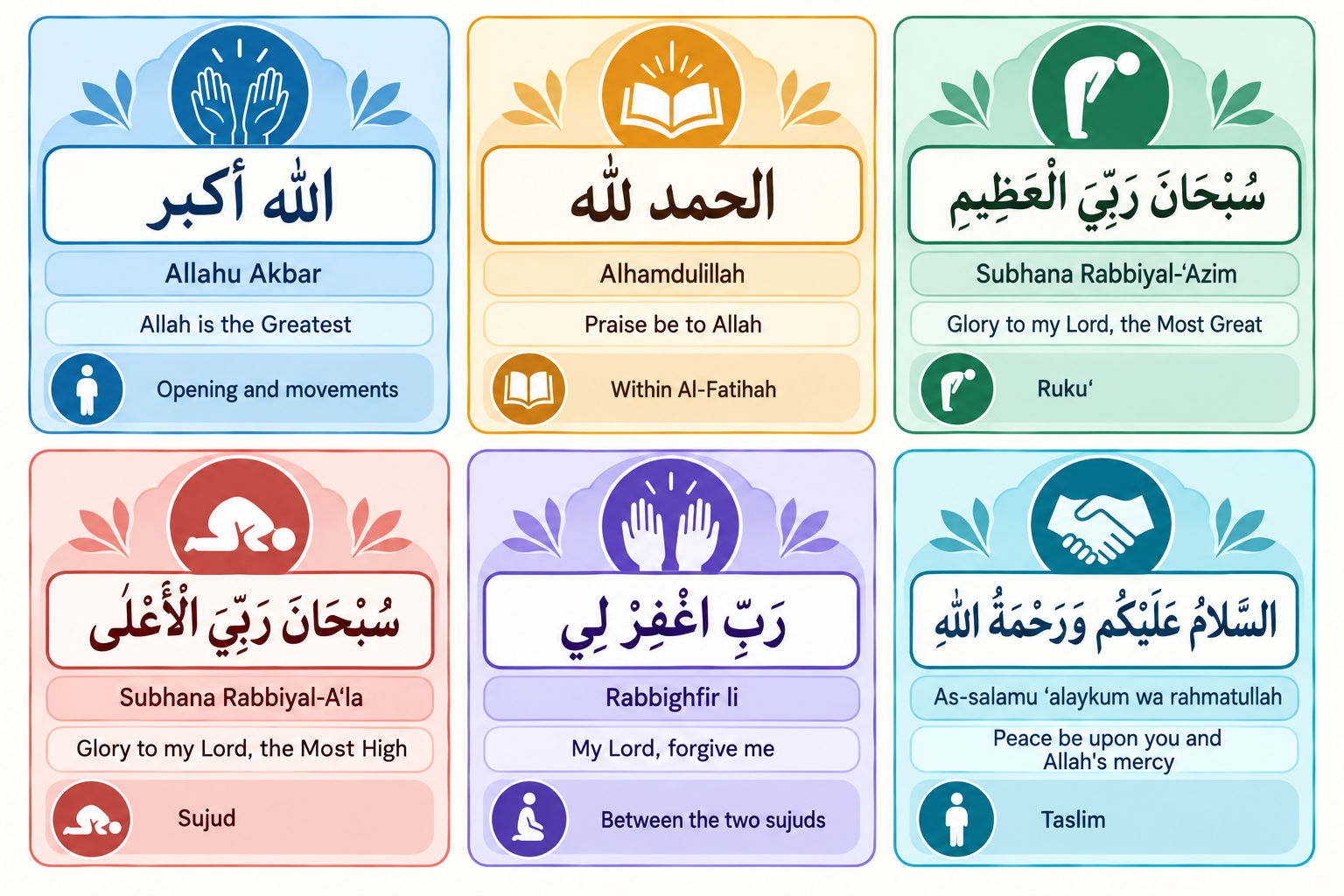
The Arabic You Already Know From Salah
Learning Arabic for Salah does not begin with hundreds of grammar rules. It can begin with understanding words you already repeat every day.
Arabic | Transliteration | Meaning | Where You Say It |
|---|---|---|---|
الله أكبر | Allahu Akbar | Allah is the Greatest | Opening and moving between positions |
الحمد لله | Alhamdulillah | Praise be to Allah | Within Al-Fatihah |
سُبْحَانَ رَبِّيَ الْعَظِيمِ | Subhana Rabbiyal-‘Azim | Glory to my Lord, the Most Great | Ruku‘ |
سُبْحَانَ رَبِّيَ الْأَعْلَىٰ | Subhana Rabbiyal-A‘la | Glory to my Lord, the Most High | Sujud |
رَبِّ اغْفِرْ لِي | Rabbighfir li | My Lord, forgive me | Between the two sujuds |
السلام عليكم ورحمة الله | As-salamu ‘alaykum wa rahmatullah | Peace be upon you and Allah's mercy | Taslim |
When you understand الله أكبر as you say it, or recognize الحمد لله رب العالمين as familiar Quranic vocabulary, the words start to mean something. Knowing meanings may support attentiveness, but it does not guarantee it.
New Muslim: Where Do I Start?
Don't try to memorize an entire prayer guide in one night. A sensible sequence:
Learn the names and times of the five prayers.
Learn Wudu.
Learn the basic movements.
Learn the Takbir and Al-Fatihah, with qualified guidance.
Learn the remaining essential recitations gradually.
Learn their meanings.
Improve pronunciation and Tajweed over time.
If you genuinely cannot yet recite required Arabic, there are recognized concessions, and a qualified teacher can explain them. Do not invent shortcuts.
Do not wait for perfect Arabic. Thinking "I'll pray after I learn Arabic" is a common trap. Begin Salah correctly while you learn, and keep the difference clear between beginning Salah and perfecting it.
Common Beginner Mistakes
Thinking Salah and Dua are the same. Salah is formal worship, and Dua is asking Allah.
Thinking prayer times are fixed clock times. They follow the sun.
Thinking all prayers have four rak‘ahs. They range from 2 to 4.
Confusing Fard and Sunnah rak‘ahs. The Fard total is 17.
Thinking Wudu must be repeated before every Salah. Not if it is still valid.
Thinking a prayer mat is required. Any clean place works.
Thinking Muslims worship the Ka‘bah. They worship Allah alone.
Waiting for fluent Arabic before starting. Begin and learn together.
Rushing Arabic without learning meaning. Add meaning gradually.
Thinking every prayer must happen in a mosque. Prayer at home is valid.
Thinking Jumu‘ah is a sixth prayer. It replaces Dhuhr on Friday.
Thinking Tahajjud is obligatory. It is voluntary.
Treating every Madhhab difference as an error. Many are legitimate differences.
Giving up because concentration is imperfect. Keep going.
Learning Salah only from unsourced social-media clips. Seek a teacher.
How to Learn Salah Without Becoming Overwhelmed
Work with a qualified teacher, use structured lessons, add a visual prayer guide, memorize in small chunks, repeat, learn the meanings, and accept corrections over time. Learn seriously, but don't let fear of small mistakes paralyze you.
Can You Learn Salah From YouTube or an App?
They can be useful supplements. But videos and apps may follow different Madhhabs, omit explanation, contain mistakes, or present one valid variant as the only way. Where possible, pair them with a teacher.
A Day Built Around Salah
Fajr begins the day with prayer. Morning is for work, study and family. Dhuhr falls amid midday responsibilities. Afternoon continues work or study, then Asr. Maghrib arrives in the evening. Then comes family, dinner or study, and Isha is the last obligatory prayer of the day.
Muslims do not stop living ordinary lives. Salah is woven into work, family, education, travel and everyday responsibilities. Muslims pray while also working, studying, raising families and taking part in society. Recurring worship happens inside ordinary life, not outside it.
How Araby Academy Can Help
Salah brings together things students often study separately: Quran (Al-Fatihah and other recitation), Tajweed (better pronunciation), Arabic (the phrases you repeat), Islamic Studies (rulings and purpose), Dhikr and Dua. Araby Academy's one-to-one lessons can help non-Arabic-speaking Muslims read Quran, improve Al-Fatihah, understand Salah vocabulary, learn Quranic Arabic and build confidence.
You may also find these helpful:
What Is Dhikr? A Beginner's Guide to Remembering Allah Every Day
How to Build a Daily Islamic Routine When You Live a Busy Life
Frequently Asked Questions
1. What are the five daily prayers in Islam? Fajr (dawn), Dhuhr (midday), Asr (afternoon), Maghrib (sunset) and Isha (night).
2. Why do Muslims pray five times a day? Because Allah prescribed it and the Prophet ﷺ taught it. The Quran connects prayer to worship and remembrance of Allah, and Muslims return to it throughout the day.
3. What times do Muslims pray? Each prayer has a window linked to the sun, so clock times vary by date and location. Use a reliable timetable for your city.
4. How many rak‘ahs are in each prayer? Fajr 2, Dhuhr 4, Asr 4, Maghrib 3 and Isha 4 (obligatory units).
5. How many obligatory rak‘ahs are there each day? 17 on an ordinary day.
6. How long does Muslim prayer take? There is no fixed time. An obligatory prayer may take several minutes, longer with Sunnah or slower recitation.
7. Why do Muslims pray in Arabic? The Quran and the Prophet's ﷺ transmitted wording are in Arabic, and it gives Muslims a shared prayer worldwide.
8. Can I pray if I do not speak Arabic? Yes. You don't need fluency, but you should learn the essential recitations. New Muslims who can't yet recite have recognized concessions; ask a qualified teacher.
9. Why do Muslims face the Ka‘bah? Allah commanded a shared direction of prayer (Quran 2:144).
10. Do Muslims worship the Ka‘bah? No. They worship Allah alone.
11. Do Muslims need Wudu before every prayer? Only if their Wudu has been broken.
12. Do Muslims need a prayer mat? No. Any clean, suitable surface is fine.
13. Do Muslims have to pray in a mosque? Congregational prayer is emphasized for men, with scholars differing on its classification. Prayer elsewhere is valid, and women's prayer at home is common and rewarded.
14. Can Muslims pray at work or school? Yes, in a clean suitable place within the prayer window.
15. Can Muslims combine prayers? In recognized situations like travel, according to scholarship, but not routinely for convenience.
16. What happens if a Muslim misses Salah? If from sleep or forgetting, pray it when you remember. If deliberate, repent sincerely and ask a scholar about making it up.
17. What is the difference between Salah and Dua? Salah is formal worship with a set form; Dua is asking Allah and is flexible.
18. Is Jumu‘ah one of the five daily prayers? No. It replaces Dhuhr on Friday for those obligated to attend.
Five Prayers, One Day of Remembering Allah
Why do Muslims stop five times every day to pray?
Because Salah is worship that Allah prescribed, and it brings the believer back, again and again, to remembrance, Quran and submission. It does not require Muslims to withdraw from ordinary life. A Muslim may be preparing for work at Fajr, at an office around Dhuhr, studying around Asr, returning home around Maghrib and ending the day around Isha. Different Muslims live different lives, and prayer times move with the sun and the seasons. Through all of it, Salah returns the believer to the worship of Allah.
If you are a beginner, do not wait until your Arabic is fluent, your pronunciation is perfect, you understand every Fiqh detail, or you feel perfectly focused. Learn correctly. Begin with the foundations. Improve gradually. Understand what you say. Ask qualified teachers when you are uncertain. And let the five prayers become familiar anchors in your relationship with Allah.
For non-Arabic-speaking Muslims, learning Salah often becomes the doorway into Quran reading, Tajweed, Arabic vocabulary, Dhikr, Dua and deeper Islamic Studies. Understanding the words repeated in prayer can turn unfamiliar sounds into meaningful acts of worship.
The five daily prayers are Fajr, Dhuhr, Asr, Maghrib and Isha. They are obligatory acts of worship performed at different periods from dawn through night. Salah combines Quran recitation, remembrance, physical worship and supplication. You do not need to be fluent in Arabic before you begin learning, but you should learn the prayer correctly, understand its essential words and actions, and improve gradually.