"I Want to Ask Allah — But I Don't Know What to Say"
Imagine someone who became Muslim a few months ago. They hear other Muslims make beautiful, flowing Arabic supplications, and they know only a handful of Arabic words. Quietly they wonder: "Can I just speak to Allah in English?"
Imagine another Muslim who has prayed for years but knows only a few memorized phrases. They wonder: "Am I making Dua correctly?"
And imagine a third person who wants something desperately, such as a spouse, a child, healing or relief from debt, and feels embarrassed to keep asking.
If you see yourself in any of them, here is the first thing to know: Dua is not a performance. Allah does not need eloquence from you. A sincere believer can ask Allah for guidance, forgiveness, health, family, marriage, children, knowledge, work, provision, protection, strength, relief and the Hereafter.
At the same time, the Prophet ﷺ taught beautiful supplications and wise etiquette that make our Dua more conscious and more complete. This guide covers how to make Dua with both: the simplicity of speaking to your Lord directly, and the Sunnah that enriches it.
The principle running through the whole article is simplicity + Sunnah + sincerity + sound Fiqh.
What Is Dua? (الدعاء — Ad-Du'a)
In Arabic, du'a (الدعاء) comes from a root meaning to call, summon or invoke. In Islam, Dua means calling upon Allah: asking Him for good, seeking His help, and turning to Him in praise and need.
Scholars such as Ibn Taymiyyah and Ibn al-Qayyim note that the word is used in two closely connected senses: Dua of asking (requesting something from Allah) and Dua of worship (all acts of worship, which are themselves a way of calling upon Him). For a beginner, the practical meaning is simple: Dua is speaking to Allah and asking Him.
The Prophet ﷺ said:
الدُّعَاءُ هُوَ الْعِبَادَةُ Ad-du'a huwa al-'ibadah — "Supplication is worship."
This was narrated by an-Nu'man ibn Bashir (may Allah be pleased with him) and recorded by Abu Dawud (1479), at-Tirmidhi (2969, who called it hasan sahih) and Ibn Majah (3828). It is graded authentic. In the narration, the Prophet ﷺ then recited Quran 40:60.
Why is asking an act of worship? Because every Dua carries a quiet confession of faith:
Dependence: I cannot manage my life alone.
Hope: You are able, and You are generous.
Humility: I am the servant; You are the Lord.
Tawhid: I turn to You, and to no one else, for what only You can give.
The Prophet ﷺ also said that whoever does not ask Allah, He becomes angry with him (at-Tirmidhi 3373, graded hasan). Asking is not a burden on Allah. Not asking is what is discouraged.
Who Do Muslims Make Dua To?
This may seem obvious, but it is the foundation: you ask Allah.
Allah says:
وَقَالَ رَبُّكُمُ ادْعُونِي أَسْتَجِبْ لَكُمْ ۚ إِنَّ الَّذِينَ يَسْتَكْبِرُونَ عَنْ عِبَادَتِي سَيَدْخُلُونَ جَهَنَّمَ دَاخِرِينَ
"And your Lord says: Call upon Me; I will respond to you. Indeed, those who are too proud to worship Me will enter Hell in humiliation." (Quran 40:60)
The verse links calling upon Allah with worship itself. The Quran repeatedly teaches that supplication of this kind belongs to Allah alone, which is why a Muslim does not need an intermediary. There is no priest, no password and no special place required. You, a sincere heart and your Lord are enough.
Does Allah Hear My Dua?
وَإِذَا سَأَلَكَ عِبَادِي عَنِّي فَإِنِّي قَرِيبٌ ۖ أُجِيبُ دَعْوَةَ الدَّاعِ إِذَا دَعَانِ ۖ فَلْيَسْتَجِيبُوا لِي وَلْيُؤْمِنُوا بِي لَعَلَّهُمْ يَرْشُدُونَ
"And when My servants ask you concerning Me, indeed I am near. I respond to the call of the caller when he calls upon Me. So let them respond to Me and believe in Me, that they may be guided." (Quran 2:186)
Some tafsir works mention a report that a person asked the Prophet ﷺ whether Allah is near, so that we may whisper to Him, or far, so that we must call out. The verse answers directly with "I am near." Notice also that Allah does not say "say: He is near." He answers the servant Himself.
The Prophet ﷺ once told his companions, who were raising their voices in remembrance: "O people, be gentle with yourselves. You are not calling upon one who is deaf or absent. You are calling upon One who is All-Hearing and Near" (Sahih al-Bukhari 2992; Sahih Muslim 2704).
Scholars of Ahl as-Sunnah understand Allah's nearness in a way that befits His majesty, as the Quran and Sunnah describe it, without imagining how it is and without comparing Him to creation. For you, the practical meaning is this: Allah hears you, including your whisper, your broken sentence and your silence.
How to Make Dua: The Simple Version
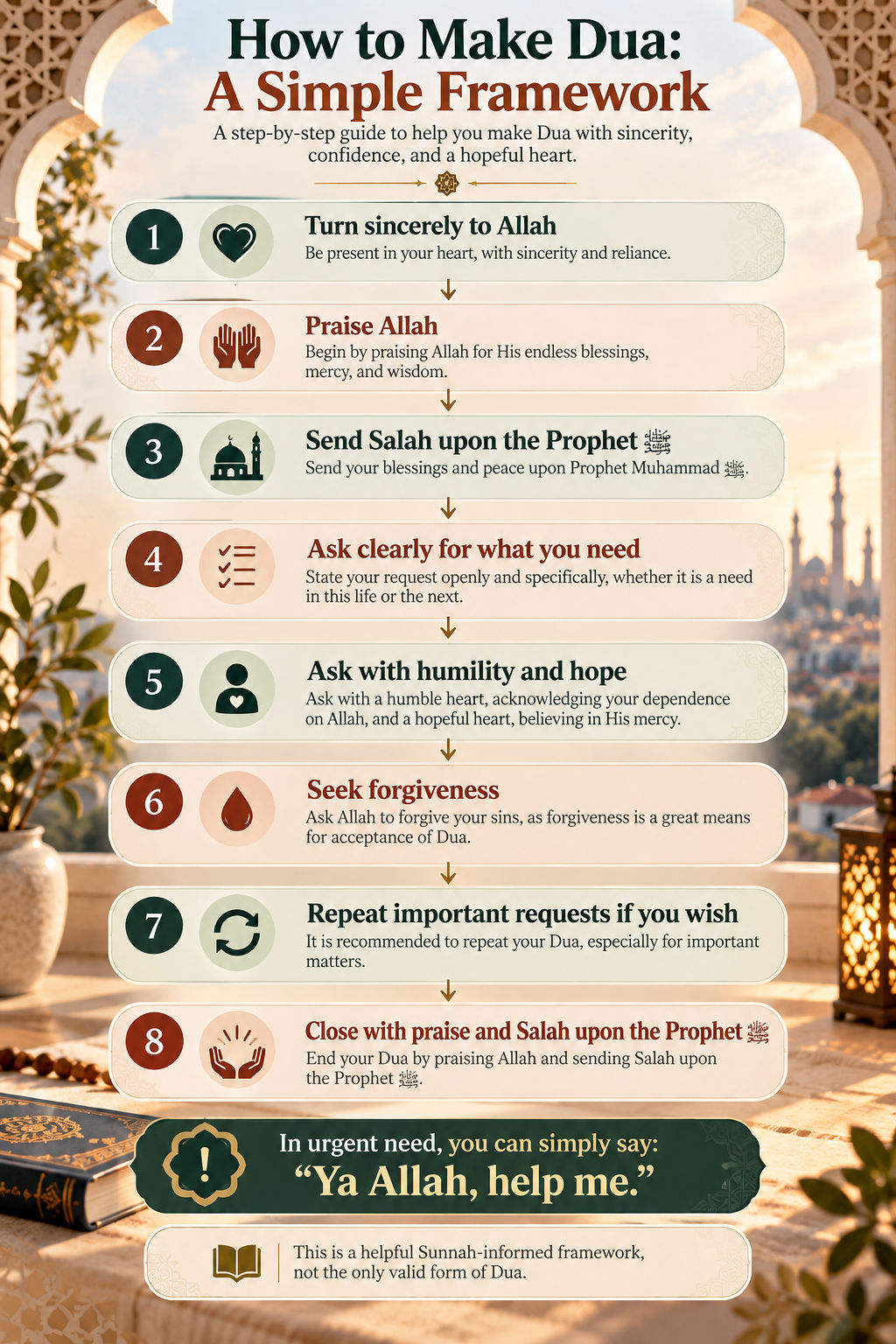
Here is a Sunnah-informed framework. It is useful for learning, but it is not the only valid way to make Dua. If you are in urgent need, say "Ya Allah, help me" straight away. The Prophet ﷺ and the Companions made urgent Duas without any preamble.
When you have time, you can follow these steps:
Turn sincerely to Allah. Remember who you are speaking to. Sincerity is the foundation of all worship.
Praise Allah. The Prophet ﷺ taught beginning with praise and glorification (Abu Dawud 1481; at-Tirmidhi 3477).
Send Salah upon the Prophet ﷺ, as that same hadith teaches.
Ask clearly for what you need. Say it in words you understand.
Ask with humility and hope. Quran 7:55 describes calling upon Allah "humbly and privately."
Seek forgiveness where appropriate. Many Prophetic Duas combine need with istighfar.
Repeat important requests if you wish. Repetition is established in the Sunnah.
Close with praise and Salah upon the Prophet ﷺ, which many scholars recommend as a fitting ending.
The scholarly basis for each step appears in the sections below.
Can I Make Dua in English?
Yes. Outside the formal ritual prayer (Salah), you may make personal Dua in any language you understand.
Scholars generally hold that personal supplication is not restricted to Arabic outside Salah. The reasoning is that Allah addresses us in the Quran with the command to call upon Him, without specifying a language, and that Dua is a conversation of the heart. The Quran also tells us that Allah sent every messenger with the language of his people (14:4), and every person in every language is asked to turn to Him. Allah knows what is in the hearts of all people and understands every tongue.
So you can ask Allah in English, French, Spanish, Urdu, Indonesian, Turkish, Hausa or your mother tongue. Many people find that Dua in their own language is where the heart is most present.
We do encourage you to learn the Quranic and Prophetic Arabic Duas gradually. Their wording is profound, authentic and beloved. But hear this clearly:
Not knowing Arabic should never stop you from making Dua.
Can I Make Dua in My Own Words?
Yes. Here are examples of the kind of simple requests a person might make. These are example personal Duas, not revealed formulas or hadith:
Example personal Dua: O Allah, help me make the right decision.
Example personal Dua: O Allah, forgive me.
Example personal Dua: O Allah, protect my family.
Example personal Dua: O Allah, help me learn the Quran.
Example personal Dua: O Allah, grant me lawful provision.
Example personal Dua: O Allah, make this difficulty easier for me.
Example personal Dua: O Allah, guide me to what is best.
You can ask in these words or in your own. The boundaries (no sinful requests, and the rules of Salah, discussed below) still apply.
Can I Make Dua in English During Salah?
This needs care, because the rulings differ depending on what part of the prayer and who the person is. Please read the three categories separately.
1. Required recitations in Salah: Arabic
Al-Fatihah, the opening Allahu Akbar, the Tashahhud and the other required parts of Salah are recited in Arabic. Do not replace Al-Fatihah with English because Dua can be made in English. Dua and Salah are different things, and the Quran's recitation is the Quran only in its Arabic wording. The overwhelming position of the scholars is that those who can learn Arabic recitation must recite in Arabic.
For someone who cannot yet memorize it, scholars discuss interim options. A hadith recorded by Abu Dawud (832, graded hasan) tells of a man who said he could not learn the Quran, and the Prophet ﷺ taught him to say phrases of tasbih, praise and takbir instead. Scholars derive detailed rulings from such texts. If this is your situation, ask a qualified teacher what applies to you while you learn.
2. Personal Dua outside Salah: any language
As explained above, you can ask Allah in your own language at any time outside the prayer.
3. Personal Dua inside Salah: scholars differ
The Prophet ﷺ said that no human speech is appropriate in Salah (Sahih Muslim 537). Scholars discuss whether non-Arabic supplication counts as ordinary speech. Views differ by school and by whether the person is able to speak Arabic, and the details are technical. The safest practical guidance for beginners is to use Arabic Prophetic and Quranic Duas inside Salah, learn them gradually, and consult a qualified scholar or teacher about your specific circumstances. Make your personal requests in your own language outside the prayer, for example in the moment right after it.
What Can You Ask Allah For?
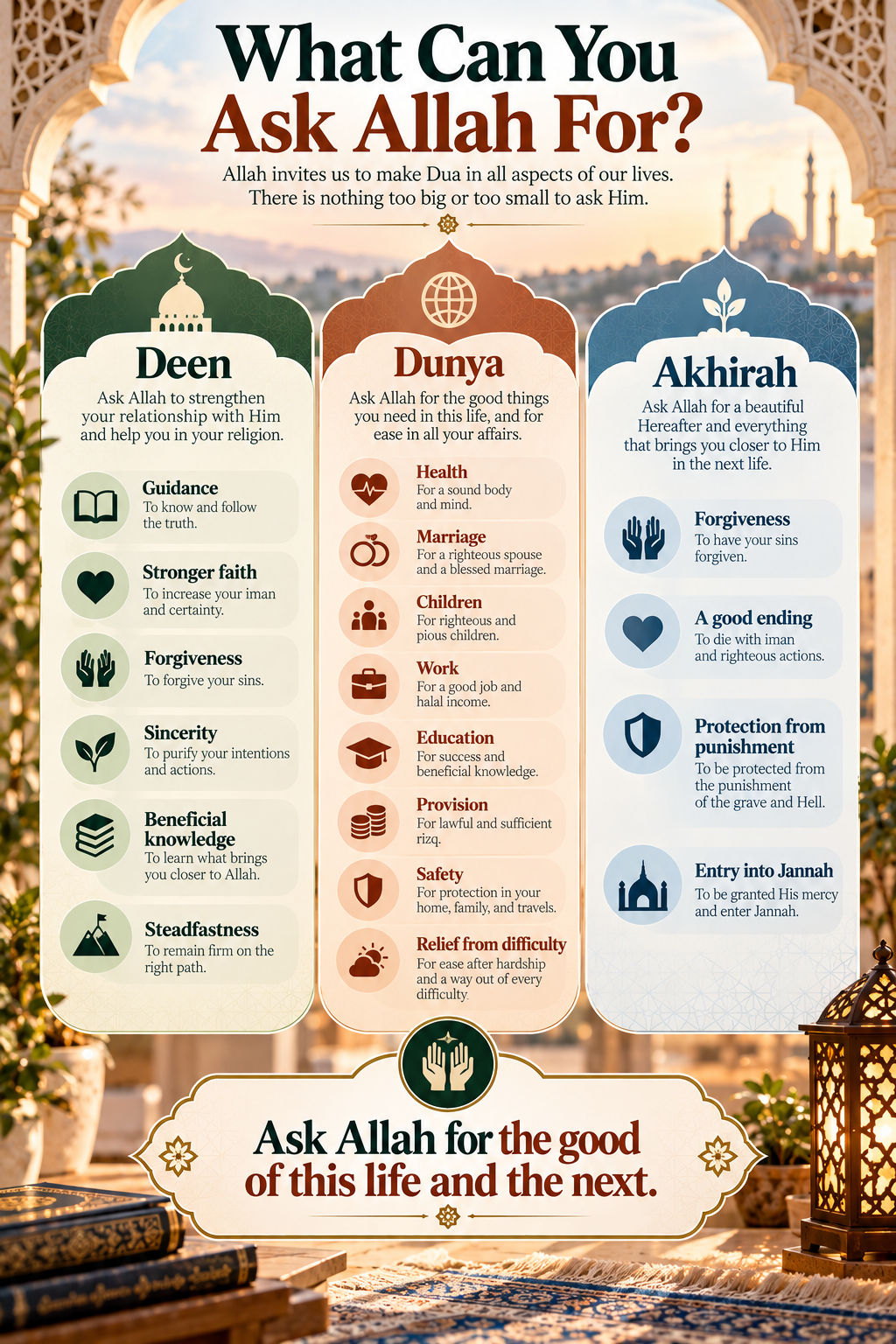
Almost everything good. Muslims can ask for:
Religion: guidance, stronger faith, forgiveness, sincerity, beneficial knowledge, steadfastness.
Dunya (this life): lawful provision, health, marriage, children, work, education, safety, relief from difficulty.
Akhirah (the Hereafter): forgiveness, protection from the Fire, entry into Jannah, a good ending.
Asking for worldly things is not spiritually inferior by default. The Quran and Sunnah include Duas for both worlds, and the Prophet ﷺ asked Allah for wellbeing, provision and ease. What the Quran criticizes is someone whose only concern is this world (see 2:200).
The Balance of Quran 2:201
رَبَّنَا آتِنَا فِي الدُّنْيَا حَسَنَةً وَفِي الْآخِرَةِ حَسَنَةً وَقِنَا عَذَابَ النَّارِ
Rabbana atina fid-dunya hasanatan wa fil-akhirati hasanatan wa qina 'adhaban-nar.
"Our Lord, give us in this world that which is good and in the Hereafter that which is good, and protect us from the punishment of the Fire." (Quran 2:201)
Anas ibn Malik reported that this was the Dua the Prophet ﷺ made most often (Sahih al-Bukhari 6389; Sahih Muslim 2690).
The word hasanah is general: "good." The classical commentators mention many examples of what it can include, such as wellbeing, provision, beneficial knowledge, righteous action and, in the Hereafter, Jannah. We should not narrow it to any single blessing. This short Dua joins good in this world + good in the Hereafter + protection from punishment.
What Should You Not Ask Allah For?
Authentic teachings set sensible boundaries:
Sinful requests. The Prophet ﷺ said a servant's Dua continues to be answered as long as he does not ask for something sinful or for the severing of family ties (Sahih Muslim 2735).
Asking for something haram, such as a forbidden relationship or unlawful gain.
Unjust Dua against others. Allah does not love transgression in Dua (Quran 7:55 ends by saying He does not love transgressors). The oppressed may call upon Allah against their oppressor, but Dua is not a tool for settling personal grudges or wishing harm on people who have not wronged you.
Dua against yourselves, your children or your wealth. The Prophet ﷺ said: "Do not make Dua against yourselves, your children or your wealth, lest it coincide with an hour in which Allah answers" (Sahih Muslim 3009).
These are limits against sin and injustice. They are not limits against honest need.
Can I Ask for Something Very Specific?
Yes. In ordinary situations you may ask Allah for a particular job, university admission, a spouse, a child, financial relief, healing or an opportunity. Specific asking is not weak Tawakkul. The Prophet ﷺ himself asked Allah for particular things.
A wise attitude is to ask sincerely for what you want while trusting that Allah knows what is best. Some people like to add "if it is good for me" as a sign of that trust, and that is optional. For decisions where you do not know which option is better, the Prophet ﷺ taught a specific prayer, Istikhara, covered later in this article. You do not need to force every Dua into one pattern.
How to Begin a Dua
Fadalah ibn 'Ubayd reported that the Prophet ﷺ heard a man making Dua in his prayer without praising Allah or sending Salah upon the Prophet. The Prophet ﷺ said, "This man was hasty." Then he taught them: when one of you prays, let him begin with praising and glorifying his Lord, then send Salah upon the Prophet ﷺ, then ask Allah for whatever he wishes (Abu Dawud 1481; at-Tirmidhi 3477, who graded it hasan sahih; also graded sahih by al-Albani).
A simple example of the pattern (example only, not a hadith):
Alhamdulillah, all praise is for Allah. O Allah, send Your peace and blessings upon Muhammad ﷺ. O Allah, I come to You in need…
This is excellent etiquette. It is not a claim that Allah refuses a spontaneous Dua made in an emergency or by someone who has never heard of this hadith.
How to Praise Allah Before Dua
You can use short phrases from the Quran and Sunnah, such as:
Alhamdulillahi Rabbil-'Alamin (الحمد لله رب العالمين): "All praise is for Allah, Lord of all worlds" (Quran 1:2).
Subhanallah (سبحان الله): "Glory be to Allah," declaring Him free of all imperfection.
Allahu Akbar (الله أكبر): "Allah is greater than everything."
Outside formal Salah, you may also praise Allah in your own language, for example by thanking Him for His mercy, His gifts and His patience with you. You do not need a complicated formula.
Calling Upon Allah by His Beautiful Names
وَلِلَّهِ الْأَسْمَاءُ الْحُسْنَىٰ فَادْعُوهُ بِهَا
"And to Allah belong the Most Beautiful Names, so call upon Him by them." (Quran 7:180)
You can match a Name to your need, using Names established in the Quran and Sunnah:
Seeking forgiveness: Ya Ghafur (The Most Forgiving), Ya Tawwab (The Ever-Accepting of repentance).
Seeking mercy: Ya Rahman, Ya Rahim.
Seeking provision: Ya Razzaq (The Provider; see Quran 51:58).
Asking Him to grant: Ya Wahhab (The Bestower, as in Quran 3:8).
For guidance, the most secure wording is not to invent a Name, but to use the Quran's own Dua: ihdina as-sirat al-mustaqim, "Guide us to the straight path" (Quran 1:6).
One firm rule: do not derive a new Name of Allah from a verb or a concept (for example, turning "He guides" or "He saves" into a Name by yourself). The Names are known only through revelation. If you are unsure whether a Name is established, ask a teacher.
Sending Salah Upon the Prophet ﷺ (الصلاة على النبي)
This means asking Allah to honor and bless His Prophet ﷺ, as the Quran commands (33:56). The best-known form is the Ibrahimic Salah recited in the Tashahhud: "Allahumma salli 'ala Muhammad wa 'ala ali Muhammad, kama sallayta 'ala Ibrahim…"
You do not need to memorize that full text before you start making Dua. A simple "Allahumma salli wa sallim 'ala nabiyyina Muhammad" ("O Allah, send peace and blessings upon our Prophet Muhammad") is a good place to begin. The evidence for including Salah upon the Prophet in Dua is the hadith of Fadalah above. A saying attributed to 'Umar that "Dua is held back until you send Salah upon the Prophet" is recorded by at-Tirmidhi (486) as a statement from 'Umar, and scholars differ on its grading, so we rely on the stronger hadith of Fadalah.
Do I Have to Raise My Hands?
No, not for every Dua. Raising the hands is well established in many situations: the Prophet ﷺ raised his hands in the Dua for rain and on the Day of 'Arafah, among other occasions, and he said that Allah is too generous and shy to return the empty hands of a servant who raises them to Him (Abu Dawud 1488; at-Tirmidhi 3556, graded acceptable by many hadith scholars).
But it is not universal. For example, during the Friday sermon, the Companion 'Umarah ibn Ruwaybah rebuked a man who raised his hands on the minbar, saying the Prophet ﷺ did no more than gesture with his index finger (Sahih Muslim 874). And scholars differ about routinely raising hands after every obligatory prayer; some permit it under the general evidence, while others note that a fixed, habitual practice was not reported from the Prophet ﷺ.
So a good rule for beginners: raise your hands when you are making a personal Dua if you wish, and do not make it a rule for every situation. For detailed rulings, consult a qualified scholar.
Do I Have to Face the Qiblah?
Not as a condition. The Prophet ﷺ faced the Qiblah and raised his hands when he made his long Dua before the Battle of Badr (Sahih Muslim 1763), and facing it is a recommended etiquette in some settings. But Dua is also made while walking, travelling, sitting, lying down before sleep and at moments of need. You may make Dua in any direction.
Do I Need Wudu to Make Dua?
No. Wudu is required for Salah, and scholars (the majority) require it to touch a physical copy of the Quran. It is not a general condition for personal Dua or dhikr. 'A'ishah (may Allah be pleased with her) said that the Prophet ﷺ used to remember Allah at all times (Sahih Muslim 373).
Being in a state of purity can be a recommended refinement, particularly if it is easy for you, but:
Do not avoid calling upon Allah just because you do not currently have Wudu.
Can I Make Dua Anywhere?
Yes. Dua is not limited to the mosque. You can make it at home, at work, in a car or while walking. The one etiquette to know: scholars advise not speaking Allah's name aloud in the toilet while relieving yourself. The Prophet ﷺ taught a Dua to say before entering (Sahih al-Bukhari 142). You can still make a silent Dua in your heart if you need to, and then continue once you leave.
Can I Make Dua Silently?
ادْعُوا رَبَّكُمْ تَضَرُّعًا وَخُفْيَةً ۚ إِنَّهُ لَا يُحِبُّ الْمُعْتَدِينَ
"Call upon your Lord humbly and privately. Indeed, He does not like transgressors." (Quran 7:55)
The classical commentators explain tadarru' as humility and khufyah as secrecy or quietness, which is closer to sincerity and farther from show. But the verse does not say every Dua must be whispered. Dua is made aloud in many Prophetic contexts, such as in congregations during Hajj and in the Dua for rain. The point is sincerity and humility, not performance.
Do I Need to Cry During Dua?
No. Tears may accompany Dua, and they are a gift when they come, but they are not required, and they are not a measure of acceptance. You may be emotional, calm, distracted, exhausted or hopeful, and still sincerely call upon Allah. Please do not worry about whether you "felt enough."
Can I Repeat the Same Dua?
Yes. Repetition is Prophetic. The Prophet ﷺ often repeated his Duas, and the hadith of the three outcomes (below) tells the Companions that Allah's giving is even greater than their asking. Repeated asking does not annoy Allah.
But do not invent a required number. Claims like "repeat this Dua 41 times for acceptance" need authentic evidence for that exact number. If a post cannot give you a source, do not treat the number as Islamic.
Best Times to Make Dua
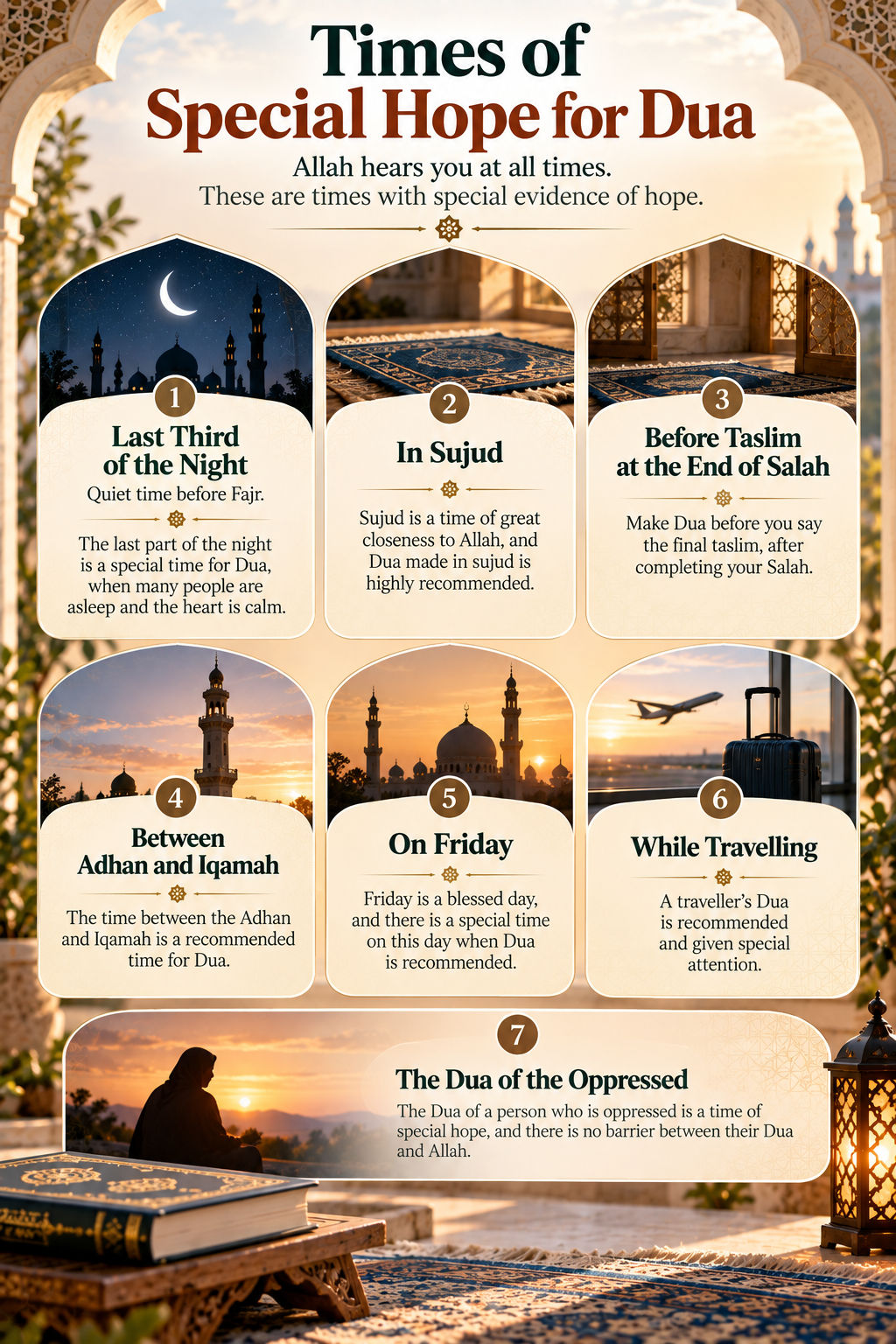
This list includes only times with sufficient evidence. Remember that Allah hears you at all times; these are simply times of special hope.
The last third of the night. The Prophet ﷺ said that our Lord descends to the lowest heaven in the last third of the night, saying, "Who is calling upon Me that I may respond? Who is asking Me that I may give? Who is seeking My forgiveness that I may forgive him?" (Sahih al-Bukhari 1145; Sahih Muslim 758). Ahl as-Sunnah affirm this as it came, in a manner that befits Allah, without asking "how" and without likening Him to creation. Practically: even a few quiet minutes before Fajr are valuable.
In Sujud. "The closest a servant is to his Lord is when he is in prostration, so increase your supplication" (Sahih Muslim 482).
Before the Taslim at the end of Salah. After the Tashahhud, the Prophet ﷺ said one may choose whatever supplication he likes (Sahih al-Bukhari 835; Sahih Muslim 402).
Between the Adhan and the Iqamah. "A Dua made between the Adhan and the Iqamah is not rejected" (Abu Dawud 521; at-Tirmidhi 212, graded sahih by al-Albani).
On Friday. The Prophet ﷺ mentioned an hour on Friday in which a Muslim servant who stands praying and asks Allah for something good will be given it (Sahih al-Bukhari 935; Sahih Muslim 852). Scholars differ on when exactly it falls. Two prominent views are the period between the imam sitting on the minbar and the end of the prayer (Sahih Muslim 853), and the last part of the day after 'Asr. Since this is uncertain, make Dua throughout Friday.
Travel. The Prophet ﷺ said three Duas are answered without doubt: the Dua of the oppressed, the Dua of the traveller, and a parent's Dua against their child (Abu Dawud 1536; at-Tirmidhi 1905, graded hasan).
The oppressed. "Beware of the Dua of the oppressed, for there is no veil between it and Allah" (Sahih al-Bukhari 1496; Sahih Muslim 19). This is a serious warning to those who wrong others, and a comfort to those who have been wronged.
While fasting / at Iftar. The narrations about Dua at the time of breaking the fast have disputed gradings among hadith scholars, and we do not want to present them as certain. What is established is the Prophet's ﷺ Dua when breaking his fast (Abu Dawud 2357, graded hasan by many). It is certainly a good time to ask Allah, but we avoid claiming a guarantee.
Rain. We intentionally leave this out as a specific "accepted time," because the narrations commonly cited for it are generally graded weak. There is no harm in making Dua during rain, but we do not attribute a special promise to it.
Dua in Sujud
Sujud is among the most important places for personal supplication. But note the distinctions:
Required recitation in sujud: the tasbih (Subhana Rabbiyal-A'la).
Quran recitation: the Prophet ﷺ said, "I have been forbidden from reciting the Quran in ruku' or sujud. In ruku', glorify your Lord; in sujud, strive in supplication, for it is fitting that you be answered" (Sahih Muslim 479). So do not recite Quran as Quran there. Scholars discuss using a Quranic Dua with the intention of Dua, not recitation; ask your teacher about the details.
Language: the safest course for beginners is Arabic Prophetic Duas in the prayer while you learn. Make your personal requests in your own language right after Salah.
Dua Before the Taslim
Many beginners think personal Dua belongs only after the prayer. In fact, after the final Tashahhud and Salah upon the Prophet ﷺ, and before saying as-salamu 'alaykum to end the prayer, is a time the Prophet ﷺ recommended for Dua. He taught seeking refuge from four things after the final Tashahhud: the punishment of Hell, the punishment of the grave, the trials of life and death, and the trial of the False Messiah (Sahih Muslim 588). He also taught Abu Bakr this Dua for the prayer (Sahih al-Bukhari 834; Sahih Muslim 2705):
اللَّهُمَّ إِنِّي ظَلَمْتُ نَفْسِي ظُلْمًا كَثِيرًا، وَلَا يَغْفِرُ الذُّنُوبَ إِلَّا أَنْتَ، فَاغْفِرْ لِي مَغْفِرَةً مِنْ عِنْدِكَ، وَارْحَمْنِي، إِنَّكَ أَنْتَ الْغَفُورُ الرَّحِيمُ
Allahumma inni zalamtu nafsi zulman kathiran, wa la yaghfirudh-dhunuba illa anta, faghfir li maghfiratan min 'indik, warhamni, innaka antal-Ghafurur-Rahim.
"O Allah, I have wronged myself greatly, and none forgives sins but You. So grant me forgiveness from You and have mercy on me. Indeed, You are the Most Forgiving, the Most Merciful."
Dua After Salah: What Is Established?
This topic is discussed with respect among scholars, so let's distinguish three things:
Established adhkar after obligatory Salah. The Prophet ﷺ would seek forgiveness three times and say Allahumma antas-Salam wa minkas-salam, tabarakta ya Dhal-Jalali wal-Ikram (Sahih Muslim 591), and the Companions reported tasbih, tahmid and takbir (33 each) afterwards (Sahih Muslim 595).
Personal Dua whenever you wish. A hadith reported by at-Tirmidhi (3499) says Dua is heard most "in the last part of the night and after the prescribed prayers." Scholars interpret "after the prayers" as possibly before the Taslim, or soon after it.
A fixed, collective or hand-raised Dua after every Fard prayer. Scholars differ. Some consider hand-raised Dua after prayer permissible and good, as part of general Dua; others consider treating it as a fixed ritual something that was not established from the Prophet ﷺ. Both positions come from scholars of sincere intent.
The beginner-friendly takeaway: do the established adhkar, make your Dua before the Taslim and after, and avoid condemning those who follow another reasonable view.
Why Isn't My Dua Being Answered?
If you have asked for marriage, children, healing, work, guidance for someone you love or relief from hardship, perhaps for months or years, this question hurts. First, a clear statement: this is not a sign you lack faith, and it does not mean Allah dislikes you.
Here is what the Prophet ﷺ taught about how Allah responds to a Dua:
"There is no Muslim who makes a Dua that contains no sin and no severing of family ties, except that Allah gives him one of three things: either He hastens the answer to his Dua, or He stores it for him in the Hereafter, or He averts from him an evil equal to it." They said, "Then we shall ask a lot." He said, "Allah is more generous." (Musnad Ahmad; the hadith is graded sahih by a number of scholars, and a similar narration from 'Ubadah ibn as-Samit is in at-Tirmidhi 3573, graded hasan.)
So a Dua is not wasted. Three outcomes are possible, and we generally cannot tell which one we are in.
Allah's Response Is Not Always the Exact Outcome You Requested
Dua is not a transaction where enough repetition forces a result. Allah is Al-'Alim (All-Knowing), Al-Hakim (All-Wise) and Ar-Rahim (Most Merciful), and the believer asks while recognizing that Allah knows what we do not (see Quran 2:216).
We should be careful not to tell a suffering person "Allah definitely denied this because something better is coming next week." We do not know the specific unseen wisdom. A better principle:
Keep asking, and entrust the outcome to Allah's knowledge, wisdom and mercy.
Do Not Become Impatient With Dua
The Prophet ﷺ said: "The Dua of any of you will be answered as long as he does not become impatient, saying, 'I made Dua but I have not been answered'" (Sahih al-Bukhari 6340; Sahih Muslim 2735). In Muslim's version, the Companions asked what impatience means, and he said it is when a person says "I made Dua and made Dua and did not see it answered," and so he gets frustrated and abandons Dua.
This does not mean you are forbidden from feeling tired, sad or confused. The Prophets themselves felt anguish. The hadith warns against giving up on turning to Allah. If you are exhausted, speak to Allah about that exhaustion too.
Barriers to Dua Acceptance
Only a few barriers are clearly established:
Asking for sin or the severing of family ties (Sahih Muslim 2735).
Impatience, as described above (Bukhari 6340; Muslim 2735).
Unlawful nourishment, as in the hadith of the traveller below.
Please do not turn this into a checklist of self-blame. Human beings generally cannot know why a specific desired outcome has not occurred, and Allah may be responding in one of the other two ways. If you find sin or a haram source of income in your life, the answer is repentance and correction, never despair.
Dua and Halal Provision
Abu Hurayrah reported that the Prophet ﷺ said Allah is pure and accepts only what is pure. Then he mentioned a man who travels far, disheveled and dusty, raising his hands to the sky and saying, "O Lord! O Lord!" while his food is haram, his drink is haram, his clothing is haram and he has been nourished with haram, "so how can his Dua be answered?" (Sahih Muslim 1015).
Scholars explain that this describes how far such a Dua is from being accepted when someone persists in unlawful earnings. The lesson is to pursue lawful provision. It is not a verdict on any individual person's Dua, and no one should use it to declare another person's Dua rejected.
Dua and Qadr
If everything is written, why make Dua? Because Dua itself is part of Qadr. Allah decreed events, the causes that lead to them, and the supplications by which people ask for them. A Dua does not change Allah's eternal knowledge, and nothing surprises Him.
A narration says that nothing repels the decree except Dua (at-Tirmidhi 2139, graded hasan by some scholars and weakened by others). Scholars who accept it explain that Dua is itself one of the means Allah has decreed. Ibn al-Qayyim compared Dua to any cause in the world: just as food is a cause for fullness, Dua is a cause for what Allah has written. For more, see our guide What Is Qadr in Islam? A Beginner's Guide to Divine Decree and Free Will.
Dua and Tawakkul
Dua does not replace action. Asking Allah and taking the means belong together:
Exam: study + Dua + Tawakkul.
Job: apply + improve your skills + Dua + Tawakkul.
Illness: seek appropriate treatment + Dua + Tawakkul.
Marriage: take responsible halal steps + Dua + Istikhara + Tawakkul.
Financial difficulty: budget + seek lawful income and support + Dua + Tawakkul.
The Prophet ﷺ said to tie your camel and then trust in Allah (at-Tirmidhi 2517). Seeking therapy, medicine or counseling does not contradict Dua. See What Is Tawakkul? How to Trust Allah Without Becoming Passive.
Dua vs Istikhara
Istikhara is a specific Prophetic prayer and supplication for decisions, taught by the Prophet ﷺ (Sahih al-Bukhari 1162): two voluntary rak'ahs followed by the transmitted Dua. It is not simply any Dua asking what to do.
Some myths to correct: you do not necessarily see a dream; no dream color is a standard answer; Istikhara does not reveal the unseen; and it does not replace research or consultation. Do your homework, ask trusted people, make Istikhara, and then proceed with the option that becomes easier for you, trusting Allah.
Dua vs Dhikr
Dua is calling upon Allah, including asking Him for needs. Dhikr is remembering Allah, through both prescribed and general forms of remembrance. The categories overlap: some Prophetic phrases combine praise, remembrance and supplication (for instance, the Dua of Yunus below). We do not need an artificially rigid boundary. For more, see What Is Dhikr? A Beginner's Guide to Remembering Allah Every Day.
Dua vs Salah
For English speakers, "prayer" is used for two different things:
Salah (الصلاة): the formal ritual prayer with defined conditions, movements, times and recitations.
Dua (الدعاء): supplication, calling upon Allah, which can be made at any time.
Salah includes Dua, but Dua does not replace Salah. When someone says "I made a prayer for you," they usually mean Dua.
Authentic Quranic Duas Every Beginner Can Learn
These short Duas are from the Quran. The "when to use" notes are suggestions for how a person might recall them, not rulings that a verse is prescribed for a modern situation.
1. Good in both worlds (Quran 2:201)
رَبَّنَا آتِنَا فِي الدُّنْيَا حَسَنَةً وَفِي الْآخِرَةِ حَسَنَةً وَقِنَا عَذَابَ النَّارِ Rabbana atina fid-dunya hasanatan wa fil-akhirati hasanatan wa qina 'adhaban-nar. "Our Lord, give us good in this world and good in the Hereafter, and protect us from the punishment of the Fire." Use: any time; it is brief and complete.
2. Ease and clear speech (Quran 20:25–28)
رَبِّ اشْرَحْ لِي صَدْرِي وَيَسِّرْ لِي أَمْرِي وَاحْلُلْ عُقْدَةً مِّن لِّسَانِي يَفْقَهُوا قَوْلِي Rabbi-shrah li sadri, wa yassir li amri, wahlul 'uqdatan min lisani, yafqahu qawli. "My Lord, expand my chest, make my task easy for me, and remove the knot from my tongue so they may understand my speech." Context: the Dua of Musa (Moses) before facing Pharaoh. Use: before a task that feels heavy, such as a talk or an exam.
3. In distress (Quran 21:87)
لَا إِلَٰهَ إِلَّا أَنتَ سُبْحَانَكَ إِنِّي كُنتُ مِنَ الظَّالِمِينَ La ilaha illa anta, subhanaka, inni kuntu minaz-zalimin. "There is no god but You; glory be to You. Indeed, I have been among the wrongdoers." Context: the Dua of Yunus (Jonah) in the belly of the whale. The Prophet ﷺ said that no Muslim calls upon Allah with it for anything except that Allah responds (at-Tirmidhi 3505, graded sahih).
4. Steadfast heart (Quran 3:8)
رَبَّنَا لَا تُزِغْ قُلُوبَنَا بَعْدَ إِذْ هَدَيْتَنَا وَهَبْ لَنَا مِن لَّدُنْكَ رَحْمَةً ۚ إِنَّكَ أَنتَ الْوَهَّابُ Rabbana la tuzigh qulubana ba'da idh hadaytana, wa hab lana min ladunka rahmah, innaka antal-Wahhab. "Our Lord, do not let our hearts deviate after You have guided us, and grant us mercy from Yourself. Indeed, You are the Bestower." Use: a daily reminder to ask for steadfastness.
5. For prayer and for descendants (Quran 14:40)
رَبِّ اجْعَلْنِي مُقِيمَ الصَّلَاةِ وَمِن ذُرِّيَّتِي ۚ رَبَّنَا وَتَقَبَّلْ دُعَاءِ Rabbi-j'alni muqimas-salati wa min dhurriyyati, rabbana wa taqabbal du'a. "My Lord, make me an establisher of prayer, and from my descendants. Our Lord, and accept my supplication." Context: the Dua of Ibrahim (Abraham). Use: for your own consistency in Salah and for your children.
6. Family (Quran 25:74)
رَبَّنَا هَبْ لَنَا مِنْ أَزْوَاجِنَا وَذُرِّيَّاتِنَا قُرَّةَ أَعْيُنٍ وَاجْعَلْنَا لِلْمُتَّقِينَ إِمَامًا Rabbana hab lana min azwajina wa dhurriyyatina qurrata a'yunin waj'alna lil-muttaqina imama. "Our Lord, grant us from among our spouses and offspring comfort to our eyes, and make us a leader for the righteous." Use: for spouses and children, as one of the qualities of the servants of Ar-Rahman.
7. Forgiveness (Quran 7:23)
رَبَّنَا ظَلَمْنَا أَنفُسَنَا وَإِن لَّمْ تَغْفِرْ لَنَا وَتَرْحَمْنَا لَنَكُونَنَّ مِنَ الْخَاسِرِينَ Rabbana zalamna anfusana, wa in lam taghfir lana wa tarhamna lanakunanna minal-khasirin. "Our Lord, we have wronged ourselves, and if You do not forgive us and have mercy on us, we will surely be among the losers." Context: the Dua of Adam and Hawwa (Eve) after their mistake. Use: after any sin.
8. Forgetfulness and mistakes (Quran 2:286, opening)
رَبَّنَا لَا تُؤَاخِذْنَا إِن نَّسِينَا أَوْ أَخْطَأْنَا Rabbana la tu'akhidhna in nasina aw akhta'na. "Our Lord, do not hold us accountable if we forget or make a mistake." Note: it is part of the closing verse of Surah al-Baqarah, whose last two verses carry great virtue (Sahih al-Bukhari 4008).
9. Knowledge (Quran 20:114)
وَقُل رَّبِّ زِدْنِي عِلْمًا Wa qur-rabbi zidni 'ilma. "And say: My Lord, increase me in knowledge." Use: a gift to every student, especially a Quran learner.
Authentic Prophetic Duas Every Beginner Can Learn
1. Guidance, piety, chastity, contentment
اللَّهُمَّ إِنِّي أَسْأَلُكَ الْهُدَى وَالتُّقَى وَالْعَفَافَ وَالْغِنَى Allahumma inni as'alukal-huda wat-tuqa wal-'afafa wal-ghina. "O Allah, I ask You for guidance, piety, chastity and self-sufficiency." Source: Sahih Muslim 2721 (from Ibn Mas'ud). Grading: sahih.
2. Steadfastness of the heart
يَا مُقَلِّبَ الْقُلُوبِ ثَبِّتْ قَلْبِي عَلَى دِينِكَ Ya Muqallibal-qulub, thabbit qalbi 'ala dinik. "O Turner of hearts, make my heart firm upon Your religion." Source: at-Tirmidhi 2140 (from Anas), hasan; the Prophet ﷺ made this Dua very often.
3. Beneficial knowledge, good provision, accepted deeds
اللَّهُمَّ إِنِّي أَسْأَلُكَ عِلْمًا نَافِعًا وَرِزْقًا طَيِّبًا وَعَمَلًا مُتَقَبَّلًا Allahumma inni as'aluka 'ilman nafi'an, wa rizqan tayyiban, wa 'amalan mutaqabbalan. "O Allah, I ask You for beneficial knowledge, good provision and accepted deeds." Source: Ibn Majah 925 (from Umm Salamah), graded sahih by al-Albani.
4. Worry, grief and burdens
اللَّهُمَّ إِنِّي أَعُوذُ بِكَ مِنَ الْهَمِّ وَالْحَزَنِ، وَالْعَجْزِ وَالْكَسَلِ، وَالْبُخْلِ وَالْجُبْنِ، وَضَلَعِ الدَّيْنِ وَغَلَبَةِ الرِّجَالِ Allahumma inni a'udhu bika minal-hammi wal-hazan, wal-'ajzi wal-kasal, wal-bukhli wal-jubn, wa dala'id-dayni wa ghalabatir-rijal. "O Allah, I seek refuge in You from worry and grief, from weakness and laziness, from miserliness and cowardice, from being overwhelmed by debt and from being overpowered by people." Source: Sahih al-Bukhari 6369 (from Anas). Grading: sahih.
5. Pardon and wellbeing
اللَّهُمَّ إِنِّي أَسْأَلُكَ الْعَفْوَ وَالْعَافِيَةَ فِي الدُّنْيَا وَالْآخِرَةِ Allahumma inni as'alukal-'afwa wal-'afiyata fid-dunya wal-akhirah. "O Allah, I ask You for pardon and wellbeing in this world and the Hereafter." Source: Abu Dawud 5074 and Ibn Majah 3871 (from Ibn 'Umar), graded sahih.
6. Pardon (the Dua recommended for Laylat al-Qadr)
اللَّهُمَّ إِنَّكَ عَفُوٌّ تُحِبُّ الْعَفْوَ فَاعْفُ عَنِّي Allahumma innaka 'afuwwun tuhibbul-'afwa fa'fu 'anni. "O Allah, You are the Pardoner and You love to pardon, so pardon me." Source: at-Tirmidhi 3513 and Ibn Majah 3850 (from 'A'ishah), graded sahih. See What Is Laylat al-Qadr?
7. Forgiveness in Salah
The Dua of Abu Bakr, given earlier in the section on Dua before the Taslim (Sahih al-Bukhari 834; Sahih Muslim 2705).
How to Learn Arabic Duas Without Memorizing Sounds You Don't Understand
At Araby Academy, we encourage students to learn Duas as meaning, not just as sound. Here is a method:
Learn the meaning first. Read the translation until you know what you are asking.
Break the Arabic into short phrases. For example, Rabbana | atina | fid-dunya | hasanah | wa fil-akhirati | hasanah | wa qina | 'adhaban-nar.
Learn the pronunciation from a teacher or a reliable recording, since transliteration alone can mislead.
Connect each phrase to its meaning. Rabbana = our Lord; dunya = this world; hasanah = good; akhirah = the Hereafter.
Use it in real Dua every day, even alongside your own words.
Review regularly, adding one new Dua every week or two.
Do not memorize a 30-word Dua as one block of sound. Understand who you are addressing, what you are asking and the key words. Understanding can deepen attention and connection. Please note, however, that a Dua is not invalid merely because you do not understand every word of an authentic formula.
Common Dua Mistakes
Believing Dua must be in Arabic. Outside formal Salah, this is not generally true.
Waiting for "perfect words." Unnecessary.
Treating Dua like a magic formula. Dua is worship, not a technique.
Inventing required repetition numbers. Avoid unsupported numbers.
Believing tears are required. They are not.
Giving up because the exact outcome has not happened. The hadith warns against abandoning Dua out of impatience.
Asking Allah while refusing every practical means. Dua and action go together.
Using weak or fabricated "powerful Dua" lists. Verify the source.
Believing every Dua requires raised hands. An overgeneralization.
Believing a dream must confirm your Dua. It need not.
Asking for something sinful. See the boundaries above.
Thinking your English is "less spiritual" than Arabic. Quranic and Prophetic Arabic have a special status, but sincere Dua in your own language is real Dua.
Viral "Dua Hacks" to Avoid
You may see posts claiming:
"Say this 313 times and your wish is guaranteed."
"Read this Surah tonight and your ex will return."
"Repeat this Divine Name X times and become rich."
"Say this Dua and receive money in 24 hours."
"Use this prayer to make someone love you."
"Recite this exact formula and Allah must grant your request."
These are not how Dua works. Specific numbers, times, rewards and guaranteed outcomes attributed to Islam need authentic evidence. Allah is not compelled by formulas. This does not mean that genuine, general dhikr is wrong; it means a viral post misusing it should not be believed. Ask one question: "What is the source?" (Even a popular saying such as "Dua is the essence of worship" in one common wording is graded weak, so verify even familiar phrases.)
Can I Make Dua for Another Person?
Yes. The Prophet ﷺ said: "The Dua of a Muslim for his brother in his absence is answered. Beside his head is an angel appointed; whenever he makes a Dua of good for his brother, the angel says: Amin, and for you the same" (Sahih Muslim 2732).
You can make Dua for parents, children, spouse, friends, teachers and Muslims in hardship. Of course, Dua does not replace practical support: if someone needs help, give it too.
Can I Ask Someone Else to Make Dua for Me?
It is permissible to ask a living, righteous Muslim to make Dua for you, as the Companions did with the Prophet ﷺ in his lifetime, and it is a kindness. But do not come to believe that any person has a special guaranteed line to Allah that you lack. You can always ask Allah directly, and Allah is near to you (2:186).
Making Dua for Your Children
Parents can ask Allah for their children's guidance, faith, good character, beneficial knowledge, protection and wellbeing. Helpful Quranic Duas include 14:40, 25:74 and the Dua of Zakariyya for righteous offspring (Quran 3:38). Prophetic example: the Prophet ﷺ sought protection for al-Hasan and al-Husayn with Allah's perfect words (Sahih al-Bukhari 3371).
And please avoid Dua against your children in anger: "Do not make Dua against yourselves, your children or your wealth…" (Sahih Muslim 3009). Take a breath and ask for guidance for them instead.
Dua When You Have No Words
Sometimes you are grieving, frightened, exhausted or overwhelmed, and you cannot form a beautiful sentence. Dua does not require literary skill. An example personal Dua such as "O Allah, help me" can express genuine need. (This is an example, not a quotation from revelation.) Allah hears hearts.
You can also lean on short authentic supplications such as "Hasbunallahu wa ni'mal-wakil" ("Allah is sufficient for us and the best disposer of affairs," Quran 3:173) or the Dua of Yunus above.
A 5-Minute Dua Routine for Beginners
This is a practical learning framework, not a prescribed five-minute Sunnah ritual. Five minutes has no religious significance.
Minute 1: Praise Allah.
Minute 2: Ask for forgiveness.
Minute 3: Ask for your faith and your Akhirah.
Minute 4: Ask for personal and family needs.
Minute 5: Pray for others, then close with praise and Salah upon the Prophet ﷺ.
Build Your Personal Dua List
A private Dua list can help you remember what to ask. This is a productivity tool, not a Sunnah practice. Consider these headings:
My faith: What do I want Allah to help me improve?
Forgiveness: What do I need to repent from?
Family: Who needs my Dua?
Health: What wellbeing am I asking for?
Work / study: What do I need help with?
Decisions: Where do I need guidance?
Muslims around the world: Who else can I remember?
Akhirah: What do I ask Allah for beyond this life?
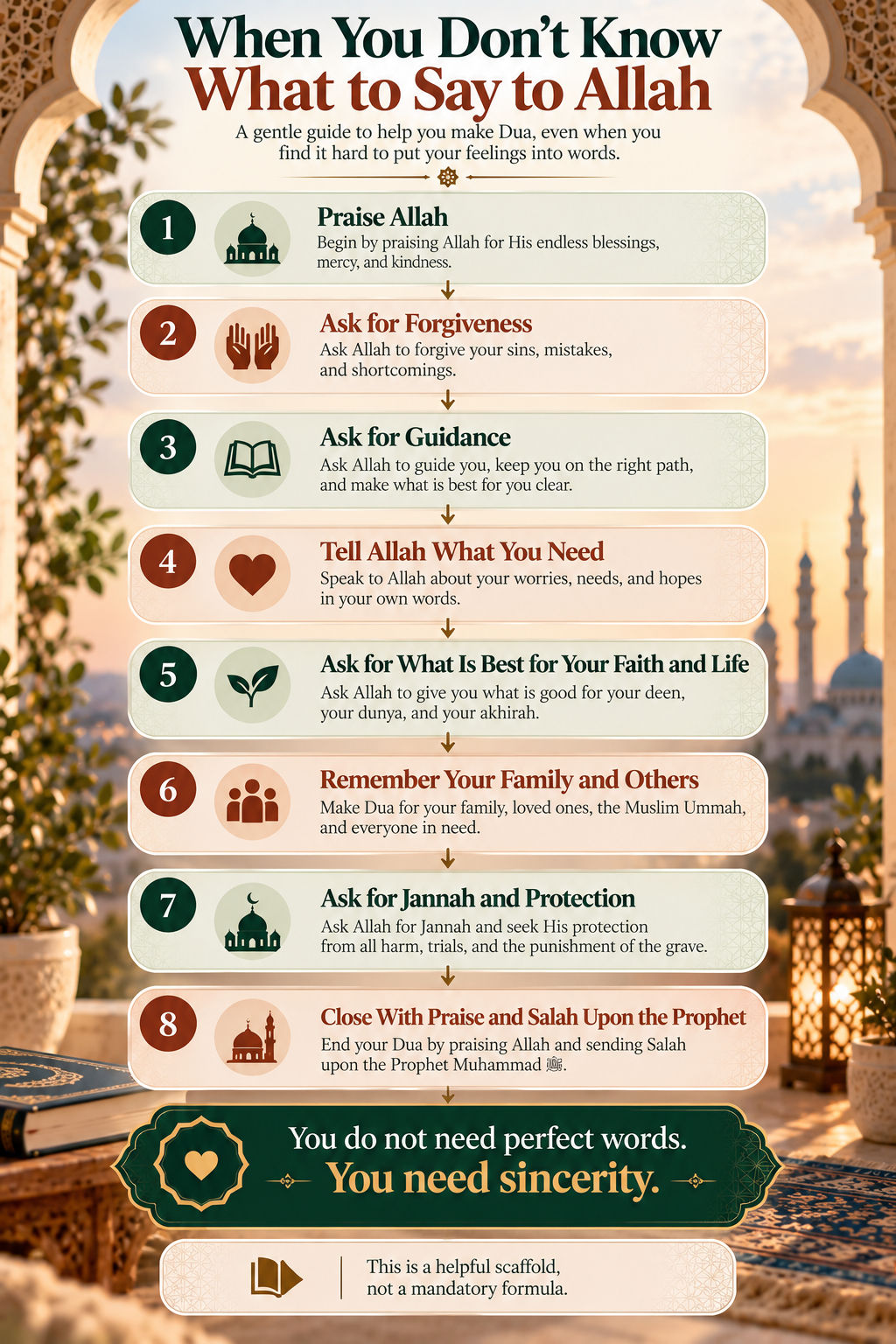
A Simple Dua Formula for Someone Who Doesn't Know What to Say
Praise Allah → ask for forgiveness → ask for guidance → ask for what you need → ask for what is best for your faith and life → ask for your family and others → ask for Jannah and protection from punishment → close with praise and Salah upon the Prophet ﷺ.
Once again, this is not mandatory. It is a scaffold for someone who is stuck.
How to Teach Children to Make Dua
Teach children that Dua is asking Allah and talking to Him with respect and love. Begin with simple requests. Teach Alhamdulillah, asking forgiveness, asking for parents, asking for guidance and a few short Quranic Duas. Do not force large lists of memorization without understanding; explain meaning before quantity, and let them hear you make Dua too.
Dua for New Muslims
If you are new to Islam, please hear this clearly:
Do not wait until your Arabic improves before calling upon Allah.
Gradually learn Al-Fatihah for Salah, the required parts of the prayer, a few short authentic Duas and Quranic phrases. But outside the formal prayer, you can sincerely ask Allah in a language you understand, within the normal boundaries of Islam. You are welcome, and Allah is near.
Arabic, the Quran and Dua
Arabic is not a barrier between you and Allah. But learning it opens doors: Quranic Duas, Prophetic supplications, Salah, dhikr, the Names of Allah and Quranic vocabulary. A non-Arabic speaker may start by memorizing Rabbana atina…, but understanding words such as Rabbana, dunya, hasanah and akhirah can turn memorized sounds into conscious supplication. We do not say this is necessary for acceptance; it is a way to bring more presence to what you already say.
Learning With Araby Academy
You do not need fluent Arabic before you can make Dua. But as you gradually understand the Quranic and Prophetic words you recite, your worship can become increasingly conscious and meaningful. Araby Academy helps non-Arabic-speaking students build that understanding step by step through Quran, Arabic, and Islamic Studies lessons. Our one-to-one lessons cover Quran reading, Tajweed, memorization, Quranic Arabic, Arabic for non-native speakers, Islamic Studies and the Arabic of Salah.
Keep Learning
What Is Tawakkul? How to Trust Allah Without Becoming Passive
What Is Qadr in Islam? A Beginner's Guide to Divine Decree and Free Will
Why Does Allah Test Us? Understanding Trials and Hardship in Islam
What Does Islam Say About Anxiety, Worry, and Trusting Allah?
How to Learn Salah When You Don't Speak Arabic
What Is Dhikr? A Beginner's Guide
What Is Laylat al-Qadr?
How to Understand the Quran Without Speaking Fluent Arabic
Learn Arabic Through the Quran
100 Most Common Words in the Quran
New Muslim Guide
Conclusion: You Do Not Need Perfect Words to Ask Allah
Return to the beginner we met at the start. Perhaps they still know only a little Arabic. Perhaps their Dua is short. Perhaps they repeat the same request. Perhaps they are still learning.
Allah does not require literary performance. Learn the beautiful Quranic and Prophetic supplications. Learn their meanings. Improve your Arabic gradually. Follow authentic etiquette. But do not let imperfect Arabic become a wall between you and sincere Dua.
Turn to Allah with sincerity, ask Him for what is good, take the means available to you, and entrust the response to His knowledge and wisdom.
Dua is not merely a way to request things. It is an act of worship that reminds the believer again and again: I need Allah. And that is where how to make Dua truly begins.

Frequently Asked Questions
1. What is Dua in Islam? Dua (الدعاء) is calling upon Allah and asking Him for what you need. It is itself an act of worship: "Supplication is worship" (Abu Dawud, at-Tirmidhi, Ibn Majah).
2. How do you make Dua step by step? Turn sincerely to Allah, praise Him, send Salah upon the Prophet ﷺ, ask clearly with humility, seek forgiveness, and close with praise and Salah upon the Prophet ﷺ. This is a helpful framework, not a condition for validity; in urgent need you may simply say, "Ya Allah, help me."
3. Can I make Dua in English? Yes. Outside the formal prayer, you may make personal Dua in any language you understand.
4. Can I make Dua in my own words? Yes, within Islamic boundaries. Simple, sincere words are enough. Learning the Prophetic Duas is recommended but not a prerequisite.
5. Can I make Dua without Wudu? Yes. Wudu is not a condition for ordinary Dua or dhikr, though being in a state of purity is a nice refinement if easy.
6. Do I have to raise my hands when making Dua? No. Hand-raising is established in many situations, but not for every Dua; for example, it is not part of the Friday sermon practice (Muslim 874). Consult a scholar for detailed rulings.
7. What is the best time to make Dua? Authentic examples include the last third of the night, sujud, before the Taslim, between the Adhan and Iqamah, the Friday hour, travel and the Dua of the oppressed. Allah hears you at any time.
8. Can I make Dua during Salah? Yes. Authentic times include sujud and before the Taslim. Use Arabic Prophetic and Quranic Duas while you learn; do not recite Quran as Quran in sujud.
9. Can I make Dua in English during Salah? Scholars differ and the details depend on the school and the person's ability. Required recitations such as Al-Fatihah must be in Arabic. Consult a qualified teacher for your case, and make personal requests in your own language outside the prayer.
10. Why is my Dua not being answered? It may be answered in one of three ways: given, replaced by averting harm, or stored for the Hereafter (Ahmad; at-Tirmidhi 3573). A delay is not a sign that Allah has rejected you. Do not give up (Bukhari 6340).
11. Can I repeat the same Dua every day? Yes. Repetition is Prophetic and does not annoy Allah. Do not assume a fixed number unless there is authentic evidence.
12. Can Dua change Qadr? Dua does not change Allah's eternal knowledge. Dua itself is part of what Allah has decreed, and scholars describe it as one of the means by which He brings about what He has written.
13. Can I ask Allah for worldly things? Yes. The Quran and Sunnah include Duas for both this world and the Hereafter (Quran 2:201).
14. How should I begin and end a Dua? A recommended etiquette is to begin with praise and Salah upon the Prophet ﷺ (Abu Dawud 1481) and to end the same way. It is an etiquette, not a condition of acceptance.
15. What is the difference between Dua, Dhikr and Salah? Salah is the formal ritual prayer; Dua is supplication; Dhikr is remembrance of Allah. The categories overlap, but only Salah has fixed conditions and form.