
Muslims often hear that Shirk is among the gravest matters in Islamic belief, and the Quran repeatedly calls people to worship Allah alone. Yet sincere readers often have practical questions. Is asking a doctor for help Shirk? Is deep love for another person Shirk? Does giving charity publicly spoil it? What about amulets, horoscopes, or an unwanted thought that suddenly appears? Can Allah forgive someone who once associated partners with Him?
Answering these well means distinguishing belief, action, intention, scholarly disagreement, and involuntary mental events. This guide explains Shirk calmly and from the sources, so that learners gain clarity rather than fear.
What Is Shirk in Islam?
Shirk is an Arabic term for associating partners with Allah in His divinity or worship. It is the opposite of Tawhid, the Islamic belief that Allah alone is God and alone deserves worship. Scholars commonly distinguish major Shirk, which contradicts the foundation of Islamic monotheism, from minor Shirk, such as certain forms of showing off in worship. Applying these terms to specific cases requires evidence, intention, and scholarly care.
Question | Short answer |
|---|---|
What is Shirk? | Associating partners with Allah in a way that contradicts His exclusive divinity or worship. |
What is its opposite? | Tawhid. |
Common classifications? | Major and minor Shirk; “hidden Shirk” is used descriptively in some discussions. |
Is every sin Shirk? | No. |
Does Allah forgive Shirk? | Sincere repentance while alive can be accepted; according to classical Tafsir, Quran 4:48 concerns meeting Allah without repentance. |
Are intrusive thoughts automatically Shirk? | No; involuntary thoughts differ from chosen belief or action. |
Shirk is serious, but understanding it correctly is different from fearing that every ordinary action might be Shirk.
What Does Shirk Mean in Arabic?
Shirk is written الشِّرْك (ash-shirk) and comes from the root ش ر ك (sh-r-k), whose basic sense is sharing or partnership. In everyday Arabic the root can describe ordinary sharing, such as partners in a business, and those uses are not religious Shirk. The theological meaning is narrower: giving anyone or anything a share in what belongs to Allah alone.
شَرِيك (sharik): a partner.
مُشْرِك (mushrik): one who associates partners, in theological usage; plural مُشْرِكُون (mushrikun).
إِشْرَاك (ishrak): the act of associating partners, the verbal noun of أَشْرَكَ (ashraka).
Tawhid (التَّوْحِيد) comes from a different root, و ح د (w-ḥ-d), connected with oneness. Roots help us recognize concepts, but they do not replace Tafsir or Aqidah scholarship.
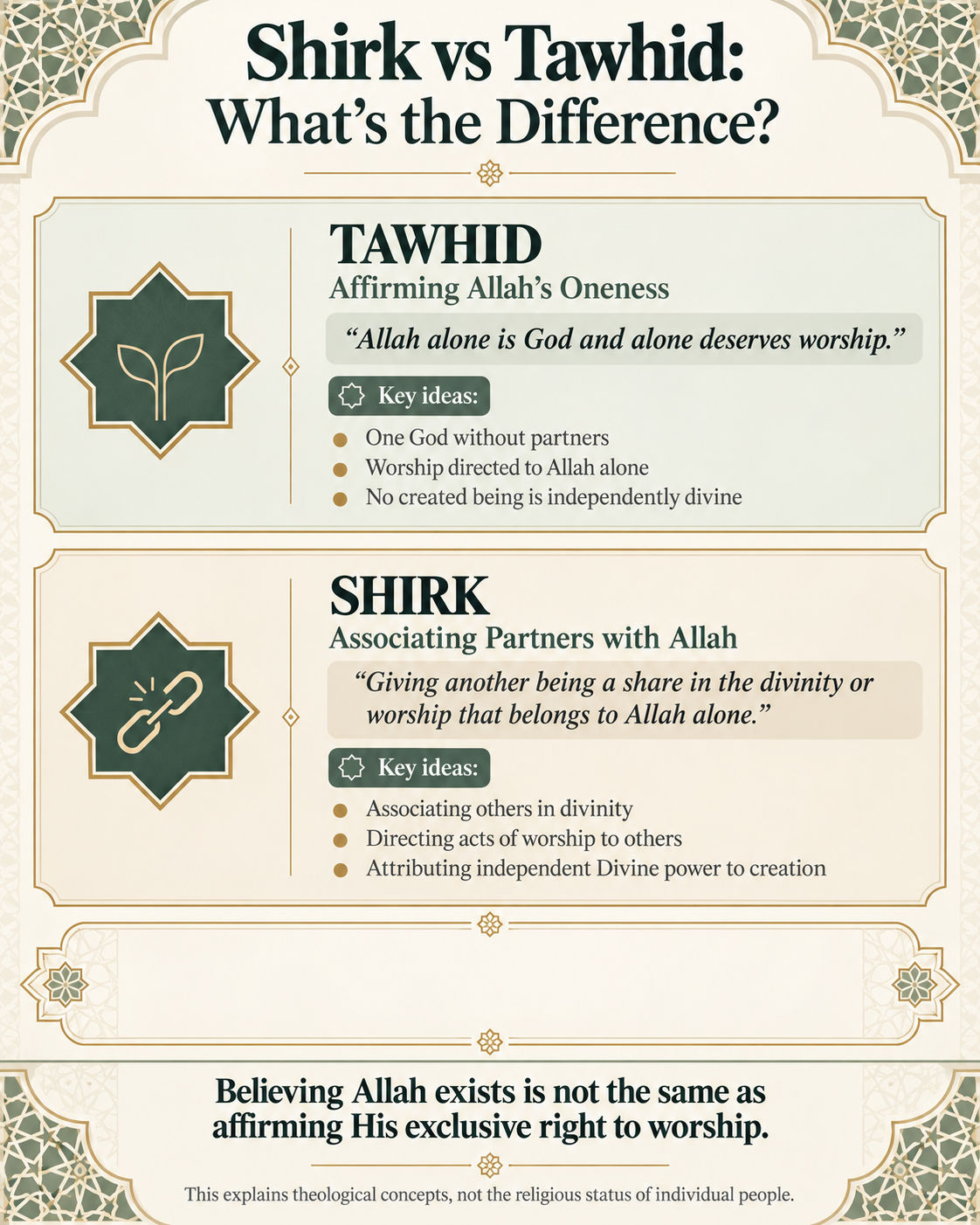
Shirk vs Tawhid: What’s the Difference?
Tawhid means affirming that Allah is One, without partner, and uniquely deserving of worship. It is the heart of the Shahada, لَا إِلَٰهَ إِلَّا اللَّهُ (la ilaha illa Allah), “There is no god but Allah.”
Tawhid | Shirk |
|---|---|
Allah alone is God and deserves worship. | Associating others with Allah in ways that contradict that exclusive status. |
Believing that Allah exists is therefore not the whole picture. The Quran notes that people asked who created the heavens and the earth would say “Allah” (29:61), yet it still calls them to worship Him alone.
Some Sunni scholars organize this teaching into Tawhid al-Rububiyyah (Allah’s lordship), Tawhid al-Uluhiyyah (His right to worship), and Tawhid al-Asma’ wa al-Sifat (His names and attributes). These are scholarly frameworks, not a numbered Quranic list, and other Sunni scholars organize the topic differently. All of them agree on the central point: worship belongs to Allah alone.
Surah Al-Ikhlas states this oneness concisely. قُلْ هُوَ اللَّهُ أَحَدٌ: “Say, He is Allah, One. Allah, the Self-Sufficient, whom all need. He neither begets nor is born, and there is none comparable to Him” (112:1–4). Qul means “say,” huwa “He,” and Ahad “One,” conveying absolute uniqueness. Classical Tafsir reads the surah as rejecting offspring, equals, and need, without speculating about Allah’s essence beyond what revelation says.
What Does the Quran Say About Shirk?
Luqman’s Warning About Shirk
Luqman advises his son: “O my son, do not associate anything with Allah. Indeed, Shirk is a tremendous wrong” (31:13). The Arabic إِنَّ الشِّرْكَ لَظُلْمٌ عَظِيمٌ is emphatic: inna (“indeed”) governs ash-shirka; the la- on la-zulmun adds further emphasis; and zulmun ‘azimun means “a tremendous wrong.” Zulm is putting something where it does not belong, so commentators explain Shirk as giving Allah’s right to another. The verse is a father’s loving counsel, not a tool for humiliating anyone.
The Quranic Call to Worship Allah Alone
The Quran presents this as the message of every Messenger: “We sent a messenger to every nation: Worship Allah and avoid false deities (Taghut)” (16:36). It also commands, “Do not set up rivals to Allah while you know” (2:22), right after reminding people that He made the earth a resting place and sent down rain as provision. And it says, “Do not set up another deity with Allah” (17:22), followed by: “Your Lord has decreed that you worship none but Him, and be good to parents” (17:23). Worshipping Allah alone never cancels duties toward people; it grounds them. These verses state a theological principle; they give no license to threaten anyone of another faith.
Prophet Ibrahim’s Rejection of Idolatry
The Quran portrays Ibrahim reasoning with his people. After watching a star, the moon, and the sun set, he declares that he has turned his face to the One who created the heavens and the earth and is not among those who associate others (6:74–79). Prophet Ibrahim’s rejection of idolatry becomes clearer when readers explore [ his story of faith, sacrifice, and trust in Allah] in its wider Quranic context.
The table below summarizes key passages.
Verse | Teaching | Note |
|---|---|---|
2:22 | Do not set up rivals to Allah | Follows a reminder of His provision |
4:48 | Warning about Shirk; lesser sins are subject to Allah’s will | Read with repentance, below |
5:72 | Rejects the divinity of the Messiah | The Quran honors him as a Prophet |
6:151 | Do not associate anything with Allah | Opens a list of ethical duties |
31:13 | Shirk is a tremendous wrong | Luqman’s advice |
39:3 | Worship Allah sincerely; rejects “nearness” through partners | See intercession, below |
39:53 | Do not despair of Allah’s mercy | An invitation to repent |
72:18 | Do not invoke anyone with Allah | Places of worship belong to Allah |
Why Does the Quran Describe Shirk as Such a Serious Sin?
Worshipping Allah alone is the center of Islamic faith, so Shirk strikes at its foundation. Asked which sin is greatest, the Prophet ﷺ answered that it is to set up a rival to Allah when He created you (Sahih al-Bukhari and Sahih Muslim). Shirk also misdirects the human heart, giving worship, hope, and ultimate dependence to what cannot own them. Yet the Quran never relies on warning alone; it pairs warnings with knowledge, signs in creation, and mercy. The Quran’s warnings about Shirk also relate to [ accountability and the Day of Judgment in Islam], while its teachings about repentance remind readers not to despair of Allah’s mercy.
What Are the Main Types of Shirk?
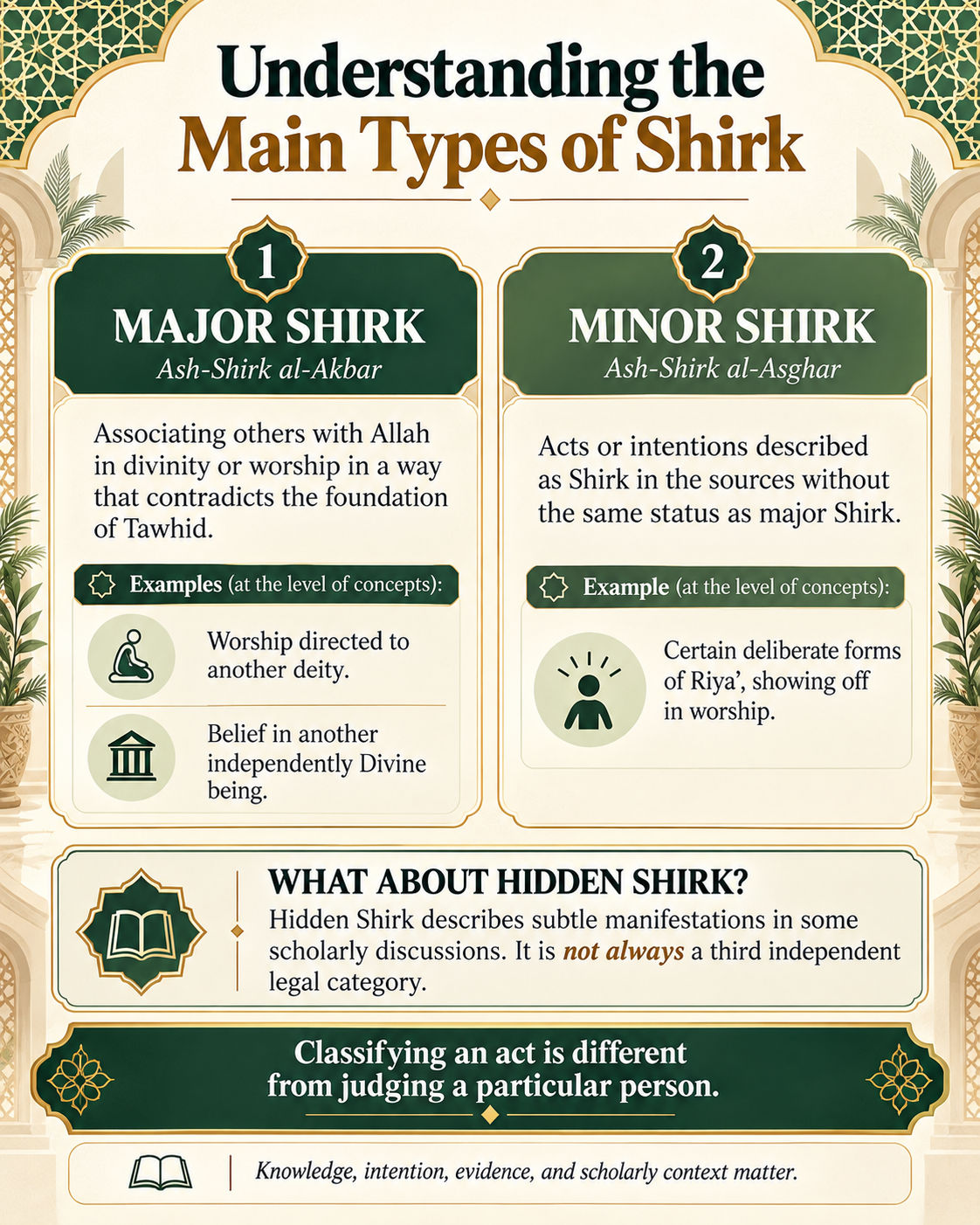
Many Sunni scholars distinguish major Shirk (ash-shirk al-akbar, الشِّرْكُ الأَكْبَر) from minor Shirk (ash-shirk al-asghar, الشِّرْكُ الأَصْغَر). Some also speak of hidden Shirk (ash-shirk al-khafi, الشِّرْكُ الْخَفِيّ). There is no single fixed three-part taxonomy; “hidden” usually describes how Shirk can appear subtly, rather than a separate legal category.
Major Shirk
Major Shirk is associating others with Allah in divinity or worship in a way that contradicts the foundation of Tawhid. Established examples include worshipping another deity alongside Allah, believing another being is independently divine, directing acts of worship such as prayer or sacrifice to anyone other than Allah, and attributing ultimate divine authority to a created being. Quran 4:48 and 5:72 warn about it. Describing a belief, however, is different from ruling on a particular person, as discussed under Takfir below.
Minor Shirk and Riya’
Minor Shirk refers to acts or motivations that the sources call Shirk but that do not carry the status of major Shirk. It is not harmless, and it does not carry exactly the same consequences. The best-known example is Riya’ (الرِّيَاء), performing worship to be admired. A report in Musnad Ahmad has the Prophet ﷺ saying, “What I fear most for you is minor Shirk,” and explaining that it is Riya’; later hadith scholars have graded it acceptable or sound. Sahih Muslim (2985) also records a Hadith Qudsi in which Allah says that whoever does a deed associating someone else with Him, He leaves that person and the association. That is a Hadith, not a Quranic verse.
Not every public good deed is Riya’. Praying in congregation, teaching, volunteering, or donating openly can all be sincere; the concern is a deliberate aim of winning admiration instead of Allah’s pleasure. When someone acts sincerely and is then praised, the Prophet ﷺ called it “the glad tidings of the believer in this world” (Sahih Muslim), which scholars apply to praise that comes unsought. Social media follows the same logic: sharing a reminder or a charitable act is not automatically Riya’, though anyone may honestly ask why they share. A moment of pride does not erase every act of worship; scholars discuss mixed intentions case by case. To protect sincerity (Ikhlas, الإِخْلَاص), reflect on your intention, do some good in private, ask Allah’s help, and learn what the sources teach about sincerity, without endlessly interrogating yourself.
What Scholars Mean by Hidden Shirk
Hidden Shirk describes subtle forms, such as quietly improving one’s worship because people are watching. A report in Ibn Majah is often cited here, though hadith scholars discuss its grading. “Hidden” does not mean every negative thought is Shirk: a passing doubt, embarrassment, or fleeting feeling is not an adopted belief or deliberate worship.
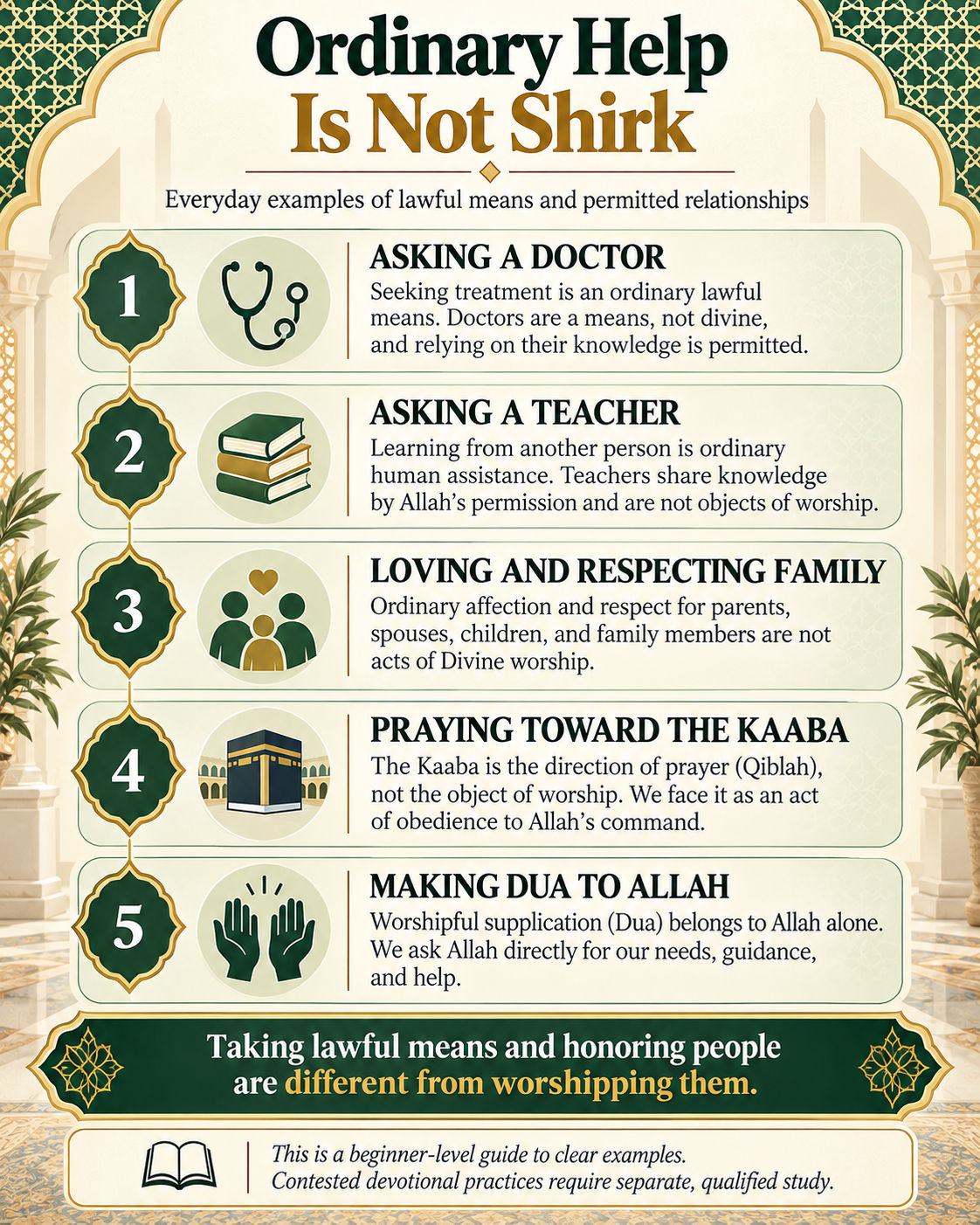
Examples of Shirk—and What Is Not Automatically Shirk
Worship vs Respect
Worship (‘ibadah, الْعِبَادَة) is devotion reserved for Allah: prayer, prostration, sacrificial offering, worshipful supplication, and ultimate reliance. Respecting parents, admiring a teacher, thanking a doctor, or loving family is not the same thing. Quran 2:165 criticizes those who love rivals “as they love Allah,” while believers are stronger in love for Allah; the issue is worship-like devotion given to another, not ordinary affection. Parents and scholars deserve respect, but no human is infallible or divine.
Asking Allah vs Asking People for Ordinary Help
إِيَّاكَ نَعْبُدُ وَإِيَّاكَ نَسْتَعِينُ, “You alone we worship, and You alone we ask for help” (1:5), means that ultimate worship and reliance belong to Allah. It does not forbid asking a doctor, teacher, relative, lawyer, or emergency service for ordinary help; the Quran itself urges cooperation in righteousness (5:2). Dua (الدُّعَاء) is worship, as the Prophet ﷺ said (Tirmidhi), and 72:18 forbids invoking anyone alongside Allah. That concerns worshipful supplication, not every use of the English word “ask.” The Prophet ﷺ advised Ibn Abbas, “If you ask, ask Allah; if you seek help, seek help from Allah” (Tirmidhi). Understanding the difference between worshipful supplication and ordinary human assistance becomes easier when readers learn [ how to make Dua and ask Allah for help].
Using Medicine and Other Practical Means
Ultimate power belongs to Allah, while people act through created causes. Using medicine does not mean believing it independently controls outcomes: the Prophet ﷺ said that Allah sent down no disease without sending a cure (Sahih al-Bukhari). A man who asked whether to tie his camel or simply trust in Allah was told to tie it and trust (Tirmidhi, graded acceptable by many scholars). Studying, working, and taking safety precautions follow the same principle. Islamic monotheism does not require abandoning practical causes; [ trusting Allah without becoming passive] helps explain how faith and responsible effort belong together. No effort guarantees success; the outcome belongs to Allah.
Respecting Prophets and Other Religious Traditions
Muslims love and honor the Prophet Muhammad ﷺ and send salawat upon him, saying صَلَّى اللَّهُ عَلَيْهِ وَسَلَّم, asking Allah to bless him and grant him peace (33:56). They do not worship him. He told his followers not to praise him excessively as the Christians praised Ibn Maryam, but to say “servant of Allah and His Messenger” (Sahih al-Bukhari), and the Quran has him say he holds no power to benefit or harm himself except as Allah wills (7:188). Likewise, Muslims face the Kaaba as a prayer direction but worship Allah alone; ‘Umar, kissing the Black Stone, said he knew it neither benefits nor harms (Sahih al-Bukhari).
Islam honors Jesus (Isa) as a Messenger and the Messiah, born miraculously to Maryam, while rejecting his divinity: “The Messiah, Jesus the son of Mary, was but a messenger of Allah” (4:171; see also 5:72). Christians hold varied formulations, so this teaching should never become ridicule or an assumption about a neighbor’s personal beliefs. The Islamic understanding of Shirk also helps explain [ what Muslims believe about Prophet Jesus] and why Islam honors him without regarding him as Divine. Theological disagreement is no license for unkindness; Muslims are called to treat people of every faith with fairness and dignity.
Careful Speech
The Prophet ﷺ forbade swearing by forefathers (Sahih al-Bukhari and Sahih Muslim), and a report in Tirmidhi says that whoever swears by other than Allah has committed Kufr or Shirk. Scholars generally read this as a stern prohibition and weigh the wording, intention, and habit before applying it to a person; one expression does not by itself put a speaker outside Islam. Another report advises saying “what Allah willed, then so-and-so willed,” rather than joining them with “and” (Abu Dawud). Saying Insha’Allah acknowledges Allah’s will, and forgetting it is not major Shirk.
Everyday Scenarios at a Glance
Scenario | What matters theologically | Beginner takeaway |
|---|---|---|
Asking a doctor for treatment | Using lawful means; Allah grants outcomes | Not Shirk |
Asking a teacher for guidance | Ordinary human help | Not Shirk |
Respecting the Prophet ﷺ | Honor without worship | Not Shirk |
Praying toward the Kaaba | A direction, not an object of worship | Not Shirk |
Making Dua to Allah | Worship directed to Allah | Core of Tawhid |
Giving charity publicly | Intention matters; visibility alone proves nothing | Not automatically Riya’ |
Claiming an object independently controls destiny | Attributes independent power to a creation | Serious theological concern |
Consulting a horoscope for hidden future knowledge | Claims knowledge of the unseen | Prohibited; serious concern |
Visiting a grave respectfully | Remembrance and prayer for the deceased are established | Not Shirk; worshipping the dead is |
Unwanted intrusive thoughts | Involuntary, not chosen | Not Shirk; seek support if distressing |
Wearing an amulet with disputed religious content | Recognized scholarly difference — seek qualified guidance. | Ask a qualified scholar |
Discussing a contested form of Tawassul | Recognized scholarly difference — seek qualified guidance. | Ask a qualified scholar |
Shirk, Intercession, and Grave-Related Practices
Intercession (ash-shafa‘ah, الشَّفَاعَة) belongs to Allah and occurs only by His permission: “Who is there that can intercede with Him except by His permission?” (2:255); “To Allah belongs all intercession” (39:44). It is not an independent power of any created being. Verses 10:18 and 39:3 criticize those who worshipped others as intermediaries who would “bring us nearer to Allah.” They address worship of those intermediaries, so they should not be transferred to any Muslim without examining what that person actually believes and does.
Tawassul (التَّوَسُّل) means seeking a means of nearness to Allah. Sunni scholars accept forms such as using Allah’s names, one’s own righteous deeds (the Hadith of the three men in the cave, Sahih al-Bukhari), or the Dua of a living righteous person (as ‘Umar asked al-Abbas to pray for rain, Sahih al-Bukhari). Other forms, such as seeking nearness through the status of a Prophet or righteous person, have received different rulings. Istighathah (الاسْتِغَاثَة) means seeking help or relief. Asking living people for help within their ability is normal (28:15), while requests addressed to the deceased or absent are a recognized area of disagreement. Scholars agree that believing any created being independently benefits or harms is Shirk.
The Prophet ﷺ said to visit graves, for they remind us of the Hereafter (Sahih Muslim). Asking Allah to forgive the deceased is part of Islamic practice; directing worship to the deceased is not. Visiting a grave or shrine does not make someone a Mushrik, and no school, Sufi community, or individual should be condemned on that basis. This is a beginner’s introduction; detailed questions belong with qualified Aqidah and Fiqh scholars.
Amulets, Astrology, and Superstition
An amulet or talisman (tamimah, تَمِيمَة) is an object worn for protection or fortune. A report in Musnad Ahmad says, “Whoever hangs a tamimah, may Allah not fulfill his wish,” and Ibn Mas‘ud reported that spells containing Shirk, amulets, and love charms are Shirk (Abu Dawud, Ibn Majah). The concern is attributing independent power to a created object. Scholars differ over amulets containing Quran or authentic supplications: some prohibit them to close the door to superstition, others permit them, and a person who wears one is not thereby outside Islam. Not every decorative or lucky-looking item is prohibited; belief about causation is what matters. Ruqyah (الرُّقْيَة), recitation of Quran and authentic supplication for protection and healing, is permitted: “There is no harm in ruqyah that contains no Shirk” (Sahih Muslim). It does not replace medical treatment, and fraudulent healers should be avoided. The evil eye (al-‘ayn, الْعَيْن) is affirmed in authentic Hadith, and believing in it is not Shirk; superstitious objects and rituals are a different matter.
Fortune-telling and astrology raise separate concerns. “Whoever goes to a diviner and asks him about anything, his prayers will not be accepted for forty nights” (Sahih Muslim), and Quran 27:65 says none in the heavens and earth knows the unseen except Allah. Astrology claims that stars determine destinies or reveal hidden matters; astronomy is the scientific study of celestial bodies and is not Shirk, nor are weather forecasts or evidence-based projections. Glancing at a horoscope is not the same as adopting its claims, but believing it controls fate is a serious theological concern. Lucky numbers or unlucky dates as harmless customs differ from believing they determine outcomes. Claims that objects or horoscopes independently control destiny are also easier to evaluate when readers understand [ Divine Decree and human responsibility] in Islam.
Shirk vs Kufr, Bid’ah, and Other Sins
Kufr (الْكُفْر) is disbelief in the broad sense; Shirk is a major form of it, and the terms overlap though scholars do not use them identically everywhere. Nifaq (النِّفَاق), hypocrisy, includes hypocrisy of belief and hypocrisy of conduct, such as the traits listed in a Hadith in Sahih al-Bukhari; ordinary human inconsistency does not make someone a hypocrite. Bid’ah (الْبِدْعَة), religious innovation, has its own categories, and a disputed innovation is not automatically major Shirk. Lying, stealing, oppression, and breaking trusts are serious sins that must not be minimized, yet they are not classified as major Shirk.
Why Muslims Must Be Careful About Takfir
Takfir (التَّكْفِير) means declaring someone a disbeliever. The Prophet ﷺ warned that if a man calls his brother “disbeliever,” the charge returns upon one of them (Sahih al-Bukhari and Sahih Muslim). A scholar may say a belief or act contradicts Tawhid; ruling that a particular person is outside Islam is different, involving knowledge, intention, interpretation, coercion, circumstances, and qualified judgment. A slip of the tongue, ignorance, or careless phrasing is not the same as deliberately adopting a contrary belief. This article offers no checklist for labeling relatives or neighbors. Where Muslims differ on theology or devotional practice, the right response is research and humility, not sweeping verdicts.
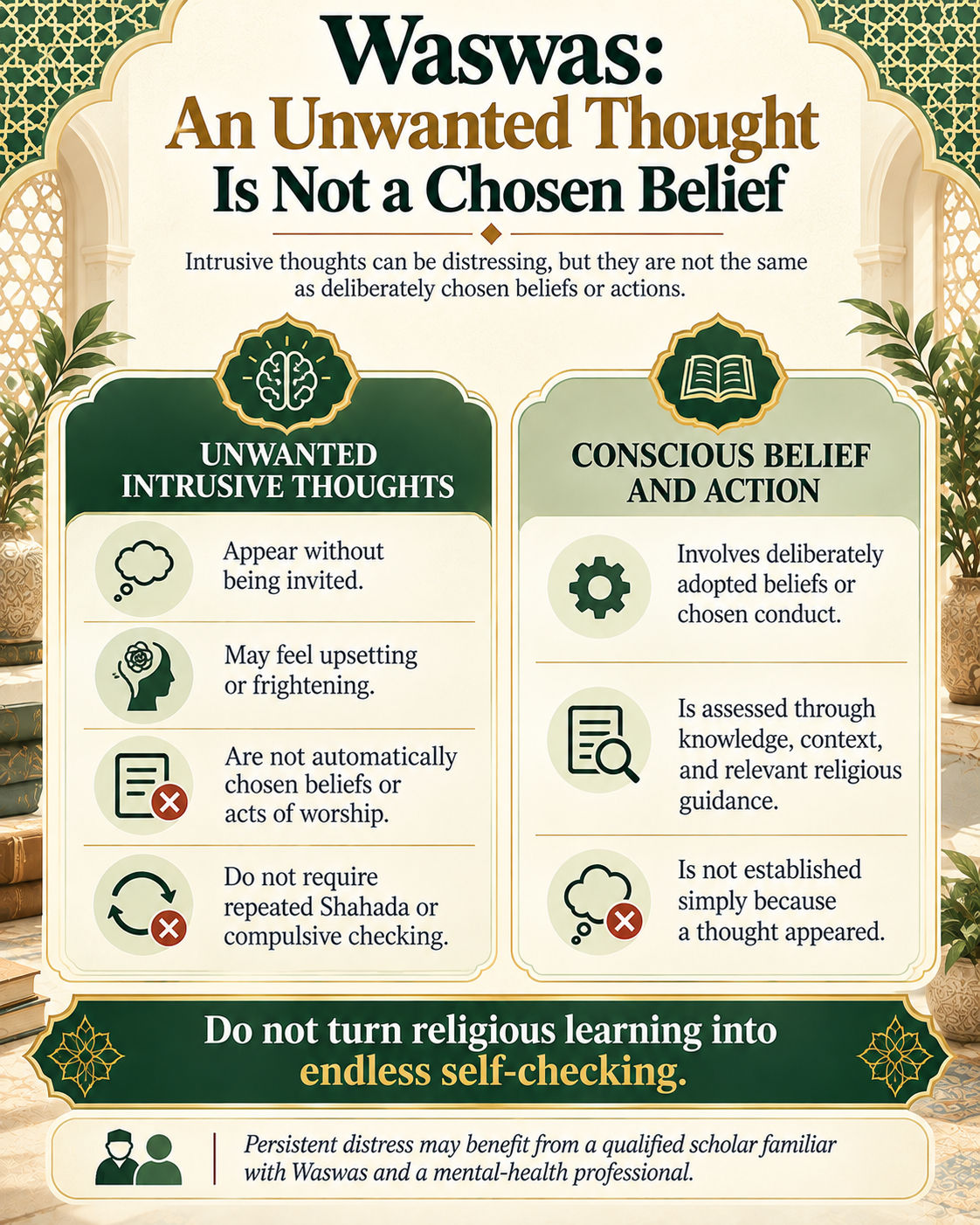
Are Intrusive Thoughts or Waswas Considered Shirk?
No. Waswas (الْوَسْوَاس) means whispering or intrusive doubts. Some Companions came to the Prophet ﷺ saying they found thoughts in themselves too grave to speak of; he asked, “Do you really find that?” and said, “That is clear faith” (Sahih Muslim), which scholars explain as their horror at such thoughts. Another Hadith says Allah has overlooked what the Ummah’s selves whisper so long as they do not act upon it or speak it (Sahih al-Bukhari and Sahih Muslim, in the Book of Faith). Scholars explain “speak” as intentionally voicing it as belief; it does not make asking a scholar, trusted person, or therapist for help an act of disbelief. For such thoughts, a further narration advises seeking refuge in Allah and stopping (Sahih Muslim).
Ordinary theological questions differ from persistent, repetitive fears. Patterns such as repeating the Shahada every few minutes, checking whether a thought was intentional, replaying conversations to find possible Shirk, repeating worship over doubtful motives, or seeking reassurance after every doubt are not acts of worship and should not be prescribed. The Shahada is a sincere affirmation, not a tool for neutralizing every thought. Persistent distress may benefit from a qualified scholar who understands Waswas and from a mental-health professional; seeking therapy does not conflict with Islam, and this article cannot diagnose anyone. Readers troubled by repeated fears of accidental Shirk may benefit from learning about [ anxiety, worry, and trusting Allah] without treating every unwanted thought as a deliberate belief. Sincere questions asked in order to understand are not disbelief, and converts or young Muslims should never be shamed for them.
Can Allah Forgive Shirk?
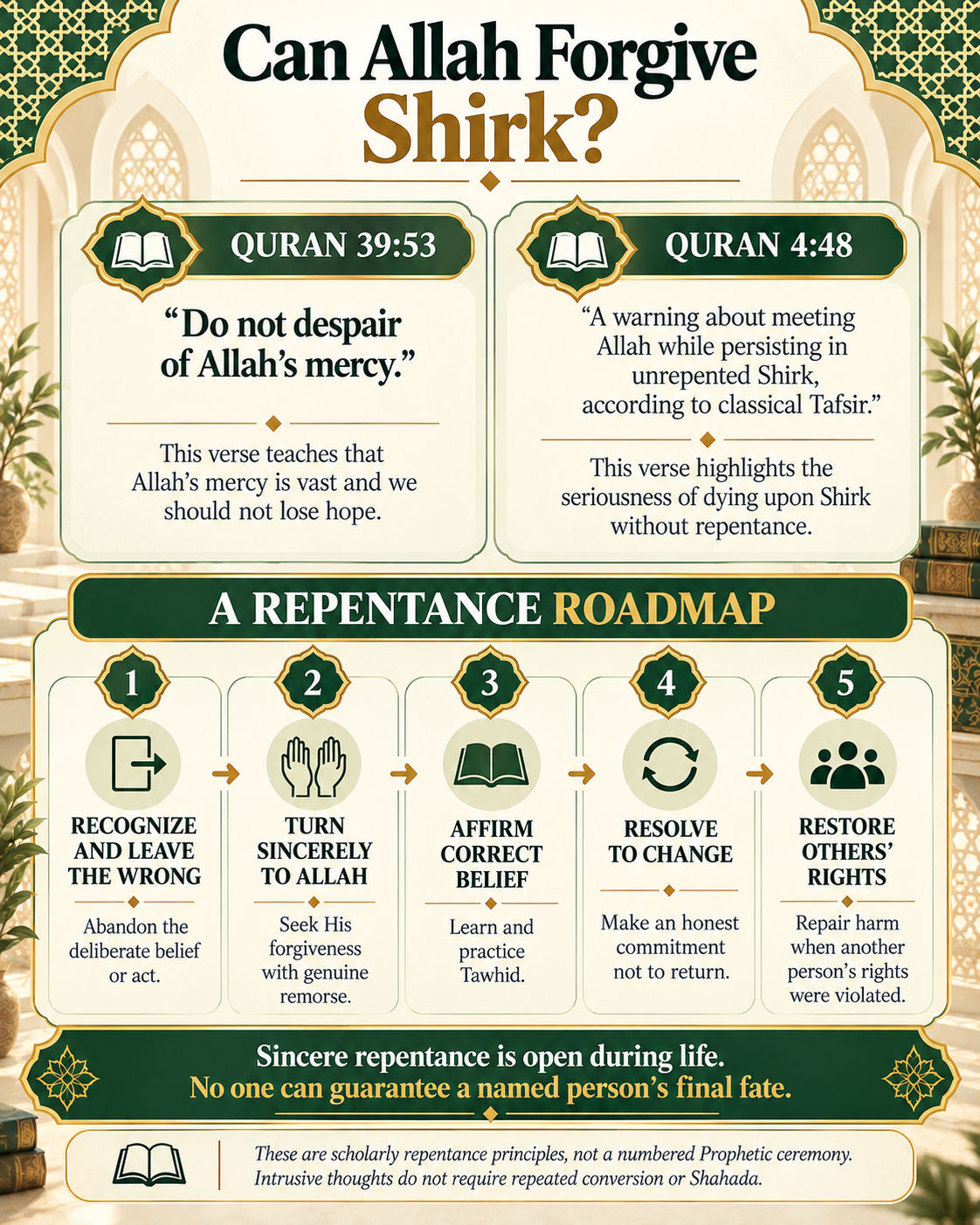
Yes: sincere repentance while a person is alive can be accepted. Allah says, قُلْ يَا عِبَادِيَ الَّذِينَ أَسْرَفُوا … لَا تَقْنَطُوا مِنْ رَحْمَةِ اللَّهِ: “Say: O My servants who have transgressed against themselves, do not despair of the mercy of Allah. Indeed, Allah forgives all sins” (39:53). Ibn Kathir and other commentators explain this as an invitation to those who repent. Quran 25:68–71 describes people who do not invoke another god with Allah and then, if they fall into grave sins but repent, believe, and do righteous deeds, Allah replaces their evil deeds with good. A Hadith in Sahih Muslim likewise teaches that Islam erases what came before it.
Quran 4:48 and 4:116 say that Allah does not forgive that partners be associated with Him, while forgiving lesser sins for whom He wills. In classical Tafsir, such as al-Tabari and Ibn Kathir, this concerns meeting Allah while persisting in unrepented Shirk. It does not deny forgiveness to someone who turns back to Allah during life, and the repetition in 4:116 is not a second rule contradicting the invitation to repent. Nor does Shirk turn every other sin into an unforgivable one; the Quran speaks of different sins, repentance, and Divine judgment without a simple formula. No one can guarantee the fate of a named individual.
How to Repent from Shirk
Scholars describe sincere Tawbah (التَّوْبَة) as recognizing and abandoning the wrong belief or act, turning to Allah, feeling remorse, resolving not to return, affirming correct belief, and restoring the rights of others if they were wronged. There is no rigid ceremony or required number of repetitions, and no need to announce past acts or confess to another person, though restoring rights or correcting public harm may bring further duties.
For someone entering or returning to Islam, the Shahada has a role under qualified guidance. That differs from anxious readers who have not left Islam and need not keep repeating it. Repentance may be renewed; Allah’s mercy is vast, though no one should deliberately return to wrongdoing, and a recurring intrusive thought is not a deliberate return. The balance is hope without complacency: Shirk is grave, repentance is open, correct belief matters, and despair is unwarranted.
How to Strengthen Tawhid in Everyday Life
This is an educational list, not a Prophetic ritual.
Learn the Shahada’s meaning. لَا إِلَٰهَ إِلَّا اللَّهُ affirms that none is worthy of worship but Allah; the complete testimony also affirms Muhammad ﷺ as His Messenger.
Study Surah Al-Ikhlas with Tafsir.
Worship Allah sincerely, seeking His pleasure.
Make Dua to Allah about everything, great and small.
Maintain obligatory Salah. Maintaining [ the five daily prayers] helps Muslims express their commitment to worshipping Allah alone through a consistent act of devotion.
Learn authentic Dhikr. Learning [ how to remember Allah through daily Dhikr] can strengthen a believer’s understanding of Tawhid without creating obsessive rituals or unsupported formulas.
Avoid unsupported supernatural claims.
Ask qualified scholars about genuine theological questions.
Repent sincerely from actual wrongdoing.
Avoid obsessive self-checking.
Learning [ why Muslims say Insha'Allah, Alhamdulillah, and SubhanAllah] can also help beginners understand how everyday language reflects belief in Allah.
With children, keep it simple: we worship Allah alone; Allah created everything; we thank people while knowing Allah is the source of every blessing; we ask Allah in Dua; and we treat people of other religions kindly and respectfully, never labeling classmates as bad because of religious difference. Avoid frightening children about passing thoughts.
15 Arabic Words About Shirk and Tawhid
Arabic | Transliteration | Meaning and use |
|---|---|---|
الشِّرْك | ash-shirk | Associating partners with Allah |
التَّوْحِيد | at-tawhid | Affirming Allah’s oneness |
شَرِيك | sharik | Partner |
مُشْرِك | mushrik | One who associates partners, in theological usage |
الْعِبَادَة | al-‘ibadah | Worship |
الدُّعَاء | ad-dua | Supplication |
الإِخْلَاص | al-ikhlas | Sincerity; also the name of Surah 112 |
الرِّيَاء | ar-riya’ | Showing off in worship |
الشَّفَاعَة | ash-shafa‘ah | Intercession |
التَّوَسُّل | at-tawassul | Seeking a means of nearness, in theological context |
الاسْتِغَاثَة | al-istighathah | Seeking aid or relief |
الْكُفْر | al-kufr | Disbelief, in relevant context |
التَّوْبَة | at-tawbah | Repentance |
الْوَسْوَاس | al-waswas | Whispering, intrusive doubts |
الشَّهَادَة | ash-shahadah | Testimony of faith |
Not every technical term here appears verbatim in the Quran; some belong to later scholarly vocabulary.
Common Misconceptions About Shirk
Myth | Reality |
|---|---|
Shirk only means worshipping statues. | Its scope is associating partners with Allah in divinity or worship. |
Every sin is Shirk. | Islam distinguishes many kinds of wrongdoing. |
Tawhid only means believing Allah exists. | It also concerns His unique status and exclusive worship. |
Allah never forgives anyone who committed Shirk. | Repentance in life differs from dying upon unrepented Shirk. |
Major and minor Shirk have identical consequences. | Scholars distinguish them. |
Hidden Shirk is always a separate third category. | The term may describe how Shirk appears subtly. |
Every public charitable act is Riya’. | Visibility does not establish hidden intention. |
Feeling happy after praise invalidates a good deed. | Intention and circumstances require nuance. |
Asking a doctor for help is Shirk. | Ordinary permissible assistance is not worship. |
Using medicine contradicts Tawhid. | Lawful means are compatible with faith. |
Muslims worship the Kaaba. | They worship Allah while facing a prescribed direction. |
Respecting the Prophet ﷺ means worshipping him. | Honoring a Prophet differs from worshipping him. |
Every grave visit is Shirk. | Visiting and worshipping the dead are distinct questions. |
Every form of Tawassul is unanimously major Shirk. | Different forms have received different rulings. |
Every amulet has one agreed ruling. | Recognized disagreement exists, especially on Quranic amulets. |
Astronomy and astrology are the same. | Science differs from fortune-telling claims. |
Any accidental phrase removes a Muslim from Islam. | Intention, knowledge, and meaning matter. |
Unwanted blasphemous thoughts are deliberate Shirk. | Authentic Hadith distinguishes them from chosen acts or beliefs. |
Ordinary Muslims should declare others disbelievers over disagreement. | Takfir requires qualified scholarly judgment. |
Constantly inspecting every thought prevents Shirk. | Obsessive checking is not sound religious education. |
Frequently Asked Questions
1. What is Shirk in Islam? Associating partners with Allah in His divinity or worship. It is the opposite of Tawhid.
2. What does Shirk mean in Arabic? From the root sh-r-k (sharing or partnership); theologically, giving anyone a share in what belongs to Allah alone.
3. What is the difference between Shirk and Tawhid? Tawhid affirms that Allah alone is God and deserves worship; Shirk associates others with Him in that status.
4. Why is Shirk considered such a serious sin? Worshipping Allah alone is the foundation of Islam, and the Quran calls Shirk “a tremendous wrong” (31:13).
5. What are the two main types of Shirk? Major Shirk, which contradicts the foundation of Tawhid, and minor Shirk, such as certain forms of showing off.
6. What is major Shirk? Directing divinity or acts of worship to anyone besides Allah. Describing an act is different from ruling on a person.
7. What is minor Shirk? Acts or motivations the sources call Shirk without the status of major Shirk, such as Riya’. It is serious, though not identical in consequence.
8. What is hidden Shirk? A descriptive term for subtle forms, such as hidden showing off. Scholars do not all treat it as a separate legal category.
9. Is Riya’ considered Shirk? Many scholars call it minor Shirk. Being seen doing good is not Riya’; the concern is deliberately seeking admiration.
10. Does Allah forgive Shirk if a person repents? Yes. Sincere repentance during life can be accepted (39:53); 4:48 concerns dying upon unrepented Shirk.
11. What does Quran 4:48 mean? Allah does not forgive being met while associating partners with Him unrepented, but forgives lesser sins for whom He wills.
12. Is every sin a form of Shirk? No. Serious sins like lying or oppression are grave but are classified differently.
13. Is asking people for help considered Shirk? Not ordinary help within human ability, such as from a doctor or teacher. Worshipful supplication belongs to Allah alone.
14. Is respecting the Prophet Muhammad ﷺ Shirk? No. Muslims honor and follow him while worshipping Allah alone; he described himself as His servant.
15. Do Muslims worship the Kaaba? No. It is the direction of prayer; worship is directed to Allah alone.
16. Is visiting graves Shirk? No; visiting graves is encouraged as a reminder of the Hereafter. Worshipping the dead is different, and some practices are scholarly disputes.
17. Are amulets or lucky charms considered Shirk? Believing an object independently protects or harms is a serious concern. Scholars differ on Quranic amulets; seek qualified guidance.
18. Is believing in astrology Shirk? Claiming stars control destiny or reveal hidden matters conflicts with Tawhid. Scientific astronomy does not.
19. Are unwanted blasphemous thoughts Shirk? No. Distressing thoughts that a person dislikes and does not adopt are not chosen belief; seek qualified religious and mental-health support if they persist.
20. How can Muslims strengthen Tawhid and avoid Shirk? Learn the Quran and Tafsir, pray sincerely, make Dua, practice authentic Dhikr, and ask qualified teachers.
Conclusion — Understanding Shirk Begins with Understanding Tawhid
We began by asking how to tell Shirk from respect, practical help, and unwanted thoughts. The purpose of studying Shirk is to understand the exclusive worship of Allah, not to fear every ordinary decision, and not to judge other people’s faith carelessly. A grounded view includes knowledge of the Quran, sincere worship, distinguishing human help from Divine power, avoiding unsupported superstition, recognizing legitimate scholarly differences, repenting sincerely, and refusing to confuse intrusive thoughts with chosen disbelief. Understanding Shirk should lead Muslims toward clearer knowledge of Tawhid, greater sincerity in worship, and a deeper awareness of Allah’s mercy—not toward careless accusations, superstition, or endless fear.
If you would like to study the Quran, Quranic Arabic, and Islamic beliefs with qualified teachers, Araby Academy welcomes you to learn at your own pace.