Do Muslims Believe in Jesus?
It is one of the questions Muslims hear most often, at school, at work, from neighbors and from friends: "Do Muslims believe in Jesus?"
The answer is yes, but probably not in the way the questioner expects.
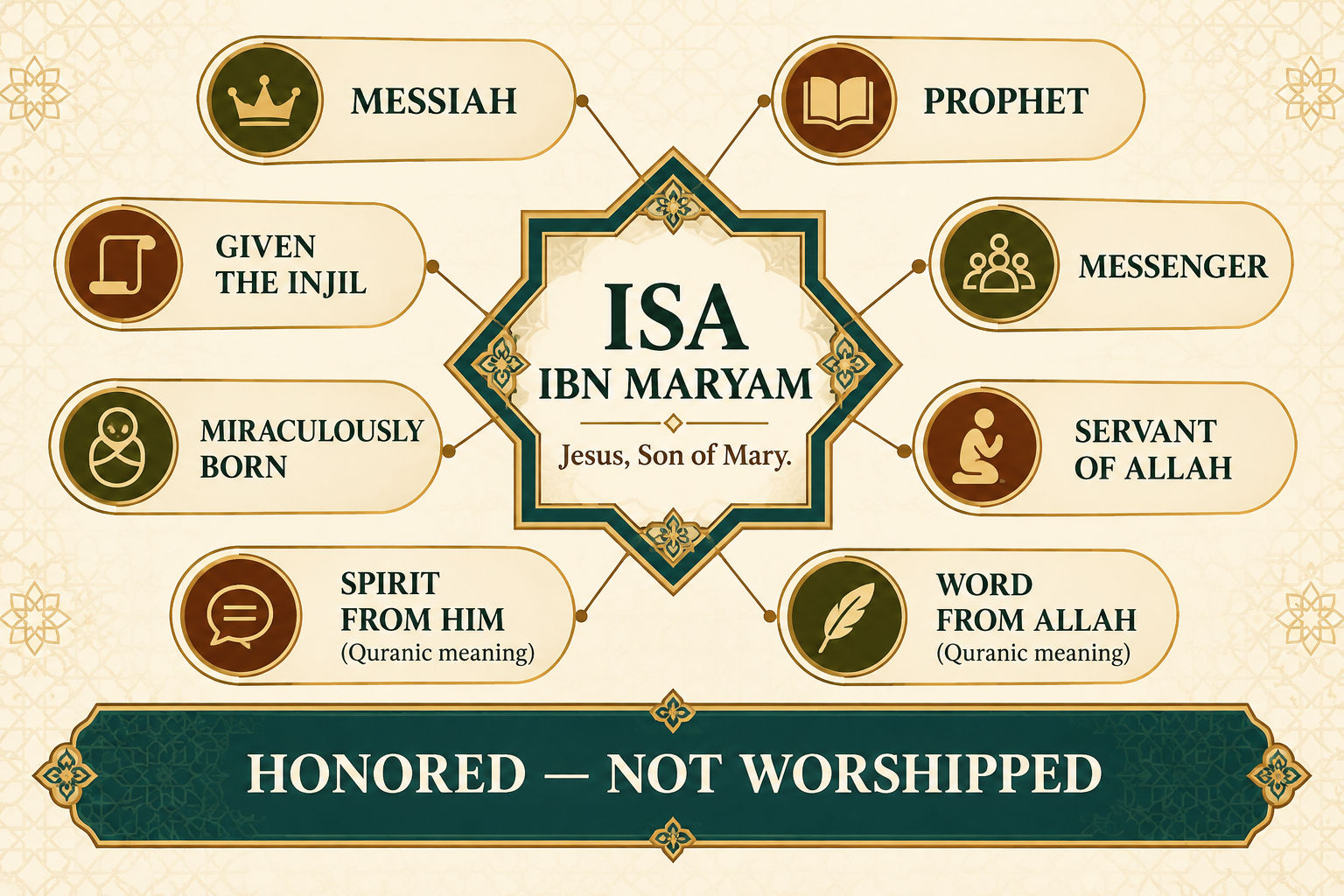
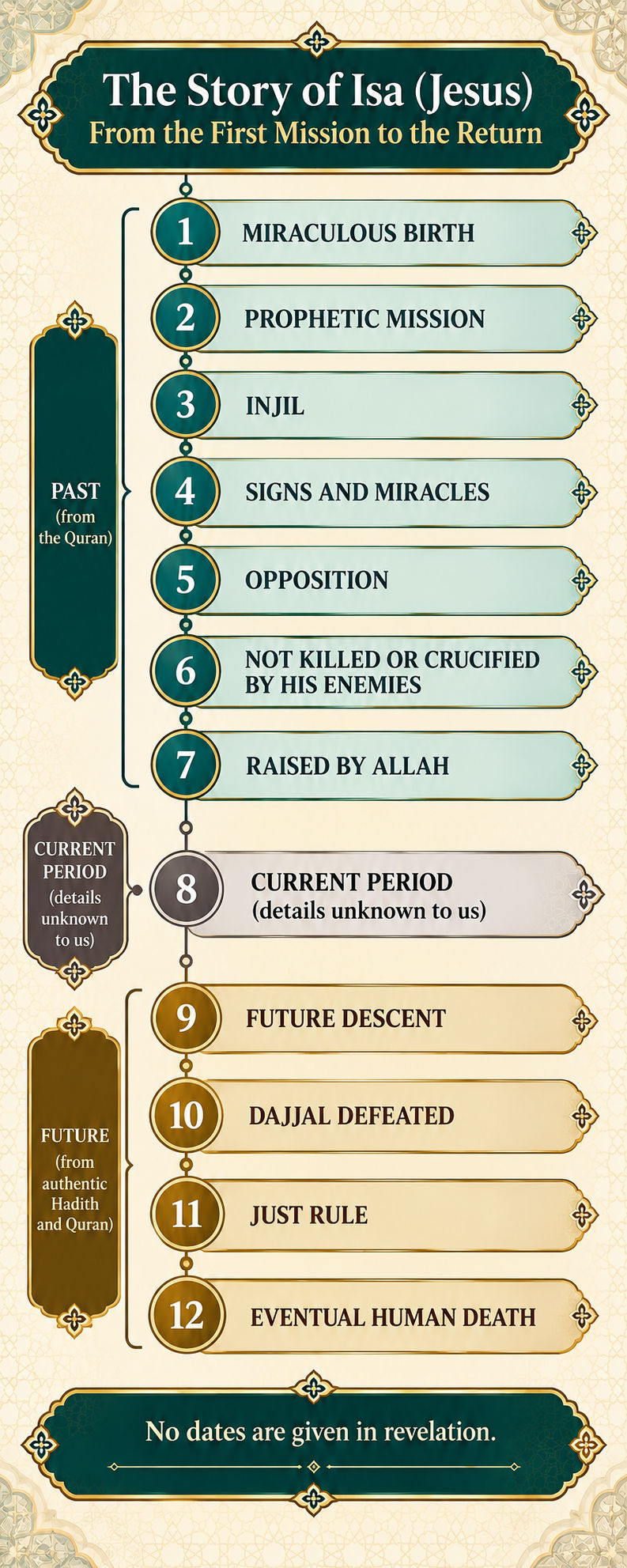
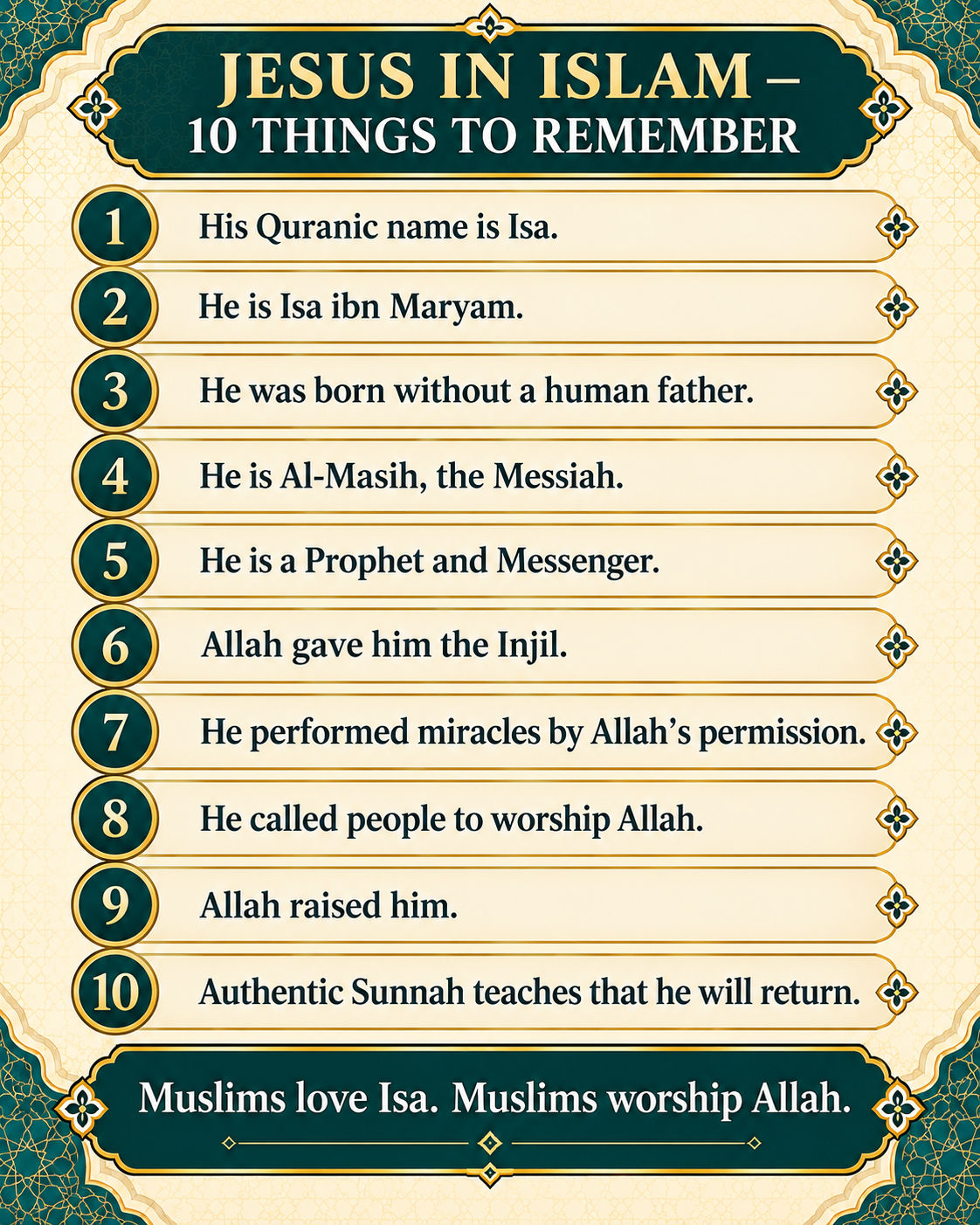
A Muslim cannot simply dismiss Jesus. The Quran speaks about him again and again. It calls him Isa (عِيسَى), Isa ibn Maryam (Jesus, son of Mary), Al-Masih (the Messiah), a Prophet, a Messenger, and "a word from Him." Muslims believe in his miraculous birth, his Prophethood, his miracles, the revelation given to him, his mission to the Children of Israel, his being raised by Allah, and, based on authentic Hadith, his future return.
What Muslims do not do is worship him or call him God or the Son of God.
Many readers are surprised to learn that Islam's disagreement with Christianity about Jesus does not begin by rejecting him. It begins by defining him differently.
So who exactly is Isa ibn Maryam according to Islam? This guide answers that question using the Quran first, then authentic Sunnah, then recognized Tafsir (Quranic commentary), and it will tell you plainly where something is certain, where scholars interpret, and where revelation is simply silent.
The short version: Muslims do not reject Jesus. Belief in Isa ibn Maryam as a genuine Prophet and Messenger of Allah is part of Islamic faith. Islam honors Jesus without worshipping him.
A note on method
This article follows three rules:
Explain Isa through Islamic revelation first, not through ideas imported from Christian theology, popular storytelling or later speculation.
When the Quran or authentic Sunnah gives certainty, say so clearly. When scholars interpret, explain the interpretation.
When revelation is silent, do not fill the silence with a story.
In Hadith, we will name the collection and narrator. In Arabic, we will explain the term. Hadith numbering differs slightly between editions, so references below point to the collection and the well-known number, and readers should confirm them in their own edition.
Isa Within the Family of Prophets
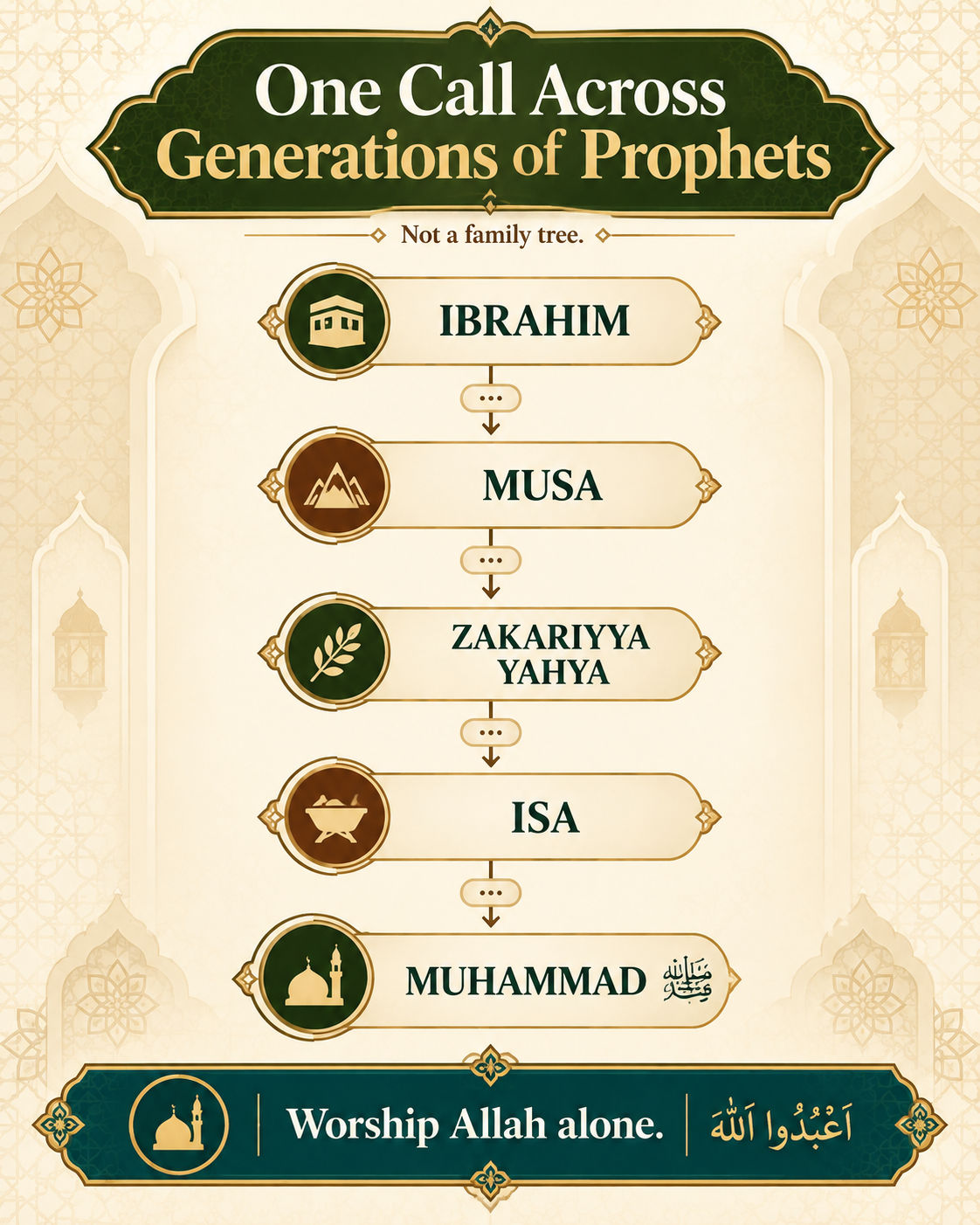
Islam does not present Isa as an isolated founder of a new religion. He belongs to the chain of Prophets that includes Adam, Nuh (Noah), Ibrahim (Abraham), Isma'il, Ishaq, Ya'qub, Yusuf, Musa (Moses), Harun, Dawud, Sulayman, Zakariyya, Yahya, and finally Muhammad ﷺ.
The Quran instructs believers to say:
"We believe in Allah and what has been revealed to us, and what was revealed to Ibrahim, Isma'il, Ishaq, Ya'qub and the tribes, and what was given to Musa and Isa and the Prophets from their Lord. We make no distinction between any of them." (Quran 2:136)
The Prophet Muhammad ﷺ made the same point in a famous Hadith: "I am the closest of people to Isa, son of Maryam, in this world and the next... Prophets are brothers from different mothers; their religion is one." (Sahih al-Bukhari 3443; Sahih Muslim 2365, narrated by Abu Hurayrah). In the same narration he adds that there is no Prophet between himself and Isa.
Can a Muslim reject Isa?
No, not while holding to the Quranic creed. The Quran presents belief in all of Allah's Messengers as part of faith (2:285), and Isa is named among them. Rejecting a Prophet whom the Quran clearly names means rejecting part of what the Quran teaches. This is a statement about doctrine, not about judging individuals. This article is concerned only with what the creed teaches.
The Prophet ﷺ also said that whoever testifies that Isa is the servant of Allah and His Messenger, His word that He cast to Maryam and a spirit from Him, will be admitted to Paradise (Sahih al-Bukhari 3435; Sahih Muslim 28, narrated by 'Ubadah ibn al-Samit). We will return to each of those phrases below.
Isa or Jesus? Understanding the Name
Isa (عِيسَى) is the name the Quran uses. In full, the Quran often says Isa ibn Maryam (عِيسَى ابْنُ مَرْيَمَ), "Isa, son of Maryam." Muslims understand this to be the same historical and religious figure whom Christians call Jesus. Arabic-speaking Christians, for their part, use a different form (Yasu') in their own tradition.
People have proposed various linguistic theories about how "Isa" relates to Hebrew or Aramaic forms of the name. These are scholarly proposals, not matters of belief, and the Quran itself does not explain them. This guide will not build any theology on them.
Why "son of Maryam"?
The Quran uses "son of Maryam" for Isa roughly twenty-three times. Scholars and commentators point to several fitting dimensions, while noting that the Quran does not list reasons itself:
It identifies him through his mother, which is unusual in Arabic naming and draws attention.
It honors Maryam, the only woman named in the Quran.
It reflects the fact that he was born without a human father.
It keeps his humanity in view: he is a human being born of a woman, not a deity.
That last point is an observation made in the context of verses such as 5:75, not a claim the Quran states in so many words.
A Miraculous Birth
Maryam in brief
Maryam, daughter of 'Imran, is described in the Quran as chosen, purified, devout and chaste, and as a siddiqah (صِدِّيقَة), a person of deep truthfulness and sincere faith (5:75). She is the mother of Isa. The full story of her family, her upbringing, her labor and her role as a model for believers has its own article: Maryam in the Quran: What Muslims Believe About Mary and Jesus. Here we need only the essentials.
Do Muslims believe in the virgin birth?
Yes. Islam explicitly teaches that Maryam conceived Isa without a human father.
In Surah Al 'Imran, angels give Maryam news of "a word from Him, whose name is the Messiah, Isa, son of Maryam, distinguished in this world and the Hereafter, and among those brought near" (3:45). Maryam asks the natural question:
"My Lord, how can I have a child when no man has touched me?" He said, "Such is Allah; He creates what He wills. When He decrees a matter, He only says to it, 'Be,' and it is." (Quran 3:47)
Surah Maryam tells the same story, adding that Maryam had withdrawn from her family and that Allah sent to her "Our Spirit," who appeared as a well-formed man (19:16–22). Islamic tradition identifies this "Spirit" in that verse as the angel Jibreel (Gabriel). Maryam's response is chastity and fear of Allah, and the answer is Allah's power, not any human cause.
Why was Isa born without a father?
The Quran gives a direct argument:
إِنَّ مَثَلَ عِيسَىٰ عِندَ اللَّهِ كَمَثَلِ آدَمَ ۖ خَلَقَهُ مِن تُرَابٍ ثُمَّ قَالَ لَهُ كُن فَيَكُونُ
"Indeed, the likeness of Isa in Allah's sight is like that of Adam. He created him from dust, then said to him, 'Be,' and he was." (Quran 3:59)
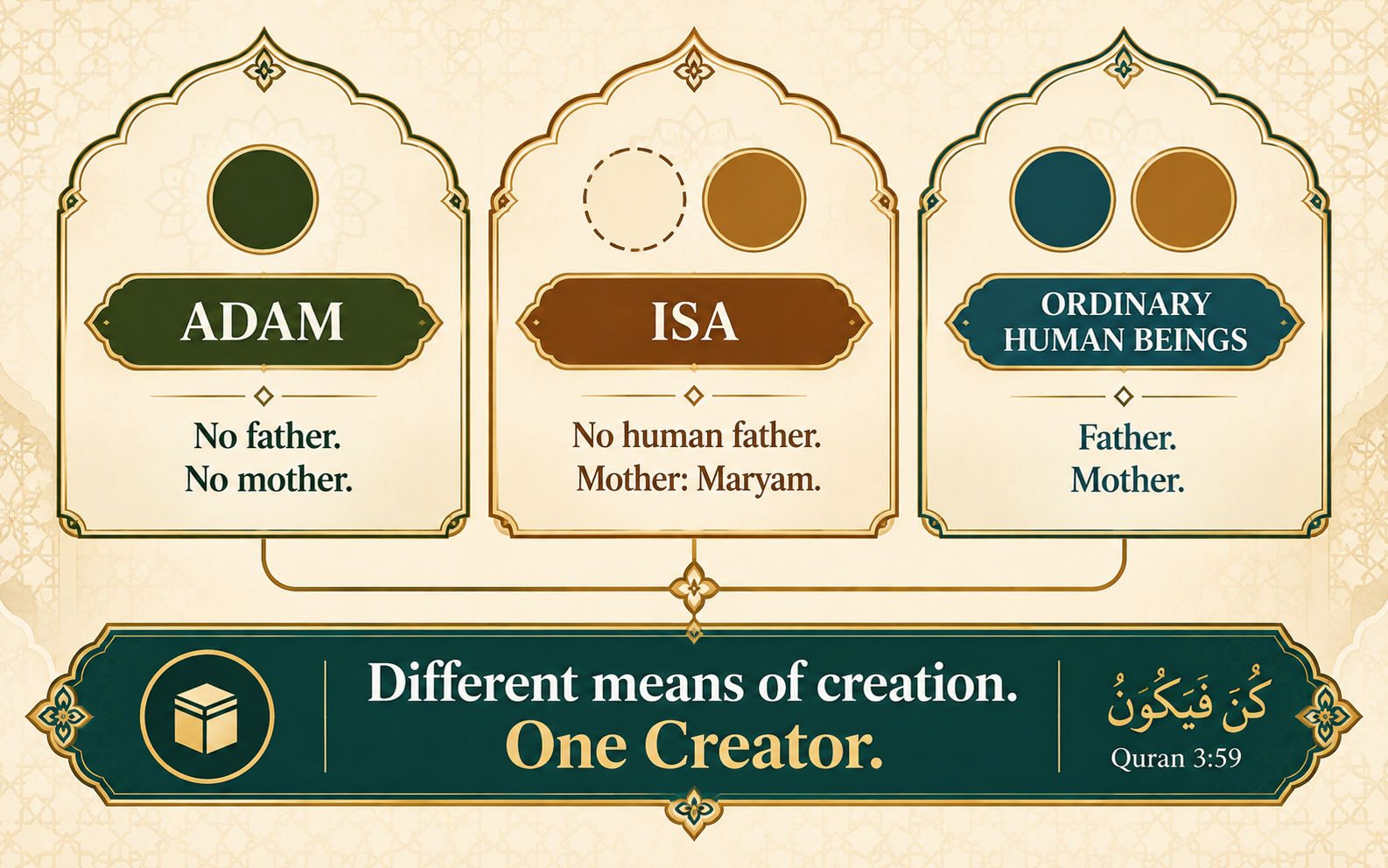
The argument is simple:
Adam had no father and no mother.
Isa had a mother but no human father.
Ordinary human beings have a mother and a father.
All three come from one Creator. If an unusual beginning proved divinity, Adam would have a stronger claim than Isa. The Quran concludes the opposite: unusual creation does not equal divinity. It shows Allah's power.
This is also why Surah Al-Anbiya and Surah Al-Mu'minun describe Maryam and her son together as "a sign" (21:91; 23:50): their story points beyond itself to the One who creates as He wills.
"Be, and it is": kun fa-yakun
The phrase كُن فَيَكُونُ (kun fa-yakun) appears in 3:47 and 3:59 above, and in 19:35. It describes Allah's sovereign creative command, the way His will brings a thing into being. It is not a magic formula, not a spell and not words that humans can use to produce results. It tells us that Allah creates without needing ordinary means, though He usually creates through them.
What Isa's Titles Mean
The Quran gives Isa a rich set of descriptions. Each needs to be understood the way the Quran and its classical commentators understand it. We begin where the Quran begins: with servanthood.
Servant of Allah: 'Abd Allah
The first words the Quran gives to the infant Isa, when Maryam's people accuse her, are not a claim of greatness. They are a statement of servanthood:
قَالَ إِنِّي عَبْدُ اللَّهِ آتَانِيَ الْكِتَابَ وَجَعَلَنِي نَبِيًّا
"He said, 'Indeed, I am the servant of Allah. He has given me the Scripture and made me a prophet.'" (Quran 19:30)
Notice the order. Before he mentions Prophethood or scripture, Isa identifies himself as 'abd Allah, a servant of Allah. In Islam, servanthood is not an insult. It is the highest honor a human being can have. The Prophet Muhammad ﷺ himself said, "Do not exaggerate in praising me as the Christians exaggerated about the son of Maryam. I am only a servant, so say: the servant of Allah and His Messenger" (Sahih al-Bukhari 3445, narrated by 'Umar).
In the following verses Isa says Allah made him blessed wherever he is, commanded him to pray and give zakah as long as he lives, made him dutiful to his mother, and says, "Peace be upon me the day I was born, the day I die, and the day I am raised alive" (19:31–33).
Prophet and Messenger: Nabi and Rasul
A Nabi (نَبِي) is a Prophet: a human being who receives revelation from Allah. A Rasul (رَسُول) is a Messenger, someone sent with a mission to a people. Every Messenger is a Prophet, and scholars have discussed the finer distinctions; for beginners it is enough to know that Isa is described as both. Quran 19:30 calls him nabi. Quran 4:171 and 5:75 call him rasul, and 3:49 says he was "a Messenger to the Children of Israel."
Al-Masih: the Messiah
The Quran calls Isa Al-Masih (الْمَسِيح), "the Messiah," in 3:45, 4:157, 4:171–172, 5:17, 5:72, 5:75 and elsewhere. So yes: Islam affirms that Jesus is the Messiah.
Two cautions help here. First, the Quranic meaning of "Messiah" should not automatically be loaded with every theological meaning developed in later Christian doctrine; Islam understands it as a title of honor for a human Messenger. Second, the title is certain, but the exact explanation of the word is not.
Classical scholars and lexicographers offered several explanations connected to the Arabic root m-s-ḥ (مسح), which carries ideas of wiping, touching, traveling and anointing. Some said he was called Masih because he wiped the afflicted and they were healed. Others said it is because he was blessed or purified, or because he traveled widely, or that the word reflects the older Semitic idea of an "anointed" one. Ibn Hajar noted in his commentary on Sahih al-Bukhari that scholars proposed a very large number of explanations. None of this is needed to understand the title's Quranic standing. Note also that the Dajjal is called al-Masih al-Dajjal, "the false messiah," a different figure we will meet later. The Arabic root is shared, but the figures are opposites.
A Word from Allah: Kalimah minhu
This title needs special precision. Quran 3:45 speaks of "a word from Him" (بِكَلِمَةٍ مِّنْهُ) and Quran 4:171 says the Messiah is "His word which He directed to Maryam" (وَكَلِمَتُهُ أَلْقَاهَا إِلَىٰ مَرْيَمَ).
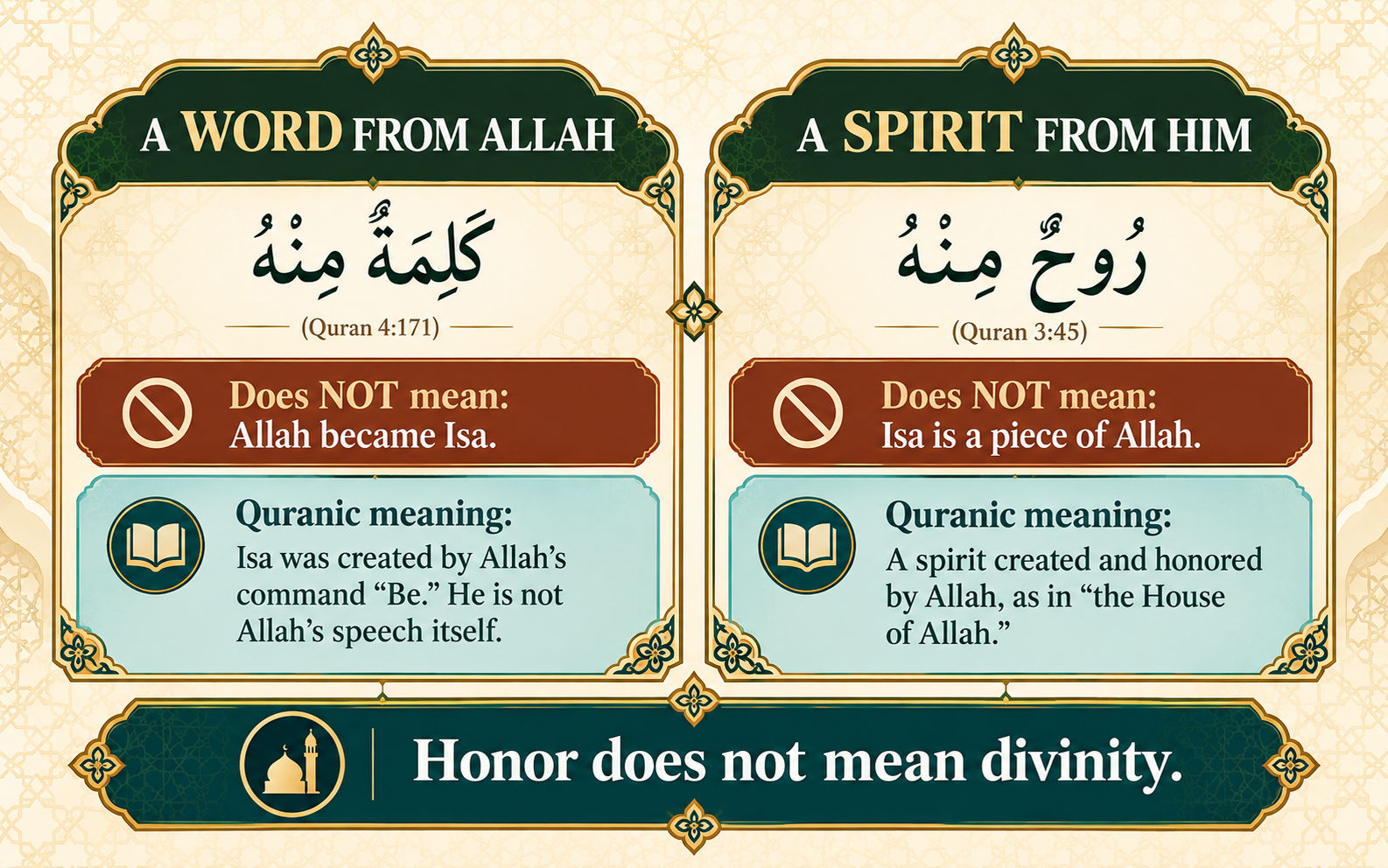
In mainstream Islamic Tafsir, this does not mean that Isa is Allah's eternal essence, that Allah became human, that Isa is a person within God, or that Isa is the same as Allah's attribute of speech.
Classical commentators, such as al-Tabari and Ibn Kathir, explain it in several connected ways:
Isa came into being through Allah's creative command, "Be" (kun), without a human father. He is called "a word from Him" because he was created by that word.
In 3:45, the same word (kalimah) is also linked to the good news the angels announced: he is the one promised in Allah's word.
Some commentators explain that he is called Allah's "word" as a form of honor and distinction, which is how the Arabic language often uses attribution.
There is a theological point here worth stating clearly. Sunni Aqidah teaches that Allah's speech is an uncreated attribute, while Isa is a created human being. Isa was created by Allah's word; he is not that word itself. Imam Ahmad ibn Hanbal made exactly this distinction when he answered those who used 4:171 to argue that the Quran is created: Isa was created by the word "Be," he is not the word itself. So "a word from Him" honors Isa, and does not blur the line between Creator and creation.
A Spirit from Him: Ruh minhu
Quran 4:171 also says the Messiah is "a spirit from Him" (وَرُوحٌ مِّنْهُ).
Does "from Him" mean "a part of Him"? No. Islam does not teach that Allah can be divided into pieces. Classical commentators explain the phrase as attribution for honor. Arabic often attributes things to Allah to express closeness, dignity and ownership: Bayt Allah, "the House of Allah" (the Ka'bah, which is a stone building He created), and Naqat Allah, "the she-camel of Allah" (Quran 7:73), which was a created animal. In the same way, Isa is a spirit created by Allah and honored by Him. The Quran also says that Allah breathed into Maryam "from Our spirit" (21:91; 66:12) in the context of this creation, and other verses use the same preposition for everything in creation. Quran 45:13 says that Allah made everything in the heavens and earth subservient to you "all from Him" (minhu). If min always meant "a part of," then everything in the universe would be part of Allah, which no one claims. Context decides what "from Him" means; English prepositions cannot decide it.
Some early commentators also explained "spirit" as meaning that Isa was a life-giving, mercy-bearing presence, because of the life he gave through Allah's permission. Whatever explanation one prefers, all mainstream explanations remain within one limit: Isa is a created servant of Allah.
Isa's Quranic titles at a glance
Arabic | Transliteration | Plain English | Quran | What it means | What it does not mean |
|---|---|---|---|---|---|
عِيسَى | Isa | Jesus | 2:87, 3:45 and others | The Quranic name | — |
عِيسَى ابْنُ مَرْيَمَ | Isa ibn Maryam | Jesus, son of Mary | 3:45, 4:157, 5:46 and others | Identified through his mother | A claim of a human father |
الْمَسِيح | Al-Masih | The Messiah | 3:45, 4:171, 5:75 | Honored title of a Messenger | Divinity |
رَسُول | Rasul | Messenger | 3:49, 4:171, 5:75 | Sent with a message from Allah | An independent authority |
نَبِي | Nabi | Prophet | 19:30 | Receives revelation from Allah | — |
عَبْدُ اللَّه | 'Abd Allah | Servant of Allah | 19:30 | Highest honor of a human being | Any lesser rank |
كَلِمَةٌ مِنْهُ | Kalimah minhu | A word from Him | 3:45, 4:171 | Created by Allah's command "Be" | Incarnation, or Allah's speech itself |
رُوحٌ مِنْهُ | Ruh minhu | A spirit from Him | 4:171 | A spirit created and honored by Allah | A piece or part of Allah |
وَجِيهًا | Wajihan | Distinguished | 3:45 | Held in honor with Allah | — |
مِنَ الْمُقَرَّبِينَ | Min al-muqarrabin | Among those brought near | 3:45 | Close to Allah | — |
مِنَ الصَّالِحِينَ | Min al-salihin | Among the righteous | 3:46 | A righteous person | — |
Why Muslims Do Not Call Isa God
The Quran's Isa is extraordinary from the beginning. His birth breaks the ordinary pattern of human reproduction, but the Quran immediately prevents the reader from confusing extraordinary creation with divinity.
The Quran makes its case through Isa's own life, not through slogans. Taken together, the verses show a figure who:
calls himself Allah's servant (19:30);
is a Messenger like others before him (5:75);
tells people to worship Allah, his Lord and theirs (3:51; 5:72; 19:36);
was created by Allah (3:59);
performed miracles "by Allah's permission" (3:49; 5:110);
and will deny, before Allah, that he ever told anyone to worship him (5:116–117).
"They both used to eat food"
مَّا الْمَسِيحُ ابْنُ مَرْيَمَ إِلَّا رَسُولٌ قَدْ خَلَتْ مِن قَبْلِهِ الرُّسُلُ وَأُمُّهُ صِدِّيقَةٌ ۖ كَانَا يَأْكُلَانِ الطَّعَامَ
"The Messiah, son of Maryam, was only a Messenger; Messengers had passed before him. And his mother was a truthful woman. They both used to eat food." (Quran 5:75)
This short sentence carries a lot. Eating reflects human need, created embodiment and dependence. A being who must eat to live is not the self-sufficient Lord of the universe. The Quran does not go further than this, and neither should we.
Is Jesus the Son of God in Islam?
No. The Quran says: "It is not for Allah to take a son; exalted is He. When He decrees a matter, He only says to it, 'Be,' and it is" (19:35). Surah al-Ikhlas states the core of Islamic Tawhid (belief in the oneness of Allah) in four short verses, including: "He neither begets nor is born, and there is none comparable to Him" (لَمْ يَلِدْ وَلَمْ يُولَدْ, 112:3–4). Quran 4:171 adds, "Do not say 'three.' Desist; it is better for you. Allah is only one God. Exalted is He above having a son."
Describing Christian belief accurately
It is important to describe the opposing belief accurately before explaining the Islamic disagreement. Mainstream Christianity, in its historic creeds, teaches that God is one God in three persons, and that the Son is eternally begotten of the Father, not produced by any physical act. It does not teach that God had physical relations with Mary, and Muslims should never describe it that way. Islam's objection is not to a caricature but to the idea of divine sonship itself, however it is understood: Allah has no offspring, no partner and no equal. That is a real and respectful disagreement, and it can be stated without insulting anyone's beliefs.
A word about Quran 5:116. It records Allah asking Isa, "Did you say to the people, 'Take me and my mother as deities besides Allah'?" Some readers hear this as a definition of the Christian Trinity. It is not one. Mainstream Nicene Christianity does not define the Trinity as Father, Son and Mary. The verse addresses a particular act of worship and deification that involved both Isa and Maryam, and it should be read on its own terms, not as a summary of formal Christian doctrine.
Isa's Message: Worship Allah
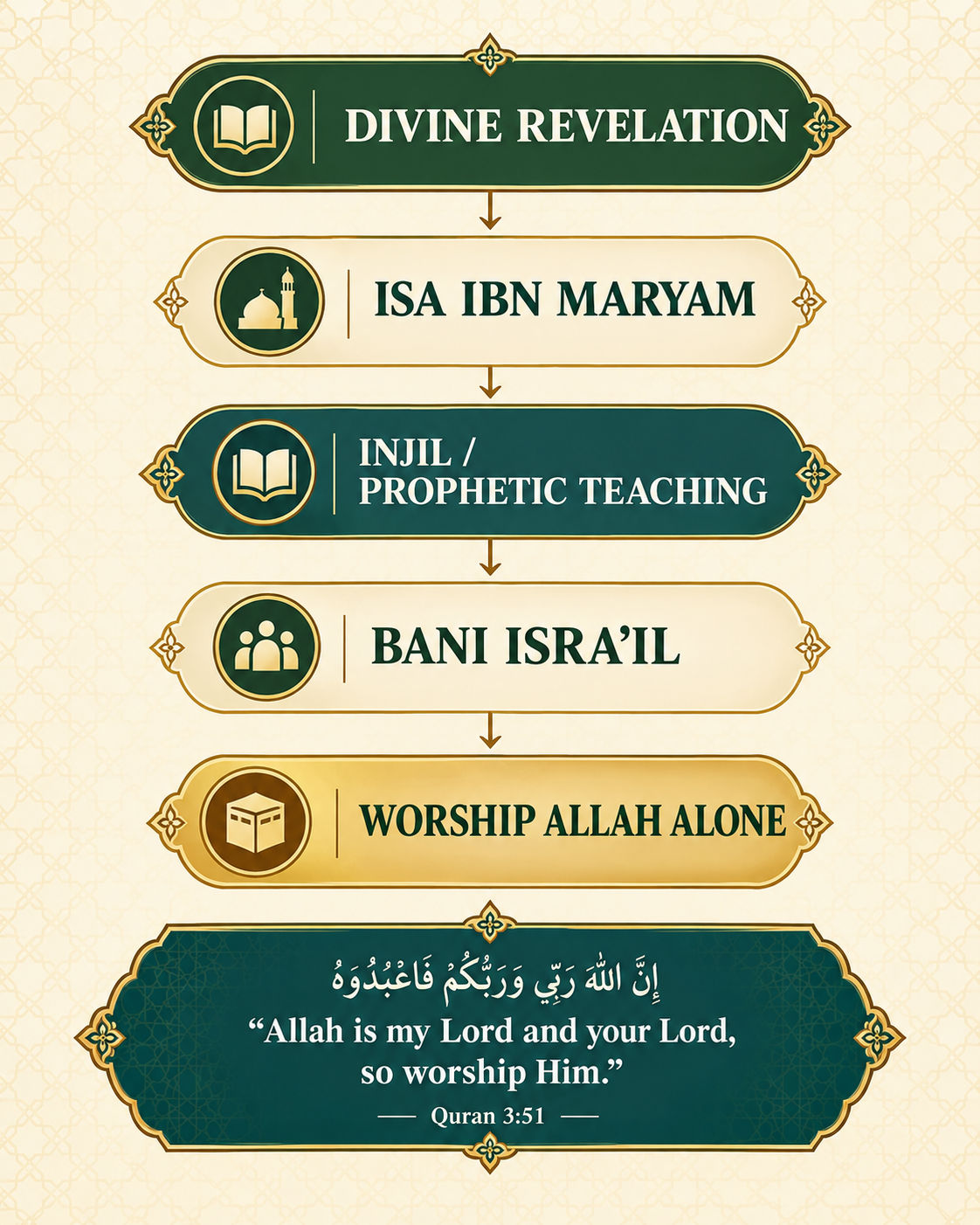
What did Isa actually preach, according to the Quran? One sentence appears again and again:
إِنَّ اللَّهَ رَبِّي وَرَبُّكُمْ فَاعْبُدُوهُ ۗ هَٰذَا صِرَاطٌ مُّسْتَقِيمٌ
"Indeed, Allah is my Lord and your Lord, so worship Him. This is a straight path." (Quran 3:51; compare 5:72 and 19:36)
This is the center of Isa's Quranic message. His words contain no claim to be worshipped, only a call to worship the One who is Lord of both Isa and his listeners.
Did Isa preach "Islam"?
The Arabic word islam means submission to Allah. In that broad sense, all Prophets called people to Islam, meaning submission to the One God. When the disciples say, "Bear witness that we are Muslims" (3:52), they are using the word in that sense. But that does not mean Isa taught every detailed legal ruling of Prophet Muhammad's ﷺ later Shari'ah. Islamic scholarship distinguishes between the Din, the universal faith of Tawhid and submission shared by all Prophets, and the Shari'ah, the specific laws that differ from one Prophet to another (see 5:48). Isa called to the first and, as we will see, brought certain specific rulings of his own.
Isa and the Children of Israel
The Quran says that Isa was sent specifically as "a Messenger to the Children of Israel" (بَنِي إِسْرَائِيلَ, Bani Isra'il, 3:49; 61:6). These are the descendants of the Prophet Ya'qub (Israel), among whom many earlier Prophets, including Musa, had come. Isa's mission was addressed to them, in the land and time where he lived. That is a statement of his specific mission, nothing more.
Isa and the Torah
Isa describes himself as "confirming what came before me of the Torah" (al-Tawrah) and says that he came to make lawful some of what had been forbidden to them (3:50; compare 61:6). So there is both continuity (he confirms the Torah) and specific legal difference (some earlier restrictions were lifted). The Quran does not list which restrictions, and we should not add details it does not give.
What is the Injil?
The Injil (الْإِنجِيل) is the revelation that Allah gave to Isa. The Quran says: "We sent Isa, son of Maryam, following in their footsteps, confirming the Torah before him, and We gave him the Injil, in which was guidance and light" (5:46). For Muslims, belief in the Injil as genuine revelation is part of faith.
Is the Injil the same as the New Testament? The answer needs care, and neither "yes" nor "the Bible today is fake" is accurate. In Islamic terminology, the Injil is the revelation that Allah gave to Isa. The Christian New Testament is a collection of writings that were composed and transmitted by the early Christian community, including four Gospel accounts about Jesus's life written by others, letters, and other works. So "the Injil" in the Quranic sense is not simply a synonym for the entire modern New Testament. Muslim scholars have discussed in detail how much of the original revelation might be preserved within the Christian scriptures, and their views vary. This article does not need to settle that debate.
Did Isa write the Injil? The Quran says Allah "gave" him the Injil. It does not say that Isa sat down and authored a physical book. "Given the Injil" should be understood as revelation, without importing a modern model of book production.
The Hawariyyun
The Hawariyyun (الْحَوَارِيُّونَ) are commonly translated as "the disciples" or "the apostles." When Isa sensed disbelief among his people, he asked, "Who will be my supporters for Allah?" and they answered: "We are supporters for Allah. We believe in Allah, and bear witness that we are Muslims" (3:52). Later, Surah al-Saff says that a group of the Children of Israel believed and a group disbelieved, and that Allah supported the believers against their enemy (61:14).
The Quran does not list their names or number. Lists of twelve names come from Christian tradition, and if you meet them, treat them as Christian historical tradition, not as Quranic information.
Isa's Miracles: By Allah's Permission
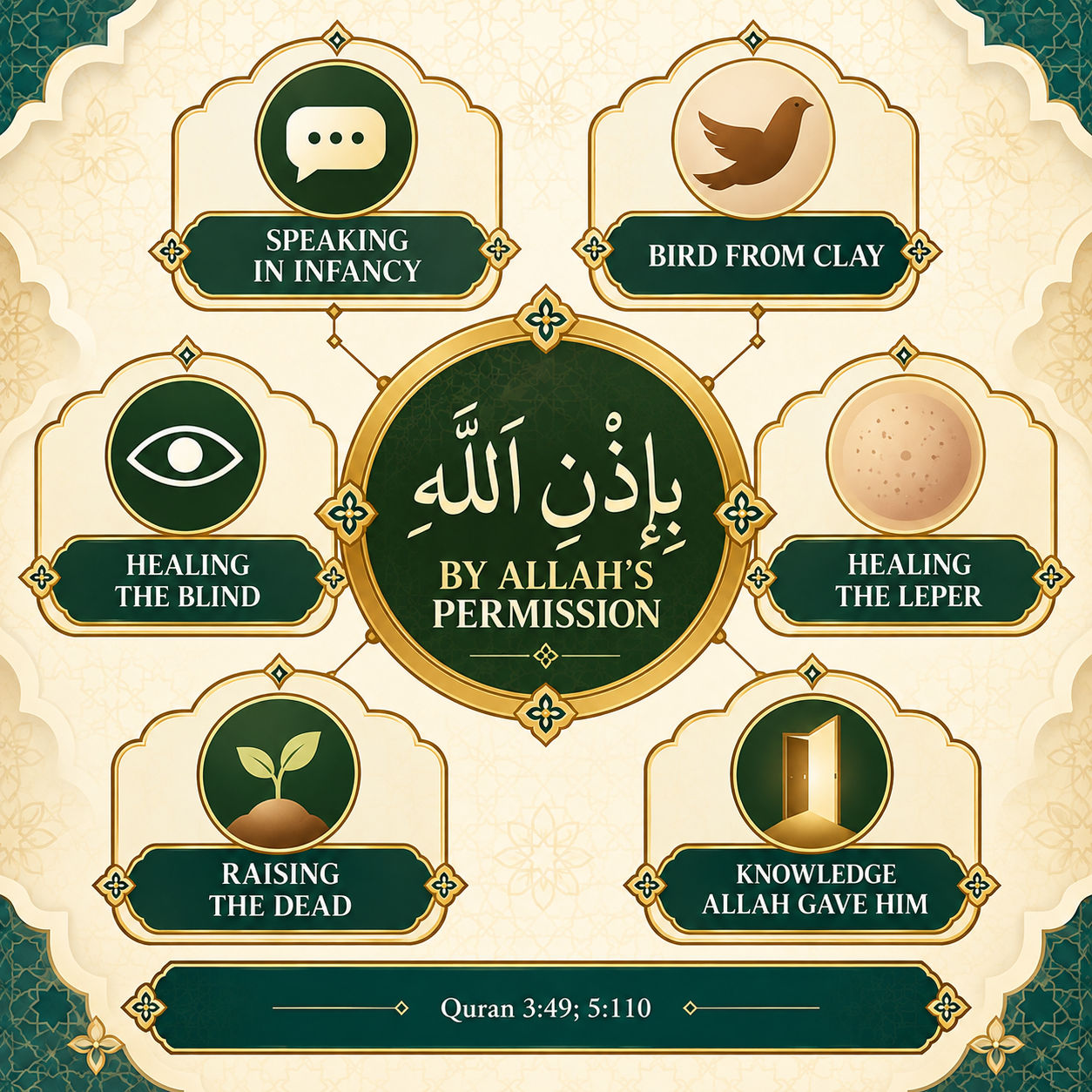
The Quran attributes remarkable signs to Isa. But it repeats a phrase that determines how Muslims understand every one of them: "by Allah's permission" (بِإِذْنِ اللَّهِ, bi-idhn Allah).
In Quran 3:49 Isa tells the Children of Israel: "I have come to you with a sign from your Lord: I fashion for you from clay the likeness of a bird, then I breathe into it and it becomes a bird by Allah's permission. And I heal the blind and the leper, and I bring the dead to life by Allah's permission. And I inform you of what you eat and what you store in your houses. Indeed in that is a sign for you, if you are believers."
Quran 5:110 recounts Allah reminding Isa of His favors, including that he spoke to people in the cradle and in maturity, that Allah taught him the Book, wisdom, the Torah and the Injil, and the same signs by Allah's permission, and that Allah restrained the Children of Israel from harming him when he brought clear proofs.
The miracles the Quran names:
Speaking in the cradle (3:46; 5:110; 19:29–33).
Forming a bird-likeness from clay, breathing into it, and it becoming a bird (3:49; 5:110).
Healing the blind (al-akmah) and the leper (al-abras) (3:49; 5:110).
Giving life to the dead (3:49; 5:110).
Informing people of what they ate and stored in their homes (3:49).
Being supported with "the Holy Spirit" (2:87, 2:253; 5:110), which commentators generally identify as Jibreel.
The descent of the table (5:112–115), discussed below.
Did Isa create a bird?
The Quran says Isa forms "the likeness of a bird" from clay, breathes into it, and it becomes a bird, and in the same breath the verse says bi-idhn Allah, by Allah's permission. That qualifying phrase must never be dropped. The miracle does not show that Isa shares Allah's independent creative power. It shows that Allah can grant a Prophet a sign, and that the power remains Allah's.
Healing and raising the dead
Al-akmah (الْأَكْمَه) is explained by classical lexicographers and commentators such as Ibn 'Abbas and Mujahid as someone born blind. Al-abras (الْأَبْرَص) refers to a chronic skin condition marked by white patches, commonly rendered "leper"; sources vary on the exact condition. We should not make modern medical claims beyond the text or diagnose any individual.
On raising the dead, the Quran says he did so "by Allah's permission," and that is all the Quran says. Some Tafsir books contain stories naming particular individuals he raised. Those reports come from sources of uneven reliability, are often influenced by Isra'iliyyat (narrations from earlier traditions), and should not be treated as established history.
Did Isa know the unseen?
Quran 3:49 says he informed people of what they ate and stored at home. That does not mean he possessed unlimited knowledge of the unseen. Islam teaches that Prophets may be informed by Allah of particular unseen matters, while independent, comprehensive knowledge of the unseen belongs to Allah alone. As Allah says, "He is the Knower of the unseen, and He does not disclose His unseen to anyone, except a messenger He has approved" (72:26–27). We will see Isa himself affirm his own limits in Quran 5:116.
The table spread
Surah al-Ma'idah ("The Table Spread") recounts that the Hawariyyun asked whether his Lord could send down a table from heaven. Isa told them to fear Allah, then made a dua (supplication), asking that it be "a festival for us" and "a sign from You." Allah answered that He would send it down, with a warning for anyone who disbelieved afterward (5:112–115).
Most classical commentators, including al-Tabari and Ibn Kathir, held that the table was indeed sent, based on Allah's words "I will send it down to you" (5:115). Some early authorities are reported to have said otherwise, so it is fair to say there was a difference of opinion, with the majority view being that it was sent. The Quran does not describe what was on the table; reports about its contents (such as bread and fish) vary and are not established. Nor does the Quran link this event with the Christian "Last Supper," and we should not assume the two are the same.
Why the miracles matter
A miracle is an ayah (آية), a "sign." A sign points beyond itself. Isa's miracles are meant to direct people toward Allah's power, not toward worship of Isa. The Quran says so in the very verse that lists them: "Indeed in that is a sign for you."
Isa and the Glad Tidings of Ahmad
The Quran says that Isa gave good news of a Messenger to come after him:
وَإِذْ قَالَ عِيسَى ابْنُ مَرْيَمَ يَا بَنِي إِسْرَائِيلَ إِنِّي رَسُولُ اللَّهِ إِلَيْكُم مُصَدِّقًا لِمَا بَيْنَ يَدَيَّ مِنَ التَّوْرَاةِ وَمُبَشِّرًا بِرَسُولٍ يَأْتِي مِن بَعْدِي اسْمُهُ أَحْمَدُ
"And when Isa, son of Maryam, said, 'O Children of Israel, I am the Messenger of Allah to you, confirming what came before me of the Torah and giving good news of a Messenger to come after me, whose name is Ahmad.'" (Quran 61:6)
Ahmad (أَحْمَد) is a name of the Prophet Muhammad ﷺ. He said, "I have several names: I am Muhammad, I am Ahmad, I am al-Mahi... al-Hashir... and al-'Aqib" (Sahih al-Bukhari 3532; Sahih Muslim 2354, narrated by Jubayr ibn Mut'im). The word is related to praise: Muhammad is "the praised one," Ahmad "the most praising" or "most praised."
This article deliberately does not make a comparative-textual claim, for example that a specific Greek word in the Gospel of John unquestionably means "Ahmad." Viral claims along those lines, such as identifying the "Paraclete" with Muhammad, are debated by scholars and need serious linguistic and historical analysis that is beyond a beginner's guide. For Muslims, the Quranic statement in 61:6 is sufficient for Islamic belief, and Islamic revelation does not depend on proving it from other texts.
What Happened to Isa? The Crucifixion Question
The most debated part of Isa's story comes near its apparent end. Here, evidence discipline becomes especially important. The Quran tells us several things with certainty, and leaves other questions unanswered.
Not everyone accepted Isa's message. The Quran says that some of the Children of Israel believed and some disbelieved (61:14), and that Allah restrained those who wished to harm him (5:110). The Quran speaks about specific groups in a specific time and place. It does not assign guilt to a whole people, and this article does not either.
 عليه السلام" />
What the Quran says
وَمَا قَتَلُوهُ وَمَا صَلَبُوهُ وَلَٰكِن شُبِّهَ لَهُمْ ۚ وَإِنَّ الَّذِينَ اخْتَلَفُوا فِيهِ لَفِي شَكٍّ مِّنْهُ
"They did not kill him, nor did they crucify him, but it was made to appear so to them [shubbiha lahum]. And indeed, those who differ over it are in doubt about it. They have no knowledge of it except the following of assumption, and they did not kill him, for certain. Rather, Allah raised him to Himself, and Allah is Exalted in Might and Wise." (Quran 4:157–158)
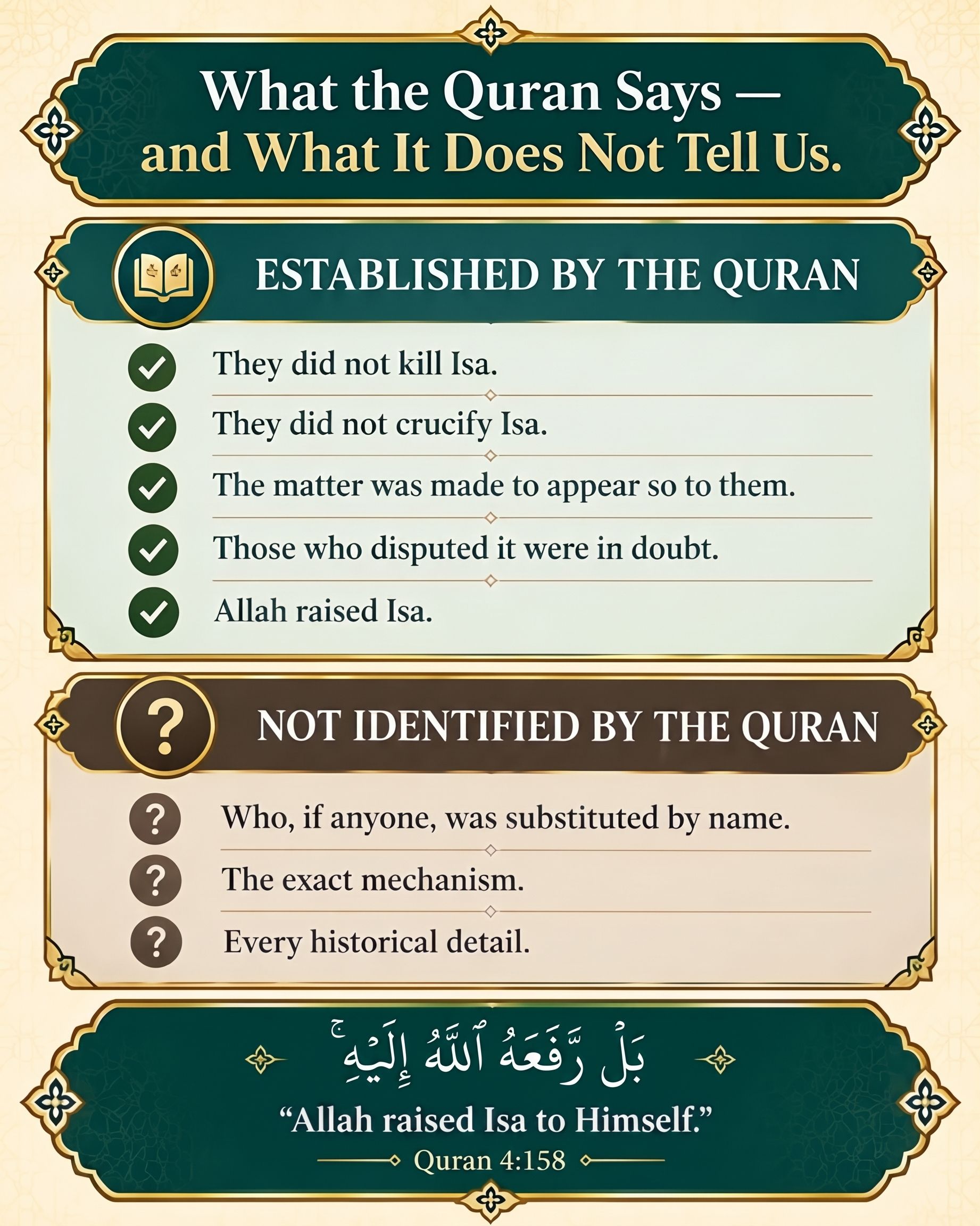
The verse is answering a claim: "We killed the Messiah, Isa, son of Maryam, the Messenger of Allah." Here is what the Quran establishes:
Certain: his opponents did not kill him, and did not crucify him.
Certain: the matter was made to appear or became unclear to them (shubbiha lahum).
Certain: those who disputed it were in doubt and lacked certain knowledge.
Certain: Allah raised him to Himself (بَل رَّفَعَهُ اللَّهُ إِلَيْهِ).
What does shubbiha lahum mean?
Shubbiha is a passive verb built on the root meaning "to be similar, to be made to resemble, to be made confusing." The verse does not say who or what the grammatical subject is. Classical scholars discuss two broad readings: that someone was made to resemble Isa, or that the matter was made unclear to them ("it appeared so to them").
It is therefore inaccurate to reduce the verse to "Allah magically changed another man's face to look like Jesus." That is one later interpretive framework within Tafsir, not the Quranic wording itself.
Who was crucified instead?
Classical Tafsir contains reports that someone else was made to resemble Isa, but the reports differ about who this was. Some describe a volunteer from among his followers, others a man who betrayed him or who entered to seize him. One report going back to the Companion Ibn 'Abbas, which Ibn Kathir considers to have a sound chain to Ibn 'Abbas, describes a volunteer among the disciples. But it is a Companion's report, and reports of this kind are often discussed in connection with earlier traditions. It is not a statement of the Prophet ﷺ.
The Quran does not name the person who was crucified. And to the best of the author's knowledge, no sound Prophetic Hadith clearly identifies a substitute by name. (Editorial note for publication: verify this second statement against a current Hadith reference before release.)
Does Islam require a specific substitution theory?
The required belief should not be made more specific than the evidence. What is required is what the verses say: Isa was not killed or crucified by his enemies, the matter was confused for them, and Allah raised him. Specific explanatory models, such as which person was made to resemble him, belong to Tafsir and are not articles of faith. It is acceptable, and intellectually honest, to say: Allah did not tell us.
This is also why the claim "every Muslim must believe Judas was transformed to look like Jesus" is wrong. That identification is not Quranic certainty.
Is Isa Alive Now? Understanding "Raised to Himself"
Quran 4:158 says Allah raised Isa to Himself (rafa'ahu Allahu ilayhi). Mainstream Sunni belief understands this to mean that Allah raised him alive, and that he remains alive in the manner Allah has decreed until his future descent. Ibn Kathir, for example, understood it as a raising in body and spirit.
The Quran and Sunnah do not tell us where he is, what he is doing, what he eats, or how time feels to him, and we should not speculate. The verse also does not give a physical location relative to Allah. Muslims affirm what is said and leave the rest to Allah.
Quran 3:55 and mutawaffika
إِذْ قَالَ اللَّهُ يَا عِيسَىٰ إِنِّي مُتَوَفِّيكَ وَرَافِعُكَ إِلَيَّ
"When Allah said, 'O Isa, I will take you [mutawaffika] and raise you to Myself...'" (Quran 3:55)
Some readers see "I will cause you to die" here. The Arabic is more nuanced. The root w-f-y means to take or receive something in full. The verb tawaffa is used in the Quran for death (as in 16:28) and also for sleep: "It is Allah who takes the souls at the time of their death, and those that do not die during their sleep" (39:42; see also 6:60). Many classical commentators, including al-Tabari and Ibn Kathir, understood 3:55 as "I will take you fully" from the earth, raising him, and pointed out that the Arabic wa ("and") does not require a time sequence. Some early authorities are reported to have understood it as a death followed by a raising. The majority reading, supported by 4:157–158 and the Hadith of his descent, is that he was taken fully and raised alive.
Quran 5:117 and tawaffaytani
In 5:117, on the Day of Judgment, Isa says: "I was a witness over them as long as I was among them; but when You took me up (tawaffaytani), You were the Observer over them." This is the same root. Scholars read it the same way, as being "taken up" and removed from among them, which is consistent with a raising and a future return. The verse does not say that he experienced death at that time.
The Return of Isa
For Islam, that is not the end of Isa's story. Authentic Hadith describe a future event unlike the return of any other earlier Prophet. When does it happen? Revelation gives no date, and no current event proves that it is near.
What the Quran says
Two Quranic passages are connected by many scholars to Isa's return, though their interpretation is debated.
Quran 4:159: "There is none from the People of the Scripture but will surely believe in him before his death." The pronoun "his" is ambiguous in Arabic: it can refer to Isa's death or to the death of the individual. Many commentators read it as referring to Isa, meaning that the People of the Scripture will believe in him before he dies after his return. Others read it differently.
Quran 43:61: "And indeed, he is a knowledge [or sign] of the Hour." Here too, commentators differ over the reference and over a variant reading ('alam, "sign"), though many connect it to Isa's descent as a sign of the Hour.
Because these are disputed readings, the strongest evidence for the descent is the Sunnah. Many scholars, such as Ibn Kathir, regarded the Hadith about it as mutawatir (reported by so many chains that error is ruled out).
The Hadith of the descent
The central narration is from Abu Hurayrah: the Prophet ﷺ said, "By Him in whose hand is my soul, the son of Maryam will soon descend among you as a just ruler (حَكَمًا عَدْلًا). He will break the cross, kill the swine, and abolish the jizyah, and wealth will overflow until no one accepts it" (Sahih al-Bukhari 3448; Sahih Muslim 155). The Prophet ﷺ also said, as narrated by Abu Hurayrah, "How will you be when the son of Maryam descends among you and your imam is from among you?" (Sahih al-Bukhari 3449; Sahih Muslim 155).
These are separate narrations and are quoted separately here. We should not merge different Hadith into one invented quotation.
Where will he descend?
In the long Hadith about the Dajjal narrated by al-Nawwas ibn Sam'an (Sahih Muslim 2937), Allah sends the Messiah, son of Maryam, and he descends "at the white minaret in the east of Damascus," wearing two garments lightly dyed, with his hands on the wings of two angels. This is what the Hadith says. Whether any modern structure is the exact minaret mentioned is a separate matter of later identification, and it should not be presented as certain.
Isa and the Dajjal
Isa is Al-Masih, the true Messiah. The Dajjal is called al-Masih al-Dajjal, "the false messiah." The titles share a word but not a meaning. The Dajjal is a major end-times deceiver, and the Prophet ﷺ said there has been no greater trial since the creation of Adam until the Hour (Sahih Muslim 2946, narrated by 'Imran ibn Husayn). This guide does not go into his details. It is enough to know that the same Hadith says Isa pursues him and kills him at the gate of Ludd (Sahih Muslim 2937). We will not speculate about modern places or events, and the Dajjal is not a topic for conspiracy.
"Break the cross, kill the swine, abolish the jizyah"
These three phrases from Sahih al-Bukhari are explained by classical commentators such as al-Nawawi and Ibn Hajar. They are not a license for any modern action.
Break the cross: it is not a story about smashing Christian property. Commentators understand it as the public exposure of the false claims made about him and the end of the beliefs the cross has come to symbolize, as truth about his identity becomes clear.
Kill the swine: commentators explain this as the lifting of what is impure and unlawful, a sign of the full establishment of the law, and it is not an attack on anyone.
Abolish the jizyah: commentators gave several explanations, including that wealth will be so abundant that no one will need or accept it, and that the circumstances of his time will be different. The Hadith is an eschatological description. It does not by itself create a modern legal or political policy.
Does Isa's return contradict Muhammad ﷺ being the final Prophet?
No. The Quran calls Muhammad ﷺ Khatam al-Nabiyyin, "the Seal of the Prophets" (33:40). Isa was already a Prophet before Muhammad ﷺ. His return is the return of a previously commissioned Prophet, not the appointment of a new one after him. Think of it this way: someone who had already been given a role returning to complete it is not the same as a new person being hired. Isa does not return with a new scripture or a new religion. Scholars such as al-Nawawi explain that, as a "just ruler," he will rule by the Shari'ah of Muhammad ﷺ.
Will Isa pray behind a Muslim imam?
In a narration in Sahih Muslim 156 from Jabir ibn 'Abd Allah, the Prophet ﷺ said that when Isa descends, the leader of the believers will say, "Come, lead us in prayer," and Isa will say, "No, some of you are leaders over others, as an honor from Allah for this Ummah." Many scholars connect "your imam from among you" with al-Mahdi. The Hadith in Bukhari and Muslim do not name him, so that identification is scholarly interpretation, not explicit Hadith text, and the Mahdi narrations vary in strength. We will not build timelines from them.
After the Dajjal, the same long Hadith (Sahih Muslim 2937) goes on to mention Ya'juj and Ma'juj. We will leave that story to a dedicated article.
Will Isa die?
The mainstream understanding is that after his return and his time on earth, Isa will die like every human being, in line with the Quranic principle "Every soul will taste death" (3:185; see also 21:34–35). Reports mention a period of forty years in connection with him (for example in Sunan Abi Dawud), but narrations on durations are not all the same and scholars discuss how they fit together; another Hadith in Sahih Muslim 2940 uses the number forty in a different context. This guide therefore gives no number of years.
Details to treat with care
Many popular lectures combine authentic and weak reports. As a reader, you should know that the following are not established by the Quran or by Sahih al-Bukhari and Sahih Muslim, and should not be repeated as certain:
That Isa was 33 when he was raised. This figure is common in Christian tradition and later Muslim literature. It is not established by the Quran or a Sahih Prophetic report.
That he will marry and have children after his return. The reports are weak or unverified.
That he will be buried beside the Prophet ﷺ in Madinah. A report to this effect is found in Jami' al-Tirmidhi (from 'Abd Allah ibn Salam), but its chain is disputed and many Hadith scholars consider it weak. It is not in Bukhari or Muslim.
The names of those he raised from the dead, the names of the twelve disciples, the contents of the table, and the name of the crucified substitute. None of these are in the Quran.
The date of his return, or any claim that current wars prove it is near. Revelation gives no date.
What will Isa look like?
Authentic Hadith do describe him, in different contexts. In the dream near the Ka'bah (Sahih al-Bukhari 3440–3441; Sahih Muslim 169) the Prophet ﷺ described a man of brown complexion with lank hair, and in the Mi'raj narrations (for example Sahih al-Bukhari 3438) a man of reddish complexion, "as if he had just come out of a bathhouse." Scholars such as Ibn Hajar discuss how these fit together, as they come from different contexts: a dream, the Night Journey, and the future descent. Classical Arabic color words do not map neatly onto English ones, so this guide will not try to draw a portrait.
On the Night Journey, the Prophet ﷺ met Isa together with Yahya in the second heaven (Sahih al-Bukhari 3207; Sahih Muslim 162, narrated by Anas ibn Malik). The Hadith calls the two sons of maternal aunts. Beyond what the text says, we do not add details about their ages or childhood.
Isa on the Day of Judgment
The Quran closes Isa's story with a scene of extraordinary humility. Allah will ask Isa, in front of everyone, whether he told people to take him and his mother as gods besides Allah. Isa replies:
"Exalted are You! It was not for me to say what I had no right to say. If I had said it, You would have known it. You know what is within myself, and I do not know what is within Yourself. Indeed it is You who is Knower of the unseen. I said to them only what You commanded me: 'Worship Allah, my Lord and your Lord.' And I was a witness over them as long as I was among them; but when You took me up, You were the Observer over them, and You are Witness over all things. If You punish them, they are Your servants; and if You forgive them, indeed it is You who is the Exalted in Might, the Wise." (Quran 5:116–118)
Three things stand out. Isa does not endorse his own worship. He describes his own knowledge as limited: prophets do not independently watch everything that happens after they leave their communities. And his closing words are submission to Allah's mercy and wisdom.
What Muslims and Christians May Recognize, and Where Islam Differs
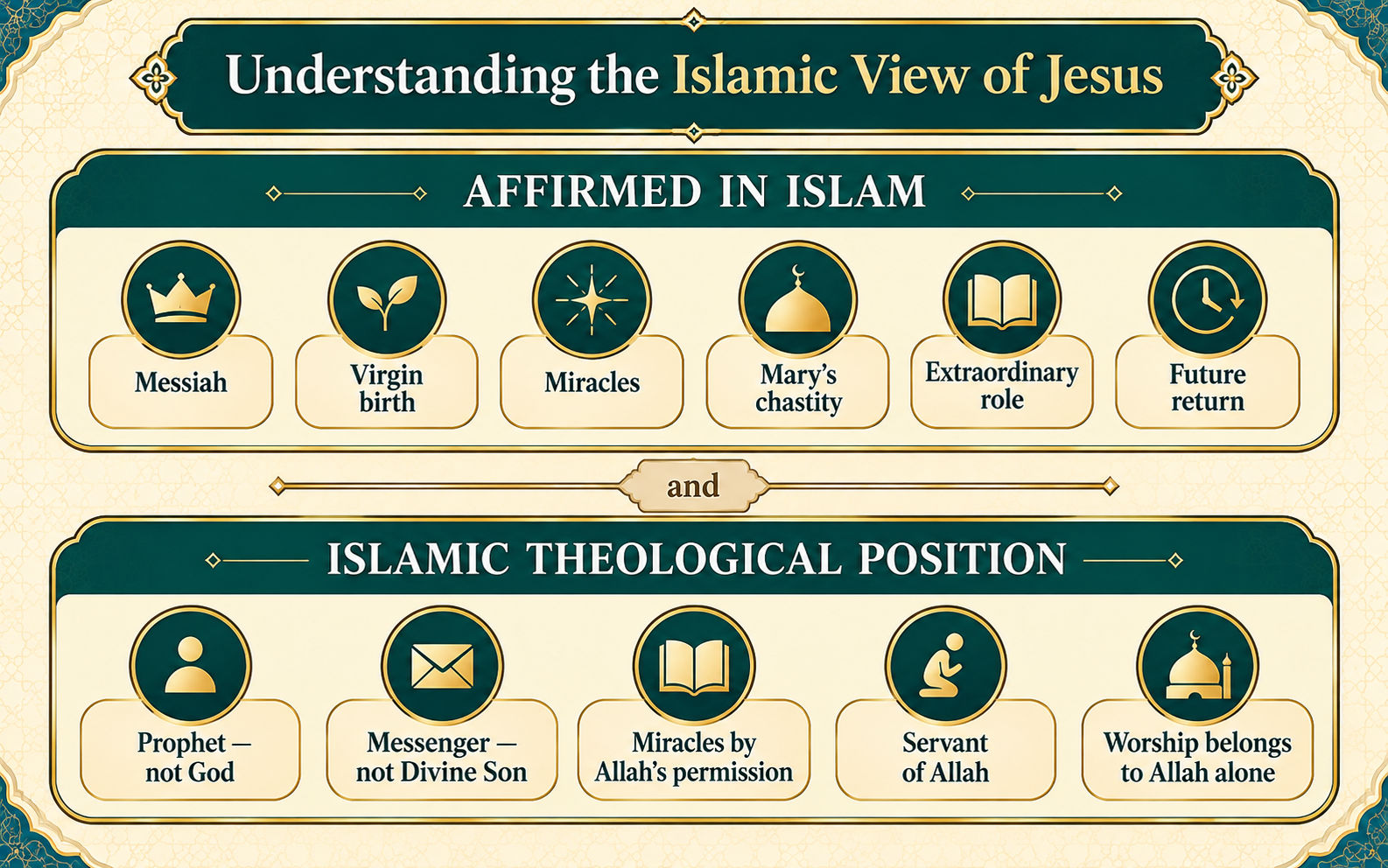
Muslims and Christians share some language about Jesus: that he was born to Mary, that the birth was miraculous, that Mary was chaste, that he is the Messiah, that he performed miracles, and that he has an extraordinary role at the end of time. But Islam and Christianity interpret several of these facts very differently, and it would be dishonest to pretend otherwise. The table below explains the Islamic position. Its purpose is to help comprehension, not to score points.
Question | Islamic belief |
|---|---|
Who is Jesus? | A Prophet, Messenger, Messiah and servant of Allah |
Mother? | Maryam |
Human father? | None |
Virgin birth? | Yes |
Divine? | No |
Son of God? | No |
Word from Allah? | Yes, in the Quranic sense of being created by Allah's command, not Divine incarnation |
Spirit from Him? | Yes, in the Quranic sense of a spirit created and honored by Allah, not a part of Allah |
Miracles? | Yes, by Allah's permission |
Scripture? | The Injil |
Mission? | Messenger to the Children of Israel calling to worship Allah |
Crucified? | The Quran denies that his enemies killed or crucified him |
Raised? | Yes, by Allah |
Return? | Yes, according to authentic Sunnah |
Worshipped? | No. Worship belongs to Allah alone |
 عليه السلام" />
Isa die for human sins?
Islam does not teach that salvation depends on Isa's sacrificial death. The Quranic framework is that no one bears another's burden ("No bearer of burdens will bear the burden of another," 6:164; 53:38), that Adam repented and Allah accepted his repentance (2:37), and that Allah forgives through repentance and mercy. Islam therefore does not teach inherited guilt from Adam. Christian traditions understand original sin in different ways, and it is not accurate to treat all denominations as identical; this article only states the Islamic position positively.
Common Misconceptions
Myth | Correction |
|---|---|
Muslims do not believe in Jesus. | Belief in Isa as a Prophet and Messenger is part of Islam. |
Muslims think Jesus was an ordinary man. | He was a Messenger, the Messiah, and miraculously born. |
Islam denies the virgin birth. | Islam explicitly affirms it (3:45–47; 19:16–22). |
Muslims do not call Jesus the Messiah. | The Quran calls him Al-Masih. |
"Word of Allah" means Islam secretly teaches Jesus is God. | The Quran means he was created by Allah's command. Isa is not Allah's speech itself. |
"Spirit from Him" means Jesus is part of God. | No. It is attribution for honor, as with "the House of Allah." |
His miracles prove independent divine power. | The Quran repeats "by Allah's permission." |
The Quran says Jesus had no miracles. | It records several. |
The Quran says Jesus was crucified and rose after three days. | It does not say this. |
Islam names the man crucified instead. | The Quran does not name him. |
Every Muslim must believe Judas was made to look like Jesus. | That is not Quranic certainty. |
Jesus is dead and irrelevant in Islam. | Mainstream Islam teaches his raising and future return. |
Jesus returns as a new Prophet after Muhammad ﷺ. | No. He is an earlier Prophet, and brings no new religion. |
Jesus will bring a new Gospel. | No new revelation or Shari'ah. |
The Quran teaches Mary is part of the Trinity. | Quran 5:116 is not a formal definition of the Nicene Trinity. |
Injil means the entire modern New Testament. | Injil is the revelation given to Isa. The New Testament is a collection of later writings. |
Muslims hate Jesus because Christians worship him. | Islam rejects his deification while commanding belief in him as a Messenger. |
Why Muslims Love Isa
Muslims love Isa because Allah chose him as a Prophet, because he is Al-Masih, because he was miraculously born, because he called people to Tawhid, because Allah gave him signs, because he was righteous, because he belongs to the family of Prophets that Muslims are commanded to believe in, and because authentic Sunnah teaches that he will return.
But love is not worship. Muslims deeply love Muhammad ﷺ, Ibrahim, Musa and Isa, yet worship belongs to Allah alone. Muslims also say عليه السلام ('alayhi al-salam, "peace be upon him") after mentioning Prophets such as Isa. It is a mark of respect and a dua for peace.
Lessons from the story of Isa
Miracles point to Allah. An ayah is a sign, and a sign points beyond itself.
Honor is not divinity. Islam gives Isa extraordinary honor, and the same principle applies to every Prophet.
The Prophets share one call: i'budu Allah, "Worship Allah."
Do not speak beyond revelation. On the crucifixion, it is acceptable to say, "Allah did not tell us."
Prophets have a protected status. In Islamic theology, Prophets are protected from major sin and from error in conveying the message ('ismah). This is not the Christian idea of a "sinless God-man"; Isa is a human servant of Allah.
For Parents, New Muslims and Friends
For children and teens. A simple formulation for parents: "Muslims love Jesus. His name in the Quran is Isa. He was born miraculously to Maryam, was a Prophet and Messiah, performed miracles by Allah's permission, called people to worship Allah, and will return before the Day of Judgment. We love him, but we worship Allah alone."
For new Muslims from a Christian background. You may feel, "Am I abandoning Jesus?" Islam does not ask you to hate Isa. It asks you to understand him differently: as the Messiah and Messenger of Allah who himself worshipped Allah.
How to answer a Christian friend.
Do Muslims believe in Jesus? "Yes. We believe Jesus, Isa ibn Maryam, is the Messiah and one of Allah's great Messengers. We believe in his virgin birth and miracles, but we do not believe he is God or the Son of God."
Do Muslims hate Jesus? "No. Belief in him is part of our religion."
Why don't Muslims worship him? "Because the Quran presents Jesus as a servant and Messenger who called people to worship Allah."
Quran Map: Major Passages About Isa
This is a map of the major passages, not an exhaustive list of every verse that mentions him.
Surah | Verses | Theme |
|---|---|---|
Al-Baqarah | 2:87, 2:136, 2:253 | Clear proofs; belief in all Prophets |
Al 'Imran | 3:42–59 | Annunciation, birth, mission, miracles, Adam comparison |
Al-Nisa | 4:156–159, 4:171–172 | Crucifixion verses; "Word" and "Spirit"; servanthood |
Al-Ma'idah | 5:17, 5:46, 5:72–75, 5:110–118 | Injil; message; miracles; table; Day of Judgment |
Al-Tawbah | 9:30–31 | Claims of divine sonship |
Maryam | 19:16–40 | Birth; cradle speech; "Allah is my Lord" |
Al-Anbiya / Al-Mu'minun | 21:91; 23:50 | Maryam and her son as a sign |
Al-Ahzab / Al-Shura | 33:7; 42:13 | Covenant with Prophets; one religion |
Al-Zukhruf | 43:57–65 | Isa as a sign; Tawhid |
Al-Hadid | 57:27 | His followers; compassion |
Al-Saff | 61:6, 61:14 | Ahmad; disciples |
To Know Isa in Islam Is to Understand Whom He Worshipped
So, do Muslims believe in Jesus? Not merely in the sense that Muslims acknowledge that Jesus existed. Islam asks Muslims to believe that Isa ibn Maryam was the Messiah, a Prophet, a Messenger, miraculously born, given revelation, supported with extraordinary signs, and raised by Allah. Authentic Sunnah also teaches that he will return.
But the Quran repeatedly directs attention through Isa to the One who sent him. His miraculous birth points to Allah's creative power. His miracles occur by Allah's permission. His revelation comes from Allah. His message calls people to Allah. And his own Quranic words identify him as عَبْدُ اللَّهِ, the servant of Allah.
Muslims do not honor Jesus by ignoring him, and they do not honor him by worshipping him. They honor Isa ibn Maryam as he is presented in revelation: the Messiah, a mighty Messenger of Allah, and a servant who called humanity to worship the One God.
Understanding Jesus in Islam therefore requires holding two truths together: Isa is extraordinary, and Isa is created. He is deeply honored, but he is not Divine. He performed astonishing miracles, but by Allah's permission. He will return, but not with a new religion. And from his miraculous birth to his future descent, the Quranic story consistently directs the reader beyond the miracle and toward its source: Allah alone.
Where to go next: read Maryam in the Quran: What Muslims Believe About Mary and Jesus*, explore* Who Are the Angels in Islam?, and If you want to read the verses about Isa in their original Arabic, Araby Academy's Quranic Arabic courses are a natural next step.