Open the Quran and count its 114 chapters. One of them carries a woman's name: مَرْيَم, Maryam. Muslims hear her story in Salah and in Quran study: her worship, her chastity, her selection, her fear, her isolation, a miraculous pregnancy, a lonely labor, her people's accusations, and the astonishing first words of her infant son.
So who is Maryam according to Islam, and what does her story teach Muslims about Isa, the man Christians know as Jesus?
Muslims do not treat Maryam as a minor figure. Nor do they worship her. They honor her because Allah honored her. The principle guiding this article is simple: let the Quran introduce Maryam before later traditions tell us who she was.
Quick Answer: Who Is Maryam in Islam?
Maryam (Mary) bint Imran is the mother of the Prophet Isa (Jesus) ibn Maryam. The Quran presents her as chosen, purified, devout, truthful and chaste, a believer whose faith is held up as an example to all believers (66:12). She conceived Isa miraculously without a human father by Allah's command. She is honored, never worshipped.
Is Mary Really Mentioned in the Quran?
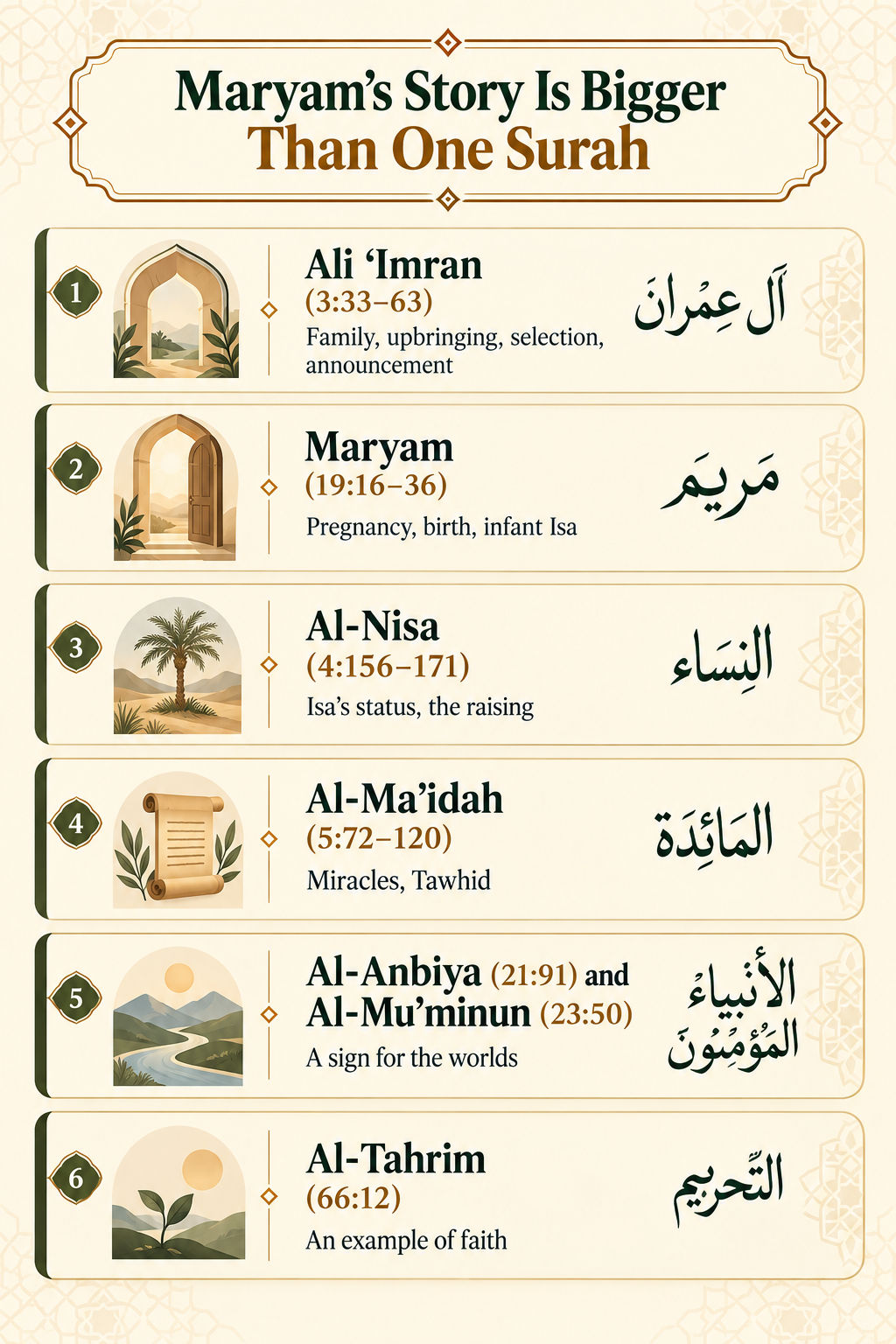
Yes. Her story is not confined to one chapter. Different passages emphasize different dimensions:
Surah Ali 'Imran (3:33–63): her family, her mother's vow, her upbringing, her selection, the announcement of Isa.
Surah Maryam (19:16–36): seclusion, the angelic messenger, pregnancy, labor, her return, and infant Isa's speech.
Surah al-Nisa (4:156–171) and al-Ma'idah (5:72–75, 5:110–120): Isa's status, his miracles by Allah's permission, and the rejection of deifying him or his mother.
Surah al-Anbiya (21:91) and al-Mu'minun (23:50): Maryam and her son as a sign for the worlds.
Surah al-Tahrim (66:12): Maryam as a model of faith and chastity.
Is she the only woman named in the Quran? Yes, Maryam is the only woman called by her personal name. Other women appear through relationships or descriptions, such as the wife of Imran, the wife of Pharaoh, or the wife of al-'Aziz. This is a fact about the Quran's wording; it is not, by itself, a ranking of all women who ever lived.
How many times is she named? She is commonly counted as named 34 times, though counts vary slightly depending on counting method, so treat the number as approximate.
Maryam Before Isa: A Story That Begins Before Her Birth
Maryam's story does not begin with a baby in her arms. It begins before her own birth, with a mother making a vow.
The Family of Imran
The Quran says Allah chose Adam, Nuh, the family of Ibrahim and the family of Imran over the worlds (3:33–34). In 66:12 she is called Maryam ibnat 'Imran, Maryam daughter of Imran. The Quran gives no detailed biography of Imran, and later genealogical material belongs to the category of tradition, not revelation.
A Mother's Vow and a Du'a
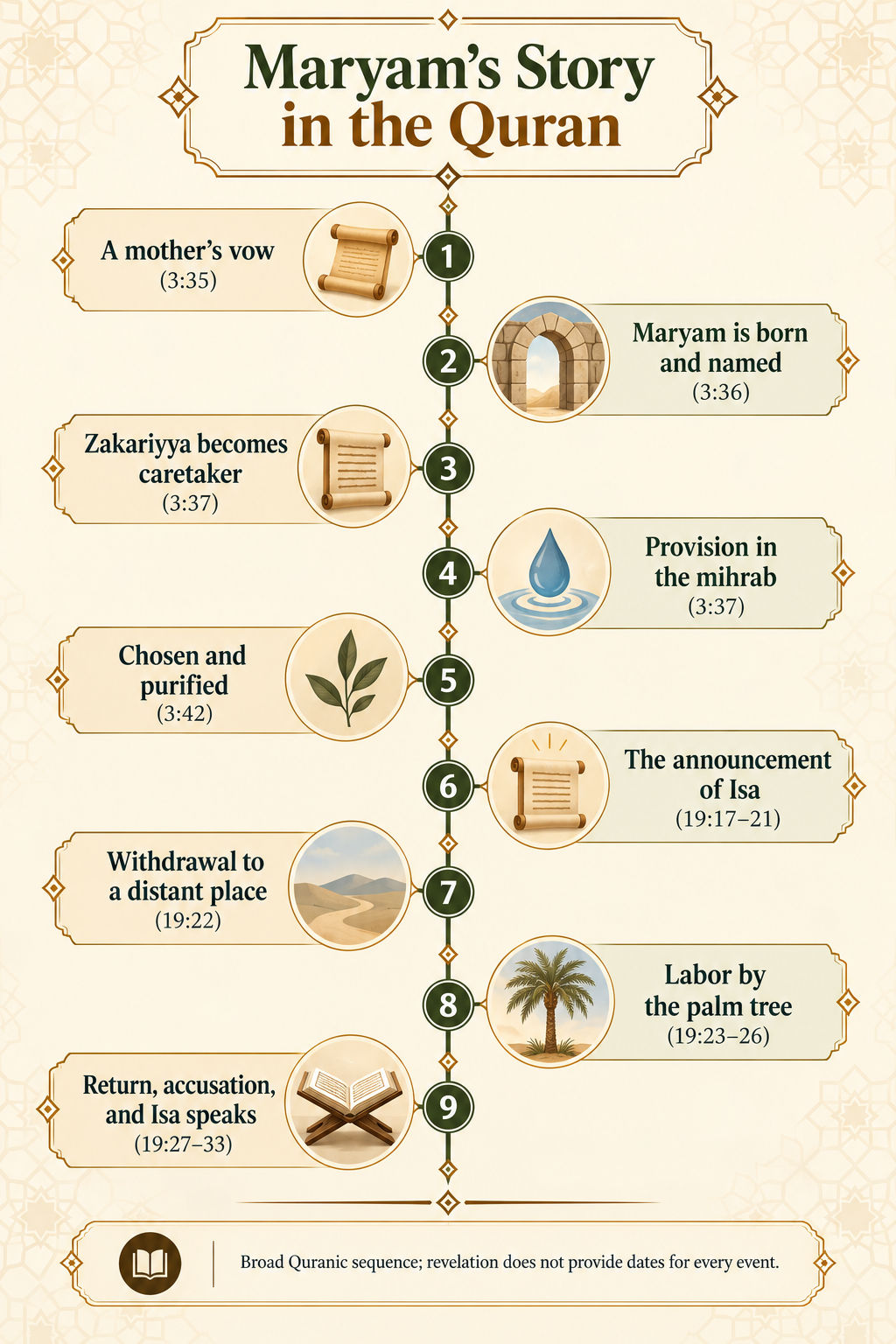
The wife of Imran said, as the Quran relates (3:35), that she dedicated what was in her womb to Allah's service, asking Him to accept it. When she gave birth, she said, "My Lord, I have given birth to a female" (رَبِّ إِنِّي وَضَعْتُهَا أُنثَىٰ), and Allah knew best what she had delivered. She named her Maryam and sought Allah's protection for her and her descendants from the accursed Shaytan (3:36).
What about "the male is not like the female"? The phrase (وَلَيْسَ الذَّكَرُ كَالْأُنثَىٰ) is understood in the narrative context: she had hoped for a son because dedication to temple service was customarily for males. The verse is about her expectation and Allah's greater knowledge, not a general statement ranking men over women. Allah's gift, a daughter, turned out to be extraordinary.
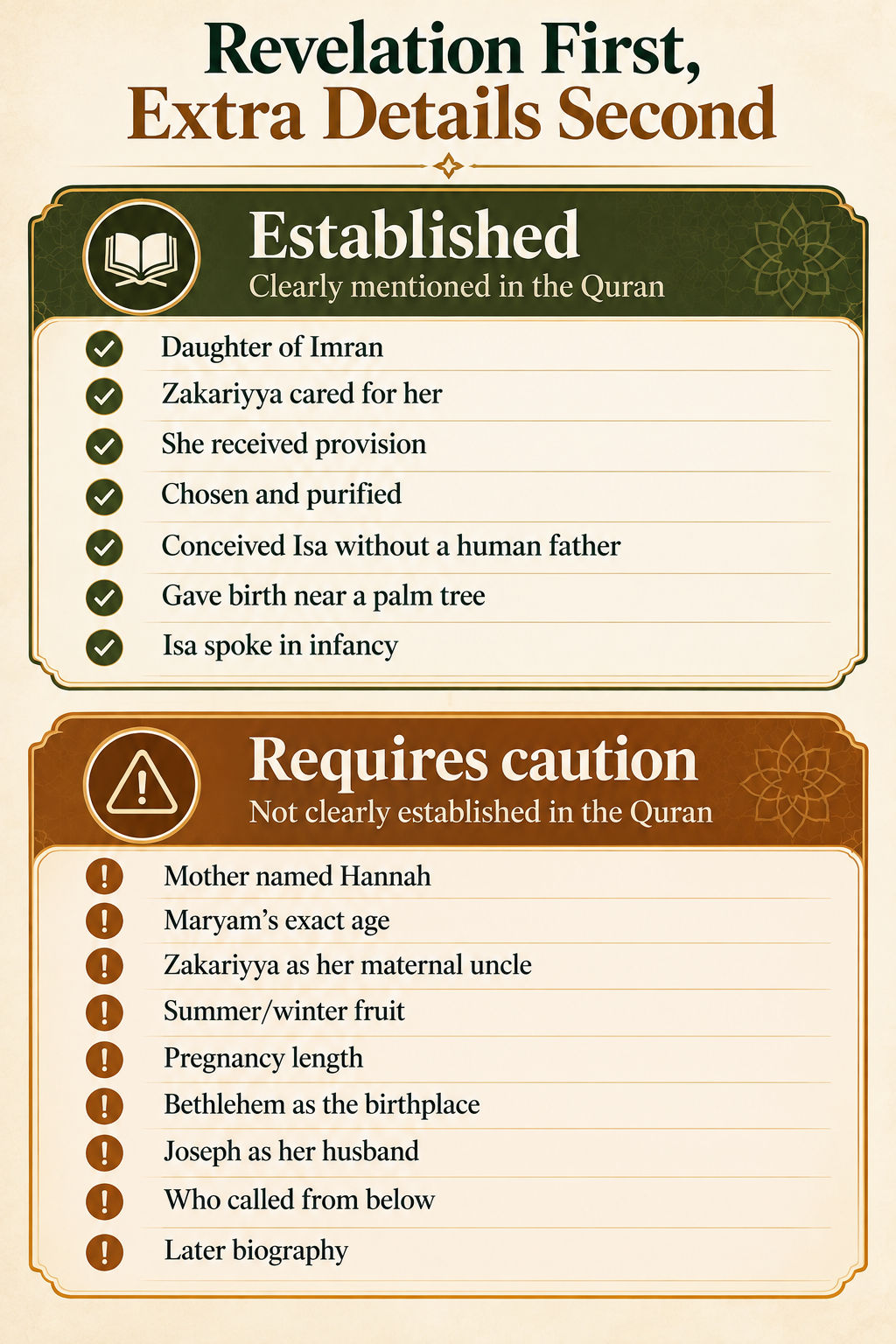
Her mother's name. The Quran does not name her. The name Hannah (Hannah bint Faqudh) appears in later historical and tafsir narrations, often with Biblical-era tradition behind it. It is a later tradition, not Quranic information, and it should be labeled that way.
The Hadith About Shaytan's Touch
Abu Hurayrah reported that the Prophet ﷺ said: "No child is born except that Shaytan touches him when he is born, and he cries out from that touch, except Maryam and her son." Abu Hurayrah then recited, "And I seek refuge for her and her descendants in You from Shaytan, the accursed" (3:36). It is recorded in Sahih al-Bukhari (no. 3431) and Sahih Muslim (no. 2366). Scholars take it as showing Allah's answer to her mother's du'a. The nature of the "touch" is unseen knowledge, and we should not add details Allah and His Messenger did not give.
Allah Accepts Her
The Quran says: فَتَقَبَّلَهَا رَبُّهَا بِقَبُولٍ حَسَنٍ وَأَنبَتَهَا نَبَاتًا حَسَنًا, "Her Lord accepted her with gracious acceptance and caused her to grow in a good manner" (3:37). Zakariyya (عليه السلام), a Prophet, became her caretaker (وَكَفَّلَهَا زَكَرِيَّا).
Who was Zakariyya to Maryam? Sources mention uncle, maternal uncle, or husband of her maternal aunt, but the Quran does not state the exact relationship. What is established is that he was a Prophet and her caretaker by Allah's arrangement. That is enough.
Provision in the Mihrab
Whenever Zakariyya entered upon her in the miḥrāb, he found provision with her. The word mihrab here refers to a private place of worship or prayer chamber. It should not be pictured automatically as the arched niche in a modern mosque. He asked, "O Maryam, from where is this for you?" She replied, هُوَ مِنْ عِندِ اللَّهِ, "It is from Allah. Indeed, Allah provides for whom He wills without account" (3:37).
Many tafsir works say the provision was summer fruit in winter and winter fruit in summer. These reports come from Companion and Tabi'i-era tafsir narrations and are not stated in the Quran, which says only rizq, provision. We hold to the Quran's wording.
The next verse begins هُنَالِكَ دَعَا زَكَرِيَّا رَبَّهُ, "There Zakariyya called upon his Lord" (3:38). Seeing that Allah provides beyond ordinary causes, he asked for righteous offspring despite old age, and that is how Yahya's story is connected to Maryam's.
Chosen, Purified, and Devoted to Worship
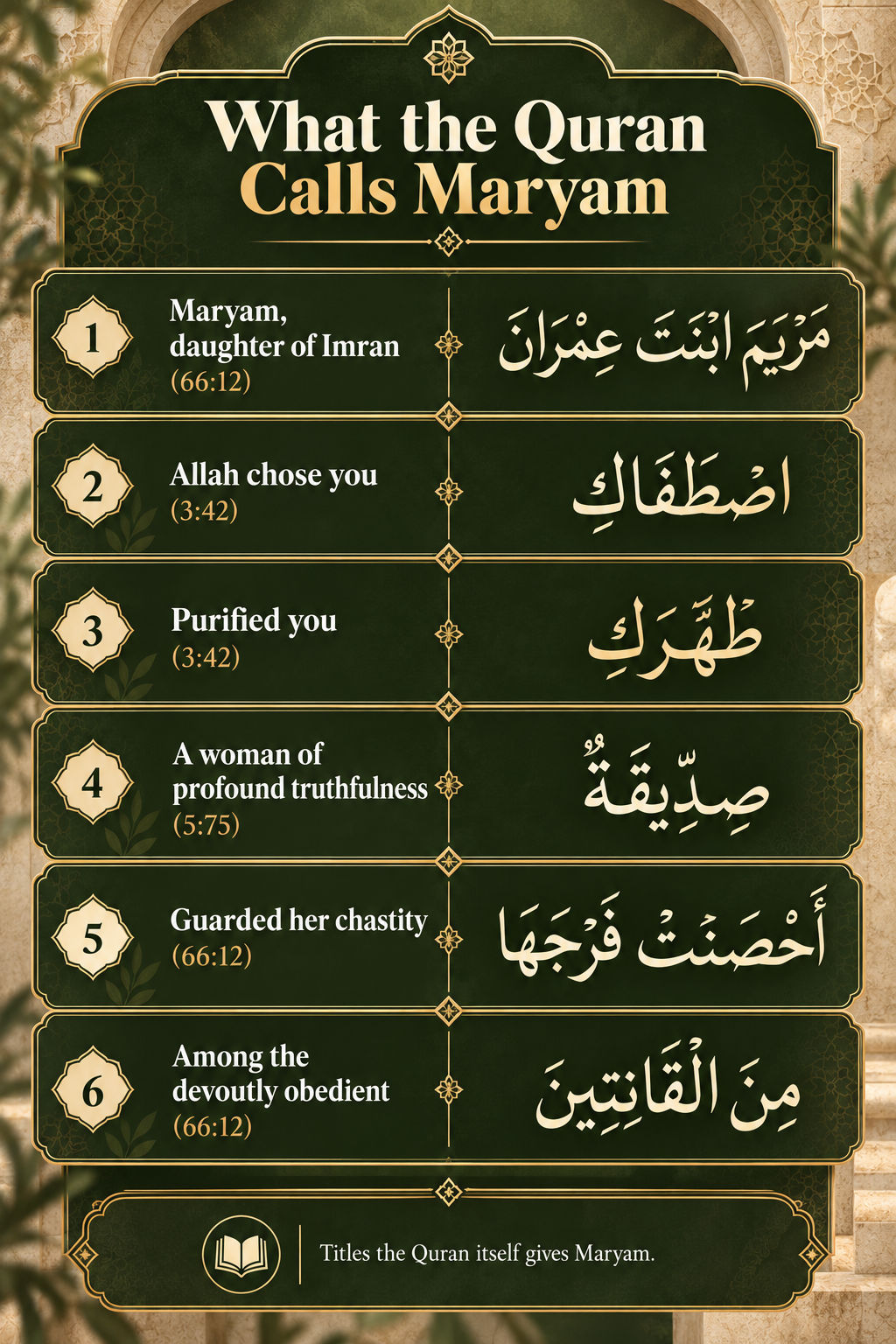
The angels said: "O Maryam, Allah has chosen you (اصْطَفَاكِ), purified you (طَهَّرَكِ), and chosen you over the women of the worlds" (3:42). Then came a command about devotion: يَا مَرْيَمُ اقْنُتِي لِرَبِّكِ وَاسْجُدِي وَارْكَعِي مَعَ الرَّاكِعِينَ, "O Maryam, be devoutly obedient to your Lord, prostrate, and bow with those who bow" (3:43).
Notice the order. Before the Quran tells of the miraculous conception, it has already shown Maryam dedicated, accepted, raised well, worshipping, provided for, chosen and purified. Her spiritual identity does not begin with motherhood.
Chosen above whom? Scholars have discussed whether "women of the worlds" means women of her own time or all women. Several mufassirun lean toward her time; others toward all women, with other texts to be read alongside it. The authentic Hadith are:
Abu Musa al-Ash'ari: "Many men reached perfection, but among women none except Maryam bint Imran and Asiyah, wife of Pharaoh..." (Bukhari, Muslim).
'Ali: "The best of her women is Maryam bint Imran, and the best of her women is Khadijah" (Bukhari 3432, Muslim 2430).
A narration from Anas names Maryam, Khadijah, Fatimah and Asiyah as women who suffice as examples (Tirmidhi).
These are separate narrations. We should not merge them into an invented "four greatest women" ranking, and we should not turn them into a contest.
Was Maryam a Prophet? Some scholars historically discussed the possibility, since angels spoke to her. The mainstream Sunni position is that she was not a Prophet but a siddiqah, a woman of deep truthfulness (5:75). Receiving angelic speech is not by itself prophethood, which has a specific technical meaning of being sent with a revealed message.
The Announcement
The story then becomes suddenly private. Maryam withdrew from her family to an eastern place and took a screen (حِجَابًا) from them (19:16–17). Here hijab means a screen or barrier of seclusion, not a discussion of modern clothing. The Quran does not tell us why she withdrew, so we should not invent a reason.
Then Allah says, فَأَرْسَلْنَا إِلَيْهَا رُوحَنَا, "We sent to her Our Spirit, and he appeared to her as a well-proportioned man" (19:17). Mainstream tafsir identifies the "Spirit" as Jibreel (عليه السلام), the angel of revelation; he is also called al-Ruh al-Amin in 26:193.
Her first response was not curiosity. It was refuge: إِنِّي أَعُوذُ بِالرَّحْمَٰنِ مِنكَ إِن كُنتَ تَقِيًّا, "I seek refuge in the Most Merciful from you, if you are God-fearing" (19:18). She is alone, a man appears, and she turns to al-Rahman. That says much about her consciousness of Allah.
The messenger replied that he was only a messenger of her Lord to give her a pure son (19:19). Elsewhere the angels announced a Word from Him, whose name is al-Masih, Isa son of Maryam (3:45). She asked how that could be when no man had touched her and she had not been unchaste (19:20, 3:47). The reply: كَذَٰلِكِ اللَّهُ يَخْلُقُ مَا يَشَاءُ, "Thus does Allah create what He wills. When He decrees a matter, He only says to it, 'Be,' and it is" (3:47).
Muslims believe Isa was born miraculously to Maryam without a human father. This is not metaphor in mainstream Islamic belief. The Quran does not present a husband as Isa's father, and we should not import Joseph from Christian tradition into the Quranic account.
On "Our Spirit." Expressions like rūḥunā do not mean a piece of Allah or God entering Maryam. In Arabic and Islamic theology, attributing something to Allah can indicate honor, ownership, or that He created it, as in "the House of Allah" (Bayt Allah) or "the she-camel of Allah" (Naqat Allah). The mechanics of the conception are unseen; the Quran only teaches that Allah creates by His command.
Why the Virgin Birth Does Not Make Isa Divine
The Quran addresses this directly: إِنَّ مَثَلَ عِيسَىٰ عِندَ اللَّهِ كَمَثَلِ آدَمَ خَلَقَهُ مِن تُرَابٍ ثُمَّ قَالَ لَهُ كُن فَيَكُونُ, "Indeed, the example of Isa to Allah is like that of Adam; He created him from dust, then said to him, 'Be,' and he was" (3:59).
Adam had neither father nor mother. Isa had a mother but no father. Ordinary humans have both. Allah creates however He wills, so unusual creation points to the Creator's power, not to a share in the Creator's divinity. "Be, and it is" is not a magic formula; it expresses Allah's unrestricted creative command.
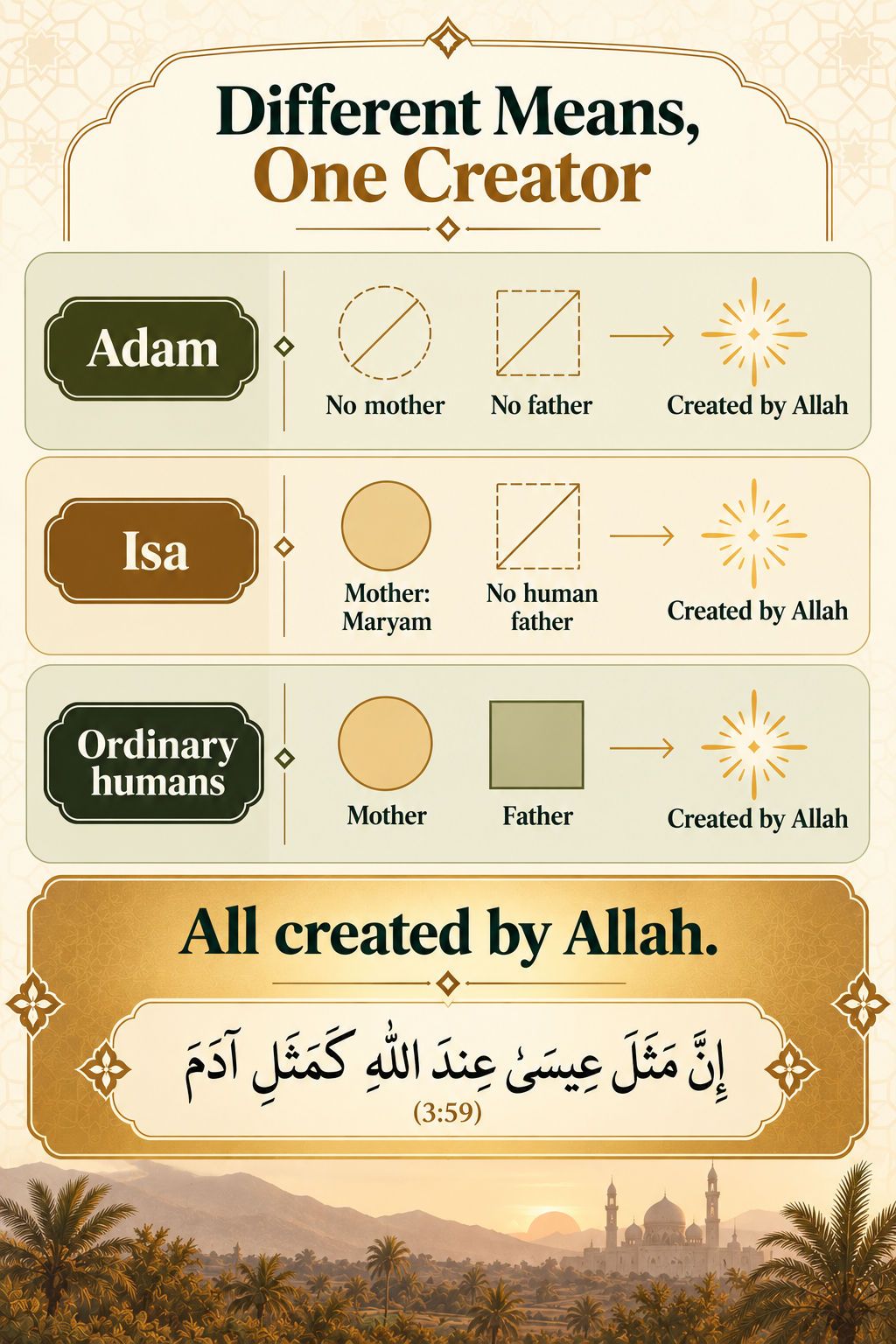
The Quran also says of Isa and Maryam, كَانَا يَأْكُلَانِ الطَّعَامَ, "They both used to eat food" (5:75), a quiet reminder of their humanity, and it calls Maryam a siddiqah in the same verse.
The Birth
The miracle did not spare Maryam from pain. She conceived and withdrew to مَكَانًا قَصِيًّا, "a distant place" (19:22). The Quran does not specify the length of the pregnancy or name the place. Bethlehem comes from historical and Christian tradition, not from the Quranic wording.
Labor brought her to the trunk of a palm tree, and she said: يَا لَيْتَنِي مِتُّ قَبْلَ هَٰذَا وَكُنتُ نَسْيًا مَّنسِيًّا, "I wish I had died before this and was something forgotten and discarded" (19:23). This is a human moment of pain, fear and the weight of what people would say. It does not show a lack of faith, and we should not diagnose her with any modern condition. The Quran lets us witness her distress without diminishing her righteousness.
Then comes comfort. Someone called her from beneath her: "Do not grieve; your Lord has placed beneath you a small stream (sariyy)" (19:24). Scholars differed on who called: some said Jibreel, others said Isa; the Arabic readings of the phrase also differ. Most understand sariyy as a rivulet; some early commentators said it meant a noble person. We should not present one view as unanimous.
She was told: وَهُزِّي إِلَيْكِ بِجِذْعِ النَّخْلَةِ تُسَاقِطْ عَلَيْكِ رُطَبًا جَنِيًّا, "Shake toward yourself the trunk of the palm tree; it will drop upon you ripe, fresh dates" (19:25). Then: فَكُلِي وَاشْرَبِي وَقَرِّي عَيْنًا, "So eat, drink, and be comforted" (19:26). Food, water, reassurance, in that tender order.
The lesson is tawakkul with action. Allah could have provided without any movement, yet she was told to shake the trunk. Trust in Allah is not passivity. This is a Quranic lesson, not a medical claim about dates and labor.
She was also told to say she had vowed a fast (sawm) to al-Rahman and would not speak to any human that day (19:26). In her law, this involved abstaining from speech. Silent fasts are not part of our Shari'ah.
The Return
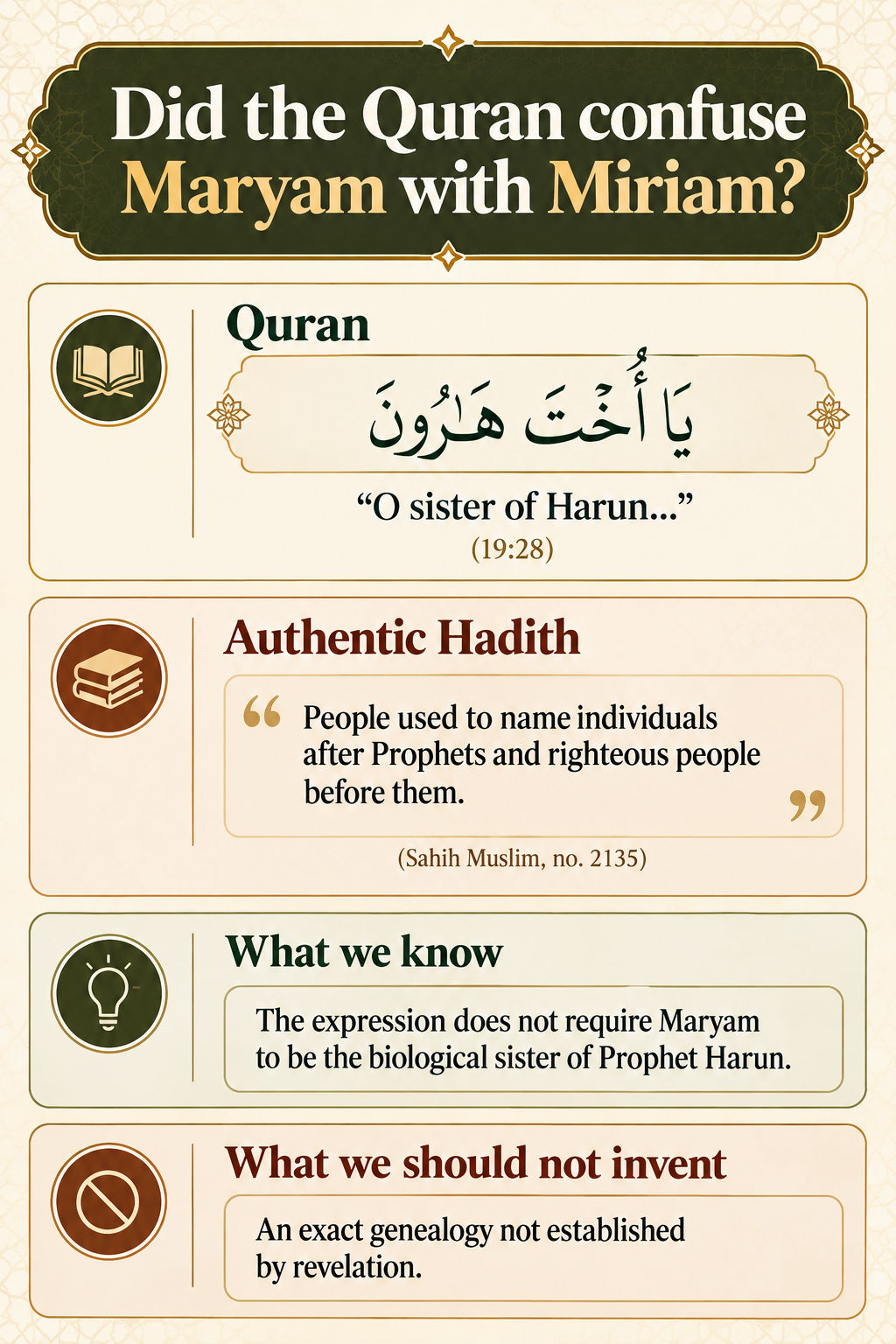
And when Maryam finally returned, the miracle was no longer private. فَأَتَتْ بِهِ قَوْمَهَا تَحْمِلُهُ, "She came to her people carrying him" (19:27). They said, يَا أُخْتَ هَارُونَ مَا كَانَ أَبُوكِ امْرَأَ سَوْءٍ وَمَا كَانَتْ أُمُّكِ بَغِيًّا, "O sister of Harun, your father was not an evil man, nor was your mother unchaste" (19:28). The accusation hurt more because her family was known for righteousness.
"Sister of Harun": Did the Quran Confuse Maryam with Miriam?
Some critics claim so. The authentic Hadith answers it. Al-Mughirah ibn Shu'bah was sent to Najran, where Christians asked him about this verse, since Musa and Harun lived long before Isa. He asked the Prophet ﷺ, who said that they used to give names after the Prophets and righteous people before them (Sahih Muslim, no. 2135). Scholars also mention that "sister of" can refer to association or lineage. The Quran does not specify a precise genealogy, and we should not invent one.
Maryam Points to the Baby
She does not deliver a defense speech. She points to the child (19:29). Her people ask how they can speak to one who is a baby in the cradle. Then Isa speaks.
The First Words of Isa
إِنِّي عَبْدُ اللَّهِ آتَانِيَ الْكِتَابَ وَجَعَلَنِي نَبِيًّا (19:30)
"Indeed, I am the servant of Allah. He has given me the Book and made me a Prophet."
This is one of the theological centers of the story. The miraculous infant does not say, "I am divine." He says, "I am the servant of Allah." He continues: He has made me blessed wherever I am, enjoined prayer and zakah as long as I live (19:31), and وَبَرًّا بِوَالِدَتِي, "[made me] dutiful to my mother, and has not made me arrogant or wretched" (19:32). Isa's own first speech honors his mother, and he ends with peace upon himself on the day he was born, the day he dies, and the day he is raised alive (19:33).
The Quran then states: "That is Isa, son of Maryam, the word of truth about which they are in dispute. It is not for Allah to take a son; exalted is He... Indeed, Allah is my Lord and your Lord, so worship Him; this is a straight path" (19:34–36).
What Muslims Believe About Isa
This section is intentionally brief, since Isa's full biography deserves its own article.
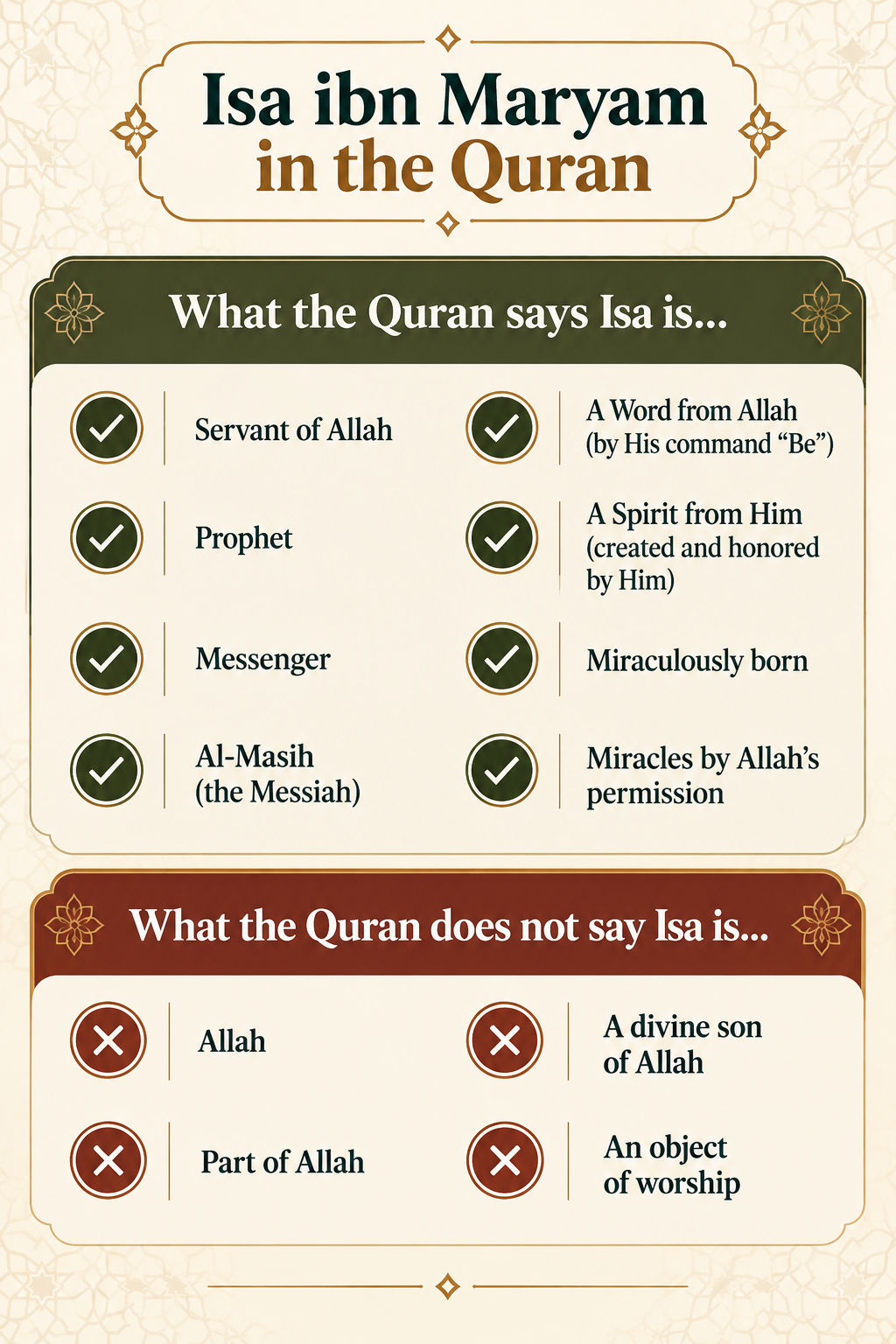
Is Isa Jesus? Yes. Isa ibn Maryam means Jesus, son of Mary. The Quran's repeated "son of Maryam" identifies him, honors his mother, and underlines his real human birth.
Al-Masih (the Messiah). Islam accepts the title (3:45). Classical scholars gave several explanations of its root, and Muslims do not simply import later Christian theological meanings.
A "Word from Allah" (3:45, 4:171). Isa was created by Allah's word, His command "Be." He is not the eternal divine Word incarnate.
A "Spirit from Him" (4:171). "From Him" indicates that Allah created him and honored him; it does not mean he is a part of Allah.
Is Isa the Son of God? No. Allah has no child (19:35, 4:171). Isa is Allah's servant, Prophet, Messenger and Messiah.
Do Muslims believe in Jesus? Yes. Belief in all the Messengers, including Isa, is part of faith (2:136, 2:285). A Muslim cannot reject Isa.
Miracles. Speaking in the cradle, creating a bird from clay and breathing into it so that it lives, healing the blind and the leper, giving life to the dead, and informing people what they ate and stored (3:49, 5:110). Each is qualified بِإِذْنِ اللَّهِ, "by Allah's permission." Miracles are signs (ayat) from Allah; they are not independent divine power.
His message was Tawhid: "Indeed, Allah is my Lord and your Lord, so worship Him" (3:51, 19:36). He confirmed the Torah and brought the Injil as revelation (3:50, 5:46). Muslims do not simply equate the original Injil with the entire modern New Testament.
The crucifixion. The Quran says وَمَا قَتَلُوهُ وَمَا صَلَبُوهُ وَلَٰكِن شُبِّهَ لَهُمْ, "They did not kill him, nor crucify him, but it was made to appear so to them," and بَل رَّفَعَهُ اللَّهُ إِلَيْهِ, "Rather, Allah raised him to Himself" (4:157–158). The Quran does not tell us who or how, and later reports on a look-alike are not established, so we stop where the evidence stops.
Return. Authentic Hadith teach that Isa will descend before the Day of Judgment and judge with justice, "break the cross, kill the swine, and abolish the jizyah" (Bukhari 2222, Muslim 155). He does not return as a new Prophet with a new religion; he follows the final Shari'ah of Prophet Muhammad ﷺ. No one knows the time, and we avoid date-setting and prophecy charts.
Maryam's Status: Truthful, Chaste, Devout
Surah al-Tahrim says: "And Maryam, daughter of Imran, who guarded her chastity, so We breathed into it of Our Spirit, and she believed in the words of her Lord and His scriptures, and was of the devoutly obedient (al-qanitin)" (66:12). Notice that she and the wife of Pharaoh are presented as examples "for those who believe," not only for women.
Chastity (aḥṣanat farjahā) is the Quran's dignified idiom for guarding oneself from unlawful relations. It is part of her honor, not the whole of it. The Quran's portrait also includes faith, worship, truthfulness, trust and steadfastness.
Siddiqah (5:75) describes a person of profound truthfulness and sincere confirmation of truth.
Honored, not worshipped. Muslims do not pray to Maryam, ask her for aid, or consider her divine. Worship belongs to Allah alone.
Not Catholic Marian doctrine. The Immaculate Conception is a Catholic doctrine about Mary's own conception, not about Jesus' virgin birth. Islam affirms Isa's virgin birth, but its picture of Maryam rests on what the Quran says.
Quran 5:116
Allah asks Isa whether he told people to take him and his mother as gods besides Allah, and he denies it. This verse should not be read as saying that the Christian Trinity consists of Father, Jesus and Mary. It addresses worship offered to Isa and Maryam. Islam's own position is absolute Tawhid, and we can state it positively and respectfully without caricaturing Christians as believing in three gods.
Common Misconceptions
Myth | Correction |
|---|---|
Muslims don't believe in Mary. | She is among the most honored women in the Quran. |
Mary is barely mentioned. | A Surah bears her name, and she appears in many chapters. |
Islam denies the virgin birth. | Islam affirms Isa's birth without a human father. |
Virgin birth means divinity. | The Quran compares Isa with Adam (3:59). |
"Spirit from Him" means a piece of God. | It indicates honor and creation, not a part of Allah. |
The Quran confused Mary with Miriam. | See 19:28 and the Mughirah Hadith above. |
The Quran names her mother Hannah. | The Quran does not name her. |
The Quran says Zakariyya was her uncle. | It says he cared for her; the exact kinship is not specified. |
The Quran says she gave birth in Bethlehem. | It says "a distant place." |
The pregnancy lasted nine months. | The Quran doesn't specify. |
Muslims reject Jesus. | Rejecting Isa's prophethood is incompatible with Islam. |
Maryam is worshipped in Islam. | She is honored, not worshipped. |
Quran vs. Popular Tradition
Topic | Quran / Authentic Sunnah | Later or Popular Detail | Evidence Status |
|---|---|---|---|
Mother's name | Not named | Hannah bint Faqudh | Later tradition |
Zakariyya's kinship | Caretaker | Uncle / brother-in-law | Disputed |
Provision | Rizq (provision) | Summer/winter fruit | Tafsir reports, not Quranic text |
Birthplace | "A distant place" | Bethlehem | Historical tradition |
Pregnancy | Not specified | 9 months / hours | Not established |
Caller from below | Not named | Jibreel or Isa | Scholarly disagreement |
Maryam's age | Not given | Various ages | Not established |
Joseph | Not mentioned | Husband/guardian | Christian tradition |
Her grave | Not mentioned | Various shrines | Not established |
The Quran does not give a complete chronological biography of Maryam, so we should not invent one.
Quranic Arabic Vocabulary
Arabic | Transliteration | Meaning | Reference |
|---|---|---|---|
مَرْيَم | Maryam | Mary | 3:36, 19:16 |
عِمْرَان | 'Imran | Her father/family | 3:33, 66:12 |
الْمِحْرَاب | al-Mihrab | Private place of worship | 3:37 |
اصْطَفَى | iṣṭafā | To choose | 3:42 |
طَهَّرَ | ṭahhara | To purify | 3:42 |
الْمَسِيح | al-Masih | The Messiah | 3:45 |
كَلِمَة | kalimah | Word | 3:45, 4:171 |
رُوح | rūḥ | Spirit | 4:171, 19:17 |
آيَة | āyah | Sign | 23:50 |
صِدِّيقَة | ṣiddīqah | Deeply truthful woman | 5:75 |
قَانِتَة | qānitah | Devoutly obedient | 66:12 |
Lessons from Maryam
Worship before recognition. Her devotion came long before her great test.
Righteousness doesn't prevent difficulty. She was chosen and purified, yet she faced isolation, labor and accusation. Hardship is not proof that Allah has rejected someone.
Reputation can be tested even when you did nothing wrong. Maryam was commanded to observe silence in her unique situation; Islam generally permits defending oneself appropriately.
Tawakkul includes action. Allah provides; Maryam shakes the palm.
Allah's power isn't limited by normal causes. Her question and Allah's answer (3:47) show His power; it is not a promise that every impossible wish will come true.
Honor comes through servitude. Her honor and Isa's first words are about being servants of Allah.
Real emotion isn't weakness. The Quran records her distress honestly. Her story is not a reason to suffer silently or avoid seeking help.
For Converts and Muslims in Christian-Majority Societies
A convert does not have to stop loving Maryam and Isa. Islam asks them to honor both as righteous servants of Allah, within a different theological framework. Here is a quick reference:
Do Muslims believe in Mary? Yes.
Do Muslims believe in Jesus? Yes, as the Messiah and Messenger of Allah, not as God or the Son of God.
The virgin birth? Yes.
His miracles? Yes, by Allah's permission.
Do Muslims worship Mary or Jesus? No.
Muslims and Christians recognize overlapping points: Mary is highly honored, Jesus is the Messiah and was born miraculously, and he performed miracles. The theological interpretation differs significantly, and we can say so with respect, without mockery.
FAQ
Is Maryam the same person as Mary, mother of Jesus? Yes. Maryam is the Arabic name of Mary, mother of Isa (Jesus).
Did Maryam have a husband? The Quran does not present a husband as Isa's father, nor does it mention Joseph.
Who announced Isa's birth? The Quran says Allah sent "Our Spirit," identified in mainstream tafsir as Jibreel, who appeared as a well-proportioned man (19:17–19).
Did baby Isa really speak? Yes. He declared, "I am the servant of Allah" (19:30).
Do Muslims believe Jesus was crucified? The Quran says they did not kill or crucify him; Allah raised him (4:157–158).
Will Jesus return? Authentic Hadith teach that Isa will descend before the Day of Judgment, following the final Shari'ah.
Maryam's Story Points Beyond Maryam
Why does the Quran give Maryam such extraordinary attention? Because her story brings together worship before recognition, purity under accusation, trust without knowing every detail, action alongside tawakkul, motherhood under extraordinary circumstances, and Allah's unrestricted power to create.
Maryam is honored without being worshipped. Isa is loved without being deified. His virgin birth is affirmed without making him the son of Allah. His miracles are signs performed by Allah's permission.
The Quran asks us neither to diminish Maryam and Isa nor to raise them beyond what Allah revealed. It asks us to honor them as they truly were: remarkable servants of the One God they worshipped.
Being chosen by Allah does not mean being spared from difficulty. The woman whom Allah purified still faced isolation, labor, accusation, and an extraordinary responsibility. Yet the Quran keeps directing our attention beyond the miracle itself, to the One who created it. Maryam worshipped Allah. Isa declared himself the servant of Allah. And every miracle, every Prophet, and every act of true devotion ultimately points to Allah alone.