Some decisions are difficult even when you have done your research. You may be considering a marriage proposal, choosing between two jobs, applying to university, or wondering whether to move closer to your family. Each option may offer something valuable, yet none comes with certainty.
Islam teaches us to approach these moments with prayer, thoughtful consideration, and trust in Allah. Salat al-Istikhara is a Sunnah prayer through which you ask Allah to guide you toward what is good and turn you away from what is harmful.
To pray Istikhara, perform two voluntary rak‘ahs, then recite the Istikhara dua while identifying the decision you are considering. Continue seeking advice and taking responsible steps afterward. You do not need to see a dream or experience a particular feeling.
This guide explains the prayer step by step, provides the dua in Arabic and English, and answers common questions about timing, dreams, repetition, and making a decision afterward.
What Is Istikhara in Islam?
Istikhara means seeking what is good. Through this prayer and supplication, a Muslim asks Allah to choose and facilitate what is best in a matter they are considering.
The Arabic word relates to khayr, meaning goodness. Its purpose is to acknowledge the limits of our knowledge while asking for help from Allah, whose knowledge is complete.
You may understand your present circumstances reasonably well. You can compare opportunities, ask questions, and identify potential risks. What you cannot know is every consequence a decision may bring.
Istikhara gives you a way to bring that uncertainty into worship.
Where Does Istikhara Come From?
The prayer is established in the Sunnah. Jabir ibn Abdullah reported that the Prophet Muhammad ﷺ taught his companions Istikhara in matters they were considering, with the care he used when teaching them a surah of the Quran.
The narration instructs the person to pray two rak‘ahs other than the obligatory prayer and then make the supplication. The specific prayer and its wording come from hadith, rather than from a Quranic verse. sunnah.com
Useful Terms for Beginners
A few terms will make the instructions easier to follow:
Rak‘ah: One unit of prayer, including standing, bowing, and prostrating.
Nafl: A voluntary prayer.
Wudu: The ritual washing performed before prayer.
Dua: Supplication, or asking Allah.
Salam: The greeting that concludes the prayer.
Istishara: Seeking advice from other people.
Tawakkul: Relying on Allah while taking appropriate action.
You do not need to master every Arabic term before beginning. Understanding what you are asking Allah is an important place to start.
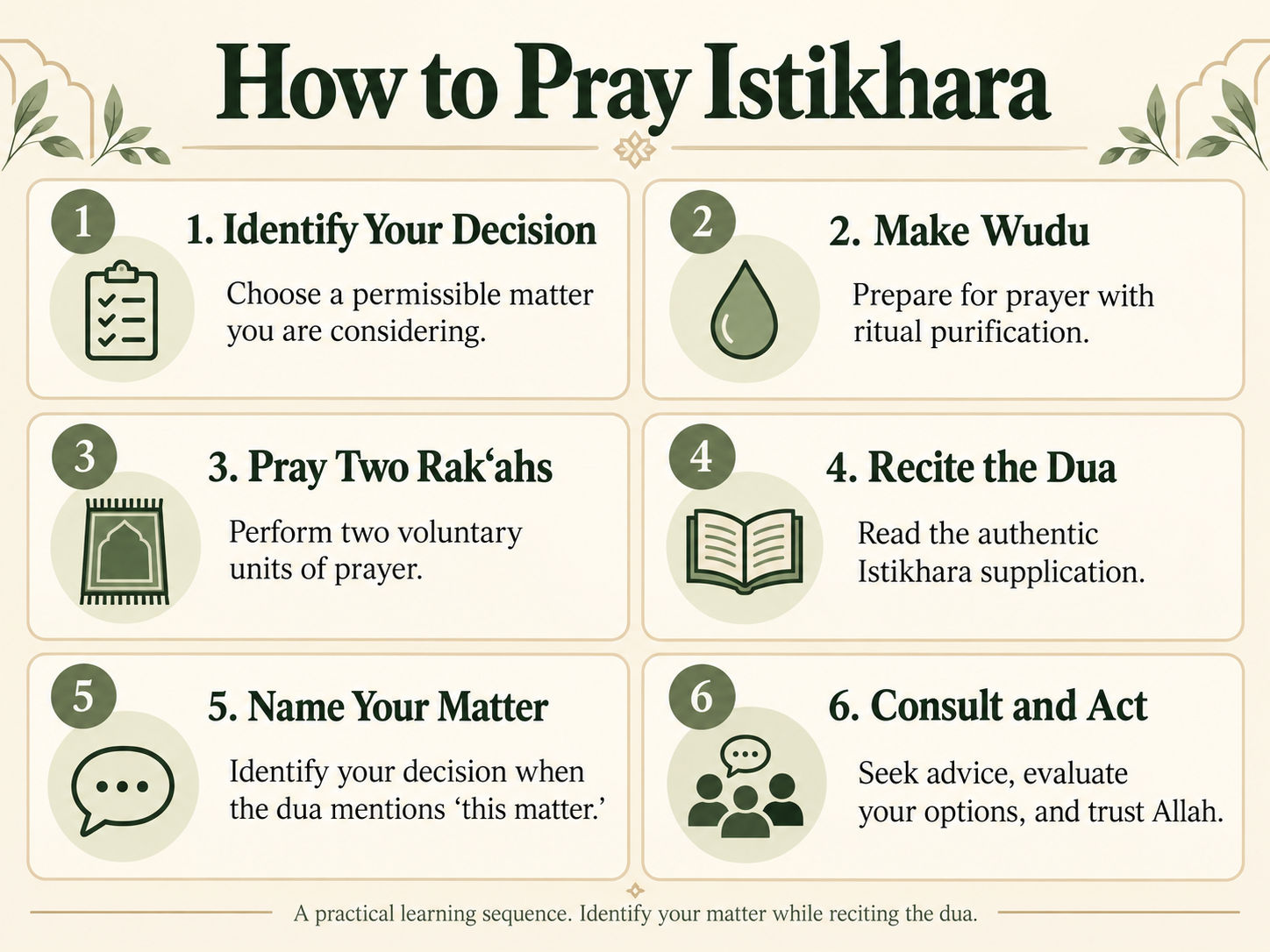
How to Pray Istikhara Step by Step
The following six steps organise the practice into a beginner-friendly sequence. The numbering is a teaching aid, rather than a numbered list from the hadith.
1. Identify the Decision You Are Considering
Begin with a clear, permissible matter.
For example, you might be considering whether to accept a particular job offer, proceed with a marriage proposal, or enrol in a course.
Try to identify the actual decision rather than asking a vague question about your entire future. “Should I accept this offer?” is more useful for your practical evaluation than “What should I do with my life?”
Istikhara is for matters in which a lawful choice is open. It does not make a prohibited action permissible or remove an established obligation.
2. Make Wudu and Prepare for Prayer
Prepare as you would for an ordinary voluntary prayer. Make wudu when required, wear suitable clothing, and choose a clean place to pray.
A quiet setting may help you concentrate, but Istikhara does not require a special room, particular decoration, or unusual ritual.
Take a moment to remember why you are praying: you are asking Allah for what is good, including when that may differ from what you currently want.
3. Pray Two Voluntary Rak‘ahs
Intend in your heart to pray two voluntary rak‘ahs for Istikhara. No special spoken formula of intention is required.
Pray as you normally would:
Begin with the opening takbir.
Recite Surah al-Fatihah and another portion of the Quran.
Complete the bowing and prostrations.
Perform the second rak‘ah.
Complete the final sitting and end with the salam.
The central narration does not prescribe a particular surah for each rak‘ah. Some scholars recommend particular recitations, but a beginner does not need to treat these recommendations as conditions of the prayer.
4. Recite the Istikhara Dua
After completing the prayer, recite the supplication below.
Reading it from a phone or printed page after the salam is a practical option if you have not memorised it. Take your time and pay attention to the meaning.
The commonly taught beginner’s method is to make the dua after the prayer. Scholars also discuss supplication before the salam; follow a qualified teacher’s guidance if you are learning that approach.
5. Identify Your Matter in the Dua
The supplication refers to hadha al-amr, meaning “this matter.”
Identify the decision you are considering, such as accepting a particular position or proceeding with a proposal. The narration includes an instruction to name one’s need.
You are asking Allah to facilitate it if it is good for you and turn it away if it is harmful.
6. Continue With Advice, Evaluation, and Action
After praying, continue the work that the decision requires.
Ask questions, check relevant facts, consult trustworthy people, and consider your responsibilities. Then make a reasonable choice with reliance on Allah.
You do not need to suspend your life while waiting for a dream. Istikhara belongs alongside responsible decision-making.
The Istikhara Dua in Arabic, Transliteration, and English
The following Arabic uses the wording about religion, livelihood, and the outcome of one’s affairs found in the narration of Jabir. The narration also records an alternative phrase concerning one’s immediate and later affairs.
Istikhara Dua in Arabic
اللَّهُمَّ إِنِّي أَسْتَخِيرُكَ بِعِلْمِكَ، وَأَسْتَقْدِرُكَ بِقُدْرَتِكَ، وَأَسْأَلُكَ مِنْ فَضْلِكَ الْعَظِيمِ، فَإِنَّكَ تَقْدِرُ وَلَا أَقْدِرُ، وَتَعْلَمُ وَلَا أَعْلَمُ، وَأَنْتَ عَلَّامُ الْغُيُوبِ.
اللَّهُمَّ إِنْ كُنْتَ تَعْلَمُ أَنَّ هَذَا الْأَمْرَ خَيْرٌ لِي فِي دِينِي وَمَعَاشِي وَعَاقِبَةِ أَمْرِي، فَاقْدُرْهُ لِي وَيَسِّرْهُ لِي، ثُمَّ بَارِكْ لِي فِيهِ.
وَإِنْ كُنْتَ تَعْلَمُ أَنَّ هَذَا الْأَمْرَ شَرٌّ لِي فِي دِينِي وَمَعَاشِي وَعَاقِبَةِ أَمْرِي، فَاصْرِفْهُ عَنِّي وَاصْرِفْنِي عَنْهُ، وَاقْدُرْ لِيَ الْخَيْرَ حَيْثُ كَانَ، ثُمَّ أَرْضِنِي بِهِ.
Source: Sahih al-Bukhari 1166. sunnah.com
Istikhara Dua Transliteration
Allahumma inni astakhiruka bi-‘ilmika, wa astaqdiruka bi-qudratika, wa as’aluka min fadlika al-‘azim. Fa-innaka taqdiru wa la aqdiru, wa ta‘lamu wa la a‘lamu, wa anta ‘allamu al-ghuyub.
Allahumma in kunta ta‘lamu anna hadha al-amra khayrun li fi dini wa ma‘ashi wa ‘aqibati amri, faqdurhu li wa yassirhu li, thumma barik li fihi.
Wa in kunta ta‘lamu anna hadha al-amra sharrun li fi dini wa ma‘ashi wa ‘aqibati amri, fasrifhu ‘anni wasrifni ‘anhu, waqdur liya al-khayra haythu kana, thumma ardini bihi.
Transliteration is a learning aid. English letters cannot represent every Arabic sound precisely, so listening to a qualified teacher can help you develop your pronunciation.
English Meaning of the Istikhara Dua
O Allah, I seek Your choice through Your knowledge, and I seek ability through Your power. I ask You from Your great bounty. You have power, while I do not; You know, while I do not; and You know all that is unseen.
O Allah, if You know that this matter is good for my religion, my livelihood, and the outcome of my affairs, decree it for me, make it easy for me, and bless it for me.
If You know that this matter is harmful to my religion, my livelihood, and the outcome of my affairs, turn it away from me and turn me away from it. Decree what is good for me wherever it may be, and make me content with it.

Understanding What You Are Asking Allah
Understanding the dua helps you approach Istikhara with attention and sincerity.
Its wording moves from acknowledging Allah’s knowledge and power to asking for goodness, protection, and contentment.
Guidance Through Allah’s Knowledge
The opening acknowledges that Allah knows what you cannot see.
A job may look attractive because of its salary while carrying responsibilities you have not yet understood. A move may feel frightening while offering benefits you cannot currently imagine.
You still investigate these matters carefully. The dua recognises that even careful investigation cannot reveal everything.
Goodness in Religion, Livelihood, and Outcome
The supplication considers more than immediate comfort.
It asks about your religion, your worldly life, and the eventual consequences of the decision. This encourages you to look beyond one appealing feature, such as prestige, income, or convenience.
A useful question is: how might this choice affect my obligations, relationships, daily life, and longer-term direction?
Protection From Harmful Attachment
The dua asks for a harmful matter to be turned away from you and for you to be turned away from it.
That second request matters. Sometimes the difficulty is not losing an opportunity but remaining deeply attached to it.
You can sincerely want something while also asking Allah to protect you if it would be harmful.
Contentment With What Is Good
The final request asks for contentment.
This does not mean you must suppress disappointment or stop improving your circumstances. It means asking Allah to help your heart accept what is good while you continue fulfilling your responsibilities.
You can feel sadness, learn from experience, and make new plans without abandoning trust.
When Should You Pray Istikhara?
Pray Istikhara when you are considering a permissible matter and a real choice remains open.
It is especially useful when an important decision involves uncertainty, but it is not restricted to major life events. The narration describes the Prophet ﷺ teaching it broadly in the matters his companions considered.
You do not need to wait until you feel completely overwhelmed. Prayer can be part of the decision process from an early stage.
Is There a Best Time to Pray Istikhara?
No exclusive hour is specified in the Istikhara narration.
Choose a suitable time when voluntary prayer is permitted and when you can give the prayer your attention. Some people find the evening convenient; others prefer another quiet moment.
The convenience of a particular time does not make it a requirement.
Can You Pray Istikhara After Isha or Before Bed?
Yes. You may pray after Isha or before bed.
However, sleeping immediately afterward is not a condition. You may also pray at another suitable time and then continue your normal activities.
There is no need to organise the prayer around the expectation of receiving a dream.
What About Restricted Prayer Times?
Voluntary prayer has restrictions at certain times, including periods associated with Fajr, sunrise, Asr, and sunset.
Scholars differ on how prayers connected to a particular reason apply during these periods. If your decision is not urgent, choose a time outside the restricted periods.
For an urgent situation or a school-specific ruling, ask a qualified scholar rather than assuming every voluntary prayer follows exactly the same rule.
Do You Need a Dream or Sign After Istikhara?
No dream is required after Istikhara.
The authentic narration teaches prayer and supplication. It does not instruct you to wait for a dream before making your decision.
This distinction can relieve a great deal of unnecessary worry. You may perform Istikhara sincerely, sleep normally, and remember no dream at all.
Do Colours Mean Yes or No?
Popular claims sometimes associate green or white with approval and red or black with rejection.
There is no established universal colour code in the authentic instructions for Istikhara. A colour in a dream should not become the deciding factor in a marriage, career, or family decision.
Similarly, a nightmare does not automatically mean that an opportunity is wrong.
What If You Feel Peaceful?
Calmness can help you think clearly, and it is natural to welcome it.
However, a feeling is not an infallible ruling. Your emotions can also reflect hope, familiarity, fear, tiredness, or a preference you already had.
Consider your feelings alongside the facts, rather than allowing them to replace investigation.
What If You Feel Nothing?
Feeling nothing unusual does not mean that you prayed incorrectly.
You are not required to experience a particular emotional response. Continue gathering information, seeking advice, and making the best decision available to you.
Some choices remain uncomfortable because they involve genuine uncertainty. That discomfort does not make responsible action impossible.
Do Obstacles Mean You Should Stop?
An obstacle is relevant information, but it is not automatically a message you can interpret with certainty.
A job offer being withdrawn means that option is no longer available. A delay may simply mean more preparation is needed. A difficult task may still be worthwhile.
Likewise, an easy opportunity is not automatically good. Consider its lawfulness, consequences, and practical realities.
What Should You Do After Istikhara?
Once you have prayed, return to the decision with a clear process.
The following questions can help:
What do I know? Separate confirmed facts from assumptions.
What information is missing? Identify what you still need to ask or check.
Who can advise me? Choose people with relevant experience and integrity.
What responsibilities are involved? Consider everyone affected.
What are the benefits and risks? Look beyond the most attractive feature.
What reasonable action can I take next? Avoid indefinite delay.
This is a practical decision-making framework, not a prescribed religious checklist.

Combine Istikhara With Consultation
Istishara means seeking advice from people.
A trustworthy adviser can notice something you have overlooked, explain an unfamiliar situation, or challenge an assumption. Choose someone who understands the subject and is willing to speak honestly.
For example, career advice is more useful from someone familiar with the profession than from someone who only shares your enthusiasm.
Consultation can happen before or after Istikhara as new information emerges.
Practise Tawakkul Through Action
Tawakkul means relying on Allah while taking appropriate means.
You submit the application, read the terms, ask the difficult questions, and fulfil your obligations. Then you entrust what lies beyond your control to Allah.
You do not need complete certainty before taking every step. Many sound decisions are made with limited information and reasonable care.
Istikhara for Marriage, Work, and Other Decisions

The same principles apply across different situations, although the practical questions will change.
Istikhara for Marriage
You may pray Istikhara when genuinely considering a marriage proposal.
Alongside prayer, consider character, religious practice, compatibility, communication, mutual consent, and the expectations each person brings to marriage.
Ask relevant questions and consult people who know the situation. Do not ignore serious concerns because you had a pleasant dream or because someone claims the marriage is spiritually guaranteed.
Istikhara does not remove the need for consent or careful judgment. A previous prayer also does not require someone to remain in a harmful situation.
Istikhara for a Job Offer
When comparing jobs, look beyond salary.
Consider the work itself, stability, working hours, travel, development opportunities, family responsibilities, and your ability to fulfil religious obligations.
You might prefer the better-paid role initially, then discover that its schedule creates serious difficulties. Alternatively, further investigation may confirm that it is a suitable opportunity.
Pray while remaining open to what the evidence shows.
Istikhara for University or Study
A course decision may involve ability, interest, fees, location, and future work.
Speak with teachers, current students, or professionals who understand the subject. Read the course requirements and consider what daily study would actually involve.
Istikhara can accompany that evaluation. It does not require you to discover your future career through a dream.
Istikhara for Moving or Family Decisions
Relocation may affect housing, employment, schooling, support networks, and care responsibilities.
Write down the practical implications for everyone involved. A move that benefits one person may create significant difficulties for another.
When a decision affects your family, include appropriate consultation and respect the rights of those affected.
Can You Repeat Istikhara?
You may repeat Istikhara if you still need guidance or the situation changes.
However, do not treat repetition as a way to force a particular answer. The central authentic narration does not prescribe seven repetitions or require you to continue until a dream appears.
You may still prefer one option after praying. The question is whether you remain sincerely willing to accept a different outcome if it is better.
If you keep repeating because you believe every anxious feeling invalidates the previous prayer, return to the meaning of the dua. It asks for guidance and goodness without requiring perfect emotional certainty.
A useful next step may be obtaining missing information rather than repeating the same evaluation indefinitely.
Istikhara for Beginners Who Do Not Know Arabic
Learning the dua can take time. Begin with its meaning, then work through the wording gradually.
Divide it into short sections:
Acknowledging Allah’s knowledge and power.
Asking for the matter if it is good.
Asking for it to be turned away if harmful.
Asking for goodness and contentment.
Practise a little at a time and use reliable pronunciation support.
Can You Read the Dua From Your Phone?
Yes, you can read the supplication from a phone or paper after completing the prayer.
You do not have to memorise it before making Istikhara. Keeping the text clearly displayed may help you recite with greater attention.
Reading from a device during salah involves separate juristic discussions, so the straightforward beginner’s approach is to read after the salam.

Can You Make Dua in English?
Outside salah, you may ask Allah in a language you understand.
Learn the Prophetic Arabic wording gradually, while also understanding what it means. You can express your needs in English and ask Allah for help with your decision.
Do not allow fear of imperfect pronunciation to stop you from making dua.
Can You Make Istikhara Without the Prayer?
The complete taught practice includes two voluntary rak‘ahs and the supplication.
If you cannot perform salah, you can still ask Allah for guidance. Scholars discuss reciting the Istikhara dua without the prayer in circumstances such as menstruation.
This distinction is helpful: the full practice includes the prayer, while supplication remains available when prayer cannot be performed.
Common Istikhara Mistakes to Avoid
Many misunderstandings arise from expecting certainty in a form that the prayer does not promise.
Mistake | A better approach |
|---|---|
Waiting indefinitely for a dream | Continue research, consultation, and responsible action. |
Treating colours as a fixed answer | Do not use dream colours as a decision rule. |
Assuming calmness proves an option is right | Consider feelings alongside facts and responsibilities. |
Ignoring clear religious obligations | Use Istikhara for choices that are genuinely open. |
Avoiding difficult questions | Investigate the matter honestly. |
Repeating until you get the answer you want | Ask sincerely for what is good, even if it differs from your preference. |
Treating every inconvenience as rejection | Evaluate obstacles according to their actual significance. |
Believing another person knows your future | Seek sound advice without accepting claims of hidden knowledge. |
You do not need a special intermediary to begin. A teacher can explain the prayer, but you can make your own supplication to Allah.
What If the Outcome Is Disappointing?
A difficult outcome does not prove that your Istikhara was invalid.
People can make careful decisions and still encounter loss, conflict, or changing circumstances. You may not understand every consequence of what happened.
Allow yourself to reassess. You can correct a mistake, change direction, seek support, or make a new decision when circumstances develop.
Trust in Allah does not require pretending that pain is easy. Nor does it require blaming yourself for lacking faith whenever something goes wrong.
The dua asks for goodness and contentment. Keep making that request while responding honestly to the situation in front of you.
Frequently Asked Questions About Istikhara
How Many Rak‘ahs Are in Istikhara?
The taught prayer consists of two voluntary rak‘ahs, separate from an obligatory prayer, followed by the supplication in the commonly taught method.
Do You Need to Memorise the Dua First?
No. You can read it after the prayer from a phone or printed page while learning it gradually.
Must Istikhara Be Prayed at Night?
No. Night may be convenient, but the prayer is not limited to bedtime. Choose a suitable time when voluntary prayer is permitted.
Do You Have to Sleep Immediately Afterward?
No. Sleeping afterward is not a condition of Istikhara. You may continue your ordinary activities.
What If You Do Not See a Dream?
Continue evaluating your options and seeking advice. The absence of a dream does not mean the prayer failed.
Can You Pray Istikhara When You Already Prefer One Option?
Yes. Having a preference does not prevent you from asking for guidance. Be willing to reconsider if the option is harmful or new information changes your assessment.
Can Someone Else Make Istikhara for You?
Others can make general dua for you. Performing another person’s Istikhara is a separate matter discussed by scholars. When you are able, perform the prayer yourself.
Can You Make Istikhara About More Than One Decision?
You can seek guidance concerning different matters. For practical clarity, identify each decision carefully and consider its circumstances rather than combining unrelated concerns into one vague question.
Does Istikhara Guarantee an Easy Outcome?
It does not promise a life without difficulty. Continue taking appropriate steps, learning from experience, and asking Allah for goodness.
Seek Allah’s Guidance and Move Forward With Trust
Learning how to pray Istikhara begins with a simple practice: pray two voluntary rak‘ahs, make the taught supplication, and ask Allah for what is good.
Then continue your responsibilities. Research the options, seek trustworthy advice, and make a reasonable decision.
You do not need to know the future or decode a hidden sign. You can acknowledge uncertainty while placing your trust in Allah.
If you would like support learning Arabic pronunciation and understanding the supplications you recite, explore Quran and Arabic learning with Araby Academy. Building understanding can help you approach daily worship with greater attention and confidence.