Around the year 570 CE, a child was born in Makkah, a trading town in western Arabia. Muslims believe that child, Muhammad ﷺ, became the Messenger through whom Allah revealed the Quran. His life included orphanhood, work, marriage, revelation, opposition, migration, leadership, conflict, reconciliation, and the daily duties of guiding people. The Seerah (his biography) follows that life from early Arabia to his death in Madinah. This guide tells it in order and shows where the evidence is strong and where it needs care.
Who Was Prophet Muhammad ﷺ?
Prophet Muhammad ﷺ was born in Makkah around 570 CE and, according to Islamic belief, received the first Quranic revelation around 610 CE. He called people to worship Allah alone, faced opposition in Makkah, migrated to Madinah in 622 CE, and led the growing Muslim community until his death in 632 CE. Muslims regard him as Allah’s final Prophet and Messenger.
He belonged to Banu Hashim, a clan of the Quraysh tribe. He ﷺ said that Allah chose Kinanah from the descendants of Ismail, Quraysh from Kinanah, and Banu Hashim from Quraysh (Sahih Muslim, narrated by Wathilah ibn al-Asqa‘) [B]. The symbol ﷺ stands for ṣallā Allāhu ʿalayhi wa sallam, “may Allah send blessings and peace upon him.” We explain why Muslims say it near the end of this guide. Companions are honored with raḍiya Allāhu ʿanhum (“may Allah be pleased with them”), which we do not repeat each time, for readability.
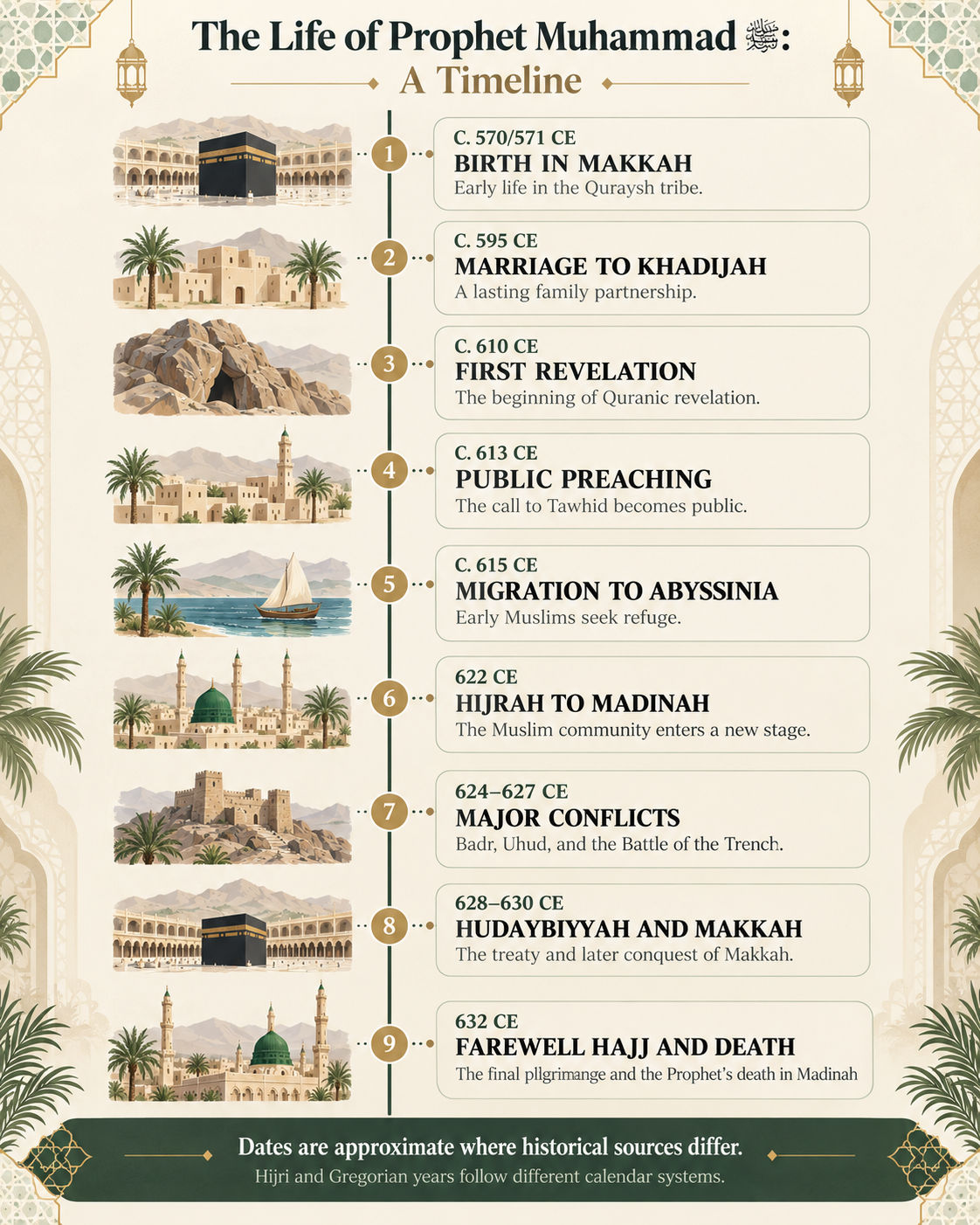
Prophet Muhammad’s Life at a Glance: Timeline
Event | Approx. date (CE) | Approx. age | Hijri | Why it matters |
|---|---|---|---|---|
Birth in Makkah | c. 570/571 | 0 | — | Traditionally linked to the Year of the Elephant |
Marriage to Khadijah | c. 595 | c. 25 | — | A partnership that supported him at the start of revelation |
First revelation | c. 610 | c. 40 | — | Prophethood and the Quran begin (Ramadan) |
Public preaching | c. 613 (traditional) | c. 43 | — | The message moves beyond a small circle |
Migration to Abyssinia | c. 615 | c. 45 | — | Believers seek refuge from persecution |
Boycott of Banu Hashim | c. 616–619 (imprecise) | c. 46–49 | — | Social and economic exclusion |
Year of Sorrow | c. 619 | c. 49 | — | Deaths of Khadijah and Abu Talib; the Ta’if journey |
Isra and Mi‘raj | Date disputed | — | — | The Night Journey; the five daily prayers |
Pledges of Aqabah | c. 620–622 | c. 50–52 | — | Madinah’s believers invite and pledge support |
Hijrah (migration) | 622 | c. 53 | 1 AH | A new community; later the Hijri calendar’s reference point |
Battle of Badr | c. March 624 | c. 54 | 2 AH | First major battle |
Battle of Uhud | c. March 625 | c. 55 | 3 AH | A setback and a lesson in discipline |
Battle of the Trench | c. 627 | c. 57 | 5 AH | Defense of Madinah |
Treaty of Hudaybiyyah | c. 628 | c. 58 | 6 AH | A truce with major consequences |
Conquest of Makkah | c. January 630 | c. 60 | 8 AH | Makkah enters the Muslim fold |
Farewell Hajj | c. March 632 | c. 62 | 10 AH | His only Hajj as Prophet; the Farewell Sermon |
Death in Madinah | c. June 632 | 63 (lunar years) | 11 AH | End of revelation and of his life |
Hijri years follow the moon and are about eleven days shorter than solar years, so every age and conversion here is approximate.
What Is the Seerah and Why Does It Matter?
Seerah (السِّيرَة, as-sīrah) comes from the Arabic root س-ي-ر, “to travel, to proceed.” It means a way of conduct, and in Islamic scholarship, the account of a life. It overlaps with other terms but is not identical to them:
Term | Arabic | Meaning | Focus |
|---|---|---|---|
Seerah | السِّيرَة | Biography, life path | The life story in sequence |
Sunnah | السُّنَّة | The Prophet’s way | His words, actions, and approvals as a source of guidance |
Hadith | الْحَدِيث | A report | Individual narrations with chains, graded by scholars |
Maghazi | المَغَازِي | Campaigns | An early genre recording his expeditions |
Shama’il | الشَّمَائِل | Qualities | His appearance and manners |
Why study it? The Quran tells believers that in the Messenger of Allah they have “an excellent example” for whoever hopes in Allah and the Last Day and remembers Allah often (Quran 33:21) [A]. That verse came in Surah al-Ahzab, in the context of the Battle of the Trench, when the community was afraid and tested. The Seerah shows revelation meeting real circumstances, how early Muslims lived their faith, and what character looked like under pressure. It does not mean every historical action is a direct legal instruction for today. Applying it responsibly takes scholarship and context.
How we know: evidence labels in this guide
Not every Seerah story has the same strength, so we mark important claims:
[A] Explicit Quranic passage.
[B] Sahih (authentic) or otherwise authenticated Hadith, mainly in Sahih al-Bukhari and Sahih Muslim.
[C] Early historical report whose transmission has been evaluated.
[D] Widely reported traditional Seerah account that needs qualification.
[E] Disputed or weak report.
[F] Modern historical reconstruction.
[G] Spiritual lesson or reflection.
The Quran is the foundation. Authenticated Hadith give firm detail. The early biographies, such as the work of Ibn Ishaq (d. c. 150 AH) as transmitted by Ibn Hisham, and the history of al-Tabari, preserve a great deal of valuable material, but they collected reports with varying chains. A story is not authenticated merely because a famous biography tells it, and it is not imaginary merely because Bukhari does not include it. Modern scholars also study dating and context. We give dates as “around” where sources differ and state them plainly where they agree.
Arabia Before Islam
The Arabian Peninsula was not one uniform society. Bedouin tribes moved with their herds; oasis towns such as Yathrib (later Madinah), Ta’if, and Khaybar farmed and traded; Yemen had an older settled culture. Caravan routes linked the south with Syria. Arabs valued poetry, hospitality, kinship, and tribal protection, but feuds, inequality, and exploitation of the weak were also real. The Quran mentions practices such as burying infant girls (81:8–9) and mistreating orphans (89:17–19). Customs and morals varied by tribe and person.
Religion was diverse too. Many Arabs practiced polytheism, keeping idols at and around the Kaaba and seeking their intercession. The Quran says some justified this as drawing nearer to Allah (39:3) [A], so they did not necessarily deny a Creator. Some individuals, often called hanifs, rejected idols. Jewish communities lived in Yathrib and Khaybar, and Christian communities lived in Najran, Syria, and Abyssinia.
Muslims call the pre-Islamic period al-Jahiliyyah (الْجَاهِلِيَّة). It comes from the root ج-ه-ل, which can mean ignorance of guidance and also impulsive, hot-tempered behavior. The Quran uses it that way (for example, 33:33 and 48:26). It does not mean “everyone before Islam was unintelligent.” Pre-Islamic Arabs were eloquent poets and capable traders, and the term describes a moral and religious state.
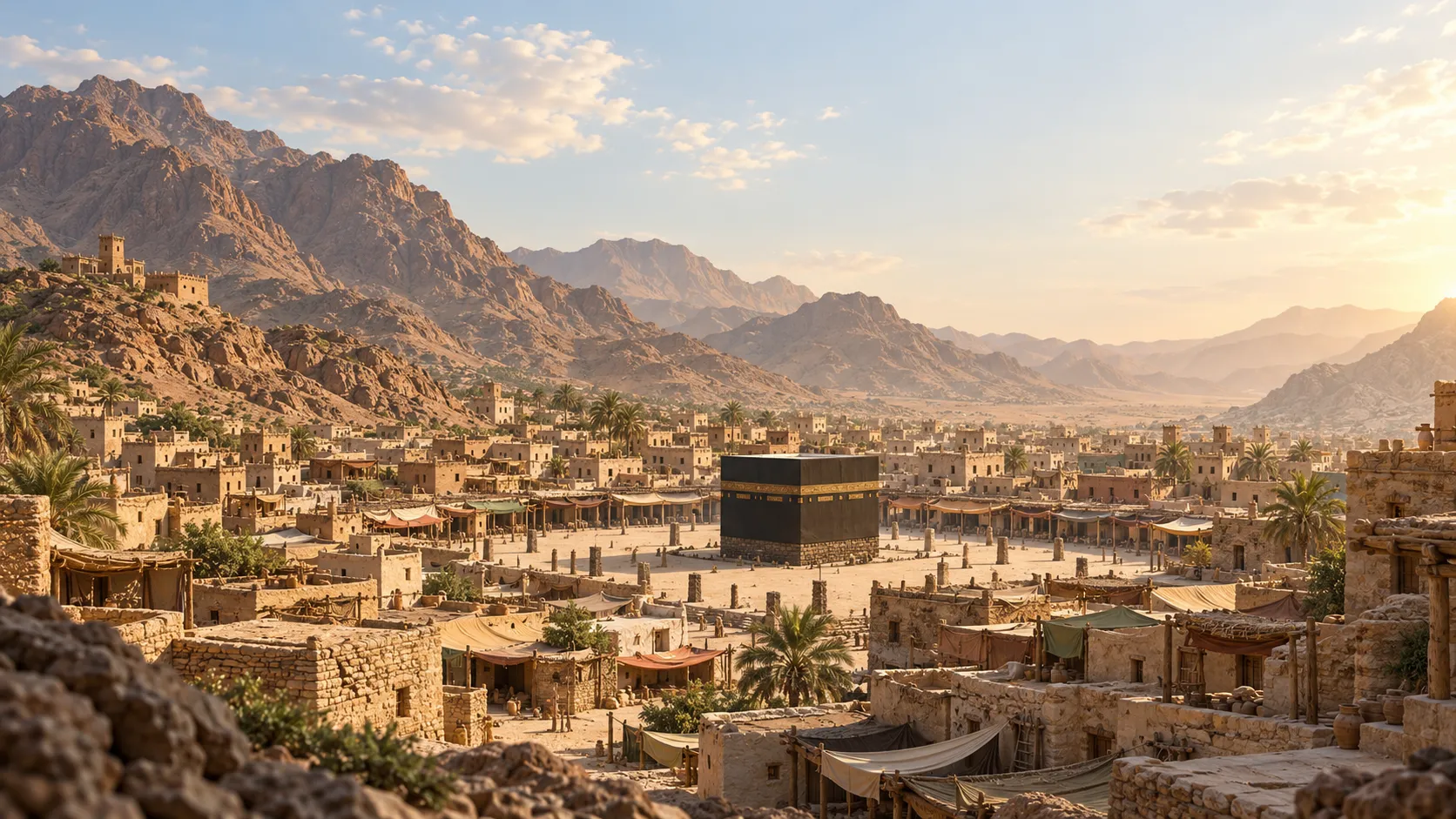
Makkah’s importance rested on the Kaaba and trade. The Quran connects the Kaaba to Ibrahim and Ismail, who raised its foundations (2:127) [A]. The Quraysh (قُرَيْش) were its custodians and organized services for pilgrims, and the Quran refers to their winter and summer trading journeys (Surah 106) [A]. Their sanctuary status brought safety, wealth, and influence. Muslims face the Kaaba in prayer as a direction of worship, but they worship Allah alone. Knowing this setting explains both his reputation and the opposition he later faced.
Birth and Childhood in Makkah
Muhammad ﷺ was born in Makkah around 570/571 CE. Early biographies place his birth in the Year of the Elephant, when Abraha’s army marched on Makkah, an event Surah al-Fil (105:1–5) alludes to [A]. The Quran does not say Muhammad was born that year; that link comes from the traditional biographies [D]. A report in Sahih Muslim says he was born on a Monday [B]. The common date, 12 Rabi‘ al-Awwal, is widely reported but disputed, and no exact Gregorian birthday is established.
His father, Abdullah ibn Abd al-Muttalib, died before he was born, according to the most widely held biographical tradition [D]. His mother, Aminah bint Wahb, died at al-Abwa’ on the road between Makkah and Madinah when he was about six [D]. A report in Sahih Muslim says he later visited her grave and was moved to tears [B]. Like many Makkan infants, he spent his first years with a Bedouin nurse, Halimah al-Sa‘diyyah of Banu Sa‘d, a custom meant for health and pure Arabic [D]. Sahih Muslim also narrates, from Anas, a report of his chest being opened in childhood; Muslims accept it as authentic, while details such as his exact age vary [B].
His grandfather, Abd al-Muttalib, a leading figure of Makkah, cared for him until his own death when Muhammad was about eight [D]. His uncle Abu Talib then became guardian and, later, protector. Abu Talib never accepted Islam, according to Sahih Bukhari [B]; his protection was a mix of family loyalty and tribal honor.
The Quran addresses his early circumstances: “Did He not find you an orphan and give you refuge?” (93:6, أَلَمْ يَجِدْكَ يَتِيمًا فَآوَىٰ) [A]. Three verses later it commands: “So do not oppress the orphan” (93:9). Reflecting on orphanhood helps readers see why the Quran so often stresses care for the vulnerable, though we should not claim a single childhood cause for later traits [G].
As a youth he shepherded, as Sahih Bukhari records him saying that every prophet shepherded sheep, and that he himself had tended sheep for the people of Makkah [B]. He later traded, including for Khadijah. Early sources report that Quraysh called him al-Amin (“the trustworthy”) [C]. A strong, authentic support is the Safa report (below), where Quraysh themselves say they had never known him to lie [B]. Stories of a monk named Bahira on a Syrian journey are debated and not needed to understand his life [E].
Around 605 CE, when Quraysh rebuilt the Kaaba after flood damage, a famous account says clans disputed who would set the Black Stone, agreed to accept the first person to enter, and found Muhammad. He placed the stone on a cloth and let each clan lift it together [D]. It appears in Ibn Ishaq and some Hadith works with varying chain grading, not in Bukhari or Muslim, so we treat it as a traditional account consistent with his reputation. Sahih Bukhari does record that he helped carry stones during the rebuilding [B].
Marriage to Khadijah and His Early Adult Life
Khadijah bint Khuwaylid رضي الله عنها was a respected, successful merchant of Quraysh who hired people to trade on her behalf. According to early sources, she engaged Muhammad for a trading journey to Syria and was impressed by his honesty, and they married around 595 CE, when he was about 25 [C]. Traditional reports often give Khadijah’s age as about 40, but others give 28 or 35, so no single figure is firmly established, and the question does not alter the history. Classical sources agree that he took no other wife while she lived.
Their children, with the usual classical details, are:
Child | Mother | Brief note |
|---|---|---|
Al-Qasim | Khadijah | Died in early childhood in Makkah |
Zaynab | Khadijah | Married Abu al-‘As; migrated to Madinah; died 8 AH |
Ruqayyah | Khadijah | Married Uthman; migrated to Abyssinia and Madinah; died c. 2 AH |
Umm Kulthum | Khadijah | Married Uthman after Ruqayyah; died 9 AH |
Fatimah | Khadijah | Married Ali; mother of Hasan and Husayn; died months after the Prophet |
Abdullah | Khadijah | Died in infancy; sources differ on whether “al-Tayyib” and “al-Tahir” are titles or separate sons |
Ibrahim | Mariyah al-Qibtiyyah | Born in Madinah; died in infancy |
Hasan and Husayn were his grandsons, not his sons. Before revelation, the Quran says he did not know the Book or the details of faith (42:52) [A], so we avoid attributing specific theology to him. Early sources say he reflected and, as revelation approached, favored solitude [B]. Before revelation, then, he was known as a trusted merchant, a husband, a father, and a thoughtful man who sometimes withdrew to reflect.
The First Revelation in the Cave of Hira
A few miles from Makkah stands Jabal al-Nur, “the Mountain of Light,” with a small cave called Ghar Hira. Aishah رضي الله عنها narrated in Sahih al-Bukhari and Sahih Muslim how revelation began [B]. It started with true dreams that came like the break of dawn; then solitude became beloved to him, and he would retreat to Hira for worship, taking provisions. One day, while there, the angel Jibril came and said, “Read.” He replied, “I am not one who reads.” The angel pressed him, said it again, and a third time, then recited. The Quran begins its account of revelation in Ramadan (2:185), and early sources place this around 610 CE, when he was about forty.
The opening verses of Surah al-‘Alaq are traditionally identified as the first revealed passage:
اقْرَأْ بِاسْمِ رَبِّكَ الَّذِي خَلَقَ خَلَقَ الْإِنسَانَ مِنْ عَلَقٍ اقْرَأْ وَرَبُّكَ الْأَكْرَمُ الَّذِي عَلَّمَ بِالْقَلَمِ عَلَّمَ الْإِنسَانَ مَا لَمْ يَعْلَمْ
“Read in the name of your Lord who created—created the human being from a clinging substance. Read, and your Lord is the Most Generous, who taught by the pen, taught the human being what he did not know.” (Quran 96:1–5, meaning in English) [A]
The command iqra’ means to read or recite. The passage grounds knowledge in Allah as Creator and Teacher and mentions the pen, which points to writing and learning. This is the Quran’s first emphasis on revelation and knowledge, though it is not a complete summary of Islamic education. The passage is the doorway to the Quran, not a complete summary of Islamic education.
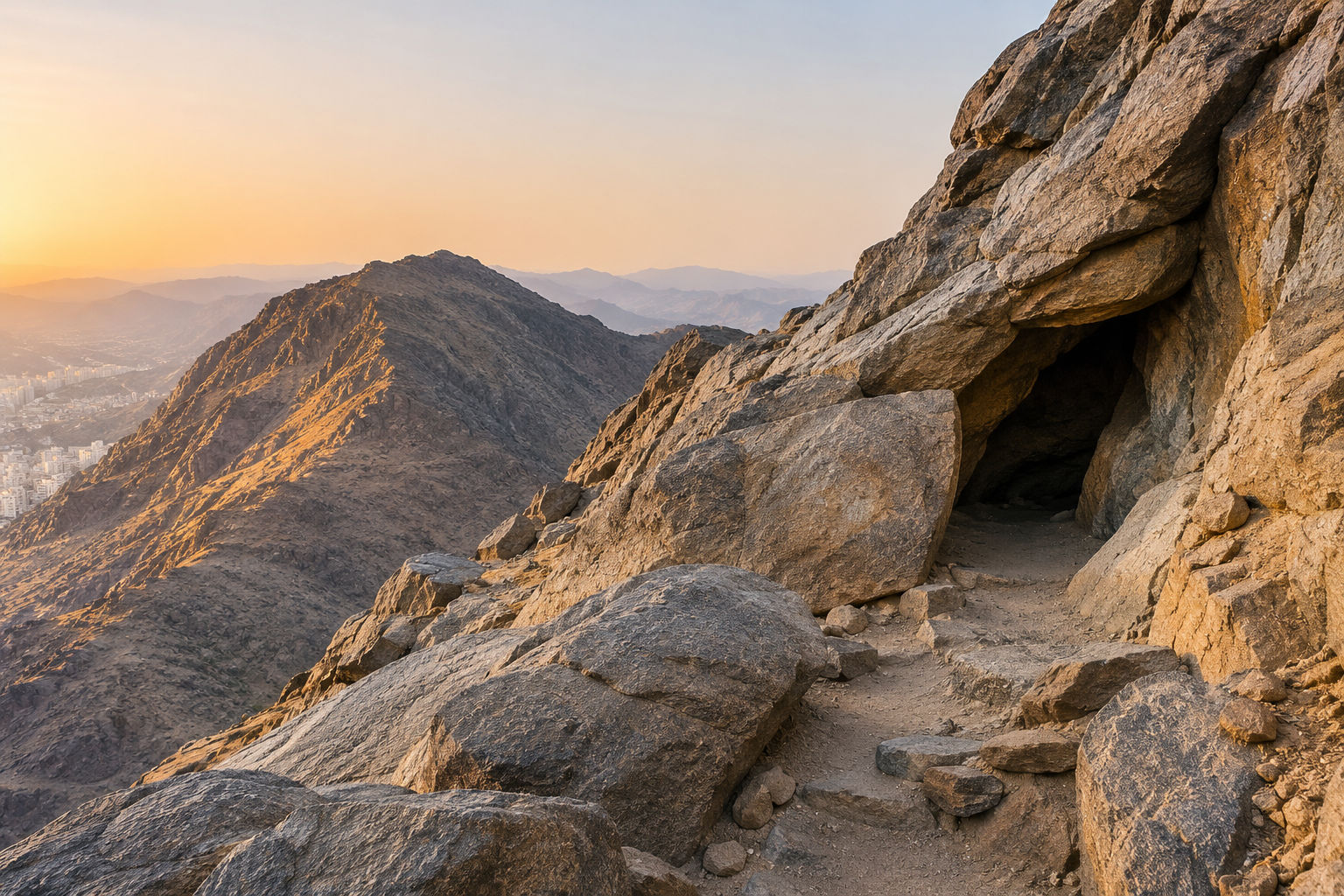
He returned home trembling, asking to be covered. He told Khadijah, “I fear for myself.” Her reassurance, preserved in the Hadith, rested on his character: she said Allah would never disgrace him, because he kept family ties, bore the burdens of the weak, helped those in need, honored guests, and assisted people in true hardship [B]. She took him to her cousin Waraqah ibn Nawfal, a Christian who knew the earlier scriptures. According to the report, Waraqah recognized the angel who came to Musa and said the Prophet would face rejection. Waraqah died soon after, and revelation paused for a time. Reports about how long the pause lasted vary, and none is firmly established [E]. Later Hadith describe the resumption with the call of Surah al-Muddaththir (74:1–5) [B], and Surah al-Duha (93:3) reassured him that his Lord had not abandoned him [A].
The First Muslims and the Call to Tawhid
Tawhid (التَّوْحِيد, the oneness of Allah) was the core message, the heart of Surah al-Ikhlas (112). Khadijah was the first to believe. Early sources name Abu Bakr as the first free man, Ali ibn Abi Talib as the first of the young, and Zayd ibn Harithah, a freed servant, as among the first [C]. Different traditions assign “first” in different categories, so they do not contradict one another. Abu Bakr’s invitation brought in others, such as Uthman, al-Zubayr, ‘Abd al-Rahman ibn ‘Awf, Sa‘d, and Talha [D].
Teaching began among trusted people for about three years in the traditional chronology. Early sources mention the house of al-Arqam ibn Abi al-Arqam near Safa as a gathering place [D]. Then the message went public. The Quran commanded him to warn his closest relatives (26:214) and to proclaim openly (15:94) [A]. Sahih Bukhari narrates that he stood on Mount Safa and called Quraysh to gather. He asked whether they would believe him if he warned of an approaching enemy. They said they had never known him to lie. He said he was a warner before a severe punishment, and Abu Lahab cursed him; Surah al-Masad (111) followed [B].
The early message included belief in the Hereafter, moral accountability, charity, justice, rejection of idolatry, and care for the vulnerable (Surah 107, 90:12–16, 17:23–26) [A]. It was not simply political reform. The believers included nobles such as Abu Bakr and Uthman, women, and people of modest status such as Bilal, Suhayb, Ammar, and Khabbab.
Why did Quraysh oppose it? Their reasons differed. Theologically, they were asked to abandon ancestral worship (43:22–23) and accept resurrection (36:78). Economically, some feared losing trade tied to shrines (28:57). Socially, the call challenged status when it welcomed slaves and the poor as equals. Tribal rivalries mattered too (43:31). Some opponents were hostile, others hesitant. Abu Talib protected him without accepting Islam, and several later opponents, such as Khalid ibn al-Walid and Amr ibn al-As, accepted Islam.
Persecution and Migration to Abyssinia
A Hadith in the tradition of Ibn Mas‘ud names the first to declare Islam openly: the Prophet, Abu Bakr, Ammar and his mother Sumayyah, Suhayb, Bilal, and al-Miqdad. The Prophet was protected by his uncle and Abu Bakr by his tribe, while the others were seized and pressured [B]. Bilal ibn Rabah, an enslaved man of Abyssinian origin, stayed firm despite pressure, and Abu Bakr bought and freed him [C]. Early sources report that Sumayyah was among the first martyrs [D], and we leave out unverified details. Sahih Bukhari narrates that the believer Khabbab complained to the Prophet about suffering; he reminded him that earlier believers had faced severe trials and that the matter would be completed, “but you are hasty” [B]. The Prophet himself was abused, as in the incident narrated by Ibn Mas‘ud when Quraysh leaders heaped filth on him while he prayed [B].
Around 615 CE, the Prophet advised some believers to seek refuge in Abyssinia, ruled by a Christian king, the Najashi (the Negus). Early sources report a first group of roughly eleven men and four women, followed by a larger party [C]. Quraysh sent envoys with gifts to demand their return. According to a report from Umm Salamah in Musnad Ahmad, graded acceptable by many scholars, Ja‘far ibn Abi Talib answered the king, describing how Islam had changed their lives: leaving idols and injustice for worship of Allah alone, truthfulness, kindness to relatives and neighbors, and prayer; then he recited from Surah Maryam, and the Najashi wept and refused to hand them over [C]. We paraphrase rather than quote it as a verbatim speech, because versions differ in wording. When the Najashi died, Sahih Bukhari reports that the Prophet informed the believers and led the funeral prayer in absentia [B]. This episode shows refuge shared across religions, though Muslims and Christians differ in their beliefs about Isa, and the Quran states its own view.
As Islam spread, Quraysh clans agreed to boycott the Prophet’s clan, Banu Hashim and Banu al-Muttalib: no marriage, no trade, and confinement largely to a ravine quarter of Makkah. Tradition places it for about three years, roughly 616–619 CE, but the exact dates are not fixed [D]. Sahih Bukhari preserves a report that Quraysh pledged at a site called Khayf Banu Kinanah to hold to their stand against him [B]. Not every member of Banu Hashim was Muslim; family loyalty held many together. The popular tale of termites eating the boycott document comes from the biographical tradition and should be treated as traditional [D].
The Year of Sorrow, Ta’if, and Isra and Mi‘raj
Around 619 CE, within a short time of each other, Khadijah and Abu Talib died. Later writers called this the Year of Sorrow (‘Ām al-Ḥuzn), a traditional label rather than a Quranic one [D]. Aishah later said she never felt jealous of any wife as she did of Khadijah because of how often he remembered her, and Sahih Bukhari records that Jibril conveyed Allah’s greeting and good news to Khadijah [B]. We do not imagine private scenes of grief. Sahih Bukhari and Muslim narrate that as Abu Talib was dying, the Prophet urged him to declare la ilaha illa Allah, but he died following the faith of his forefathers, and the Quran says Allah guides whom He wills (28:56) [A][B]. His protection had shielded the Prophet, and its loss left him far more exposed.
He went to Ta’if seeking support from the leaders of Thaqif, and was rejected and driven out, with Zayd ibn Harithah at his side according to early sources [C]. Aishah asked him whether any day had been harder than Uhud. In Sahih Bukhari and Muslim he replied that the day at Ta’if, with the people’s response, was the hardest; he walked on dazed until Qarn al-Tha‘alib, where the angel in charge of the mountains offered to crush the two mountains over the town. He refused, saying he hoped Allah would bring from their descendants people who worshipped Allah alone [B]. That patience was not passivity; it was a choice made while hurting. The long supplication often attributed to him at Ta’if comes from a weakly transmitted report, so we do not quote it as authenticated, even though its theme of turning to Allah in weakness is sound [E].
The Quran opens Surah al-Isra with the Isra, the Night Journey:
سُبْحَانَ الَّذِي أَسْرَىٰ بِعَبْدِهِ لَيْلًا مِنَ الْمَسْجِدِ الْحَرَامِ إِلَى الْمَسْجِدِ الْأَقْصَى
“Glory be to Him who took His servant by night from the Sacred Mosque to the Farthest Mosque…” (Quran 17:1, partial meaning) [A]
Authentic Hadith in Bukhari and Muslim describe the Mi‘raj, the ascension, and add that, after a discussion of the number, fifty prayers were reduced to five daily prayers [B]. Surah al-Najm (53:13–18) also refers to a vision of great signs of his Lord [A]. We describe none of the unseen scenes, because the sources speak of them in a way that should not be turned into images. Many scholars hold it was both bodily and spiritual, though views differ. No exact date is authenticated: it is placed before the Hijrah, with differing years and months proposed, and the popular 27th of Rajab has no firm proof [E].
The Hijrah to Madinah
The road to Madinah began in the pilgrimage seasons. Yathrib’s two main Arab tribes, the Aws and Khazraj, had been worn down by years of war, including the Battle of Bu‘ath mentioned by Aishah in Sahih Bukhari [B]. Around 620 CE, a small group of Khazraj men met the Prophet at Aqabah near Mina and accepted Islam. In the following year about twelve men took the First Pledge of Aqabah (bay‘ah, a pledge of allegiance): not to associate anything with Allah, steal, commit adultery, kill their children, or slander, as narrated by ‘Ubadah ibn al-Samit in Sahih Bukhari [B]. Mus‘ab ibn ‘Umayr was sent to teach them [C]. In 622 CE, about seventy-three men and two women took the Second Pledge of Aqabah, promising to protect him as they protected their own families, as narrated by Ka‘b ibn Malik [C]. Madinah was not uniform: besides Arab believers and non-believers, there were several Jewish tribes.
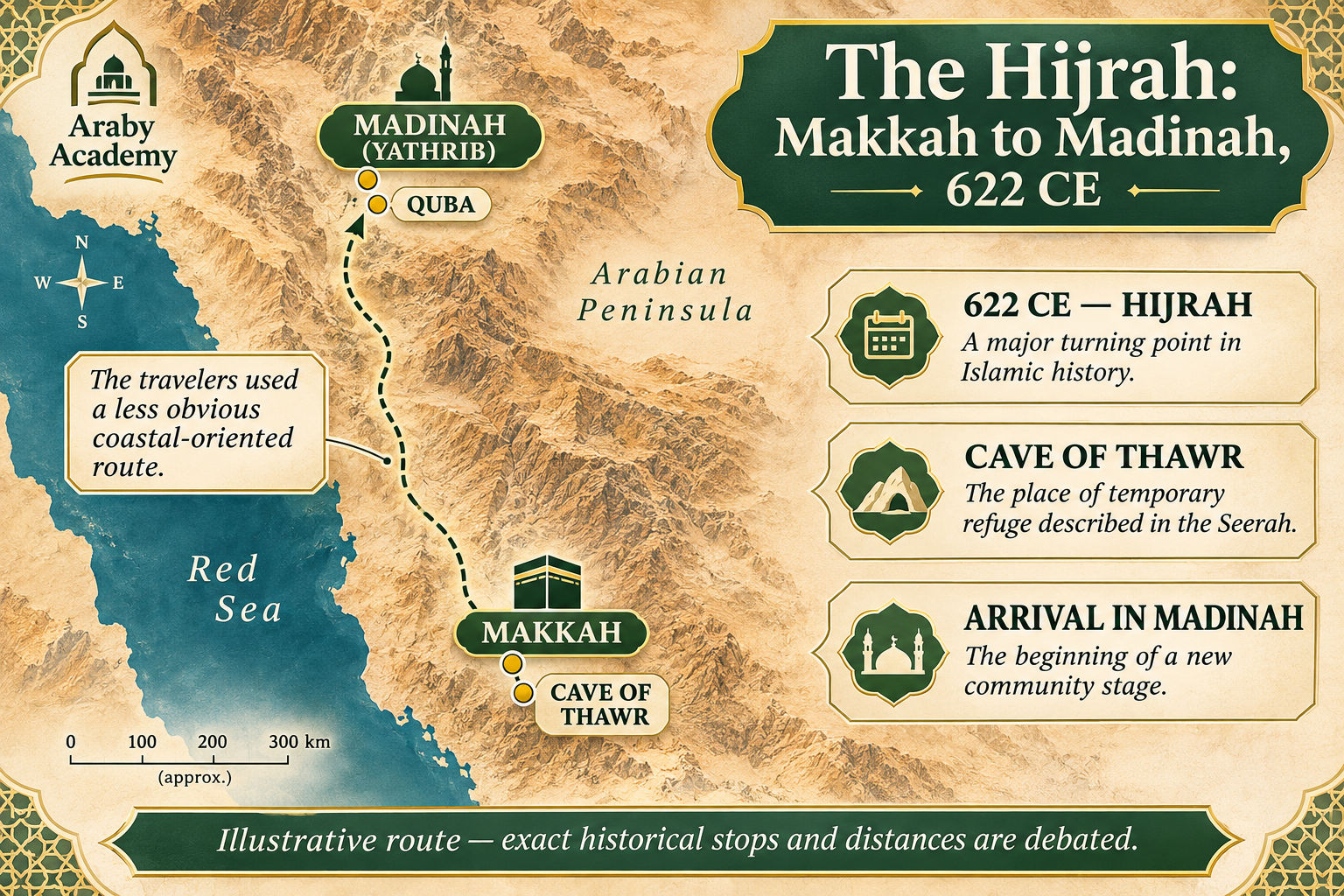
Quraysh plotted against him, as the Quran alludes (8:30) [A]. The Muslims left in small groups, and the Prophet waited for Abu Bakr. In the long narration of Aishah in Sahih Bukhari, they left Makkah by night [B]. They took shelter in the Cave of Thawr south of Makkah, a different mountain from Hira, for three nights, while ‘Abdullah ibn Abi Bakr gathered news, Asma’ bint Abi Bakr brought provisions, and ‘Amir ibn Fuhayrah managed the flock. Their guide, ‘Abdullah ibn Uraqit, was not Muslim but was trusted. Sahih Bukhari records Abu Bakr’s fear that a pursuer looking down would see them, and the Prophet’s reply: “What do you think of two, Allah being the third?” [B]. The Quran recalls it: “When he said to his companion, ‘Do not grieve; Allah is with us’” (9:40, لَا تَحْزَنْ إِنَّ اللَّهَ مَعَنَا) [A]. Popular tales add a spider’s web and doves at the cave. A spider’s web appears in a narration in Musnad Ahmad whose grading scholars debate, and the doves appear in later sources with weak support [E]. The Quran and Sahih reports already convey Allah’s protection without them.
They then traveled toward Madinah by a coastal route, avoiding the usual road. Sahih Bukhari mentions the pursuit by Suraqah ibn Malik, whose horse stumbled, and the safety he then requested [B]. Beyond these broad details, later reconstructions of exact stops and distances vary. We therefore avoid exact turns, stops, or distances that the sources do not give.
At Quba, on the edge of Madinah, he stayed with Banu ‘Amr ibn ‘Awf. Anas’s report in Sahih Bukhari says fourteen nights, while Ibn Ishaq says about four days, and sources differ on sequence [B][D]. The Quba mosque is traditionally regarded as the first mosque built after the Hijrah, and many commentators link it to Quran 9:108. His arrival in Madinah is traditionally placed on 12 Rabi‘ al-Awwal, around late September 622 CE. The famous song Tala‘a al-Badru ‘Alayna is popularly tied to this arrival, but its attribution comes from a chain with serious criticism, and some place it at his return from Tabuk, so we do not treat it as an established scene [E]. The Hijri calendar did not begin at the migration itself. It was introduced under Caliph Umar around 17 AH, after consultation, and counted from the Hijrah year; Sahl ibn Sa‘d says in Sahih Bukhari that Muslims reckoned from his arrival in Madinah [B]. The Hijrah did not simply change the Prophet’s address; it transformed the setting in which Muslims practiced their faith.
Building the First Muslim Community
The first major act in Madinah was building his mosque, Masjid al-Nabawi, on land purchased from two orphans. Anas narrates that palm trees were cut, the site cleared, and the walls built of mud brick with palm trunks, with the Prophet working alongside the believers [B]. We give no measurements the sources do not support. The mosque served for prayer, teaching, consultation, and receiving delegations; poor believers known as Ahl al-Suffah lodged at its edge [B].
The emigrants from Makkah are the Muhajirun (المُهَاجِرُون) and the Madinan believers who received them are the Ansar (الأَنْصَار, “helpers”). The Quran praises both (59:8–9) [A]. Bonds of brotherhood paired many of them. In a report in Sahih Bukhari, Sa‘d ibn al-Rabi‘ offered half his wealth to ‘Abd al-Rahman ibn ‘Awf, who declined and asked only to be shown the market, where he began trading [B]. Not every pairing in the sources is equally documented.
Historians also discuss the Charter (or Constitution) of Madinah, a text preserved by Ibn Ishaq and others that sets out rights and duties among the Muslims and other groups of Madinah, including Jewish tribes, in matters such as security and defense [D]. Scholars debate its dating, whether it is one document or several, and how to interpret specific clauses [F]. We treat it as an important early source, not as a fully authenticated verbatim Prophetic text clause by clause. Madinah’s Jewish tribes included Banu Qaynuqa‘, Banu al-Nadir, and Banu Qurayzah. Relations moved between cooperation and tension, and conflicts arose from specific political disputes with specific groups, not from religion as such. The Quran says Allah does not forbid kindness and justice toward those who do not fight believers over their religion (60:8) [A], and Sahih Bukhari reports that the Prophet stood for a Jewish funeral procession [B]. Individuals such as ‘Abdullah ibn Salam accepted Islam [B]. None of this should be generalized to Jewish people today.
Obligations came gradually. The direction of prayer changed from Jerusalem to the Kaaba (Quran 2:144), about sixteen or seventeen months after the Hijrah, according to al-Bara’ in Sahih Bukhari [A][B]. Fasting in Ramadan was prescribed (2:183–185), traditionally in 2 AH [C], and other duties, such as zakat and social and family rules, were established step by step. Obligations came gradually, and Madinah’s revelation addressed a community learning to live its faith in public.
Badr, Uhud, and the Battle of the Trench
Muslim emigrants had lost homes and property, and the Quran gave permission to fight those who wronged them (22:39–40) [A]. After skirmishes, the Battle of Badr took place on 17 Ramadan 2 AH, around March 624 CE, near wells southwest of Madinah. It arose when a Makkan army came to defend a caravan led by Abu Sufyan and met the Muslims, who numbered about 313 against roughly a thousand (Quran 8:5–19) [A][C]. The Muslims prevailed; Sahih Bukhari reports about seventy of Quraysh killed and seventy captured [B]. Surah al-Anfal (8:67–70) also addresses the handling of captives. Badr teaches reliance on Allah alongside preparation and consultation, and it belongs to a particular moment of a community at war, not to a general call for violence.
The Battle of Uhud followed in Shawwal 3 AH, around March 625 CE, when about 3,000 Makkans came to avenge Badr against roughly 700 Muslims. The Prophet placed archers on a hill and told them to hold their position, as al-Bara’ narrates in Sahih Bukhari [B]. When Muslims gained the upper hand, many archers left their posts, the Makkan cavalry circled round, and the Muslims suffered losses of about seventy, including the Prophet’s uncle Hamzah [B]. The Prophet himself was wounded, with his face injured and a tooth broken, according to Sahih Bukhari and Muslim [B]. The Quran speaks of the dispute and disobedience, and also of forgiveness (3:152–155), and says the setback came “from yourselves” (3:165) [A]. It avoids simple blame: the same passages mention fear, confusion, and pardon. A rumor that he was killed prompted Quran 3:144, which Abu Bakr would later recite at his death.
In Shawwal 5 AH, around 627 CE, a coalition (al-Ahzab, “the confederates”) of Quraysh and allied tribes, possibly about ten thousand, marched on Madinah in the Battle of the Trench (Ghazwat al-Khandaq, غَزْوَةُ الْخَنْدَق) [D]. The believers dug a defensive trench; Sahih Bukhari describes them digging in hunger and cold, with the Prophet carrying earth and, in Jabir’s report, binding a stone to his stomach in hunger [B]. The strategy is traditionally credited to Salman al-Farisi in early Seerah, but this is not in the Sahih collections, so it is a traditional attribution [D]. Surah al-Ahzab (33:9–11) recalls the fear and the winds and unseen forces that turned the siege back [A]. After the coalition withdrew, the Prophet said, in a report in Sahih Bukhari, that Quraysh would not attack them again and that the Muslims would now march against them [B].
The Prophet then moved against Banu Qurayzah, who were accused of breaking their agreement during the siege. They accepted arbitration by Sa‘d ibn Mu‘adh, whose ruling was carried out, as reported in Sahih Bukhari and Muslim [B]. Modern historians discuss details and numbers [F]. It concerned one tribe’s alleged breach of treaty, not a judgment on Jews as a people. Each of the three battles left a lasting lesson: preparation with trust at Badr, discipline at Uhud, and shared labor at the Trench.
The Treaty of Hudaybiyyah
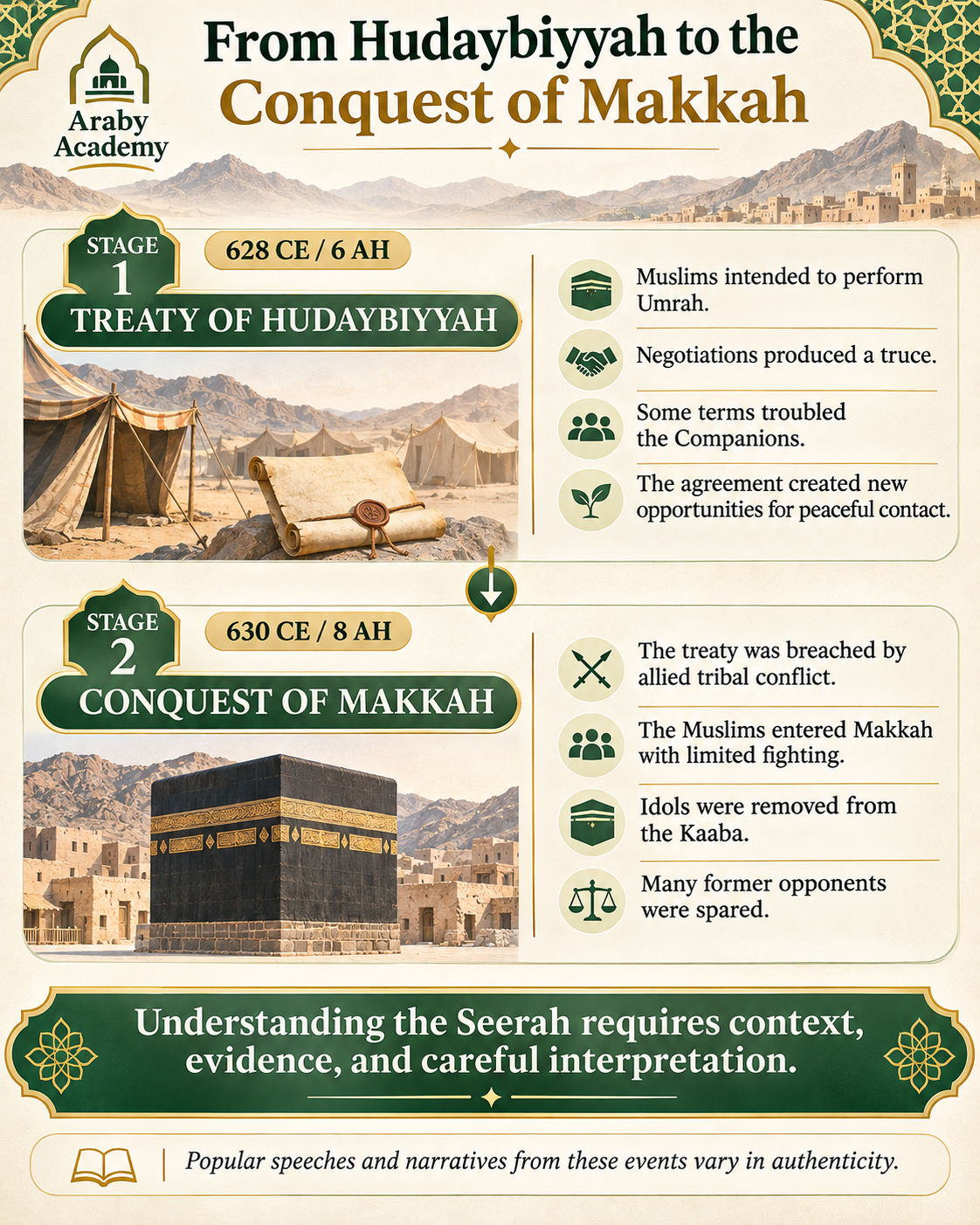
In Dhu al-Qa‘dah 6 AH, around March 628 CE, the Prophet set out for Makkah with about 1,400 Muslims (Jabir in Sahih Bukhari), wearing pilgrim garb and bringing sacrificial animals, intending ‘umrah [B]. Quraysh barred them, and negotiations took place at Hudaybiyyah, near Makkah, with Suhayl ibn ‘Amr as Quraysh’s envoy. Reported terms included a truce of about ten years, return the next year to perform ‘umrah, the return of anyone from Quraysh who came to the Muslims without his guardian’s permission, but not vice versa, and freedom for tribes to join either side [B][C]. Suhayl objected to the wording “in the name of Allah, the Most Gracious, the Most Merciful” and to “Messenger of Allah”, and the Prophet accepted the changes (al-Bara’, Sahih Bukhari) [B].
Many companions were troubled; ‘Umar questioned the terms. After the agreement, the Prophet told them to sacrifice and shave, and they hesitated until he did so himself, following the advice of Umm Salamah, as in Sahih Bukhari [B]. On the return journey Surah al-Fath began: “Indeed, We have granted you a clear victory” (48:1, إِنَّا فَتَحْنَا لَكَ فَتْحًا مُبِينًا) [A], and a report in Sahih Bukhari says ‘Umar asked if it was a victory, and he said yes [B]. The truce opened roads for travel and invitation, and Islam spread in the following period; early sources add that Khalid ibn al-Walid and ‘Amr ibn al-‘As accepted Islam around then [D]. The treaty was not simply a defeat; neither did everyone see its wisdom at once. It teaches patience, negotiation, and long-term judgment, though lessons should not be stripped of their circumstances [G].
After Hudaybiyyah, the Prophet sent letters inviting rulers and chiefs to Islam. Sahih Bukhari preserves the letter to Heraclius, including a verse from Quran 3:64, along with Abu Sufyan’s questioning by Heraclius [B]. For other letters, such as those to the Najashi, Khosrow, and the Muqawqis of Egypt, preserved wordings differ, and the authenticity of surviving texts is debated [F], so each should be judged separately.
The Conquest of Makkah
In Ramadan 8 AH, around January 630 CE, the Prophet marched on Makkah with a large force, traditionally about ten thousand. The immediate cause was that Banu Bakr, allied with Quraysh, attacked Khuza‘ah, allied with the Muslims, which Muslims saw as a breach of the Hudaybiyyah truce [C]. Sahih Bukhari and Muslim report that he gave safety to those who stayed in their homes, entered the Sacred Mosque, or sheltered in the house of Abu Sufyan, and that Makkah was entered with limited fighting [B]. At the Kaaba, he removed the idols, reciting “Truth has come and falsehood has vanished” (Quran 17:81) as Ibn Mas‘ud narrates in Sahih Bukhari, which reports about three hundred and sixty idols [A][B]. This was the removal of objects of polytheism from a house Muslims believe was built for the worship of one God.
Much is remembered about clemency, and early biographies relate a broad pardon speech, “Go, for you are free,” but that wording rests on a chain of limited strength, so we describe it without quoting [D]. What is firmly documented is that many former enemies were spared and later accepted Islam. Not everyone was treated identically: sources name a small number of people ordered to face consequences for specific crimes, and some of them were later pardoned [C]. Sahih Bukhari reports that one, Ibn Khatal, was killed [B]. It was an act of mercy with legal limits, not a blanket erasure of all consequences.
In Shawwal 8 AH came the Battle of Hunayn against Hawazin and Thaqif, which began with a reversal for the Muslims and ended in their favor (Quran 9:25–26) [A]; afterward the Prophet allowed Hawazin to recover their captives, as reported in Sahih Bukhari [B]. The following year, 9 AH, is known as the Year of Delegations, as tribes across Arabia sent envoys; Surah al-Nasr (110:1–3) speaks of people entering Islam in multitudes [A]. The conquest of Makkah marked a decisive change, but the Seerah did not end there.
The Farewell Pilgrimage and Final Sermon
In Dhu al-Hijjah 10 AH, around March 632 CE, the Prophet led the Farewell Hajj, teaching the rites as he performed them. Jabir’s long narration in Sahih Muslim gives its framework [B]. At ‘Arafah, he addressed the people, and the sermon is often called the Farewell Sermon. There is no single transcript. Popular English versions merge passages from several narrations, so we cite them separately:
Sahih Muslim (Jabir): blood and wealth are sacred, like the sanctity of that day, month, and land; pre-Islamic interest and blood-vengeance are set aside; fear Allah regarding women; he left the Book of Allah as guidance; and the people bore witness that he had conveyed the message [B].
Sahih Bukhari (Abu Bakrah): the sanctity of blood, property, and honor, and the instruction that those present should convey to those absent [B].
Musnad Ahmad: that no Arab has superiority over a non-Arab, nor a non-Arab over an Arab, except by taqwa, a report graded authentic by several contemporary scholars, whose wording some other scholars discuss [C].
Quran 5:3 states that on “this day” Allah perfected the religion and completed His favor: الْيَوْمَ أَكْمَلْتُ لَكُمْ دِينَكُمْ [A]. ‘Umar narrates in Sahih Bukhari that it was revealed at ‘Arafah on a Friday [B]. This does not mean the whole Quran came down at that moment; revelation continued until shortly before his death.
The Final Days and Death of Prophet Muhammad ﷺ
In 11 AH he fell ill. With his wives’ permission he stayed in Aishah’s room [B]. Aishah narrates that he told people to have Abu Bakr lead prayers, and Abu Bakr did [B]. Anas narrates that on the Monday of his death, he lifted the curtain and smiled as he saw the Muslims praying behind Abu Bakr [B]. Aishah reports that his last words were, “With the highest companion” [B]. He died in Madinah on a Monday in Rabi‘ al-Awwal 11 AH, around June 632 CE, at about 63 years of age (Aishah, Sahih Bukhari and Muslim) [B]. The common date of 12 Rabi‘ al-Awwal is debated, so no precise Gregorian day is given.
The community was stunned. In Sahih Bukhari, ‘Umar at first denied that he had died. Abu Bakr entered, kissed him, then spoke to the people: whoever worshipped Muhammad should know that Muhammad has died, and whoever worships Allah should know that Allah is alive and never dies. He recited Quran 3:144, “Muhammad is but a messenger; messengers have passed away before him” (وَمَا مُحَمَّدٌ إِلَّا رَسُولٌ) [A][B]. He was buried in the room of Aishah, where he had died. The later mosque layout around that room is not the original arrangement.
The Character of Prophet Muhammad ﷺ and His Family Life
The Quran describes him as being of great character (68:4), and when asked about his character Aishah said it was the Quran (Sahih Muslim) [A][B]. Reports from his household show it.
Family and humility. Aishah said he served his family, and when prayer came he went out to pray (Sahih Bukhari) [B]; Musnad Ahmad reports he mended his clothes and sandals [B]. After Khadijah, he married several wives, eleven in all according to classical sources, with nine alive at his death (Anas, Sahih Bukhari). The marriages involved widows, alliances, and social bonds [C]. Aishah bint Abi Bakr became a major teacher and narrator of Hadith. Classical sources, relying on reports in Sahih Bukhari and Muslim, give her age at marriage as young, while some modern scholars question the chronology based on other reports; this is a real discussion that deserves qualified scholarship, and we do not settle it here [B][F]. He also faced loss: Sahih Bukhari records tears at the death of his son Ibrahim, with the words that the eye weeps and the heart grieves, and he said only what pleases his Lord [B].
Children and the vulnerable. Abu Qatadah narrates that he carried his granddaughter Umamah while praying [B]. When a visitor said he never kissed his children, the Prophet replied that one who does not show mercy will not be shown mercy (Sahih Bukhari and Muslim) [B]. Anas served him for years and said he never told him “uff” or criticized what he had done [B]. He said that he and the guardian of an orphan would be close in Paradise (Sahl, Sahih Bukhari) [B]. In his Hajj sermon he urged fear of Allah regarding women. Reports about women show kindness and also rulings from the Madinan period; one report should not be read as describing everything [B].
Honesty, courage, mercy, worship. Quraysh at Safa affirmed his honesty. Anas narrates that when Madinah was alarmed by a noise at night, the Prophet had already ridden out to check and told them not to fear [B]. Quran 21:107 says, “We have not sent you except as a mercy to the worlds” (وَمَا أَرْسَلْنَاكَ إِلَّا رَحْمَةً لِلْعَالَمِينَ) [A]. Commentators connect this to guidance and compassion, and it does not mean he never faced conflict. Aishah reports that he prayed at night until his feet swelled, replying, “Should I not be a grateful servant?” (Sahih Bukhari) [B]. He fasted, remembered Allah often, and recited the Quran.
Why do Muslims say ﷺ? The phrase صَلَّى اللَّهُ عَلَيْهِ وَسَلَّمَ (ṣallā Allāhu ʿalayhi wa sallam) follows Quran 33:56, which says Allah and His angels send blessings on the Prophet and believers should do so too [A]. It is a prayer for him, not worship of him. In Islam he is Allah’s servant and messenger, not divine; the Quran has him say he is only a human being to whom revelation is given (18:110) [A]. Quran 33:40 calls him the Messenger of Allah and the seal of the prophets (وَخَاتَمَ النَّبِيِّنَ) [A].
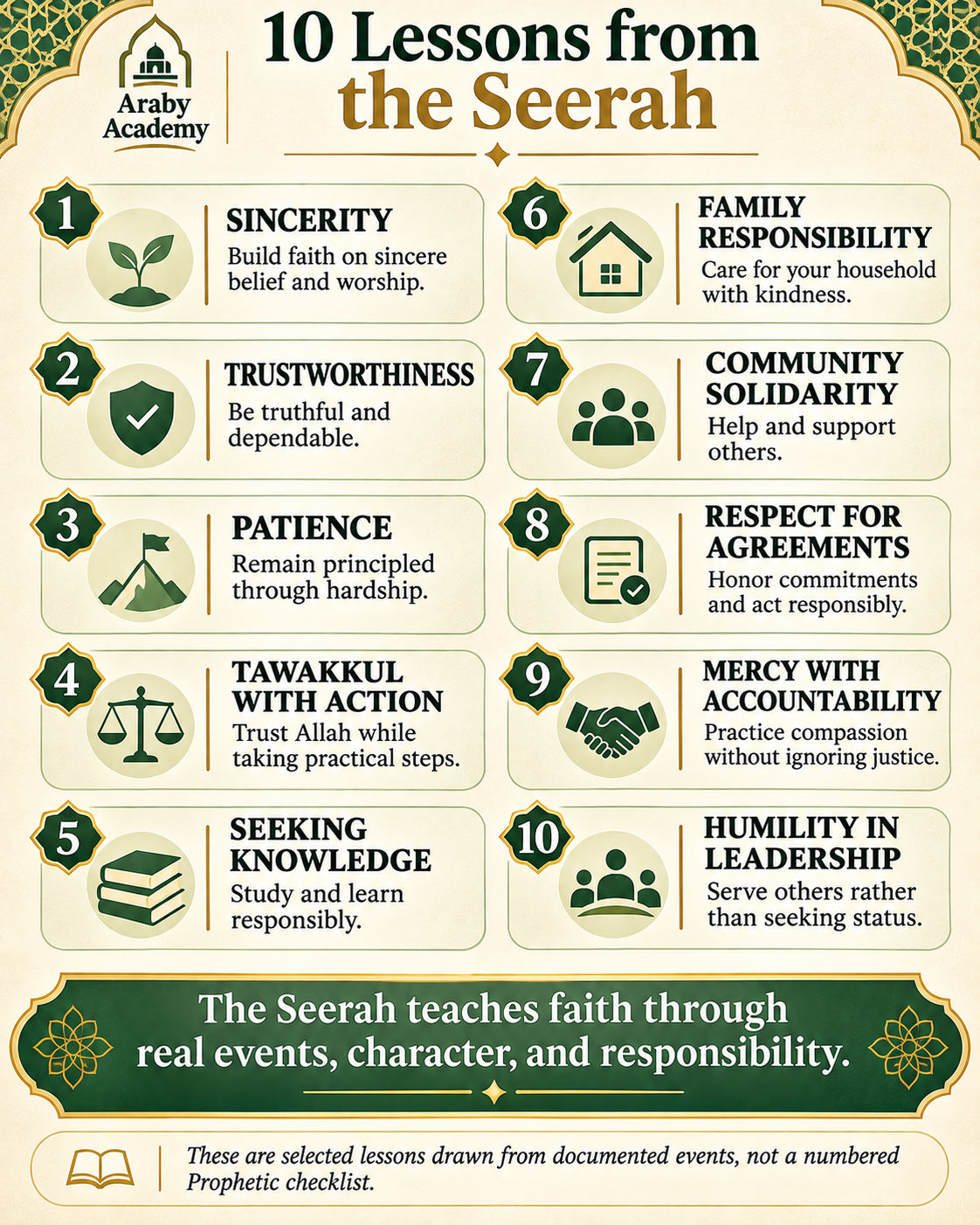
10 Lessons Muslims Can Learn from the Seerah
Sincerity in faith: the first revelation placed worship and reading under the name of the Lord (Quran 96:1–5).
Trustworthiness: Quraysh admitted they had never known him to lie (Safa report, Sahih Bukhari).
Patience under opposition: his reply at Ta’if, hoping for believers from the descendants of those who rejected him (Sahih Bukhari and Muslim).
Reliance upon Allah with action: the preparation for Hijrah and the words “Allah is with us” (Quran 9:40).
Seeking knowledge: the opening word iqra’ and the teaching circles of the early community.
Responsibility toward family: he served his household (Aishah, Sahih Bukhari).
Community solidarity: Muhajirun and Ansar, and shared digging at the Trench.
Respect for agreements: Hudaybiyyah, accepted even when hard.
Mercy with accountability: clemency at Makkah alongside legal consequences for specific offenses.
Humility in leadership: he worked alongside the believers building the mosque (Anas, Sahih Bukhari).
Each lesson is tied to a documented moment, so it should be read in context, not as a slogan. Timeless principles, such as honesty, mercy, and patience, can guide family, work, education, and community care today. Rulings tied to particular conditions need qualified scholars.
How the Seerah Helps Us Understand the Quran
Many passages respond to events in his life. Scholars call the study of these circumstances asbab al-nuzul, “occasions of revelation.” Not every verse has a single authenticated occasion. Revelation is classed as Makki or Madani, broadly before or after the Hijrah, with scholarly nuances; the terms are not purely geographic. Makki passages emphasize tawhid, the Hereafter, and moral foundations; Madani passages address community, law, and treaties, as tendencies, not strict rules. Examples: Surah al-‘Alaq with the beginning of revelation, passages of al-Anfal and Al ‘Imran tied to Badr and Uhud, and Surah al-Fath tied to Hudaybiyyah. A teacher of tafsir connects these with care.
15 Essential Arabic Seerah Words
Technical meanings developed over time, and not every term appears in the Quran with its later meaning.
Arabic | Transliteration | Meaning | Root | Beginner takeaway |
|---|---|---|---|---|
السِّيرَة | as-sīrah | Biography, life path | س-ي-ر | The story of his life |
النُّبُوَّة | an-nubuwwah | Prophethood | ن-ب-أ | Being chosen to receive news from Allah |
الرِّسَالَة | ar-risālah | The message, messengership | ر-س-ل | He was sent to convey it |
الوَحْي | al-waḥy | Revelation | و-ح-ي | How Allah communicated to him |
القُرْآن | al-Qur’ān | The Quran (recitation) | ق-ر-أ | Revelation received over about 23 years |
الدَّعْوَة | ad-da‘wah | Invitation, call | د-ع-و | The public call at Safa |
التَّوْحِيد | at-tawḥīd | Oneness of Allah | و-ح-د | The heart of the message |
الهِجْرَة | al-hijrah | Migration | ه-ج-ر | Leaving Makkah for Madinah |
المُهَاجِرُون | al-muhājirūn | Emigrants | ه-ج-ر | Those who left Makkah |
الأَنْصَار | al-anṣār | Helpers | ن-ص-ر | Madinan believers who supported them |
الأُمَّة | al-ummah | Community | أ-م-م | The shared community of believers |
السُّنَّة | as-sunnah | Way, practice | س-ن-ن | His teachings and example |
الْحَدِيث | al-ḥadīth | Report, speech | ح-د-ث | A narration with a chain |
الْغَزْوَة | al-ghazwah | Campaign he joined | غ-ز-و | Badr and the Trench are ghazwahs |
الأَخْلَاق | al-akhlāq | Character, ethics | خ-ل-ق | What Aishah linked to the Quran |
Frequently Asked Questions
Who was Prophet Muhammad ﷺ?
He was the final Prophet and Messenger in Islam, born in Makkah around 570 CE to the Quraysh tribe. He received revelation around age 40, called people to Allah alone, migrated to Madinah in 622 CE, and died in 632 CE.
What is the Seerah?
Seerah (السِّيرَة) is the biography of the Prophet ﷺ. It tells his life in order, drawing on the Quran, authenticated Hadith, and early historical works, and it differs from Hadith, which are individual reports.
When and where was Prophet Muhammad born?
He was born in Makkah around 570/571 CE. Tradition connects the year with the Year of the Elephant. The exact day and Gregorian date are disputed, though 12 Rabi‘ al-Awwal is widely reported.
Who were his parents, and was he an orphan?
His father was Abdullah ibn Abd al-Muttalib and his mother Aminah bint Wahb. Tradition says Abdullah died before his birth and Aminah when he was about six, so he was raised by his grandfather and then his uncle Abu Talib.
Who was Khadijah?
Khadijah bint Khuwaylid was a respected merchant of Makkah and the Prophet’s first wife, whom he married around 595 CE. She was the first to believe in him and supported him when revelation began.
How many children did he have?
Classical sources name seven: al-Qasim, Abdullah, Zaynab, Ruqayyah, Umm Kulthum, and Fatimah with Khadijah, and Ibrahim with Mariyah. All but Fatimah died before him. Hasan and Husayn were his grandsons.
What happened in the Cave of Hira?
Around 610 CE, in the cave on Jabal al-Nur, the angel Jibril brought him the first revelation, commanding him to read, as narrated by Aishah in Sahih Bukhari. He returned to Khadijah, who reassured him.
What was the first revealed passage?
The first five verses of Surah al-‘Alaq (96:1–5), which begin “Read in the name of your Lord who created,” are traditionally the first revealed passage.
Who was the first Muslim?
Reports differ by category: Khadijah is the first to believe, Abu Bakr the first free man, Ali among the first young people, and Zayd ibn Harithah among the first freed servants.
Why did Quraysh oppose Islam?
Motives varied: loyalty to ancestral worship, denial of resurrection, fear for trade and status, tribal rivalry, and discomfort with a message that treated the poor and enslaved as equals.
Why did some Muslims migrate to Abyssinia?
Around 615 CE, persecution in Makkah led the Prophet to advise some believers to seek refuge with the Christian ruler, the Najashi, who protected them.
What was the Year of Sorrow?
It is the traditional name for around 619 CE, when Khadijah and Abu Talib died within a short time. The label is traditional, not Quranic, and the Ta’if journey followed.
What was Isra and Mi‘raj?
It was the Night Journey from the Sacred Mosque to the Farthest Mosque (Quran 17:1) and the ascension described in authentic Hadith, in which the five daily prayers were prescribed. Its exact date is disputed.
Why did he migrate to Madinah, and when?
After the Aqabah pledges, Madinah’s believers offered protection, and danger grew in Makkah. The Hijrah took place in 622 CE, which later became the starting point of the Hijri calendar.
What happened at the Battle of Badr?
In Ramadan 2 AH, around March 624 CE, about 313 Muslims met a Makkan army of roughly a thousand near Badr and prevailed. The Quran refers to it in Surah al-Anfal.
What was Hudaybiyyah?
It was a truce in 6 AH, around 628 CE, between Quraysh and the Muslims, who were barred from ‘umrah. Surah al-Fath calls it a clear victory, and it led to wide peaceful contact.
When was Makkah conquered?
In Ramadan 8 AH, around January 630 CE, after the truce was breached. The idols were removed from the Kaaba, and many former opponents were pardoned.
What was the Farewell Sermon?
It was his address at ‘Arafah during the Farewell Hajj in 10 AH, stressing sanctity of life and property and responsibility. Popular versions are composites of several reports, so check each passage.
When did Prophet Muhammad die?
He died in Madinah in Rabi‘ al-Awwal 11 AH, around June 632 CE, aged about 63. He was buried in Aishah’s room.
How long did he preach in Makkah and Madinah?
He preached roughly thirteen years in Makkah and ten in Madinah, according to the commonly cited reports, which include some difference in counting.
What was his character like?
Sources describe honesty, mercy, patience, courage, humility, and devotion. Authentic reports also show grief and loss, and he served his family and was kind to children.
Why should Muslims study the Seerah?
It gives the setting of revelation, shows how the Quran was lived, and helps readers learn character responsibly. Study it with qualified teachers and authentic sources.
Why the Life of Prophet Muhammad ﷺ Still Matters
The Seerah is not merely an ancient story. It explains the setting of the Quran’s revelation and the life of the Prophet whom Muslims follow. It includes childhood, marriage, revelation, opposition, migration, leadership, family, negotiation, conflict, mercy, and worship. But study should not become admiration detached from evidence, and the best path is the Quran, authentic Sunnah, responsible scholarship, and qualified teaching.
The life of Prophet Muhammad ﷺ is best understood not as a collection of isolated inspirational stories, but as a continuous journey of revelation, worship, responsibility, and guidance. If you would like to keep learning Quran, Arabic, and Islamic Studies with qualified teachers, Araby Academy is here to help.