An Invisible Part of Your World
Think of an ordinary day. You wake up, pray, speak, work, study, make dua, read a page of Quran, help someone, make a mistake, repent, and go to sleep.
Islamic revelation teaches that this visible day is not the whole of reality. There are created beings we ordinarily cannot see. One carried revelation to the Prophet Muhammad ﷺ. Some record deeds. Some attend gatherings where Allah is remembered. Some are assigned to death, and some to rain or to Hell. Some will have roles on the Day of Judgment. They are الملائكة, Al-Mala’ikah: the angels.
This article will not turn the unseen into fantasy. We will keep asking one question: what has Allah actually told us about the angels?
The method of this article: Angels belong to al-Ghayb, the unseen. We describe them only as far as authentic revelation describes them. Where the Quran and Sunnah are silent, we stay silent.
Belief in Angels Is Part of Iman
Belief in angels is not a side topic. The Quran places it inside the definition of faith. Surah al-Baqarah describes true righteousness as believing in Allah, the Last Day, the angels, the Book, and the prophets (Quran 2:177). Later in the same surah: “The Messenger believes in what was revealed to him from his Lord, and so do the believers. All of them believe in Allah, His angels, His Books, and His messengers” (2:285). Surah al-Nisa’ warns that whoever disbelieves in Allah, His angels, His Books, His messengers, and the Last Day has strayed far (4:136).
The best-known summary comes from the Hadith of Jibril (Sahih Muslim 8, from ‘Umar ibn al-Khattab; also Sahih al-Bukhari 50, from Abu Hurayrah). Asked about Iman, the Prophet ﷺ answered that it is to believe in Allah, His angels, His Books, His messengers, the Last Day, and the divine decree (qadar), its good and its bad.
There is a beautiful irony here. The one who asked that question was himself an angel. Jibril came to teach the Companions what belief is, and belief in angels was part of the lesson.
What Does “Malak” Mean?
The Arabic singular is مَلَك (malak), “angel.” The plural is مَلَائِكَة (mala’ikah).
Arabic lexicographers disagree about where the word comes from. One view links it to a root meaning “message” or “sending,” so a malak is one who is sent. Another links it to a root of strength and authority. We should not pretend this is settled. The word’s etymology is a language discussion, and our theology comes from what revelation says about angels, not from tracing their name to a root.
What Are Angels in Islam? A Clear Definition
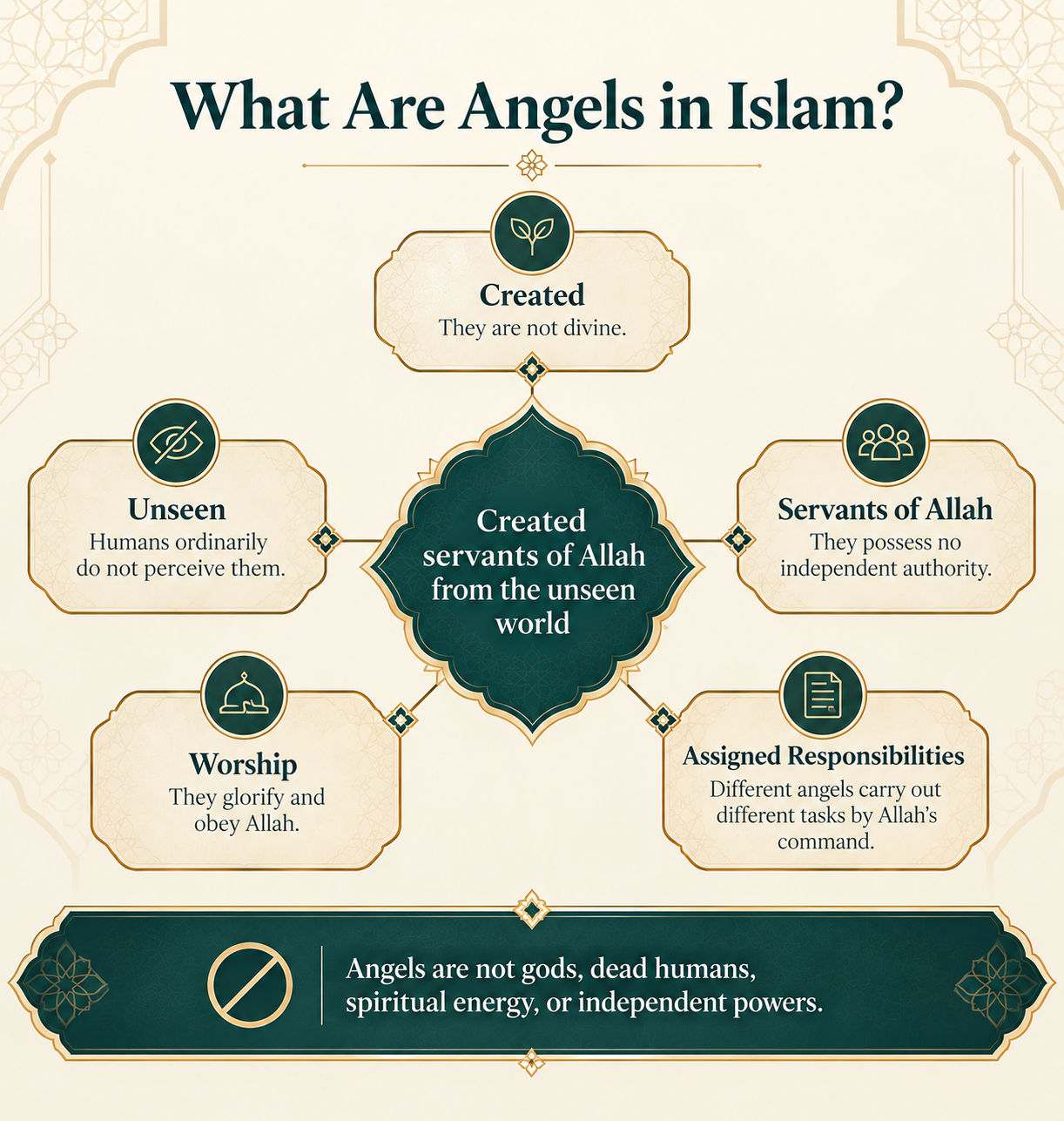
Angels are created servants of Allah, belonging to the unseen world, who worship Him and carry out the responsibilities He assigns to them.
Each phrase matters:
Created. They are not divine and had a beginning.
Servants of Allah. They share nothing of His authority. The Quran says even the angels nearest to Him do not disdain servanthood (4:172).
Unseen. Humans ordinarily cannot perceive them.
Worship. They glorify and obey Allah.
Assigned responsibilities. Different angels have different tasks.
By this definition angels are not “spiritual energy,” forces of nature, symbols, vibrations, demigods, independent powers, or the souls of the dead. Each phrase in the definition shuts a door that folklore likes to leave open.
Created, Not Divine
Pre-Islamic Arabs claimed the angels were Allah’s daughters. The Quran rejects this repeatedly, with some of its sharpest language (16:57; 17:40; 37:149–153; 43:19). Surah al-Zukhruf says they made the angels, “who are servants of the Most Merciful,” into females (43:19).
The conclusion is simple. Angels are honored creatures, not children of Allah, not gods, and not intermediaries to be worshipped. Allah alone creates, controls, and deserves worship.
What Are Angels Made Of?
Sahih Muslim (2996), from ‘Aisha رضي الله عنها, records the Prophet ﷺ saying that the angels were created from light, the jinn from smokeless fire, and Adam from what has been described to you (that is, clay).
That is everything revelation tells us here. This does not mean angels are photons, electromagnetic energy, “frequencies,” or something that can be measured. We believe the report as it came, “light,” and we do not turn the unseen into a physics experiment.
Were Angels Created Before Humans?
Surah al-Baqarah shows the angels present when Allah announced that He would place a khalifah on earth (2:30). So angels existed before humanity’s appointment on earth. The text does not give a cosmic timeline, and neither will we.
Obedient Servants: What Revelation Says About Their Nature
Do angels have free will? Can they disobey?
The Quran’s wording is direct. Of the angels of Hell it says: “They do not disobey Allah in what He commands them, and they do what they are commanded” (66:6). Elsewhere they are “honored servants who do not precede Him in speech and act only by His command” (21:26–27), and they “fear their Lord above them and do what they are commanded” (16:49–50).
“Free will” is a modern philosophical phrase, and the Quran does not use it for angels. The safest formulation is this: revelation teaches that angels do not rebel against Allah and carry out what He commands them. How angelic volition works is not described, so we do not speculate.
Do angels get tired of worship?
“They glorify Him night and day; they never slacken” (21:19–20). We should not picture this as human fatigue. The text simply tells us their devotion does not flag.
Do angels know everything?
No. When Allah taught Adam the names and asked the angels about them, they answered: سُبْحَانَكَ لَا عِلْمَ لَنَا إِلَّا مَا عَلَّمْتَنَا, “Glory be to You; we have no knowledge except what You have taught us” (2:32). Angels know what Allah teaches them. Knowledge of the unseen ultimately belongs to Allah.
Do angels eat, sleep, marry, or have children?
Eating. Ibrahim’s guests were angels in human form. He brought them a roasted calf, “but when he saw their hands did not reach for it, he became suspicious and fearful of them” (11:69–70; see also 51:24–28). Commentators such as Ibn Kathir understand the refusal to eat as part of what revealed them to him.
Sleeping. The Quran says they never slacken in glorifying Allah, but it does not give us a ruling or description of “angelic sleep.” We should not invent one.
Marriage and children. Revelation gives no family life for angels. The only thing it says in this area is a rejection of pagan claims that angels are Allah’s daughters. Do not build a biological theory beyond that.
Are angels male or female?
The Quran condemns those who “make the angels, who are servants of the Most Merciful, female” (43:19). Arabic grammatical gender does not tell us biological sex. So the careful answer is that Islam rejects calling angels female or Allah’s daughters, and revelation does not invite us to assign human biological categories to them.
Wings, Size, and Appearance
Surah Fatir opens by describing the angels as messengers “with wings, two, three, or four,” and adds يَزِيدُ فِي الْخَلْقِ مَا يَشَاءُ: “He adds to creation what He wills” (35:1). So there is no single wing count for every angel.
Sahih al-Bukhari (3232) and Sahih Muslim (174), from Ibn Mas’ud, report that the Prophet ﷺ saw Jibril with six hundred wings. This is a description of Jibril, not a template for angels in general. We also should not blend the descriptions of different angels into one generic picture. The sources give us scattered facts, not a portrait.
Jibril in his true form
The Prophet ﷺ saw Jibril in his real angelic form on two occasions. Sahih Muslim (177) reports ‘Aisha رضي الله عنها saying he saw Jibril in his true form, his vast form filling what is between sky and earth. The Quranic passages usually connected to this are Surah al-Najm 53:5–18 and Surah al-Takwir 81:19–23. The second describes the Quran as the word of “an honored messenger, possessing power, with the Lord of the Throne, secure, obeyed there, trustworthy” and says the Prophet ﷺ “saw him on the clear horizon.”
These passages are demanding, and commentators discuss who is referred to in each phrase. The Companions’ reports that Jibril is meant are the standard understanding, but readers who study Surah al-Najm in depth should read the tafsir directly and not rely on a summary.
Can angels appear as humans?
Yes, by Allah’s permission. The Quran gives several examples:
Angels visited Ibrahim as guests (11:69; 51:24–28).
Angels came to Lut as handsome young men (11:77–81).
Allah sent Jibril to Maryam, and “he appeared to her as a well-proportioned man” (فَتَمَثَّلَ لَهَا بَشَرًا سَوِيًّا, 19:17).
Jibril came to the Companions as a man in the famous hadith below.
This does not mean angels are humans. It means that Allah can let them appear in a human form.
Can ordinary people see angels? What about claims today?
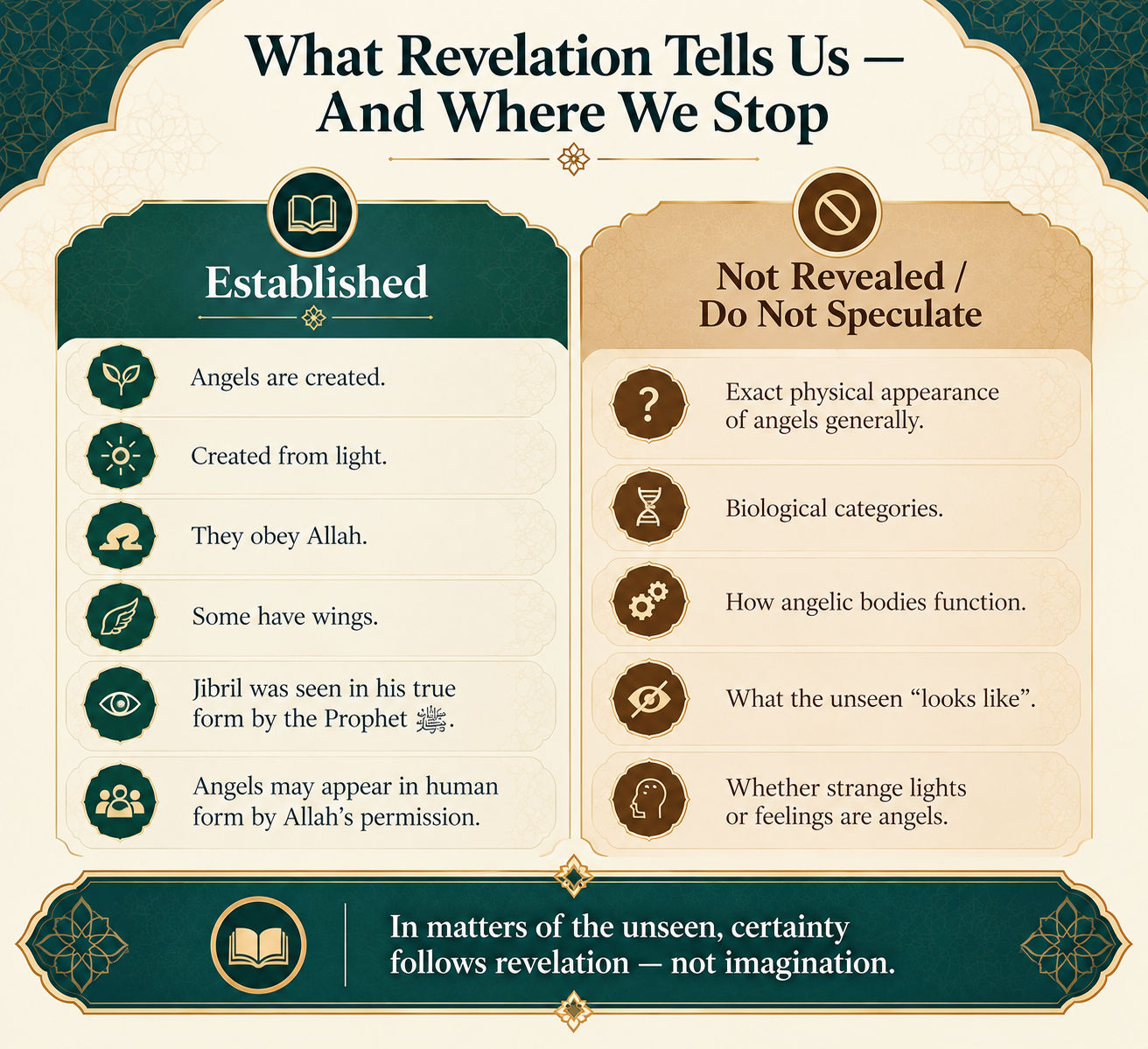
Ordinarily we do not see angels, and the Quran notes that Allah placed them beyond our normal perception (see 6:8–9). Revelation records some appearances, but we should not treat shadows, dreams, lights, coincidences, strangers, or odd feelings as certain angel encounters.
If someone says “I saw an angel,” respond gently. We need not ridicule or diagnose them. But a personal experience cannot establish doctrine, and no dream or vision can override the Quran and authentic Sunnah.
Jibril: The Angel of Revelation
جِبْرِيل (Jibril, also spelled Jibreel; “Gabriel” in English) is among the greatest of the angels. His defining role is carrying revelation by Allah’s command. Surah al-Baqarah says whoever is an enemy to Jibril should know that “he brought it down upon your heart by Allah’s permission” (2:97). Surah al-Shu’ara’ says “the Trustworthy Spirit” (الرُّوحُ الْأَمِين, al-Ruh al-Amin) brought the Quran down upon the Prophet’s heart (26:193–194). Commentators identify this Spirit as Jibril.
Jibril and the Quran
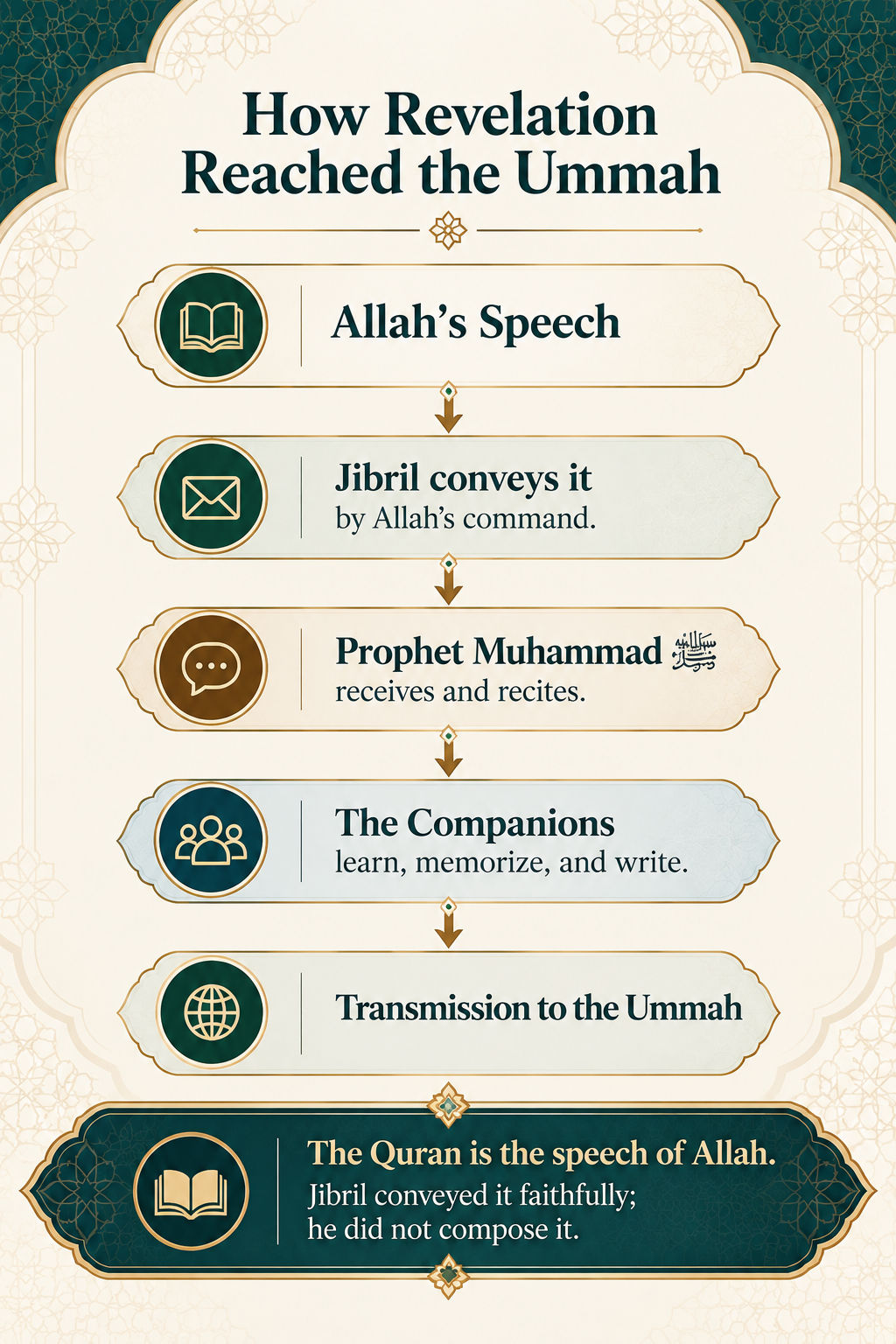
For Quran students this is where angels stop being abstract. The chain of transmission runs:
Allah’s speech → Jibril conveys it by Allah’s command → the Prophet Muhammad ﷺ receives and recites → the Companions learn, memorize, and write → transmission to the ummah.
Precision matters here. The Quran is the speech of Allah, not Jibril’s composition and not Muhammad’s. Jibril conveyed it faithfully by Allah’s command; he did not compose it. (For the full story of preservation, see our article How Was the Quran Preserved? From Revelation to the Mushaf We Read Today.)
The first revelation
In Sahih al-Bukhari (3), ‘Aisha رضي الله عنها narrates that in the Cave of Hira the angel came and said اقْرَأْ, “Read!” The Prophet ﷺ answered that he was not a reader. This happened three times, and then the angel recited the opening of Surah al-‘Alaq: “Read in the name of your Lord who created” (96:1). The Quran you open today began with an angelic command.
Reviewing the Quran each Ramadan
Sahih al-Bukhari (6), from Ibn ‘Abbas, reports that Jibril would meet the Prophet ﷺ every night of Ramadan to review the Quran with him. Sahih al-Bukhari (3624), from Fatimah رضي الله عنها, adds that in his final year Jibril reviewed it with him twice. This shows the care taken with the Quran during the Prophet’s lifetime. It does not by itself tell us the details of later manuscript standardization, which belongs to the preservation article.
The Hadith of Jibril
In the hadith of ‘Umar (Sahih Muslim 8), a man appeared among the Companions with intensely white clothes and intensely black hair, with no sign of travel on him, and none of them knew him. He sat close to the Prophet ﷺ and asked about Islam, Iman, Ihsan, and the Hour. When he left, the Prophet ﷺ told ‘Umar that it was Jibril, who had come to teach them their religion.
This hadith is foundational because it organizes the religion into three levels: outward practice, inward belief, and excellence of worship. The one who taught it was an angel.
Jibril and Maryam
In Surah Maryam, after she withdrew from her people, Allah sent “Our Spirit,” who appeared to her as a well-proportioned man (19:17). She sought refuge in the Most Merciful, and he told her he was only a messenger of her Lord (19:19). Commentators identify the Spirit here as Jibril.
Mika’il
مِيكَال (Mika’il, or Mikal in some Quranic transliterations) is named once in the Quran, alongside Jibril: whoever is an enemy to Allah, His angels, His messengers, Jibril, and Mika’il, Allah is an enemy to the disbelievers (2:98). The English “Michael” is the conventional equivalent. We will not turn this into comparative religion.
Many books say Mika’il is responsible for rain and vegetation. The Quran does not state this. The attribution appears in tafsir and later reports, and I know of no explicit Sahih hadith that states it. It is widely repeated, so treat it as a traditional attribution to be held with the right degree of confidence. What is firmly established is that he is a noble angel named in the Quran, and that the Prophet ﷺ invoked him by name along with Jibril (see the next section).
Israfil and the Trumpet
The Quran mentions الصُّور (al-Sur), the Trumpet or Horn, and says it will be blown (e.g., 39:68). It does not name who blows it.
The name Israfil is in an authentic hadith, but not as the blower: Sahih Muslim (770), from ‘Aisha, records the Prophet’s night-prayer supplication, “O Allah, Lord of Jibril, Mika’il, and Israfil...” So Israfil is a real, authentically named angel.
The link between Israfil and the Trumpet comes from other reports. There is a hadith, recorded by al-Tirmidhi and Ahmad from Abu Sa’id al-Khudri and graded authentic by a number of later scholars, in which the Prophet ﷺ speaks of “the one with the horn” who has the horn to his mouth and is waiting for permission. Scholars commonly identify him as Israfil, and the explicit connection of the name to the Trumpet rests largely on longer, less firmly graded narrations. So the careful statement is: Israfil is authentically named, and a large number of scholars identify him as the one who blows the Trumpet, though the Quran itself does not name the blower.
The Trumpet and the Last Day
“The Trumpet will be blown, and whoever is in the heavens and the earth will fall unconscious, except whom Allah wills. Then it will be blown again, and suddenly they will be standing, looking on” (39:68). The Trumpet is part of the Last Day’s events. Scholars have discussed the number of blasts (two, or three counting a blast of terror), and the details differ. We stay with what the Quran says plainly and do not build a timetable.
The Angel of Death
The Quran says: “Say, ‘The Angel of Death, who has been entrusted with you, will take your souls; then to your Lord you will be returned’” (32:11). The Arabic title is مَلَكُ الْمَوْت (Malak al-Mawt).
Is the Angel of Death named Azrael?
Myth check: “The Angel of Death is called Azrael in the Quran.”
Correction: The Quran gives a title, Malak al-Mawt, not a personal name.
“Azrael” or “‘Izra’il” is widespread in later Muslim culture and writing. I know of no authentic Prophetic text that establishes it as his name. It appears in later reports, some tied to Isra’iliyyat (material passed down from earlier scriptural communities and not verified by Islamic sources). The safest Quranic wording is “the Angel of Death,” Malak al-Mawt. We do not need to attack people who use the traditional name. We just separate revelation from later tradition.
One Angel of Death or many angels?
Surah al-Sajdah speaks of the Angel of Death. Other verses speak of “Our messengers” taking a soul, “and they do not neglect” (6:61), and of angels taking the souls of people in different states (16:28, 16:32). Commentators reconcile these by saying the Angel of Death has the assigned responsibility, and other angels may take part by Allah’s command. We do not know a “chart” of how this works, so we do not invent one.
Malik, the Keepers of Hell, and the Nineteen
مَالِك (Malik) is named in the Quran. The people of Hell call: “O Malik, let your Lord put an end to us,” and he replies that they will remain (43:77). Sahih al-Bukhari (1386, the long dream hadith) also describes Malik as the keeper of Hell.
The Quran also speaks of the keepers of the Fire (khazanat jahannam). Surah al-Muddaththir says: “Over it are nineteen” (74:30), and then: “We have made the keepers of the Fire none but angels, and We made their number only as a trial for those who disbelieve...” (74:31). That verse tells us the number is a test of faith. It is not a code. We do not add names, appearances, a hierarchy, or “Quran 19” numerology to it.
Harut and Marut
Surah al-Baqarah 2:102 mentions what was sent down “upon the two angels in Babylon, Harut and Marut.” It says they never taught anyone until they said, “We are only a trial, so do not disbelieve.” People learned from them what could cause separation between spouses, yet “they could not harm anyone with it except by Allah’s permission.”
That is what the Quran establishes: two named angels, a trial, and a warning against disbelief. A famous story adds a woman, wine, murder, and punishment by hanging. That story is not Quranic fact. It is reported in some books, but scholars such as Ibn Kathir judge it to be most likely drawn from Isra’iliyyat (traced back to Ka’b al-Ahbar) and not a sound Prophetic report. It also clashes with the Quran’s description of angels as not disobeying Allah. A small minority of early readers even read the word as “two kings.” Our rule is to keep the Quranic text separate from the added narrative.
The Recording Angels (Kiraman Katibin)
Surah al-Infitar says: “Indeed, over you are watchers, كِرَامًا كَاتِبِينَ, noble recorders, who know what you do” (82:10–12). Surah Qaf adds that two receivers sit “on the right and on the left,” and “he does not utter a word except that with him is a watcher ready” (رَقِيبٌ عَتِيدٌ, 50:17–18).
“Kiraman Katibin” is a description, not a pair of personal names. Popular names given to the two are not established.
What does the Sunnah add?
Sahih al-Bukhari (6491), from Ibn ‘Abbas, says Allah wrote down good and bad deeds and then clarified: whoever intends a good deed and does not do it, a full good deed is written for him; whoever intends it and does it, ten to seven hundred times or more is written. Whoever intends a bad deed and does not do it, a good deed is written; if he does it, one bad deed is written.
You may have heard that the angel on the left “waits six hours before writing a sin.” A report along these lines exists in later collections, but scholars differ on its grading, so we do not build a rule on it. What the strong evidence gives us is that Allah’s mercy surrounds the recording: good intentions are rewarded, and bad ones that are not acted on are not recorded as sins.
Do angels record our thoughts?
Sahih al-Bukhari (2528) and Sahih Muslim (127), from Abu Hurayrah, say Allah has forgiven my ummah what passes through their minds, so long as they do not speak or act on it. So we should distinguish thoughts, intentions, speech, and action. Passing thoughts are overlooked. Sincere good intentions are rewarded. Speech and action are recorded (50:18).
We also should not claim the recording angels have independent access to hearts. Allah alone has unlimited knowledge of the hidden. Likewise, the verse about the recorders does not mean every angel hears everyone, everywhere. It means that angels with this assignment carry out their task by Allah’s command.
Guardian Angels and the Mu’aqqibat
Surah al-Ra’d says: “For each person there are مُعَقِّبَات (mu’aqqibat), successive angels before him and behind him, who guard him by the command of Allah” (13:11). Commentators explain mu’aqqibat as angels who succeed one another in turn. Surah al-An’am says Allah “sends guardians over you” (6:61), and Surah al-Tariq says there is a guardian over every soul (86:4).
The Quranic idea is that Allah assigns angels to guard, by His command. This is different from the Western idea of a single personal “guardian angel” who guides your destiny. The texts speak in the plural, and we do not name a lifelong angel companion for each person. And protection ultimately comes from Allah, so we ask Allah for protection and not the angels.
Angels in a Muslim’s Day
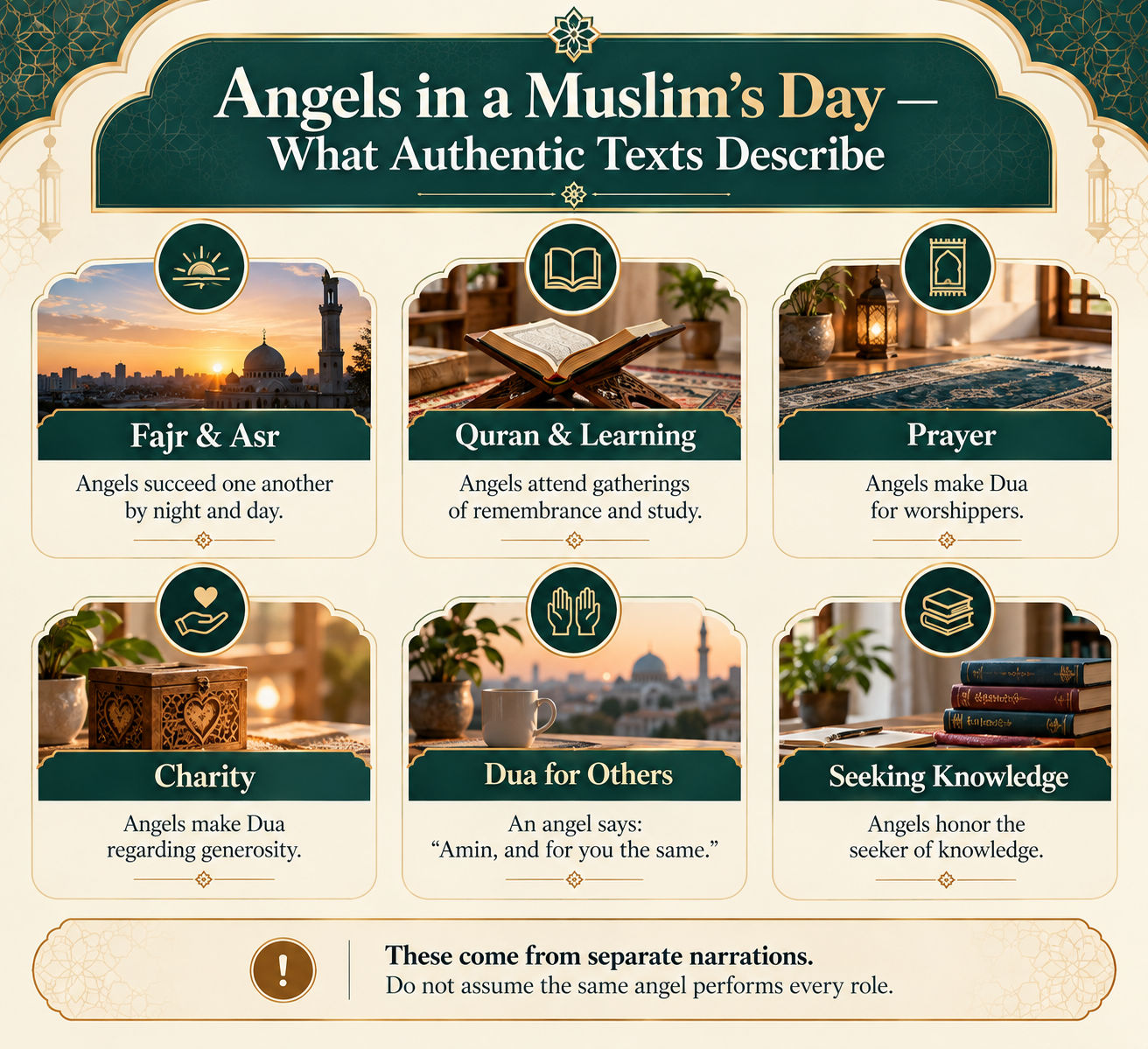
Some authentic texts describe angels’ involvement in everyday worship. They are separate narrations, each with its own scope, and we should not merge them into one universal statement or imagine the same angel doing all of these.
Night and day angels
Sahih al-Bukhari (555) and Sahih Muslim (632) report that angels succeed one another among you by night and day, and they gather at Fajr and ‘Asr. Those who stayed with you ascend, and their Lord asks them, though He knows best, how they left His servants. They say, “We left them praying, and we came to them while they were praying.” The question is not because Allah needs a report. It is an honoring of the worshippers.
Gatherings of remembrance and learning
Sahih al-Bukhari (6408) and Sahih Muslim (2689) describe roaming angels who search for people remembering Allah. Sahih Muslim (2699) says that when people gather in a house of Allah reciting and studying the Book together, tranquility descends on them, mercy covers them, angels surround them, and Allah mentions them to those with Him. This gives real meaning to authentic gatherings of remembrance and study. It does not mean a tingle or a feeling proves angels have arrived.
The Quran
Sahih al-Bukhari (5018) and Sahih Muslim (796) report that Usayd ibn Hudayr was reciting Surah al-Baqarah at night when his horse shied. He saw something like a canopy of lamps rising. The Prophet ﷺ told him they were angels who had come near to listen to his recitation, and that had he continued, people would have seen them. This is a specific incident. It does not mean every unusual light during recitation is an angel.
Prayer and forgiveness
A worshipper who stays in his place of prayer has angels saying, “O Allah, forgive him, O Allah, have mercy on him” (Bukhari and Muslim, from Abu Hurayrah).
Allah and His angels send blessings on the first row (Sunan Abu Dawud, graded authentic by scholars such as al-Albani).
Allah, His angels, and the creatures of the heavens and earth send blessings on the one who teaches people good (Jami’ al-Tirmidhi, graded hasan/sahih).
What does “the angels’ salah” mean? Commentators, citing early authorities mentioned by al-Bukhari, explain that Allah’s salah is His praise and mercy, and the angels’ salah is their dua and seeking of forgiveness.
Surah Ghafir shows this in the Quran itself. “Those who carry the Throne and those around it glorify their Lord with praise, believe in Him, and ask forgiveness for the believers” (40:7–9). We do not try to visualize the Throne or the angels carrying it.
Charity
Sahih al-Bukhari (1442) and Sahih Muslim (1010) report that every morning two angels descend. One says, “O Allah, give the spender a replacement,” and the other, “O Allah, give the one who withholds loss.” It is a reminder to give generously. It is not a guaranteed financial formula.
Salam upon the Prophet ﷺ
Sunan al-Nasa’i (from Ibn Mas’ud), graded authentic by scholars such as al-Hakim and al-Albani, records that Allah has roaming angels who convey to the Prophet ﷺ the greetings of his ummah. We should not claim a specific angel does nothing but carry every individual salawat without authentic evidence.
Dua for someone absent
Sahih Muslim (2732), from Abu al-Darda’, says that when a Muslim makes dua for his brother in his absence, the angel appointed over him says: “Amin, and for you the same.” It is a powerful encouragement to pray for others.
Visiting the sick
Jami’ al-Tirmidhi (from ‘Ali) says that when a Muslim visits a sick Muslim in the morning, seventy thousand angels pray for him until evening, and the same applies if he visits in the evening. Some narrations are mawquf (traced to ‘Ali rather than the Prophet ﷺ), though many scholars accept it as authentic. We qualify the grading and avoid inflating the number.
Seekers of knowledge
Sunan Abu Dawud and Jami’ al-Tirmidhi (from Abu al-Darda’) report that angels lower their wings for the seeker of knowledge, pleased with what he does. Scholars discuss the chain, and many grade it hasan or sahih. Commentators explain the “lowering of wings” as humility, respect, and help, and do not insist on a literal picture of how that looks.
Do Angels Enter Our Homes?
Sahih al-Bukhari (3225) and Sahih Muslim (2106) report the Prophet ﷺ saying that angels do not enter a house containing a dog or images. In Sahih Muslim (2104), Jibril delayed visiting him because of a dog under his bed.
Scholars such as al-Nawawi explain that these are the angels of mercy, not the recording angels, who do not leave a person. We should not read this to mean that no angel at all ever enters a house with an image.
Dogs. The same Sunnah permits dogs for hunting, herding, and farming (Bukhari and Muslim). Islamic law discusses dogs separately in terms of purity, ownership, and use. This hadith is not a license to be cruel to animals.
Images. The classical term is suwar, and understanding it takes fiqh context. Contemporary scholars discuss how those rulings apply to modern photography, ID photos, medical images, and children’s drawings. This article does not issue a verdict on that.
Bells. Sahih Muslim (2113) reports that angels do not accompany a company with a dog or a bell. This is about travel, specifically bells on animals. Do not stretch it to doorbells, school bells, or phone notifications.
Bad smells. Sahih Muslim (564), from Jabir, says that whoever eats garlic or onions should not approach our mosque, “for the angels are harmed by what harms the children of Adam.” This is mosque etiquette, not superstition.
Do angels leave when you sin? Online posts claim this, but no authentic text establishes that the recording angels abandon a person because of sin. Some weak reports exist about angels distancing from specific acts. We do not build a rule on them.
Angels, Death, and the Hereafter
At death
Surah al-Nahl contrasts the two experiences: angels take the souls of the righteous “in a good state,” saying, “Peace be upon you, enter Paradise for what you used to do” (16:32), while wrongdoers meet a harsher scene (16:28; 47:27).
Musnad Ahmad and Sunan Abu Dawud record a long hadith from al-Bara’ ibn ‘Azib on the soul’s departure. Many scholars, among them Ibn al-Qayyim, regard it as authentic, though a few have raised criticism of a narrator in the chain. If you use it, summarize responsibly and do not add the embellishments that circulate online.
In the grave
Sahih al-Bukhari (1338), from Anas, reports that when a servant is placed in his grave, two angels come and ask about the Prophet ﷺ. The believer answers that he is Allah’s servant and messenger. The names Munkar and Nakir come from a hadith in Jami’ al-Tirmidhi (from Abu Hurayrah) that al-Tirmidhi calls hasan and that later scholars also accept as hasan. The Bukhari and Muslim reports speak of “two angels” without these names.
Our focus should be on the idea of questioning and on firmness upon faith, not on sensational grave imagery.
On the Day of Judgment
Surah al-Fajr says the Lord will come “and the angels, rank upon rank” (89:22). Surah al-Haqqah says angels will stand on the edges of the sky and that eight will carry the Throne above them (69:17). Sahih Muslim (2842) says Hell will be brought with seventy thousand reins, each held by seventy thousand angels. The point is the vast number and the greatness of that Day, not a cinematic sequence.
In Paradise
Surah al-Ra’d says that angels will enter upon the people of Paradise from every gate: سَلَامٌ عَلَيْكُم بِمَا صَبَرْتُمْ, “Peace be upon you for what you patiently endured” (13:23–24). (See What Is Jannah Like? A Quranic Guide to Paradise in Islam.)
How many angels are there?
We do not know the number. Sahih al-Bukhari (3207) and Sahih Muslim (162), in the Isra’ and Mi’raj narration, say that seventy thousand angels enter al-Bayt al-Ma’mur (the frequented house in the heavens) every day and do not return to it again. The point is vast numbers and constant worship. It is not a basis for an exact count.
Angels, Jinn, and Humans

Angels, jinn, and humans are three distinct creations. The Prophet ﷺ taught that angels came from light and jinn from smokeless fire (Muslim 2996). The table below stays with what revelation says.
Question | Angels | Jinn | Humans |
|---|---|---|---|
Created from | Light (Muslim 2996) | Smokeless fire (Quran 55:15; Muslim 2996) | Clay (Quran 55:14; Muslim 2996) |
Usually unseen | Yes | Yes | No |
Obedience | Described as not disobeying Allah (66:6) | Can believe or disbelieve (72:11–14) | Can believe or disbelieve |
Food | Ibrahim’s guests did not eat (11:70) | Eat (Muslim 450 on bones; Muslim 2017) | Eat |
Reproduction | Not described | Have offspring (18:50) | Yes |
Death | Not specified in detail | Die (Bukhari 7383) | Die |
Iblis | Not an angel | Iblis was of the jinn (18:50) | Not applicable |
Role in revelation | Jibril carried revelation | Not carriers of revelation | Prophets received it |
Becoming another kind after death | No | No | Do not become angels |
Where revelation is silent, the table says so. We never fill the gap with assumptions.
[Visual 4 goes here: see the image plan.]
Was Iblis an angel?
No. Surah al-Kahf says: “...except Iblis; he was كَانَ مِنَ الْجِنِّ (one of the jinn), so he departed from the command of his Lord” (18:50). Angels do not disobey Allah (66:6), and Iblis did, so the Quran itself distinguishes them.
Why does Iblis appear in the account where angels are told to prostrate? The standard explanation is that he was present among them and was therefore addressed by the command, though not one of them by nature. Some early reports attributed to Ibn ‘Abbas describe him as from a tribe of angels called “jinn.” Al-Hasan al-Basri and many later scholars, including Ibn Kathir, held that the Quran’s direct wording settles it: he was a jinn. This is not a contradiction in the Quran.
The angels and Adam
When Allah announced a khalifah on earth, the angels asked: “Will You place therein one who causes corruption and sheds blood, while we glorify You with praise and sanctify You?” (2:30). Most commentators do not read this as rebellion. It is a question seeking understanding, and Allah answers: “I know what you do not know.” The angels then concluded with the acknowledgment we saw earlier: “We have no knowledge except what You have taught us” (2:32).
The angels were then commanded to prostrate to Adam (2:34). That was obedience to Allah, not worship of Adam. It was a commanded act at a particular moment, and it is not a model for imitation in the Shari’ah we follow today, in which prostration is for Allah alone.
(Classical scholars also discussed whether angels or the righteous among humans are better. It is a scholarly debate, not a basic article of faith for beginners.)
What Angels Are Not: Cherubs, Dead Humans, and “Angel Numbers”
Not cherubs. Popular Western art shows angels as winged babies, women in white dresses, humans with halos, or glowing figures. These conventions come from later artistic traditions, and we do not need to mock anyone to say that Islam derives its beliefs from the Quran and Sunnah, not from paintings.
Not dead humans. A person does not become an angel after death. Humans remain humans, angels remain angels, jinn remain jinn. If a grieving friend says, “Heaven gained another angel,” receive it with gentleness. They are expressing love, and you can later explain the difference kindly.
Not energy. Angels are not frequencies, vibrations, crystals, chakras, or tools for “manifestation.” None of that comes from revelation.
Angel numbers
Modern “angel numbers” such as 111, 222, 333, 444, 555, and 11:11 come from modern numerology and New Age belief. They are not part of Islamic teaching. No verse or authentic hadith says that angels send messages through repeated number patterns. So “444 means Jibril is protecting you,” “11:11 means your dua is accepted,” and “222 means angels approve your relationship” are all unsupported. A Muslim should not assign unseen meaning to a number pattern without revelation. Allah’s help is sought by dua and effort, not by decoding clocks.
Dreams
Islam recognizes true dreams, but not every dream is a divine message. A beautiful person in a dream is not necessarily an angel, and not every light is Jibril. No dream can establish creed or change what is halal and haram. If you are troubled by an experience, speak to a trusted teacher.
Should We Pray to Angels? Can They Protect Us?
We do not call on Jibril, Mika’il, the Angel of Death, or a “guardian angel” for independent help. Angels are servants of Allah, and worship and dua belong to Him alone. Angels may be assigned by Allah to guard, but protection ultimately comes from Allah. So we ask Allah.
Teaching Children About Angels
Teach children these eight points: angels are real; Allah created them; they obey Allah; we usually cannot see them; Jibril brought revelation; angels record deeds; some guard by Allah’s command; we worship Allah, not angels.
Avoid cartoon theology, invented angel characters, and threats such as “the angel wrote that down and Allah will punish you!” Recording angels should teach accountability, mercy, tawbah, and good deeds. They should not produce fear or obsession. A child who learns that angels record the good they do, and that Allah forgives those who repent, grows up with hope and responsibility together.
How Belief in Angels Changes Daily Life
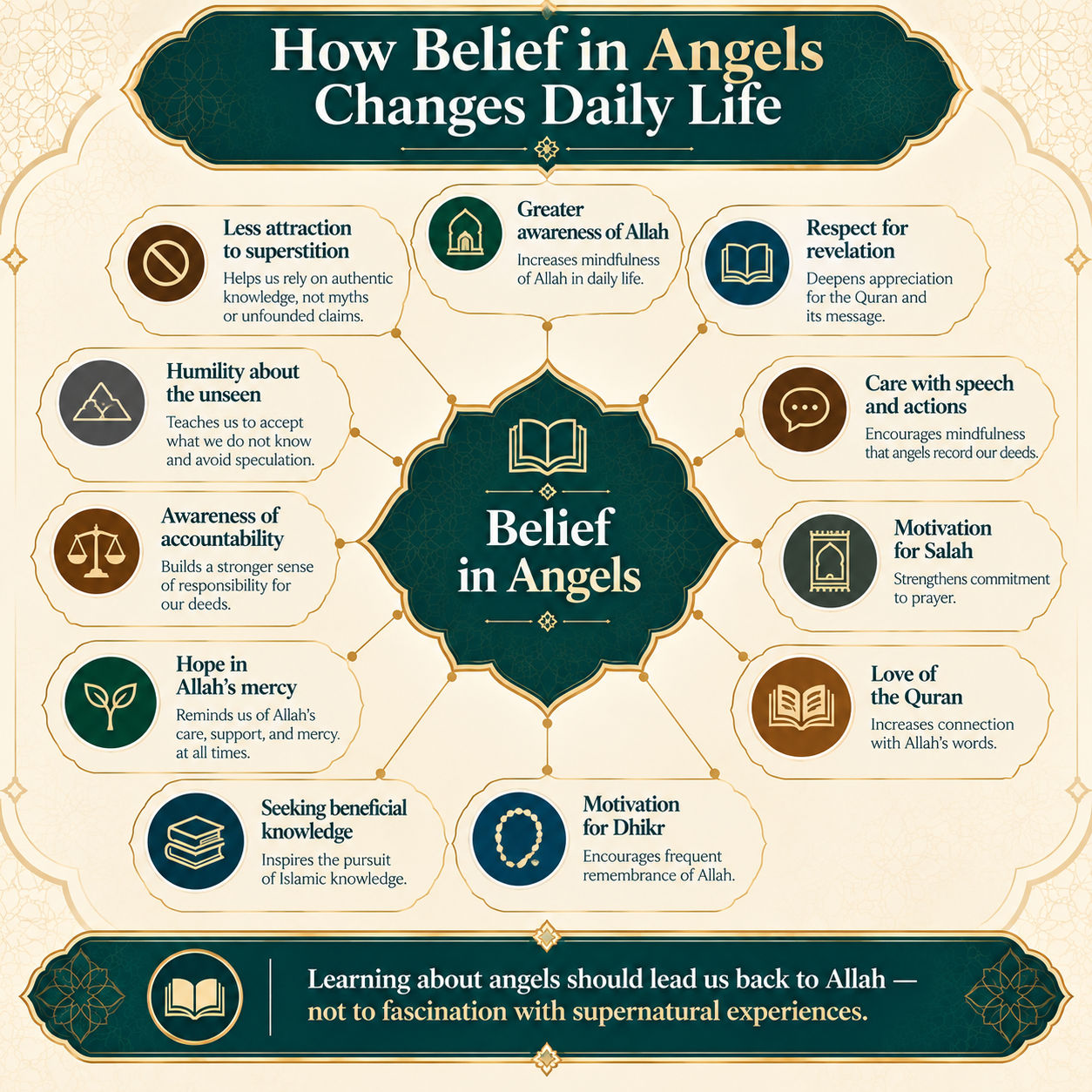
Properly understood, belief in angels should leave us with:
Greater awareness of Allah.
Respect for revelation.
More care with speech and actions.
Motivation for Salah.
Love of the Quran.
Motivation for dhikr and seeking knowledge.
Hope in Allah’s mercy.
Awareness of accountability.
Humility about the unseen.
Less attraction to superstition.
Speech
“Not a word does he utter but there is a watcher ready” (مَا يَلْفِظُ مِن قَوْلٍ إِلَّا لَدَيْهِ رَقِيبٌ عَتِيدٌ, 50:18). Before gossip, insults, lies, harsh online comments, or cruel messages, remember that speech matters. The purpose is taqwa, not paranoia.
Digital life
A phone does not create a morally separate universe. An anonymous comment, a private message, backbiting, spreading false information, and viewing what is prohibited all remain actions. So do helping someone, teaching beneficial knowledge, giving charity, and encouraging good. We do not claim angels interact with phones. The principle is moral accountability.
Loneliness
Do not tell yourself, “I’m never alone because my guardian angel is my friend.” Islam places comfort in Allah, who knows us, hears us, and is aware of us. Revelation also teaches that Allah has angels carrying out His commands around the human world. Keep Allah, not angels, at the center.
Which Angels Are Named? An Evidence Map
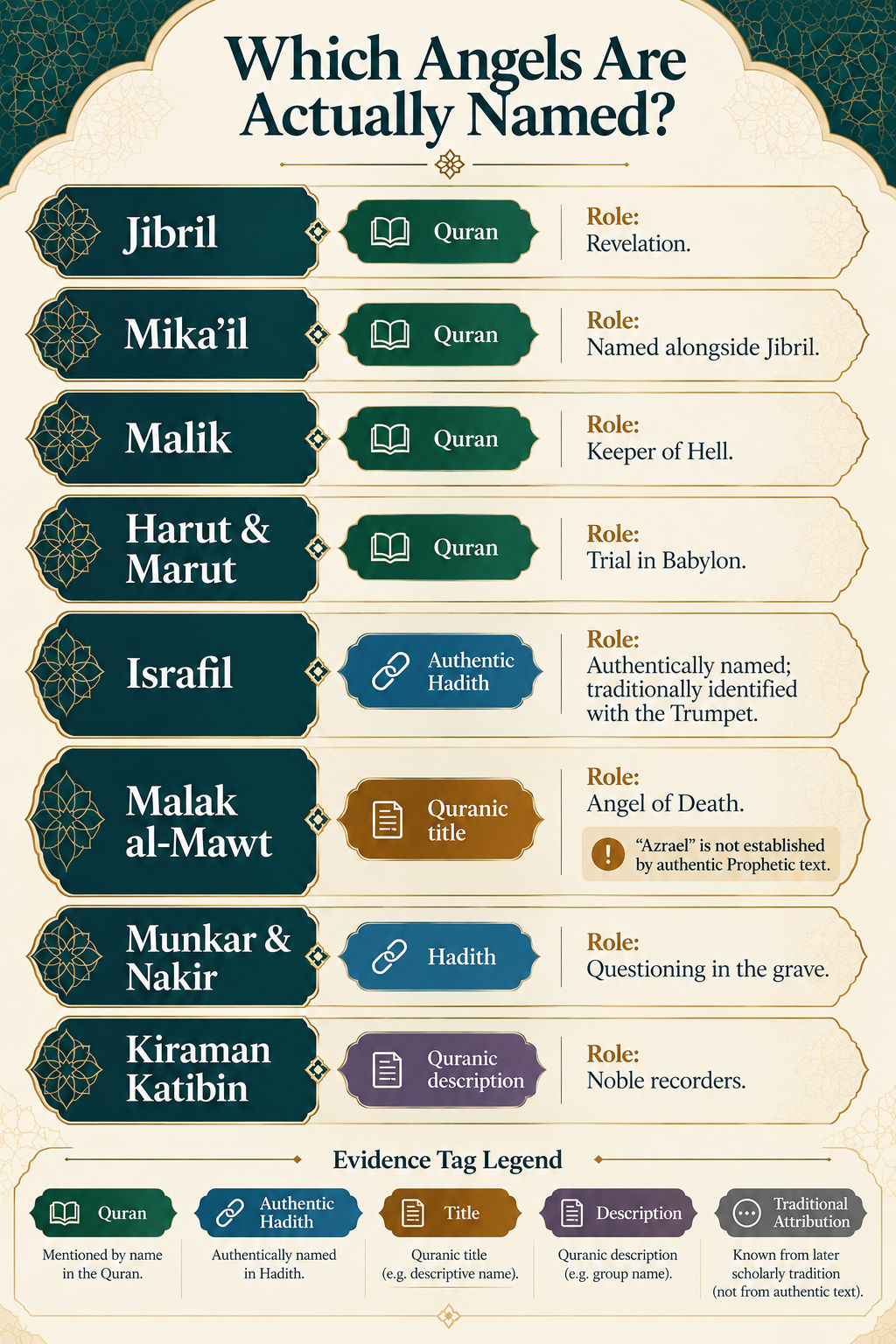
Not every name in children’s books has a source. Before assigning a name, ask whether it is in the Quran, in an authentic hadith, only in tafsir, from Isra’iliyyat, or from later tradition, and whether it is a title or a description. Each row below carries its own evidence label.
Name / Description | Arabic | Source | Authentically named? | Established role | Caution |
|---|---|---|---|---|---|
Jibril | جِبْرِيل | Quran 2:97–98; hadith | Yes (Quran) | Carried revelation | Not the author of the Quran |
Mika’il | مِيكَال | Quran 2:98 | Yes (Quran) | Named alongside Jibril | Rain/vegetation role is traditional, not explicit in the Quran |
Malik | مَالِك | Quran 43:77 | Yes (Quran) | Keeper of Hell | Do not depict or elaborate |
Harut and Marut | هَارُوت وَمَارُوت | Quran 2:102 | Yes (Quran) | A trial sent in Babylon | Famous stories are not Quranic fact |
Israfil | إِسْرَافِيل | Muslim 770; later reports | Yes (hadith) | Invoked by the Prophet ﷺ; widely identified as the one with the Trumpet | Link to the Trumpet rests on weaker explicit reports |
Angel of Death | مَلَكُ الْمَوْت | Quran 32:11 | Title, not a personal name | Takes souls | “Azrael” is not established by an authentic Prophetic text |
Munkar and Nakir | مُنْكَر وَنَكِير | Tirmidhi (hasan) | Yes (hadith) | Question in the grave | Grave imagery should not be sensationalized |
Kiraman Katibin | كِرَامًا كَاتِبِينَ | Quran 82:10–12 | Description, not names | Record deeds | Popular personal names are not established |
Treat any list of “ten angels every Muslim must know” with caution until each name is traced to its source.
Quranic Arabic Vocabulary
Learning the vocabulary helps you read the verses above directly. In each case, the meaning comes from how revelation uses the word, not from the word alone.
Arabic | Transliteration | Core meaning | Where it appears | Safe takeaway |
|---|---|---|---|---|
مَلَك | Malak | Angel | Throughout | A created servant of Allah |
مَلَائِكَة | Mala’ikah | Angels | 2:285 | Belief in them is part of Iman |
جِبْرِيل | Jibril | Gabriel | 2:97 | Carried revelation |
مِيكَال | Mika’il | Michael | 2:98 | A named angel |
مَلَكُ الْمَوْت | Malak al-Mawt | Angel of Death | 32:11 | A title, not “Azrael” |
كِرَامًا كَاتِبِينَ | Kiraman Katibin | Noble recorders | 82:11 | Deeds are recorded |
رَقِيب | Raqib | Watcher | 50:18 | Words are observed |
عَتِيد | ‘Atid | Ready, present | 50:18 | Always prepared |
مُعَقِّبَات | Mu’aqqibat | Successive attendants | 13:11 | Guards by Allah’s command |
الرُّوحُ الْأَمِين | Al-Ruh al-Amin | The Trustworthy Spirit | 26:193 | Identified as Jibril |
الصُّور | Al-Sur | The Trumpet | 39:68 | Not to be confused with al-Sur (السُّور, walls) |
Common Myths About Angels
Myth | Correction |
|---|---|
Angels are dead humans. | They are a separate creation. |
Angels are female. | The Quran rejects calling them female (43:19). |
They’re “spiritual energy.” | The hadith says light; do not turn it into physics. |
Every angel has two wings. | 35:1 gives varied numbers; Jibril has six hundred. |
Iblis was an angel. | 18:50 says he was of the jinn. |
Azrael is named in the Quran. | The Quran says Malak al-Mawt. |
The Quran names Israfil as the blower of the Trumpet. | The Quran mentions the Trumpet without naming the blower. |
Angel numbers are Islamic. | They are not from the Quran or Sunnah. |
444 means angels are protecting you. | No authentic evidence. |
Humans become angels. | Humans and angels remain distinct. |
Angels know everything. | They know what Allah teaches them (2:32). |
You can pray to your guardian angel. | Dua is for Allah alone. |
Every strange light is an angel. | Subjective experience does not establish unseen claims. |
Angels abandon you after a sin. | No authentic evidence for this claim. |
Every popular named angel is in the Quran or Sunnah. | Each name must be verified. |
Frequently Asked Questions
1. What are angels in Islam? Created servants of Allah, from the unseen world, who worship Him and carry out His commands.
2. What are angels made of? Light, according to Sahih Muslim 2996. Do not extend this into physics.
3. Why do Muslims believe in angels? Because the Quran and Sunnah teach it, and belief in angels is part of Iman (2:285).
4. Can angels disobey Allah? The Quran describes them as not disobeying Allah (66:6).
5. Do angels have free will? The Quran does not use that phrase. It says they obey Allah and do what they are commanded.
6. Do angels have wings? Some do (35:1). Jibril is reported with six hundred.
7. Can humans see angels? Not ordinarily. Revelation records angels appearing in human form by Allah’s permission.
8. Who is Jibril? The angel who carried revelation to the Prophets, including the Quran to Muhammad ﷺ.
9. Who is Mika’il? An angel named in the Quran (2:98). The rain and vegetation role is traditionally attributed to him.
10. Who is Israfil? An angel named in an authentic hadith (Muslim 770) and widely identified by scholars as the one who blows the Trumpet.
11. Is the Angel of Death named Azrael? The Quran calls him Malak al-Mawt. “Azrael” is not established by an authentic Prophetic text.
12. What are Kiraman Katibin? The “noble recorders” of Surah al-Infitar who record deeds.
13. Does everyone have guardian angels? The Quran speaks of angels who guard by Allah’s command (13:11). It does not describe a single named personal angel.
14. Do angels record our thoughts? Speech and actions are recorded. Passing thoughts are overlooked unless acted on or spoken, and good intentions are rewarded (Bukhari and Muslim).
15. Do angels enter houses with dogs or pictures? Hadith say the angels of mercy do not enter such houses. Scholars distinguish them from the recording angels and discuss how the rulings apply today.
16. Was Iblis an angel? No. He was of the jinn (18:50).
17. Do humans become angels after death? No.
18. Are angel numbers like 444 part of Islam? No.
Conclusion: Believing in What You Cannot See
The Muslim lives in a visible world of people, homes, work, screens, roads, food, money, and problems. Revelation teaches that reality is larger than what the eyes perceive. Angels remind us that the Quran came through real revelation, that our actions and words matter, that worship matters, that death is not the end, and that Allah’s creation extends beyond our senses.
But we do not end with fascination with angels. The angels themselves worship Allah, obey Allah, glorify Allah, and carry out His commands. The more correctly we understand the angels, the less likely we are to worship creation, and the more clearly we see the greatness of the Creator.
Islam does not teach us about angels so that we can chase supernatural experiences. It teaches us about angels so that our faith in Allah, revelation, accountability, and the unseen becomes more real.