Your First Umrah Can Feel Overwhelming
You may have dreamed about seeing the Ka'bah for years. Then the trip becomes real, and excitement mixes with worry.
Where do I enter Ihram? What exactly is Miqat? What do I say? What if I'm on a plane? How many times do I circle the Ka'bah? Do I need a different Dua for every round? What happens at Safa and Marwah? Do women cut their hair? What if I make a mistake? What if I don't speak Arabic?
Take a breath. Umrah has a clear structure, and it is much simpler than it looks from the outside. Once you understand the sequence, and learn to tell the real Sunnah apart from the cultural additions that circulate in booklets and videos, most of the anxiety fades.
This guide answers one question: "I've never performed Umrah before. What exactly do I do, in what order, and what do I need to know before I go?" It explains how to perform Umrah step by step, from preparation and Miqat to Ihram, Tawaf, Sa'i and the final haircut. It is written for first-timers, converts, non-Arabic speakers, elderly pilgrims, families and women, and it flags the places where scholars differ so you can follow the guidance of the scholar or school you trust.
What Is Umrah?
Umrah is an act of worship performed at the Sacred Mosque (Masjid al-Haram) in Makkah. It consists of:
Ihram, entering a sacred state with the intention to perform Umrah,
Tawaf, seven circuits around the Ka'bah,
Sa'i, walking seven lengths between the hills of Safa and Marwah,
Halq or Taqsir, shaving or shortening the hair, which ends Ihram.
How it differs from Hajj. Hajj takes place on specific days of Dhul Hijjah and includes further rites (Arafah, Muzdalifah, Mina, stoning the Jamarat, sacrifice) with its own conditions and rulings. Umrah has its own, shorter structure and can generally be performed at other times of the year, subject to current rules and operational restrictions set by the authorities.
Its ruling. Scholars differ. The Shafi'i and Hanbali schools hold that Umrah is obligatory once in a lifetime for those able; the Hanafi and Maliki schools hold that it is a strongly emphasised Sunnah (sunnah mu'akkadah). Either way, it is a beloved act of worship, and the Prophet ﷺ said that one Umrah to the next is an expiation for what lies between them (Bukhari and Muslim).
This guide covers a stand-alone Umrah. Umrah combined with Hajj (Tamattu') has additional details that are outside its scope.
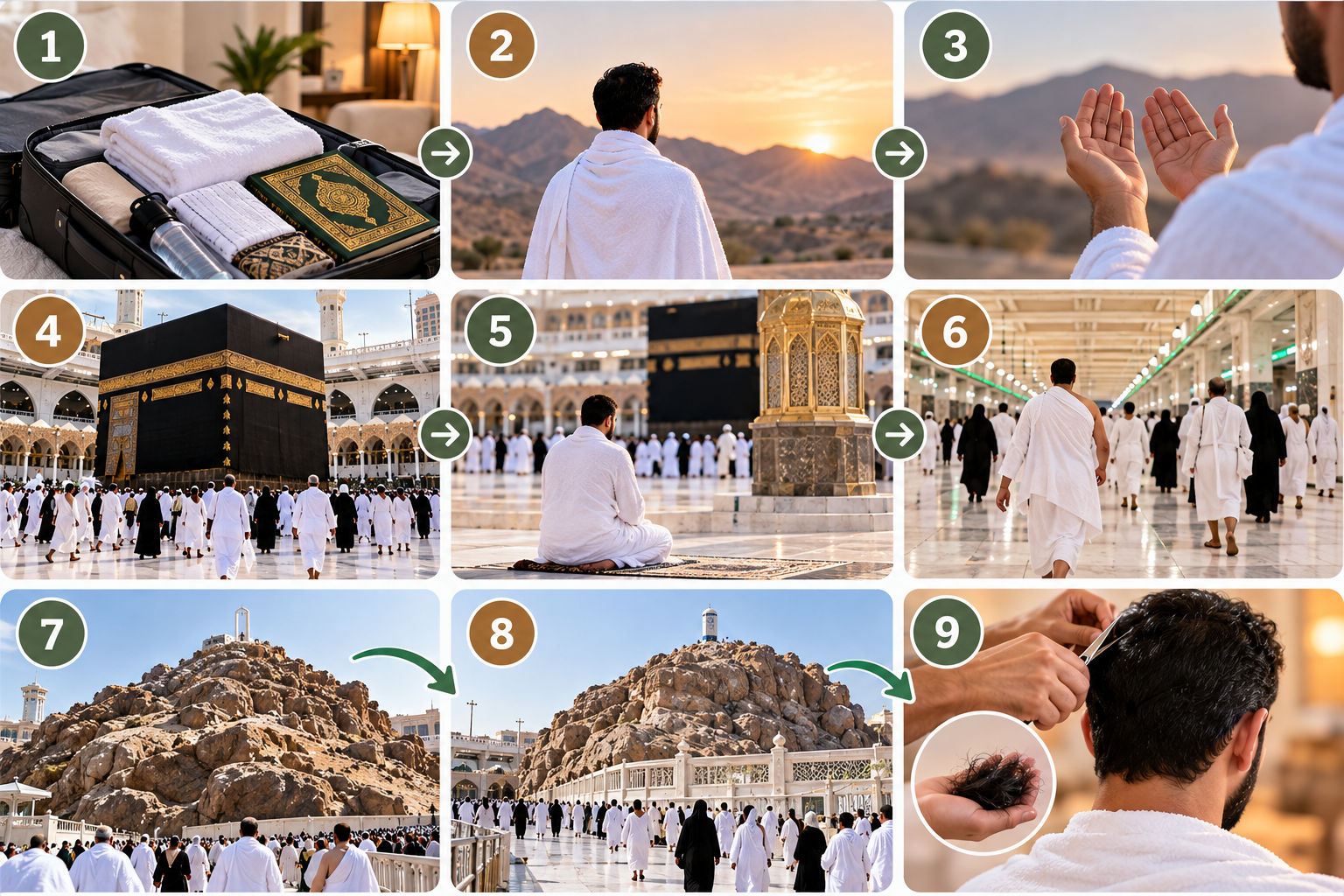
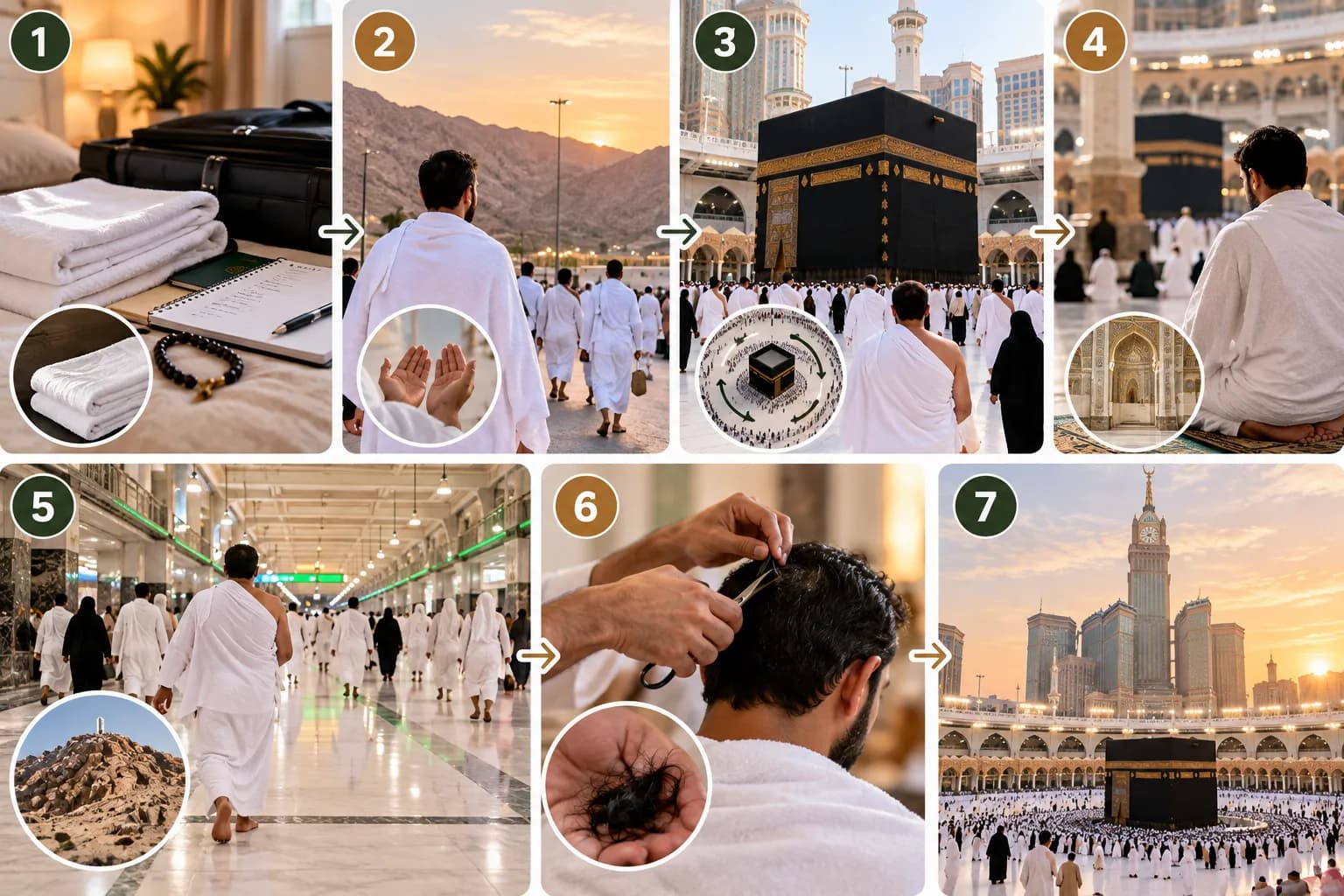
Umrah at a Glance
This is a simplified overview. Details follow in the sections below.
Stage | What You Do |
|---|---|
1 | Prepare before Miqat (learning, ghusl, Ihram clothing) |
2 | Enter Ihram for Umrah at (or, for air travelers, as you approach) the Miqat |
3 | Begin the Talbiyah |
4 | Travel to Masjid al-Haram |
5 | Perform seven circuits of Tawaf, starting and ending at the Black Stone |
6 | Pray two Rak'ahs after Tawaf and drink Zamzam |
7 | Perform Sa'i: seven lengths, from Safa to Marwah |
8 | Men shave or shorten; women shorten a small amount |
9 | Ihram ends |
Before You Travel: Prepare Spiritually, Not Just Logistically
Many people spend weeks on flights and hotels and almost no time on the worship itself. Spiritual preparation does not require any special ritual; it is simply what a sincere traveler to Allah's House would do:
Make sincere Tawbah. Return to Allah, leave sins, and resolve to improve.
Settle rights. Where appropriate, pay debts, write down your responsibilities, and seek forgiveness from anyone you have wronged.
Renew your intention that this journey is for Allah alone.
Learn the rites beforehand. This is the single best preparation. A pilgrim who understands the sequence spends less time worrying in Makkah.
Learn a few Duas and the meaning of the Talbiyah.
Prepare for crowds and heat with patience. Much of Umrah is practicing sabr.
There is no special "pre-Umrah prayer" or ritual in the Sunnah, so do not feel you are missing one.
Practical Umrah Preparation Checklist
Keep these two categories separate in your mind: religious requirements and travel conveniences.
Religious (evergreen)
Learn the sequence and what you will say
Ihram clothing ready (see below)
Plan where you will enter Ihram (Miqat)
Wudu knowledge and a plan for restroom breaks
Know whom you will ask (a scholar or knowledgeable group leader) if a question arises
Travel conveniences (check current official sources before relying on any rule)
Passport and entry/visa authorization
Any required health documents
Confirmed accommodation and transport
Prescribed medicine, basic first-aid items
Comfortable, easy-to-remove footwear (sandals for men in Ihram)
Unscented toiletries (fragrance is restricted in Ihram)
Small bag, water bottle, power bank (where permitted)
ID and emergency contacts (hotel name, group leader's number)
Saudi visa, permit, vaccination, app, baggage, airport and entry rules change. Always confirm them with official Saudi sources close to your travel date. This article deliberately does not list them.
What Is Miqat?
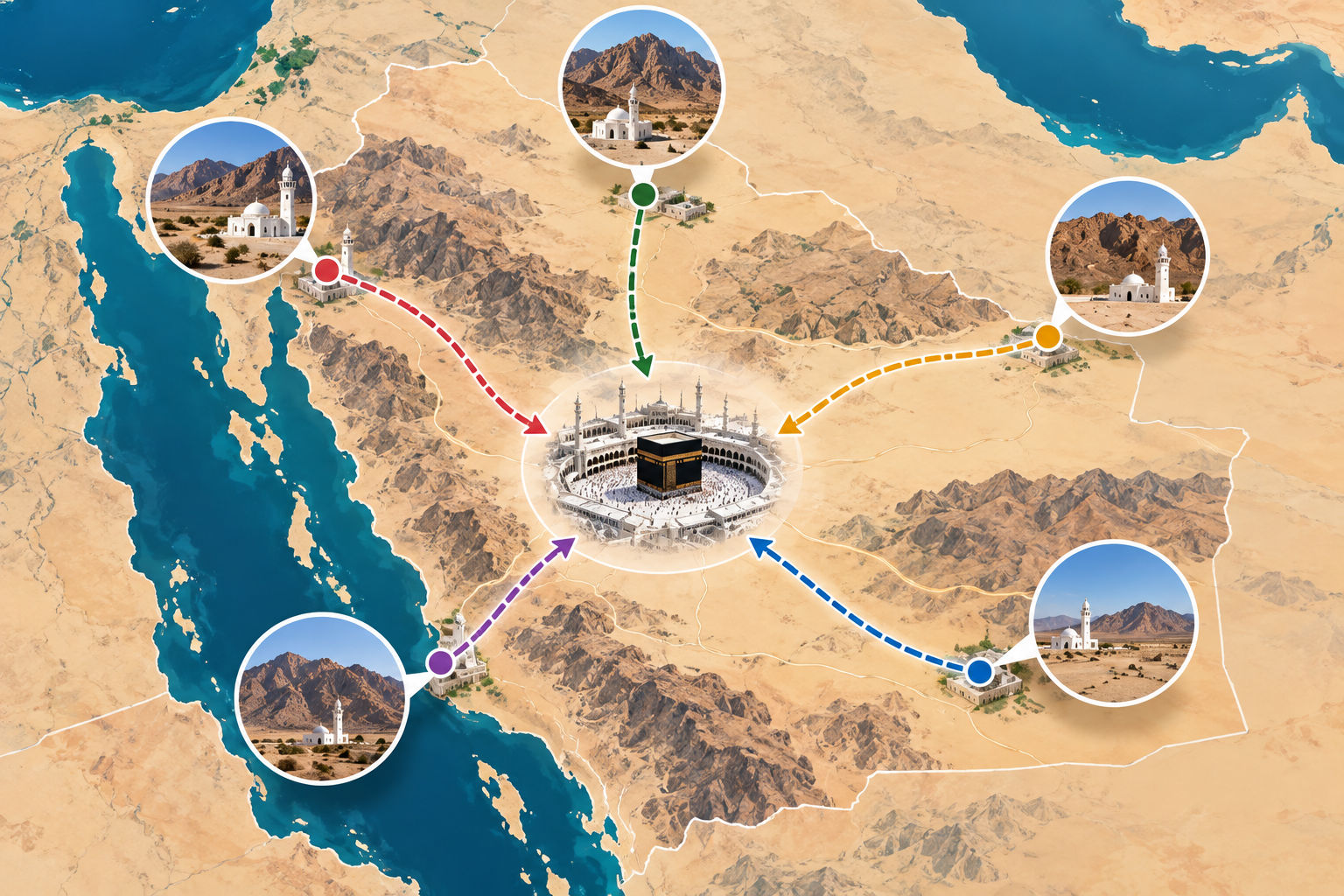
Miqat is not a building where people change clothes. It is a prescribed boundary that a person intending Hajj or Umrah must not cross without having entered Ihram. The Prophet ﷺ designated the points (Bukhari 1524, Muslim 1181):
Miqat | For travelers coming from |
|---|---|
Dhul-Hulayfah (Abyar Ali) | Madinah direction |
Al-Juhfah (near Rabigh) | Levant, Egypt, North Africa direction |
Qarn al-Manazil (As-Sayl al-Kabir) | Najd/Taif direction |
Yalamlam | Yemen direction |
Dhat 'Irq | Iraq direction (established by the Prophet ﷺ or by 'Umar, according to differing reports; scholars accept it) |
Those who pass through these points on the way to Makkah with the intention of Umrah enter Ihram there. People who live inside the Miqat boundaries enter Ihram from their place of residence; people living in Makkah go outside the Haram boundary (commonly to Tan'im) for Umrah.
Flying to Jeddah: When Do I Enter Ihram?
This is the most important practical question for travelers from the US, UK, Canada, Europe and Australia.
You cannot wait until you reach your Makkah hotel. Jeddah is inside the Miqat boundaries. Most scholars, including the major fatwa bodies, therefore teach that air travelers must enter Ihram before their flight passes over the Miqat (or the point parallel to it), and not at Jeddah. If you cross it without Ihram while intending Umrah, ask a scholar about the remedy as soon as possible.
Two things are easy to confuse:
What it is | |
|---|---|
Putting on Ihram garments | Clothing. Can be done at home, at the airport or on the plane. It does not make you muhrim. |
Entering the state of Ihram | Making the intention for Umrah (and saying the Talbiyah) at the Miqat. This is when the restrictions begin. |
A common, safe plan:
Do ghusl and put on your Ihram garments before boarding (or in the airport) so you aren't changing in a cramped bathroom.
Stay in normal behaviour during the flight; you are not yet in Ihram.
Learn the Miqat that applies to your route. Follow the airline or group announcements, which usually say when you are approaching it.
Make your intention for Umrah and begin the Talbiyah when told, or as you approach it.
Flight routes differ, so don't rely on fixed minute counts. Entering Ihram a little before the Miqat is valid, but because the restrictions begin immediately, many scholars advise not doing so hours early. Ask your group leader or scholar what applies to your airline route.
Arriving in Madinah first? See the next section.
What If I Visit Madinah Before Makkah?
If you go to Madinah first and later travel from Madinah to Makkah for Umrah, you enter Ihram at Dhul-Hulayfah (Abyar Ali), the Miqat for that route, before you pass it. Many pilgrims put on Ihram clothing in Madinah and make their intention at Abyar Ali. Where transportation by bus is used, stops are commonly arranged there, but ask your group exactly how the plan works for your method of transport.
Visiting Madinah is highly meaningful for Muslims, but it is not one of the rites required to complete Umrah. Your Umrah is complete, and valid, without ever visiting it.
Preparing for Ihram
Before entering Ihram, the following are recommended. None is obligatory unless stated.
Ghusl. Reported of the Prophet ﷺ (Tirmidhi, hasan). Women in menstruation or post-natal bleeding are also advised to do ghusl and enter Ihram (the Prophet ﷺ told Asma bint Umays this, Muslim 1209).
Hygiene. Trim nails and remove unwanted body hair beforehand if needed, because you cannot do so once in Ihram.
Perfume on the body (men). 'A'ishah (may Allah be pleased with her) said she perfumed the Prophet ﷺ before he entered Ihram (Bukhari 1539, Muslim 1189). Scholars advise applying it to the body, not the Ihram cloths, and making sure you don't apply more after the intention.
Ihram clothing (men). See below.
Optional: a two-Rak'ah prayer, if it's not a disliked prayer time, is mentioned by some scholars. Not required.
Ihram Is More Than Two White Cloths
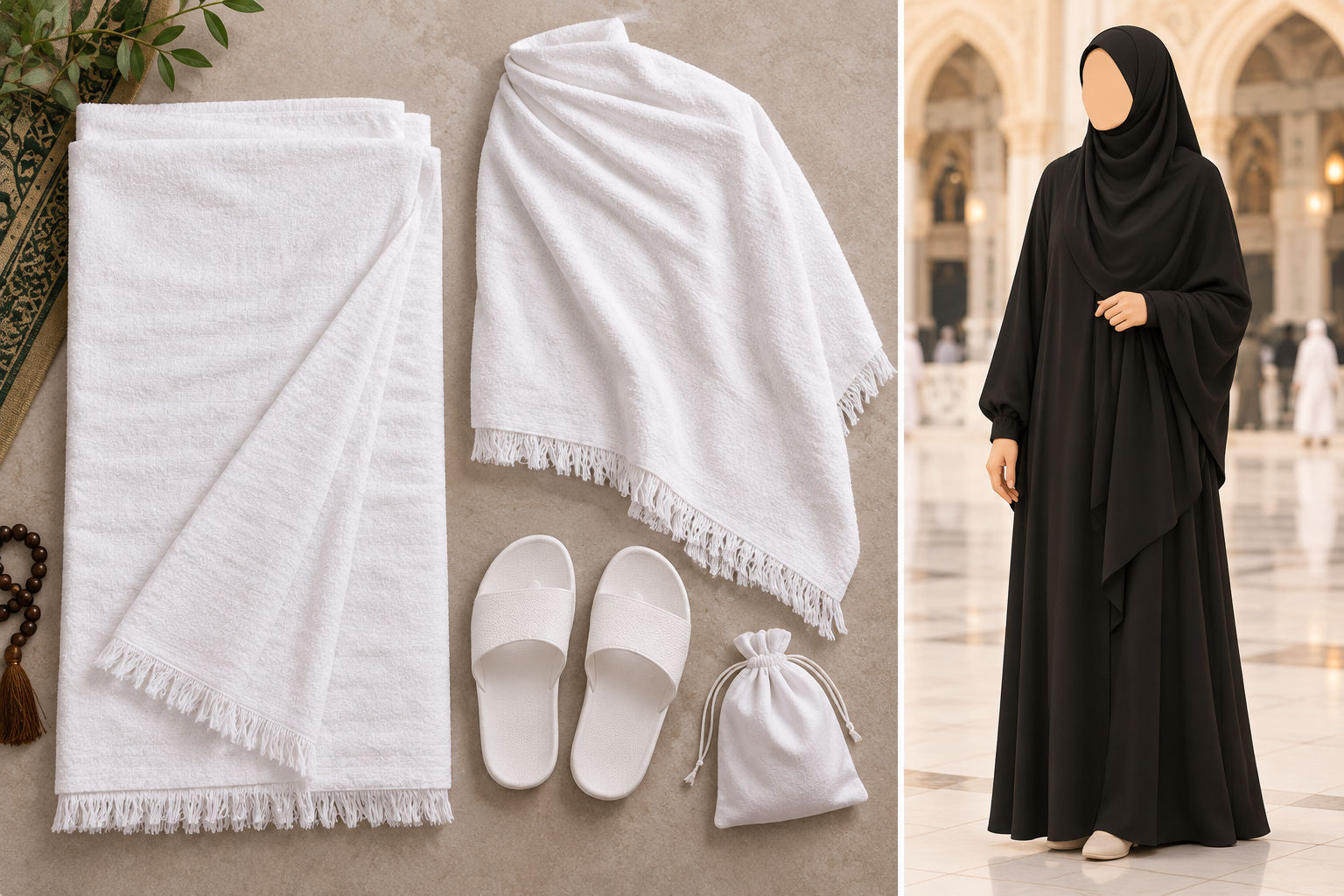
Ihram is a sacred state, not merely clothing. You enter it by intention (with the Talbiyah). Wearing white cloth alone doesn't put you in it, and being in Ihram carries obligations of behaviour and restrictions, not just a uniform.
For men. The usual garments are an izar (lower wrap) and rida' (upper wrap), ideally white, but colour is not specified. The precise rule is that a man in Ihram must not wear sewn garments cut to the shape of the body or its limbs (shirt, trousers, underwear) or cover his head with something attached to it (cap, turban), or wear closed footwear covering the ankles (socks, boots). The Prophet ﷺ listed these (Bukhari 134, Muslim 1177). It is not accurate to say "nothing stitched is allowed": a belt, watch, ring, glasses, sandals and a money belt are allowed. The izar may have seams, and an umbrella for shade is allowed.
For women. There is no special white Ihram dress. A woman wears her normal modest, Islamically appropriate clothing in any colour. Her restrictions are different from men's, covered below.
How to Make the Intention for Umrah
Niyyah (intention) is in the heart. You are deciding, as you enter Ihram, that you are performing Umrah for Allah.
You then express the intention through the Talbiyah. Scholars mention that one may begin by saying "Labbayka 'Umrah" (Here I am, answering You, for Umrah), then continue with the Talbiyah. There is no long Arabic "Niyyah sentence" that must be recited. If you see a printed intention formula presented as required, it isn't.
Some pilgrims who are worried they might be prevented from completing (for example by illness) add the condition the Prophet ﷺ taught Duba'ah bint al-Zubayr (Muslim 1207): "If something prevents me, my place of release is where You prevent me." This is optional and relevant mainly for those with a real concern.
The Talbiyah: What It Means
Arabic:
لَبَّيْكَ اللَّهُمَّ لَبَّيْكَ، لَبَّيْكَ لَا شَرِيكَ لَكَ لَبَّيْكَ، إِنَّ الْحَمْدَ وَالنِّعْمَةَ لَكَ وَالْمُلْكَ، لَا شَرِيكَ لَكَ
Transliteration: Labbayk Allahumma labbayk, labbayka la sharika laka labbayk, innal-hamda wan-ni'mata laka wal-mulk, la sharika lak.
Meaning: "Here I am, O Allah, here I am. Here I am, You have no partner, here I am. Indeed, all praise and blessings are Yours, and all sovereignty. You have no partner."
Source: Narrated by Ibn 'Umar as the Talbiyah of the Prophet ﷺ (Bukhari 1549, Muslim 1184).
Phrase by phrase:
Labbayk is a response: you are answering a call. Tradition links it to Ibrahim's call to people to perform Hajj. You came because you were invited.
La sharika lak is Tawhid: worship is for Allah alone.
Al-hamd is praise; ni'mah is blessing; mulk is sovereignty. Everything, including the ability to be there, comes from Him.
This is not a chant for the bus ride. It is a declaration of Tawhid and submission.
Volume. Men say the Talbiyah aloud; women say it quietly, so that only they or those near them hear (the view of most scholars).
When to stop. In Umrah, most scholars say you stop the Talbiyah when you begin Tawaf (Tirmidhi, hasan sahih, from Ibn 'Abbas). The Maliki school says to stop when you reach the Haram or see the houses of Makkah. Follow the school or scholar you trust.
Restrictions of Ihram
Once you have made the intention, the following are restricted until Ihram ends:
Cutting or removing hair and clipping nails
Wearing perfume, or using scented products (use unscented soap)
Sexual relations and intimacy, including marriage contracts and proposals (Muslim 1409)
Hunting or killing wild game (Quran 5:95)
Quarrelling and sinful behaviour (Quran 2:197), and you should be especially patient with others
For men: sewn fitted garments, head covering, and ankle-covering footwear
For women: the fitted face-veil (niqab) and gloves
The Prophet ﷺ said the muhrima woman does not wear the niqab or gloves (Bukhari 1838).
Cutting trees or plants in the Haram of Makkah is also restricted for everyone, in or out of Ihram.
Mistakes carry different outcomes depending on what happened, whether it was intentional, forgotten, or done out of ignorance or necessity, and which school's view is applied. This guide does not list penalties because those cannot be given responsibly without knowing the exact case.
What If I Accidentally Break an Ihram Rule?
Don't panic, and don't guess.
Not every mistake has the same consequence.
Many scholars say that a mistake made by forgetfulness or ignorance does not bring sin, although some views still require a remedy.
Allah mentions that a person who must remove hair due to illness or harm has a specific, flexible remedy of fasting, charity, or sacrifice (Quran 2:196). This shows that the law makes provisions for hardship.
Stop the action (for example, take off the stitched garment you realised you were wearing) and then describe exactly what happened to a qualified scholar. Avoid answers from social-media comment sections.
Arriving in Makkah
When you arrive:
Settle essentials quickly (luggage, wudu, restroom). You may do this in Ihram; there is no ruling that you must go straight to the mosque, though it is the next step.
Continue the Talbiyah as appropriate until you begin Tawaf.
Resist the urge to film your arrival.
Approach with humility. There are no special rituals for entering Makkah that you must perform.
Entering Masjid al-Haram
Enter with etiquette common to all mosques:
Be in wudu if possible (it is required for Tawaf according to most scholars; see below).
Enter with the right foot and say: "Bismillah, was-salatu was-salamu 'ala Rasulillah. Allahumma iftah li abwaba rahmatik." ("In the name of Allah, and peace and blessings on the Messenger of Allah. O Allah, open for me the doors of Your mercy.") (Abu Dawud 465 and Muslim 713 for the closing Dua.)
Misinformation check: Many guides give a special Dua to be said on first seeing the Ka'bah. The reports usually cited (such as the narration attributed to 'Umar, or "Allahumma zid hadha al-bayt tashrifan...") have weak chains, and there is no authentic fixed Dua for that moment. You may make any personal Dua you wish. Also, the claim that a Dua at the first sight of the Ka'bah is guaranteed to be accepted is not supported by authentic evidence.
Seeing the Ka'bah for the First Time
For many Muslims this is one of the most powerful moments in life. You have turned to this direction in prayer all your life, and now it's in front of you.
Let the moment be yours:
Pause with gratitude and humility.
Make Dua in your own words, in any language. You don't need to say the perfect phrase.
Step out of the flow of foot traffic so you don't block others.
Let others worship too.
Save photos for later. You may cry, you may feel nothing yet, and both are normal.
Tawaf: The Step-by-Step Guide
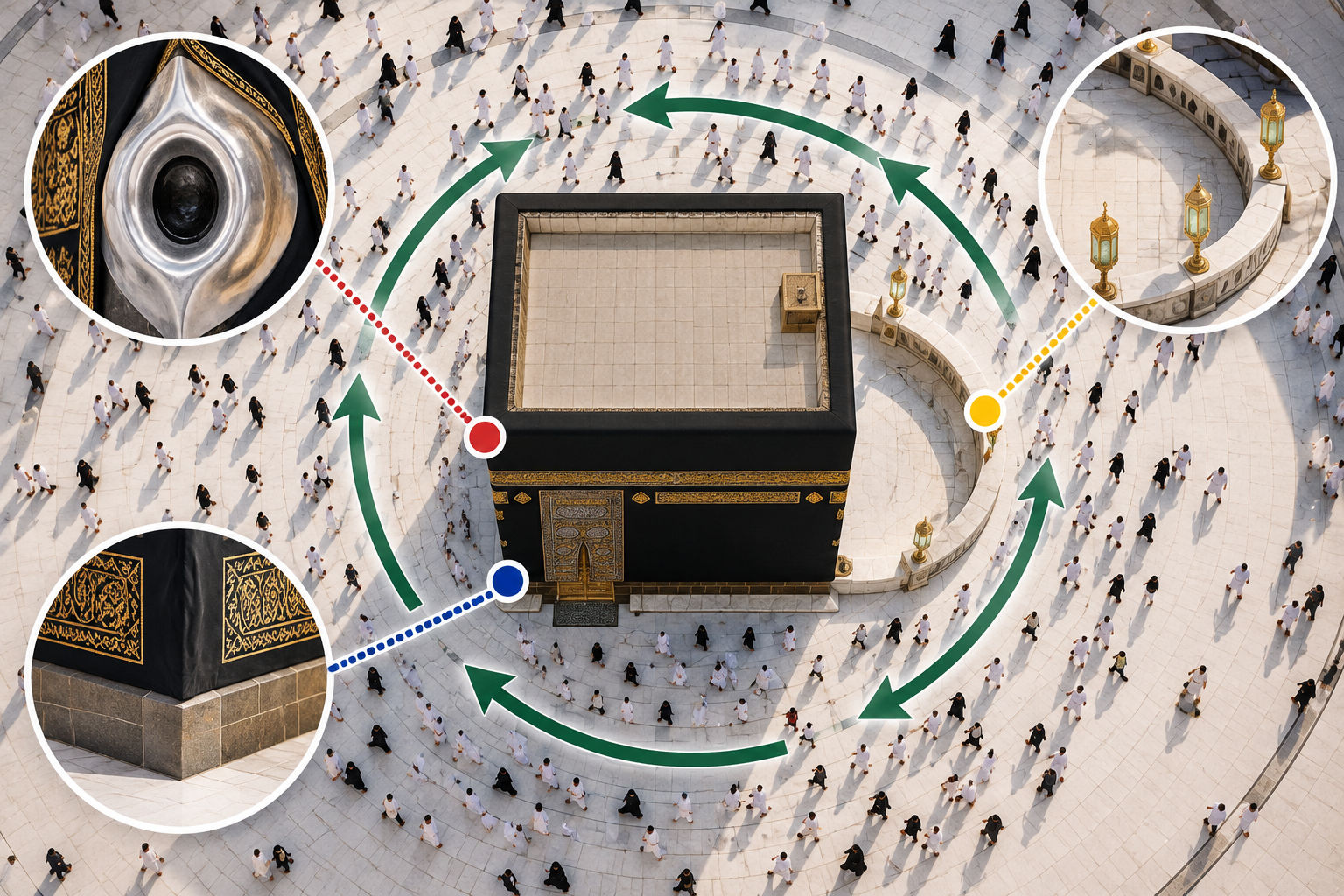
Tawaf is seven circuits around the Ka'bah, starting and ending at the corner of the Black Stone (Hajar al-Aswad).
Before starting, prepare as for prayer: be in wudu. Most scholars (Maliki, Shafi'i, Hanbali) require it for Tawaf; the Hanafis consider it obligatory (wajib) with a compensatory remedy if missed; a few scholars treat it as not required. Being in wudu is the safest way to be covered by all views. Cover your 'awrah and move with calm.
Step 1: Identify the Starting Point
The Black Stone is set in the eastern corner of the Ka'bah. The mosque has used markers along the edge of the Tawaf area to help pilgrims see when they are aligned with it. Check what is currently in use when you arrive, and ask staff or a group member if unsure.
Men: before starting, uncover the right shoulder (idtiba', see below).
Step 2: Begin the First Circuit
Face the Black Stone and, if you can touch it without hurting anyone, touch and kiss it. If you can't, point to it with your right hand and say "Allahu akbar" (the Prophet ﷺ did this on his Tawaf when mounted, Bukhari 1613). Some narrations of Ibn 'Umar add "Bismillah." Don't kiss your hand after pointing.
Do not push, hurt, or endanger people to touch or kiss the Black Stone. It is a Sunnah act; hurting Muslims is a sin. 'Umar famously said that it is a stone that cannot benefit or harm and that he kissed it because he saw the Prophet ﷺ do so (Bukhari 1597, Muslim 1270). The same applies if the crowds make it impossible: pointing from where you are is complete.
Step 3: Keep the Ka'bah on Your Left
Turn so the Ka'bah is on your left and walk counter-clockwise. Stay outside the Hijr (Hatim), the semi-circular wall; it is part of the Ka'bah, so walking through it doesn't count as Tawaf.
At the Yemeni Corner (the corner before the Black Stone), you may touch it with your right hand if it's easy. Don't kiss it, don't point to it, and don't touch the other corners. The Prophet ﷺ touched only the two Yemeni corners (Bukhari 1609, Muslim 1267).
Step 4: Complete Seven Circuits
Circuit 1 begins when you align with the Black Stone and ends when you align again.
Repeat until you have completed seven. The seventh also ends at the Black Stone line.
Counting tip: Use a hand counter or finger-tally ring, or keep seven small cues on your fingers. If walking with family, appoint one person to count aloud at each Black Stone line.
Do You Need a Different Dua for Every Tawaf Circuit?
No. Many printed booklets list a specific Dua for Round 1, Round 2, up to Round 7. These lists are not Prophetic prescriptions, and no authentic hadith assigns a Dua to each circuit. You will see them in guidebooks and groups repeating them aloud; you don't have to.
What the Sunnah gives you:
Between the Yemeni Corner and the Black Stone, the Prophet ﷺ said: "Rabbana atina fid-dunya hasanah wa fil-akhirati hasanah wa qina 'adhab an-nar" ("Our Lord, give us good in this world and good in the Hereafter and protect us from the punishment of the Fire", Quran 2:201; Abu Dawud 1892, graded hasan).
General dhikr such as SubhanAllah, Alhamdulillah, La ilaha illa Allah, Allahu akbar.
Quran recitation, and Salawat on the Prophet ﷺ.
Your own Dua, in your own language, for anything you need.
You are free to use a Dua book as a source of ideas, as long as you don't treat the circuit-by-circuit assignment as a ritual.
Raml and Idtiba' for Men
These are Sunnah practices for men in a Tawaf that is followed by Sa'i, as in Umrah.
Idtiba' is to pass the middle of the rida' under the right armpit and place its ends over the left shoulder, so the right shoulder is uncovered. It is done only during Tawaf. Cover your shoulder again before praying the two Rak'ahs and for the rest of your time in Ihram. Don't walk around Makkah with an exposed shoulder for the rest of the trip. (Most scholars say it ends when Tawaf ends.)
Raml is a brisk walk with short, quick steps and shoulders squared, done in the first three circuits of Tawaf. In the remaining four, walk normally (Bukhari and Muslim, from Ibn 'Umar). If the crowd makes raml unsafe, skip it; safety comes first.
Women do neither: no idtiba' and no raml.
What Should Women Know About Tawaf?
Walk normally, with no raml.
Dress modestly and comfortably. Keep your hair and body covered and avoid dressing in ways that make it hard to move or pray.
Crowd safety. Stay within your group, stay toward the outer circles if overwhelmed, and avoid unnecessary physical contact where possible.
Wudu is required; plan restroom breaks, since you may need to repeat it.
Menstruation. See the dedicated section below.
What Happens After Tawaf?
Men cover the right shoulder again.
Pray two Rak'ahs. The Prophet ﷺ recited Surah al-Kafirun in the first and Surah al-Ikhlas in the second (Muslim 1218). Schools vary in how emphatic this is: Hanafis consider it wajib, others a confirmed Sunnah. Do it.
Pray them near Maqam Ibrahim if you can do so without difficulty. If it's crowded, pray anywhere in the mosque. This is valid.
Drink Zamzam and make Dua.
Some scholars mention returning to the Black Stone (touch or point to it) before heading to Safa, as in Jabir's narration. It's a minor Sunnah, not required.
Never obstruct or endanger people merely to perform a recommended act in a particular spot.
Maqam Ibrahim
Maqam Ibrahim is the stone on which Prophet Ibrahim ﷺ stood while building the Ka'bah, preserved near the Ka'bah. Allah says: "And take the Maqam of Ibrahim as a place of prayer" (Quran 2:125), and describes it among the clear signs in Makkah (Quran 3:97).
It is not a grave, and pilgrims are not required to touch it. Wiping or seeking blessing from it is not part of the Sunnah. Correct etiquette: pray the two Rak'ahs toward it or nearby if easy, otherwise pray elsewhere. Don't stand in the way of people performing Tawaf, and don't create crowds.
Drinking Zamzam
The Prophet ﷺ said of Zamzam: "It is blessed, it is a food that nourishes" (Muslim 2473, from Abu Dharr). It is reported that he drank from it standing (Bukhari 1637).
Etiquette: Drink in the name of Allah, drink your fill, and make Dua for your needs.
You may have heard "Zamzam is for whatever it is drunk for." That narration is graded differently by scholars (accepted by some, rejected by others), so don't treat it as a guarantee of specific worldly results. You may certainly make a sincere personal Dua while drinking.
There's no obligation to pour it on yourself or carry it home. Those are optional.
Sa'i Between Safa and Marwah
Allah says: "Indeed, Safa and Marwah are among the symbols of Allah. So whoever performs Hajj to the House or Umrah, there is no blame on him for walking between them." (Quran 2:158). The Prophet ﷺ said "Perform Sa'i, for Allah has prescribed Sa'i for you" (reported by Ahmad and others; accepted by scholars as the basis for it being a pillar).
Step 1: Begin at Safa
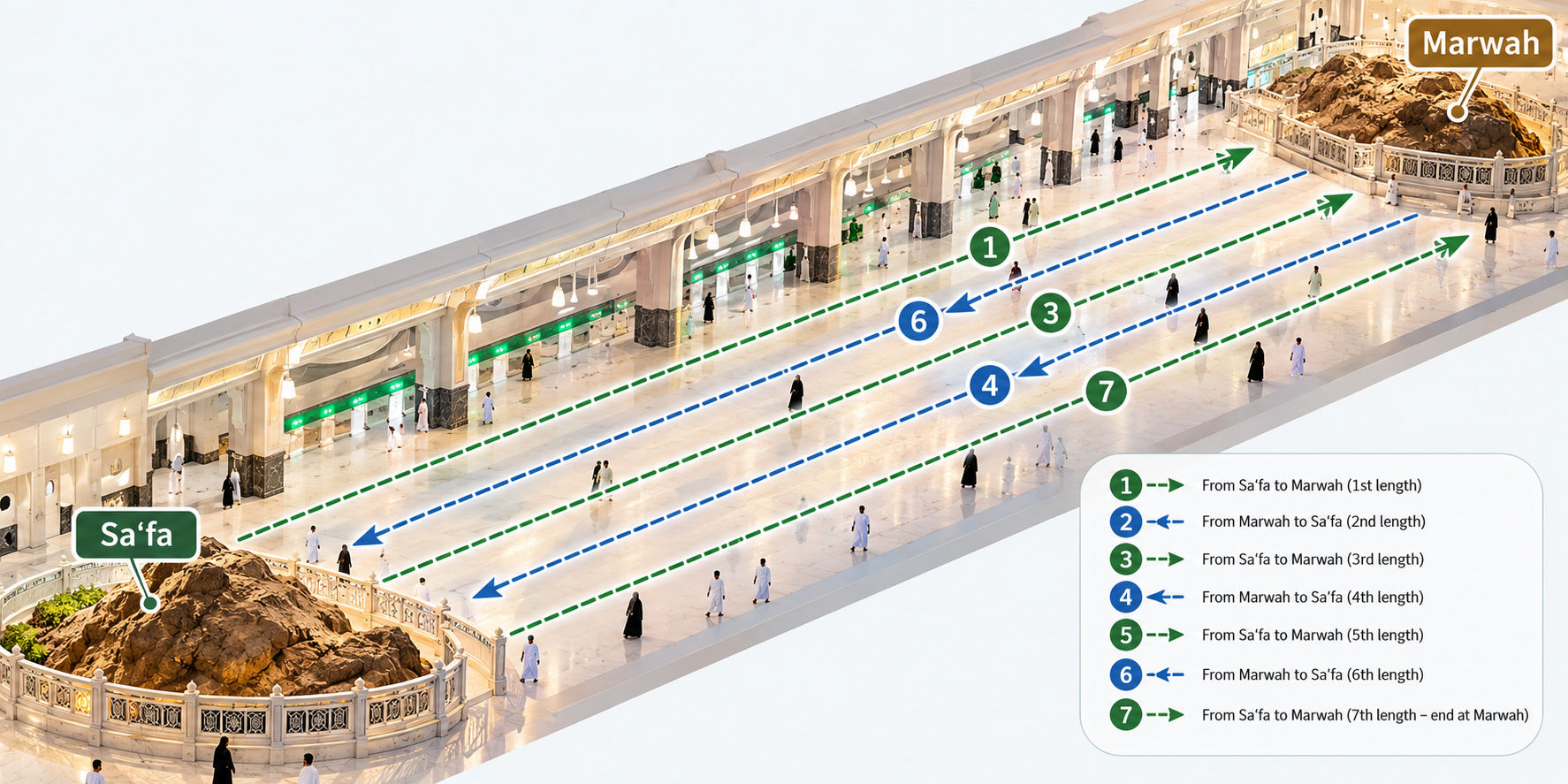
Sa'i begins at Safa and ends at Marwah.
As he approached Safa, the Prophet ﷺ recited "Inna as-Safa wal-Marwata min sha'a'irillah" and said "I begin with what Allah began with" (Muslim 1218). Recite it once, at the start, not on each length. Face the Ka'bah (you do not have to climb the hill), raise your hands, and say the remembrance below.
Step 2: Safa to Marwah
This is one length.
Step 3: Marwah to Safa
This is two.
Keep going, counting each one-way trip: Safa→Marwah is 1, Marwah→Safa 2, Safa→Marwah 3, Marwah→Safa 4, Safa→Marwah 5, Marwah→Safa 6, Safa→Marwah 7.
The seventh length ends at Marwah. If you finish at Safa, you have counted wrongly, because that would be an even number of lengths.
Wudu is not required for Sa'i according to most scholars, though it is better. Sa'i must come after a valid Tawaf.
What Do You Say at Safa and Marwah?
At the top of Safa and again at Marwah, the Prophet ﷺ faced the Ka'bah, praised and glorified Allah, and said (Muslim 1218):
لَا إِلَهَ إِلَّا اللَّهُ وَحْدَهُ لَا شَرِيكَ لَهُ، لَهُ الْمُلْكُ وَلَهُ الْحَمْدُ وَهُوَ عَلَى كُلِّ شَيْءٍ قَدِيرٌ، لَا إِلَهَ إِلَّا اللَّهُ وَحْدَهُ، أَنْجَزَ وَعْدَهُ، وَنَصَرَ عَبْدَهُ، وَهَزَمَ الْأَحْزَابَ وَحْدَهُ
La ilaha illa Allahu wahdahu la sharika lah, lahul-mulku wa lahul-hamdu wa huwa 'ala kulli shay'in qadir. La ilaha illa Allahu wahdah, anjaza wa'dah, wa nasara 'abdah, wa hazamal-ahzaba wahdah.
"There is no god but Allah alone, with no partner. His is the dominion and His is the praise, and He has power over all things. There is no god but Allah alone; He fulfilled His promise, aided His servant, and defeated the confederates alone."
He said it three times with Dua in between. At the other lengths, walk and make your own Dua and dhikr. There is no separate required Dua for each of the seven lengths.
The Green-Marker Area During Sa'i
Between two designated points in the valley, the Prophet ﷺ moved faster (Muslim 1218). Today these points are marked, though the design of markers may change, so look for the signs on site.
Men move at a brisk jog or fast walk in this section, if it is safe.
Women walk at a normal pace.
If there are crowds, elderly people, or children, walk normally. Safety comes first, and the Sunnah isn't worth hurting someone.
The Story Behind Safa and Marwah
When Ibrahim ﷺ left his wife Hajar and infant son Isma'il ﷺ in the barren valley of Makkah, Hajar asked him whether Allah had commanded this. When he said yes, she said, "Then He will not let us be lost" (Bukhari 3364). When the water ran out, she walked and ran between Safa and Marwah seven times, looking for help. Allah then brought forth Zamzam.
Sa'i is not random walking. It is a remembrance of effort joined with trust in Allah: she did what she could and relied on Him completely. That is the spiritual meaning of tawakkul, and it's worth carrying in your heart as you walk.
Finishing Umrah: Halq or Taqsir
After Sa'i, you complete Umrah by cutting your hair.
Men:
Halq is shaving the whole head.
Taqsir is shortening the hair evenly from the whole head, not just a few strands.
The Prophet ﷺ prayed for mercy for those who shave three times and for those who shorten once (Bukhari and Muslim), so shaving carries greater virtue. Shortening is also fully valid. Both are acceptable.
Women: They do not shave. A woman gathers her hair and trims the ends, commonly the length of a fingertip (about 1 cm / half an inch to an inch). Scholars' descriptions vary somewhat on the minimum amount, so if you want the safest guidance, follow your school's amount from the end of each lock.
When Does Ihram End?
Ihram ends after Halq or Taqsir. At that point, you are out of Ihram and all the restrictions end: you may wear normal clothes, use perfume, trim nails, and resume marital relations. Your Umrah is complete.
The pillars of Umrah are Ihram, Tawaf and Sa'i (the Hanafis count Sa'i as wajib). Halq/Taqsir is required to leave Ihram.
The Complete Umrah Sequence in One Page
(Save this on your phone.)
Prepare before Miqat: ghusl, Ihram clothing.
Enter Ihram at the appropriate Miqat (before crossing it).
Make the intention in your heart for Umrah.
Say the Talbiyah.
Reach Makkah and Masjid al-Haram.
Be in wudu; do seven circuits of Tawaf, starting and ending at the Black Stone.
Pray two Rak'ahs and drink Zamzam.
Begin Sa'i at Safa.
Complete seven lengths, ending at Marwah.
Men shave or shorten; women trim a small amount.
Ihram ends.
Umrah Duas: What Do You Actually Need to Memorize?
You do not need to memorize a thick booklet of Duas.
Established Words to Learn
The Talbiyah
2:201, between the Yemeni Corner and the Black Stone
The Safa/Marwah remembrance
The mosque entrance Dua
Personal Dua
Ask Allah sincerely in your own language for forgiveness, guidance, family, health, faith, Quran, provision, the Hereafter, and any need. You don't need Arabic for this. Allah understands every language.
Non-Arabic speakers should not spend the entire Umrah anxiously reading phonetic transliteration they don't understand. Learn the few established phrases and their meanings, then use the rest of the time to speak to Allah from your heart.
Do I Need to Speak Arabic to Perform Umrah?
No, you do not need to speak Arabic fluently to perform Umrah. But learning a little makes it easier and more meaningful.
Arabic | Meaning |
|---|---|
Umrah (عمرة) | The lesser pilgrimage |
Ihram (إحرام) | The sacred state of pilgrimage |
Miqat (ميقات) | Boundary for entering Ihram |
Tawaf (طواف) | Circling the Ka'bah |
Sa'i (سعي) | Walking between Safa and Marwah |
Safa / Marwah (الصفا / المروة) | The two hills |
Talbiyah (تلبية) | The pilgrim's response "Labbayk" |
Zamzam (زمزم) | The blessed water |
Halq (حلق) | Shaving the head |
Taqsir (تقصير) | Shortening the hair |
Understanding even these terms makes announcements, signs and group instructions clearer.
Umrah for Women: Essential Differences
Clothing. Normal modest dress, any colour. No special white uniform.
Talbiyah. Said quietly.
No raml, no idtiba'.
Sa'i. Normal pace in the marked area.
Hair. Trim a fingertip's length from the ends; do not shave.
Face and hands. In Ihram, a woman should not wear the fitted face-veil (niqab) or gloves (Bukhari 1838). That is different from the other issue: when non-mahram men are near, women are reported to have lowered a loose cloth from the head over the face and removed it when they passed (Abu Dawud 1833, from 'A'ishah, which many scholars accept as sound enough for this). Many scholars therefore say a woman may lower loose fabric (not fitted to the face) when needed, and others recommend that it not touch the face; scholars differ on details, so follow the guidance of your scholar.
Crowd safety. Stay with your group and set a meeting point.
Menstruation. See below.
What If My Period Starts During Umrah?
Do not panic. This happened to 'A'ishah (may Allah be pleased with her), and the Prophet ﷺ told her: "Do what the pilgrim does, except do not perform Tawaf of the House until you are pure" (Bukhari 1650, Muslim 1211).
According to the majority view:
Act | While menstruating |
|---|---|
Enter Ihram / make intention | Yes (do ghusl first if you can; Muslim 1209) |
Talbiyah, Dhikr, Dua | Yes |
Tawaf | No, wait until you are pure and have done ghusl |
Sa'i | Can be done if the Tawaf was completed before the period began (purity isn't a condition for Sa'i), but not before Tawaf |
Entering the prayer area of the mosque | Not permitted |
Where the period began before Tawaf, the usual guidance is to wait, if your travel plans allow. Where it truly isn't possible to wait (for example, a flight cannot be changed), scholars hold differing opinions, and some contemporary scholars permit Tawaf in cases of real necessity. This is exactly the situation to bring to a qualified scholar immediately, with the details of your timeline.
Umrah for Elderly Pilgrims and People With Disabilities
Wheelchairs and mobility aids are valid. The Prophet ﷺ performed Tawaf mounted on a camel because of difficulty (Bukhari and Muslim), and Umm Salamah did so as well. Using a wheelchair or motorized aid does not reduce the reward.
Take breaks. Rest, hydrate, and don't push through exhaustion.
Avoid dangerous congestion. Choose less crowded times or levels where possible.
Plan assistance. Travel with a companion who knows the rites.
This guide does not make medical claims; check with your doctor and with current official health guidance.
For questions on how to perform the rites with a particular disability, ask a scholar.
Umrah With Children
Write your hotel name and a parent's number on a card or wristband.
Set a meeting point and practice "stay with us."
Keep water, snacks, and rest breaks at hand.
Teach simple meanings beforehand: "Labbayk means I'm answering Allah's call."
Keep expectations realistic. Don't force an exhausted child through extra activities.
A child's Umrah is valid and rewarded, but it does not replace the obligation once they reach adulthood (a woman asked the Prophet ﷺ about a child on Hajj and he said, "Yes, and you have reward", Muslim 1336). For details on how a young child enters Ihram, consult a scholar.
Common First-Time Umrah Mistakes
Waiting until after Miqat to enter Ihram. Make your intention before crossing it.
Thinking Ihram means only white cloth. It's a state entered by intention.
Believing women must wear white. They don't.
Using an invented Dua for each Tawaf circuit. Not from the Sunnah.
Pushing people to reach the Black Stone. Point from where you are.
Miscounting Tawaf. Use a counter and the Black Stone line.
Miscounting Sa'i. Each one-way trip is a length.
Starting Sa'i at Marwah. It starts at Safa.
Thinking Safa→Marwah→Safa is one round. Each one-way trip counts separately, so that's two.
Men keeping the right shoulder exposed outside Tawaf. Cover it for prayer and afterwards.
Taking photos at the expense of worship or other pilgrims.
Panicking over every small mistake. Seek reliable guidance instead of fear.
What If I Lose Count During Tawaf or Sa'i?
Scholars discuss this carefully. Common guidance:
If you are unsure, many scholars say to build on the number you are certain of (the lower one) and complete from there. Others allow acting on your strong probable estimate.
An extra circuit done out of caution does not ruin the rite in the way a missing one does.
If the doubt only occurs after finishing, many scholars say don't worry about it.
If the uncertainty is serious, ask a scholar on the spot or as soon as you can.
What If I Make a Mistake During Umrah?
Reassurance first:
Not every mistake invalidates Umrah.
Not every mistake requires restarting.
Not every mistake requires a sacrifice.
Not every mistake has the same consequence.
Some errors are minor; others require a remedy; a very few, such as intimacy while in Ihram before completing the rites, can affect the Umrah itself, which is why it matters to ask. The answer depends on exactly what occurred. Describe the real event to a qualified scholar, not to random online commenters.
Physical Safety During Umrah
Hydrate often and rest in shade.
Heat: avoid peak hours if you can.
Footwear: comfortable sandals or shoes (men: sandals only in Ihram).
Medication: keep it accessible and with its prescription.
Vulnerable family: keep them in sight.
Meeting points: agree on one before you separate.
ID/contact details: carry them on you.
Never take dangerous risks to touch or reach a sacred location.
For medical or current health requirements, consult your doctor and current official guidance.
Don't Turn Umrah Into a Photography Project
A photograph or two can be a lovely memory where allowed. But don't spend your Tawaf or Dua:
filming yourself,
making content,
blocking pathways,
photographing strangers,
retaking scenes.
You may not return for a long time. Be present, worship, and respect others' privacy.
After Umrah: What Should Change?
Umrah is not the end of the journey. Keep:
Your Salah, on time
Quran daily, even a page
Tawbah and dhikr
Better character with family and neighbours
Dua
Learning
We can hope the Umrah is accepted, but acceptance rests with Allah. Don't expect or claim any specific observable change; do keep working on yourself with hope.
Umrah and the Quran
Many pilgrims arrive in Makkah wishing they could read the Quran more confidently, understand what they hear in Salah, read the signs around them, understand the Duas of the Quran, or recite with better Tajweed.
Let Umrah be the beginning of a stronger Quran-learning journey. After you return, you might aim to:
learn the Arabic letters and read fluently,
study Tajweed,
memorize short Surahs,
learn common Quranic vocabulary,
start Quranic Arabic.
If preparing for Umrah has made you realize that you want to read the Quran more confidently or understand more of the Arabic you encounter in worship, Araby Academy's one-to-one Quran and Arabic lessons can help you continue that journey with structured guidance, whether in Quran reading, Tajweed, memorization, Quranic Arabic, or Arabic for non-native speakers.
Related reading on this site: How to Learn Salah When You Don't Speak Arabic · How to Read the Quran in Arabic · Tajweed for Beginners · 50 Essential Arabic Words Every Muslim Should Know · 100 Most Common Words in the Quran · Quranic Arabic vs Modern Standard Arabic · How Long Does It Take to Learn Arabic? · What Is Laylat al-Qadr? · The First 10 Days of Dhul Hijjah · Islamic Calendar Explained · New Muslim Guide
Frequently Asked Questions
1. How do you perform Umrah step by step? Prepare, enter Ihram at the Miqat with the intention for Umrah, say the Talbiyah, perform seven circuits of Tawaf, pray two Rak'ahs, drink Zamzam, perform seven lengths of Sa'i from Safa to Marwah, then shave or shorten your hair to leave Ihram.
2. What are the main stages of Umrah? Ihram, Tawaf, Sa'i, and Halq/Taqsir.
3. What is Ihram? A sacred state you enter by intention (with the Talbiyah). It carries restrictions, and it is not just the clothing.
4. Where should I enter Ihram if I am flying to Jeddah? Before your flight passes the Miqat or the point parallel to it, not after landing in Jeddah. Learn the Miqat for your route and follow announcements.
5. Can I change into Ihram clothes on the plane? You can wear the garments anywhere beforehand; you enter the state of Ihram by making the intention at the Miqat.
6. What do you say when starting Umrah? Make the intention in your heart, you may say "Labbayka 'Umrah," then recite the Talbiyah.
7. How many times do you walk around the Ka'bah? Seven circuits, starting and ending at the Black Stone, with the Ka'bah on your left.
8. Do I need a different Dua for every Tawaf round? No. There are no authentic circuit-specific Duas. Make dhikr and personal Dua, and say 2:201 between the Yemeni Corner and the Black Stone.
9. How many times do you walk between Safa and Marwah? Seven one-way lengths.
10. Does Sa'i start at Safa or Marwah? It starts at Safa and ends at Marwah.
11. What do women wear for Umrah? Normal modest clothing in any colour. There is no special white dress. Women don't wear a fitted niqab or gloves in Ihram.
12. Can a woman perform Umrah while menstruating? She may enter Ihram and make Talbiyah, dhikr and Dua, but according to the majority view she waits to be pure before Tawaf. Ask a scholar if she cannot wait.
13. Do you have to shave your head after Umrah? No. Men may shorten instead (shaving is more virtuous). Women only trim a small amount.
14. Can I perform Umrah if I don't speak Arabic? Yes. Learn the Talbiyah and a few phrases, and make Dua in your own language.
15. What should I do if I make a mistake during Umrah? Don't panic. Stop the act if possible and ask a qualified scholar, describing exactly what happened.
Conclusion: From "What Do I Do?" to "Labbayk Allahumma Labbayk"
Before learning, Umrah can look like dozens of unfamiliar rituals. Once you understand the sequence, it becomes clear:
Prepare. Enter Ihram correctly. Answer Allah's call with the Talbiyah. Perform Tawaf. Walk between Safa and Marwah. Complete the final hair-cutting rite. Leave Ihram.
But Umrah is more than a sequence of movements. Let it be accompanied by Tawhid, repentance, patience, Dua, remembrance, gratitude, and submission to Allah.
Learn the rites before you travel, so that when you reach Makkah you spend less time worrying about what comes next and more time worshipping. And when you return home, let the Quran and Arabic you longed to understand become the next step of your journey.