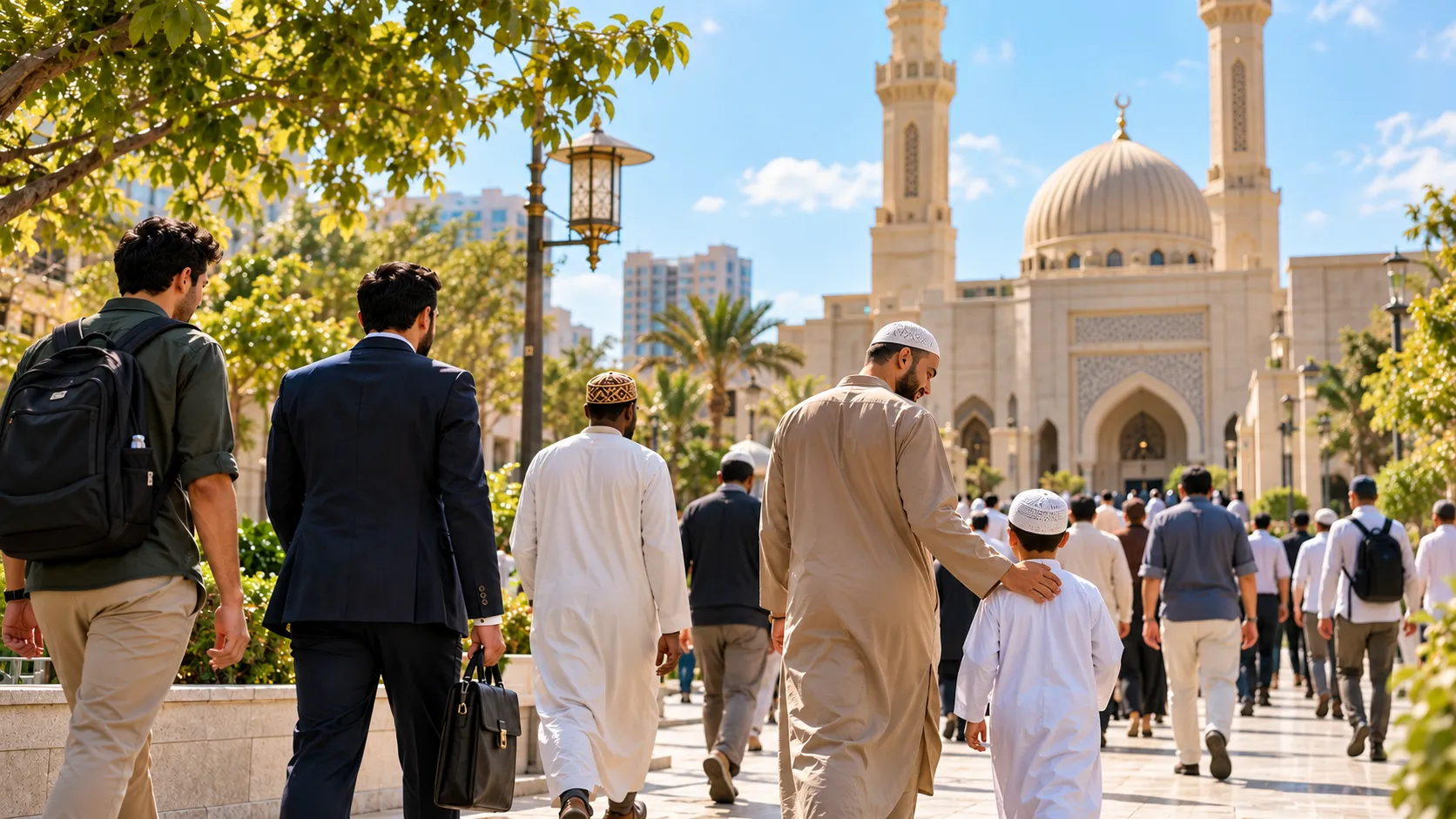
It is a little before noon on a Friday. In Cairo, a shopkeeper lowers his shutter halfway. In London, a student closes her laptop between lectures. In Toronto, an engineer slips out of a meeting. In Lagos, a taxi driver parks and locks his car. In Kuala Lumpur, a father buttons his son’s shirt. In Paris, New York and Sydney, people who share no common language or workplace are all walking toward the same kind of building.
Nothing about their schedules has changed. Deadlines still exist. Emails are still unanswered. Yet something in the day is different, because the Adhan (the call to prayer) is not announcing another meeting, appointment or transaction. It is calling them toward ذِكْرِ اللَّهِ (dhikr Allah), “the remembrance of Allah.”
The Quran puts it directly:
يَا أَيُّهَا الَّذِينَ آمَنُوا إِذَا نُودِيَ لِلصَّلَاةِ مِن يَوْمِ الْجُمُعَةِ فَاسْعَوْا إِلَىٰ ذِكْرِ اللَّهِ وَذَرُوا الْبَيْعَ ۚ ذَٰلِكُمْ خَيْرٌ لَّكُمْ إِن كُنتُمْ تَعْلَمُونَ
“O you who believe, when the call to prayer is made on the day of Jumu’ah, proceed earnestly to the remembrance of Allah and leave off trade. That is better for you, if you only knew.” (Quran 62:9, translated meaning)
And the very next verse completes the picture:
فَإِذَا قُضِيَتِ الصَّلَاةُ فَانتَشِرُوا فِي الْأَرْضِ وَابْتَغُوا مِن فَضْلِ اللَّهِ وَاذْكُرُوا اللَّهَ كَثِيرًا لَّعَلَّكُمْ تُفْلِحُونَ
“Then when the prayer is concluded, disperse through the land, seek Allah’s bounty, and remember Allah often, so that you may succeed.” (Quran 62:10, translated meaning)
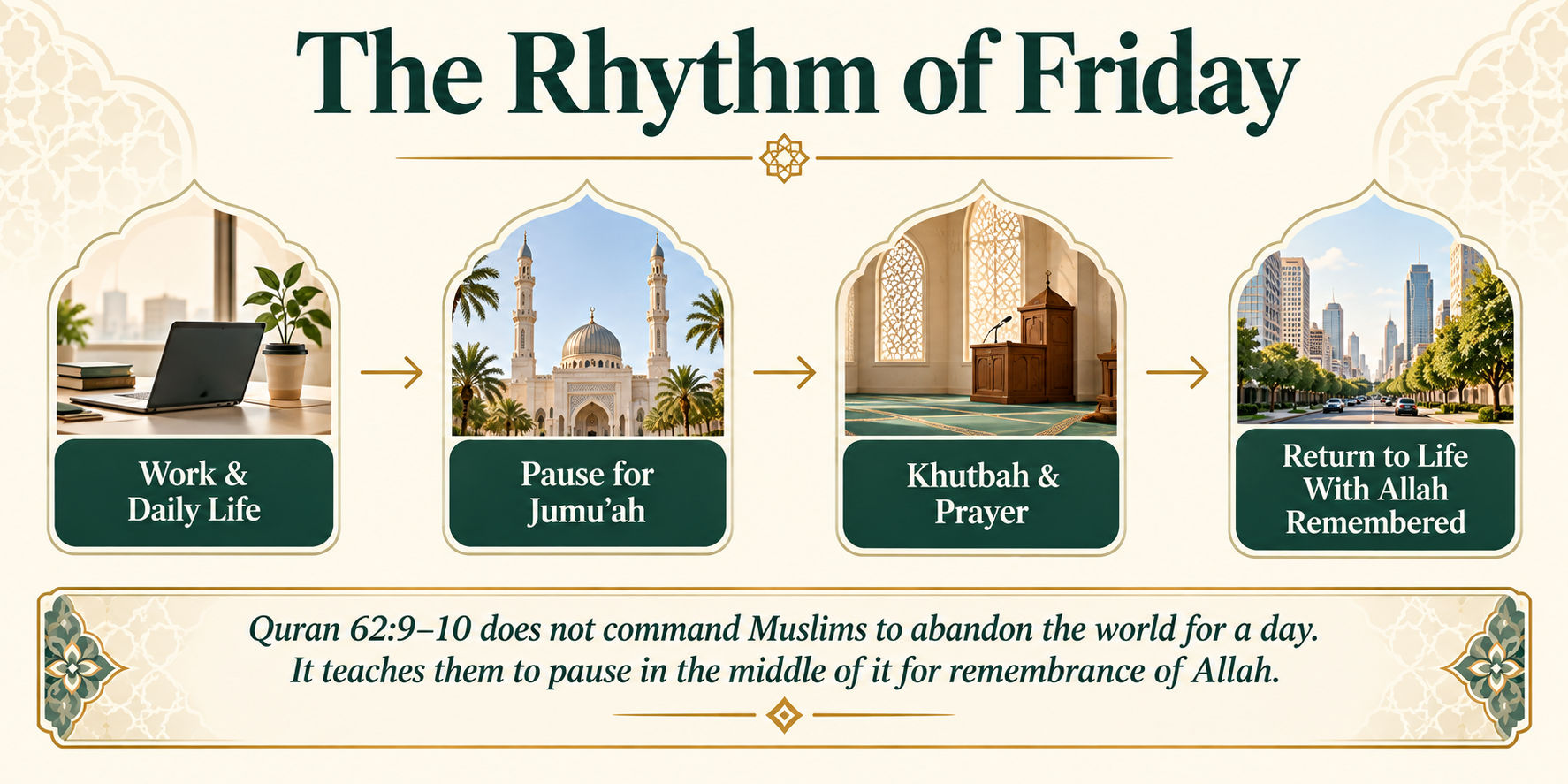
That pair of verses holds the whole rhythm of Friday: work, pause, worship, return to lawful life with Allah remembered. Islam does not ask Muslims to abandon the world for a day. It asks them, once a week, to stop in the middle of the world and remember who they are answerable to.
This guide explains Friday in Islam from the ground up: what Jumu’ah is, why Friday is special, who must attend, how the prayer works, what to do before and after, what is obligatory, what is recommended, where scholars differ, and which popular “Friday rituals” have no solid evidence. It is written especially for new Muslims, non-Arabic speakers, students, working professionals, parents and Muslims living where Friday is an ordinary working day.
Our guiding principle throughout:
Make Friday special because revelation made it special, not because internet lists added rituals to it.
The Short Answer: Why Is Friday Special in Islam?
Friday is special because Allah named a chapter of the Quran after it (Surah al-Jumu’ah), commanded eligible believers to gather for prayer and remembrance on it, and because the Prophet Muhammad ﷺ described it as the best day on which the sun rises. It is the day of the weekly congregational prayer called Jumu’ah, which includes a sermon (Khutbah) followed by two Rak’ahs (units) of prayer. It also carries a special hour in which Dua (personal supplication) is especially hoped to be answered.
Three things to keep in mind from the start:
Jumu’ah is a specific obligation (for those it applies to) centered on a gathering, not a ban on working all day.
Several Friday practices have strong authentic support: Ghusl (a full wash), cleanliness, arriving early, listening to the Khutbah, sending blessings on the Prophet ﷺ, and Dua.
Many viral “Friday rituals” are not established. We will name them honestly.
How This Article Labels What It Says
A common problem with Friday advice online is that everything is called “Sunnah.” To avoid that, this guide marks each teaching with one of these categories:
Label | Meaning |
|---|---|
Quran | Stated in the Qur’an itself |
Authentic Sunnah | Reported from the Prophet ﷺ through reliable chains (Sahih or Hasan) |
Fiqh ruling | A legal conclusion scholars draw from the evidence |
Scholarly difference | A point on which recognized schools of thought differ |
Recommended | Encouraged practice, not required |
Cultural habit | Common custom with no specific Friday evidence |
Weak or unverified | Widely repeated, but not reliably established |
A note on terms. Sunnah here means the practice and teaching of the Prophet ﷺ. Fard (or Wajib in general usage) means obligatory. Madhhab means a recognized school of Islamic law (Hanafi, Maliki, Shafi’i, Hanbali). Where these schools differ, we say so respectfully, and we do not treat differences as attacks on anyone’s practice.
What Does Jumu’ah Mean?
The Arabic word is الجُمُعَة (al-Jumu’ah). It comes from the root ج م ع (j-m-’), which carries the sense of gathering or bringing together. From the same root come جَمَعَ (jama’a, to gather or collect) and جَمَاعَة (jama’ah, a group or congregation).
That fits the day well: Jumu’ah is the weekly congregational prayer in which Muslims gather in one place. Scholars have offered several explanations for why the day itself carries this name, including that people gather for prayer on it. It is wise not to push the etymology further than the language allows. What we can say with confidence is that the word and the practice point in the same direction: coming together for the remembrance of Allah.
Two spellings you will see are Jumu’ah and Jummah. They refer to the same day and prayer.
Friday in the Quran: Surah al-Jumu’ah (62:9–10)
Surah al-Jumu’ah, the 62nd chapter of the Qur’an, is where Friday prayer is commanded. Let us walk through the key phrases of verse 9.
“When the call is made”
إِذَا نُودِيَ لِلصَّلَاةِ refers to the Adhan. The obligation to move toward Jumu’ah begins with the call, so the Adhan is not background noise on Fridays; it is the signal to pause.
“Proceed earnestly” (فَاسْعَوْا)
This is one of the most misunderstood words in the verse. The verb سَعَى (sa’a) in Arabic does not mean only “to run.” It commonly means to strive, to go with purpose and effort toward something, as in “to pursue a goal.” The verse is therefore telling believers to go with seriousness and priority, putting remembrance first.
This matters because the Prophet ﷺ taught how to approach prayer physically. In Sahih al-Bukhari and Sahih Muslim, he said in meaning: when the Iqamah (the second call, just before the prayer begins) is called, do not come running; come walking with calm and dignity, and pray what you catch and complete what you miss. So there is no conflict. The Quran commands earnest priority; the Sunnah shapes the manner as peaceful and composed.
Takeaway: Fas’aw means “go earnestly,” not “sprint.” Rushing through the door out of breath is not what the verse or the Sunnah is asking for.
“Leave trade” (وَذَرُوا الْبَيْعَ)
بَيْع (bay’) means sale or trade. The command is to leave buying and selling for the sake of Jumu’ah. Scholars generally extend the principle to other distracting engagements that would prevent a person from attending.
Three questions come up:
To whom does it apply? Primarily to those upon whom Jumu’ah is obligatory. Someone not obligated (for example, a traveler) is not placed under the same duty, though good conduct and avoiding harm to others still apply.
When does the restriction begin? Here, jurists differ, and the difference arises from history. In the time of the Prophet ﷺ, Abu Bakr and Umar, there was one Adhan, given when the Imam sat on the pulpit. In the caliphate of Uthman ibn Affan (may Allah be pleased with him), an additional Adhan was introduced earlier because Madinah had grown, as narrated in Sahih al-Bukhari. Scholars therefore discuss which call triggers the legal restriction on trade: some tie it to the first call after the sun passes its peak, while others tie it to the call given when the Imam sits to begin the Khutbah.
What should an ordinary reader do? Do not rely on a simplistic universal clock rule. Follow your local mosque’s schedule and the school of thought it follows, and leave your work early enough to arrive calmly.
“That is better for you”
The verse closes by reminding the believer that this pause is khayr, good, for them. This is not a loss of income; it is a reorientation of the day around what lasts.
Then Return to Life (62:10)
The next verse is as important as the first. فَإِذَا قُضِيَتِ الصَّلَاةُ (“when the prayer is concluded”) فَانتَشِرُوا فِي الْأَرْضِ (“then disperse through the land”) وَابْتَغُوا مِن فَضْلِ اللَّهِ (“and seek Allah’s bounty”).
After Jumu’ah, a Muslim may go back to lawful work, study, errands and family life. The verse does not end with “and rest,” it ends with “and remember Allah often.” The aim is not to leave the world, but to carry remembrance back into it.
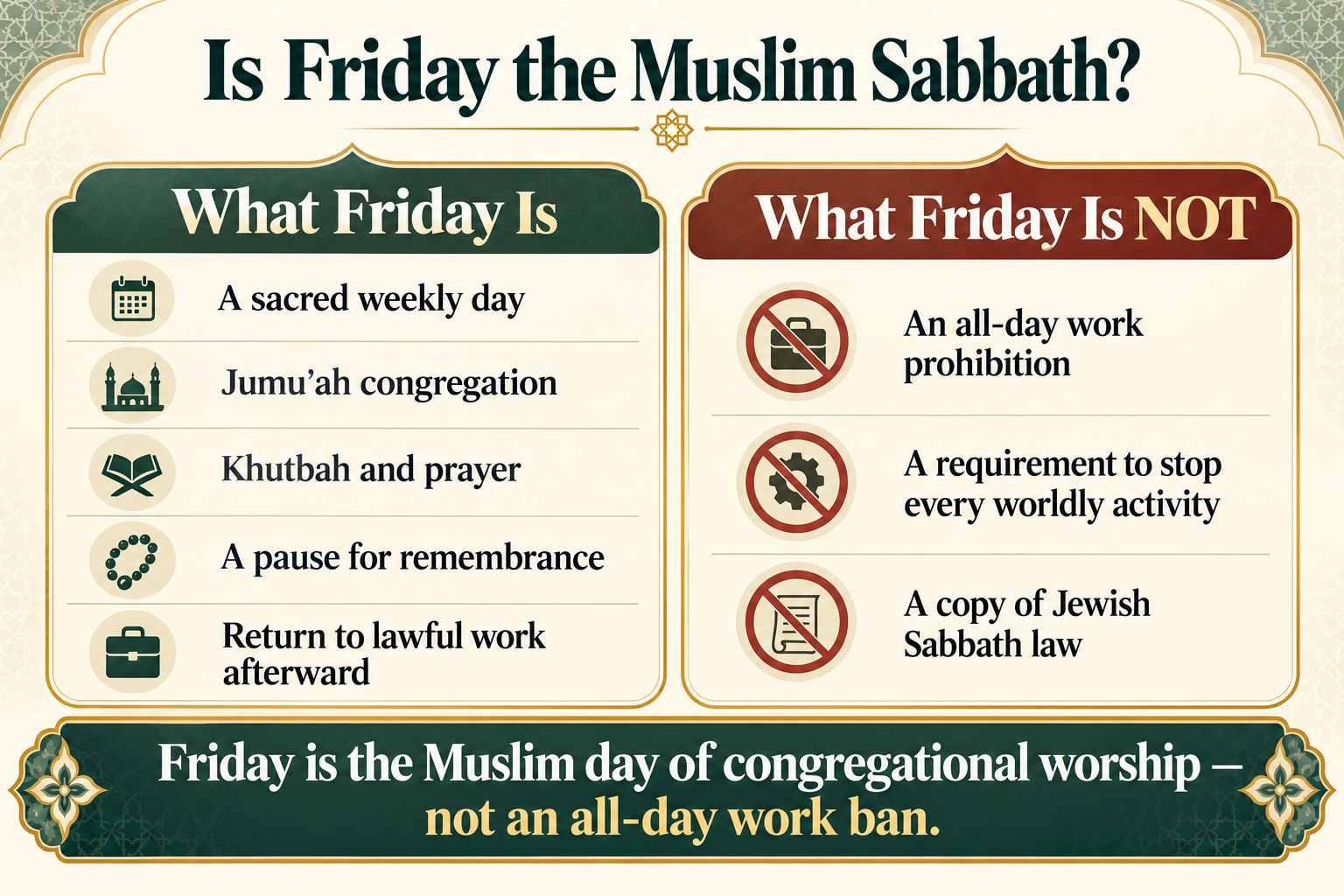
Is Friday the Muslim Sabbath?
This phrase appears everywhere, and it is helpful in one way and misleading in another.
Where it helps: Friday has unique sacred importance and a weekly communal act of worship.
Where it misleads: The “Sabbath” in Jewish law is a day of cessation from work with its own legal details. Islam does not generally prohibit working for the entire Friday. The specific obligation is to attend Jumu’ah and leave trade for it, and then, according to the Quran itself, to disperse and seek Allah’s bounty.
The Prophet ﷺ also explained, in Sahih al-Bukhari and Sahih Muslim, that earlier communities differed over their special day, while Allah guided the Muslim community to Friday. So the better statement is:
Friday is the Muslim day of congregational worship, not an all-day work-ban.
And that is why the question “Can Muslims work on Friday?” has a straightforward answer: yes, outside the time Jumu’ah requires. Many Muslim-majority countries have a Friday weekend or half-day, but that is a decision of society or government, not a Quranic requirement.
Why Friday? What the Authentic Sunnah Says
The best day on which the sun rises
In Sahih Muslim, Abu Hurayrah (may Allah be pleased with him) narrates that the Messenger of Allah ﷺ said, in meaning: The best day on which the sun has risen is Friday. On it Adam was created, on it he was admitted to Paradise, and on it he was removed from it. And the Hour will not be established except on Friday.
This report gives us what we can know. Nothing more should be added to it.
On Adam (peace be upon him): The narration mentions creation, entry into Paradise and removal from it. It does not give any description of how these events looked, so we do not add imagery or elaborate storytelling. We state only what the authentic report states.
On the Hour: The Hadith tells us the Day of Judgment will occur on a Friday. It does not tell us which Friday, which date, which year or which century. This is not a license for predictions. The Prophet ﷺ taught that the knowledge of the Hour belongs to Allah alone. (To learn more, see our guide What Is the Day of Judgment in Islam?)
A caution about different wordings: some other narrations of this Friday Hadith in different collections include additional details. These are separate reports with their own wording, and responsible writers do not blend them into one “super-Hadith.”
Is Friday a “weekly Eid”?
You may have seen: “Friday is the Eid of the believers.” Does an authentic report say this?
Yes, but we must be precise. There are reports that call Friday an Eid:
A narration in Sunan Ibn Majah, from Ibn Abbas (may Allah be pleased with them both), in which the Prophet ﷺ describes Friday as a day Allah made an Eid for Muslims and then mentions Ghusl, using fragrance and the Siwak (a tooth-cleaning twig). Some contemporary Hadith scholars graded it Hasan (acceptable).
A narration from Abu Hurayrah recorded in Ahmad and others, in which Friday is called an Eid in the context of not singling it out for fasting. Some scholars also graded this Hasan.
So it is fair to say that authentic-leaning reports describe Friday as an Eid in the sense of a recurring day of gathering and worship. But this phrase is not in Sahih al-Bukhari or Sahih Muslim, and it should not be quoted as such. When you read “weekly Eid,” read it as a description with support, not as a separate Eid with its own special Eid prayer.
Why Muslims Gather
The theological purpose of Jumu’ah is worship and remembrance. But the social side is real. In one hall stand people of different ages, jobs, incomes, ethnicities and mother tongues, shoulder to shoulder, facing the same direction, listening to the same words.
It would be dishonest, though, to romanticize every mosque. Some Khutbahs are dull. Some mosques are crowded, cold or culturally unfamiliar. Some congregations are warmer than others. None of that changes the purpose: you are there to remember Allah, and to be reminded.
One thing is worth noticing. The Quran frames this gathering not as an extra, but as something worth stopping work for.
Who Must Attend Jumu’ah?
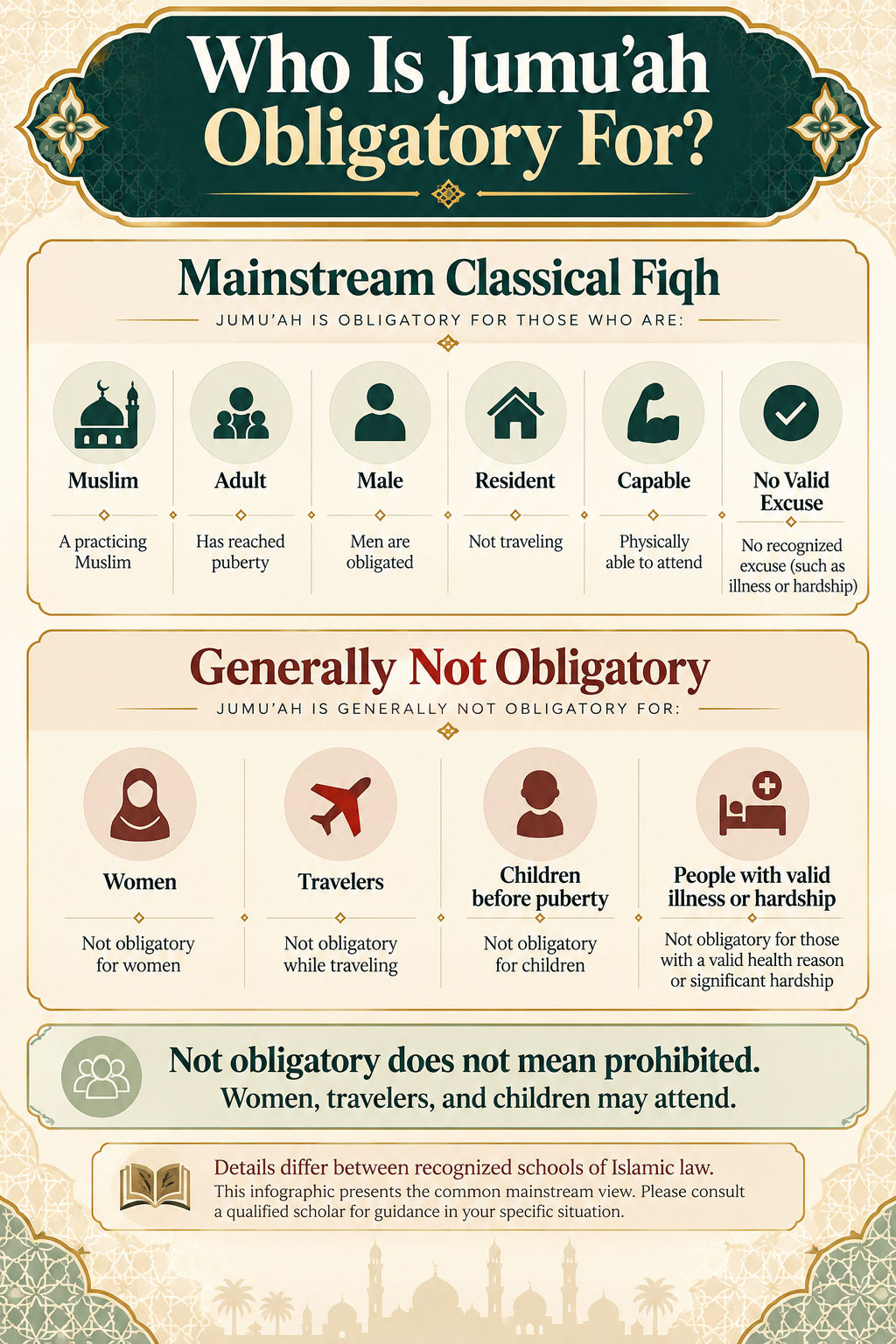
Fiqh ruling. Jumu’ah is a firm obligation, and the mainstream classical position lists the people upon whom it is obligatory as those who are:
Muslim
Adult (past puberty and of sound mind)
Male
Resident (not a traveler)
Capable (healthy and able to attend)
Without a valid excuse
A frequently cited report in Sunan Abu Dawud says Jumu’ah is a binding right upon every Muslim in congregation except four: a slave, a woman, a child and a sick person. Scholars have discussed its chain, and many accepted it; the mainstream ruling also rests on wider principles accepted by the jurists. Details differ between schools, especially about the traveler and about what counts as a valid excuse, so the sections below stay at the level of widely agreed principles.
To be clear, “not obligatory” is not the same as “not allowed.” Women, travelers and children may attend.
Women and Jumu’ah
This section deserves care, because it is where the most careless statements appear.
What the mainstream classical Fiqh says: Jumu’ah is generally not obligatory upon women. This is a relief and a recognition of their responsibilities, not a prohibition.
What is also true: Women may attend the mosque and pray Jumu’ah. In Sahih al-Bukhari and Sahih Muslim, the Prophet ﷺ said, in meaning, not to prevent the women servants of Allah from the mosques of Allah. If a woman prays Jumu’ah with the congregation, it takes the place of Dhuhr for her; she does not need to pray Dhuhr afterward.
So avoid both of these statements:
✗ “Friday prayer is for men only.”
✗ “Women should never go to Jumu’ah.”
Fragrance. For women attending the mosque, authentic reports in Sahih Muslim caution against wearing strong perfume when going out to pray. This does not mean women should neglect hygiene or freshness; cleanliness applies to everyone equally. It means avoiding noticeable scent that draws attention in a shared space.
If a woman does not attend: She prays Dhuhr (four Rak’ahs) at home at its time. She does not need to wait until the mosque Jumu’ah is finished, and she can pray as soon as Dhuhr time begins. Neither a woman who attends nor a woman who prays Dhuhr at home should be shamed.
Friday still has plenty for her at home: Quran, Salawat (blessings upon the Prophet ﷺ), Dua, Dhikr, family learning and kindness, and we will return to that in the routine sections below.
Children and Jumu’ah
Children before puberty are not generally obligated. But attending can teach mosque manners, congregational worship, listening and a sense of belonging.
Parents know their children best. Consider age, attention span, how crowded the mosque is, and whether the child can be reasonably quiet. A toddler who needs to leave is not a failure, and parents of young children should not be made to feel unwelcome. A calm, short and positive experience is worth more than forcing a child to sit through something that leaves them dreading the mosque.
Travelers and Jumu’ah
The mainstream ruling is that Jumu’ah is generally not obligatory upon a traveler. If a traveler wishes to attend a valid Jumu’ah, it is good and it is sufficient for him in place of Dhuhr. If not, he prays Dhuhr (shortened to two Rak’ahs where the traveler’s concession applies). Schools differ on details such as what counts as “traveling” and the timing of departure, so a traveler with a specific situation should ask a qualified scholar.
Illness, Hardship and Other Excuses
Islam is built on ease. Jurists recognize valid excuses that lift the obligation, including:
Illness that makes attendance difficult or harmful
Significant hardship, such as severe weather or serious danger on the way
Fear for one’s life, safety or property in real situations
Caregiving that cannot be left (for example, nursing someone who cannot be left alone)
Do not build a universal list from intuition. “I’m tired,” “I’m busy” or “It’s inconvenient” are not the kind of excuses the jurists have in mind. At the same time, do not burden the person who genuinely has a valid excuse with guilt.
Disability and accessibility
Being disabled does not automatically remove the obligation, and it does not automatically impose it either. The ruling depends on the person’s actual ability and hardship. A wheelchair user whose mosque has a ramp is in a different position from one whose mosque has none. A Deaf worshipper may attend with a sign-language interpreter or written Khutbah text where available. A person with chronic illness or sensory sensitivity may need a quiet side area or a shorter stay.
This is also a responsibility for communities: mosques should improve step-free access, accessible washrooms, seating for those who need it, captioning or translated summaries and quieter spaces. Making Jumu’ah reachable is part of honoring it.
Work and Jumu’ah: A Practical Guide for Muslims in Non-Muslim-Majority Countries
For many readers, this is the real question. Friday is a normal workday, and the Quran says to leave trade for Jumu’ah. How do these fit together?
Start from the verse: it addresses believers for whom attendance is obligatory. Real life is complicated, and the situations differ:
Office employees can often use a lunch break or arrange a slightly longer one.
Shift workers, drivers, factory and retail workers may have fixed schedules that need advance conversations.
Healthcare workers may have duties they cannot abandon without harming patients; this is a recognized area of necessity and should be discussed with a scholar for the specific case.
Teachers are bound by class schedules.
Remote workers usually have the most flexibility, and their remote status does not remove the duty.
Practical steps that help in almost every case:
Plan ahead. Find the nearest mosque or prayer room and its Jumu’ah times, then calculate travel time.
Speak to your employer early and calmly, ideally when you are hired or when your schedule is set, not on Friday morning. Frame it as a regular, predictable, around-an-hour request, and offer to make up the time.
Adjust your lunch period so it lines up with Jumu’ah.
Look for earlier or later services. Many mosques run first and second Jumu’ahs (see below).
Check workplace and campus prayer rooms, which sometimes host Jumu’ah.
What if my employer refuses?
Two extremes are unhelpful. One says: “Quit immediately.” The other says: “Work always excuses you.” Neither fits the facts. The obligation is serious, but personal circumstances vary: finances, dependents, availability of other work, how firm the refusal is, and whether a workable alternative exists.
If you face a genuine conflict, the best path is to:
seek a practical accommodation (swap shifts, a longer break, a different mosque time),
speak with a trustworthy local scholar about your specific situation, and
consider realistic alternatives over time.
Do not make life harder than Islam makes it, and do not treat the obligation lightly either. Please also note that employment rights differ from country to country; this article does not give legal advice, and you may want to check local employment guidance separately.
School and University
Students can do much more than they think.
Check the timetable early each term and see whether Friday classes collide with Jumu’ah.
Speak to the school or university about a reasonable arrangement.
Look for the Muslim Student Association or chaplaincy, since many campuses host their own Jumu’ah.
Identify the nearest mosque and plan travel time.
For minors, parents may need to coordinate with the school. Not every country gives the same legal rights to such accommodation, so avoid assuming a universal right.
A short, polite and well-planned request is often received better than a last-minute demand.
Multiple Jumu’ah Services: First, Second, Even Third
Many mosques in Europe, North America and Australia hold more than one Jumu’ah in a day. Is that allowed?
Classical discussions of multiple Jumu’ah gatherings in one locality developed in towns and conditions very different from today’s cities. Schools varied in how strictly they limited it. Many contemporary scholars and councils accept multiple services where there is real need, such as limited space, different work and school hours and large Muslim populations. So it is not right to casually declare modern multi-service Jumu’ahs invalid. If your mosque uses this arrangement, follow its qualified leadership and choose the service that you can attend calmly and fully.
When Is Jumu’ah Prayed?
Jumu’ah is prayed in the time of Dhuhr, the early-afternoon prayer. The mainstream practice, supported by reports such as that of Anas in Sahih al-Bukhari, is that the Prophet ﷺ prayed it after the sun had passed its peak. Some scholars, notably in the Hanbali school, also allowed it slightly earlier on the basis of other reports, such as one from Jabir in Sahih Muslim. This is a scholarly difference about the beginning of the time.
For a beginner, the guidance is simple: follow your local mosque’s published schedule. Mosque times are set by qualified people who have already considered this.
Does Jumu’ah Replace Dhuhr?
Yes, for anyone who validly performs Jumu’ah. It is not “Dhuhr plus an extra Friday prayer.” After a valid Jumu’ah, a person does not pray the four Fard Rak’ahs of Dhuhr.
Some communities have a custom of praying an extra four Rak’ahs after Jumu’ah, sometimes called Zuhr Akhir (“last Dhuhr”). This arose in particular circumstances in some schools’ discussions, usually out of caution about whether a given Jumu’ah was valid. It is not a universal Sunnah and should not be presented as one. If your mosque or school of thought has a position on it, follow your local scholarship.
Jumu’ah does not replace Fajr, Asr, Maghrib or Isha. It replaces only Dhuhr. For the broader picture of the five prayers, see The 5 Daily Prayers Explained: Why Muslims Pray Throughout the Day.
How Many Rak’ahs Is Jumu’ah?
The obligatory congregational Jumu’ah prayer is two Rak’ahs, prayed after the Khutbah. A Rak’ah is one unit of prayer (standing, bowing, prostrating).
The evidence includes a report from Umar ibn al-Khattab (may Allah be pleased with him) in Sunan al-Nasa’i and Sunan Ibn Majah: the prayer of the traveler is two, Adha is two, Fitr is two, and Jumu’ah is two, complete and not shortened, as spoken by your Prophet ﷺ. This was graded sound by Hadith scholars. In addition to this, the continuous practice of Muslims across generations establishes it.
Be careful to separate:
Fard Jumu’ah: two Rak’ahs, obligatory.
Voluntary or Sunnah prayers before or after: optional, and the details differ between schools (see below).
So “Jumu’ah is four Rak’ahs” is a common confusion that usually comes from adding the Sunnah prayers to the Fard.
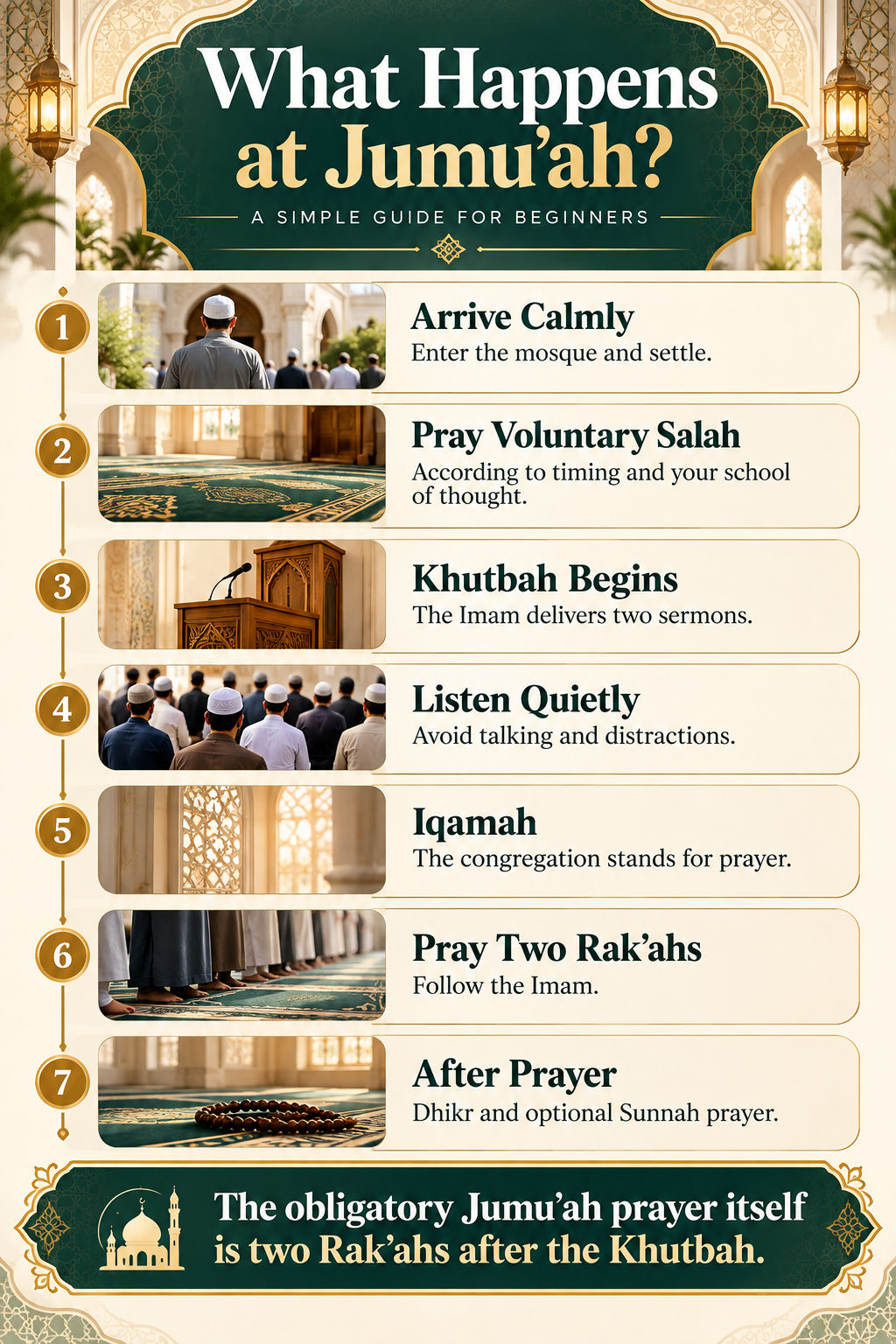
What Happens During Jumu’ah? A Beginner’s Flow
Arrive at the mosque and enter calmly.
Pray voluntary prayer (including Tahiyyat al-Masjid, the greeting of the mosque, depending on timing).
The Imam (the prayer leader) delivers the Khutbah, in two parts.
The congregation listens.
Iqamah is called, the call just before the prayer begins.
Two Rak’ahs of Jumu’ah are prayed with the Imam.
Post-prayer Sunnah and Dhikr (remembrance) as applicable.
Do not treat the number of Sunnah Rak’ahs before Jumu’ah as unanimously fixed; we cover this below.
The Khutbah (الخُطْبَة)
Al-Khutbah means a sermon or formal address. In Jumu’ah it is not a casual talk before the prayer; it is an integral part of the Jumu’ah service. The Quran’s phrase “remembrance of Allah” in 62:9 is understood by many scholars as including the Khutbah. For this reason, jurists treat the Khutbah as a requirement for a valid Jumu’ah, though they differ on exact conditions such as content and minimum length.
Two parts
The established practice is two Khutbahs with a brief sitting between them. In Sahih al-Bukhari and Sahih Muslim, Ibn Umar reports that the Prophet ﷺ used to deliver two sermons, sitting in between. Another report from Jabir ibn Samurah in Sahih Muslim describes him delivering the Khutbah standing, which is consistent with Quran 62:11, where the believers are rebuked for leaving the Prophet ﷺ “standing.” The typical content includes praise of Allah, Salawat on the Prophet ﷺ, advice to be mindful of Allah (Taqwa), Quranic recitation, and a reminder, then Dua.
Language of the Khutbah
This is a major question for international communities. Scholars differ. Some schools emphasize Arabic for the essential opening elements (praise, Salawat, Taqwa advice, a Quranic verse), while allowing the exhortation itself to be in the language the congregation understands. Others lean toward Arabic more fully, and others are more flexible with the local language. In practice, most mosques in the West deliver the Khutbah in a mixture of Arabic and the local language.
So avoid two sweeping claims: “The Khutbah is invalid unless every word is in Arabic,” and “It can always be entirely in any language.” Neither reflects the schools fairly. The practical rule: follow your mosque’s established practice and qualified scholarship.
Listening to the Khutbah
This is one of the most strongly emphasized etiquettes. In Sahih al-Bukhari and Sahih Muslim, Abu Hurayrah (may Allah be pleased with him) reports that the Prophet ﷺ said, in meaning: if you say to your companion “Be quiet” on Friday while the Imam is delivering the Khutbah, you have engaged in laghw (idle or improper speech).
Notice the force of this: even telling someone else to be quiet, which is a good thing to say at another time, counts as laghw in that moment. The point is that the listener’s whole attention belongs to the Khutbah.
Can I talk during the Khutbah? Generally, no. Listen. Some exceptions are discussed by jurists: speaking to the Imam when he addresses you, and urgent situations of safety or harm, such as warning a person of danger. Do not overcomplicate it; for an ordinary reader, silence is the rule.
Using your phone
A relevant report in Sahih Muslim (Abu Hurayrah) says that whoever touches the pebbles during the Khutbah has engaged in laghw. Early mosques had pebbled floors, and fiddling with them was a distraction. Scholars have applied the principle to modern distractions: scrolling, messaging, social media, photographing and recording.
Be careful in how this is understood. The text establishes that distraction harms the reward of Jumu’ah. It does not say that your Jumu’ah is formally invalid because you checked your phone, and we should not claim that without evidence. The right distinction is between sin, distraction or loss of reward on one side and formal invalidation on the other. The simple practice is to switch your phone to silent before you sit down and keep it away.
Replying to Salam during the Khutbah
Scholars differ. The Hanafi and Maliki schools generally say to stay silent and not even return a greeting aloud, while some Shafi’i and Hanbali scholars allow a reply to Salam. The safe practice many follow is not to greet anyone during the Khutbah in the first place, and to stay quiet if greeted.
Praying two Rak’ahs when you enter during the Khutbah
In Sahih al-Bukhari and Sahih Muslim, Jabir (may Allah be pleased with him) reports that Sulayk al-Ghatafani came in while the Prophet ﷺ was delivering the Khutbah and sat down. The Prophet ﷺ asked if he had prayed, and when he said no, told him to stand and pray two Rak’ahs. The report in Muslim adds that he told him to keep them brief.
Schools differ in how they apply this. The Shafi’i and Hanbali schools take it as general guidance: if you enter while the Khutbah is happening, pray two brief Rak’ahs (Tahiyyat al-Masjid) before sitting. The Hanafi and Maliki schools understand the situation differently and prefer to sit and listen. Both groups are trying to follow evidence; this is not a reason to criticize anyone. Follow your school or your local mosque’s practice.
Sunnah Prayers Before and After Jumu’ah
Before
There is no universally agreed fixed number of Sunnah Rak’ahs before Jumu’ah comparable to the regular Dhuhr Sunnah. In Sahih al-Bukhari, Salman al-Farisi’s report encourages one to pray “what was written for him,” meaning voluntary prayer according to ability, before the Imam arrives. Some schools, notably the Hanafi, prescribe a set number (often four), while others leave it open. Pray voluntary Salah before the Imam comes, and do not stress about the exact count.
After
The authentic evidence includes two reports:
In Sahih Muslim, Abu Hurayrah reports the Prophet ﷺ said: when one of you prays Jumu’ah, let him pray four Rak’ahs after it.
In Sahih al-Bukhari and Sahih Muslim, Ibn Umar reports that the Prophet ﷺ used to pray two Rak’ahs at home after Jumu’ah.
Scholars reconcile these in different ways. Some say four is a general instruction and two at home was a practice in certain circumstances. Others, such as the approach attributed to Ibn Taymiyyah, say if you pray in the mosque, pray four, and if you pray at home, pray two. Do not insist that one report cancels the other. Two, four, or a combination are all within what scholars have accepted; follow your school.
Arriving Late, Missing Jumu’ah and Praying at Home
What if I arrive late?
The general principle comes from Sahih al-Bukhari and Sahih Muslim: whoever catches a Rak’ah of the prayer has caught the prayer. A specific report in Sunan Ibn Majah and elsewhere says whoever catches one Rak’ah of Jumu’ah should add another to it. Hadith scholars including al-Albani graded this sound. According to the majority, if you join before the Imam raises his head from the bowing of the second Rak’ah, you have caught Jumu’ah, so you complete it with one more Rak’ah. If you join after that, according to the majority you pray Dhuhr (four Rak’ahs). Some Hanafi scholars hold that catching the Imam even in the final sitting is enough. Schools differ here, so follow your local practice.
What if I miss Jumu’ah?
Pray Dhuhr, four Rak’ahs. Do not pray a two-Rak’ah “Jumu’ah” alone at home, because Jumu’ah is a congregational prayer with conditions.
Can I pray Jumu’ah at home?
Not by yourself. You cannot simply decide, “I’ll pray two Rak’ahs at home and call it Jumu’ah.” Jumu’ah requires a congregation and a Khutbah. That said, a Jumu’ah organized in a workplace, campus or community space can be valid when it meets the conditions the jurists lay out. If you want to organize one, ask a qualified scholar.
What is the minimum number for Jumu’ah?
This is a famous scholarly difference. Schools set very different minimums, from as few as three or so in some views up to forty in others, and some state numbers in between. Do not write or repeat that “Jumu’ah requires exactly 40 people” as if it were the universal rule of Islam. One reason for the forty view is a report in Sunan Abu Dawud about the early Jumu’ah in Madinah led by As’ad ibn Zurarah, which other jurists read as describing an event rather than setting a limit. For the ordinary worshipper: follow the reliable local mosque and its scholarship.
Women-only Jumu’ah
This is a specialized topic. The mainstream classical positions did not regard a women-only Jumu’ah as the standard form, and some contemporary discussions exist. Rather than casually declaring either view, ask a qualified scholar if the question is real in your situation.
Online and livestream Jumu’ah
Watching a livestream of a Khutbah is not the same as being part of the physical Jumu’ah congregation. Contemporary fiqh councils have generally held that remote viewers do not form part of that congregation, because a congregation relies on being gathered in one place. So do not treat following a YouTube or Zoom service as your Jumu’ah and then skip the mosque. If you are genuinely unable to attend, pray Dhuhr, and you can still benefit from a livestream as learning.
Speakers, overflow rooms and multi-floor mosques
Hearing the Imam through normal mosque speakers is not the same as remote participation: you are in the mosque, in the congregation, connected to the Imam. Mosques also commonly use overflow rooms and multiple floors. The details of continuity can be technical, so follow the mosque’s organized arrangements.
Preparing for Jumu’ah
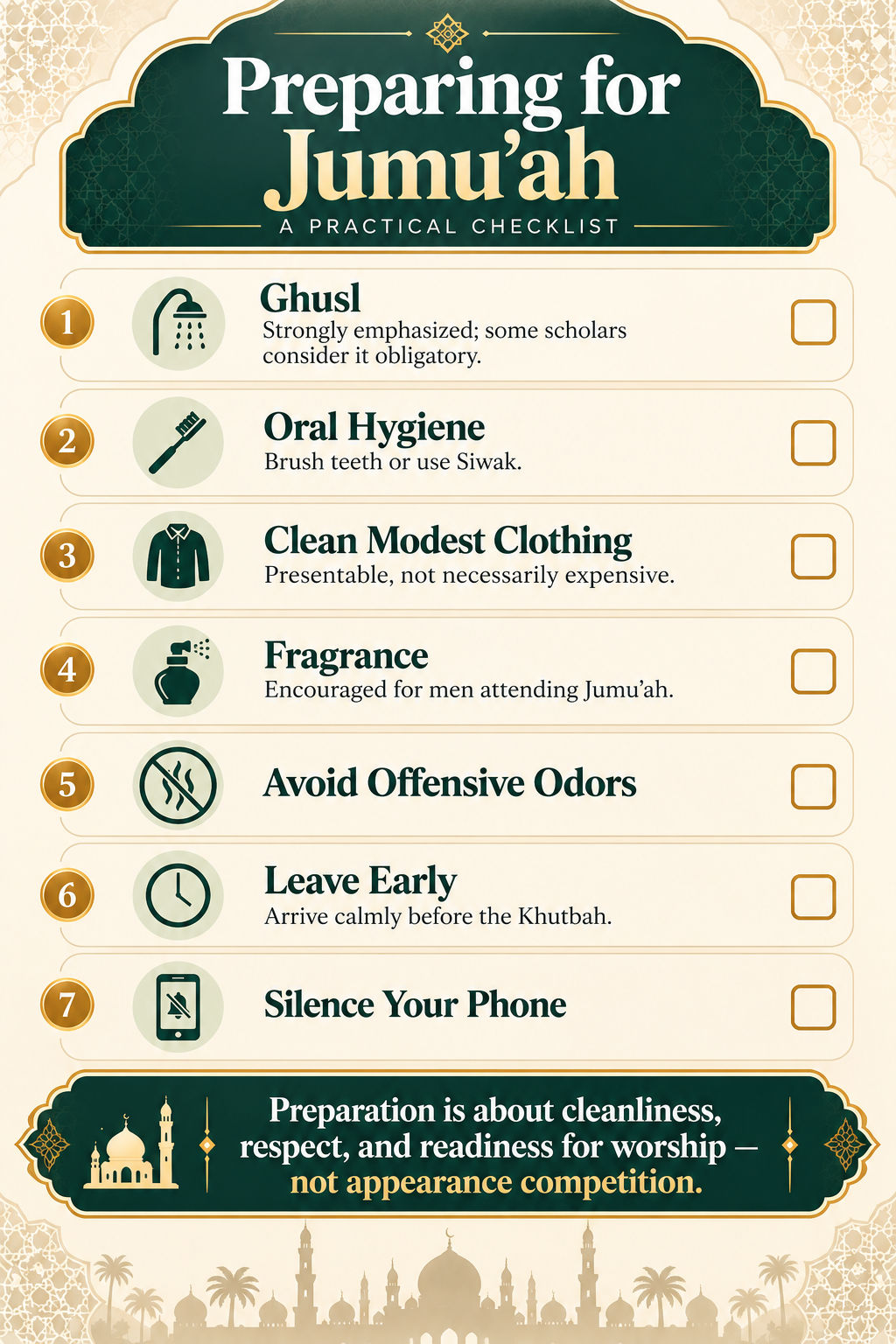
The Sunnah around Friday is mostly about preparation and respect for the gathering. Here is what the evidence supports.
Ghusl on Friday (الغُسْل)
Ghusl is a full-body wash. In Sahih al-Bukhari and Sahih Muslim, Abu Sa’id al-Khudri (may Allah be pleased with him) reports that the Prophet ﷺ said: غُسْلُ يَوْمِ الْجُمُعَةِ وَاجِبٌ عَلَى كُلِّ مُحْتَلِمٍ (“The Friday Ghusl is wajib upon every adult”). Muslim’s version adds Siwak and fragrance as one is able.
Scholarly difference. The word wajib in this Hadith can be understood as “obligatory” or as “emphasized and strongly confirmed.” Some scholars (including the Zahiri school and a few others) held it is obligatory. The majority hold it is a strongly emphasized Sunnah, not a condition for the validity of the prayer. They point to the incident in Sahih al-Bukhari and Sahih Muslim in which Umar rebuked Uthman for coming late and doing only Wudu, yet no one told Uthman to go and repeat the prayer or to bathe. They also cite a Hasan report (Abu Dawud, Tirmidhi) that Wudu is acceptable, but Ghusl is better.
The article’s approach is simple: do not hide this disagreement, and do not minimize the instruction. Take a bath before Jumu’ah. It is strongly encouraged, and some scholars treat it as required.
When should it be done? Jurists connect it to going to Jumu’ah, so doing it on Friday itself, close to the time you leave, is best. Opinions vary on whether it begins at dawn, and there is no single exact universal time. A Thursday-night shower is good hygiene, but most scholars would not count it as the Friday Ghusl.
Does it replace Wudu? The Friday Ghusl is for cleanliness, not ritual impurity. Schools differ on whether it also fulfills the requirement of Wudu. The safe practice is to make sure you are in a state of Wudu when you pray, performing it if there is any doubt.
Siwak and oral hygiene
In Sahih al-Bukhari and Sahih Muslim, the Prophet ﷺ emphasized the Siwak, saying that were it not hard on his community, he would have commanded it at every prayer. Muslim’s Friday Hadith above also mentions it. The purpose is cleanliness and respect for the people beside you. Brushing and using the Siwak both serve it.
Clothing
The Quran says, “Take your adornment at every place of prayer” (7:31, translated meaning). A report in Sunan Abu Dawud and Ibn Majah says there is no harm if a person has two garments for Jumu’ah besides his work clothes (graded Hasan). Wear clean, presentable, modest clothing. Expensive clothing is not religiously superior.
White clothing. A Hadith in Tirmidhi and Abu Dawud encourages wearing white because it is among the best of your clothes. This is general Sunnah evidence, not a Friday-specific command, so it should not be presented as a required Friday dress code.
New clothes every Friday. We are not aware of any sound evidence for this, and it should be treated as a cultural habit. Clean and appropriate matters more than new.
Fragrance
Authentic reports encourage men to use fragrance for Jumu’ah. Salman al-Farisi’s Hadith in Sahih al-Bukhari adds oil and scent from one’s household. For women attending the mosque, see the earlier note on avoiding strong perfume. In all cases, avoid strong smells such as heavy onion or garlic, cigarette smoke or body odor. Aisha’s report in Sahih al-Bukhari about people who came from work smelling of sweat shows the Prophet ﷺ encouraged bathing.
Arriving early
In Sahih al-Bukhari and Sahih Muslim, Abu Hurayrah reports that the Prophet ﷺ said, in meaning: whoever bathes on Friday as in the bath after janabah, and goes in the first hour, it is as if he offered a camel; in the second hour, a cow; in the third, a horned ram; in the fourth, a hen; in the fifth, an egg. When the Imam comes out, the angels attend to listen to the remembrance.
These are analogies for reward, which show that earlier is better. They are not a literal currency to calculate.
When do the angels stop recording? A related report in Sahih al-Bukhari says angels stand at the mosque doors writing down arrivals in order, and when the Imam sits (for the Khutbah) they close their records and listen to the remembrance. In other words, the early-arrival reward is linked to coming before the Khutbah begins.
Does “first hour” mean 60 minutes? Not necessarily. The Arabic سَاعَة (sa’ah) can mean a portion of time, not a fixed 60 minutes. Scholars differ on how to understand it: some count the hours from sunrise, others from after the sun passes its peak, and others as short divisions of the time before the Imam arrives. Do not present exact clock divisions as established. The takeaway is simple: come early if you can.
Walking and not stepping over others
A report from Aws ibn Aws in Sunan Abu Dawud and Sunan al-Tirmidhi describes the person who bathes, goes early, walks rather than rides, sits near the Imam, listens and does not engage in laghw, and says that for every step he takes he will have the reward of a year of fasting and prayer. Tirmidhi graded it Hasan, and scholars such as al-Albani graded it sound, though there is some scholarly discussion about its wording. If you cite it, cite it with its full conditions and understand the phrase as a sign of great reward, not an arithmetic formula. Do not use it to promise something specific to a person.
As for stepping over people: a report in Sunan Abu Dawud and Ahmad describes the Prophet ﷺ seeing a man stepping over people’s necks during the Khutbah and telling him, in meaning, “Sit; you have caused harm.” Arriving late does not justify disturbing others.
In simple terms: sit where there is space, fill the front rows when you can, and avoid blocking doors or aisles. We should teach etiquette without creating rigid rules that Islam did not set.
Surah al-Kahf on Friday: An Evidence Audit
Reading Surah al-Kahf (chapter 18) on Friday is a widely practiced act. Because it is popular, it deserves an honest look at the evidence, not a rubber stamp.
What it is not: Not a Hadith of Sahih al-Bukhari or Sahih Muslim. Do not describe it that way.
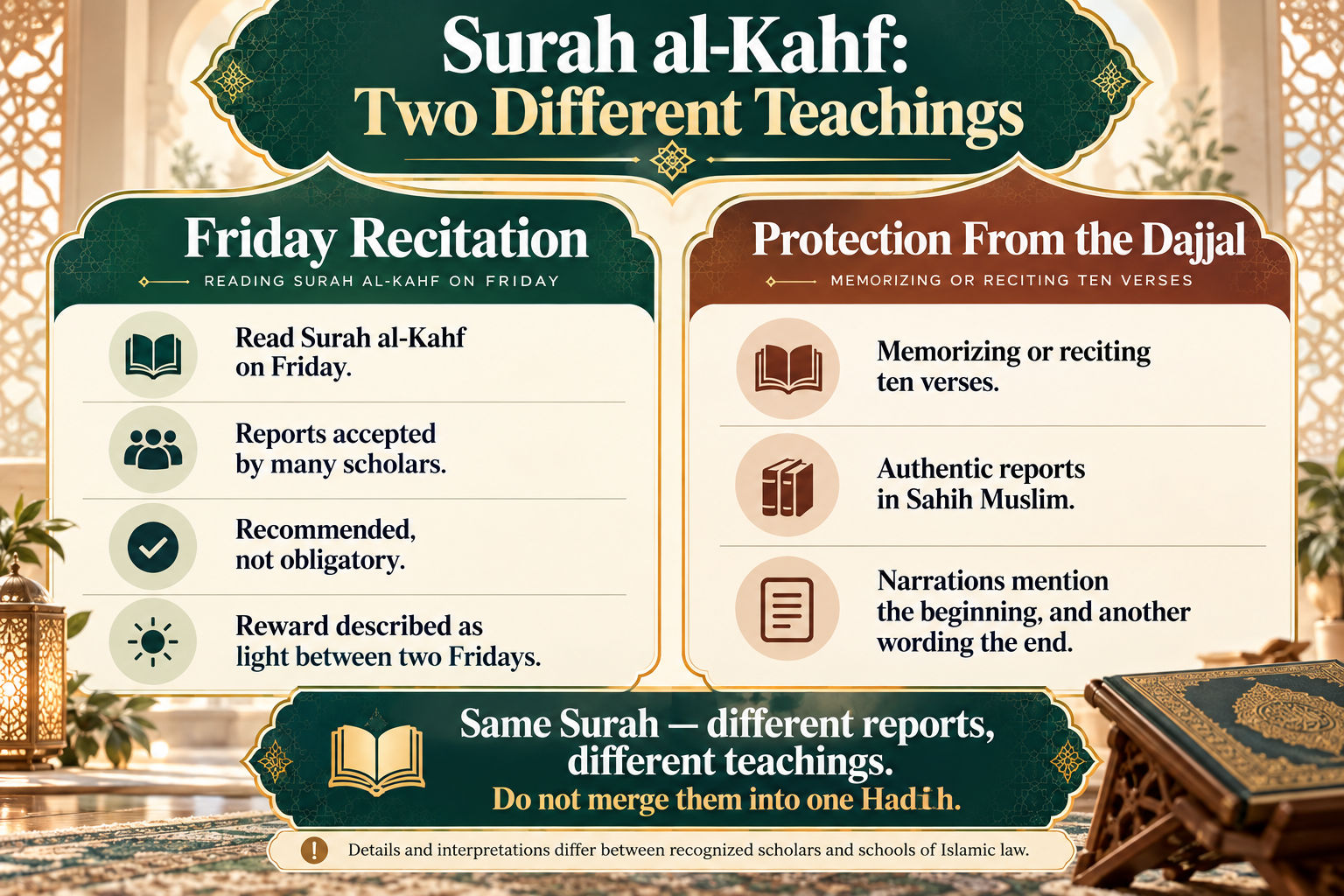
What the sources are: The best-known report comes from Abu Sa’id al-Khudri (may Allah be pleased with him) and is recorded by al-Hakim and al-Bayhaqi, with the meaning that whoever reads Surah al-Kahf on Friday will have a light between the two Fridays. Other wordings exist in other collections, and some of those are weaker and contain larger claims (such as a light stretching a great distance). Responsible writers should not blend them.
Grading and scholarly discussion: Scholars discuss whether the report is best preserved as the Prophet’s ﷺ saying (marfu’) or as the statement of the Companion Abu Sa’id (mawquf). Some Hadith critics preferred the mawquf form. Others noted that a statement of this kind about reward is not something a Companion would normally say from his own opinion, so it carries the force of a Prophetic report. Several later scholars, including al-Hakim and in recent times al-Albani, graded it sound, and the practice is recommended in the major schools. A fair summary is: supported by reports that many scholars accepted, with scholarly discussion about the precise grading and form, so treat it as a recommended practice, not an obligation.
When can it be read? Many scholars understand Friday as running from Thursday sunset (the Islamic day begins at Maghrib) until Friday sunset, so reading it from Thursday night through Friday is generally accepted. Do not make the timing narrower than the evidence.
Do I have to read all of it? The Friday reports concern reading the Surah. Reading as much as you can is still good, but the reward statement is about the Surah. If you only have a few minutes, reading what you can is better than reading nothing.
Surah al-Kahf and the Dajjal: a separate teaching
A different, authentic set of narrations in Sahih Muslim links verses of Surah al-Kahf to protection from the Dajjal (the false messiah who will appear near the end of time). Abu al-Darda’ reports the Prophet ﷺ said that whoever memorizes ten verses from the beginning of the Surah is protected from the Dajjal, and some narrators of that report mention the last ten verses. Another narration in Muslim tells a person who meets the Dajjal to recite the opening verses of the Surah.
These are two different teachings:
Friday recitation | Dajjal-related verses |
|---|---|
Reading the Surah on Friday | Memorizing or reciting the first (or in one wording, last) ten verses |
Reward: a light between two Fridays | Protection from the Dajjal |
Reports in al-Hakim, al-Bayhaqi, etc. | Reports in Sahih Muslim |
Do not say that the Friday reading is “to protect you from the Dajjal,” unless one is clear that this connection is not stated in the Friday reports. They are related by the same Surah, not the same Hadith.
Salawat on Friday (الصلاة على النبي ﷺ)
Salawat means sending prayers and blessings upon the Prophet Muhammad ﷺ. It is one of the most beloved acts, and the Quran itself says that Allah and His angels send blessings upon the Prophet and calls believers to do likewise (33:56).
For Friday specifically, a report from Aws ibn Aws (may Allah be pleased with him) in Sunan Abu Dawud and Sunan Ibn Majah has the Prophet ﷺ saying, in meaning: among the best of your days is Friday, so increase your Salawat upon me on it, for your Salawat is presented to me. Several Hadith scholars, including Ibn Hibban, al-Hakim and al-Albani, graded it sound, though a few scholars have noted discussion about one link in its chain. It is widely accepted and relied upon.
Do not use invented counts
The Hadith says to increase Salawat. It does not say “say this exact formula 1,000 times and a miracle is guaranteed.” Please separate:
General Dhikr practice: saying Salawat as often as you wish.
A specific number with a specific promised reward: this requires authentic evidence, and viral claims usually lack it.
Which form?
A well-known authentic form is Salat Ibrahimiyyah, taught in Sahih al-Bukhari (from Ka’b ibn Ujrah) and recited in the final sitting of the prayer:
اَللَّهُمَّ صَلِّ عَلَى مُحَمَّدٍ وَعَلَى آلِ مُحَمَّدٍ كَمَا صَلَّيْتَ عَلَى إِبْرَاهِيمَ وَعَلَى آلِ إِبْرَاهِيمَ إِنَّكَ حَمِيدٌ مَجِيدٌ، اَللَّهُمَّ بَارِكْ عَلَى مُحَمَّدٍ وَعَلَى آلِ مُحَمَّدٍ كَمَا بَارَكْتَ عَلَى إِبْرَاهِيمَ وَعَلَى آلِ إِبْرَاهِيمَ إِنَّكَ حَمِيدٌ مَجِيدٌ
Allahumma salli ‘ala Muhammad wa ‘ala ali Muhammad, kama sallayta ‘ala Ibrahim wa ‘ala ali Ibrahim, innaka Hamidun Majid. Allahumma barik ‘ala Muhammad wa ‘ala ali Muhammad, kama barakta ‘ala Ibrahim wa ‘ala ali Ibrahim, innaka Hamidun Majid.
Other valid forms exist, including the shorter “Allahumma salli ‘ala Muhammad” and “sallallahu ‘alayhi wa sallam.” Outside the prayer, no single formula is the only one that counts.
Dua on Friday: The Special Hour
Dua (الدُّعَاء) is personal supplication, simply asking Allah. For Friday, Sahih al-Bukhari and Sahih Muslim report from Abu Hurayrah that the Prophet ﷺ mentioned Friday and said, in meaning: in it there is an hour, and a Muslim servant who happens to stand praying and asks Allah for something good will be given it, and he indicated with his hand how brief it is.
What we know: The hour is real, it is brief, and it is a time of acceptance. What we do not know with certainty: its exact timing.
When is it? Scholars differ
Two views stand out as the strongest, and scholars have mentioned many others:
From when the Imam sits on the pulpit until the prayer ends. This is based on a report in Sahih Muslim from Abu Burdah, from Abu Musa al-Ash’ari, which attributes this to the Prophet ﷺ. Some Hadith critics debated whether it is the Prophet’s own words or those of a later narrator, though it appears in Muslim.
The last part of the day after Asr until sunset. This is based on reports including one from Abdullah ibn Salam and another from Jabir recorded in Abu Dawud and al-Nasa’i, which many scholars graded acceptable. Many scholars strongly favored this view.
There is no unanimous agreement. The practical answer is to make Dua during both periods if you can, and to make Dua throughout the day.
Can I make Dua in my own language?
Outside the prayer, yes. You may ask Allah in any language you understand. He knows what is in your heart. Do not imply that Dua is accepted only in Arabic. As for Dua inside the Salah, schools differ on details, so follow your school on that. (For more, see How to Make Dua: A Beginner’s Guide to Asking Allah.)
Friday Dhikr and Quran
Do not invent a long list of “Friday-only” Adhkar. Dhikr (remembrance of Allah) is encouraged every day, and the Quran says to remember Allah often (62:10). Distinguish general daily Dhikr from Friday-specific evidence. The same goes for the Quran: reading Quran is virtuous any day, and Surah al-Kahf has specific Friday reports, but it would be wrong to claim that every Surah has a Friday-specific reward. (See What Is Dhikr? A Beginner’s Guide to Remembering Allah Every Day.)
Surahs the Prophet ﷺ Recited on Friday
In Jumu’ah
In Sahih Muslim, reports from Ibn Abbas and Abu Hurayrah say that the Prophet ﷺ sometimes recited Surah al-Jumu’ah and Surah al-Munafiqun in Jumu’ah. Another report in Muslim (Nu’man ibn Bashir) says that he sometimes recited Surah al-A’la and Surah al-Ghashiyah. The Imam is not required to recite these every Friday; these are reported practices, not conditions.
In Fajr
In Sahih al-Bukhari and Sahih Muslim, Abu Hurayrah reports that the Prophet ﷺ used to recite Surah al-Sajdah and Surah al-Insan in Fajr on Friday. Some people think the aim was to perform the prostration of recitation each Friday. Scholars such as Ibn al-Qayyim and Ibn Taymiyyah explained that these Surahs describe the creation of Adam and the Day of Resurrection, which are themes associated with Friday, and cautioned against treating the prostration as the point or picking only the verse of prostration. Recite the whole Surah, as the Sunnah reflects.
Fasting on Friday
Here is a case where popular piety and authentic Sunnah point in different directions.
In Sahih Muslim, Abu Hurayrah reports that the Prophet ﷺ said, in meaning: do not single out Friday night for night prayer from among the nights, and do not single out Friday for fasting from among the days, unless it falls in a fast that one of you habitually keeps. In Sahih al-Bukhari and Muslim, reports from Jabir and Juwayriyyah describe the Prophet ﷺ discouraging a person from fasting only on Friday and asking whether they had fasted the day before or planned to fast the day after.
Is it haram? Scholars generally treat singling out Friday for a voluntary fast as makruh (discouraged), with some going stricter. Common exceptions include:
Fasting a day before or after Friday
A regular pattern, such as fasting alternate days, or the White Days (13th–15th of the lunar month)
An obligatory fast, such as Ramadan, or a make-up (Qada) or vowed fast
Days that coincide with a recommended fast such as Arafah or Ashura, as scholars apply the principle
So the message to “fast every Friday because it is holy” runs against the Hadith. A related narration describes Friday as an Eid and warns against making it a fast day, which gives a reason: it is a day of gathering and worship, not primarily of fasting.
Friday Night (Laylat al-Jumu’ah)
In Islamic reckoning the day begins at sunset, so Friday begins on Thursday at Maghrib. This is ليلة الجمعة (Laylat al-Jumu’ah, “the night of Friday”).
But notice that Sahih Muslim’s Hadith above actually tells believers not to single out Friday night for special night prayer. Therefore, do not recommend specific Rak’ah counts, Surahs or formulas for Thursday night/Friday that have no authentic basis. You may pray and read Quran as you normally would, and begin your Friday intentions and preparations, but do not fill the night with invented rituals.
Popular Friday Claims: What the Evidence Supports
Here is an honest audit of common claims. Our standard is simple: a special reward or ritual for Friday needs a sound text, not a repeated claim.
Claim | Assessment |
|---|---|
Surah Ya-Sin on Friday for a special reward | Reports tying Ya-Sin to Friday specifically are weak or unestablished. Reading Quran is good on any day, but do not assign a special Friday reward. |
Surah al-Dukhan on Friday night for forgiveness | Reported in Tirmidhi and others through weak chains. Do not repeat it as Sunnah. |
“80 years of sins forgiven” for a Salawat count after Asr | Reported through very weak or fabricated chains according to many Hadith critics. Do not publish. |
Cutting nails on Friday | Nail trimming is part of natural hygiene (fitrah) and good any day. We are not aware of a sound Prophetic report giving Friday a special reward for it. Treat as permissible and good hygiene, not a Friday-specific Sunnah. |
Haircuts on Friday | No established Friday-specific evidence. Cultural routine. |
Visiting graves on Friday for special reward | Grave visits have a general basis, but reports of a special Friday reward are weak. |
Charity on Friday | Charity is always virtuous. Some scholars, such as Ibn al-Qayyim, favored giving more on Friday, reasoning that good deeds are weightier on virtuous days, but there is no explicit sound Prophetic promise specific to Friday charity. Recommended as general virtue. |
Getting married on Friday | Permissible, and some scholars considered it preferable. It is not an established Sunnah. |
Saying “Jumu’ah Mubarak” as a Sunnah greeting | We are not aware of clear evidence that the Prophet ﷺ and his Companions used it as a fixed weekly greeting. Many scholars say not to present it as Sunnah, while ordinary kind wishes are a separate question and many view them as permissible customs. Not worth conflict. |
Handshaking after Jumu’ah | Shaking hands is generally good. Making it a fixed ritual believed to be a required Friday Sunnah needs evidence. |
Collective Duas after Jumu’ah in an invented format | Do not make up Friday-specific collective formulas. General Dhikr after prayer is fine. |
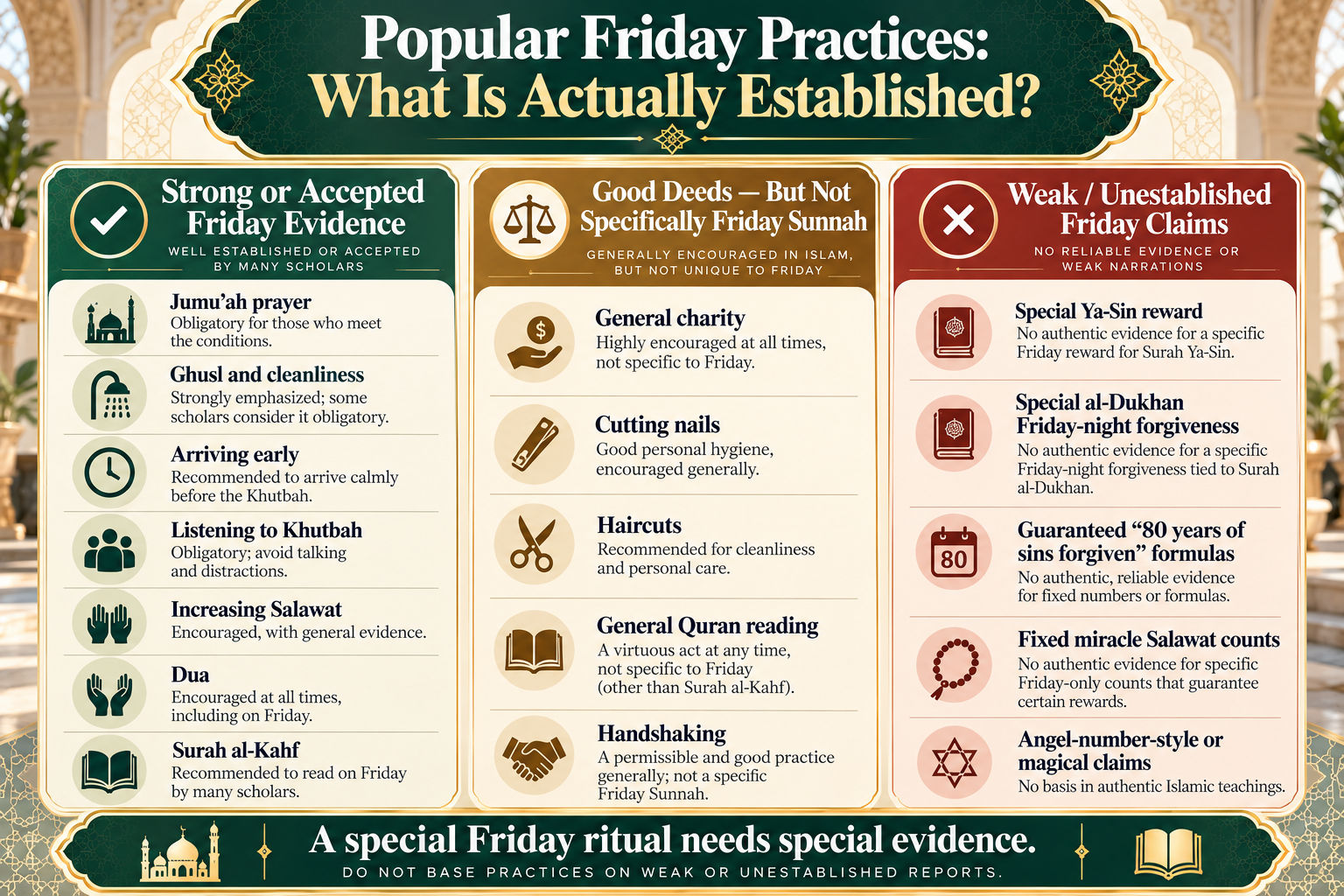
None of this means those good deeds are bad. It means: do them as ordinary good, not as something the Prophet ﷺ prescribed for Friday.
Your First Jumu’ah as a New Muslim
If you are new to Islam, or returning after a long time, the idea of walking into a Friday congregation can feel intimidating. Here is a reassuring walkthrough.
Before you go
Check the mosque’s address and Jumu’ah time (many post it on their website or social media).
If relevant, check which entrance is used by men and women.
Perform Wudu (the ablution) at home or at the mosque.
Wear clean, modest clothes.
Arrive early if you can; it gives you time to settle.
Silence your phone.
When you arrive
Shoes are typically removed and placed in a designated area. Look for signs or ask.
Follow the mosque’s organization. People are usually happy to point you the right way.
Pray two brief Rak’ahs of greeting if appropriate to your school and timing, or sit quietly.
Sit, listen and follow the congregation.
During the prayer
Stand in the row, watch the Imam and those beside you, and follow their movements. Nobody expects a newcomer to know everything. Stand, bow and prostrate with the congregation as best you can, and learn gradually.
After
Ask questions. Greet people. Many mosques are glad to connect new Muslims with a mentor or a beginners’ class.
You do not need to know everything before you belong in the mosque.
What should a convert wear?
Clean, modest clothing is what matters. There is no requirement for a thobe, abaya, kufi or any particular ethnic dress. Islam is not tied to Arab clothing; a suit, jeans and a long-sleeved shirt, or a shalwar kameez are all fine when modest and clean. Women should follow Islamic modesty guidelines (covering the body appropriately and a headscarf), which can be done in many practical, comfortable ways. If you are unsure, ask a sister at the mosque; most will gladly help.
Do I need to speak Arabic?
No. The prayer includes prescribed Arabic recitation, but a newcomer can learn it gradually. Many mosques have beginner support. Do not let language anxiety keep you from attending.
What if I do not understand the Khutbah?
Do not conclude that it is pointless. Listen respectfully, look for mosque translations or a summary where available, read the topic afterward, learn recurring words, and study Quranic Arabic step by step. Presence, listening and remembrance have value even before understanding is complete.
Mosque culture versus Islam
You may encounter different languages, cultural dress, different customs and even different school-of-thought practices (for example, in how people pray after Jumu’ah). Two reminders help: not every unfamiliar practice is wrong, and not every mosque custom is universal Islam. If something is puzzling, ask kindly and look for the evidence behind it. If you come from another faith background and have questions about how Islam views the figures you know, you may enjoy our guide Who Is Jesus in Islam?
Friday for Women at Home, and for Parents
For women who do not attend the mosque
Friday does not become spiritually empty. A woman at home can pray Dhuhr on time, read Quran, read Surah al-Kahf as part of the recommended practice, send Salawat, make Dua (especially in the late-afternoon window), engage in Dhikr, learn with her family and do acts of kindness and charity. Just distinguish Friday-specific Sunnah (Surah al-Kahf, Salawat, Dua hour, Ghusl and cleanliness as applicable) from general worship that is good any day.
For parents
Some ideas that do not have to become a performance:
Teach children a few Jumu’ah words (Khutbah, Imam, Adhan).
Lay out clothes the night before to avoid a stressful morning.
Aim to arrive calmly rather than chaotically.
Teach basic Khutbah manners: sit, listen, no talking.
Ask one question afterward, such as “What is one thing you heard?”
Read a little Quran together and make Dua as a family.
Keep it light. A weary, shouted-at child does not leave with love for Jumu’ah.
Building a Sustainable Friday Routine
The aim is not a longer list. It is a rhythm you can actually keep. For help fitting this with the rest of your week, see How to Build a Daily Islamic Routine When You Live a Busy Life.
A minimum viable Friday (for busy professionals)
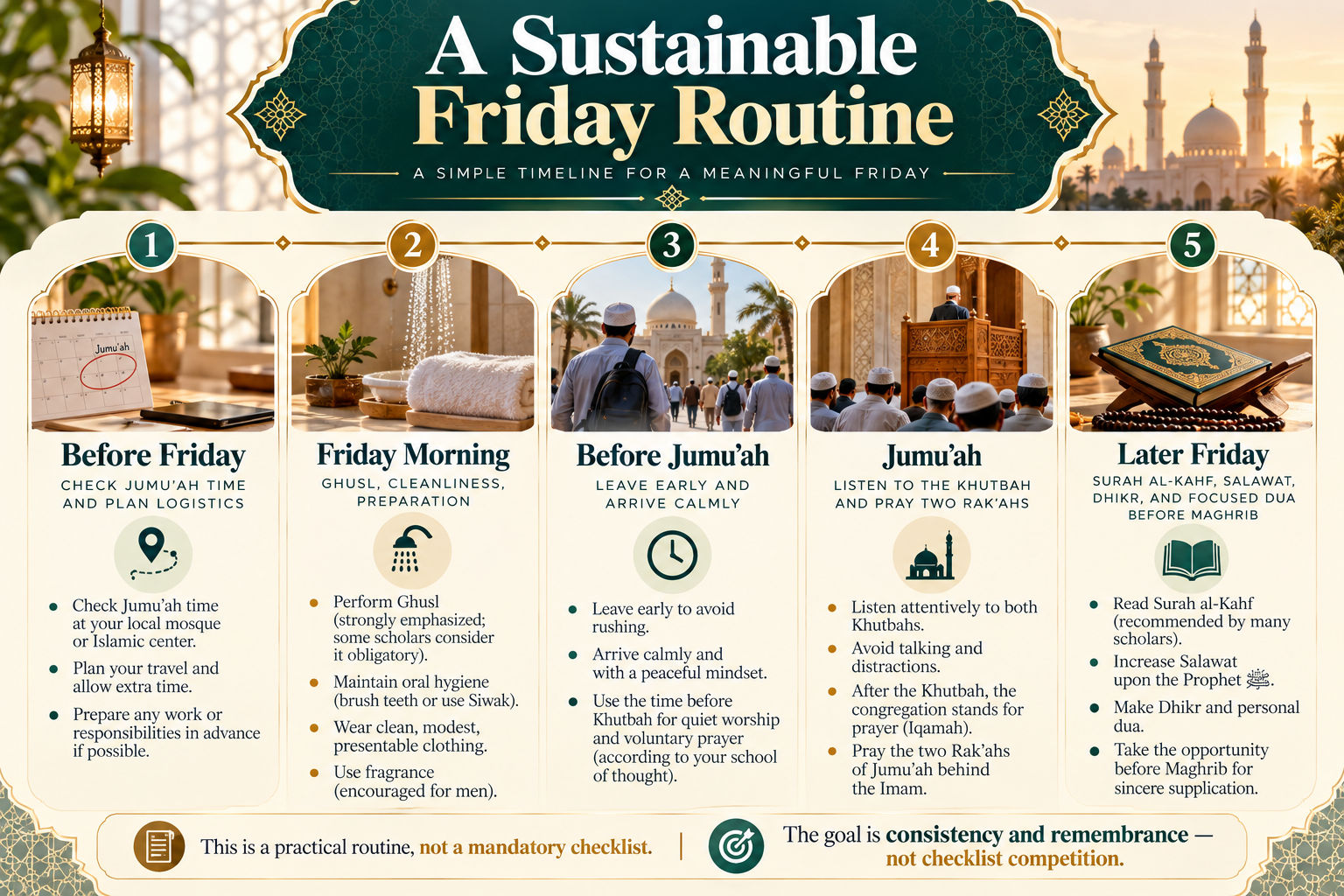
When | What | Level |
|---|---|---|
Before the day | Find your Jumu’ah location and time; tell your manager early | Essential planning |
Morning | Bathe and prepare if practical | Recommended (Ghusl is strongly emphasized, and some scholars hold it obligatory) |
During normal moments | Send Salawat on the Prophet ﷺ | Recommended |
Lunch / Jumu’ah | Attend, listen to the Khutbah, pray two Rak’ahs | Obligatory (for those it applies to) |
Afternoon | Read Surah al-Kahf, as much as you can | Recommended |
Before Maghrib | Make focused Dua | Recommended |
A fuller Friday (if you have flexibility)
Thursday evening: Begin Friday intentionally. Remember that the Islamic day has started.
Friday morning: Ghusl, clean clothes, Quran or Surah al-Kahf.
Before Jumu’ah: Arrive early, pray voluntary prayer, make Dhikr.
Khutbah: Listen.
After: Sunnah prayers, Dhikr, time with family and community.
Late afternoon: Dua.
This is an optional routine. Do not present it as mandatory, and do not feel guilty for doing a smaller version.
A simple Friday checklist
Thursday evening
□ Remember that Islamic Friday has begun. (General good practice)
□ Plan Jumu’ah logistics. (Practical, supports the obligation)
□ Optional Quran or worship, without inventing rituals. (General good practice)
Friday before Jumu’ah
□ Ghusl, according to the ruling you follow. (Strongly emphasized Sunnah; obligatory in some views)
□ Clean yourself and brush your teeth or use Siwak. (Recommended)
□ Wear clean, modest clothes. (Recommended)
□ Use appropriate fragrance, where applicable. (Recommended)
□ Arrive early if possible. (Recommended)
□ Avoid offensive smells. (General good practice)
At Jumu’ah
□ Silence your phone. (General good practice, supports the obligation)
□ Pray appropriately before the Khutbah. (Recommended)
□ Listen to the Khutbah and avoid unnecessary talk. (Obligatory to attend; listening is strongly emphasized)
□ Pray two Rak’ahs with the congregation. (Obligatory)
During Friday
□ Read Surah al-Kahf. (Recommended)
□ Increase Salawat. (Recommended)
□ Make Dua. (Recommended)
□ Remember Allah often. (General good practice)
Before Maghrib
□ Make focused Dua, especially considering the strong scholarly view about the final period of Friday. (Recommended)
Friday Should Not Become a Checklist Competition
A Muslim can perform every visible “Friday habit” and still miss the heart of Jumu’ah: by talking through the Khutbah, wronging people, neglecting the other prayers, showing off, or treating the day as a social performance. The goal is not a perfect list. The goal is remembrance of Allah.
Common Mistakes
Arriving after the Khutbah every week without a valid reason
Talking during the Khutbah
Scrolling on your phone
Stepping over people or blocking doors and aisles
Strong unpleasant odors
Treating the Khutbah as networking time
Passing along weak Hadith as fact
Shaming women who attend
Shaming women who validly pray Dhuhr at home
Believing Friday replaces every other Islamic practice
What Happens If Someone Misses Jumu’ah?
Two things are true at once.
Missing Jumu’ah through negligence is serious. In Sahih Muslim, a report from Ibn Umar and Abu Hurayrah warns that people must stop abandoning Jumu’ah, or Allah will seal their hearts and they will become heedless. Another report in Sunan Abu Dawud, al-Tirmidhi and others, from Abu al-Ja’d al-Damri (graded sound by many), says whoever leaves three Jumu’ahs out of negligence, Allah seals his heart.
But valid excuses are not negligence. The sick person, the traveler, the woman, the child, or someone facing genuine hardship should not be terrified by these warnings. They are not addressed to them.
Does missing three Fridays make someone a non-Muslim?
No, and this viral idea should be corrected. The warning describes a serious spiritual danger, not an automatic declaration of leaving Islam. Scholars carefully distinguish denying the obligation (a matter of belief) from sinfully neglecting it (a major shortcoming) from having a valid excuse. Takfir (declaring someone out of the faith) is a grave matter that is not decided by internet formulas. If you or someone you know has missed Jumu’ah and feels worried, the answer is sincere repentance, returning to Jumu’ah, and speaking to a qualified scholar if needed.
Friday to Friday: Expiation and Mercy
In Sahih Muslim, Abu Hurayrah reports that the Prophet ﷺ said, in meaning: the five daily prayers, Friday to Friday, and Ramadan to Ramadan are expiation for what is between them, as long as major sins are avoided.
This is a beautiful mercy. But read it carefully. It does not mean that “Friday automatically erases every sin regardless of repentance.” Major sins require repentance, and the rights of other people require appropriate redress, such as returning what is owed or seeking forgiveness.
Do not turn worship into transactional math
Be careful of the style of claims that say “do X on Friday and exactly Y sins are erased.” Unless an authentic text says so explicitly, do not state it, and even where a text gives reward, remember its conditions and context. Worship is a relationship with Allah, not a calculator.
Friday as a Weekly Reset
There is something deeply healthy about the rhythm Islam gives the week: work, then worship; community, then Quran; reflection, then Dua. Friday does not ask you to withdraw. It asks you to return to Allah and then go back to your responsibilities with a clearer heart. We do not need borrowed slogans about energy or vibrations; Islam already has the words: remembrance (dhikr), mindfulness (taqwa), repentance (tawbah), gratitude (shukr) and reliance (tawakkul).
Friday Vocabulary: Ten Words Worth Knowing
Arabic | Transliteration | Core meaning | Root | Friday context |
|---|---|---|---|---|
الجُمُعَة | Al-Jumu’ah | Friday; gathering | ج م ع | The day and weekly congregational prayer |
ذِكْرُ اللَّه | Dhikr Allah | Remembrance of Allah | ذ ك ر | What Quran 62:9 tells us to go toward |
الصَّلَاة | Al-Salah | Prayer | ص ل و | The two Rak’ahs of Jumu’ah |
الخُطْبَة | Al-Khutbah | Sermon, address | خ ط ب | Delivered in two parts before the prayer |
الأَذَان | Al-Adhan | Call to prayer | أ ذ ن | The call that signals the pause |
الإِمَام | Al-Imam | Leader | أ م م | Delivers Khutbah and leads prayer |
الجَمَاعَة | Al-Jama’ah | Congregation | ج م ع | The gathered worshippers |
الغُسْل | Al-Ghusl | Full-body wash | غ س ل | Friday preparation |
الدُّعَاء | Al-Du’a | Supplication | د ع و | The special hour of response |
الصَّلَاة عَلَى النَّبِيّ | Salat ‘ala al-Nabi (Salawat) | Sending blessings on the Prophet ﷺ | ص ل و | Increased on Friday |
What to remember: if you learn only three, learn Jumu’ah, Khutbah and Dhikr. If you want to go deeper into the Quran’s Arabic, this is exactly the kind of vocabulary that begins to make Jumu’ah feel familiar.
Fourteen Friday Myths, Corrected
Myth: Friday is the Muslim Sabbath. Reality: Friday is sacred and includes obligatory congregational worship, but Islam does not generally prohibit work throughout the whole day.
Myth: Muslims cannot work on Friday. Reality: The Quran commands eligible believers to leave trade for Jumu’ah, then permits seeking Allah’s bounty afterward.
Myth: Jumu’ah is four Rak’ahs. Reality: The obligatory congregational Jumu’ah is two Rak’ahs after the Khutbah.
Myth: Women are forbidden from Jumu’ah. Reality: It is generally not obligatory on women, but they may attend, and a valid Jumu’ah replaces Dhuhr.
Myth: Everyone must wear a thobe or kufi. Reality: Clean, modest clothing is what matters.
Myth: Every Muslim must wear white on Friday. Reality: White has general Sunnah support, but it is not a uniquely Friday obligation.
Myth: You must physically run because the Quran says fas’aw. Reality: The verse means to proceed earnestly; the Sunnah teaches calm approach.
Myth: Surah al-Kahf on Friday is in Sahih al-Bukhari. Reality: Its reports come through other sources and require proper grading.
Myth: The first ten verses of al-Kahf and Friday reading are the same Hadith. Reality: They are distinct evidentiary discussions.
Myth: The Dua hour is at a known clock time. Reality: The hour is established, but scholars differ about its exact timing.
Myth: You should fast every Friday because it is holy. Reality: Authentic Sunnah discourages singling Friday out for fasting in ordinary circumstances.
Myth: Cutting nails on Friday brings a guaranteed special reward. Reality: Do not assign Friday-specific reward without authentic evidence.
Myth: Saying “Jumu’ah Mubarak” is an established weekly Sunnah. Reality: There is no clear evidence of it as a fixed Prophetic greeting; kind wishes are a separate question.
Myth: Watching a livestream at home counts as attending. Reality: Remote viewing does not ordinarily make you part of the physical congregation.
(And a bonus: if you miss three Fridays you automatically leave Islam. Reality: Warnings concern serious negligent abandonment, but Takfir is not made by simplistic formulas.)
Friday Is a Weekly Return to What Matters
Go back to the opening scene. The shopkeeper, the student, the engineer, the driver and the father all carried something into Friday: deadlines, classes, family responsibilities, messages, appointments, worries.
Then comes the call: come to remembrance.
Pause. Listen. Pray. Remember Allah. Then Quran 62:10 sends the believer back into the world. That detail matters. Jumu’ah is not an escape from life. It is a weekly recalibration of life around Allah.
Friday is not special because Muslims abandon the world for a day. It is special because, in the middle of the world, Allah calls them back to remember what the world can make them forget.
Come to Jumu’ah. Listen. Pray. Remember Allah. Make Dua. Then return to your responsibilities carrying that remembrance with you.
Frequently Asked Questions About Friday in Islam
1. Why is Friday special in Islam? Allah revealed a chapter of the Quran named for it and commanded eligible believers to gather for Jumu’ah. The Prophet ﷺ called it the best day on which the sun rises. It carries a weekly congregational prayer, a sermon, recommended acts such as Ghusl and Salawat, and an hour in which Dua is especially hoped to be answered.
2. What does Jumu’ah mean? Jumu’ah comes from the Arabic root j-m-’, which carries the sense of gathering. It names both Friday and the weekly congregational prayer in which Muslims gather. Related words from the same root include jama’ah (congregation) and jama’a (to gather).
3. What does the Quran say about Friday? Surah al-Jumu’ah (62:9–10) tells believers that when the call to prayer is made on Friday, they should proceed earnestly to the remembrance of Allah and leave trade. After the prayer, they may disperse in the land, seek Allah’s bounty and remember Allah often.
4. Is Friday the Muslim Sabbath? Not in the sense of an all-day work ban. Friday has special sacred status and obligatory congregational worship, but the Quran allows believers to return to lawful work after the prayer. “Sabbath” can therefore mislead if it implies Islam prohibits working the whole day.
5. Can Muslims work on Friday? Yes, outside the time that Jumu’ah requires. Eligible believers should leave trade when Jumu’ah is due and attend, and then they may return to work. Muslims in non-Muslim-majority countries should plan ahead, speak to employers early and seek local scholarly advice for difficult cases.
6. Who has to attend Jumu’ah? In mainstream Fiqh, it is obligatory on adult, resident, capable Muslim men without a valid excuse. Women, travelers, children and those with valid hardship are generally not obligated. Schools differ on some details, so follow qualified local scholarship.
7. Do women have to attend Jumu’ah? According to mainstream classical Fiqh, Jumu’ah is not obligatory on women. They are not prohibited either. A woman who does not attend prays Dhuhr at home. If she attends and prays Jumu’ah with the congregation, it takes the place of Dhuhr.
8. Can women attend Friday prayer? Yes. Authentic Hadith instruct not to prevent women from the mosques of Allah. Women who attend should follow mosque etiquette, avoid strong perfume and dress modestly. Women who choose to pray at home are also fulfilling their obligation by praying Dhuhr.
9. How many Rak’ahs is Jumu’ah? The obligatory congregational Jumu’ah prayer is two Rak’ahs, prayed after the Khutbah. Voluntary Sunnah prayers before or after are separate and vary by school of thought, which is why some people think Friday prayer is four or more.
10. Does Jumu’ah replace Dhuhr? Yes, for someone who validly performs Jumu’ah. It is not “Dhuhr plus extra.” You do not normally pray four Fard Rak’ahs of Dhuhr afterward. If you miss Jumu’ah, you pray Dhuhr as usual.
11. Is Ghusl required before Jumu’ah? An authentic Hadith calls Friday Ghusl wajib for every adult. Most scholars understand this as a strongly emphasized Sunnah, while some hold it is obligatory. Either way, bathing and cleanliness before Jumu’ah are strongly encouraged.
12. What should I do before Friday prayer? Bathe, clean your teeth or use Siwak, wear clean modest clothes, use fragrance if you are a man, avoid strong odors, leave early, walk calmly, and silence your phone. Arriving before the Imam is rewarded.
13. Can I talk during the Khutbah? Generally no. A Hadith in Bukhari and Muslim says that even telling your companion to be quiet while the Imam speaks is laghw. Limited exceptions, such as responding to the Imam or warning of danger, are discussed by jurists. Avoid phone use too.
14. Should Muslims read Surah al-Kahf every Friday? Reading it on Friday is a widely recommended practice based on reports that many scholars accepted, though scholars discuss the grading of those reports. It is not found in Bukhari or Muslim. It is recommended, not obligatory, and is distinct from the Dajjal-related verses.
15. When is the special time for Dua on Friday? Authentic Hadith confirm an hour on Friday in which Dua is answered. Scholars differ about when: from the Imam sitting until the prayer ends, or after Asr until sunset. Many favored the latter. It is best to make Dua in both periods.
16. Can Muslims fast on Friday? Yes, but singling out Friday for a voluntary fast is discouraged unless you also fast the day before or after, or it falls in your regular fasting pattern or an obligatory or recommended fast that coincides. This is based on authentic Hadith.
17. What happens if I miss Jumu’ah? If you have a valid excuse, pray Dhuhr (four Rak’ahs). If it was out of negligence, repent and return. Authentic warnings concern repeated, negligent abandonment. They are not aimed at the sick, travelers or others with valid excuses.
18. Can I watch Jumu’ah online from home instead of attending? Not ordinarily. Mainstream contemporary scholarship holds that watching a livestream does not make you part of the physical Jumu’ah congregation. If you cannot attend with a valid excuse, pray Dhuhr. A livestream can still be useful for learning.
19. What should a new Muslim expect at Jumu’ah? You will hear the Adhan, sit through a two-part Khutbah, then pray two Rak’ahs behind the Imam. You do not need Arabic fluency or special clothing, only cleanliness and modesty. Follow the congregation and ask questions afterward.
20. Is saying “Jumu’ah Mubarak” Sunnah? We are not aware of clear evidence that the Prophet ﷺ and his Companions used it as a fixed weekly greeting. Many scholars say not to present it as Sunnah. Ordinary good wishes are a separate matter, and it is unnecessary to turn this into conflict.