A person can learn a lot about Islam from the outside. Muslims pray five times a day, read the Quran, fast in Ramadan, and travel to Makkah for Hajj. Yet behind every one of these practices sits a more basic question: Who is Allah?
Some readers wonder whether “Allah” is simply another word for God. Others have heard that Muslims worship a different deity. And some Muslims have said the Name Allah all their lives without ever studying how the Quran describes Him. This guide takes the question seriously and answers it from revelation, not imagination.
Who Is Allah in Islam?
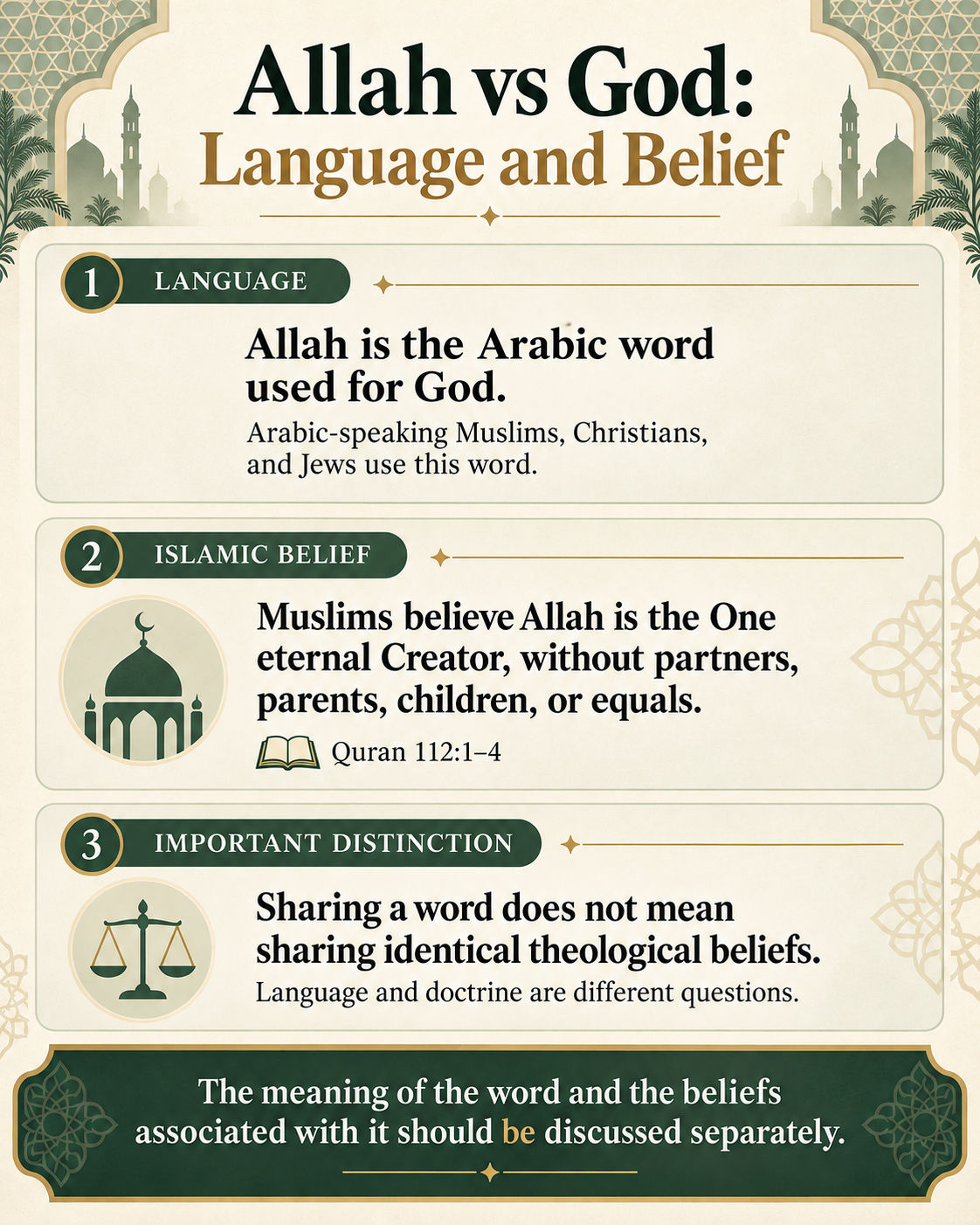
In Islam, Allah is the One God, the eternal Creator and Sustainer of everything. Muslims believe Allah has no partners, parents, children, or equals, and that He alone deserves worship. The Quran describes Him as all-knowing, all-powerful, merciful, wise, and unlike anything He created. “Allah” is also the Arabic word used for God, including by Arabic-speaking Christians, although Islamic and Christian beliefs about God differ.
That is the short answer. Quran translations below are renderings of meaning; the Arabic text is the Quran itself. Everything that follows unpacks that answer one question at a time, beginning with the word itself.
What Does the Word Allah Mean?
The Arabic is اللَّه (Allah). In Arabic, it functions as the proper Name of the One God. Unlike the English word “god,” it has no plural and no feminine form, and it is not capitalized or lowercased to signal different kinds of deity. Arabic has a separate common word, ilah (إِلَٰه), meaning a deity or object of worship, which can be pluralized (alihah, “gods”).
Arabic grammarians have discussed the word’s origin for centuries. Some treat it as a proper Name that is not derived from anything. Others see it as a contraction of al-ilah, “the Deity.” Because scholars differ, it is best not to present any single etymology as settled. What is clear is how the Quran uses it: as the Name to which all other Names belong (“To Allah belong the Most Beautiful Names,” 7:180).
Allah vs God
“God” is the ordinary English word. “Allah” is the Arabic Name. Arabic-speaking Christians and Jews say “Allah” in their own prayers and Arabic Bibles, and Maltese Christians say Alla. The table separates two questions that are often blurred together.
Question | Language answer | Islamic theological answer |
|---|---|---|
Is “Allah” the Arabic word for God? | Yes. Arabic speakers of several faiths use it. | Muslims use it as the Name of the One Creator and Lord of all. |
Does everyone who says “Allah” mean the same doctrine? | No. A shared word can carry different beliefs. | Islam defines Allah through revelation: One, uncreated, with no offspring, and nothing like Him. |
Must Muslims say “Allah” in English? | No rule requires it. Many prefer it for precision. | Both “Allah” and “God” can refer to the One Creator; the Arabic Name carries no plurality or gender. |
Language and theology are two separate questions. A shared word does not settle whether two communities describe God the same way.
Is Allah an Arab God?
No. The Quran opens by praising Allah as “Lord of all the worlds” (1:2), says Muhammad ﷺ was sent “to all of mankind” (34:28), and teaches that humanity was made into peoples and tribes so that they may know one another, with the best in Allah’s sight being the most conscious of Him (49:13). Arabic is the language of the Quran (12:2), not a boundary around its God. Most Muslims in the world today are not Arab.
Is Allah a Moon God?
This claim spread widely in modern polemical writing, drawing on early twentieth-century speculation about South Arabian astral cults. Mainstream historians of pre-Islamic Arabia do not accept it. Ancient Arabia certainly had many deities, some linked to celestial bodies, but the evidence does not show that “Allah” was a moon deity. Pre-Islamic inscriptions and poetry show the Name used for a high God, including in Christian contexts. The Quran itself forbids prostrating to the sun or moon: “Prostrate to Allah, who created them” (41:37). The crescent as a Muslim emblem emerged centuries later through political and cultural use; it was not part of early Islamic worship.
Did People Know the Name Allah Before Islam?
Yes. The Quran says that when pagan Arabs were asked who created the heavens and the earth, they would answer, “Allah” (29:61; 31:25). Yet they also directed worship to intermediaries, saying they served them only to bring them closer to Allah (39:3). Pre-Islamic Arabia was diverse, with polytheists, Jews, Christians, and seekers of Abrahamic monotheism, so no sweeping statement covers all of them. The key point is this: recognizing Allah as Creator was not the same as the Quranic call to worship Him alone.
How Does the Quran Describe Allah?
The Quran does not answer with a philosophical treatise. It answers with revelation, beginning with one of its shortest chapters.
Surah Al-Ikhlas
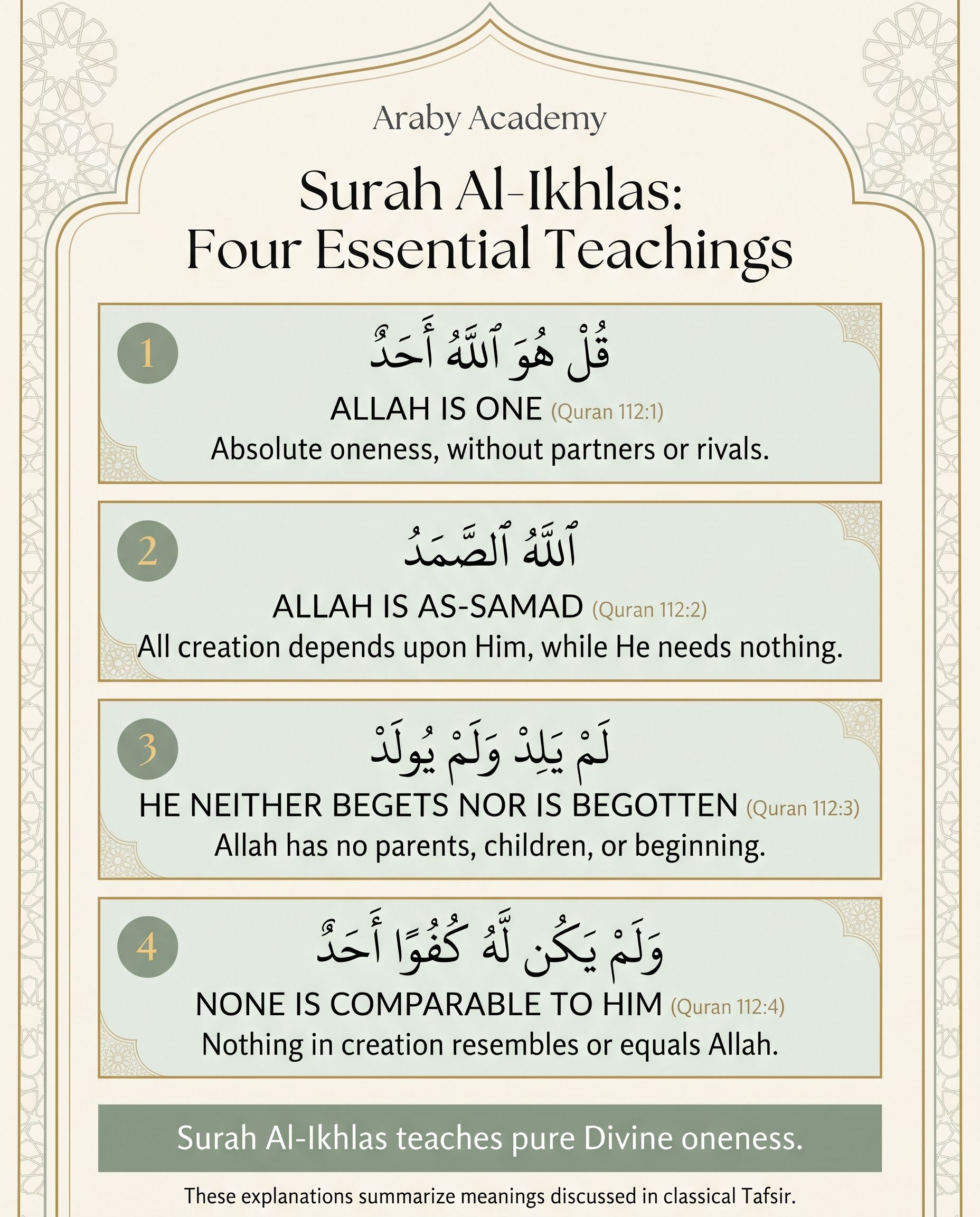
قُلْ هُوَ اللَّهُ أَحَدٌ اللَّهُ الصَّمَدُ لَمْ يَلِدْ وَلَمْ يُولَدْ وَلَمْ يَكُن لَّهُ كُفُوًا أَحَدٌ
“Say: He is Allah, One. Allah, the Self-Sufficient Refuge. He neither begets nor is begotten. And there is none comparable to Him.” (112:1–4)
The Prophet ﷺ described this surah as equal to a third of the Quran (Sahih al-Bukhari 5013), which scholars usually explain by its subject: pure Divine oneness.
1. “He is Allah, One” (Ahad)
Ahad (أَحَد) does not mean “one among many.” Classical commentators explain it as absolute uniqueness: no partner, no division into parts, no rival in His Lordship or in His right to worship. The surah answers the question “Who is Allah?” by pointing past images to His oneness.
2. “Allah, As-Samad”
As-Samad (الصَّمَد) appears only here in the Quran. Classical tafsir, including al-Tabari’s collection of early views, gives several meanings: the One to whom all creation turns in need, the One perfect in His attributes, the One who needs nothing. No single English phrase exhausts the word. All the meanings point the same way: everything depends on Allah, and He depends on nothing.
3. “He neither begets nor is begotten”
This verse rejects Divine parents and Divine offspring. In Islamic thought, begetting belongs to beings who need continuation, family, or beginnings; Allah is beyond these. The Quran repeats the point elsewhere (6:101; 19:88–93). Muslims reject the belief that God has a son; Christians who confess the Son as part of the Trinity understand that doctrine in a specific, non-biological sense, discussed below.
4. “None is comparable to Him”
Kufu (كُفُوًا) means an equal or match. No person, power, or idea stands on His level. This leads directly to the anchor verse of this article, 42:11, which we return to in the section on Divine form.
Four short verses, and each one closes a door that human imagination might otherwise open.
Ayat al-Kursi: The Throne Verse
اللَّهُ لَا إِلَٰهَ إِلَّا هُوَ الْحَيُّ الْقَيُّومُ ۚ لَا تَأْخُذُهُ سِنَةٌ وَلَا نَوْمٌ
“Allah: there is no deity but Him, the Ever-Living, the Self-Subsisting Sustainer. Neither drowsiness nor sleep overtakes Him.” (2:255)
The Prophet ﷺ identified this as the greatest verse in the Quran (Sahih Muslim 810). It teaches that Allah is Al-Hayy (the Ever-Living), Al-Qayyum (who sustains all and needs no sustaining), that His knowledge encompasses what is before and behind creation, and that no one intercedes except by His permission. Because He never tires, He does not need rest. Preserving the heavens and earth does not burden Him.
What Is Tawhid?
At-Tawhid (التَّوْحِيد) comes from a verb meaning “to make one” or “to affirm oneness.” It is the belief that Allah is One, and the commitment to live accordingly. For beginners, it helps to see three connected parts:
Allah is the One Lord and Creator. He alone creates, owns, and sustains.
Allah alone deserves worship. Prayer, supplication, devotion, and ultimate hope belong to Him.
Allah is described only as revelation describes Him. We affirm His Names and attributes without making Him like creation.
Later scholars named these three Rububiyyah, Uluhiyyah, and Asma wa-Sifat. Different schools organize the topic differently, so treat this as a teaching summary rather than a single fixed historical diagram. Araby Academy’s dedicated Tawhid guide goes deeper.
What Does Worshipping Allah Alone Mean?
Ibadah (worship) covers acts such as salah, dua (supplication), fasting, remembrance (dhikr), sacrifice, and devotion of the heart: love, fear, hope, and reliance. To worship Allah alone is to direct these to Him and no one else. Ordinary lawful human help is not worship. Asking a doctor to treat you or a friend to carry a bag is normal life; Tawhid is concerned with calling on anyone as though they control what only Allah controls.
Does Believing in One Creator Mean Tawhid Is Complete?
Not according to the Quran. The pagan Arabs acknowledged that Allah created everything (29:61), and yet the Quran says, “Most of them do not believe in Allah except while associating others with Him” (12:106). Tawhid is more than agreeing that a Creator exists; it is sincere devotion to Him alone. This does not mean every religious tradition follows the same pattern, and Muslims should describe others’ beliefs accurately.
Tawhid, in other words, is not only a belief held in the mind; it is a direction given to the heart.
Is Allah Eternal and Uncreated?
Who Created Allah?
Islam teaches that Allah was not created. Creation applies to things that begin to exist; Allah has no beginning. Surah Al-Ikhlas says, “He neither begets nor is begotten” (112:3), and the Quran asks, “Were they created by nothing, or were they the creators?” (52:35). Muslims do not answer the question with elaborate philosophy. They rely on what revelation says: Allah is the Creator of everything created, and He is the First.
Did Allah Have a Beginning or Will He End?
هُوَ الْأَوَّلُ وَالْآخِرُ وَالظَّاهِرُ وَالْبَاطِنُ ۖ وَهُوَ بِكُلِّ شَيْءٍ عَلِيمٌ
“He is the First and the Last, the Most High and the Most Near, and He has full knowledge of all things.” (57:3)
Al-Awwal (الأَوَّل) means the First, with nothing before Him. Al-Akhir (الآخِر) means the Last, with nothing after Him. The Prophet ﷺ taught this in a supplication: “You are the First, and nothing is before You; You are the Last, and nothing is after You” (Sahih Muslim 2713). Time is part of creation, so created time does not contain Allah the way it contains us. Scholars warn against pushing this into speculative philosophy beyond what revelation states.
Does Allah Need Food, Sleep, or Rest?
No. Ayat al-Kursi says drowsiness and sleep do not overtake Him (2:255), and the Quran says “He feeds and is not fed” (6:14). Allah is Al-Ghani, free of need. All needs belong to creation.
Does Allah Have a Physical Form?
لَيْسَ كَمِثْلِهِ شَيْءٌ ۖ وَهُوَ السَّمِيعُ الْبَصِيرُ
“There is nothing like Him, and He is the All-Hearing, All-Seeing.” (42:11)
This verse is the anchor of Islamic belief about Allah’s nature. Muslims do not imagine, draw, or describe Allah as having a human or any created form, and they do not treat speculation about His essence as revelation. When someone asks whether Allah “looks like” a person, the answer is no: whatever we imagine, He is not like that. That one sentence is the compass for everything else in this guide: whatever we affirm about Allah, we affirm without making Him like His creation.
Is Allah Male or Female?
Neither. Sex belongs to created bodies, and Allah is not a body like creation. The Quran also rejects the idea that Allah has a consort (6:101). The masculine pronoun is a matter of Arabic grammar, not biology.
Why Does the Quran Say “He” for Allah?
Arabic has no neuter pronoun; every noun is grammatically masculine or feminine, including things with no sex (the sun, shams, is grammatically feminine). The Quran’s huwa (هُوَ) is therefore the grammatical form for a single referent, not a claim that Allah has a male body. English “He” follows the same convention.
Why Does the Quran Sometimes Say “We”?
In Arabic, as in other languages, a singular speaker may use a plural of majesty. When the Quran says, “It is We who sent down the Reminder” (15:9), the style expresses grandeur. The same Quran says, in the first person singular, “Indeed, I am Allah; there is no deity except Me” (20:14). So “We” is never an announcement of several gods. In some passages the plural may also reflect Allah acting through His angels or His chosen means, and the context decides.
Why Does the Quran Switch Between “He,” “I,” and “We”?
Arabic rhetoric calls this shift al-iltifat (الالتفات), a change of grammatical person to refresh attention or deepen meaning. Surah Al-Fatihah gives a famous example: it speaks of Allah in the third person (“Lord of the worlds”) and then turns to address Him directly, “You alone we worship” (1:5). The reasons vary by context, and not every shift has the same one.
Where Is Allah? Transcendence and Nearness
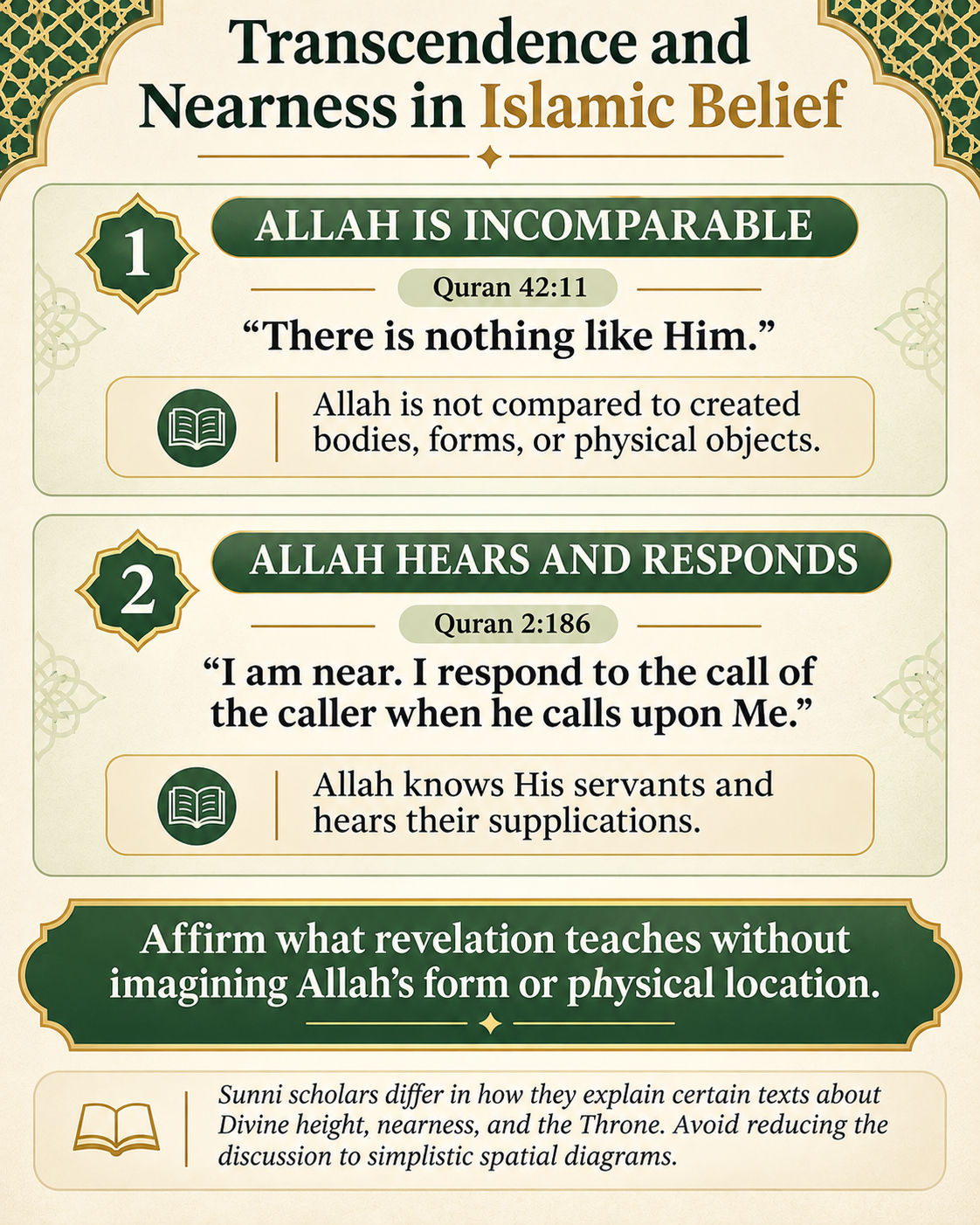
This is one of the most carefully handled questions in Islamic theology, because the sources contain several kinds of statements. All Sunni scholars agree that Allah is not contained by creation and does not need space, a throne, or a direction. They differ in how they explain some wording.
Statements of Divine height. The Quran says that “the Most Merciful rose over the Throne” (20:5) and asks, “Do you feel secure that He who is in the heaven will not cause the earth to swallow you?” (67:16). In Sahih Muslim (537), the Prophet ﷺ asked a woman, “Where is Allah?” and she said, “In the sky,” and he said she was a believer.
Statements of Divine nearness. The Quran says, “He is with you wherever you are” (57:4), and “We are closer to him than his jugular vein” (50:16).
Allah and the Throne
The Arsh (العَرْش), the Throne, is a mighty creation of Allah. Scholars explain istiwa (استواء) in three recognized ways: (1) affirming the revealed wording as befits Allah, without asking “how” and without likeness to creation, a view found in the famous statement attributed to Imam Malik that the istiwa is known, its manner is unknown, belief in it is required, and asking about it is an innovation; (2) entrusting the meaning to Allah (tafwid); and (3) interpreting it in a way that emphasizes sovereignty and exaltation (ta’wil), favored by many Ash’ari and Maturidi scholars. These approaches share the principle of 42:11. No one should speculate about the mechanics.
Is Allah Everywhere?
Scholars distinguish two things. First, Allah’s knowledge, hearing, seeing, and power reach everywhere. Second, claims about His essence. Most scholars reject the idea that Allah’s essence is inside or mixed with creation, and they explain “He is with you” (57:4) as being with His creation in knowledge, oversight, and support. Because formulations differ, a single slogan, such as “Allah is everywhere” or “Allah is only above,” should not be treated as the unanimous Sunni statement.
Is Allah Close to Us?
“When My servants ask you about Me, I am near. I respond to the call of the caller when he calls upon Me.” (2:186)
Commentators explain this nearness as nearness of knowledge, hearing, response, and mercy, not of physical distance or bodily movement. Allah also knows every inner whisper: “We know what his soul whispers to him” (50:16). Moral responsibility, however, concerns chosen belief and action. The Prophet ﷺ said Allah has pardoned his community for passing thoughts in their minds, so long as they do not act on or speak them (Sahih al-Bukhari 5269; Sahih Muslim 127).
Can Anyone See Allah?
Musa عليه السلام asked, “My Lord, show me, that I may look at You,” and was told, “You will not see Me” (7:143). The Quran also says, “Vision does not perceive Him, but He perceives all vision” (6:103). Yet the majority of Sunni scholars hold that believers will see their Lord in the Hereafter, citing 75:22–23 and the report that “you will see your Lord as you see the moon on a full-moon night” (Sahih al-Bukhari 554; Sahih Muslim 633). The comparison is about how clearly the vision will be, not a likeness of Allah to the moon. No living person can visualize Allah through meditation, and Muslims do not depict a vision of Him.
What Are Allah’s Beautiful Names and Attributes?
وَلِلَّهِ الْأَسْمَاءُ الْحُسْنَىٰ فَادْعُوهُ بِهَا
“To Allah belong the Most Beautiful Names, so call upon Him by them.” (7:180)
Al-Asma al-Husna (الأَسْمَاءُ الْحُسْنَى) are Names that convey perfect meanings. They are how Muslims come to know Allah and how they call upon Him. The Quran gathers many of them in 59:22–24 at the end of Surah Al-Hashr.
Are Allah’s Names Limited to 99?
The Prophet ﷺ said, “Allah has ninety-nine names, one hundred less one; whoever enumerates them will enter Paradise” (Sahih al-Bukhari 2736; Sahih Muslim 2677). Scholars understand this as stating the special virtue of a group of 99 Names, not as limiting all Names to that number. Another report has the Prophet ﷺ asking Allah by “every name You have named Yourself or kept in the knowledge of the unseen” (Musnad Ahmad; graded sahih by a number of scholars). The popular list of 99 Names comes from a report in which many hadith scholars hold that the enumeration was added by narrators, so no one should call a given list the verbatim Prophetic enumeration. See Araby Academy’s 99 Names guide for the full study.
A Few Names That Show the Balance
Ar-Rahman and Ar-Rahim (الرَّحْمَٰنُ الرَّحِيمُ, 1:3): Mercy. Commentators often describe Ar-Rahman as mercy that is vast and covers all creation, and Ar-Rahim as mercy that is constant and directed toward believers (33:43). These are recognized explanations, not rigid dictionary rules.
Al-’Alim (الْعَلِيم, 2:29): All-Knowing, whose knowledge has no gaps.
Al-Hakim (الْحَكِيم, 31:27): All-Wise. This does not mean we always know the wisdom behind a particular hardship.
Al-Ghafur (الْغَفُور, 39:53): The Forgiving, who covers and pardons sins.
At-Tawwab (التَّوَّاب, 2:37; 9:104): He who repeatedly accepts repentance.
Al-Wadud (الْوَدُود, 85:14): The Most Loving. The Quran uses it in the context of Allah’s love for His servants; it is not a physical or romantic love.
Ar-Razzaq (الرَّزَّاق, 51:58): The Provider. Reciting the Name is not a formula that guarantees wealth.
As-Sami’ and Al-Basir (السَّمِيع الْبَصِير, 42:11): He hears and sees all, without bodily organs or likeness to creatures.
Why Allah’s Names Matter
The Names change how a person prays and lives. We ask for forgiveness by Al-Ghafur and At-Tawwab, ask for provision by Ar-Razzaq, and trust the decree of Al-Hakim when life makes little sense. They also shape gratitude and reverence, because we know to whom we are grateful. These Names are not decorative titles; they are doors into dua, gratitude, trust, and repentance.
Does Allah Know Everything?
Yes. The Quran says Allah is “All-Knowing of everything” (57:3) and asks, “Does He who created not know, while He is the Subtle, the All-Aware?” (67:14). His knowledge includes the past, present, and future, public deeds and private intentions: “He knows the secret and what is even more hidden” (20:7). It includes al-ghayb (الغَيْب), the unseen, which no created being knows except by what Allah reveals (27:65). The Prophet ﷺ reported that Allah decreed the measures of creation before creating the heavens and earth (Sahih Muslim 2653).
Allah’s Power and Will
Al-Qudrah (القُدْرَة) is Allah’s power. “Allah is over all things competent” (2:20), and when He decrees something, He says to it, “Be,” and it is (36:82). Nothing happens outside His knowledge and permission. But Islam does not teach that everything that happens is something Allah approves. Sunni theologians distinguish between what Allah allows to occur and what He commands and loves. The Quran says Allah “does not approve disbelief for His servants” (39:7) and “does not like corruption” (2:205), though both exist in the world. Schools use slightly different terms for this distinction, so it is best taught as a principle rather than a single technical formula.
Qadr and Human Responsibility
Qadr (Divine Decree) means that Allah’s knowledge and sovereignty encompass all creation: “Indeed, We created everything with measure” (54:49). Yet the Quran also says, “The truth is from your Lord, so whoever wills, let him believe, and whoever wills, let him disbelieve” (18:29), and “Allah does not burden a soul beyond its capacity” (2:286). Qadr is therefore not fatalism. When the Companions asked whether they should simply rely on what is written, the Prophet ﷺ told them to keep working, for each person is eased toward what he was created for (Sahih al-Bukhari 4949; Sahih Muslim 2647).
Allah’s knowing what we will choose does not mean He forces us to choose it. Knowing and compelling are different things. Believers should not claim to resolve every metaphysical detail, and the Qadr guide covers the topic more fully. In daily life, trust and action go together: the Quran says whoever relies on Allah, He is enough for him (65:3), and the Prophet ﷺ said that Allah sent down a cure for every disease (Sahih al-Bukhari 5678). Visiting a doctor does not contradict tawakkul, trust in Allah.
Does Allah Hear and Answer Dua?
Yes. Dua (supplication) is calling on Allah, and the Prophet ﷺ said, “Dua is worship” (Abu Dawud 1479; al-Tirmidhi 2969, graded hasan sahih). Allah says, “Call upon Me; I will respond to you” (40:60), and 2:186 describes Him as near and responsive.
This does not guarantee the exact worldly outcome at the exact time we want. The Prophet ﷺ said that a person’s dua is answered as long as he is not impatient, saying, “I prayed, but have not been answered” (Sahih al-Bukhari 6340; Sahih Muslim 2735). The Quran reminds us, “Perhaps you dislike something and it is good for you” (2:216). Muslims therefore understand that Allah hears every supplication, and that the response is shaped by His knowledge of what is truly beneficial. Other reports describe particular forms of response, such as postponement or reward in the Hereafter, but their grading varies, so this article does not rely on them.
You may speak to Allah in any language. Arabic matters for the recited parts of salah, but informal dua outside prayer can be in your own words. Allah also hears silent prayers: He knows what the soul whispers (50:16), and the Quran commends remembering Him within oneself (7:205). The prophet Zakariyya called upon his Lord in a secret call (19:3).
How Do Allah’s Mercy and Justice Work Together?
Is Allah Merciful?
Mercy is central. Allah says, “My mercy encompasses all things” (7:156). The Prophet ﷺ said that when Allah created creation, He wrote in a book with Him, “My mercy prevails over My wrath” (Sahih al-Bukhari 3194; Sahih Muslim 2751), and that Allah placed one hundred parts of mercy, sending down one part to creation, by which creatures show kindness to one another (Sahih al-Bukhari 6000; Sahih Muslim 2752).
Does Allah Forgive All Sins?
لَا تَقْنَطُوا مِن رَّحْمَةِ اللَّهِ ۚ إِنَّ اللَّهَ يَغْفِرُ الذُّنُوبَ جَمِيعًا
“Do not despair of the mercy of Allah. Indeed, Allah forgives all sins.” (39:53)
The Quran also says that Allah does not forgive association with Him if a person dies upon it, while He forgives lesser sins for whom He wills (4:48, 116). Scholars explain that these verses speak of dying without repentance; the Quran elsewhere says even those who committed shirk can repent and be forgiven (25:68–70). No living person who sincerely turns to Allah should be told that forgiveness is impossible.
Does Allah Love People?
Yes, according to the Quran. Allah loves those who repent and purify themselves (2:222), those who do good (2:195), and those who act justly (49:9). The Quran also says He does not love transgressors (2:190). Divine love is real but unlike human love, and it is never an approval of every action.
Does Allah Get Angry?
The Quran speaks of Allah’s anger and displeasure toward wrongdoing (for example, 4:93). Muslim scholars affirm this as befits Allah, who does not lose control like a human being. Some explain it as the Divine reaction to injustice, others as the will to punish; all agree that His mercy prevails.
Does Allah Punish Innocent People?
The Quran states that no soul bears another’s burden (6:164) and that Allah does not wrong anyone even by the weight of an atom (4:40). Because we cannot see anyone’s inner state, we should never claim to know why a particular person is suffering.
Mercy without justice would take no wrongdoing seriously, and justice without mercy would leave no road back.
Why Did Allah Create Us?
وَمَا خَلَقْتُ الْجِنَّ وَالْإِنسَ إِلَّا لِيَعْبُدُونِ
“I did not create jinn and mankind except to worship Me.” (51:56)
Allah is free of need. Right after this verse, He says, “I do not want any provision from them” (51:57), and the Quran says, “You are those in need of Allah, while Allah is the Free of need, the Praiseworthy” (35:15). In a Divine saying, Allah tells His servants that if all of humanity were as pious as the most pious heart, it would add nothing to His dominion (Sahih Muslim 2577). Worship does not supply Allah with anything. It guides and benefits us.
Worship is broader than salah. It includes fasting, charity, honesty, justice, kindness, and everyday work done lawfully with sincere intention, since actions are judged by intentions (Sahih al-Bukhari 1). Not every ordinary act is automatically worship regardless of intention or lawfulness. What does Allah want from us? The Quran points to faith, sincere worship, justice and kindness (16:90), gratitude (14:7), sincere repentance (66:8), and responsibility for our deeds (99:7–8). These verses give a reliable core, not a complete answer to every philosophical question about creation; the Quran also describes life as a test (67:2) and humanity as stewards on earth (2:30).
Worship, in this sense, is not something Allah needs from us; it is how we turn toward the One we need.
Why Does Allah Allow Suffering?
This is one of the hardest questions, and honesty requires humility. The Quran does not claim to explain every case. It offers principles:
Life is a test. “We will surely test you with fear, hunger, loss of wealth, lives, and fruits, but give good news to the patient” (2:155). Allah “created death and life to test you” (67:2).
Humans cause harm. “Corruption has appeared on land and sea because of what people’s hands have earned” (30:41). Injustice is condemned, and the wronged may speak out against it (4:148). No one is asked to silently accept abuse; seeking safety and help is right.
This world is temporary. The final accounting is in the Hereafter (3:185; 99:7–8).
Human knowledge is limited. The story of Musa and Khidr (18:60–82) shows hidden wisdom behind events that look cruel at first.
Are All Hardships Punishments?
No. Prophets suffered, and the Quran presents Ayyub عليه السلام as patient in illness (21:83–84). The Prophet ﷺ taught that any hardship, even a thorn, can expiate sins for a believer (Sahih al-Bukhari 5641; Sahih Muslim 2573). He also said the people most severely tested are the Prophets, then those next in righteousness (al-Tirmidhi 2398; Ibn Majah 4023; graded hasan sahih by many scholars). These reports offer comfort. They do not mean that every sufferer is necessarily favored, or that illness proves Divine anger. Never tell a grieving person that their child’s illness or their trauma is Allah’s punishment.
Why Do Bad People Sometimes Prosper?
Worldly success is not proof of Divine approval. The Quran warns that humans wrongly think wealth means honor and poverty means disgrace (89:15–17), and says that granting ease can itself be a trial (6:44; 3:178). We cannot judge anyone’s unseen standing with Allah.
Faith, Mental Health, and Intrusive Thoughts
Faith can bring hope and meaning, but anxiety and depression are not automatic signs of weak belief. The Prophet ﷺ grieved deeply at the death of his son Ibrahim: “The eyes shed tears, the heart grieves” (Sahih al-Bukhari 1303). Seeking professional care is part of using lawful means. If you are struggling, please speak to a qualified doctor or therapist, and to a trusted teacher if helpful.
Some people experience unwanted thoughts about Allah. The Prophet ﷺ told Companions who found such whispers too terrible to speak that this reflected clear faith (Sahih Muslim 132), and taught that whoever is troubled by them should seek refuge in Allah and stop (Sahih al-Bukhari 3276; Sahih Muslim 134). Involuntary thoughts are not the same as deliberate belief or action. Avoid repeatedly testing yourself; if the thoughts persist, speak to a professional familiar with intrusive thoughts.
Personal Loss
No one can honestly claim to know why a particular person lost a child, faced infertility, endured violence, or became seriously ill. What we can say is that Allah is just, merciful, and close to the one who calls on Him, and that He asks us to respond with patience, care, and action to help one another. Hope without false certainty is both honest and Islamic.
How Allah Guides: Prophets, Revelation, and the Quran
Allah does not leave humanity without guidance. “We sent into every nation a messenger: worship Allah and avoid false deities” (16:36), and no messenger was sent before Muhammad ﷺ except that he was told, “There is no deity except Me, so worship Me” (21:25). The Quran describes the ways Allah communicates: revelation, from behind a veil, or by sending a messenger (42:51). Revelation is given to Prophets; ordinary people do not receive new scripture.
Muslims believe the Quran is the speech of Allah (see 9:6), revealed as guidance (2:185) to bring people from darkness to light (14:1). Muslims worship Allah alone, not Muhammad ﷺ, whom the Quran calls the Messenger of Allah and the Seal of the Prophets (33:40; 48:29). Muslims also love and honor Isa (Jesus) ibn Maryam عليه السلام as one of the mighty Messengers, born miraculously to Maryam, who said of himself, “I am the servant of Allah” (19:30; see 3:45–49). The Quran presents him as a human Messenger, not as God or God’s son.
Is Allah the Same God as the God of Christianity and Judaism?
This question mixes three separate ones: language, reference, and doctrine.
Language. Arabic-speaking Jews and Christians use Allah for God, as explained above.
Shared Abrahamic roots. The Quran tells Muslims to say to the People of the Book, “Our God and your God is one, and to Him we submit” (29:46). Many Muslim scholars therefore hold that the Creator referred to is the same, while descriptions differ.
Doctrine. Judaism affirms God’s absolute unity, and in this Islam stands very close. Mainstream Christianity affirms one God in three persons, Father, Son, and Holy Spirit, sharing one divine essence, and confesses Jesus as fully God and fully man. Christians do not teach three separate gods. Islam disagrees with the Trinity and divine sonship, holding that they conflict with Tawhid (4:171; 5:73; 112:3). That is a real theological difference, and it should be stated without caricature.
Scholars of religion and theologians, Muslim, Christian, and Jewish, continue to discuss whether “the same God” is best answered by reference or by description. A one-sentence slogan in either direction oversimplifies a serious question.
How Can Muslims Know Allah Better?
Muslims know Allah first through revelation: the Quran, the authentic Sunnah, and reliable scholarship, including classical tafsir. Reflection on creation also helps. The Quran invites people to consider the heavens, the earth, and the alternation of night and day (3:190–191), but nature alone does not reveal every Name or command. Speculation should not replace revelation.
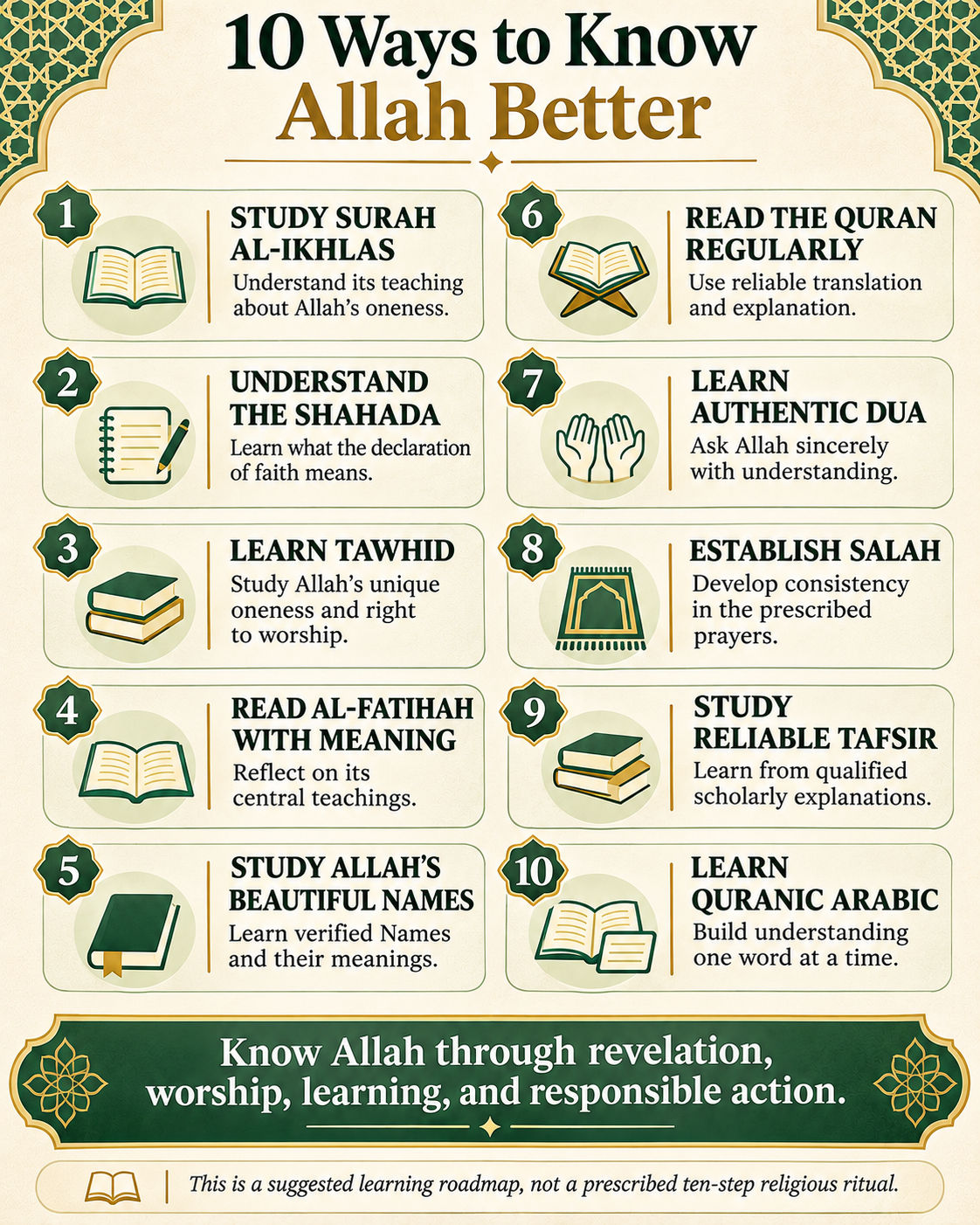
A Ten-Step Roadmap
This is an editorial learning plan, not a fixed ritual.
Study Surah Al-Ikhlas with its meaning.
Understand the Shahada.
Learn Tawhid.
Read Al-Fatihah with meaning.
Study Allah’s Beautiful Names.
Read the Quran regularly.
Learn authentic dua.
Establish salah.
Study reliable tafsir.
Learn Quranic Arabic gradually.
None of these steps is a magic formula; they are a sensible path that the Quran and Sunnah support, taken gradually and sincerely.
Seven Questions to Ask Before Believing or Repeating Any Claim About Allah
This is a research framework, not a Prophetic list.
What does the Quran say?
What does authentic Sunnah say?
What does this Arabic word mean in context?
How do Tafsir scholars explain it?
Is this a Divine Name or a description?
Is this a shared principle or a disputed interpretation?
Am I inventing something revelation does not establish?
Words Muslims Say About Allah
Allahu Akbar (اللَّهُ أَكْبَر): “Allah is greater” or “the Greatest.” Akbar is a comparative form; scholars explain it as Allah being greater than anything we could compare or describe. It opens the call to prayer and each movement of salah.
Alhamdulillah (الْحَمْدُ لِلَّه): “All praise belongs to Allah,” the second verse of Al-Fatihah (1:2).
Subhanallah (سُبْحَانَ اللَّه): “Glory be to Allah,” declaring Him free of every imperfection and unlike creation (17:43).
La ilaha illallah (لَا إِلَٰهَ إِلَّا اللَّه): “None deserves worship except Allah” (47:19), the first half of the Shahada.
Al-Fatihah itself condenses much of this: Allah is Lord of the worlds, the Most Merciful, Master of the Day of Judgment; to Him alone we direct worship and ask for help (1:2–5).
Teaching Children About Allah
Children do best with short, true, warm statements: Allah is One. Allah created us. Allah is unlike anything we see or imagine. Allah is merciful. Allah knows us and hears our dua. Allah wants us to do what is right. Do not ask children to draw Allah or give them pictures of Him. Instead use Arabic vocabulary cards, simple verses, nature walks, a poster of Names with verified text, or a thankfulness journal.
If a child asks, “What does Allah look like?” you can say calmly: “That’s a thoughtful question. Allah is not like anything we have seen, and we cannot picture Him. The Quran says nothing is like Him. But we know He is kind, He hears us, and He is always with us in knowledge and care.” If a child asks, “Who created Allah?” you can say: “Allah is not created. Things that are made have a beginning, but Allah was always there and never ends.” Welcome curiosity. Do not teach children that Allah hates them when they make mistakes, that questions bring punishment, or that fear means no faith. Teach respect, wonder, worship, and repentance.
15 Arabic Words That Explain Islamic Belief About Allah
Arabic | Transliteration | Root | Meaning | Quran | Beginner note |
|---|---|---|---|---|---|
اللَّه | Allah | no agreed root | The One God | 20:14 | The Name that all other Names describe |
رَبّ | Rabb | r-b-b | Lord, Sustainer | 1:2 | Owner who nurtures and sustains |
إِلَٰه | Ilah | debated | Deity, object of worship | 20:14 | Only Allah deserves it |
أَحَد | Ahad | — | One, unique | 112:1 | Not “one among many” |
الصَّمَد | As-Samad | ṣ-m-d | Self-sufficient, depended upon | 112:2 | All turn to Him; He needs none |
الرَّحْمَٰن | Ar-Rahman | r-ḥ-m | Most Merciful | 1:3 | Vast mercy for creation |
الرَّحِيم | Ar-Rahim | r-ḥ-m | Merciful | 1:3 | Constant, caring mercy |
الْحَيّ | Al-Hayy | ḥ-y-y | Ever-Living | 2:255 | Never dies or tires |
الْقَيُّوم | Al-Qayyum | q-w-m | Self-Subsisting Sustainer | 2:255 | Sustains all; needs no support |
الْعَلِيم | Al-’Alim | ʿ-l-m | All-Knowing | 2:29 | No gaps in His knowledge |
الْحَكِيم | Al-Hakim | ḥ-k-m | All-Wise | 31:27 | Perfect wisdom |
الْخَالِق | Al-Khaliq | kh-l-q | Creator | 59:24 | Brings things into being |
الرَّزَّاق | Ar-Razzaq | r-z-q | Provider | 51:58 | Source of all provision |
الْغَفُور | Al-Ghafur | gh-f-r | Forgiving | 39:53 | Covers and pardons sins |
الْعَرْش | Al-’Arsh | ʿ-r-sh | Throne | 20:5 | A creation of Allah, not His need |
Allah, Rabb, and Ilah. Allah is the Divine Name. Rabb describes Allah as Lord, Master, and Sustainer, depending on context. Ilah means one who is worshipped; the Shahada says there is no ilah but Allah. These are related but not interchangeable, and no single formula captures every use.
Learning Arabic helps because translations can compress meaning. Arabic study shows roots, patterns, pronouns, ranges of meaning, and Divine Names. But Arabic fluency alone does not qualify anyone to issue advanced interpretations of Aqidah; that requires scholarship.
Fifteen words will not make anyone a scholar, but they can make an English translation feel much less distant.
Common Misconceptions About Allah
Seven Common Mistakes
Confusing grammar with Divine gender. Arabic “he” is grammar, not biology.
Imagining Allah as a human. 42:11 closes that door.
Treating Allah as an ethnic deity. He is Lord of all the worlds.
Equating Tawhid with merely believing in a Creator. The Quran calls for worship of Him alone.
Inventing explanations of Divine essence. Where revelation is silent, we stay silent.
Reducing Allah’s mercy to permission for sin. Mercy and accountability belong together.
Treating Qadr as an excuse for passivity. The Prophet ﷺ told his Companions to keep acting.
Twenty Myths and Realities
Myth | Reality |
|---|---|
Allah is a different Arab god. | Islam teaches that Allah is the Creator of everything; the Arabic Name is used by more than one religious community. |
Allah is the moon god. | Mainstream historians do not support the claim, and Islamic teaching rejects worship of the moon (41:37). |
Something created Allah. | Allah is eternal and uncreated (57:3; 112:3). |
Allah has a human body. | Nothing resembles Him (42:11). |
Allah is male because the Quran says “He.” | Arabic grammatical gender is not biological sex. |
“We” in the Quran means several gods. | It is a majestic plural in Arabic style; the Quran insists on one God (20:14). |
All scholars explain Allah’s relation to space in identical technical terms. | Recognized approaches differ while all affirm that nothing is like Him. |
Muslims worship Muhammad ﷺ. | Muslims worship Allah alone and accept Muhammad ﷺ as His Messenger. |
Islam teaches that God has children. | Surah Al-Ikhlas rejects divine offspring. |
The Trinity means three separate gods. | Mainstream Christian doctrine claims one God in three persons; accurate description comes first, then disagreement. |
Allah is far away and does not hear prayers. | The Quran affirms that He is near and responds (2:186). |
Allah’s mercy means sins do not matter. | Mercy and responsibility belong together. |
Allah’s justice means repentance is impossible. | The Quran invites sincere repentance (39:53). |
Allah loves every action. | The Quran distinguishes righteous from wrongful actions (2:190). |
Every suffering person is being punished. | We cannot identify the hidden purpose of someone’s hardship. |
Qadr means no human responsibility. | Islam affirms accountability alongside Divine Decree. |
Trusting Allah means never seeing a doctor. | Responsible action is compatible with tawakkul. |
You must speak Arabic for Allah to hear your dua. | Learning Arabic is valuable, but Allah’s knowledge is not limited by language. |
The 99 Names are magic formulas for worldly success. | Specific claims about guaranteed results need authentic evidence. |
Asking questions about Allah means you have lost faith. | Sincere inquiry differs from deliberate rejection; involuntary doubts are distinct from chosen disbelief. |
Frequently Asked Questions
1. Who is Allah in Islam? Allah is the One God, the eternal Creator and Sustainer of everything. Muslims believe He has no partners, parents, children, or equals, and that He alone deserves worship. The Quran describes Him as all-knowing, all-powerful, merciful, wise, just, and unlike creation (112:1–4; 42:11).
2. What does Allah mean in Arabic? “Allah” is the Arabic Name for God. It has no plural or feminine form. Grammarians differ on whether it is a non-derived proper name or a contraction of al-ilah (“the Deity”), so no single origin should be presented as settled.
3. Is Allah the same as God? “Allah” is the Arabic word for God, used by Muslims and Arabic-speaking Christians and Jews. Sharing the word does not mean sharing identical doctrine. Islam describes Allah as One, uncreated, and without offspring or equal.
4. Do Christians in Arabic-speaking countries say Allah? Yes. Arabic-speaking Christians use “Allah” in prayer, worship, and Arabic Bibles, and used it before Islam. Their theology, including belief in the Trinity, differs from Islamic Tawhid.
5. Is Allah an Arab god? No. The Quran calls Allah the Lord of all the worlds (1:2) and says Muhammad ﷺ was sent to all mankind (34:28). Arabic is the language of revelation, not a limit on who Allah is for.
6. Is Allah a moon god? No. Mainstream historians of ancient Arabia do not support the claim, and the Quran forbids prostrating to the moon, saying to prostrate to Allah who created it (41:37).
7. Who created Allah? Islam teaches that Allah is not created. He is the First, with nothing before Him (57:3), and He “neither begets nor is begotten” (112:3). Creation applies to things that begin; Allah is eternal.
8. Does Allah have a beginning? No. He is Al-Awwal, the First, and Al-Akhir, the Last (57:3). Created time does not contain Him as it contains creation.
9. Does Allah have a physical body? Muslims do not describe Allah as having a created form. “There is nothing like Him” (42:11). Scholars explain scriptural wording in different recognized ways, but all affirm that He is unlike creation.
10. Is Allah male or female? Neither. Sex belongs to created bodies. Arabic grammar uses masculine forms, but that is not a statement about biology.
11. Why does the Quran say “He”? Arabic has no neuter pronoun, so huwa is the grammatical form. It does not mean Allah has a male body.
12. Why does Allah sometimes say “We”? It is a plural of majesty in Arabic style. The Quran also uses “I” and insists there is no deity but Allah (20:14), so it does not imply multiple gods.
13. Where is Allah? The Quran and Sunnah speak of Allah’s height and His nearness. Sunni scholars explain these differently, by affirming wording without asking how, entrusting meaning, or interpreting, but all agree He is not like creation and not contained by it.
14. Is Allah everywhere? Muslims agree that Allah’s knowledge, hearing, seeing, and power encompass everything. Most scholars reject the idea that His essence is inside creation. Formulations differ, so it is best not to reduce the topic to a slogan.
15. Does Allah know our thoughts? Yes. “We know what his soul whispers to him” (50:16). Passing thoughts that a person dislikes and does not act on are not counted against them (Sahih al-Bukhari 5269).
16. Is Allah close to us? Yes. “I am near; I respond to the call of the caller” (2:186). Scholars understand this as nearness of knowledge, hearing, response, and mercy, not physical distance.
17. Does Allah hear dua? Yes. Allah invites His servants to call on Him (40:60), and He hears every supplication, spoken or silent. He answers according to His knowledge of what is best, which may differ from what we ask.
18. Does Allah forgive all sins? The Quran says Allah forgives all sins for those who turn to Him (39:53). Dying upon unrepented shirk is the exception mentioned in 4:48. A living person who sincerely repents should never despair.
19. Does Allah love people? Yes. The Quran says Allah loves those who repent, do good, and act justly (2:222; 2:195; 49:9). His love is not human love, and it is not approval of every action.
20. Why did Allah create humans? The Quran says, “I did not create jinn and mankind except to worship Me” (51:56). Worship benefits and guides us; it does not give Allah anything He lacks. The Quran also describes life as a test (67:2).
21. Does Allah need worship? No. “Allah is the Free of need” (35:15). Our worship is for our benefit and as our response to Him.
22. Why does Allah allow suffering? The Quran describes life as a test, speaks of human wrongdoing and the accountability of the Hereafter, and points to hidden wisdom. No one can honestly explain why a particular person suffers. Hardship is not automatically punishment.
23. Is Allah the same God worshipped in Christianity and Judaism? Muslims believe in the One Creator of Abraham, and the Quran says, “Our God and your God is one” (29:46). Doctrines differ, especially concerning the Trinity and divine sonship. Scholars discuss reference and description separately.
24. What are Allah’s Beautiful Names? They are Names conveying perfect meanings, such as Ar-Rahman, Al-’Alim, and Al-Ghafur (7:180; 59:22–24). A famous hadith speaks of 99 Names, but this does not limit Allah’s Names to that number.
25. What is Tawhid? Tawhid is belief in Allah’s oneness: He alone is Lord and Creator, He alone deserves worship, and His Names and attributes are affirmed without likening Him to creation.
26. How can a Muslim know Allah better? Start with Surah Al-Ikhlas and the Shahada, read the Quran with meaning, learn Allah’s Names, pray, make dua, study reliable tafsir, and learn Quranic Arabic gradually.
Knowing Allah Begins With Revelation
A person may begin by asking: Who is Allah? The Quran answers with a coherent picture. Allah is One. He is eternal and the Creator of all things. He needs nothing. Nothing resembles Him. His knowledge and power encompass creation. He is merciful and just. He alone deserves worship.
That understanding is meant to lead somewhere: to sincere salah, to dua, to learning, to gratitude, to repentance, to moral responsibility, and to trust. To know Allah in Islam is not to imagine a physical form or invent descriptions beyond revelation. It is to learn what the Quran and authentic Sunnah teach about the One who created us, sustains us, hears our prayers, and calls us to worship Him alone.
If you would like to keep going, Araby Academy offers gentle, one-to-one lessons in Quran, Tajweed, and Quranic Arabic, so that these words of revelation can be read, understood, and lived at your own pace.