What Are the 99 Names of Allah?
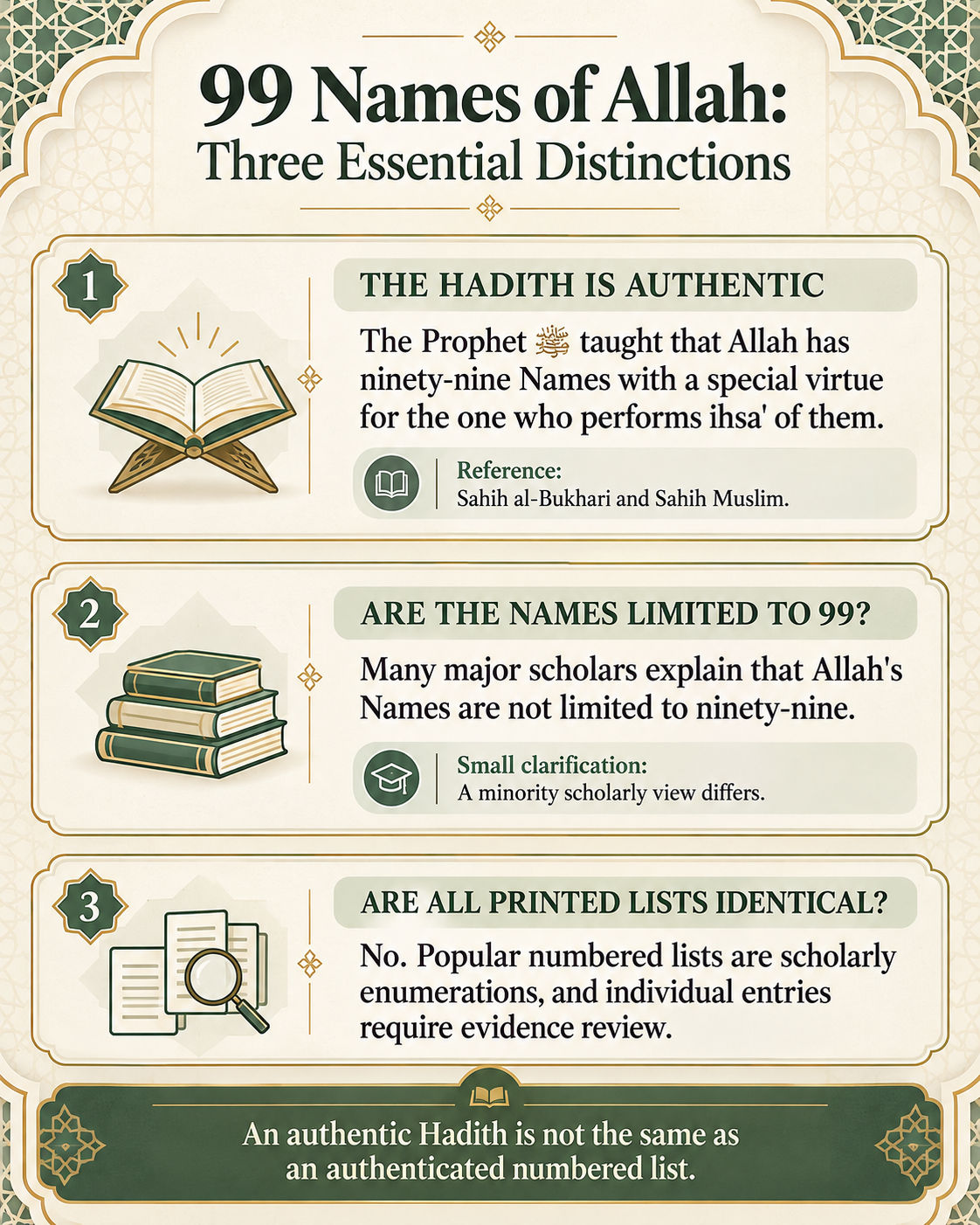
The 99 Names of Allah (Asma' Allah al-Husna) are the Most Beautiful Names by which Allah has described Himself in the Quran and through the Prophet Muhammad ﷺ, such as Ar-Rahman (The Most Merciful), Al-'Alim (The All-Knowing) and Al-Ghafur (The Ever-Forgiving). The number 99 comes from an authentic hadith about ninety-nine Names, but scholars distinguish three separate questions: the hadith is authentic, Allah's Names are not limited to 99 according to many scholars, and the popular numbered lists require their own source review.
That three-part distinction is the key to this article. Once it is clear, the Names stop being a poster on the wall and become a doorway into the Quran.
A few terms, defined first. Tawhid is belief in the oneness of Allah. Aqidah is creed, the core beliefs of Islam. Sifat (singular sifah) are attributes. Tawqifi means a matter known only through revelation. Ihsa' is the word used in the hadith for “enumerating” or “preserving” the Names. Isnad is a hadith's chain of narrators. Idraj is the insertion of someone's words into a report's wording. Dua is supplication. Tafsir is Quranic commentary.
What Does Asma al-Husna Mean?
The phrase al-Asma' al-Husna (الأَسْمَاءُ الْحُسْنَى) means “The Most Beautiful Names.” It has three parts.
Ism (اسم), plural asma' (أسماء): a name. Classical Arabic scholars discussed whether the word derives from a root meaning elevation (s-m-w, the view usually attributed to the Basran grammarians) or from marking (w-s-m, usually attributed to the Kufans). The difference is a technical one and does not change the meaning for readers.
Husna (حسنى): the feminine superlative form of ahsan, “most beautiful, best.” Arabic grammar uses this feminine form to describe a plural of non-human things, so al-asma' al-husna reads smoothly as “the best, most beautiful names.”
The definite article (al-): these are the Beautiful Names, which belong to Allah in perfect form, with no deficiency in meaning.
So Asma al-Husna is not a general phrase for “nice names.” It names a category fixed by revelation: the Names that Allah has made known as His own, each indicating a perfection.
Why it matters: a Divine Name tells us something true about Allah, and Muslims call upon Him through it. That is why the Names are studied with the Quran, not just recited from a chart.
Knowing the Names is more than memorizing a list.
What Does the Quran Say About Allah's Beautiful Names?
The Quran speaks about the Names in several places. These verses are the foundation of everything else in this article.
Quran 7:180
وَلِلَّهِ الْأَسْمَاءُ الْحُسْنَىٰ فَادْعُوهُ بِهَا ۖ وَذَرُوا الَّذِينَ يُلْحِدُونَ فِي أَسْمَائِهِ
“And to Allah belong the most beautiful names, so call upon Him by them, and leave those who deviate concerning His names.”
Two instructions appear here. The first is to call upon Allah by His Names, which makes the Names part of worship and Dua. The second is a warning about ilhad, deviation concerning the Names. Classical commentators (such as al-Tabari) explained deviation as including giving Allah names He has not given Himself, denying or distorting the meaning of His Names, or directing them to something other than Him. This verse is the reason Muslim scholars take such care with evidence in this field.
Quran 17:110. Allah says, in meaning: “Call upon Allah or call upon Ar-Rahman; whichever you call, to Him belong the most beautiful names.” The verse shows that Allah and Ar-Rahman are not rival gods or rival forms of address. They are Names of the One Lord.
Quran 20:8. “Allah, there is no deity except Him; to Him belong the most beautiful names.” The verse places the Names directly after the declaration of oneness, which is where the study of the Names naturally begins.
Quran 42:11. “There is nothing like Him, and He is the All-Hearing, the All-Seeing.” This verse governs the whole subject. A Name tells us about Allah's perfection, and it never makes Him resemble creation. When we read about hearing, seeing, knowledge or mercy in relation to Allah, we affirm what He has told us, and we do not imagine how it is. Nothing is to be pictured, drawn or compared.
The Authentic Hadith About the 99 Names
The famous hadith is narrated by Abu Hurayrah (may Allah be pleased with him). It appears in Sahih al-Bukhari (for example 2736, 6410 and 7392) and in Sahih Muslim (2677). In Arabic, the core wording is:
إِنَّ لِلَّهِ تِسْعَةً وَتِسْعِينَ اسْمًا، مِائَةً إِلَّا وَاحِدًا، مَنْ أَحْصَاهَا دَخَلَ الْجَنَّةَ
In English: “Allah has ninety-nine names, one hundred less one. Whoever ahsaha them will enter Paradise.” Some narrations, including in Muslim, add that Allah is witr (One, “odd”) and loves the witr. The wording differs slightly between collections and between chains within the same collection, so a published edition should quote each source separately instead of treating all versions as identical.
This hadith is authentic by the standards of Bukhari and Muslim. That is the first of the three claims.
What Does “Ahsa'ha” Mean?
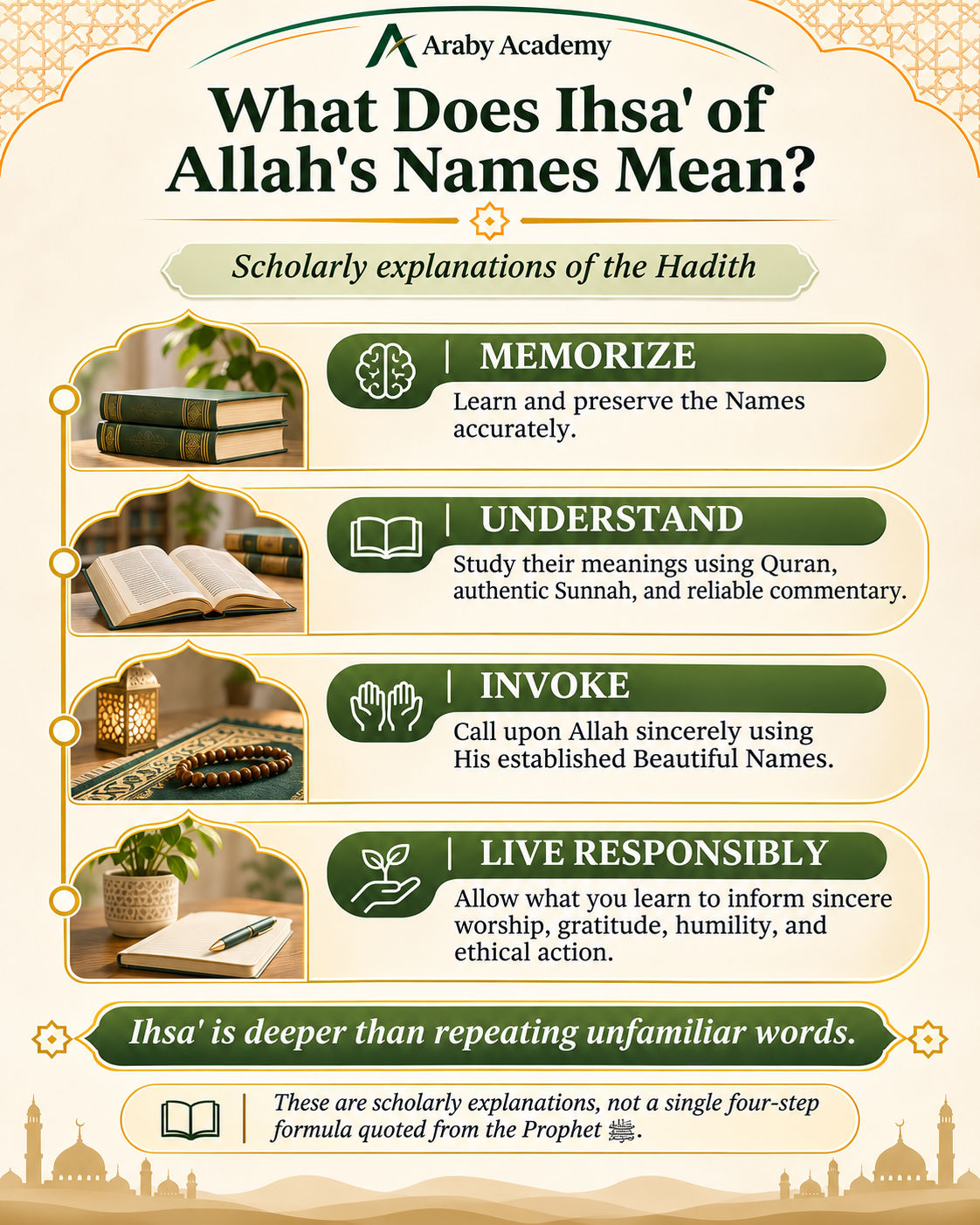
The verb ahsa (أَحْصَى) comes from the root h-s-y and carries the sense of counting, enumerating and encompassing. Scholars have offered several explanations of what it requires, and they do not all define it identically. The commonly mentioned views include:
Memorizing and preserving the Names, a reading closest to the literal counting sense, reported from several commentators on the hadith.
Understanding their meanings and recognizing what each Name teaches.
Acting upon them: worshipping Allah in a way that fits what the Names indicate, and calling upon Him by them.
A combined view. Ibn al-Qayyim, in Bada'i' al-Fawa'id, is often cited for describing levels: counting the Names, understanding their meanings, and invoking Allah through them. Ibn Hajar discusses several of these meanings in Fath al-Bari.
These are scholarly explanations of the hadith. They are not additional words of the Prophet ﷺ, and nobody should attribute them to him verbatim.
Does memorizing the list guarantee Paradise? The hadith promises a great reward, and Muslims should take it seriously. But a responsible reading does not reduce it to “recite ninety-nine unfamiliar sounds and ignore belief, worship and obligations.” The reward is tied to ihsa', which scholars understand as involving knowledge, belief and worship, and the hadith has to be read alongside the rest of the Quran and Sunnah. Treat it as a motive to learn, not a loophole.
Does Allah Have Only 99 Names?
Many major scholars say no. Imam al-Nawawi, in his commentary on Sahih Muslim, reports that scholars agree the hadith does not mean Allah has no Names beyond these. They read it as meaning that these ninety-nine have a special virtue for whoever ahsaha them, just as someone might say, “I have a hundred dirhams set aside for charity” without meaning those are all his possessions.
A supplication reported from Ibn Mas'ud, in Musnad Ahmad and Sahih Ibn Hibban, supports this reading. It asks Allah “by every name that is Yours, which You have named Yourself with, or taught to any of Your creation, or revealed in Your Book, or kept to Yourself in the knowledge of the unseen with You.” Scholars such as al-Albani graded this hadith sahih, though some critics have discussed one narrator in the chain, so editors should verify the grading they choose to cite. The point it makes is clear: some Names are known to Allah alone.
A minority view exists as well. Ibn Hazm held that the Names are exactly ninety-nine and tried to collect them from the texts. Representing that fairly matters, because the disagreement is real, and it is a disagreement of scholars working from the same revelation.
Why Do Lists of the 99 Names Differ?
The most important accuracy point in this article is the third claim: the hadith's authenticity is a separate question from the authenticity of any particular enumerated list.
Jami' al-Tirmidhi (3507) and Ibn Majah (3861) transmit a version of the hadith that includes a full list of the Names, usually through al-Walid ibn Muslim. Al-Tirmidhi himself described the report as gharib, meaning that it comes through a narrow route. Hadith critics, including Ibn Taymiyya and Ibn Hajar, discussed whether the list was truly said by the Prophet ﷺ or whether a narrator or teacher added it to the report. This is called idraj (الإِدْرَاج). Many scholars concluded that the list is not an established Prophetic enumeration. Some modern scholars grade the Tirmidhi version weak, though opinions on details vary, so cite each grading by name.
That does not make a printed poster fraudulent. It means four things:
The core hadith is authentic, and many Names are clearly established in the Quran and sound Sunnah.
Scholars across centuries tried to gather the Names from the texts, and their lists reflect different criteria.
Some entries in the popular list are established beyond question, while others are derived from verbs, from hadith reports discussed by critics, or from the Tirmidhi tradition itself.
Because the lists vary, a careful student chooses one list, labels it honestly, and studies each Name with its evidence.
Idraj also gives beginners a short lesson in method. A text can be widely circulated and widely loved while still needing source criticism.
The 99 Names of Allah in Arabic, Transliteration, and English
Below is a widely circulated traditional enumeration of 99 Names, with authentication notes. It is not presented as the exact Prophetic list. The pattern follows the common modern printing in which “Allah” stands above the numbered Names and the numbered list begins with Ar-Rahman.
How to Read This Reference Table
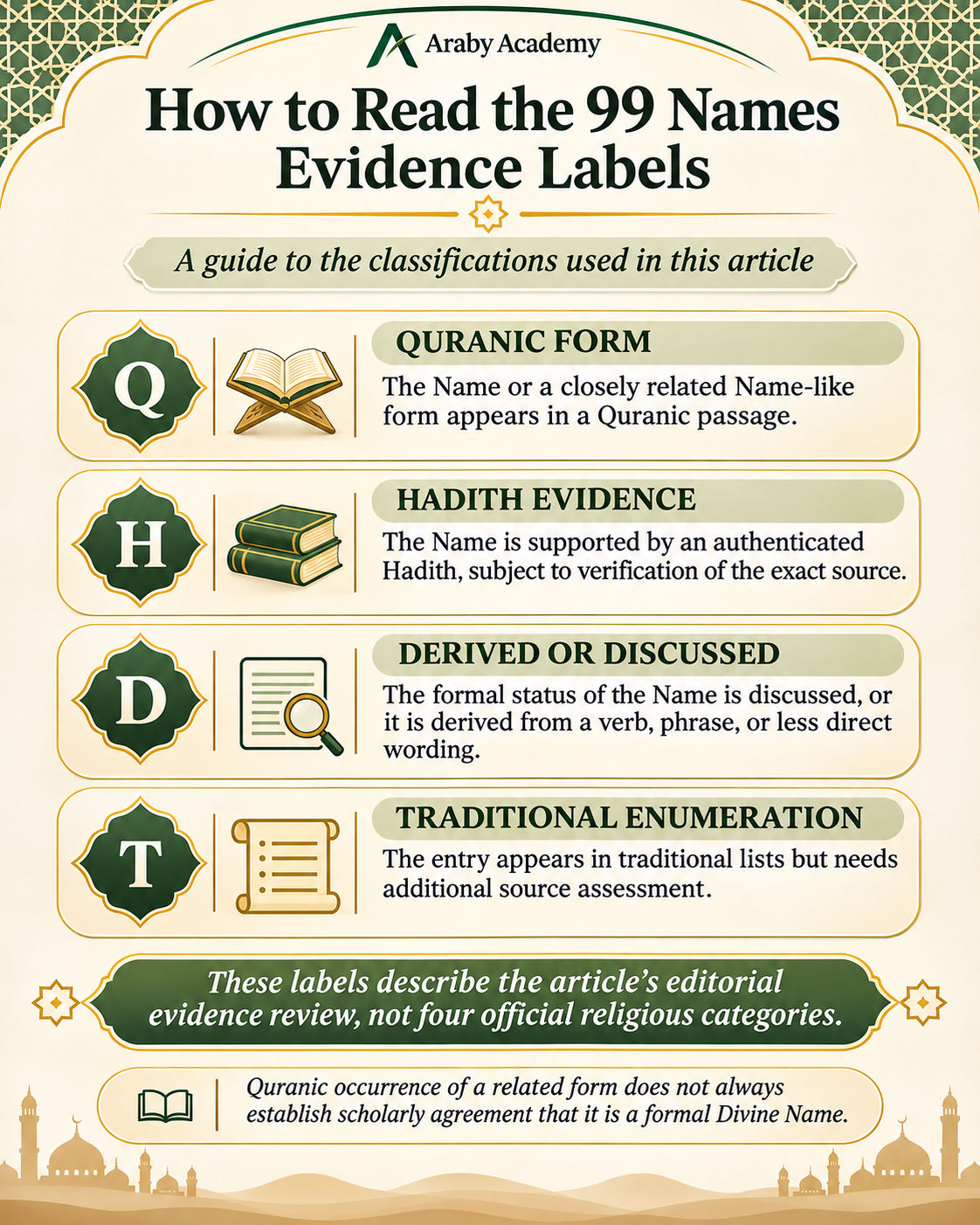
Evidence labels used:
Q: appears as a Name (or in a Name-like form) in a Quranic passage.
H: established through an authenticated hadith (the editors should verify the exact grading cited).
D: discussed as a formal Name; commonly derived from a verb, a construct phrase or a less direct text.
T: included in the traditional enumeration but needing an additional source assessment.
The glosses are short. English cannot carry the full range of an Arabic Name, and no gloss should be treated as exhaustive. A verse reference is given where a clear form appears. “Q” means a Quranic form is present, not that every scholar uses identical criteria for a formal Name.
Above the count: Allah (الله) is the unique, all-comprehensive Divine Name (Q: 20:8, 59:22).
Names 1–25
# | Arabic | Transliteration | Short gloss | Evidence note |
|---|---|---|---|---|
1 | الرَّحْمَٰن | Ar-Rahman | The Most Merciful (all-encompassing mercy) | Q: 1:3, 59:22 |
2 | الرَّحِيم | Ar-Rahim | The Especially Merciful | Q: 1:3, 33:43 |
3 | الْمَلِك | Al-Malik | The King, Sovereign | Q: 59:23, 20:114 |
4 | الْقُدُّوس | Al-Quddus | The Pure, Holy | Q: 59:23, 62:1 |
5 | السَّلَام | As-Salam | The Source of Peace, Perfect and Free of defect | Q: 59:23 |
6 | الْمُؤْمِن | Al-Mu'min | The Giver of Security | Q: 59:23 (interpretation noted below) |
7 | الْمُهَيْمِن | Al-Muhaymin | The Guardian, Watchful Over All | Q: 59:23 |
8 | الْعَزِيز | Al-'Aziz | The Almighty | Q: 59:1, 59:23 |
9 | الْجَبَّار | Al-Jabbar | The Compeller, the Restorer | Q: 59:23 |
10 | الْمُتَكَبِّر | Al-Mutakabbir | The Supremely Great | Q: 59:23 |
11 | الْخَالِق | Al-Khaliq | The Creator | Q: 59:24, 6:102 |
12 | الْبَارِئ | Al-Bari' | The Originator | Q: 59:24 |
13 | الْمُصَوِّر | Al-Musawwir | The Fashioner | Q: 59:24 |
14 | الْغَفَّار | Al-Ghaffar | The Oft-Forgiving | Q: 20:82, 38:66, 71:10 |
15 | الْقَهَّار | Al-Qahhar | The Subduer | Q: 13:16, 39:4 |
16 | الْوَهَّاب | Al-Wahhab | The Bestower | Q: 3:8, 38:9 |
17 | الرَّزَّاق | Ar-Razzaq | The Provider | Q: 51:58 |
18 | الْفَتَّاح | Al-Fattah | The Opener, the Judge | Q: 34:26 |
19 | الْعَلِيم | Al-'Alim | The All-Knowing | Q: 2:29 and many others |
20 | الْقَابِض | Al-Qabid | The Withholder | H: Abu Dawud, al-Tirmidhi (verify grading) |
21 | الْبَاسِط | Al-Basit | The Expander | H: same report as 20 |
22 | الْخَافِض | Al-Khafid | The Abaser | D: derived from verb; T |
23 | الرَّافِع | Ar-Rafi' | The Exalter | D: derived from verb; T |
24 | الْمُعِزّ | Al-Mu'izz | The Giver of Honor | D: derived from verb (3:26); T |
25 | الْمُذِلّ | Al-Mudhill | The Giver of Humiliation | D: derived from verb (3:26); T |
Names 26–50
# | Arabic | Transliteration | Short gloss | Evidence note |
|---|---|---|---|---|
26 | السَّمِيع | As-Sami' | The All-Hearing | Q: 42:11, 2:127 |
27 | الْبَصِير | Al-Basir | The All-Seeing | Q: 42:11, 17:1 |
28 | الْحَكَم | Al-Hakam | The Judge | H: Abu Dawud (verify grading); D |
29 | الْعَدْل | Al-'Adl | The Just | T: widely listed; Quranic evidence discussed (D) |
30 | اللَّطِيف | Al-Latif | The Subtle, the Kind | Q: 6:103, 22:63, 67:14 |
31 | الْخَبِير | Al-Khabir | The All-Aware | Q: 6:18, 6:103, 67:14 |
32 | الْحَلِيم | Al-Halim | The Forbearing | Q: 2:235, 17:44 |
33 | الْعَظِيم | Al-'Azim | The Magnificent | Q: 2:255, 42:4 |
34 | الْغَفُور | Al-Ghafur | The Ever-Forgiving | Q: 39:53, 2:235 |
35 | الشَّكُور | Ash-Shakur | The Most Appreciative | Q: 35:30, 64:17 |
36 | الْعَلِيّ | Al-'Aliyy | The Most High | Q: 2:255, 42:4 |
37 | الْكَبِير | Al-Kabir | The Most Great | Q: 13:9, 22:62 |
38 | الْحَفِيظ | Al-Hafiz | The Preserver | Q: 11:57 (form الحفيظ) |
39 | الْمُقِيت | Al-Muqit | The Sustainer, Witness | Q: 4:85 |
40 | الْحَسِيب | Al-Hasib | The Reckoner, Sufficient | Q: 4:6, 4:86 |
41 | الْجَلِيل | Al-Jalil | The Majestic | D: Quran has dhu al-jalal (55:27, 55:78); T |
42 | الْكَرِيم | Al-Karim | The Generous | Q: 27:40, 82:6 |
43 | الرَّقِيب | Ar-Raqib | The Watchful | Q: 4:1, 5:117 |
44 | الْمُجِيب | Al-Mujib | The Responsive | Q: 11:61 |
45 | الْوَاسِع | Al-Wasi' | The All-Encompassing | Q: 2:115, 2:268 |
46 | الْحَكِيم | Al-Hakim | The All-Wise | Q: 2:32, 31:27 |
47 | الْوَدُود | Al-Wadud | The Most Loving | Q: 11:90, 85:14 |
48 | الْمَجِيد | Al-Majid | The Glorious | Q: 11:73, 85:15 |
49 | الْبَاعِث | Al-Ba'ith | The Resurrector | D: derived from verb (22:7); T |
50 | الشَّهِيد | Ash-Shahid | The Witness | Q: 4:33, 22:17 |
Names 51–75
# | Arabic | Transliteration | Short gloss | Evidence note |
|---|---|---|---|---|
51 | الْحَقّ | Al-Haqq | The Truth, the Real | Q: 22:6, 24:25 |
52 | الْوَكِيل | Al-Wakil | The Trustee, Disposer of Affairs | Q: 3:173, 4:171 |
53 | الْقَوِيّ | Al-Qawiyy | The Strong | Q: 22:40, 42:19 |
54 | الْمَتِين | Al-Matin | The Firm | Q: 51:58 |
55 | الْوَلِيّ | Al-Waliyy | The Protecting Ally | Q: 42:9, 2:257 |
56 | الْحَمِيد | Al-Hamid | The Praiseworthy | Q: 14:8, 31:26 |
57 | الْمُحْصِي | Al-Muhsi | The Reckoner of All | D: derived from verb (19:94, 72:28); T |
58 | الْمُبْدِئ | Al-Mubdi' | The Originator | D: verb (10:4, 85:13); T |
59 | الْمُعِيد | Al-Mu'id | The Restorer | D: verb (10:4, 85:13); T |
60 | الْمُحْيِي | Al-Muhyi | The Giver of Life | D: participle (30:50, 41:39); T |
61 | الْمُمِيت | Al-Mumit | The Giver of Death | D: derived from verb (2:258, 15:23); T |
62 | الْحَيّ | Al-Hayy | The Ever-Living | Q: 2:255, 3:2, 20:111 |
63 | الْقَيُّوم | Al-Qayyum | The Self-Subsisting, Sustainer | Q: 2:255, 3:2, 20:111 |
64 | الْوَاجِد | Al-Wajid | The Finder, the One Lacking nothing | D: derived from verb; T |
65 | الْمَاجِد | Al-Majid | The Noble, Glorious | D: variant of 48; T |
66 | الْوَاحِد | Al-Wahid | The One | Q: 13:16, 14:48 |
67 | الْأَحَد | Al-Ahad | The Unique | Q: 112:1 (discussed as Name, D) |
68 | الصَّمَد | As-Samad | The Eternal Refuge | Q: 112:2 |
69 | الْقَادِر | Al-Qadir | The All-Capable | Q: 6:65, 75:40 |
70 | الْمُقْتَدِر | Al-Muqtadir | The All-Powerful | Q: 54:42, 54:55 |
71 | الْمُقَدِّم | Al-Muqaddim | The Bringer Forward | H: Bukhari and Muslim in a Dua (verify) |
72 | الْمُؤَخِّر | Al-Mu'akhkhir | The Delayer | H: Bukhari and Muslim in a Dua (verify) |
73 | الْأَوَّل | Al-Awwal | The First | Q: 57:3 |
74 | الْآخِر | Al-Akhir | The Last | Q: 57:3 |
75 | الظَّاهِر | Az-Zahir | The Manifest, Supreme | Q: 57:3 |
Names 76–99
# | Arabic | Transliteration | Short gloss | Evidence note |
|---|---|---|---|---|
76 | الْبَاطِن | Al-Batin | The Hidden, Intimately Aware | Q: 57:3 |
77 | الْوَالِي | Al-Wali | The Governor | D: Quran has wali (13:11); form discussed; T |
78 | الْمُتَعَالِ | Al-Muta'al | The Self-Exalted | Q: 13:9 |
79 | الْبَرّ | Al-Barr | The Source of Goodness | Q: 52:28 |
80 | التَّوَّاب | At-Tawwab | The Acceptor of Repentance | Q: 2:37, 9:104 |
81 | الْمُنْتَقِم | Al-Muntaqim | The Avenger | D: Quran has dhu intiqam (3:4, 14:47); T |
82 | الْعَفُوّ | Al-'Afuww | The Pardoner | Q: 4:99, 22:60 |
83 | الرَّؤُوف | Ar-Ra'uf | The Compassionate | Q: 2:143, 9:117 |
84 | مَالِكُ الْمُلْك | Malik al-Mulk | Owner of Sovereignty | Q: 3:26 (construct phrase; D) |
85 | ذُو الْجَلَالِ وَالْإِكْرَام | Dhu al-Jalal wa al-Ikram | Lord of Majesty and Honor | Q: 55:27, 55:78 (construct phrase; D) |
86 | الْمُقْسِط | Al-Muqsit | The Equitable | D: Quran has muqsitin (5:42); disputed as a Name; T |
87 | الْجَامِع | Al-Jami' | The Gatherer | Q: 3:9, 4:140 |
88 | الْغَنِيّ | Al-Ghaniyy | The Self-Sufficient | Q: 2:263, 35:15 |
89 | الْمُغْنِي | Al-Mughni | The Enricher | D: derived from verb (9:28); T |
90 | الْمَانِع | Al-Mani' | The Preventer | D: derived from hadith wording; T |
91 | الضَّارّ | Ad-Darr | The Distresser | D: derived; T |
92 | النَّافِع | An-Nafi' | The Benefiter | D: derived; T |
93 | النُّور | An-Nur | The Light | D: 24:35 is interpreted in several ways; T |
94 | الْهَادِي | Al-Hadi | The Guide | Q: 22:54, 25:31 |
95 | الْبَدِيع | Al-Badi' | The Originator Without Precedent | Q: 2:117, 6:101 (construct form; D) |
96 | الْبَاقِي | Al-Baqi | The Everlasting | D: Quran has the verb (55:27); T |
97 | الْوَارِث | Al-Warith | The Inheritor | D: Quran has al-warithun (15:23, 28:58); T |
98 | الرَّشِيد | Ar-Rashid | The Guide to Right Conduct | T: no clear Quranic Name; included in Tirmidhi-derived lists |
99 | الصَّبُور | As-Sabur | The Patient | T: no clear Quranic Name; included in Tirmidhi-derived lists |
Notes on this table.
Not every row has the same evidentiary status. Names marked Q appear clearly in the Quran. Rows marked D or T (about 30 of the 99) are derived from verbs or construct phrases, rest on reports that hadith critics have discussed, or are included mainly because they appear in the Tirmidhi tradition. We say so plainly rather than forcing a false uniformity.
Variation is normal. Printed lists commonly vary on whether Al-Wahid and Al-Ahad both appear, how the phrases Malik al-Mulk and Dhu al-Jalal wa al-Ikram are counted, and which entries near the end are used. Some lists replace entries with Names scholars regard as better supported.
Al-Mu'min (6) is explained by some commentators as the One who gives security, and by others as the One who affirms the truth of His messengers. It is not a simple “the believer.”
Al-Qadir and Al-Qadeer are two transliterations of Al-Qadir (القادر) and two different Arabic forms: al-qadir (القادر, 6:65) and al-qadir with the longer vowel pattern al-qadir/al-qadeer (القدير, as in 2:20). Do not merge al-Qadir with al-Muqtadir, which is a separate Quranic form (54:42).
Every row should be checked by an editor against the primary text before publication, using the verification notes at the end of this document.
The next sections move from the list to what the Names actually teach.
What Do Allah's Names Teach Us About Him?
The Names are best studied in families, because the Quran often places related Names together. Below are about twenty-five of the most educationally important Names, grouped by theme. They do not exhaust Allah's perfection. They are a starting point.
First, a method note. A Name (ism) is a title that points to Allah. An attribute (sifah) is a quality such as mercy or knowledge. Scholars agree Names indicate attributes: Ar-Rahman points to mercy. But they discuss carefully how Names, attributes and acts relate, and not every school uses the same terms. For beginners the safe conclusion is simple: use the Names established by reliable evidence, affirm what revelation affirms, and never compare Allah to creation (42:11).
Why not every verb becomes a Name. The Quran says Allah creates, gives life, causes death, and takes revenge on wrongdoers. Those are acts. Scholars generally say an act does not by itself establish a formal Beautiful Name, because a Name must itself be attested as a Name, and must be a perfect attribute with no deficiency in meaning. This is why some entries in the table above carry a D label. Deriving a Name from a verb or from an English adjective just to reach the number 99 is exactly the invention that 7:180 warns about.
Names of Mercy and Forgiveness
Ar-Rahman and Ar-Rahim (الرحمن الرحيم). Both come from the root r-h-m, related to mercy and to rahim, the womb, a word that suggests care and kinship. Classical commentators such as al-Tabari and Ibn Kathir explained Ar-Rahman as the mercy that is vast, covering all creation, and Ar-Rahim as mercy that is directed toward the believers, citing 33:43 (“He is ever Merciful to the believers”). Others stress that the two together intensify the sense of mercy, or that one refers to the attribute in itself and the other to its reaching creation. Beginners should not reduce this to “Rahman is only for this world.”
Ar-Rahman | Ar-Rahim | |
|---|---|---|
Arabic | الرحمن | الرحيم |
Root | r-h-m | r-h-m |
Common translation | The Most Merciful | The Especially / Ever Merciful |
Interpretive nuance | Vast, encompassing mercy; often used as a Name by itself (17:110) | Mercy that reaches and benefits; often tied to believers (33:43) |
Quranic examples | 1:3, 20:5, 55:1 | 1:3, 2:37, 33:43 |
What not to oversimplify | It does not mean mercy “only in this world” | It does not mean Allah is not merciful to others |
Al-Ghafur and Al-Ghaffar (الغفور الغفار). Both come from gh-f-r, whose core sense is covering or protecting, which is why mighfar means helmet. Al-Ghafur appears in 39:53 (“Do not despair of the mercy of Allah; Allah forgives all sins”). Al-Ghaffar appears in 20:82, 38:66 and 71:10. Both are intensive forms, fa'ul and fa''al. Many scholars say the patterns point to abundance or repetition of forgiveness, but no grammar rule requires the same shade of meaning for every word on the same pattern, and there is no sound basis for rigid viral claims such as “Ghaffar covers sins in this world and Ghafur in the next.” Read each in its verse.
At-Tawwab (التواب). From t-w-b, “to return.” Allah is the One who accepts the return of His servants and who also turns toward them with mercy and ability to repent (2:37, 9:104). It teaches that the door of return is open. For the practical steps, see How to Repent in Islam: A Complete Guide to Tawbah and Allah's Forgiveness
Al-'Afuww (العفو). From '-f-w, whose senses include erasing and pardoning. The best-known Prophetic Dua is the one 'A'ishah was taught for Laylat al-Qadr, “O Allah, You are Ever-Pardoning, You love to pardon, so pardon me” (reported by al-Tirmidhi and Ibn Majah and graded sahih by al-Tirmidhi). There is no sound basis for insisting on a fixed one-word contrast between 'afw and maghfirah beyond what scholars say about the language.
Al-Wadud (الودود). Appears in 11:90 (“My Lord is Merciful and Loving”) and 85:14. Scholars explained it as the One who loves His righteous servants and is loved by them, or as the One whose love is abundant. It is not a human romantic emotion. Allah's love is a perfection that befits Him, and nothing resembles Him.
Forgiving others, when appropriate, is a response to Allah's mercy, but it never requires a person to give up justice or personal safety.
Names of Knowledge and Wisdom
Al-'Alim (العليم) (root '-l-m) means that Allah's knowledge encompasses the seen and unseen, intentions and hidden acts (for example 2:29, 67:13–14). This should bring awareness and humility, not obsessive fear. Involuntary intrusive thoughts are not sins, and anxiety in this area deserves gentleness and, where needed, qualified help.
Al-Hakim (الحكيم) (root h-k-m) means the All-Wise: the One whose decrees and commands are perfectly placed. A believer can trust Allah's wisdom without claiming to know the exact purpose behind every personal hardship. For that subject see Why Does Allah Test Us?
As-Sami' and Al-Basir (السميع البصير). The Quran joins them in 42:11, immediately after saying nothing is like Him. They affirm that Allah hears and sees in a manner that befits Him, and that no supplication and no deed is hidden from Him. We affirm the meaning and do not picture an organ or compare it to ours.
Al-Khabir (الخبير) means the All-Aware, whose knowledge reaches the inner reality of things (6:18, 67:14). It is often paired with Al-Hakim and Al-'Alim.
Al-Latif (اللطيف) is explained by commentators as combining subtle knowledge, reaching the finest details, with gentle kindness in how Allah deals with His servants (6:103; 12:100; 22:63; 67:14). In 12:100, Yusuf (peace be upon him) uses it of how Allah brought about his family's reunion. This is a Quranic reflection and not a license to read every coincidence as a coded sign.
Knowledge and wisdom belong to Allah in perfection, and human beings are always learners.
Names of Power and Lordship
Al-Malik (الملك) is the King whose sovereignty is complete and needs no one (59:23). Human rulers hold delegated, limited and temporary authority. Al-'Aziz (العزيز) combines might, invincibility and honor, so no single English word is enough (59:23). Al-Qadir (القادر) and Al-Qadir/Al-Qadeer (القدير) express capability over everything; keep them separate from Al-Muqtadir (المقتدر) (54:42).
Al-Khaliq, Al-Bari' and Al-Musawwir (59:24). The three appear together. Commentators say Al-Khaliq points to creation as planned measure and bringing into being, Al-Bari' to creating without defect and giving things their distinct existence, and Al-Musawwir to giving each creature its particular form. These are shades scholars discussed, not an official division. This is a statement about creation. It does not mean picturing Allah as an artist with tools.
Al-Jabbar and Al-Mutakabbir (59:23). In human use, jabbar and mutakabbir often carry negative meanings of tyranny and arrogance (for example 40:35). For Allah, classical commentators and lexicographers explain Al-Jabbar as the One who sets things right, the Compeller whose will cannot be resisted, and the Exalted; Al-Mutakabbir as the One who is above all deficiency and truly Great. The same word, in a different subject, does not carry the same flaw, and we do not compare His perfection to human pride.
Al-Hayy and Al-Qayyum. Found together in 2:255, 3:2 and 20:111. Al-Hayy is the One whose life is perfect and without beginning or end. Al-Qayyum is the One who exists by Himself and sustains everything else. Their pairing teaches that everything depends on Him while He depends on none.
Reliance on Allah (tawakkul) goes together with effort, never in place of it.
Names of Provision and Care
Ar-Razzaq (الرزاق) (root r-z-q) appears in 51:58 alongside Dhu al-Quwwah al-Matin. Allah is the Provider, and provision includes far more than money: health, time, guidance, family. The Prophet ﷺ taught lawful effort (for example, the hadith about the birds that go out hungry and return full, in al-Tirmidhi). There is no authenticated promise of wealth from repeating this Name a fixed number of times.
Al-Wakil (الوكيل) means the Trustee in whom affairs are placed (3:173). It is the Name behind hasbunallahu wa ni'ma al-wakil. Tawakkul is not passivity. See What Is Tawakkul?
Al-Hafiz (الحفيظ) means the Preserver and Guardian (11:57). Al-Hafiz in the Tirmidhi list uses the form حفيظ, and it should not be automatically merged with the Quranic active participle حافظ in 12:64.
Al-Karim (الكريم) means Generous and Noble (27:40, 82:6). Ash-Shakur (الشكور) means the Most Appreciative of good deeds: He rewards a little good with much (35:30, 64:17). He does not need our thanks. The Prophet ﷺ also said that whoever does not thank people has not thanked Allah (Abu Dawud and al-Tirmidhi), so gratitude to Allah includes thanking others appropriately.
Names of Oneness and Perfection
Allah, Al-Ahad, Al-Wahid and As-Samad. Surah Al-Ikhlas (112:1–4) says: “Say: He is Allah, One. Allah is As-Samad. He neither begets nor is born, and there is none comparable to Him.” Samad has several classical explanations: the One to whom all turn in need (attributed to Ibn 'Abbas), the One who is perfect and has no hollow, or the One who remains when all else ends. Scholars cite more than one explanation, and no single English word captures all of them. Al-Ahad stresses uniqueness and Al-Wahid oneness, and the lines between them are explained differently, so avoid hard rules.
Al-Quddus and As-Salam (59:23). Quddus is Pure and Holy, far beyond any defect. Salam is often explained as the One free of all defect and the source of peace. It is more than the greeting as-salamu 'alaykum.
Do not picture Allah. The Names are meant to build knowledge and reverence, not mental images. Muslims believe nothing is like Allah (42:11). Within Sunni scholarship, Athari, Ash'ari and Maturidi scholars have explained some attribute texts differently, but they agree on His uniqueness and perfection. That unity is more important for beginners than the differences. For more on belief in one God, see What Is Tawhid?
12 Divine Name Pairs That Students Often Confuse
Pairs help us notice nuance, but a good pair comparison avoids invented rules.
Ar-Rahman vs Ar-Rahim: vast mercy and mercy that reaches the believers (see table above).
Al-Ghafur vs Al-Ghaffar: both forgiving, in intensive forms; read each in context (39:53; 20:82).
Al-'Alim vs Al-Khabir: knowledge, and awareness of inner reality (6:18).
Al-Qadir vs Al-Muqtadir: capability, and capability exercised with full command (54:42).
Al-Wahid vs Al-Ahad: oneness and uniqueness (13:16; 112:1).
Al-Khaliq vs Al-Bari': creation as planning and as bringing into existence (59:24).
Al-Bari' vs Al-Musawwir: originating and giving form (59:24).
Al-Hayy vs Al-Qayyum: perfect life and self-subsisting sustaining (2:255).
Al-Malik vs Malik al-Mulk: the King, and Owner of Sovereignty. Malik al-Mulk (3:26) is a construct phrase, so scholars discuss it as a Name.
Al-Halim vs Al-Ghafur: forbearance (delaying punishment) and forgiveness (2:225).
Al-'Afuww vs Al-Ghafur: pardon and covering; related but not identical senses.
Al-Wadud vs Ar-Rahim: love and mercy are paired, but they are separate Names (11:90).
The overlap is real, and so is the nuance.
How to Use Allah's Names in Dua
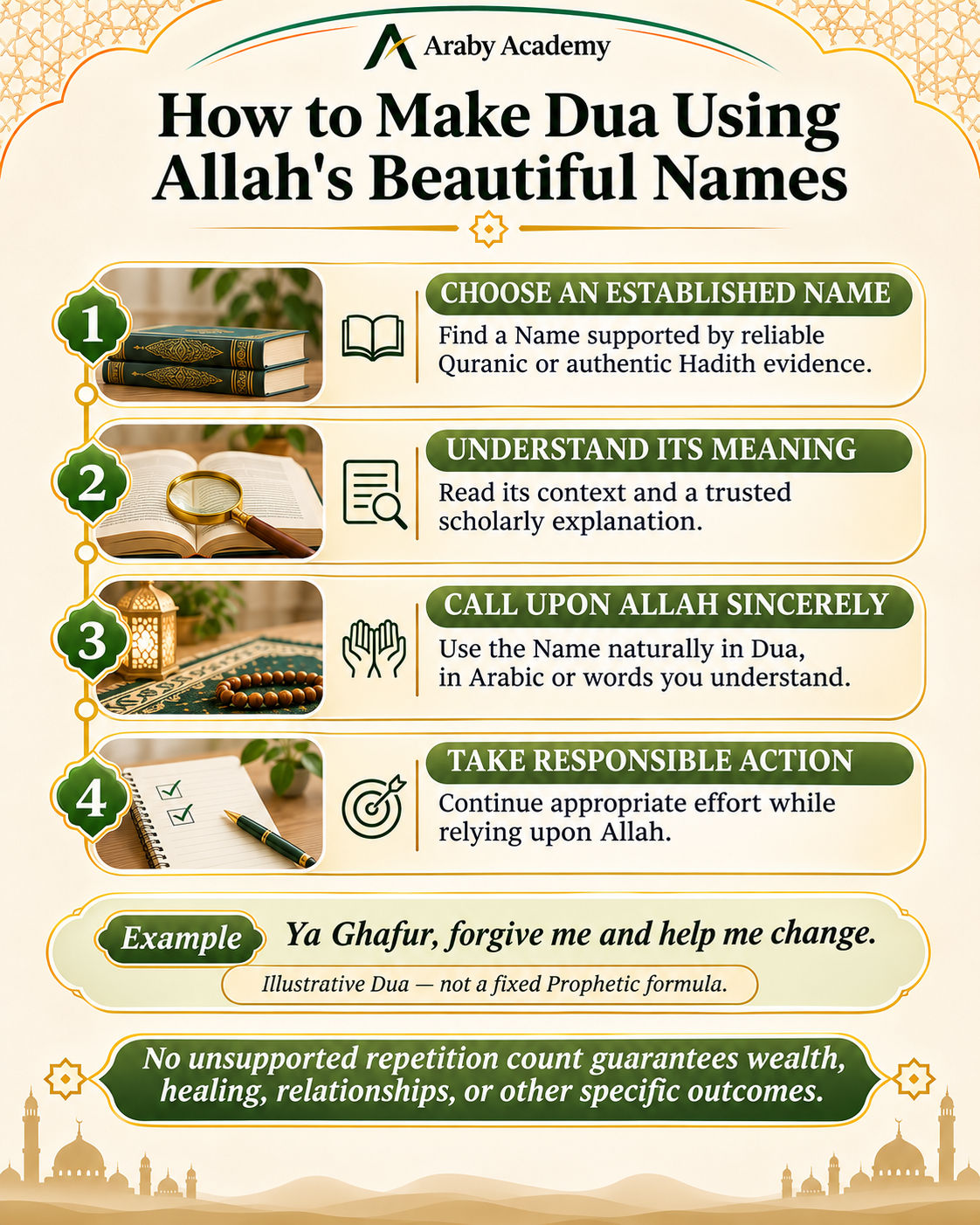
Quran 7:180 says to call upon Allah by His Names. Muslims make Dua by choosing Names that fit what they are asking, and by making that Dua sincerely. Examples, not scripts:
Seeking forgiveness: Ya Ghafur, forgive me. Ya Tawwab, accept my repentance.
Seeking mercy: Ya Rahman, Ya Rahim, have mercy on me.
Seeking provision: Ya Razzaq, provide for me in a lawful way and give me contentment.
Seeking guidance: Ya Hadi, guide me; Ya 'Alim, You know what is best for me.
You may say “Ya Rahman.” Quran 17:110 shows that calling upon Allah by Ar-Rahman is valid. Nothing requires you to repeat a Name a fixed number of times, and no authenticated hadith attaches a count to a Name. See How to Make Dua and What Is Dhikr?
Do you need a different Name for every problem? No. No fixed system of problems and Names has been established. Names help you understand what you are asking, and your Dua is still addressed to Allah alone.
Should you repeat a Name 100 or 1,000 times? General dhikr is encouraged, but circulating claims such as “Ya Razzaq 308 times for wealth,” “Ya Wadud 1,001 times to make someone love you” or “Ya Latif 129 times to solve every problem” are not established as Sunnah. A number and a promised result need reliable evidence.
Can reciting Al-Wadud make someone marry you? No. Marriage involves free consent, character and rights. Names are not tools for controlling another person's will. A sound Dua is Ya Wadud, grant me a righteous spouse if it is good for me.
Can reciting Ar-Razzaq guarantee wealth? No authentic promise exists. Work lawfully, make Dua, give thanks and rely on Allah.
Can the Names cure illness? Dua is meaningful and the Quran is a mercy, but a Name is not a guaranteed cure, and seeking medical treatment is encouraged in Islam.
Anxiety. Reflecting on Allah's mercy and wisdom can bring reassurance, but anxiety is not a sign of weak faith, and memorizing Names does not replace qualified care. See What Does Islam Say About Anxiety?
Numerology (abjad). Claims based on letter values give numbers for Names and promise outcomes. Letter-number systems are historical conventions, not revelation, and cannot make a Dua more answerable.
Greatest Name. Hadith reports mention Ism Allah al-A'zam (اسم الله الأعظم), for example in the narration of Buraydah (Abu Dawud 1493, al-Tirmidhi 3475, Ibn Majah 3857, graded sahih by al-Albani) and another about Allah, la ilaha illa huwa al-Hayy al-Qayyum (Abu Dawud 1496, al-Tirmidhi 3478). Scholars differ on which Name or combination is meant, and no knowledge of it gives supernatural power.
Dreams. A dream cannot add a Name to the creed. Revelation is closed.
A Name opens understanding; it does not work as a spell.
How to Memorize and Understand the Names
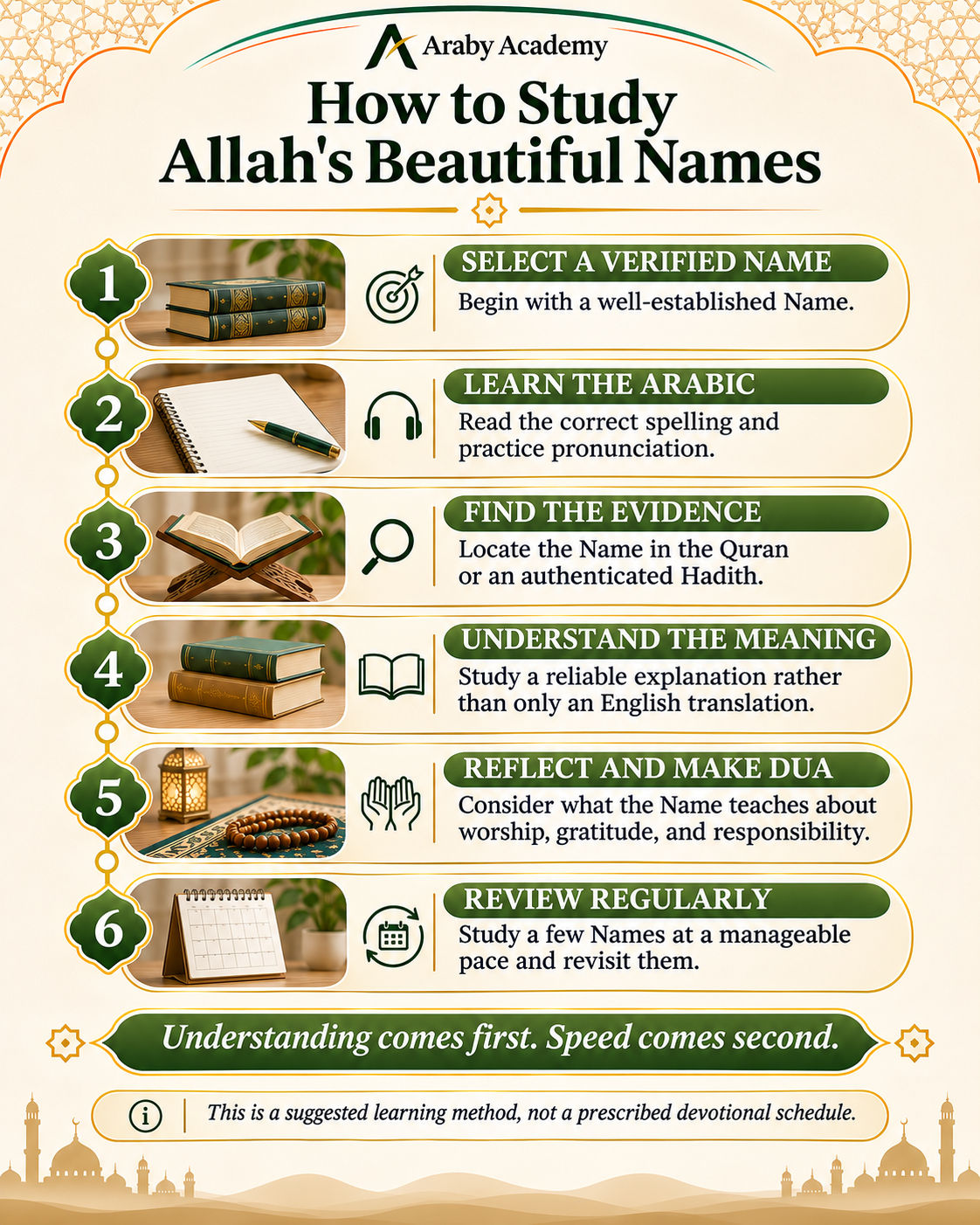
This is an editorial study plan. It is not a prescribed ritual, and it does not promise memorization in a set number of days.
Choose a well-sourced list and keep the same list throughout.
Learn accurate Arabic pronunciation from a qualified teacher or reliable audio.
Memorize in small groups of three to five.
Understand each meaning before moving on.
Find the Quran or Hadith evidence and read the verse in context.
Review with spaced repetition: the next day, three days later, a week later.
Use verified Names in Dua, in your own words.
Avoid magical claims and fixed counts.
Study with a qualified teacher where possible.
Revise steadily.
An optional four-week beginner plan. Week 1: Names of mercy and forgiveness. Week 2: knowledge and wisdom. Week 3: power and provision. Week 4: oneness and perfection. It is a way to begin, not a guarantee of finishing all 99.
For new Muslims. You do not need to memorize the Names to enter Islam or to worship well. Start with Allah, Ar-Rahman, Ar-Rahim, Al-Ghafur and Al-'Alim, and add more gradually.
Ten Names to begin with. Each is well attested in the Quran. Dua lines are examples, not fixed wording.
Name | Arabic | Meaning | Source | Reflection question | Example Dua |
|---|---|---|---|---|---|
Allah | الله | The One God | 20:8 | What does “no deity but Him” change in my day? | Ya Allah, increase me in knowledge of You |
Ar-Rahman | الرحمن | Most Merciful | 1:3 | Where do I see mercy around me? | Ya Rahman, have mercy on me |
Ar-Rahim | الرحيم | Especially Merciful | 33:43 | How can I be merciful to others? | Ya Rahim, be merciful to my family |
Al-'Alim | العليم | All-Knowing | 2:29 | Do I act the same in private and in public? | Ya 'Alim, You know my situation; guide me |
Al-Hakim | الحكيم | All-Wise | 31:27 | What helps me trust what I do not understand? | Ya Hakim, grant me wisdom |
Al-Ghafur | الغفور | Ever-Forgiving | 39:53 | What do I need to return from? | Ya Ghafur, forgive me |
At-Tawwab | التواب | Accepter of repentance | 2:37 | What step is my repentance asking for? | Ya Tawwab, accept my repentance |
Ar-Razzaq | الرزاق | The Provider | 51:58 | What provision have I not thanked Him for? | Ya Razzaq, provide for me lawfully |
Al-Hayy | الحي | Ever-Living | 2:255 | What changes when I remember He never dies? | Ya Hayy, revive my heart |
Al-Qayyum | القيوم | Self-Subsisting Sustainer | 2:255 | What do I depend on too much? | Ya Qayyum, sustain my affairs |
Understanding comes first, and speed comes second.
7 Common Mistakes When Learning Allah's Names
Memorizing English without Arabic. Pair every gloss with the Arabic Name and a verse.
Assuming every list is equally authenticated. Remember the three-claim distinction.
Inventing Names from positive adjectives. Not every nice word, or every verb attributed to Allah, is a Name.
Overinterpreting Arabic roots. A root gives a family of meanings, not a final definition.
Treating Names as magical formulas. There are no authenticated counts that guarantee wealth, love or cure.
Ignoring Quranic context. Read the whole verse and a trusted tafsir.
Turning theological differences into hostility. Scholars have sincerely differed on details such as the exact count and how some attribute texts are explained.
Let the differences teach you humility instead of hostility.
How Parents Can Teach the Names to Children
Start with simple truths: Allah is One. Allah is the Creator. Allah is Merciful. Allah knows us. Allah hears our Dua. Allah is unlike anything we can imagine. Avoid frightening imagery and avoid describing Allah as having a body. Teach a few Names slowly, in warm everyday moments, never as a threat.
Seven family activities (educational, not devotional rituals): (1) Name-and-meaning flashcards. (2) Matching each Name to a Quran reference. (3) An Arabic root notebook. (4) A weekly reflection. (5) A parent-child Dua conversation. (6) Listening to correct pronunciation. (7) A friendly family quiz.
Names and naming. 'Abd (عبد) means servant, as in Abdullah or 'Abd al-Rahman. Compounds are valid when the second word is an established Divine Name, and scholars have reported agreement that naming someone “servant of” other than Allah is not allowed. Some Names can be used for people only without the definite article, and others are reserved for Allah. Rulings can be detailed, so ask a qualified scholar.
Calligraphy and display. Writing the Names respectfully is a long Muslim tradition. Scholars differ on amulets, and calligraphy is not a guaranteed shield. Keep sacred writing out of disrespectful places.
Quranic Arabic: Roots and Patterns in the Beautiful Names
Arabic words mostly come from three-letter roots. Seeing the root helps students notice relationships.
ر ح م (r-h-m): Ar-Rahman, Ar-Rahim.
غ ف ر (gh-f-r): Al-Ghafur, Al-Ghaffar.
ع ل م ('-l-m): Al-'Alim.
ح ك م (h-k-m): Al-Hakim.
ر ز ق (r-z-q): Ar-Razzaq.
Patterns. Fa'il or fa'eel (رحيم, عليم, حكيم) often marks an established quality. Fa'ul (غفور, شكور) and fa''al (غفار, رزاق) often suggest abundance or intensity. These are tendencies, not rules to apply mechanically to every word.
The definite article (الـ) marks the Name as “the” one. Adding it to any adjective does not make a Divine Name.
Solar letters. Before letters such as r, t, s and sh, the l of al- is assimilated: we write Ar-Rahman, At-Tawwab, As-Sami', Ash-Shakur, but pronounce the doubled consonant.
Two sounds beginners ask about. The letter 'ayn (ع) is a distinct throat sound in Al-'Alim, Al-'Aziz and Al-'Afuww, and is not silent. The letter ghayn (غ) in Al-Ghafur is a voiced sound produced at the back of the mouth, similar to a gargle. Learn both with a teacher. A small pronunciation mistake does not mean your Dua is invalid, so improve gradually.
Why transliterations differ. Ar-Rahman/Al-Rahman, Al-Ghafur/Al-Ghafoor and Al-'Alim/Al-Aleem are the same Names in different romanizations. They do not suggest different Names.
A shared root links words, but context decides meaning.
Common Misconceptions
“Allah has only 99 Names.” The hadith establishes a special virtue of ninety-nine; many scholars hold that the Names are not limited to that number.
“Every circulated list is verbatim Prophetic.” The enumeration needs its own analysis.
“Memorizing sounds replaces worship.” Ihsa' has been explained more deeply.
“Every positive adjective or verb is a Name.” Reliable evidence is required.
“All Names have perfect one-word translations.” The Arabic is richer.
“Rahman and Rahim have one rigid distinction.” Classical interpretations include nuance.
“A Name repeated 313 times guarantees money.” Fixed counts and promises need evidence.
“Al-Wadud forces someone to love you.” Names are not coercive magic.
“The Names eliminate mental illness.” Faith and healthcare can coexist.
“Allah resembles creation because words are shared.” Nothing resembles Allah (42:11).
“Muslims worship the written Names.” Muslims worship Allah.
“Dreams can add Names.” Personal experiences do not establish revelation.
“Every word starting with Al- is a Name.” No.
“The letter 'ayn is silent.” It is a distinct sound.
“Different spellings mean different Names.” Romanization varies.
“Frighten children into memorizing.” Teach gently and gradually.
“Invoke Ar-Razzaq and stop working.” Tawakkul does not replace effort.
“Only Arabic speakers can invoke the Names.” Anyone can make sincere Dua while learning.
“Learning the Names is only vocabulary.” It is part of knowing and worshipping Allah.
“A dream or numerology can reveal secret Names or power.” Neither is a source of religious proof.
Frequently Asked Questions
1. What are the 99 Names of Allah? They are Beautiful Names by which Allah is known in the Quran and Sunnah, such as Ar-Rahman and Al-'Alim. The number comes from an authentic hadith; the printed lists are scholarly enumerations.
2. What does Asma al-Husna mean? “The Most Beautiful Names.” Ism means name, and husna is the feminine superlative of “beautiful, best.”
3. Are Allah's Names mentioned in the Quran? Yes. Many appear directly, for example in 59:22–24, 112, and 2:255, and the Quran commands calling on Him by them (7:180).
4. Does Allah have only 99 Names? Many scholars say no; the hadith establishes special virtue for ninety-nine. Ibn Hazm took a stricter view. The supplication of Ibn Mas'ud mentions Names kept in Allah's knowledge.
5. Is the popular list authentic? The hadith is authentic. The full enumeration in al-Tirmidhi was discussed by critics as possibly inserted (idraj), so lists should be labeled honestly.
6. What hadith mentions the 99 Names? Abu Hurayrah's narration in Sahih al-Bukhari (e.g. 6410, 7392) and Sahih Muslim (2677).
7. What does ihsa' mean? Scholars include memorizing, understanding, and acting on the Names. Not all use an identical definition.
8. Does memorizing all 99 guarantee Paradise? The hadith promises a great reward for ihsa', which scholars explain as more than reciting words. It does not replace belief, worship or obligations.
9. Can Muslims invent Divine Names? No. Names are known through revelation; 7:180 warns against deviation concerning them.
10. Names vs attributes? A Name points to Allah and indicates a perfect attribute. Scholars discuss how names, attributes and acts relate, and not every school describes it in the same terms.
11. Why different English translations? Arabic Names carry root, pattern and Quranic context. One English word rarely captures all.
12. What does Ar-Rahman mean? The Most Merciful, with vast, encompassing mercy; from the root r-h-m.
13. Rahman vs Rahim? Classical commentators often describe Rahman as vast mercy and Rahim as mercy reaching the believers (33:43), without a single rigid rule.
14. Ghafur vs Ghaffar? Both mean forgiving, in intensive forms (fa'ul and fa''al). Read each in context.
15. What does Al-Wadud mean? The Most Loving (11:90; 85:14); Allah's love befits Him and is not a human emotion.
16. What does Al-Latif mean? Commentators explain it as subtle knowledge combined with gentle kindness (6:103; 22:63).
17. What does As-Samad mean? The One to whom all turn in need, among other classical explanations (112:2).
18. Can I make Dua using the Names? Yes, 7:180 commands it. Use them with sincerity and in your own words.
19. Does repeating a Name a fixed number guarantee a result? No authenticated evidence supports that claim.
20. What is the Greatest Name? Hadith mention it; scholars differ on which Name or combination is meant.
21. How do beginners memorize? In small groups, with meaning, verses and review, using one list. No fixed timeline.
22. How should parents teach children? Gently, with simple meanings and no frightening images; Allah is One, Merciful and unlike creation.
23. Are printed lists identical? No. They vary in a few entries and in how phrases are counted.
24. Can the Names help with Quranic Arabic? Yes: roots, patterns and the definite article appear throughout.
25. Is perfect pronunciation required first? No. Improve gradually.
26. How do I study one Name deeply? Ask: Is it established? Where does it appear? What does the Arabic mean? What did the commentators say? How does it inform Dua and character?
Learning Allah's Names Is a Way to Know Him Better
Quran 7:180 begins with a statement and ends with an invitation: to Allah belong the most beautiful Names, so call upon Him by them. They are not a collection of magical words. They are part of revelation, and they teach mercy, forgiveness, knowledge, wisdom, power, provision, oneness and perfection, without reducing Allah to human categories.
Memorizing, understanding, invoking and living responsibly are different steps on the same road.
The most meaningful way to begin learning Allah's Beautiful Names is not to rush through ninety-nine unfamiliar words, but to study each Name with the Quran, understand its meaning, and let that knowledge deepen sincere worship.
If you would like to read these Names in the Quran itself, Araby Academy offers guided study in Quranic Arabic, Tajweed and Islamic Studies for adults and children, with one-to-one teachers who can help with pronunciation and meaning.