A Muslim loses a job. A marriage ends. A parent dies. Someone you love is diagnosed with a serious illness. A student studies for months and still fails. Someone makes Dua for years and sees nothing they recognize as an answer.
Then comes the question, often whispered rather than spoken: "Why is Allah allowing this?"
Sometimes a harder one follows: Is Allah angry with me? Or: If Allah loves me, why does this hurt so much?
These questions usually come from pain, not rebellion. If you have asked them, you are not a bad Muslim. The Quran itself speaks constantly about trials, loss, fear, grief, patience, trust, hope and the temporary nature of this world. Islam never pretends suffering is unreal. Instead, it places suffering inside a much larger framework.
This article asks why Allah tests us and tries to answer honestly, using the Quran and authentic Sunnah, without slogans and without pretending to know what Allah has not told us.
The Most Important Distinction in This Article
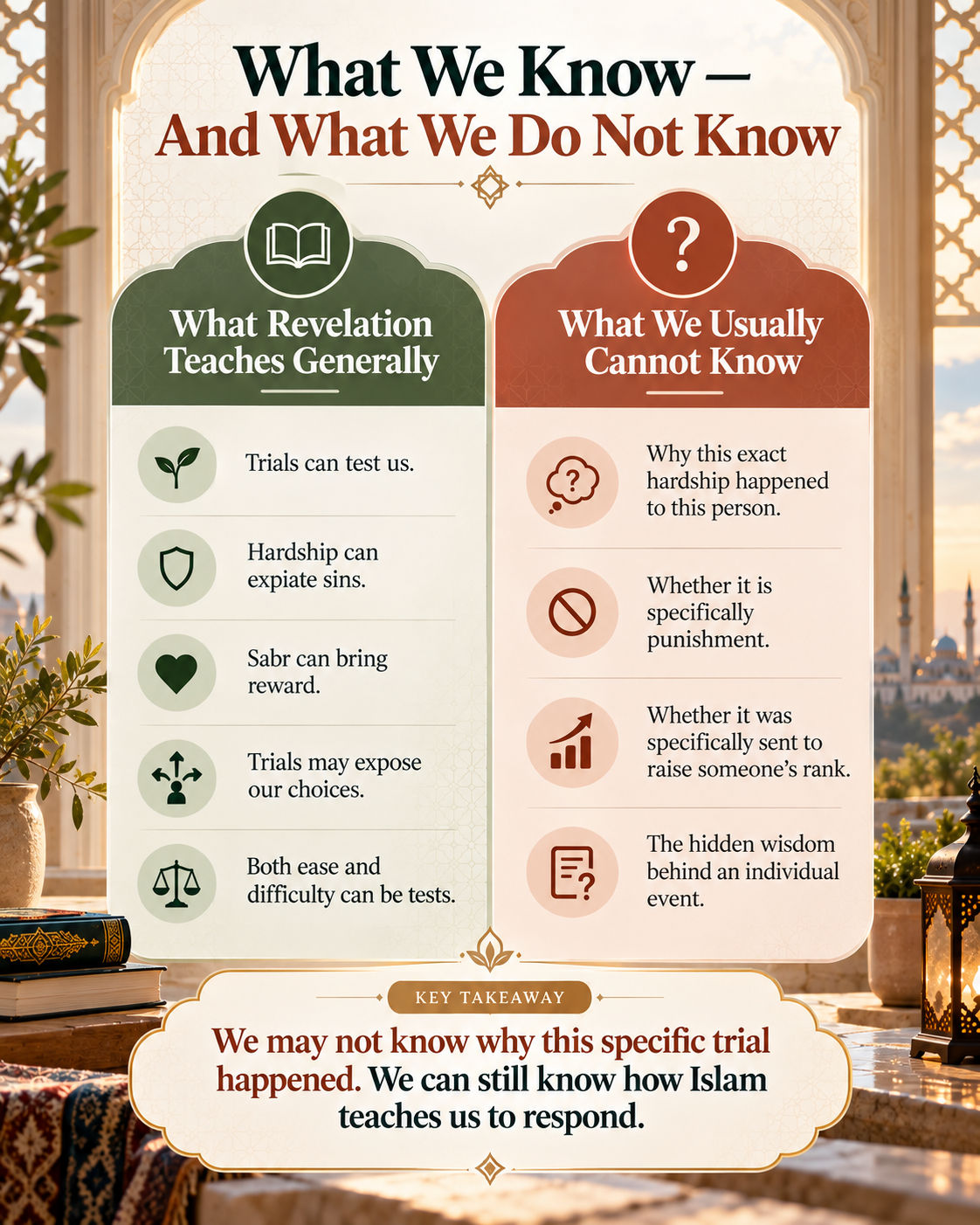
Throughout this article, we separate two things:
What revelation tells us generally about trials. The Quran and Sunnah teach that hardship can test, purify, warn, expose, develop patience and raise a believer in reward.
What we can know about one person's specific trial. Usually, very little. We are not given access to the unseen wisdom behind an individual event.
The first does not automatically give us the right to apply the second. We should not look at a grieving person and declare, "Allah is punishing you," or "Allah gave you this illness to raise your rank." We do not know.
Sometimes the most honest Islamic answer is: "We do not know the specific wisdom, but we know what Allah has taught us about how to respond."
What Is a "Test" in Islam? A Short Arabic Guide
English uses one word, "test," for several Quranic ideas. Knowing the Arabic helps explain why translations vary between test, trial, affliction, temptation, tribulation and calamity. These words are not interchangeable one-to-one translations; their meaning depends on context.
Ibtila' (ابتلاء) and the verb yabluu come from the root ب-ل-و, which carries the sense of putting something to the proof. It can apply to ease and to difficulty.
Bala' (بلاء) comes from the same root. It can mean a hardship, but in some verses it means a trial that may also be a favor. For example, Quran 8:17 uses it for a "good" bala' from Allah to the believers.
Fitnah (فتنة) is used in several ways in the Quran. Classical lexicons relate it to melting gold in fire to test its purity. Depending on the verse, it can mean a trial, a temptation, persecution (as in 2:191), or punishment by burning (as in 85:10). So Fitnah is not simply "test." Translators decide from context.
Musibah (مصيبة) comes from a root meaning to strike a target. It describes a misfortune that "strikes" a person, as in Quran 2:156.
No single English word captures all four. This is one reason many students find that learning Quranic Arabic changes how they read familiar verses.
Why Does Allah Test Us? Because Life Itself Is a Test
Quran 67:2 gives a foundation:
ٱلَّذِي خَلَقَ ٱلْمَوْتَ وَٱلْحَيَوٰةَ لِيَبْلُوَكُمْ أَيُّكُمْ أَحْسَنُ عَمَلًا ۚ وَهُوَ ٱلْعَزِيزُ ٱلْغَفُورُ
Alladhi khalaqa al-mawta wal-hayata li-yabluwakum ayyukum ahsanu 'amalan, wa huwa al-'Azizu al-Ghafur.
"He who created death and life to test you, as to which of you is best in deed. And He is the Almighty, the Forgiving." (Quran 67:2)
Many commentators, including Ibn Kathir, understand "best in deed" as the most sincere and most correct in following Allah's guidance. Notice the verse ends with two Names: al-'Aziz (the Almighty) and al-Ghafur (the Forgiving). The test takes place under a Lord who is powerful and forgiving.
This tells us that the dunya (worldly life) is not Paradise. It is not promised to be uninterrupted comfort. But Islam does not say "life is supposed to be miserable." Worldly life contains joy, relationships, beauty, worship, difficulty, uncertainty and loss. All of these become settings in which human beings respond to Allah.
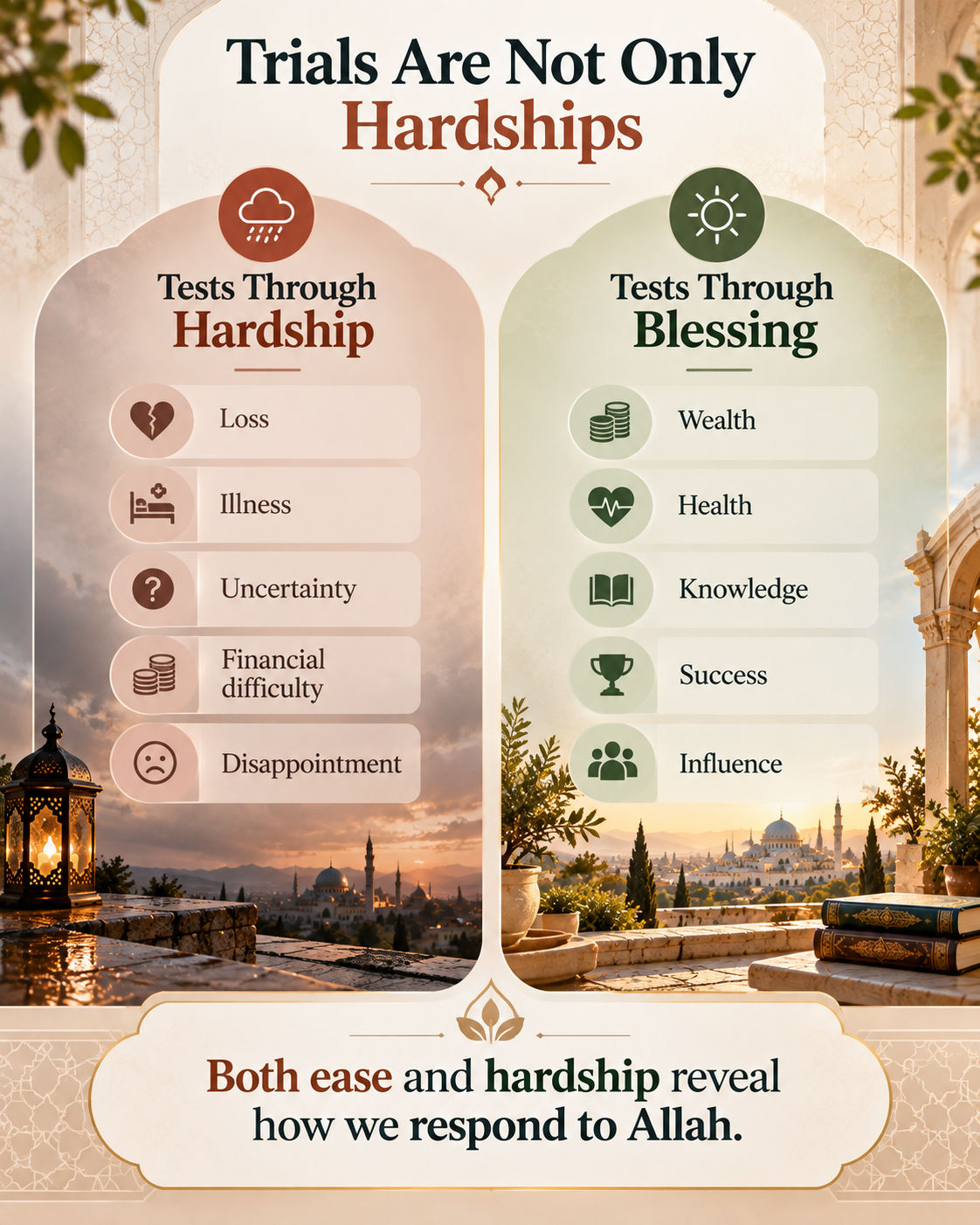
We Are Tested With Good Things Too
Most people hear "test" and think "suffering." The Quran says otherwise:
كُلُّ نَفْسٍ ذَآئِقَةُ ٱلْمَوْتِ ۗ وَنَبْلُوكُم بِٱلشَّرِّ وَٱلْخَيْرِ فِتْنَةً ۖ وَإِلَيْنَا تُرْجَعُونَ
Kullu nafsin dha'iqatu al-mawt, wa nabluukum bish-sharri wal-khayri fitnah, wa ilayna turja'un.
"Every soul will taste death. We test you with evil and with good as a trial, and to Us you will be returned." (Quran 21:35)
Here the word fitnah appears as a "trial," and it covers both hardship and blessing. Consider:
Wealth tests gratitude, generosity, humility and responsibility.
Knowledge tests sincerity, humility and acting on what one knows.
Influence or authority tests justice and ego.
Health, success, children and comfort test gratitude and whether they distract us from Allah.
The Prophet ﷺ said: "How wonderful is the affair of the believer; all of his affairs are good… if something good happens to him, he is grateful, and that is good for him; if something harmful happens to him, he is patient, and that is good for him." (Sahih Muslim, narrated by Suhayb)
This leads to one of the most important conclusions of this article: ease is not necessarily proof of Allah's approval, and hardship is not necessarily proof of Allah's anger.
Does Hardship Mean Allah Is Angry With Me?
Not necessarily. Worldly hardship alone is not reliable evidence that Allah dislikes someone, and worldly comfort alone is not reliable evidence that He is pleased.
Quran 89:15–17 addresses a common human assumption. It describes a person who, when Allah tests him by giving him honor and blessings, says, "My Lord has honored me," and when Allah tests him by restricting his provision, says, "My Lord has humiliated me." The Quran answers: "No!" (kalla), rejecting that conclusion. Commentators explain that provision, wide or narrow, is not the measure of a person's worth before Allah, and the passage goes on to point to real failures such as neglecting the orphan.
If you are struggling, do not translate every difficulty into "Allah hates me." If you are comfortable, do not translate every blessing into "I must be on the right path." Both readings turn a limited view of life into a verdict on the unseen.
Is Every Hardship a Punishment?
No. But it would also be inaccurate to say hardship is never connected to consequences.
The Quran says: "Whatever misfortune strikes you is because of what your hands have earned, and He pardons much" (42:30). Scholars understand this as a general principle that wrongdoing can have consequences, and that Allah pardons far more than He holds us to account. Yet the Prophets, who were sinless in conveying the message and among the most beloved to Allah, were also tested severely, and many afflictions affect children and animals who have earned nothing. So Muslim scholars do not treat every affliction as a punishment.
The practical conclusion: we usually cannot classify one person's hardship from the outside. A more constructive personal question than "Can I decode the unseen reason?" is: "What can I learn, repair, repent from, and do responsibly now?" Self-reflection is healthy; concluding "this proves I am being punished" is not something revelation gives us the authority to say.
Why Test Us If Allah Already Knows Everything?
This is one of the most important questions, and the answer must be clear:
Allah does not test people in order to acquire knowledge He previously lacked.
His knowledge is complete and eternal, covering what was, what is, and what will be. Mainstream Islamic theology, across its major schools, agrees on this.
So what is the test for? Scholars explain several things in broad terms:
Human actions become real. A person's choices, whether faithful, grateful, patient or otherwise, actually occur in the world. Reward and accountability rest on what people really do, not merely on what Allah knew they would do.
Proof is established. Allah is perfectly just. A decision about a person's destiny rests on their lived choices, so that no one can say, "I would have done otherwise."
What is inside is made manifest. Verses such as 29:2–3 and 47:31 use the verb "to know" (ya'lam) in the context of testing. Classical commentators, including al-Tabari and Ibn Kathir, explain this as knowledge in the sense of the matter occurring and becoming manifest in reality, not Allah learning something new.
The test, then, is not for Allah's information. It is for ours: for our reality, our accountability and our growth.
Why Were the Prophets Tested So Severely?
Sa'd ibn Abi Waqqas asked the Prophet ﷺ which people are tested most severely. He replied:
«الأنبياء ثم الأمثل فالأمثل، فيُبتلى الرجل على حسب دينه…»
"The Prophets, then the next best, then the next best. A man is tested according to his religious commitment…" (Jami' al-Tirmidhi, Sunan Ibn Majah and Musnad Ahmad; al-Tirmidhi graded it hasan sahih.)
The narration continues that the trial continues until the person walks on the earth without sin.
What does this show? That severe hardship is not evidence of low status before Allah. Some of the most beloved people to Allah suffered enormously. This does not mean that every suffering person is a prophet-like figure, or that hardship is a sign of high rank. It means we cannot read a person's standing with Allah off the surface of their circumstances.
The Prophet ﷺ also said: "The greatness of reward comes with the greatness of the trial. When Allah loves a people, He tests them; whoever is pleased gets His pleasure, and whoever is displeased gets His displeasure." (Tirmidhi, Ibn Majah; graded hasan.) This hadith should be handled with care. It shows that Allah may test those He loves, and that our response matters. It does not say that every hardship proves Allah's love, so we should not use it as a universal explanation for any individual's suffering.
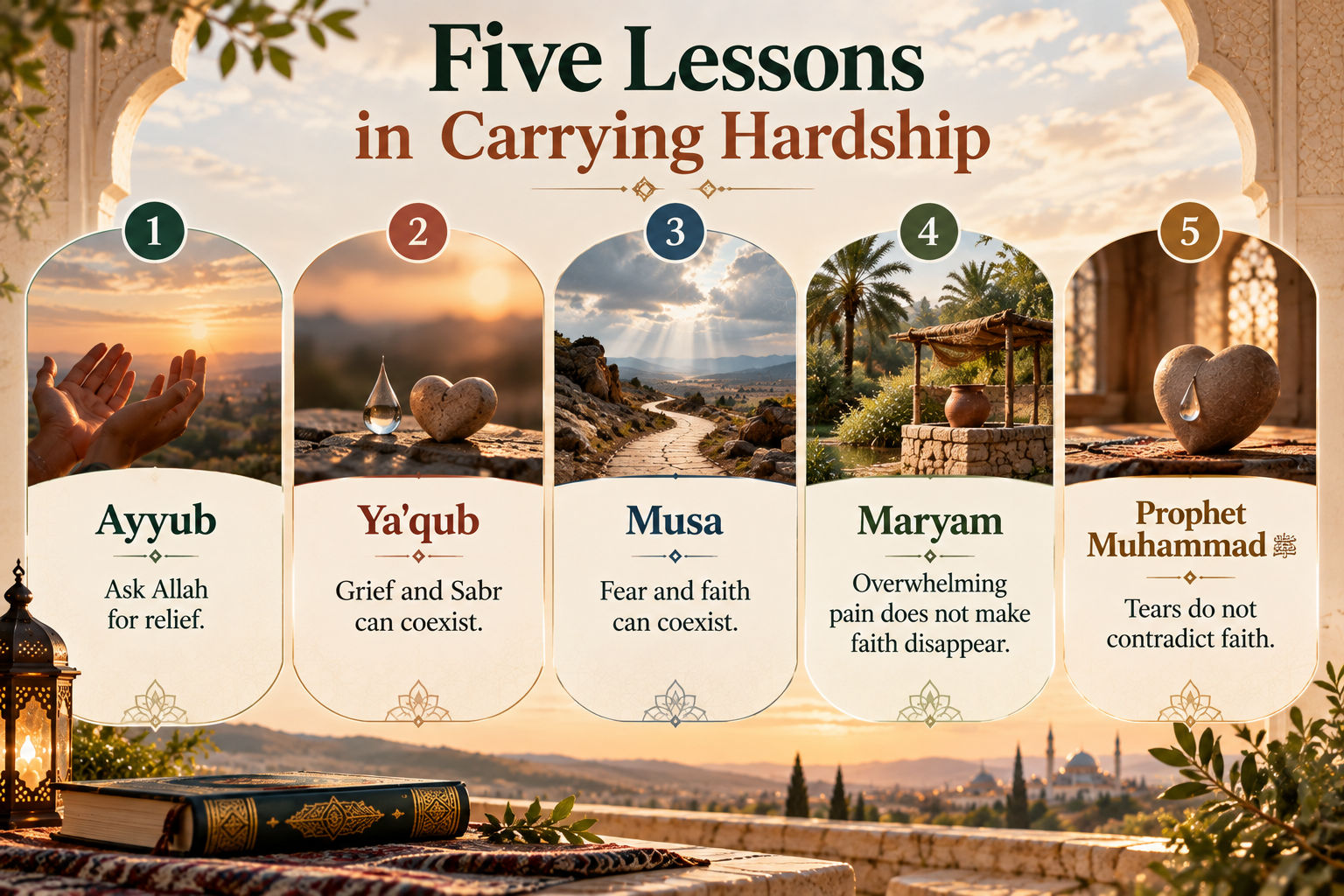
Lessons From the Prophets: Five Ways of Carrying Hardship
The Quran does not give us abstract theory alone. It gives us human beings, the best of humanity, who feel, cry, ask, fear and endure.
Ayyub (Job) عليه السلام: Illness, Dua and Steadfastness
The Quran tells of Ayyub in a few verses: "And [remember] Ayyub, when he called to his Lord: Indeed, harm has touched me, and You are the Most Merciful of the merciful" (21:83). The next verse says Allah responded and removed the harm (21:84). In Surah Sad (38:41–44), Allah describes him as "patient, an excellent servant; indeed, he was one who constantly turned back [to Allah]."
We have deliberately avoided popular storytelling details here (exact years of illness, specific diseases, descriptions of his body) because the Quran does not establish them. What the Quran does establish is clear and enough:
He faced a prolonged hardship.
He called upon Allah for relief.
Allah is described as praising him for patience after he made that Dua.
That last point matters. Ayyub's patience included asking Allah to remove the harm. A suffering Muslim is not required to remain silent to be patient.
Ya'qub (Jacob) عليه السلام: Sabr Does Not Mean Emotional Numbness
When Yusuf was lost and his brother also taken from him, Ya'qub said: "Oh, my sorrow over Yusuf!" and the Quran says "his eyes turned white with grief, and he was suppressing [his sorrow]" (12:84). Then he said:
قَالَ إِنَّمَا أَشْكُو بَثِّي وَحُزْنِي إِلَى ٱللَّهِ وَأَعْلَمُ مِنَ ٱللَّهِ مَا لَا تَعْلَمُونَ
Qala innama ashku baththi wa huzni ila Allahi wa a'lamu min Allahi ma la ta'lamun.
"He said: I only complain of my suffering and my grief to Allah, and I know from Allah what you do not know." (Quran 12:86)
Earlier, he had said fa-sabrun jamil, "beautiful patience" (12:83). Many commentators explain that this beautiful patience is not complaining to people in a way that expresses displeasure with Allah's decree, while pouring out one's grief to Allah is not only permitted but is what Ya'qub himself did. So: Sabr does not require emotional numbness. Tears and pain are not automatically the opposite of patience.
Musa (Moses) عليه السلام: Fear and Trust Can Coexist
The Quran openly says Musa felt fear. When Allah sent him and Harun to Pharaoh, they said, "Our Lord, we fear that he will hasten [to harm] us or transgress" and Allah replied, "Fear not. Indeed, I am with you both; I hear and I see" (20:45–46). When the sorcerers' ropes seemed to move, "Musa sensed fear within himself" and Allah told him "Fear not, indeed it is you who are superior" (20:67–68).
Musa continued to obey despite fear, and Allah's response to his fear was reassurance, not rebuke. Faith does not require every human emotion to disappear. (We avoid applying modern clinical labels, such as "anxiety," to Quranic descriptions; they are different frameworks.)
Maryam (Mary) عليها السلام: When Hardship Feels Overwhelming
Quran 19:23 describes the pains of childbirth driving Maryam to the trunk of a palm tree, where she said: "I wish I had died before this and been something forgotten and out of sight." The Quran records the intensity of her distress without softening it. It does not rebuke her.
What follows in the account (19:24–26) is care: a voice reassures her not to grieve, her Lord has provided a stream below her, she is told to shake the palm trunk for fresh dates, to eat, drink and be comforted, and to say that she has vowed silence. (Commentators differ on who the speaker was.) We should not add details beyond this. The lesson is simple: the Quran treats overwhelming distress as real, and Allah responds with reassurance, provision and guidance.
Prophet Muhammad ﷺ: Faith Does Not Eliminate Grief
The Prophet ﷺ lost loved ones, was rejected and harmed, and was forced to leave his home. In the Ta'if episode, reported by Aisha in Sahih al-Bukhari and Sahih Muslim, he was rejected and stoned, and when offered the chance to have the mountains crush the people, he hoped instead that Allah would bring from them those who would worship Him alone. When his son Ibrahim died, Anas reported that his eyes shed tears, and he said:
«إِنَّ الْعَيْنَ تَدْمَعُ، وَالْقَلْبَ يَحْزَنُ، وَلَا نَقُولُ إِلَّا مَا يُرْضِي رَبَّنَا، وَإِنَّا بِفِرَاقِكَ يَا إِبْرَاهِيمُ لَمَحْزُونُونَ»
"The eye weeps and the heart grieves, and we say only what pleases our Lord. O Ibrahim, we are truly grieved by your parting." (Sahih al-Bukhari, Sahih Muslim)
This is a clear model: grief and faith coexist. What the Prophet ﷺ forbade was excessive wailing, tearing clothes and speech that objects to Allah's decree (Bukhari, Muslim), not tears.
Trials Can Expiate Sins
The Prophet ﷺ said: "No fatigue, illness, worry, grief, harm or distress befalls a Muslim, even a thorn that pricks him, except that Allah expiates some of his sins for it." (Sahih al-Bukhari and Sahih Muslim, from Abu Sa'id al-Khudri and Abu Hurayrah.)
This is a source of hope: even small and unseen pains are not wasted. But do not use this hadith as a response to a grieving person. "Don't be sad, your sins are being erased" can feel like dismissal. The truth of the hadith should be offered with compassion, and often later, not in the first hour of someone's loss.
Trials Can Raise a Believer's Rank
The hadith of Sa'd quoted above, and others, indicate that patience through trial can lead to elevated reward in the Hereafter. The Quran says: "Only the patient will be given their reward without account" (39:10).
But again we must be careful. Islam teaches that faithfully endured hardship can become a means of immense reward. It does not give us authority to say to a specific person, "Allah gave you this to raise your rank." We do not know. We only know what is promised to those who remain patient and faithful.
Trials Reveal What We Choose
Quran 29:2–3 asks: "Do people think they will be left to say, 'We believe,' and not be tried? We tried those before them, so Allah will surely make evident those who are truthful and make evident the liars." Similarly, 3:186 and 47:31 describe testing in wealth, lives and conduct.
Claims of faith become real through decisions: honesty when lying would be easier, prayer when exhausted, generosity when afraid, forgiveness when hurt. As explained earlier, this is about what becomes manifest in our reality, not Allah learning something new.
A Framework for Hardship: Quran 2:155–157
وَلَنَبْلُوَنَّكُم بِشَيْءٍ مِّنَ ٱلْخَوْفِ وَٱلْجُوعِ وَنَقْصٍ مِّنَ ٱلْأَمْوَالِ وَٱلْأَنفُسِ وَٱلثَّمَرَاتِ ۗ وَبَشِّرِ ٱلصَّٰبِرِينَ ٱلَّذِينَ إِذَا أَصَابَتْهُم مُّصِيبَةٌ قَالُوا۟ إِنَّا لِلَّهِ وَإِنَّا إِلَيْهِ رَاجِعُونَ أُوْلَٰئِكَ عَلَيْهِمْ صَلَوَاتٌ مِّن رَّبِّهِمْ وَرَحْمَةٌ ۖ وَأُوْلَٰئِكَ هُمُ ٱلْمُهْتَدُونَ
"We will surely test you with something of fear and hunger, and a loss of wealth, lives and fruits; and give good news to the patient: those who, when disaster strikes them, say, 'Indeed we belong to Allah, and indeed to Him we will return.' Upon them are blessings from their Lord and mercy, and it is they who are rightly guided." (Quran 2:155–157)
Note the wording: the verse says "something of" fear and hunger. It speaks of tests as a general reality, not a statement about any one person's cause. And the response it highlights is a statement:
إِنَّا لِلَّهِ وَإِنَّا إِلَيْهِ رَاجِعُونَ
Inna lillahi wa inna ilayhi raji'un. "Indeed we belong to Allah, and indeed to Him we will return."
Many people only say this after a death, but it is stated for any musibah. It carries three ideas: we belong to Allah (ownership), we return to Allah (accountability and hope), and loss is not the final word. It is a statement of perspective, not a magic phrase to say mechanically while suppressing pain.
What Does Sabr Actually Mean?
Sabr (الصبر) is often translated as "patience," which is useful but incomplete. The root ص-ب-ر carries the idea of holding, restraining or binding. Scholars such as Ibn al-Qayyim described three broad kinds: patience in obedience (continuing to worship and do right), patience in avoiding disobedience, and patience in the face of Allah's decrees.
In practice, Sabr includes steadfastness, perseverance, restraint from sinful reactions, and continuing to do what is right while in difficulty. The Prophet ﷺ said, "Patience is at the first strike [of calamity]" (Sahih al-Bukhari and Sahih Muslim). The Prophet ﷺ said this to a woman crying at a grave; she did not recognize him, and the point is that the measure of patience is how one behaves when pain first hits, not that tears are forbidden.
Sabr is not passivity. A person can practice Sabr while seeking treatment, leaving danger, pursuing justice, asking for help, changing jobs, crying, grieving, and making Dua for the hardship to end.
Can You Ask Allah to Remove a Test?
Yes. Absolutely.
Ayyub called upon Allah for relief (21:83).
Yunus, in the darkness inside the whale, said "There is no god but You; exalted are You; indeed I have been of the wrongdoers" (21:87), and Allah says He responded and saved him (21:88).
Zakariyya called upon his Lord quietly for a child (19:3–4).
The Prophet ﷺ made Dua for the sick, saying: "Remove the harm, Lord of mankind, and heal; You are the Healer" (Sahih al-Bukhari), and taught us to seek refuge in Allah from the severity of affliction (jahd al-bala') (Sahih al-Bukhari and Sahih Muslim).
Accepting Allah's decree does not mean preferring pain or refusing to ask Him for relief. Dua is itself an act of worship and a form of Sabr and Tawakkul.

Tawakkul During Hardship
Tawakkul (توكل), from the root و-ك-ل (to entrust), means relying on Allah while taking appropriate means. The Prophet ﷺ said that if people truly relied on Allah, He would provide for them as He provides for birds, who go out in the morning hungry and return full (Jami' al-Tirmidhi; hasan sahih). The birds still go out.
So in practice:
Illness: treatment + Dua + Tawakkul. The Prophet ﷺ said Allah has sent down a cure for every disease He has sent down (Sahih al-Bukhari).
Unemployment: applications + skills + Dua + Tawakkul.
Family difficulty: honest communication + wise advice + Dua + Tawakkul.
Studying: preparation + Dua + Tawakkul.
Tawakkul is never an excuse for inactivity.
Hardship and Qadr
Qadr (القدر), Divine decree, means that nothing occurs outside Allah's knowledge and will. But belief in Qadr does not mean actions do not matter, injustice should be ignored, treatment is unnecessary, or humans bear no responsibility.
The Prophet ﷺ said: "Strive for what benefits you, seek help from Allah, and do not be helpless. If something befalls you, do not say, 'If only I had done such and such,' but say, 'Allah decreed, and what He willed He did'" (Sahih Muslim). This hadith combines effort and acceptance: act before the event; accept after it, without self-torment.
Qadr and human responsibility are both part of the Islamic picture. The detailed theology belongs in a dedicated article on Qadr.
Does Allah Never Give You More Than You Can Handle?
Quran 2:286 begins: لَا يُكَلِّفُ ٱللَّهُ نَفْسًا إِلَّا وُسْعَهَا (La yukallifu Allahu nafsan illa wus'aha), "Allah does not burden a soul beyond its capacity."
This is often quoted to people in crisis as, "Allah won't give you more than you can handle." That is not what the verse says. In context, many commentators understand it primarily as a statement about Allah's mercy in legal obligations and accountability: He does not hold us to what we are genuinely unable to do. Notice also that the same verse continues with a Dua: "Our Lord, do not burden us with that which we have no ability to bear." Believers are taught to ask Allah for relief from burdens beyond their strength.
So please do not use this verse to imply that:
a Muslim should never feel overwhelmed,
asking for help is failure,
someone must tolerate abuse,
mental illness shows weak faith, or
every hardship can be carried alone.
Feeling overwhelmed is human. Even the Messenger and the believers with him cried, "When will Allah's help come?" and were told that Allah's help is near (2:214).

"With Hardship Comes Ease": What Does It Actually Mean?
فَإِنَّ مَعَ ٱلْعُسْرِ يُسْرًا إِنَّ مَعَ ٱلْعُسْرِ يُسْرًا
Fa-inna ma'a al-'usri yusra. Inna ma'a al-'usri yusra.
"Indeed, with hardship comes ease. Indeed, with hardship comes ease." (Quran 94:5–6)
The word is ma'a, "with," not "after." Commentators note the beauty of the repetition: al-'usr ("the hardship") appears with the definite article both times, suggesting the same hardship, while yusr ("ease") is indefinite both times, which some scholars understand as a plurality of eases. A saying reported from early authorities such as Ibn Mas'ud and Ibn 'Abbas expresses this as "one hardship will never overcome two eases." It is an early scholarly statement, not a sound statement of the Prophet ﷺ, and should be presented as such.
What the verse does not say is that your exact problem will vanish on a specific date. It is a promise of hope: ease is present alongside difficulty, and difficulty does not have the last word. Allah does not give us a timeline.
Why Do Some People Seem to Have Easier Lives?
When you are tired and struggling, someone else's life can look effortless. Remember:
We see only part of anyone's life.
Worldly ease is not a full measure of Allah's favor, and worldly hardship is not a full measure of His displeasure.
Different people have different tests, and blessings are themselves tests.
Ultimate justice is not confined to this world.
We do not need to assume that everyone who looks happy is secretly miserable. We simply do not know. Comparison costs us gratitude for what we do have and distracts us from our own responsibilities.

The Hereafter Changes the Meaning of Suffering
An Islamic answer to suffering is incomplete if it treats this life as all there is. The Quran teaches resurrection, accountability, Divine justice, reward and Paradise.
The Prophet ﷺ described a person who lived the most comfortable life in this world but who, when dipped once in Hellfire, is asked whether he has ever known any good, and says, "No, by Allah." Then the most afflicted person in the world, who is among the people of Paradise, is dipped once in Paradise and asked whether he ever experienced hardship, and says, "No, by Allah, my Lord, I have never experienced hardship and never seen distress." (Sahih Muslim, from Anas.)
This does not erase present pain. Islam says present pain matters, but it is not the final chapter.
What About Suffering Caused by Other People?
Not every hardship is something we should imagine Allah "commanding" another person to do. Humans commit injustice, abuse, oppression and betrayal through their own choices, and they are accountable for them.
Mainstream Muslim theology distinguishes between what occurs within Allah's universal decree (He permits events to happen in His creation) and what Allah approves, loves and commands (the moral law). Scholars of different schools explain the details differently, but they agree that Qadr never excuses wrongdoing. "It was decreed" does not make the oppressor innocent, and it does not silence the oppressed.
Sabr Does Not Mean Staying in Abuse
If you are experiencing domestic abuse, violence, exploitation or danger, do not just "have Sabr." The Prophet ﷺ said, "There is to be no harm and no reciprocating harm" (Sunan Ibn Majah, Musnad Ahmad; graded hasan; also included in al-Nawawi's Forty Hadith).
Seeking safety, trusted support, appropriate authorities, professional help, legal advice and scholarly guidance may be necessary, depending on circumstances. If you are in immediate danger, contact your local emergency services. Sabr is never permission for someone else to continue harming you.
Hardship and Mental Health
Spiritual struggle and clinical mental-health conditions are not the same thing, and they are not competing options. A person may benefit spiritually from Salah, Quran, Dua, Dhikr, community and Tawakkul, and may need therapy, counseling, psychological assessment, psychiatric care or medical treatment.
This article cannot diagnose anyone. We would simply stress:
Depression, anxiety, trauma-related conditions and similar difficulties should not be assumed to be caused by weak Iman, sin, Jinn, magic or the evil eye.
Do not stop prescribed medication without consulting your doctor.
Seeking professional help is a form of taking appropriate means, which Islam commends.
If your distress is persistent, severe or you are having thoughts of harming yourself, please contact a qualified professional or your local emergency or crisis service right away.
What If Hardship Makes My Faith Weaker?
For some, hardship brings them closer to Allah. For others, it brings numbness, confusion, anger, exhaustion or distance. If that is you, you are not beyond mercy, and you do not need to feel ashamed.
Small anchors help:
Protect the obligatory prayers as much as you can.
Make honest Dua, in your own words.
Talk with trustworthy people; avoid isolating yourself completely.
Read a manageable amount of Quran.
Seek knowledge from reliable teachers.
Seek professional help where appropriate.
Spiritual recovery is usually gradual. Allah says: "Do not despair of the mercy of Allah. Indeed, Allah forgives all sins" (39:53).
Can I Tell Allah That I Am Hurting?
Yes. This is what Ya'qub did in 12:86. Scholars distinguish between pouring out one's grief to Allah (permitted, and an act of worship) and objecting to Allah's decree or accusing Him of injustice (forbidden). You do not have to pretend before Allah. You can say, in your own language:
"O Allah, this is difficult."
"O Allah, help me."
"O Allah, give me patience."
"O Allah, remove this hardship."
"O Allah, guide me to what I should do."
For Dua inside the formal prayer (Salah), scholars of different schools have different details about the language and wording. Many encourage personal Dua in prostration (sujud), which the Prophet ﷺ said is a time when Dua is likely to be answered (Sahih Muslim). If you are unsure, ask a teacher in your school of thought.
Why Hasn't Allah Answered My Dua?
We cannot promise that Dua guarantees your exact request. What the Prophet ﷺ taught is: "No Muslim makes a Dua that contains no sin or severing of kinship, except that Allah gives him one of three things: He hastens the answer, or He stores it for him in the Hereafter, or He turns away from him an equivalent harm." The Companions said, "Then we will make more Dua." He said, "Allah is more generous." (Musnad Ahmad; graded authentic by a number of hadith scholars.)
So an "unanswered" Dua is not necessarily a rejected one. The Prophet ﷺ also warned against giving up: the Dua of one of you is answered unless he becomes impatient and says, "I made Dua but was not answered" (Sahih al-Bukhari and Sahih Muslim).
If you are worried that unanswered Dua means sin, please do not leap there. Scholars do mention things that can hinder Dua, such as consuming what is unlawful, but it is harmful to assume that your long wait must mean you are sinful. Allah's response is governed by His wisdom and mercy.
Is It Wrong to Ask "Why?"
A sincere "Why is this happening? Help me understand" is not rebellion. The Quran frequently invites reflection. What scholars warn against is arrogant objection, as though Allah owes us an account. The sincere seeker turns the question into knowledge, Dua, reflection and trusted guidance rather than suppressed doubt. This is especially important for new Muslims, who should feel free to ask.
What Should You Do During a Trial? Ten Practical Steps
Protect the obligatory acts. Start with Salah rather than building a huge optional routine you cannot sustain.
Make honest Dua. Ask for relief and for strength.
Take appropriate means. Solve what can be solved.
Seek advice. Religious, medical, professional, legal or practical, depending on the issue.
Practice Sabr. Keep responding in ways that please Allah.
Practice Tawakkul. Entrust outcomes to Allah after taking means.
Avoid sinful shortcuts. Hardship does not automatically make the forbidden permissible. Genuine necessity rulings exist in Fiqh, and need qualified guidance.
Remember the Hereafter. The dunya is not the whole story.
Keep hope. Do not despair of Allah's mercy.
Allow yourself to be human. Grief, tears, tiredness and asking for help do not contradict faith.
A Realistic Difficult-Day Routine
This is a gentle suggestion, not an impossible productivity schedule. Only the Adhkar and prayers named below are Sunnah; the rest is practical advice.
Morning: Pray Fajr. Say your morning Adhkar (Sunnah). Identify the one most necessary task today (practical). Ask Allah for help (Dua).
During the day: Maintain the obligatory prayers (obligation). Take one practical step on the hardship and reach out for support if needed (practical). Make short Dhikr where you can (Sunnah). Try not to compare your life with others' (practical).
Evening: Read some Quran, even a page or less. Pray Maghrib and Isha. Reflect on what was within your responsibility today, and make Dua.
Before sleep: Say the bedtime Adhkar, such as Ayat al-Kursi (Sahih al-Bukhari) and the last two verses of Surat al-Baqarah (Sahih al-Bukhari). Acknowledge what is unresolved, entrust it to Allah, and rest.
A Few Authentic Duas for Hardship
1. At a calamity. Umm Salamah reported that the Prophet ﷺ taught: إِنَّا لِلَّهِ وَإِنَّا إِلَيْهِ رَاجِعُونَ، اللَّهُمَّ أْجُرْنِي فِي مُصِيبَتِي وَأَخْلِفْ لِي خَيْرًا مِنْهَا (Inna lillahi wa inna ilayhi raji'un. Allahumma'jurni fi musibati wa akhlif li khayran minha). "We belong to Allah and to Him we return. O Allah, reward me in my affliction and replace it for me with something better." (Sahih Muslim.) The "replacement" is a request, and Allah decides how and when.
2. Ayyub's Dua (Quran 21:83). Anni massaniya ad-durru wa anta arhamu ar-rahimin. "Indeed, harm has touched me, and You are the Most Merciful of the merciful." A simple model of honest need.
3. Yunus's Dua (Quran 21:87). لَا إِلَٰهَ إِلَّا أَنتَ سُبْحَانَكَ إِنِّي كُنتُ مِنَ ٱلظَّٰلِمِينَ (La ilaha illa anta, subhanaka, inni kuntu min adh-dhalimin). Yunus said it in the darkness of the whale. The Prophet ﷺ said no Muslim calls upon Allah with it for anything except that Allah answers him (Jami' al-Tirmidhi, graded sahih by al-Albani). Treat this as a hopeful teaching about Allah's generosity, not a magic formula.
4. Seeking refuge from burdens. اللَّهُمَّ إِنِّي أَعُوذُ بِكَ مِنَ الْهَمِّ وَالْحَزَنِ، وَالْعَجْزِ وَالْكَسَلِ، وَالْبُخْلِ وَالْجُبْنِ، وَضَلَعِ الدَّيْنِ وَغَلَبَةِ الرِّجَالِ (Allahumma inni a'udhu bika minal-hammi wal-hazan, wal-'ajzi wal-kasal, wal-bukhli wal-jubn, wa dala'id-dayni wa ghalabatir-rijal). "O Allah, I seek refuge in You from worry and grief, helplessness and laziness, miserliness and cowardice, the burden of debt and being overpowered by men." (Sahih al-Bukhari.) Notice it asks for refuge from helplessness, which pairs well with taking action.
Quran Verses About Trials and Hardship at a Glance
2:155–157: hardship is a general reality; the patient receive glad tidings.
2:214: even the Messenger and believers asked "When is Allah's help?"; help is near.
2:286: Allah does not burden beyond capacity; so we ask Him for ease.
3:186: believers will be tried in wealth and selves; patience and taqwa are firm resolve.
12:86: pouring out grief to Allah.
21:35: testing with both good and bad.
29:2–3: faith is lived and made evident.
39:53: do not despair of Allah's mercy.
67:2: life and death as a test of best deeds.
94:5–6: with hardship is ease.
Read each verse in its full context rather than as an isolated quote.
Ten Things Not to Say to Someone Going Through a Trial
"Allah is punishing you." You do not know that.
"Everything happens for a reason." Vague, and often badly timed.
"Just have Sabr." Without compassion and practical help, this dismisses pain.
"At least it isn't worse." It minimizes real suffering.
"Allah only tests the people He loves." The evidence is more nuanced; use it with care and never as a universal explanation.
"If your faith were stronger, this wouldn't hurt." False and harmful.
"Don't cry." The Prophet ﷺ wept.
"You shouldn't need therapy." Seeking treatment is a legitimate means.
"Something better is definitely coming." We do not know the unseen.
"Don't ask questions." Questions can be part of learning.
Try instead: "I'm here." "May Allah make this easier for you." "How can I help?" "Would you like me to just listen?" "Can I help you find appropriate support?"

Common Misconceptions About Trials in Islam
"Every hardship is punishment." No; hardship has many possible wisdoms, and we can rarely identify them for others.
"Every blessing means Allah is pleased." Blessings are also tests (21:35).
"Sabr means never crying." Ya'qub wept; the Prophet ﷺ wept.
"Tawakkul means doing nothing." The birds go out in the morning.
"Qadr excuses wrongdoing." It does not remove accountability.
"Strong believers never struggle emotionally." The Prophets did.
"Asking for relief means you lack Sabr." Ayyub asked.
"Professional help means weak Iman." Treatment is among the means the Prophet ﷺ encouraged.
"Every trial's wisdom will be revealed in your lifetime." Not promised.
"Enough Dua guarantees your preferred outcome." The Prophet ﷺ described three possible forms of response.
Can a Trial Become a Blessing?
Yes, hardship can become a source of enormous spiritual good, but hardship itself should never be romanticized. Possible outcomes include forgiveness, reward, deeper Tawakkul, repentance, changed priorities, empathy and greater awareness of Allah. But not every trauma will visibly produce growth, and no one should be pressured to find "the lesson" right away. Sometimes the right response is simply: endure, seek help, make Dua, and keep going.
When the Trial Ends, and When It Doesn't
When it ends, reflect: What did I learn about my dependence on Allah? Which habits should I keep? Who supported me and deserves thanks? What do I now understand about others' suffering? Is there anything to repair?
When it does not end, as with chronic illness, disability, long-term caregiving, infertility, lasting grief or prolonged financial strain, Islamic hope does not depend on a worldly happy ending. Islam's picture is not "problem → patience → miracle." It includes ongoing Sabr, adaptive action, support, worship, meaning and the promise of reward in the Hereafter, without pretending the pain is not real.
Teaching Children About Trials
Avoid telling a child, "Allah did this to see if you're good." Try instead: difficult things happen in this life; Allah knows when we are sad; we can ask Him for help; it is okay to cry; we can talk with trusted adults; we still try to do what is right; and this life is not the end. Avoid fear-heavy theology with children.
New Muslims and the Shock of Hardship
A new Muslim might think, "I accepted Islam. Why did life get harder?" Islam is not a contract guaranteeing wealth, health, family acceptance, easy relationships or immediate peace. New Muslims may face family tension, loneliness, community adjustment and a steep learning curve. This is not a sign of failure. Seek community, reliable teachers, gradual learning, honest Dua and, where relevant, professional support.
Understanding Hardship Through Quranic Arabic
Seeing the roots behind familiar words adds depth, though vocabulary alone does not make one a commentator on the Quran (Tafsir requires training).
صبر (Sabr): root ص-ب-ر, holding oneself steady, restraining.
بلاء (Bala') and ابتلاء (Ibtila'): root ب-ل-و, to test or prove; can describe hardship or favor.
مصيبة (Musibah): root ص-و-ب, to strike a target; a misfortune that strikes.
توكل (Tawakkul): root و-ك-ل, to entrust; the same root as wakil (trustee).
عسر ('Usr): hardship, difficulty.
يسر (Yusr): ease, facility.
In 94:5–6, knowing that 'usr is definite and yusr indefinite opens the door to the commentators' discussions on those verses. This is one reason many students value learning Arabic through the Quran.
Continuing to Learn: How Araby Academy Can Support You
Difficult periods often make people want to understand the Quran more deeply than a translation alone allows. If hardship has made you want to understand the Quran more deeply, learning the language and meanings you encounter in Salah and Quran can turn familiar verses into a more conscious part of your relationship with Allah. Araby Academy offers structured one-to-one Quran, Arabic and Islamic learning for non-Arabic-speaking students, including Quran reading, Tajweed, memorization, Quranic Arabic and Islamic Studies.
Related reading (link to published pages once live): What Does Islam Say About Anxiety, Worry, and Trusting Allah? · What Is Tawakkul? · What Is Qadr in Islam? · How to Make Dua: A Beginner's Guide · What Is Dhikr? · How to Learn Salah When You Don't Speak Arabic · How to Understand the Quran Without Speaking Fluent Arabic · Learn Arabic Through the Quran · 100 Most Common Words in the Quran · New Muslim Guide · What Is Jannah Like? · What Happens After We Die?
Frequently Asked Questions
1. Why does Allah test us? The Quran says life and death were created to test who is best in deed (67:2), and that people are tried with both good and bad (21:35). Trials can have several wisdoms, but we usually cannot know the specific one behind our own.
2. Why test us if Allah already knows everything? Allah's knowledge is complete and is not increased by testing. Tests make human choices real and manifest, which is the basis of just reward and accountability.
3. Does Allah test people He loves? A hadith says that when Allah loves a people He tests them (Tirmidhi, hasan), and another says that when He wants good for someone He afflicts him (Bukhari). But this does not mean every hardship proves Allah's love, and ease does not prove the opposite.
4. Does hardship mean Allah is angry with me? Not necessarily. Quran 89:15–17 corrects the assumption that wealth means honor and restricted provision means humiliation.
5. Is every hardship a punishment? No. Some consequences may relate to wrongdoing (42:30), but hardship may also be a test, expiation or means of reward, and we usually cannot classify an individual case.
6. Why do good people suffer in Islam? The Prophets, who were the best of people, were tested the most (Tirmidhi). Worldly suffering is not a measure of one's standing with Allah, and the Hereafter is where full justice is realized.
7. What does the Quran say about trials? See 2:155–157, 3:186, 21:35, 29:2–3, 67:2 and 94:5–6, among others.
8. What is Sabr during hardship? Steadfastness: continuing in obedience, avoiding sinful reactions and enduring while taking appropriate action. It is not passivity or numbness.
9. Can I cry and still have Sabr? Yes. Ya'qub wept (12:84) and the Prophet ﷺ wept at the death of his son Ibrahim.
10. Can I ask Allah to remove a trial? Yes. Ayyub, Yunus and Zakariyya asked, and the Prophet ﷺ made Dua for relief.
11. Why hasn't Allah answered my Dua? A Dua may be answered by granting the request, by averting harm, or by storing reward for the Hereafter (Musnad Ahmad). Do not assume an unanswered Dua means you are sinful.
12. Does Allah give people more than they can handle? Quran 2:286 is mainly about obligation and accountability, not a promise that you will never feel overwhelmed. Believers are taught to ask Allah not to burden them beyond their strength.
13. How should Muslims respond to hardship? Protect obligatory worship, make honest Dua, take appropriate means, seek advice and support, practice Sabr and Tawakkul, avoid the forbidden, keep hope and remember the Hereafter.
14. Can I seek therapy or medical help while trusting Allah? Yes. Tawakkul includes taking means, and the Prophet ﷺ encouraged seeking treatment.
15. What is the relationship between trials and Qadr? Events occur within Allah's knowledge and decree, yet humans remain responsible for their choices. Qadr is not an excuse for wrongdoing or inaction.
Conclusion: The Test Is Not the End of the Story
We began with a painful question: If Allah is Merciful, why does He allow hardship?
Islam answers that this dunya was never promised to be Paradise. Human beings experience blessings and tests, choices, loss, love, grief, success and disappointment, and Allah knows every part of it. Trials do not automatically mean Allah has rejected someone. Ease does not automatically mean He approves. We may not know why a specific event was decreed.
But revelation teaches what we can do: turn to Allah, take appropriate action, make Dua, practice Sabr and Tawakkul, seek help, repent where repentance is needed, stay hopeful and remember the Hereafter.
Islam does not promise that every hardship will make sense during this life. It teaches that no faithful struggle, patient act, sincere Dua or moment of turning toward Allah is lost with Him. (See Quran 3:195, 18:30 and 39:10, which affirm that Allah does not let the deeds of the doers of good be lost and that the patient are rewarded without account.)
If this article has made you want to understand the Quran more deeply, Araby Academy is here to support that journey, one lesson at a time.
I may not know why this specific hardship was written for me. But Islam teaches me that hardship is not automatically rejection, grief is not the opposite of faith, Sabr does not mean doing nothing, and I can turn to Allah while taking every responsible step available to me.