
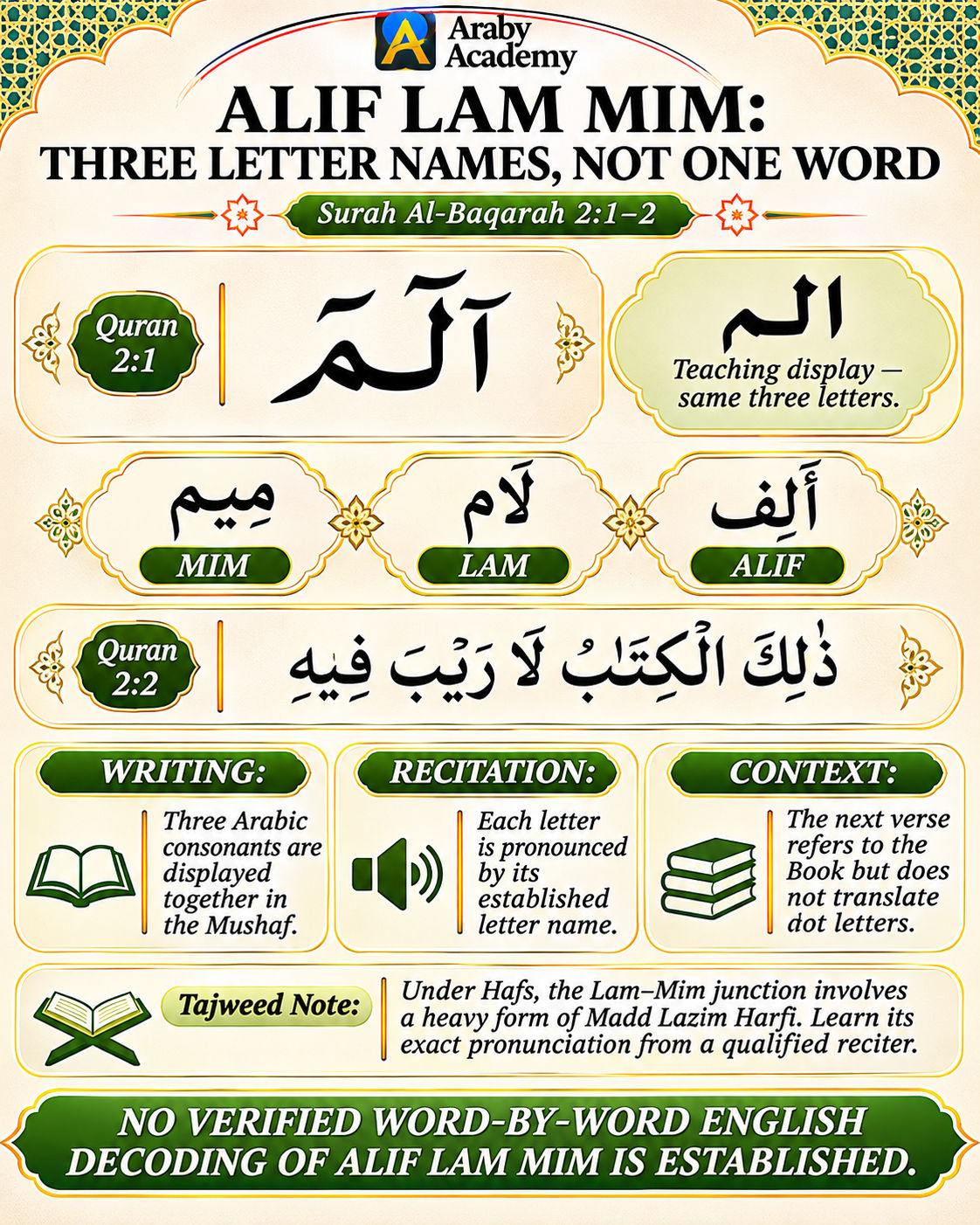
A beginner opens Surah Al-Baqarah and reads the first verse: الم. Three Arabic letters stand alone. They do not form a familiar word, and the next verse turns to the Book: ذَٰلِكَ الْكِتَابُ لَا رَيْبَ فِيهِ. Questions follow naturally. Why begin this way? How are the letters pronounced? Why do translators give no ordinary English meaning? Are there other openings like this, and do scholars agree about them?
Short answer: The Muqatta’at are separate Arabic letters at the beginning of 29 Quranic Surahs, such as Alif Lam Mim, Ya Sin, Ha Mim, and Qaf. They are recited by their letter names, not as ordinary Arabic words. Classical commentators proposed different explanations, while many scholars refrained from claiming certainty about their precise intended meaning. Their occurrence, recitation, and context can still be studied through Tajweed and reliable Tafsir.
This article introduces Huruf al-Muqatta’at through ten representative openings. It does not claim to solve the mystery. It separates what is verified, what scholars have proposed, and what remains uncertain.
What Are the Muqatta’at?
Al-Huruf al-Muqatta’ah (الْحُرُوفُ الْمُقَطَّعَةُ) means “the disjoined letters.” Harf (حَرْف) is a letter, huruf (حُرُوف) is letters, and muqatta’ah (مُقَطَّعَة) means separated. Muqatta’at is the common plural label. In Arabic grammar, harf can also mean a particle, but here it means a written letter. English labels such as disconnected, isolated, or mysterious letters describe the phenomenon rather than serving as exact technical translations.
The conventional figures are these. Twenty-nine Surahs begin with Muqatta’at. Fourteen different Arabic letters occur: ا ل م ص ر ك ه ي ع ط س ح ق ن. The alphabet is commonly counted as 28 basic letters, so half appear. Note that ح (Ḥa, a constricted throat sound) and ه (Ha, a soft glottal “h”) are different consonants. This arithmetic is a textual observation, not a proven code. The study of these unusual openings belongs within the Quranic Sciences that help readers understand revelation and its language, rather than an independent system of secret-code interpretation.
Readers who are new to Arabic can begin with the foundations of Quranic Arabic and how the language of the Quran works, then return to the special recitation of these opening letters.
How Are the Disconnected Letters Recited?
They are recited by letter names. الم is read Alif, Lam, Mim, not as one word with guessed vowels. Keep four things apart: the written symbol م, its name mim, its sound inside an ordinary word such as ماء, and its recited form in an opening.
This article uses Hafs ‘an ‘Asim as its instructional reference. That does not make Hafs the only valid canonical reading.
Tajweed varies by letter. Names with a long vowel in the middle followed by a sukun, such as lam and mim, fall under Madd Lazim Harfi (مَدٌّ لَازِمٌ حَرْفِيٌّ), traditionally taught with six counts. A common mnemonic is نقص عسلكم. It is called mukhaffaf (light) when nothing is doubled and muthaqqal (heavy) when a sound is assimilated, as in lam into mim in الم. Names of two sounds, such as ḥa, ṭa, ha, ya, and ra, take natural Madd. Alif has no extension, and ‘ayn allows four or six counts in Hafs. Neighboring sounds may add idgham or ghunnah, so confirm details with a qualified teacher.
Tajweed is not Tafsir. Tajweed establishes how the letters are recited, while Tafsir examines proposed meanings. Correct pronunciation does not establish meaning, and no interpretation authorizes changing the recitation. Rasm is the Mushaf’s writing convention, dabt its vocalization marks, and Qira’at the transmitted readings. None turns a letter’s placement or a decorative mark into a hidden translation. Nor are the Muqatta’at words from three-letter roots, since Arabic vocabulary follows root-and-pattern systems while these are read as letter names.
Do Scholars Know What the Muqatta’at Mean?
Classical scholars discussed the question at length without reaching one confirmed answer. The table summarizes broad approaches, which differ in evidentiary strength.
What Have Scholars Said About the Muqatta’at?
Approach | What it proposes | Relevant source | How certainly it can be stated |
|---|---|---|---|
Leaving meaning to Allah | Ultimate meaning is known to Allah | Discussed by al-Tabari, al-Qurtubi, al-Razi | Recognized cautious position, not a claim of meaninglessness |
Surah designations | Letters name or label Surahs | Al-Tabari, al-Qurtubi, al-Suyuti’s Al-Itqan | Reported view; no sound Prophetic text decides it |
Opening or attention devices | Letters signal and draw attention to revelation | Classical commentaries | Interpretive proposal |
Inimitability | Quran is built from letters familiar to Arabs yet unmatched | Ibn Kathir; al-Zamakhshari | Scholarly interpretation, not a dictionary translation |
Abbreviations, names, oaths | Letters hint at Divine names, attributes, or oaths | Reports cited by al-Tabari and al-Qurtubi | Strength of reports varies; not established meaning |
Al-Tabari collects several of these views. Ibn Kathir reports them and gives notable attention to the inimitability explanation. Al-Qurtubi also lists differing opinions. These discussions generally rest on Companion and Successor reports and commentators’ reasoning rather than a sound Prophetic report decoding each letter, so no explanation should be attributed to the Prophet ﷺ without an authenticated narration.
The inimitability view notes that the Quran uses the same letters familiar to its first audience, yet remains unmatched. It is an interpretation, and counting letters does not mathematically prove impossibility of imitation. Caution is not dismissal: saying Allah knows best does not mean the letters lack purpose. Many Surahs mention the Book or Quran after the letters, but that correlation does not prove one unique purpose.
10 Quranic Opening-Letter Examples at a Glance
Opening | Letter names | Surah | Verse | Distinctive feature |
|---|---|---|---|---|
الم | Alif, Lam, Mim | Al-Baqarah | 2:1 | Opens six Surahs |
المص | Alif, Lam, Mim, Sad | Al-A’raf | 7:1 | Four letters |
الر | Alif, Lam, Ra | Yunus | 10:1 | Opens five Surahs |
كهيعص | Kaf, Ha, Ya, ‘Ayn, Sad | Maryam | 19:1 | Five letters in one verse |
طه | Ta, Ha | Ta Ha | 20:1 | Also the Surah’s common name |
طسم | Ta, Sin, Mim | Ash-Shu’ara | 26:1 | Also opens Al-Qasas |
يس | Ya, Sin | Ya Sin | 36:1 | Also the Surah’s common name |
حم | Ḥa, Mim | Ghafir | 40:1 | Opens seven Hawamim Surahs |
حم / عسق | Ḥa, Mim / ‘Ayn, Sin, Qaf | Ash-Shura | 42:1–2 | Two verses |
ص / ق / ن | Sad / Qaf / Nun | Sad, Qaf, Al-Qalam | 38:1; 50:1; 68:1 | Single letters |
1. Alif Lam Mim: Why Surah Al-Baqarah Begins with Three Letters
Surah Al-Baqarah 2:1 opens with الم, written as three letters and recited as Alif, Lam, Mim.
Immediately afterward, verse 2:2 refers to the Book.
ذَٰلِكَ الْكِتَابُ لَا رَيْبَ فِيهِ (“That is the Book about which there is no doubt.”)
This is a verified contextual relationship, not a translation of the letters. In Hafs, each name is read separately, and the lam–mim junction is a heavy Madd Lazim Harfi that a teacher should demonstrate. Al-Tabari, Ibn Kathir, and al-Qurtubi each discuss several explanations, including leaving the meaning to Allah, Surah-name views, and inimitability. None yields one dictionary meaning. Avoid any claim that “Alif means X, Lam means Y, Mim means Z” came from the Prophet ﷺ without an authenticated narration. Correctly reading Alif Lam Mim becomes easier after reviewing [ common Arabic letter-pronunciation mistakes that Quran learners should avoid], especially when letter names include sounds unfamiliar to English speakers.
Practice: How many letters are written, and how many names recited? What does 2:2 discuss? Which claims about meaning remain unproven?
2. Alif Lam Mim Sad: Why Surah Al-A’raf Opens with Four Letters
Surah Al-A’raf 7:1 opens with المص, four letters recited as Alif, Lam, Mim, Sad.
Verse 7:2 then refers to a Book sent down to the Prophet ﷺ.
كِتَابٌ أُنزِلَ إِلَيْكَ (“A Book revealed to you.”)
The letters themselves are not the word “Book,” and the final Sad is not a suffix added to a meaningful word “Alif Lam Mim.” Sad (ص) is a heavy, emphatic letter and must not be confused with the lighter Sin (س). English spelling cannot capture this, so listen to a qualified reciter rather than inventing English-only pronunciation rules. No independent meaning for the added letter is confirmed. The difference between writing a letter and reciting its full name is easier to understand after learning [how Arabic Harakat and pronunciation marks guide Quran reading], while remembering that the Muqatta’at have their own established recitational conventions.
Practice: How many letters are present? Which sound must not be confused with Sin? What does the following passage discuss?
3. Alif Lam Ra: A Repeated Opening Across Several Surahs
Surah Yunus 10:1 opens with الر, recited Alif, Lam, Ra, a sequence that also begins Hud (11), Yusuf (12), Ibrahim (14), and Al-Hijr (15).
In the Hafs numbering, this opening is not counted as a separate verse, so 10:1 includes the words that follow.
الر ۚ تِلْكَ آيَاتُ الْكِتَابِ الْحَكِيمِ (“These are the verses of the wise Book.”)
The following words give local context but do not supply the full meaning of the opening, and nothing here creates a word from the letters. Repetition is a verifiable fact. It does not prove one numerical code. The canonical Qira’at are transmitted recitations, not personal guesses about meaning, and some differ in details of letter names, so a qualified teacher should verify them. Students should distinguish these letter-name pronunciation rules from the Quran’s canonical Qira’at and how transmitted readings are preserved, because recitation is not a license to invent new interpretations or sounds.
Practice: Which Surahs share this combination? What does Yunus say immediately afterward? Why is repetition not a verified secret code?
4. Kaf Ha Ya ‘Ayn Sad: The Five-Letter Opening of Surah Maryam
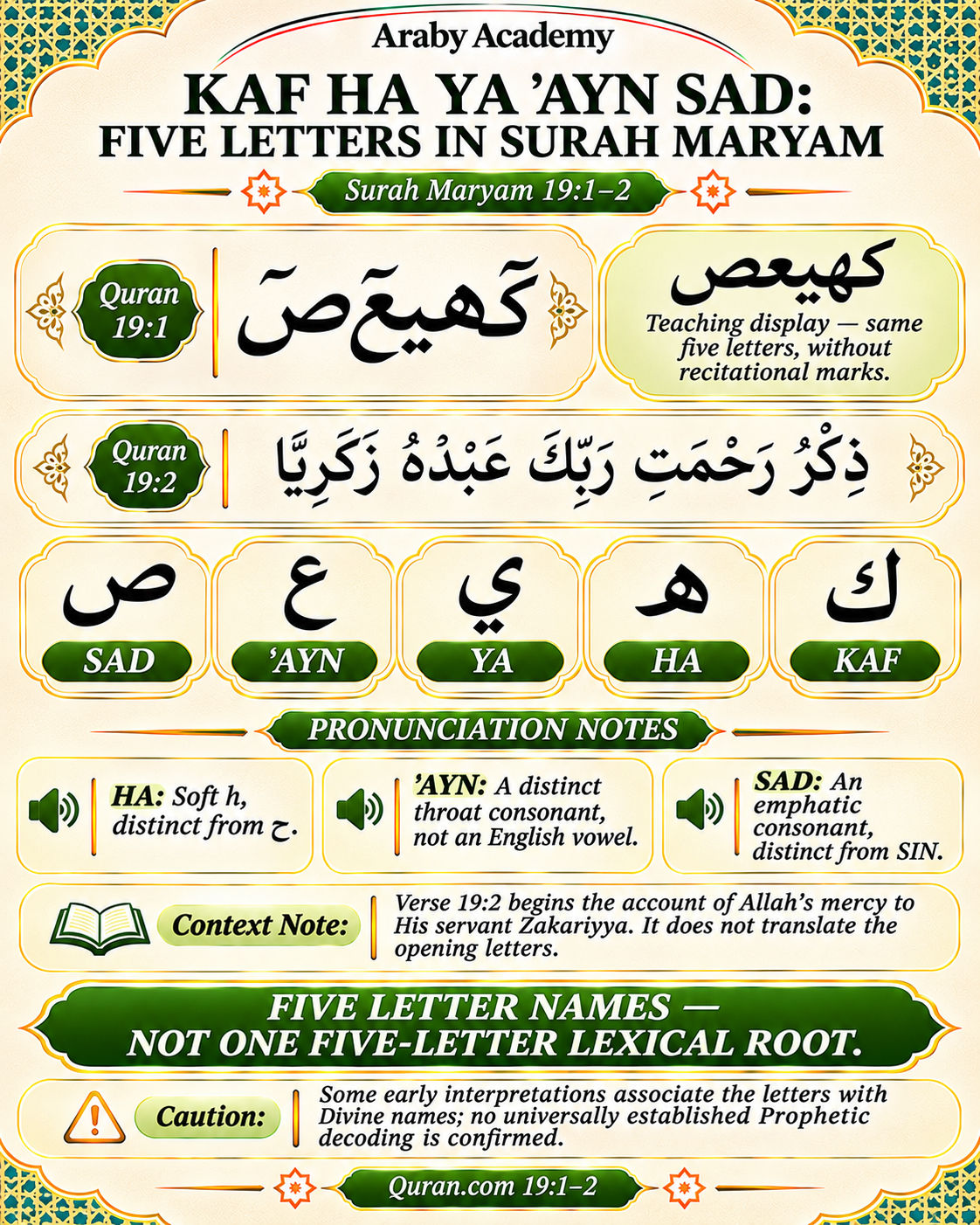
Surah Maryam 19:1 opens with كهيعص, five letters recited Kaf, Ha, Ya, ‘Ayn, Sad.
Verse 19:2 begins the narrative connected with Allah’s mercy toward His servant Zakariyya.
ذِكْرُ رَحْمَتِ رَبِّكَ عَبْدَهُ زَكَرِيَّا (“A mention of your Lord’s mercy to His servant Zakariyya.”)
That verse does not translate the five letters. Take care with ه (a soft “h,” not ح), ع (‘Ayn, a deep throat sound with no English equivalent), and ص (emphatic Sad). The sequence is not a five-letter word from a lexical root, so no morphological breakdown should be invented. Some reports attributed to early authorities expand the letters into Divine names. Their chains and strength vary, and they are not an established Prophetic decoding.
Practice: How many letters are written? What is the fourth? How does 19:2 begin its narrative? What is established, and what remains open?
5. Ta Ha: Are These Letters a Word, a Surah Name, or Something Else?
Surah Ta Ha 20:1 opens with طه, recited Ta, Ha.
Verse 20:2 states that the Quran was not sent down upon the Prophet ﷺ to cause him distress.
مَا أَنزَلْنَا عَلَيْكَ الْقُرْآنَ لِتَشْقَىٰ (“We did not send down the Quran to you to cause you hardship.”)
Ta Ha is the common name of Surah 20, but that does not prove the letters are a verified personal name of the Prophet ﷺ. Some reports propose that name or other meanings, and classical commentators relate them without treating them as settled. The well-known narration of Jubayr ibn Mut’im in Sahih al-Bukhari and Sahih Muslim lists several names of the Prophet ﷺ, and Ta Ha is not among them. Ta (ط) is heavy and distinct from ت. Ta and Ha are two-sound names with natural Madd, not six counts. Although Ta Ha is an opening-letter sequence rather than a verse-ending pattern, students interested in Quranic sound can also explore [ the science of Fawasil and why Quranic verses sometimes end with similar sounds].
Practice: Is recitation the same as pronouncing a vocabulary word? Why should a possible interpretation not be presented as a confirmed Prophetic statement?
6. Ta Sin Mim: Why Surah Ash-Shu’ara Begins with Three Letters
Surah Ash-Shu’ara 26:1 opens with طسم, recited Ta, Sin, Mim, and the same sequence opens Al-Qasas (28).
Verse 26:2 refers to the verses of the clear Book.
تِلْكَ آيَاتُ الْكِتَابِ الْمُبِينِ (“These are the verses of the clear Book.”)
This is an observable textual pattern, not a manufactured translation. Distinguish emphatic ط from the lighter ت, and remember that no English transliteration is exact pronunciation. In the sin–mim junction, the name’s final sound interacts with the next letter, which a teacher can demonstrate. Keep apart the Quranic text, a reported early interpretation, and a commentator’s own conclusion, since they are not equally authenticated. The letters in Ash-Shu’ara show why Tafsir can explain questions that an English Quran translation leaves open, since transliterating an opening does not establish its precise intended significance.
Practice: Which consonants occur? How is a scholarly proposal different from a confirmed translation?
7. Ya Sin: Why the Quran Opens Surah 36 with Two Letters
Surah Ya Sin 36:1 opens with يس, recited Ya, Sin.
Verse 36:2 begins an oath by the Quran, and verse 36:3 addresses the Prophet ﷺ as one of the messengers.
وَالْقُرْآنِ الْحَكِيمِ إِنَّكَ لَمِنَ الْمُرْسَلِينَ (“By the wise Quran. You are indeed among the messengers.”)
These verses do not prove the letters mean “O Muhammad.” Ya Sin is the common Surah name, but claiming it is a personal name of the Prophet ﷺ requires independent evidence. Early reports cited in Tafsir propose various readings, including a name or an address, and commentators differ. Some English translations transliterate the letters and add explanatory notes, but a footnote is not Quranic Arabic, and transliteration is not a complete semantic translation. Different editorial notes on Ya Sin also help explain [ why English Quran translations sometimes present additional explanatory wording], even when the underlying Arabic opening remains the same.
Practice: Does a Surah being named after its opening settle the opening’s meaning? How should footnotes be evaluated?
8. Ha Mim: The Opening Shared by Seven Surahs
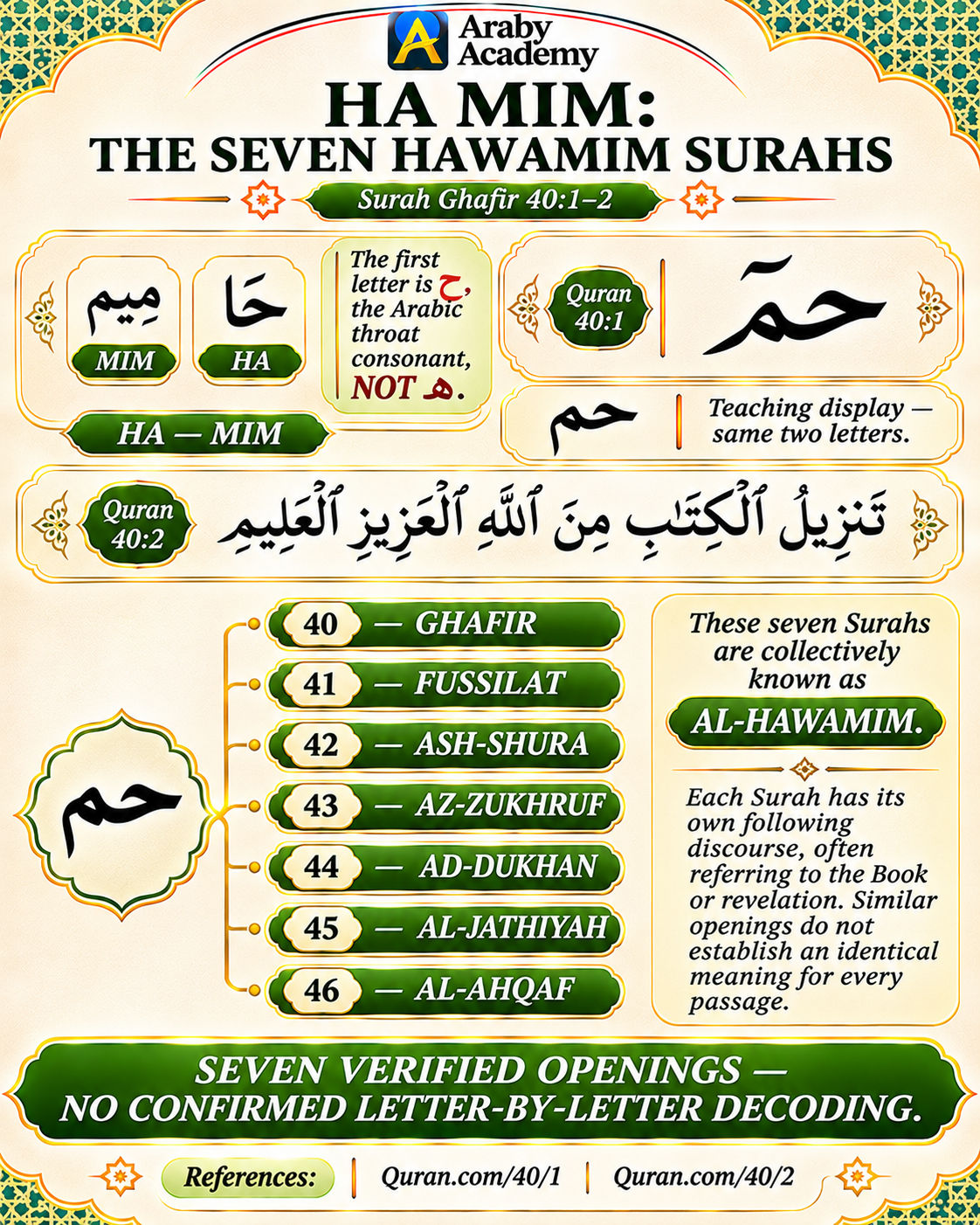
Surah Ghafir 40:1 opens with حم, recited Ḥa, Mim, and begins the group of seven Surahs called al-Hawamim (الْحَوَامِيم).
Verse 40:2 refers to the revelation of the Book from Allah.
تَنزِيلُ الْكِتَابِ مِنَ اللَّهِ الْعَزِيزِ الْعَلِيمِ (“The revelation of the Book is from Allah, the Almighty, the All-Knowing.”)
The seven are Ghafir (40), Fussilat (41), Ash-Shura (42), Az-Zukhruf (43), Ad-Dukhan (44), Al-Jathiyah (45), and Al-Ahqaf (46). Each is followed by a reference to revelation or the Book, though the wording differs. The collective name is not a deciphering of Ha Mim. Ḥa is a throat consonant, distinct from ه. Some reports treat Ha Mim as a name or an oath, but their strength varies, and no verified “Ha means X, Mim means Y” exists.
Practice: How many Surahs belong to the group, and which begins it? How does a repeated opening differ from a decoded meaning?
9. Ha Mim and ‘Ayn Sin Qaf: Why Surah Ash-Shura Has Two Opening Verses
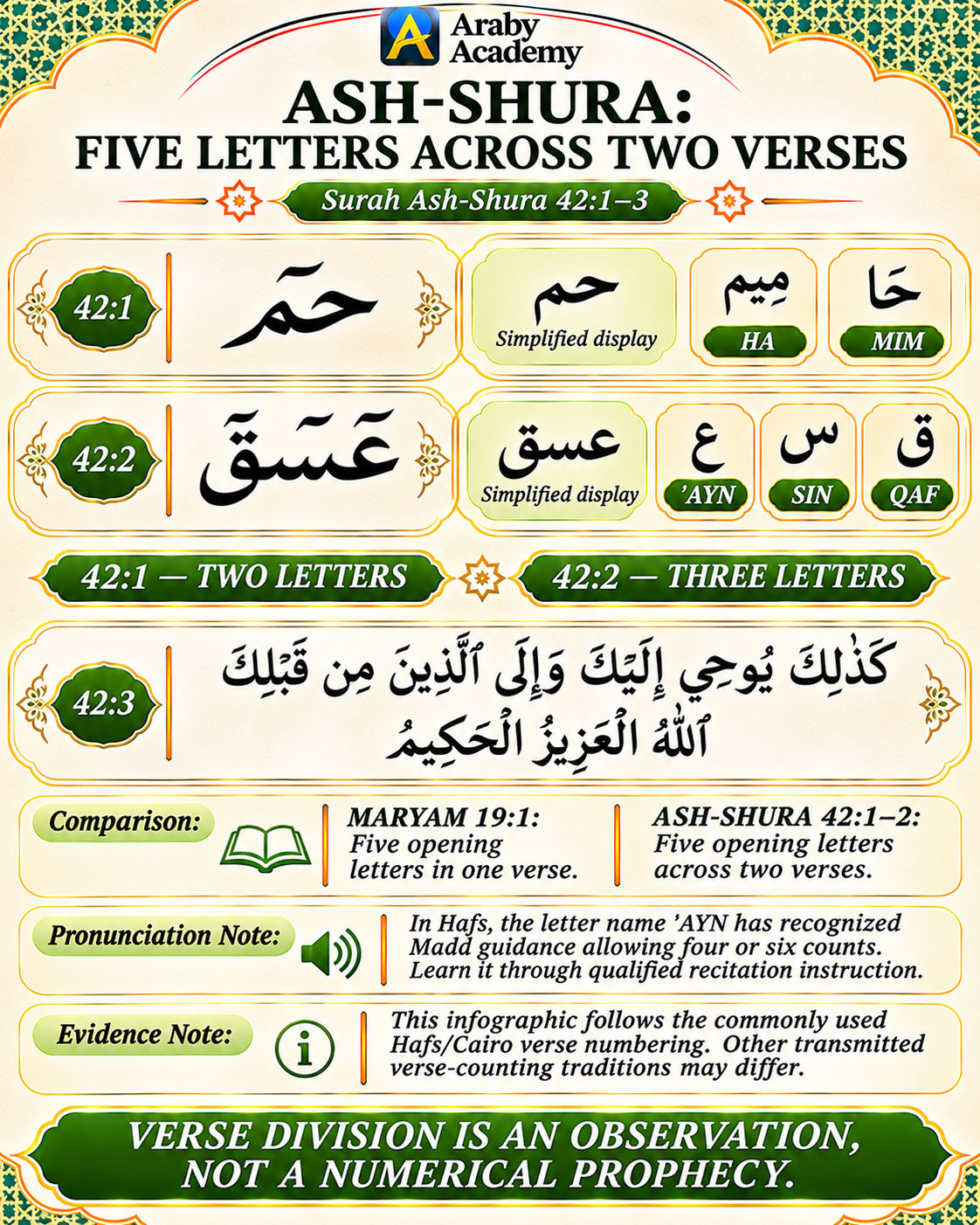
Surah Ash-Shura 42:1 is حم and 42:2 is عسق, so its opening spans two verses in the commonly used Hafs/Cairo numbering.
Verse 42:3 then speaks of revelation to the Prophet ﷺ and to those before him.
كَذَٰلِكَ يُوحِي إِلَيْكَ وَإِلَى الَّذِينَ مِن قَبْلِكَ اللَّهُ الْعَزِيزُ الْحَكِيمُ (“Thus Allah, the Almighty, the Wise, sends revelation to you and to those before you.”)
The letters are Ḥa, Mim, then ‘Ayn, Sin, Qaf, and the combination is not one five-letter dictionary word. Maryam 19:1 presents five letters in one verse, while Ash-Shura divides them across two. Verse-counting works record that traditions differ on such openings, so cite the numbering system you use. The difference proves no numerical prophecy, and 42:3 does not automatically decode the preceding letters. The mention of revelation to earlier messengers in Ash-Shura also connects with [ how the Quran presents recurring prophetic stories in different Surahs], although narrative comparison and the study of opening letters are separate topics.
Practice: Which letters belong to 42:1 and which to 42:2? What does 42:3 actually say?
10. Sad, Qaf, and Nun: Why Some Surahs Begin with Just One Letter
Surah Sad (38:1), Surah Qaf (50:1), and Surah Al-Qalam (68:1) each open with a single letter: ص, ق, and ن, recited Sad, Qaf, and Nun.
In each, the letter is followed by an oath, but the objects of the oath differ.
ص ۚ وَالْقُرْآنِ ذِي الذِّكْرِ — ق ۚ وَالْقُرْآنِ الْمَجِيدِ — ن ۚ وَالْقَلَمِ وَمَا يَسْطُرُونَ (“By the Quran full of reminder”; “By the glorious Quran”; “By the pen and what they write.”)
Reports about Qaf as a mountain encircling the earth, or Nun as an inkwell or a fish, are not established by the letters themselves. Ibn Kathir treats the Qaf-mountain material critically as likely linked to Israelite reports. Likewise, no verified Divine-name expansion of Sad exists. A shared structure (one letter), a shared category (Arabic letters), and a verified shared meaning are three different things.
Practice: Which Surahs have one-letter openings, and what does each following verse mention? Why check a proposed expansion before accepting it?
Where Do the Muqatta’at Appear? All 29 Surahs
Which Surahs Begin with Muqatta’at?
Opening | Surahs | Count |
|---|---|---|
الم | Al-Baqarah 2, Al ‘Imran 3, Al-‘Ankabut 29, Ar-Rum 30, Luqman 31, As-Sajdah 32 | 6 |
المص | Al-A’raf 7 | 1 |
المر | Ar-Ra’d 13 | 1 |
الر | Yunus 10, Hud 11, Yusuf 12, Ibrahim 14, Al-Hijr 15 | 5 |
كهيعص | Maryam 19 | 1 |
طه | Ta Ha 20 | 1 |
طسم | Ash-Shu’ara 26, Al-Qasas 28 | 2 |
طس | An-Naml 27 | 1 |
يس | Ya Sin 36 | 1 |
ص | Sad 38 | 1 |
حم | Ghafir 40, Fussilat 41, Ash-Shura 42 (plus عسق), Az-Zukhruf 43, Ad-Dukhan 44, Al-Jathiyah 45, Al-Ahqaf 46 | 7 |
ق | Qaf 50 | 1 |
ن | Al-Qalam 68 | 1 |
Total | 29 |
Three counts must stay separate: 14 different letters, 14 distinct sequences when ‘Ayn Sin Qaf is listed apart from Ha Mim, and 29 Surahs. Ash-Shura is counted once.
Are the Muqatta’at a Secret Numerical Code?
The Quran does contain verifiable recurring letter combinations. Some people have proposed mathematical interpretations, including “19 code” theories, but these are not established Tafsir. Ask: Which Quran text and reading are counted? Which orthographic convention applies? How are hamzah and alif counted? Are recitation marks included? Does the result change if one counting decision changes? Was the method defined before or after the result appeared? Is there any Tafsir evidence? A mathematical coincidence is not a confirmed explanation.
Abjad is a historical alphabetic numerical system. Its existence does not authenticate every calculation or date derived from it, and the letters offer no guaranteed prediction of future events and no basis for fortune-telling. Historical notation, a scholarly report, a speculative calculation, and a verified Quranic meaning are four different things.
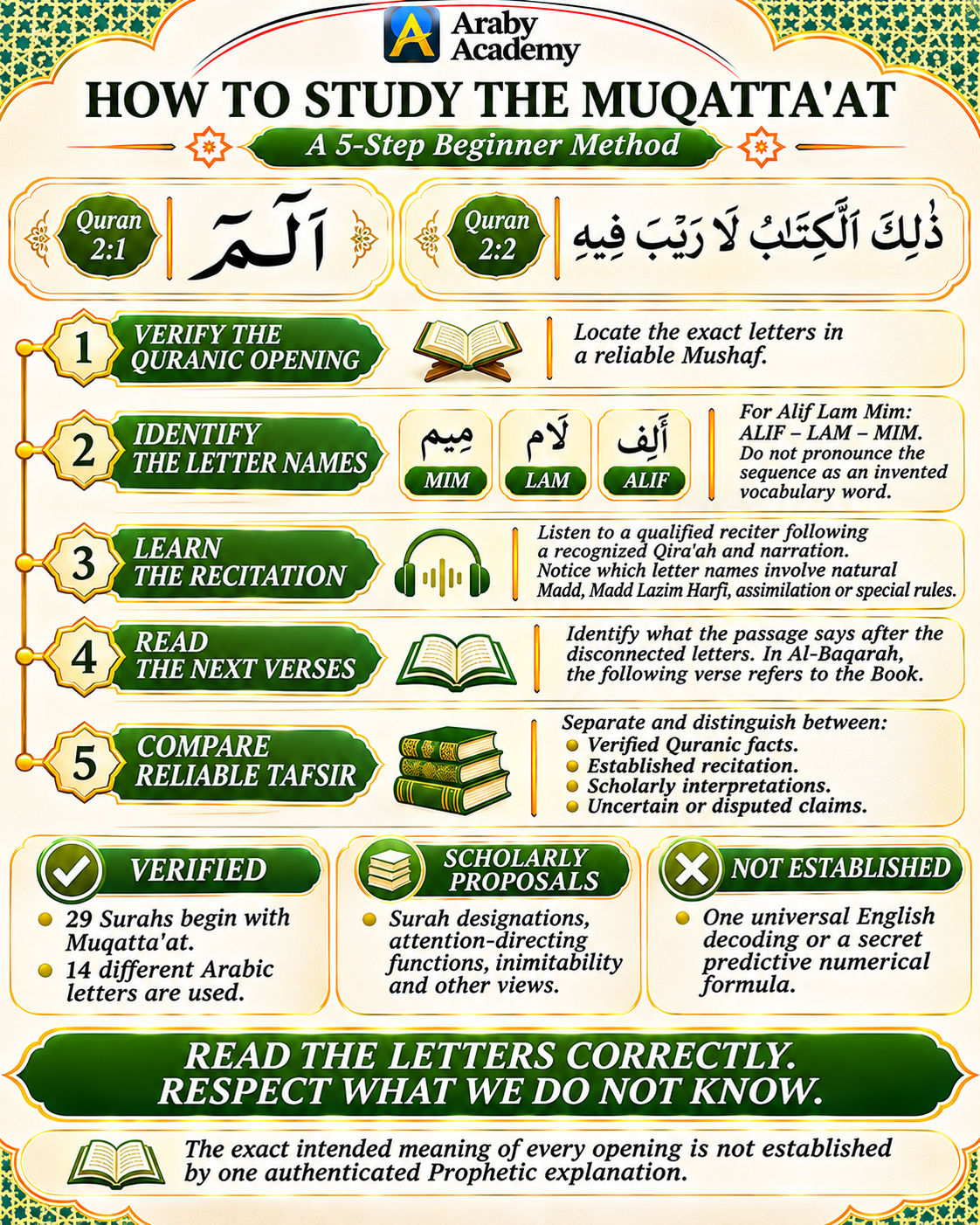
How to Study the Muqatta’at in Five Steps
Find the opening in a verified Mushaf.
Identify the individual letters and their names.
Listen to a qualified reciter using the selected reading.
Read the next several verses and consult reputable Tafsir.
Separate what is certain from what scholars propose and what remains unknown.
Students who want to strengthen their Arabic before exploring advanced Tafsir can follow [ a step-by-step beginner’s roadmap for learning Quranic Arabic], using the opening letters as an opportunity to improve pronunciation and careful reading.
Surah | Opening | Letter names | Recitation note | Next verse | Established observation | Interpretation to verify |
|---|---|---|---|---|---|---|
Al-Baqarah 2:1–2 | الم | Alif, Lam, Mim | Names read separately; lam–mim heavy Madd | 2:2 refers to the Book | Verse follows the letters | Which view, reported by whom? |
Ash-Shura 42:1–3 | حم / عسق | Ḥa, Mim / ‘Ayn, Sin, Qaf | ‘Ayn allows 4 or 6 in Hafs | 42:3 on revelation | Two verses in Hafs numbering | Which views on the five letters? |
(blank) |
A seven-day plan can follow the examples in order: Alif Lam Mim; Alif Lam Mim Sad and Alif Lam Ra; Kaf Ha Ya ‘Ayn Sad; Ta Ha and Ta Sin Mim; Ya Sin and Ha Mim; Ash-Shura; then Sad, Qaf, Nun and the 29-Surah table. It does not promise mastery. A ten-minute routine can use two minutes each to read one opening, listen, check Tajweed guidance, read surrounding verses, and record one established observation and one open question.
Common Misconceptions
Myth: Alif Lam Mim is an ordinary word. Reality: It is recited as separate letter names.
Myth: Every Muqatta’ah has a confirmed English translation. Reality: Scholars have offered differing approaches.
Myth: All scholars agree on one decoding. Reality: Their interpretations differ.
Myth: Each letter stands for a confirmed Divine name. Reality: Proposed expansions require evidence.
Myth: The letters are random decorations. Reality: They are part of the transmitted text.
Myth: They can be pronounced however one wishes. Reality: They have established recitational forms.
Myth: Every letter takes six counts. Reality: Tajweed rules vary by letter and context.
Myth: Ta Ha is certainly an authenticated personal name of the Prophet ﷺ. Reality: That claim needs careful source assessment.
Myth: Ya Sin has one universally accepted meaning. Reality: Classical explanations differ.
Myth: Ha Mim occurs in only one Surah. Reality: Seven Surahs form the Hawamim.
Myth: Ash-Shura 42:1–2 is one verse in every numbering. Reality: Hafs/Cairo counts two; cite your system.
Myth: Qaf definitely means a mountain, or Nun an inkwell. Reality: These are reports or interpretations, not confirmed translations.
Myth: A secret numerical code explains every letter. Reality: Repeated characters alone do not establish that.
Frequently Asked Questions
1. What are Huruf al-Muqatta’at? Separate Arabic letters that open 29 Surahs, recited by their letter names.
2. What does Alif Lam Mim mean? Its precise intended meaning is not confirmed. Scholars have offered several explanations, and many left the matter to Allah.
3. Why do some Surahs begin with disconnected letters? Commentators proposed Surah designations, attention-directing openings, inimitability, and other explanations. None is a proven dictionary translation.
4. How many Surahs contain them, and how many letters are used? Twenty-nine Surahs, using 14 different letters.
5. How do you pronounce Alif Lam Mim? As three letter names: Alif, Lam, Mim, with Tajweed taught by a qualified reciter.
6. Are they ordinary Arabic words? No. They are read as letter names, not as words from lexical roots.
7. What have classical scholars said? Al-Tabari, Ibn Kathir, and al-Qurtubi discuss several views, with differing evidentiary strength.
8. Did the Prophet ﷺ explain Alif Lam Mim? Do not attribute a decoding to him without an authenticated narration.
9. Why is the Quran mentioned after many openings? It is a textual pattern some scholars connect with inimitability, but it does not prove one purpose.
10. What does Kaf Ha Ya ‘Ayn Sad mean? Its meaning is not confirmed. Reported expansions vary in strength.
11. Are Ta Ha and Ya Sin names of the Prophet ﷺ? They are common Surah names. Claims of a personal name need evidence and are not part of the well-known list of his names in Bukhari and Muslim.
12. What are the Hawamim Surahs? Surahs 40–46, all beginning with Ha Mim.
13. Why does Ash-Shura begin with two verses of letters? Hafs/Cairo numbering counts 42:1 (حم) and 42:2 (عسق) separately.
14. What do Sad, Qaf, and Nun mean? No single meaning is confirmed. Mountain or inkwell claims are reports needing evaluation.
15. Do Tajweed rules apply? Yes, but the rule depends on the letter name, neighboring sounds, and reading.
16. What is Madd Lazim Harfi? A required Madd in certain letter names, traditionally six counts, light or heavy depending on assimilation.
17. Are the Muqatta’at a numerical code? Recurring letters are verifiable. Numerical codes require independent evidence and are not established Tafsir.
18. How should beginners study them? Use a verified Mushaf, learn the letter names, listen to a qualified reciter, read the next verses, and separate fact from proposal.
Read the Letters Correctly, Respect What We Do Not Know
The Muqatta’at are among the Quran’s most recognizable and intriguing openings. Their letters are transmitted and recited according to established rules, while their precise intended significance has been the subject of considerable scholarly discussion. Rather than accepting every proposed decoding, begin with what can be verified: the Arabic letters, their pronunciation, the Surahs in which they appear, and the verses that follow. Reliable Tafsir can introduce the scholarly explanations, while intellectual humility helps us distinguish knowledge from speculation.
To study Quranic Arabic, Tajweed, and Tafsir step by step, you can learn with qualified Araby Academy teachers.