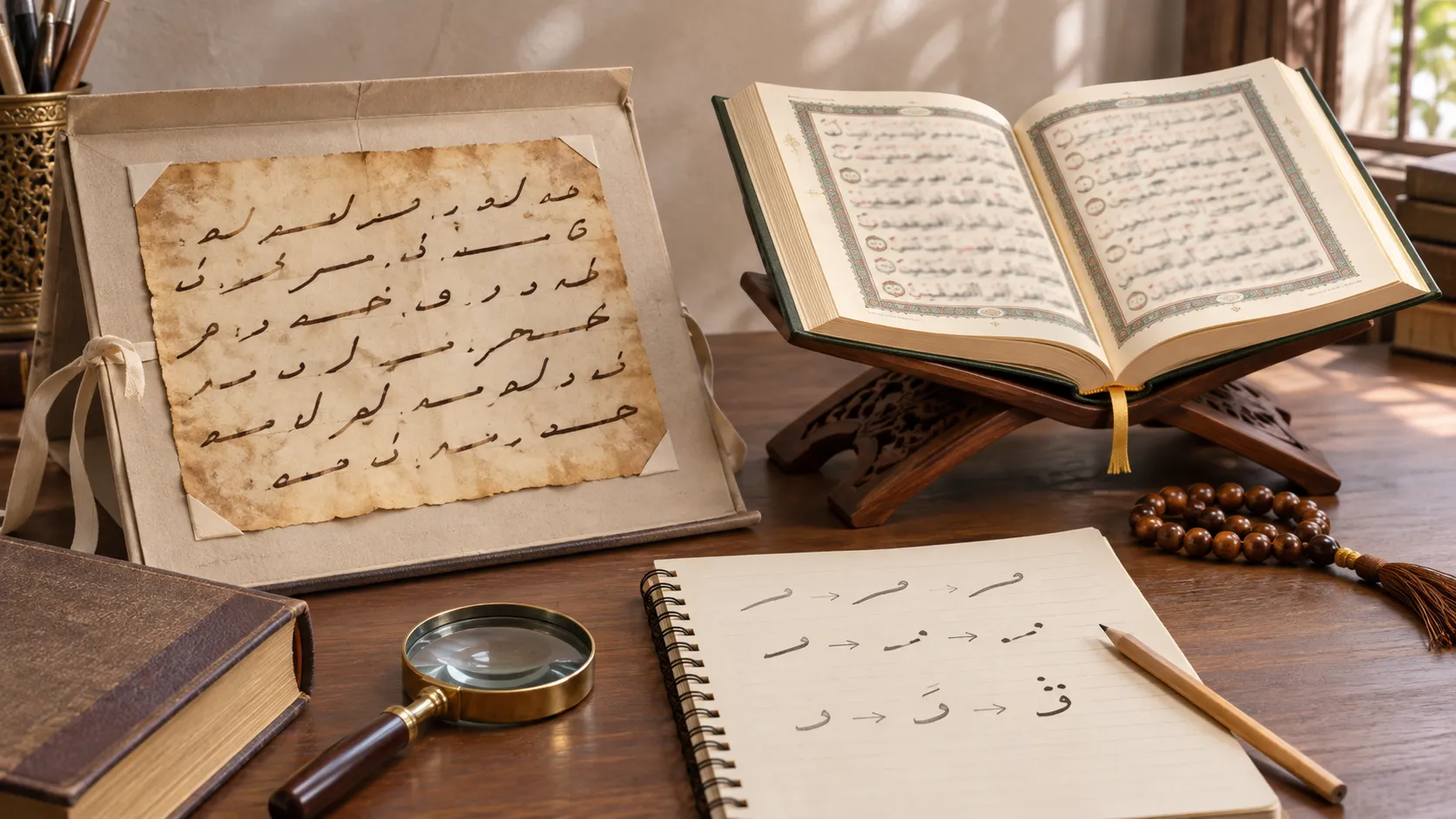
Imagine two pages side by side. One is a modern printed Mushaf, where every consonant is clearly pointed and small vowel signs sit above and below the letters. The other is an early Hijazi Quran manuscript, where the letters lean and most of the page looks bare by comparison.
A beginner may reasonably ask: Are these even the same writing system? How could anyone recognize the words? When did the dots appear? Were vowels added later? Does the different appearance mean the Quran’s text was different?
To answer, we need four separate ideas: script (letter shapes and handwriting style), spelling (orthography), vocalization (marks for short vowels and related features), and recitation (the Quran as heard and taught). This article follows real manuscripts and the scholars who study them, and it marks where evidence ends and interpretation begins.
The Short Answer: Did Early Quran Manuscripts Have Dots?
Some of the earliest surviving Quran manuscripts have occasional dots that distinguish Arabic consonants, but they generally do not contain the complete vowel-marking system familiar from modern printed Mushafs. Consonantal dotting and vowel notation developed through different practices over time. Early readers also relied on a living tradition of recitation, not only the visible writing. Manuscripts such as the Birmingham Quran and other Hijazi fragments help historians investigate how Arabic script and Quranic reading aids developed.
Consonantal Dots vs Vowel Marks: What’s the Difference?
Four Different Kinds of Marks in Quranic Writing
Type | Arabic term | What it helps identify | Example | Historical caution |
|---|---|---|---|---|
Consonantal dotting | نَقْطُ الْإِعْجَام (Nuqat al-I’jam) | Which consonant a shape represents | ب ت ث | Early manuscripts often dot only some letters |
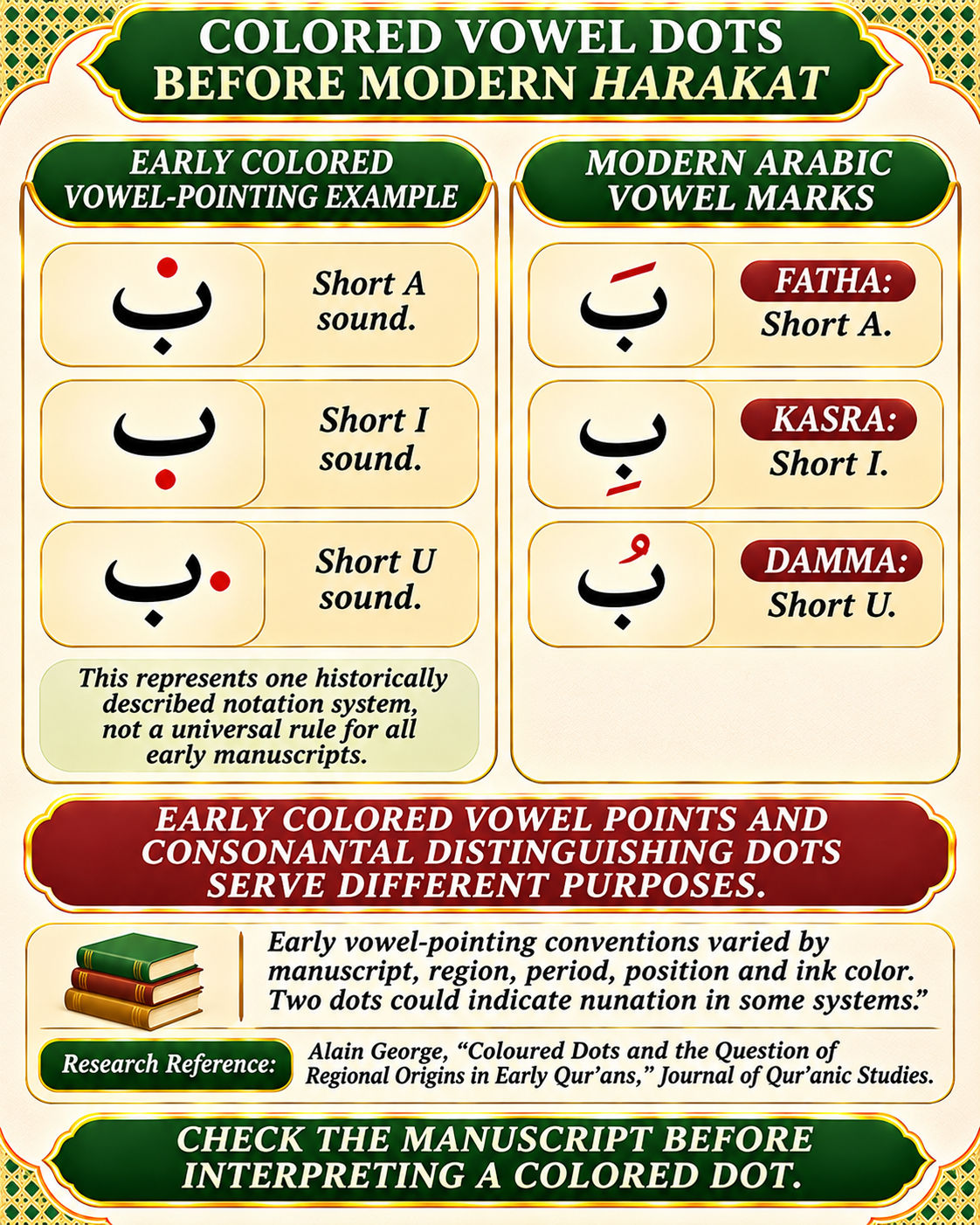
Vowel pointing | نَقْطُ الْإِعْرَاب (Nuqat al-I’rab) | Short vowels and endings in early systems | A colored dot above or below a letter | Color and placement varied by manuscript |
Modern Harakat | التَّشْكِيل (Tashkil) | Fatha, Kasra, Damma, Sukun, Shadda, Tanween | بَ بِ بُ | Modern shapes did not all exist in the earliest pages |
Verse and recitation marks | Various | Verse ends, divisions, pauses | Rosettes, strokes, Waqf signs | A separate category, not dots on letters |
Rasm, Rasm al-Mushaf, and Dabt
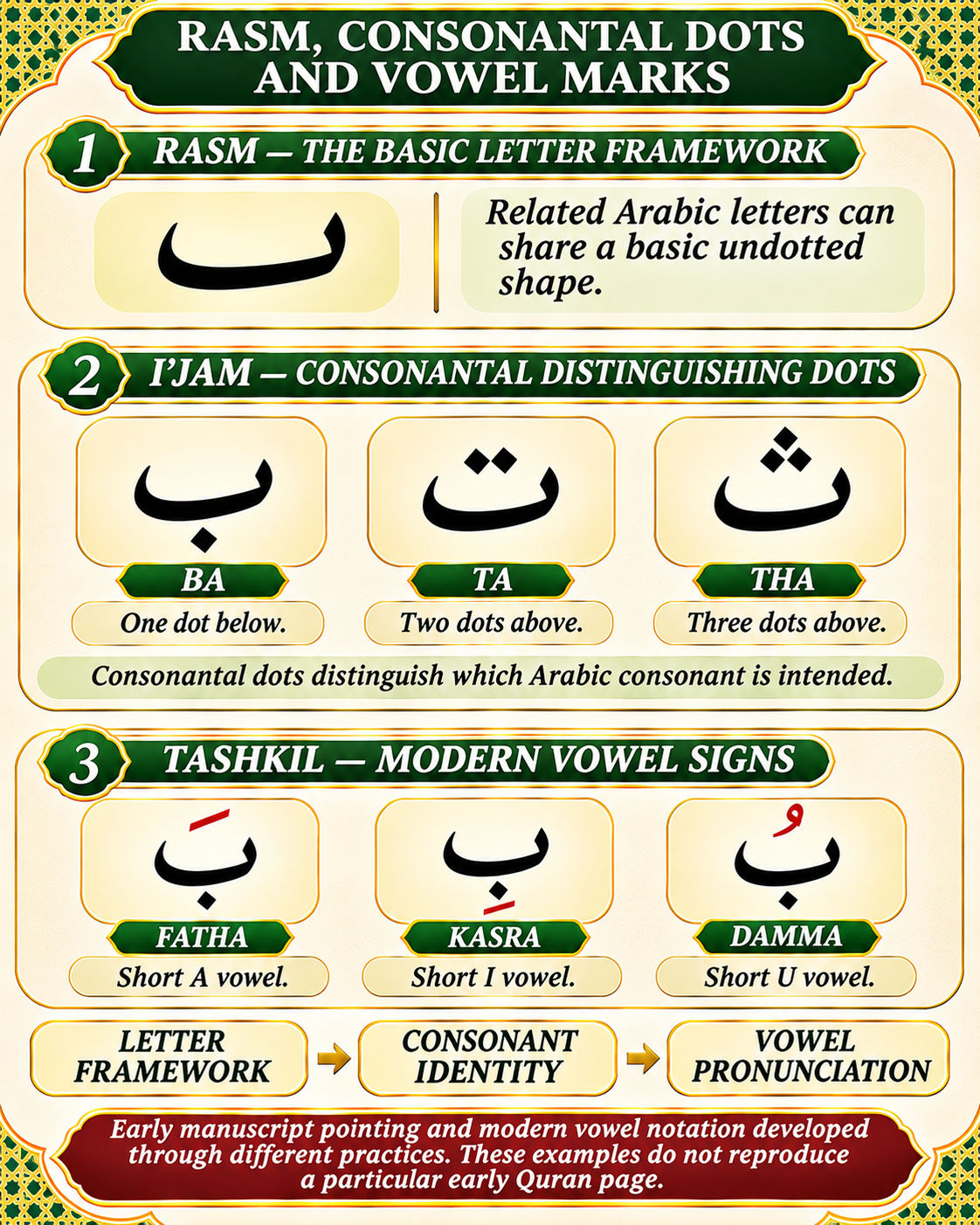
Rasm (رَسْم) is the written consonantal framework of a text. Rasm al-Mushaf (رَسْمُ الْمُصْحَف) refers to the spelling conventions of the Quranic codex tradition. Dabt (ضَبْط) refers to the aids that secure accurate reading, such as dots and vowel signs.
Rasm is not Arabic grammar, not Tajweed, and not every later vowel sign. A printed Mushaf combines Rasm, Dabt and verse markers on one page, so it does not automatically reproduce every visible feature of a seventh-century page. Early manuscripts also do not agree in every spelling detail. Dabt aids are reading tools, not additional revealed verses.
Consonantal dots
In early Arabic writing, several letters shared one basic outline. Dots separated them: ب ت ث share one shape, ج ح خ another, and س ش a third. To recognize why early consonantal writing needed careful reading, it helps to understand [ the Arabic letters and their correct pronunciation in Quran reading], especially the letters whose shapes are closely related. These are modern teaching examples, not tracings of any manuscript, and historical handwriting varied.
Vowel marks
Fatha, Kasra and Damma mark the short vowels (بَ بِ بُ). Sukun (بْ) marks the absence of a vowel, Shadda (بّ) marks doubling, and Tanween (بً بٍ بٌ) marks the “-n” endings. These are familiar modern signs, and each has its own history. The distinction between early vowel dots and today’s printed signs becomes clearer through [ the Arabic Harakat used to represent vowels and other pronunciation features], which learners encounter in a modern Mushaf.
Why both slogans fail
“Arabic had no dots” is too broad, because some early inscriptions, papyri and Quran leaves show dotted letters. “Early Qurans were fully vowelized” is also wrong, because the dense notation of modern Mushafs is not generally found on the earliest pages. The record sits between these slogans, and it varies by manuscript, region and period.
1. The Early Arabic Rasm: What Could Be Written Without Full Vowel Marks?
Rasm is the skeleton of written Arabic: the consonantal outlines of words before dots and vowel signs are added. In many early hands, several letters shared one stroke, so a single outline could stand for different consonants. Modern readers who meet such a line often feel lost. The three-step graphic below is a modern teaching demonstration, not a tracing of any Quran page.
One undotted skeleton can be compatible with more than one pointed Arabic form. That does not mean early communities guessed the Quran afresh from each page. Readers learned the text through teachers and memory, and the written line worked beside that knowledge. Even a small written distinction can matter, which is why students benefit from exploring Quranic examples where one Arabic letter makes a meaningful difference before studying historical scripts with sparse consonantal dots.
Misconception corrected: an undotted page is unreadable. For a reader who already knows the text, the skeleton is a prompt, not a puzzle. Try this: write ب ت ث, erase the dots, and notice what remains.
2. Did Early Quran Scribes Use Consonantal Dots? Sometimes, Yes
Adam Bursi’s article “Connecting the Dots: Diacritics, Scribal Culture, and the Qur’an in the First/Seventh Century” (Journal of the International Qur’anic Studies Association, 2018) surveys early dotting. It argues that diacritics belonged to scribal culture from the first Islamic century and were used selectively. Early Arabic papyri and inscriptions also show some dotted letters, so dotting was not a Quran-only practice.
Sparse does not mean nonexistent. Some points appear and many possible ones are absent, and frequency and placement differ from modern practice. This evidence does not show identical dotting across seventh-century manuscripts, and it does not give one date when dotting “began.” Dots belong to the wider history of Arabic writing, not only to Quran codices.
Misconception corrected: dots were invented after Islam, all at once. Try this: in a catalogue description, note whether pointing is called occasional, frequent or systematic.
3. The Birmingham Quran: What a Very Early Hijazi Fragment Shows
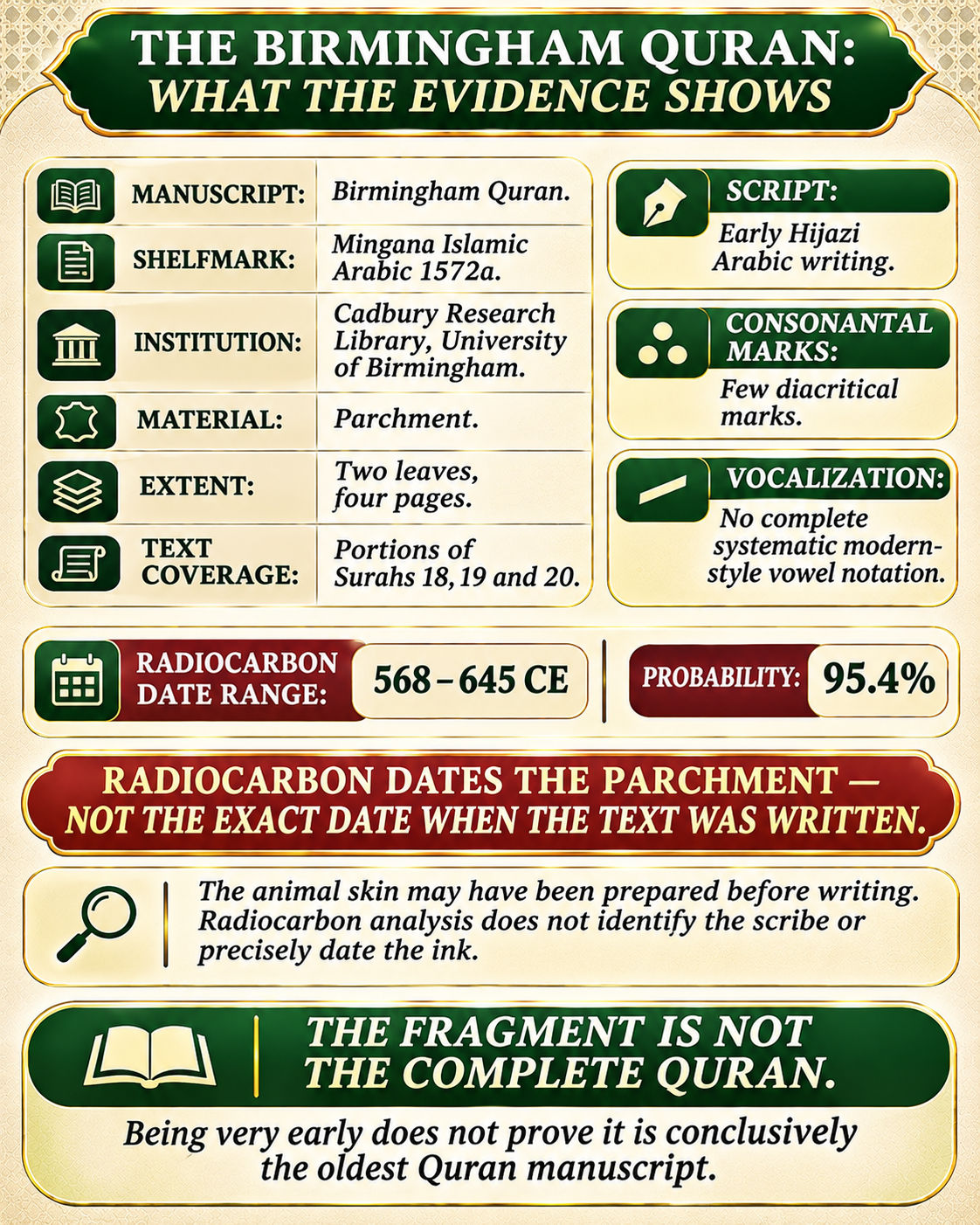
The Cadbury Research Library at the University of Birmingham holds Mingana Islamic Arabic 1572a: two parchment leaves, giving four pages, with portions of Surahs 18 to 20. The University reports radiocarbon testing of the parchment with a range of 568–645 CE at 95.4% probability. It describes the script as Hijazi, with few diacritical marks and no systematic vocalization.
The radiocarbon range dates the parchment, not a guaranteed year of writing. “Few marks” is not “zero marks,” and “no systematic vocalization” means no developed short-vowel system like that of modern Mushafs. The fragment gives physical evidence for early Quranic writing, handwriting, orthography and material culture. It does not prove the age of every verse, the scribe’s identity, the date of each dot, or the history of compilation. It does not contain the whole Quran, and it cannot simply be called the oldest manuscript in the world. Marks visible in a digital image may not all have been added at the same time. Looking at early Hijazi script also helps readers distinguish [ Quranic Arabic from Modern Standard Arabic and contemporary writing conventions], without assuming that differences in handwriting are the same as differences in language.
Misconception corrected: “568 CE is when it was copied.” Try this: find the shelfmark and the date type on the University’s catalogue page.
4. Early Quran Leaves in Paris: Why Identifying the Same Codex Matters
The Bibliothèque nationale de France holds Arabe 328, a shelfmark with several subdivisions that should not be treated as one book. Scholarly work, notably by Alba Fedeli, has proposed that leaves catalogued as Arabe 328(c) and the Birmingham leaves belong to the same original codex. Researchers compare script, page dimensions, line layout, letterforms, text sequence, decoration and material. A single photograph cannot prove that two leaves once belonged together.
A folio is one leaf, and it normally has two sides, called recto and verso. A bifolio is a folded sheet forming two leaves. Catalogues use these terms constantly, so learn them early. The proposal is a scholarly identification that requires verification, not a settled fact for every reader. If correct, it shows how dispersed leaves can be reunited on paper, without inventing a binding history.
Misconception corrected: all of Arabe 328 is one manuscript. Try this: find a catalogue entry and decide whether it describes a folio or a bifolio.
5. British Library Or. 2165: A Larger Early Quran Manuscript
The British Library catalogue describes Or. 2165 as an Arabic Quran codex of 121 folios, commonly classed as Hijazi. It is not the Birmingham fragment. Catalogues and research projects can assign different dates: an institutional range may be broad, while a project such as Corpus Coranicum may offer a paleographic estimate. Editors should copy the catalogue’s wording and the research project’s estimate exactly, rather than choosing one as the date.
Different dates do not mean the manuscript is poorly understood. They mean different methods answer different questions. Published descriptions point to sparse consonantal pointing rather than systematic vowel marking, but a reader must not label every dark dot as a consonantal dot, because decorative verse markers look similar. The relationship between an early written Rasm and transmitted pronunciation becomes clearer when studying the Quran’s canonical Qira’at and their established reading traditions, rather than imagining that every vowel was guessed from the manuscript. A consonantal outline does not fix one reading in every position, and readers were not free to invent readings.
Misconception corrected: a catalogue date measures when the text was written. Try this: read the British Library entry and note its script label and date wording.
6. The Sana’a Palimpsest: What Two Layers of Quranic Writing Can Reveal
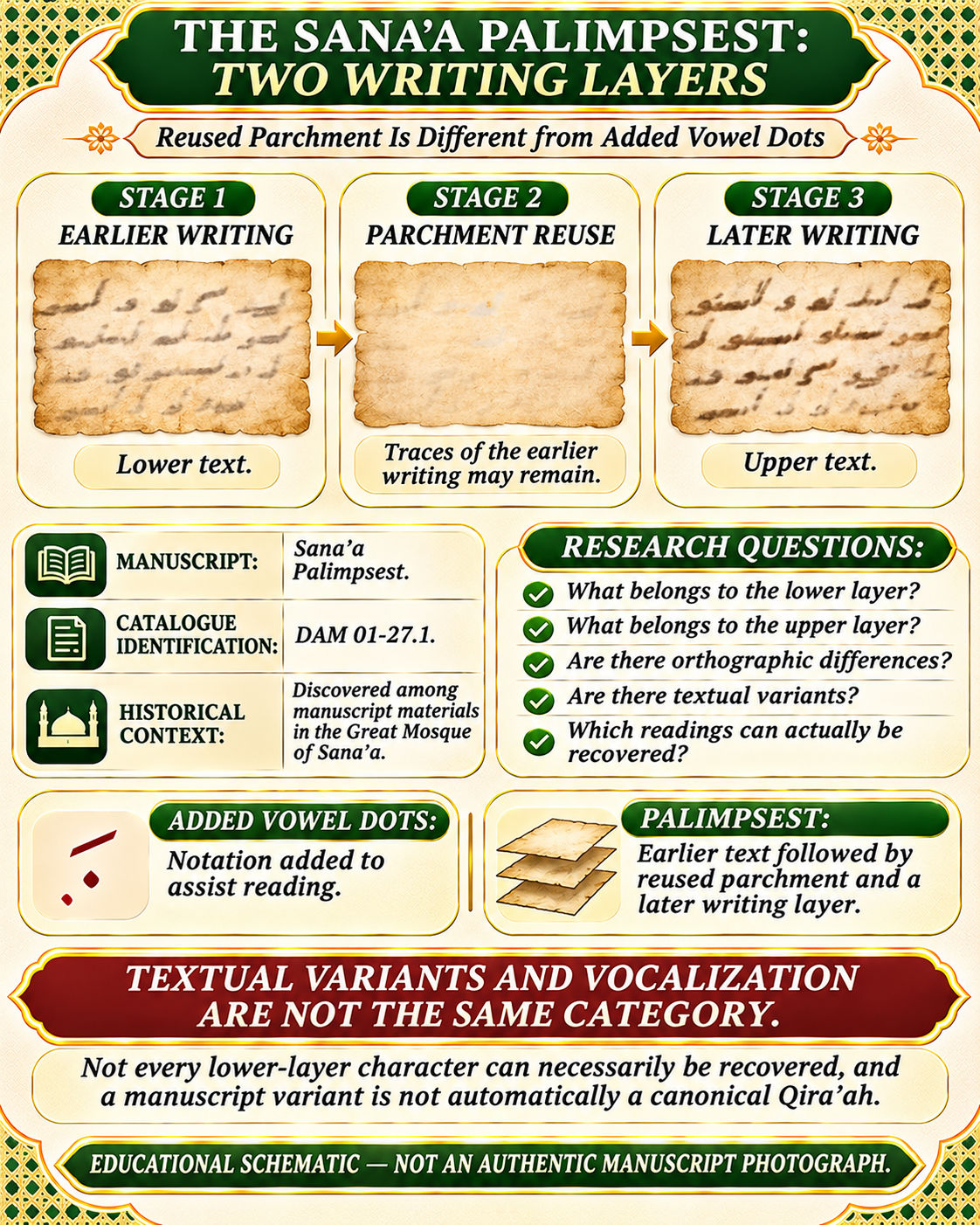
A palimpsest is parchment reused after earlier writing was washed or scraped away. Imaging, such as ultraviolet photography, can sometimes recover the lower text. The Sana’a palimpsest (catalogued DAM 01-27.1) was found among manuscripts in the Great Mosque of Sana’a and has a lower and a later upper Quranic text. Studies such as Asma Hilali’s book on the palimpsest examine the layers, script, orthography and dating. Scholars interpret the layers and the date range in different ways.
A palimpsest is not the same thing as a manuscript with added vowel dots. Its lower text has attracted discussion of textual variants, which is a different question from vocalization. Scholars distinguish consonantal spelling, vowel marking, scribal correction, textual variants and the reuse of the parchment. A variant in the lower layer is not automatically a canonical Qira’ah, and not every erased letter can be recovered.
Misconception corrected: the palimpsest only shows harmless dotting changes. Try this: explain in one sentence why overwriting is not the same as adding a vowel dot.
Readers should also distinguish scribal reading marks from [ the Quran’s mysterious opening letters such as Alif Lam Mim], which are part of the Quranic wording rather than later instructions about vowels. This is a conceptual clarification, not a claim about any particular Sana’a folio.
7. Red and Colored Dots: How Early Quran Manuscripts Marked Vowels
Alain George’s article “Coloured Dots and the Question of Regional Origins in Early Qur’ans” (Journal of Qur’anic Studies) examines how colored dots were used and whether they reflect regional practice. In some manuscripts, a red dot above a letter marks the sound a, a red dot below marks i, and a red dot beside the letter marks u. This matches a system described in later literature, but every claim must be checked against the particular manuscript.
Two dots can indicate nunation in some systems, but placement and color varied between manuscripts. A vowel dot is not a consonant dot, and its meaning depends on color, position, system, period and scribal context. Other colors appear in some manuscripts for other functions, so there is no universal code. A colored dot does not by itself prove when it was added, who added it, which reading was intended, or where the page was made. Early vowel-pointing systems also help explain why Arabic I’rab and case endings matter when reading Quranic sentences, since word-final pronunciation can clarify grammatical relationships.
Misconception corrected: red always means Fatha. Try this: in a catalogue, find the color and position of any vowel dots described.
8. Not Every Dot Means the Same Thing: Consonants, Vowels, and Verse Markers
Four categories should not be conflated: consonantal differentiating dots, vowel-pointing dots, verse separators and decorative punctuation, and later recitation marks. Early manuscripts may separate verses with dots, strokes, rosettes or other devices, depending on the manuscript. A red line that separates Surahs may be decoration or division, so its function must be checked.
A reader who sees a dot over a word should inspect shape, ink color, location, function and date. A verse separator is not a Damma, and decorative punctuation is not a consonantal point. A manuscript may also hold original writing, later corrections, later vocalization, decorative changes and conservation work. These layers were not necessarily produced together, and their sequence needs analysis.
Misconception corrected: every dot is a letter dot. Try this: sort the four categories on a blank card and add one example for each.
9. Who Added Arabic Dots? The Scholars Named in Historical Reports
Later biographical and grammatical reports link Abu al-Aswad al-Du’ali (أَبُو الْأَسْوَدِ الدُّؤَلِيّ), Yahya ibn Ya’mur and Nasr ibn ‘Asim to early pointing, but they were written well after the events. Abu al-Aswad is traditionally associated with early vowel-pointing, reportedly using dots of a different ink color. Yahya ibn Ya’mur and Nasr ibn ‘Asim are traditionally associated with distinguishing similar consonants. Works such as Abu ‘Amr al-Dani’s al-Muhkam fi Naqt al-Masahif preserve such accounts, centuries after the people they describe.
The reports are valuable history, but they are not direct documentation. No surviving manuscript in Abu al-Aswad’s hand proves them, and no source credits him with all Arabic dots, vowel marks, grammar and modern typography. Scholars weigh the reports against manuscripts, which show selective dotting in use already in the first Islamic century. The work associated with early Arabic grammarians is easier to appreciate when readers understand the difference between Nahw and Sarf in Quranic Arabic, since sentence endings and word forms are related but distinct areas of study. Arabic grammar was not created from nothing after Islam, and no single scholar standardized every rule.
Misconception corrected: one man invented all the dots. Try this: write one line on what a report says, who wrote it, and when.
10. Al-Khalil and the Later Evolution of Arabic Vowel Signs
Al-Khalil ibn Ahmad al-Farahidi (الْخَلِيلُ بْنُ أَحْمَدَ الْفَرَاهِيدِيّ), a major figure in Arabic grammar and lexicography, is traditionally associated with a newer system of small shaped signs for short vowels, along with notation for features such as Hamzah and Shadda. These are later reports, not proof of a single event. The shaped signs gradually replaced colored dots in many contexts, but not instantly or everywhere.
Later manuscripts show red-dot conventions and newer shaped signs coexisting. Different regions and genres adopted changes at different speeds, and the record does not follow one smooth path. The modern Mushaf is the result of long development, and editions do not all use identical Dabt symbols.
Modern Mushafs combine Rasm, Dabt, verse markers and reading guidance on a single page. They include consonantal dots, short-vowel signs, Shadda, Sukun, Madd notation, verse markers and Waqf signs. Modern Mushafs also contain recitation guidance, which makes [Waqf and Ibtida rules for stopping and restarting Quranic recitation] a useful companion topic to the history of Arabic dots and vowel signs.
Misconception corrected: Al-Khalil’s signs instantly replaced earlier systems. Try this: compare a red-dot description with a modern Fatha and note the differences.
What Can Radiocarbon Dating Actually Tell Us?
What We Can Learn from Three Early Quran Manuscript Collections
Manuscript | Institution and shelfmark | Date information (type) | Dot/vowel observation | Limitation |
|---|---|---|---|---|
Birmingham fragment | Cadbury Research Library, Mingana Islamic Arabic 1572a | 568–645 CE, 95.4% (parchment radiocarbon) | Few diacritics, no systematic vocalization | Dates parchment, not writing |
British Library codex | British Library, Or. 2165 | Catalogue range and research estimate (editor to verify; two method types) | Sparse pointing reported | Estimates differ by method |
Sana’a palimpsest | Dar al-Makhtutat, Sana’a, DAM 01-27.1 | Radiocarbon and paleographic studies (editor to verify) | Layers study textual variants, not just dots | Lower layer partly recoverable |
Radiocarbon dating of parchment measures the organic material, the animal skin. It does not directly date the ink, identify the scribe, fix the date a codex was assembled, show where it was written, or trace its transmission history. A skin may have been prepared before the text was written, so a radiocarbon range can fit more than one proposed writing date. Parchment dates, institutional catalogue ranges and paleographic estimates are different kinds of evidence, so manuscripts should not be ranked by age without comparable criteria.
Ink can also be analyzed scientifically, but a color difference alone does not prove who added a mark or when. Old parchment is fragile, ink fades, and some marks are hard to see in ordinary photographs. High-resolution imaging and conservation research help, and tiny dots should not be judged from low-resolution pictures.
How Does Manuscript Evidence Relate to Quranic Recitation?
Religious belief, traditional accounts of compilation, surviving manuscripts and modern academic methods are different kinds of evidence, and they can be discussed respectfully together. Early Quranic recitation was transmitted orally in learning communities, and the written Rasm and recitation interacted. The canonical Qira’at are transmitted reading traditions, so incomplete pointing does not mean anyone could invent a pronunciation. Not every manuscript variant is a canonical Qira’ah.
The history of writing is also not Tafsir, which studies meaning, and not Tajweed, which concerns accurate recitation. Written marks are visual aids and do not replace transmitted oral instruction. Researchers cannot always know who wrote a page, where, exactly when each mark was added, or why a scribe omitted a dot.
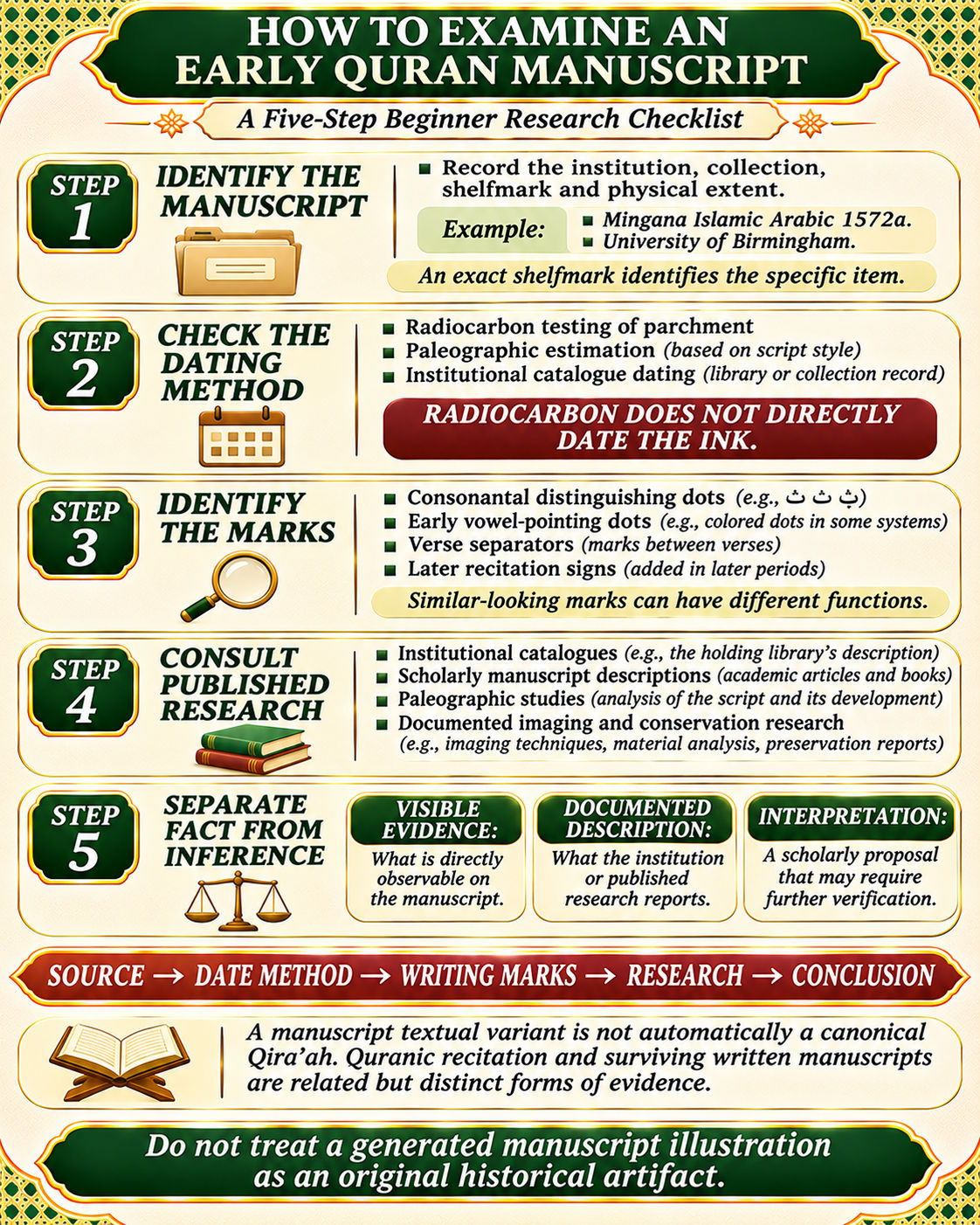
How to Examine an Early Quran Manuscript in Five Steps
Identify the institution and shelfmark.
Check the manuscript’s dating method.
Distinguish consonantal dots, vowel points and decorative marks.
Read the published paleographic description or edition.
Separate what is visibly documented from what scholars infer.
To continue studying this history responsibly, readers can explore [ the Quranic Sciences that connect manuscript evidence, recitation, language, and interpretation], while keeping the different disciplines and their methods clearly distinguished.
Manuscript | Institution | Date type | Consonantal dots | Vowel signs | Certain? | Verify? |
|---|---|---|---|---|---|---|
Mingana Islamic Arabic 1572a (worked example, from the catalogue) | Univ. of Birmingham | Parchment radiocarbon | Few | No systematic vocalization | Parchment range | Writing date |
For a beginner activity, compare ب ت ث as modern teaching examples, then read an institutional description and find the shelfmark, script, date type, material and vocalization. For a seven-day plan, move from Rasm to dots, Birmingham, Paris and London, Sana’a, colored dots and attributions, then Al-Khalil and review. A ten-minute routine works too: read one catalogue entry, note the reference, review one feature, check one scholarly explanation, and write one supported fact and one open question. This is introductory study, not paleographic training.
Common Misconceptions
Myth | Reality |
|---|---|
Earliest manuscripts had absolutely no dots. | Some contain occasional consonantal dots. |
Letter dots and vowel dots are the same. | They have different functions. |
Every modern vowel sign existed in the first century. | Vocalization developed over time. |
No one could pronounce the Quran until dots existed. | Recitation was transmitted orally. |
Radiocarbon dates the ink. | It dates the parchment. |
The Birmingham fragment is the whole Quran. | It has portions of particular Surahs. |
Birmingham is conclusively the oldest. | That needs evidence beyond a parchment date. |
All early manuscripts look alike. | Scribal practices varied. |
Sana’a shows only decorative changes. | Its layers need textual analysis. |
Every variant is a Qira’ah. | These are distinct categories. |
Abu al-Aswad invented all Arabic writing. | The history is more complex. |
A reconstruction is a manuscript photograph. | Teaching illustrations must be labeled. |

Frequently Asked Questions
1. Did the earliest Quran manuscripts have dots? Some have occasional consonantal dots, but not systematic pointing like a modern Mushaf.
2. Did early Quran manuscripts have vowel marks? Generally not the developed system of modern Mushafs. Some later early manuscripts use colored vowel dots.
3. How did Muslims read Quranic Arabic without full vowel signs? Through oral teaching and memory. The written text supported a living recitation tradition.
4. What is Rasm in Quran manuscripts? The consonantal framework of the written text, separate from later dots and vowel signs.
5. What is the difference between I’jam and I’rab? I’jam dots distinguish consonants. I’rab pointing marks short vowels and endings.
6. Did Arabic have consonantal dots before Islam? Evidence is limited and debated, but dotted letters appear in early Islamic inscriptions and papyri. Scholars discuss the evidence from earlier periods carefully.
7. Why were early letter dots sometimes sparse? Scribes used them selectively. Manuscript evidence does not fully explain each choice.
8. What is Hijazi script? A broad classification of early, often sloping Arabic book hands. It does not prove a manuscript was written in the Hijaz.
9. What is Kufic script? A family of angular early scripts. The name does not mean a manuscript was made in Kufa.
10. How old is the Birmingham Quran manuscript? Its parchment has a reported radiocarbon range of 568–645 CE at 95.4%. The writing date needs further evidence.
11. Does radiocarbon dating tell us when the text was written? No. It dates the parchment, which may have been prepared before writing.
12. What does British Library Or. 2165 show? A 121-folio early Quran codex, whose dating differs by method. Check the catalogue directly.
13. What is the Sana’a palimpsest? A reused parchment with a lower and an upper Quranic text, studied for script, orthography and textual variants.
14. Are manuscript textual variants the same as vowel marks? No. Variants, corrections, spelling and vocalization are different categories.
15. What did red dots mean in early Quran manuscripts? In some, red dots marked short vowels by position. Conventions varied, so check each manuscript.
16. Who was Abu al-Aswad al-Du’ali? An early figure traditionally associated with vowel-pointing and grammar, known through later reports.
17. Did one person invent Arabic vowel marks? Not according to the evidence. Reports name several scholars, and the manuscripts show gradual development.
18. What did Al-Khalil ibn Ahmad contribute? He was a major Arabic grammarian, traditionally associated with later shaped vowel signs.
19. How are modern Harakat different from early vowel dots? Early dots were colored points. Modern Harakat are standardized shaped signs.
20. Where can readers find reliable images of early Quran manuscripts? Institutional catalogues and digital collections, such as Birmingham and the British Library, and Corpus Coranicum. Check reuse rights.
From Early Rasm to Modern Harakat: Reading the Evidence Carefully
The history of Quranic writing is more interesting than the simple claim that the earliest manuscripts had no dots. Some early texts already used occasional consonantal pointing, while fuller vowel notation and other reading aids developed through different scribal traditions over time. Manuscripts preserved in collections such as Birmingham, London, Paris, and Sana’a offer valuable evidence of that history. Studying them carefully means distinguishing physical evidence from later reports, and dates of parchment from dates of writing. For today’s learner, this history can deepen appreciation for both Arabic script and the tradition of careful Quranic recitation.
If you would like to read the Quran correctly, you are welcome to study Quranic Arabic with qualified Araby Academy teachers.