Imagine turning the page from Surah Al-Anfal to Surah At-Tawbah in your Mushaf (the written copy of the Quran). Almost every Surah has opened with the same line, so your eye expects it again:
بِسْمِ اللَّهِ الرَّحْمَٰنِ الرَّحِيمِ
Instead, the ninth Surah begins like this:
بَرَاءَةٌ مِنَ اللَّهِ وَرَسُولِهِ إِلَى الَّذِينَ عَاهَدْتُمْ مِنَ الْمُشْرِكِينَ
"[This is a declaration of] disassociation, from Allah and His Messenger, to those with whom you made a treaty among the polytheists." (Quran 9:1, Sahih International translation, lightly adapted for the bracketed note)
So why does Surah At-Tawbah not start with Bismillah?
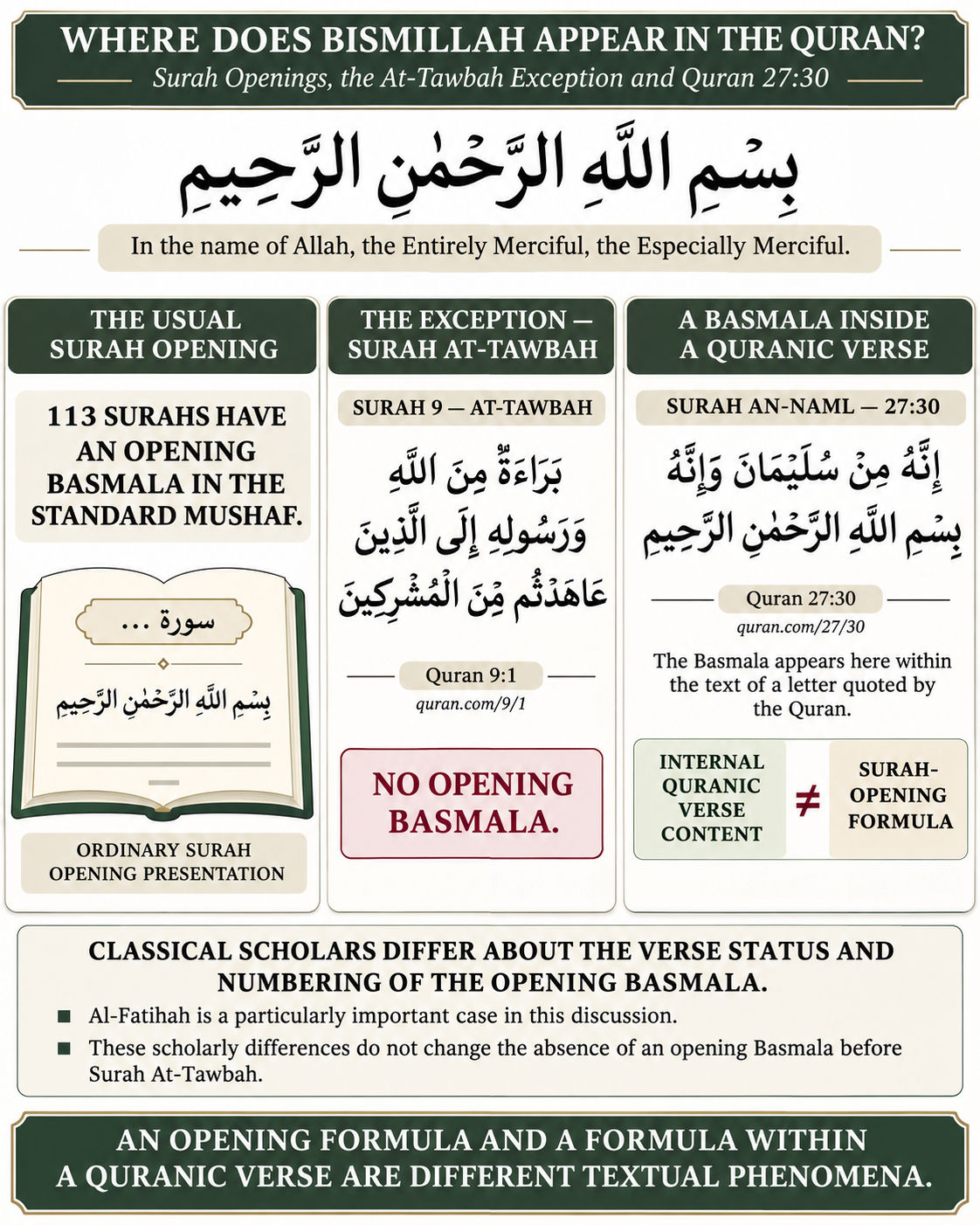
The short answer: Surah At-Tawbah is transmitted and written without an opening Basmala (the phrase "Bismillah al-Rahman al-Rahim") in the standard Mushaf. Classical scholars have discussed several explanations. These include the Surah's relationship with Surah Al-Anfal, the transmitted arrangement of the Quran, and the tone of the Surah's opening declaration of disavowal. The textual fact is far more certain than the exact historical reason for it. This article keeps those two things apart.
What Is the Basmala, and Why Does It Usually Appear Before a Surah?
The Basmala is the phrase Bismillah al-Rahman al-Rahim: "In the name of Allah, the Entirely Merciful, the Especially Merciful." It begins a task by placing it under Allah's name and seeking His help. Ar-Rahman and Ar-Rahim both come from the root for mercy. Scholars often describe Ar-Rahman as mercy that is all-encompassing and Ar-Rahim as mercy that is continuous and directed, especially toward believers.
In the standard Mushaf, 113 Surahs open with the Basmala, and Surah At-Tawbah is the exception. Surah Al-Fatihah is a special case in the other direction: scholars of different schools have discussed whether the Basmala counts as its first verse.
The Basmala also appears inside the Quran's text. In Surah An-Naml it occurs within a verse, in the letter of Prophet Sulayman:
إِنَّهُ مِن سُلَيْمَانَ وَإِنَّهُ بِسْمِ اللَّهِ الرَّحْمَٰنِ الرَّحِيمِ (Quran 27:30)
"Indeed, it is from Solomon, and indeed, it reads: 'In the name of Allah, the Entirely Merciful, the Especially Merciful.'"
An opening Basmala written before a Surah and a Basmala occurring within a verse are different textual phenomena. Both facts are covered below.
Islamic legal and recitation schools have also long discussed whether the opening Basmala is a verse of every Surah, a verse of Al-Fatihah only, or a separator between Surahs. Reciters and jurists in different traditions came to different conclusions. These discussions concern classification and verse numbering. They do not touch the established fact that the Mushaf has no opening Basmala before Surah At-Tawbah.
What Is Surah At-Tawbah About?
Surah At-Tawbah is the ninth Surah, a long Madinan Surah. It has a second name, Surah Bara'ah, taken from its first word. Bara'ah means disavowal, release, or freeing oneself from an obligation. At-Tawbah means repentance, and the Surah gets that name from its repeated teaching about turning back to Allah.
Historical context
The Surah belongs to the last phase of the Madinan period, around the ninth year after the Hijra. Several events frame it:
Treaty relationships. By this time the Muslim community in Madinah had treaties with various Arabian tribes. Some treaties were fixed-term, some open-ended, and some had been broken.
The public declaration. Early reports say the opening verses were announced to the people at the Hajj season. Hadith sources report that Abu Bakr led the pilgrimage that year and that Ali ibn Abi Talib conveyed the announcement.
The expedition of Tabuk. The Surah also addresses the hardship of the Tabuk expedition, those who stayed behind with excuses, and the hypocrites among the community.
Not only warnings
The Surah is not exclusively about warfare. It contains stern warnings, discussion of hypocrisy, and accountability. It also contains some of the Quran's strongest passages on repentance and mercy.
Quran 9:1–6 should be read within its immediate context, because the text itself limits the declaration. Verse 4 excepts treaty partners who kept their agreements:
إِلَّا الَّذِينَ عَاهَدتُّم مِّنَ الْمُشْرِكِينَ ثُمَّ لَمْ يَنقُصُوكُمْ شَيْئًا وَلَمْ يُظَاهِرُوا عَلَيْكُمْ أَحَدًا فَأَتِمُّوا إِلَيْهِمْ عَهْدَهُمْ إِلَىٰ مُدَّتِهِمْ
"Excepted are those polytheists with whom you made a treaty and who have not been deficient toward you in anything or supported anyone against you; so complete for them their treaty until its term." (Quran 9:4, Sahih International)
Verse 6 commands protection for anyone seeking safety:
وَإِنْ أَحَدٌ مِّنَ الْمُشْرِكِينَ اسْتَجَارَكَ فَأَجِرْهُ حَتَّىٰ يَسْمَعَ كَلَامَ اللَّهِ ثُمَّ أَبْلِغْهُ مَأْمَنَهُ
"And if any one of the polytheists seeks your protection, then grant him protection so that he may hear the words of Allah. Then deliver him to his place of safety." (Quran 9:6, Sahih International)
These verses address specific treaty circumstances in a specific historical situation. Responsible reading does not lift them out of that context as unrestricted instructions toward all people in every era. Classical commentators such as al-Tabari, Ibn Kathir, and al-Qurtubi discuss them in this setting, and this article does not attempt a full commentary.
The Established Fact: Surah At-Tawbah Has No Opening Basmala
Some things are firmly established:
The Surah is part of the Quran. No classical scholar questions this.
It follows Surah Al-Anfal in the standard Mushaf arrangement.
It is written and recited without an opening Basmala in the transmitted Mushaf tradition.
This is not a modern editorial decision, and it is not a printing error. Mushaf copies across the centuries preserve the same presentation. The Quran has been passed down by both written copies and living recitation. Writing and reciting follow what was transmitted, not an editor's preference for consistency.
What is not established with the same certainty is the precise historical reason. Scholars discuss it through reports and reasoning, and those reports differ in strength. The next sections separate them.
The Report of Uthman ibn Affan and the Link with Surah Al-Anfal
The best-known report on this question is a conversation between Ibn Abbas and Uthman ibn Affan.
What the report says
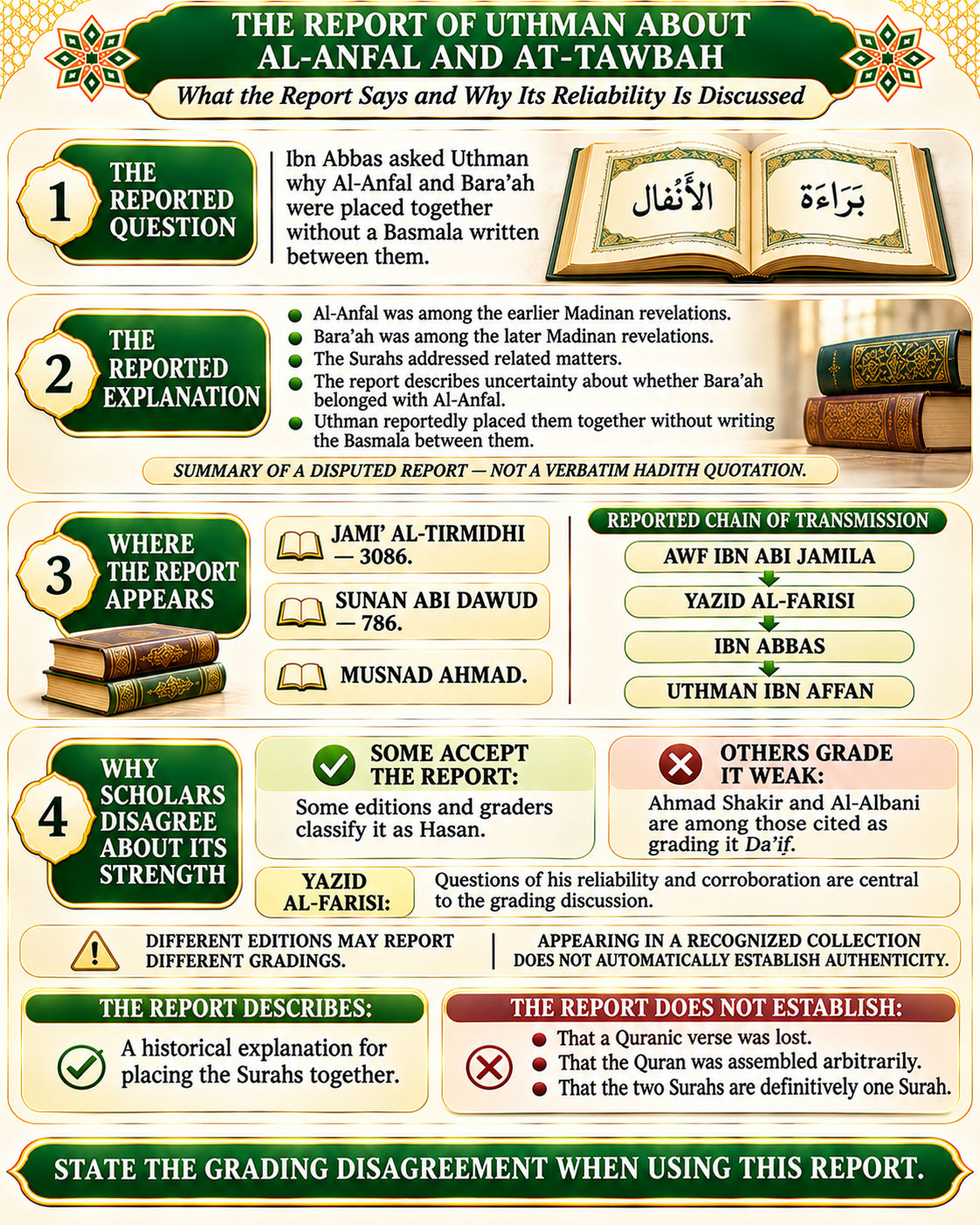
Ibn Abbas asked Uthman why he had placed Al-Anfal, one of the mathani (Surahs of fewer than a hundred verses), together with Bara'ah, one of the mi'in (Surahs of around a hundred verses or more). He also asked why Uthman had put them among the seven long Surahs without writing the Basmala between them.
In its wording, Uthman answers in these terms: when revelation came to the Prophet ﷺ, he would call one of his scribes and tell him to place the passage in a particular Surah. Al-Anfal was among the first revealed in Madinah, and Bara'ah among the last revealed. Its content resembled that of Al-Anfal, and the Prophet ﷺ passed away without clarifying whether it was part of Al-Anfal. For that reason Uthman placed them together and did not write the Basmala between them.
Where it is found
The report appears in Jami' al-Tirmidhi (no. 3086), in Sunan Abi Dawud (no. 786), and in Musnad Ahmad. The chain runs through Awf ibn Abi Jamila, from Yazid al-Farisi, from Ibn Abbas, from Uthman. Al-Tirmidhi notes that this chain is the one by which it is known.
Its reliability is disputed
The grading is mixed, so the report should not be called simply "sahih" or "fabricated." Modern editions of Tirmidhi list different assessments. Some editors grade it hasan (acceptable). Ahmad Shakir and al-Albani graded it da'if (weak). Some printed editions record a different Tirmidhi grading than others, which is one reason checking a specific edition matters.
The discussion centres on Yazid al-Farisi, who is generally described as a reliable-enough narrator when corroborated (maqbul). Critics point out that this report has no strong corroboration, which is why some graders regard the chain as weak. Those who accept it point to the chain's overall acceptability and to its wide circulation in recognized collections.
Appearance in a recognized Hadith collection is not by itself a guarantee of authenticity. If you use this report in teaching, state the disagreement.
What it would suggest if accepted
If a reader accepts the report, three points follow:
The ordering was made on the basis of what the Prophet ﷺ had taught about placement, plus Uthman's judgment in a case where the Prophet ﷺ had not stated a ruling.
The Basmala was omitted from the join between the two Surahs.
The reason given is the closeness of the Surahs' content.
What the report does not say deserves equal emphasis. It does not say the Companions doubted the Quran's authenticity, and it does not say the Surah was inserted arbitrarily. It also does not say that Al-Anfal and Bara'ah are definitively one Surah. Later writers drew some of those conclusions, but they come from interpretation, not from the report's wording.
Explanation One: The Relationship Between Al-Anfal and At-Tawbah
The first explanation links the missing Basmala to the connection between the two Surahs. Both deal with the Muslim community's circumstances of conflict, treaties, and obligations, and both address public accountability. Al-Anfal opens with matters surrounding the aftermath of Badr. At-Tawbah addresses the final phase of relations with Arabian tribes and the Tabuk expedition.
Some scholars take that closeness as the basis for treating them as adjoining units in the Mushaf. Others stress that they are separate Surahs. They point out, for example, that the Surahs differ in structure and in the occasions they address.
The distinction matters:
Thematic similarity shows that two texts relate to each other. It does not prove that they were once a single Surah.
Reports about arrangement (such as the Uthman report above) are historical claims that must be graded separately.
The question of "one Surah or two" is a separate scholarly question, and this article does not treat it as settled.
The responsible statement is: some scholars connect the omission with the closeness of Al-Anfal and At-Tawbah, and the Uthman report is the main transmitted basis for that view. It is not established that At-Tawbah is the second half of Al-Anfal.
Explanation Two: The Opening Declaration of Bara'ah
The second explanation is the one most often repeated. It links the missing Basmala with the tone of the Surah's opening.
The reasoning
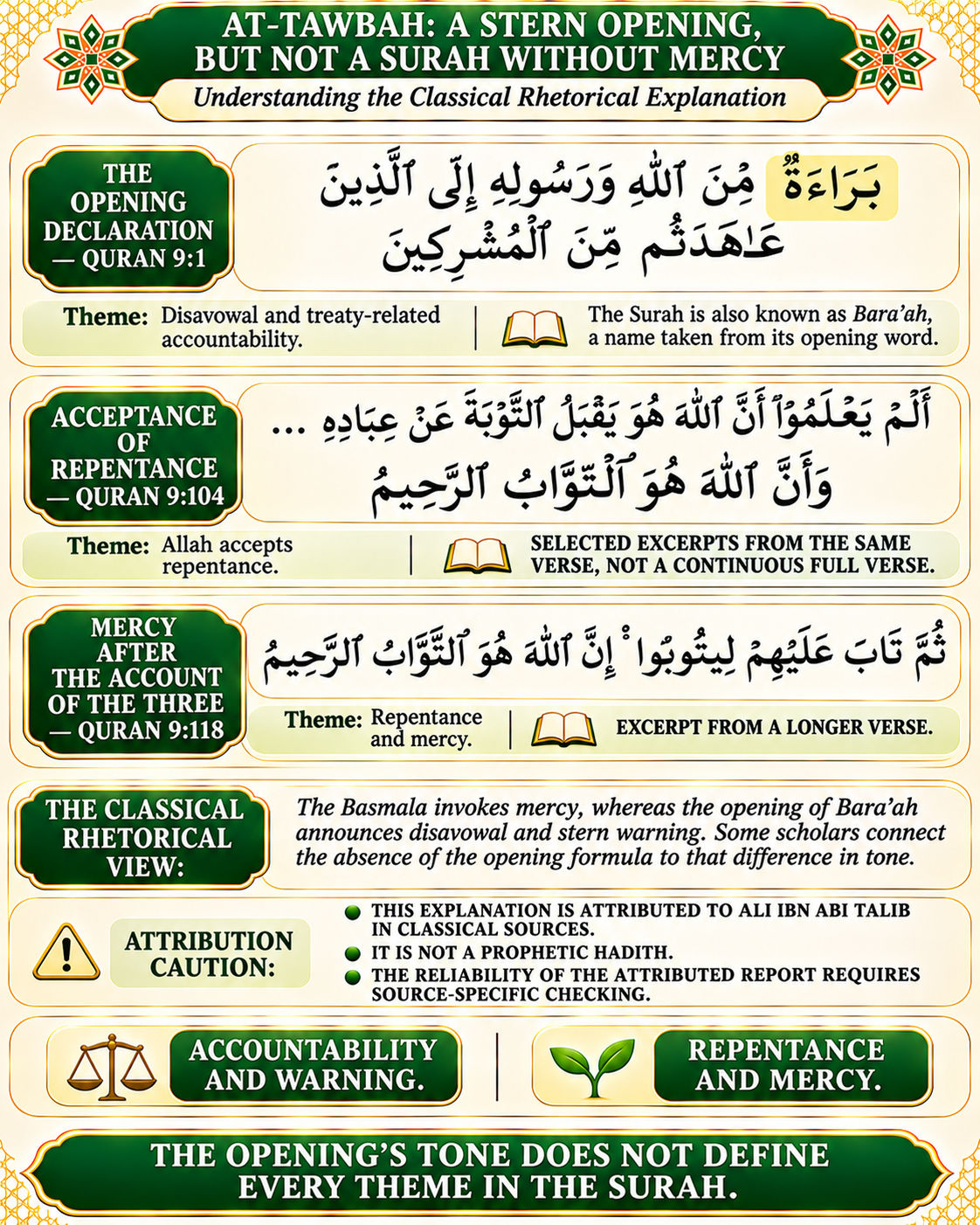
The Basmala names Allah's mercy through Ar-Rahman and Ar-Rahim. The opening of At-Tawbah announces disavowal and serious warnings toward treaty-breakers. Some scholars saw a fit between the two: a declaration of this kind would not be introduced with the formula of mercy.
The attribution to Ali
This view is commonly attributed to Ali ibn Abi Talib. Reports of it appear in sources such as al-Hakim's al-Mustadrak. They say, in meaning, that the Basmala is a statement of safety and mercy, whereas Bara'ah was revealed with the sword. Classical commentators including Ibn Kathir and al-Qurtubi relay this explanation.
Caution is needed. This is a statement attributed to Ali and relayed in tafsir works. It is not a statement of the Prophet ﷺ. The reliability of its chains has been discussed, and this article has not independently verified each chain, so anyone using it in teaching should check the grading in the source. Frequent repetition online does not make a quotation authentic. At most, it should be presented as a classical explanation attributed to Ali.
An essential qualification
None of this means the Surah lacks mercy. The Surah's own name points the other way. At-Tawbah is the Surah of repentance, and it contains passages such as:
أَلَمْ يَعْلَمُوا أَنَّ اللَّهَ هُوَ يَقْبَلُ التَّوْبَةَ عَنْ عِبَادِهِ ... وَأَنَّ اللَّهَ هُوَ التَّوَّابُ الرَّحِيمُ (Quran 9:104, excerpted)
"Do they not know that it is Allah who accepts repentance from His servants ... and that it is Allah who is the Accepting of Repentance, the Merciful?"
Quran 9:118 also describes how Allah turned toward the three Companions who stayed behind from Tabuk, and ends:
ثُمَّ تَابَ عَلَيْهِمْ لِيَتُوبُوا ۚ إِنَّ اللَّهَ هُوَ التَّوَّابُ الرَّحِيمُ
"Then He turned to them so that they might repent. Indeed, Allah is the Accepting of Repentance, the Merciful."
A rhetorical explanation for the opening explains a feature of the beginning of the Surah. It does not say that the Surah as a whole is without compassion.
Explanation Three: The Basmala Follows the Transmitted Text
A third approach is more cautious. It emphasizes that the Quran's writing and recitation are governed by transmission, not by the reader's expectation of stylistic uniformity. On this view, the Mushaf is written as it was received and arranged, and the absence of the Basmala before Surah At-Tawbah is part of what was received.
This position does not offer a story about why. It says that the established text is the starting point, and that the exact historical cause is not recoverable with certainty from authenticated evidence.
It also marks what cannot be claimed:
There is no authenticated statement of the Prophet ﷺ that explains the omission.
There is no authenticated evidence that the Prophet ﷺ ordered the removal of a previously revealed Basmala.
A historical reconstruction should not be presented as if it were a transmitted narration.
Did Surah At-Tawbah Originally Have Bismillah?
Readers often ask this directly. The honest answer requires separating several questions:
Is the Basmala part of the transmitted opening of a Surah? For Surah At-Tawbah, the transmitted text has none.
Is the Basmala a separator? Many scholars understood the Basmala before a Surah as marking the start of a new Surah. Where a Surah is joined to the previous one, no separator is written.
How were the Surahs arranged? That is a historical question, and the Uthman report is relevant to it (with the grading caveat above).
What is the status of the Basmala in recitation? That is a question of Qira'at and jurisprudence.
What cannot be claimed: that an original verse has been lost, that the Basmala was physically erased, or that a manuscript discovery shows otherwise. Early Quran manuscripts can tell us about writing conventions in their time. They do not by themselves settle the question of why a particular Surah has no opening Basmala. Any manuscript-based claim should come from verified academic work and be stated within its limits.
Can You Say Bismillah Before Reciting Surah At-Tawbah?
This is a recitation question, not a question of permissibility in the sense of sin. Practices here come from the Qira'at (the recognized modes of recitation) and from Tajweed scholarship. The details vary among authorities, so confirm specifics with a qualified teacher. The guidance below is general.
First, two terms. Isti'adhah is the phrase "A'udhu billahi min ash-shaytan ir-rajim" (I seek refuge in Allah from the accursed Satan), said before recitation. Waqf is stopping, and ibtida' is beginning.
Scenario 1: Starting from the first verse of At-Tawbah
The widely taught position is to recite Isti'adhah and begin directly with "Bara'atun min Allah..." without the Basmala. Some Qira'at works discuss other views, but the mainstream teaching is to omit the Basmala here.
Scenario 2: Starting from a later verse
Starting from within the Surah, such as from verse 5 or verse 104, is treated like starting from the middle of any Surah. Isti'adhah is recited, and the Basmala is generally regarded as permitted.
Scenario 3: Continuing from the end of Al-Anfal into At-Tawbah
Qira'at scholarship describes recognized ways of joining the two Surahs without reciting a Basmala. The commonly described options are:
Waqf: stopping at the end of Al-Anfal, then beginning At-Tawbah.
Saktah: a brief pause without taking a breath.
Wasl: joining the two directly, with no Basmala.
Which option a reciter uses depends on the reading they have studied. I have not listed the specific technical form for each, because these should be learned by listening to a qualified teacher, not copied from an article.
Scenario 4: Starting a reading session with At-Tawbah
This is the same as Scenario 1. Say Isti'adhah, then begin at "Bara'ah."
These are recitation conventions. They are not rulings that an act is forbidden or invalid, and this article does not declare any of them so. Where a question matters to your own practice, ask a teacher trained in Qira'at.
Why Is Bismillah Found Inside Surah An-Naml?
Quran 27:30, quoted above, records the Basmala as part of Sulayman's letter to the Queen of Sheba. In that verse it is Quranic content: words quoted from a letter.
That is a different matter from the written opening formula before a Surah. The two facts are separate. The internal Basmala in An-Naml is not a replacement or a "balance" for the missing one in At-Tawbah. Some popular claims count the Basmalas across the Quran and propose a numerical balance. Those depend on counting conventions that scholars treat differently, and they rest on pattern-finding rather than on textual or transmitted evidence. This article does not rely on them.
What This Teaches Us About Quranic Sciences
A simple question exposes how many disciplines are involved:
Quranic text: what the Mushaf contains.
Transmission: how it was handed down in writing and recitation.
Mushaf arrangement: how the Surahs were ordered.
Historical reports: such as the Uthman narration, each with its own grading.
Tafsir: classical commentary.
Linguistic interpretation: the meaning of Bara'ah and the Basmala's phrasing.
Recitation practice: Qira'at and Tajweed.
A confident single-sentence answer on social media usually flattens all of this. Scholarly disagreement on the reason does not make the Quran unreliable. The text is not in doubt. What scholars discuss is why a feature of the text is the way it is. The explanations also do not all carry equal evidentiary weight. A transmitted report with a disputed chain, a rhetorical explanation attributed to Ali, and a general point about transmission are different kinds of evidence.
A Practical Way to Study Surah At-Tawbah Responsibly
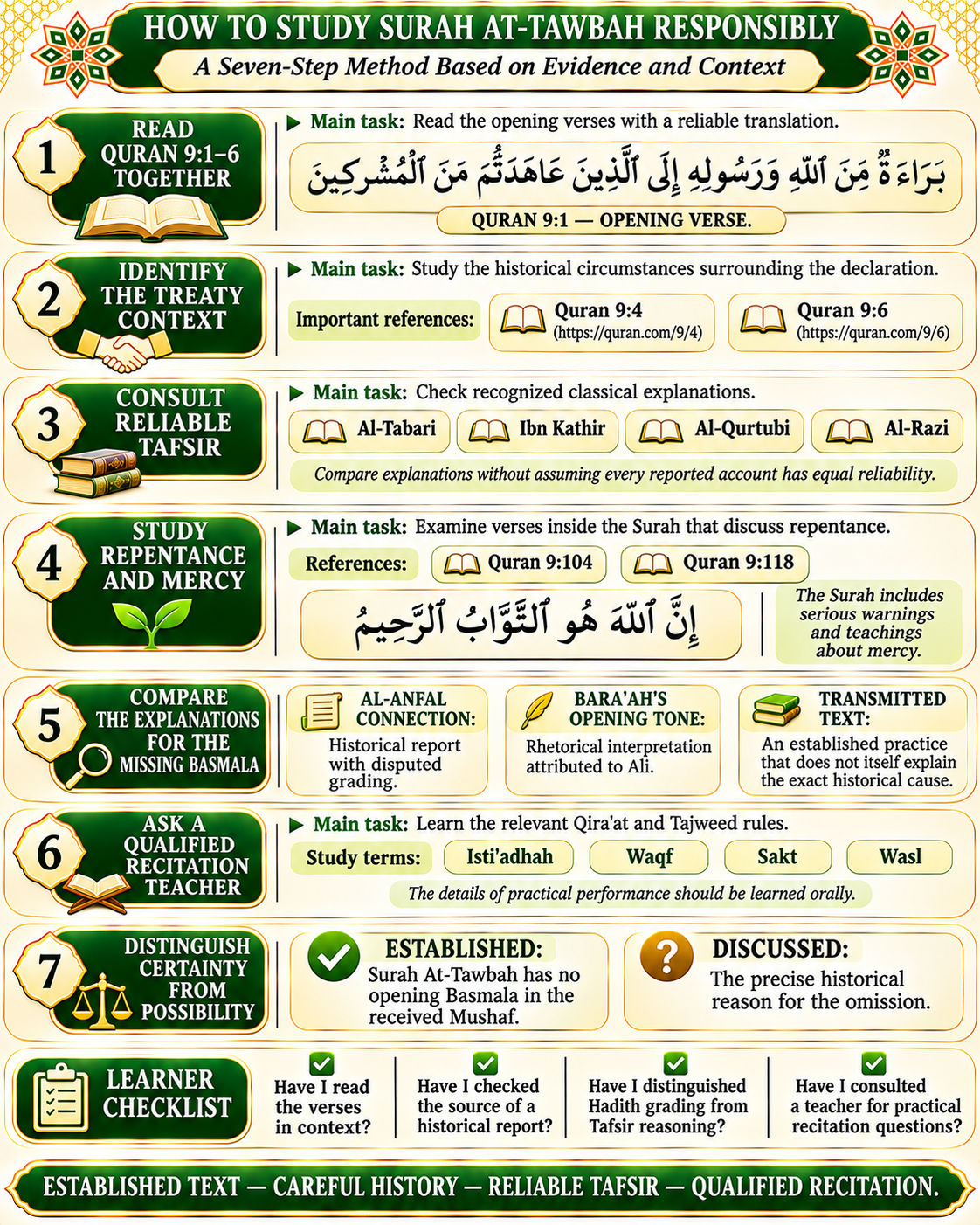
Read Quran 9:1–6 with a reliable translation.
Identify the specific treaty-related context of the opening.
Read recognized Tafsir, such as al-Tabari, Ibn Kathir, al-Qurtubi, and al-Razi.
Examine how the Surah discusses repentance and mercy.
Compare the explanations for the missing Basmala and note which are transmitted reports and which are reasoning.
Ask a qualified recitation teacher about practical questions.
Keep established facts separate from interpretive possibilities.
Studying Quranic Arabic helps you see why bara'ah and tawbah are chosen words. Tafsir gives the historical setting, and Tajweed lets you apply the recitation conventions accurately. Araby Academy's personalized lessons in Quran, Tajweed, and Islamic studies are one way to work through these questions with a teacher.
Comparison of the Explanations
Explanation | Main idea | Type of evidence | Important qualification |
|---|---|---|---|
Al-Anfal and At-Tawbah relationship | The Surahs were placed together, so no Basmala was written between them | Report of Uthman and Ibn Abbas (Tirmidhi, Abu Dawud, Ahmad) plus thematic closeness | The report's grading is disputed; thematic similarity does not prove the Surahs were once one |
Opening declaration of Bara'ah | The Basmala signals mercy, while the opening announces disavowal | Statement attributed to Ali, relayed in tafsir and Hadith works; rhetorical reasoning | Chains need checking; does not mean the Surah lacks mercy (see 9:104, 9:118) |
Transmission | The text is written as it was received | General principles of Quranic transmission | Does not offer a specific historical reason |
Numerical or "balancing" theories | An internal Basmala in An-Naml compensates | Counting patterns | Not based on textual or transmitted evidence; not relied on here |

Frequently Asked Questions
Why does Surah At-Tawbah not begin with Bismillah?
It is transmitted and written without an opening Basmala. Classical scholars offer several explanations, including its relationship with Al-Anfal and the nature of its opening declaration. The fact is established, and the exact reason is discussed.
Is Surah At-Tawbah the only Surah without an opening Bismillah?
Yes. In the standard Mushaf it is the only Surah that opens without the Basmala.
Did the Prophet ﷺ explain why Bismillah is absent?
No authenticated statement of the Prophet ﷺ explaining the omission is established. The Uthman report itself says the Prophet ﷺ did not clarify the Surah's relationship to Al-Anfal.
Is Surah At-Tawbah part of Surah Al-Anfal?
Not as an established fact. Some scholars discuss their closeness, but the Mushaf presents them as separate Surahs.
Can I say Bismillah before reading Surah At-Tawbah?
At the start of the Surah, the mainstream teaching is Isti'adhah without the Basmala. From the middle of the Surah, the Basmala is generally treated as permitted. Check specifics with a Qira'at teacher.
Does Surah At-Tawbah contain verses about Allah's mercy?
Yes. For example, Quran 9:104 and 9:118 emphasize Allah as At-Tawwab Ar-Rahim, the Accepting of Repentance, the Merciful.
Was Bismillah removed from Surah At-Tawbah?
That is not established. No authenticated evidence shows removal of a verse. The transmitted text has no opening Basmala here.
What is the difference between Surah At-Tawbah and Surah Bara'ah?
Nothing. They are two names for the same Surah.
Conclusion
The absence of the opening Basmala in Surah At-Tawbah is an established feature of the transmitted Mushaf. The precise explanation has been discussed through historical reports, textual considerations, and scholarly interpretation. Each of those has a different strength of evidence. Reducing the matter to a single oversimplified claim loses that distinction.
The Surah itself carries both serious warnings and powerful teachings on repentance and Allah's mercy. A missing opening formula does not remove either. The best way to understand it is through reliable Tafsir and its historical context. If you would like to study Quran, Tajweed, and Islamic sciences with a teacher, Araby Academy offers live one-to-one lessons.