"Time for Quran class, habibi."
"Do I have to? Quran lessons are so boring."
Your stomach tightens. Maybe you feel disappointed, or worried, or a little hurt. A thought follows quickly: Does my child dislike learning the Quran? Did I do something wrong? Should I insist?
Take a breath. When a child says Quran lessons are boring, that is not automatically a rejection of the Quran, a sign of weak faith, or disrespect. It is information about the learning experience.
The short, practical answer: stay calm, ask what specifically feels boring, and work out whether the cause is the lesson format, the level, the teacher, tiredness, or something emotional. Then make one targeted adjustment while keeping a respectful, sustainable routine. No single technique makes every child love Quran lessons, but a thoughtful response usually improves things.
What Does "Quran Lessons Are Boring" Actually Mean?
Children use "boring" as a catch-all. It can describe very different experiences:
The lesson is too easy, or too hard.
They don't understand what they are reciting.
They feel embarrassed about mistakes.
The method is repetitive, or the lesson is longer than their current capacity.
They are tired after school.
They can't see any progress.
They rarely get to participate.
They don't connect with the teacher.
They feel rushed to memorize, or associate the lesson with criticism.
They don't see why it matters.
The lesson cuts into rest or play.
Occasionally, a broader learning or emotional difficulty is involved.
Most complaints are ordinary. A child who groans on a Tuesday after a long school day is not necessarily anxious, and a teacher who gets a "boring" is not necessarily poor. One complaint is not a diagnosis.
What matters is the pattern. Occasional grumbling that fades once the lesson starts is very different from persistent dread, stomachaches before class, tears, or a sudden change in a child who used to enjoy it. The first calls for curiosity. The second calls for closer attention (see Sections E and H).
The First Thing to Say When Your Child Complains
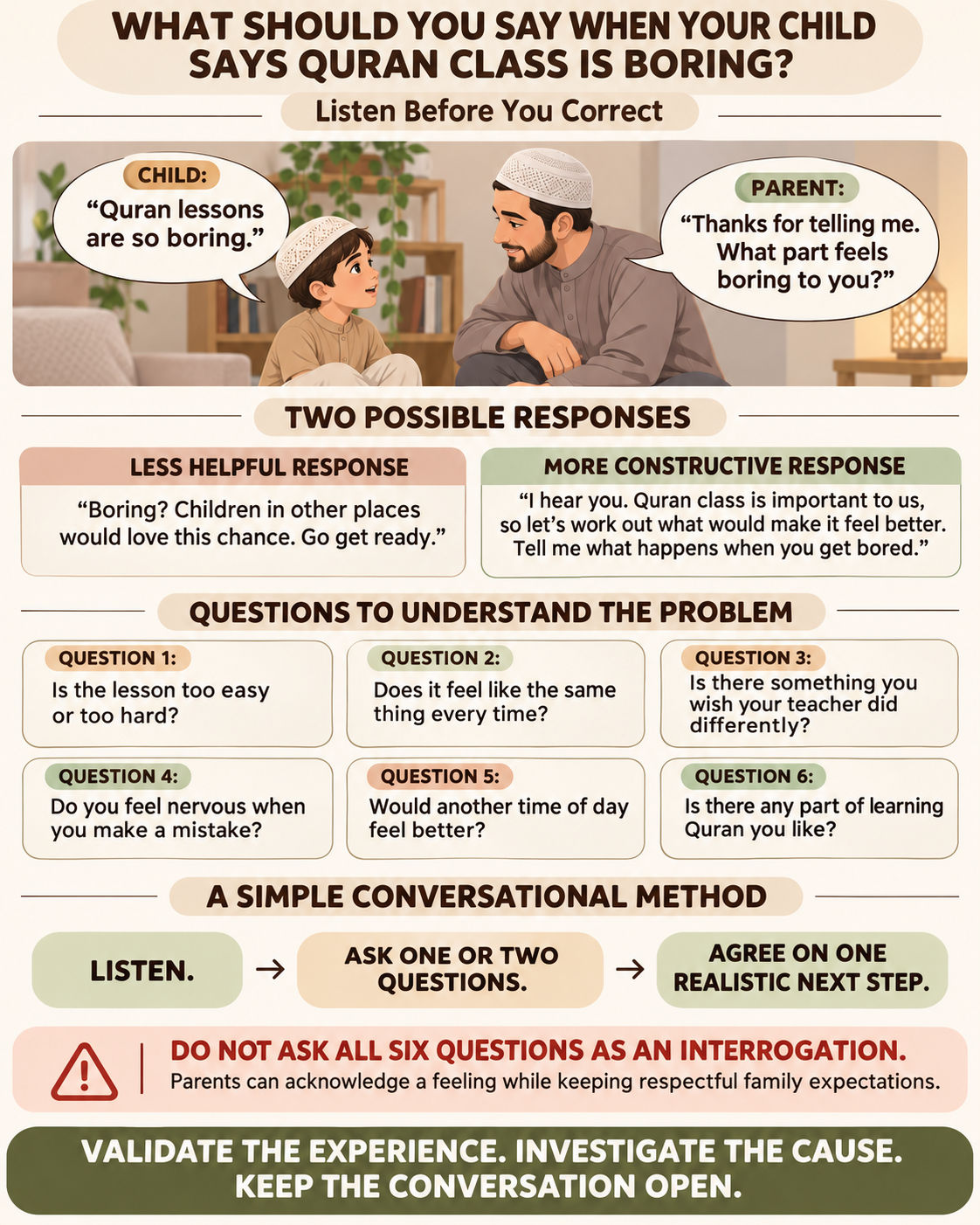
Start with listening. A simple opener works well:
"Thanks for telling me. What part feels boring to you?"
Then choose one or two follow-ups, not all of them at once:
"Is the lesson too easy or too hard?"
"Does it feel like the same thing every time?"
"Is there something you wish your teacher did differently?"
"Do you feel nervous when you make a mistake?"
"Would another time of day feel better?"
"Is there any part of learning Quran you like?"
Some principles help. Listen before you correct. Use open questions rather than interrogation. Don't dismiss the feeling, and don't promise to change everything. You can acknowledge the complaint while still holding the boundary that Quran learning matters in your family.
An unhelpful response: "Boring? Children in other places would love this chance. Go get ready."
A more constructive one: "I hear you. Quran class is important to us, so let's work out what would make it feel better. Tell me what happens when you get bored."
Feeling frustrated in the moment doesn't make you a bad parent. It means you care. Pause, then try again calmly.
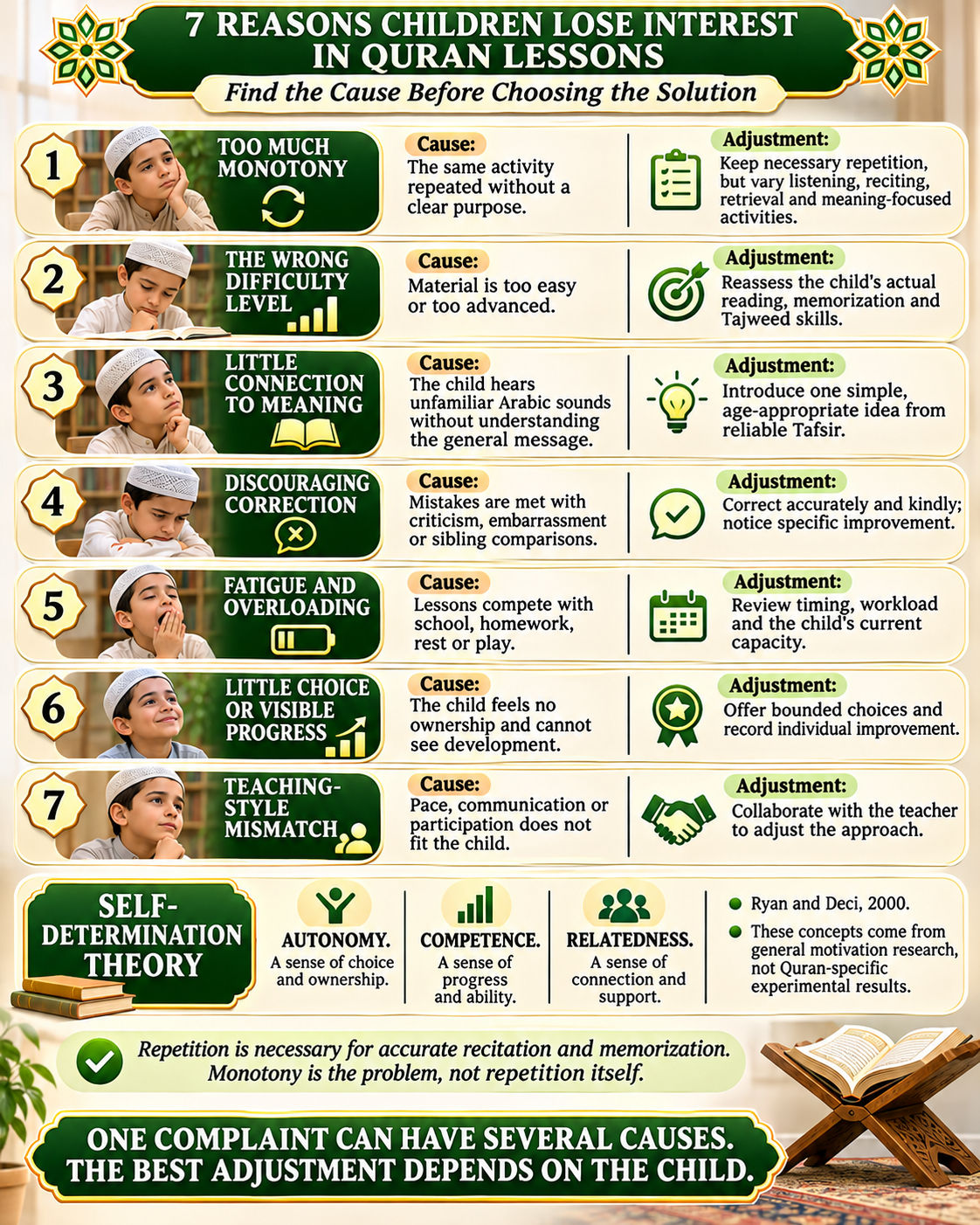
Seven Common Reasons Children Lose Interest in Quran Lessons
1. The lesson is too repetitive
Repetition is not the enemy. Pronunciation and memorization genuinely require it. The problem is monotony: saying the same lines the same way, with no sense of purpose.
Keep the revision, but vary how it happens. A child might listen first, then recite, then identify a word they recognize, then recite again for the teacher. Retrieval practice (recalling material rather than only re-reading it) and spacing review over time are well supported in general learning research (Roediger & Karpicke, 2006; Cepeda et al., 2006). Those studies were not conducted in Quran classes, but the principle sensibly applies to revision.
2. The level is wrong
Material that is too advanced produces frustration. Material that is too easy produces yawning. Both get described as "boring."
Ask the teacher for a clear picture of the child's current reading, memorization, and Tajweed level, and whether the lesson matches it. The goal is a task that stretches the child a little without overwhelming them. (For a gentle overview of how Tajweed develops, see Araby Academy's Tajweed for Beginners.)
3. The child doesn't understand what they are learning
A child reciting unfamiliar Arabic sounds with no idea what they mean may feel like they're performing, not learning.
A short, age-appropriate explanation of the general meaning of a Surah can change that. Understanding complements accurate recitation. It does not replace it, and a child does not need to understand every word before reciting.
4. The child feels criticized or afraid of mistakes
Correction is essential in Quran learning. But correction without any encouragement can make a lesson feel like a series of failures. There is a real difference between "Let's fix that sound together" and a sigh, a raised voice, or a comment about a sibling who "already knows this."
Teachers can pair each correction with something specific that went well. Parents can avoid reacting with embarrassment when a child makes mistakes at home.
5. Lessons compete with fatigue, schoolwork, and play
A child who has been at school all day and then has homework may have little left. Timing, rest, and the family's weekly rhythm matter.
There is no universally ideal lesson length, and anyone who gives you an exact formula is overstating the science. Observe your own child: when are they most alert, and how long can they stay engaged before the quality drops?
6. The child has little choice or sense of progress
Children (and adults) tend to engage more when they feel some ownership and can see themselves improving. Self-determination theory, developed by Edward Deci and Richard Ryan, describes autonomy, competence, and relatedness as basic psychological needs that support motivation (Ryan & Deci, 2000). This is general psychology research, not a Quran-specific finding, but it translates into practical steps: offer bounded choices and make progress visible.
7. The teaching style doesn't fit the child
Fit involves pace, how much interaction there is, how explanations are given, how the teacher communicates, how the lesson is structured, and how responsive the teacher is to the child's signals. A mismatch doesn't mean the teacher is incompetent. A wonderful teacher for one child can be a poor fit for another. Treat the teacher as a partner in solving the problem, not as the default culprit.
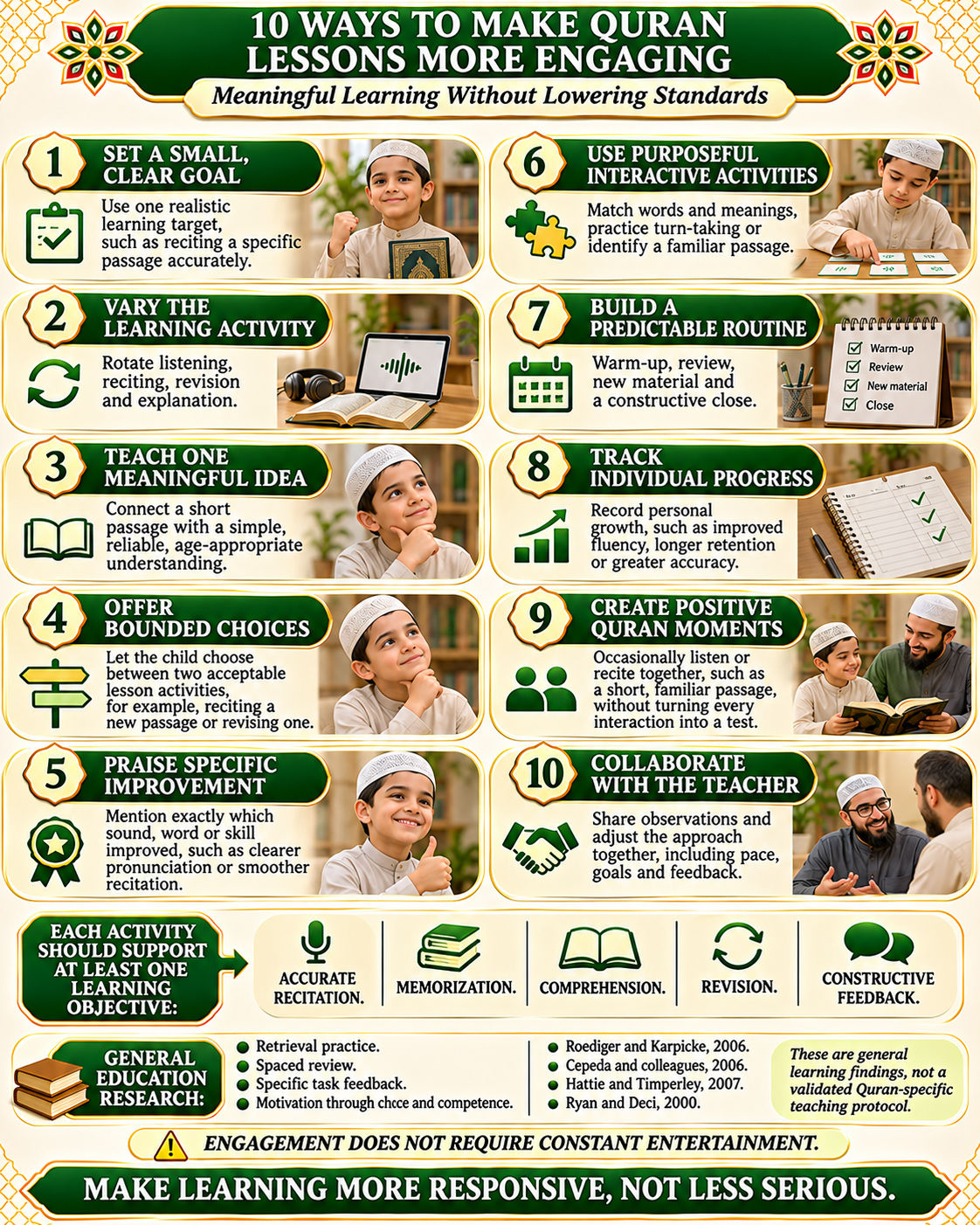
Ten Ways to Make Quran Lessons More Engaging
The aim is sustainable engagement with meaningful learning. It is not entertainment, and enjoyment is not the only measure of a good lesson.
1. Make the goal small and clear
What to do: Agree on a short, specific target for the week, such as reading three lines accurately or memorizing the first part of a Surah.
Why it helps: A clear, reachable goal gives a sense of competence.
Example: "This week we'll make the first four verses really smooth."
Caution: Avoid universal memorization targets. They ignore differences in age, ability, and school load.
2. Change the activity, not the importance of the Quran
What to do: Rotate through listening, reciting, reviewing, reading, discussing meaning, recognizing familiar words, and teacher-guided correction.
Why it helps: Variety keeps attention without lowering standards.
Example: Ten minutes of review, five minutes of new reading, and five minutes on one word's meaning.
Caution: Variation should support the learning goal. If it only fills time, it distracts.
3. Let the child understand one meaningful idea
What to do: Pick a short passage from a familiar Surah and explain one idea in simple language, based on a reliable tafsir or your teacher's guidance.
Example: In Al-Fatihah, the opening verse (1:2) begins with al-hamd, praise of Allah. A teacher might explain that we say alhamdulillah when we are thankful and invite the child to name something they're thankful for.
Caution: Keep it faithful to what scholars explain. Don't turn a verse into a personal moral slogan or a lever to pressure behavior.
4. Offer limited choices
What to do: Give real but bounded options.
Example: "Would you like to revise the first passage or the second one first?" or "Shall we practice reading before memorization today?"
Caution: Don't offer choices you can't honor, and don't offer "Do you want to do Quran today?" if the answer is not up for negotiation.
5. Celebrate effort and specific improvement
What to do: Name exactly what improved.
Examples: "Your pronunciation of that word was clearer today." "You remembered the beginning without my help." "You stayed patient while we fixed that difficult sound."
Why it helps: Specific feedback tells a child what to repeat. Research on feedback emphasizes that information about the task and how to improve is more useful than generic praise (Hattie & Timperley, 2007).
Caution: Avoid exaggerated praise and never compare siblings.
6. Use age-appropriate interactive activities
What to do: Try matching Quranic words with meanings, listening and identifying a familiar verse, short review challenges, turn-taking recitation, teacher-guided word recognition, and brief reflection questions.
Caution: Games must serve a learning objective. Not every lesson needs to be gamified, and entertainment should never replace recitation practice.
7. Build a predictable but flexible routine
What to do: Keep lessons at consistent times and give each session a familiar shape: warm-up, review, new material, a positive close.
Why it helps: Predictability lowers resistance. Consistency does not require rigid daily pressure. A family that manages a steady routine most days usually does better than one that attempts an ambitious schedule and collapses. Our guide to building a daily Quran habit has practical ideas that work for families too.
8. Involve the child in tracking progress
What to do: Keep a simple visual record: Surahs studied, pronunciation improvements, revision completed, new words understood, and a personal goal.
Caution: A chart should show growth, not rank children or shame anyone. If it becomes a competition, put it away.
9. Create positive Quran moments outside formal lessons
What to do: Listen to a favorite reciter together, recite a familiar Surah as a family, or talk briefly about a short verse and everyday kindness.
Caution: Not every family interaction should become a test. If your child feels quizzed every time the Quran is mentioned, the warmth disappears.
10. Work with the teacher to adjust the experience
What to do: Share specific observations about pace, teaching style, review load, correction approach, participation, and goals.
A sample message to a teacher:
Assalamu alaikum. Thank you for teaching [Name]. I wanted to share something I've noticed: lately [he/she] has been saying the lessons feel boring and seems reluctant before class. I'd like to understand what might help. Could we talk about whether the pace and level are right, and whether we could vary the activities a little or build in more encouragement? I'd appreciate your view on what you're seeing in the lessons too.
Why it helps: The teacher sees what you don't, and you see what the teacher doesn't. Collaboration beats blame.
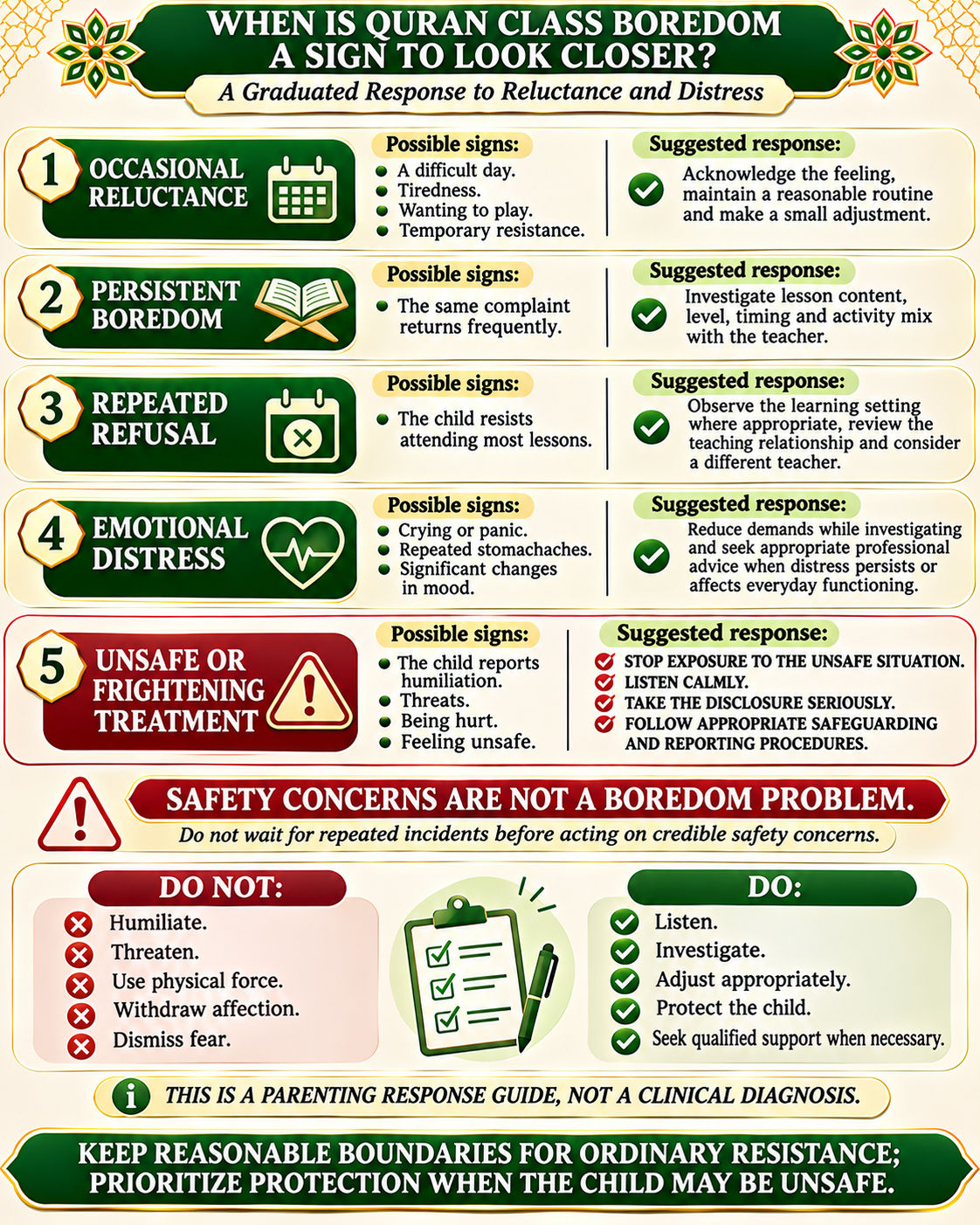
What If Your Child Refuses to Attend Quran Class?
Not all reluctance is the same. It helps to place what you're seeing on a spectrum:
Occasional reluctance: a bad day, tiredness, a competing activity.
Persistent boredom: the complaint keeps coming back with similar details.
Repeated refusal: the child resists going most of the time.
Emotional distress: crying, panic, stomachaches, withdrawal, or marked changes in mood.
Fear of the teacher: the child describes being scared, humiliated, or treated harshly.
Overwhelming pressure: school, family, or other demands have crowded out everything else.
A graduated response:
Occasional reluctance: keep the routine, adjust the activity, and acknowledge the feeling.
Persistent boredom: shorten or reschedule lessons, reassess goals, and talk to the teacher.
Repeated refusal: observe the lesson where appropriate (many online platforms let a parent sit in), review the teaching environment, and consider a different teacher.
Emotional distress: temporarily reduce demands while you investigate, and consider professional guidance if distress is persistent or affects other areas of life.
What not to do: Do not use punishment, humiliation, threats, or physical force. Do not withdraw affection. These responses teach a child to associate the Quran with fear and make honest communication less likely.
Safety comes first. If a child reports being frightened, humiliated, hurt, or treated in any unsafe way, treat it as a safeguarding matter, not a boredom problem. Stop their exposure to the situation, listen calmly, believe them enough to act, and follow appropriate safeguarding and reporting procedures. Do not wait for it to happen repeatedly, and do not ask them to endure it for the sake of continuity.
What If the Child Likes Games but Dislikes Memorization?
This is common, and it isn't laziness. Games deliver immediate feedback and rewards. Memorization is effortful and its payoff is delayed. These feel different, and it is normal for a child to prefer the first.
Entertainment should not replace memorization, and some challenging practice is a normal part of learning. What you can do is make the effort more manageable:
Use shorter practice segments.
Set clear, small goals.
Give meaningful, specific feedback.
Vary revision methods (recite, listen, fill in a missing word, recite to a parent).
Build skills gradually.
Our guide on how to memorize the Quran covers revision systems in more depth, including how to avoid moving forward too fast.
What If the Child Is Learning Quran in a Language They Don't Understand?
Many children whose home language is English or another non-Arabic language face several challenges at once: unfamiliar sounds, an unfamiliar script, unfamiliar vocabulary, little access to meaning, and, sometimes, lower confidence and a pace that outstrips their comprehension.
Fluent Arabic is not a prerequisite for beginning Quran recitation. A child doesn't have to master Classical Arabic before learning short Surahs. But parallel support helps: basic Arabic literacy, frequent Quranic vocabulary, and short, simple explanations of what is being recited. Gradually, the sounds start to feel like language, not just noise. Pace matters here, and a teacher who understands second-language learners can make a big difference.
What If the Child Used to Enjoy Quran Lessons but Suddenly Stopped?
A sudden change deserves careful attention. Possible factors include a heavier school workload, a new teacher, increased difficulty, family stress, peer experiences, a discouraging incident in class, or tiredness.
Notice patterns. When did it start? What changed around then? Does the reluctance appear only before Quran class or in other areas as well? Ask gently what has changed, without suggesting an answer.
You are not diagnosing anything here. If distress is persistent, significant, or affects several areas of life (sleep, appetite, school, friendships), seek appropriate professional guidance from a pediatrician, school counselor, or child mental health professional. For a related perspective, see our article on why some children memorize Quran but slowly lose their love for it.
Should You Change the Quran Teacher?
A change may be worth considering when:
The child consistently struggles to connect.
The pace stays unsuitable despite discussion.
Feedback is persistently discouraging.
Communication with the teacher doesn't improve.
The child experiences ongoing fear or humiliation.
The teacher cannot reasonably adapt to the learner's needs.
One difficult lesson is not enough reason. Normal correction and ordinary learning challenges differ from harmful teaching. Impulsively switching teachers without understanding the problem can simply move the problem to a new setting.
For credible safety concerns, protection comes first. Do not wait for repeated incidents.
A checklist for a child-focused Quran teacher:
Accurate recitation and sound Tajweed knowledge.
Patience and a warm manner with children.
Corrects errors kindly and notes strengths.
Adjusts pace, level, and activities to the individual child.
Communicates clearly and regularly with parents.
Explains meaning at an appropriate level.
Sets realistic goals and tracks progress.
Welcomes parent feedback and questions.
How to Adapt Quran Learning to Different Ages
These are flexible examples, not developmental rules. Children differ in readiness, attention, language proficiency, learning needs, and interests, and there is no reliable formula for how long a child of a given age can concentrate.
Approximately 5 to 7: Warm teacher interaction, familiarity with sounds, short activities, positive participation, gentle correction, and a patient pace.
Approximately 8 to 11: Clear goals, growing independence, reading development, visible progress, age-appropriate comprehension, and interactive review.
Approximately 12 to 15: Respectful communication, more autonomy, personal goals, attention to meaning, realistic schedules, and collaborative planning. Teenagers often respond better to being consulted than managed.
Teaching Children to Love the Quran Without Guilt or Fear
Islamic teaching offers a strong foundation for a gentle, respectful approach to instruction. Here are some sources, with the context they deserve.
Quran 16:125 instructs: "Invite to the way of your Lord with wisdom and good instruction, and argue with them in a way that is best." The verse concerns calling people to Islam, but scholars draw from it a broader principle: wisdom and good manner are the right tools for teaching.
Quran 20:44 has Allah telling Musa and Harun to speak to Pharaoh with gentle speech. The context is specific, addressing a tyrant. But the principle that gentle speech is chosen even in difficult situations is a reasonable lesson for how we speak to our own children. This is an application, not a direct ruling about parenting.
Sahih al-Bukhari 5027: "The best among you are those who learn the Quran and teach it" (narrated by Uthman, may Allah be pleased with him).
Sahih Muslim 2593: The Prophet ﷺ said, in the narration of Aisha, that gentleness adorns whatever it is found in, and is never removed from something without making it worse.
Sahih al-Bukhari 69: "Make things easy and do not make them difficult; give glad tidings and do not make people run away" (narrated by Anas, may Allah be pleased with him). This is general guidance on facilitating rather than burdening.
Sahih al-Bukhari 4937: The one who recites the Quran with difficulty, struggling through it, receives a double reward (narrated by Aisha). This is deeply reassuring for a child who finds reading hard.
(Hadith numbering can differ slightly between editions, so check against the edition you use.)
These are the scriptural foundations. Applying them to modern parenting is our interpretation, not a direct text. Islamic education can combine love, respect, patience, consistency, appropriate expectations, kind correction, personal example, and responsibility. Children may feel frustration at times, and appropriate boundaries are not coercion. The goal is not to make the Quran entertaining. It is to make learning sustainable and meaningful.
What Parents Should Avoid
Most of these come from good intentions and worry. Here is why they tend to backfire.
Comparing siblings. It creates resentment and teaches children that worth depends on rank.
Shaming mistakes. Fear of error makes children avoid trying.
Threatening punishment for ordinary struggles. Difficulty isn't defiance.
Using religious guilt to silence questions. Children need to feel safe asking.
Demanding unrealistic memorization targets. They set children up to feel they are always failing.
Treating every complaint as disobedience. You miss useful information.
Ignoring fatigue. A tired child learns poorly.
Dismissing fear. If a child says they're scared, take it seriously.
Changing teachers impulsively. Understand the problem first.
Over-rewarding. Heavy rewards can overshadow the meaning of the task. This is a recognized concern in motivation research (Ryan & Deci, 2000), though small, occasional celebrations are fine.
Making Quran learning a constant performance. Constant showing-off turns learning into pressure.
One parenting mistake does not cause lifelong religious disengagement, and learning difficulties are not all your fault. Adjust, and keep going.
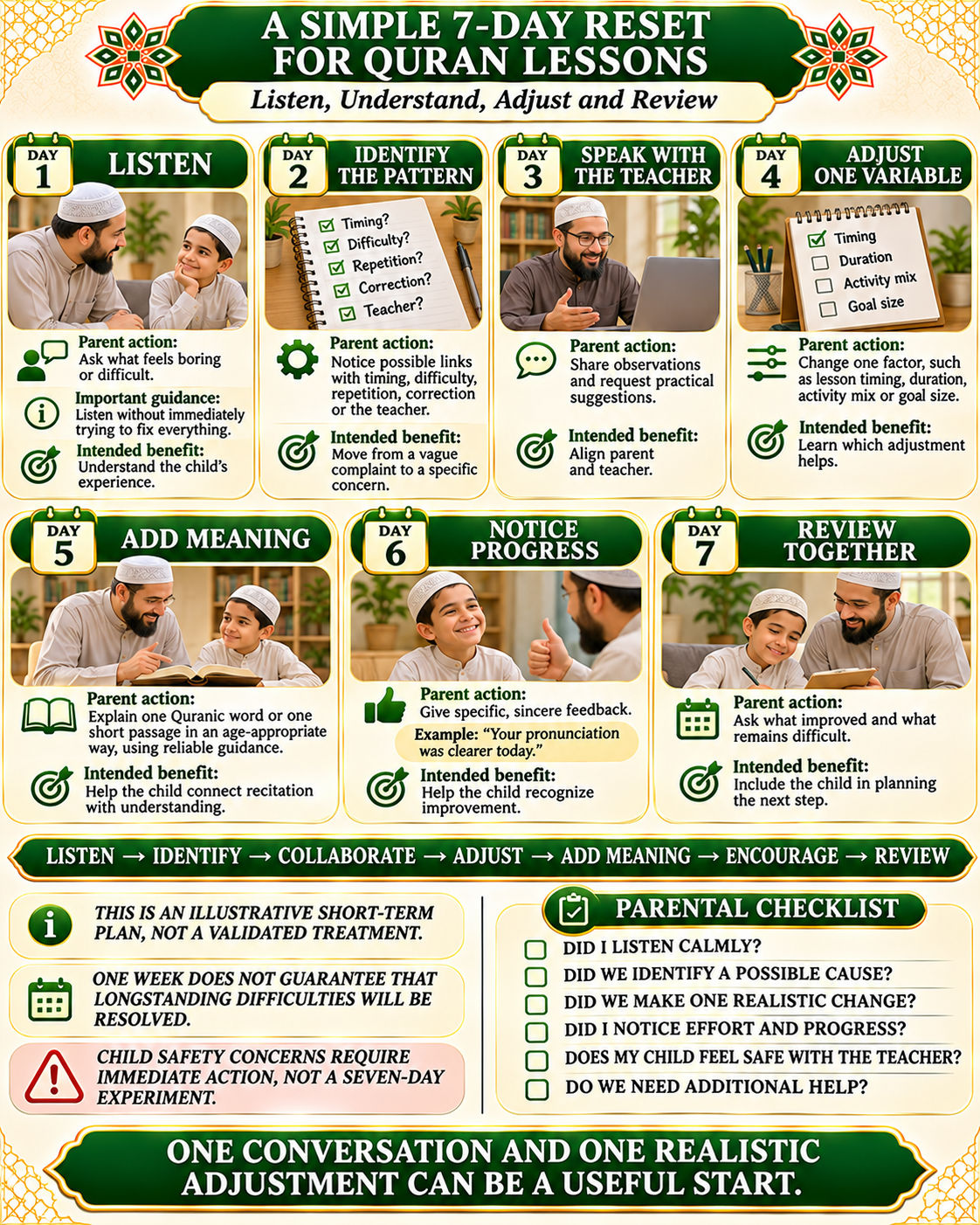
A Simple Seven-Day Reset
This is a short-term plan to investigate and improve the experience, not a guarantee of lasting change.
Day | Parent action | Intended benefit |
|---|---|---|
1. Listen | Ask what feels boring or difficult. Listen without fixing. | Your child feels heard and you gather information. |
2. Identify the pattern | Notice whether it relates to timing, difficulty, repetition, correction, or the teacher. | Moves from a vague complaint to a specific cause. |
3. Speak with the teacher | Share your observations and ask for practical adjustments. | Aligns parent and teacher. |
4. Adjust one variable | Change one thing: time of day, lesson length, activity mix, or goal size. | Lets you see what actually helps. |
5. Add meaning | Briefly discuss one Quranic word or short passage at your child's level. | Builds a connection between sounds and meaning. |
6. Notice progress | Give specific, sincere feedback about effort or improvement. | Builds a sense of competence. |
7. Review together | Ask what improved and what is still hard. | Keeps your child involved and shows next steps. |
Adapt the plan to your child's age and needs. One week may not resolve longstanding difficulties, and the plan shouldn't become another source of pressure. If there are serious safety concerns, act immediately instead of running an experiment.

Frequently Asked Questions
Why does my child find Quran lessons boring?
There is rarely a single reason. Common causes include repetition, a mismatched level, not understanding what is being recited, fear of mistakes, tiredness, and little sense of progress. Ask your child specific questions to find out which applies.
What should I say when my child says Quran class is boring?
Something like: "Thanks for telling me. What part feels boring?" Listen first, then problem-solve together.
Should I force my child to attend Quran lessons?
Maintaining a reasonable routine is part of parenting, and one complaint is not grounds to cancel. But force, threats, and punishment are counterproductive. Investigate the cause, adjust, and keep expectations respectful. If a child shows real fear or distress, pause and look into it.
What if my child refuses to memorize the Quran?
Check whether the goal is too large, revision is too repetitive, or the child feels pressure. Try smaller targets, varied revision, and more encouragement. Memorization can also wait while reading and understanding develop.
How long should Quran lessons be for children?
There is no scientifically established universal length. Observe your child's engagement and discuss pacing with the teacher. Shorter, focused sessions often work better than long, tiring ones for many children, but needs vary.
How can I motivate my child without bribing them?
Use specific encouragement, visible progress, bounded choices, and shared meaning. Occasional small celebrations are fine, but avoid making rewards the main reason for learning.
What if my child becomes anxious before Quran class?
Don't dismiss it. Ask calmly what worries them, talk with the teacher, and check for fear of mistakes or harsh treatment. If anxiety persists, seek professional guidance, and if the child describes unsafe treatment, prioritize their safety.
Can online Quran lessons keep children engaged?
They can, especially when lessons are live, one-to-one, and adapted to the child. A teacher who responds to the child in real time can vary activities and adjust pace. Screen fatigue is real, so keep sessions suitable for the child's age. For a broader overview, see our guide to learning Quran online.
Conclusion
A child saying Quran lessons are boring does not automatically mean they dislike the Quran. The most useful response is to understand the learning difficulty, keep communication respectful, and make appropriate changes.
You don't need to fix everything at once. Begin with one conversation and one realistic adjustment. Effective Quran education brings together accurate instruction, patient correction, appropriate challenge, meaningful progress, consistency, encouragement, and a positive relationship between teacher and student.
If you'd like to explore a more individualized approach, Araby Academy offers live one-to-one Quran lessons for children, with age-appropriate pacing, regular teacher feedback, and gradual progress.