A note before we begin: "never forget it" is an aspiration, not a guarantee. Human memory weakens without review, and even the strongest Quran students need regular Muraja'ah (revision). What this article offers is a realistic system for memorizing Quran, strengthening retention, finding weak portions, and keeping what you have memorized through consistent revision.
Introduction: Memorizing Is Only Half the Journey
Imagine a student who spends several days memorizing a Surah. Eventually, they can recite it without looking. They feel successful, and they move on to the next Surah, then another.
Several weeks later, they return to the first Surah. Suddenly, some verses are missing. Similar Ayat are mixed together. The beginning is clear, but the transitions are shaky. They find themselves glancing at the Mushaf again and again.
Then comes the question: "Why do I keep forgetting Quran after I memorize it?"
Here is the first thing to know: forgetting does not automatically mean you are incapable of Hifz. In most cases, the problem is not your ability or even your motivation. The problem is that the method emphasizes acquisition (getting the Quran in) but neglects retention (keeping it there).
Many students know how to memorize a page. Far fewer have been taught how to keep it. This leaves many people stuck in a frustrating cycle:
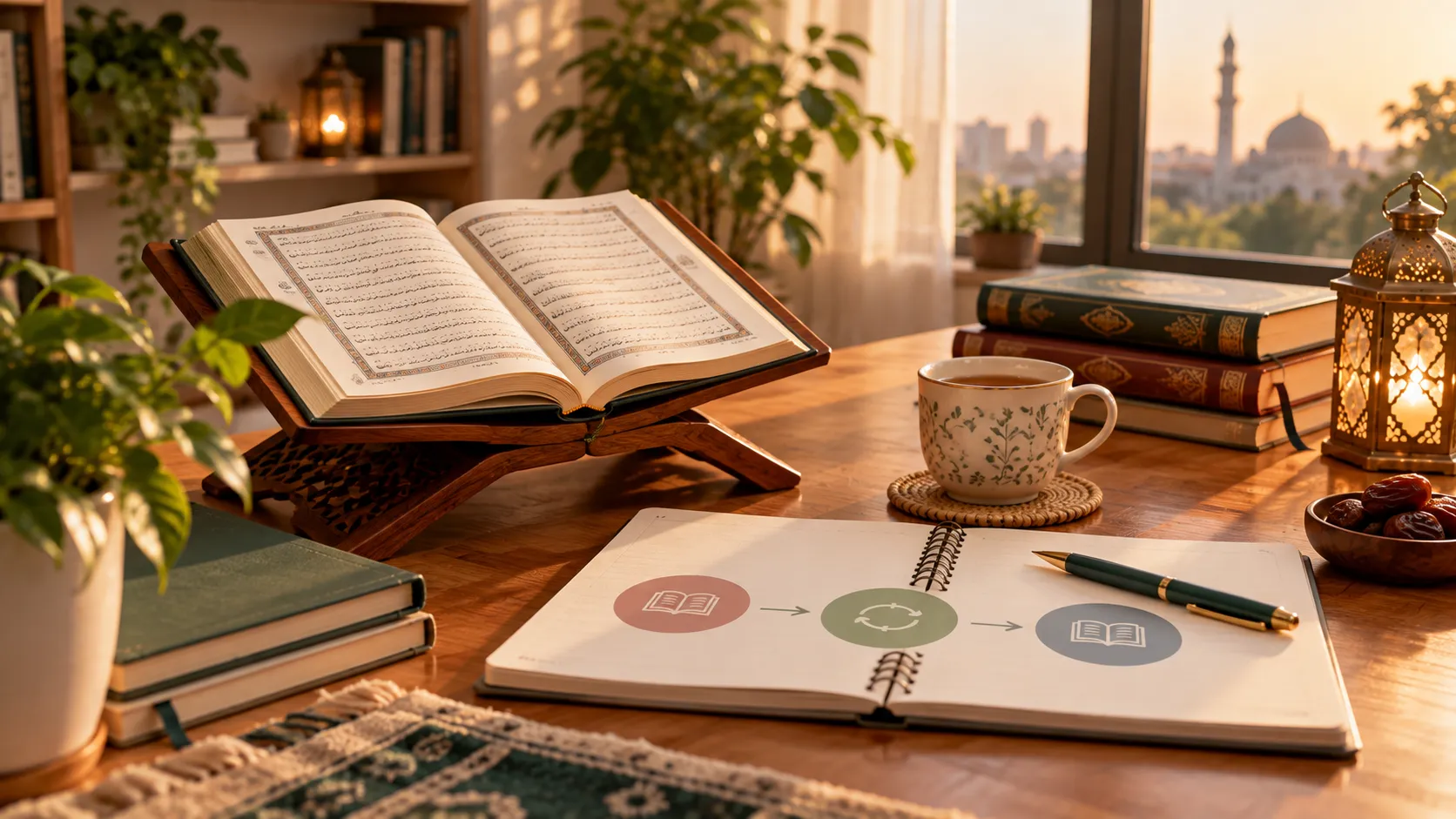
Memorize → move forward → forget → relearn → become discouraged → stop.
This guide on how to memorize the Quran is built to break that cycle. It gives you a complete system for both halves of the journey, and it rests on one central principle:
New memorization and revision are not two separate Quran activities. They are two halves of Hifz.
What Does Hifz Actually Mean?
Hifz (حفظ) is the Arabic word for memorizing, preserving, and guarding. In Quranic study it refers to committing the Quran to memory, and the word itself carries the idea of protecting what you hold. That is a helpful reminder: Hifz is not a single event, it is ongoing care.
Real Hifz is more than being able to repeat a page once. A strong Hifz eventually includes:
accurate recall
correct sequencing of verses
reliable transitions between Ayat
correct pronunciation
sound Tajweed
the ability to recite without constantly reconstructing the next verse
long-term maintenance
A person who has memorized the entire Quran is called a Hafiz (male) or Hafizah (female). It is a noble goal, and many Muslims work toward it. But not everyone needs to complete the entire Quran to have a meaningful relationship with Allah's Book. Memorizing even small portions and keeping them alive, so that you can recite them in prayer and live with them, is valuable. Be ambitious, but do not despise a smaller goal done well.
Why Do We Forget Quran After Memorizing It?
Forgetting is a normal human experience, and understanding the causes is the first step to fixing them. None of the following is a character flaw.
Weak initial memorization. The student moved on before the page was truly stable. It felt known, but it was only barely held.
Insufficient repetition. A passage may feel familiar without being reliably retrievable. Familiarity and recall are not the same thing.
Too much new memorization. When each day is filled with new material, revision time gets squeezed out until older pages begin to slip.
Irregular Muraja'ah. Older portions may sit untouched for weeks, and unused memory fades.
Similar verses. Ayat with similar wording are easy to confuse, especially when you have never deliberately compared them.
Memorizing only visually. Some students rely heavily on where a verse sits on the page. When the page is gone, the memory has few other supports.
Pronunciation errors becoming embedded. A mistake repeated during memorization becomes part of the memory and is harder to fix later than to prevent now.
Long breaks. Even strong Hifz weakens when it is not used. A break from revision, whether from illness, travel, exams, or a busy season, naturally leaves some wear.
If you recognize yourself here, take heart. Every one of these is fixable, and the fix is a better system, not a better person.
What the Prophet ﷺ Taught About Maintaining Quran Memorization
The Prophet ﷺ spoke directly about this challenge. In an authentic hadith narrated by Abu Musa al-Ash'ari (may Allah be pleased with him) and recorded in Sahih al-Bukhari (and also in Sahih Muslim), he said:
تَعَاهَدُوا هَذَا الْقُرْآنَ، فَوَالَّذِي نَفْسِي بِيَدِهِ لَهُوَ أَشَدُّ تَفَلُّتًا مِنَ الْإِبِلِ فِي عُقُلِهَا
In meaning: Keep checking on and reviewing this Quran, for by Him in whose hand is my soul, it escapes more quickly than camels from their tying ropes. (Sahih al-Bukhari 5033; Sahih Muslim 791.)
There is also a well-known hadith narrated by Abdullah ibn Umar (may Allah be pleased with him), in which the Prophet ﷺ compared the one who has memorized the Quran to the owner of hobbled camels: if he keeps watch over them, he holds on to them, and if he lets them go, they go away. (Sahih al-Bukhari 5031; Sahih Muslim 789.)
Hadith numbering can differ slightly between editions and online databases, so always check the reference in the edition you use.
Notice what these narrations do and do not say. They do not say that the person who forgets has failed. They describe how memorized Quran works, and they prescribe the response: ta'ahud, which means attentive, repeated care.
So the lesson is simple:
Revision is not evidence that your Hifz failed. Revision is part of Hifz itself.
There is also real comfort in another authentic hadith, narrated by Aisha (may Allah be pleased with her): the one who recites Quran skillfully is with the noble angels, and the one who recites it with difficulty, struggling through it, will have a double reward. (Sahih al-Bukhari 4937; Sahih Muslim 798.) Struggle in learning Quran is not a sign of rejection. Keep going.
And Allah reminds us of His facilitation:
وَلَقَدْ يَسَّرْنَا الْقُرْآنَ لِلذِّكْرِ فَهَلْ مِن مُّدَّكِرٍ (Al-Qamar 54:17)
In meaning: And We have certainly made the Quran easy for remembrance, so is there any who will remember?
Before You Memorize: Build the Right Foundation
Efficient Hifz begins before the first memorized line. Five foundations make the biggest difference.
1. Correct Quran Reading
If you cannot yet read accurately, you risk memorizing your mistakes repeatedly. In that case, it may be wiser to spend some time strengthening your reading first, even while you memorize a few short Surahs you already know. See our guide How to Read the Quran in Arabic for a clear starting path.
2. A Tajweed Foundation
You do not need to master every advanced rule before memorizing anything. But core pronunciation and recitation accuracy should develop alongside Hifz, not after it. Start with the basics in Tajweed for Beginners, and keep learning as you go.
3. A Reliable Mushaf
Using the same Mushaf consistently helps. The layout of the page, such as where an Ayah begins, which lines sit at the top or bottom, becomes a secondary visual cue. But it is only a cue. Do not let page-location memory replace true recall of the words.
4. A Qualified Teacher
A teacher is especially valuable for:
Makharij (articulation points of the letters)
Tajweed
mistakes you cannot hear in yourself
verse transitions
accountability
checking whether your memorization is actually stable
5. A Realistic Daily Time
Choose a routine you can keep during an ordinary, tiring week, not only during a very motivated one. Twenty consistent minutes beat two heroic hours once a month.
The Three-Part Hifz System
This is the heart of the article. Every serious Hifz schedule needs three layers working together.
1. New Memorization
The new Ayat or lines you are learning now.
2. Recent Revision
Material you memorized in the last days or weeks that is not yet fully stable.
3. Long-Term Muraja'ah
Older memorization that must be kept active.
You can think of it as:
New → Strengthen → Maintain
The most common mistake is:
New → New → New → New
This feels like progress, but it quietly builds on a base that is loosening. Eventually earlier memorization collapses and the student has to rebuild what they thought they already owned.
How to Memorize the Quran Page by Page: A Step-by-Step Method
Here is a practical method you can adapt to your ability, your teacher's guidance, and your available time.
Step 1: Listen to the Passage
Listen to a reliable reciter while following the Mushaf. This builds your sense of pronunciation, rhythm, verse boundaries, and unfamiliar words. Listening supports teacher correction. It does not replace it.
Step 2: Read the Passage Carefully
Read while looking at the text. Fix any difficult words before you try to memorize them.
Step 3: Understand the Basic Meaning
Read a reliable translation and aim to grasp the general meaning and the flow of ideas. Understanding does not automatically guarantee memorization, but meaning gives your memory more connections to hold on to.
Step 4: Divide Into Small Sections
Depending on your level, a section might be:
one Ayah
part of a long Ayah
two short Ayat
a few lines
You do not have to attack a full page at once.
Step 5: Repeat While Looking
Repeat each section deliberately and attentively. How many repetitions you need varies from person to person and from passage to passage. Some people like counting, such as 10 or 20 times, as a personal technique, but there is no magic number. Repeat until you can recite it correctly and without hesitation, not until you hit a target.
Step 6: Recite Without Looking
Close or cover the Mushaf and try to recite from memory. This is active recall, and it is where memory is actually built. If you get stuck, look briefly, correct yourself, and try again.
Step 7: Connect the Ayat
Do not treat each Ayah as an isolated unit. Practice:
Ayah 1 → Ayah 2, then Ayah 2 → Ayah 3, then the full sequence.
Step 8: Recite the Entire Portion
Recite the whole portion from beginning to end without looking.
Step 9: Have It Checked
Where possible, recite to a teacher. Small errors in pronunciation or wording are easy to miss alone.
Step 10: Review It Later the Same Day
Success right now does not mean the passage is secure. Review it again later in the day, and again the next day, as explained in the Muraja'ah system below.
The Importance of Verse Transitions
Many students know each Ayah on its own but freeze between Ayat. This is one of the most common hidden weaknesses in Hifz.
The fix is transition practice. For each Ayah, deliberately learn:
the ending of the current Ayah + the beginning of the next Ayah
Then test yourself on transitions specifically. Say the last few words of an Ayah and go directly into the next one. Ordinary start-to-finish repetition can hide weak transitions because momentum carries you across them. Isolating the links reveals where your chain is thin.
The First-Ayah Test
Most students always recite a Surah from the beginning. This can create a false sense of security, because the earlier verses act as a runway that carries you into the later ones.
Try this instead: ask a friend, a family member, or your teacher (or use written prompts) to give you the beginning of an Ayah from the middle, and then continue from there.
This helps distinguish two things:
True retrieval strength: you can start from any point and continue.
Sequence-dependent familiarity: you can only continue if you start from the beginning.
If you stumble when starting from the middle, that is not failure. It is useful information about what to revise.
The Golden Rule: Don't Move Forward Too Quickly
Chasing page counts is one of the most common Hifz problems. A student may proudly say, "I memorize one page every day." But if the earlier pages are collapsing, the real rate of progress is much lower than it sounds.
Strong Hifz is better than fast Hifz.
When revision starts deteriorating, slow down the new memorization. This is not going backward. It is protecting everything you have already built.
How Much Quran Should You Memorize Per Day?
There is no universal answer. These are examples only:
Very busy beginner: 1–3 Ayat, or a few lines.
Consistent beginner: several lines, or roughly half a page, depending on verse length and ability.
Experienced student: potentially larger portions, as long as revision stays strong.
Intensive Hifz student: may follow a much faster, teacher-supervised schedule.
The correct daily amount is the amount that lets you maintain what you have already memorized. If you cannot, the amount is too high for now.

A Practical Muraja'ah System
Here is a revision structure you can adopt. Adjust the intervals as your memorization grows.
Same-day review. Review new material again later the same day.
Next-day review. Before adding anything new, recite yesterday's portion.
Recent review. Review the material from the previous several days.
Weekly review. Recite the week's memorization together.
Long-term review. Maintain older Surahs and Ajza' on a rotating schedule, so that every part is revisited regularly and nothing sits untouched for too long.
This follows the same logic found in learning research. Retrieving information from memory (rather than only re-reading it) and spreading review across time are among the best-supported ways to retain material. You do not need to turn this into a science project. The practical takeaway is simple: recite from memory, and come back to it again and again, with gaps that grow as the memory strengthens.
The New / Recent / Old Revision Model
Layer | Purpose | Example |
|---|---|---|
New | Learn today's portion | Today's Ayat |
Recent | Stabilize new Hifz | Previous days and weeks |
Old | Prevent long-term loss | Earlier Surahs and Ajza' |
The proportion of your time changes as your Hifz grows. A beginner with five memorized Surahs has relatively little old revision. Someone with 15 Juz has a much larger maintenance responsibility.
The more Quran you memorize, the more important Muraja'ah becomes.
Many experienced students end up spending more time on revision than on new memorization, and that is a sign of a healthy system, not a slow one.
A Sample 60-Minute Hifz Routine
This is an illustration, not a rule. Some students will need even more time on revision.
20 minutes: Old Muraja'ah. Rotate through earlier Surahs or Ajza'.
15 minutes: Recent revision. Strengthen the last several days' material.
20 minutes: New memorization. Follow the step-by-step method.
5 minutes: Final recall test. Recite today's new portion from memory and note any weak spots.
A 30-Minute Hifz Routine for Busy Adults
10 minutes: Old revision
10 minutes: Recent revision
10 minutes: New memorization
If your existing memorization has become weak, consider revision only for a while. There is nothing wrong with a "no new memorization" day. Often it is exactly the right choice.
A 15-Minute Minimum Routine
For very busy seasons such as exams, a new baby, travel, or a demanding work period:
5 minutes old review
5 minutes recent review
5 minutes new material, or reinforcement of something you already know
During difficult seasons, maintaining what you have is often more valuable than constantly expanding it. A small, steady habit keeps the door open.
The Weekly Hifz System
Here is one example of how a week could look. These days are not religiously prescribed. They are simply a practical way to organize your time, and you should adapt them to your life.
Monday–Thursday: New memorization plus revision.
Friday: Lighter new material and a larger review.
Saturday: New memorization plus testing.
Sunday: Major weekly revision, or a no-new-Hifz consolidation day.
Should You Memorize New Quran Every Day?
Not necessarily. Many students benefit from different kinds of days:
consolidation days to let recent material settle
revision-only days
correction days to fix errors a teacher has flagged
testing days to find weak spots
Pausing new memorization for a short time can actually protect your long-term progress. A student who consolidates well often moves forward faster in the end than one who adds new material every single day and keeps repairing the damage.
What If Your Old Hifz Is Already Weak?
First, do not tell yourself to "start over." You have not lost everything. Parts of your memory are likely still strong, and relearning something you once knew is usually faster than learning it for the first time. Here is a recovery plan.
Step 1: Stop or Reduce New Memorization
Free up time and mental energy for repair.
Step 2: Assess What Is Strong, Medium, and Weak
Go through what you have memorized and sort it into three categories:
Green (Strong): You can recite it confidently.
Yellow (Unstable): You hesitate or make several errors.
Red (Weak): You cannot reliably recite it without the Mushaf.
Step 3: Prioritize the Red Sections
Relearn these carefully, using the step-by-step method above.
Step 4: Maintain the Green Sections
Do not neglect strong material while you repair the weak. Keep it on a light rotation so it stays green.
Step 5: Resume New Memorization Gradually
Add new material only when your revision workload feels manageable.
Every strong Hafiz has had to repair old Quran at some point. Returning to what you once memorized is not shameful. It is exactly what the Prophet's ﷺ guidance asks of us: keep coming back.
The Hifz Strength Test
A passage is not "strong" just because you recited it successfully once. Test it in several ways:
from the beginning
from random Ayat in the middle
after a delay
in Salah, where appropriate
to a teacher
after several days without looking
against similar verses
Mistakes in these tests are not failures. They are diagnostic information showing you exactly what to revise.
Similar Verses: How to Stop Mixing Them Up
Verses with very similar wording are called Mutashabihat. They are among the most common causes of confusion, even for advanced students.
A classic example is the description of what Pharaoh's people did to the Children of Israel. In Surat al-Baqarah (2:49) the wording is yudhabbihuna abna'akum (يُذَبِّحُونَ أَبْنَاءَكُمْ), while in Surat al-A'raf (7:141) it is yuqattiluna abna'akum (يُقَتِّلُونَ أَبْنَاءَكُمْ). The surrounding wording is very close, and a single word differs.
Strategies that help:
Compare the verses side by side in your Mushaf.
Identify the exact differing words and focus only on those.
Understand the context of each Surah and why the wording fits there.
Mark the distinctions in your study notes.
Repeat the transitions that follow each version.
Ask your teacher. They often know the common trouble spots.
Keep a "similar verses" notebook that records the pairs that confuse you.
Does Understanding Arabic Make Hifz Easier?
It can help. Understanding Arabic gives you:
semantic sequence (what comes next logically)
vocabulary recognition
grammatical connections
thematic cues
For example, knowing who is speaking in a passage, or what a verse is discussing, can prevent random sequence errors.
But understanding does not remove the need for repetition and Muraja'ah. Even native Arabic speakers must review. Think of meaning as an extra anchor, not a replacement for practice.
If you would like to build this anchor, see Learn Arabic Through the Quran and Quranic Arabic vs Modern Standard Arabic, which explain how the two relate.
Memorizing Quran When You Don't Speak Arabic
If you are not an Arabic speaker, welcome. Many Muslims from every background memorize substantial portions of the Quran, or the entire Quran, without being native Arabic speakers. You face some specific challenges:
unfamiliar vocabulary
similar-sounding words
pronunciation
fewer meaning-based cues
Here is how to respond:
Learn accurate Quran reading first. Accurate reading is your foundation.
Listen carefully to a reliable reciter.
Study the basic meanings of what you memorize.
Learn frequent Quranic vocabulary. Our guide 100 Most Common Words in the Quran is a good place to begin.
Gradually study Quranic Arabic. See How to Understand the Quran Without Speaking Fluent Arabic.
Work with a teacher who can hear and correct your pronunciation.
Avoid relying entirely on transliteration. It cannot capture many Arabic sounds and can fix errors in place.
Should You Listen to the Same Reciter?
During early memorization, using one reliable reciter can help. It gives you a stable pronunciation model, a familiar pace, and predictable pauses.
But Hifz should eventually become independent of one recording. You should be able to recite without mentally depending on a specific reciter's melody. If you find that you can only recall a passage by "hearing" a particular voice, practice reciting in silence and in your own natural voice, and test yourself with a teacher.
Should You Use the Same Mushaf?
Yes, it is usually helpful. Visual consistency lets you remember the top and bottom of the page, the approximate position of a verse, and the shape of the page. That is a useful secondary cue.
But be careful. Do not let page-location memory substitute for actual Quran recall. If you can only recite when you picture the page, test yourself from the middle and without any visual aid.

Should You Memorize Before or After Fajr?
Many students find early morning effective. The environment may be quieter, distractions are often lower, and the mind may feel fresher. But there is no universally proven "best Hifz time," and people differ.
Other good options include:
before work or school
after Asr
after Maghrib
in the evening
The best time is the one you can consistently protect.
How to Use Salah to Strengthen Hifz
Reciting what you have memorized in prayer is one of the most beautiful ways to maintain it. It gives you active recall, meaningful repetition, and integrates the Quran into your worship. Many students deliberately choose portions they are revising for their voluntary prayers.
A few cautions. The details of what and how much to recite in different prayers and Rak'ahs vary between schools of Islamic jurisprudence, so ask a qualified teacher or scholar where you are unsure. And do not turn Salah into only a memory exercise. Prayer is worship first, and focus and humility remain the priority.
Can Technology Help With Hifz?
Yes, in moderation. Useful tools include:
Quran audio
repetition players
a digital Mushaf
flashcards for the beginnings of Ayat
revision trackers
recording your own recitation and listening back
teacher video lessons
Be careful not to spend more time setting up apps than memorizing Quran. The system matters more than the app. A simple notebook and a consistent routine will beat the most elaborate tool used inconsistently.
Common Quran Memorization Mistakes
1. Memorizing too much too fast. Speed without stability creates future repair work. Slow down until recent material is secure.
2. Neglecting Muraja'ah. Revision is not optional. It is half of Hifz.
3. Moving forward with weak pages. A shaky page becomes a shaky foundation for the next one.
4. Memorizing pronunciation errors. Errors set quickly. Get correction early.
5. Depending entirely on transliteration. It cannot reproduce Arabic sounds accurately. Learn to read the Arabic script.
6. Changing methods every week. Constant switching prevents any method from working. Pick a sound method and give it time.
7. Comparing your speed with others. People differ widely in ability, age, time, and background. Compare yourself only with your own consistency.
8. Never testing from the middle. If you only recite from the start, you will not discover hidden weaknesses.
9. Ignoring similar verses. They do not go away on their own. Study them deliberately.
10. Giving up after missing several days. A short gap is not the end. Return with a small step.
11. Measuring progress only by number of pages. Measure how much you can still recite well.
12. Setting an unsustainable schedule. A plan you cannot keep is worse than a smaller plan you can.
How Long Does It Take to Memorize the Quran?
There is no universal timeline, and anyone promising "the whole Quran in X months" is selling something. The real answer depends on many factors:
age
reading ability
Arabic knowledge
daily memorization amount
revision load
access to a teacher
consistency
previous memorization
life responsibilities
Consider two illustrative students. One races through new pages and neglects review, and finds that much of what they learned has to be rebuilt. The other moves more slowly but keeps excellent revision. The second student may take longer on paper, yet finish with a much stronger Hifz and far less repair along the way.
Rather than asking "how fast can I finish?" ask "how strong will it be when I finish?"
Can Adults Memorize the Quran?
Yes. Adults can memorize the Quran.
There are real challenges: work, family, fatigue, inconsistent schedules, and for some learners, slower memorization. These are practical obstacles, not proof that your memory is too weak.
Adults also bring real strengths:
discipline
understanding
goal-setting
appreciation of meaning
the ability to study independently and plan
Start small, protect a fixed time, build a revision habit early, and work with a teacher. You do not need to apologize for starting later. If you are starting out, see the beginner steps above, and remember the Prophet's ﷺ encouragement for the one who struggles with the Quran.

Quran Memorization for Children
For parents supporting a child's Hifz, the goal is a lifelong relationship with the Quran, not a short-term performance.
Things to consider:
Age-appropriate lesson length. Younger children tire quickly.
Pronunciation before speed.
Regular revision, built into the routine from the start.
A good relationship with the teacher.
Realistic targets.
Enough sleep.
School workload and overall balance.
Encouragement, especially for effort.
Meaning, shared in a way that suits the child's age.
Please avoid:
humiliation
shouting
comparing siblings
excessive punishment
tying Hifz to parental approval
chasing competition results at the expense of retention
A child who feels safe and loved around the Quran is far more likely to return to it for life. For more, see Teaching Quran to Children.
What If My Child Keeps Forgetting Quran?
Before adding pressure, look at the system. Consider:
too much new memorization
inadequate review
weak reading
difficulty with pronunciation
lessons that are too long
fatigue
an inconsistent routine
a poor fit with the teacher
unrealistic targets
The answer is not automatically "more pressure." Often the curriculum needs adjusting: smaller new portions, more review, and a calmer pace. Speak with the teacher and make changes together.
Motivation vs Discipline in Hifz
Motivation rises and falls. A sustainable system cannot depend on feeling inspired every day. That is why discipline matters:
a fixed study time
manageable targets
teacher accountability
simple tracking
a small minimum routine
a plan for getting back on track after missed days
But Hifz is not purely mechanical. Keep your intention and your spiritual connection at the center. Discipline carries you through the dry days, and connection gives the effort its meaning.
Renew Your Intention
Reflect on why you are memorizing. Niyyah (intention) shapes the whole journey. Your reasons may include:
seeking Allah's pleasure
strengthening your connection with the Quran
reciting more Quran in Salah
preserving the Quran in your heart
learning Allah's words
teaching your family
Return to this intention often, especially when the journey feels heavy.
What to Do When You Lose Motivation
Stop judging the whole journey by one bad week.
Reduce your daily target.
Return to strong, favorite Surahs. Remind yourself that you can do this.
Repair weak Hifz. It is often more satisfying than starting something new.
Recite to a teacher.
Review your intention.
Restart with a small minimum habit.
Never let missing seven days become a reason to miss seven months.
A 30-Day Hifz Reset Plan
This plan works especially well if you are returning after a long break.
Week 1: Assessment. No aggressive new memorization. Go through what you have memorized and sort it into Green, Yellow, and Red.
Week 2: Repair. Prioritize the weak sections. Relearn them carefully and have them checked.
Week 3: Stabilize. Set up a consistent daily rhythm of recent review and old Muraja'ah.
Week 4: Resume growth. Gradually reintroduce small amounts of new memorization, while keeping revision protected.
Example Hifz Plans by Goal
These are sample directions, not rigid paces.
Goal A: Memorize Short Surahs
Suitable for complete beginners. Memorize a few lines at a time, recite each Surah daily for a week, and then rotate older Surahs every few days. Focus on accurate pronunciation.
Goal B: Memorize Juz Amma
Work from the Surahs that feel most accessible, adding a small portion at a time. Keep a steady cycle of recent review and a weekly full recitation of what you have completed.
Goal C: Memorize Several Ajza'
As your memorization grows, revision takes up more of your time. Divide your older material into sections and rotate through them on a schedule, so that each part is revisited regularly. Expect revision to become the largest part of your session.
Goal D: Complete Hifz
Complete Hifz is a long-term journey that benefits greatly from teacher supervision and a carefully designed system with increasingly substantial Muraja'ah. No single pace fits everyone. A good teacher will adjust the plan to your capacity and your revision strength.

Your Personal Hifz Dashboard
Keep tracking simple enough that it never eats into your study time. A single notebook page or a short table is enough. Track:
New memorization: What did you add?
Recent review: What needs strengthening?
Old Muraja'ah: What did you revise?
Errors: Which Ayat repeatedly cause difficulty?
Similar verses: What do you tend to confuse?
Teacher feedback: What corrections need attention?
Next review: When should this section come back?

When Should You Get a Quran Teacher?
A teacher becomes especially valuable when:
pronunciation errors persist
you cannot assess your own recitation
your Tajweed is weak
your motivation is inconsistent
your memorization lacks structure
similar verses cause repeated trouble
you are attempting serious, long-term Hifz
One-to-one instruction offers:
immediate correction
an individualized pace
accountability
adaptive revision targets
ongoing progress assessment
A good Hifz program is not simply "here is your next page." It considers your reading level, Tajweed, pronunciation, memorization capacity, recent revision, old revision, recurring errors, and individual pace.
At Araby Academy, students can work one-to-one with teachers on Quran reading, Tajweed, memorization, revision, and Quranic Arabic, so each part of the system supports the others. If you are looking for guidance, you can also explore our Online Quran Classes and our resources on Arabic Pronunciation for Quran and How Long Does It Take to Learn Arabic?
Frequently Asked Questions
1. What is the best way to memorize the Quran?
Balance three layers daily: a small amount of new memorization, review of recent material, and a rotating schedule of older Muraja'ah. Use active recall, learn verse transitions, test from the middle, and have a teacher correct your recitation.
2. How can I memorize Quran without forgetting it?
You cannot guarantee you will never forget, but you can greatly reduce forgetting. Review consistently, slow new memorization when revision weakens, test yourself, correct errors early, and treat Muraja'ah as part of Hifz.
3. How much Quran should I memorize every day?
It depends on your level and time. A busy beginner may do 1–3 Ayat or a few lines, while experienced students may do more. The right amount is the amount that lets you keep your previous memorization strong.
4. How many times should I repeat an Ayah to memorize it?
There is no universal number. Repeat deliberately and attentively until you can recite it correctly without looking, then test again later. Counting can be a personal tool, but the goal is reliable recall, not a number.
5. How often should I revise memorized Quran?
Review new material the same day and the next day, recent material over the following days, and older material on a rotating schedule. The more you have memorized, the more of your time revision should take.
6. How long does it take to memorize the Quran?
There is no fixed timeline. It depends on age, reading ability, Arabic knowledge, daily amount, revision load, teacher access, consistency, and life responsibilities. A steady, well-reviewed pace often produces stronger results than a rushed one.
7. Can adults memorize the entire Quran?
Yes. Adults face real challenges like work and family, but they also bring discipline, understanding, and planning skills. With a realistic routine and good guidance, adults can memorize substantial portions or the entire Quran.
8. Can I memorize Quran if I don't speak Arabic?
Yes. Many non-Arabic-speaking Muslims memorize substantial portions of the Quran. Learn accurate reading, listen to a reliable reciter, study basic meanings and common vocabulary, and work with a teacher who can correct your pronunciation.
9. Should I understand Quran before memorizing it?
It is helpful to understand the general meaning as you memorize, because meaning gives your memory extra connections. But understanding is not a requirement for memorizing, and it does not replace repetition and revision.
10. What should I do if my old Hifz becomes weak?
Do not start over. Pause or reduce new memorization, sort your material into strong, unstable, and weak, relearn the weak sections, keep the strong ones active, and resume new memorization gradually.
11. Is it better to memorize quickly or slowly?
Strong Hifz is better than fast Hifz. A pace that allows you to keep what you have learned will usually serve you better over time than a rushed pace that requires constant repair.
12. Do I need a teacher to memorize Quran?
A teacher is not a formal requirement for every learner, but one is strongly recommended. A teacher corrects pronunciation and Tajweed, checks transitions, provides accountability, and helps you judge whether your memorization is truly stable.
Conclusion: The Quran You Keep Is More Important Than the Page You Finish Today
Return for a moment to the student from the beginning of this article. At first, they measured progress by one question: "How many pages did I memorize?"
Now there is a better question: "How much of what I memorized can I still recite well?"
That change in thinking is the heart of how to memorize the Quran in a way that lasts. Hifz is not a race through 604 pages. It is a relationship with the Quran, built through repetition, correction, revision, patience, understanding, worship, and consistency.
Some days will be for new memorization. Other days will be for nothing but repairing old Quran. Both are progress.
Memorize carefully. Review relentlessly. Correct mistakes early. Understand what you can. Keep returning to the Quran.
If you would like a teacher to guide you through this journey, Araby Academy offers one-to-one Quran, Tajweed, and Hifz instruction, with teachers who can build a plan around your level, your schedule, and your goals. We would be honored to help you keep the Quran you carry.