
Millions of Muslims recite Surah Al-Fatihah every day. Some learned it as small children, repeating it after a parent or teacher. Some recite it confidently without speaking Arabic. Others are learning it for the first time after becoming Muslim. For all of them there is a difference between knowing its sounds and understanding its words.
The Surah begins with praise. It teaches Allah's mercy and authority, moves into direct worship and seeking help, and then asks for guidance. So what changes when a Muslim finally understands the words they have been reciting in prayer for years? This guide helps you find out. It keeps five things clearly separate: the Quranic text, the translation, scholarly Tafsir (Quranic commentary), linguistic reflection, and practical spiritual application.
What Is Surah Al-Fatihah? (Quick Answer)
Surah Al-Fatihah is the first chapter of the Quran, known as "the Opening" and "Umm al-Kitab," and it is central to daily Salah. It has seven verses in the standard numbering, though scholars differ on whether the Basmalah is counted as its first verse. It teaches praise of Allah, His mercy, accountability, exclusive worship, reliance on Him, and the constant need for guidance.
The Text of Surah Al-Fatihah: Arabic, Transliteration, and Translation
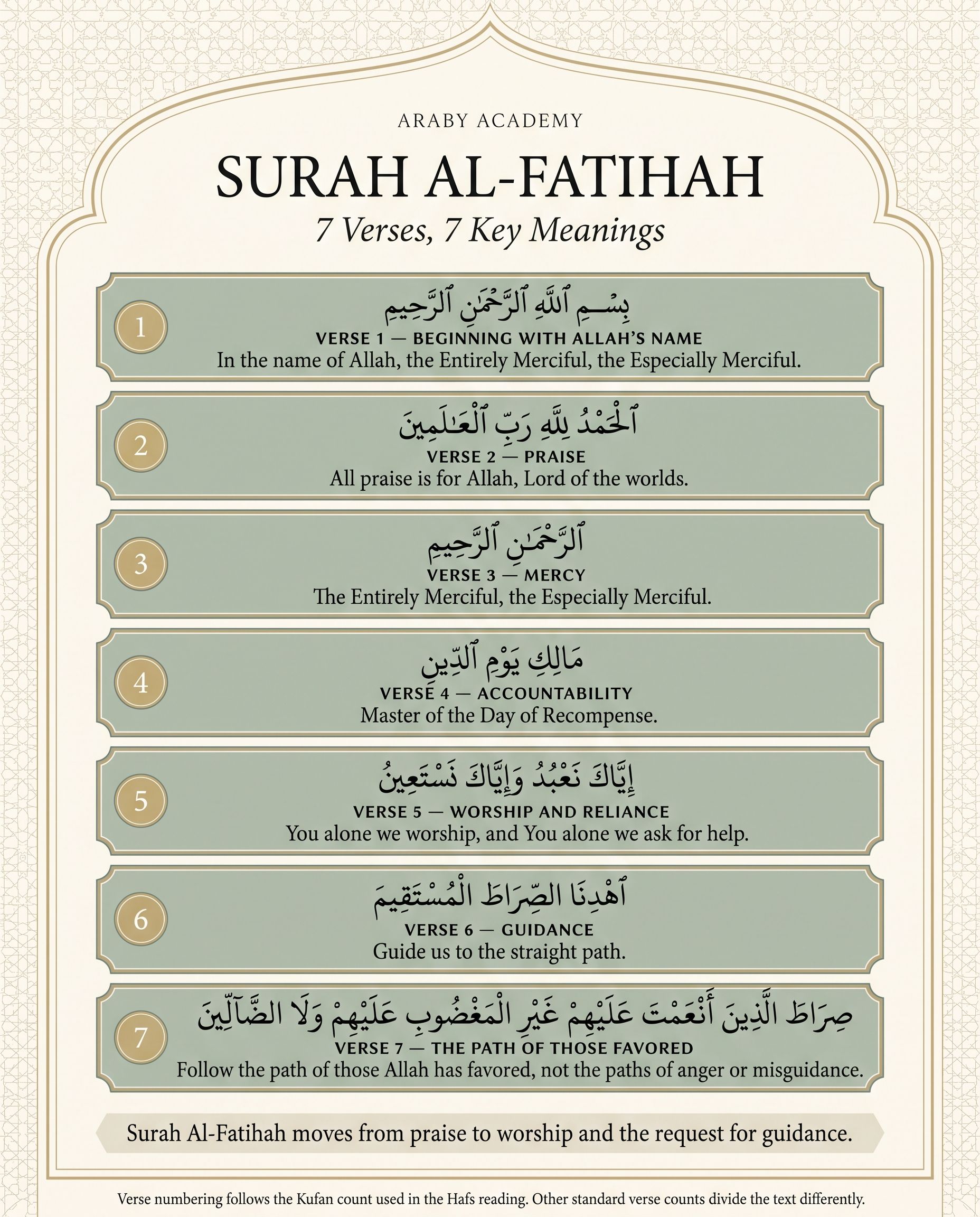
The Arabic below follows the Hafs 'an 'Asim reading in the Uthmani script, the reading used in most printed Mushafs today. Verse numbers follow the Kufan count, which counts the Basmalah as verse 1. The transliteration is only a rough aid. The English is a plain-language rendering of the meanings, in line with standard translations such as Saheeh International.
Verse | Arabic | Transliteration | Meaning |
|---|---|---|---|
1 | بِسْمِ ٱللَّهِ ٱلرَّحْمَـٰنِ ٱلرَّحِيمِ | Bismillāhi r-Raḥmāni r-Raḥīm | In the name of Allah, the Entirely Merciful, the Especially Merciful. |
2 | ٱلْحَمْدُ لِلَّهِ رَبِّ ٱلْعَـٰلَمِينَ | Al-ḥamdu lillāhi rabbi l-ʿālamīn | All praise is for Allah, Lord of the worlds. |
3 | ٱلرَّحْمَـٰنِ ٱلرَّحِيمِ | Ar-Raḥmāni r-raḥīm | The Entirely Merciful, the Especially Merciful. |
4 | مَـٰلِكِ يَوْمِ ٱلدِّينِ | Māliki yawmi d-dīn | Master of the Day of Recompense. |
5 | إِيَّاكَ نَعْبُدُ وَإِيَّاكَ نَسْتَعِينُ | Iyyāka naʿbudu wa iyyāka nastaʿīn | You alone we worship, and You alone we ask for help. |
6 | ٱهْدِنَا ٱلصِّرَٰطَ ٱلْمُسْتَقِيمَ | Ihdinā ṣ-ṣirāṭa l-mustaqīm | Guide us to the straight path. |
7 | صِرَٰطَ ٱلَّذِينَ أَنْعَمْتَ عَلَيْهِمْ غَيْرِ ٱلْمَغْضُوبِ عَلَيْهِمْ وَلَا ٱلضَّآلِّينَ | Ṣirāṭa lladhīna anʿamta ʿalayhim ghayri l-maghḍūbi ʿalayhim wa lā ḍ-ḍāllīn | The path of those upon whom You have bestowed favor, not of those who earned anger, nor of those who went astray. |
The English here is a translation of meanings, not the Quran itself. The Quran is the Arabic revelation, and no translation can carry every shade of its wording, sound, or rhythm. Use the English to understand, and the Arabic to recite.
The Basmalah Question and the Seven Verses
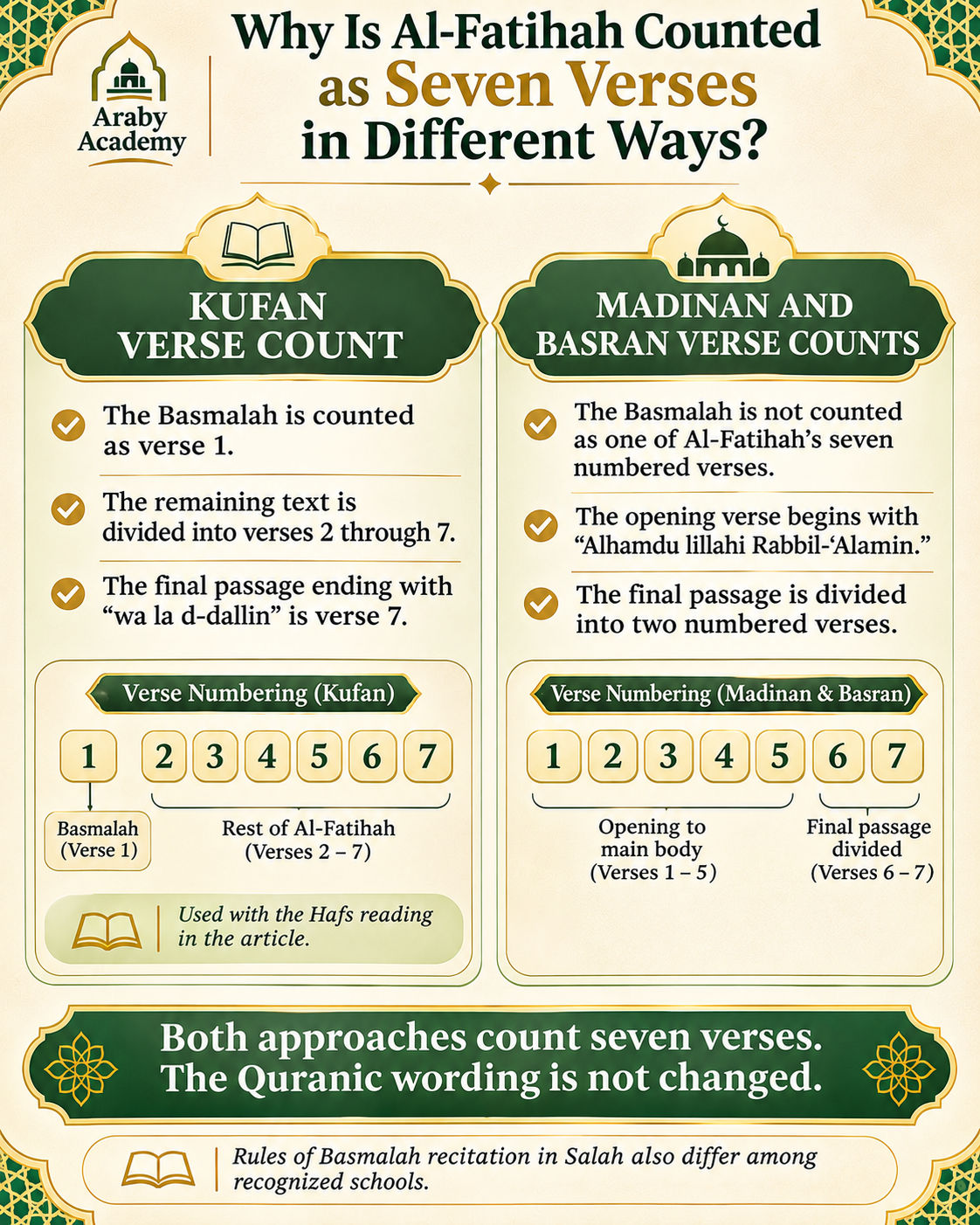
Scholars agree that the Basmalah (بِسْمِ اللَّهِ الرَّحْمَٰنِ الرَّحِيمِ) is Quranic text; it also appears inside Surah An-Naml (27:30). They differ on whether it is a verse of Al-Fatihah itself. In the Kufan count used with Hafs, and in the Shafi'i school, it is verse 1 and the seven verses end at "wa lā ḍ-ḍāllīn." In the Madinan and Basran counts, and in the Hanafi, Maliki, and dominant Hanbali views, the Basmalah is a Quranic verse that stands at the start of surahs without being counted within Al-Fatihah. Those counts reach seven by splitting the end differently: "Ṣirāṭa lladhīna anʿamta ʿalayhim" is verse 6, and "ghayri l-maghḍūbi ʿalayhim wa lā ḍ-ḍāllīn" is verse 7.
So the Surah has seven verses either way. What differs is where the lines fall. Recitation in Salah also differs by school. Shafi'i scholars recite the Basmalah aloud in loud prayers as part of Al-Fatihah. Hanafis and Hanbalis recite it silently. Malikis do not recite it at the start of obligatory prayers, though they allow it in voluntary ones. The reports behind these positions include Anas's narration (Sahih al-Bukhari 743, Sahih Muslim 399) that the Prophet ﷺ and his early successors began the recitation with "Alhamdu lillahi Rabbil-'Alamin." Scholars read this differently, and none of these positions is a sectarian dispute.
What Does "Al-Fatihah" Mean? The Names of the Surah
الفَاتِحَة comes from the root ف ت ح (fa-ta-ḥa), whose core sense is opening. Al-Tabari explains that the Surah is called the Opening because the Quran opens with it in the Mushaf and because prayer recitation opens with it. That is all the title claims.
Name | Arabic | Meaning | Source and status |
|---|---|---|---|
Fatihat al-Kitab | فَاتِحَةُ الْكِتَابِ | Opening of the Book | Prophet's wording in the Hadith of 'Ubadah ibn as-Samit (Bukhari 756, Muslim 394) |
Umm al-Kitab / Umm al-Quran | أُمُّ الْكِتَابِ / أُمُّ الْقُرْآنِ | Foundation of the Book | Hadith of Abu Hurayrah (Tirmidhi 2875, "hasan sahih"; Abu Dawud 1457) |
As-Sab' al-Mathani | السَّبْعُ الْمَثَانِي | The Seven Oft-Repeated | Quran 15:87; Bukhari 4474 |
Al-Hamd | الْحَمْد | The Praise | Identifies the Surah by its opening phrase in the same Hadith reports |
As-Salah | الصَّلَاة | The Prayer | Sahih Muslim 395; scholars take "prayer" there to mean Al-Fatihah |
Ash-Shifa, Al-Kafiyah, Al-Asas | الشِّفَاء، الْكَافِيَة، الْأَسَاس | Healing, Sufficing, Foundation | Later descriptive titles listed by some scholars, not established as the Prophet's own naming |
Umm al-Kitab. أُمّ literally means "mother," but in Arabic it also means source, foundation, or that which gathers and leads. Al-Tabari notes that the Arabs call whatever gathers or heads a matter an "umm." Al-Fatihah gathers the Quran's foundational themes in brief: praise of Allah, worship, the Hereafter, and guidance. The title is not biological, and it does not mean other surahs descend from it.
As-Sab' al-Mathani. Allah says: "We have certainly given you seven of the oft-repeated [verses] and the great Quran" (15:87). The Prophet ﷺ identified "Alhamdu lillahi Rabbil-'Alamin" as "the Seven Oft-Repeated and the Great Quran which I was given" (Sahih al-Bukhari 4474). Al-Tabari also records a minority view that the phrase meant seven long surahs, but the Hadith settles it for most commentators. Explanations of "oft-repeated" include its repetition in every rak'ah (unit of prayer) and its combination of praise and supplication.
Makki or Madani? Why It Opens the Mushaf
Most commentators classify Al-Fatihah as Makki, revealed in Makkah. Surah 15, itself Makki, mentions the Seven Oft-Repeated, which supports this. Ibn Kathir and al-Qurtubi also record reports that it is Madani, and that it was revealed twice. No exact date is established, so none is claimed here.
Its place as Chapter 1 follows the arrangement of the Mushaf, not the order of revelation. The first revelation was the opening of Surah Al-'Alaq (96:1–5). Al-Fatihah is first in the book because it is the natural doorway to the rest of it.
Why Al-Fatihah Is Central in Salah
The Prophet ﷺ said: "There is no prayer for the one who does not recite the Opening of the Book" (Sahih al-Bukhari 756, Sahih Muslim 394, from 'Ubadah ibn as-Samit رضي الله عنه). Another narration in Sahih Muslim (395) from Abu Hurayrah says that whoever prays without reciting the Mother of the Quran, his prayer is "deficient," said three times, "not complete."
Is it required in every rak'ah? Scholars differ in detail. The Shafi'i, Maliki, and Hanbali schools treat Al-Fatihah as a pillar (rukn) of every rak'ah for the imam and the individual. The Hanafi school treats it as wajib (obligatory but ranked below a pillar), requires some Quran recitation as the fard, and requires Al-Fatihah in the first two rak'ahs of obligatory prayers. In the later rak'ahs, Hanafis treat reciting it as sunnah and allow silence or tasbih.
Behind the imam. The schools differ again. Shafi'is hold that the follower recites Al-Fatihah in every rak'ah, loud or silent. Hanafis hold that the imam's recitation suffices for the follower, citing Quran 7:204 and reports on listening. Malikis and Hanbalis generally have followers listen in loud prayers and recite in silent ones, with differences in detail. A beginner praying in congregation should follow the practice of their own school or a qualified local teacher, and should not be told their prayer is invalid over a school-specific question.
If you cannot recite it yet. Genuine inability is treated with mercy. A man told the Prophet ﷺ he could not learn any Quran, and the Prophet taught him: "Subhanallah, wal-hamdu lillah, wa la ilaha illallah, wallahu akbar, wa la hawla wa la quwwata illa billah" (Abu Dawud 832, Nasa'i 924; graded hasan by many scholars). This is a temporary accommodation for real inability, not a permanent replacement. Learn Al-Fatihah promptly with a qualified teacher.
Can the English count? Most scholars hold that a translation is not itself the Quran, because the Quran is the Arabic wording, so it does not take the place of Al-Fatihah in Salah. A historical Hanafi discussion about non-Arabic recitation for those unable exists, but the mainstream practice across the schools is Arabic recitation. If you are unable, ask a qualified scholar about your specific case. Meanwhile, understanding the English meaning is a way to bring presence to the Arabic words, not a way to skip them.
The Hadith Qudsi: "I Have Divided the Prayer Between Myself and My Servant"
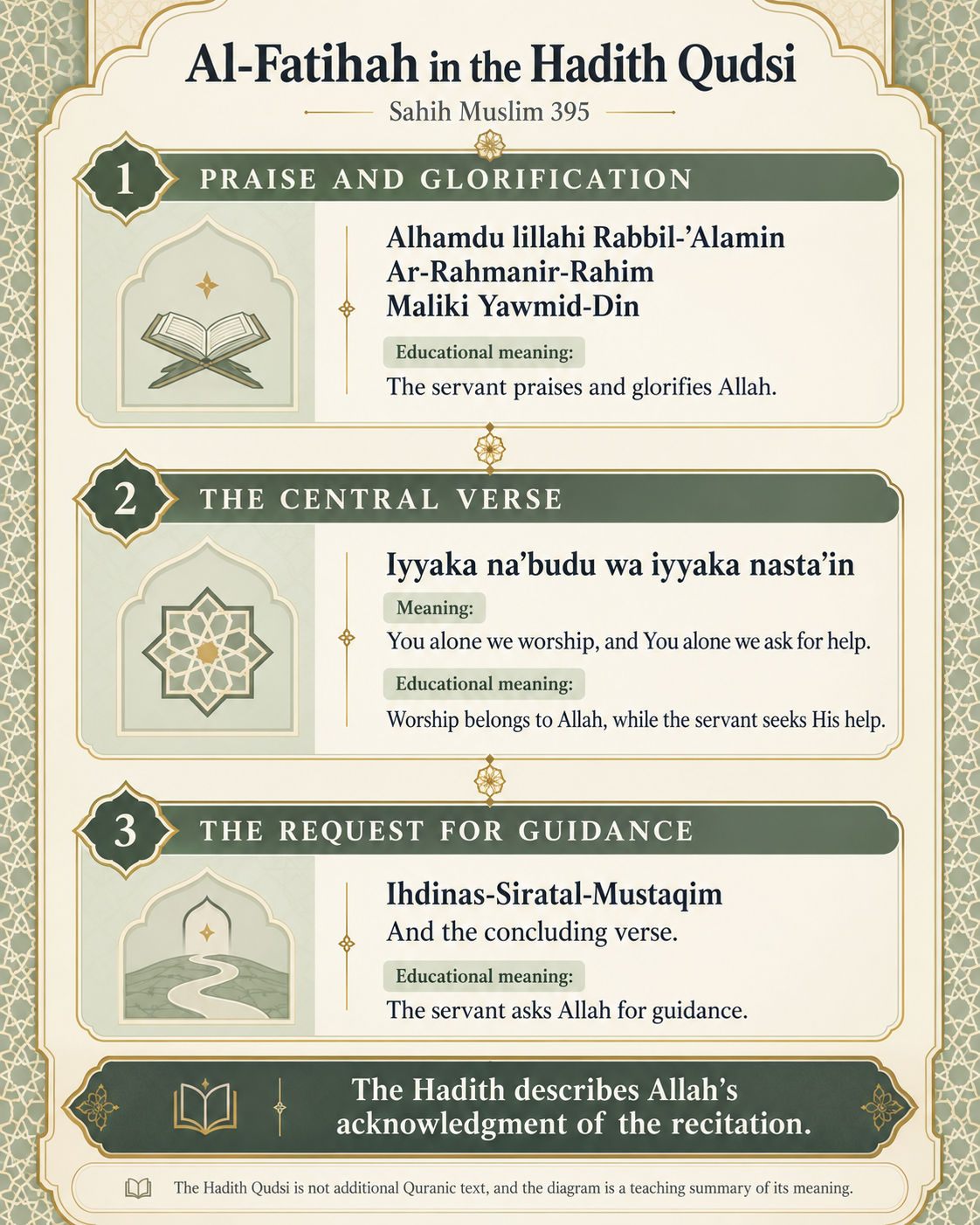
Sahih Muslim 395 records from Abu Hurayrah رضي الله عنه that the Prophet ﷺ reported that Allah said: "I have divided the prayer between Myself and My servant into two halves, and My servant shall have what he asks for." A Hadith Qudsi is a report in which the Prophet ﷺ relates words attributed to Allah that are not part of the Quran's text, so none of these responses is an extra verse of Al-Fatihah. Scholars such as al-Nawawi explain that "prayer" here means Al-Fatihah, whose verses divide into praise of Allah and the servant's petition.
What the servant recites | What the Hadith says (Sahih Muslim 395) | What it teaches |
|---|---|---|
Alhamdu lillahi Rabbil-'Alamin | Allah says: "My servant has praised Me." | Praise is acknowledged, not lost. |
Ar-Rahmanir-Rahim | "My servant has extolled Me." | Mentioning His mercy honors Him. |
Maliki yawmid-Din | "My servant has glorified Me." In one report: "My servant has entrusted [his affair] to Me." | Remembering accountability honors His majesty. |
Iyyaka na'budu wa iyyaka nasta'in | "This is between Me and My servant, and My servant shall have what he asks for." | Worship is Allah's right; asking for help is the servant's need. |
Ihdinas-siratal-mustaqim ... walad-dallin | "This is for My servant, and My servant shall have what he asks for." | The closing verses are the servant's petition. |
Each response above is quoted from its own wording in the narration. The extra phrase "entrusted to Me" appears in a separate report within the same chapter, and it is not merged into the first one. This changes how we read the Surah: it is praise, and then a request, in a conversation framed by Allah's own words. Do not expect to hear a voice in prayer. The Hadith tells us that Allah acknowledges His servant's words, and Muslims affirm what the Prophet ﷺ reported without speculation about how Allah's response is expressed.
A Roadmap of the Surah
One way to hold the Surah in mind is to follow its movement: opening in Allah's name; praise; mercy; accountability; worship and seeking help; the request for guidance; and the straight path described by those who walked it. The Surah rises from praise to personal address, and then to a request. That progression is the shape of a servant approaching his Lord.
This map is an editorial teaching structure rooted in Tafsir, not a numbered sequence revealed separately from the verses.
Verse 1: Bismillah (Counted as Verse 1 in the Kufan Numbering)
بِسْمِ اللَّهِ الرَّحْمَٰنِ الرَّحِيمِ — "In the name of Allah, the Entirely Merciful, the Especially Merciful."
Beginning in Allah's name connects an act with seeking His help and blessing, as commentators such as Ibn Kathir explain. It is said before a lawful act, and it reminds the speaker that the action depends on Him.
The "Bi" (بِ). This is a preposition, usually rendered "in" or "with." Grammarians note that it needs something to attach to, an understood verb or noun such as "I begin" or "my beginning is." Scholars differ over the best reconstruction, and the Quran does not state it, so the meaning should not be pinned to one certain wording. Most commentators agree the sense is beginning with seeking Allah's help and blessing.
"Ism" (اسْم). Simply "name." There is a technical dispute among grammarians about its root, but a beginner does not need it to understand the phrase.
"Allah." This is the Arabic name for the one God, the Creator and Sustainer of everything, with no partner, offspring, or equal (see Quran 112:1–4). It is not the name of an ethnic or tribal deity. Arabic-speaking Christians also use the word for God. For a longer treatment, see What Is Tawhid? A Beginner's Guide to Believing in One God in Islam
Ar-Rahman and Ar-Rahim. Both come from the root ر ح م (r-ḥ-m), mercy. Their forms differ, and Tafsir draws out the nuance.
Ar-Rahman | Ar-Rahim | |
|---|---|---|
Arabic | الرَّحْمَـٰن | الرَّحِيم |
Root | ر ح م | ر ح م |
Form | Pattern fa'lān, often taken to signal fullness and breadth | Pattern fa'īl, often taken to signal a settled, enduring attribute |
Common English | The Entirely Merciful / Most Gracious | The Especially Merciful / Most Merciful |
Tafsir nuance | Mercy as broad as all creation (see 7:156); used as a Name only for Allah (17:110) | Often linked to His mercy toward believers (33:43) and to mercy as an ongoing attribute |
Reflection | Everything we have comes within His mercy | That mercy reaches the servant who turns to Him |
Some commentators, citing earlier scholars, say Ar-Rahman is the broader mercy and Ar-Rahim is more specific to believers. Others emphasize the difference of form. The Quran also uses "rahim" for the Prophet ﷺ (9:128). No single rigid distinction is accepted by every scholar, so hold both Names together.
Verse 2: Alhamdu Lillahi Rabbil-'Alamin
الْحَمْدُ لِلَّهِ رَبِّ الْعَالَمِينَ — "All praise is for Allah, Lord of the worlds."
Al-Hamd (الْحَمْد). Praise of someone for his excellence and his good deeds, spoken with love and honor. Al-Tabari adds that Allah praised Himself here and, in doing so, taught His servants how to praise Him. The article "al-" in "al-hamd" is commonly read as covering every kind of praise, which is why many translations say "all praise." The article does not behave identically in every Arabic sentence.
Hamd and Shukr. Shukr is thanks, a response to a benefit, and can be shown by the heart, tongue, and limbs (see 34:13). Hamd can praise a person for his qualities even when you received nothing from him, but it is mainly expressed by speech. Classical scholars therefore describe the two as overlapping, each wider in one respect: hamd is wider in its reasons, and shukr is wider in how it is expressed. Al-Tabari treats "Alhamdu lillah" as also meaning thanks to Allah, so "they are never exact synonyms" is a safer statement than a strict rule.
Why "lillah" (لِلَّه)? It joins the preposition lam, meaning "for" or "belonging to," with the name Allah. The idea is that praise belongs to, and is due to, Allah alone. The sentence is a noun sentence, which in Arabic often conveys a settled truth, not an event.
Rabb (رَبّ). Al-Tabari explains that the word means the master who is obeyed, the one who sets things right and manages them, and the owner. It is usually rendered "Lord," and "Sustainer" and "Nurturer" capture part of it. Used with the definite article, it refers to Allah alone; with a possessor it can refer to people, as in "owner of the house." No English word carries every nuance. It is richer than "Creator," because it includes ownership, care, and authority over what He created.
Al-'Alamin (الْعَالَمِين). The plural of 'alam, meaning each kind or category of creation. Commentators such as Ibn Kathir report Ibn 'Abbas's reading that Allah is the Lord of all creatures. Some lexicons relate "'alam" to 'alamah, a sign, because creation signals its Creator, though this is a lexical suggestion, not a settled Tafsir point. The verse is not evidence for multiple universes or extraterrestrial civilizations, and it should not be stretched to claim them.
Why begin with praise? The Surah does not start with a request. It starts by recognizing who Allah is. Praise and gratitude go together with worship, because the one who knows his Lord praises Him in what he says and obeys Him in what he does. This is not generic positive thinking. The praise is directed to Allah, for who He is.
Verse 3: Ar-Rahmanir-Rahim
الرَّحْمَـٰنِ الرَّحِيمِ — "The Entirely Merciful, the Especially Merciful."
The two Names return right after "Lord of the worlds." Al-Qurtubi notes that Lordship carries a sense of awe and warning, so the mention of mercy right after it balances that with hope. This is an interpretive observation from Tafsir, not a psychological effect stated in the Quran. The repetition has no numerical code to decode, and it should not be treated as one.
Verse 4: Maliki Yawmid-Din
مَالِكِ يَوْمِ الدِّينِ — "Master of the Day of Recompense."
Two authentic readings. Hafs 'an 'Asim, as well as al-Kisa'i and Ya'qub, read مَالِكِ (Māliki, with a long alif): Owner or Master. Other recognized readers, including Nafi', Ibn Kathir, and Abu 'Amr, read مَلِكِ (Maliki, without it): King or Sovereign. Both are established recitations. Together they give a fuller picture: He owns the Day and everything in it, and He is the sovereign who rules over it, as in "To whom belongs the dominion this Day? To Allah, the One, the Prevailing" (40:16). Neither reading is a corruption of the other, and both are authentic parts of the recitational tradition.
Yawm (يَوْم). "Day." In the phrase, "yawm" is in a genitive relationship with "ad-din," so the structure is "Master of [the Day of Recompense]."
Ad-Din (الدِّين). Here it means recompense and reckoning, the Day on which people are repaid. Al-Tabari cites the Arabic usage "as you recompense, you will be recompensed." Din does not mean "religion" in every place it appears. Compare 82:17–19, which describes the Day of Recompense and says that on it "the command that Day is Allah's."
This verse connects the Surah to belief in the Hereafter. For a gentle introduction, see What Is the Day of Judgment in Islam? A Beginner's Guide to the Hereafter
Mercy and judgment together. The Surah places mercy beside accountability. Mercy does not cancel responsibility, and accountability does not cancel mercy. The believer hopes in Allah's mercy and takes his own deeds seriously.
Verse 5: Iyyaka Na'budu wa Iyyaka Nasta'in
إِيَّاكَ نَعْبُدُ وَإِيَّاكَ نَسْتَعِينُ — "You alone we worship, and You alone we ask for help."
This is the center of the Surah. The Hadith Qudsi calls it "between Me and My servant."
Iyyaka (إِيَّاكَ). A second-person pronoun meaning "You," standing as the object of the verb. Iyyaka does not mean "only" by itself. The exclusivity comes from the structure.
Why the object comes first. The normal order would be "na'buduka" (we worship You). Putting the object first, "iyyaka na'budu," gives emphasis and restriction: You, and no one else, we worship. Ibn Kathir and other commentators read it this way, and Arabic rhetoric calls this fronting. The second "iyyaka" repeats the pattern for the second act, so each statement is exclusive on its own.
Na'budu (نَعْبُدُ). From the root ع ب د (ʿ-b-d), the same root as "'abd," servant. It is a present-tense verb with the prefix "n-," meaning "we worship" or "we serve." The root carries humility and submission. A widely quoted scholarly definition describes worship as everything Allah loves and is pleased with, in word and deed, outward and inward. This includes Salah, fasting, and du'a; the Prophet ﷺ said "Du'a is worship" (Tirmidhi 3371). Ordinary lawful help between people is not worship in this sense.
Nasta'in (نَسْتَعِينُ). From ع و ن (ʿ-w-n), help. The prefix "-sta-" marks seeking: "ista'ana" is to seek help, and "nasta'in" is "we seek help."
Does it mean we never ask people for help? No. Doctors, teachers, family, and emergency services are lawful means, and the Quran says, "Cooperate in righteousness and piety" (5:2). The verse is about devotional dependence on Allah as the One who ultimately gives help. The Prophet ﷺ told Ibn 'Abbas, "If you ask, ask Allah; if you seek help, seek help from Allah" (Tirmidhi 2516). Taking lawful means while relying on Allah is the subject of What Is Tawakkul? How to Trust Allah Without Becoming Passive
Why "we," not "I"? Commentators mention several possibilities: the individual stands within the community of believers, prayer is shared worship, and a person asks for others what he asks for himself. No single reason is established as the exclusive one.
The shift to "You." The first verses speak about Allah in the third person: He is Lord, He is merciful, He is Master of the Day. Then the Surah turns to speak to Him directly. Arabic rhetoric calls this shift in person al-iltifat (الالتفات). Ibn Kathir and other commentators explain that after praising Allah, the servant stands before Him and addresses Him. Rhetoricians such as al-Zamakhshari also see in it a renewed freshness and a movement from knowing about Allah to speaking to Him. It is one of the most beautiful features of the Surah's Arabic.
Why worship before help? Ibn Kathir and others explain that worship is the purpose and seeking help is the means, so the purpose is named first. This is a point about this verse, not an absolute rule for every du'a. For more on how to ask, see How to Make Dua: A Beginner's Guide to Asking Allah
Tawhid in a single verse. The verse brings together exclusive worship and exclusive reliance on Allah. It echoes the meaning of the Shahada; see What Is the Shahada?
Verse 6: Ihdinas-Siratal-Mustaqim
اهْدِنَا الصِّرَاطَ الْمُسْتَقِيمَ — "Guide us to the straight path."
Ihdina (اهْدِنَا). From the root ه د ي (h-d-y). It is an imperative with the pronoun "us." In Arabic grammar, a request from a lower party to a higher one is a supplication, not a command. A human does not command Allah; he asks. Scholars distinguish several layers of guidance: showing the way, enabling a person to follow it, and keeping him firm on it.
Why ask for guidance if we are already Muslim? Because guidance is continuous. A person can know the truth and still need help living by it. Allah says of the believers' du'a: "Our Lord, do not let our hearts deviate after You have guided us" (3:8), and "those who are guided, He increases them in guidance" (47:17). The believer asks for consistency, understanding, and protection from error. Guidance is not a one-time certificate.
As-Sirat (الصِّرَاط). "Path" or "clear road," a metaphor for the way of faith and action. This verse does not describe a physical road.
Al-Mustaqim (الْمُسْتَقِيم). From the root ق و م (q-w-m), in the form of the participle of "istaqama": straight, upright, without deviation. Compare 6:153: "This is My straight path, so follow it."
What is the straight path? Al-Tabari concludes that the commentators' descriptions all point to the same reality: the clear path without crookedness, which is Islam. Reports identify it with the Quran, with Islam, and with following the Prophet ﷺ. The Prophet ﷺ also gave a parable of a straight path with open doors on either side and a caller above it (reported by Ahmad and Tirmidhi 2859 from al-Nawwas ibn Sam'an; scholars have graded it differently, with many accepting it). The straight path should not be defined by a modern political ideology.
Verse 7: Siratal-Ladhina An'amta 'Alayhim
صِرَاطَ الَّذِينَ أَنْعَمْتَ عَلَيْهِمْ غَيْرِ الْمَغْضُوبِ عَلَيْهِمْ وَلَا الضَّالِّينَ — "The path of those You have favored, not of those who earned anger, nor of those who went astray."
Who are those Allah has favored? Quran 4:69 answers: "Whoever obeys Allah and the Messenger, they will be with those upon whom Allah has bestowed favor of the prophets, the steadfast affirmers of truth, the martyrs, and the righteous, and excellent are those as companions." These categories are not identical in rank. The point is that the straight path has been walked before by real people.
An'amta (أَنْعَمْتَ). From ن ع م (n-ʿ-m), favor and blessing. It is a past-tense verb addressed to Allah ("You bestowed favor"), which continues the direct address from verse 5.
Al-Maghdub (الْمَغْضُوب). From غ ض ب (gh-ḍ-b), anger. It is a passive participle: "those upon whom anger has fallen." See, for example, 2:61.
Ad-Dallin (الضَّالِّين). From ض ل ل (ḍ-l-l), going astray. It is an active participle in the plural: "those who go astray." See 5:77.
Classical Tafsir of the two groups. A report from 'Adi ibn Hatim رضي الله عنه states that the Prophet ﷺ said those with anger upon them are the Jews and those astray are the Christians (Tirmidhi 2954; he graded it hasan gharib). Ibn Abi Hatim is cited by Ibn Kathir as saying the commentators did not disagree on this. This historical Tafsir should not be erased.
The same commentators also draw a principle from it, and Ibn Kathir highlights it: whoever knows the truth and abandons it resembles the first description, and whoever worships without knowledge resembles the second. A saying attributed to Sufyan ibn 'Uyaynah applies this to Muslims too. So the verse is a warning to the reader about two failures, not a license for contempt. The Quran itself says the People of the Book are not all alike (3:113–115) and commands justice and kindness toward peaceful non-Muslims (60:8). The verse is a prayer for one's own path, and it provides no justification for hatred or stereotypes about any living community.
What the last verse teaches. Guidance involves knowing what is true, acting on it with sincerity, and staying on the path. That is a reflection supported by the Tafsir above, and it should not be stretched into more than it says.
Is "Ameen" Part of Al-Fatihah?
No. آمِين is not a verse of the Surah and does not appear in the Mushaf at the end of it. It is said after reciting the Surah in Salah on the authority of the Sunnah: "When the imam says 'Ameen,' say 'Ameen,' for whoever's 'Ameen' coincides with the angels' 'Ameen,' his previous sins will be forgiven" (Sahih al-Bukhari 780, Sahih Muslim 410). It is commonly rendered "O Allah, answer," though the Arabic word is not captured by one English equivalent. Schools differ on audibility: Shafi'is and Hanbalis say it aloud in loud prayers, and Hanafis say it silently. Malikis generally have followers say it, with differences over the imam. Several of these positions rest on authentic reports, and none should be called the only valid one.
The Surah is both praise and a request, but it is not an ordinary du'a. It is Quran, with the status and recitation rules that belong to the Quran, and it also contains a petition.
Word by Word: The Essential Arabic of Al-Fatihah
This table covers the key words with their verse locations (Kufan numbering). Particles and pronouns have no root, so none is forced onto them.
Arabic | Transliteration | Root / type | Literal sense | Verse and learning note |
|---|---|---|---|---|
بِسْمِ | bismi | preposition bi + noun ism | in/with the name of | 1. Bi plus ism, joined |
اللَّه | Allah | proper name of God | Allah | 1, 2. Note the shaddah on lam |
الرَّحْمَـٰن | ar-Rahman | ر ح م | Entirely Merciful | 1, 3. Solar lam |
الرَّحِيم | ar-Rahim | ر ح م | Especially Merciful | 1, 3. Solar lam |
الْحَمْد | al-hamd | ح م د | praise | 2. Lunar lam |
لِلَّه | lillah | lam + Allah | for/belonging to Allah | 2 |
رَبّ | Rabb | ر ب ب | Lord, Sustainer | 2. In an idafah with al-'alamin |
الْعَالَمِين | al-'alamin | ع ل م, plural | the worlds, all creation | 2. Lunar lam |
مَالِك | Malik | م ل ك | owner, master | 4. Hafs reading |
يَوْم | yawm | ي و م | day | 4 |
الدِّين | ad-din | د ي ن | recompense | 4. Solar lam |
إِيَّاك | iyyaka | pronoun (object) | You, fronted | 5 |
نَعْبُد | na'budu | ع ب د, verb | we worship | 5. Letter 'ayn |
نَسْتَعِين | nasta'in | ع و ن, verb | we ask for help | 5. 'Ayn and long ī |
اهْدِنَا | ihdina | ه د ي, imperative | guide us | 6 |
الصِّرَاط | as-sirat | noun | the path | 6, 7. Letter sad |
الْمُسْتَقِيم | al-mustaqim | ق و م, participle | straight, upright | 6. Letter qaf |
أَنْعَمْتَ | an'amta | ن ع م, verb | You bestowed favor | 7. Noon sakinah before 'ayn |
الْمَغْضُوب | al-maghdub | غ ض ب, passive participle | the one angered upon | 7. Letter dad |
الضَّالِّين | ad-dallin | ض ل ل, active participle | those astray | 7. Dad and a long madd |
Arabic Grammar in Al-Fatihah, for Beginners
The definite article (ال). Attached to the front of a noun, as in al-hamd and as-sirat. It makes a noun definite, and in "al-hamd" it is commonly read as covering all praise. It does not carry the same nuance in every sentence.
Idafah (إضافة). A possessive chain. In "Rabbi l-'alamin," "Rabb" is the first term (not given the article or tanween) and "al-'alamin" is its genitive complement: Lord of the worlds. The same pattern appears in "Maliki yawmi d-din" and in "Sirata lladhina."
Pronouns. "-na" in ihdina means "us"; "-hum" in 'alayhim means "them"; "-ta" in an'amta means "You."
Fronting. Iyyaka comes before its verb for emphasis, as discussed above.
Verbs. Na'budu and nasta'in are present-tense, first-person plural. Ihdina is an imperative used as a supplication. An'amta is past tense.
Participles. Al-maghdub (passive: one upon whom anger is) and ad-dallin (active plural: those who go astray) show how meaning shifts with the form.
Shift of person. The move from "He" to "You" is al-iltifat, covered above.
Tajweed in Al-Fatihah
Tajweed means reciting each letter from its correct articulation point with its proper characteristics. The points below apply to the Hafs reading. For a full introduction, see Tajweed for Beginners: What It Is, Why It Matters, and How to Start
'Ayn (ع) in na'budu, nasta'in, al-'alamin, and 'alayhim. It is a throat letter produced from the middle of the throat, and the English apostrophe does not reproduce it. Do not replace it with a hamzah or drop it.
Ha (ه) and Ha (ح). The ح is in al-hamd, ar-Rahman, ar-Rahim, and the ه is in ihdina, lillah, and 'alayhim. They are different letters, and the ح is deeper and breathier from the middle of the throat.
Sad (ص) in as-sirat and sirat. It is a heavy letter, never replaced by a light sin (س), even with a kasra after it.
Dad (ض) in al-maghdub and ad-dallin. A distinctive letter articulated from the side of the tongue against the upper molars. There is no accurate English equivalent, so imitating a "d" or "z" is wrong. Learn it from a teacher.
Shaddah. A doubled letter, as in Allah, ar-Rahman, rabbi, iyyaka, and ad-dallin. Missing a shaddah changes the word.
Lam shamsiyyah and qamariyyah. The lam of the article merges into the next letter in ar-Rahman, ar-Rahim, ad-din, as-sirat, and alladhina (solar). It is pronounced in al-hamd, al-'alamin, al-mustaqim, and al-maghdub (lunar).
Madd. Natural lengthening (2 counts) occurs in "Malik," "ar-Rahman," and "nasta'in." Ad-dallin has the strongest lengthening in the Surah: a necessary madd (madd lazim) of 6 counts, because the long vowel is followed by a shaddah in the same word. At a stop, the final long vowel in words such as al-'alamin, ad-din, and nasta'in may be extended according to the rules of stopping (waqf).
Pronunciation needs audio feedback from a qualified teacher. Written descriptions cannot replace listening and correction.
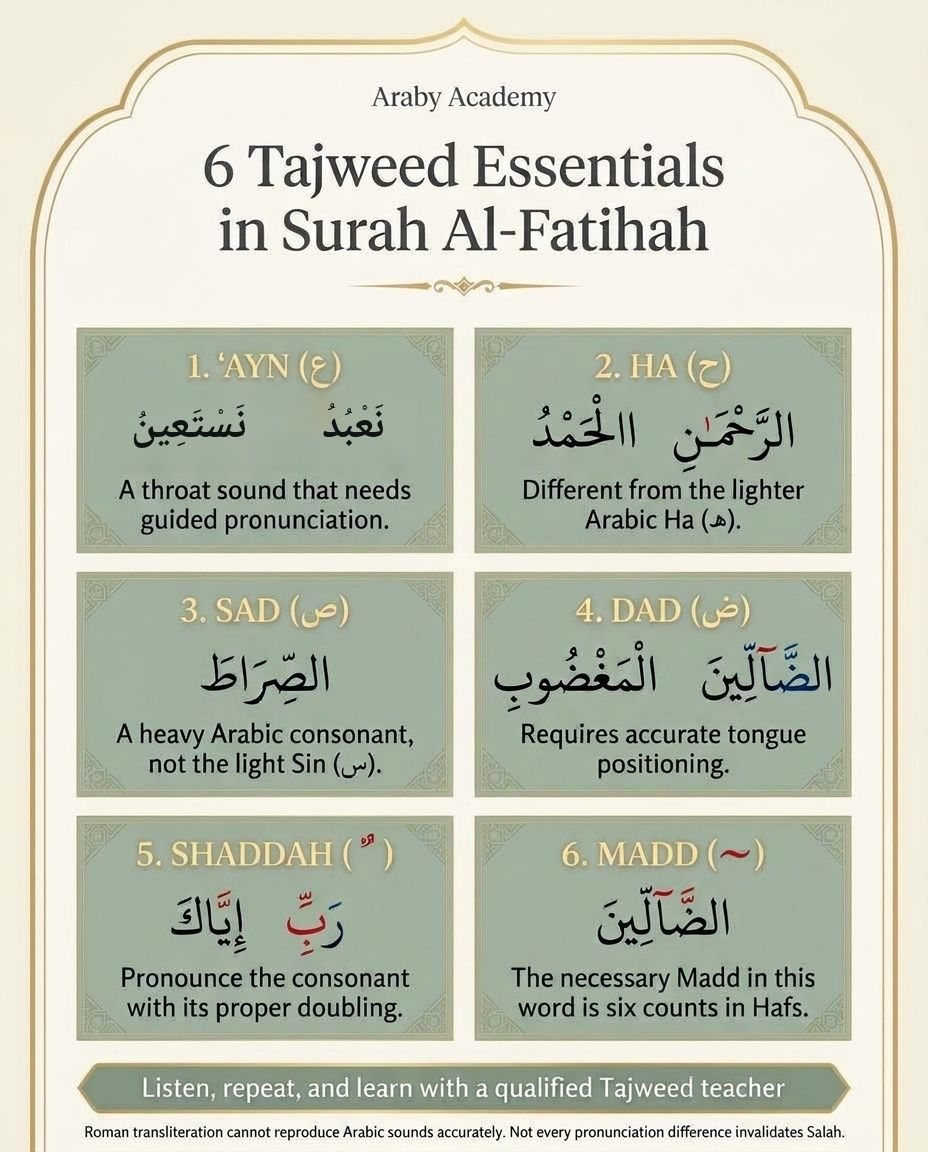
Common mistakes. Replacing the 'ayn with a hamzah; confusing the sad with the sin; pronouncing the dad like a "d"; shortening the long vowels or dropping the madd in ad-dallin; missing the shaddah; and rushing so that letters blur. An accent difference is not the same as a mistake, and not every error invalidates prayer.
Does a pronunciation mistake invalidate Salah? The answer depends on several things: whether the mistake was unintentional, whether the person is unable despite effort, whether it changes the meaning, and whether it comes from negligence. Allah does not burden a soul beyond its capacity (2:286). Jurists are generally stricter about changes that alter the meaning of Al-Fatihah, such as saying "an'amtu" (I bestowed) for "an'amta" (You bestowed), and more lenient with learners who are still improving and sincerely trying. The schools differ in their details, so ask a qualified teacher about your own situation, and do not assume your prayer is invalid.
How to Learn Al-Fatihah from Zero
A practical sequence: (1) listen to a qualified reciter, (2) learn the Arabic letters, (3) learn one phrase at a time, (4) have a teacher check your pronunciation, (5) memorize the accurate words, (6) learn the meanings, (7) practice in Salah as your teacher guides you, and (8) review often. Transliteration can help at the start, but it should not be a permanent substitute for reading Arabic.
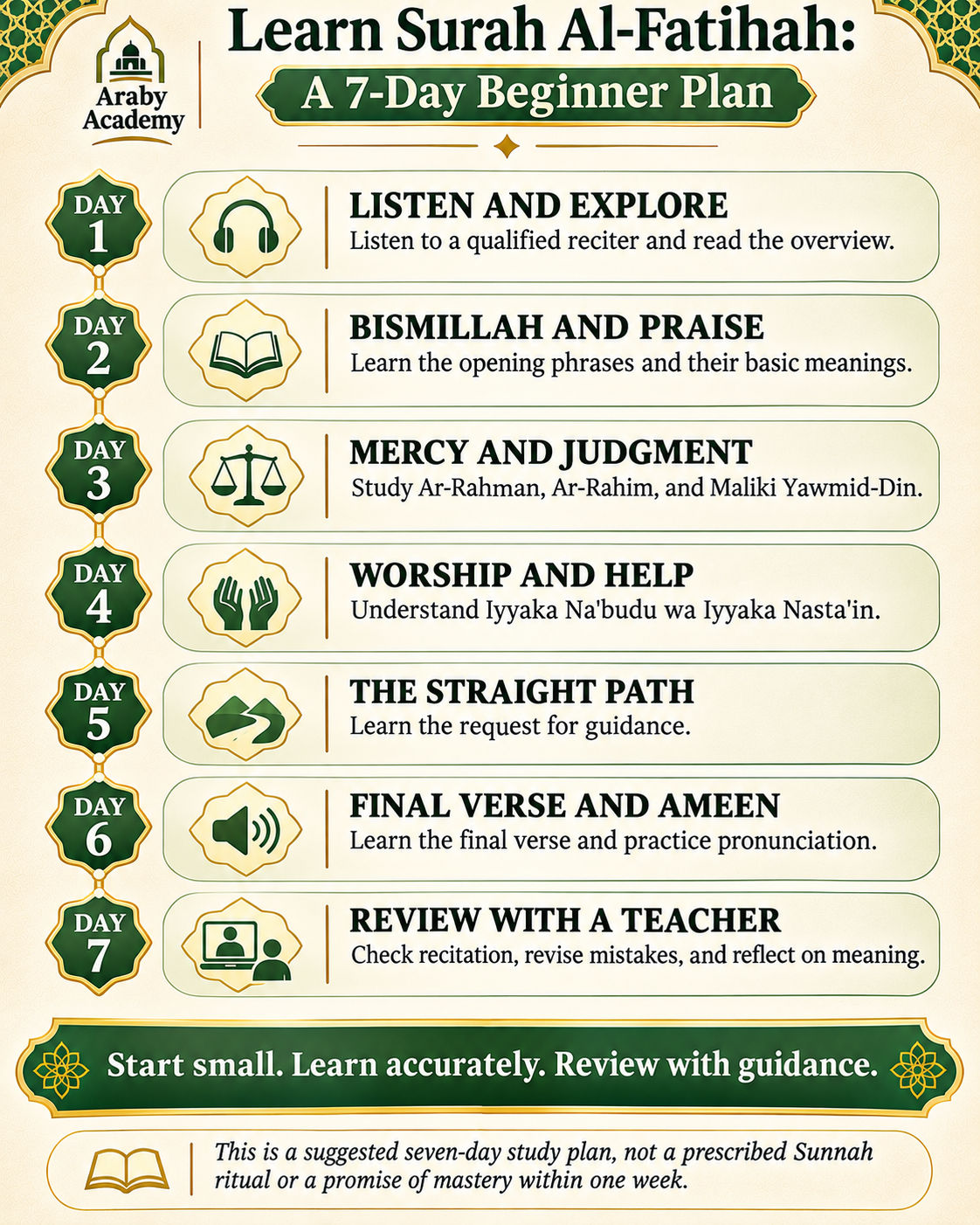
A seven-day beginner plan. This is an educational plan, not a Sunnah ritual, and it does not promise mastery in a week. Day 1: listen and read the overview. Day 2: Basmalah and praise. Day 3: mercy and judgment. Day 4: worship and seeking help. Day 5: guidance and the straight path. Day 6: the last verse, Ameen, and pronunciation. Day 7: review with a teacher and reflect on the meaning.
Memorizing without Arabic. Use audio, repeat in small chunks, learn the meaning of each chunk, ask for feedback, and review slowly. Avoid promises of instant memorization.
Children. Teach in short, gentle sessions with repetition and simple meaning-based examples. Encourage them, and correct pronunciation without shame. Avoid punishment. Parents can use word-matching cards, verse-order cards, a meaning quiz, letter spotting, listen-and-repeat, family reflection, and a teacher-guided review. These are learning activities, not prescribed acts of worship. At Araby Academy, we teach Al-Fatihah this way in one-to-one lessons for adults and children.
Al-Fatihah as Ruqyah, and Claims About Counts
In a narration in Sahih al-Bukhari (5736) and Sahih Muslim (2201), a group of Companions traveled and were refused hospitality by a tribe. The tribe's chief was stung by a scorpion. One Companion recited Al-Fatihah over him, and the man recovered. When they asked the Prophet ﷺ, he said: "How did he know it is a ruqyah?" and asked for a share of what they received. This shows that Quranic ruqyah is legitimate. It does not mean Al-Fatihah automatically cures every illness. Recitation and du'a can accompany medical care, and no one should stop necessary treatment or ignore doctors.
Popular formulas that require reciting it 7, 41, or 100 times for a promised result, such as marriage or wealth, are not supported by reliable evidence. General Quran recitation is rewarded: the Prophet ﷺ said each letter earns a good deed multiplied tenfold (Tirmidhi 2910), but fixed counts tied to guaranteed results should not be presented as Sunnah.
Khushu', the Five Prayers, and Reflection
Khushu' (الخشوع) is humble, attentive presence in worship. Understanding Al-Fatihah cannot guarantee perfect concentration, but it can give the mind something to hold. The Surah is recited in every unit of obligatory prayer. The five daily prayers contain 17 obligatory rak'ahs (2+4+4+3+4), so the number 17 is the count of units, not the number of recitations every worshipper makes: the Hanafi school, for example, has Al-Fatihah recited in the first two units of obligatory prayers, and followers differ by school. See The 5 Daily Prayers Explained: Why Muslims Pray Throughout the Day
Seven reflection questions for each rak'ah. This is an educational device, not a Sunnah ritual, and it does not need to be done in order or all at once.
Whom am I praising?
What does Allah's mercy mean in my life?
What does accountability ask of me?
Whom do I worship?
Whose help do I seek?
Why do I need guidance?
What path am I asking to follow?
The Surah also connects with the Names of Allah (Allah, Ar-Rahman, Ar-Rahim, Rabb, Malik); see The 99 Names of Allah Explained . Some of these are formal Names, and some are descriptions in context.
Ten Life Lessons and Seven Overlooked Points
Ten lessons: begin with Allah's name (1); praise Him (2); recognize His mercy (3); remember accountability (4); worship Him alone (5); seek His help (5); ask for guidance continually (6); value the path of the righteous (7); learn from misguidance without arrogance (7); and make recitation meaningful.
Seven things often overlooked: the meaning of the title; the word-by-word structure; the Hadith Qudsi; the shift to "You"; the use of "we"; the daily need for guidance; and that Ameen is not part of the Quranic text.
Common Misconceptions
Myth | Reality |
|---|---|
Al-Fatihah is only an introduction. | Authentic Sunnah establishes its central place in Salah. |
Every scholar counts the Basmalah the same way. | Numbering and Fiqh differ. |
English captures all the Arabic. | Translation communicates meanings, not every feature of the wording. |
Hamd and shukr are exact synonyms. | Classical scholars note overlapping but distinct senses. |
Rabb means only Creator. | It also includes ownership, care, and authority. |
Al-'Alamin proves other universes. | Do not impose speculative cosmology on the verse. |
The two readings of Malik contradict each other. | Both are authenticated recitations. |
Iyyaka literally means "only." | Exclusivity comes from structure and context. |
Iyyaka nasta'in forbids asking people for help. | Ordinary lawful help is not worship. |
Only new Muslims need guidance. | Every believer asks for it. |
Ameen is a verse of the Surah. | It is not part of the Quranic text. |
Only scholars can understand it. | Beginners can learn gradually with reliable teaching. |
Grammar must be mastered first. | Word-by-word learning helps from the start. |
Any accent difference invalidates prayer. | Rulings depend on the type of mistake and on ability. |
One recitation cures any illness. | No unsupported medical promises. |
41 recitations guarantee marriage or wealth. | Such promises lack reliable evidence. |
The last verse permits hatred of all Jews or Christians. | It must not be used for collective hostility or discrimination. |
The Surah is about personal success. | Its themes are praise, mercy, worship, accountability, and guidance. |
Memorizing the Arabic removes the need to study meaning. | Understanding deepens recitation. |
From Reciting Al-Fatihah to Understanding It
A Muslim may recite Al-Fatihah many thousands of times in a lifetime. Its words deserve more than mechanical repetition. They teach praise, mercy, accountability, worship, reliance, guidance, and a meaningful path. Understanding does not automatically guarantee perfect khushu', but it can support more attentive prayer.
Al-Fatihah is short enough to learn early in life, yet rich enough to return to throughout a lifetime of Quran study. If you want to learn to read Arabic and recite with accurate Tajweed, a qualified teacher is the best next step, and Araby Academy offers one-to-one lessons for adults and children. For daily habits, see How to Build a Daily Quran Habit That Actually Lasts
Frequently Asked Questions
1. What is Surah Al-Fatihah? It is the first chapter of the Quran, called the Opening and Umm al-Kitab. It is recited in every rak'ah of Salah in most schools' rulings, and it combines praise of Allah, worship, reliance, and a request for guidance.
2. What does Al-Fatihah mean? "Al-Fatihah" means "the Opening," from the root f-t-h, to open. The Surah opens the Mushaf and opens the recitation of prayer.
3. How many verses does Al-Fatihah have? Seven, in every standard count. Counts differ on where the lines fall: the Kufan count includes the Basmalah as verse 1, while the Madinan and Basran counts do not.
4. Is Bismillah the first verse? In the Kufan numbering used with Hafs, and in the Shafi'i school, yes. In the Hanafi, Maliki, and dominant Hanbali views, it is a Quranic verse that begins surahs but is not counted within Al-Fatihah.
5. What is Umm al-Kitab? It means "Mother of the Book," or foundation of the Book. Arabic uses "umm" for a source or that which gathers, so the title reflects the Surah's gathering of the Quran's foundational themes, not a biological sense.
6. What are the Seven Oft-Repeated Verses? This is As-Sab' al-Mathani (Quran 15:87). The Prophet ﷺ identified it as Al-Fatihah (Bukhari 4474), and commentators connect "oft-repeated" to its recitation in every rak'ah.
7. What is the English translation of Al-Fatihah? "In the name of Allah, the Entirely Merciful, the Especially Merciful. All praise is for Allah, Lord of the worlds. The Entirely Merciful, the Especially Merciful. Master of the Day of Recompense. You alone we worship and You alone we ask for help. Guide us to the straight path, the path of those You have favored, not of those who earned anger, nor of those who went astray."
8. Why do Muslims recite Al-Fatihah in Salah? The Prophet ﷺ said there is no prayer for one who does not recite the Opening of the Book (Bukhari 756, Muslim 394). Scholars differ on its precise ruling in each rak'ah, but its central place is established.
9. Is Salah valid without Al-Fatihah? The schools differ. Most treat it as a pillar, and the Hanafi school treats it as obligatory but not a pillar. Someone who truly cannot recite it yet should follow the accommodation in the Hadith of Ibn Abi Awfa and learn it promptly.
10. Does the follower recite behind an Imam? Schools differ. Shafi'is say yes. Hanafis say the imam's recitation suffices. Malikis and Hanbalis generally say listen in loud prayers and recite in silent ones. Follow your school or a qualified local teacher.
11. What does Alhamdulillahi Rabbil-'Alamin mean? "All praise is for Allah, Lord of the worlds." It places praise with Allah and recognizes Him as Lord of all creation.
12. What does Rabb mean? It means Lord, master, sustainer, and one who manages and nurtures. Al-Tabari explains it with the senses of master, one who sets right, and owner. No single English word covers all of this.
13. What is the difference between Ar-Rahman and Ar-Rahim? Both come from the root r-h-m. Many commentators describe Ar-Rahman as mercy broad enough for all creation and Ar-Rahim as mercy especially connected to believers or as an enduring attribute. Scholars do not all draw one rigid line.
14. What is the difference between Malik and Malik? Malik (with a long alif) means owner or master, and Malik (short) means king or sovereign. Both are authentic recitations, and they complement each other.
15. What does Yawm ad-Din mean? The Day of Recompense, or Day of Judgment. "Din" here means repayment and reckoning, not "religion."
16. What does Iyyaka Na'budu mean? "You alone we worship." Placing "iyyaka" before the verb is a grammatical fronting that conveys exclusivity: worship is for Allah and no one else.
17. What does Iyyaka Nasta'in mean? "You alone we ask for help." It means relying on Allah alone as the ultimate source of help. It does not forbid asking doctors, teachers, or others for lawful help.
18. What does Ihdinas Siratal Mustaqim mean? "Guide us to the straight path." It asks Allah to show the way, enable us to follow it, and keep us firm on it.
19. Why do believers ask for guidance every day? Guidance is continuous, and a person can know the truth yet still need help following it. The Quran includes a supplication not to let hearts deviate after being guided (3:8).
20. Who are those favored by Allah? Quran 4:69 names the prophets, the steadfast affirmers of truth, the martyrs, and the righteous. Their ranks are not identical.
21. Is Ameen part of the Surah? No. It is said after the Surah in Salah on the authority of the Sunnah, and it is not a verse of Al-Fatihah.
22. Can I recite Al-Fatihah in English during Salah? Most scholars say a translation is not the Quran and does not replace the Arabic. If you are truly unable, follow the accommodation in the Hadith of Ibn Abi Awfa, ask a qualified scholar, and learn the Arabic soon.
23. How can a non-Arabic speaker memorize it? Listen to a qualified reciter, repeat in small chunks, learn each chunk's meaning, get a teacher's feedback on pronunciation, and review slowly.
24. What Tajweed rules should beginners learn? Start with the letters 'ayn, ḥa, sad, and dad, plus the shaddah, the solar and lunar lam, natural madd, and the long madd in ad-dallin. Learn them with audio feedback.
25. Can Al-Fatihah be recited as Ruqyah? Yes. A narration in Bukhari and Muslim describes a Companion reciting it over a tribal chief, and the Prophet ﷺ approved. It should accompany, not replace, medical care, and it carries no guaranteed cure.
26. How can understanding the Surah improve Khushu'? Knowing the meaning gives the mind something to hold in each verse. It supports attentiveness without guaranteeing perfect concentration.