“With hardship comes ease.” Many readers have heard this English phrase countless times. The Arabic reads إِنَّ مَعَ الْعُسْرِ يُسْرًا (Quran 94:6), and it raises questions. Why “with” rather than “after”? What does inna contribute? Why does the Surah repeat a nearly identical sentence?
This guide studies twelve complete Quranic expressions where grammar, context, and rhetoric add real detail. It does not promise hidden secrets; it shows how verified features help you read more carefully.
Quick answer: Some Quranic expressions contain grammatical and rhetorical features that a short English translation cannot display fully. Word order may signal emphasis, particles can strengthen or restrict a statement, repetition can organize a passage, and a metaphor can connect several ideas at once. For example, Al-Fatihah places “You” before the verb in “You alone we worship,” while Surah Ash-Sharh repeats a statement about hardship and ease. Understanding these features requires authentic Arabic, context, and reliable Tafsir.
Why Quranic Arabic Expressions Can Carry More Than a Short English Translation
A translation communicates meaning in another language. A linguistic explanation shows how the Arabic builds that meaning through word order, particles, pronouns, repetition, metaphor, and nearby verses. The two are complementary, and a translation is not wrong merely because it omits a grammar note.
Three terms help. Balāghah (بَلَاغَة) is the Arabic scholarly tradition of rhetoric: how effective expression suits its audience and situation, which is more than “beautiful words.” Naḥw explains how words function in a sentence, and ṣarf explains how words are formed and inflected. Scholars do not accept every rhetorical observation equally, so this article attributes interpretive claims.
Students who want to understand these examples more confidently can begin with [ what Quranic Arabic involves beyond recognizing individual words] before studying the grammatical and rhetorical details of complete verses.
Translators balance clarity, readability, literal structure, contextual meaning, and English idiom. Different English renderings become easier to assess after learning [ why Quran translations sometimes use different wording], especially when translators must choose between preserving Arabic structure and explaining its meaning. The English lines below are my own explanatory paraphrases, not quotations from a named translation.
12 Quranic Expressions at a Glance
Expression | Ref. | Short rendering | Main feature |
|---|---|---|---|
الْحَمْدُ لِلَّهِ رَبِّ الْعَالَمِينَ | 1:2 | All praise belongs to Allah, Lord of the worlds | Nominal clause |
إِيَّاكَ نَعْبُدُ وَإِيَّاكَ نَسْتَعِينُ | 1:5 | You alone we worship; You alone we ask for help | Fronting |
لَا رَيْبَ فِيهِ | 2:2 | There is no doubt about it | Categorical negation |
فَاذْكُرُونِي أَذْكُرْكُمْ | 2:152 | Remember Me; I will remember you | Command and response |
هُنَّ لِبَاسٌ لَّكُمْ وَأَنتُمْ لِبَاسٌ لَّهُنَّ | 2:187 | They are a garment for you, and you for them | Reciprocal metaphor |
إِنَّمَا الْمُؤْمِنُونَ إِخْوَةٌ | 49:10 | The believers are brothers | Restriction |
مَا وَدَّعَكَ رَبُّكَ وَمَا قَلَىٰ | 93:3 | Your Lord has not forsaken you, nor disliked you | Ellipsis |
إِنَّ مَعَ الْعُسْرِ يُسْرًا | 94:6 | With hardship comes ease | Emphasis, repetition |
فَبِأَيِّ آلَاءِ رَبِّكُمَا تُكَذِّبَانِ | 55:13 | Which of your Lord’s favors do you both deny? | Dual, refrain |
فَأَيْنَ تَذْهَبُونَ | 81:26 | So where are you going? | Rhetorical question |
فَلَا تَقُل لَّهُمَا أُفٍّ | 17:23 | Do not say “uff” to them | Brief utterance |
وَقُل رَّبِّ زِدْنِي عِلْمًا | 20:114 | Say: My Lord, increase me in knowledge | Supplication |
1. “All Praise Is Due to Allah”: Alhamdulillah Explained
الْحَمْدُ لِلَّهِ رَبِّ الْعَالَمِينَ (Quran 1:2). My paraphrase: “All praise belongs to Allah, Lord of the worlds.”
English “Praise be to Allah” can sound like a speaker’s exclamation, but the Arabic contains no verb meaning “I praise.” It is a nominal clause: al-ḥamdu (“the praise”) is the subject and lillāh (“for Allah”) completes it. The definite article is commonly understood to refer to praise in its fullest sense, and the prefix li- expresses belonging or entitlement. Rabb al-ʿālamīn then describes the One praised through His lordship over all creation. Some commentators see stability in the nominal form, but that is an interpretation of this phrase, not a rule that every nominal sentence means eternity.
A common mistake is to treat hamd and shukr as rigid opposites without checking the lexicons. Try this: find the noun, the preposition, and the description in the verse.
2. “You Alone We Worship”: Why Arabic Word Order Matters
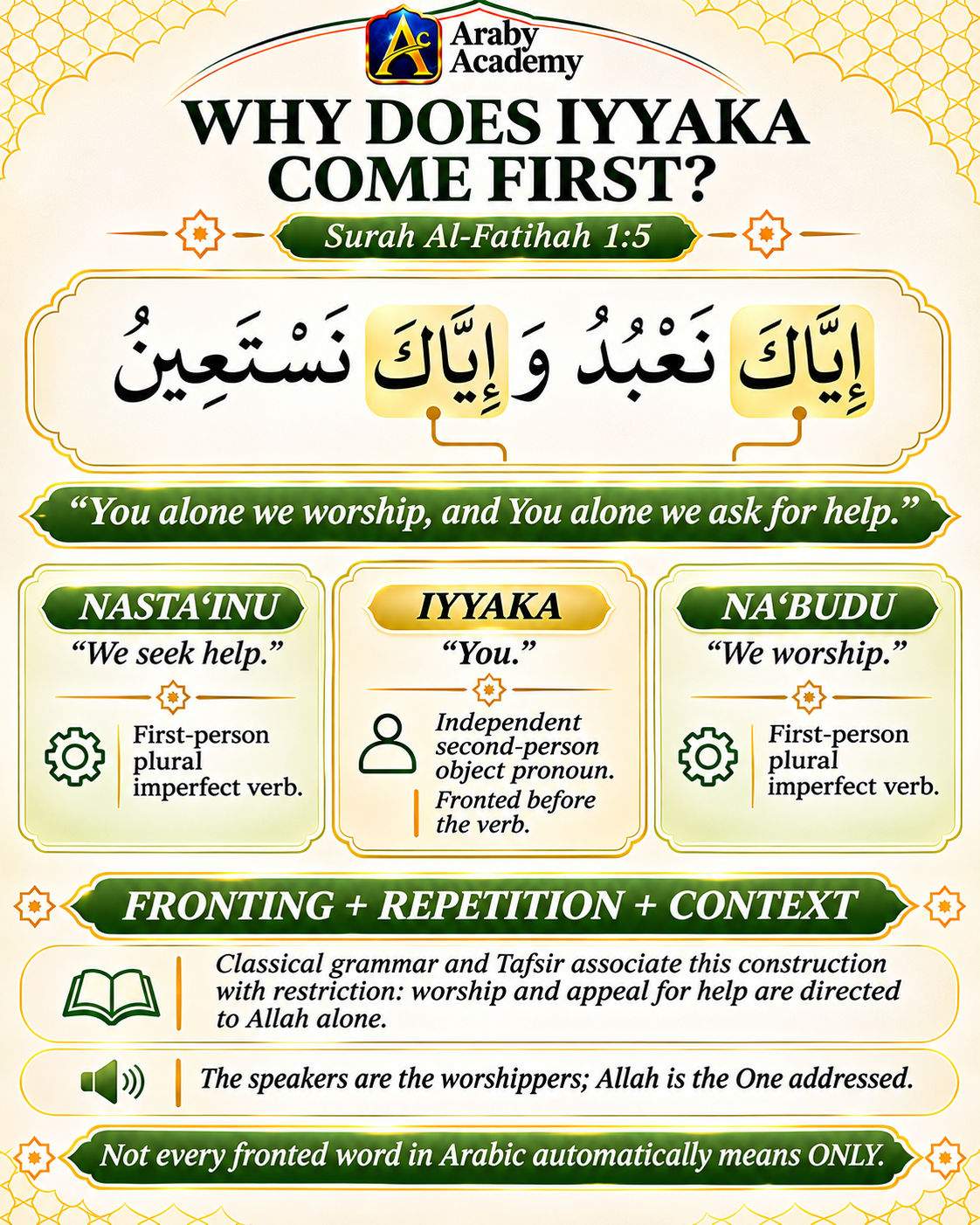
إِيَّاكَ نَعْبُدُ وَإِيَّاكَ نَسْتَعِينُ (Quran 1:5). My paraphrase: “You alone we worship, and You alone we ask for help.”
Arabic would normally place the verb first and attach the pronoun: naʿbuduka, “we worship You.” Here the independent object pronoun iyyāka comes before the first-person plural verbs naʿbudu and nastaʿīn. Classical grammarians and commentators such as al-Zamakhshari describe this fronting (taqdīm) as conveying restriction (qaṣr): worship and requests for help are directed to Allah alone. English adds “alone” because it cannot reorder the sentence the same way. Repeating iyyāka gives each act its own direct address. The speakers are the worshippers, and the One addressed is Allah, a shift from the third-person praise of the previous verses.
A common mistake is to claim that every fronted word in Arabic means “only.” The placement of Iyyaka is an excellent introduction to [ Quranic examples where Arabic word order changes the emphasis], because a natural English translation may communicate the effect without copying the Arabic sequence. Try this: ask who speaks, who is addressed, and which word comes before each verb.
3. “There Is No Doubt in It”: The Grammar of La Rayba Fihi
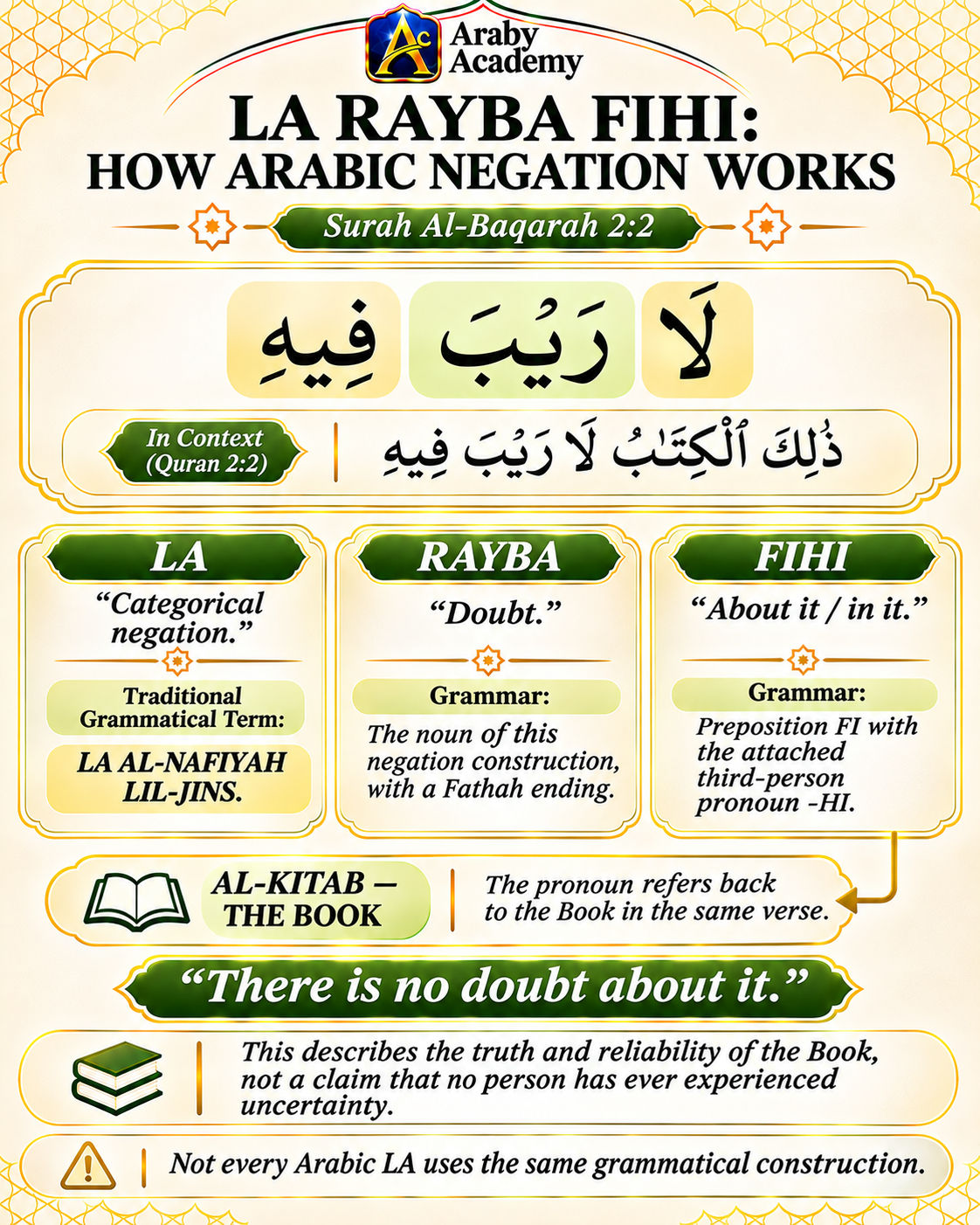
لَا رَيْبَ فِيهِ (Quran 2:2). My paraphrase: “There is no doubt about it.”
Traditional grammar calls this lā al-nāfiyah lil-jins: negation of a whole category, denying that any rayb belongs to the matter. The noun takes a fatha because of that construction. Lexicographers such as al-Raghib describe rayb as doubt joined with unease or suspicion, so it is not interchangeable with every Arabic word translated “doubt.” Fīhi is fī (“in, about”) plus the attached pronoun -hi (“it”), which refers back to dhālika al-kitāb, “that Book,” in the same verse. Commentators such as al-Tabari and Ibn Kathir treat the statement as being about the Book’s truth and source, not as a report that no person has ever felt doubt. Not every lā in the Quran works this way.
A common mistake is to read the verse as a claim about every person’s feelings. The short expression La Rayba Fihi shows why small Arabic words and particles can affect the meaning of a Quranic sentence, even when an English reader notices only the main noun. Try this: identify the negation, the noun, and the referent of -hi.
4. “Remember Me, and I Will Remember You”: Parallelism and Pronouns
فَاذْكُرُونِي أَذْكُرْكُمْ (Quran 2:152). My paraphrase: “So remember Me; I will remember you.”
Fa- links the command to the preceding verse, which mentions the Messenger and the teaching Allah gave, so it works like “so.” Udhkurūnī is a group imperative: the verb udhkur-, the plural “you” -ū, and the object “me” -nī. Adhkurkum is the response: first-person a-, the same root, and -kum (“you”). Grammarians explain its jussive ending as the answer to a command. The root repeats while the participants swap: people first, then Allah. Divine remembrance is not human memory; commentators such as Ibn Kathir relate it to Allah’s mercy, reward, and care. The verse continues with وَاشْكُرُوا لِي وَلَا تَكْفُرُونِ, commanding gratitude and forbidding ingratitude, so the opening phrase is only part of the instruction.
A common mistake is to picture divine remembrance as human memory. The change in speaker and addressee within this short exchange becomes easier to follow when readers understand [ why the Quran uses different first-person and third-person expressions] and how Arabic pronouns function. Try this: match “Me” and “you” to their suffixes.
5. “They Are Garments for You”: The Quran’s Reciprocal Metaphor
هُنَّ لِبَاسٌ لَّكُمْ وَأَنتُمْ لِبَاسٌ لَّهُنَّ (Quran 2:187). My paraphrase: “They are a garment for you, and you are a garment for them.”
Libās ordinarily means clothing. Here it is a metaphor, and the same noun is applied to both sides: hunna (feminine plural, the wives) and antum (masculine plural, the husbands), each paired with la- (“for”). The two clauses mirror each other, so the image runs in both directions. Commentators such as al-Tabari and Ibn Kathir explain it in terms of closeness, mutual covering, and comfort, but the verse itself does not spell out every association. It appears among the passages on the nights of fasting; this article does not treat the rulings. The grammatical parallel shows a reciprocal image, not a legal ruling that every marital role is identical.
A common mistake is to read libās as a literal clothing instruction. The garment image is a natural starting point for exploring [ powerful Quranic metaphors and how reliable Tafsir explains them], because the Arabic expression connects its imagery with the surrounding passage. Try this: find the noun that supplies the image and the pronouns that make it mutual.
6. “The Believers Are Brothers”: What Innama Adds
إِنَّمَا الْمُؤْمِنُونَ إِخْوَةٌ (Quran 49:10). My paraphrase: “The believers are, in truth, brothers.”
Classical grammar and Balaghah commonly describe innamā as a particle of restriction and emphasis, though its effect depends on the construction and it should not be reduced to one English word. The basic nominal statement is al-mu’minūn (“the believers”) plus ikhwah (“brothers”). The verse continues with فَأَصْلِحُوا بَيْنَ أَخَوَيْكُمْ, “so reconcile between your two brothers,” and fa- ties the bond to a duty. Commentators explain this as brotherhood in faith rather than biological kinship, and legal questions such as inheritance need separate scholarship.
A common mistake is to quote only the opening clause. Try this: ask what innamā adds, then read what instruction follows.
7. “Your Lord Has Not Forsaken You”: Quranic Ellipsis
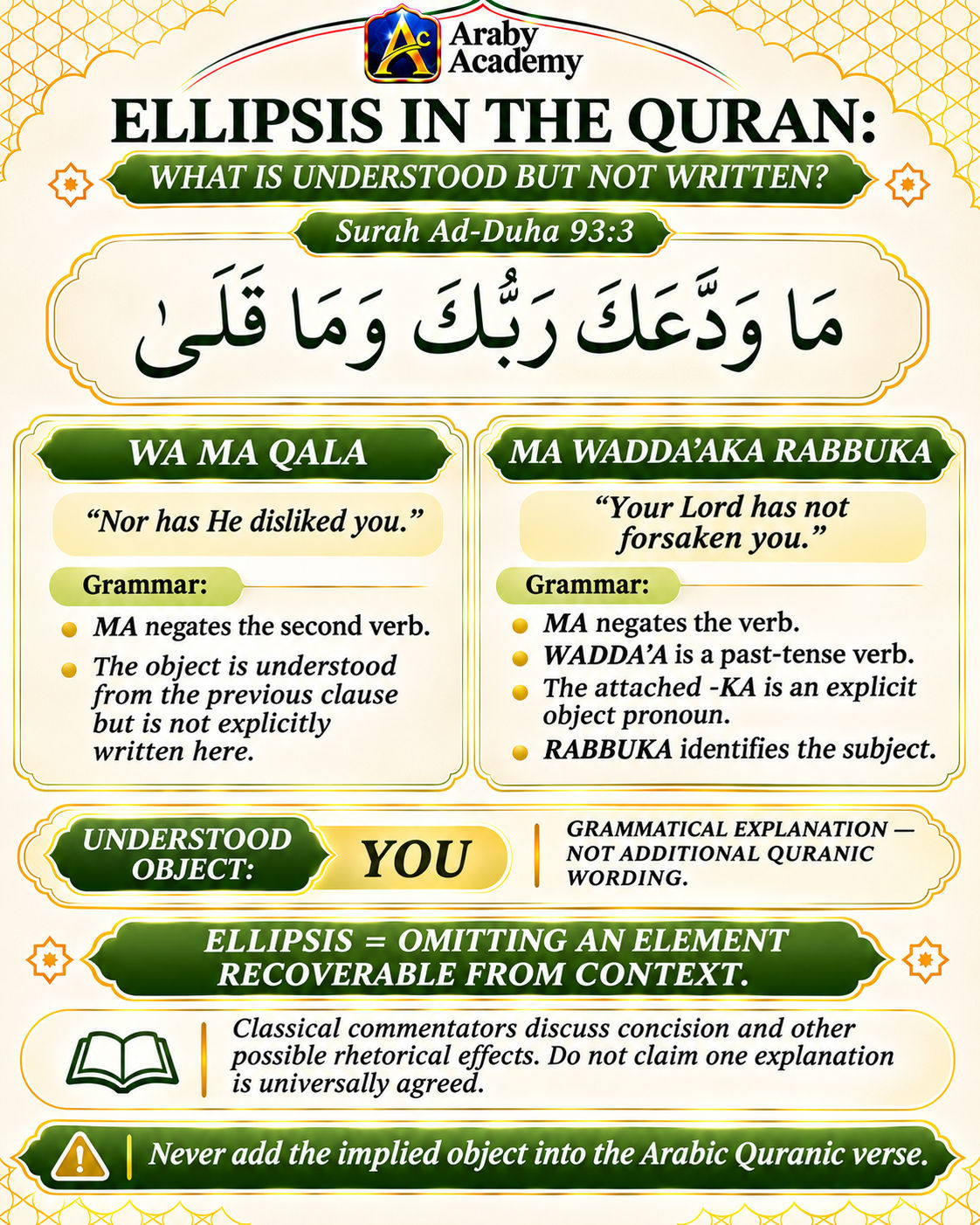
مَا وَدَّعَكَ رَبُّكَ وَمَا قَلَىٰ (Quran 93:3). My paraphrase: “Your Lord has not forsaken you, nor has He disliked you.”
Mā negates both past-tense verbs. Waddaʿaka carries the attached object -ka (“you”) and means to leave someone behind; qalā means to dislike or hate intensely, as lexicons such as Lane note. The second clause writes no object. Grammarians and commentators such as al-Zamakhshari understand “you” as intended and recoverable from the first clause. Explicit in the first clause: the object -ka. Understood in the second clause: the same object, not written again. (That is a grammatical explanation, never to be added to the Quranic text.) Explanations for the omission include concision and fit with the verse endings; none need be the only reason. The Surah belongs to a consoling context, and while reports mention a pause in revelation, their details vary, so this article relies only on the broad reassurance.
A common mistake is to write the understood object into the Quranic text. The reassurance in Surah Ad-Duha shows why Tafsir can explain important details beyond a short English Quran translation, especially when the Arabic leaves a grammatical element understood rather than repeated. Try this: compare the two clauses and say what is missing.
8. “With Hardship Comes Ease”: Emphasis and Repetition
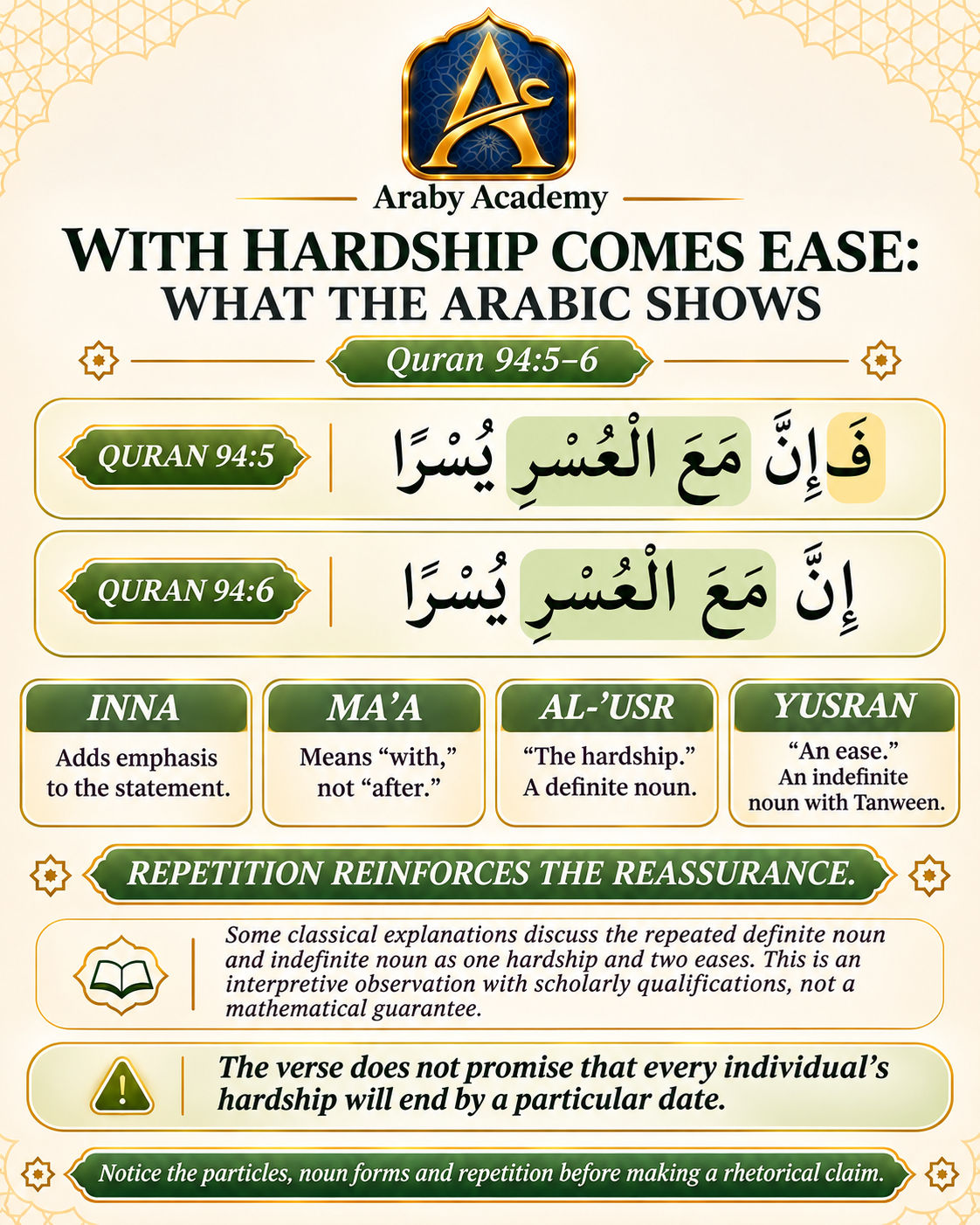
إِنَّ مَعَ الْعُسْرِ يُسْرًا (Quran 94:6), after فَإِنَّ مَعَ الْعُسْرِ يُسْرًا (94:5). My paraphrase: “Indeed, with hardship comes ease.”
Inna strengthens a statement; “indeed” is a natural English match here but not a universal one. Maʿa means “with,” and the Arabic does not say “after”; commentators take it to express nearness or accompaniment without setting a timetable for anyone. Al-ʿusr is definite (“the hardship”), while yusran is indefinite with tanween (“an ease”). Verse 94:5 begins with fa- and 94:6 repeats the statement without it, which reinforces the assurance. Many commentators, citing a report attributed to early authorities, observe that a repeated definite noun usually points to the same thing while a repeated indefinite may be new, yielding “one hardship, two eases.” Others qualify this as a general tendency with exceptions, or read 94:6 simply as emphatic repetition. Treat it as a respected observation, not mathematical proof. Indefiniteness here does not mean infinite or measurable ease, and neither the grammar nor the verse sets a timetable for any individual.
A common mistake is to treat “one hardship, two eases” as a mathematical law. Try this: find the word for “with,” the definite noun, the indefinite noun, and the repeated sentence.
9. “Which of Your Lord’s Favors Will You Deny?”: Rhetorical Questions
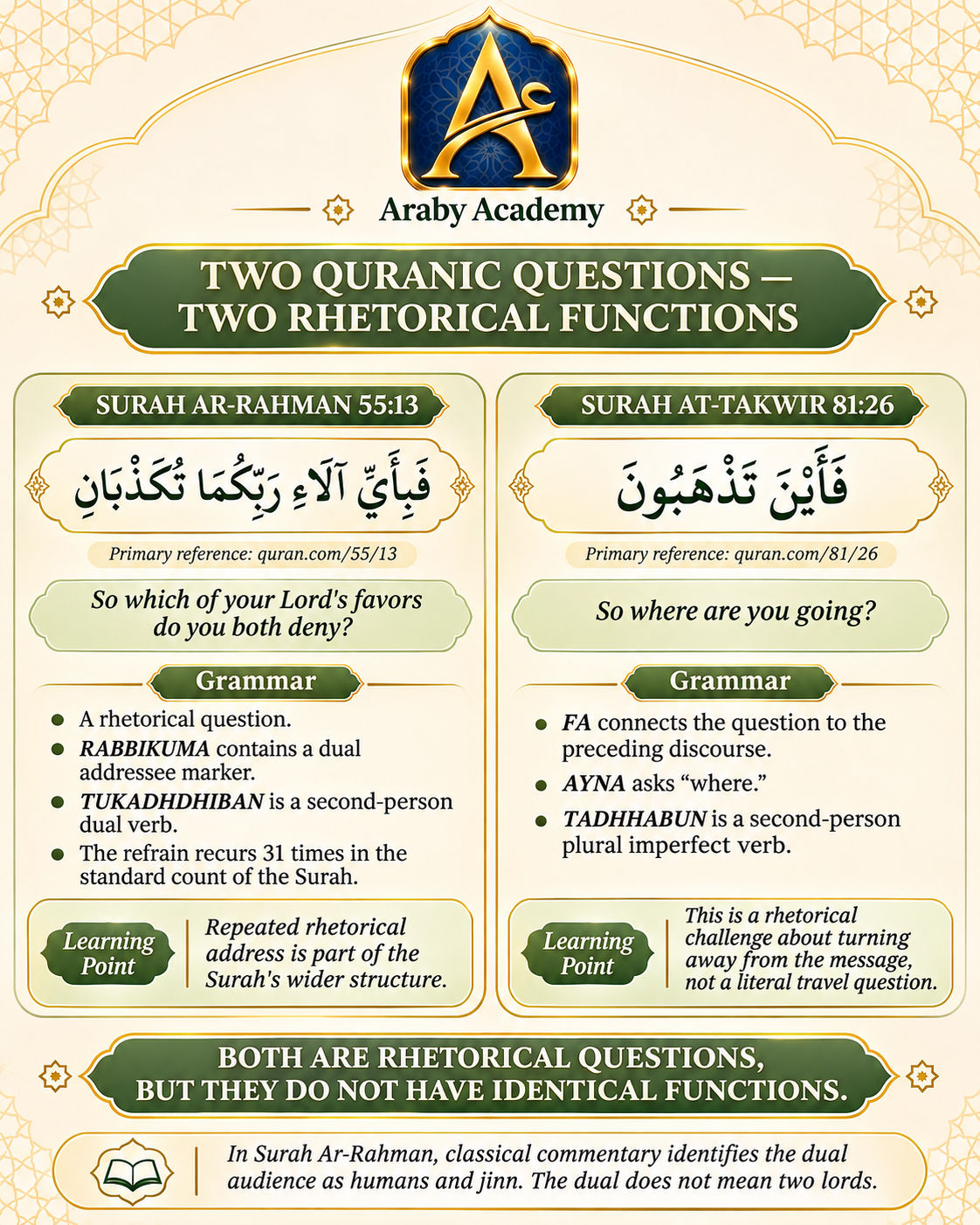
فَبِأَيِّ آلَاءِ رَبِّكُمَا تُكَذِّبَانِ (Quran 55:13). My paraphrase: “So which of your Lord’s favors do you both deny?”
The question uses ayy (“which”), but it does not seek information; it is rhetorical, rebuking and inviting acknowledgment. Rabbikumā (“your Lord,” addressed to two) and tukadhdhibān (“you two deny”) are dual forms. Commentators explain the two addressed as humans and jinn, who are called together in 55:31. Rabb itself is singular, so the dual implies nothing about two lords. Ālā’ is commonly rendered “favors” or “blessings.” The refrain recurs throughout the Surah, in the standard count 31 times. Its placement follows each passage of blessings or warnings, and it need not carry a new dictionary meaning each time.
A common mistake is to think the dual means two lords. The recurring question in Surah Ar-Rahman also invites readers to explore [ how Quranic verse endings and sound patterns contribute to the structure of a Surah], without reducing Quranic rhetoric to sound alone. Try this: circle the dual endings and ask what comes just before each repetition.
10. “So Where Are You Going?”: A Rhetorical Challenge
فَأَيْنَ تَذْهَبُونَ (Quran 81:26). My paraphrase: “So where are you going?”
Fa- connects the question to the preceding verses, which present the Quran as the speech of a noble messenger rather than of an accursed devil. Ayna asks “where,” and tadhhabūn is a second-person plural imperfect: “you are going.” Yet the question is not about travel. Classical commentators such as al-Tabari and Ibn Kathir read it as a rebuke: after such clear evidence, what path are you taking? An English reader may hear inspirational advice, but context makes it a challenge to the audience’s response. Unlike the refrain of Surah Ar-Rahman, this is a single question inside an argument.
A common mistake is to turn the question into a motivational travel slogan. Try this: read verses 19–26 and say who is being challenged.
11. “Do Not Even Say Uff”: Meaning Through Brevity
فَلَا تَقُل لَّهُمَا أُفٍّ (Quran 17:23). My paraphrase: “Do not say even ‘uff’ to them.”
Uff is a brief interjection of annoyance or disgust, according to lexicons such as Lane. Lā taqul is a negative command. Lahumā is li- plus the dual -humā, “to the two of them,” referring to the parents the verse introduces as “one or both” reaching old age. Commentators such as Ibn Kathir explain that forbidding the mildest sign of irritation makes harsher words and acts all the more forbidden; the verse goes on to forbid harshness and command honorable speech, وَقُل لَّهُمَا قَوْلًا كَرِيمًا. This is an ethical teaching within a passage about worship and parental care, not a rule about pronouncing two letters.
A common mistake is to translate only the word uff and ignore the full verse. Try this: ask what the dual suffix refers to and what the verse commands next.
12. “My Lord, Increase Me in Knowledge”: Grammar of a Quranic Supplication
وَقُل رَّبِّ زِدْنِي عِلْمًا (Quran 20:114). My paraphrase: “And say: My Lord, increase me in knowledge.”
Wa-qul is an imperative addressed to the Prophet ﷺ, following the instruction not to hasten with the Quran before its revelation is completed, so the prayer is tied to receiving revelation. Rabbi is rabb with the attached “my.” Zidnī is the imperative of zāda plus -nī (“me”). In a supplication, the imperative is simply the grammar of request, not a superior ordering Allah. ʿIlman is accusative with tanween, the thing requested; “knowledge” is indefinite but not thereby infinite. Scholars relate the request to knowledge connected with revelation, and many also cite the verse for the value of knowledge generally.
A common mistake is to use the phrase as a context-free slogan. The request for increased knowledge becomes even more meaningful when readers study [Quranic word pairs such as 'Ilm and Hikmah that English can easily flatten], while remembering that the full prayer requires its own context. Try this: say who is told to speak, which word makes the request, and what -nī contributes.
All 12 Quranic Expressions at a Glance
Expression | Ref. | Simple rendering | Arabic feature | English may not show |
|---|---|---|---|---|
Alhamdulillah | 1:2 | Praise belongs to Allah | Nominal clause | No “I praise” verb |
Iyyaka na‘budu | 1:5 | You alone we worship | Fronting | Word order |
La rayba fihi | 2:2 | No doubt about it | Lā of category | Referent of -hi |
Fadhkuruni | 2:152 | Remember Me | Same root, swapped roles | Pronoun suffixes |
Hunna libas | 2:187 | Garments for each other | Mirrored clauses | Both-way image |
Innama | 49:10 | Believers are brothers | Restriction | The particle’s force |
Ma wadda‘aka | 93:3 | Not forsaken, not disliked | Ellipsis | Understood object |
Inna ma‘a al-‘usr | 94:6 | Hardship brings ease | Definite/indefinite | Repetition across 94:5–6 |
Fa-bi-ayyi ala’i | 55:13 | Which favors do you deny? | Dual, refrain | Two addressees |
Fa-ayna tadhhabun | 81:26 | Where are you going? | Rhetorical question | Challenge, not direction |
La taqul lahuma uff | 17:23 | Say not “uff” | Dual suffix | The wider command |
Rabbi zidni ‘ilma | 20:114 | Increase me in knowledge | Imperative as prayer | Link to revelation |
Six Arabic Language Features That Help Explain These Expressions
The twelve examples illustrate six overlapping features, not a complete taxonomy of Balaghah. Grammatical structure: al-Hamd and La Rayba. Emphasis and restriction: Iyyaka and Innama. Parallelism and reciprocity: Dhikr and Libas. Ellipsis and concision: Ad-Duha. Repetition and rhetorical questions: Ash-Sharh, Ar-Rahman, and At-Takwir, which differ, since one repeats immediately, one refrains across a Surah, and one challenges within an argument. Expressive brevity and supplication: Uff and Rabbi Zidni ʿIlma. Small words such as inna, lā, innamā, fa-, and maʿa matter, but each acts according to its construction, and roots such as dh-k-r or ʿ-l-m explain only part of a phrase.
How to Analyze Quranic Expressions Step by Step
Confirm the Arabic. Read the complete phrase and verse in a reliable Mushaf.
Identify the structure. Note nouns, verbs, particles, and pronouns.
Look for one real feature. Word order, negation, repetition, metaphor, or ellipsis.
Read context and Tafsir. The surrounding verses and recognized commentators control interpretation.
Compare translations. An omitted grammar detail does not make a translation wrong.
Worked example, iyyāka naʿbudu: the object pronoun precedes the verb; commentators read restriction; English supplies “alone.” The overinterpretation to avoid is the idea that all fronting means exclusivity.
A Simple Seven-Day Quranic Arabic Practice Plan
Day 1: expressions 1–2. Day 2: 3–4. Day 3: 5–6. Day 4: 7–8. Day 5: 9–10. Day 6: 11–12. Day 7: review all twelve and list points that need Tafsir. A ten-minute session works too: two minutes reading, two identifying a feature, three on context, two comparing translation and Tafsir, one recording an observation. This is a study aid, not a guarantee of mastery. Once these expressions become familiar, students can apply the same approach through seven short Surahs to study word by word, building a habit of connecting Arabic structure with reliable meaning.
Common Mistakes When Studying Quranic Expressions
Treating English word order as Arabic word order: compare the Arabic sequence.
Assuming nominal sentences prove eternality: check context.
Ignoring inna and innamā: ask what they add.
Treating repetition as redundant, or inventing a secret meaning for it: look for its placement and function.
Reading every question literally: test whether it rebukes or reminds.
Missing pronoun references: trace each suffix.
Treating an inferred word as Quranic wording: label it as explanation.
Turning metaphor into literal description: ask what Tafsir says.
Explaining a phrase without its full verse or Tafsir: always read both.
Frequently Asked Questions
1. Why do short Quranic expressions carry more meaning in Arabic? They do not always carry more meaning, but Arabic structure, such as word order, particles, and pronouns, can add emphasis and relationships that a brief translation does not display.
2. What is Balaghah? It is the Arabic scholarly study of effective expression, including how structure, imagery, and context shape meaning. Scholars debate some rhetorical observations.
3. What does Alhamdulillah mean in Quran 1:2? It is a nominal clause: the praise belongs to Allah. It is not a verb meaning “I praise.”
4. Why does Al-Fatihah say “You alone”? Fronting iyyāka before the verb is described by classical scholars as conveying restriction, which English renders with “alone.”
5. What does La Rayba Fihi mean? It denies that doubt belongs to the Book, referred to by -hi. Commentators read it as a statement about the Book’s truth, not everyone’s feelings.
6. What does “Remember Me, I will remember you” mean? It pairs a command with a response using the same root. Commentators relate Allah’s remembrance to mercy, reward, and care, not human memory.
7. Why does the Quran compare spouses to garments? Libās is a reciprocal metaphor. Commentators explain closeness, covering, and comfort, within a passage about the nights of fasting.
8. What does Innama add? It is commonly described as restriction or emphasis. The verse then draws a duty of reconciliation from the bond of faith.
9. What does “Your Lord has not forsaken you” mean? It reassures the Prophet ﷺ that Allah has neither left nor disliked him, in a consoling Surah.
10. What is ellipsis in Quranic Arabic? It is omitting a word the listener can recover, like the object after qalā in 93:3. Scholars explain it as concision, among other reasons.
11. Why “with hardship” rather than “after”? The Arabic word is maʿa, “with.” Commentators understand nearness or accompaniment, without promising timing for any individual.
12. Why does Ash-Sharh repeat the statement? Repetition can reinforce reassurance; some scholars also read the repeated definite and indefinite nouns as pointing to separate eases.
13. Does the Quran promise exactly two eases? Not as an agreed mathematical rule. “One hardship, two eases” is a respected observation with scholarly qualifications.
14. Why does Ar-Rahman repeat the same question? It recurs after passages of blessings and warnings as a refrain. Its function is tied to context, and each repetition need not carry a different dictionary meaning.
15. What does Rabbikuma mean? “Your Lord,” addressed to two. Commentators identify the two as humans and jinn; rabb remains singular.
16. Why does the Quran ask “Where are you going?” In context, commentators read it as a rebuke to those turning away despite clear evidence, not a question about direction.
17. Why must believers not say “uff” to parents? It forbids the mildest sign of irritation, so harsher treatment is all the more prohibited; the passage commands kind speech.
18. What does Rabbi Zidni ʿIlma mean? “My Lord, increase me in knowledge.” The imperative is a supplication, and the verse is set in the context of receiving revelation.
19. Can English translations preserve Quranic rhetoric? Often they convey the core meaning, emphases, and images, though they may need notes to show dual forms, ellipsis, or word order.
20. How can beginners analyze a Quranic expression? Confirm the Arabic, identify its structure, spot one feature, read the verse in context with Tafsir, and then compare translations.
Read the Arabic, Notice the Structure, and Check the Tafsir
We began with “With hardship comes ease.” A short Quranic expression can be simple to remember and still reward careful study. When you look at the Arabic, you may notice why a word comes first, why a phrase is repeated, how a pronoun connects two clauses, or why a question carries more than its literal wording. These observations do not replace translation or Tafsir; they help you use both more thoughtfully. Begin with one expression, check its structure and context, and let understanding grow through reliable learning. If you would like guidance, you are welcome to study Quranic Arabic and Tafsir with qualified Araby Academy teachers.