
A young boy tells his father about an extraordinary dream. His brothers become jealous, separate him from his family, and leave him in a well. Taken to Egypt, he faces temptation, false accusation, and imprisonment before being entrusted with responsibility. Years later, the brothers who harmed him stand before him without recognising who he is.
The story of Prophet Yusuf, known as Joseph in English, is told in Surah Yusuf, Chapter 12 of the Quran. It follows his journey through betrayal, hardship, and leadership, ending with forgiveness and a family reunion. Its central lessons include patience, integrity, reliance on Allah, and mercy.
Yet this is more than a story of someone overcoming difficult circumstances. Surah Yusuf explores how faith shapes a person’s choices when they are vulnerable, misunderstood, or finally in a position of power.
This guide follows the Quranic narrative, explains important Arabic expressions, and explores lessons for everyday life. Where interpretations differ, those differences are acknowledged. Details that the Quran does not provide are not presented as established facts.
Who Was Prophet Yusuf?
Prophet Yusuf, peace be upon him, was the son of Prophet Ya‘qub, known in English as Jacob. He belonged to the prophetic family of Ibrahim and Ishaq.
His story appears in a sustained narrative in Surah Yusuf, which contains 111 verses. The chapter moves through family relationships, separation, moral trials, imprisonment, public responsibility, and reconciliation. Quran.com
Throughout these changes, Yusuf’s circumstances shift dramatically. His commitment to Allah remains the thread connecting them.
For readers encountering the story for the first time, three terms are especially useful:
Sabr: Patience, perseverance, and steadfastness.
Tawakkul: Reliance on Allah while taking appropriate action.
Tafsir: Scholarly explanation of the Quran.
Understanding these ideas helps us read the story as guidance for character and worship, as well as a sequence of events.
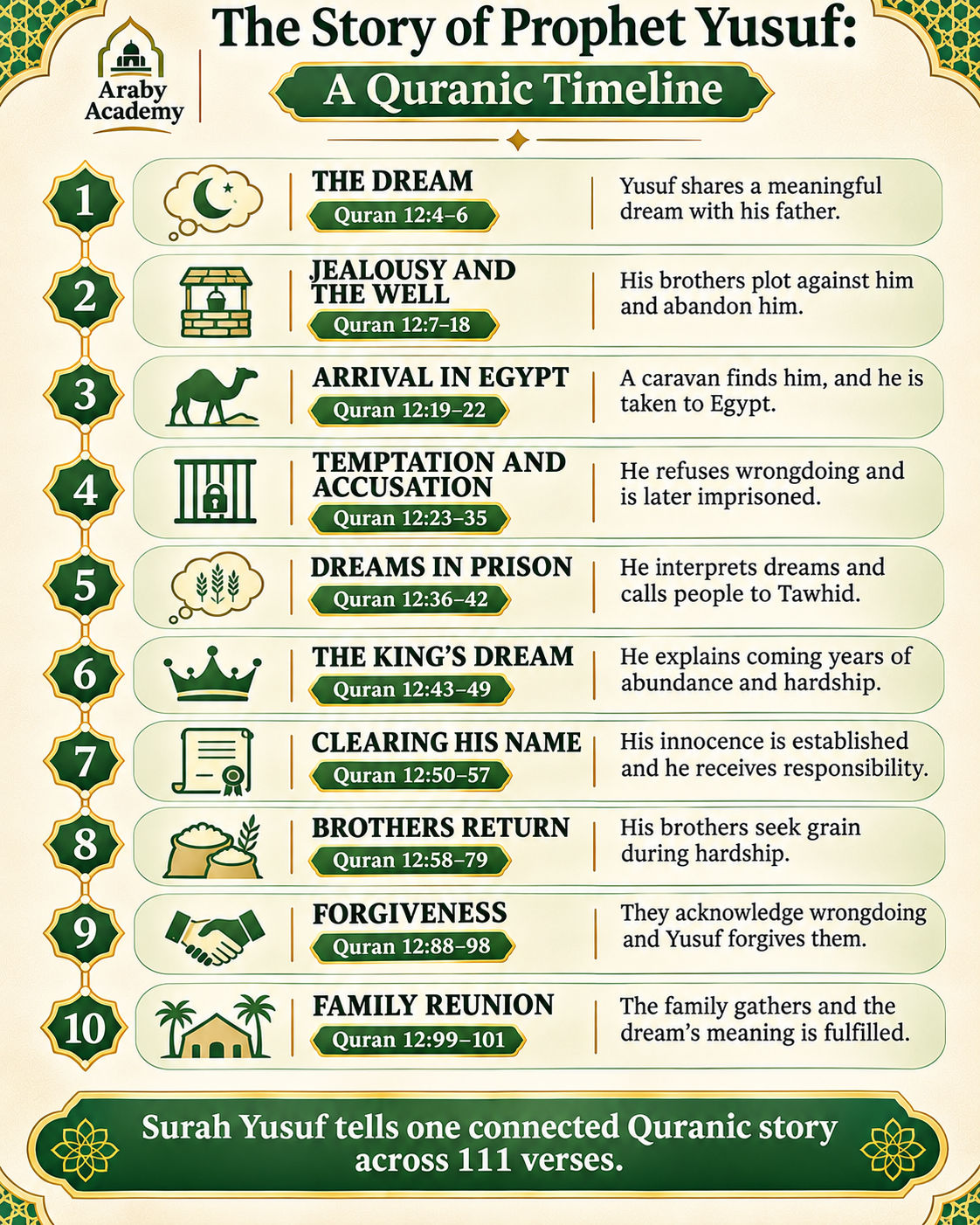
The Story of Prophet Yusuf at a Glance
Stage | Quran references | Main events |
|---|---|---|
The childhood dream | 12:4–6 | Yusuf tells his father about eleven stars, the sun, and the moon. |
His brothers’ jealousy | 12:7–14 | Resentment develops into a plan to remove him. |
The well | 12:15–18 | Yusuf is abandoned, and his brothers return with a false account. |
Arrival in Egypt | 12:19–22 | A caravan finds him, and he is taken into an Egyptian household. |
Temptation and accusation | 12:23–35 | Yusuf refuses wrongdoing and is eventually imprisoned. |
Life in prison | 12:36–42 | He calls others to Allah and interprets two prisoners’ dreams. |
The king’s dream | 12:43–49 | Yusuf explains the coming years of abundance and hardship. |
Vindication and responsibility | 12:50–57 | His innocence is acknowledged, and he receives authority. |
His brothers’ return | 12:58–87 | The family’s circumstances lead to further visits and trials. |
Recognition and forgiveness | 12:88–98 | Yusuf reveals his identity, and his brothers acknowledge their wrongdoing. |
Reunion and gratitude | 12:99–101 | The family reunites, and the earlier dream is fulfilled. |
The verse ranges follow the main scenes; some themes continue across several sections.
Why Is Surah Yusuf Called the Best of Stories?
In verse 12:3, Allah describes the narration with the expression ahsan al-qasas, commonly translated as “the best of stories” or “the best of narratives.”
Classical commentators discuss the richness of its lessons and the excellence of its telling. The story brings together relationships between parents and children, siblings, people in authority, and those who depend on them.
It also shows people facing different kinds of tests. Yusuf is tested through vulnerability and later responsibility. Ya‘qub experiences prolonged grief. The brothers must confront the consequences of their own actions.
Reading the whole chapter matters. A single scene may highlight patience or forgiveness, but the complete narrative shows how these qualities develop alongside truthfulness, effort, and accountability.
Yusuf’s Dream and His Father’s Advice
The story begins with Yusuf telling his father that he saw eleven stars, the sun, and the moon prostrating to him.
Ya‘qub advises him not to share the dream with his brothers, fearing that they may plot against him. He also speaks of Allah choosing Yusuf, teaching him interpretation, and completing His favour upon the family.
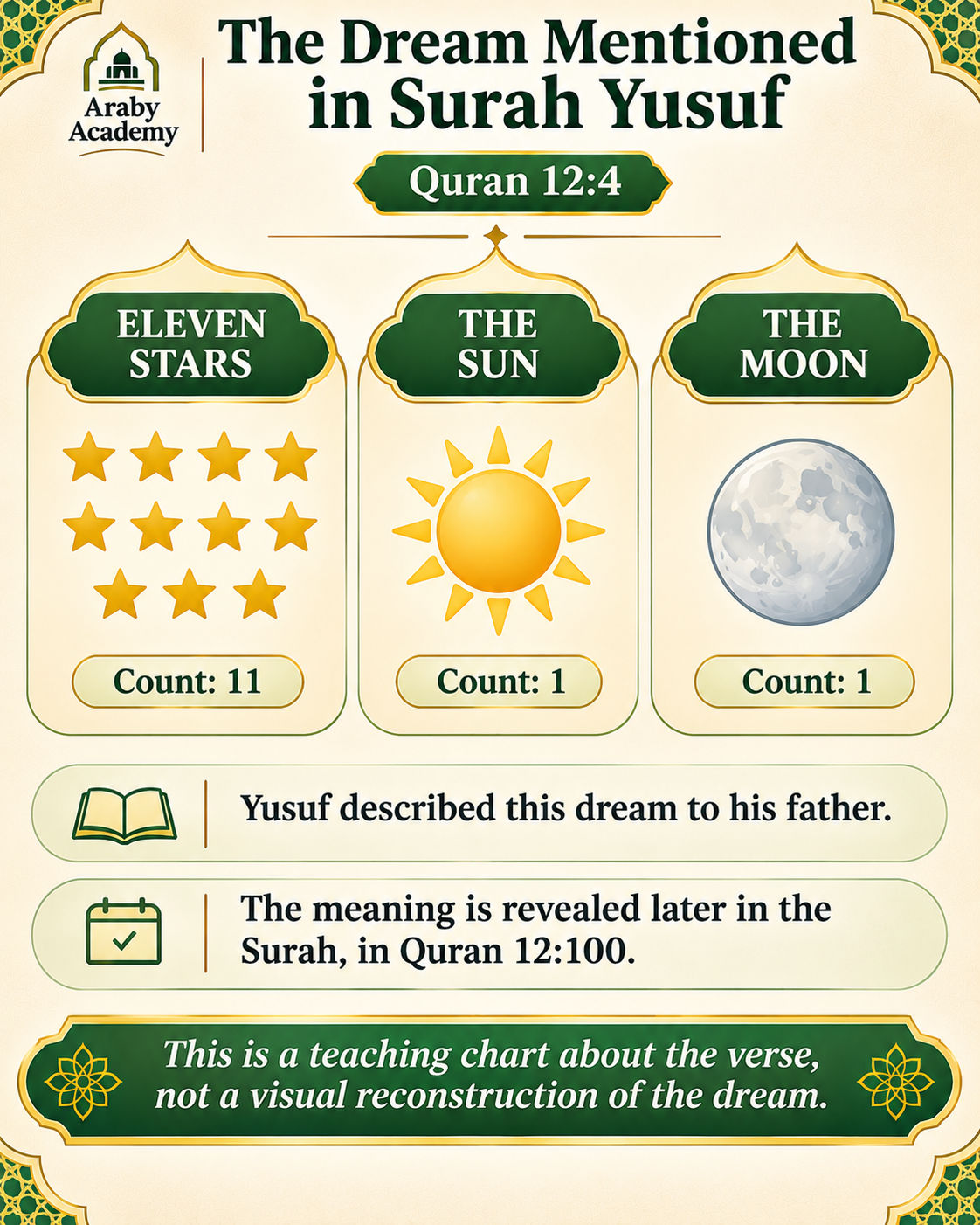
Quran reference: 12:4–6.
Discretion Can Be an Act of Wisdom
Ya‘qub’s advice recognises a foreseeable risk. It does not teach that every relative should be distrusted or that all good news must be hidden.
A practical lesson is to consider whom we tell, when we speak, and whether the listener can respond responsibly.
The dream itself belongs to Yusuf’s particular story. Its symbols should not be turned into a universal system for interpreting everyone’s dreams.
Why Yusuf’s Brothers Became Jealous
The brothers believe that Yusuf and his brother are dearer to their father than they are. Their words reveal their perception; they do not establish that Ya‘qub acted unjustly.
Instead of addressing their resentment honestly, they discuss removing Yusuf so their father’s attention will turn towards them.
One brother proposes leaving him in a well where travellers might find him, rather than killing him.
Quran reference: 12:8–10.
When Comparison Becomes Harmful
Jealousy becomes especially destructive when people treat another person’s blessings as something that must be taken away.
The brothers’ behaviour shows a progression: comparison becomes resentment, resentment becomes justification, and justification leads to wrongdoing.
For families, the story offers a starting point for discussing envy and responsibility. Feeling overlooked does not make harming someone else acceptable.
Their expectation that they could become righteous afterward also exposes a dangerous way of thinking: planning wrongdoing while assuming repentance can simply be postponed.
Yusuf Is Thrown Into the Well
The brothers persuade Ya‘qub to let Yusuf accompany them. Their father expresses concern that a wolf might attack him while they are distracted.
They take Yusuf away and place him in the well. At this moment of separation, Allah reveals to him that he will one day tell them about their deed while they are unaware.
The brothers return at night, crying. They claim that a wolf has devoured Yusuf and present his shirt stained with false blood.
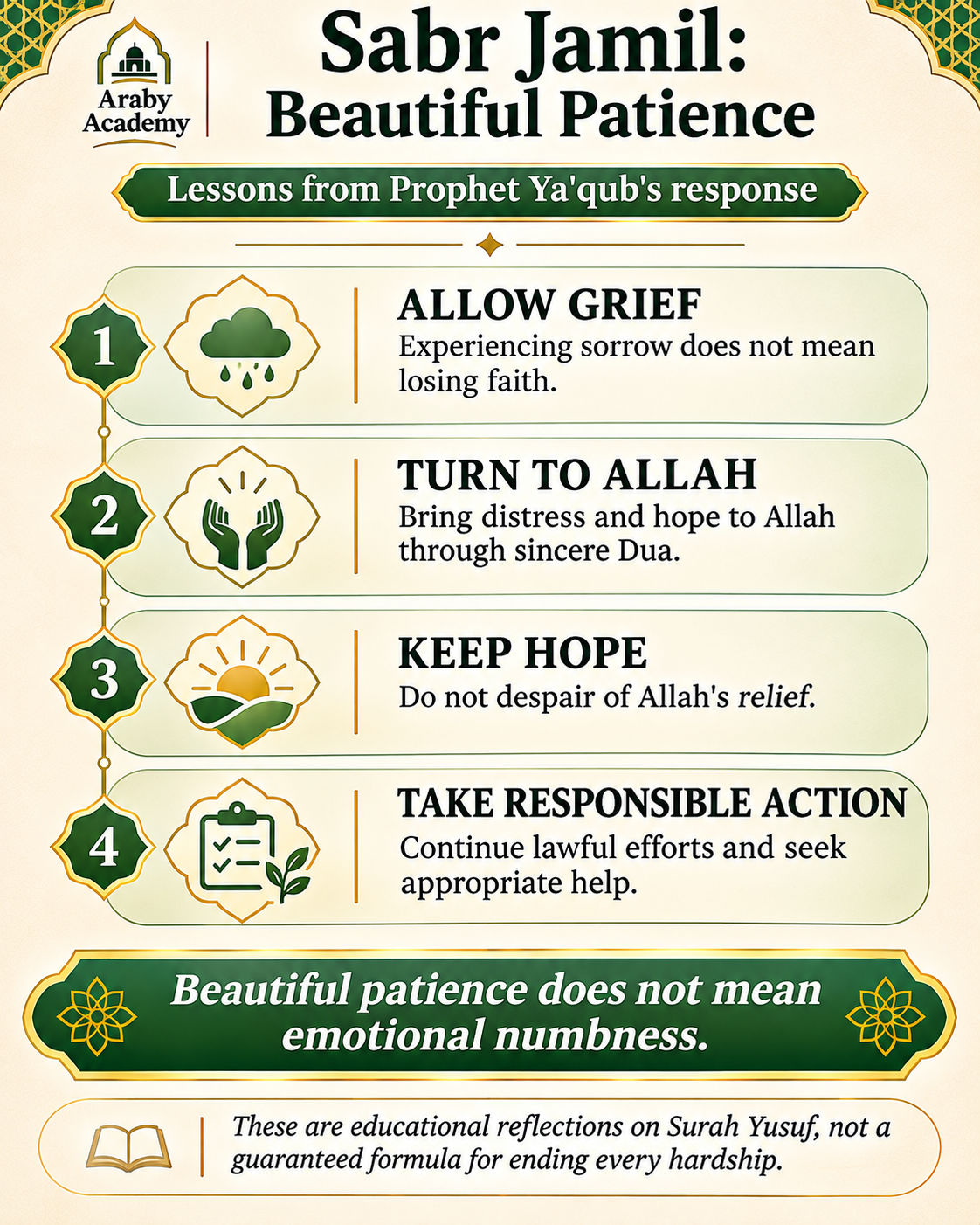
Ya‘qub does not accept their account. He turns to Allah for help and speaks of beautiful patience.
Quran reference: 12:11–18.
What Does Beautiful Patience Mean?
The Arabic expression is:
فَصَبْرٌ جَمِيلٌ
Fa-sabrun jamil.
It is commonly rendered as “beautiful patience” or “graceful patience.”
The rest of the story helps explain what this means. Ya‘qub grieves deeply, speaks to Allah about his sorrow, and later sends his sons to search.
His patience is not emotional numbness. It includes faith, restraint, supplication, and action.
From the Well to Egypt
A caravan stops near the well. When its water-drawer lowers a bucket, Yusuf is discovered. He is treated as merchandise and sold for a small price.
In Egypt, the man who buys him tells his wife to treat him well. The Quran then describes Allah establishing Yusuf in the land and granting him judgment and knowledge as he reaches maturity.
Quran reference: 12:19–22.
The movement from the well to Egypt changes Yusuf’s circumstances, but the story does not provide every historical detail. It does not specify his age, the well’s depth, or the caravan’s route.
Who Was Al-‘Aziz?
The narrative refers to the Egyptian official as al-‘Aziz. This is a title, and it should not be casually replaced with a precise modern government position.
His wife is not named in the Quran. The name “Zulaykha” appears in later accounts and should be identified accordingly.
The chapter also refers to Egypt’s ruler as a king. It does not identify a dynasty or provide dates for the events.
Yusuf’s Test of Temptation and False Accusation
The wife of al-‘Aziz attempts to seduce Yusuf and locks the doors. He refuses and seeks refuge in Allah.
His response includes the words:
مَعَاذَ اللَّهِ
Ma‘adh Allah.
The expression conveys seeking Allah’s protection.
Quran reference: 12:23.
Integrity Under Pressure
This scene involves an unequal relationship: the woman has authority within the household where Yusuf lives.
Yusuf’s refusal demonstrates commitment to Allah under pressure. The lesson includes seeking protection and resisting wrongdoing, without blaming people who experience harassment or coercion.
Verse 12:24 has received extensive scholarly discussion. Interpretations of its wording differ, but the verse explicitly describes Allah turning evil and indecency away from Yusuf. Sensational additions should not replace the Quranic account.
The Torn Shirt and the Accusation
As Yusuf moves towards the door, she tears his shirt from behind. They encounter her husband, and she accuses Yusuf.
A witness from her household proposes examining the shirt. A tear from the front would support one account; a tear from behind would support Yusuf’s explanation.
The shirt is torn from behind.
Quran reference: 12:25–29.
The scene highlights the importance of considering evidence instead of accepting an accusation merely because of the accuser’s position.
Why Was Yusuf Imprisoned?
Later, the women of the city discuss the incident. At a gathering, they are astonished by Yusuf’s appearance and cut their hands.
The wife of al-‘Aziz acknowledges pursuing him and threatens him with imprisonment if he refuses.
Yusuf asks Allah to turn their scheme away from him. Despite the signs of his innocence, those involved decide to imprison him for a time.
Quran reference: 12:30–35.
His imprisonment is an injustice. The narrative does not suggest that every accusation is true or that power reliably protects the innocent.
Prophet Yusuf in Prison
Two young men enter prison with Yusuf. Each tells him a dream and asks for its interpretation.
One sees himself pressing wine. The other carries bread on his head while birds eat from it.
Before explaining their dreams, Yusuf speaks about the knowledge Allah has given him and calls them to worship Allah alone.
Quran reference: 12:36–40.
Faith and Service During Hardship
Prison does not prevent Yusuf from offering guidance. He speaks about the faith of Ibrahim, Ishaq, and Ya‘qub, and explains the worship of the One God.
He then interprets the dreams: one man will return to serving wine, while the other will be executed.
This knowledge was taught to Yusuf by Allah. The account is not an invitation to treat dream interpretation as a skill anyone can acquire from a list of symbols.
Seeking Release Is Consistent With Patience
Yusuf asks the man who will be released to mention him to his master. He remains in prison for several more years.
Quran reference: 12:41–42.
The Quran does not give a precise total duration of his imprisonment.
His request for help is important. Patience did not require him to stop seeking release or accept injustice without using available means.
The King’s Dream and Yusuf’s Plan
The king dreams of seven fat cows being eaten by seven lean cows, alongside seven green ears of grain and seven dry ones.
His advisers cannot explain it. The former prisoner remembers Yusuf and returns to ask him.
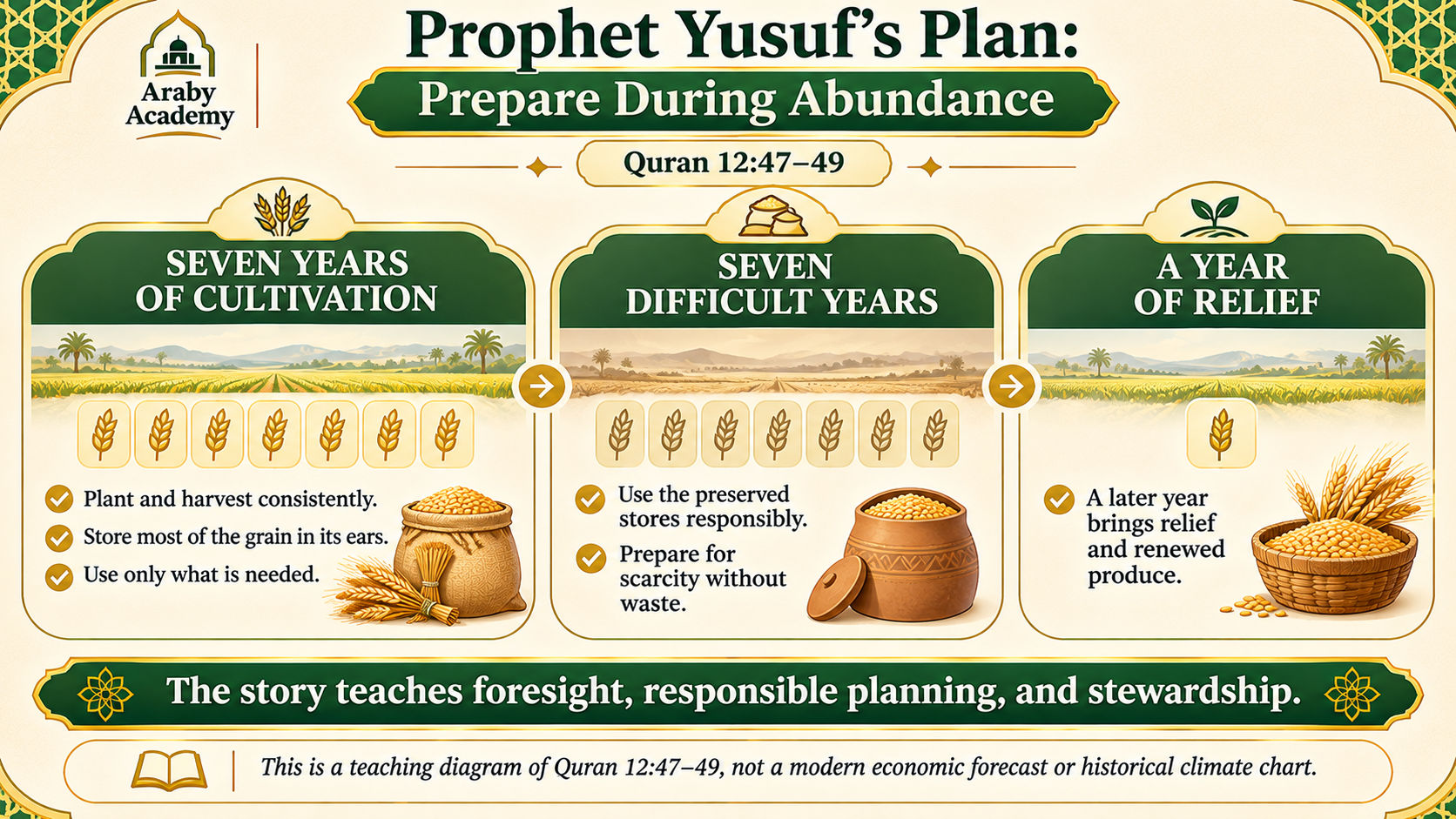
Yusuf explains that there will be seven years of cultivation, followed by seven difficult years that will consume much of what has been stored. Afterward, a year of relief will come.
Quran reference: 12:43–49.
Preparing During Times of Abundance
Yusuf provides practical guidance: preserve the harvest in its ears, apart from what is needed for food.
His response combines understanding with preparation. Knowing that hardship is coming leads to organised action.
A useful lesson is to prepare when resources are available, avoid waste, and take responsibility for those who depend on good planning.
The passage does not prescribe a complete modern economic system. Its account does show foresight and careful management.
Yusuf Clears His Name and Receives Responsibility
When the king summons Yusuf, he asks that the earlier incident be investigated.
The women acknowledge that they know no wrongdoing on his part, and the wife of al-‘Aziz admits that she pursued him.
Quran reference: 12:50–51.
Yusuf’s innocence is now publicly recognised. His concern for the truth shows that patience and seeking vindication can coexist.
Commentators differ about the speaker in verses 12:52–53. Some attribute the words to Yusuf, while Ibn Kathir favours their being a continuation of the woman’s statement. A translation or retelling should not conceal this difference. Quran.com
Trustworthiness and Knowledge Belong Together
The king recognises Yusuf as someone trusted and established in his presence.
Yusuf asks to be placed over the storehouses of the land, describing himself as:
حَفِيظٌ عَلِيمٌ
Hafizun ‘alim.
The expression brings together careful guardianship and knowledge.
Quran reference: 12:54–55.
Responsibility requires more than good intentions. A person entrusted with resources needs both integrity and the ability to manage them.
Yusuf’s Brothers Return to Egypt
During the period of hardship, Yusuf’s brothers come to obtain provisions. He recognises them, but they do not recognise him.
He asks them to bring their brother from their father on a future visit. Ya‘qub is reluctant and requires a solemn commitment that they will return with him unless circumstances beyond their control prevent it.
Quran reference: 12:58–66.
Precaution and Reliance on Allah
Ya‘qub advises his sons to enter by different gates, while acknowledging that ultimate judgment belongs to Allah.
His actions bring practical precaution and reliance together.
Trusting Allah does not mean refusing to consider risks. Equally, taking precautions does not give a person complete control over outcomes.
Yusuf and His Brother
When his brother arrives, Yusuf privately reveals his identity to him.
A royal cup is later placed in his brother’s bag. The brothers state the applicable penalty, and the events lead to Yusuf retaining his brother.
Quran reference: 12:69–76.
The Quran presents this within Allah’s plan for Yusuf. Its particular circumstances should not be treated as general permission to deceive others.
When the brothers make a hurtful allegation about Yusuf, he does not immediately reveal himself or retaliate. The scene adds another example of restraint under pressure.
Ya‘qub’s Grief and His Hope in Allah
The brothers return without their brother, while the eldest remains behind.
Ya‘qub again speaks of beautiful patience. His grief over Yusuf is renewed, and the Quran describes his eyes becoming white from sorrow.
He says:
إِنَّمَا أَشْكُو بَثِّي وَحُزْنِي إِلَى اللَّهِ
Innama ashku baththi wa huzni ila Allah.
The meaning is that he brings his anguish and sorrow to Allah.
Quran reference: 12:83–86.
Sadness Does Not Cancel Faith
Ya‘qub is a Prophet, yet he experiences profound grief.
His example challenges the idea that strong faith must always look cheerful or emotionally unaffected. A person can feel deep sorrow while continuing to worship and hope.
The account should also be read carefully: it describes Ya‘qub’s circumstances without providing a medical explanation for every experience of grief or loss of sight.
Hope Leads to Action
Ya‘qub tells his sons to search for Yusuf and his brother and not to despair of Allah’s relief.
Quran reference: 12:87.
He does not merely wait. He gives them something to do.
Hope in this passage is active: keep seeking, keep asking, and do not assume that the limits of your knowledge are the limits of what Allah can bring about.
Yusuf Reveals His Identity and Forgives His Brothers
The brothers return in need and ask Yusuf for assistance.
He asks whether they remember what they did to Yusuf and his brother. They begin to recognise him and ask whether he is indeed Yusuf.
He confirms his identity and acknowledges Allah’s favour.
Quran reference: 12:88–90.
The brothers admit their wrongdoing. Yusuf responds:
لَا تَثْرِيبَ عَلَيْكُمُ الْيَوْمَ
La tathriba ‘alaykum al-yawm.
The phrase means that there will be no reproach against them that day. He also asks Allah to forgive them.
Quran reference: 12:91–92.
Mercy When Retaliation Is Possible
Earlier in the story, Yusuf was vulnerable to his brothers’ decisions. Now they stand before him in need.
His response shows mercy when he has the ability to retaliate.
The brothers’ admission matters too. The account does not erase their wrongdoing or suggest that they were never responsible.
Forgiveness and Restored Trust Are Different
Yusuf’s example invites reflection on forgiveness. Applying that lesson requires care.
Forgiveness, reconciliation, accountability, and personal safety are distinct questions. Someone may choose to forgive while maintaining boundaries. Restoring trust may require evidence of change over time.
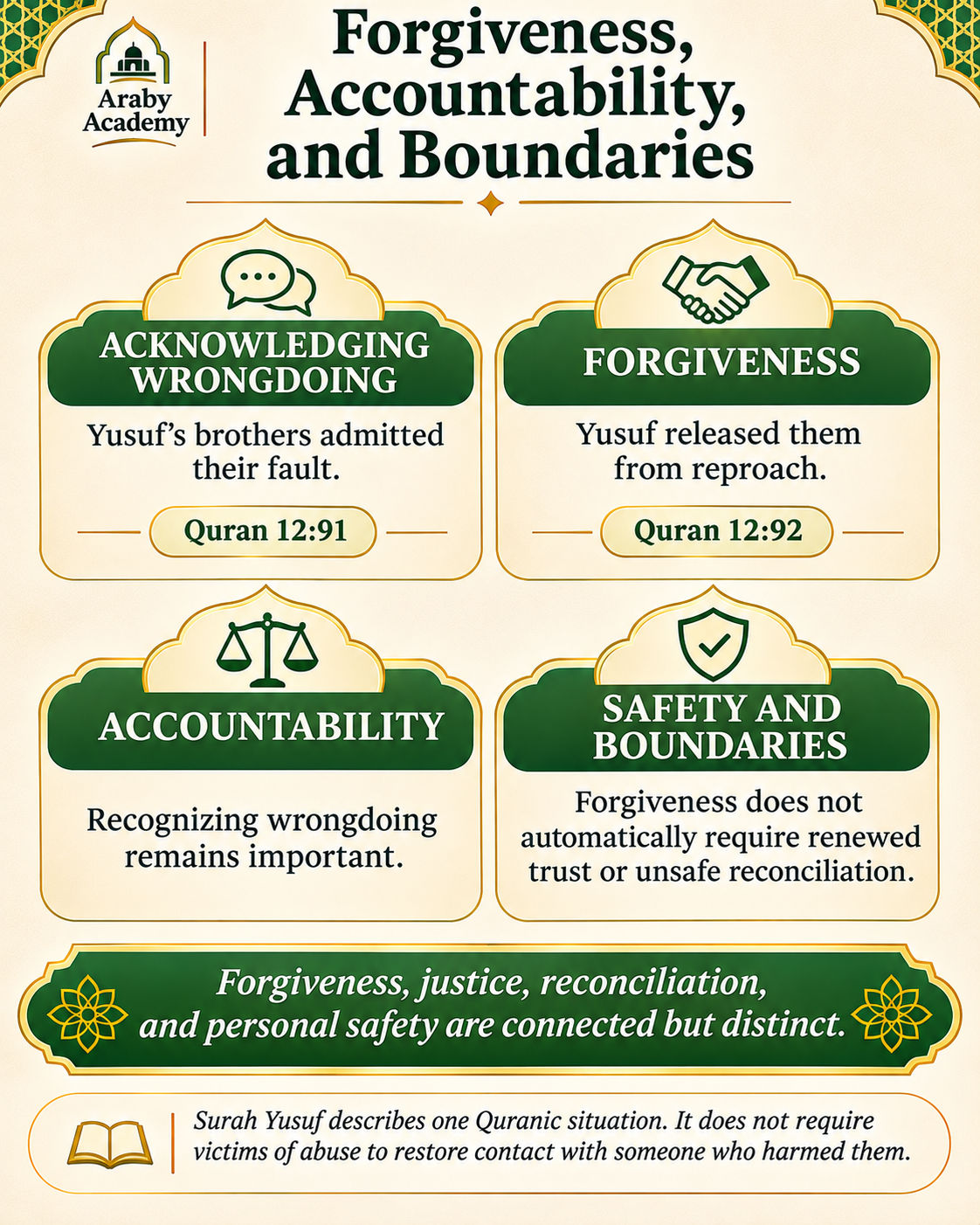
The story should never be used to pressure a person into returning to danger.
The Family Reunion and the Fulfilment of the Dream
Yusuf sends his shirt to his father. When it reaches Ya‘qub and is placed over his face, his sight returns.
The brothers ask their father to seek forgiveness for them, and he agrees to ask his Lord.
Quran reference: 12:93–98.
The family then comes to Egypt. Yusuf welcomes his parents, and the reunion brings the earlier dream to its fulfilment.
Understanding the Prostration in the Story
Verse 12:100 describes the family’s prostration before Yusuf.
Classical explanation identifies this as an expression of honour permitted under earlier religious law. It is not permission for Muslims to prostrate to another person. Quran.com
Yusuf recognises the fulfilment of his childhood dream and speaks with gratitude about Allah’s kindness.
The narrative reaches this moment through many years of separation and trial. Yusuf’s words focus on Allah’s favour rather than celebrating revenge.
Prophet Yusuf’s Dua in Surah Yusuf
After the reunion, Yusuf turns to Allah in supplication.
Arabic Text
رَبِّ قَدْ آتَيْتَنِي مِنَ الْمُلْكِ وَعَلَّمْتَنِي مِنْ تَأْوِيلِ الْأَحَادِيثِ ۚ فَاطِرَ السَّمَاوَاتِ وَالْأَرْضِ أَنْتَ وَلِيِّي فِي الدُّنْيَا وَالْآخِرَةِ ۖ تَوَفَّنِي مُسْلِمًا وَأَلْحِقْنِي بِالصَّالِحِينَ
Transliteration
Rabbi qad ataytani minal-mulki wa ‘allamtani min ta’wilil-ahadith. Fatiras-samawati wal-ard, anta waliyyi fid-dunya wal-akhirah. Tawaffani musliman wa alhiqni bis-salihin.
Meaning in English
My Lord, You have granted me authority and taught me interpretation. Creator of the heavens and earth, You are my guardian in this life and the next. Let me die in submission to You and join me with the righteous.
Quran reference: 12:101. This is a simple rendering of the meaning. Quran.com
The prayer brings together gratitude, recognition of Allah’s gifts, and concern for a faithful end.
Even after receiving authority and being reunited with his family, Yusuf’s deepest request concerns his relationship with Allah.
10 Lessons From the Story of Prophet Yusuf
1. Jealousy Needs to Be Addressed Before It Becomes Harm
The brothers allow comparison to shape their judgment. Their story encourages honest recognition of envy before it turns into harmful action.
2. Mistreatment Does Not Determine Your Character
Yusuf experiences betrayal and injustice without allowing the behaviour of others to become the standard for his own conduct.
3. Patience Can Include Tears
Ya‘qub’s grief shows that patience is compatible with sorrow and supplication. Emotional pain is not, by itself, proof of weak faith.
4. Integrity Matters When It Is Costly
Yusuf’s choices are not always rewarded with immediate comfort. He maintains his principles even when the immediate consequences are difficult.
5. Claims Should Be Examined Fairly
The torn shirt and the later admission demonstrate the importance of investigating accusations. Position and influence do not make a claim true.
6. Reliance on Allah Includes Preparation
Yusuf’s plan for the harvest connects faith with practical responsibility. Preparation can be an expression of trust.
7. Leadership Requires Competence and Honesty
The qualities expressed in hafizun ‘alim belong together. Trust must be supported by knowledge and careful stewardship.
8. Allah’s Decree Does Not Excuse Wrongdoing
The story unfolds within Allah’s knowledge and wisdom, but the brothers remain accountable. They acknowledge what they did.
9. Repentance Begins With Honesty
The brothers stop defending themselves and admit their fault. Genuine change requires facing wrongdoing rather than rewriting it.
10. Gratitude Matters After Relief
Yusuf turns to Allah after success and reunion. Worship and humility remain essential when circumstances improve.
Seven Arabic Expressions to Learn From Surah Yusuf
Arabic expression | Transliteration | Meaning | Reference |
|---|---|---|---|
أَحْسَنَ الْقَصَصِ | Ahsan al-qasas | The best of narratives | 12:3 |
فَصَبْرٌ جَمِيلٌ | Fa-sabrun jamil | Beautiful patience | 12:18, 12:83 |
مَعَاذَ اللَّهِ | Ma‘adh Allah | I seek refuge in Allah | 12:23 |
حَفِيظٌ عَلِيمٌ | Hafizun ‘alim | A knowledgeable guardian | 12:55 |
إِنَّمَا أَشْكُو بَثِّي وَحُزْنِي إِلَى اللَّهِ | Innama ashku baththi wa huzni ila Allah | I bring my anguish and sorrow to Allah | 12:86 |
وَلَا تَيْأَسُوا مِنْ رَوْحِ اللَّهِ | Wa la tay’asu min rawh Allah | Do not despair of Allah’s relief | 12:87 |
لَا تَثْرِيبَ عَلَيْكُمُ الْيَوْمَ | La tathriba ‘alaykum al-yawm | No reproach against you today | 12:92 |
These are short renderings of meaning. Translations may use different English words while conveying similar ideas.
Learning the expressions in context is more valuable than memorising them as isolated slogans. Notice who speaks, what has happened, and how the words relate to the surrounding verses.
How to Study Surah Yusuf With Understanding
Begin With the Quranic Account
Read a reliable translation alongside the Arabic text.
Separate three things as you study:
What the Quran explicitly states.
What commentators explain or disagree about.
What later storytellers or modern readers add.
Popular details about ages, names, dates, and later marriages should not automatically be treated as Quranic facts.
Use Tafsir to Explore Difficult Passages
Tafsir helps explain vocabulary, context, and interpretive differences.
For example, the discussion of verses 12:52–53 shows why two translations may identify the speaker differently. Learning that a question is debated can improve understanding rather than weaken it.
Avoid building a major conclusion on an isolated translated phrase without considering its context.
Notice Patterns Without Inventing Meanings
Shirts appear at several important moments: the shirt with false blood, the shirt torn from behind, and the shirt sent to Ya‘qub.
Dreams also connect major parts of the narrative.
These patterns are useful subjects for reflection. They do not create a method for predicting the future or assigning fixed meanings to objects in personal dreams.
Teach Children Through Age-Appropriate Themes
For younger children, focus on honesty, jealousy, kindness, patience, and asking Allah for help.
A timeline, vocabulary cards, and drawings of non-human objects such as a well or grain can support learning without depicting Prophets.
With teenagers, discuss rumours, pressure, boundaries, responsibility, and how to admit mistakes. Explain sensitive scenes respectfully and at an appropriate level.
Follow a Simple Seven-Day Reading Plan
Day | Verses | Focus |
|---|---|---|
1 | 12:1–18 | The dream, jealousy, and beautiful patience |
2 | 12:19–35 | Egypt, integrity, and injustice |
3 | 12:36–49 | Prison, faith, and preparation |
4 | 12:50–57 | Vindication and responsibility |
5 | 12:58–79 | The brothers’ visits |
6 | 12:80–101 | Grief, forgiveness, reunion, and dua |
7 | 12:102–111 | The closing message and review |
This is a suggested study schedule, not a prescribed religious practice. Adjust the pace to allow thoughtful reading.
Frequently Asked Questions About Prophet Yusuf
Where Is the Story of Prophet Yusuf in the Quran?
It is told in Surah Yusuf, Chapter 12, which contains 111 verses. The chapter presents the main narrative in a continuous sequence.
What Was Prophet Yusuf’s Dream?
He saw eleven stars, the sun, and the moon prostrating to him. He later recognised its fulfilment during the family reunion described in verse 12:100.
Why Did Yusuf’s Brothers Put Him in a Well?
Their jealousy led them to seek his removal so their father’s attention would turn towards them. One brother suggested the well instead of killing him.
Is Zulaykha Named in the Quran?
No. The Quran refers to the wife of al-‘Aziz without naming her. “Zulaykha” belongs to later accounts.
How Long Was Yusuf in Prison?
The Quran mentions several years but does not give a precise total. A specific duration should not be presented as explicitly stated in the Quran.
What Did the King’s Dream Mean?
Yusuf explained that years of cultivation and abundance would be followed by seven difficult years, then a year of relief. He also advised preserving grain.
What Does Sabr Jamil Mean?
It means beautiful or graceful patience. In Ya‘qub’s story, it coexists with sorrow, prayer, hope, and efforts to find his sons.
How Did Yusuf Forgive His Brothers?
After they admitted their wrongdoing, he released them from reproach that day and asked Allah to forgive them.
Does the Story Promise That Every Hardship Ends in Wealth or Status?
No. The narrative teaches faithfulness, patience, and trust. It should not be turned into a promise that every person’s suffering will follow the same worldly outcome.
What Is the Main Lesson of Surah Yusuf?
The chapter teaches steadfastness in faith through changing circumstances, alongside integrity, responsible action, repentance, gratitude, and forgiveness.
Learning From Yusuf’s Patience, Faith, and Forgiveness
The story of Prophet Yusuf speaks to experiences that many people recognise: jealousy, separation, temptation, false accusation, grief, and the difficulty of forgiving.
Its lessons become clearer when the narrative is read as a whole. Yusuf seeks protection, uses his knowledge, pursues vindication, manages responsibility, and responds with mercy. Ya‘qub grieves while continuing to hope and act.
Read Surah Yusuf slowly, explore its meaning through reliable Tafsir, and learn the Arabic expressions that give its message depth.
To strengthen your connection with the Quran, explore Quran and Arabic learning with Araby Academy. Understanding the words you recite can help you reflect more carefully on their guidance.