Across the world, millions of Muslims change their daily routines during Ramadan. They eat before dawn. They abstain from food and drink throughout the fasting day, and they break the fast at sunset. Many attend extra night prayers and give more time to Quran recitation and charity.
To an outsider, this may look like a month built around unusual mealtimes. For Muslims, its meaning goes much deeper. Why does Islam prescribe fasting, and what is Ramadan really meant to teach?
The Quran answers in one verse. Fasting is prescribed “so that you may attain Taqwa” (Quran 2:183). Taqwa means God-consciousness: a living awareness of Allah that shapes how a person speaks, acts, and treats others. This guide explains what Ramadan is, how fasting works, who is exempt, and how the month connects to the Quran, prayer, charity, and everyday life.
What Is Ramadan in Islam?
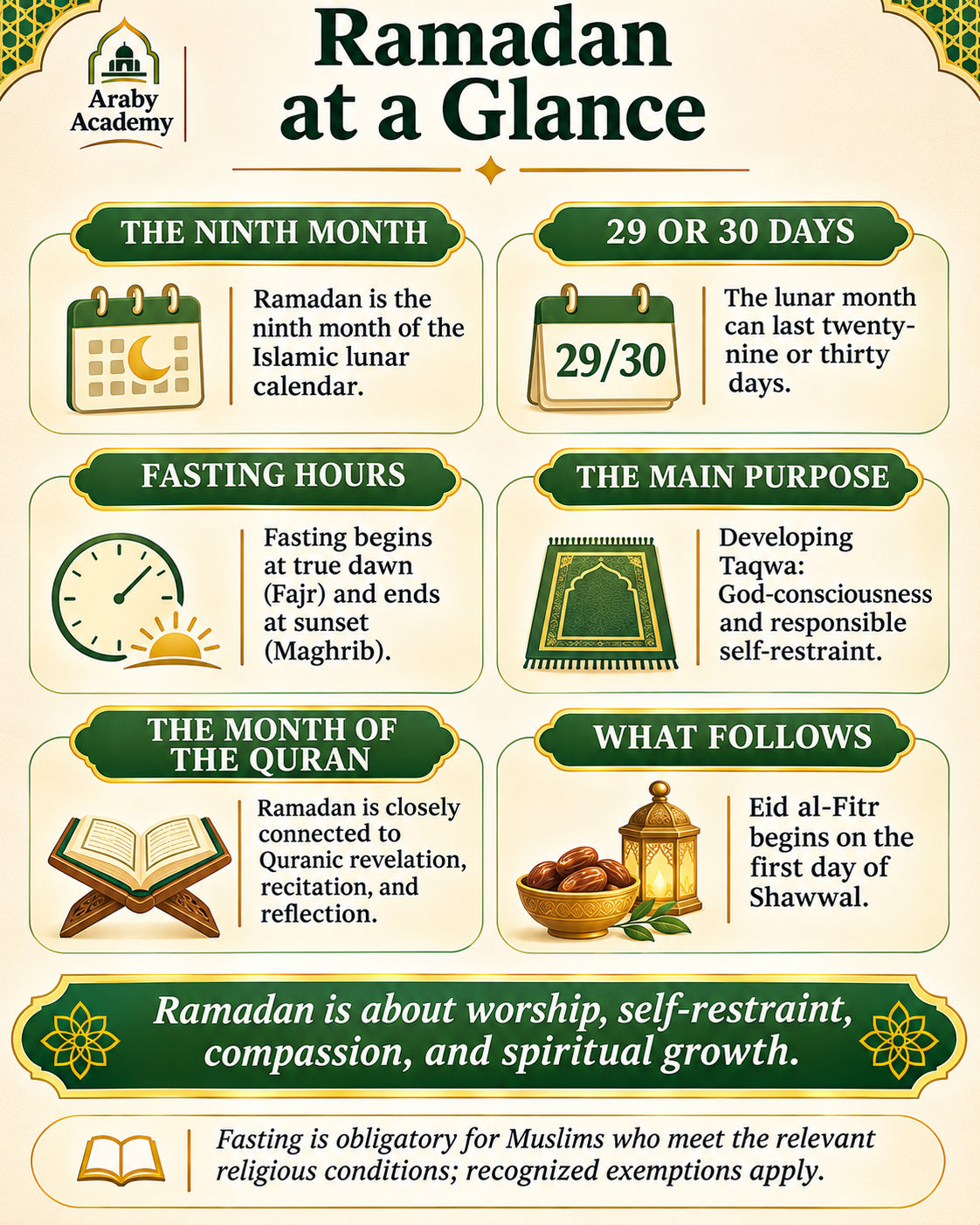
Ramadan is the ninth month of the Islamic lunar calendar and the month in which Muslims observe obligatory fasting. From true dawn until sunset, eligible Muslims abstain from food, drink, and sexual relations while seeking to grow in God-consciousness, self-discipline, and obedience to Allah. Ramadan is also closely connected to the Quran, extra prayers, charity, and Laylat al-Qadr.
Ramadan at a glance
Question | Answer |
|---|---|
What month is Ramadan? | The ninth month of the Islamic calendar |
Why is it important? | It is the month of obligatory fasting and is closely associated with Quranic revelation |
When is the daily fast? | From true dawn until sunset |
Who fasts? | Muslims who meet the relevant religious conditions |
How long does it last? | 29 or 30 days |
What is its spiritual goal? | Taqwa, as described in Quran 2:183 |
What comes afterward? | Eid al-Fitr, on the first of Shawwal |
The Arabic name رَمَضَان (Ramadan) is commonly linked by classical lexicographers to a root associated with scorching heat and parched ground. Some explanations connect the name to the season in which it was first used. These discussions belong to the history of the word. The religious meaning of Ramadan comes from the Quran and Sunnah, not etymology. The popular saying that the name literally means “burning away of sins” is a devotional reflection, not established dictionary meaning.
It also helps to separate two terms. Ramadan is the month. Sawm (الصَّوْم) and siyam (الصِّيَام) are the act of fasting. Both mean “to refrain” in Arabic. The Quran uses sawm for Maryam’s vow of silence (19:26) and siyam for the fasting of 2:183. The two words overlap heavily and do not describe different religious practices. In Islamic law, Ramadan fasting is a specific act of worship with defined timing and conditions.
Why Is Ramadan Important?
Quran 2:183–185 lays the foundation. Verse 183 prescribes fasting and states its purpose. Verse 184 speaks of a set number of days and recognizes illness and travel. Verse 185 identifies the month in which the Quran was sent down, calls believers to fast it, and affirms that Allah intends ease, not hardship. Together these verses give obligation, purpose, revelation, and mercy.
Ramadan and the Five Pillars
The Prophet Muhammad ﷺ said that Islam is built on five things: the testimony of faith, establishing prayer, giving Zakat, Hajj, and fasting Ramadan (Sahih al-Bukhari 8; Sahih Muslim 16, narrated by Ibn Umar). Fasting Ramadan is one of Islam’s foundational obligations, alongside worship such as [ the five daily prayers], which structure Muslim life throughout the year.
The pillar is the obligation to fast. Ramadan is the month in which that obligation is fulfilled. Fasting at other times of year is voluntary or arises from other circumstances, and it is not the pillar itself.
Fasting and Taqwa
Quran 2:183 reads:
يَا أَيُّهَا الَّذِينَ آمَنُوا كُتِبَ عَلَيْكُمُ الصِّيَامُ كَمَا كُتِبَ عَلَى الَّذِينَ مِن قَبْلِكُمْ لَعَلَّكُمْ تَتَّقُونَ
“O you who believe, fasting is prescribed for you, as it was prescribed for those before you, so that you may attain Taqwa.”
Taqwa (التَّقْوَى) comes from a root meaning to guard or protect oneself. In Tafsir it includes awareness of Allah, reverence, and guarding oneself from what displeases Him by obeying Him. It is not simply fear. Fasting supports Taqwa because each day a person leaves lawful things, such as food, drink, and comfort, only because Allah commanded it. That trains restraint and sincerity, and it can deepen gratitude and compassion for people who regularly go without.
None of this is automatic. Fasting does not make anyone morally superior. It is an opportunity, and what a person does with it matters.
The Prophet ﷺ described fasting as a shield: the fasting person should avoid obscene or foolish speech, and if someone insults or fights him, he should say, “I am fasting” (Sahih al-Bukhari 1894; Sahih Muslim 1151). Scholars understand the “shield” as protection from sin through restraint. He also warned that if a person does not give up false speech and acting on it, Allah has no need of his giving up food and drink (Sahih al-Bukhari 1903).
The Prophet ﷺ also said that whoever fasts Ramadan imanan wa-ihtisaban, with faith and seeking Allah’s reward, will have previous sins forgiven (Sahih al-Bukhari 1901). Ihtisab (الاحْتِسَاب) means doing an act sincerely, expecting reward from Allah alone. Many hadith scholars understand the forgiveness to refer mainly to minor sins. Major sins require sincere repentance (Tawbah), and rights owed to other people still need to be returned. The hadith is not a license for wrongdoing, and only Allah knows whose worship is accepted.
When Does Ramadan Start and End?
The Islamic (Hijri) calendar is lunar. It has twelve months, and each begins with the new crescent. Ramadan falls between Sha’ban and Shawwal. A lunar year is about 354 days, roughly 10–11 days shorter than the Gregorian solar year. So Ramadan begins about 10–11 days earlier on the Gregorian calendar each year and moves through every season over roughly three decades. It does not stay in one Gregorian month.
Each lunar month lasts 29 or 30 days. The Prophet ﷺ said: “Fast when you see it and stop fasting when you see it; if it is obscured, complete Sha’ban as thirty” (Sahih al-Bukhari 1909; Sahih Muslim 1081). He also indicated that a month can be twenty-nine days (Sahih al-Bukhari 1907). Worship plans should therefore not assume exactly thirty days.
An astronomical new moon (conjunction) is a calculable event. The first visible crescent, which traditional sighting looks for, appears later and depends on location and weather. Muslim communities and scholars hold recognized, differing approaches: local sighting, wider regional sighting, a single global sighting, or astronomical calculation, with different views on the role of religious authorities. Countries may therefore start on different days because of geography, visibility, and method. These differences are not necessarily political or bad-faith. Most Muslims follow their local mosque or trusted authority and avoid declaring another community’s Ramadan invalid.
How Does Fasting Work During Ramadan?
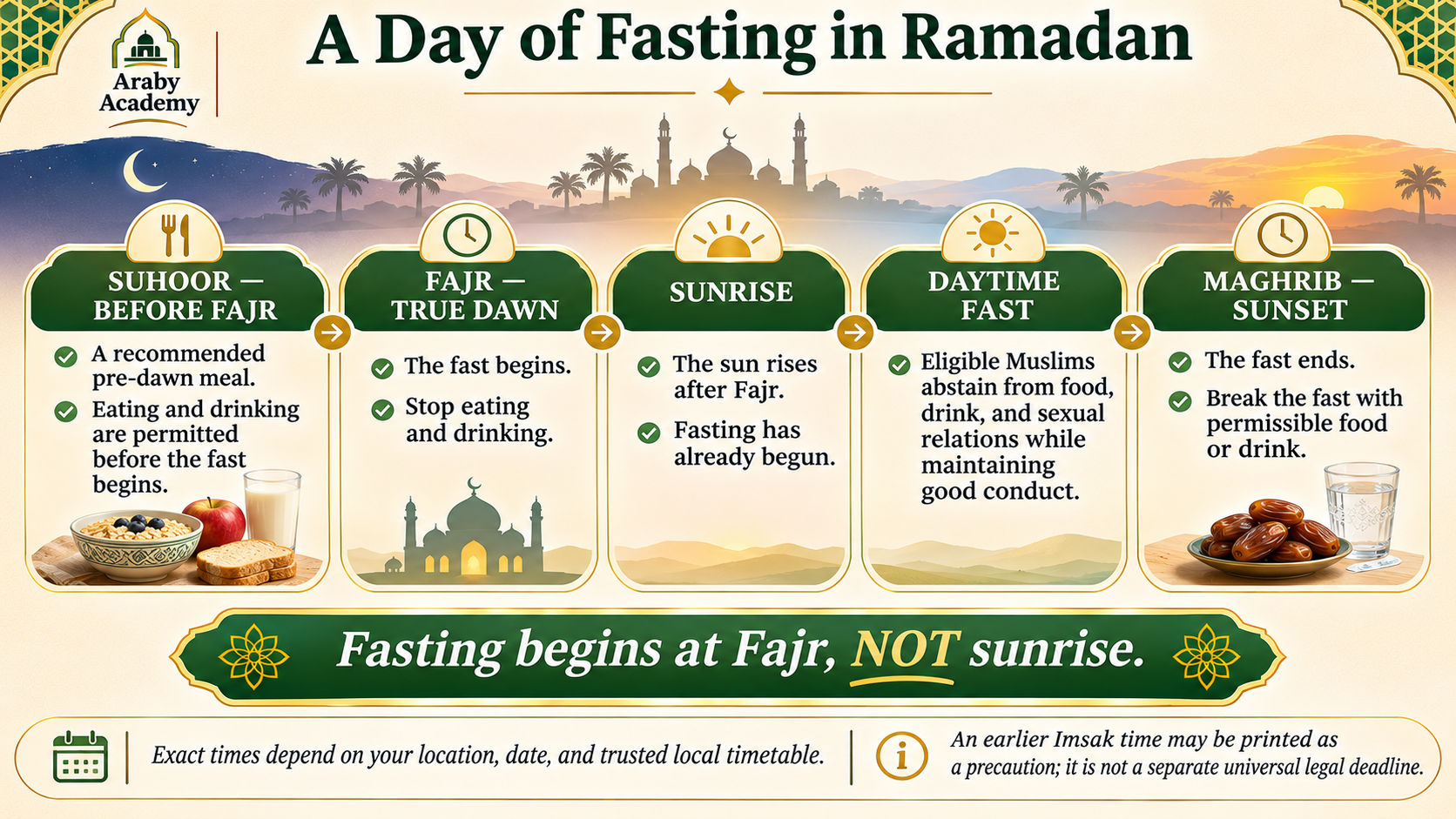
Eligible Muslims abstain from eating, drinking (including water), and sexual relations from true dawn until sunset, with the intention to fast (Quran 2:187). This is the legal minimum. The aim is a fast of the whole person, including speech, eyes, temper, and time, so the meaning of the fast goes beyond the legal minimum.
Suhoor, Fajr, and the Start of the Fast
Suhoor (السُّحُور) is the pre-dawn meal. The Prophet ﷺ said, “Take Suhoor, for in Suhoor there is blessing” (Sahih al-Bukhari 1923; Sahih Muslim 1095). It is a recommended Sunnah, not a condition: a fast without Suhoor is still valid. A sensible Suhoor uses ordinary nutritious foods, water, and moderate portions. Individual health needs differ, and no single food guarantees freedom from thirst or tiredness.
The fast begins at true dawn. Quran 2:187 permits eating and drinking “until the white thread of dawn becomes distinct from the black thread.” True dawn is the Fajr light spreading across the horizon. Sunrise comes later, and the fast starts at Fajr, not sunrise.
Many timetables print an “Imsak” time several minutes before Fajr. This is a precaution. It is not a separate universal legal deadline, so check what your local timetable means.
Iftar and Sunset
Iftar (الإِفْطَار) is breaking the fast at sunset. The Prophet ﷺ said that when night approaches from the east, day retreats from the west, and the sun has set, the fasting person should break the fast (Sahih al-Bukhari 1954; Sahih Muslim 1100). He also said people remain in good as long as they hasten to break the fast (Sahih al-Bukhari 1957; Sahih Muslim 1098). Muslims therefore do not generally wait for full darkness, but they must not break the fast before sunset is confirmed.
Anas reported that the Prophet ﷺ broke his fast with fresh dates, then dry dates, then water (Sunan Abi Dawud 2356; Jami’ at-Tirmidhi 696), a report many scholars grade acceptable (hasan). Dates are a Sunnah, not a requirement. Any permissible food or water breaks the fast validly.
A frequently quoted Iftar supplication is:
ذَهَبَ الظَّمَأُ وَابْتَلَّتِ الْعُرُوقُ وَثَبَتَ الأَجْرُ إِنْ شَاءَ اللَّهُ
“The thirst has gone, the veins are moistened, and the reward is confirmed, if Allah wills.” (Sunan Abi Dawud 2357)
Scholars differ on its grading, with several accepting it as hasan. The widely repeated “Allahumma laka sumtu” wording is reported through a weaker chain. No Arabic formula is mandatory, and anyone may make Dua in their own words.
Intention and Good Conduct
Niyyah (النِّيَّة) means intention. It is an act of the heart, and no spoken Arabic formula is required. Scholars differ on details. Maliki scholars accept one intention at the start of Ramadan for consecutive days. Shafi’i and Hanbali scholars generally require the intention each night before Fajr. Hanafi scholars allow the Ramadan intention to be made until shortly before midday. In practice, deciding in your heart to fast and waking for Suhoor reflects the intention. Follow your teacher’s school where it matters.
If someone eats or drinks out of genuine forgetfulness, the Prophet ﷺ said to complete the fast, because Allah fed and gave him drink (Sahih al-Bukhari 1933; Sahih Muslim 1155). Deliberate eating and drinking is different. Detailed cases, such as medicines, injections, tests, vomiting, and smoking, vary among scholars and deserve a dedicated source or a qualified teacher.
Lying, insults, backbiting, and quarreling do not, by the common scholarly view, invalidate the legal fast, so the day does not have to be made up. They do damage its spiritual reward, which is why the Prophet ﷺ warned about them.
Who Must Fast—and Who Is Exempt?
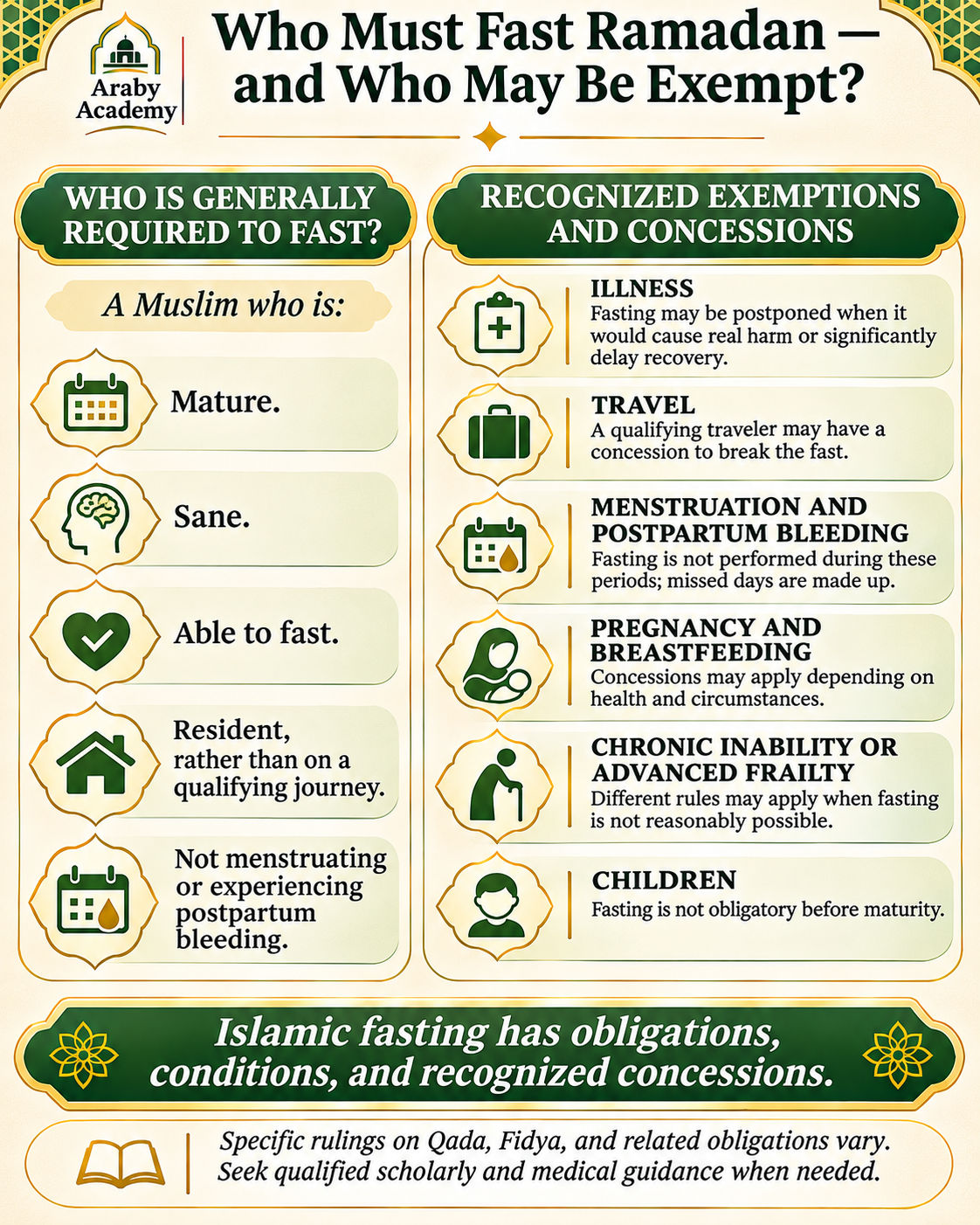
In general, fasting Ramadan is required of a Muslim who is mature, sane, able to fast, resident (not on a qualifying journey), and free from menstruation or postpartum bleeding. Islam also recognizes real hardship. Concessions are a mercy from Allah, not a measure of anyone’s faith.
Illness and Travel
Quran 2:184 says that whoever is ill or on a journey may fast the same number of other days later. For temporary illness, a person may postpone fasting if fasting would cause real harm or significantly delay recovery, and then make up the days. Serious health questions need a doctor’s assessment and qualified religious guidance. Nobody should fast against urgent medical advice or change medication without medical supervision.
For travel, the Prophet ﷺ gave Hamza al-Aslami the choice to fast or to break the fast (Sahih al-Bukhari 1943; Sahih Muslim 1121). Scholars differ on the distance that counts as travel (commonly cited figures are around 80 km, depending on the school), on when the journey begins, and on whether fasting or not fasting is better when hardship is slight. There is no single universal threshold, so ask a local scholar.
Menstruation, Pregnancy, and Breastfeeding
Women do not fast during menstruation or postpartum bleeding (Nifas), and they make up those days later. Aishah رضي الله عنها said they were told to make up fasts, not prayers (Sahih Muslim 335). This is no sign of spiritual deficiency. Dhikr, Dua, charity, and learning remain open, and scholars discuss specific rulings on Quran recitation.
The Prophet ﷺ was reported to have lifted fasting from the pregnant and nursing (Sunan Abi Dawud 2408; Jami’ at-Tirmidhi 715, graded hasan). Juristic approaches differ on whether they owe Qada, Fidya, or both, depending on whether the concern is for themselves or for the child. The circumstances vary, so rulings are not identical for everyone. A doctor and a trusted scholar can advise on a specific case, and no one should risk her health or her child’s health out of pressure.
Children, Older Adults, and Chronic Illness
Fasting becomes obligatory at maturity (puberty). The Companions are reported to have gently trained children to fast in short stretches (Sahih al-Bukhari 1960). Families can introduce Ramadan gradually, and children should never be shamed, pressured, or put at risk.
Quran 2:184 also mentions those who can fast only with great hardship, for whom feeding a poor person is prescribed. Scholars apply this to people unable to fast with no expectation of recovery, such as some older adults or those with chronic illness. Old age alone does not automatically mean exemption, and each case needs assessment.
Anyone with an eating disorder, a serious metabolic condition, or a history of medically dangerous fasting should seek medical care and qualified scholarly advice before fasting. No article can prescribe a plan for an individual.
Qada, Fidya, and Kaffarah
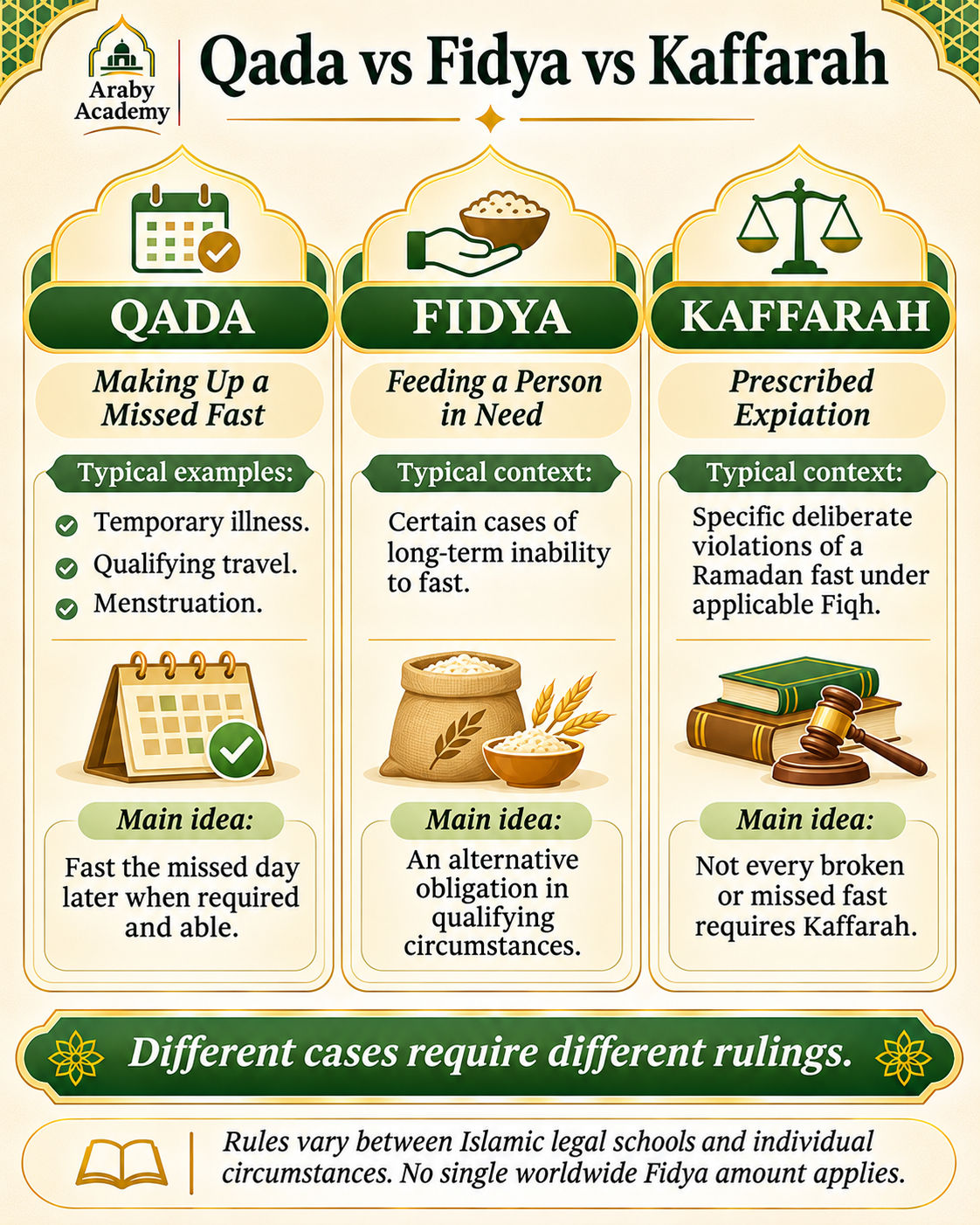
Term | Meaning | Typical context |
|---|---|---|
Qada (القَضَاء) | Making up missed fasts | Illness, travel, menstruation, and other valid reasons |
Fidya (الفِدْيَة) | Feeding a person in need for each missed day | Qualifying cases, such as long-term inability to fast |
Kaffarah (الْكَفَّارَة) | Prescribed expiation | Particular deliberate violations under applicable Fiqh |
Qada should ideally be completed before the next Ramadan, though schools differ on delays. The Fidya amount and method vary with scholarly method and local costs, and no single worldwide figure exists. Kaffarah, according to the majority, applies to deliberately breaking a Ramadan fast through intercourse. The hadith lists freeing a slave, fasting two consecutive months, or feeding sixty poor people (Sahih al-Bukhari 1936). Some schools extend it to other deliberate violations. Not every missed or broken fast requires Kaffarah, and cases can overlap, so ask a qualified scholar.
Why Is Ramadan Called the Month of the Quran?
Quran 2:185 reads: “The month of Ramadan is the one in which the Quran was sent down as guidance for humankind, with clear proofs of guidance and criterion” (شَهْرُ رَمَضَانَ الَّذِي أُنزِلَ فِيهِ الْقُرْآنُ). Ibn Abbas and many early scholars explained that the Quran was sent down in full to the lowest heaven on Laylat al-Qadr in Ramadan, then revealed gradually to the Prophet ﷺ over about twenty-three years. Others understand the verse as marking the beginning of revelation in Ramadan. Neither view claims the entire Quran was given to the Prophet ﷺ in a single ordinary night.
The Prophet ﷺ was most generous in Ramadan, when Jibril would meet him each night and review the Quran with him (Sahih al-Bukhari 6). That is why Muslims give the Quran more time in this month, through recitation, reflection, revision, and understanding. There is no universal individual obligation to complete the whole Quran in Ramadan. Completion is a valuable goal, but slow, sincere reading with understanding is equally meaningful, and beginners should never be shamed.
Rather than aiming only for a large number of pages, Muslims can use Ramadan to develop [ a daily Quran reading habit that actually lasts] beyond the month itself.
Learning the vocabulary of 2:183–187 can deepen this engagement. Arabic fluency, however, is not required for a valid fast.
Prayer, Dua, and Dhikr in Ramadan
The five obligatory prayers remain essential in Ramadan. Fasting and Salah are separate obligations, and extra worship does not replace Salah.
Quran 2:186 appears within the fasting passage: “When My servants ask you about Me, I am near. I respond to the call of the caller when he calls on Me” (أُجِيبُ دَعْوَةَ الدَّاعِ إِذَا دَعَانِ). Its placement reminds believers that Ramadan is a time of closeness to Allah. Ramadan also offers an opportunity to build confidence in [ making sincere Dua and asking Allah for help], whether someone speaks Arabic fluently or is still learning.
Alongside Quran and Salah, simple practices such as [ remembering Allah through Dhikr] can help believers bring greater awareness to the ordinary moments of Ramadan. Authentic forms include Istighfar (seeking forgiveness), Tasbih (glorifying Allah), and praise. There is no fixed Ramadan-only number of repetitions.
What Is Taraweeh and Night Prayer?
Taraweeh (التَّرَاوِيح) are voluntary night prayers performed in Ramadan, usually in congregation after Isha. The name refers to the short rests between sets. The Prophet ﷺ said that whoever stands in prayer in Ramadan with faith and seeking reward will have previous sins forgiven (Sahih al-Bukhari 37; Sahih Muslim 759). He prayed with the people for some nights and then stopped, fearing it might be made obligatory (Sahih al-Bukhari 729). Later, Umar رضي الله عنه gathered the people behind one imam (Sahih al-Bukhari 2010).
Taraweeh is a stressed Sunnah, not one of the five obligatory prayers, and missing it does not affect the validity of the fast.
Scholars differ on the number of Rak’ahs. Aishah reported that the Prophet ﷺ did not exceed eleven Rak’ahs in Ramadan or outside it (Sahih al-Bukhari 1147), and many communities pray eight followed by Witr. Hanafi, Shafi’i, and Hanbali practice commonly involves twenty, and the Maliki tradition includes larger historical numbers. Witr is a separate prayer. None of these recognized practices should be dismissed as invalid.
Qiyam al-Layl (قِيَامُ اللَّيْل) means standing in prayer at night, and Taraweeh is its communal form in Ramadan. Tahajjud (التَّهَجُّد) is generally understood as night prayer after waking from sleep, though scholars use the term with some variation.
What Is Laylat al-Qadr?
Laylat al-Qadr (لَيْلَةُ الْقَدْر) is the Night of Decree, Power, or Measure. Surah al-Qadr (97:1–5) says: “We sent it down on the Night of Decree. And what will make you know what the Night of Decree is? The Night of Decree is better than a thousand months. The angels and the Spirit descend in it by their Lord’s permission with every matter. It is peace until the emergence of dawn.”
The phrase “better than a thousand months” shows the night’s immense worth. It does not give a mathematical formula for multiplying any individual deed.
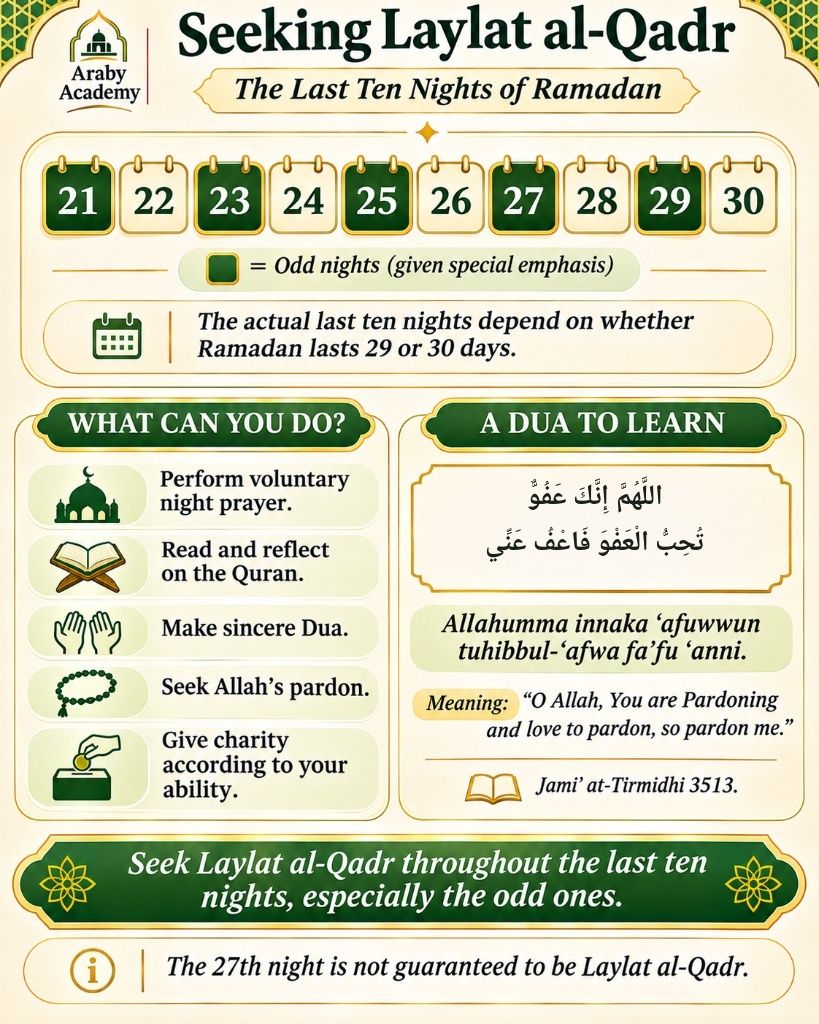
The Prophet ﷺ taught Muslims to seek it among the odd nights of the last ten nights of Ramadan (Sahih al-Bukhari 2017, and related reports). Many communities emphasize the 27th night because of reports from some Companions. The broader guidance is to seek it throughout the last ten nights, especially the odd ones. Readers who want to understand the final nights more deeply can study [ the meaning and virtues of Laylat al-Qadr] rather than assuming one particular night is guaranteed.
Aishah asked what to say if she found the night, and the Prophet ﷺ taught her:
اللَّهُمَّ إِنَّكَ عَفُوٌّ تُحِبُّ الْعَفْوَ فَاعْفُ عَنِّي
Allahumma innaka ‘afuwwun tuhibbul-‘afwa fa’fu ‘anni.
“O Allah, You are Pardoning and love to pardon, so pardon me.” (Jami’ at-Tirmidhi 3513; Sunan Ibn Majah 3850, graded sahih)
Some narrations add karim after ‘afuwwun.
In the last ten nights the Prophet ﷺ would stay awake in worship, wake his family, and exert himself more (Sahih al-Bukhari 2024; Sahih Muslim 1174). He also practiced I’tikaf (الاعْتِكَاف), devotional retreat in a mosque (Sahih al-Bukhari 2025). Scholars differ on its minimum length, conditions, and rules for women. Nobody needs to perform I’tikaf to benefit from these nights.
Charity, Zakat, and Zakat al-Fitr
Ramadan encourages generosity. Ibn Abbas described the Prophet ﷺ as most generous in Ramadan, “more generous than the blowing wind” (Sahih al-Bukhari 6). He also said that whoever feeds a fasting person receives a reward like his, without lessening the fasting person’s reward (Jami’ at-Tirmidhi 807). Charity should preserve people’s dignity. It should never reduce those in need to an inspirational image. Nobody is required to give money they do not have, and even a good word is charity (Sahih al-Bukhari 2989).
Many Muslims pay Zakat al-Mal in Ramadan by choice, but its due date depends on each person’s own lunar-year cycle. It is not universally required in Ramadan.
Zakat al-Fitr is a separate obligation tied to the end of Ramadan. Ibn Umar reported that the Prophet ﷺ required one sa’ of dates or barley from every Muslim, to be paid before people go out to the Eid prayer (Sahih al-Bukhari 1503; Sahih Muslim 984). Ibn Abbas said it purifies the fasting person from idle talk and feeds the poor (Sunan Abi Dawud 1609). A sa’ is roughly two to three kilograms of staple food, depending on the measure used. Hanafi scholars allow paying its cash value, many other scholars traditionally prefer food, and many contemporary bodies accept cash, so follow your local scholarly guidance. No worldwide fixed amount exists. It may be paid a day or two before Eid or on Eid morning before the prayer.
Type | Nature | Timing |
|---|---|---|
Sadaqah | Voluntary giving | Any time |
Zakat al-Mal | Obligatory annual wealth Zakat | When due, per conditions |
Zakat al-Fitr | Obligatory end-of-Ramadan giving | Before the Eid prayer |
Ramadan Traditions Around the World
Muslims observe Ramadan across many languages, cuisines, daylight lengths, and community sizes. In some places, families gather for large Iftars, hang lanterns, or serve special desserts. Others observe quietly, with a simple meal and a few friends. These customs differ and none is itself an act of worship. Harmless traditions need not be condemned, but they should not be confused with religious obligations. No single food is “the” Ramadan food.
Ramadan is also not a diet or fitness challenge. Moderation at Iftar protects the purpose of the month, and body-shaming has no place in it.
Observing Ramadan in the West
Muslims in Western countries often fast while working or studying among colleagues who are not fasting. They may face long summer days, limited prayer space, a lack of public holidays, commuting, and community isolation. Muslim families navigating school and work schedules may benefit from practical advice about [ observing Ramadan in the West] while maintaining both religious commitments and everyday responsibilities.
Some practical suggestions:
Long work hours: Plan meals, protect sleep, ask politely about flexible breaks or leave, and avoid unsafe overexertion. Accommodation rights vary by country and employer.
Students and exams: Schedule demanding study for your most alert hours. If fasting seriously harms your health or performance, consult a trusted scholar.
Colleagues: A short, friendly explanation usually helps.
High latitudes: Where daylight is extremely long or irregular, scholars have approved special methods for fasting and prayer times, such as following a nearby city or a fixed timetable. Follow your local recognized authority.
How to Prepare for Your First Ramadan
New Muslims often begin Ramadan without a Muslim family around them, and that is entirely fine. Start with the practical basics:
Find local fasting times from a reliable local timetable, and learn what Suhoor and Iftar mean.
Form the intention in your heart. No special words are required.
Find a mosque or community, in person or online, and ask for help early.
Learn gradually. Nobody expects a perfect first Ramadan.
Plan sleep and meals, and set a small Quran goal.
Review any fasts you owe, and set aside a budget for charity.
A realistic Ramadan often begins before the first fast, which is why [preparing for Ramadan months in advance] can help families avoid last-minute pressure.
Teaching Children About Ramadan
Children can learn what Ramadan means, why adults fast, and how kindness, gratitude, charity, Quran, and community fit together. Families can use the month to nurture [ a strong Islamic identity in Muslim children] through understanding, shared worship, and kindness rather than pressure.
Some educational suggestions, not fixed rituals:
Quran verse cards and Arabic vocabulary matching
Good-deed reflection jars
Family charity discussions
Simple family Duas
Reading together about Laylat al-Qadr
Younger children can try a few hours of fasting, but only if they are healthy and willing. It should never be a public competition, and children who cannot fast should never be shamed.
A Realistic Daily Ramadan Routine
This is an optional framework, not a Sunnah sequence:
Before Fajr: Suhoor and preparation
Daytime: Work or study, obligatory prayers, avoiding wrongdoing
After Asr: Quran or Dhikr, as practical
Sunset: Iftar and Maghrib
Evening: Isha, optional Taraweeh, family duties
Before bed: Reflection, Dua, reasonable rest
Please adapt it to your circumstances. An ideal Ramadan does not require expensive meals, constant mosque attendance, large donations, or perfect productivity.
For many Muslims, [ building a daily Islamic routine that fits a busy life] is more sustainable than copying an intensive schedule that ignores their responsibilities.
What Happens After Ramadan?
Ramadan ends when its 29 or 30 days are complete and the crescent of Shawwal is established. Zakat al-Fitr is paid before the Eid prayer, and Eid al-Fitr follows.
Eid al-Fitr (عِيدُ الْفِطْر) is the festival marking the end of the fast, on the first of Shawwal. It includes the Eid prayer, family and community gathering, gratitude, and charity. It is not merely a party after a diet.
Fasting on the day of Eid al-Fitr is prohibited (Sahih al-Bukhari 1990; Sahih Muslim 1137). The last day of Ramadan is still a fasting day, while the first of Shawwal is Eid.
The Prophet ﷺ encouraged fasting six days of Shawwal after Ramadan (Sahih Muslim 1164). These days are voluntary, and scholars differ on whether to complete owed Ramadan fasts first. Fasting is not limited to Ramadan; for example, [ fasting on Ashura and understanding its significance] introduces another important occasion in the Islamic calendar.
To keep Ramadan’s habits, continue the five prayers, a small daily Quran portion, regular Dhikr, charity, reasonable sleep, and family learning. A single month cannot guarantee transformation, but it can start habits worth keeping.
10 Common Ramadan Misconceptions
Fasting is only about hunger. The Quran names Taqwa as the goal (2:183).
The fast begins at sunrise. It begins at true dawn (Fajr), earlier than sunrise.
Taraweeh replaces obligatory prayers. The five prayers remain obligatory, and Taraweeh is voluntary.
Every Muslim must fast regardless of health. Islam recognizes lawful concessions (2:184–185).
Ramadan is always 30 days. It is 29 or 30.
Every culture’s customs are religious obligations. Many are cultural.
Laylat al-Qadr is guaranteed on one date. Seek it in the last ten nights, especially the odd ones.
Everyone must finish the Quran in Ramadan. It is a valuable goal, not a universal obligation.
Every missed fast requires Kaffarah. Qada, Fidya, and Kaffarah apply differently.
Ramadan matters only during the month. Its habits can continue all year.
15 Arabic Words About Ramadan
Arabic | Transliteration | Meaning and note |
|---|---|---|
رَمَضَان | Ramadan | The ninth Islamic month |
الصِّيَام | As-Siyam | Fasting (Quran 2:183) |
الصَّوْم | As-Sawm | Fasting; also vow of silence (19:26) |
التَّقْوَى | At-Taqwa | God-consciousness |
السُّحُور | As-Suhur | Pre-dawn meal (hadith term) |
الإِفْطَار | Al-Iftar | Breaking the fast (hadith term) |
الفَجْر | Al-Fajr | True dawn; start of the fast |
المَغْرِب | Al-Maghrib | Sunset and the evening prayer |
النِّيَّة | An-Niyyah | Intention |
الدُّعَاء | Ad-Dua | Supplication (2:186) |
القُرْآن | Al-Quran | The Quran (2:185) |
القِيَام | Al-Qiyam | Standing in prayer |
التَّرَاوِيح | At-Tarawih | Ramadan night prayers |
الْقَدْر | Al-Qadr | Decree, measure, power (Surah 97) |
الفِطْر | Al-Fitr | Breaking the fast (as in Eid al-Fitr) |
Not all of these appear verbatim in 2:183–187. Some, such as Suhoor, Iftar, Taraweeh, and Niyyah, belong to the hadith and fiqh vocabulary.
A closer look at 2:183. Kutiba means “was prescribed” (from the root k-t-b, to write). ‘Alaykum means “upon you.” As-Siyam is the verbal noun from the root ṣ-w-m. La’allakum means “so that you may,” and tattaqun comes from the root w-q-y, to guard oneself, which is the root of Taqwa.
Frequently Asked Questions
What is Ramadan in Islam?
It is the ninth month of the Islamic calendar, in which Muslims observe obligatory fasting and increase worship, Quran, and charity.
Why do Muslims fast during Ramadan?
Allah prescribed it, and Quran 2:183 gives the purpose: to attain Taqwa, or God-consciousness.
Is Ramadan one of the Five Pillars?
Fasting Ramadan is one of the Five Pillars. The month is the time in which that obligation is fulfilled.
What does Ramadan mean in Arabic?
The name is linked by lexicographers to intense heat or parched ground. Its religious meaning comes from the Quran and Sunnah.
How long does Ramadan last?
Twenty-nine or thirty days, depending on the lunar month.
Why does Ramadan change dates?
The lunar year is about 10–11 days shorter than the solar year, so Ramadan moves earlier each Gregorian year.
When does the daily fast begin?
At true dawn (Fajr), not sunrise, and it ends at sunset.
Can Muslims drink water during the fast?
No. Eating and drinking, including water, are abstained from during fasting hours, except in cases of forgetfulness or a valid concession.
What is the difference between Suhoor and Iftar?
Suhoor is the meal before dawn, and Iftar is the meal that breaks the fast at sunset.
Who is required to fast Ramadan?
Mature, sane, able Muslims who are resident and free from menstruation or postpartum bleeding.
Can sick people skip Ramadan fasting?
Those whose illness makes fasting harmful may postpone and make up the days, following medical and scholarly advice.
Can pregnant or breastfeeding women postpone fasting?
They may in relevant circumstances. Whether they owe Qada, Fidya, or both depends on the situation and the scholarly approach.
Do children have to fast?
Fasting becomes obligatory at maturity. Before that, children can be gently introduced to it, without pressure.
What happens if someone misses a fast?
It is usually made up later (Qada), unless Fidya applies. Kaffarah applies only to specific deliberate violations.
What is the difference between Qada, Fidya, and Kaffarah?
Qada is making up a fast, Fidya is feeding a person in need in qualifying cases, and Kaffarah is a prescribed expiation for certain deliberate violations.
What is Taraweeh?
Voluntary night prayers performed in Ramadan, commonly after Isha. They are not one of the five obligatory prayers.
What is Laylat al-Qadr?
The Night of Decree, described in Surah al-Qadr as better than a thousand months, sought in the last ten nights of Ramadan.
Is Laylat al-Qadr always the 27th night?
No. Many emphasize the 27th, but the guidance is to seek it in the last ten nights, especially the odd ones.
What is Zakat al-Fitr?
A special obligation tied to the end of Ramadan, given to people in need before the Eid prayer. It is separate from annual Zakat al-Mal.
What happens when Ramadan ends?
Eid al-Fitr begins on the first of Shawwal. Fasting that day is prohibited, and voluntary fasts such as the six days of Shawwal may follow.
Conclusion — Ramadan Is More Than a Month Without Food or Drink
Return to that fasting day: the pre-dawn meal, the daytime restraint, the sunset prayer, the evening Quran. The timing of Suhoor and Iftar matters, but the month means more than changed mealtimes. It teaches Taqwa, obedience, prayer, Dua, self-restraint, generosity, gratitude, and responsibility toward the community.
Each person’s circumstances differ, and not every Muslim can do every optional act. The goal is sincere worship within the guidance Allah has given.
Ramadan is not simply a month of going without food and drink. It is an opportunity to remember why Muslims worship Allah, strengthen their relationship with the Quran, and carry meaningful habits of faith into the rest of the year. If you would like to continue that journey, you can learn Quran, Tajweed, Arabic, and Islamic Studies with qualified teachers at Araby Academy.