
A Muslim wakes up in Ramadan and brushes their teeth, then accidentally swallows a little saliva. At work they need a blood test. A colleague uses an asthma inhaler. Someone else eats a bite of food before remembering they are fasting. All may ask the same question: “Have I broken my fast?”
Islamic jurisprudence (Fiqh) does not give these situations one answer. This guide separates what clearly invalidates a fast, what does not, and what involves recognized scholarly differences. It is an educational guide, not a personal fatwa or medical consultation.
What Breaks the Fast in Islam? Quick Answer
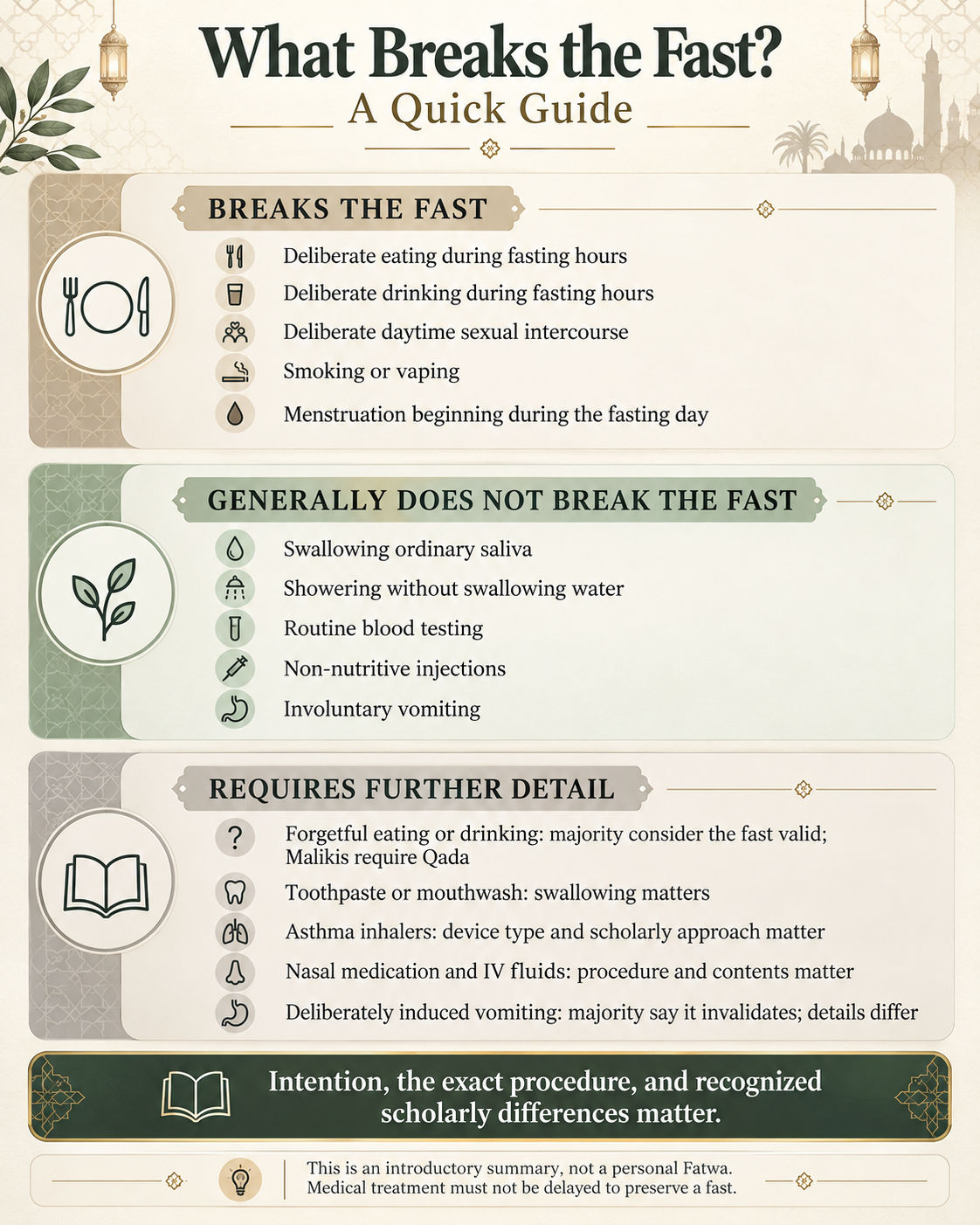
Deliberately eating, drinking, or having sexual intercourse during the daytime fast invalidates a Ramadan fast. Eating or drinking forgetfully does not, according to authentic Hadith. Vomiting, menstruation, medical treatment, and accidental swallowing each need separate distinctions, and some medical procedures involve scholarly differences. The ruling depends on what happened, whether it was deliberate, and the evidence.
Scholars call fast-invalidating acts al-mufattirat (المُفَطِّرَات) or mubtilat as-sawm (مُبْطِلَات الصَّوْم). These are juristic terms, not Quranic chapter headings.
Fasting Rules at a Glance
Action / situation | General ruling | Important condition or difference |
|---|---|---|
Intentional eating | Breaks the fast | Illness or travel are lawful exemptions, a separate category |
Intentional drinking | Breaks the fast | Includes water, coffee, and juice; small amounts are no exception |
Forgetful eating or drinking | Generally does not break | Complete the fast (Bukhari 1933); Malikis still require making up the day |
Swallowing ordinary saliva | Generally does not break | Phlegm brought to the mouth is discussed separately |
Toothbrushing without swallowing | Generally does not break | Some scholars dislike toothpaste without need |
Deliberate vomiting | Breaks the fast (majority) | Hanafis require a mouthful; Qada is required |
Involuntary vomiting | Generally does not break | Deliberately swallowing it back is different |
Sexual intercourse | Breaks the fast | Qada and repentance; Kaffarah rules differ by school |
Wet dream | Generally does not break | Involuntary; Ghusl is needed for prayer |
Menstruation | Breaks the fast | Fasting is not valid; the day is made up later |
Routine non-nutritive injection | Generally does not break | Not all injections are alike |
Nutritional infusion | Breaks the fast | It replaces food |
Metered-dose asthma inhaler | Depends on details / scholarly difference | IIFA 2018: does not break; powder and nebulizers differ |
Blood test | Generally does not break | Transfusion and donation are different procedures |
Bathing or showering | Generally does not break | Avoid swallowing water |
Perfume | Generally does not break | Deliberately inhaling incense smoke is disputed |
Smoking or vaping | Breaks the fast | Also harmful to health |
These labels summarize common positions; the sections below explain exceptions.
When Does a Ramadan Fast Begin and End?
Fasting (sawm or siyam) means abstaining from eating, drinking, and marital relations in the daytime, with the intention of worshipping Allah. Allah says: “Eat and drink until the white thread of dawn becomes distinct from the black thread of night; then complete the fast until the night” (Quran 2:187). The same verse permits eating, drinking, and marital intimacy during the nights of Ramadan. Quran 2:183 gives the purpose: that believers may attain taqwa, God-consciousness. Fasting also requires niyyah (intention), made in the heart, not spoken aloud.
The fast begins at Fajr, true dawn, the light spreading across the horizon, not sunrise. It ends at Maghrib, when the sun has set, not when the sky is fully dark. Clock times change daily, so use a reliable local timetable. Understanding the boundaries of the fast is easier when you know [ the timing and purpose of the five daily prayers], especially Fajr and Maghrib.
The Quran also shows Islam’s ease. The ill and travelers make up days later, and “Allah intends ease for you and does not intend hardship” (Quran 2:185). That applies to genuine illness and travel; it does not make every inconvenience a reason to skip fasting.

Does Intention or Forgetfulness Change the Ruling?
Yes. Fiqh distinguishes deliberate acts, forgetfulness, unintended events such as involuntary vomiting, coercion, honest mistakes about time, and ignorance of a ruling. They are not treated alike. The four Sunni schools (Hanafi, Maliki, Shafi‘i, and Hanbali) agree on the core invalidators but differ on details: bloodletting, vomiting, mistakes about time, medical procedures, and Kaffarah. This guide names differences where they matter. They are recognized scholarly differences, not confusion in the religion.
Eating, Drinking, and Swallowing: What Invalidates Fasting?
Deliberately eating or drinking between Fajr and Maghrib invalidates the fast, whether the item is food, water, coffee, or juice. Small amounts are no exception. This differs from eating under a lawful exemption such as illness. Tablets, capsules, and syrups swallowed during fasting hours also break the fast, but never skip or delay medication without medical advice. Chewing gum can release flavor that is swallowed, so many scholars treat it as invalidating or avoid it. Tasting food while cooking is disliked without need, yet does not break the fast if nothing is swallowed.
Eating or Drinking Forgetfully
Abu Hurayrah reported that the Prophet ﷺ said: “Whoever forgets while fasting and eats or drinks, let him complete his fast, for Allah has fed him and given him drink” (Sahih al-Bukhari 1933; Sahih Muslim 1155).
The Hadith states no penalty, so most scholars consider the fast valid. The Maliki school requires making up the day, though without sin or Kaffarah. When you remember, stop at once, spit out any food in your mouth, and continue fasting. Do not finish the bite or drink, and do not panic.
Scenario A: Sara drinks tea at her desk, then remembers. She stops and continues fasting. Scenario B: Omar remembers halfway through lunch but thinks, “I’ve already started,” and keeps eating. He has deliberately broken his fast.
Accidental Swallowing
Water swallowed accidentally during wudu or swimming is not automatically deliberate drinking. Several schools distinguish normal rinsing from exaggerated rinsing. The Prophet ﷺ told Laqit ibn Sabirah to snuff water deeply into the nose “unless you are fasting” (Abu Dawud 142; Tirmidhi 788), so exaggeration is discouraged. An unintended swallow after ordinary rinsing is generally excused. The Maliki school is stricter and requires Qada if water reaches the throat. When unsure, ask a teacher.
Swallowing Saliva or Mucus
Swallowing your own saliva does not invalidate the fast; it is unavoidable. Do not spit constantly or monitor each swallow. Phlegm is discussed separately: if it stays in the throat, swallowing it is excused. If it has reached the mouth, Shafi‘i and Hanbali scholars advise spitting it out and regard deliberately swallowing it as problematic, while Hanafi and Maliki positions are more lenient. Bleeding gums or nosebleeds do not break the fast by themselves. Spit blood out, and do not rinse compulsively over traces. Unavoidable dust is excused.
Brushing Teeth, Toothpaste, and Mouthwash
Cleaning your teeth does not itself break the fast; the question is whether something is swallowed. Amir ibn Rabi‘ah reported seeing the Prophet ﷺ use the siwak while fasting (Tirmidhi 725; scholars discuss its grading, and Bukhari cites the practice in a chapter title). The siwak (السِّوَاك) or miswak is therefore valid. Shafi‘i scholars dislike it after midday, citing the fasting person’s mouth odor being better to Allah than musk (Bukhari 1894), but that is one school’s position, not a universal ban.
Most contemporary scholars permit toothpaste when none is swallowed. Its flavor and foam lead some scholars to prefer brushing before Fajr or after Iftar, or using little and rinsing carefully. A trace swallowed unintentionally does not generally invalidate; do not rinse repeatedly for certainty. Mouthwash and gargling are likewise not invalidating if spat out, but strongly flavored products need caution.
Dental examinations, cleaning, fillings, local anesthetic, and extractions are not equivalent to eating or drinking; the 1997 IIFA resolution lists them as non-invalidating when swallowing is avoided. Avoid swallowing blood or water. Do not delay urgent dental treatment.
Do Medicines and Injections Break the Fast?
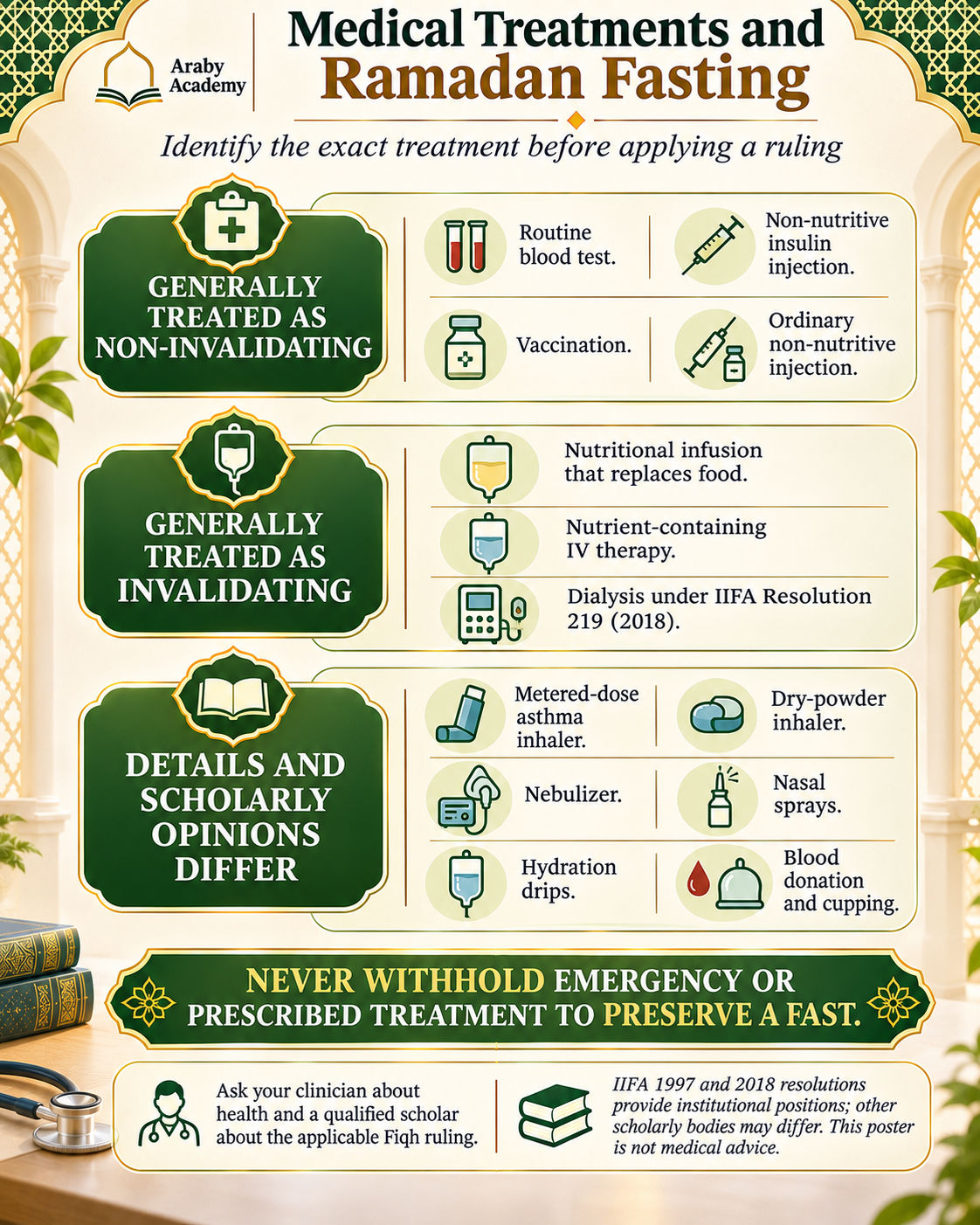
Revelation does not mention modern treatments, so scholars reason by analogy: does the treatment supply food or drink, or enter the digestive tract? The International Islamic Fiqh Academy (IIFA) addressed this in Resolution 93 (1/10, 1997), which postponed several questions, and Resolution 219 (3/23, 2018), which continued it. These are institutional positions, not rulings every scholar or school shares. “Inhaler,” “injection,” and “drip” are not single procedures, so identify the exact treatment first.
Procedure | Documented position | Important exception | Ask a scholar or doctor when |
|---|---|---|---|
Eye drops | Not invalidating (IIFA 1997) | Earlier jurists differed if taste reaches the throat | Use is frequent or prescribed |
Ear drops | Not invalidating (IIFA 1997) | Earlier jurists discussed a perforated eardrum | Eardrum problem is known |
Nasal sprays | Depends on procedure and scholarly methodology | Acceptable if nothing reaching the throat is swallowed; some are stricter | Use is regular |
Metered-dose inhaler | IIFA 2018: does not invalidate | Some Fatwa bodies disagree | Before Ramadan; never withhold rescue use |
Powder inhaler | IIFA 2018: invalidates, as some powder reaches the stomach | Others treat residue as excused | Before Ramadan, with your doctor |
Insulin | Not invalidating as a non-nutritive injection (IIFA 1997) | Fasting safety is a medical question | Always, before Ramadan |
Vaccination | Not invalidating as a non-nutritive injection | None for the injection itself | Rarely |
Routine blood test | Generally not invalidating | Draw is not a transfusion | If details are unclear |
Blood transfusion | Depends on procedure and scholarly methodology | Views differ | Always |
IV fluids | Depends on the fluid: plain medication does not; nutrient fluids do | Hydration drips are disputed | Always; never delay care |
Nutritional infusion | Invalidates | Replaces food | Not applicable |
Dialysis | IIFA 2018: invalidates | Fidya for patients with no expected recovery | Always |
Always identify the exact treatment before applying any ruling.
Eye Drops and Nasal Sprays
Eye and ear drops are not food or drink and are generally treated as non-invalidating. Nasal products are more complicated because the nose connects to the throat, so do not group them with inhalers. Avoid sniffing hard or swallowing what reaches the throat, and keep nasal rinsing gentle.
Asthma Inhalers and Nebulizers
IIFA Resolution 219 held that standard metered-dose inhalers do not invalidate the fast, because they target the respiratory system and the small amount reaching the stomach is unintended and forgivable. It held that dry-powder capsule inhalers do invalidate, because a portion reaches the stomach. Nebulizers and humidified treatments deliver liquid mist, and authorities differ; Jordan’s General Iftaa Department, for example, holds that nebulizers invalidate the fast. These are documented positions, not a consensus. Never withhold a prescribed rescue inhaler for fear of invalidating a fast. In a breathing emergency, treat first. If your scholar considers the fast invalidated, make it up.
Insulin, Vaccines, and IV Fluids
Subcutaneous and intramuscular injections that are not nutritive, including insulin and vaccines, are treated as non-invalidating by IIFA (1997). Never refuse a needed vaccine, or change, delay, or skip insulin, without your clinician. Intravenous treatment differs by content: fluids with sugar or nutrients and nutritional infusions are treated as invalidating, plain medication through a vein is not, and plain hydration drips are disputed. Ask your doctor what is being given.
Blood Tests, Donations, and Dialysis
A routine blood draw for tests is commonly treated as non-invalidating and is not a transfusion. Cupping (hijama, الْحِجَامَة) is a real scholarly difference. Ibn Abbas reported that the Prophet ﷺ was cupped while fasting (Sahih al-Bukhari 1938), while Shaddad ibn Aws reported, “The cupper and the one cupped have broken their fast” (Abu Dawud 2369). Hanbali scholars hold that cupping invalidates the fast; others do not. Blood donation is discussed by analogy and may weaken you, so do not donate if it could harm you. IIFA 2018 treats hemodialysis and peritoneal dialysis as invalidating and advised patients with no expected recovery to forgo fasting and pay Fidya. Never delay dialysis to preserve a fast.
IIFA also treats oxygen, endoscopy, suppositories, enemas, vaginal treatments, and unconsciousness under general anesthesia as non-invalidating when no nutrient fluids are given; some Fatwa bodies differ on rectal treatments. Never delay emergency surgery to preserve a fast.
Does Vomiting Break the Fast?
Abu Hurayrah reported that the Prophet ﷺ said: “Whoever is overcome by vomiting need not make up the fast, and whoever vomits deliberately must make it up” (Abu Dawud 2380; Tirmidhi 720; Ibn Majah 1676). Hadith scholars discuss its chain, yet jurists broadly act on this distinction. Involuntary vomiting does not invalidate the fast. Deliberately induced vomiting invalidates it according to the majority, and the day is made up (Hanafis require a mouthful). Swallowing vomit back deliberately is different from involuntary vomiting. Never suppress dangerous vomiting, and treat medically necessary vomiting as a health matter. Acid reflux that reaches the mouth should be spat out; an involuntary swallow is generally excused.
Menstruation, Postpartum Bleeding, and Fasting
Menstruation (hayd, الْحَيْض) prevents a valid fast. Aisha said: “We were commanded to make up the fasts, and not commanded to make up the prayers” (Sahih Muslim 335). This is a concession, not a sign of inferiority, and a woman can still make dua, dhikr, and charity. If bleeding begins even shortly before Maghrib, that day does not count and is made up, according to established Fiqh. Do not examine yourself repeatedly to fix the exact moment. If bleeding ends before Fajr, she makes the intention and fasts; the majority hold the fast valid even if Ghusl is after Fajr, though she must not delay prayer. Postpartum bleeding (nifas, النِّفَاس) follows the same fasting rule, but not every postnatal spotting is nifas. Irregular non-menstrual bleeding (istihadah, الاسْتِحَاضَة) does not stop fasting, and a woman who has it should ask a qualified scholar.
Marital Intimacy, Wet Dreams, and Fasting
Marital intimacy is permitted on Ramadan nights (Quran 2:187), so the whole month is not prohibited. Deliberate intercourse during the day invalidates the fast, is a serious sin, and requires repentance, Qada, and Kaffarah. In the Hadith, a man said, “I am ruined,” because he had intercourse in Ramadan, and the Prophet ﷺ asked whether he could free a slave, fast two consecutive months, or feed sixty poor people (Bukhari 1936; Muslim 1111). Hanafi, Shafi‘i, and Hanbali scholars follow that order, while the Maliki school treats it as a choice among the three. Cases of forgetfulness or coercion involve differences, so ask a scholar.
Aisha reported that the Prophet ﷺ kissed and embraced while fasting, “and he was the most able of you to control his desire” (Bukhari 1927; Muslim 1106). Kissing does not automatically break the fast, but scholars advise avoiding it when self-control is doubtful, and ejaculation invalidates the fast. Deliberate ejaculation, such as through masturbation, invalidates the fast according to the schools; it requires Qada and repentance, and Kaffarah only according to some Maliki scholars. A wet dream (ihtilam, الاحْتِلَام) is involuntary, does not invalidate the fast, and requires Ghusl only for prayer. Aisha and Umm Salamah reported that the Prophet ﷺ sometimes entered Fajr in janabah after intimacy and fasted (Bukhari 1925; Muslim 1109), but the person must still bathe for prayer. Involuntary thoughts are not deliberate acts; Allah overlooks what passes through the mind unless a person acts or speaks (Sahih al-Bukhari 2528).
Showering, Swimming, Perfume, and Everyday Activities
Bathing does not invalidate the fast; keep water out of your mouth and nose. Swimming is not an automatic invalidator either, but it carries a real risk of swallowing water and exhaustion, so use caution. Sweat, exercise, and crying do not break the fast, though dehydration is a health risk and hazardous exertion is not recommended. Smelling perfume, deodorant, or food does not break the fast. Deliberately inhaling incense (bakhoor) smoke or particles is disputed, with some jurists treating it as invalidating, so avoid it. Smoking invalidates the fast, and scholars apply the same reasoning to vaping; both are harmful, and Iftar is no reason to resume nicotine. Breathing ordinary dust is excused.
Does Lying, Anger, or Gossip Break the Fast?
The Prophet ﷺ said: “Whoever does not give up false speech and acting upon it, Allah has no need of his giving up food and drink” (Sahih al-Bukhari 1903). He also called fasting a shield and said to answer a quarrel with “I am fasting” (Bukhari 1894). These wrongs damage the purpose and reward of fasting; the schools do not list them as invalidators, so do not conflate the categories.
Category | Meaning | Examples |
|---|---|---|
Legal invalidity | Specific acts under Fiqh end the fast’s validity | Deliberate eating, drinking, intercourse |
Reduced reward | The fast stays valid but its benefit suffers | Lying, backbiting, anger |
Lawful exemption | Islam permits not fasting | Illness, travel, menstruation |
What If You Eat After Fajr or Break Your Fast Early by Mistake?
Honest mistakes about time differ from deliberate eating. Someone who eats believing it is still night, then learns Fajr had entered, or who trusted a faulty timetable, did not intentionally break the fast. Most scholars still require making up that day, while some, including Ibn Taymiyyah, hold that no Qada is required. Continuing to eat after learning that Fajr has entered is deliberate.
The same disagreement applies to someone who breaks the fast believing the sun had set when it had not. Asma bint Abi Bakr reported that people broke the fast on a cloudy day in the Prophet’s time and then the sun appeared (Sahih al-Bukhari 1959). Most jurists require Qada; others do not. Neither case is deliberate early breaking.
Must you keep abstaining until Maghrib after the fast is invalidated? Many scholars say a person who broke the fast without excuse should abstain for the rest of the day out of respect for the month. Rulings differ for someone who becomes eligible mid-day, such as a traveler arriving home, a woman becoming pure, or a child reaching puberty. Ask a qualified scholar.
When Is It Permissible to Break a Fast for Health Reasons?
Illness is a Quranic basis for a concession (Quran 2:185), and Quran 2:184 provides compensatory feeding for those who cannot fast. A person need not become critically unwell before seeking help. Seeking appropriate medical care is compatible with [ trusting Allah while taking practical means], because Tawakkul should not become an excuse for avoidable harm.
This section explains religious categories; it is not medical advice, and no one should change medication because of it.
Diabetes: Some people with diabetes can fast with individualized clinical guidance; for others it is unsafe. Do not change insulin or medication on your own, and seek urgent care for dangerous symptoms.
Asthma and respiratory illness: Never withhold rescue treatment. Acute breathing difficulty is a safety priority.
Kidney disease and dialysis: Do not fast against medical advice. IIFA advised patients with no expected recovery to forgo fasting and pay Fidya.
Pregnancy and breastfeeding: Fasting is neither always safe nor always unsafe. If fasting risks harm to mother or child, the concession applies. Scholars differ on whether Qada alone or Qada plus Fidya follows.
Elderly or frail readers: Capacity and health matter, not age alone. Permanent inability usually leads to Fidya.
Planning Medication and Medical Appointments
Readers taking regular medication can benefit from [ preparing for Ramadan months in advance], including discussing any safe schedule changes with their clinician before fasting begins. Where possible, ask for appointments outside fasting hours.
Medical Emergencies
Safety first. If you faint, struggle to breathe, become severely dehydrated, or face any emergency, get treatment immediately. Do not wait for a fatwa. Ask about the missed fast afterward.
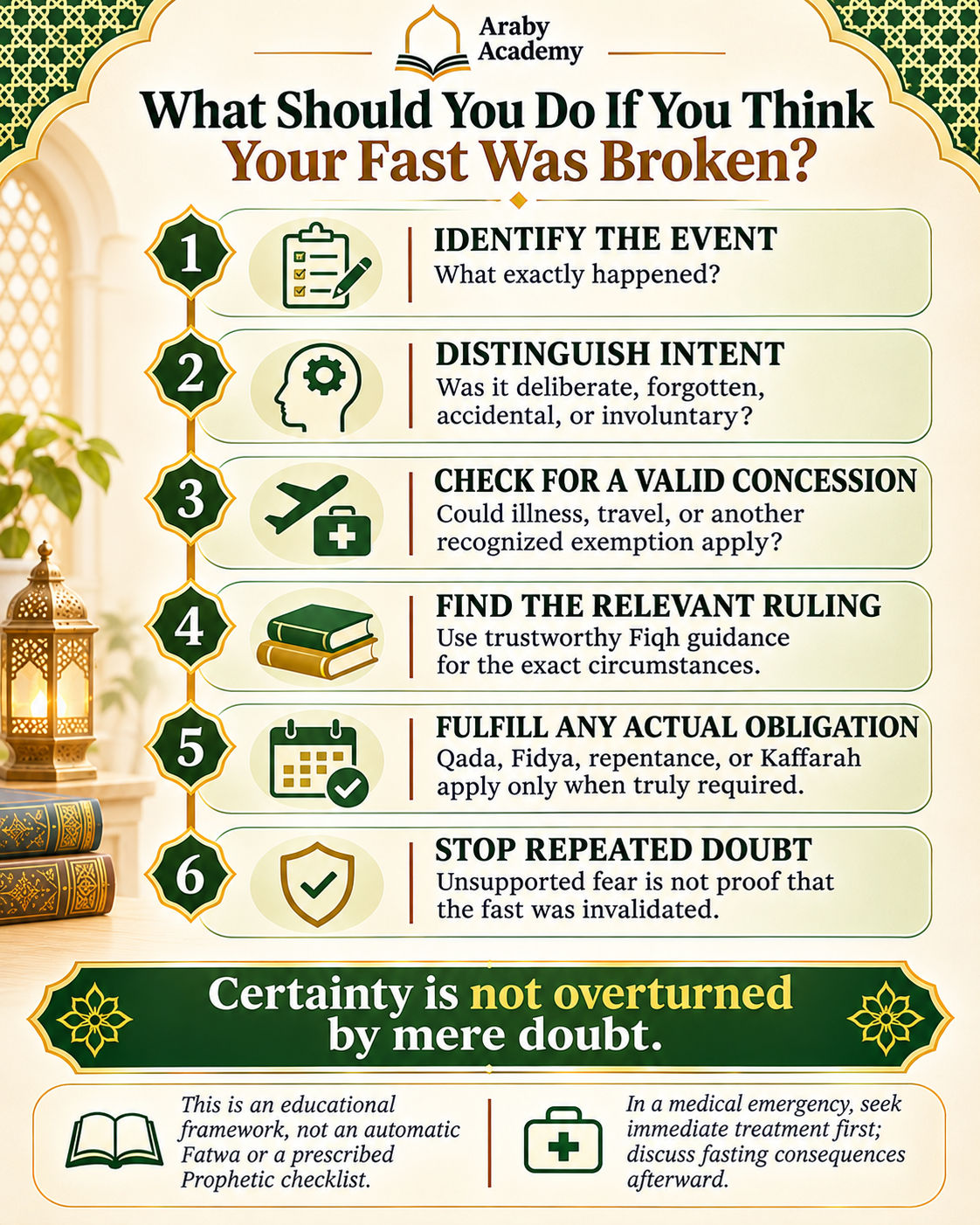
What to Do If Your Fast Is Broken
This is an educational decision framework, not a personal ruling.
Identify accurately what happened.
Separate deliberate action from genuine mistake.
Check whether a medical or religious exemption applies.
Do not assume the strictest penalty.
Follow the guidance of your school or a trusted scholar.
Make up the day or fulfill another duty if it is truly required.
Seek qualified advice for disputed cases.
Do not treat unsupported doubt as proof that your fast was invalid.
Repentance (tawbah) after a deliberate violation means recognizing the wrong, stopping it, feeling sincere remorse, resolving not to return, and fulfilling any outstanding duty, such as Qada or Kaffarah. Guilt alone does not discharge those obligations, and sincere readers should not be shamed. Someone who deliberately violated a fasting obligation should also learn [ how to make sincere Dua and ask Allah for help] while addressing any religious responsibilities that remain.
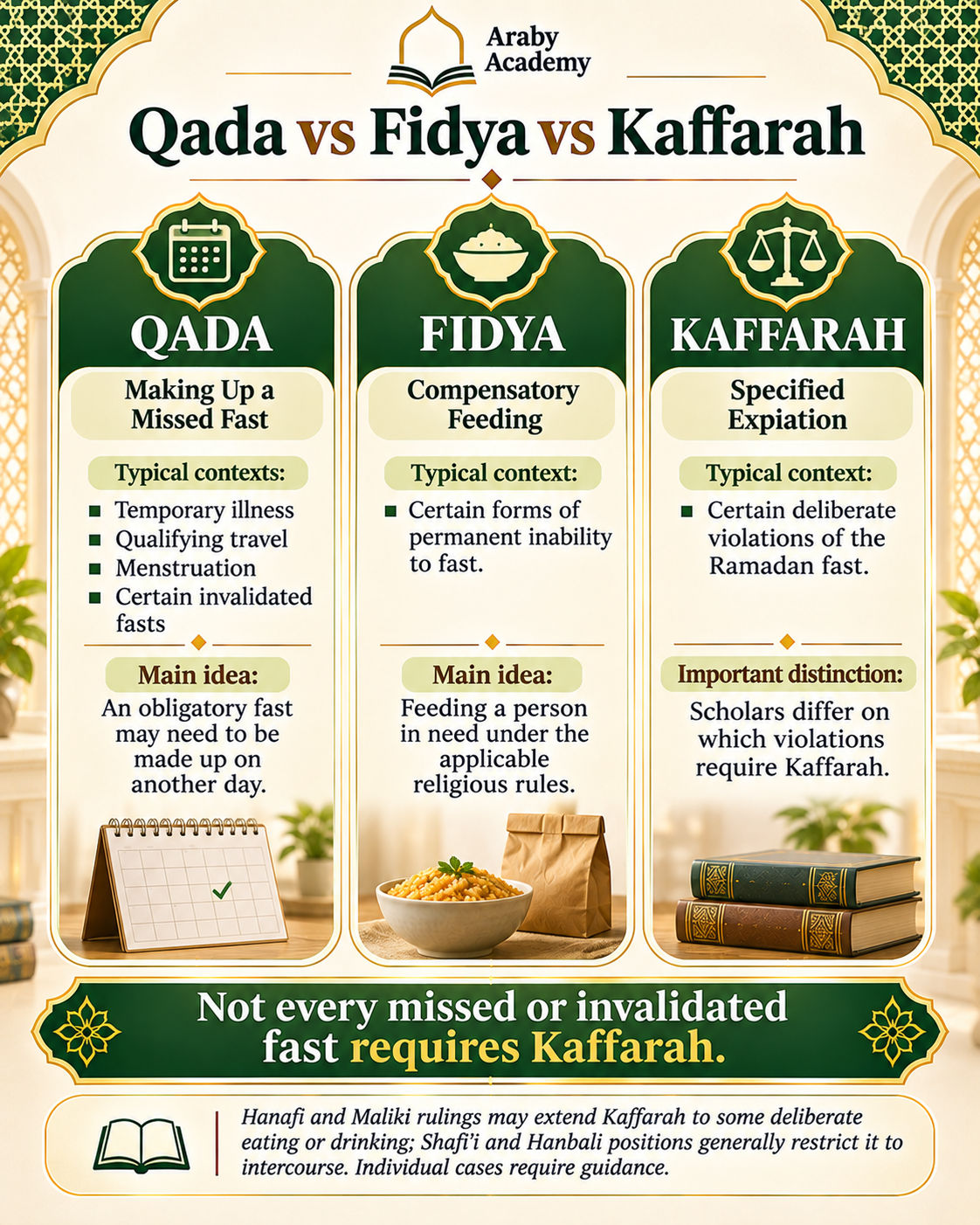
Qada vs Fidya vs Kaffarah
Term | Purpose | Common context | Important qualification |
|---|---|---|---|
Qada (الْقَضَاء) | Make up a missed obligatory fast | Temporary illness, travel, menstruation, breaking the fast | Not every invalidation has the same Qada rule |
Fidya (الْفِدْيَة) | Feed a poor person for each missed day | Permanent inability, such as old age or chronic illness | Pregnancy and breastfeeding views differ |
Kaffarah (الْكَفَّارَة) | Specified expiation for certain violations | Deliberate daytime intercourse; for Hanafis and Malikis also deliberate eating or drinking without excuse | Shafi‘is and Hanbalis limit it to intercourse; it is not for ordinary missed fasts |
Fidya has no universal fixed amount; follow local scholarly guidance.
10 Common Fasting Mistakes to Avoid
Confusing Fajr with sunrise. The fast begins at true dawn.
Assuming every accidental swallow invalidates. Intent and avoidability matter.
Treating ordinary saliva as forbidden. Do not monitor swallowing.
Giving every injection one ruling. Check method and contents.
Ignoring inhaler differences. Metered-dose, powder, and nebulized treatments are assessed differently.
Believing showering breaks the fast. Just keep water out of mouth and nose.
Confusing reward with validity. Backbiting harms reward; it is not a listed invalidator.
Assuming one Kaffarah for everything. Schools differ.
Refusing necessary medical treatment. Health comes first.
Rechecking every sensation. Doubt is not proof.
What If You Doubt Whether Your Fast Is Valid?
Fiqh holds that certainty is not overturned by doubt. If you are unsure whether anything was swallowed, your fast remains valid unless you are reasonably certain otherwise. Do not replay minor events, repeat days until you feel perfectly sure, or assume the fast broke. Repeated obsessive doubt is called waswas (الْوَسْوَاس). For readers who repeatedly fear they have invalidated their fast without clear evidence, learning about [ anxiety, worry, and trust in Allah] may help alongside appropriate scholarly and mental-health support.
Common Myths, Corrected
Myth | Correction |
|---|---|
Saliva breaks the fast | Ordinary saliva is not drinking |
Brushing always breaks it | Swallowing is the concern |
Forgetful eating breaks it | Hadith gives a concession |
Every injection breaks it | Procedures and substances differ |
All inhalers work alike | Delivery methods differ |
All vomiting breaks it | Intent matters |
A wet dream breaks it | It is involuntary |
The seriously ill must fast regardless | Islam provides concessions |
Every missed fast needs 60 days | Kaffarah has particular rules |
Doubt proves invalidity | Certainty is not overturned by doubt |
If a claim sounds absolute, check the details.
Fasting Rules for Busy Muslims and Families
Commutes, shifts, school, appointments, long daylight, and non-Muslim workplaces all affect fasting. Do not assume legal rights that you have not verified locally. Balancing healthcare, employment, and worship is one of the practical aspects of [ observing Ramadan while living in the West], where ordinary work schedules may not change during the month. Careful decisions about food, medicine, worship, and everyday responsibilities also belong to the wider challenge of [ navigating Halal living in the West]. Keeping a consistent timetable for meals, medication, sleep, and worship can form part of [ a sustainable daily Islamic routine] during Ramadan and throughout the year.
Eight Practical Scenarios
What happened | Main consideration | Scholarly differences? | Next step |
|---|---|---|---|
Drinks water, forgetting | Bukhari 1933 | Malikis require Qada | Stop and continue fasting |
Brushes, swallows no toothpaste | Swallowing is the issue | Some dislike toothpaste | Avoid repeated rinsing |
Needs insulin | Non-nutritive injection | Generally agreed | Follow your clinician |
Involuntary vomiting | Not deliberate | Little | Continue if safe; seek care if severe |
Period begins shortly before sunset | Hayd | Not on this principle | Break fast; make up later |
Uses metered-dose inhaler | IIFA 2018: not invalidating | Some bodies disagree | Use it; ask a scholar |
Believes sun set, but it had not | Honest mistake | Most require Qada; some do not | Stop eating; follow your school |
Needs emergency IV | Medical necessity | Depends on fluid | Accept care; ask about Qada |
Simple Fasting Checklist
This is an educational checklist, not a Prophetic ritual.
Confirm local Fajr and Maghrib times.
Make the intention.
Plan necessary medication safely.
Learn the basic invalidators.
Know which actions are generally permitted.
Avoid obsessive checking.
Know when medical help is needed.
Ask a qualified scholar about disputed cases.
Ramadan Fasting vs Voluntary Fasting
Intention, breaking the fast, and making it up can differ between obligatory and optional fasts. Schools disagree on whether a voluntary fast may be broken freely and whether it must be made up, so do not apply every Ramadan rule to voluntary fasts. The rules for obligatory Ramadan fasting should also be distinguished from the voluntary practices discussed in [ the meaning and virtues of fasting on Ashura].
How to Continue Worship When You Cannot Fast
A missed or invalid fast is not a reason to abandon prayer, Quran, or dua. A menstruating woman is excused from prayer and fasting only, and scholars differ on reciting Quran from memory. A person who cannot fast for a valid reason may still explore appropriate acts of worship connected with [ the virtues and meaning of Laylat al-Qadr], according to their circumstances. Charity and feeding the fasting also remain open.
15 Arabic Words About Fasting
Arabic | Transliteration | Meaning and context |
|---|---|---|
الصِّيَام | As-Siyam | Fasting; the word in Quran 2:183 (root ص-و-م) |
الصَّوْم | As-Sawm | Fasting; same root |
المُفَطِّرَات | Al-Mufattirat | Fast-invalidating acts; a Fiqh term |
الفَجْر | Al-Fajr | True dawn; the fast begins |
المَغْرِب | Al-Maghrib | Sunset; the fast ends |
النِّيَّة | An-Niyyah | Intention of the heart |
النِّسْيَان | An-Nisyan | Forgetfulness; Bukhari 1933 |
الْقَضَاء | Al-Qada’ | Making up an obligation |
الفِدْيَة | Al-Fidyah | Compensatory feeding |
الْكَفَّارَة | Al-Kaffarah | Expiation |
الرُّخْصَة | Ar-Rukhsah | Legal concession |
الْحَيْض | Al-Hayd | Menstruation |
النِّفَاس | An-Nifas | Postpartum bleeding |
الْغُسْل | Al-Ghusl | Ritual bath |
التَّوْبَة | At-Tawbah | Repentance |
Frequently Asked Questions
1. What breaks the fast in Islam? Deliberate eating, drinking, and intercourse, plus deliberate vomiting, menstruation, and smoking. Other cases depend on intent and details.
2. Does eating or drinking forgetfully break the fast? No. Bukhari 1933 says to complete the fast. Malikis still require making up the day.
3. Does swallowing saliva break the fast? No, ordinary saliva does not. Phlegm brought to the mouth involves school differences.
4. Does brushing teeth or toothpaste break the fast? Not by itself. Avoid swallowing; some scholars advise brushing outside fasting hours.
5. Does mouthwash break the fast? Not if nothing is swallowed, though it is better avoided during fasting hours.
6. Does vomiting break the fast? Involuntary vomiting does not; deliberately induced vomiting does according to the majority.
7. Do eye drops invalidate fasting? IIFA 1997 treats eye and ear drops as non-invalidating, though some earlier jurists differed.
8. Does nasal spray break the fast? It depends on whether anything reaches and is swallowed from the throat. Scholars differ.
9. Can I use an asthma inhaler while fasting? Yes in an emergency. IIFA 2018 says metered-dose inhalers do not invalidate; other devices and scholars differ.
10. Does insulin break the fast? Not as a non-nutritive injection, per IIFA 1997. Never change doses without your clinician.
11. Do injections or IV fluids break the fast? Non-nutritive injections do not. Nutritional or sugar-containing infusions do. Hydration drips are disputed.
12. Does a blood test or donation break the fast? Routine tests are commonly non-invalidating. Donation and cupping involve scholarly differences and health concerns.
13. Does menstruation invalidate the fast? Yes. Women do not fast during menstruation and make up the days later.
14. Does a wet dream invalidate the fast? No, it is involuntary. Ghusl is needed for prayer.
15. Does kissing break the fast? Not automatically. Avoid it if self-control is doubtful; ejaculation invalidates the fast.
16. Does showering or swimming break the fast? Not inherently. Keep water out of your mouth and nose.
17. Does smoking or vaping break the fast? Yes, scholars treat both as invalidating, and both harm health.
18. What if I eat after Fajr by mistake? Most scholars require Qada; some do not. Knowingly continuing is deliberate.
19. What are Qada, Fidya, and Kaffarah? Qada is making up a day, Fidya is feeding the poor for inability, and Kaffarah is expiation for specified violations.
20. What if I am too ill to fast? Islam provides a concession. Seek medical advice, and ask a scholar about Qada or Fidya.
Conclusion — Understanding the Rules Without Losing the Purpose of Fasting
We began with a brushed tooth, a swallowed trace of saliva, a blood test, an inhaler, and a forgotten bite. Now the picture is clearer: not every action invalidates the fast, forgetfulness has specific Prophetic guidance, medical treatments need careful classification, health concessions matter, and the remedy for a missed fast depends on circumstances.
The purpose of learning what breaks the fast is not to turn Ramadan into a month of constant anxiety. It is to worship Allah with knowledge, respect the boundaries He has set, and understand the mercy and responsibility built into Islamic law. To keep learning Quran and Islamic Studies with qualified teachers, explore the courses at Araby Academy.