The tenth of Muharram approaches.
Some Muslims prepare to fast. Some families receive a message: “Fast tomorrow.” Others get a list claiming “Ten Prophets were saved on Ashura.” Some see images of Musa and Pharaoh, others of Karbala. Some communities prepare sermons about Husayn, and others distribute food. Some ask, “Is Ashura a celebration?” Others ask, “Is it a day of mourning?”
A new Muslim may reasonably wonder: what actually happened on Ashura, and what did the Prophet ﷺ teach Muslims to do?
To answer properly, we must separate four things:
Revelation (what the Quran says)
Authentic Sunnah (what the Prophet ﷺ did and taught)
Early Islamic history (what happened later, and how well it is documented)
Later customs (what communities added over the centuries)
Ashura should be understood through authentic revelation and responsible history, not through inherited legends, sectarian polemics, or viral reward lists.
A second principle runs through this article: the Sunnah gives Ashura a clear act of worship, fasting. History gives the day an additional tragedy to remember, Karbala. Neither truth needs to erase the other.
(Throughout, we use the labels Quranic, Authentic Sunnah, Early Historical Report, Fiqh Interpretation, Scholarly Difference, Cultural Practice, Weak, Fabricated and Sectarian Tradition, and we do not merge them.)
Ashura in One Minute
Question | Answer |
|---|---|
When? | 10 Muharram |
Main Sunnah? | Voluntary fasting |
Why? | The Prophet ﷺ fasted it, and the Madinah report links it to Allah saving Musa |
Reward? | Hope for expiation of the previous year, understood by scholars as concerning minor sins |
Best common practice? | 9th + 10th |
Only the 10th? | Valid |
Obligatory? | No |
Special Salah? | Not authentically established |
Special Dua? | No specific Prophetic Ashura formula is established |
Karbala? | Husayn رضي الله عنه was martyred on Ashura in 61 AH |
Do Muslims fast because of Karbala? | No. The Sunnah predates Karbala |
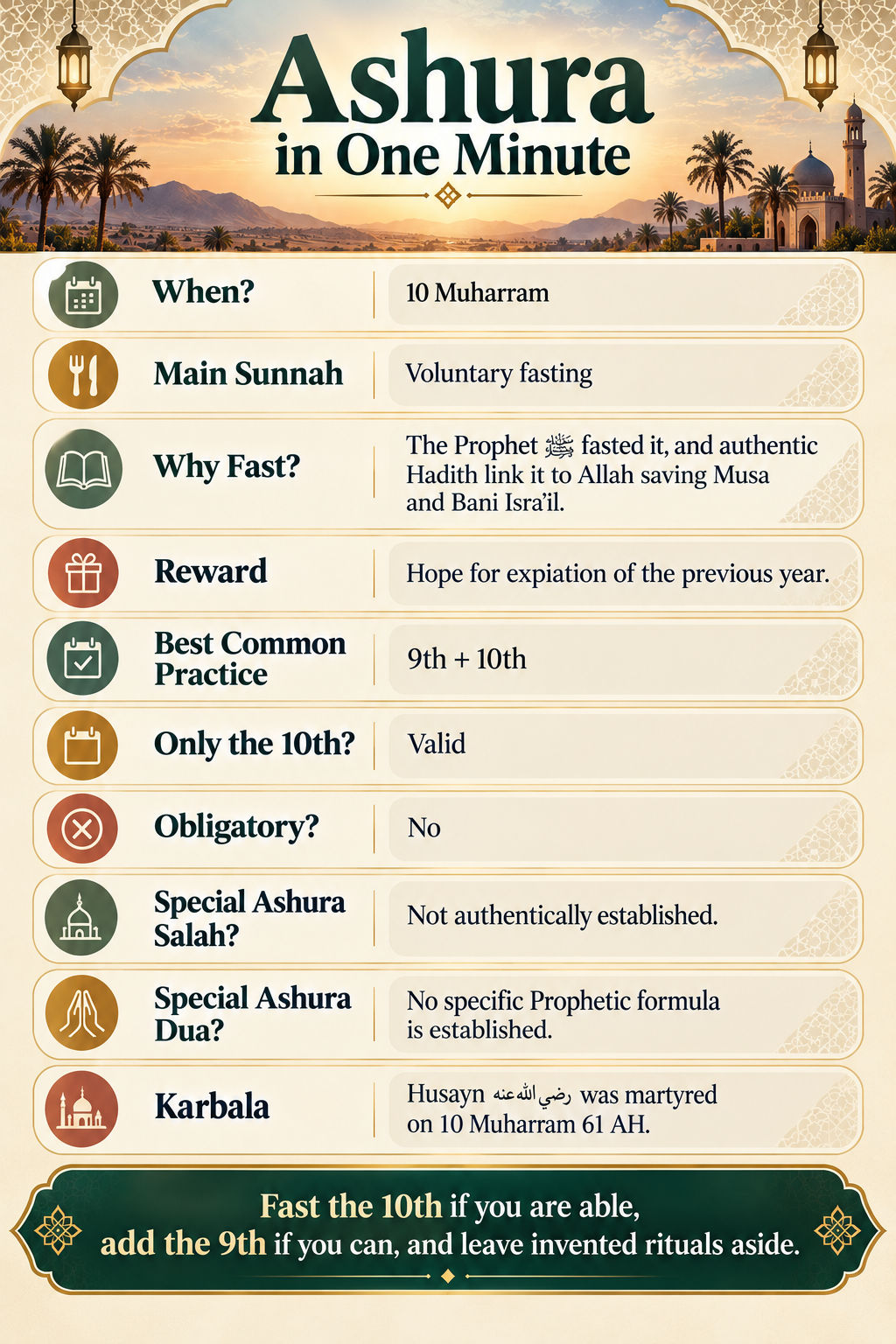
If you remember one sentence: fast the 10th if you are able, add the 9th if you can, and leave invented rituals aside.
What Does “Ashura” Mean?
The word is عَاشُورَاء (‘Ashura). It comes from the Arabic root ع-ش-ر (‘-sh-r), connected with عَشَرَة (‘asharah), “ten,” and with “tenth.” In Islamic usage it names the tenth day of Muharram.
Classical lexicographers discuss the exact word-form and whether the name pre-dates Islam. We will not claim more than that. One historical note: a report from Ibn Abbas shows the question “which day is Ashura?” was asked early. He told the questioner to count from the new moon and fast on the ninth morning, which is read as meaning the tenth. The overwhelming position of scholars is that Ashura is the tenth.
Muharram (مُحَرَّم) is the first month of the Hijri calendar and one of the four sacred months. The Prophet ﷺ called fasting in it the best fasting after Ramadan (Sahih Muslim).
When Does Ashura Begin?
The Islamic day begins at sunset, so 10 Muharram begins at Maghrib after 9 Muharram ends. But the fast itself runs from true dawn (Fajr) to sunset (Maghrib). A “day” starts in the evening, and the fasting hours run from dawn.
The Hijri calendar is lunar, about 11 days shorter than the Gregorian year, so Ashura moves earlier each year. It fell around 25–26 June in 2026, and will fall around mid-June in 2027. Because communities sometimes begin Muharram a day apart (moon sighting versus calculation), the Gregorian date can differ between places. Follow a reliable local authority and do not let this become an anxiety.
The First Great Ashura Story: Musa and Pharaoh
The Quran tells this story across many surahs, including al-Baqarah, al-A’raf, Yunus, Taha, al-Shu’ara and al-Qasas. We keep to what the Quran states and avoid inventing dialogue or importing details from films and later storytelling.
The outline is clear. Pharaoh exalted himself in the land and oppressed Bani Isra’il (28:4). Allah sent Musa عليه السلام, who called Pharaoh to worship Allah alone. Pharaoh rejected him and continued the oppression. Allah then commanded Musa to leave with his people by night (26:52). Pharaoh pursued them. Allah saved Musa and those with him and drowned Pharaoh and his forces. In 2:50, Allah reminds Bani Isra’il: “We parted the sea for you, saved you, and drowned the people of Pharaoh while you were watching.”
“The Sea in Front, Pharaoh Behind”
The most powerful moment is in Surah al-Shu’ara. When the two groups came within sight of each other, Musa’s companions said:
إِنَّا لَمُدْرَكُونَ
“We are surely going to be overtaken.” (26:61)
Musa replied:
كَلَّا إِنَّ مَعِيَ رَبِّي سَيَهْدِينِ
“No! Indeed, my Lord is with me; He will guide me.” (26:62)
This is tawakkul (trust in Allah), but it is not denial of danger. The danger was real: water ahead, an army behind. Musa’s certainty rested in Allah’s guidance, not in the absence of a threat.
The Quran then describes the sea being struck and parted (26:63). We do not add the sea’s location, the height of the water, or the size of either group, because the Quran does not give them, and identifying the exact body of water with archaeological certainty goes beyond the evidence.

Pharaoh’s Drowning
In 10:90–92, as the water overtook Pharaoh, he declared belief. Allah’s response was, in meaning, “Now? And you disobeyed before and were among the corrupters.” The verse continues that Allah would save Pharaoh’s body so that he would be a sign for those after him.
You will see viral claims that a particular Egyptian mummy has been proven to be Musa’s Pharaoh and that this “proves the Quran.” Be cautious. Identifying a specific mummy with that Pharaoh is disputed among historians and Egyptologists, and Muslims do not need speculative archaeology to establish a Quranic truth. The Quran’s claim stands on revelation.
What Does This Have to Do With Ashura? The Madinah Hadith
Ibn Abbas رضي الله عنهما reports (Sahih al-Bukhari; Sahih Muslim) that when the Prophet ﷺ came to Madinah he found the Jews fasting on Ashura. He asked about it. They said it was a righteous day on which Allah saved Bani Isra’il from their enemy, and Musa fasted it. The Prophet ﷺ replied, in meaning, “I have more right to Musa than you,” so he fasted it and ordered the Muslims to fast it.
Did the Prophet ﷺ “Copy” the Jews?
No. The Hadith presents Musa as a Prophet of Allah whose deliverance Muslims also affirm. Islam does not treat Musa as a foreign figure. He is among the greatest of the Prophets. The phrase “more right to Musa” expresses continuity: Muslims stand within the monotheistic message Musa brought. The fast is an act of gratitude to Allah, not imitation of a community.
Did the Jews Really Fast on the 10th of Muharram?
Modern readers sometimes compare this with Jewish calendars, where the nearest well-known fast, Yom Kippur, falls on 10 Tishri. Be careful here. Scholars have discussed several possibilities: differences between the lunar calendars and their intercalation, a particular observance known to the Jews of Madinah, and what the Hadith means by “found them fasting.” Ibn Hajar notes that the Prophet ﷺ arrived in Rabi’ al-Awwal, so the report is understood as referring to the Ashura he met after arriving. We should neither claim that Ashura simply equals Yom Kippur, nor say the Hadith is false because of modern calendar dates.
Ashura Before the Hijrah
Aisha رضي الله عنها reports (Bukhari; Muslim) that Quraysh used to fast Ashura in the Jahiliyyah and the Prophet ﷺ fasted it too. After he came to Madinah he continued to fast it and ordered fasting. When Ramadan was made obligatory, Ashura was left: whoever wished fasted it, and whoever wished left it.
This corrects an oversimplified story, that the Prophet ﷺ “discovered” Ashura from the Jews in Madinah.
Reconciling the Two Hadith Streams
The usual scholarly reading, discussed by Ibn Hajar in Fath al-Bari and al-Nawawi in his commentary on Muslim, is:
Ashura was already known and observed in Makkah, and the Prophet ﷺ fasted it.
In Madinah, the Jewish community’s account supplied and confirmed the connection to Musa’s deliverance.
The Prophet ﷺ then commanded and emphasized the fast.
Ramadan later became obligatory.
Ashura became voluntary.
This reading is widely discussed by commentators, but it is a reconciliation, not a single binding verdict. Scholars also debate details, such as how the Makkan practice related to the Madinan one.
Was Ashura Ever Obligatory?
Scholars differed. Some (notably many Hanafis) held it was obligatory before Ramadan. Many others, including the Shafi’is, held it was strongly emphasized but never technically obligatory. Mu’awiyah رضي الله عنه reports the Prophet ﷺ saying Allah had not prescribed its fast upon them (Bukhari; Muslim). All agree on today’s ruling:
Fasting Ashura today is not obligatory. It is a highly recommended voluntary fast.
Why Do Muslims Fast Ashura?
Primarily because the Prophet ﷺ fasted it and encouraged fasting it. It also expresses gratitude to Allah for saving Musa and the believers, and it carries an authentic virtue of expiation. It is not correct to say “we fast because Husayn died.” We return to this below.
The Reward: “Expiation of the Previous Year”
Abu Qatadah رضي الله عنه reports in Sahih Muslim that the Prophet ﷺ said, in meaning:
صِيَامُ يَوْمِ عَاشُورَاءَ أَحْتَسِبُ عَلَى اللَّهِ أَنْ يُكَفِّرَ السَّنَةَ الَّتِي قَبْلَهُ
“Fasting the Day of Ashura, I hope from Allah, expiates the year before it.”
Note the wording “I hope” (أَحْتَسِبُ): it is a hope placed in Allah’s mercy, not a transactional guarantee.
What Does It Mean?
The mainstream scholarly reading, reflected by al-Nawawi and earlier by Ibn Abd al-Barr, is that such expiation concerns minor sins, based on other texts that tie expiation to avoiding major sins (e.g., the five prayers, Sahih Muslim). Major sins require sincere tawbah. Scholars add that if a person has no minor sins to expiate, one may hope for lightening or a raising of rank. This is a hope, so we state it as one.
What About Rights Owed to People?
حقوق العباد (the rights of people) are not erased by fasting. Stolen money must be returned, debts paid, slander repaired, and injustice redressed. Ashura is not a license to avoid repentance or justice.
9th, 10th, or 11th?
The Ninth
Ibn Abbas reports (Sahih Muslim) that when the Prophet ﷺ fasted Ashura and ordered it, the Companions said the Jews and Christians venerate this day. He answered, in meaning, “If I live to next year, I will fast the ninth.” The following year did not come. The Prophet ﷺ passed away.
Be precise: he intended to fast the ninth but did not complete it. That intention is still Sunnah evidence, so scholars see 9 + 10 as having the strongest direct basis. Several explanations are given for why the ninth: to distinguish the Muslim practice from that of others, and, as Ibn Abbas’s report suggests, as an extra precaution. We do not claim more than the sources say.
The Tenth Alone
Fasting only the 10th is valid and earns the Ashura fast according to the majority of scholars. A few Hanafi texts discuss disliking singling out the tenth, so a Hanafi reader may follow their school’s guidance. Do not tell anyone who missed the ninth that they “missed Ashura.” They can still fast the tenth.
The Eleventh
A well-known report from Ibn Abbas (Musnad Ahmad; Ibn Khuzaymah) says: “Fast the day of Ashura and differ from the Jews: fast a day before it or a day after it.” ⚑ Its chain includes Ibn Abi Layla, whose memory is criticized. Some scholars therefore weaken it, while others accept or strengthen it by supporting reports, including Ibn Abbas’s own practice. This is a scholarly disagreement, so do not label it simply “Sahih.”
The “Three Levels”
Ibn al-Qayyim, in Zad al-Ma’ad, describes levels of fasting Ashura: the highest is the 9th, 10th and 11th, then 9th and 10th, then the 10th alone. This is a later scholarly organization, not a Prophetic Hadith, and it depends partly on the disputed eleventh-day report.
Option | Evidence strength | Practical note |
|---|---|---|
9 + 10 | Strongest direct basis (the Prophet’s stated intention) | The most commonly recommended |
10 only | Valid | Fully counts as the Ashura fast |
10 + 11 | Based on the disputed report and scholarly reasoning | Acceptable, with the nuance above |
9 + 10 + 11 | Scholarly recommendation, not a Prophetic formula | Extra voluntary fasting in Muharram is virtuous, but don’t call this the Prophetic formula |
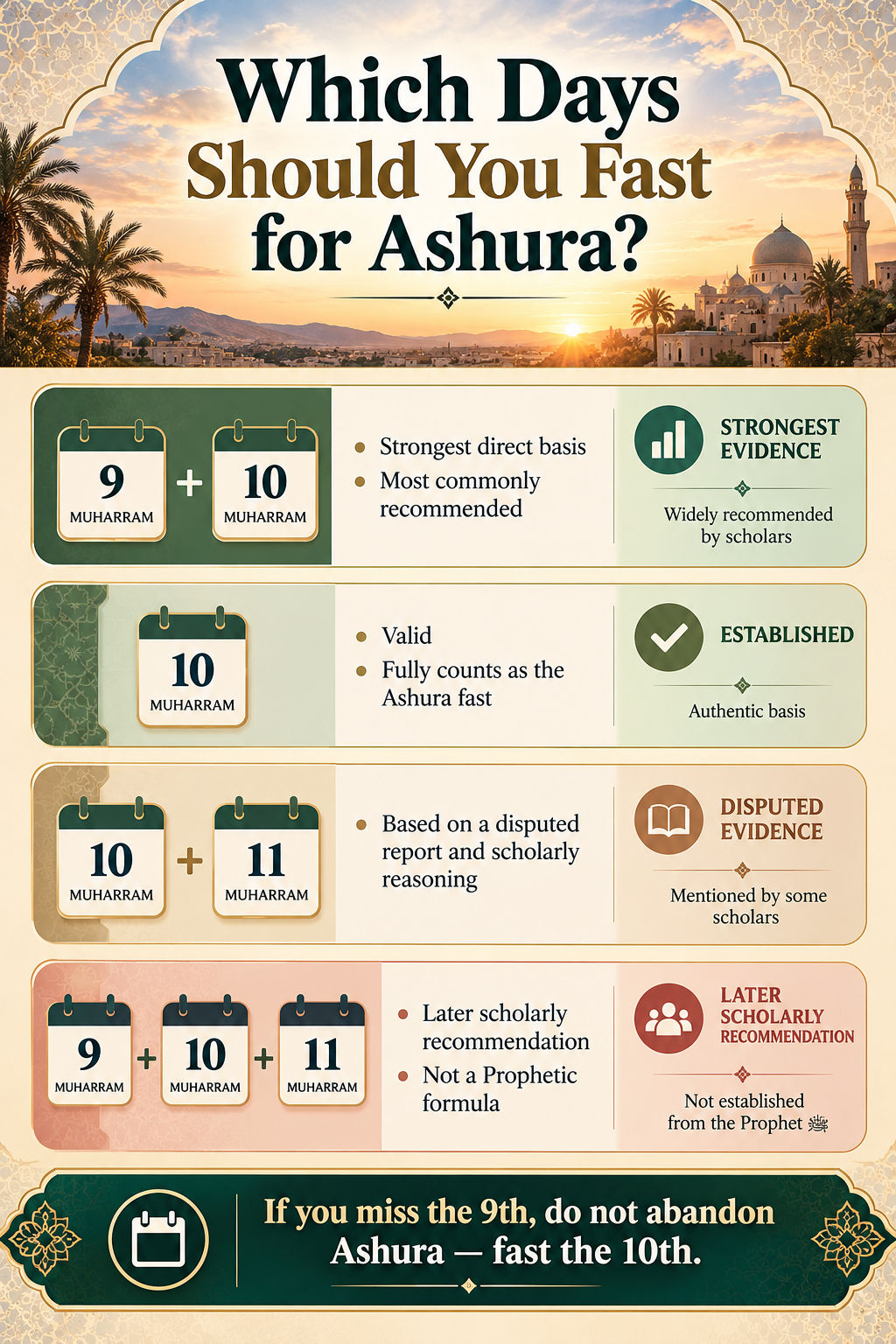
If mosques disagree on the date, follow your reliable local authority. A person who wishes to be cautious may add an adjacent day, without obsessing.
Practical Fiqh Questions
Intention (niyyah). It is an intention of the heart. No Arabic formula such as "نويت صوم عاشوراء" is required, and none is a Prophetic requirement.
Intending after Fajr. Aisha reports (Sahih Muslim) that the Prophet ﷺ once asked if there was food, and on hearing there was none, said he would fast. Schools differ on the details. Most allow a voluntary fast to be intended after dawn if nothing breaking the fast has occurred, though the Malikis require the intention from the night. Ideally, intend the night before.
Qada of Ramadan. An obligatory make-up fast takes priority over a voluntary one. Whether you may combine the intentions differs among scholars: whether the fast counts as Qada, and whether you may also hope for the Ashura reward, are two questions. Many scholars say a Qada fast taken on that day still brings the hope of the day’s virtue, while others advise separating them. Consult your school or a scholar.
Women. Women can fast Ashura. During menstruation they do not fast, and no one should stigmatize this. A missed voluntary Ashura fast is not a debt. Pregnant or breastfeeding women who worry about health need not force an optional fast. This is not medical advice.
Illness and travel. Ashura is voluntary, so no one should harm themselves for it. Travelers may fast or not, according to circumstance.
Children. Children who are not yet accountable need not fast. The Companions gradually accustomed their children to fasting, and Rubayyi’ bint Mu’awwidh describes this in Bukhari and Muslim, but do not push very young children into unsafe fasting.
Friday. The Prophet ﷺ discouraged singling out Friday for fasting unless it coincides with a fast one habitually keeps (Bukhari; Muslim). Because Ashura has its own independent reason, scholars generally treat it differently from singling out Friday merely because it is Friday.
Saturday. A narration says not to fast on Saturday except what is obligatory (Abu Dawud; Tirmidhi). Its authenticity and meaning are debated ⚑. Many scholars permit fasting an established occasion like Ashura on a Saturday, and combining it with the 9th or 11th removes the issue for those who want to be cautious. Do not abandon Ashura because of a viral Saturday claim.
Suhoor and iftar. Eat suhoor, because there is blessing in it, and break the fast promptly at sunset. No Ashura-specific food is required.
Karbala: The Second Memory
Who Was Husayn?
Husayn ibn Ali رضي الله عنهما was the grandson of the Prophet ﷺ, the son of Ali ibn Abi Talib and Fatimah رضي الله عنهما, and the brother of Hasan. He was a member of the Ahl al-Bayt. Authentic Hadith include the Prophet ﷺ saying that Hasan and Husayn are masters of the youth of Paradise (Tirmidhi, graded sahih) and that Husayn is from him and he is from Husayn (Tirmidhi; Ibn Majah, graded hasan). Love and respect for the Prophet’s family is deeply rooted in Sunni sources. Caring about Husayn is not “sectarian.”
What Happened
The historically established core, which is widely agreed across Sunni and Shia sources, is as follows. After Mu’awiyah رضي الله عنه died in 60 AH, his son Yazid took the leadership. Husayn did not give allegiance under those circumstances. Letters from Kufa invited him to Iraq, and he set out. The political situation there turned against him, and his small group was intercepted. On 10 Muharram 61 AH (October 680 CE), at Karbala, Husayn and members of his household and supporters were killed.
This was a profound tragedy and an injustice. Beyond this core we are careful. Details such as exact numbers, speeches, final words and dramatic scenes vary between reports and come from sources of differing reliability.
Reading the Sources
Our earliest narrative material comes largely through reports such as those of Abu Mikhnaf, preserved by al-Tabari. Al-Tabari recording a report does not authenticate it, since he preserves what reached him, often with chains. Hadith critics generally weaken Abu Mikhnaf as a transmitter, while historians still use him because early material is scarce. Later maqtal literature and devotional storytelling add much that cannot be verified. Handle these with caution, and treat dramatic details as reported with variants or later devotional tradition unless sourced.
Yazid
Historians debate the details of Yazid’s personal responsibility. This article does not rest on cursing him, defending him or settling that debate. The central point is that Husayn was unjustly killed.
The Chronology That Matters
During the Prophet’s life: Ashura fasting is established.
11 AH: the Prophet ﷺ passes away.
61 AH: Husayn is martyred at Karbala on Ashura.
Muslims fast Ashura because of the Prophetic Sunnah, not because of Karbala. Karbala remains a profound tragedy remembered on the same date.
The fasting Sunnah predates Karbala by about five decades. So fasting Ashura does not disrespect Husayn, and loving Husayn does not contradict the Sunnah. A Muslim can fast by Sunnah, love Husayn and grieve at Karbala without contradiction.
Sunni and Shia Approaches, Respectfully
At a high level, Sunni practice centers on the Prophetic fast and on gratitude to Allah for Musa’s deliverance, while also regarding Karbala as a tragedy. Many Shia communities place Karbala and the mourning of Husayn at the center of Ashura, through gatherings (majalis), remembrance, and in some communities black clothing and processions. Practices vary widely within Shia communities, so avoid “all Shias do X.”
Two inflammatory distortions should be rejected: “Sunnis celebrate Husayn’s death” and “Shias worship Husayn.” Neither is accurate. Sunni fasting is worship of Allah and gratitude for deliverance, not celebration of Husayn’s death.
Regarding mourning, the Prophet ﷺ wept at his son Ibrahim’s death (Bukhari), so grief and tears are human and permissible. Prohibited mourning, such as striking the cheeks, tearing clothes and calling with the call of the Jahiliyyah (niyahah), is a separate matter (Bukhari; Muslim). Intentionally harming oneself is not part of mainstream Sunni practice, and many scholars, including a range of Shia authorities, reject it, some encouraging blood donation instead. Do not generalize it to all Shia observance.
Is Ashura an Eid? No. It is a virtuous fasting day. Is it an annual mandated mourning day? There is no Prophetic command for that, though Husayn’s martyrdom deserves respectful remembrance.
The Evidence Audit: Customs, Rituals and Miracle Lists
Special Salah, Dua and Dhikr
Reports of a special Ashura prayer (with set rak’ahs or surah counts) are weak or fabricated, as classical critics such as Ibn al-Jawzi noted. No specific Prophetic Ashura Dua is established, so do not forward one. General dua and dhikr are excellent. Specific numbers, formulas or guaranteed rewards need evidence, including claims about reciting Surah al-Ikhlas a set number of times. When breaking the fast, the stronger report is "ذهب الظمأ وابتلت العروق وثبت الأجر إن شاء الله" (Abu Dawud, graded hasan), while "اللهم لك صمت" has a weak chain ⚑.
Kohl and Bathing
Reports that applying kohl on Ashura prevents eye disease, or that bathing on Ashura prevents illness all year, are classed by major critics as fabricated. Ibn Taymiyyah observed that some such customs arose as reactions in the sectarian atmosphere around Ashura. These are not “just culture” when attached to a religious reward claim. Ordinary hygiene, of course, is fine.
Special Food
Dishes such as Turkey’s aşure are cultural. Eating a permissible food is fine, but attaching a specific religious reward requires evidence.
Spending Extra on Family: DISPUTED
The report “Whoever expands spending on his family on Ashura, Allah will expand for him throughout the year” is narrated through several Companions (via al-Bayhaqi and al-Tabarani). Its individual chains are weak. Some scholars, including al-Bayhaqi, held that the routes strengthen each other, and some later authorities (e.g., al-Albani) graded it hasan by its routes. Others, including Ibn al-Jawzi, considered it unsound, and Ahmad is reported to have said it has no sound basis ⚑. Reports of early scholars saying they tried it and found it true are experience, not revelation. So this is disputed. Someone who practices it on a recognized scholarly view should not be shamed, and no one should promise guaranteed wealth.
Charity and Graves
Charity is always good, and grave visitation has general Islamic basis. Ashura-specific ritualization or numerical rewards need evidence. Weddings are not prohibited in Muharram, though community sensitivities vary.
The “Prophets on Ashura” Lists
Viral lists claim Adam’s repentance, Nuh’s Ark landing, Ibrahim’s rescue from the fire, Yunus leaving the fish, Ayyub’s healing, Yusuf’s reunion, Sulayman’s kingdom, Isa’s birth and more all fell on Ashura. Audit them:
Nuh: the Quran says the Ark rested on al-Judi (11:44), not on Ashura. One report linking the Ark and Ashura appears in Ahmad with a chain that editors grade weak ⚑, and it is not in the Sahihayn.
Adam, Ibrahim, Yunus, Ayyub and the rest: the Quran confirms the events, but no authentic evidence assigns them to Ashura. Such lists appear in later compilations and are not established.
A true event can still be given a false date. “Allah saved Ibrahim from the fire” is Quranic. “…on Ashura” is an additional claim requiring additional evidence.
Arabic Vocabulary for Ashura
Arabic | Transliteration | Root / Meaning | Takeaway |
|---|---|---|---|
عَاشُورَاء | ‘Ashura | ع-ش-ر, “tenth” | The tenth of Muharram |
مُحَرَّم | Muharram | ح-ر-م, sacred | First Hijri month, a sacred month |
صَوْم | Sawm | ص-و-م, to abstain | Fasting |
صِيَام | Siyam | same root | Fasting (the Quran’s usual term in 2:183) |
مُوسَى | Musa | n/a | A Prophet of Allah |
فِرْعَوْن | Fir’awn | n/a | Pharaoh, the oppressor |
بَنُو إِسْرَائِيل | Banu Isra’il | “Children of Israel” | The community Musa led |
نَجَّى | Najja | ن-ج-و, to save | “Allah saved them” |
يُكَفِّر / كَفَّارَة | Yukaffir / Kaffarah | ك-ف-ر, to cover | Expiation of sins |
شُكْر | Shukr | ش-ك-ر | Gratitude, the heart of the fast |
أَهْلُ الْبَيْت | Ahl al-Bayt | “People of the house” | The Prophet’s family |
Common Myths
Myth | Reality |
|---|---|
Ashura is the first of Muharram | It is the tenth |
We fast because Husayn died | The Sunnah predates Karbala and is linked to Musa’s deliverance |
The fast began only when the Prophet ﷺ saw Jews fasting | Authentic Hadith also show he fasted it in Makkah; scholars reconcile the reports |
Ashura is obligatory | Voluntary since Ramadan became obligatory |
Three days are required | The tenth alone is valid |
Missed the ninth, so no point fasting | Fast the tenth |
10+11 equals 9+10 in evidence | The evidence differs |
Ashura erases all major sins | Generally understood as minor sins; major sins need tawbah |
It erases money owed to people | People’s rights still need redress |
There is a mandatory special Dua | None is established |
There is a special Ashura Salah | None authenticated |
Kohl guarantees eye health | The reports are not established |
Bathing protects all year | Not established |
Every Prophet had a miracle on Ashura | Quranic events attached to unverified dates |
Nuh’s Ark definitely landed on Ashura | Quran says al-Judi; the date needs separate evidence |
Sunnis celebrate Husayn’s death | False |
Caring about Husayn is only Shia | He is the Prophet’s beloved grandson |
Every Shia practices self-flagellation | Practices vary widely |
Weddings are forbidden in Muharram | No general prohibition |
Ashura is an Eid | It is a virtuous fasting day |
Evidence-Strength Table
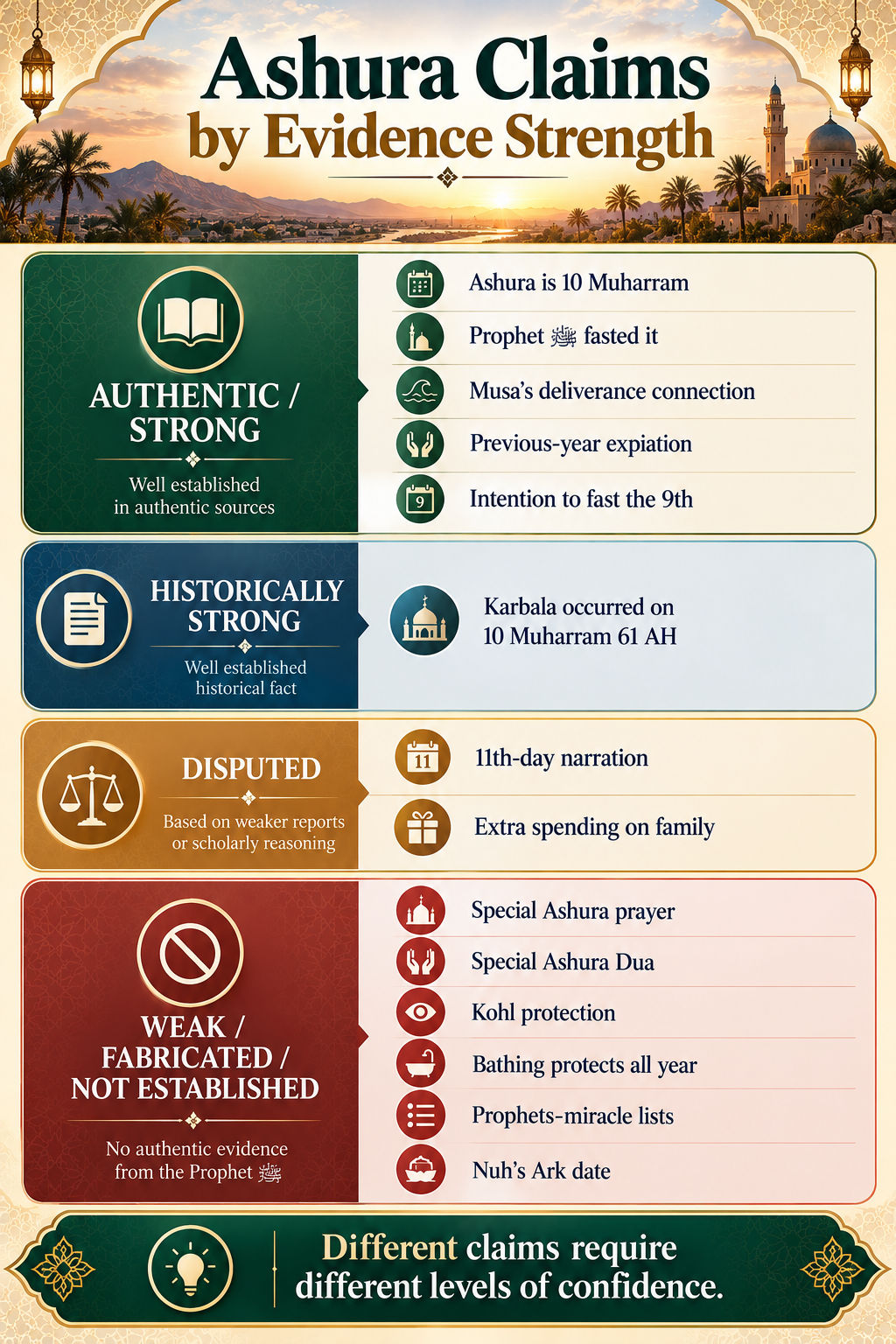
Claim | Level | Source type | Practical conclusion |
|---|---|---|---|
Ashura = 10 Muharram | STRONG (majority view) | Hadith; Ibn Abbas’s report; scholars | Fast the tenth |
Musa saved; fasted in gratitude | AUTHENTIC (Madinah Hadith) | Bukhari; Muslim | Core reason |
Prophet fasted | AUTHENTIC | Bukhari; Muslim | Sunnah |
Quraysh fasted | AUTHENTIC | Aisha (Bukhari; Muslim) | Predates Madinah |
Ramadan made it voluntary | AUTHENTIC | Aisha; Mu’awiyah | Not obligatory |
Previous-year expiation | AUTHENTIC | Sahih Muslim | Hope; mainly minor sins |
Intention to fast the ninth | AUTHENTIC | Sahih Muslim | Add the ninth |
11th-day narration | DISPUTED | Ahmad; Ibn Khuzaymah ⚑ | Optional |
Karbala on 10 Muharram 61 AH | STRONG / well established | Early historical reports | Remember with respect |
Extra family spending | DISPUTED | Bayhaqi; Tabarani ⚑ | Don’t shame; don’t promise |
Kohl | FABRICATED | Critics (Ibn al-Jawzi) | Don’t attach religious reward |
Bathing | FABRICATED | Same | Same |
Special prayer | FABRICATED / WEAK | Same | Don’t practice |
Special Dua | NOT ESTABLISHED | Make general dua | |
Nuh Ark date | WEAK / NOT ESTABLISHED | Ahmad variant ⚑ | Don’t assert |
Adam repentance date | NOT ESTABLISHED | Don’t assert | |
Prophets-miracles list | NOT ESTABLISHED | Later compilations | Don’t forward |
What Should a Muslim Actually Do on Ashura?
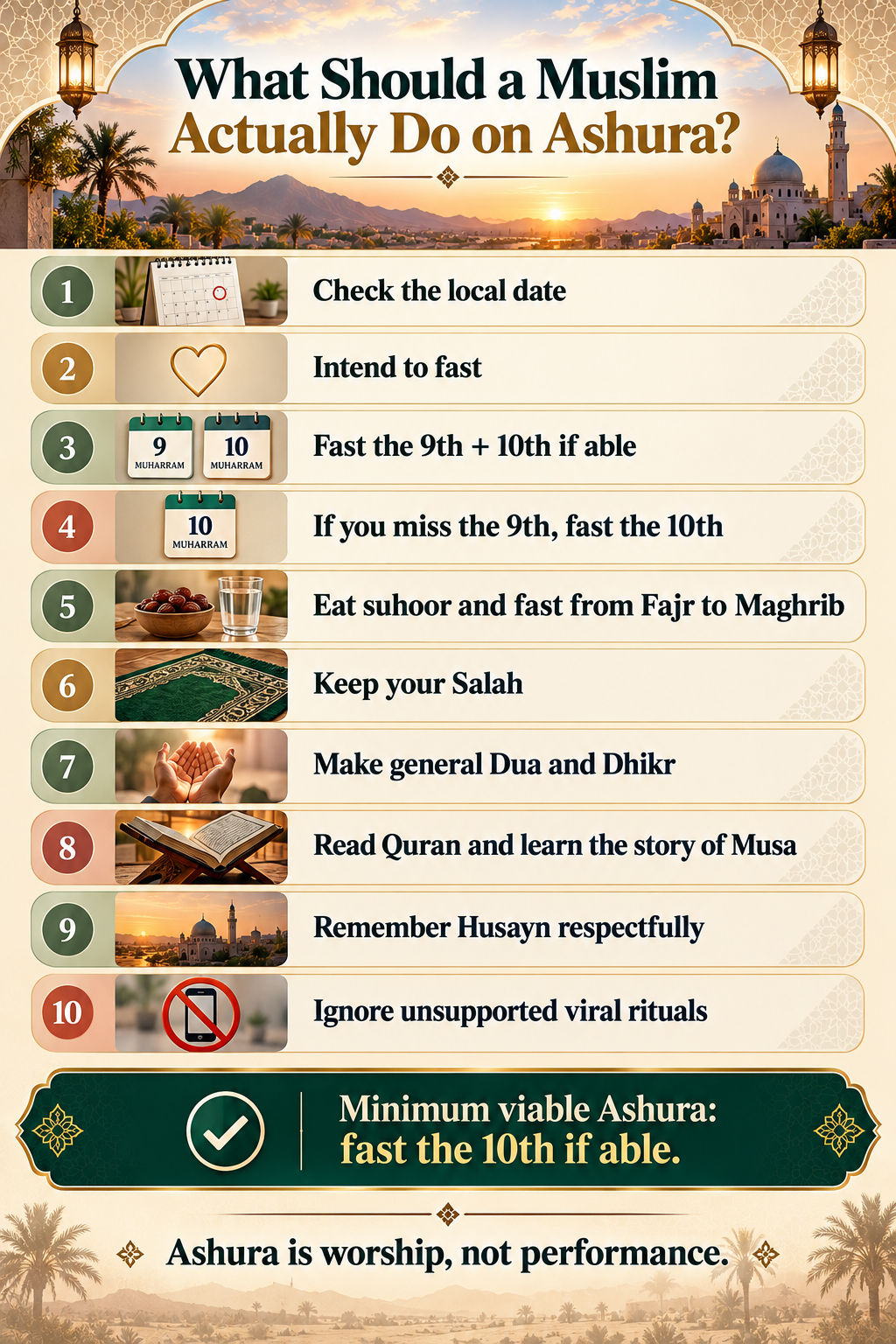
A simple plan, especially for converts:
Check the date with your local community.
Make an intention to fast, from the night if possible.
Fast the 9th and 10th if able. If you missed the 9th, fast the 10th.
Eat suhoor, and fast from Fajr to Maghrib.
Keep your Salah.
Make general dua and dhikr (see What Is Dhikr?).
Read Quran, and learn the story of Musa.
Learn about Husayn respectfully.
Break the fast promptly.
Ignore unsupported viral rituals.
Minimum viable Ashura: fast the 10th if able. That is the core action.
With children: teach that Musa trusted Allah, that oppression does not last forever, that Allah saves believers, that fasting can express gratitude, that the Prophet ﷺ loved Musa, that Husayn was beloved family of the Prophet ﷺ, and that Karbala was a tragedy. Skip graphic details and slogans (see How to Build a Daily Islamic Routine).
Before you share an Ashura post, ask:
Does it quote the Quran? Does the Quran actually mention Ashura?
Does it quote Hadith? Where is it found, is the wording Prophetic or later, and what is its grading?
Does it promise a precise reward?
Does it assign a historical event to Ashura? What is the evidence for the date?
Ashura is not a performance. You can post nothing and still observe it beautifully, without judging those unable to fast.

FAQ
1. What is Ashura? The tenth day of Muharram, a day on which the Prophet ﷺ fasted and encouraged fasting, remembering Allah’s deliverance of Musa.
2. When is Ashura? 10 Muharram. The Islamic day begins at sunset, but the fast runs from Fajr to Maghrib. The Gregorian date moves about 11 days earlier each year.
3. Why do Muslims fast Ashura? Because the Prophet ﷺ fasted it and encouraged it, in gratitude to Allah for saving Musa and Bani Isra’il, and because of its authentic virtue.
4. What happened to Musa on Ashura? The Madinah Hadith says it is the day Allah saved Musa and his people from Pharaoh. The Quran narrates the deliverance without dating it.
5. Did the Prophet ﷺ fast Ashura? Yes, authentically, in Makkah and Madinah (Bukhari; Muslim).
6. Did Muslims fast Ashura before Ramadan? Yes. It was commanded or emphasized, and scholars differ on whether it was obligatory.
7. Is it obligatory? No. It has been voluntary since Ramadan was prescribed.
8. What is the reward? The Prophet ﷺ hoped it expiates the previous year, understood by scholars as minor sins.
9. Does it forgive all sins? No. Major sins need tawbah, and rights of people need redress.
10. Should Muslims fast the 9th and 10th? This has the strongest direct Sunnah basis, from the Prophet’s stated intention.
11. Can I fast only the 10th? Yes, according to the majority.
12. Can I fast the 10th and 11th? Yes, based on a disputed report and scholarly reasoning.
13. What if I miss the 9th? Fast the 10th.
14. Should I fast all three days? It is a virtuous voluntary option, but not a Prophetic formula and not required.
15. Can I combine Ashura with a missed Ramadan fast? Qada has priority. Whether intentions may be combined differs by school, so consult a scholar.
16. What if it falls on Friday or Saturday? Ashura is an established occasion, so many scholars permit it. Adding an adjacent day removes the concern.
17. What happened to Husayn on Ashura? He was martyred at Karbala on 10 Muharram 61 AH, a profound tragedy.
18. Do Sunni Muslims mourn Husayn? Sunnis regard his killing as a tragedy and love him as the Prophet’s grandson, though they do not make it an annual mourning ritual.
19. Why do Sunnis and Shias observe Ashura differently? Sunni practice centers on the Prophetic fast, and many Shia communities center commemoration of Karbala. Practices vary within each group.
20. What should Muslims actually do? Fast the 10th (and the 9th if able), pray, make dua, remember Allah, learn the story of Musa, and avoid invented rituals.
Optional: There is no established special Ashura Dua. Extra family spending is disputed. Kohl reports are not established. The Ark’s landing on Ashura is not established.
Ashura Is a Day of Memory, but Above All, a Day of Worship
Long before Karbala, Ashura reminded believers of Musa. A tyrant seemed powerful. A vulnerable community seemed trapped. The sea stood before them and an army approached from behind. And Musa said: “No. Indeed, my Lord is with me; He will guide me.” Allah delivered them.
The Prophet ﷺ taught Muslims to remember that deliverance through fasting. Decades later, the same date became linked to another unforgettable chapter: the martyrdom of Husayn رضي الله عنه. We must not collapse these events or let one erase the other. Ashura teaches gratitude, tawakkul, resistance to oppression, repentance, historical honesty, love for Allah’s Prophets and for the family of Muhammad ﷺ, and restraint from adding religious claims without evidence.
We do not need legends to make Ashura meaningful. Its authentic story is already powerful.
Fast because the Prophet ﷺ taught us to fast. Remember Musa and thank Allah for deliverance. Remember Husayn with love and sorrow. Reject injustice. Leave superstition behind. And worship Allah with evidence, sincerity, and hope.