Quick answer: In Islam, death is not the end of human existence. It is the transition from worldly life (Ad-Dunya) into Barzakh, an unseen intermediate existence that lasts until resurrection. After that come resurrection, the gathering of humanity, judgment and accountability, and the final life of the Hereafter. We know these stages only through the Quran and authentic Sunnah.
Is Death the End? Why the Unseen Must Be Learned from Revelation
Every civilization has asked the same question: what happens when we die? Philosophers, poets, and ordinary families sitting beside a hospital bed have all asked it. For Muslims, the answer does not come from speculation, dreams, or stories passed from person to person. It comes from revelation.
The Quran moves the reader again and again through one sequence: this world, death, resurrection, judgment, and the Hereafter. Belief in the Last Day (al-Yawm al-Akhir) is one of the pillars of faith, named in the Quran (2:177) and in the hadith of Jibril (Sahih Muslim 8). This guide explains what happens after death in Islam as carefully as the evidence allows.
Because this subject is al-Ghayb, the unseen, the standard of evidence has to be strict. One rule governs every section:
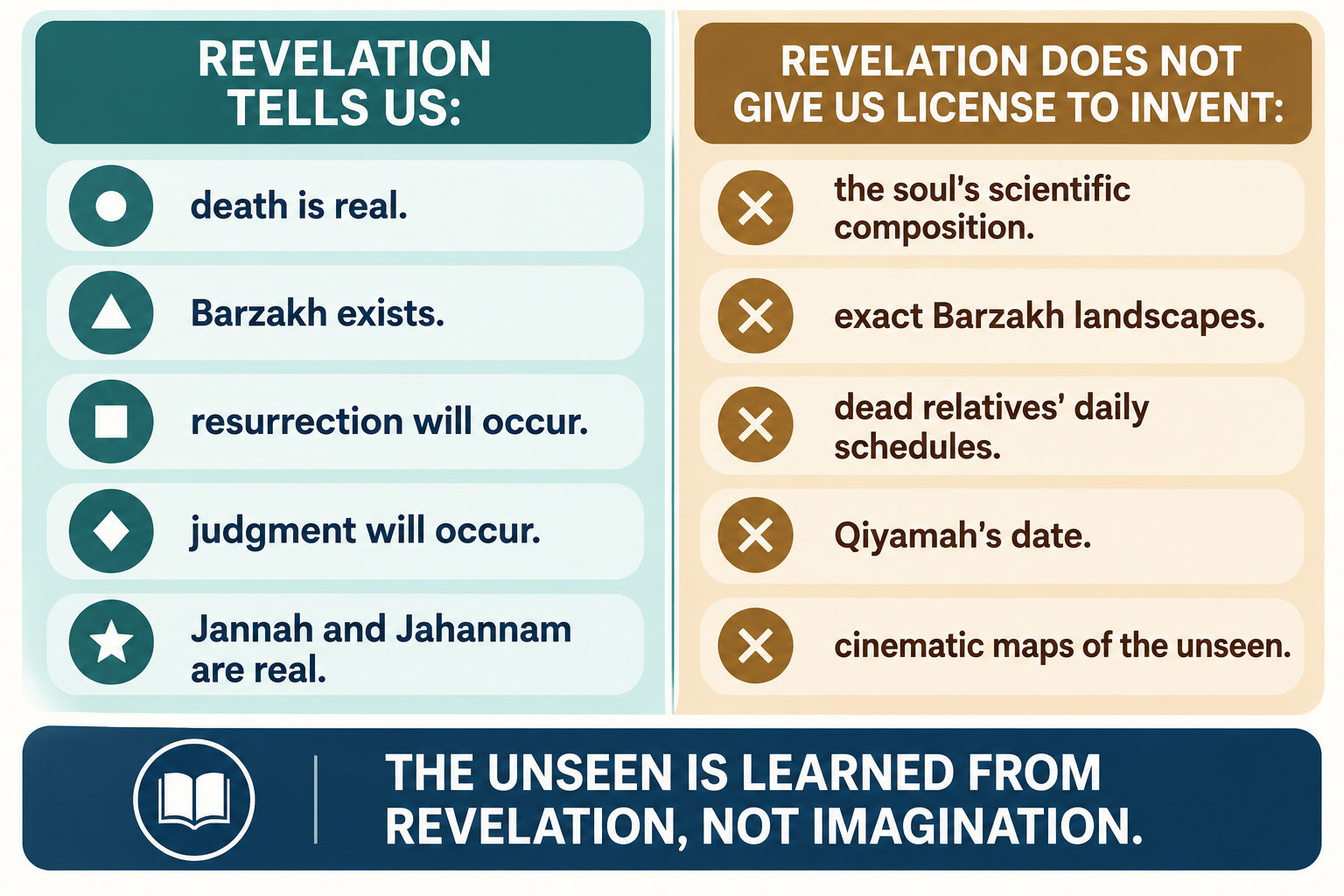
When revelation speaks, explain it carefully. When revelation does not tell us, do not fill the silence with imagination.
Dreams, ghost stories, near-death accounts, films, and viral clips can be moving, but none of them is an independent source of Islamic belief. The unseen is learned from revelation, not imagination.
To keep things honest, this article distinguishes five levels of confidence:
Certain: clearly established by the Quran or Sahih hadith.
Established, details qualified: the reality is established, but the details are limited.
Scholarly difference: recognized scholars differ.
Unverified popular claim: widely repeated, but lacking sound evidence.
Unknown to us: revelation has not told us.
Our sources, in order: the Quran; Sahih al-Bukhari and Sahih Muslim; other authentic or hasan hadith, with grading stated; and established tafsir and Aqidah scholarship.
Before the Journey: Life in Ad-Dunya
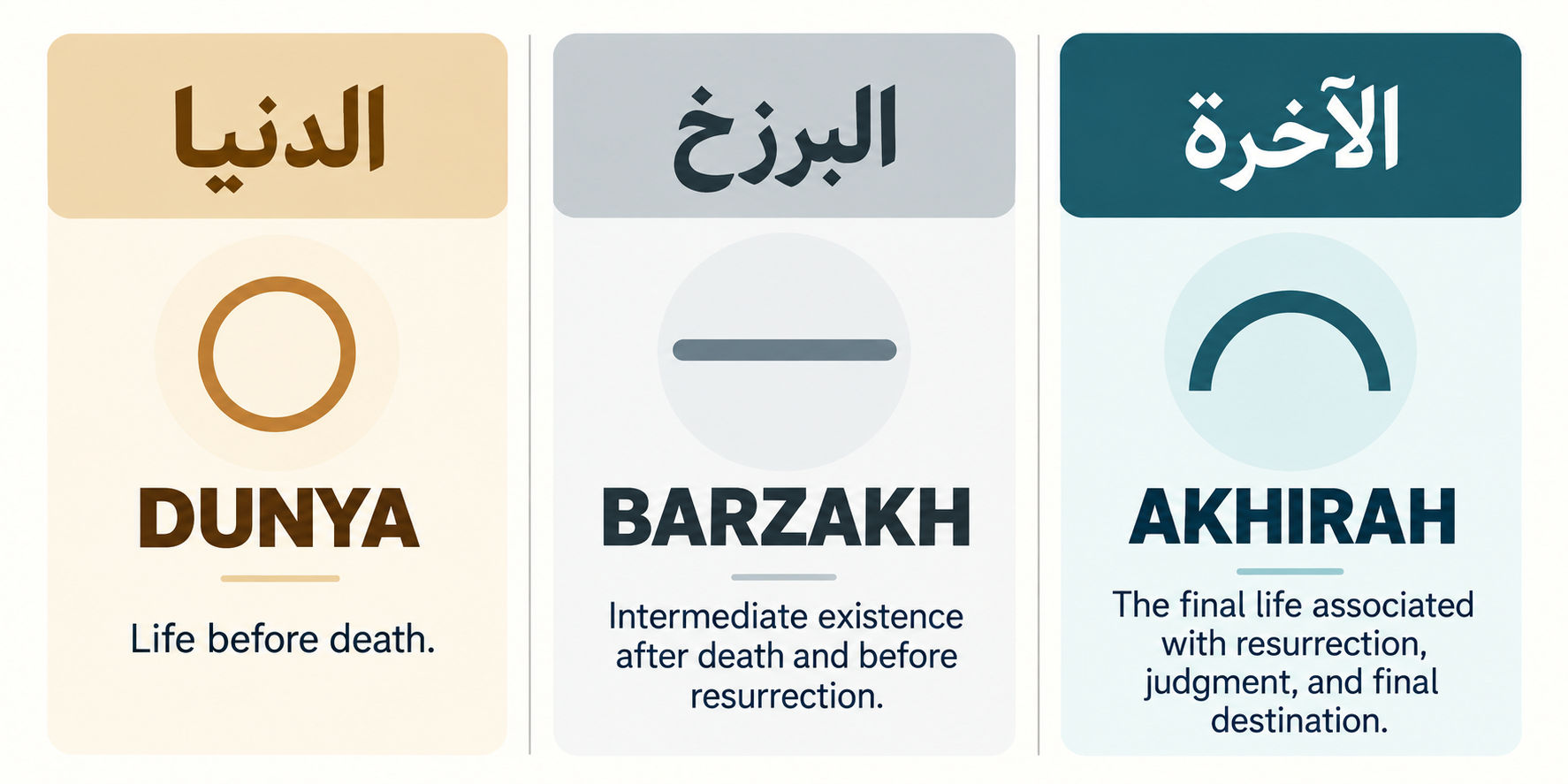
The journey begins before death. The Quran calls this life Ad-Dunya (الدنيا), "the nearer life", and describes it as temporary and as a test: "He who created death and life to test you as to which of you is best in deed" (67:2). Quran 57:20 compares it to rain whose growth delights the farmers and then turns to dry stubble, and 29:57 reminds us that every soul will return to Allah.
This does not make worldly life meaningless. The Quran tells the one who has been given wealth to seek the Hereafter with it, "and do not forget your share of this world" (28:77). Islam does not ask anyone to abandon family, work, health, education, or society. The temporary nature of Dunya changes our priorities. It does not cancel our responsibilities.
"Every Soul Will Taste Death"
The Quran states the universal reality plainly:
كُلُّ نَفْسٍ ذَائِقَةُ الْمَوْتِ ۗ وَإِنَّمَا تُوَفَّوْنَ أُجُورَكُمْ يَوْمَ الْقِيَامَةِ
Kullu nafsin dha'iqatul-mawt; wa innama tuwaffawna ujurakum yawmal-qiyamah. "Every soul will taste death. You will only be given your full recompense on the Day of Resurrection." (Quran 3:185)
"Taste" (dha'iqah) is a Quranic way of saying every soul will personally experience death. Classical commentators such as Ibn Kathir draw from the verse a simple point: no one is exempt, and full recompense is not completed in this world. Rich and poor, powerful and weak, famous and unknown all face the same moment. The same wording appears in 21:35, where life's ease and hardship are described as a test. We do not need to turn the idiom into speculation about what "tasting" feels like.
Does the Soul Continue After Death? Understanding Ar-Ruh
Islam affirms that human existence continues after death. The Quran speaks of the ruh (الروح), usually translated "soul" or "spirit", but it also draws a boundary:
وَيَسْأَلُونَكَ عَنِ الرُّوحِ ۖ قُلِ الرُّوحُ مِنْ أَمْرِ رَبِّي وَمَا أُوتِيتُم مِّنَ الْعِلْمِ إِلَّا قَلِيلًا
"They ask you about the soul. Say: the soul is from the affair of my Lord, and you have been given only little knowledge." (Quran 17:85)
Revelation tells us important things about the soul: it is real, it is taken at death, and existence continues. It does not tell us what the soul is made of, how large it is, or how it relates to the body in detail. So this article makes no claims about the soul's composition, "energy," "frequency," or quantum properties. Such claims have no basis in revelation. Revelation tells us what we need to know, not everything we might want to know.
What Happens at the Moment of Death?
The Quran describes death as an event in which angels are involved. Allah "sends guardians over you until, when death comes to one of you, Our messengers (angels) take him" (6:61). It speaks of angels taking the souls of the righteous in a good state (16:32), and of "the agony of death" (sakrat al-mawt) arriving in truth (50:19). The Prophet ﷺ himself experienced this, saying "There is no god but Allah; indeed death has agonies" (Sahih al-Bukhari 4449). The agony of death is a real part of the human experience. It is not by itself a sign of how Allah views the person.
Malak al-Mawt: The Angel of Death
Quran 32:11 says: "Say: the Angel of Death (Malak al-Mawt) who has been entrusted with you will take you, then to your Lord you will be returned." The Quran and Sahih hadith use the title Malak al-Mawt. The popular name "Azrael" (Izra'il) is not found in the Quran or in Sahih al-Bukhari or Sahih Muslim. It appears in later reports and commentary traditions, and the Quran itself uses a title. So this article uses "the Angel of Death" and does not present "Azrael" as a Quranic fact. This is also a good example of the difference between a title that revelation gives and a name that tradition later popularized.
What About the Detailed Hadith of al-Bara' ibn 'Azib?
A long narration from al-Bara' ibn 'Azib, recorded in Musnad Ahmad and Sunan Abi Dawud, describes the departure of the soul and the questioning in the grave in detail. Many scholars have authenticated it, while a minority have criticized aspects of its chains. For this reason, and because popular retellings often add embellishments, this article does not build on its extended scenes. We rely instead on points independently established in Sahih al-Bukhari and Sahih Muslim, such as the questioning and its link to Quran 14:27, discussed below.
What Is Barzakh?
The Quran names this stage directly. Speaking of those who ask to return after death, it says:
وَمِن وَرَائِهِم بَرْزَخٌ إِلَىٰ يَوْمِ يُبْعَثُونَ
"...and behind them is a barrier (barzakh) until the Day they are resurrected." (Quran 23:100)
Barzakh (البرزخ) means a barrier or partition. In Islamic teaching it refers to the intermediate existence between death and resurrection. Certain: it exists and lasts until resurrection. Unknown to us: its nature beyond what revelation states. Barzakh cannot be observed or tested by experiment, and no one has returned to describe it.
Barzakh is not simply "the grave." The grave (qabr) is where the body is placed, while Barzakh refers to the wider unseen existence that follows death. Scholars discuss the relationship between the two, but we should not collapse them carelessly or invent details about that relationship.
What Happens to the Body?
The body is washed, shrouded, prayed over, and buried, and these steps are covered in guides to Janazah. What matters here is the distinction: the body is buried, while revelation speaks of an unseen post-death existence. We do not speculate about exactly how soul and body are related in Barzakh beyond what established scholarship says. A person whose body is lost at sea, destroyed, or never recovered is not outside Allah's power or the realities of the Hereafter.
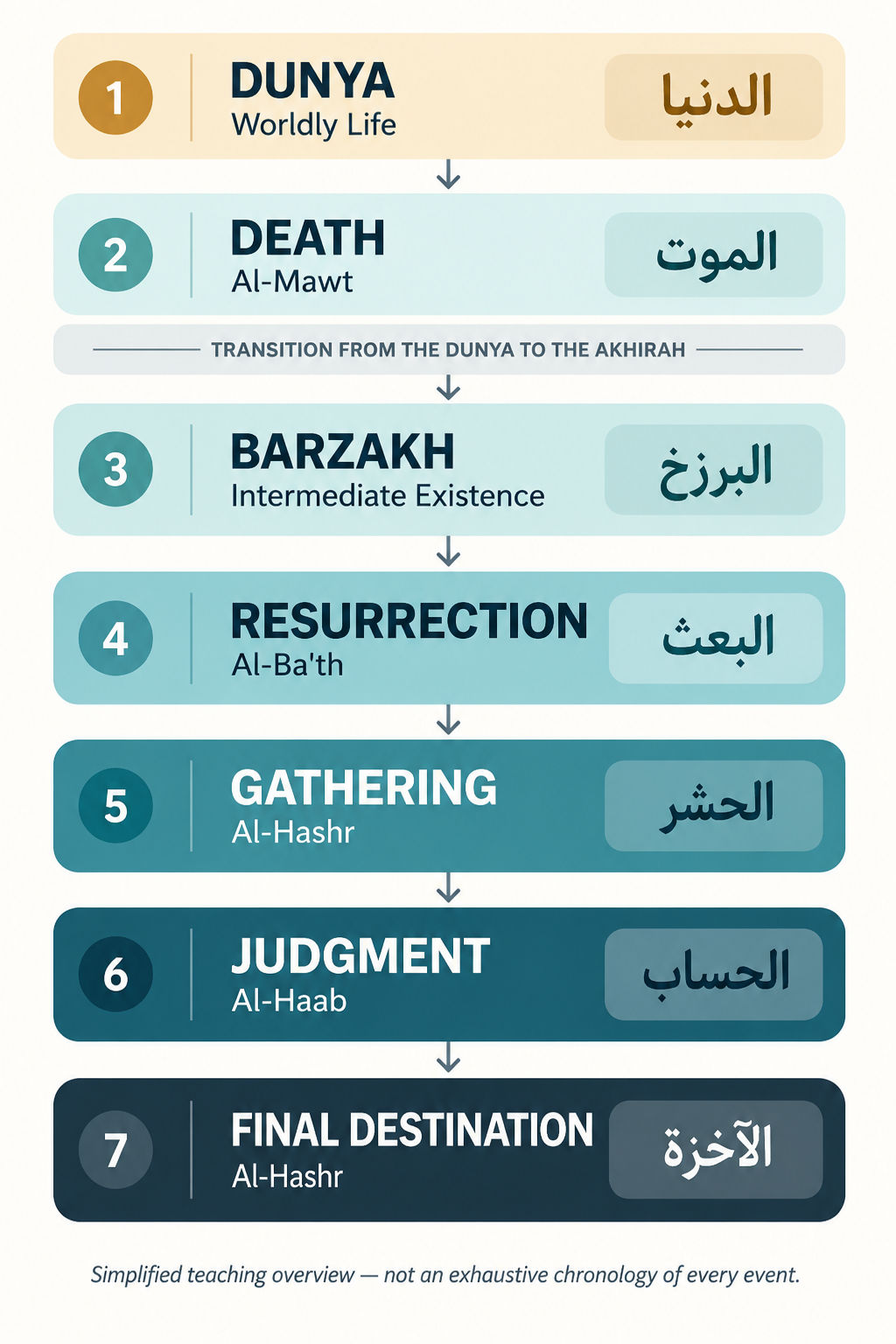
The Islamic Journey at a Glance
Here is a simplified sequence to help beginners hold the whole picture in mind:
Worldly life (Dunya) → Death → Barzakh → Resurrection → Gathering → Judgment and accountability → Final destination
This is a simplified educational overview. Revelation contains additional events and details, and scholars discuss the ordering of some events.
The map is useful, but it is not a complete chronology. Where texts do not settle the order, we should not pretend to.
What Happens in the Grave?
Mainstream Sunni belief affirms three realities connected to the life of Barzakh: questioning, punishment for some, and comfort for others. We discuss only what the evidence establishes.
The Questioning and Munkar and Nakir
Sahih al-Bukhari (1338) and Sahih Muslim (2870) report that when a servant is placed in the grave, two angels come, sit him up, and ask about the Prophet Muhammad ﷺ. The believer testifies that he is Allah's servant and messenger. Another narration links this to Quran 14:27: "Allah keeps firm those who believe with the firm word, in worldly life and in the Hereafter" (Bukhari 1369; Muslim 2871).
The names Munkar and Nakir come from a narration in Jami' at-Tirmidhi (1071), which Tirmidhi graded hasan gharib and which many scholars accept. The Sahih collections speak of "two angels." Other narrations summarize the questions as concerning one's Lord, one's religion, and the Prophet. We do not reproduce dialogue beyond the narrations, and we do not describe the angels' appearance.
After burial the Prophet ﷺ would say: "Ask forgiveness for your brother and ask that he be made firm, for he is now being questioned" (Sunan Abi Dawud 3221, graded authentic by many scholars). This is a practical reminder: the believer's response to the questioning is a matter for supplication, not fear alone.
Is There Punishment in the Grave?
Yes, according to mainstream Sunni belief, based on the Quran and Sunnah. Quran 40:46 says the people of Pharaoh are "exposed to the Fire morning and evening," and Sahih al-Bukhari (218; Muslim 292) reports the Prophet ﷺ passing two graves and saying their occupants were being punished, one for not protecting himself from urine and the other for spreading slander. He also sought refuge in Allah from the punishment of the grave in prayer (Bukhari 1377).
Three guardrails apply. First, the nature of this punishment is unknown to us, so we avoid graphic descriptions. Second, hardship at the time of death is not proof of punishment, as the Prophet's own agony shows. Third, we cannot claim to know the state of any particular deceased person.
Is There Comfort in Barzakh?
Yes. The Prophet ﷺ said that when one of you dies, his place is shown to him morning and evening: if he is among the people of Paradise, he is shown Paradise, and if among the people of the Fire, the Fire (Sahih al-Bukhari 1379; Sahih Muslim 2866). Quran 3:169–170 speaks of those killed in Allah's cause as alive with their Lord and provided for, a statement about a particular group. Many commentators also read Quran 41:30, which speaks of angels reassuring the believers "do not fear and do not grieve", as including the moment of death. Revelation gives us the comfort without a scenic map, and we should not add one.
Questions People Ask About the Dead
Grief makes people ask what the dead can know, see, or do. These questions deserve honest answers, which means stating clearly where revelation speaks and where it is silent.
Can the Dead Hear the Living?
There is no simple universal answer. The Prophet ﷺ said the deceased hears the sound of the mourners' sandals as they walk away (Bukhari 1338). After Badr, he addressed the slain disbelievers and told Umar, "You do not hear what I say better than they do, but they cannot reply" (Bukhari 3976; Muslim 2874). Aisha, however, pointed to Quran 27:80 and 35:22, "you cannot make those in the graves hear." Scholars have reconciled these texts in different ways. A common approach is that the Quranic verses negate benefit and response, while specific narrations establish particular cases of hearing.
So we say: hearing is established in specific reported cases, and we do not conclude that the dead hear everything said to them. This question cannot justify practices that have no basis in Islamic teaching, such as calling on the dead for help. The Prophet ﷺ taught visitors to greet the people of the graves and pray for them (Sahih Muslim 975). The emphasis is on supplicating for them.
Can Dead Relatives See What We Are Doing?
Viral posts claim that your mother watches you every Friday or that your parents see everything you do. Authentic evidence does not establish such claims. A few weak reports speak of deeds being shown to relatives, and they cannot carry a matter of Aqidah. Unknown to us: what the dead know of this world beyond what revelation states. Emotional comfort is valid, but it is not a source of doctrine.
Do Souls Return Home on Thursdays, Fridays, in Ramadan, or After 40 Days?
These customs exist in many cultures, but they have no basis in the Quran or authentic Sunnah. Cultural traditions are not automatically Islamic doctrine. What is established is simple: make dua, give charity, and live well.
Do the Dead Visit Us in Dreams?
A dream can be emotionally meaningful, and the Prophet ﷺ taught that true dreams are good tidings (Sahih al-Bukhari 6983). But a dream is not an independent source for establishing Islamic doctrine about the dead. We cannot assume every dream of a deceased person is a real visit, and we do not dismiss them as meaningless either. A comforting dream can move us to pray for the person. It cannot tell us their final state.
What About Near-Death Experiences?
People report lights, tunnels, leaving the body, or meeting relatives. These accounts are of interest, but they cannot establish or override Islamic belief. Those who return from a near-death event did not complete death, so these reports do not reveal Barzakh, and Islam does not need them as proof.
Can We Communicate with the Dead?
Mediums, séances, spirit boards, and psychics claim to contact the dead. Islam directs us away from them. Allah alone has knowledge of the unseen (27:65), and the Prophet ﷺ warned against going to diviners and believing them (Sahih Muslim 2230). We do not describe methods. The legitimate relationship with the deceased is dua for them, not attempts to summon them.
What Can Benefit Someone After Death?
The Prophet ﷺ said: "When a person dies, his deeds come to an end except for three: ongoing charity (sadaqah jariyah), knowledge from which people benefit, or a righteous child who prays for him" (Sahih Muslim 1631). Other acts benefit the deceased too, according to recognized scholarship.
Does Dua Benefit the Deceased?
Yes. The Quran describes believers who say, "Our Lord, forgive us and our brothers who preceded us in faith" (59:10). The funeral supplication reported in Sahih Muslim (963) includes: Allahumma-ghfir lahu warhamhu wa 'afihi wa'fu 'anhu (اللَّهُمَّ اغْفِرْ لَهُ وَارْحَمْهُ وَعَافِهِ وَاعْفُ عَنْهُ), "O Allah, forgive him, have mercy on him, give him well-being, and pardon him." We make dua sincerely, without inventing formulas that promise guaranteed results.
Can I Give Charity on Behalf of Someone Who Died?
Yes. A man told the Prophet ﷺ that his mother had died suddenly and asked if she would be rewarded if he gave charity for her. The Prophet ﷺ said yes (Bukhari 1388; Muslim 1004). We do not promise a specific amount of reward. The reward is Allah's to give. Scholars also discuss fasting owed by the deceased (Bukhari 1952) and Hajj on someone's behalf (Bukhari 1513).
What About Quran Recitation for the Deceased?
This is a matter of recognized scholarly difference. Some scholars, citing "man will have only what he strives for" (53:39), hold that the reward of recitation does not reach the deceased. Others, including many later jurists and Ibn Taymiyyah in his fatwas, hold that it can benefit them. We present both and avoid turning this into sectarian argument. Everyone agrees on dua and charity.
When Will the Day of Judgment Happen?
Human beings do not know. Quran 7:187 says the knowledge of the Hour is with Allah alone. Quran 31:34 lists it among the matters of the unseen with Him, and 33:63 repeats that its knowledge is with Allah. In the hadith of Jibril, when the Prophet ﷺ was asked about the Hour, he replied, "The one asked knows no more than the one asking" (Sahih Muslim 8). Quran 79:42–45 shows that the Prophet's role was to warn, not to announce a date.
No One Can Calculate Qiyamah
Numerology, "Quran codes," eclipse calculations, viral year predictions, and Hadith arithmetic do not have a scholarly basis. If Allah did not give the date to the Prophet ﷺ, no calculation can claim it.
What About the Signs?
The Prophet ﷺ taught that there are minor and major signs. Among the major signs, Sahih Muslim (2901) mentions the smoke, the Dajjal, the beast, the sun rising from the west, the descent of Isa son of Maryam, Gog and Magog, and landslides. The signs are a reminder, not a license to invent a date or to call every news event a sign. Each should be verified independently, and this deserves its own dedicated article.
The Trumpet and Resurrection
The Trumpet (As-Sur)
As-Sur (الصُّور) is the trumpet or horn mentioned in the Quran, for example: "And the trumpet will be blown, and whoever is in the heavens and earth will fall unconscious, except whom Allah wills. Then it will be blown again, and at once they will be standing, looking on" (39:68). See also 36:51 and 69:13.
Who blows it? The Quran does not name the angel. Israfil is named as an angel in Sahih Muslim (770), in the Prophet's night prayer supplication. The identification of Israfil as the one who blows the trumpet is widely accepted by scholars, but it rests on narrations of varying strength rather than on the Quran's text.
How many blasts? Quran 39:68 clearly mentions two. Some scholars, relying on a longer narration of disputed strength, speak of three. We state what is safe: the Quran speaks of a blast causing unconsciousness and another causing resurrection. The Prophet ﷺ said there would be forty between the two blasts, and Abu Hurayrah declined to specify forty what (Bukhari 4814). We should do the same.
Resurrection (Al-Ba'th)
Al-Ba'th (البعث) is resurrection. Islam teaches real bodily resurrection. It is not "our memories living on," a metaphor, or the soul merging into universal energy. Quran 36:78–79 records a man asking who can revive decayed bones, and the answer is: "He who produced them the first time, and He is All-Knowing of every creation." Quran 75:3–4 says Allah is able even to restore the fingertips. See also 22:5–7, 50:15, and 64:7.
Why Does the Quran Argue for Resurrection?
The Quran does not only command belief. It argues. The One who created from nothing can re-create (36:79). The dead earth revived by rain is a sign of how Allah gives life (22:5–6). Both arguments appeal to what a person has already seen and ask him to reason from it. Tafsir works such as Ibn Kathir's draw out these links between creation and resurrection.
The Gathering and the Changed Earth
Al-Hashr (الحشر) is the gathering of humanity. The Prophet ﷺ said people will be gathered barefoot, unclothed, and uncircumcised. Aisha asked whether men and women would then look at one another, and he said the matter would be too severe for anyone to pay attention to that (Bukhari 6527; Muslim 2859). The hadith conveys the intensity of the Day. It is not meant to dwell on nakedness.
The Quran also says the earth will be transformed: "the Day the earth is replaced by another earth, and the heavens" (14:48). See 20:105–107, 84:3–5, and Surah 99. We do not attempt scientific models of these events, because revelation does not give us a model to work with.
The Day of Judgment: Accountability (Al-Hisab)
The Quran uses several names for the Last Day, including Yawm al-Qiyamah (يوم القيامة), "the Day of Resurrection" (75:1); Al-Yawm al-Akhir (اليوم الآخر), "the Last Day"; Yawm al-Din, "the Day of Recompense" (1:4); and Yawm al-Hisab (يوم الحساب), "the Day of Reckoning" (38:16). The names emphasize different aspects of one reality.
How long is it? Quran 70:4 speaks of a day whose measure is fifty thousand years, and 32:5 mentions a day of a thousand years. Commentators discuss what these refer to, and they do not convert it into earthly clock mathematics. We should not either.
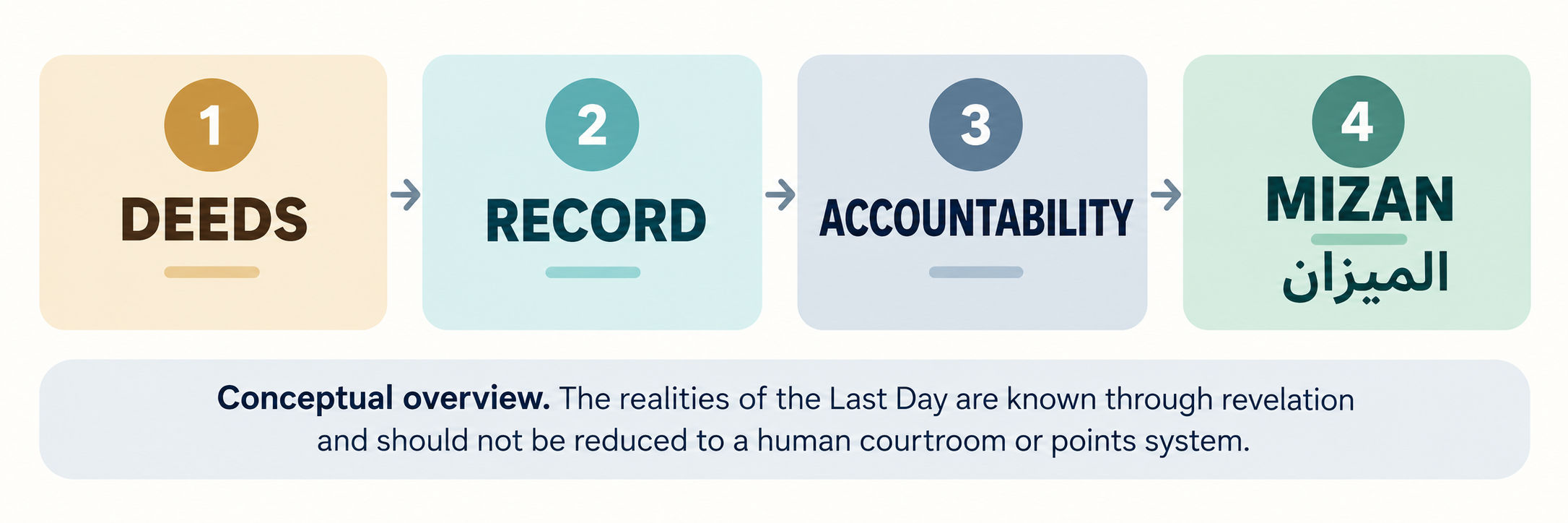
Accountability covers faith, deeds, and responsibilities, and it combines perfect justice with Divine mercy. It is not a simple points system. The Prophet ﷺ said, "No one's deeds will save him." The Companions asked, "Not even you?" He said, "Not even me, unless Allah envelops me with His mercy" (Sahih al-Bukhari 5673; Muslim 2816). He also said that for the believer, reckoning is a presentation of deeds, and whoever is examined in detail is punished (Bukhari 103). Another narration says Allah brings the believer close and, after he acknowledges his sins, says, "I concealed them for you in the world, and today I forgive them" (Bukhari 2441; Muslim 2768).
The Record of Deeds
The Quran says every person's deeds are recorded: "And We have fastened every human's deed to his neck, and We will bring out for him on the Day of Resurrection a record which he will find spread open" (17:13). In 18:49 the sinners are alarmed that nothing, small or great, has been left out. Quran 69:19–37 and 84:7–12 describe the one given his record in his right hand, who will have an easy reckoning, and the one given it behind his back or in his left hand. We take these as the Quran describes them and add no visual detail.
The Scales (Al-Mizan)
Al-Mizan (الميزان) is the scale. Quran 21:47 says: "We will set up the just scales for the Day of Resurrection, so no soul will be wronged at all." See also 7:8–9 and 23:102–103. Scholars differ on exactly what is weighed: deeds, records, or the people themselves. We do not settle that disagreement.
Does Allah need a scale to know our deeds? No. Allah already knows everything. The scales belong to the reality of Divine justice. They do not give Allah new information.
Will Our Body Parts Testify?
Yes. The Quran says: "That Day We will seal their mouths, and their hands will speak to Us and their feet will testify" (36:65; also 24:24 and 41:20–21). The point is that nothing can be hidden and no excuse can be manufactured. Other forms of testimony are mentioned too, such as a witness from every nation (4:41). We do not invent courtroom dialogue.
What Happens to Wrongs Between People?
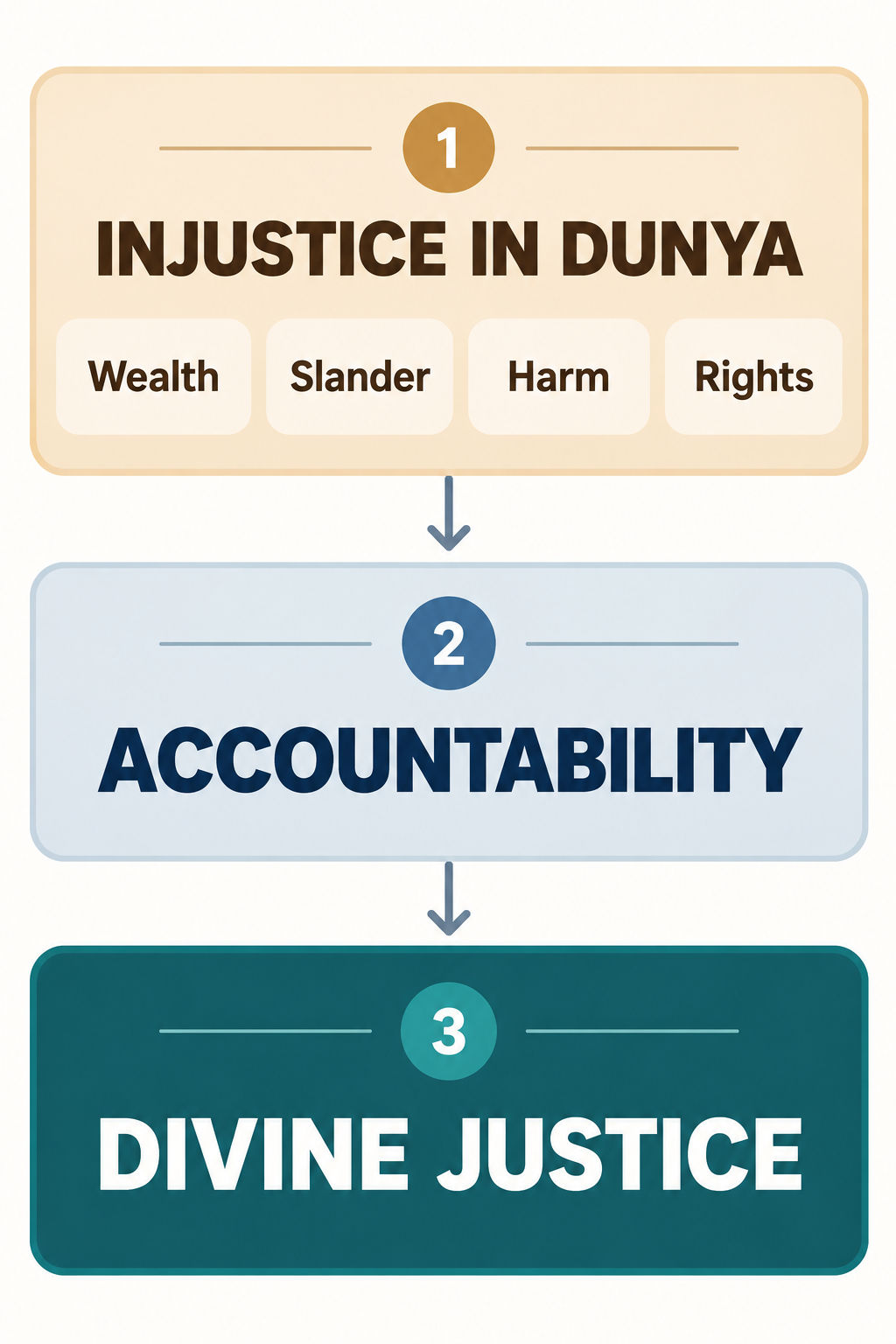
This is one of the most practical sections in the article. The Prophet ﷺ asked the Companions, "Do you know who the bankrupt person is?" They said it is someone without money or goods. He said:
"The bankrupt of my Ummah is one who comes on the Day of Resurrection with prayer, fasting, and zakat, but has insulted this one, slandered that one, consumed the wealth of another, shed the blood of another, and struck another. Each will be given from his good deeds. If his good deeds run out before the claims are settled, some of their sins will be taken and thrown on him, and then he will be thrown into the Fire." (Sahih Muslim 2581)
Worship does not give anyone permission to mistreat people. Insults, slander, stolen wealth, violence, and injustice are matters of Huquq al-'Ibad, the rights of people.
The Prophet ﷺ also said: "Whoever has wronged his brother regarding his honor or anything else, let him seek release from it today, before there is neither dinar nor dirham" (Sahih al-Bukhari 2449).
In practice, this means returning what you took, repaying debts, apologizing where appropriate, correcting injustice, and stopping the harm. Complex cases need care. Confessing every hidden wrong to the people involved may sometimes create new harm, and scholars give different guidance depending on the situation. For complicated restitution, consult a qualified scholar.
Debts. The Prophet ﷺ said that the martyr is forgiven everything except debt (Sahih Muslim 1886). This shows how seriously Islam takes owed money. Document debts, repay them, and plan your estate responsibly. This is not legal or financial advice. Seek qualified help for specific cases.
Justice among creation. The Prophet ﷺ said: "You will surely render the rights to those who are owed them on the Day of Resurrection, until the hornless sheep is given justice against the horned sheep" (Sahih Muslim 2582).
What happens to animals? Quran 6:38 says animals are communities like us and "then to their Lord they will be gathered." Quran 81:5 says wild animals will be gathered. Some commentators say that after retribution animals become dust, but this is not firmly established by sound text. We therefore do not make claims about particular pets in either direction, and we leave their affair to Allah's wisdom and justice.
Intercession, the Hawd, and the Sirat
Intercession (Ash-Shafa'ah)
Ash-Shafa'ah (الشفاعة) is intercession. It occurs only by Allah's permission: "Who is there that can intercede with Him except by His permission?" (2:255; also 20:109 and 34:23). Nobody can override Allah. The Prophet ﷺ has the greatest intercession on the Day of Resurrection (Bukhari 4712), and also intercession for people of major sins in his Ummah. Scholars also mention others who may intercede with permission, such as prophets, angels, and believers (Bukhari 7439). It does not mean "just call yourself Muslim and deeds don't matter." Allah is the one who permits it, and to whom.
The Prophet's Basin (Al-Hawd)
The Prophet ﷺ spoke of a basin whose water is whiter than milk and sweeter in scent than musk, with cups like the stars of the sky, and whoever drinks from it will never thirst (Bukhari 6579; Muslim 2292). He also warned that some will be turned away from it. We keep to these descriptions.
The Sirat
Mainstream belief affirms a bridge, the Sirat, set over Jahannam. Sahih al-Bukhari (7439) and Sahih Muslim (183) describe people crossing according to their deeds, some like the blink of an eye and others like wind, birds, or fast horses. Some are saved, some are scratched and released, and some fall into the Fire. The famous phrase "thinner than a hair and sharper than a sword" appears in Sahih Muslim in the form of a report that reached the narrator, not as a clear direct statement of the Prophet ﷺ, and scholars treat it with caution. Therefore this article does not repeat it as a description. The Sirat is not an action scene. We say what the texts say.
The Final Destination
What Is Jannah?
Al-Jannah (الجنة), Paradise, is the final abode of reward, peace, and life without death or suffering. A caller will say to its people: "You will live and never die" (Sahih Muslim 2837). Quran 9:72 says Allah's pleasure (ridwan) is "greater" than the gardens themselves. According to mainstream Sunni belief, the believers will see their Lord (75:22–23; Bukhari 554). Jannah is not merely luxury.
Allah said: "I have prepared for My righteous servants what no eye has seen, no ear has heard, and no human heart has imagined" (Sahih al-Bukhari 3244; Muslim 2824). Quran 32:17 says no soul knows what is hidden for them of joy. The revealed descriptions are real, but the full reality exceeds worldly experience.
Gates and levels are not the same thing. The Prophet ﷺ spoke of eight gates of Jannah (Bukhari 3257), and one of them is named Ar-Rayyan for those who fast (Bukhari 1896). Separately, he spoke of a hundred degrees in Jannah, with Al-Firdaws the highest (Bukhari 2790). Many viral diagrams of "8 levels of Jannah" or lists of gate names are not supported by authentic evidence, and we do not reproduce them.
What Is Jahannam?
Jahannam (جهنم), Hell, is described in the Quran as a place of justice and consequence for those who rejected the truth and persisted in wrongdoing. The Quran warns of it so that people avoid it. Quran 15:44 says it has seven gates, "for each gate is a portion assigned." Quran 4:145 mentions "the lowest depths" of the Fire, which indicates degrees. But viral charts of "seven levels with exact names and assigned groups" are not established by sound text. The Quran uses several names for the Fire, but that does not give us an ordered taxonomy. We focus on warning and justice, not entertainment.
Is Hell Eternal?
Mainstream Sunni belief distinguishes two groups. Those who die in disbelief are in the Fire eternally (4:169; 98:6). Believing sinners may be forgiven or punished, but they are not eternal residents. The Prophet ﷺ said that those with even an atom's weight of faith in their hearts will eventually be brought out (Bukhari 7439). We make no declarations about any specific person.
Justice, Mercy, and the Sinful Muslim
Justice and mercy are not competing attributes. Quran 4:40 says Allah does not wrong even an atom's weight, and 99:7–8 says whoever does an atom's weight of good will see it and whoever does an atom's weight of evil will see it. The Prophet ﷺ also said that Allah's mercy prevails over His wrath (Bukhari 3194).
Can a sinful Muslim enter Jannah? A person who dies with Tawhid may be forgiven, may be punished and later admitted, or may be helped by intercession, all by Allah's will (see 4:48). This is no license to sin, because deeds matter. It is no reason for despair either. Major sins are not automatically disbelief, and mercy does not make deeds irrelevant.
Quran 39:53 says:
قُلْ يَا عِبَادِيَ الَّذِينَ أَسْرَفُوا عَلَىٰ أَنفُسِهِمْ لَا تَقْنَطُوا مِن رَّحْمَةِ اللَّهِ ۚ إِنَّ اللَّهَ يَغْفِرُ الذُّنُوبَ جَمِيعًا
"Say: O My servants who have transgressed against themselves, do not despair of Allah's mercy. Indeed, Allah forgives all sins." Those who repent sincerely should never be told their sins are too great for Allah.
Repentance Before Death
Tawbah is accepted until the final moment. The Prophet ﷺ said Allah accepts the servant's repentance as long as he has not reached the death rattle (ghargharah) (Jami' at-Tirmidhi 3537, hasan). Quran 4:17–18 shows repentance is not accepted when someone waits until death is present. This is not a loophole for postponement. No one knows when death will come, so do not delay: repent, restore people's rights, pray, correct harmful habits, and return to Allah.
Hard Questions About Individuals
What Happens to Children Who Die?
Scholars hold that children of Muslims who die before maturity are in Paradise, and the Prophet ﷺ gave glad tidings to parents who lose children with patience (Bukhari 1248; Muslim 2632). For the children of non-Muslims, scholars discuss different views, and when the Prophet ﷺ was asked, he said, "Allah knows best what they would have done" (Bukhari 1385). Many scholars hold the hope of Paradise for them, based on the vision of children in Ibrahim's care (Bukhari 7047). To grieving parents, we offer compassion and trust in Allah's mercy and justice.
What About People Who Never Heard of Islam?
Quran 17:15 says: "We never punish until We have sent a messenger." Scholars discuss Ahl al-Fatrah, those unreached by a clear message. A narration in Musnad Ahmad, authenticated by a number of scholars, says some such people will be tested on the Day of Resurrection. We do not say "everyone who never heard goes to Paradise" or "everyone goes to Hell." Allah judges with perfect justice.
What About Non-Muslims After Death?
The general teaching is that faith, accountability, and the message matter (3:85; Muslim 153). But general doctrine is different from judging a particular person's final destination, which we cannot know. We speak without polemic or triumphalism, with respect for human dignity.
Can We Say a Specific Person Is in Jannah or Jahannam?
Specific certainty requires revelation, such as the Companions given glad tidings of Paradise (Tirmidhi 3747). For everyone else we hope for the righteous and fear for ourselves. When Umm al-'Ala said of Uthman ibn Maz'un, "May Allah honor you", the Prophet ﷺ replied, "How do you know? By Allah, I am the Messenger of Allah and I do not know what will be done with me" (Bukhari 1243). So we do not turn funerals into guarantees, a crowd into proof of Paradise, or declare anyone damned.
What About Suicide?
Suicide is a grave sin, and the Prophet ﷺ warned against it (Bukhari 3463; Muslim 109). But a Muslim who dies this way is not automatically outside Islam, and final judgment belongs to Allah. Funeral and legal questions should be referred to a scholar. If you or someone you know is struggling, please reach out right now to local emergency services, a crisis line, or someone you trust. Mental-health crises deserve immediate support, and no one should be left to face them alone.
Death and Grief
Belief in the Hereafter does not mean Muslims do not grieve. When the Prophet ﷺ's son Ibrahim died, his eyes shed tears and he said: "The eyes shed tears and the heart grieves, and we say only what pleases our Lord. O Ibrahim, we are saddened by your parting" (Sahih al-Bukhari 1303; Muslim 2315). Tears are not weak faith. He also said that Allah does not punish for the tears of the eye or the sorrow of the heart, but He may punish or show mercy because of what is said on the tongue (Bukhari 1304). Wailing and acts of despair such as slapping the cheeks and tearing clothes are prohibited (Bukhari 1294). We should not shame the grieving, and we should not present stoicism as the standard.
What should you say? Quran 2:156 describes those who face hardship:
إِنَّا لِلَّهِ وَإِنَّا إِلَيْهِ رَاجِعُونَ
Inna lillahi wa inna ilayhi raji'un. "Indeed, we belong to Allah, and indeed to Him we will return." It is not just a condolence phrase. It states ownership, return, and trust. The Prophet ﷺ taught Umm Salamah to add, "O Allah, reward me in my calamity and replace it with something better" (Sahih Muslim 918).
How Belief in the Hereafter Changes Daily Life
Belief in the Hereafter does not make worldly life worthless. It makes worldly choices meaningful. A Muslim works, learns, loves family, helps people, builds beneficial things, and enjoys lawful blessings, while remembering accountability. The Prophet ﷺ is reported to have said that if the Hour is established while one of you holds a sapling, he should plant it if he can (Musnad Ahmad, authenticated by many scholars).
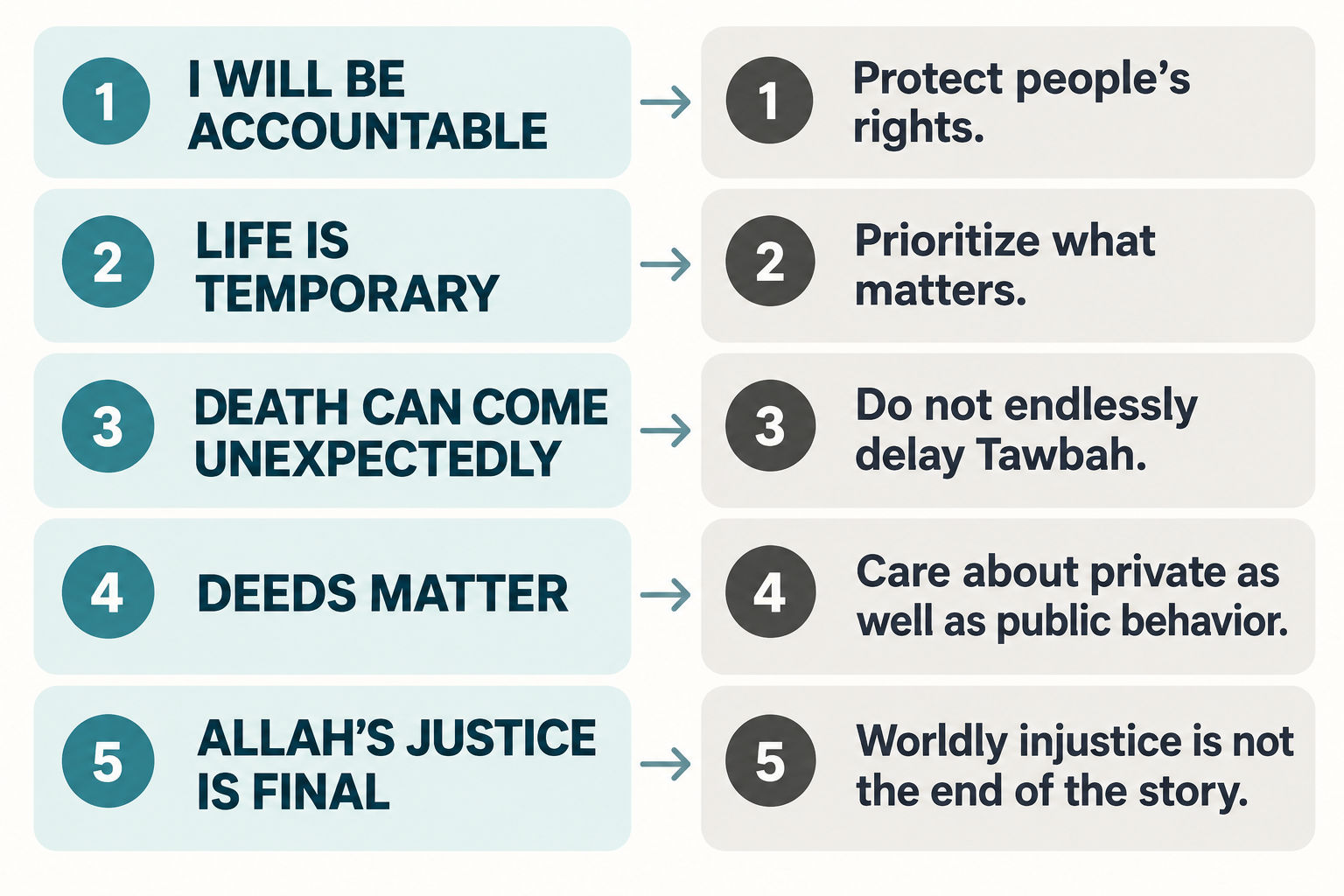
Belief | Daily effect |
|---|---|
My deeds are recorded. | I care about what I do privately. |
People's rights matter. | I avoid injustice and repay debts. |
Death can come unexpectedly. | I do not endlessly delay Tawbah. |
Worldly hardship is not the final chapter. | I try to keep hope and patience. |
Allah judges perfectly. | I do not assume any injustice escapes accountability. |
These are intended effects of belief, not guaranteed psychological outcomes.
Hidden Deeds, Injustice, and Hope
If deeds matter beyond public reputation, then private worship, secret charity (2:271), and unseen wrongdoing all matter. This is not surveillance-style fear. It is the awareness that sincerity is known to Allah.
Belief in ultimate justice also means human courts are not the final court. But this does not tell victims to do nothing and wait for the Hereafter. Islam does not eliminate the legitimate pursuit of justice in this life.
For the person who regrets their sins, has repented, feels spiritually behind, or has recently returned to Islam or converted, the message is hope. The Prophet ﷺ said, "None of you should die except thinking well of Allah" (Sahih Muslim 2877). We cannot promise Paradise to any individual, and we can point to Allah's mercy as the Quran and Sunnah describe it.
Fear, Hope, and Love
Worship is not fear of Hell alone, nor hope of Paradise alone. The Quran describes believers who call upon Allah "in hope and fear" (21:90), who fear the Hereafter and hope for their Lord's mercy (39:9), and whom Allah loves and who love Him (5:54). A healthy faith holds love, hope, fear, gratitude, and submission together.
Remembering Death Without Becoming Morbid
The Prophet ﷺ said: "Remember often the destroyer of pleasures," meaning death (Jami' at-Tirmidhi 2307, authenticated by many scholars). The purpose is perspective, not terror. It is not about obsessively monitoring death or constant speculation.
Is "live every day as if it is your last" a hadith? Not in that wording. The closest authentic text is the Prophet ﷺ saying, "Be in this world as if you were a stranger or a traveler" (Bukhari 6416). The advice about not waiting for the morning in the evening is Ibn Umar's own addition in that report. The popular line "Work for your Dunya as if you will live forever and for your Akhirah as if you will die tomorrow" is not an established hadith.
A Simplified Map of the Islamic Hereafter
Dunya: worldly life
Death
Barzakh
Resurrection
Gathering
Accountability and judgment
Events of the Last Day
Final destination
This is a simplified teaching map, not a claim that every detailed event has been placed into an undisputed exhaustive chronology.
What We Know and What We Should Not Invent
Question | What revelation establishes | What we should not claim |
|---|---|---|
Do humans continue after death? | Yes. Revelation establishes post-death existence. | Do not invent scientific mechanics of the soul. |
Is there Barzakh? | Yes. | Do not pretend we can observe it experimentally. |
Will resurrection occur? | Yes, real resurrection. | Do not reduce it to metaphor. |
When is Qiyamah? | Allah has not given humanity the date. | Do not calculate one. |
Can dead relatives watch everything we do? | No general claim is established. | Do not turn emotional stories into doctrine. |
Is there questioning in the grave? | Yes, in authentic hadith. | Do not invent dialogue or appearances. |
Are the scales real? | Yes, in the Quran. | Do not reduce them to a points system. |
The principle behind the table is simple: the unseen is learned from revelation, not imagination.
Common Myths About Death in Islam
"The Angel of Death is named Azrael in the Quran." The Quran uses the title Malak al-Mawt. The name is not in the Quran or the Sahih collections.
"The soul stays in the house for 40 days." No sound evidence supports this.
"Dead relatives visit every Friday." Not established by authentic evidence.
"Every dream about a deceased person is their soul visiting." Dreams do not establish doctrine.
"Near-death experiences prove what Barzakh looks like." They cannot establish Islamic belief.
"A dead relative can see everything you do." No general claim is established.
"Islam tells us the date of Judgment Day." It does not. Knowledge of the Hour is with Allah.
"Scientists can calculate Qiyamah." No calculation is valid.
"The Sirat is described by every popular phrase online." Several viral phrases are not established descriptions.
"Every diagram of the seven levels of Hell is Quranic." The Quran mentions seven gates (15:44). The viral charts are not established.
"Every gate or level name of Jannah online is authentic." Verify each one.
"If someone suffers while dying, Allah is punishing them." The Prophet ﷺ experienced the agonies of death.
"Grief means weak faith." The Prophet ﷺ wept for his son.
"A sinful Muslim is automatically outside Islam." Major sins are serious, but not automatic disbelief.
"Thinking about the Hereafter means abandoning worldly responsibilities." The Quran says do not forget your share of this world (28:77).
Arabic Vocabulary of the Hereafter
Arabic | Transliteration | Meaning |
|---|---|---|
الدنيا | Ad-Dunya | Worldly life |
الموت | Al-Mawt | Death |
الروح | Ar-Ruh | Soul, spirit |
البرزخ | Al-Barzakh | Barrier, intermediate existence |
البعث | Al-Ba'th | Resurrection |
الحشر | Al-Hashr | Gathering |
القيامة | Al-Qiyamah | The Day of Resurrection |
الحساب | Al-Hisab | Reckoning |
الميزان | Al-Mizan | Scale |
الشفاعة | Ash-Shafa'ah | Intercession |
الجنة | Al-Jannah | Paradise |
جهنم | Jahannam | Hell |
الآخرة | Al-Akhirah | The Hereafter |
Quranic Arabic and the Language of the Hereafter
Readers meet these words again and again in the Quran: akhirah, mawt, ba'th, hisab, jannah, nar. Learning Quranic Arabic helps you recognize recurring concepts directly. It does not replace Tafsir, and a vocabulary list is not a theology. It simply helps you read with understanding.
Learning the Hereafter Properly with Araby Academy
At Araby Academy, students study the Quran, Tajweed, Quranic Arabic, Arabic for non-native speakers, and Islamic Studies, including one-to-one lessons. Words such as Akhirah, Qiyamah, Jannah, and Hisab appear hundreds of times across Islamic learning. Systematic study can move you beyond fragmented social-media information.
Questions about the unseen deserve more than viral clips. They deserve careful study of the Quran, authentic Sunnah, and reliable Islamic scholarship.
Related reading: What Is Qadr in Islam?, Why Does Allah Test Us?and The 5 Daily Prayers Explained.
Death Is Not the End of the Story
So, what happens after we die? Islam teaches that worldly life ends in death. Death is followed by Barzakh. Humanity will be resurrected and gathered, and Allah will judge with perfect knowledge and justice. Deeds matter. People's rights matter. Repentance matters. Mercy matters. The final life is not this one.
The purpose of learning about the Hereafter is not to become obsessed with reconstructing the unseen. It is to live differently because the Hereafter is real. This article does not teach how to die. It asks why belief in death should help us learn how to live.
Islam gives us enough knowledge of the Hereafter to prepare for it, but not permission to invent the parts Allah has kept unseen.
For non-Arabic-speaking Muslims, studying the Quran, Quranic Arabic, and Islamic Studies can make words such as Dunya, Barzakh, Ba'th, Hisab, Akhirah, Jannah, and Jahannam more than unfamiliar religious vocabulary. They become recurring Quranic concepts that shape how a Muslim understands life itself.
Frequently Asked Questions
1. What happens immediately after death in Islam? The soul is taken by angels, and the person enters Barzakh, an unseen existence lasting until resurrection. Details beyond revelation are unknown to us.
2. What happens to the soul after death in Islam? It continues to exist. The Quran says knowledge of the soul is limited (17:85), so we do not describe its nature.
3. What is Barzakh? The barrier or intermediate existence between death and resurrection (23:100).
4. What happens in the grave in Islam? Authentic hadith describe questioning, and comfort or punishment, without giving a full picture.
5. Who are Munkar and Nakir? The names come from a hasan narration in Tirmidhi. Sahih hadith speak of two angels.
6. Is there punishment in the grave? Mainstream Sunni belief affirms it based on Quran 40:46 and authentic hadith. Its nature is unknown to us.
7. Can dead people hear us? Hearing is established in specific reported cases. We do not conclude that the dead hear everything.
8. Can dead relatives see us? No general claim is established by authentic evidence.
9. Do souls return home after death? No sound evidence supports returns on set days or after 40 days.
10. Can the dead visit us in dreams? Dreams can be meaningful, but they do not establish doctrine about the dead.
11. Can Dua benefit someone who has died? Yes (59:10; Muslim 963).
12. Can charity benefit the deceased? Yes (Bukhari 1388; Muslim 1004).
13. When will the Day of Judgment happen? Only Allah knows (7:187).
14. What happens during resurrection? People are bodily resurrected and gathered (36:78–79; 36:51).
15. What are the scales on Judgment Day? Al-Mizan represents Divine justice (21:47). Scholars differ on exactly what is weighed.
16. What is the Sirat? A bridge over Jahannam described in Sahih hadith (Bukhari 7439). Crossing varies by deeds.
17. What is intercession in Islam? Intercession occurs only with Allah's permission (2:255).
18. What is Jannah? The abode of reward and peace, whose full reality exceeds our imagination (32:17).
19. What is Jahannam? The Fire, a place of justice and consequence, described in the Quran as a warning.
20. How should belief in the Hereafter change a Muslim's life? By encouraging repentance, protecting people's rights, sincere worship, hope in Allah's mercy, and responsible living.