
Read the Quran slowly and Musa عليه السلام keeps appearing in very different conditions. He is an infant placed on the water. A frightened young man slipping out of a city. A traveler with nothing, resting in the shade. A Prophet standing before a fire in the dark. A man asking Allah to open his chest. A Messenger facing one of history's great symbols of tyranny. A leader guiding a difficult community. A student who discovers the limits of his own knowledge.
Why does the Quran return to Musa so often? Because his story carries many of its central themes: tawhid, tyranny, fear, dua, repentance, qadr, leadership, patience, knowledge, arrogance, freedom, gratitude, human weakness, and divine power. The story of Prophet Musa is not simply a Prophet defeating a tyrant. It shows how Allah prepares, corrects, strengthens, teaches, and guides a servant through fear, mistakes, exile, revelation, confrontation, leadership, disappointment, and trust.
The Quran does not present him as a distant, flawless superhero. It shows a Prophet who feels fear, anger, exhaustion, and uncertainty under enormous responsibility, and who repeatedly turns back to Allah. His greatest strength was not self-confidence. It was knowing where to turn.
How This Article Separates Revelation from Retelling
Musa's story is one of the most retold in the world, so details reach us from several layers:
Quran: stated explicitly in revelation.
Authentic Sunnah: established by sound Hadith, mainly Sahih al-Bukhari and Sahih Muslim.
Tafsir and scholarly interpretation: explanations by early and later scholars, which vary in strength.
Isra'iliyyat: reports that came into Muslim books from Biblical, Jewish, and Christian sources.
Popular culture: films, children's books, and social media.
The Prophet ﷺ taught a balanced rule: narrate from Bani Israel without harm, but do not simply believe or disbelieve what the People of the Book say, and affirm what Allah revealed (Sahih al-Bukhari). Scholars summarize it this way: accept what revelation confirms, reject what it contradicts, and do not assert as Islamic fact what it neither confirms nor denies. Also, "mentioned by al-Tabari" does not mean "authentic Hadith." Tafsir books preserve Quranic interpretation, Companion statements, and sometimes weak or Isra'iliyyat reports. Here, the Quran leads, and every other layer is labeled.
Is Musa the Most Mentioned Prophet in the Quran?
Musa is generally recognized as the Prophet mentioned by name most often in the Quran. The figure most often cited is roughly 136 mentions, but counts differ slightly depending on how verses and name forms are counted, so treat it as approximate rather than exact.
His story is spread across many chapters. The major passages are in Al-Baqarah, Al-A'raf, Yunus, Al-Isra, Al-Kahf, Maryam, Ta-Ha, Al-Shu'ara, Al-Naml, Al-Qasas, Ghafir, Al-Zukhruf, Al-Dukhan, and Al-Nazi'at, with shorter references in many more.
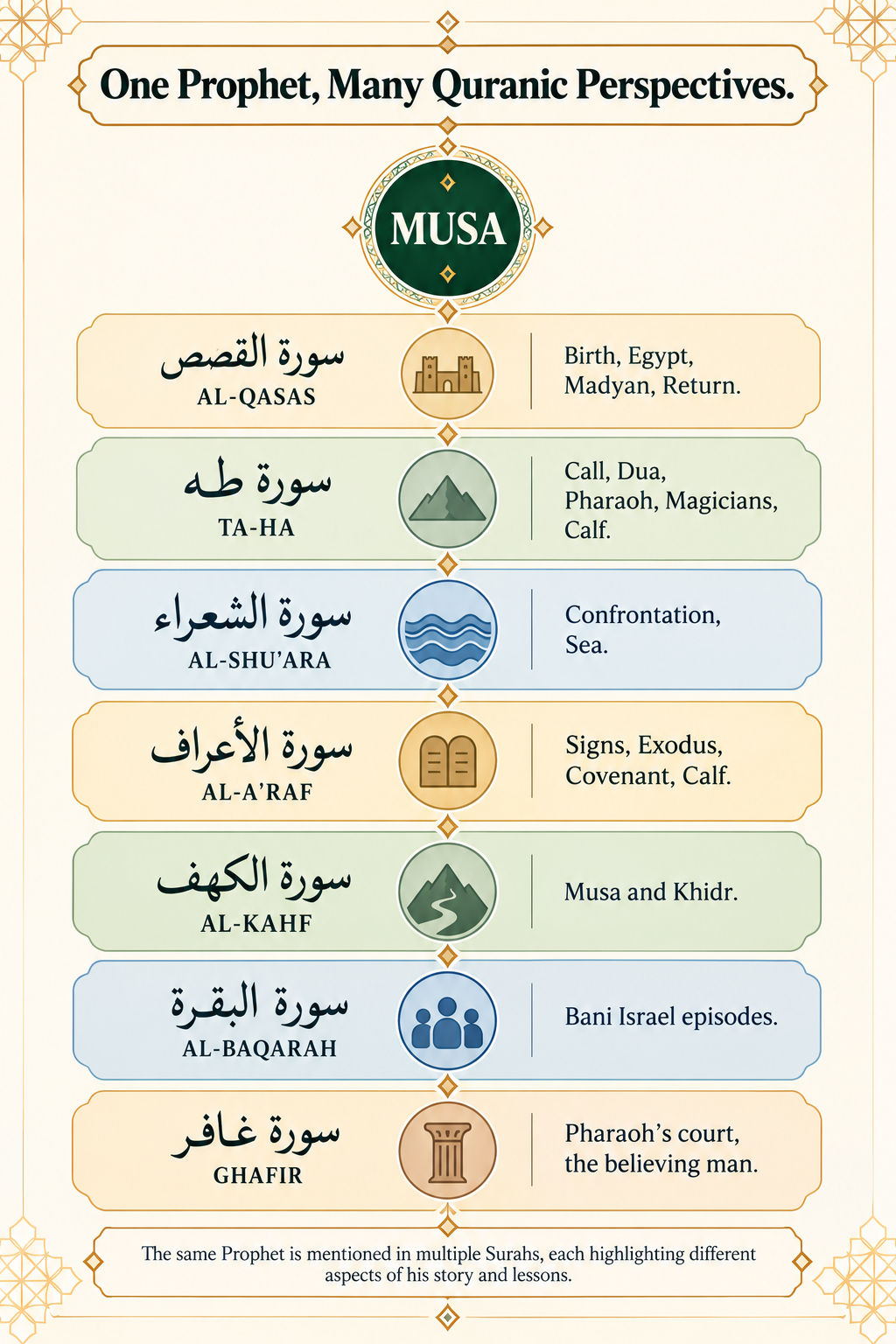
The repetition is purposeful. Each telling serves the surah it appears in:
Al-Qasas: birth, upbringing, exile in Madyan, and return.
Ta-Ha: reassurance, revelation, mission, and conversation with Allah.
Al-Shu'ara: confrontation with Pharaoh and the magicians, then the sea.
Al-A'raf: signs, deliverance, the covenant, and the calf.
Yunus: faith, Pharaoh, and deliverance.
Al-Kahf: Musa's journey of learning.
Ghafir: Pharaoh's court and the believing man.
The Quran is not repeating itself. Each retelling serves the surah it sits in.
Musa's Story at a Glance
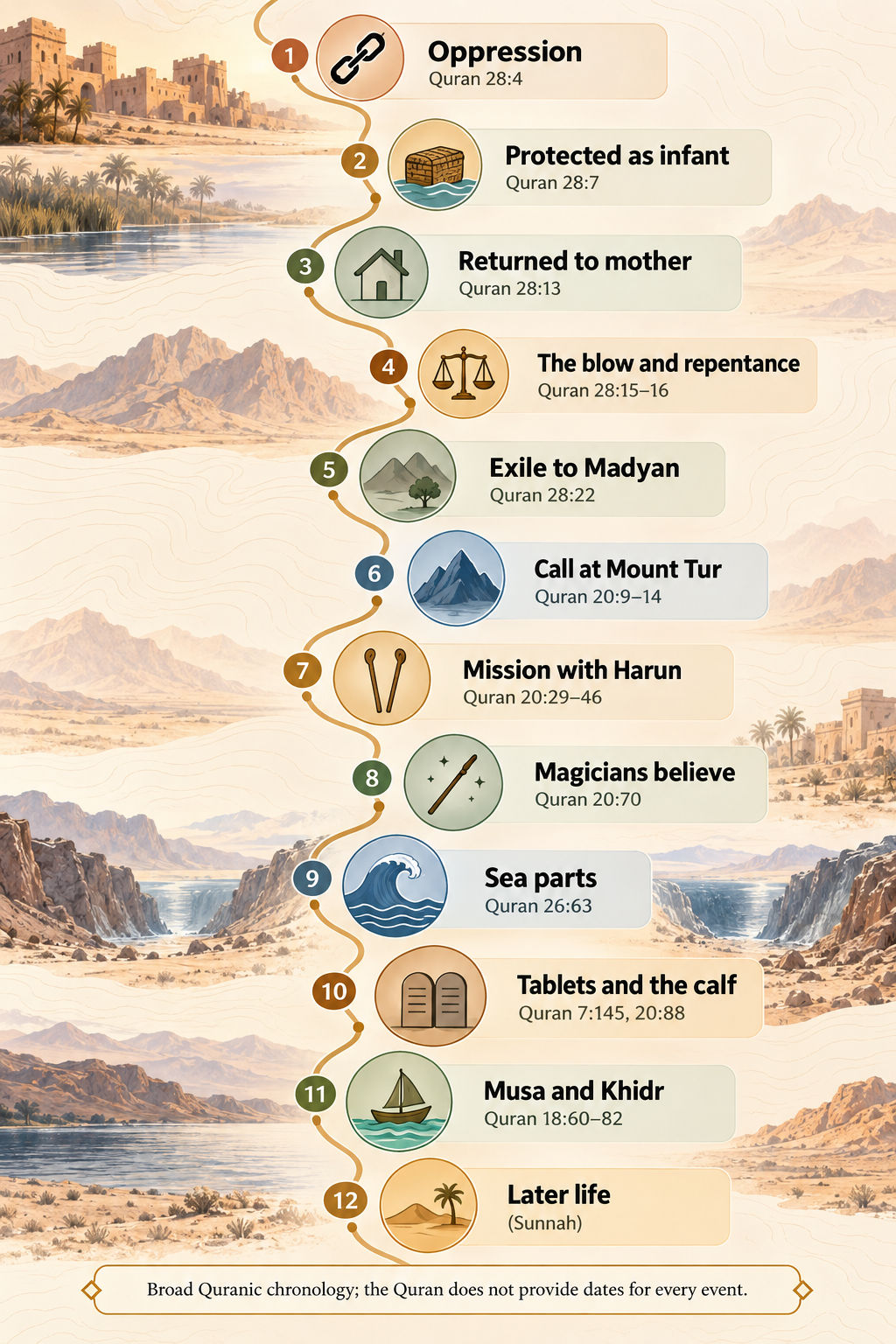
The arc runs: oppression, divine protection, a mistake, repentance, exile, preparation, revelation, mission, confrontation, deliverance, leadership, testing, learning, and legacy. The Quran gives the broad order of events, not dates for most of them.
 عليه السلام" />
Pharaoh and Bani Israel: The World Musa Was Born Into
Who are Bani Israel?
بَنُو إِسْرَائِيل (Banu Isra'il) means "Children of Israel." In the Islamic tradition, Israel is the Prophet Ya'qub عليه السلام, so Bani Israel are his descendants. The Quran criticizes particular actions of particular groups at particular times, and also praises the righteous among them (for example 7:159). This article is about Quranic history and guidance, not modern identities.
Pharaoh: a title, not necessarily a name
فِرْعَوْن (Fir'awn) is the title the Quran uses for the ruler who opposed Musa. It does not give his personal name and does not identify him as Ramses II or anyone else. Historians have proposed several candidates, but those are hypotheses, not revelation.
The Quran describes tyranny as a pattern. Quran 28:4 says Pharaoh exalted himself in the land, divided its people into factions, weakened one group, slaughtered their sons, and spared their women. Quran 14:6 recalls this as a severe trial for Bani Israel. The pattern combines arrogance, political power, dehumanization, social division, violence, and claims of supremacy.
Did Pharaoh claim to be God?
The Quran quotes him saying أَنَا رَبُّكُمُ الْأَعْلَىٰ, "I am your highest lord" (79:24), and "I do not know that you have any god other than me" (28:38). We do not need to say more about Egyptian theology than the Quran says. Revelation shows a ruler who placed himself above accountability.
Birth and Protection: A Frightening Command, a Reassuring Promise
Why were baby boys being killed? The Quran establishes the policy but does not state a motive. Some Tafsir works record a report that Pharaoh dreamed of an Israelite boy ending his kingdom. Ibn Kathir treats the long narrations of this kind as reports going back to Ibn 'Abbas rather than Prophetic Hadith, and considers them likely influenced by Isra'iliyyat. So we treat the dream as a traditional explanation, not Quranic fact.
In Surah al-Qasas (28:7), Allah inspires Musa's mother: nurse him, and when you fear for him, place him in the water. Do not fear and do not grieve; We will return him to you and make him one of the Messengers. Notice the structure: the command is frightening, and the promise is reassuring.
Was Musa's mother a Prophet? The verb is وَأَوْحَيْنَا ("We inspired"). Wahy in the Quran covers different kinds of inspiration, including to the bees (16:68). The overwhelming majority of Sunni scholars do not consider Musa's mother a Prophet, though a small number of scholars held otherwise.
The water. The word is الْيَمّ (al-yamm), a large body of water. The Quran uses it both for where Musa was placed and for the sea where Pharaoh drowned (7:136). "The Nile" is the common classical and historical understanding, but it is an inference, not the Quran's wording. Surah Ta-Ha (20:39) uses the word تَابُوت (tabut), a chest or box. The Quran gives no dimensions, material, location, or route.
Pharaoh's household. Quran 28:8 says Pharaoh's household picked him up, and the result, not their intention, was that he became an enemy and a source of grief to them. Then 28:9 quotes Pharaoh's wife: قُرَّتُ عَيْنٍ لِّي وَلَكَ, "a comfort of the eye for me and for you; do not kill him." The Quran does not name her. Sahih al-Bukhari and Sahih Muslim name "Asiyah, wife of Pharaoh" when the Prophet ﷺ speaks of women who reached perfection, so the name comes from Sunnah, not from the Quran's account of rescuing Musa.
Returned to his mother. Musa's mother's heart became empty (28:10). His sister watched from a distance (28:11). Allah prevented him from accepting other nurses, and she said: "Shall I direct you to a household who will raise him for you and are sincere to him?" (28:12). He was returned "so that her eye be comforted, that she not grieve, and that she know the promise of Allah is true" (28:13).
That gives Lesson 1: Allah's plan can operate beyond what you can see. The baby was safe in the very environment his mother feared. This is not a slogan that enemies will always fund your destiny. It is that Allah can bring protection through means nobody could predict, and Qadr does not mean we can forecast how He will resolve our problems.
Was Musa an Egyptian prince? The Quran says Pharaoh later reminded him, "Did we not raise you among us as a child, and you stayed among us for years of your life?" (26:18). Household upbringing is established. Military training, princely rank, and palace lifestyle come from cinema and later storytelling, not from revelation.
The Blow, the Repentance, and the Escape
When Musa reached maturity, Allah gave him حُكْمًا وَعِلْمًا, judgment and knowledge (28:14). The Quran gives no age. Then, in 28:15, he entered the city at a time of inattention and found two men fighting, one from his group and one from his enemy. The man from his group asked for help. Musa struck the other man, and the man died.
The Quran does not describe premeditated murder. It describes a blow that caused a death, and Musa's response: "This is of Satan's work," and
رَبِّ إِنِّي ظَلَمْتُ نَفْسِي فَاغْفِرْ لِي
Rabbi inni zalamtu nafsi faghfir li: "My Lord, I have wronged myself, so forgive me." Then: فَغَفَرَ لَهُ, "So He forgave him" (28:16). He does not rationalize, blame others, or pretend nothing happened. That is Lesson 2: a mistake should lead to repentance, not despair.
What does this say about Prophets and mistakes? Mainstream Sunni scholarship holds that Prophets are protected in conveying the message and from persisting in wrongdoing, while they can make human errors in judgment and are corrected and quick to repent. Musa is neither an ordinary sinner nor a figure who never errs in any way.
The next day (28:17–19), Musa vows never to support wrongdoers. The same Israelite cries for help again, and Musa recognizes the man's troublemaking. The Quran gives no further dialogue, and we add none. Then a man came running from the far side of the city: the chiefs are conspiring to kill you (28:20). Musa left خَائِفًا يَتَرَقَّبُ, "fearful and watchful," and prayed:
رَبِّ نَجِّنِي مِنَ الْقَوْمِ الظَّالِمِينَ
"My Lord, save me from the wrongdoing people" (28:21).
Here is Lesson 3: tawakkul does not mean you never feel afraid. The Quran openly calls Musa afraid, and fear does not mean weak faith. Tawakkul is turning to Allah and acting responsibly while afraid. Related reading: What Is Tawakkul? How to Trust Allah Without Becoming Passive.
Madyan: Exile, Work, and a Dua of Need
Musa turned toward Madyan (Midian), hoping his Lord would guide him to the right way (28:22). Its precise location is a matter of historical geography; it is traditionally associated with northwestern Arabia, but the Quran gives no coordinates and we should not treat a map point as revelation.
At the water he found people watering animals and two women holding theirs back. They explained they could not water until the shepherds left, and their father was very old (28:23). Musa watered for them, then withdrew to the shade. He had left home, lost security, and was alone, yet he helped strangers. That is Lesson 4: helping others matters even when you are struggling. Then he prayed:
رَبِّ إِنِّي لِمَا أَنزَلْتَ إِلَيَّ مِنْ خَيْرٍ فَقِيرٌ
"My Lord, I am truly in need of whatever good You send down to me" (28:24). It is an admission of complete need, not a formula. Do not trust claims that reciting it a set number of times guarantees a spouse or job.
One woman came back walking shyly. Her father invited him, and one daughter said: إِنَّ خَيْرَ مَنِ اسْتَأْجَرْتَ الْقَوِيُّ الْأَمِينُ, "The best one you can hire is the strong, the trustworthy" (28:26). Qawiyy (capable, strong) and amin (trustworthy) remain a model of work ethics.
The father offered to marry her sister to Musa for eight years of service, with ten as optional generosity (28:27). Sahih al-Bukhari reports from Ibn 'Abbas that Musa completed the longer and better term.
The Quran does not name the father or the woman. Some classical reports identify the father as Prophet Shu'ayb, but others reject this, and no sound Prophetic report establishes it. The name Safura (Zipporah in Biblical tradition) comes from later tradition, not the Quran.
The Call at Mount Tur
After fulfilling the term, Musa traveled with his family and saw a fire near the Tur (28:29). He said to his family, "Stay here; I perceive a fire; perhaps I will bring you news from it or a burning brand to warm yourselves" (28:29), and elsewhere "or find guidance at the fire" (20:10). The surahs tell the scene with different emphases, so we do not splice them into one invented quotation.
Did Musa see Allah in the fire?
No. The Quran says he was called, and Allah spoke to him. It does not say Allah was inside the fire or contained by the mountain, and we avoid speculating about how. Allah said:
إِنَّنِي أَنَا اللَّهُ لَا إِلَٰهَ إِلَّا أَنَا فَاعْبُدْنِي وَأَقِمِ الصَّلَاةَ لِذِكْرِي
"Indeed, I am Allah. There is no deity except Me, so worship Me and establish prayer for My remembrance" (20:14). The mission begins with tawhid, worship, prayer, and remembrance. Related reading: The 5 Daily Prayers Explained.
Kalimullah, the staff, and the hand
كَلِيمُ اللَّه (Kalimullah) is the traditional title meaning "the one Allah spoke to," from "And Allah spoke to Musa directly" (4:164; see also 7:143). Allah then asked, "What is that in your right hand, O Musa?" (20:17). He answered about his staff, then threw it, and it became a moving snake. The Quran uses different words in different places: hayyah, thu'ban, and jann. Scholars treat these as different emphases, not contradictions. The second sign was his hand coming out white without any harm (20:22). It is not a statement about skin color.
Musa's dua before the mission
When charged with this responsibility, Musa did not say "I am ready." He said:
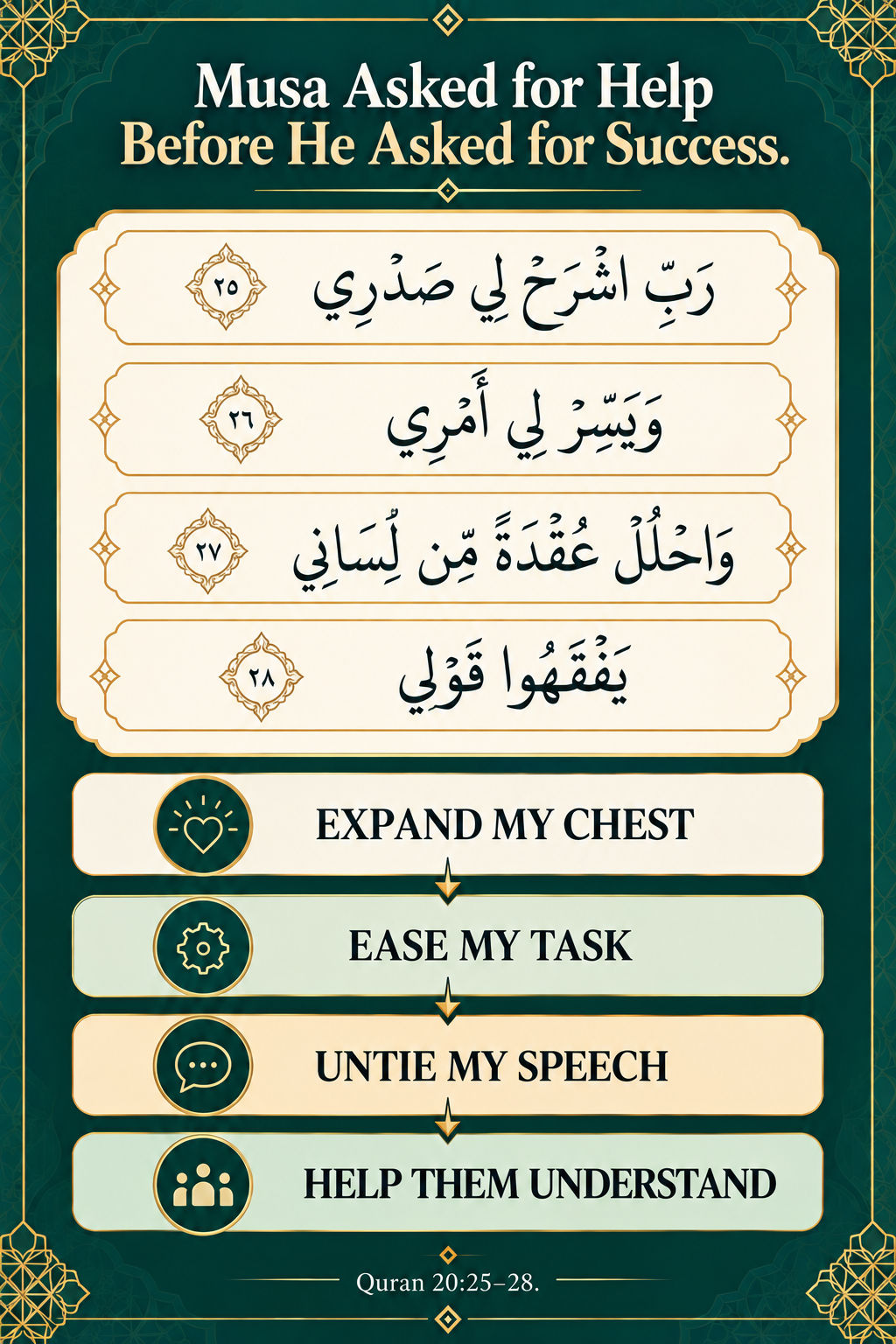
رَبِّ اشْرَحْ لِي صَدْرِي وَيَسِّرْ لِي أَمْرِي وَاحْلُلْ عُقْدَةً مِّن لِّسَانِي يَفْقَهُوا قَوْلِي
Rabbi ishrah li sadri, wa yassir li amri, wahlul 'uqdatan min lisani, yafqahu qawli (20:25–28).
ishrah li sadri: open and expand my chest (give me capacity and calm).
yassir li amri: make my task easy.
uhlul 'uqdatan min lisani: untie the knot from my tongue.
yafqahu qawli: so they may understand my speech.
He asked for help before he asked for success. That is Lesson 5: ask Allah for help before difficult responsibilities.
Did Musa have a speech impediment?
The Quran confirms Musa's concern about his speech (20:27; 26:13; 28:34). It does not say what the "knot" was, and it records Allah's answer: "You have been granted your request, O Musa" (20:36). Pharaoh later mocked him as one who "can hardly make himself clear" (43:52), but that is the opponent's rhetoric. The popular hot-coal story, in which the child Musa seized Pharaoh's beard and then placed a coal in his mouth, is not in the Quran or in authentic Prophetic Hadith. It appears in long reports traced back to Ibn 'Abbas and carries the Isra'iliyyat concerns noted above, so we do not present it as history.
Musa and Harun Before Pharaoh
Asking for help is not weakness
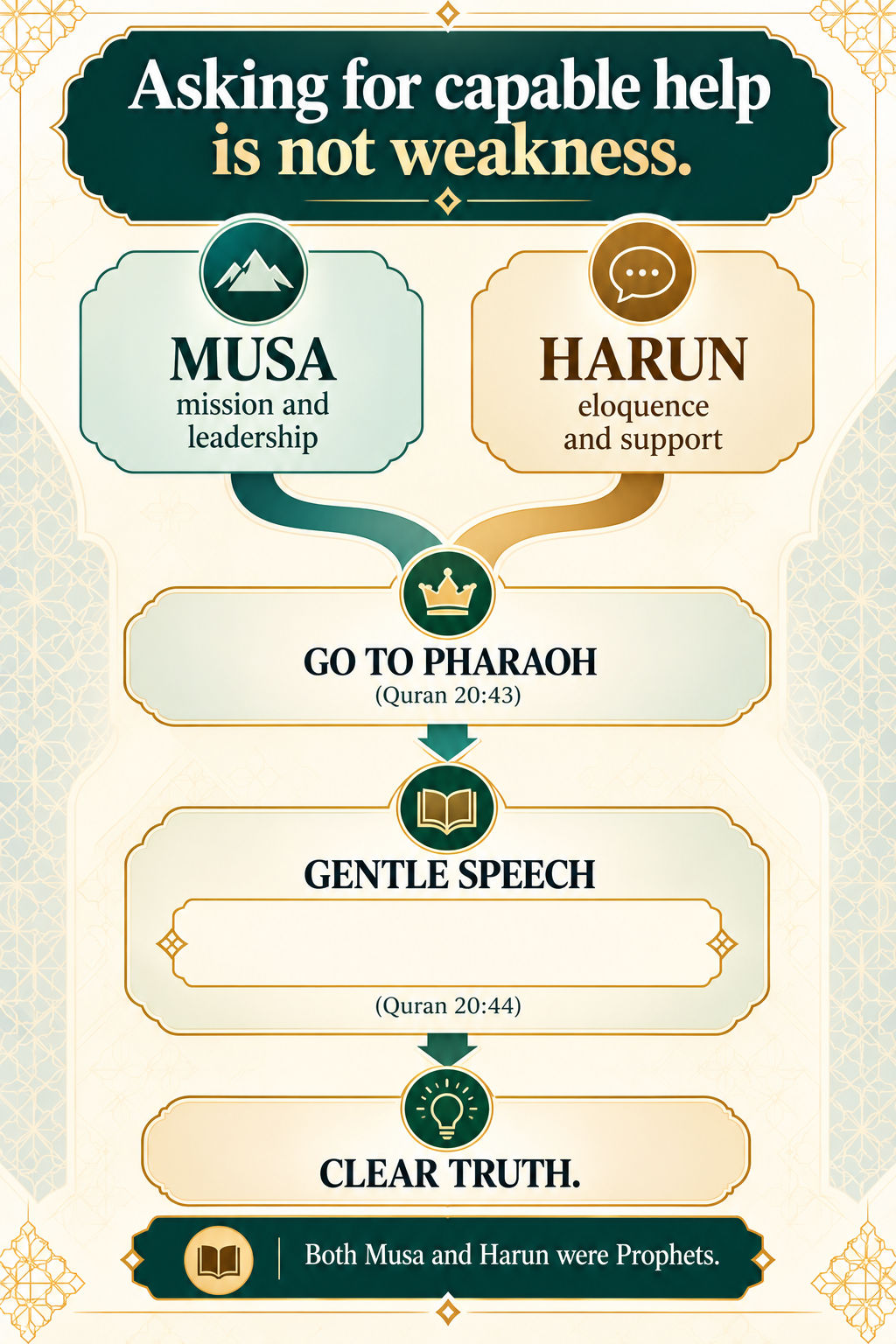
Musa asked: "Appoint for me a helper from my family, Harun, my brother. Strengthen my back through him, and let him share my task" (20:29–32). He said Harun was more fluent (28:34). Allah granted it, and Quran 19:53 says: "We gave him out of Our mercy his brother Harun as a Prophet." Harun was a Prophet, not an assistant. Lesson 6: good leadership includes knowing when you need help. Both were Prophets, and Musa's request honored Harun rather than diminished him.
Gentle speech without compromise
Allah commanded: "Go to Pharaoh, for he has transgressed" (20:43). Then: فَقُولَا لَهُ قَوْلًا لَّيِّنًا, "Speak to him with gentle speech, perhaps he will remember or fear" (20:44). Even to Pharaoh. But gentleness never meant compromise: they still told him plainly to let Bani Israel go and worship the Lord of the worlds. This verse does not tell victims of abuse to stay politely near their abusers; it describes how to deliver truth. Lesson 7: speak truth courageously without abandoning wisdom.
Fear and "I am with you"
They said: "Our Lord, we fear he will hasten against us or transgress" (20:45). Allah replied:
لَا تَخَافَا ۖ إِنَّنِي مَعَكُمَا أَسْمَعُ وَأَرَىٰ
"Do not fear. Indeed I am with you both; I hear and I see" (20:46). Mainstream scholars understand this nearness as Allah's support, protection, hearing, and seeing, without asking how.
The confrontation
Pharaoh raised Musa's upbringing and the earlier killing (26:18–19). Musa did not deny the act: "I did it then, while I was among those who had not been guided," he said, and he fled out of fear until Allah gave him judgment and made him a Messenger (26:20–21). Past failure did not erase present responsibility.
Pharaoh's response was propaganda: mockery (43:51–52), threats of prison (26:29), appeals to the elite, and claims that Musa would corrupt the country and change their religion (40:26). The chiefs called Musa a skilled magician who wanted to expel them (26:34–35). Qarun (wealth) and Haman (an official) appear as part of this system of arrogance, but we leave them there.
The Magicians: Guidance Can Change a Person Quickly
Pharaoh gathered skilled magicians for a public contest (26:38; 20:59). The Quran gives no number. Claims of 70, 72, or thousands are not established. They threw their ropes and staffs, and it seemed to Musa that they were moving (20:66). He sensed fear within himself (20:67), and Allah answered: "Do not fear. You are the superior" (20:68). Again, fear did not cancel his faith.
When Musa's staff swallowed what they had made, the magicians fell down in prostration: "We believe in the Lord of Harun and Musa" (20:70). They were experts in their craft, and they recognized something that was not within the limits of their craft.

Minutes earlier they served Pharaoh
Pharaoh threatened to cut off their hands and feet on opposite sides and crucify them (20:71). They answered that they would not prefer him over the clear proofs that came to them, and asked only for patience and a death as Muslims (20:72; 26:50; 7:126). Guidance can change a person very quickly. This matters to reverts and to Muslims returning to practice: do not judge anyone only by yesterday. Do not promise everyone instant transformation either.
Signs and Broken Promises
The Quran lists signs sent to Pharaoh's people: drought and shortage of fruit, then the flood, locusts, al-qummal, frogs, and blood (7:130–133). Al-qummal is variously understood as lice, ticks, or small crop-destroying insects. The Quran also speaks of nine clear signs (17:101; 27:12), and scholars differ about which nine. It is not the Biblical "Ten Plagues" framework, so we do not equate them.
The pattern repeats: affliction, a request that Musa pray, a promise to believe and release Bani Israel, relief, and a broken promise (7:134–135). It is a moral pattern of arrogance.
Within Pharaoh's people was also رَجُلٌ مُّؤْمِنٌ مِّنْ آلِ فِرْعَوْنَ, a believing man who concealed his faith and argued, "Would you kill a man because he says, 'My Lord is Allah'?" (40:28). He is not named. The Quran also holds up Pharaoh's wife as an example for believers, praying: "My Lord, build for me near You a house in Paradise and save me from Pharaoh and his deeds" (66:11).
The Sea: "My Lord Is with Me"
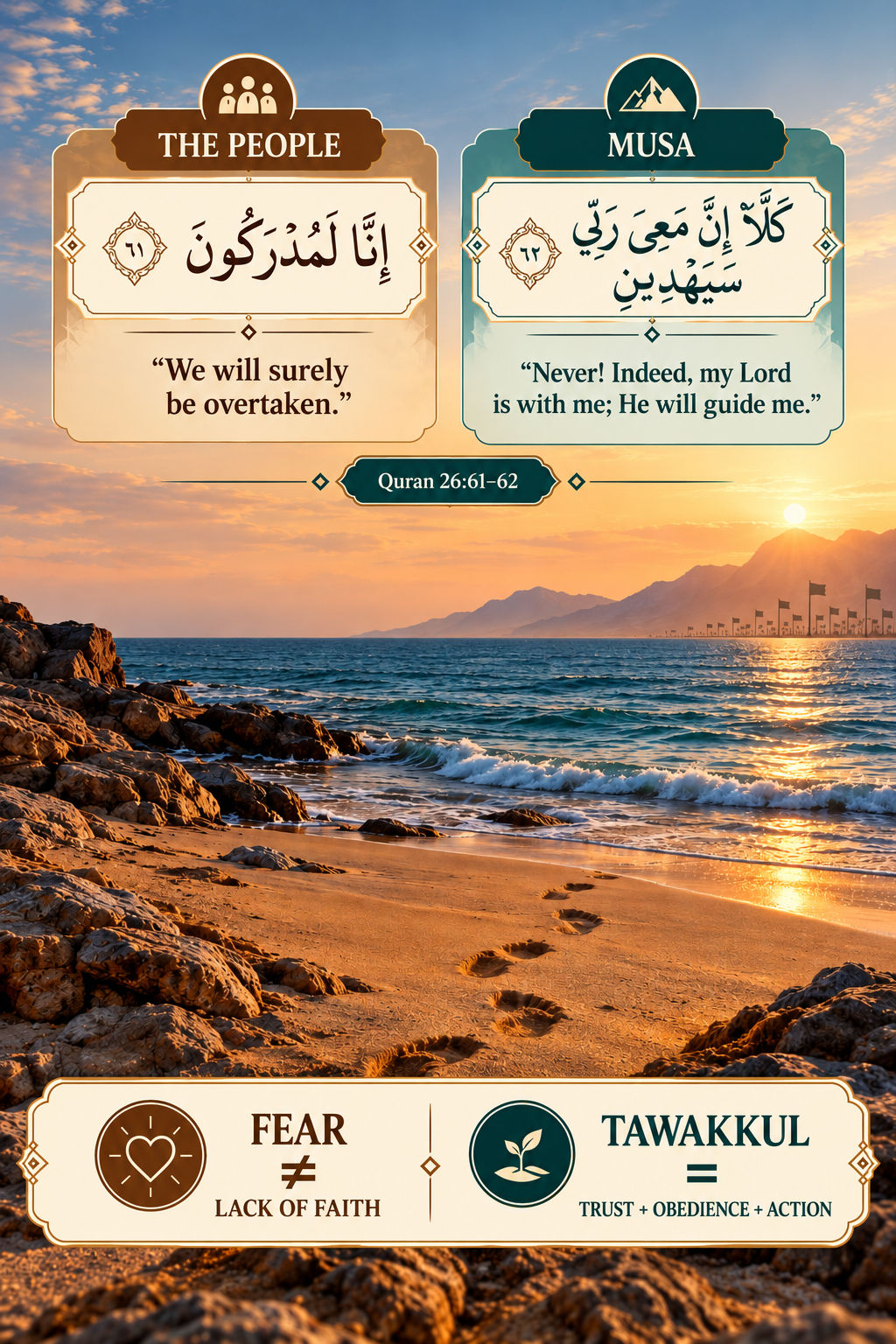
Allah commanded Musa to travel by night with Bani Israel, warning them they would be pursued (26:52). Pharaoh sent callers to the cities and pursued them. When the two groups saw each other, Musa's companions said:
إِنَّا لَمُدْرَكُونَ
"We will surely be overtaken." Musa replied:
كَلَّا ۖ إِنَّ مَعِيَ رَبِّي سَيَهْدِينِ
"Never! Indeed my Lord is with me; He will guide me" (26:61–62). Fear and trust were in the same heart at the same moment.
Then came the command to strike the sea with his staff. It split, and each part was like a great towering mountain (26:63), leaving a dry path (20:77). We do not offer tide or wind explanations that shrink the miracle.
The Quran says al-bahr, "the sea." It does not say "Red Sea." That identification, and any specific crossing point, belongs to historical geography, not revelation.
Pharaoh's Drowning and What the Quran Says About His Body
As the water overtook Pharaoh, he said, "I believe that there is no deity except the One the Children of Israel believe in, and I am of those who submit" (10:90). The answer came: "Now? And you had disobeyed before and were of the corrupters?" (10:91). Scholars explain that repentance offered only when death is already visible is not accepted (see 4:18; 40:84–85). A hadith recorded by al-Tirmidhi says Allah accepts a servant's repentance until the death rattle reaches the throat. This is one more reason not to postpone returning to Allah.
Then: "So today We will save you in your body, that you may be a sign to those after you" (10:92). Tafsir understand that his body would remain visible as a sign. The Quran does not name a mummy, and we do not attach this verse to any particular mummy or to viral claims, since the identification of Pharaoh is itself unestablished.
After the Sea: Idols, a Mountain, Tablets, and a Calf
Musa's story does not end at Pharaoh's drowning. Being freed from a tyrant does not automatically remove bad habits, fear, ingratitude, or the influence of idolatry.
Soon after crossing, they passed a people devoted to idols, and some said: اجْعَل لَّنَا إِلَٰهًا كَمَا لَهُمْ آلِهَةٌ, "Make for us a god as they have gods." Musa answered, "You are a people who are ignorant" (7:138).
Allah then set an appointment of thirty nights, completed with ten more, so forty in total, and Musa left Harun in charge: "Take my place among my people, do right, and do not follow the way of the corrupters" (7:142). Musa asked, رَبِّ أَرِنِي أَنظُرْ إِلَيْكَ, "My Lord, show me that I may look at You." Allah said, لَن تَرَانِي, "You will never see Me in this world; but look at the mountain." When his Lord manifested to the mountain, it crumbled and Musa fell unconscious. When he woke, he said, "Glory to You; I repent to You, and I am the first of the believers" (7:143). Mainstream Sunni teaching is that believers will see Allah in the Hereafter (75:22–23; Sahih al-Bukhari), but no one can in this world. We do not depict or describe divine form.
Allah gave Musa the الْأَلْوَاح (al-alwah), the Tablets, with guidance and detail (7:145). The Quran does not give their material, number, or size, and does not list the Biblical Ten Commandments here.
While he was away, his people were tested with the calf. In Surah Ta-Ha, al-Samiri leads them to make عِجْلًا جَسَدًا لَّهُ خُوَارٌ, "a calf, a body that lowed" (20:88). "Al-Samiri" is the title the Quran gives, and his historical identity is debated, so we do not equate him with the later Samaritan community or invent a biography. Unlike the Biblical account, the Quran shows Harun warning them: "You are only being tested by this" (20:90).
When Musa returned angry and grieved (7:150), he put down the Tablets and seized his brother's head. Harun said, "Son of my mother, the people judged me weak and nearly killed me" (7:150; see 20:94). Musa listened, and prayed:
رَبِّ اغْفِرْ لِي وَلِأَخِي وَأَدْخِلْنَا فِي رَحْمَتِكَ
"My Lord, forgive me and my brother and admit us into Your mercy" (7:151). The Quran does not treat all anger as sinful, and leaders can react on incomplete information and must still listen.
That is Lesson 8: freedom from oppression must be followed by spiritual reform. Physical liberation can arrive in a single night; spiritual reform usually takes much longer.
Leading a Difficult Community
The Quran then shows Musa leading people with repeated trials. In the story of the cow (2:67–73), they were told to slaughter a cow and kept asking for more details until the task became narrower. The lesson is not that questions are bad, since the Quran praises sincere ones, but that reluctance and needless complication are blameworthy. The extra details of the victim and killer in later commentaries are not Quranic. They were given water from a rock, which produced twelve springs, and each group knew its drinking place (2:60). They were provided with الْمَنّ (manna) and السَّلْوَى (quail) (2:57). Hadith says the truffle is part of the manna (Sahih al-Bukhari), but we do not claim a full botanical identification.
Then Musa told them to enter the Holy Land (5:21). They refused because of its strong inhabitants. Two God-fearing men urged them to enter, yet the people said, "Go, you and your Lord, and fight; we are staying here" (5:24). Musa turned to Allah: "My Lord, I have no control except over myself and my brother" (5:25). The land was forbidden to them for forty years while they wandered (5:26). The Quran criticizes specific actions of specific groups, and it praises righteous members of Bani Israel as well; this is a lesson about human behavior, not ethnic character.
Musa and al-Khidr: The Limits of Human Knowledge
Sahih al-Bukhari reports that Musa stood among Bani Israel and was asked who was most knowledgeable. He said, "I am." Allah corrected him because he did not attribute knowledge to Allah, and told him of a servant at the meeting of the two seas who knew what he did not. Musa was not arrogant; he was being taught a point of etiquette about knowledge.
Quran 18:65 calls the man "a servant from among Our servants whom We had given mercy from Us and taught knowledge from Us." The Quran does not name him. Sahih al-Bukhari identifies him as al-Khidr. A fish placed in a container was the sign, and the same narration names Musa's young companion as Yusha' ibn Nun. We give no geography beyond "the meeting of the two seas." Many scholars held Khidr to be a Prophet, partly because he says, "I did not do it of my own accord" (18:82), but scholars have differed.
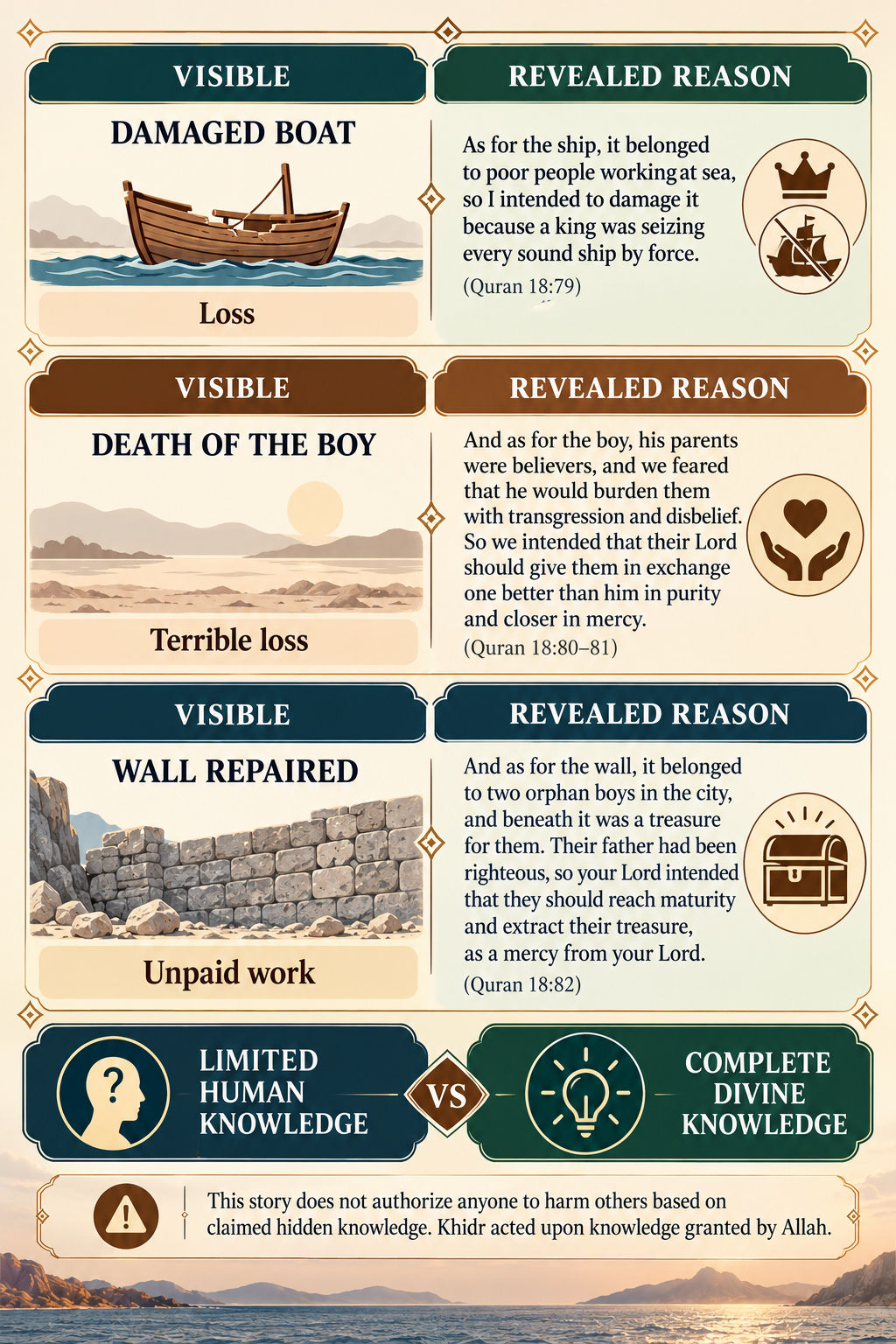
Khidr warned him: "How can you be patient about what you do not encompass in knowledge?" (18:68). Three events followed.
The boat: Khidr damaged it. The reason (18:79): it belonged to poor workers at sea, and a king was seizing every [sound] ship by force.
The boy: Khidr killed him. The reason (18:80–81): his parents were believers, and they feared he would burden them with transgression and disbelief, and Allah would replace him with a better and more merciful child.
The wall: Khidr repaired it without payment. The reason (18:82): beneath it was a treasure belonging to two orphan boys, and Allah willed that they reach maturity and extract it.
What looked like harm, loss, and waste each held a purpose Musa could not see.
A necessary guardrail
This story does not allow anyone to break Islamic law because of intuition, dreams, visions, or "spiritual knowledge." Khidr acted on knowledge granted by Allah specific to his situation, and the Shariah protects life, property, and justice for everyone else. The story teaches humility before divine wisdom, not permission for lawlessness. It also does not promise that every tragedy will make sense to you in this life; sometimes we will never know why. It teaches that our knowledge is limited while Allah's is complete.
Musa was a Messenger spoken to by Allah, the leader of a nation, and he still traveled to learn. Lesson 9: knowledge requires humility. Related reading: What Is Qadr in Islam? and Why Does Allah Test Us? Lesson 10: you do not need to understand every part of Qadr to trust the One who does.
Musa in the Sunnah: The Angel of Death, His Burial, and the Night Journey
The Angel of Death. Sahih al-Bukhari and Sahih Muslim report that the Angel of Death came to Musa and he struck him, and the angel's eye was affected. The angel returned to Allah and said that He had sent him to a servant who did not want death. Allah restored the eye and told him to offer Musa a long life or death. Musa chose death and asked to be brought near the Holy Land "a stone's throw." Classical Hadith commentators, including al-Nawawi and Ibn Hajar, record the explanation that the angel came in the form of a man, Musa did not recognize him, and he defended himself against an intruder. The restoration of the eye shows Musa was not blamed.
His burial. The Prophet ﷺ said that if he were there, he would show his grave beside the road near the red sand dune (Sahih al-Bukhari; see also Sahih Muslim). No authentic report fixes a modern shrine, so we do not assert one.
The night journey. The Prophet ﷺ met Musa during the Isra' and Mi'raj. When fifty daily prayers were prescribed, Musa advised him to return and ask for reduction because of what he knew of his own people, until five remained with the reward of fifty (Sahih al-Bukhari; Sahih Muslim). The report of Musa weeping, because more of this Ummah would enter Paradise, is understood by scholars as grief, not jealousy: sorrow that fewer of his own people benefited from his guidance.
Other connections. The Prophet ﷺ found the Jews of Madinah fasting on Ashura because Allah saved Musa and Bani Israel that day, and said, "We have more right to Musa than you," and fasted it (Sahih al-Bukhari; Sahih Muslim). After a harsh remark at Hunayn, the Prophet ﷺ said, "May Allah have mercy on Musa; he was harmed more than this and remained patient" (Sahih al-Bukhari; Sahih Muslim).
Powerful Duas of Prophet Musa in the Quran
These are Quranic prayers, not formulas for guaranteed marriage, money, jobs, visas, or healing.
1. Seeking forgiveness (28:16). رَبِّ إِنِّي ظَلَمْتُ نَفْسِي فَاغْفِرْ لِي · Rabbi inni zalamtu nafsi faghfir li · "My Lord, I have wronged myself, so forgive me." Context: after the death of the man. Lesson: return immediately.
2. Seeking safety (28:21). رَبِّ نَجِّنِي مِنَ الْقَوْمِ الظَّالِمِينَ · Rabbi najjini mina l-qawmi z-zalimin · "My Lord, save me from the wrongdoing people." Context: fleeing Egypt. Lesson: act and ask.
3. Admitting need (28:24). رَبِّ إِنِّي لِمَا أَنزَلْتَ إِلَيَّ مِنْ خَيْرٍ فَقِيرٌ · Rabbi inni lima anzalta ilayya min khayrin faqir · "My Lord, I am in need of whatever good You send down to me." Context: the shade of Madyan. Lesson: honest need before Allah.
4. Before a heavy task (20:25–28). رَبِّ اشْرَحْ لِي صَدْرِي وَيَسِّرْ لِي أَمْرِي · Rabbi ishrah li sadri wa yassir li amri · "My Lord, expand my chest and ease my task for me." Context: the call at Tur. Lesson: ask before you begin.
5. For himself and his brother (7:151). رَبِّ اغْفِرْ لِي وَلِأَخِي وَأَدْخِلْنَا فِي رَحْمَتِكَ · Rabbi ighfir li wa li-akhi wa adkhilna fi rahmatik · "My Lord, forgive me and my brother and admit us into Your mercy." Context: after the calf. Lesson: repair relationships through dua. Related reading: How to Make Dua.
Quranic Arabic from Musa's Story
These terms help readers recognize words in Surahs Ta-Ha, Al-Qasas, and Al-A'raf. We do not derive theology from word roots alone.
Arabic | Transliteration | Core meaning | Reference | Context |
|---|---|---|---|---|
فِرْعَوْن | Fir'awn | Pharaoh (ruler's title) | 28:4 | The tyrant who opposed Musa |
الْيَمّ | al-yamm | large body of water | 28:7; 7:136 | Where Musa was cast, and the sea of the drowning |
مَدْيَن | Madyan | Midian | 28:22 | Where Musa took refuge |
الْعَصَا | al-'asa | the staff | 20:18 | The sign given at Tur |
آيَة | ayah | sign, miracle, verse | 20:22 | The hand and the staff |
السَّحَرَة | al-saharah | the magicians | 20:70 | They prostrated and believed |
تَوَكَّلْنَا | tawakkalna | we have relied | 10:85 | Musa's believing followers |
نَجِّنِي | najjini | save me | 28:21 | The dua leaving Egypt |
اشْرَحْ لِي صَدْرِي | ishrah li sadri | open my chest for me | 20:25 | Before the mission |
الْأَلْوَاح | al-alwah | the Tablets | 7:145 | Received on the mountain |
الْعِجْل | al-'ijl | the calf | 20:88 | The test in Musa's absence |
صَبْر | sabr | patience, steadfastness | 18:67–68 | Khidr's warning |
Common Myths and Misconceptions About Musa
Myth: The Quran identifies Pharaoh as Ramses II. Correction: It does not name him.
Myth: The Quran says Pharaoh dreamed an Israelite boy would end his rule. Correction: That appears only in later reports, not the Quran.
Myth: The Quran says Musa floated down the Nile in a wicker basket. Correction: It says tabut (chest) and al-yamm; "the Nile" is inferred.
Myth: The Quran names Pharaoh's wife Asiyah. Correction: The Quran says "wife of Pharaoh"; authentic Hadith supplies the name.
Myth: Musa was definitely an Egyptian prince. Correction: The Quran confirms household upbringing, not princely rank.
Myth: Musa murdered a man intentionally. Correction: The Quran describes a blow that caused a death, followed by immediate repentance.
Myth: Musa definitely married Prophet Shu'ayb's daughter Safura. Correction: The Quran names neither father nor daughter.
Myth: The hot coal caused Musa's speech difficulty. Correction: Not established by the Quran or authentic Sunnah.
Myth: The Quran lists the Biblical Ten Plagues. Correction: It lists specific signs and refers to nine signs.
Myth: The Quran says it was specifically the Red Sea. Correction: It says al-bahr, "the sea."
Myth: A particular mummy proves Quran 10:92. Correction: The verse should not be tied to an uncertain identification.
Myth: The Quran blames Harun for the calf. Correction: It shows Harun warning his people; al-Samiri is central.
Myth: Prophets never feel fear. Correction: The Quran says Musa feared, and he stayed faithful.
What the Quran Says vs. What Popular Stories Add
Topic | Quran / authentic Sunnah | Popular addition | Evidence status |
|---|---|---|---|
Pharaoh's identity | A ruler titled Pharaoh | Ramses II or another named king | Historical hypothesis |
Baby's container | A tabut cast into al-yamm | Detailed basket and route | Added detail |
Pharaoh's dream | Killing policy only | A prophetic dream | Later reports |
Asiyah | Name in authentic Hadith; Quran says "wife of Pharaoh" | "Quran says she rescued Musa" | Sunnah supplies name |
Palace childhood | Raised in Pharaoh's household | Prince with military training | Cinematic addition |
Hot coal | Not mentioned | Coal caused speech difficulty | Not established |
Shu'ayb in Madyan | Unnamed elderly father | Prophet Shu'ayb | Disputed; no sound Prophetic report |
Safura | Unnamed woman | Safura / Zipporah | Later tradition |
Magicians | Number not given | 70, 72, thousands | Unestablished |
Sea location | al-bahr | Red Sea crossing point | Historical hypothesis |
Pharaoh's body | A sign for later generations | A named mummy | Unestablished identification |
al-Samiri | A title, central to the calf | The Samaritan | Debated |
Musa's grave | Near the red dune (Hadith) | Specific shrines | Not established |
The rule is simple: revelation comes first, and storytelling comes second.
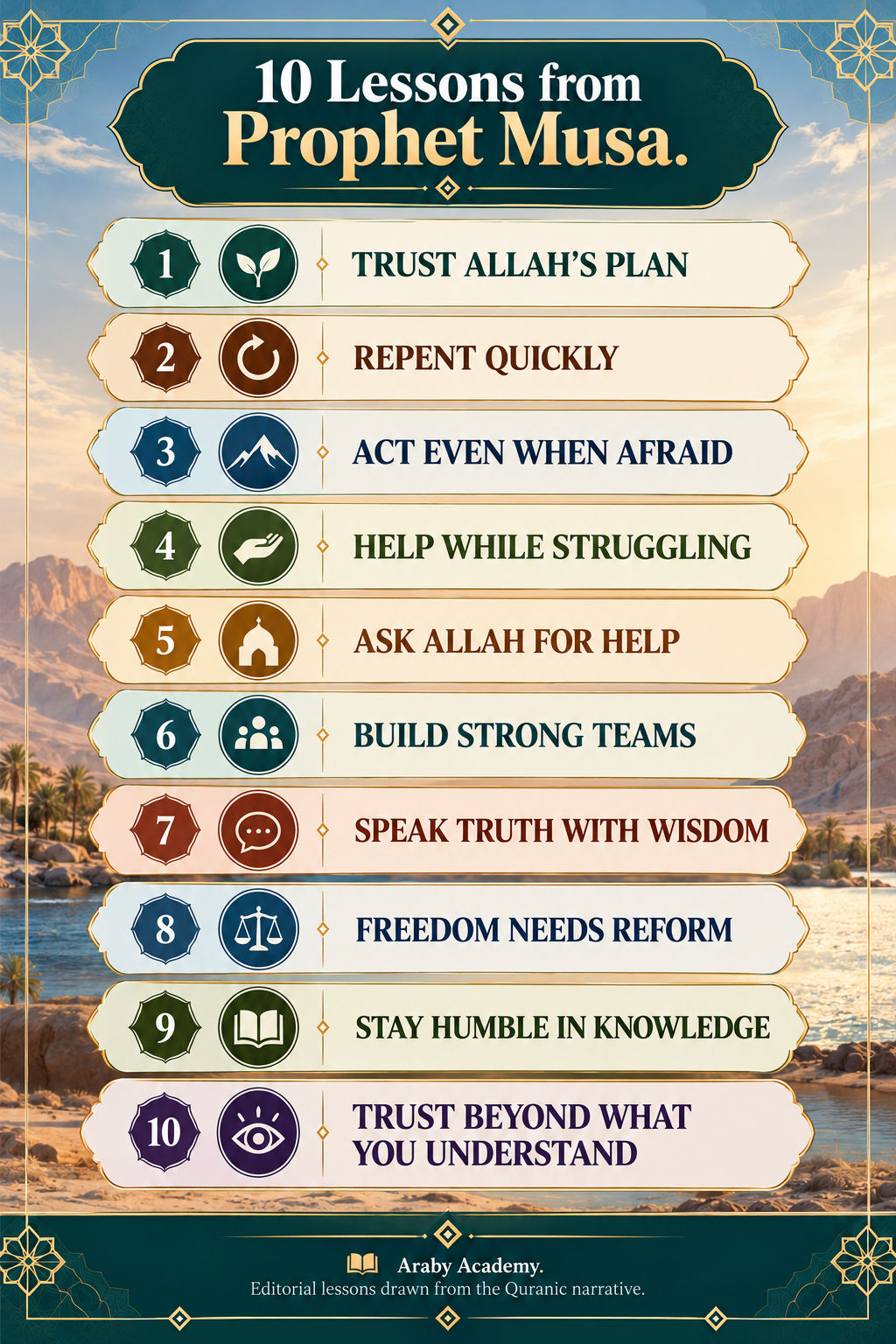
10 Lessons from Prophet Musa
Trust Allah's plan. It can operate beyond what you can see: the river, the household, and the mother restored.
Repent quickly. After the death of the man, Musa turned straight to Allah.
Act even when afraid. Tawakkul is not the absence of fear: the escape, the magicians, and the sea.
Help while struggling. At the water of Madyan he served others while he had nothing.
Ask Allah for help. "Expand my chest" came before the mission, not after it.
Build strong teams. He asked for Harun, a fellow Prophet, and did not carry the mission alone.
Speak truth with wisdom. Gentle speech and clear truth belong together.
Freedom needs reform. Leaving Pharaoh was faster than removing his influence.
Stay humble in knowledge. The greatest of students still traveled to learn.
Trust beyond what you understand. You do not need to understand every part of Qadr to trust the One who does.
These ten labels are editorial; the Quran itself does not number them.
Musa's Story Did Not End at the Sea
Why does the Quran tell us about Musa so often? Because his story speaks to people in many conditions.
To someone afraid: Musa was afraid, and still moved forward with Allah. To someone who made a mistake: Musa immediately returned to Allah. To someone with nothing: Musa sat in the shade of Madyan and admitted his need. To someone facing an overwhelming responsibility: Musa asked Allah to expand his chest and ease his task. To someone facing power: Musa stood before Pharaoh. To someone leading difficult people: Musa knew that victory does not end the work. To someone who thinks they know enough: Musa traveled to learn. To someone confused by Qadr: Musa learned that what humans see is only part of reality.
His story teaches that faith is not the promise that we will never feel afraid, make mistakes, face uncertainty, or struggle to understand. It teaches us where to turn when we do.
Prophet Musa was one of Allah's greatest Messengers and the Prophet mentioned by name most frequently in the Quran. Allah protected him as an infant, guided him after a serious mistake, prepared him through exile, spoke to him, sent him with Harun to confront Pharaoh, delivered Bani Israel through the sea, and continued teaching him through the challenges of leadership and knowledge. His story teaches me that fear does not cancel faith, repentance can follow failure, leadership requires help, knowledge requires humility, and tawakkul means obeying Allah even when I cannot yet see how the story will end.