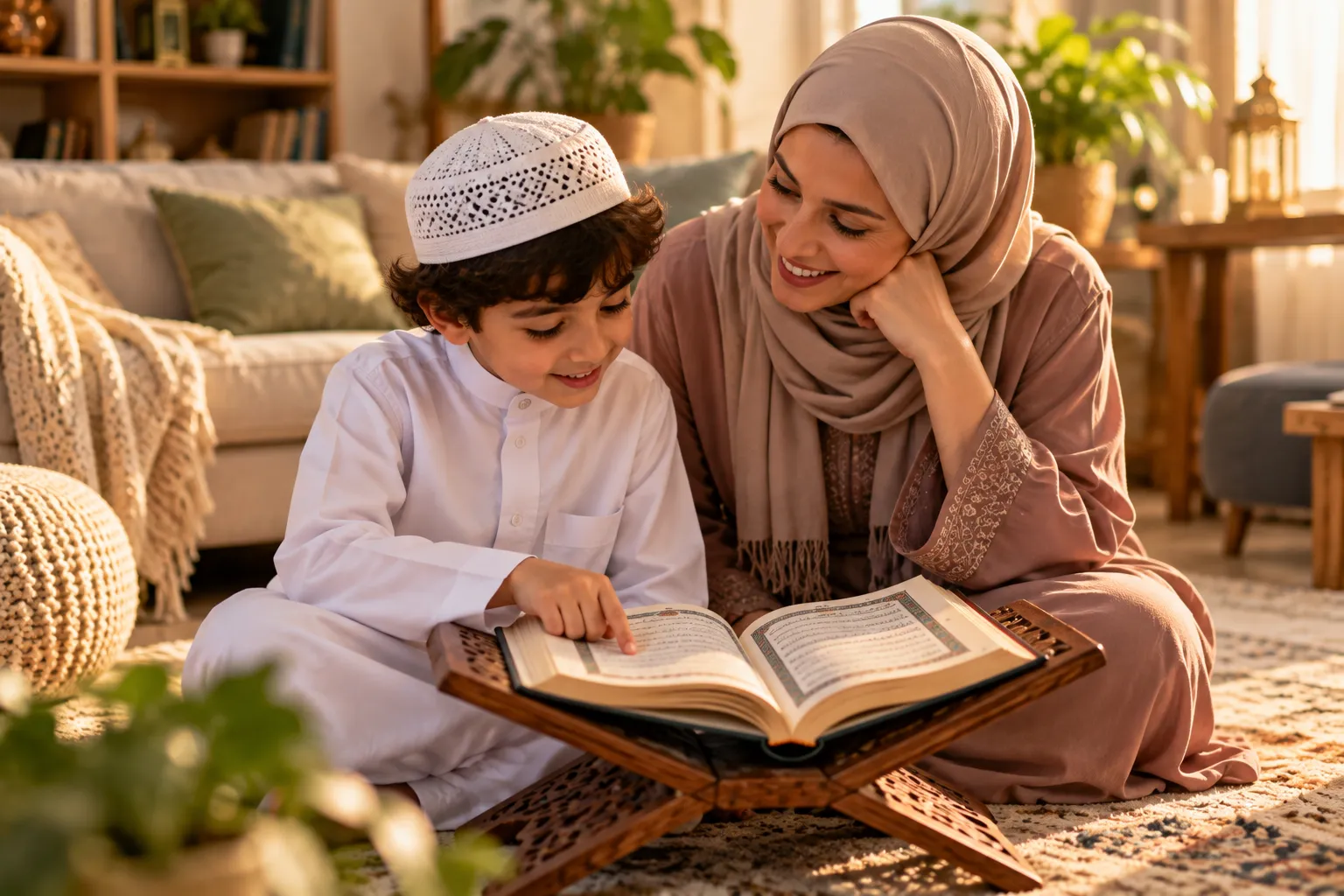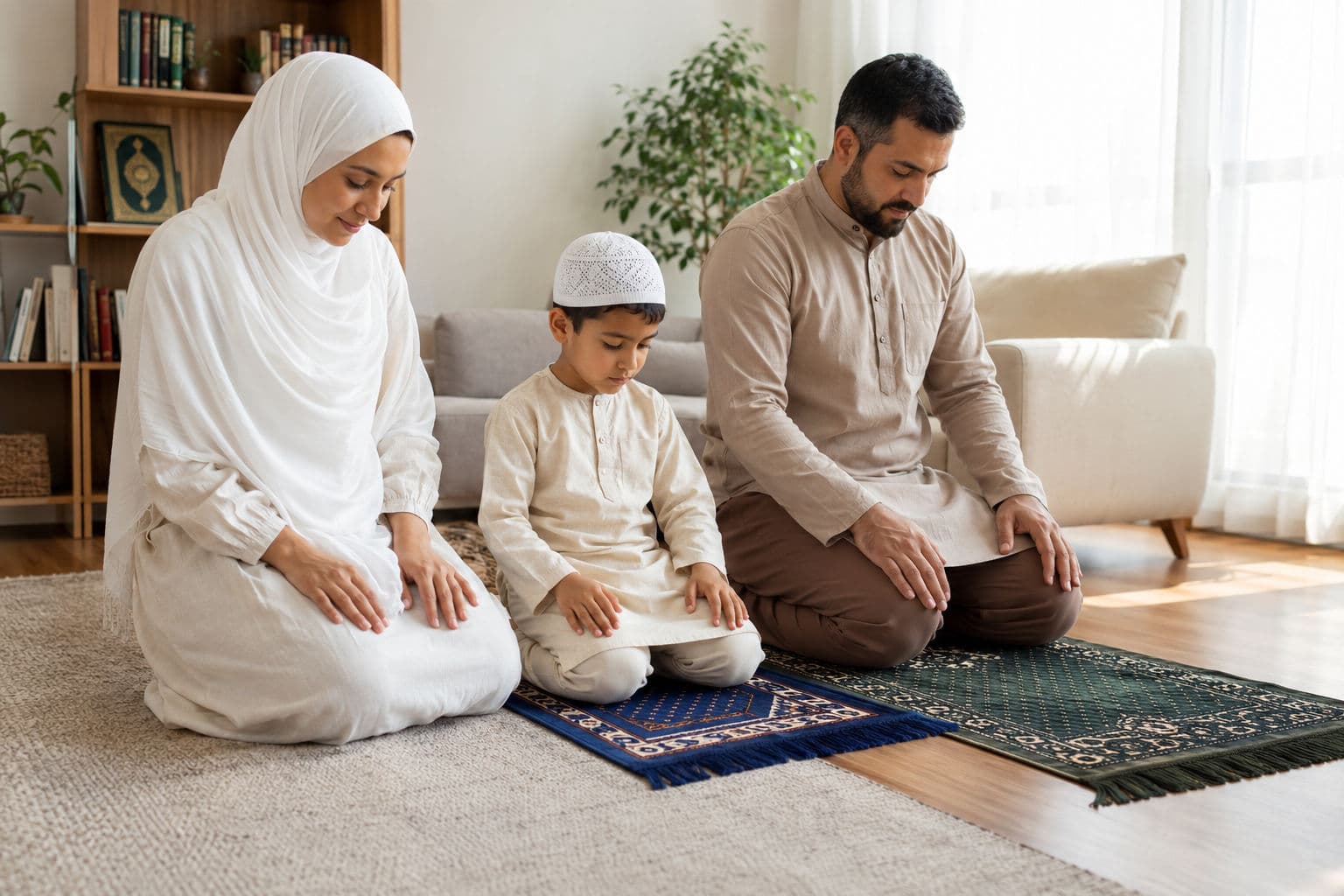
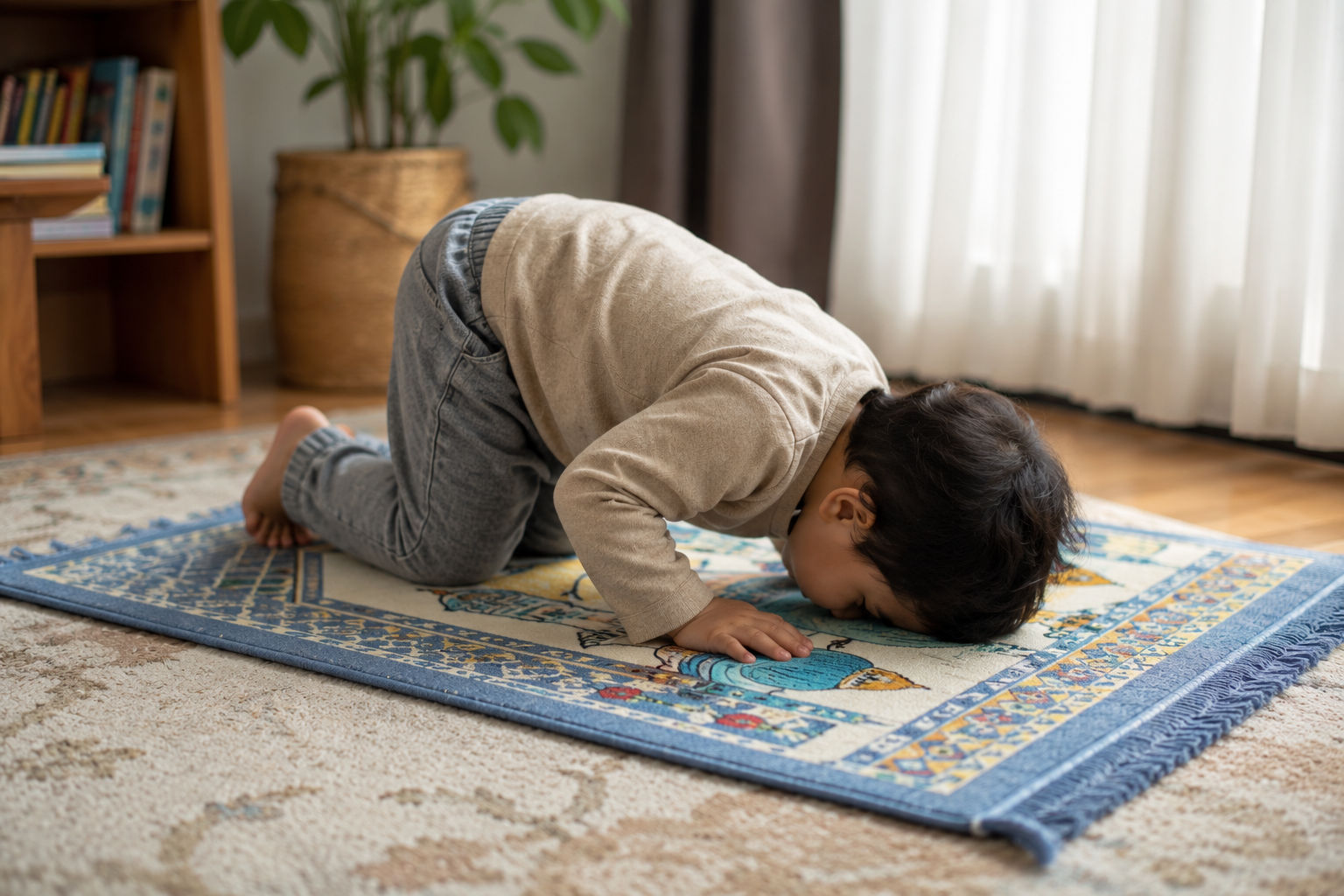
You are sitting on your prayer mat, forehead to the ground in sujood, when you feel a small hand press beside yours. Your toddler is copying you again — eyes half-closed, little bottom raised in the air. Your heart fills with something words can barely hold.
That moment is not an accident. It is a seed. And everything you do as a parent in the coming years will either water that seed or allow it to wither.
If you have ever asked yourself, "When should my child start praying? Am I too early? Too late? Am I doing this right?" — this article is written for you.
The answer, as you will discover, is both simpler and more beautiful than you might expect. Islam does not give us a rigid checklist. It gives us a journey — one that begins long before a child understands the words of the prayer, and one that, with patience and love, can shape a person for their entire life.

Why Salah Matters in a Child's Life
Before asking when, it helps to remember why.
Salah is not simply a ritual Muslims perform five times a day. It is the central pillar of a Muslim's relationship with Allah. It is the practice the Prophet Muhammad ﷺ described as the dividing line between faith and disbelief. It is the action for which children, and then adults, will be asked on the Day of Judgment before anything else.
Allah says in the Quran:
وَأْمُرْ أَهْلَكَ بِالصَّلَاةِ وَاصْطَبِرْ عَلَيْهَا
"Enjoin prayer upon your family and be steadfast in it." — Surah Ta-Ha (20:132)
In this verse, Allah addresses the Prophet ﷺ directly, instructing him to command his household to pray. The scholars of tafsir, including Imam Ibn Kathir and Imam Al-Tabari, explain that this command extends to every believing parent. The instruction to "be steadfast in it" tells us that this is not a one-time conversation — it is a lifelong commitment.
The Prophet ﷺ himself told us:
"The first thing a person will be asked about on the Day of Resurrection is prayer. If it is sound, the rest of his deeds will be sound. And if it is corrupt, the rest of his deeds will be corrupt." — Jami' at-Tirmidhi, No. 413 (Sahih)
When a child grows into an adult who loves Salah — not merely performs it — they carry something priceless through every difficulty life brings. They have a direct line to Allah. They have structure in their day. They have an identity rooted in something far greater than culture, nationality, or social status.
Helping your child establish that relationship is among the greatest gifts you will ever give them.
What Does Islam Say About the Right Age?
The clearest guidance from the Sunnah on this question comes from a well-known hadith narrated by Amr ibn Shu'ayb, from his father, from his grandfather:
"Command your children to pray when they are seven years old, and discipline them for it when they are ten, and separate them in their beds." — Sunan Abi Dawud, No. 495 (Hasan Sahih)
This single narration is the foundation upon which Islamic scholars have built centuries of guidance about children and Salah. It contains three distinct milestones:
Age | Instruction |
|---|---|
7 years old | Begin commanding them to pray |
10 years old | Hold them accountable if they neglect it |
Puberty | They become fully obligated — Salah is now fard (obligatory) |
Understanding this progression changes everything. Islam is not asking you to turn prayer into a burden for a seven-year-old. It is inviting you to plant a habit, nurture a love, and build a foundation — gradually, over years.
Is a Child Sinful for Missing Prayer Before Puberty?
No. Islamic scholars are in complete agreement on this point. The pen of accountability (qalam al-taklif) is lifted from children until they reach puberty. This is based on the hadith:
"The pen has been lifted from three: the sleeping person until they awaken, the child until they reach puberty, and the insane person until they regain their mind." — Sunan Abi Dawud, No. 4402; Jami' at-Tirmidhi, No. 1423 (Sahih)
A child who misses Salah before puberty is not sinful. However, the parent carries a responsibility to teach, encourage, and guide. The hadith of Sunan Abi Dawud places that duty clearly on our shoulders.
Understanding the Hadith About Teaching Children at Seven
The instruction to "command" a child to pray at age seven has been carefully analyzed by classical Islamic scholars.
Imam An-Nawawi, in his commentary on related narrations, explains that the command at seven is not meant to be coercive or harsh. Rather, it is an instruction to begin establishing the prayer as a regular, expected part of the child's day. The goal at this stage is habit formation — helping prayer become as natural and familiar as eating and sleeping.
The word used in the hadith is muruu — command them. But scholars clarify that this "command" at age seven is paired with patience and encouragement, not punishment. Punishment is explicitly reserved for the age of ten, and even then, scholars like Ibn Qudama and Ibn Hajar have emphasized that any discipline must be mild, measured, and never traumatic.
Imam Ibn Hajar al-Asqalani writes in Fath al-Bari, his commentary on Sahih al-Bukhari, that the wisdom behind beginning at seven is that this is the age at which a child typically reaches the age of discernment (sinn al-tamyiz) — the ability to reason, understand cause and effect, and begin internalizing values.
Modern developmental psychology agrees. Around ages six to eight, children enter what the psychologist Jean Piaget called the concrete operational stage — they can follow logical sequences, understand rules, and begin to appreciate why routines matter.
Islam understood this long before modern psychology gave it a name.
Why Islam Begins Before Seven
Here is a truth that many parents miss: Islamic parenting for Salah does not begin at age seven. It begins at birth — perhaps even before.
The Prophet ﷺ gave us the practice of reciting the adhan in a newborn's right ear immediately after birth. This is not simply a cultural custom. It is an intentional beginning. The first words a Muslim child hears in this world are the call to prayer: Allahu Akbar. Hayya 'ala as-salah. Allah is the Greatest. Come to prayer.
From that first breath, the seeds of Salah are being planted.
Ages 2–4: Learning Through Observation
What your child is ready for: Watching, imitating, feeling the rhythm of prayer in the home.
Children at this age are extraordinary imitators. Long before they understand words, they absorb atmosphere. They notice when you roll out the prayer mat. They hear the adhan. They watch your body move through ruku and sujood.
The Prophet ﷺ said:
"Every child is born upon the fitrah (natural disposition toward goodness and Allah). It is his parents who make him a Jew, a Christian, or a Magian." — Sahih al-Bukhari, No. 1358; Sahih Muslim, No. 2658
This hadith is a reminder that you are already shaping your child's spiritual identity — through your actions, your home environment, and what they see every single day.
What You Can Do Right Now
Let them join you. Allow your toddler to stand beside you, sit on the prayer mat, or even climb on your back during sujood. The Prophet ﷺ himself extended his sujood when his grandsons Al-Hasan or Al-Husayn climbed on him. (Reported in Musnad Ahmad and authenticated by scholars.)
Name the prayer. Say "Baba is praying Asr" or "Mama is making wudu for Maghrib." Simple labels build a vocabulary of worship.
Buy a small prayer mat just for them. Let them have their own space. This is a tiny investment with enormous symbolic power.
Celebrate their imitation. When your two-year-old puts their head on the floor, smile, praise them warmly, and tell them how much Allah loves it when we remember Him.
A note to parents: At this age, there is no "wrong" way to pray. Your child touching their forehead to the floor with no proper form is pure gold. Correct nothing. Celebrate everything.
Ages 4–6: Building Love for Salah
What your child is ready for: Learning the movements, beginning to hear the Arabic words, connecting prayer to stories and meaning.
By age four, most children have the cognitive ability to begin learning sequences. They can follow along with the general movements of Salah. They can begin memorizing short surahs — Al-Fatiha, Al-Ikhlas, Al-Falaq, Al-Nas — not as a requirement, but as a natural part of family life.
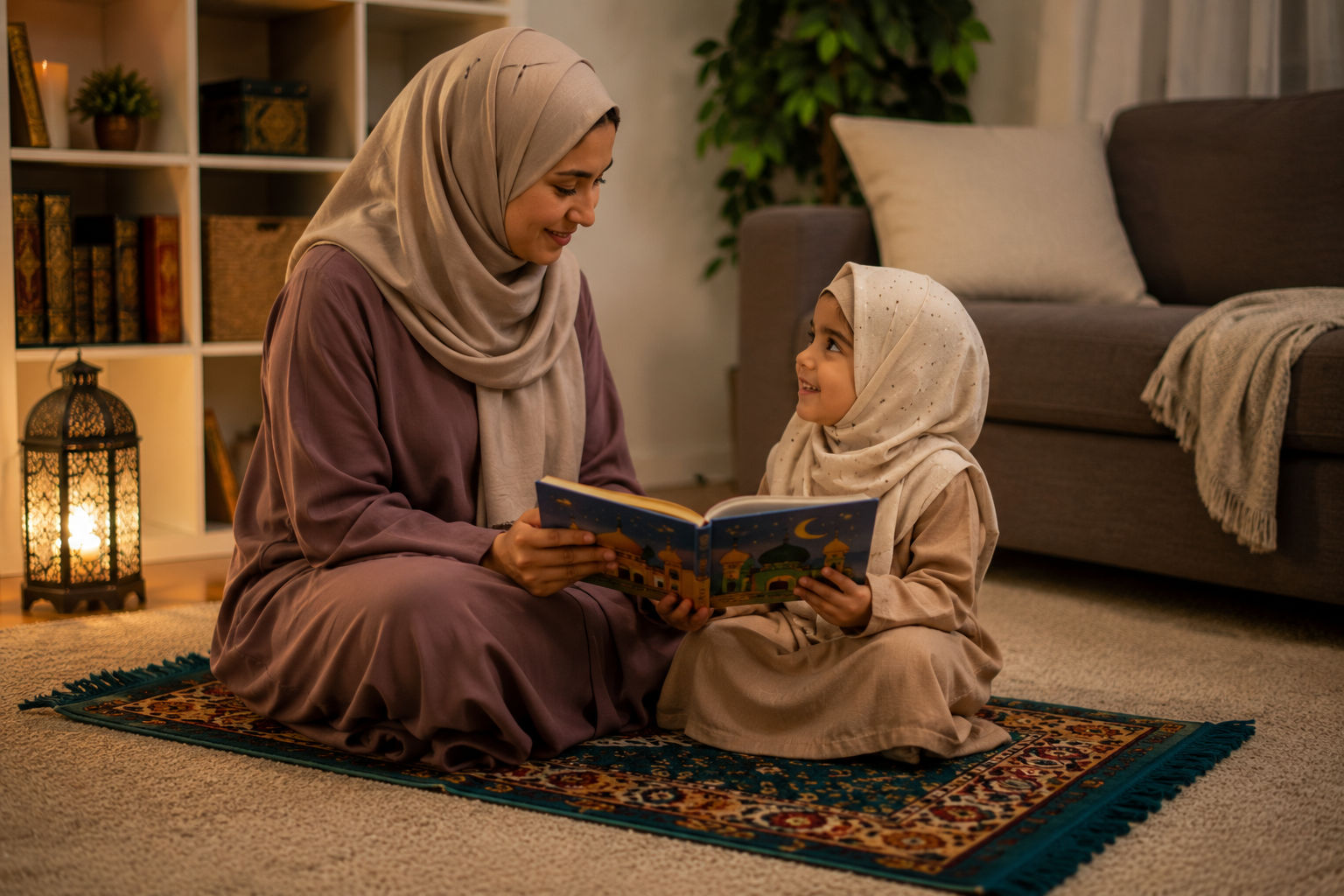
This is also the age when storytelling becomes incredibly powerful. Children at this stage are deeply emotionally engaged with stories. Telling them about how the Prophet Ibrahim ﷺ prayed alone in the desert, how Maryam alayhis salam was known for her night prayers, how the companions loved Salah even under difficulty — these stories build an emotional connection that facts alone cannot.
The Prophet ﷺ told us:
"Teach children to love the Prophet, love his family, and love reciting the Quran."
While this particular narration has some discussion around its chain, its meaning aligns with the broader Islamic principle that love is cultivated through connection, story, and example — not through commands alone.
What You Can Do Right Now
Teach wudu as a fun activity. Play the "wudu game" — let them wash their hands, face, and feet with you. Link it to cleanliness and preparation for speaking with Allah. (See our forthcoming article: How to Teach Wudu Step by Step.)
Pray one prayer together every day as a family. Start with Maghrib, which is short and comes at a time when families are often gathered.
Tell stories of the prophets and Salah. Emphasize how much the prophets loved prayer — it was their comfort, not their burden.
Use simple language to explain why we pray. "We pray because Allah loves us and we love Allah. Just like you talk to Mama when you need something, we talk to Allah."
Let them "lead" sometimes. Allow your child to stand in front of you and mimic the imam role. This builds confidence and a sense of ownership over prayer.
Parenting scenario: Six-year-old Sana keeps fidgeting during Salah and running off to play. Rather than correcting her mid-prayer, her mother finishes the prayer, then sits with Sana and gently says: "I love that you tried to pray with me. Next time, do you want to try making it to the salam at the end?" One small goal. One small win.
Ages 7–10: Establishing the Habit
What your child is ready for: Regular, expected Salah — all five prayers — with growing independence and understanding.
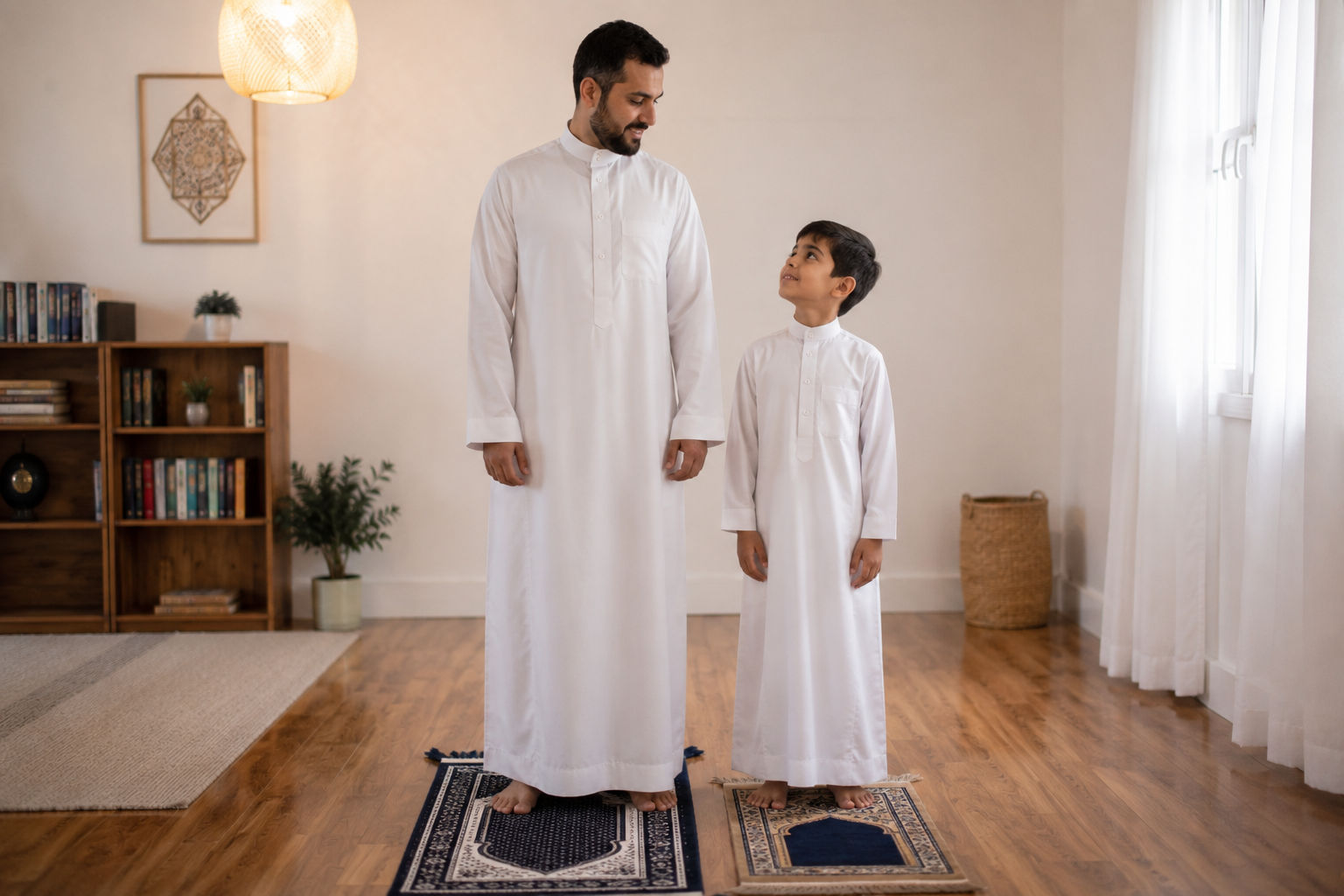
This is the age the Prophet ﷺ identified explicitly. At seven, prayer becomes part of your child's expected daily schedule. Not as a punishment. Not with threats. But as a clear, warm, consistent expectation — the way homework, brushing teeth, and eating dinner are expected.
At this stage, your child is capable of:
Performing all five prayers with correct movements and basic intention
Reciting Al-Fatiha and at least one other surah
Understanding that prayer is obligatory for Muslims
Experiencing a growing sense of personal responsibility for their own prayer
The key insight from child development at this age is habit formation. Research by behavioral psychologists confirms that habits established in middle childhood (ages 6–12) are among the most durable of a person's life. This is precisely why Islam's guidance lands at seven. The window is open. Use it wisely.
Building the Habit Without Pressure
Set gentle reminders, not alarms. A parent calling "Time for Asr, habibi" is infinitely more powerful than an app notification.
Create a family prayer schedule. When everyone prays together, no child feels singled out or burdened.
Track consistency, not perfection. A simple chart on the fridge celebrating "Days We Prayed Together" builds positive momentum.
Acknowledge effort, not just outcomes. "You prayed Fajr even when you were tired — that is the sign of a strong heart."
Explain the meaning. At this age, children can understand what they are saying in Salah. Teach them the meaning of Al-Fatiha. Explain what Allahu Akbar means. Show them that prayer is a conversation, not a performance.
Internal resource: Our upcoming article Teaching Children to Love the Quran explores how memorization and meaning work together to deepen a child's connection to worship.
Understanding the Guidance About Age Ten
At ten years old, the hadith introduces the concept of accountability: "discipline them for it when they are ten."
This is perhaps the most misunderstood part of the narration, and it deserves careful, compassionate explanation.
First: the discipline mentioned is mild. Islamic scholars, including Imam Al-Nawawi and Imam Ibn Qudama al-Maqdisi in Al-Mughni, clarify that the permitted response at ten is a light, non-harmful correction — not anger, not harshness, not emotional pressure, and certainly not physical harm. The purpose is to signal seriousness, not to traumatize.
Second: this guidance assumes that the parent has spent the previous three years — from age seven to ten — building the habit with love, consistency, and encouragement. A child who reaches ten having been supported and guided is in a very different place than one who was ignored and then suddenly held strictly accountable.
Third: context matters. A parent who calmly says, "We take prayer seriously in this family, and I need you to make it a priority" is engaging in entirely appropriate Islamic parenting. A parent who uses Salah as a site of anger, humiliation, or harsh punishment is violating the very spirit of the Prophet's ﷺ guidance.
The goal is never compliance through fear. The goal is a young person approaching puberty — when Salah becomes fully obligatory — who has already internalized prayer as part of who they are.
Common Mistakes Parents Make
Even the most loving and intentional parents can fall into these traps. Awareness is the first step.
1. Forcing Prayer Too Early
Demanding that a three-year-old perform complete, correct Salah causes the opposite of what parents want. It turns prayer into stress. It creates negative emotional associations. The Prophet ﷺ never imposed worship on children prematurely. Let the early years be about joy, imitation, and love.
2. Waiting Too Long to Introduce Salah
Some parents think, "They're too young — we'll start when they're older." But habits form over years, not overnight. A child who reaches seven with no exposure to prayer is starting from scratch at exactly the moment they should already be building the routine.
3. Using Fear Instead of Love
Saying "If you don't pray, you will go to hellfire" to a six-year-old is both theologically premature and emotionally harmful. Children are not accountable before puberty. Fear-based motivation tends to create adults who either rebel entirely or practice religion anxiously, without joy. The Prophet ﷺ was sent as a mercy to the worlds (Surah Al-Anbiya, 21:107). Our parenting should reflect that mercy.
4. Being Inconsistent
Children thrive on routine. If prayer happens sometimes but not always — if parents are strict about Maghrib but casual about Fajr and Asr — children receive a confusing message. Salah is meant to be the anchor of the day, every day.
5. Expecting Perfection
A seven-year-old's prayer will not look like a scholar's prayer. Their focus will wander. They will forget words. They will rush. This is completely normal. Correct gently, teach patiently, and celebrate participation over perfection.
6. Correcting Every Small Mistake Mid-Prayer
Interrupting a child every time their foot placement is wrong or their recitation is slightly off teaches them to feel anxious during prayer, not peaceful. Offer gentle, loving corrections after the prayer — one thing at a time.
7. Not Modeling the Prayer Yourself
Children learn primarily by watching their parents. A parent who tells their child to pray but does not pray consistently themselves sends a message that no lecture can undo. Your prayer mat on the floor is the most powerful Islamic education your child will ever receive.
Practical Ways to Make Children Love Salah
This is where the journey becomes beautiful. Here are strategies grounded in both Islamic wisdom and modern understanding of how children learn:
Create a Salah Corner
Designate a small, clean, beautiful space in your home as the family prayer area. Put a soft prayer mat there. Perhaps a small shelf with the Quran. Perhaps a simple decoration with Arabic calligraphy. When prayer has a place, it becomes part of the home's identity — not something that interrupts life, but something that belongs.
Pray Together Whenever Possible
The Prophet ﷺ prayed with his family, his companions, and his grandchildren. Group prayer is not just more rewarding in terms of reward — it is also far more effective for children. When they see you pray, with focus and love, they want to be part of something meaningful.
Use Positive Language Around Salah
Instead of: "Stop playing and come pray." Try: "Prayer time! Let's go talk to Allah together."
Language shapes attitude. Frame Salah as a privilege and an invitation, not an interruption or a duty to get through.
Celebrate Milestones
Did your child pray all five prayers today? Celebrate it. Not with extravagant rewards — but with genuine, warm acknowledgment. "I am so proud of you. I think Allah is pleased with you today." These words cost nothing and mean everything.
Tell Stories That Inspire
The lives of the prophets and the companions are filled with moving accounts of devotion to prayer. Tell your children how Bilal ibn Rabah RA — once a slave who was tortured for his faith — was so beloved by the Prophet ﷺ that he was chosen as the first muadhdhin. Tell them how the Prophet ﷺ said that prayer was the coolness of his eyes — his greatest comfort. These stories plant seeds of admiration and longing.
Teach the Meaning, Not Just the Words
When children understand what they are saying — that Al-Fatiha is a conversation with Allah, that Subhana Rabbiyyal Adheem means "Glory be to my Lord, the Most Great" — prayer transforms from recitation to communication. This is one of the most powerful shifts a parent can facilitate.
Let Children Ask Questions
Curiosity is a sign of engagement. When a child asks, "Why do we have to pray five times?" or "Does Allah really hear me?" — these are gifts. Answer with honesty, warmth, and age-appropriate depth. "Yes, Allah always hears you. Every single word. That's one of the most amazing things about Him."
Use Islamic Apps and Resources Thoughtfully
There are now excellent Islamic apps, videos, and songs that help children learn the movements and words of prayer in engaging ways. Use these as supplements — not substitutes — for family-based learning. (See our forthcoming article: Screen Time in Muslim Families.)
Frequently Asked Questions
What if my child refuses to pray?
First, ask yourself whether you have built a foundation of love for Salah over the years before this moment. Refusal rarely comes from nowhere — it often signals that prayer has felt like a burden rather than a gift.
If a child under ten refuses, do not force them or punish them. Revisit the relationship. Make prayer more joyful. Pray alongside them. Ask what they find difficult or boring, and address that with patience.
For children approaching puberty, a calm, serious conversation is appropriate: "You are getting older. Prayer is becoming an obligation for you. I want to help you because I love you and I want the best for your life and your akhirah."
Is my child sinful if they miss prayer before puberty?
No. As explained earlier, a child before puberty is not accountable for religious obligations. The qalam al-taklif — the pen of obligation — is lifted from them. However, this does not mean parents should be indifferent. Missing prayers during childhood means missing the habit-formation window that Islam wisely identifies.
Should I wake my child for Fajr?
Yes — gently and age-appropriately. For a young child (under seven), the experience of being woken up by a loving parent whispering "Fajr time, habibi" — and perhaps being carried to the prayer mat half-asleep — can become one of their most cherished childhood memories. It does not have to be a daily struggle. Start by involving them once or twice a week. Build gradually.
For children aged seven and above, Fajr should increasingly become part of the expected routine, with gentle reminders and family consistency.
How do I teach toddlers Salah?
You don't "teach" in the formal sense. You invite and include. Let them stand beside you. Let them copy your movements. Celebrate their presence. Read them simple Islamic books about prayer. Over time, the familiarity of it becomes natural.
Think of it less as instruction and more as immersion. Children learn language not through grammar lessons but through living in an environment where language is used constantly. The same is true for prayer.
Should I reward my child for praying?
In the early years (ages 4–7), small, tangible rewards can be a helpful bridge — a sticker, a special praise, a small treat — because they help connect the positive feeling to the action of prayer. This is rooted in the Islamic concept that we begin with what motivates people and gradually build intrinsic motivation.
However, over time, the goal is to shift from external reward to internal love. By the time a child approaches ten, the motivation should increasingly come from their relationship with Allah and their own sense of identity as a Muslim — not from a prize chart.
What if my child loses interest as a teenager?
Teenagers go through a period of questioning and identity-formation that is completely normal. The best protection against losing interest in prayer is a foundation built in childhood that is associated with love, belonging, and meaning — not coercion and fear.
If a teenager is struggling with Salah, avoid power struggles. Keep the lines of communication open. Share your own experience honestly: "There are days when prayer feels hard for me too. But I always feel better when I do it." Be consistent in your own prayer. Make du'a for them sincerely.
Remember that Allah is Al-Hadi — the Guide. Your job is to plant seeds and water them. Allah alone opens hearts.
A Quick-Reference Guide: Salah Development by Age
Age | What to Focus On | What to Avoid |
|---|---|---|
0–3 | Exposure, atmosphere, adhan, joining parents informally | No expectations, no correction |
4–6 | Learning movements, hearing Arabic, family prayer time | Demanding perfection, length, or full Arabic |
7–9 | Regular prayer routine, all five daily prayers, growing understanding | Harshness, shame, fear |
10–puberty | Reinforcing accountability with love, explaining meaning deeply | Punitive anger, pressure |
Puberty+ | Full obligation — support, not control | Giving up, disengagement |
Final Thoughts: You Are Planting for Eternity
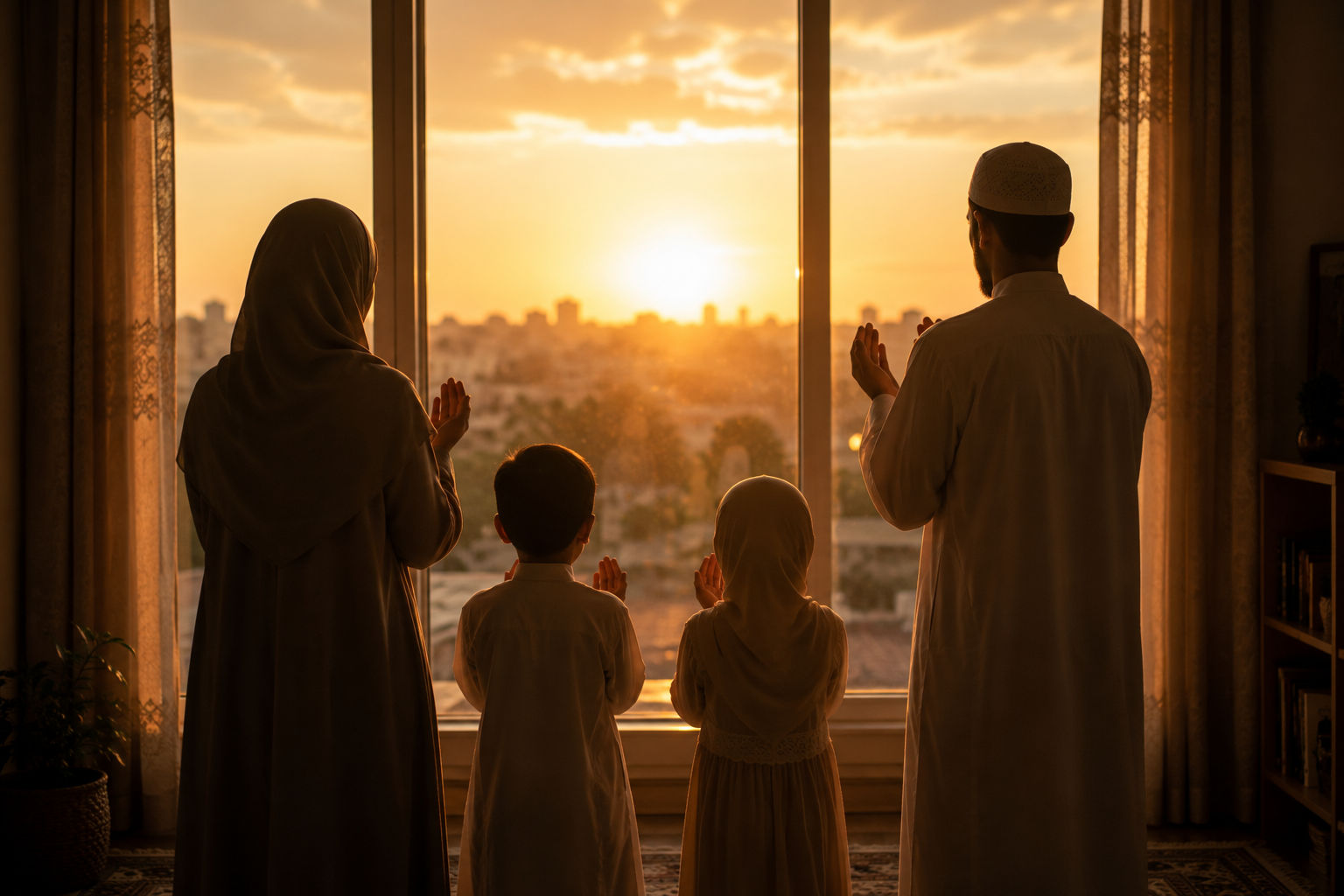
Every time you call your child to prayer — gently, warmly, consistently — you are making an investment that compounds over decades. You are not just teaching them movements and words. You are teaching them who they are.
The Prophet ﷺ said:
"When a person dies, their deeds come to an end except for three things: ongoing charity, beneficial knowledge, or a righteous child who prays for them." — Sahih Muslim, No. 1631
A child who grows to love Salah is a gift to themselves, to you, and to the entire ummah. They will pray for you when you are gone. They will teach their own children. They will carry this light forward in ways you cannot yet imagine.
You will not do this perfectly. There will be mornings when getting everyone to Fajr feels impossible. There will be phases when your child resists. There will be seasons when you yourself feel spiritually dry. That is the honest reality of parenthood and of faith.
But if you keep coming back to the prayer mat — together, with love, with patience, with du'a — you are doing exactly what Islam asks of you.
Make du'a. The Prophet Ibrahim ﷺ made one of the most beautiful duas ever recorded:
رَبِّ ٱجْعَلْنِى مُقِيمَ ٱلصَّلَوٰةِ وَمِن ذُرِّيَّتِى ۚ رَبَّنَا وَتَقَبَّلْ دُعَآءِ
"My Lord, make me one who establishes prayer, and also from my descendants. Our Lord, accept my supplication." — Surah Ibrahim (14:40)
If Ibrahim ﷺ — the Khalil of Allah, the Friend of Allah — needed to make du'a for his children to pray, then so do we. Make that du'a every day. Allah hears every word.
Explore More at Araby Academy:
How to Teach Wudu Step by Step
Teaching Children to Love the Quran
Positive Parenting in Islam
Raising Children with Good Character
Fun Islamic Activities for Kids
Building an Islamic Home
This article is part of Araby Academy's commitment to providing Muslim parents with Islamically authentic, educationally grounded, and practically useful guidance. All Quranic references are from established translations with scholarly context. Hadith are cited from their primary collections with authenticity grades where applicable.