The Birth of Prophet Muhammad ﷺ: What Every Muslim Family Should Know
Every parent hopes their child will find someone worth admiring — someone whose character becomes a quiet compass for how to treat people, handle disappointment, and love Allah.
For over 1.4 billion Muslims, that someone is Prophet Muhammad ﷺ.
His story is not a distant legend confined to history books. It is a living relationship — one that begins the moment a child first hears his name and grows every time they learn how he laughed, forgave, played with children, and loved.
This guide walks through the authentic story of his birth, the world he entered, the character that made him beloved, and — most importantly — practical ways your family can help your children fall in love with him. Not once a year during Mawlid season, but all year long.
A note on authenticity: Every historical claim, Quranic verse, and hadith in this article is drawn from recognized sources — the Quran, Sahih al-Bukhari, and Sahih Muslim — with references included so you can look deeper yourself. Where scholars have genuinely differed on a historical detail, that difference is named honestly rather than smoothed over.
Why Every Child Should Know the Story of Prophet Muhammad ﷺ
Children are always looking for someone to imitate. Long before they can articulate values, they absorb them by watching who they admire.
Allah tells us in the Quran:
"There has certainly been for you in the Messenger of Allah an excellent pattern for anyone whose hope is in Allah and the Last Day and [who] remembers Allah often." (Surah Al-Ahzab, 33:21)
That verse is not addressed only to adults. It is an invitation to every generation — including the smallest members of our households — to find in him a living pattern for kindness, patience, and courage.
Here is why this matters so deeply for children specifically:
He gives them a moral compass they can picture. Abstract values like "be honest" or "be kind" become concrete when a child can picture a real person living them out.
He gives them belonging. Loving the Prophet ﷺ connects a child to a global family of believers across every country and century.
He gives them hope. His life shows that gentleness is not weakness, and that even a difficult childhood — he was orphaned young — does not determine a person's destiny.
He gives them a reason to love the Quran. Once children know that his character was the Quran in action, the Quran stops feeling like a rulebook and starts feeling like a portrait of someone they already love.
"I want my children to know him better."
If that thought is forming in your heart right now, you are exactly where this article hopes to take you.
The World Before His Birth
To understand why his arrival mattered so much, it helps to understand the world he was born into.
Pre-Islamic Arabia — often called the Jahiliyyah, or "age of ignorance" — was not ignorant in every sense. Arabs of the time were skilled poets, traders, and genealogists. But spiritually and socially, the peninsula was in crisis:
Idol worship was widespread. The Kaaba itself, built to honor the One God, had become surrounded by hundreds of idols.
Tribal warfare could erupt over minor insults and last for generations.
The vulnerable suffered most. Some tribes practiced female infanticide out of shame or poverty. Slaves and the poor had little protection.
Justice was inconsistent, often depending on a person's tribe or wealth rather than what was right.
This was a world that knew about God but had largely lost its way in worshipping Him rightly, and in treating one another with justice and mercy.
It was into this world — not a peaceful, ready-made paradise, but a fractured one badly in need of guidance — that the final Messenger was born.
The Birth of the Prophet ﷺ
The Year of the Elephant
Muhammad ﷺ was born in the year historians call 'Aam al-Feel — the Year of the Elephant — corresponding to roughly 570 CE.
The name comes from a dramatic event that occurred that same year. Abraha, the Abyssinian governor of Yemen, marched on Makkah with an army that included war elephants, intending to destroy the Kaaba. According to the Quran, his army was miraculously repelled:
"Have you not considered, [O Muhammad], how your Lord dealt with the companions of the elephant? Did He not make their plan into misguidance? And He sent against them birds in flocks, striking them with stones of hard clay, and He made them like eaten straw." (Surah Al-Fil, 105:1–5)
That an entire chapter of the Quran memorializes this event — the same year the Prophet ﷺ was born — has long struck scholars and families alike as a profound sign of the era Allah was preparing.
His Noble Lineage
Muhammad ﷺ was born in Makkah to a family respected throughout Arabia for its honor and its guardianship of the Kaaba.
Relation | Name | Notes |
|---|---|---|
Father | Abdullah ibn Abdul Muttalib | Passed away before or very shortly after the Prophet's birth |
Mother | Aminah bint Wahb | From the Banu Zuhrah clan of Quraysh |
Grandfather | Abdul Muttalib | Chief of Banu Hashim; custodian of the Kaaba and the well of Zamzam |
Tribe | Quraysh | The most respected tribe in Makkah |
Clan | Banu Hashim | Descendants of Ibrahim (peace be upon him) through Ismail |
His father, Abdullah, died on a trade journey before the Prophet ﷺ could know him. This meant that from his very first breath, Muhammad ﷺ was an orphan — a detail that later became central to his own tenderness toward orphans and vulnerable children.
💡 A gentle teaching moment for parents: Long before he taught anyone else about resilience, Allah gave the Prophet ﷺ personal experience of loss. Children who face hardship early can take comfort in knowing that even the most beloved of Allah's creation began his life with grief — and that Allah's plan for him was still one of extraordinary mercy.
What We Know About the Day He Was Born
Historians broadly agree on three points regarding his birth:
He was born in the Year of the Elephant.
He was born in the month of Rabi' al-Awwal.
He was born on a Monday.
That last point comes directly from his own words. When asked why he fasted on Mondays, the Prophet ﷺ replied:
"That is the day I was born, and the day I was sent with revelation." (Sahih Muslim 1162)
The exact date within Rabi' al-Awwal, however, is genuinely disputed among scholars — and it is worth being honest about this rather than presenting a single date as settled fact.
The most widely repeated popular view places his birth on the 12th of Rabi' al-Awwal, based largely on the accounts of the early biographer Ibn Ishaq. This date has no strong chain of narration behind it, though it became the most commonly cited date in later biographical works.
Other scholars, including some who applied astronomical calculation to the historical record, concluded the birth more likely fell on the 8th or 9th of Rabi' al-Awwal.
What is not in dispute is the day of the week — a Monday — since that detail comes from an authentic hadith rather than later historical reconstruction.
You may also encounter popular stories describing dramatic omens on the night of his birth — palaces cracking, fires extinguishing, and similar events. These stories appear in later biographical literature, but many hadith scholars consider their chains of narration weak. Rather than repeating them as established fact, it is more honest — and more in keeping with the spirit of this Prophet who valued truthfulness above all — to focus on what is authentically confirmed: a child was born into hardship and loss, in a spiritually darkened world, who would go on to become a mercy for all of creation.
The Meaning of Allah Sending His Final Messenger
Why does it matter that Muhammad ﷺ was the final prophet?
Allah describes the purpose of his mission in a single, sweeping verse:
"And We have not sent you, [O Muhammad], except as a mercy to the worlds." (Surah Al-Anbiya, 21:107)
Not a mercy to one tribe. Not a mercy to one era. A mercy to the worlds — every nation, every generation, every child who will ever learn his name.
This is part of why Muslims believe his message is complete and universal, rather than limited to a particular people or time, as some earlier revelations were understood to be. His teachings on worship, family, business ethics, justice, and character were meant to serve as a lasting guide — as relevant to a child in today's world as they were to a child in 7th-century Makkah.
For a Muslim family, this truth carries a quiet responsibility: if his guidance is truly meant for every generation, then teaching it well to this generation is one of the most meaningful gifts a parent can give.
The Beautiful Character of the Prophet ﷺ
When Aisha (may Allah be pleased with her) — his wife and one of the most trusted narrators of his life — was asked to describe his character, she gave one of the most quoted answers in Islamic history:
"Have you not read the Quran? ... Verily, the character of the Prophet of Allah was the Quran." (Sahih Muslim 746)
The Quran itself confirms this:
"And indeed, you are of a great moral character." (Surah Al-Qalam, 68:4)
Here is what that looked like in practice — not as abstract praise, but through specific, authentic moments from his life.
Mercy
A companion named Al-Aqra' ibn Habis once watched the Prophet ﷺ kiss his grandson Hasan and remarked, "I have ten children, and I have never kissed any one of them." The Prophet ﷺ looked at him and said:
"He who does not show mercy will not be shown mercy." (Sahih al-Bukhari 5997; Sahih Muslim 2318)
Patience and Gentleness
Anas ibn Malik served the Prophet ﷺ for ten years as a young boy. Reflecting on that decade, he said:
"By Allah, he never even said to me, 'Uff!' He never said harshly, 'Why did you do that?' or, 'Why did you not do that?'" (Sahih al-Bukhari 6038; Sahih Muslim 2309)
Ten years. Countless childhood mistakes. Not one harsh word.
Generosity
Ibn Abbas described the Prophet's ﷺ generosity as unmatched, especially in Ramadan, adding:
"The Messenger of Allah was more generous than the fast wind." (Sahih al-Bukhari 1902; Sahih Muslim 2308)
Courage
At the Battle of Hunayn, when many fighters briefly scattered under a surprise attack, the Prophet ﷺ did not retreat. Companions later recalled him standing firm on his mule, declaring:
"I am the Prophet, without a doubt. I am the son of Abdul Muttalib." (Sahih al-Bukhari 4315)
Forgiveness
Perhaps the most remarkable moment of his life came at the conquest of Makkah, when he returned — with full power to punish — to the very people who had exiled, boycotted, and warred against him for over two decades. Historical accounts of his life record him saying simply: "Go, you are free." No revenge. No humiliation. Just mercy, extended to people who had shown him none.
Humility
Despite being the leader of a growing nation, he mended his own clothes, helped with household tasks, and sat among his companions so unassumingly that visitors sometimes could not identify him without being told.
How the Prophet ﷺ Treated Children
If there is one theme that should shape how we teach children about the Prophet ﷺ, it is this: he adored children, and he showed it constantly.
He carried a toddler through his prayers. Abu Qatadah reported that the Prophet ﷺ would lead the prayer while carrying his granddaughter Umama on his shoulder — setting her down gently when he bowed or prostrated, and picking her back up when he stood. (Sahih al-Bukhari 516; Sahih Muslim 543)
He got down to their level, literally. He would kneel, race, and play with children rather than simply observing them from a distance.
He greeted children as equals. He would offer the greeting of peace, As-salamu alaykum, to children he passed — modeling respect for the youngest members of the community, not just adults.
He noticed their small sorrows. He was known to gently ask about a child's pet or a lost toy, treating a child's grief as worthy of real attention rather than dismissal.
He never used harshness as a teaching tool. As Anas's testimony above shows, correction from the Prophet ﷺ came without shame, mockery, or anger — even across a full decade of a child's ordinary mistakes.
💡 Reflection for parents: If the most influential man in Arabia found time to carry a toddler through his prayers, gentleness with our own children is never a distraction from a meaningful life — it is one.
Teaching Children to Love the Prophet ﷺ
Love for the Prophet ﷺ is not something that can be forced into a child's heart. It grows the same way any love grows — through stories, repetition, and warmth.
Here are ways real families build that love, gently and consistently:
Read one Seerah story a week. You don't need to cover his entire life in one sitting. A single story — his patience with a rude neighbor, his kindness to an elderly woman, his gentleness with his grandchildren — is enough to plant something lasting.
Send salawat together. A simple family habit of saying "Allahumma salli 'ala Muhammad" after mentioning his name teaches reverence without a lecture.
Let questions lead the conversation. When a child asks "Did he ever get scared?" or "Did he like sweets?", answer honestly. Curiosity is the doorway to love.
Connect his Sunnah to daily life. Smiling at family, saying Bismillah before meals, being gentle with animals — these are small, repeatable Sunnahs a child can practice today, not someday.
Talk about him outside of Rabi' al-Awwal. If the only time his name comes up is once a year, children absorb the idea that he is a seasonal topic rather than a daily companion.
At Araby Academy, this is exactly the kind of learning we try to build into our Quran and Seerah lessons for children — not memorization for its own sake, but stories and study that help a child feel personally connected to the Prophet ﷺ and to the Book he brought.
What Is Mawlid?
Mawlid (or Mawlid al-Nabi) refers to the birth of the Prophet ﷺ, and in many Muslim communities, to gatherings held to commemorate it — typically featuring Seerah recitations, poetry in his honor, and communal meals.
It is worth understanding both the history and the honest scholarly conversation around it.
A brief history: The Prophet ﷺ, his companions, and the earliest generations of Muslims did not hold an annual birthday commemoration. The practice of organizing large public Mawlid gatherings developed centuries later — most notably under Muzaffar al-Din Kokburi, the ruler of Erbil, who organized elaborate Mawlid celebrations in the early 7th century after the Hijrah (around 1207 CE). The custom spread from there across much of the Muslim world.
Two respected scholarly positions exist on organizing it:
View | Reasoning | Associated with |
|---|---|---|
Mawlid gatherings are an innovation to avoid | The Prophet ﷺ, his companions, and the earliest scholars never instituted an annual birthday observance; adding new fixed religious occasions is cautioned against | Ibn Taymiyyah and many later scholars in this tradition |
Mawlid gatherings are a praiseworthy innovation | While not practiced by the earliest generations, gathering to remember the Prophet's ﷺ life and increase love for him has a basis in the general Islamic encouragement to send blessings upon him and study his Seerah | Ibn Hajar al-Asqalani, Imam al-Suyuti, and others in this tradition |
Importantly, even scholars who caution against formal Mawlid celebrations have acknowledged the sincerity and good intention behind them. This is a matter where sincere, knowledgeable scholars have differed — not a dividing line between "good" and "bad" Muslims.
What every Muslim agrees on, regardless of position on Mawlid gatherings: loving the Prophet ﷺ, learning about his life, sending salawat upon him, and striving to follow his example are not optional and are not confined to any single day of the year.
Whatever your family's practice around Rabi' al-Awwal, the goal this article hopes to encourage is the same: keep his story alive in your home every month, not only during his birth month.
Why Loving the Prophet ﷺ Means Following Him
It is easy to feel love for the Prophet ﷺ in a moment of emotion — hearing a moving Seerah story, listening to salawat, standing at a place connected to his life.
But the Quran is clear that real love shows up in imitation, not just feeling:
"Say, [O Muhammad], 'If you should love Allah, then follow me, [so] Allah will love you...'" (Surah Aal 'Imran, 3:31)
Following him doesn't require grand gestures. It shows up in small, repeatable choices:
Choosing a gentle word over a harsh one, as he did with Anas for ten years.
Softening toward someone who has wronged you, as he did at the conquest of Makkah.
Making time for a child's small joys, as he did for his granddaughter during prayer itself.
Teaching a child to love the Prophet ﷺ is, in the end, teaching them to become someone who treats others the way he treated people — patiently, mercifully, and without pretense.
Practical Parenting Ideas: Bringing His Life Into Your Home
You don't need a curriculum to start. Small, joyful habits build a lifelong connection.
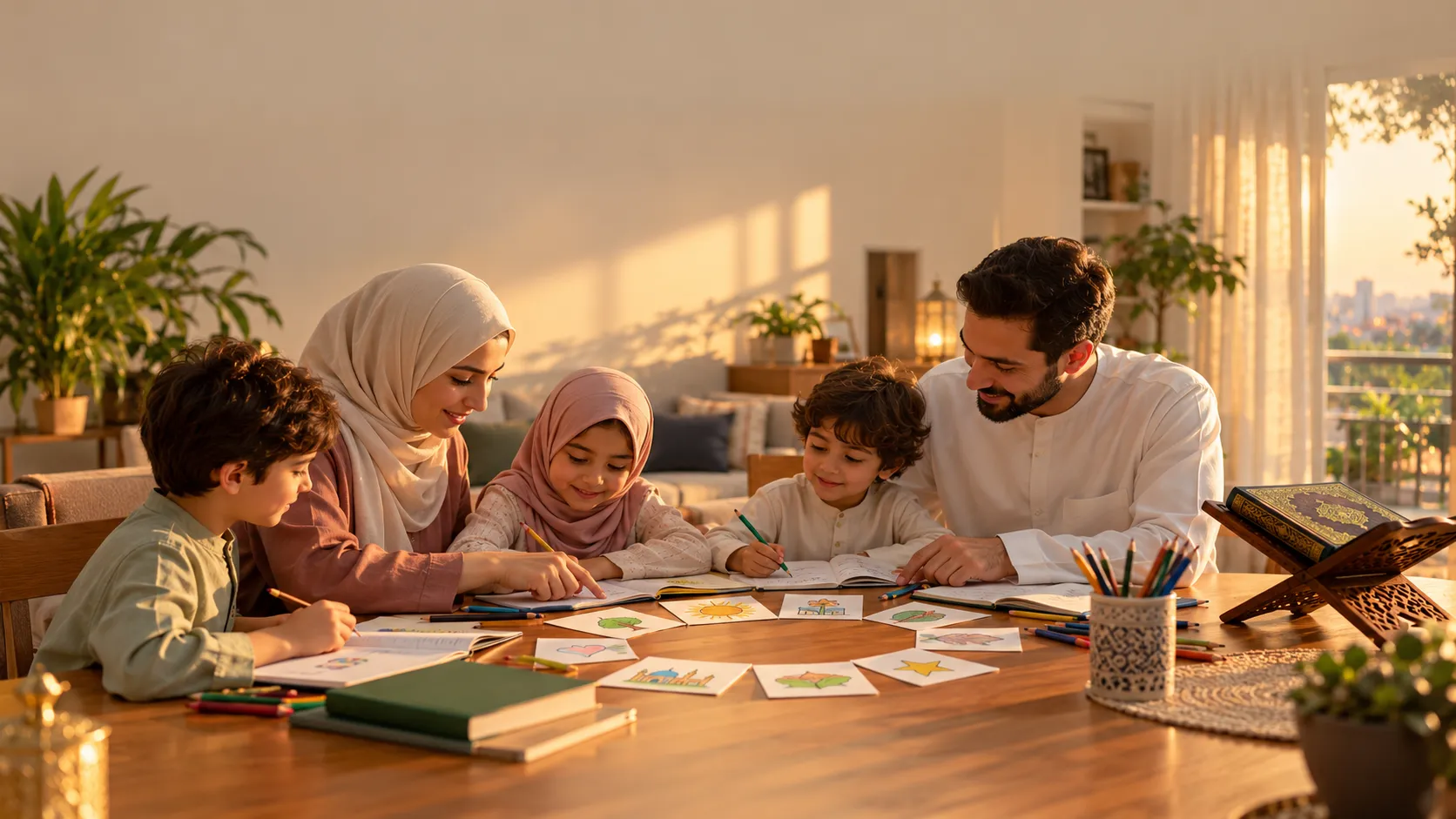
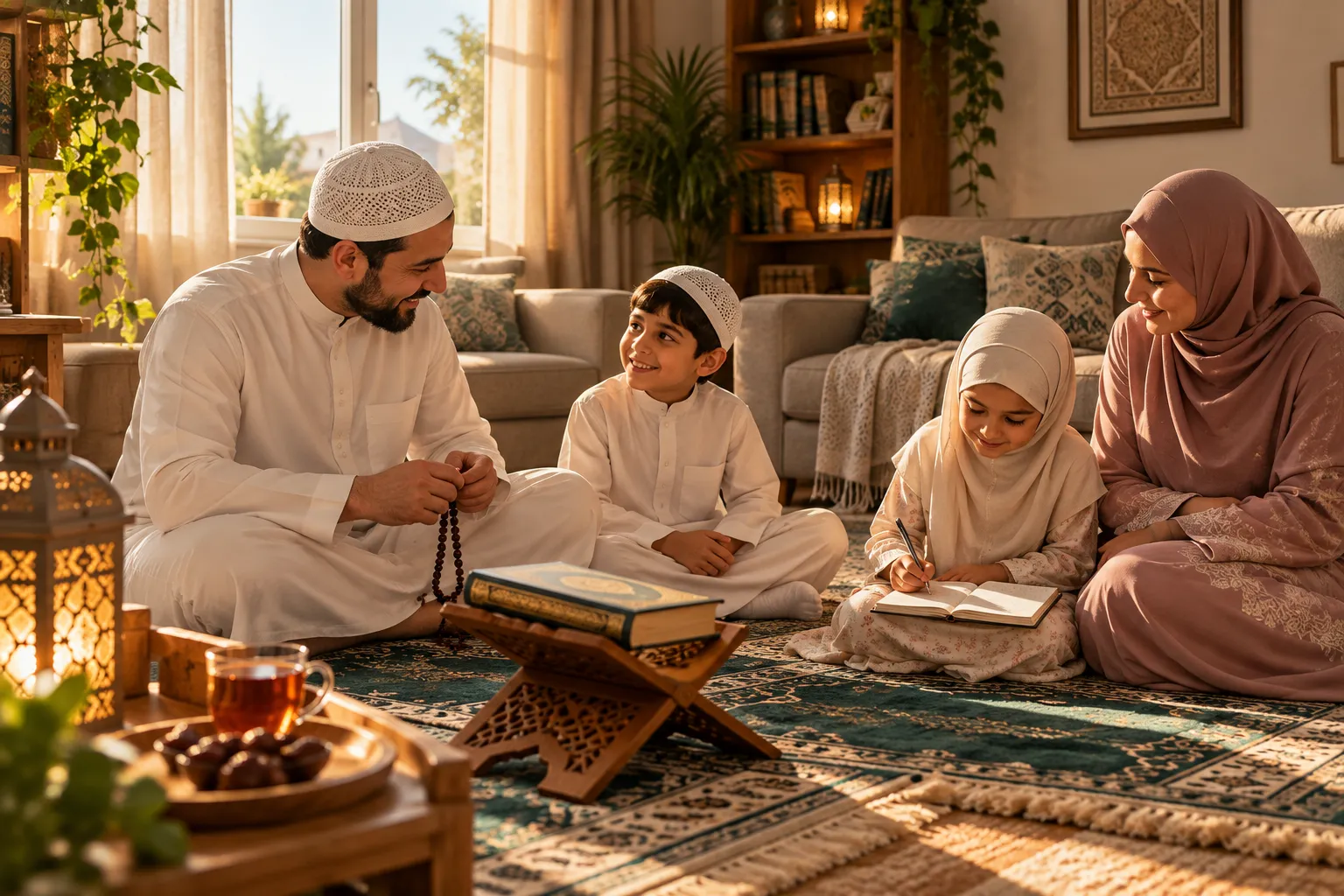
Family Seerah Night. Pick one evening a week for a short story from his life, followed by open discussion.
Bedtime Seerah Stories. Replace one bedtime story a week with a moment from his childhood or youth.
Weekly Sunnah Challenge. Choose one small Sunnah — smiling more, saying salawat, being gentle with a sibling — and practice it as a family for a week.
Memorize a Short Hadith Together. Even a single line, understood and lived, is worth more than pages memorized without meaning.
Keep a Children's Seerah Journal. Let children draw or write one thing they learned about him each week.
Visit an Islamic Library or Bookstore. Let children choose their own age-appropriate Seerah book — ownership builds enthusiasm.
Encourage Every Question. "Did he have a favorite food?" and "Was he ever sad?" are wonderful doorways into deeper understanding. Answer them warmly, even the ones you need to research together.
Discuss After Reading, Don't Just Read. Ask: "What would you have done in that moment?" Reflection makes a story stick.
The goal is never obligation. It's joy — the same joy you'd want your child to feel getting to know any person they love.
Frequently Asked Questions
1. When was Prophet Muhammad ﷺ born? He was born in the Year of the Elephant (around 570 CE), in the month of Rabi' al-Awwal, on a Monday — this last detail confirmed in his own words in Sahih Muslim. The exact date within the month is genuinely disputed among scholars, with the 12th being the most popularly cited and the 8th or 9th considered more likely by some scholars based on historical and astronomical analysis.
2. Where was the Prophet Muhammad ﷺ born? He was born in Makkah, in the Arabian Peninsula, into the Banu Hashim clan of the Quraysh tribe.
3. Who were Prophet Muhammad's ﷺ parents? His father was Abdullah ibn Abdul Muttalib, who passed away before or very shortly after his birth. His mother was Aminah bint Wahb. He was raised in part by his grandfather Abdul Muttalib, and later by his uncle Abu Talib.
4. What does Mawlid mean, and is celebrating it required in Islam? Mawlid refers to the birth of the Prophet ﷺ and, in many communities, to gatherings held in his honor. Scholars have genuinely differed on whether organizing formal annual celebrations is recommended or best avoided. What all scholars agree on is that loving, studying, and following the Prophet ﷺ is essential — regardless of one's view on the celebration itself.
5. How can I teach my child to love Prophet Muhammad ﷺ? Start small and stay consistent: a weekly Seerah story, sending salawat together, connecting his Sunnah to daily life, and welcoming every question your child asks. Love grows through repetition and warmth, not through a single lesson.
6. What is the best age to start teaching a child about the Prophet's ﷺ life? There is no single "correct" age — even toddlers can enjoy simple stories about his kindness to children and animals. As children grow, the same stories can be revisited with more historical and spiritual depth.
7. Why is Prophet Muhammad ﷺ called "a mercy to the worlds"? This phrase comes directly from the Quran (Surah Al-Anbiya, 21:107), reflecting the belief that his message was sent not for one people or era, but as guidance and mercy for all of humanity, for all time.
Conclusion: A Story Worth Retelling All Year
The story of Prophet Muhammad's ﷺ birth is, at its heart, a story about hope arriving in a hard place — an orphaned child, born into a fractured world, who grew to become, in the Quran's own words, a mercy to all the worlds.
That story doesn't belong only to Rabi' al-Awwal. It belongs in your home in Ramadan, in Muharram, on an ordinary Tuesday evening when your child asks an unexpected question about him.
Every story you share, every salawat you send together, every small Sunnah you practice as a family is a way of keeping that promise: I want my children to know him better.
That desire, gently and consistently acted upon, is one of the greatest gifts a Muslim parent can give.
Araby Academy's Quran and Islamic studies programs are built to help families nurture exactly this kind of lasting love — for Allah, for the Quran, and for the example of His final Messenger ﷺ.