A beginner opens Surah al-Baqarah and meets the word كُتِبَ (Quran 2:183). Expecting an English-style dictionary, they search under the letter Kaf and find little help. An early Arabic scholar would point them to the root ك ت ب (k-t-b), and one classical dictionary might send them to the last root letter, Ba. Why would a dictionary work this way? Who invented these systems? And how did scholars preserve the meanings of Arabic words?
Short answer: Arabic dictionaries developed from early efforts to explain vocabulary, preserve Arabic usage, and study the language of the Quran. Kitab al-’Ayn, associated with the eighth-century scholar al-Khalil ibn Ahmad, is often regarded as the first systematic comprehensive Arabic lexicon, although the authorship of its transmitted text is debated. Later scholars arranged words by other systems, including final-root-letter order, and wrote specialist works on difficult Quranic words. These books remain valuable, but understanding an Ayah also requires grammar, context, and reliable Tafsir.
Why Did Early Scholars Begin Collecting Arabic Words?
The Quran mattered enormously: readers needed to understand its wording, including rare vocabulary. But it was never the only cause. Grammar, poetry and older usage, the spread of Islam, growing cities, administration, and the participation of non-native speakers all created demand for organized linguistic knowledge. Basra and Kufa became early centers of grammar, philology, poetry, Quranic readings, and language collection, though dictionary authors came from many places.
Scholars gathered evidence from Quranic wording, poetry, and reported speech, including speech of communities their methods treated as authoritative. Those judgments belong to the scholars themselves; they are not modern linguistic facts about “pure” Arabic.
Key Terms
Mu’jam (مُعْجَم): today’s usual word for a dictionary or lexicon. Early books were not all titled this way.
Lughah (لُغَة): language or linguistic usage. In a title such as Tahdhib al-Lugha it names the subject; its sense varies between texts.
Lexicography: compiling and studying dictionaries: collecting words, organizing entries, explaining meanings, documenting usage, comparing derivatives, and sometimes judging disputed reports.
Jadhr (جَذْر), root: the consonantal core of related words, commonly three consonants, as in ك ت ب. Quadriliteral roots and weak letters exist, so there is no universal three-letter rule.
Radical: a consonant belonging to the root, unlike prefixes, pronoun suffixes, or plural endings.
Wazn (وَزْن): a morphological pattern. The root is not the whole written word.
Shahid (شَاهِد): a supporting attestation: a Quranic usage, a line of poetry, or an expression. Citations do not all carry equal weight.
What Is Gharib al-Quran, and How Is It Different from a Dictionary?
Gharib al-Quran (غَرِيبُ الْقُرْآن) is the study of Quranic words that may be unfamiliar or difficult for particular readers. It does not mean the Quran is foreign or incomprehensible. A general lexicon documents Arabic broadly; a Gharib work explains Quranic vocabulary; a grammar book analyzes sentence roles; a Tafsir interprets verses. They overlap, but they are different genres, and Gharib works do not share one layout: some follow Surah order, others roots or the alphabet.
10 Milestones in the History of Arabic Dictionaries
Period | Scholar or tradition | Work | Contribution | Quranic connection |
|---|---|---|---|---|
1st–2nd c. AH | Early exegetes, incl. Ibn ’Abbas | Transmitted explanations | Word glosses | Direct |
d. c. 170–175 AH / 8th c. CE | al-Khalil | Kitab al-’Ayn | Phonetic root lexicon | Indirect |
d. c. 209 AH / 824 CE | Abu ’Ubayda | Majaz al-Quran | Linguistic explanation | Direct |
d. 276 AH / 889 CE | Ibn Qutayba | Tafsir Gharib al-Quran | Surah-ordered glossary | Direct |
d. 321 AH / 933 CE | Ibn Duraid | Jamharat al-Lugha | Alphabetical framework, root grouping | Indirect |
d. 370 AH / 980 CE | al-Azhari | Tahdhib al-Lugha | Source criticism | Indirect |
d. 395 AH / c. 1004 CE | Ibn Faris | Maqayis al-Lugha | Root semantics | Indirect |
c. 393–400 AH / c. 1003–1010 CE | al-Jawhari | Al-Sihah | Final-radical order | Indirect |
5th c. AH / 11th c. CE | al-Raghib | Al-Mufradat | Quranic root lexicon | Direct |
d. 711 AH / 1311 CE | Ibn Manzur | Lisan al-’Arab | Large compilation | Indirect |
1. Early Quranic Word Explanations Before Comprehensive Dictionaries
Tradition: early Quranic exegesis, including ’Abd Allah ibn ’Abbas (عَبْدُ اللَّهِ بْنُ عَبَّاس, died c. 68 AH / 687 CE). Period: first–second centuries AH. Type: transmitted explanations, not a dictionary.
Before any large lexicon, scholars explained words orally and in notes, using familiar Arabic speech and poetry. Later sources attribute many lexical explanations to Ibn ’Abbas, and collections such as the Masa’il Nafi’ ibn al-Azraq are linked to his name. These attributions are reported by later writers, and each collection needs separate evaluation; no surviving dictionary can be called his autograph. Gharib al-Quran gradually became a specialized field.
Consider Quran 80:31–32: وَفَاكِهَةً وَأَبًّا مَتَاعًا لَّكُمْ وَلِأَنْعَامِكُمْ. Classical commentators connect أَبًّا (abban) with pasture or fodder, which suits the mention of livestock in the next verse. Yet a gloss is not a complete Tafsir.
The early effort to explain difficult Quranic vocabulary also belongs within the Quranic Sciences that support understanding and interpreting the Quran, because lexical explanation developed alongside several other scholarly disciplines.
Takeaway: the earliest question was not “Where is the entry?” but “What does this word mean in this passage?”
2. Al-Khalil ibn Ahmad and Kitab al-’Ayn: The Dictionary That Started with a Sound
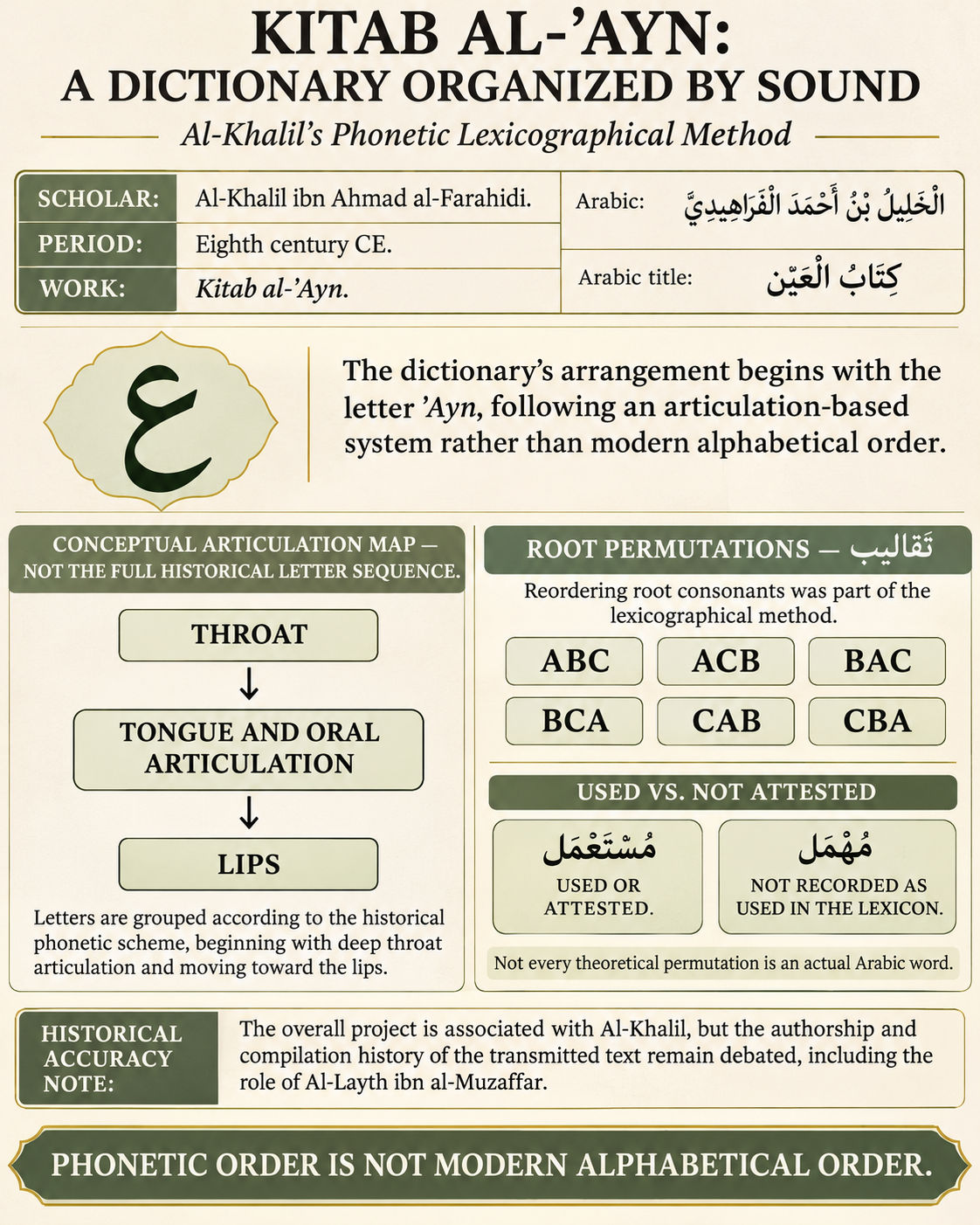
Scholar: al-Khalil ibn Ahmad al-Farahidi (الْخَلِيلُ بْنُ أَحْمَدَ الْفَرَاهِيدِيّ), of Basra; traditionally died 175 AH / 791 CE, though sources give slightly earlier dates. Work: كِتَابُ الْعَيْن, Kitab al-’Ayn, a comprehensive root lexicon.
It is often regarded as the first systematic comprehensive Arabic dictionary. That claim needs qualifying: explanations and word lists existed earlier. Its famous innovation is phonetic arrangement. Instead of modern alphabetical order, letters follow articulation points, starting from the throat and moving toward the lips. The book begins with ع (’Ayn), the deepest consonant in that scheme, and takes its name from this letter, not from the word ’ayn (eye, spring). Later reports about the choice of the opening letter should be read as reports.
Its method includes taqalib (تَقَالِيب), grouping every rearrangement of a root’s radicals together. Abstract radicals A-B-C yield six: ABC, ACB, BAC, BCA, CAB, CBA. Entries were classified as musta’mal (مُسْتَعْمَل, used) or muhmal (مُهْمَل, unused). Not every permutation was an attested word, and “unused” within the lexicon is not “impossible” in every Arabic variety.
Authorship is the major caution. The plan is widely associated with al-Khalil, but later reports name al-Layth ibn al-Muzaffar as a compiler or completer, and scholars such as Ramzi Baalbaki and Kees Versteegh discuss the transmitted text’s history. There is no unanimous agreement that al-Khalil wrote every surviving entry. He is also associated with grammar, prosody, and phonetic observation, but those are not parts of the dictionary.
Al-Khalil’s root-based project becomes easier to appreciate when learners understand [ how Arabic roots connect families of Quranic words], although locating a root does not automatically establish the intended meaning of every derived form.
Takeaway: lexicography became a system for examining words through sounds, roots, patterns, and usage evidence.
3. Abu ’Ubayda and Majaz al-Quran: Explaining the Quran’s Language
Scholar: Abu ’Ubayda Ma’mar ibn al-Muthanna (أَبُو عُبَيْدَةَ مَعْمَرُ بْنُ الْمُثَنَّى), commonly died 209 AH / 824 CE. Work: مَجَازُ الْقُرْآن, Majaz al-Quran, early linguistic commentary.
Majaz is often explained from the root ج و ز, “to pass across”: an expression is explained by passing to its sense or paraphrase. The book treats vocabulary, idiom, syntax, and rhetorical structures, comparing Quranic wording with Arabic usage and poetry. Poetry served as linguistic evidence, never as revelation. Majaz here is not simply the later narrow category of metaphor; modern scholars read the term’s early meaning with nuance, and no single formula is universally agreed.
Kitab al-’Ayn is a broad lexicographical project; Majaz al-Quran explains Quranic language. Both belong to linguistic scholarship, but they are different genres.
Abu ’Ubayda’s terminology also provides historical context for [ Quranic metaphors, parables, and other Arabic rhetorical images], while reminding readers that the meaning of the word Majaz evolved across different scholarly disciplines.
Takeaway: a dictionary, a linguistic commentary, and a rhetoric treatise may share evidence, so identify the type of work first.
4. Ibn Qutayba and Tafsir Gharib al-Quran: A Glossary Following the Surahs
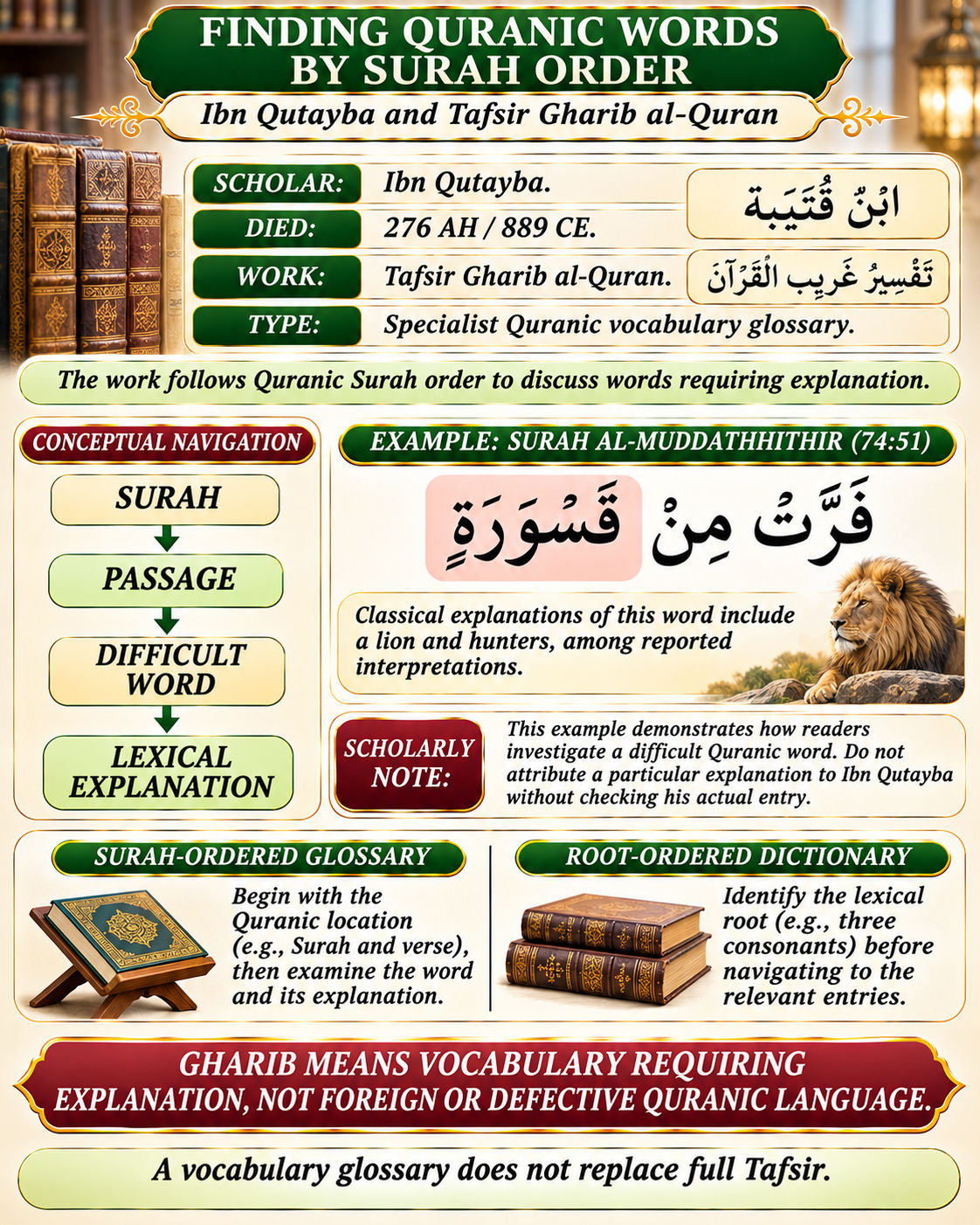
Scholar: ’Abd Allah ibn Muslim ibn Qutayba (ابْنُ قُتَيْبَةَ), died 276 AH / 889 CE. Work: تَفْسِيرُ غَرِيبِ الْقُرْآن, Tafsir Gharib al-Quran, “Explanation of Difficult Quranic Words,” a specialist glossary.
It explains difficult words in Surah order, so a learner can begin with a passage and find relevant vocabulary. That differs from a root-organized lexicon, where one must first identify the root. Despite its title, it is not a full verse-by-verse Tafsir covering every aspect of every Ayah. Gharib here marks vocabulary needing explanation, not foreign revelation, bad Arabic, or a secret code.
Take قَسْوَرَةٍ in Quran 74:51 (فَرَّتْ مِن قَسْوَرَةٍ). Classical sources preserve more than one explanation, such as a lion or hunters, so no single universal meaning should be asserted. We make no claim here about Ibn Qutayba’s specific entry without checking his text.
Ibn Qutayba’s work also shows why Tafsir provides information beyond an English translation, since even a short explanation of difficult vocabulary depends on knowing what the Quranic passage actually says.
Takeaway: some works are easier to consult by Surah and Ayah than by root; organization follows the author’s purpose.
5. Ibn Duraid and Jamharat al-Lugha: Rethinking How Arabic Words Were Organized
Scholar: Ibn Duraid (ابْنُ دُرَيْد), traditionally died 321 AH / 933 CE. Work: جَمْهَرَةُ اللُّغَة, Jamharat al-Lugha, a general lexicon.
Ibn Duraid kept root analysis and permutations but used a more familiar alphabetical framework, grouping material by structure such as root length. It was neither an identical modern A-to-Z dictionary nor a complete break from al-Khalil’s methods. Specialist scholarship should be consulted for its exact arrangement, and we make no claims here about his selection of common or rare words or entry counts.
Arrangement shapes the reader’s experience. A scholar may preserve advanced root analysis while making words easier to find, but a later dictionary is not automatically easier to use.
Take كِتَاب (kitab) and كُتُب (kutub): the visible letters shift, yet both belong to ك ت ب. Likewise بَاب (bab) and أَبْوَاب (abwab) gain an initial alif in the plural, and their root is a weak one (advanced). A root lexicon therefore asks the reader to look beneath the surface form.
The movement from Kitab to Kutub or Bab to Abwab makes the Arabic plural patterns that change how Quranic words are formed especially relevant to dictionary use, because the visible plural may not preserve the singular’s exact letter pattern.
Takeaway: morphology makes historical dictionary search easier, because forms must be traced to their lexical bases.
6. Al-Azhari and Tahdhib al-Lugha: Collecting and Critically Evaluating Arabic
Scholar: Abu Mansur al-Azhari (أَبُو مَنْصُورٍ الْأَزْهَرِيّ), died 370 AH / 980 CE. Work: تَهْذِيبُ اللُّغَة, Tahdhib al-Lugha, a large lexicon whose title suggests refining or revising, arranged on al-Khalil’s phonetic principle.
Accounts of his life, including his own, report travel and a period among Bedouin tribes, where he listened to speech directly. We should treat these as reported accounts. He also criticized earlier material, including parts of the transmitted Kitab al-’Ayn.
Lexicographers faced genuine questions. Was a word attested? Who used it? Was the reported form reliable? Did earlier authorities agree? Could a manuscript contain errors? What examples supported the meaning? This is source criticism, not modern statistics or peer review. Historical scholars also applied their own criteria for authoritative usage; we should describe those criteria without assuming any community spoke unchanged Arabic forever.
An attested usage, a dictionary gloss, and a contextual Quranic interpretation are three different things; an attestation does not automatically determine a verse’s meaning.
Al-Azhari’s attention to linguistic evidence helps explain why Quran translations can differ when Arabic words have multiple attested uses, because choosing the meaning that fits an Ayah requires more than selecting the first dictionary gloss.
Takeaway: a definition is an argument supported by usage and sources, not a random equivalent.
7. Ibn Faris and Maqayis al-Lugha: Finding Relationships Among Root Meanings
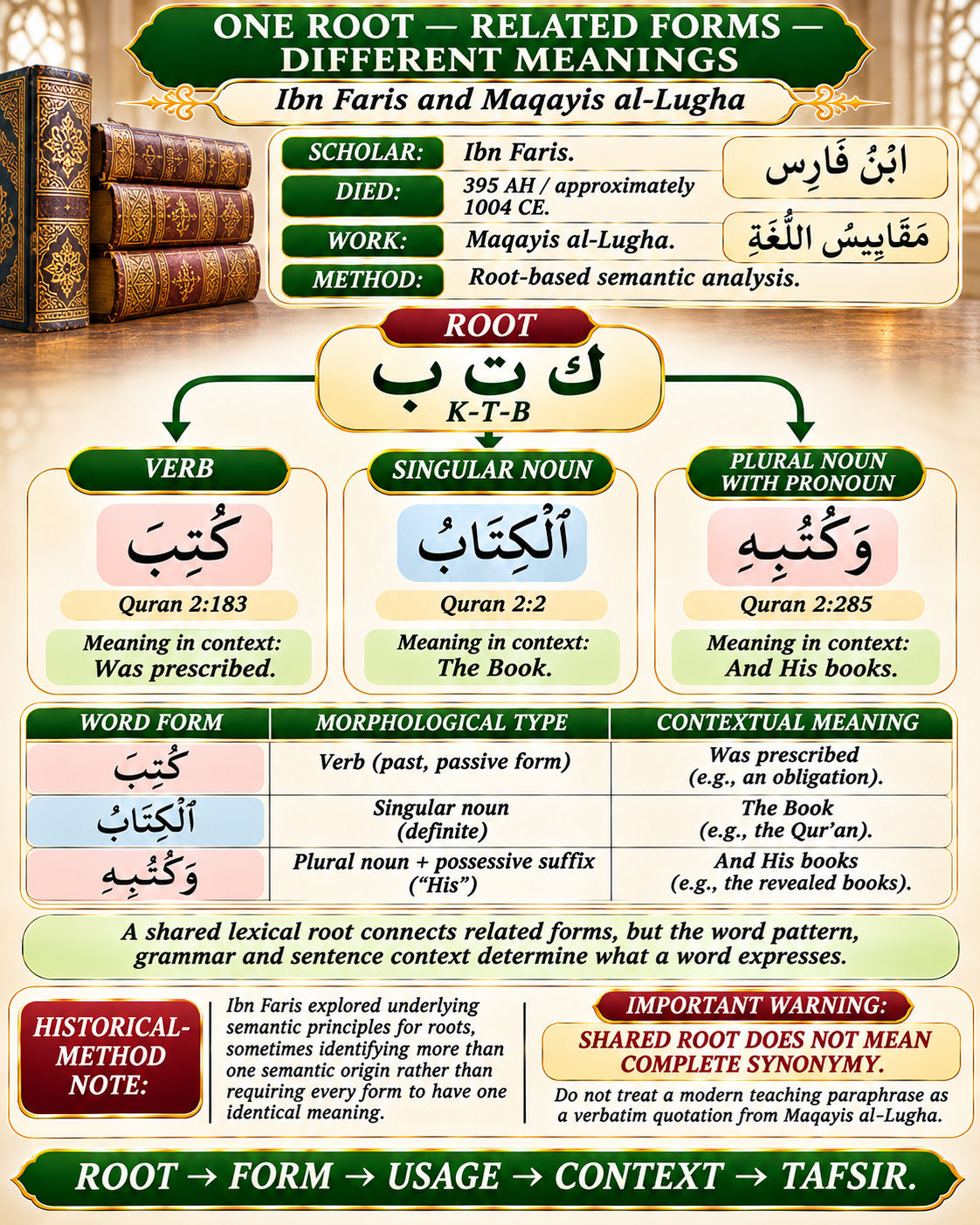
Scholar: Ibn Faris (ابْنُ فَارِس), traditionally died 395 AH / c. 1004 CE. Work: مَقَايِيسُ اللُّغَة, Maqayis al-Lugha, “Standards of Language,” a root-semantics lexicon, not a bilingual dictionary.
Ibn Faris often proposes underlying semantic principles for a root and explains how derived words relate to them. Crucially, he does not reduce every root to one essence: a root may have more than one origin, and other usages may be treated as exceptions. The false rule “every root has exactly one meaning expressed by every derivative” is not his method. His analysis is a scholarly method, not an infallible law.
Take ك ت ب: كُتِبَ (2:183), الْكِتَابُ (2:2), and كُتُبِهِ (2:285). My own paraphrases: kutiba “was prescribed,” al-Kitab “the Book,” kutubihi “His books.” They are morphologically related yet look unrelated in English. A common root shows relationship; it does not prove synonyms, one fixed spiritual meaning, knowledge of every Quranic interpretation, or authority over a verse’s grammar.
Ibn Faris’s approach is easier to apply when students understand the difference between Nahw and Sarf in Quranic Arabic, since a lexical root connects word forms while sentence grammar helps determine their meaning in context.
Takeaway: a root is a starting point for investigation, not a final interpretation.
8. Al-Jawhari and Al-Sihah: Why Some Dictionaries Start with a Word’s Last Root Letter
Scholar: Abu Nasr Isma’il ibn Hammad al-Jawhari (أَبُو نَصْرٍ الْجَوْهَرِيّ), died around the turn of the fourth–fifth century AH; sources differ, so no single year is certain. Work: الصِّحَاح, Al-Sihah, commonly given the fuller title تَاجُ اللُّغَةِ وَصِحَاحُ الْعَرَبِيَّة, a general lexicon concerned with sound usage, not Quranic words only.
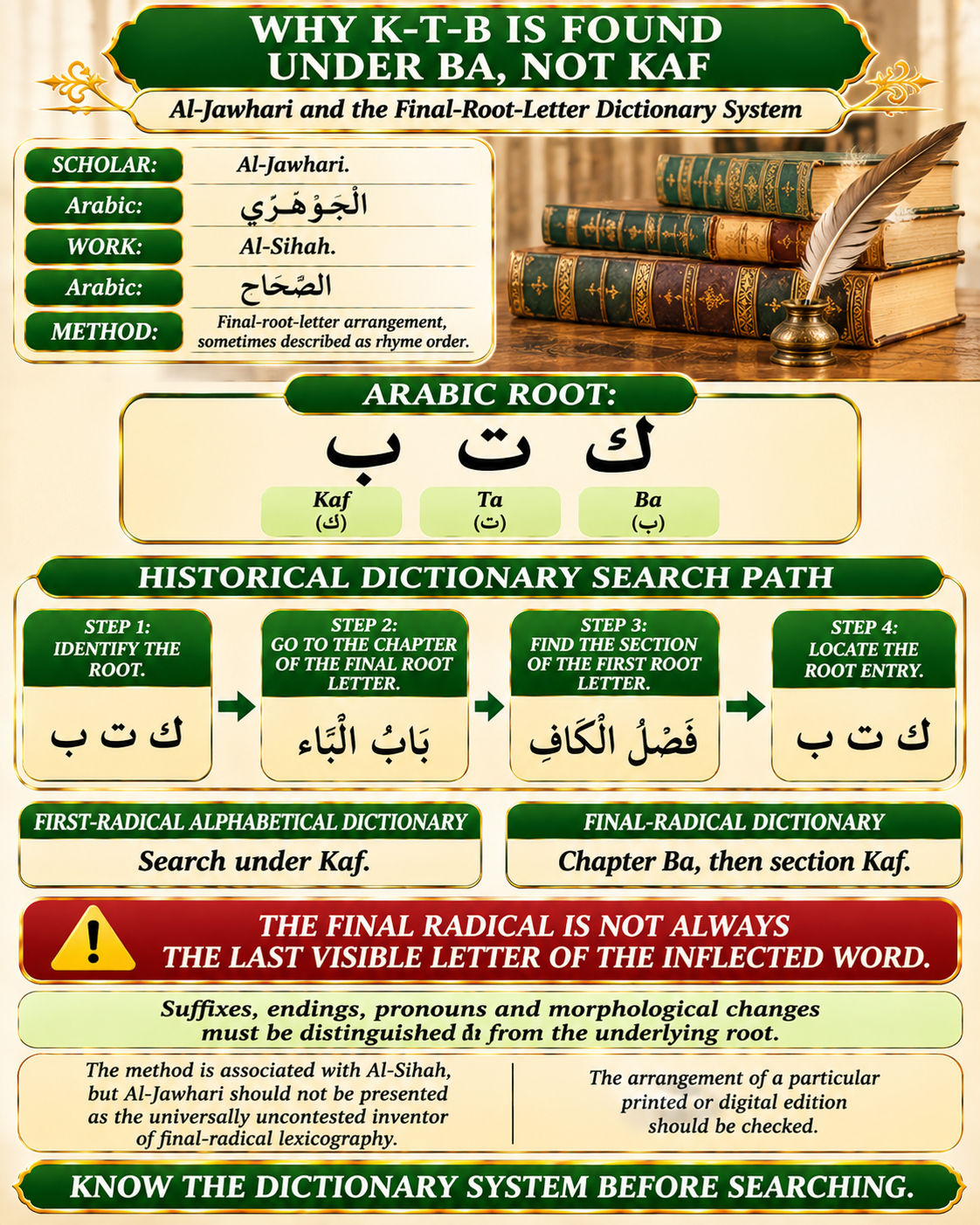
It uses the final radical of the root as its main organizing principle, often called rhyme order: a chapter for each last radical, then sections by first radical. For ك ت ب the first radical is ك (Kaf), the second ت (Ta), and the final ب (Ba). The reader goes to the Ba chapter, then the Kaf section. This differs from sorting by the last visible letter of an inflected word, and edition details should be checked. No single motive explains the system.
Predecessors and influences remain debated. Names in the discussion include al-Bandaniji and al-Farabi, author of Diwan al-Adab, so al-Jawhari should not be called the indisputable inventor of rhyme-order lexicography.
The final-root-letter arrangement of Al-Sihah should not be confused with [ the Arabic science of Fawasil and Quranic verse endings], since a dictionary’s rhyme order and the sound patterns of Quranic Ayat are different topics.
Takeaway: check how a dictionary organizes entries first; otherwise you can know the right root and search the wrong section.
9. Al-Raghib al-Isfahani and Al-Mufradat: A Dictionary Focused on Quranic Vocabulary
Scholar: al-Raghib al-Isfahani (الرَّاغِبُ الْأَصْفَهَانِيّ), fifth century AH / eleventh century CE; later dates such as c. 502 AH / 1108 CE are also given. Work: الْمُفْرَدَاتُ فِي غَرِيبِ الْقُرْآن, Al-Mufradat fi Gharib al-Quran, a specialized Quranic lexicon, not a modern “Quran vocabulary” textbook.
The work studies Quranic words through roots, derivatives, related senses, and Quranic occurrences, with attention to subtle distinctions. Its entries follow an alphabetical framework by root, though editions and digital versions may present it differently. Not every distinction a lexicographer draws is universally accepted.
For example, a learner meeting هُدًى (2:2) can trace its root ه د ي, compare other Quranic occurrences, and read al-Raghib’s explanation. This is an educational suggestion, not a quotation.
Al-Mufradat focuses on Quranic vocabulary; Lisan al-’Arab is a vast general lexicon of Classical Arabic. Their goals and coverage differ. English translations may use overlapping words for different Arabic terms, but no universal rule says how two Arabic words always differ.
Al-Raghib’s attention to lexical nuance makes [ Quranic Arabic word pairs that appear similar in English but differ in usage] a useful next subject, provided readers avoid turning contextual differences into rigid dictionary formulas.
Takeaway: find the entry, list possible meanings, examine the Quranic use, then read reliable Tafsir. Do not stop at the first gloss.
10. Ibn Manzur and Lisan al-’Arab: Preserving Centuries of Arabic Scholarship
Scholar: Ibn Manzur (ابْنُ مَنْظُور), Muhammad ibn Mukarram, died 711 AH / 1311 CE. Work: لِسَانُ الْعَرَب, Lisan al-’Arab, an encyclopedic lexicon of Classical Arabic. It was not the first Arabic dictionary.
Ibn Manzur drew extensively on earlier works, commonly including al-Azhari’s Tahdhib al-Lugha, Ibn Sidah’s Al-Muhkam, al-Jawhari’s Al-Sihah, Ibn Barri’s commentary correcting Al-Sihah, and Ibn al-Athir’s Al-Nihayah. Collecting, preserving alternative explanations, consolidating references, and organizing a huge body of vocabulary is a real intellectual achievement, not mere copying. The arrangement follows the final-radical tradition, but modern digital editions may rearrange it.
Today’s student can identify the root, find the entry, read several explanations, notice citations, compare usage, check another lexicon, and consult Tafsir. One long copied paragraph is not understanding. Lisan does not settle every Qira’ah issue, legal view, theological dispute, historical report, or verse’s complete meaning.
Modern students can turn this history into a practical habit by following [ a step-by-step roadmap for learning Quranic Arabic from scratch], combining dictionary searches with morphology, grammar, and reliable Tafsir.
Takeaway: distinguish the original source, the later compilation, the printed edition, and the digital interface.
Three Ways Classical Arabic Dictionaries Organized Words
Method | Work | Organization | Beginner search | Caution |
|---|---|---|---|---|
Phonetic order | Kitab al-’Ayn | By articulation point, throat to lips; permutations grouped | Identify the root, then find its radicals’ sound-based section | Not modern ABC |
Alphabetical root-centered | Jamharat al-Lugha; Al-Mufradat | Roots under alphabetical framework | Use the first radical, then follow the next radicals | Internal structure varies |
Final-root-letter | Al-Sihah; Lisan al-’Arab | Chapter by last radical, section by first | For ك ت ب: Ba chapter, Kaf section | Not the final printed letter |
Real methods were more diverse than these three categories, and they coexisted rather than replacing one another.
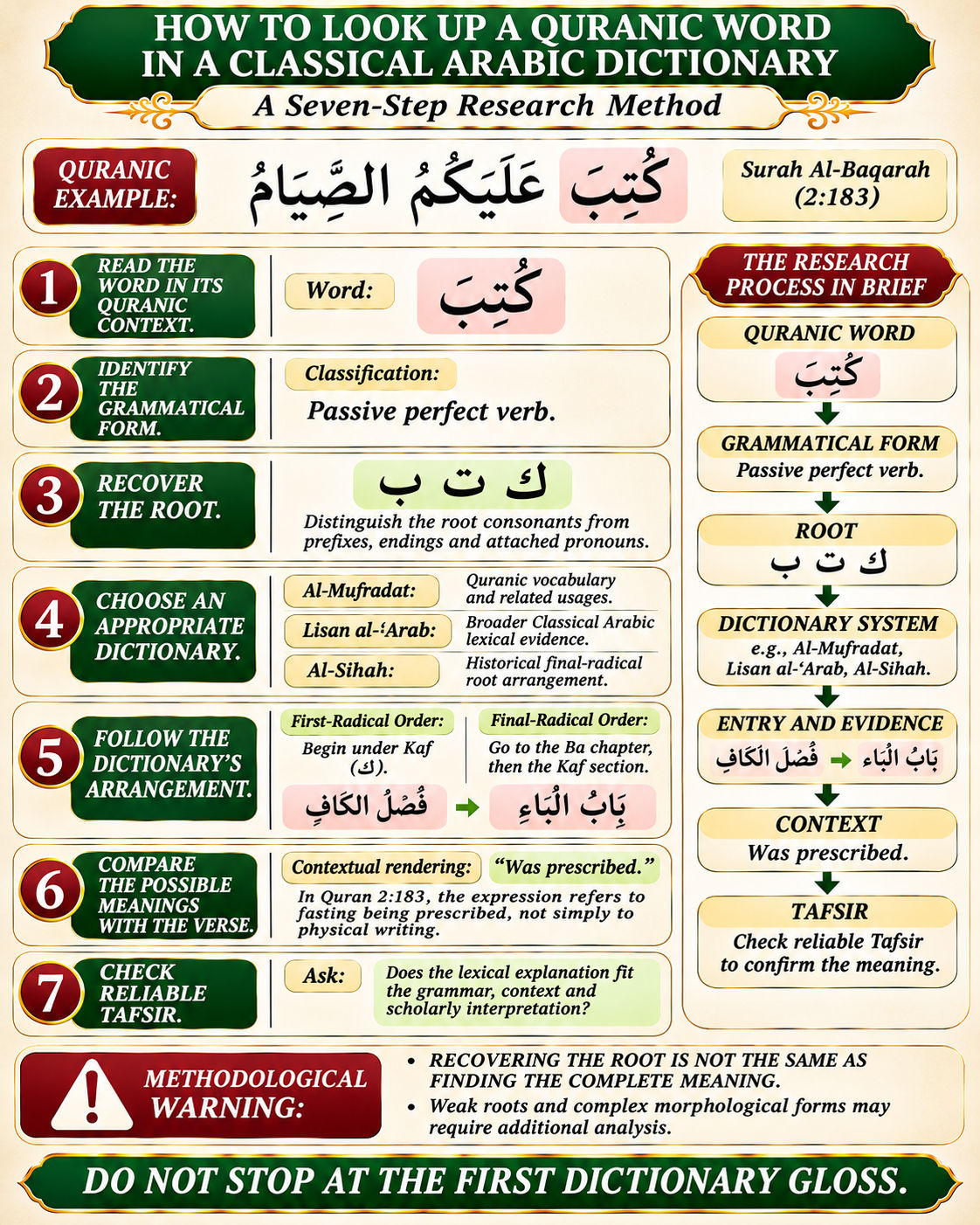
How to Look Up a Quranic Word in a Classical Dictionary
Take كُتِبَ عَلَيْكُمُ الصِّيَامُ (Quran 2:183).
Read the verse and note the full Arabic word, كُتِبَ.
Identify its form: a passive verb.
Recover the root: ك ت ب. Radicals differ from affixes; here, nothing is attached.
Choose a dictionary: Al-Mufradat for Quranic usage, Lisan for broad evidence.
Use its arrangement: Ba then Kaf in Al-Sihah or Lisan; Kaf in a first-radical dictionary.
Compare the entry with the verse and linguistic evidence. Here the verb is commonly rendered “prescribed,” not merely “written.”
Consult Tafsir and note disagreements.
The weak-letter problem: removing the first or last letter does not always reveal the root, and advanced examples need expert morphology.
Quranic word | Verse | Root | Form | Dictionary | Context note |
|---|---|---|---|---|---|
كُتِبَ | 2:183 | ك ت ب | passive verb | Al-Sihah | prescribed |
الْكِتَاب | 2:2 | ك ت ب | noun with article | Al-Mufradat | the Book |
كُتُبِهِ | 2:285 | ك ت ب | plural + pronoun | Lisan | His books |
عَيْنٌ | 88:12 | ع ي ن | noun | Lisan | spring |
أَبًّا | 80:31 | أ ب ب | noun | Gharib glossary | fodder |
What Arabic Dictionaries Can and Cannot Tell You
Source | Purpose | Cannot establish alone |
|---|---|---|
General lexicon | Meanings, forms, usage | Verse interpretation |
Gharib glossary | Explains Quranic words | Full Tafsir |
Linguistic Tafsir | Language and meaning | Every grammatical detail |
Grammar book | Sentence roles | Lexical range |
Quranic Arabic Corpus | Root, form, occurrences | Tafsir by tag |
Boundaries overlap. One written word can carry different meanings: عَيْن is an eye in وَالْعَيْنَ بِالْعَيْنِ (5:45) and a spring in فِيهَا عَيْنٌ جَارِيَةٌ (88:12). The letter ع in Kitab al-’Ayn is a separate matter. In وَاللَّيْلِ إِذَا عَسْعَسَ (81:17), classical discussions of the verb involve different explanations of the night’s movement, so the dictionary alone does not settle it. Commentators, grammar, Qira’at where relevant, and translators’ choices are distinct evidence.
After Ibn Manzur, the tradition continued: al-Zamakhshari’s Asas al-Balaghah, al-Firuzabadi’s Al-Qamus al-Muhit, al-Zabidi’s Taj al-’Arus, modern editions, and digital tools. Distinguish medieval manuscripts, later copies, printed editions, and online transcriptions.
Common Myths About Arabic Dictionary History
Myth: nothing explained Arabic words before Kitab al-’Ayn. Reality: earlier explanation and transmission existed.
Myth: Kitab al-’Ayn follows modern alphabetical order. Reality: it is phonetic.
Myth: everyone agrees al-Khalil wrote every entry. Reality: authorship is debated.
Myth: al-Layth’s role is dismissed. Reality: it appears in major discussions and needs attribution.
Myth: Majaz al-Quran is only about metaphor. Reality: its terminology is broader.
Myth: Gharib means the Quran is foreign. Reality: it means vocabulary needing explanation.
Myth: all Quranic glossaries share one arrangement. Reality: Surah order, roots, and other systems occur.
Myth: lexicographers ignored evidence. Reality: attestation was used and debated.
Myth: all words of one root mean the same. Reality: derivatives and contexts differ.
Myth: rhyme-order means the final printed letter. Reality: it means the final root radical.
Myth: Lisan made earlier dictionaries irrelevant. Reality: they remain sources and witnesses.
Myth: a dictionary settles Quranic interpretation. Reality: Tafsir, grammar, and context remain necessary.
Five errors to avoid: searching only by the first visible letter; treating prefixes as root letters; treating derivatives as identical to the root; choosing the first gloss without context; quoting without naming author and edition.
Frequently Asked Questions
1. When did Arabic dictionaries first appear? Explanations of words predate dictionaries. Comprehensive lexicons appear in the second century AH, with Kitab al-’Ayn among the earliest.
2. What was the first Arabic dictionary? Kitab al-’Ayn is often called the first systematic comprehensive Arabic dictionary, but earlier glosses and word lists existed, so “first” needs qualification.
3. Who was al-Khalil ibn Ahmad al-Farahidi? A Basran scholar, died c. 170–175 AH, associated with Kitab al-’Ayn, grammar, prosody, and phonetic observation.
4. Why is Kitab al-’Ayn called the Book of ’Ayn? It is named for its opening letter ع, which begins its articulation-based arrangement.
5. Did al-Khalil write all of Kitab al-’Ayn? Unclear. The plan is associated with him, but al-Layth ibn al-Muzaffar and others appear in discussions of the transmitted text.
6. Why did early scholars study the language of the Quran? To understand its wording and rare vocabulary, alongside grammar, poetry, literature, administration, and Islam’s spread.
7. What does Gharib al-Quran mean? Explanation of Quranic words that may be unfamiliar or difficult for some readers. It does not mean the Quran is foreign.
8. How did Arabic poetry help explain Quranic vocabulary? Scholars treated poetry as evidence of Arabic usage, comparing words and idioms. It was linguistic evidence, not revelation.
9. What is Abu ’Ubayda’s Majaz al-Quran? An early linguistic commentary explaining Quranic vocabulary, idiom, syntax, and rhetorical structures; it is not an alphabetical dictionary.
10. Is Majaz al-Quran only a book about metaphors? No. In early usage majaz was broader than the later narrow rhetorical sense.
11. What did Ibn Qutayba contribute to Quranic vocabulary studies? His Tafsir Gharib al-Quran explains difficult words in Surah order, though it is not a complete Tafsir.
12. How did Ibn Duraid organize Jamharat al-Lugha? He used a more familiar alphabetical framework with root grouping and permutations. It was not identical to modern A–Z order.
13. Why is al-Azhari’s Tahdhib al-Lugha important? It combines wide collection with criticism of earlier reports and sources, showing source evaluation in Arabic lexicography.
14. What is distinctive about Ibn Faris’s Maqayis al-Lugha? It explores semantic principles behind roots, sometimes proposing more than one origin for a root.
15. Why did al-Jawhari organize Al-Sihah by final root letters? He followed a rhyme-order method using the final radical. No single motive is certain, and earlier works are debated as influences.
16. What is Al-Mufradat fi Gharib al-Quran? Al-Raghib al-Isfahani’s Quran-focused lexicon, exploring root-related forms, senses, and subtle usage distinctions.
17. Who wrote Lisan al-’Arab? Ibn Manzur, who died in 711 AH / 1311 CE, compiled it from earlier lexicons.
18. What is the difference between a Quranic lexicon and a general Arabic dictionary? A Quranic lexicon explains Quranic vocabulary; a general dictionary documents wider Arabic usage across periods and genres.
19. Can a Classical Arabic dictionary replace Tafsir? No. It supplies possible meanings and evidence; interpretation also needs context, grammar, Qira’at where relevant, and reliable Tafsir.
20. How can a beginner look up a Quranic word in a historical Arabic dictionary? Identify the word form and root, learn the dictionary’s arrangement, read the entry, then compare with context and Tafsir.
The Scholars Who Helped Preserve Arabic Meaning
The next time you open a classical Arabic dictionary to understand a word in the Quran, you are entering a scholarly tradition built over centuries. Early scholars explained unfamiliar vocabulary, al-Khalil developed a remarkable approach to organizing Arabic roots, later lexicographers refined their methods, and works such as Al-Mufradat and Lisan al-’Arab preserved invaluable linguistic knowledge. Learning how these dictionaries work can make Quranic Arabic less mysterious, but the best understanding still comes from combining vocabulary, grammar, context, and reliable Tafsir.
If you would like to explore Quranic Arabic step by step, you are welcome to learn with qualified Araby Academy teachers in one-to-one online lessons.