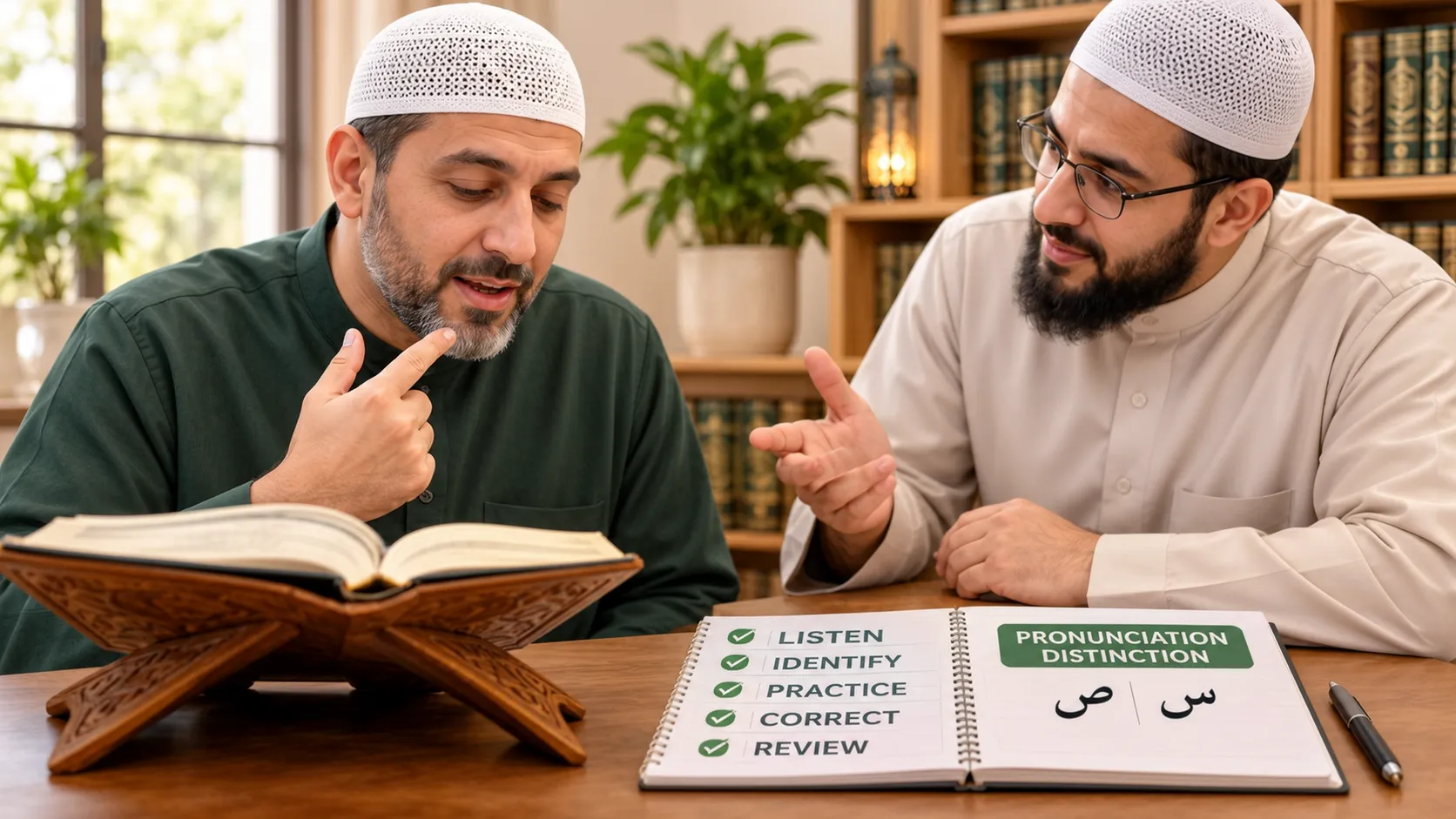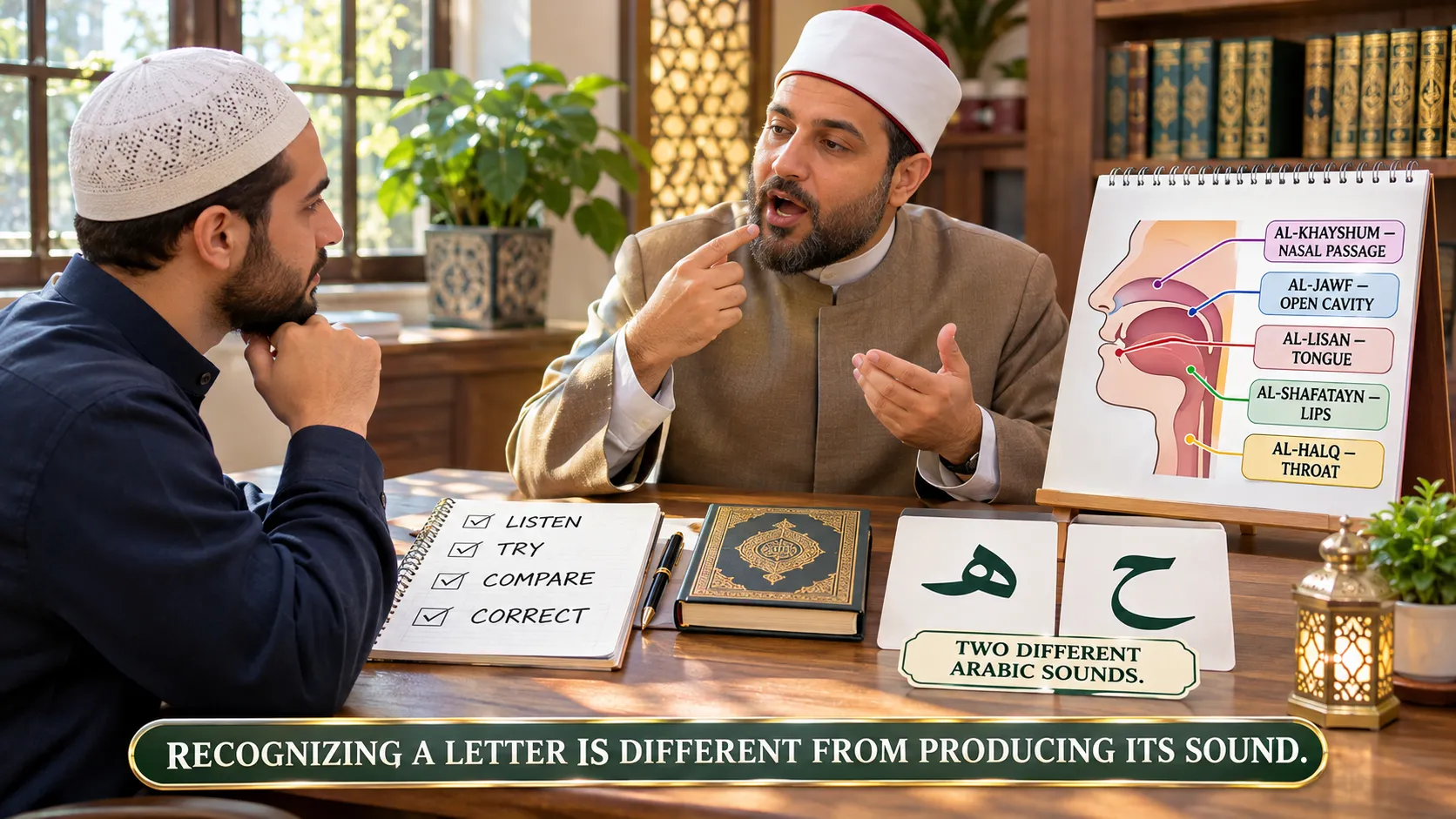
You can read the Arabic alphabet and still hear ح and ه as the same sound. The same can happen with ع and ء, ص and س, ق and ك, or ض and ظ. On the page they look different, but to the ear they may seem almost identical.
The problem is rarely forgetting letter names. Often these sounds need articulation patterns that your first language never trained you to make.
Makharij al-Huruf (مَخَارِجُ الْحُرُوفِ) are the articulation points from which Arabic letter sounds emerge. Learning them helps Quran students understand where sounds are formed and tell apart letters that might otherwise be confused.
Traditional Tajweed organises these points into five major regions: the open cavity (Al-Jawf), the throat, the tongue, the lips, and the nasal passage. The widely taught classification associated with Imam Ibn al-Jazari identifies seventeen specific points within them. Other classical counts exist, and this guide follows the seventeen-point system.
What Does Makharij al-Huruf Mean?
مَخْرَج (Makhraj): a point of emergence or articulation.
مَخَارِج (Makharij): the plural of Makhraj.
حَرْف (Harf): a letter.
حُرُوف (Huruf): letters.
Five things are easy to blur together:
The written letter, such as ق.
The letter's name, Qaf.
The sound it represents.
Its Makhraj, where the sound is articulated.
Its Sifat, the characteristics that distinguish it.
A learner may recognise ق and know it is called Qaf, yet produce it close to ك. Recognition does not guarantee correct production.
Traditional Makhraj and the modern linguistic idea of "place of articulation" are related but not identical frameworks. They were built for different purposes, and this article treats them as complementary.
Why Makharij Matter in Quran Recitation
Arabic distinguishes many words by consonants, so keeping letters distinct preserves clarity. Knowing the Makharij helps you:
Reduce recurring errors.
Support Tajweed learning and memorisation accuracy.
Read more independently.
Give a teacher a clearer way to locate the source of a difficulty.
Some substitutions can change a word, but not every imperfection does. Not every accent difference is a letter substitution, and not every Tajweed error carries the same weight. Questions about the legal consequences of recitation mistakes belong with qualified scholars. A learner should not fear practising.
The Islamic Foundation
Allah says: وَرَتِّلِ الْقُرْآنَ تَرْتِيلًا (Quran 73:4), "And recite the Quran with measured recitation." Commentators generally explain tartil as slow, deliberate, clear recitation that gives letters their due. The Prophet ﷺ is reported to have said, in a hadith narrated by Aisha (may Allah be pleased with her), that the skilled reciter is with the noble, obedient angels, and that the one who recites with difficulty, stumbling over it, receives a double reward (Sahih al-Bukhari 4937; Sahih Muslim 798).
Two principles follow from these texts. Careful recitation deserves serious effort, and a struggling learner should keep going, because the hadith offers encouragement and not an excuse to avoid correction.
The detailed classification of articulation points is a later scholarly systematisation. The Quran and Hadith establish the importance of recitation, not each technical category.
Ibn al-Jazari and the Seventeen Makharij
Shams al-Din Muhammad ibn Muhammad ibn Muhammad ibn Ali ibn Yusuf al-Jazari (c. 751–833 AH / 1350–1429 CE) was a leading authority on Quran recitation, Tajweed and the ten qira'at. He is known for al-Nashr fi al-Qira'at al-Ashr and for his poem al-Muqaddimah al-Jazariyyah, which says:
مَخَارِجُ الْحُرُوفِ سَبْعَةَ عَشَرْ
عَلَى الَّذِي يَخْتَارُهُ مَنِ اخْتَبَرْ
"The articulation points of the letters are seventeen, according to the view chosen by the one who has tested (them)."
Classical scholars discussed other counts. Sibawayh is commonly associated with sixteen, since he does not count Al-Jawf separately. Fourteen is associated with scholars such as al-Farra', who merge some tongue points. These are different ways of grouping the same alphabet, not different alphabets.
Meet Your Speech Organs
Lungs: supply the airflow.
Larynx and vocal folds: the voice box and the folds inside it, which can vibrate to produce voicing.
Throat (pharynx): the passage above the larynx.
Oral cavity: the mouth.
Nasal cavity: where nasal resonance happens.
Tongue: divided into root, back, middle, sides and tip.
Hard palate: the bony roof of the mouth.
Soft palate: the fleshy part behind it.
Upper gums (alveolar ridge): the ridge behind the upper front teeth.
Teeth and lips.
Airflow, voicing, shaping, place and nasal resonance are different jobs. Speech involves coordinated activity, so no sound comes from one organ in isolation. Traditional descriptions name the primary location.
You do not need to touch your throat, insert anything into your mouth, or force your tongue. Stop any exercise that causes pain, strain or breathing difficulty.
The Five Regions at a Glance
Region | Arabic | General location | Makharij | Associated sounds |
|---|---|---|---|---|
Al-Jawf | الْجَوْف | Open cavity of mouth and throat | 1 | Madd Alif, Madd Waw, Madd Ya |
Al-Halq | الْحَلْق | Throat | 3 | ء ه ع ح غ خ |
Al-Lisan | اللِّسَان | Tongue | 10 | 18 letters |
Al-Shafatayn | الشَّفَتَان | Lips | 2 | ف ب م و |
Al-Khayshum | الْخَيْشُوم | Nasal passage | 1 | Ghunnah |
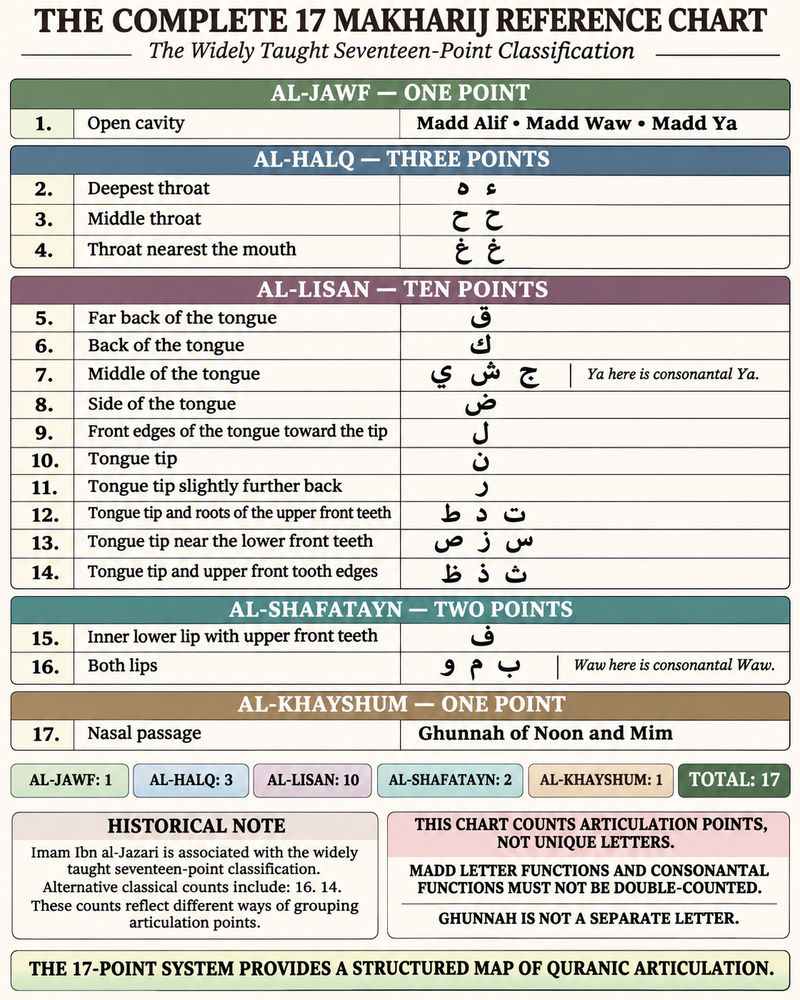
That gives 1 + 3 + 10 + 2 + 1 = 17 points. This is a count of points, not letters. Some forms appear in more than one category by function: Madd Waw versus consonantal Waw, Madd Ya versus consonantal Ya, and Madd Alif versus Hamzah. Ghunnah is not an extra letter.

Region One: Al-Jawf (الْجَوْف)
Al-Jawf is the open space of the mouth and throat through which air flows for the three Madd letters. Unlike the other regions, there is no precise point of contact.
Madd letter | Condition | Example |
|---|---|---|
ا | Alif after a Fathah | قَالَ |
وْ | Silent Waw after a Dammah | يَقُولُ |
يْ | Silent Ya after a Kasrah | قِيلَ |
Short vowels (Fathah, Dammah, Kasrah) pair with long vowels. Not every written Waw or Ya is a Madd letter, because at the start of a syllable they are consonants. Madd Alif is also not Hamzah, which comes from the throat. Madd lengths are covered in a separate article.
Practice: Listen to a qualified reciter and contrast short and long vowels, such as a short "a" against the long one in قَالَ. English vowel spellings only approximate Arabic vowels, so use a recording as your guide.
Region Two: Al-Halq (الْحَلْق)
The throat holds three points and six letters, listed from deepest to nearest the mouth.
Makhraj | Letters | Description | Common confusion |
|---|---|---|---|
Aqsa al-Halq (deepest) | ء Hamzah, ه Ha | Hamzah is a brief closure and release of the voice box (a glottal stop). Ha is a soft breathy sound. | Dropping Hamzah, or making Ha too hard |
Wasat al-Halq (middle) | ع ʿAyn, ح Ḥa | Both are made with a narrowing in the throat. ʿAyn is voiced, and Ḥa is a clear, breathy, whispered sound. | ع as ء, or ح as ه |
Adna al-Halq (nearest the mouth) | غ Ghayn, خ Kha | Back-of-mouth friction. Ghayn is voiced and Kha is breathy. | Using a hard "g" or "k" |
Modern phonetics may call ع and ح pharyngeal, and غ and خ velar or uvular, so classical and modern labels do not match exactly.
Examples: أَنْعَمْتَ (Hamzah and ʿAyn, 1:7), الْحَمْدُ (Ḥa, 1:2), هُدًى (Ha, 2:2), خَلَقَ (Kha, 96:1), غَيْرِ (Ghayn, 1:7). These letters matter for Izhar Halqi, covered in the Noon Sakinah article.
Practice: Compare pairs slowly beside an accurate recording. Never squeeze the throat. A relaxed, small movement is better than force.
Region Three: Al-Lisan (اللِّسَان)
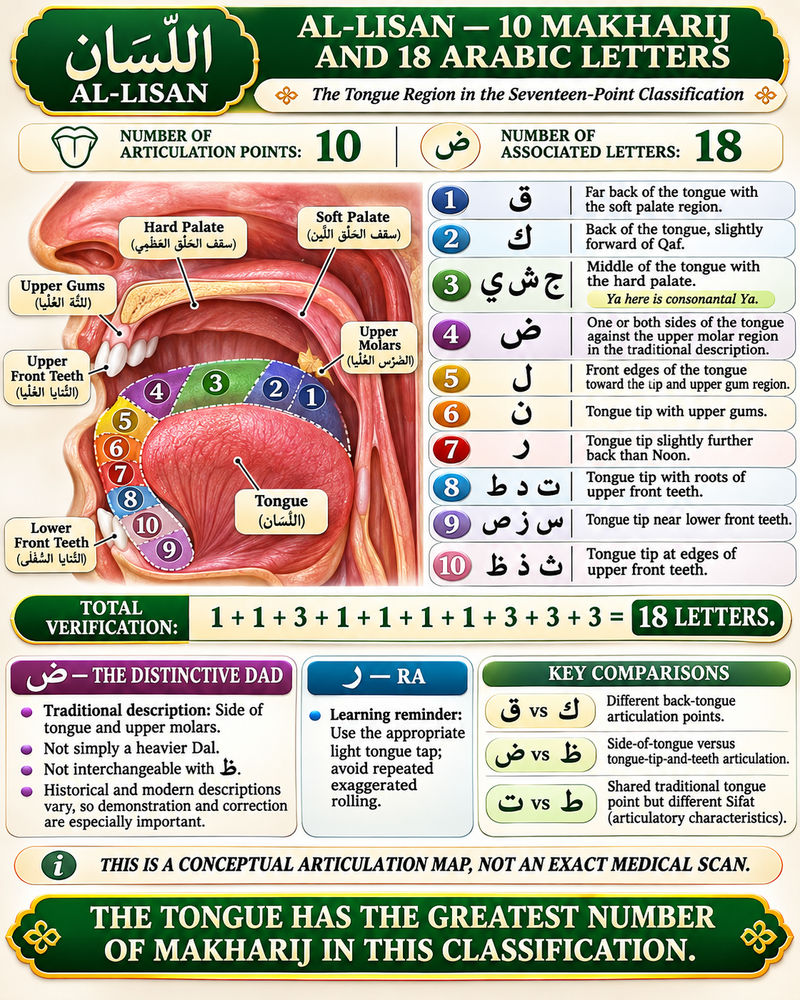
The tongue holds ten points and eighteen letters, listed from back to front.
# | Letters | Tongue part and contact | Notes |
|---|---|---|---|
1 | ق Qaf | Far back of the tongue and the soft palate above | A deep sound, not English "K" |
2 | ك Kaf | Back of the tongue, slightly forward of Qaf, and the palate | Qaf and Kaf differ in location, not just in force |
3 | ج ش ي | Middle of the tongue and the hard palate | Consonantal Ya is not Madd Ya. Do not use a dialect Jim in place of the recitation Jim. |
4 | ض Ḍad | One or both sides of the tongue and the upper molars | See below |
5 | ل Lam | Front edges of the tongue toward the tip, with the upper gums | Heavy in "Allah" after Fathah or Dammah, light after Kasrah |
6 | ن Noon | Tip of the tongue and the upper gums | The oral contact is separate from Ghunnah |
7 | ر Ra | Tip of the tongue, slightly further back than Noon | Has a light inherent tap. Do not exaggerate it. |
8 | ت د ط | Tip of the tongue and the roots of the upper front teeth | Ṭa is a heavy emphatic, not a louder Ta |
9 | س ز ص | Tongue tip near the lower front teeth | Safir (whistling quality). Ṣad is heavy. |
10 | ث ذ ظ | Tongue tip and the edges of the upper front teeth | English "th" is only a starting reference. Ẓa is heavy. |
That makes 1 + 1 + 3 + 1 + 1 + 1 + 1 + 3 + 3 + 3 = 18 letters, so all eighteen tongue letters are accounted for.
On Ḍad: The traditional description places it at the side of the tongue (many teachers say either or both sides) with the upper molars. Its characteristics include heaviness and a lengthening of sound along the tongue's side. It is not a heavy Dal and not the same as ظ. Compare الضَّالِّينَ (1:7) with الظَّالِمِينَ. Because historical and modern descriptions of Ḍad vary, learning it generally needs demonstration and correction from a qualified teacher.
On Ra: Do not roll it repeatedly. Most Ra sounds need only a light tap.
Region Four: Al-Shafatayn (الشَّفَتَان)
ف Fa: the inner part of the lower lip touches the edges of the upper front teeth. The lips themselves do not close.
ب م و: these share the two lips but are produced differently.
Ba: the lips close fully and release.
Mim: the lips close and the sound has nasal resonance.
Consonantal Waw: the lips round without full closure. Madd Waw belongs to Al-Jawf.
Practice: Use a mirror to watch lip closure for ب and م, rounding for و, and lower-lip placement for ف. A mirror cannot show internal movements. Keep movements natural, not exaggerated.
Region Five: Al-Khayshum (الْخَيْشُوم)
Al-Khayshum is the nasal passage, associated with غُنَّة (Ghunnah), the nasal resonance of Noon and Mim. Noon is articulated at the tongue tip and Mim at the lips, with nasal resonance added. Ghunnah is a quality of sound, not an additional letter.
It is most noticeable in Noon and Mim with Shaddah (إِنَّ, ثُمَّ) and in some Idgham, Ikhfa, Iqlab and Mim Sakinah cases. Its duration and degree vary by context. Those rules are covered in a separate article.
Practice: Listen to examples and notice the nasal resonance. Never pinch your nose forcefully or restrict your breath. A beginner cannot reliably judge Ghunnah by a physical test, so seek feedback.
The Seventeen Makharij: Reference Table
# | Region | Articulation point | Letters or sound |
|---|---|---|---|
1 | Al-Jawf | Open cavity | ا و ي (Madd letters) |
2 | Al-Halq | Deepest throat | ء ه |
3 | Al-Halq | Middle throat | ع ح |
4 | Al-Halq | Throat nearest the mouth | غ خ |
5 | Al-Lisan | Far back of tongue | ق |
6 | Al-Lisan | Back of tongue | ك |
7 | Al-Lisan | Middle of tongue | ج ش ي (consonantal) |
8 | Al-Lisan | Side of tongue | ض |
9 | Al-Lisan | Front edges of tongue | ل |
10 | Al-Lisan | Tongue tip | ن |
11 | Al-Lisan | Tongue tip, slightly further back | ر |
12 | Al-Lisan | Tongue tip and upper-tooth roots | ت د ط |
13 | Al-Lisan | Tongue tip near lower teeth | س ز ص |
14 | Al-Lisan | Tongue tip and upper-tooth edges | ث ذ ظ |
15 | Al-Shafatayn | Lower lip and upper teeth | ف |
16 | Al-Shafatayn | Both lips | ب م و (consonantal) |
17 | Al-Khayshum | Nasal passage | Ghunnah of ن and م |
How Many Arabic Letters Are There?
The orthographic alphabet is usually counted as 28, with Hamzah treated as a form of Alif or a letter of its own. Some Tajweed teaching counts 29, listing the Alif of Madd separately from Hamzah. This is a counting convention, not a different alphabet.
Madd Waw and Madd Ya are not extra letters. Adding every sound form in the table above would double-count them.
Makharij and Sifat
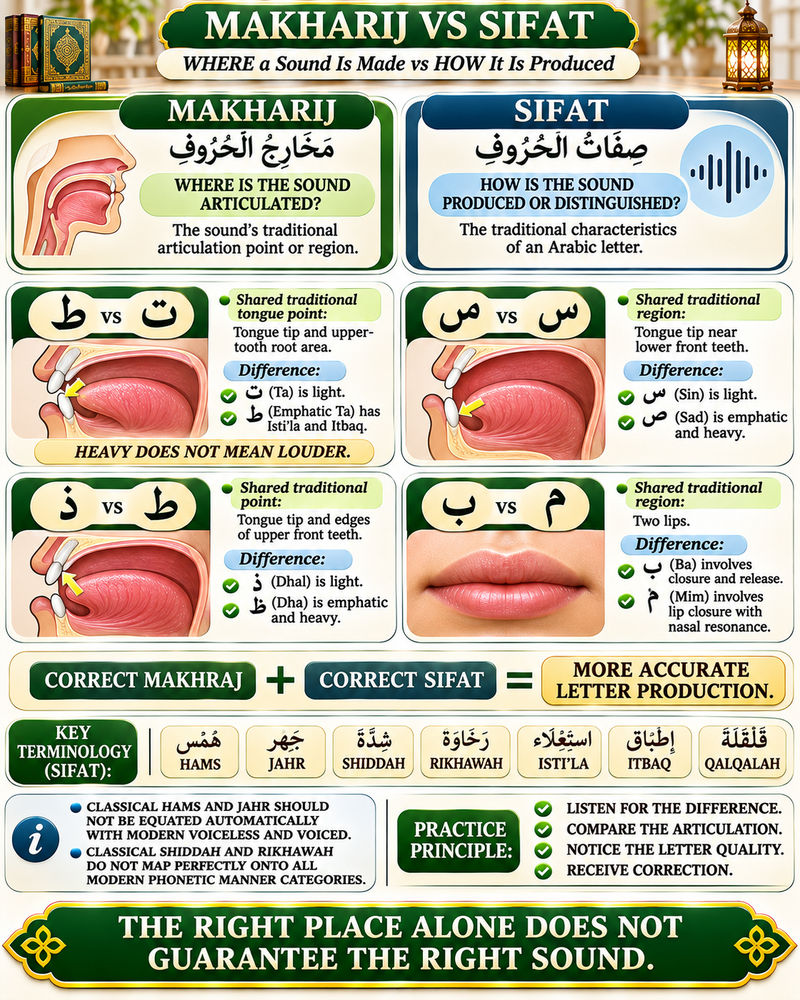
Makharij show where a sound is articulated. Sifat (صِفَاتُ الْحُرُوفِ) are characteristics that describe how it is produced and what distinguishes it. Some letters share a Makhraj and differ in Sifat:
ت and ط: same tongue point. Ṭa has isti'la (the back of the tongue rises toward the palate) and itbaq (the tongue spreads against the palate), so it is heavy. Ta is not.
س and ص: same region. Ṣad is heavy, with isti'la and itbaq. Sin is light.
ذ and ظ: same point. Ẓa is heavy and Dhal is not.
ب and م: same lips. Mim carries Ghunnah and Ba does not.
Other characteristics you will meet include hams, jahr, shiddah, rikhawah, istifal, infitah, safir and qalqalah. Traditional hams and jahr should not be equated directly with modern voiceless and voiced. Shiddah and rikhawah do not match every modern manner category, either. Heavy letters are not "louder" and light letters are not "quieter." Finding the right Makhraj is necessary, but it is not enough without the right Sifat.
Commonly Confused Letters
These are illustrative challenges, not a ranking, and different learners struggle with different sounds.
Pair | Makhraj difference | Common mistake | Correction cue |
|---|---|---|---|
ح / ه | Middle throat versus deepest | Using ه for ح | Compare الْحَمْدُ with هُدًى |
ع / ء | Both throat, different point and quality | Replacing ع with a stop | Compare أَنْعَمْتَ |
خ / غ | Same region, breathy versus voiced | Mixing them | Compare خَلَقَ with غَيْرِ |
ق / ك | Far back versus back of tongue | Qaf as Kaf | Compare قُلْ with كَفَرُوا |
س / ص | Same region, ص is heavy | Making ص light | Compare نَسْتَعِينُ with الصِّرَاطَ |
ت / ط | Same point, ط is heavy | Making ط light | Compare تَبَّتْ with الطَّارِقُ (86:1) |
ذ / ظ | Same point, ظ is heavy | Making ظ light | Listen for the difference in weight |
ض / ظ | Side of tongue versus tongue tip and teeth | Treating them as the same | Compare الضَّالِّينَ with الظَّالِمِينَ |
د / ض | Tongue tip versus side of tongue | Making ض a "heavy د" | Teacher demonstration is especially useful |
ث / س | Tongue tip at the teeth versus near lower teeth | Using س for ث | Compare ثُمَّ with a "sss" sound |
Can Changing a Letter Change a Word?
Sometimes, yes. These are real Arabic words that differ by a single letter:
قَلْب (heart) and كَلْب (dog). Both occur in the Quran, for example قَلْبٌ in 50:37 and الْكَلْبِ in 7:176.
تِين (figs) and طِين (clay). Both occur in the Quran, for example وَالتِّينِ (95:1) and طِينٍ (38:71).
سَيْف (sword) and صَيْف (summer). The word صَيْف appears in 106:2. سَيْف is general Arabic vocabulary and does not appear in the Quran.
These show why accuracy matters, not that a learner is committing wrongdoing every time they struggle. Accurate articulation is a learning goal that needs effort and guidance.
Finding a Letter's Makhraj
A traditional technique makes the letter silent (sakin) and places a vowelled Hamzah before it. Practice forms include أَقْ، أَكْ، أَحْ، أَعْ، أَسْ، أَصْ، أَتْ، أَطْ. These are exercises, not Quranic quotations.
Listen to an accurate demonstration.
Say the form slowly.
Notice the main region.
Compare it with a similar letter.
Repeat without tension.
Use it in an Arabic word.
Use it in a verified Quranic example.
Seek qualified feedback.
This is not a universal self-diagnostic, and some sounds need adaptation. Physical sensation alone cannot always locate the precise Makhraj. Avoid forceful repetition, and stop if anything feels uncomfortable.
A Seven-Day Starter Plan
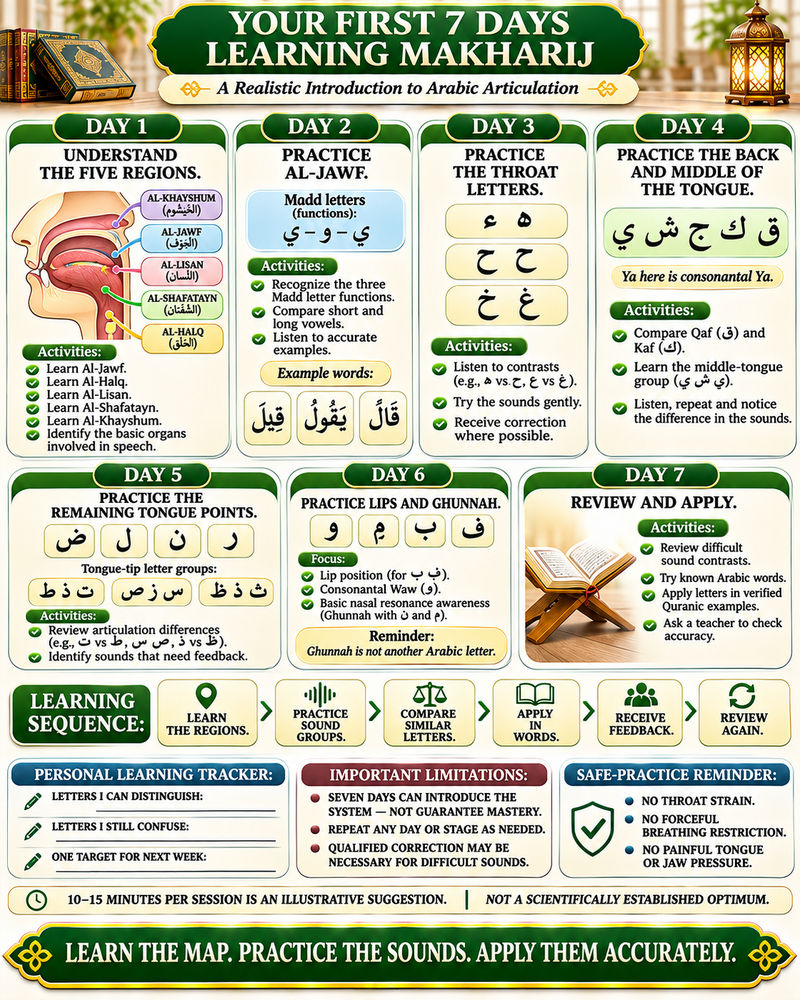
This is an illustrative plan, not an official curriculum. Ten to fifteen minutes a session is a suggestion, not a scientifically established optimum. Seven days can introduce the system but cannot guarantee mastery, so repeat any day as needed.
Day 1: Learn the five regions and basic organs.
Day 2: Al-Jawf, with short and long vowels.
Day 3: The six throat letters in small groups.
Day 4: Qaf, Kaf, Jim, Shin and consonantal Ya.
Day 5: Ḍad, Lam, Noon, Ra and the tongue-tip letters.
Day 6: The lip letters and basic Ghunnah awareness.
Day 7: Review difficult contrasts and apply them in Quranic words.
Learning Makharij as a Non-Arabic Speaker
Your first language shapes what you hear and produce. You may not notice a distinction your language never uses, and recognising a sound is different from producing it. Established habits take time to change. Repeated listening and corrective feedback help.
Experiences differ from person to person, so avoid generalising about any group. Native Arabic speakers also do not automatically have Tajweed-standard pronunciation, because regional dialects may use different sound patterns. Those patterns are not inferior, but they differ from Quran recitation standards. Build new distinctions gradually.
Children and Parents
A young child can learn to pronounce a letter accurately before they can name its articulation category. Listening, imitation, short demonstrations, visual cues, repetition and specific feedback all work well. Older students may benefit from more explicit explanation. A child does not need to memorise all seventeen points before reading Quran, though theory helps some learners. Adapt to the learner's age, ability and goals.
Can You Learn Makharij Without a Teacher?
You can build useful foundations from reliable Tajweed books, accurate diagrams, verified demonstrations, qualified reciters, structured practice and self-recording. Independent learning has real limits, though. You might:
Hear two sounds as identical.
Make a sound incorrectly while believing it is right.
Compensate with a different organ.
Confuse Makhraj with Sifat.
Carry an established mistake into connected reading.
A qualified teacher can listen to you individually, spot recurring errors, demonstrate accurately, give specific feedback and check your connected reading. Not every error requires formal enrolment, and no number of lessons can be guaranteed to fix every difficulty. If you have persistent speech, hearing or physical difficulties, a qualified professional may help.
If you understand the theory but are unsure whether you are producing the sounds correctly, guided one-to-one instruction may help. Araby Academy offers live one-to-one Quran and Tajweed lessons, and eligible students may receive up to three free 30-minute trial lessons. Trials are scheduled separately and are subject to availability and applicable eligibility, booking and confirmation requirements. A request is not a confirmed appointment.
How Makharij Connect to Other Tajweed Topics
Noon Sakinah and Tanween: the throat letters and the lips and nose explain why Izhar, Idgham, Iqlab and Ikhfa sound as they do.
Qalqalah: the letters ق ط ب ج د.
Madd: the vowel lengthening that starts in Al-Jawf.
Tafkhim and Tarqiq: heavy and light letters.
Sifat: the characteristics that complete the picture.
Connected recitation: applying all this in real passages, not only isolated sounds.
Not every Tajweed rule can be derived from articulation location alone.
Classical Tajweed and Modern Phonetics
Traditional Tajweed is a scholarly framework for recitation. Modern phonetics describes place, manner, voicing, airflow and resonance. The two have different origins and purposes, and they complement each other. Modern phonetics does not invalidate Tajweed, and not every classical description matches a single modern anatomical category.
Frequently Asked Questions
What are Makharij al-Huruf?
They are the articulation points from which Arabic letter sounds emerge.
How many Makharij are there?
The widely taught count is seventeen, in five regions. Other classical counts include sixteen and fourteen.
Which letters come from the throat?
ء ه ع ح غ خ.
What is the difference between Makharij and Sifat?
Makharij show where a sound is articulated, and Sifat describe how it is produced and distinguished.
Is Ghunnah a separate letter?
No. It is the nasal resonance of Noon and Mim.
Can incorrect Makharij change a word's meaning?
Sometimes, as with قَلْب and كَلْب. Not every imperfection changes meaning.
Can I learn Makharij by myself?
You can build foundations, but a qualified teacher helps catch errors you cannot hear yourself.
How long does it take?
It varies from learner to learner, so no timeline can be promised.
Conclusion
Accurate Quran pronunciation involves more than recognising written letters. Its five regions are Al-Jawf, Al-Halq, Al-Lisan, Al-Shafatayn and Al-Khayshum. The seventeen-point classification gives a structured way to see where Arabic sounds are articulated. Makharij explain where, and Sifat explain how a sound is distinguished.
Start with the sounds you find hardest. Listen to accurate demonstrations, practise gradually without tension, apply the sounds in real Quran reading, and seek qualified feedback where you need it. If you would like guided help, you can explore Araby Academy's live one-to-one Quran and Tajweed lessons at arabyacademy.com. Eligible students may receive up to three free 30-minute trial lessons, subject to availability and applicable eligibility, booking and confirmation requirements.
Understanding where a letter comes from is the beginning of accurate pronunciation. Learning to produce that sound consistently, distinguish it from similar letters, and apply it correctly in Quran recitation is the skill that develops through attentive practice and reliable guidance.