You have recited Surah Al-Fatihah thousands of times. Then, during a lesson, a qualified teacher gently points out that a familiar Arabic sound has not been pronounced accurately.
You feel surprised, perhaps embarrassed. Questions follow. Have I been saying this incorrectly all these years? Can I actually change it now? Where do I even begin?
(This is an illustrative scenario, not a testimonial. Many adult learners recognize it.)
The direct answer: yes, many longstanding Quran pronunciation habits can improve through qualified assessment, targeted correction, careful listening, and repeated practice. The first step is identifying the actual error, not trying to relearn every Tajweed rule at once. Improvement is a skill-building process. It is uneven, it takes time, and no outcome or timeline can be guaranteed. But a mistake you discover today is not a verdict on your past. It is information you can now use.
This guide gives you a diagnostic framework, a correction sequence, and a realistic four-week starting plan.
Why Quran Pronunciation Mistakes Become Habits
Pronunciation is a motor skill. Repeat a sound the same way enough times and it becomes automatic, whether or not it is accurate. Several common circumstances create this pattern:
Learning by imitation only, from family, community, or recordings, without anyone checking your own output.
Limited corrective feedback. Many learners are corrected on reading fluency but not on articulation.
First-language sound patterns. Your native sound system shapes which Arabic distinctions you hear easily and which seem to blur together.
Memorizing before mastering sounds. A verse can be fully memorized while carrying the same inaccurate sound in every repetition.
Reading from transliteration, which cannot represent Arabic sounds reliably.
Confusing recognition with articulation. You may recognize ع on the page and still produce something different.
It helps to separate four abilities that are easily confused: knowing what a word means, recognizing its written form, remembering it, and producing its sounds accurately. You can have the first three and still need work on the fourth.
General research on adult second-language speech supports a balanced view. Learners' first-language experience shapes how they perceive new sounds, yet the Speech Learning Model (Flege, 1995; revised by Flege and Bohn, 2021) proposes that the mechanisms for learning sounds remain available across the lifespan. These are findings about second-language speech in general. They were not tested specifically on Quran recitation, and they do not claim that habits become permanently fixed at a certain age.
Can Adults Really Improve Quran Pronunciation?
Yes, and the ingredients are well understood: focused listening, awareness of how the sound is produced, feedback, repeated accurate production, gradual habit adjustment, and consistency. In one well-known laboratory study, Japanese adults trained to distinguish English /r/ and /l/ improved substantially when training included feedback, and the benefit transferred to new words (McCandliss et al., 2002). Again, this is general language-learning evidence, but it matches what good teachers observe: feedback matters.
Several goals are easy to confuse, and they are not identical:
Improving pronunciation of the sounds you currently get wrong.
Achieving perfect native-like speech.
Mastering every advanced Tajweed rule.
Obtaining a formal recitation certification (Ijazah).
This article focuses on the first goal. The target is accurate production of the relevant Quranic sounds and recitation features according to the recitation tradition you are taught. A non-Arabic accent is not automatically incorrect recitation, and nobody should promise to erase your accent.
Two Kinds of Mistakes: Lahn Jali and Lahn Khafi
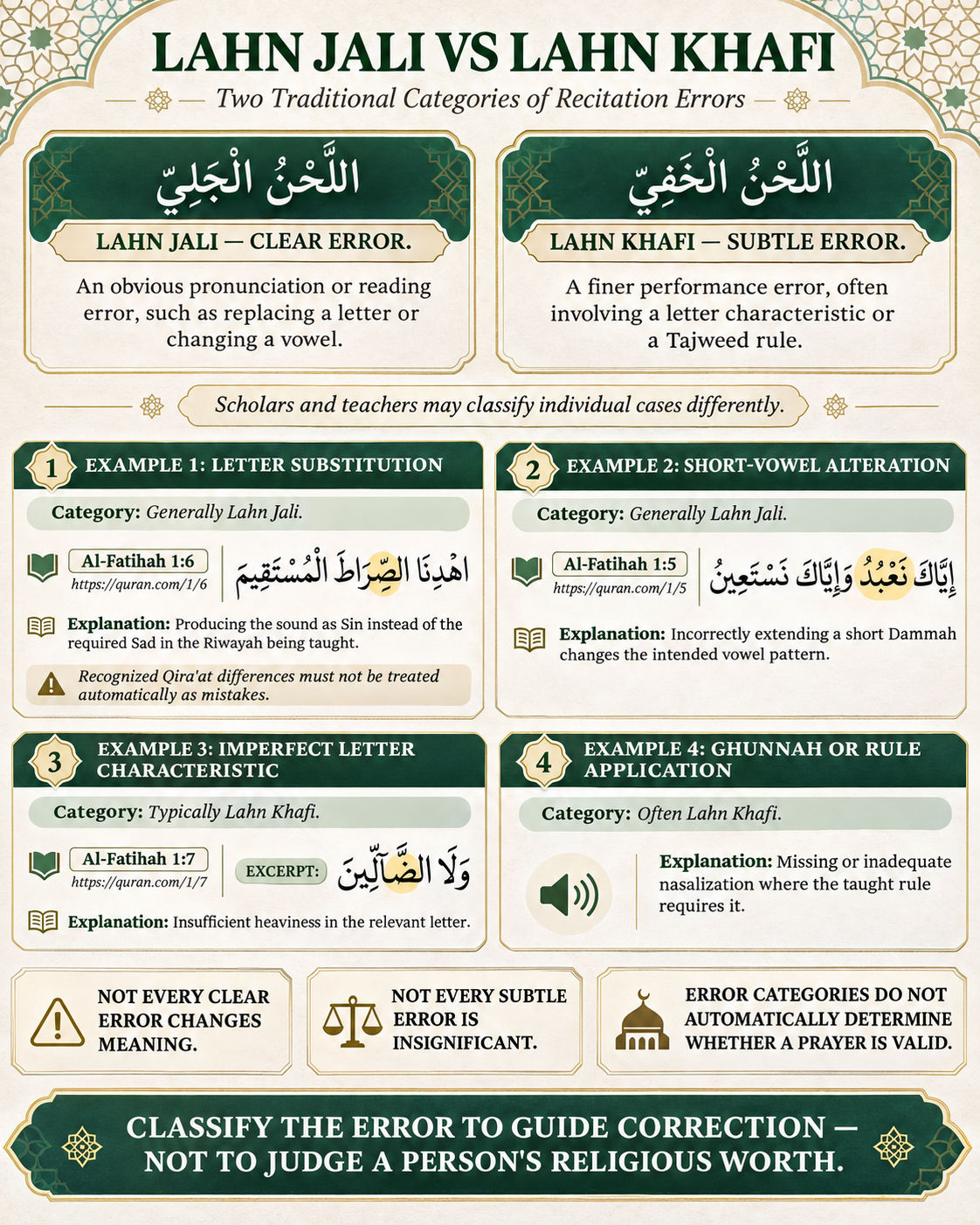
Tajweed scholars call a recitation error lahn (لحن). It is traditionally divided into two types:
اللحن الجلي (Lahn Jali), the clear error: an obvious mistake that is noticeable to anyone familiar with Arabic, such as replacing one letter with another or changing a vowel.
اللحن الخفي (Lahn Khafi), the subtle error: a finer mistake, such as an imperfect letter characteristic or a recitation rule not fully applied, usually detected by someone trained in Tajweed.
Three cautions keep this framework honest. Not every Lahn Jali changes a word's meaning. Not every Lahn Khafi is trivial. And scholars and teachers do not all classify every individual mistake identically. These categories describe recitation quality. They are not automatic rulings about the validity of prayer.
Error category | Example of the issue | Why correction matters | Recommended learning focus |
|---|---|---|---|
Letter substitution (Jali) | Pronouncing ص as س in الصِّرَاطَ (1:6) | A different letter is produced; it may or may not form another word | Makharij and Sifat with teacher feedback |
Vowel change or addition (Jali) | Lengthening the short dammah in نَعْبُدُ (1:5) | The vowel pattern of the word is altered | Vowel length discrimination, slow guided repetition |
Imperfect characteristic (typically Khafi) | Insufficient heaviness on ض in الضَّالِّينَ (1:7) | Preserves accuracy and the quality of recitation, even where the word is still recognizable | Sifat refinement after the basics are stable |
Rule application (often Khafi) | Weak or missing ghunnah where the rule requires it | Part of correct performance even when meaning is unchanged | Context-based rule practice with a teacher |
Some teachers place particular errors, such as incomplete madd, in a different category. A qualified teacher will tell you how they classify what you need to fix.
Makharij al-Huruf: Where Arabic Sounds Are Produced
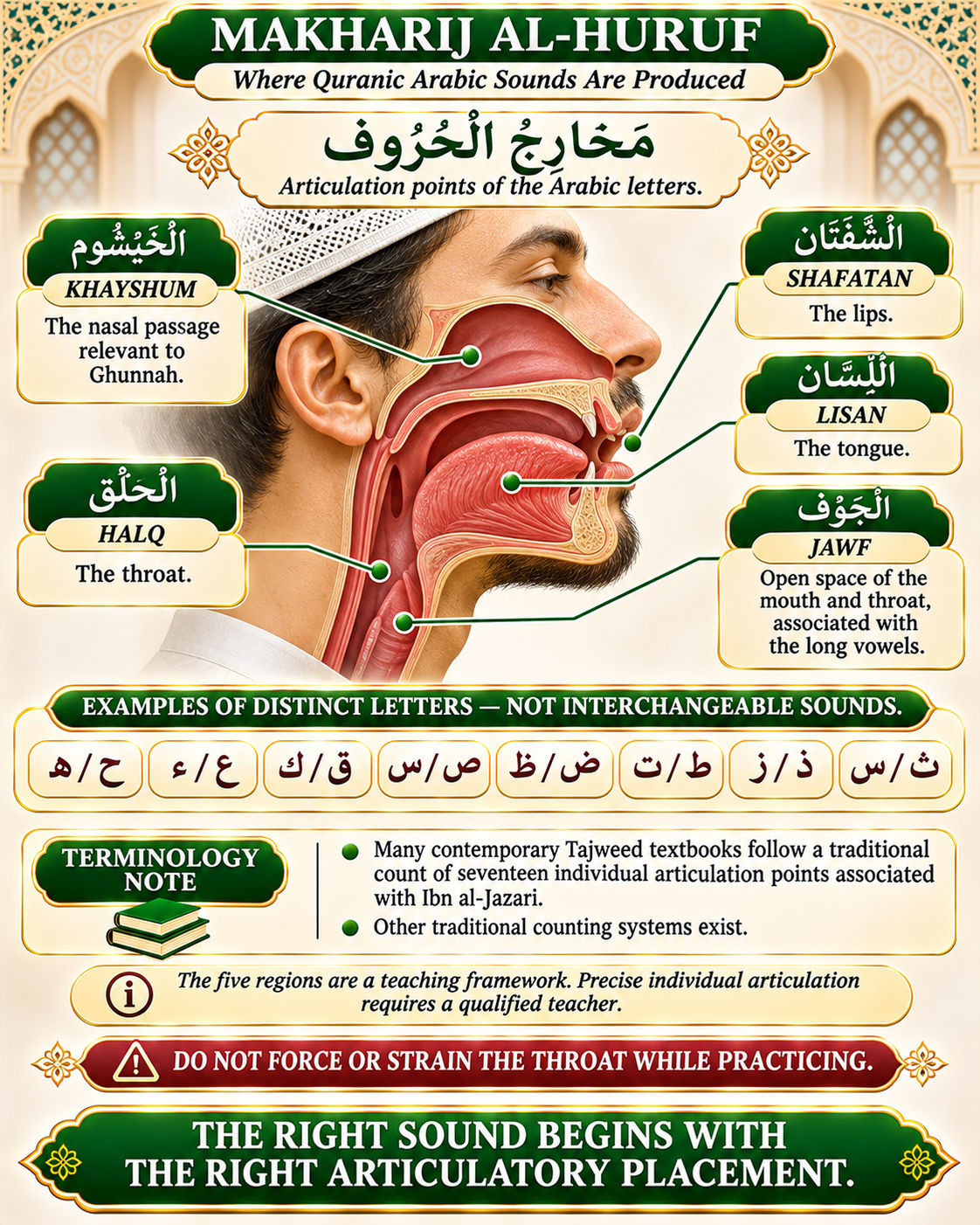
مخارج الحروف (Makharij al-Huruf) are the articulation points of the letters. Teaching texts commonly group them into five regions: the jawf (the open space of the mouth and throat, associated with the long vowels), the throat, the tongue, the lips, and the nasal passage (for ghunnah). Within these regions, traditional systems count individual points differently. Many contemporary texts follow the count of seventeen found in Ibn al-Jazari's al-Muqaddimah al-Jazariyyah, while some earlier authorities counted fewer. Do not treat any single numbering as the only valid one. For correction, the practical question is simpler: does this sound come from the right place?
Sounds learners commonly find challenging include ح/ه, ع/ء, ق/ك, ص/س, ض/ظ, ط/ت, ذ/ز, and ث/س. Not every learner struggles with every pair, and the pairs are not interchangeable. Each is a distinct letter. English approximations can help a beginner locate a starting point, but they are always imperfect, so a teacher should assess what you actually produce.
Sifat al-Huruf: Why the Right Place Is Not Enough
صفات الحروف (Sifat al-Huruf) are the characteristics of a letter: how it behaves once produced. Makharij answers "where?" Sifat answers "how?"
A few useful pairs of terms:
Tafkhim (تفخيم) is heaviness or fullness; Tarqiq (ترقيق) is lightness.
Hams (همس) is a whispered quality with airflow; Jahr (جهر) is a voiced quality.
Shiddah (شدة) is a complete stop of sound; Rikhawah (رخاوة) is a continuing flow of air.
Qalqalah (قلقلة) is an echoing release on ق ط ب ج د when they carry sukoon.
Here is how this plays out. ص and س are produced near each other and both carry a whistling quality. But ص is heavy and س is light. A learner may reach the right area yet produce a light ص, which sounds like س. Similarly, ق and ك are close, but ق is deeper, voiced, and heavy, while ك is lighter and whispered. Fixing only the place, without the characteristics, leaves the sound inaccurate.
Short Vowels, Sukoon, and Madd
Arabic distinguishes three short vowels, fathah (a), kasrah (i), and dammah (u), and a sukoon (ْ), which marks the absence of a vowel. Madd (مد) is the lengthening of the long vowels ا و ي according to rule.
Common errors include:
Lengthening a short vowel (for example, stretching the dammah on نَعْبُدُ).
Shortening a required long vowel (for example, the alif and ya in الْعَالَمِينَ, 1:2).
Inserting a vowel where there should be sukoon.
Changing one vowel into another.
Inconsistent timing for the same rule.
How long a madd lasts depends on the type of madd and the recitation tradition being taught. There is no universal duration in seconds. Madd types are not all equal, and your teacher should model the length that applies to your reading. Transliteration cannot encode this reliably, which is another reason to work from the Arabic script with supervision.
Ghunnah, Noon, and Meem
Ghunnah (غنة) is a nasal sound associated with noon and meem. Rules governing noon sakinah and tanween and meem sakinah determine when the noon or meem is pronounced clearly (izhar), merged (idgham), hidden (ikhfa), or converted (iqlab), and when ghunnah appears. For instance, the noon sakinah in أَنْعَمْتَ (1:7) is followed by ع, a throat letter, which calls for a clear noon.
Learn each rule as a sound in context, not as a list of names. Different categories of nasalization are applied differently, so a teacher's live modeling matters more here than memorizing definitions.
The Step-by-Step Correction Method
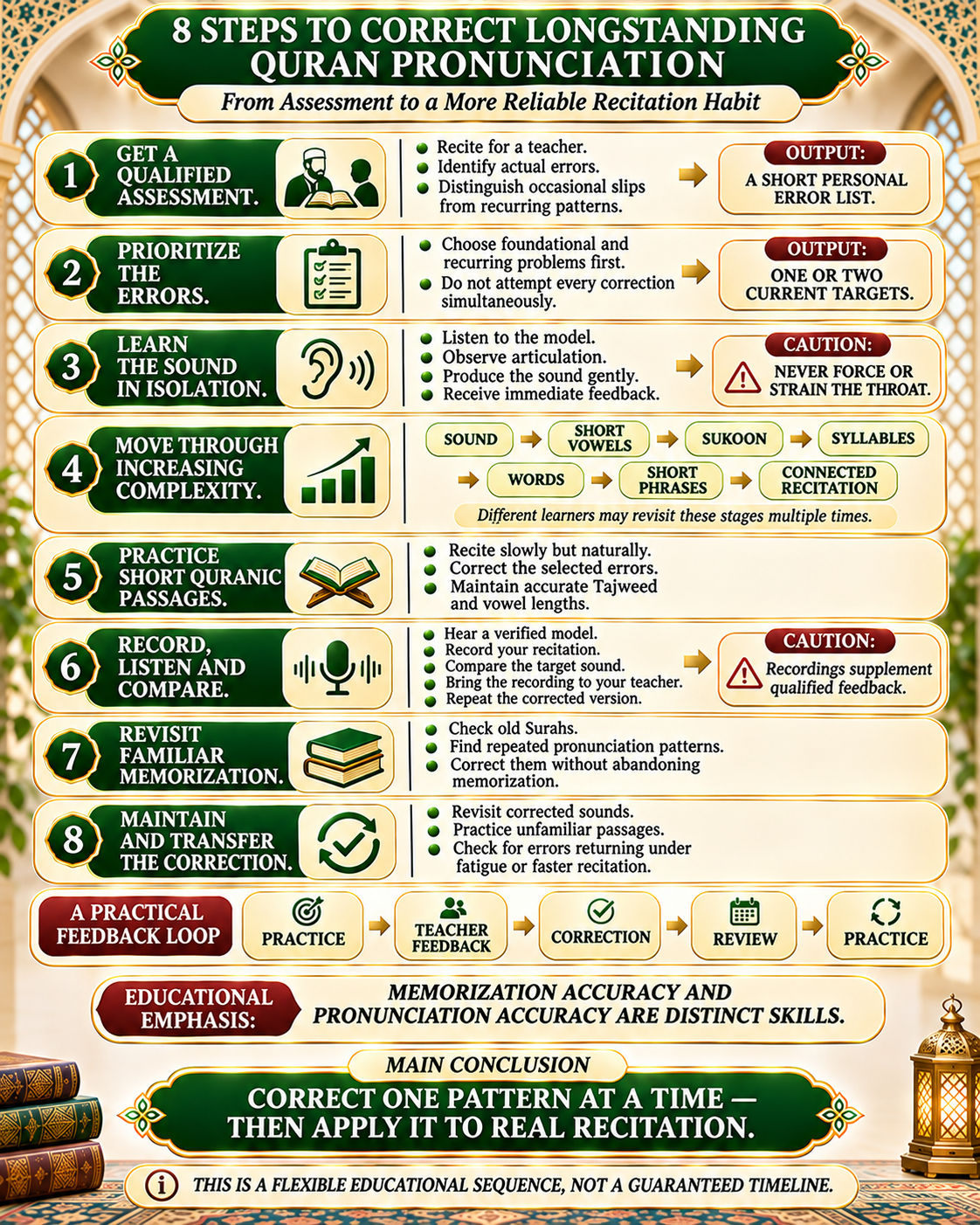
Step 1: Get an Honest Recitation Assessment
Start with a qualified Quran teacher who can hear what you really do. A useful assessment looks at letter articulation, letter characteristics, short and long vowels, sukoon, common Tajweed rules, fluency, and consistency. A good teacher also distinguishes between:
Occasional slips and systematic errors.
Problems with a single letter and problems that only appear in connected recitation.
Memorization errors and reading-fluency difficulties.
You should leave with a short, prioritized list, not dozens of corrections.
Step 2: Prioritize, Do Not Fix Everything at Once
A teacher can prioritize by accuracy, potential effect on a word, how frequently the error occurs, how foundational it is, your readiness, and dependencies between skills. For example, stabilizing the difference between two letters usually comes before refining an advanced rule that depends on those letters. The exact order must come from your own assessment. No universal hierarchy fits every learner.
Step 3: Learn the Sound in Isolation
With the teacher modeling, work on one letter. Listen first, then observe how it is produced, repeat in a controlled way, compare your attempt with the model, and get immediate feedback so you do not rehearse the wrong version. Descriptions of articulation help, but they are rarely enough without live feedback.
Never force or strain your throat. If a sound causes pain or voice fatigue, stop and tell your teacher. Accurate sounds come from correct placement and airflow, not from pressure.
Step 4: Move From Letters to Syllables and Words
A flexible progression looks like this:
The sound alone.
The sound with short vowels.
The sound with sukoon, where relevant.
Simple syllables.
Quranic words.
Short phrases.
Connected recitation.
For example, if the target is ح, you might move from the isolated letter to الْحَمْدُ (1:2) and then to the full phrase. Being correct in isolation does not guarantee being correct in running recitation, so expect to repeat this ladder more than once.
Step 5: Practice With Short Quranic Passages
Choose a short passage and focus on only a few target errors. Recite slowly and with control, correct immediately, repeat accurate attempts, and let fluency return gradually. There is no single correct speed for everyone. Slow practice is a learning technique. It is never permission to stretch vowels or distort rules. As the Quran instructs, "وَرَتِّلِ الْقُرْآنَ تَرْتِيلًا" (Al-Muzzammil 73:4), recite in measured, deliberate fashion.
Step 6: Record, Listen, Compare, Correct
Recordings are a useful supplement:
Listen to a verified recitation model.
Record your own attempt.
Compare the specific sound you are working on.
Note a difference.
Bring it to your teacher for feedback.
Repeat the corrected version.
Be realistic about self-assessment. You may not hear errors in your own voice, especially distinctions your first language does not use. Recordings do not replace qualified correction, and automated AI pronunciation scorers have not been shown to be authoritative for Quranic recitation, so treat them as, at most, a prompt to ask your teacher.
Step 7: Revisit Old Memorization
Memorized passages can preserve old pronunciation patterns. That does not mean throwing away what you know. Memorization accuracy (the right words in the right order) and pronunciation accuracy (the right sounds) are different things. Review familiar Surahs with your teacher, identify repeated errors, correct one pattern at a time, check the same sound in different words, and reassess periodically. For a structured approach to revision, see Araby Academy's guide to memorizing the Quran and keeping it.
Step 8: Maintain the Correction
Keep reviewing. Continue getting teacher feedback, watch for recurring mistakes, and apply corrected sounds to unfamiliar passages. Over time, aim to lean less on conscious sound-by-sound monitoring so the corrected habit becomes the natural one. Errors can return, especially under fatigue or speed, and that is a normal reason to keep revising, not a failure.
Five Common Quran Pronunciation Challenges
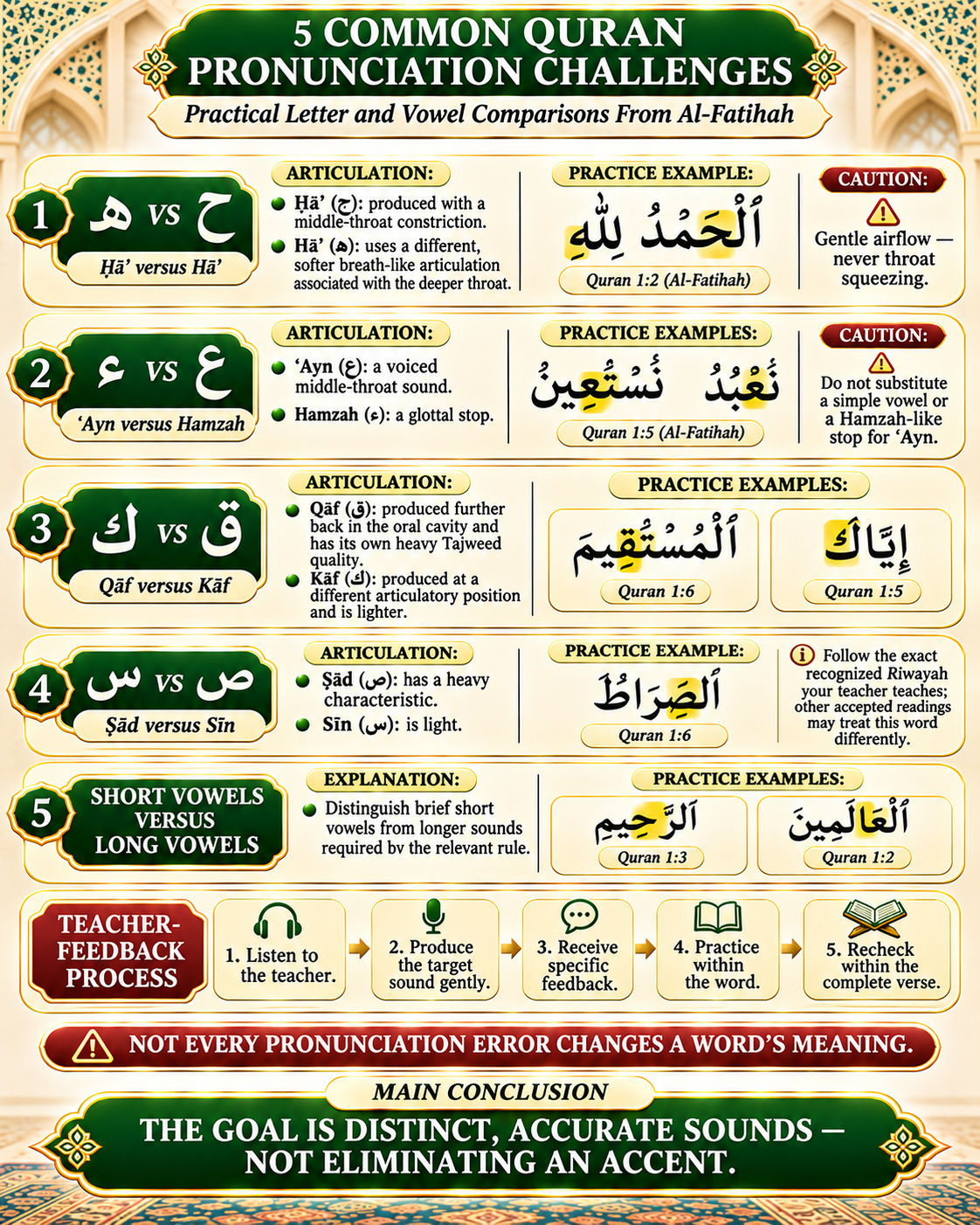
1. ح versus ه
The distinction: ح comes from the middle of the throat with a narrow, airy constriction. ه comes from the deepest part of the throat and is a softer breath. Both are whispered (hams).
The challenge: Learners often default to a ه-like breath for ح, which loses its constricted friction.
Safe practice: Compare الْحَمْدُ with لِلَّهِ (1:2) after hearing your teacher model them. Practice with gentle airflow and no squeezing.
Teacher feedback: Needed to confirm whether your ح has the right quality, since it is hard to self-judge.
2. ع versus ء
The distinction: ع comes from the middle throat as a voiced, constricted sound that can continue. ء (hamzah) comes from the deepest throat as a brief stop.
The challenge: Many learners replace ع with a hamzah-like stop or an "a" vowel.
Safe practice: Listen to the ع in نَعْبُدُ and نَسْتَعِينُ (1:5), then practice gentle, comfortable production, never strained.
Teacher feedback: Essential, because ع has no English equivalent.
3. ق versus ك
The distinction: ق is produced further back, with the rear of the tongue near the soft palate. It is heavy and voiced. ك is produced slightly forward and is lighter.
The challenge: Producing ق as ك, or ق without its heaviness.
Safe practice: Compare مُسْتَقِيمَ (1:6) with إِيَّاكَ (1:5), listening for depth and weight.
Teacher feedback: Needed to judge the right position and heaviness.
4. ص versus س
The distinction: Both come from near the tip of the tongue and the front teeth with a whistling quality. ص is heavy (tafkhim, with the tongue raised); س is light.
The challenge: Saying ص in light form so it merges with س. In الصِّرَاطَ (1:6), the written letter is ص in the commonly taught Hafs recitation, and it should sound like it. (Other recognized readings treat this word differently, so follow your teacher's riwayah.)
Safe practice: Compare ص and س in isolation, then in the word.
Teacher feedback: Needed to judge heaviness.
5. Short versus Long Vowels
The distinction: Short vowels are brief. Long vowels (and madd) are extended according to rule.
The challenge: Blurring lengths, either dragging short vowels or clipping long ones.
Safe practice: Listen to الرَّحِيمِ and الْعَالَمِينَ (1:2-3) and tap a steady pulse while your teacher models lengths.
Teacher feedback: Needed to match the length to the specific rule and tradition.
None of these examples claims that every mistake changes meaning. Whether a given error produces a different word depends on the word.
What If You Discover Mistakes in Al-Fatihah?
Because Al-Fatihah is recited in every prayer, it is reasonable to make it a priority. Work on accurate letters, accurate vowels, consistent pronunciation, appropriate Tajweed, and qualified correction.
Whether past mistakes affect past prayers is a separate religious question, and a general article cannot answer it. The answer depends on the specific error, whether it changes a word or meaning, your ability and circumstances at the time, and the jurisprudential discussions on the matter. Scholars discuss these points, and individual rulings turn on details not available here. It would be wrong to say that every earlier prayer was invalid, and equally wrong to say that every pronunciation issue is excused.
If you have a specific concern, speak with a qualified scholar who can consider your circumstances. In the meantime, avoid fear, repeated checking, or compulsive repetition. Calm, steady correction with a teacher is more effective than anxiety.
How to Stop Feeling Embarrassed About Your Pronunciation
Common barriers are fear of judgment, comparing yourself with fluent reciters, feeling too old, worrying about the past, frustration at slow progress, and anxiety about reciting aloud. Respectful correction is about skill, not about you as a person. A good teacher treats each correction as ordinary work.
The Prophet ﷺ said, as narrated by Aisha (Sahih Muslim 798; also in Sahih al-Bukhari 4937):
«الْمَاهِرُ بِالْقُرْآنِ مَعَ السَّفَرَةِ الْكِرَامِ الْبَرَرَةِ، وَالَّذِي يَقْرَأُ الْقُرْآنَ وَيَتَتَعْتَعُ فِيهِ وَهُوَ عَلَيْهِ شَاقٌّ لَهُ أَجْرَانِ»
In meaning: the one who is skilled in the Quran is with the noble, righteous angel-scribes, and the one who recites haltingly and finds it hard has two rewards. Scholars explain this as consolation and encouragement for the person who struggles, not as a comparison placing the struggling reciter above the skilled one. It also does not suggest that inaccurate recitation should never be corrected. It affirms that your effort has dignity while accurate learning remains a worthy goal.
How Long Does It Take?
There is no universal timeline, and any promise of correction in 7, 14, or 30 days should be treated with caution. Time depends on how many errors you have, the type of sound distinction, your first language, your prior instruction, how often you practice with feedback, the quality of that feedback, your consistency, any hearing or speech-related considerations, and individual learning differences.
Progress is often uneven. You may produce a sound well in a lesson but slip in fluent recitation. That is normal. Measure specific improvements, such as a particular letter that is now stable in three words, rather than comparing yourself with other students.
What If a Sound Remains Extremely Difficult?
Persistent difficulty can call for more individualized instruction, a different explanation of articulation, extra listening-discrimination exercises, slower progression, or a change of teaching method. If you suspect a hearing, voice, or speech concern, consult an appropriate professional, since a Quran teacher cannot diagnose these. Never use painful or unsafe exercises. Not every difficulty can be eliminated through effort alone, and that is not a personal failing. Your teacher can help you work toward the best accuracy you can reach.
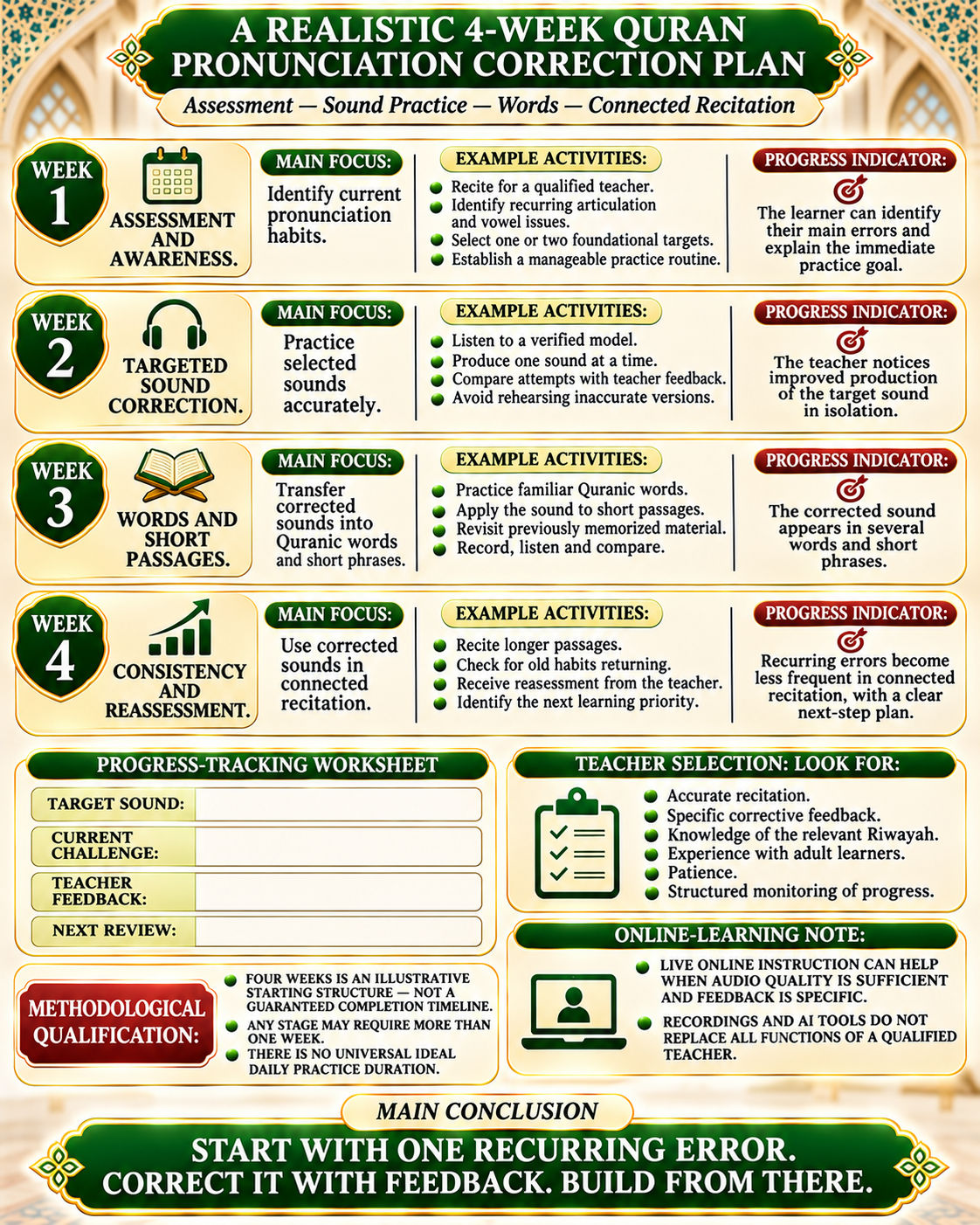
A Four-Week Starting Plan
This is an initial structure, not a guarantee of complete correction. Any stage may need more than a week, and there is no one ideal daily duration.
Week | Main focus | Example activity | Progress indicator |
|---|---|---|---|
1 | Assessment and awareness | Teacher-guided assessment; choose one or two foundational errors | You can name your top recurring errors and have a manageable routine |
2 | Targeted sound correction | Practice selected sounds with feedback | The teacher notes a more accurate sound in isolation |
3 | Words and short passages | Apply corrections to Quranic words; review a familiar passage; record and compare | The corrected sound appears in several words and short phrases |
4 | Consistency and reassessment | Recite connected verses with corrected sounds; reassess | Fewer recurrences in connected recitation, and a plan for the next phase |
Choosing a Qualified Tajweed Teacher
Look for accurate recitation, Tajweed knowledge, familiarity with the recitation tradition you are learning, the ability to identify errors, clear articulation explanations, patient correction, structured feedback, experience with adults, appropriate pacing, respectful communication, and the ability to monitor progress.
An Ijazah can be relevant and should be described accurately, but it does not automatically guarantee effective teaching, and different competent teachers may hold different kinds of certification. A strong reciter, a knowledgeable Tajweed instructor, and an effective adult educator overlap but are not the same thing. Ask how a teacher gives feedback and tracks progress.
Can Online Lessons Help?
Live online instruction offers access to qualified teachers, individual feedback, flexible scheduling, repeatable audio, structured practice, and progress tracking. Limitations include audio quality, connection delay, microphone distortion, difficulty observing some articulatory details, and inconsistent practice between lessons. Online is not automatically better or worse than in-person. It depends on the teacher, the technology, and the quality of feedback. Recordings and AI tools cannot replace every function of a qualified teacher.
Frequently Asked Questions
Can I correct Quran pronunciation after years of mistakes? Many learners can improve substantially with assessment, targeted correction, and consistent practice. Results vary and cannot be guaranteed.
Is it too late to learn Tajweed as an adult? No evidence supports a fixed age after which improvement is impossible. Adult learners often bring focus and motivation.
How do I know if I pronounce Arabic letters incorrectly? Usually you cannot reliably tell yourself. A qualified teacher listening to your recitation is the most dependable way.
Which mistakes should I correct first? Your teacher decides after assessment, usually favoring accuracy, frequency, and foundational skills.
What is the difference between Makharij and Sifat? Makharij are where a letter is produced. Sifat are how it sounds, such as heavy or light, whispered or voiced.
Can I improve by listening to reciters? Listening builds discrimination and is valuable, but it does not replace feedback on your own recitation.
Do pronunciation mistakes invalidate Salah? This cannot be answered generally. It depends on the error and your circumstances, so consult a qualified scholar.
Can online lessons help? They can, when the teacher is qualified, the audio is clear, and feedback is specific.
Conclusion
Longstanding Quran pronunciation habits can often be improved through accurate assessment, qualified instruction, focused correction, repeated accurate practice, teacher feedback, gradual application, and consistent revision. You do not have to fix every mistake immediately.
Start small. Identify your single most important recurring error and begin there.
If you would like guided help, Araby Academy offers live one-to-one Quran and Tajweed lessons, where a teacher can assess your recitation, guide correction, and help you build a structured practice routine.