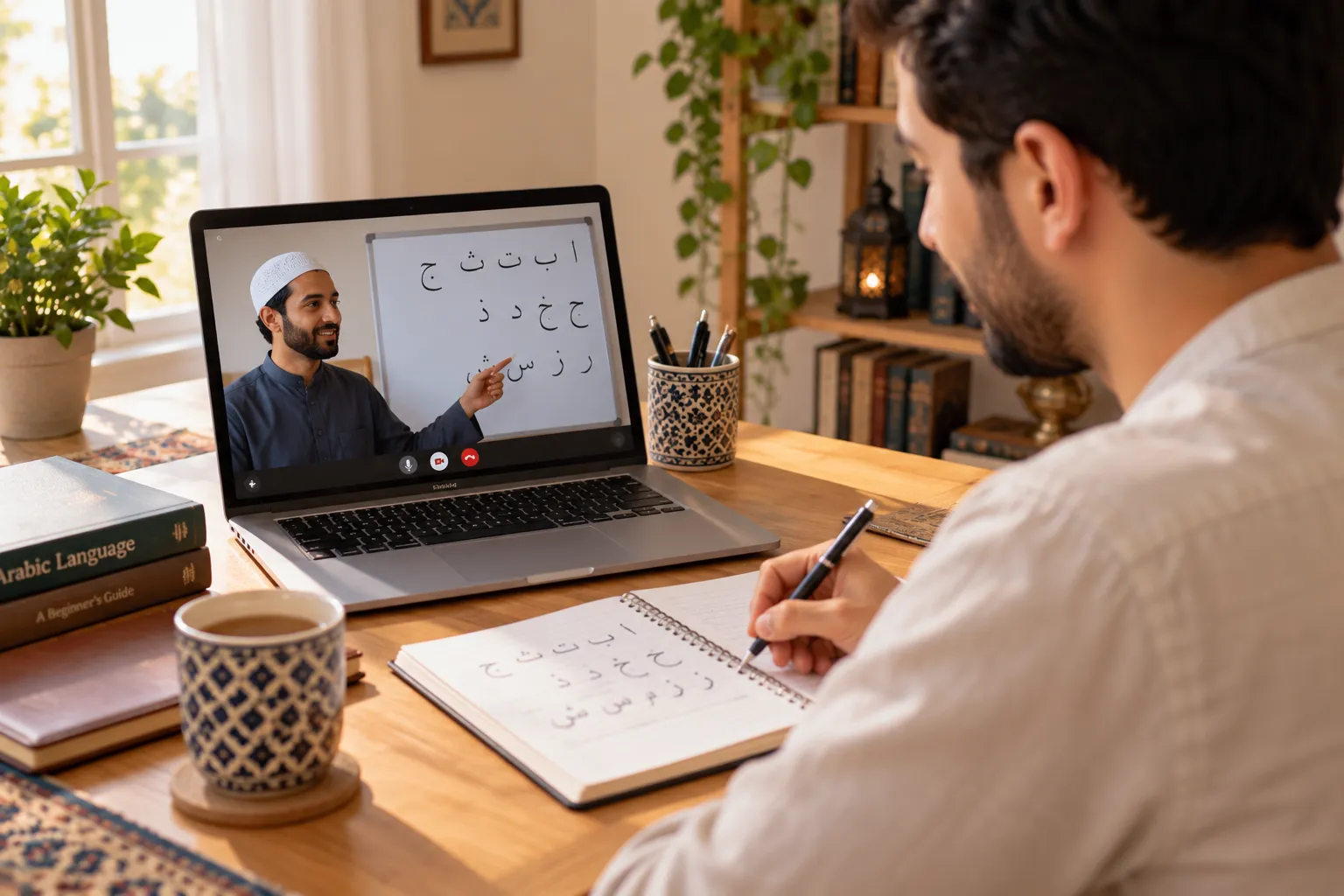
You've learned your first words:
كتاب (kitab), book
بيت (bayt), house
طالب (talib), student
Everything feels manageable. Then you open a grammar textbook and meet this:
مبتدأ، خبر، مضاف، مضاف إليه، مرفوع، منصوب، مجرور…
Suddenly Arabic feels impossible.
The problem usually isn't Arabic itself. It's learning too many grammatical concepts before you have enough Arabic to see why they matter. Arabic grammar is a large system, but you don't need all of it at once. This guide covers Arabic grammar for beginners: eight foundational concepts that let you recognize what's happening in simple Arabic sentences and keep studying with confidence.
You don't have to memorize anything today. You only have to start seeing patterns.
Grammar should help you understand Arabic, not prevent you from using it.
A better progression looks like this: recognize the building blocks → understand basic sentence patterns → notice relationships between words → gradually add complexity. This article teaches the first layer.
What Is Arabic Grammar?
Grammar describes how words work together to create meaning. Take this English sentence:
The student reads the book.
Change the order or form of the words and the meaning changes: who does the action, who receives it, whether something is definite, who owns what, when it happens, how many there are. Arabic grammar handles the same jobs, though it often expresses them differently from English.
You'll meet two traditional terms:
النحو (Nahw): broadly, sentence structure and the relationships between words.
الصرف (Sarf): broadly, word formation and patterns, such as how one root produces many words.
You'll encounter both as you study, but you don't need the theoretical distinction yet.
Which Arabic Does This Article Teach?
The foundations here reflect Modern Standard Arabic (MSA) and Classical/Quranic Arabic. Spoken dialects (Egyptian, Levantine, Gulf and others) often use different vocabulary, simplified endings and different structures, so I won't mix them in here.
MSA and Quranic Arabic share a large grammatical foundation, and an MSA student will recognize much of Quranic grammar. They are not identical, though. Quranic and Classical Arabic can be more classical in vocabulary, richer in morphology and rhetorically more complex. Where a Quranic example clarifies a concept, I'll use it and label it.
Concept 1: Arabic Words Fall Into Three Basic Categories
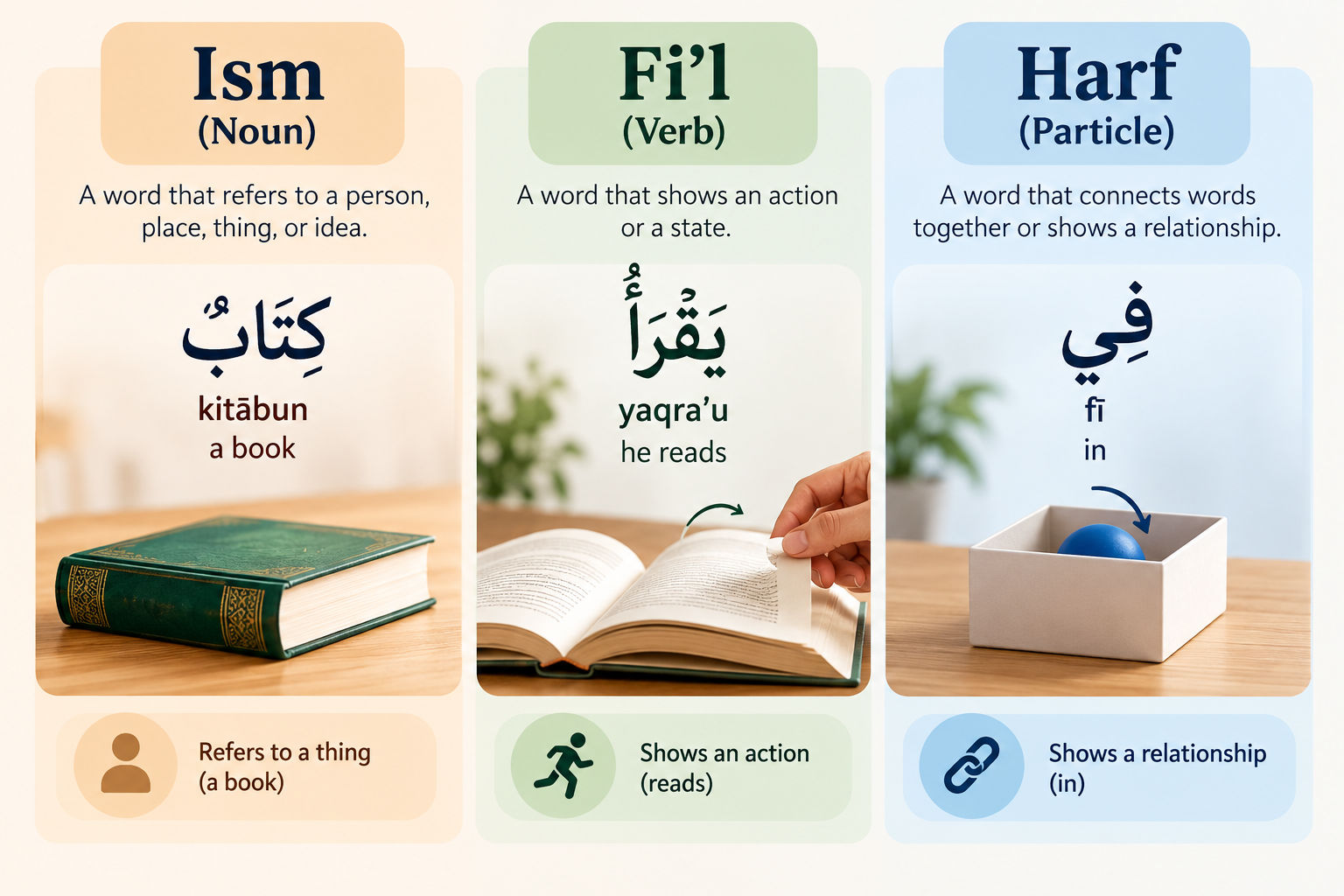
Classical Arabic grammar broadly sorts words into three types:
Term | Arabic | Rough idea |
|---|---|---|
Ism | اسم | names things, people and qualities |
Fi'l | فعل | verb: an action or event tied to time |
Harf | حرف | particle: a small word expressing a relationship |
Ism (اسم)
Ism is broader than the English "noun." It includes words we'd call nouns, and also adjectives, pronouns and other nominal words, depending on the analysis. For now, think of it as "the naming and describing words."
كتاب: book
طالب: student
كبير: big (an adjective, still an ism)
محمد: Muhammad
Fi'l (فعل)
A fi'l is a verb, and it carries time. Three forms to recognize:
كَتَبَ: he wrote (past)
يَكْتُبُ: he writes / is writing (present/imperfect)
اُكْتُبْ: write! (command)
Harf (حرف)
Particles are small words that connect or relate other words:
في: in
من: from
إلى: to
Word-by-word: in كتاب في البيت (a book in the house), كتاب is an ism, في is a harf, and البيت is an ism.
Common beginner mistake: treating "ism = noun" as perfect equivalence, so that "big" seems to be a different kind of thing from "book." In Arabic analysis both are isms.
Mini Exercise
Label each as Ism, Fi'l or Harf: مدرسة · يقرأ · على · معلم · اذهب · كبيرة · إلى · طالبة
Answers: Ism · Fi'l · Harf · Ism · Fi'l (command: "go!") · Ism (adjective) · Harf · Ism.
Notice next time you read Arabic: try tagging every word you see as ism, fi'l or harf. Even this rough sorting reveals the shape of a sentence.
Concept 2: Arabic Has Masculine and Feminine Words
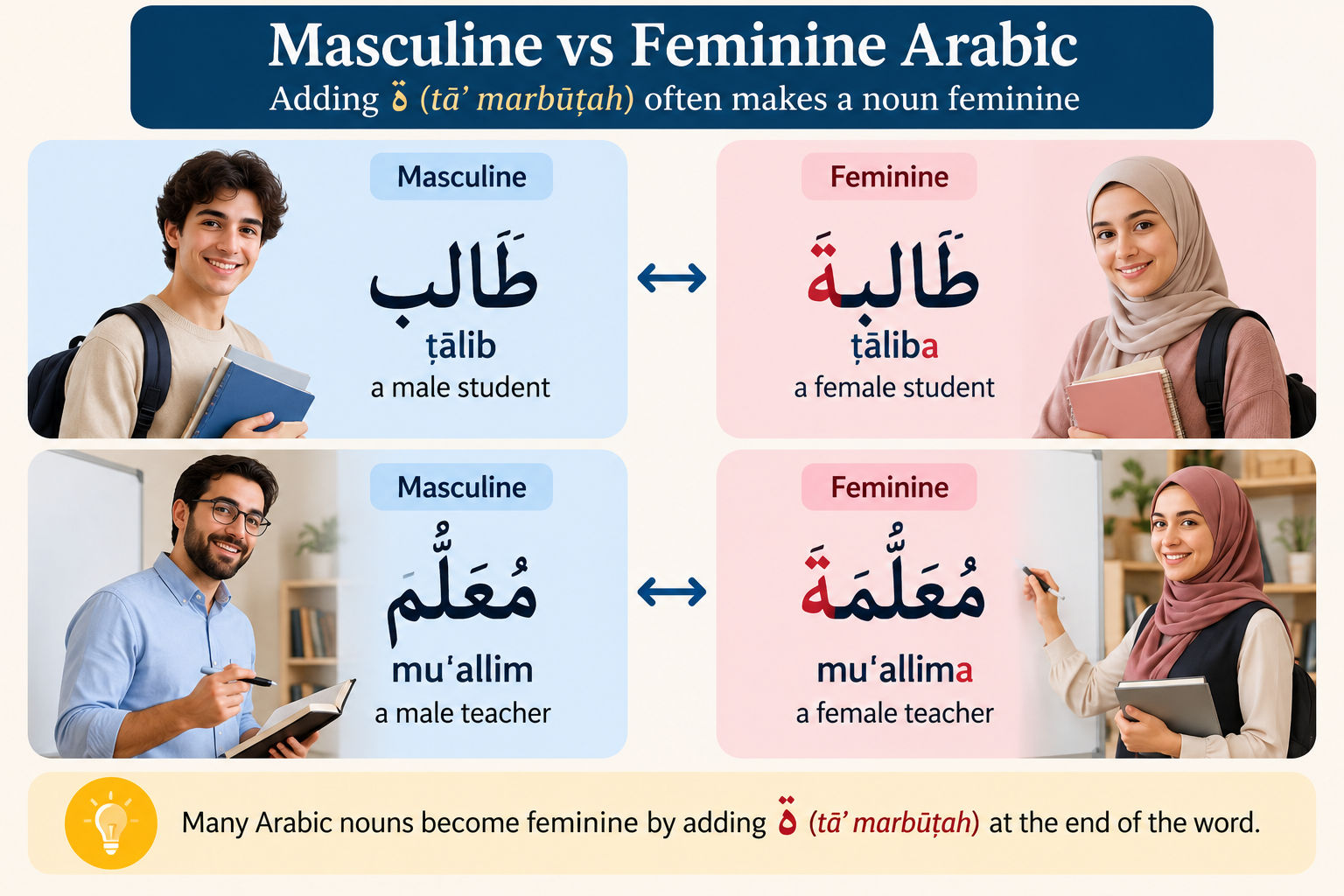
Every Arabic noun has a grammatical gender: مذكر (mudhakkar), masculine, or مؤنث (mu'annath), feminine. This is grammatical, not always biological. A table or a door is not "male" or "female," but the word still has a gender that other words must match.
A common feminine marker is ة (ta marbutah):
Masculine | Feminine |
|---|---|
طالب (male student) | طالبة (female student) |
معلم (male teacher) | معلمة (female teacher) |
Gender also affects the words that describe a noun:
طالب جديد: a new male student
طالبة جديدة: a new female student
The adjective follows the noun and matches its gender. That's all you need for now.
Warning: Not every feminine noun ends in ة, and not every word ending in ة is feminine. شمس (sun) is grammatically feminine with no ة. خليفة (caliph/successor) ends in ة but refers to a man. Treat ة as a strong clue, not a guarantee.
Common beginner mistake: assuming every word without ة is masculine.
Mini Exercise
Choose the matching adjective, جديد (m.) or جديدة (f.): ① كتاب ___ ② سيارة ___ ③ بيت ___ ④ مدرسة ___
Answers: ① جديد ② جديدة ③ جديد ④ جديدة.
Notice next time: when you see a ة, look at the neighbouring words and check whether they match in gender.
Concept 3: Definite vs. Indefinite Nouns
Arabic distinguishes نكرة (nakirah), indefinite ("a book"), from معرفة (ma'rifah), definite ("the book").
The easiest way to make a noun definite is to add ال (al-):
كتاب → الكتاب: a book → the book
بيت → البيت: a house → the house
Arabic has no word for "a." An unmarked noun is simply indefinite.
Other things are definite too, including proper names (محمد), pronouns, and possessed nouns such as كتابي (my book). You'll sort these out gradually.
A quick pronunciation note. The ل of ال is sometimes pronounced and sometimes absorbed into the next letter. We say al-kitab (الكتاب), but ash-shams (الشمس), not "al-shams." You'll learn the full pattern (sun and moon letters) in reading lessons. For now, just know that this is why الـ is written the same way but sounds different.
Why definiteness matters: it decides how phrases and sentences are built.
كتاب جديد: a new book
الكتاب الجديد: the new book
When the noun is definite, the adjective also takes ال. Concept 7 builds on this.
Common beginner mistake: adding ال to the noun but forgetting the adjective.
Mini Exercise
Make definite: بيت · سيارة · مدرسة · معلم
Answers: البيت · السيارة · المدرسة · المعلم.
Notice next time: does the word start with ال? Is the word next to it also definite?
Concept 4: Arabic Has Nominal and Verbal Sentences
This is one of the most useful ideas in Arabic grammar.
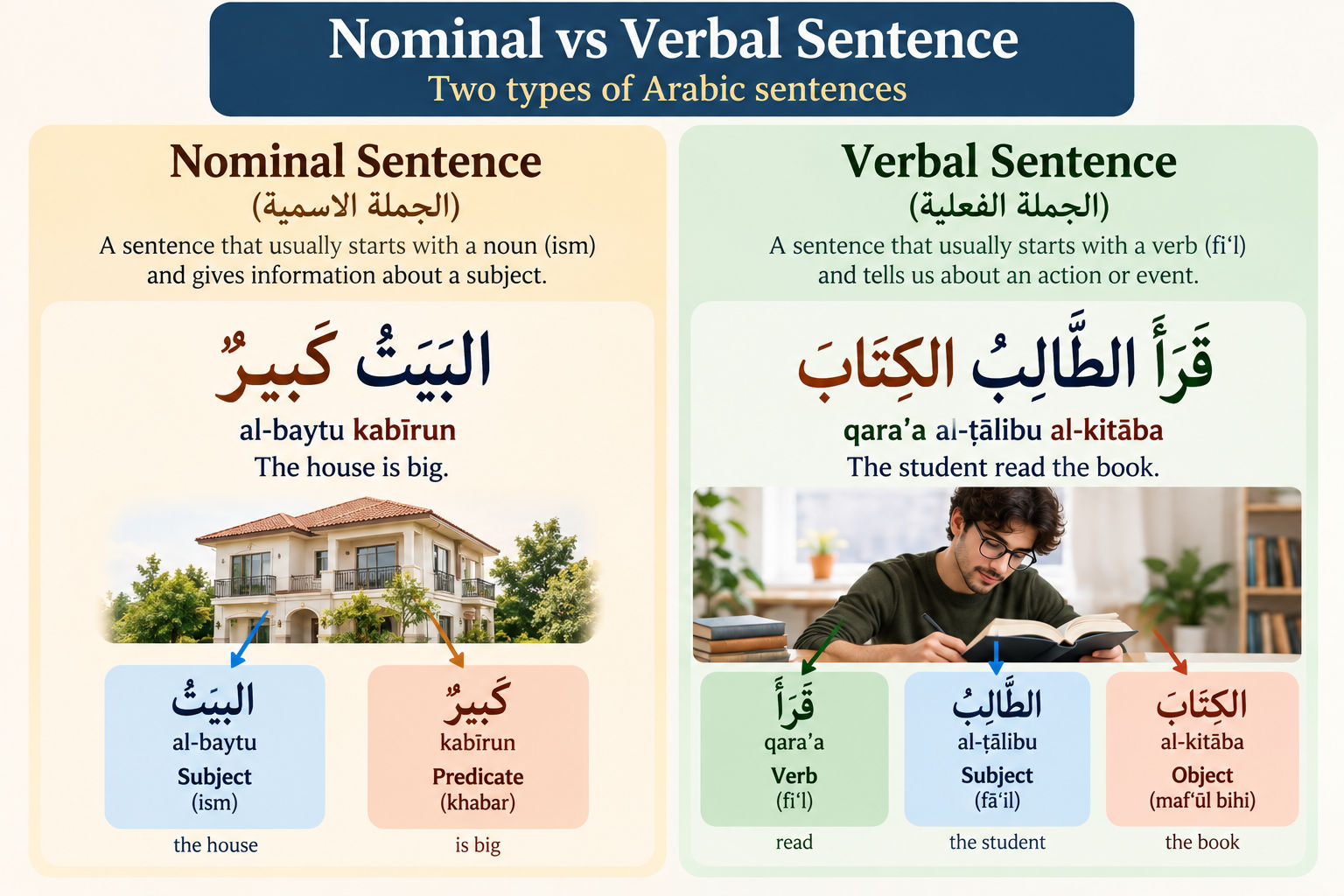
The Nominal Sentence: الجملة الاسمية (Al-Jumlah Al-Ismiyyah)
A nominal sentence typically begins with an ism.
البيتُ كبيرٌ
al-baytu kabirun, "The house is big."
البيت: the house
كبير: big
Notice there is no word for "is." In the present tense, Arabic often doesn't need one.
Two traditional terms describe the parts:
مبتدأ (mubtada'): what we're talking about ("the house")
خبر (khabar): what we say about it ("is big")
More examples:
الطالبُ جديدٌ: The student is new.
أنا طالبٌ: I am a student.
الكتابُ في البيتِ: The book is in the house. (Here the khabar is a phrase, في البيت.)
Advanced grammar defines these categories more precisely, but this concept is enough to begin with.
The Verbal Sentence: الجملة الفعلية (Al-Jumlah Al-Fi'liyyah)
A verbal sentence typically begins with a verb.
قرأ الطالبُ الكتابَ, "The student read the book."
قرأ: read (فعل, verb)
الطالب: the student (فاعل, fa'il, the doer/subject)
الكتاب: the book (مفعول به, maf'ul bihi, the direct object)
A common pattern is verb → doer → object. But Arabic word order is flexible, and other structures occur. Never assume Arabic is "always VSO." For instance, الطالبُ قرأ الكتابَ is also possible, with a slightly different emphasis and analysis.
Common beginner mistake: translating every Arabic sentence as if it must contain "is," or expecting the verb to come second as in English.
Mini Exercise
Nominal or verbal? ① الكتابُ جديدٌ ② كتبَ المعلمُ الدرسَ ③ المدرسةُ كبيرةٌ ④ يقرأ الطالبُ
Answers: ① nominal ② verbal ③ nominal ④ verbal.
Notice next time: what is the first word, an ism or a fi'l? That tells you which kind of sentence you're probably in.
Concept 5: Pronouns Change How Arabic Sentences Work
Independent pronouns are separate words:
أنا: I
أنتَ: you (masculine singular)
أنتِ: you (feminine singular)
هو: he
هي: she
نحن: we
(That's a starter set, not the whole chart.)
Verbs carry the subject inside them. The beginning of the verb shows who is acting:
أَكْتُبُ: I write
يَكْتُبُ: he writes
تَكْتُبُ: she writes / you (masculine singular) write
That last form has two possible meanings. The same letters can be read two ways, and context (or the surrounding words) tells you which one.
Attached pronouns are small endings added to words, often showing possession:
كتابي: my book
كتابك: your book
كتابه: his book
كتابها: her book
كتابنا: our book
One small suffix does the work of an English word. This matters a great deal in the Quran. Consider this phrase from Surah Al-Baqarah (2:201):
رَبَّنَا آتِنَا فِي الدُّنْيَا حَسَنَةً
"Our Lord, give us good in this world…" (opening of the verse)
رَبَّنَا is rabb (Lord) plus ـنا (our). آتِنَا is a command ("give") plus ـنا (us). Once you spot ـنا, many Quranic phrases open up.
Common beginner mistake: ignoring the suffix and reading the word as a bare noun.
Notice next time: check the last letters of words for ـي ـك ـه ـها ـنا.
Concept 6: Idafah Expresses "X of Y"
الإضافة (Idafah) is a construction in which one noun belongs to or relates to another, usually translated "X of Y."
كتابُ الطالبِ: the student's book / the book of the student
كتاب: مضاف (mudaf), the "added" word
الطالب: مضاف إليه (mudaf ilayh), "that to which it is added"
More examples:
بابُ البيتِ: the door of the house
كتابُ المعلمِ: the teacher's book
In English we use "of" or "'s." In Arabic, you put the two nouns side by side. Three beginner observations:
The first noun (the mudaf) does not take ال. Say كتابُ الطالبِ, not "الكتاب الطالب."
The definiteness of the whole phrase comes from the second noun. كتابُ الطالبِ is definite ("the student's book"), while كتابُ طالبٍ is indefinite ("a student's book").
The second noun is genitive (majrur), which is why it ends in a kasrah (ـِ). We'll touch on that in Concept 8.
A Quranic example from Surah Al-Fatihah (1:2):
الْحَمْدُ لِلَّهِ رَبِّ الْعَالَمِينَ
"All praise is for Allah, Lord of the worlds."
رَبِّ الْعَالَمِينَ ("Lord of the worlds") is an Idafah: rabb + al-'alamin. Beginners can recognize the "X of Y" shape here, and understand that fuller analysis of the verse belongs to teachers and tafsir.
Common beginner mistake: putting ال on both nouns.
Notice next time: two nouns side by side, the first without ال, usually signal "X of Y."
Concept 7: Nouns and Adjectives Must Agree
Arabic adjectives normally follow the noun and match it in gender and definiteness (and number, which you'll study later):
Indefinite | Definite |
|---|---|
كتاب جديد (a new book) | الكتاب الجديد (the new book) |
سيارة جديدة (a new car) | السيارة الجديدة (the new car) |
Now the most important beginner distinction in this article:
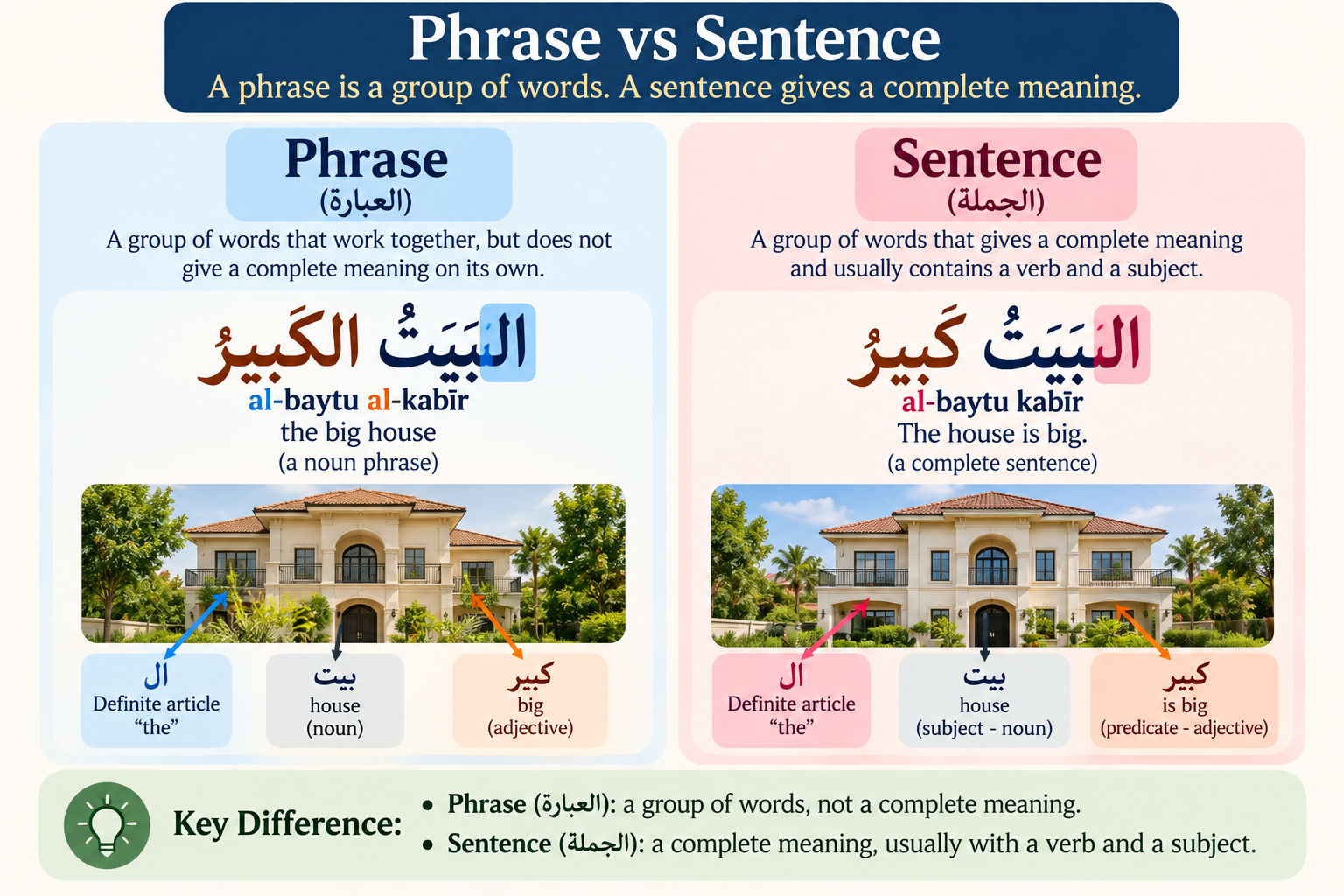
البيتُ الكبيرُ: "the big house" (a phrase)
البيتُ كبيرٌ: "the house is big" (a sentence)
In the phrase, both words are definite (both take ال). The adjective describes the noun.
In the sentence, the noun is definite and the predicate adjective is indefinite. It says something about the house.
More pairs:
المدرسةُ الجديدةُ (the new school) vs. المدرسةُ جديدةٌ (the school is new)
الطالبُ الجديدُ (the new student) vs. الطالبُ جديدٌ (the student is new)
الكتابُ القديمُ (the old book) vs. الكتابُ قديمٌ (the book is old)
Quick test: both words have ال → phrase. Only the first has ال → sentence.
Common beginner mistake: reading البيت كبير as "the big house." Without ال on the second word, it's a complete sentence.
Notice next time: count the ال's. They tell you whether you're reading a phrase or a sentence.
Concept 8: Word Endings Can Carry Grammatical Information
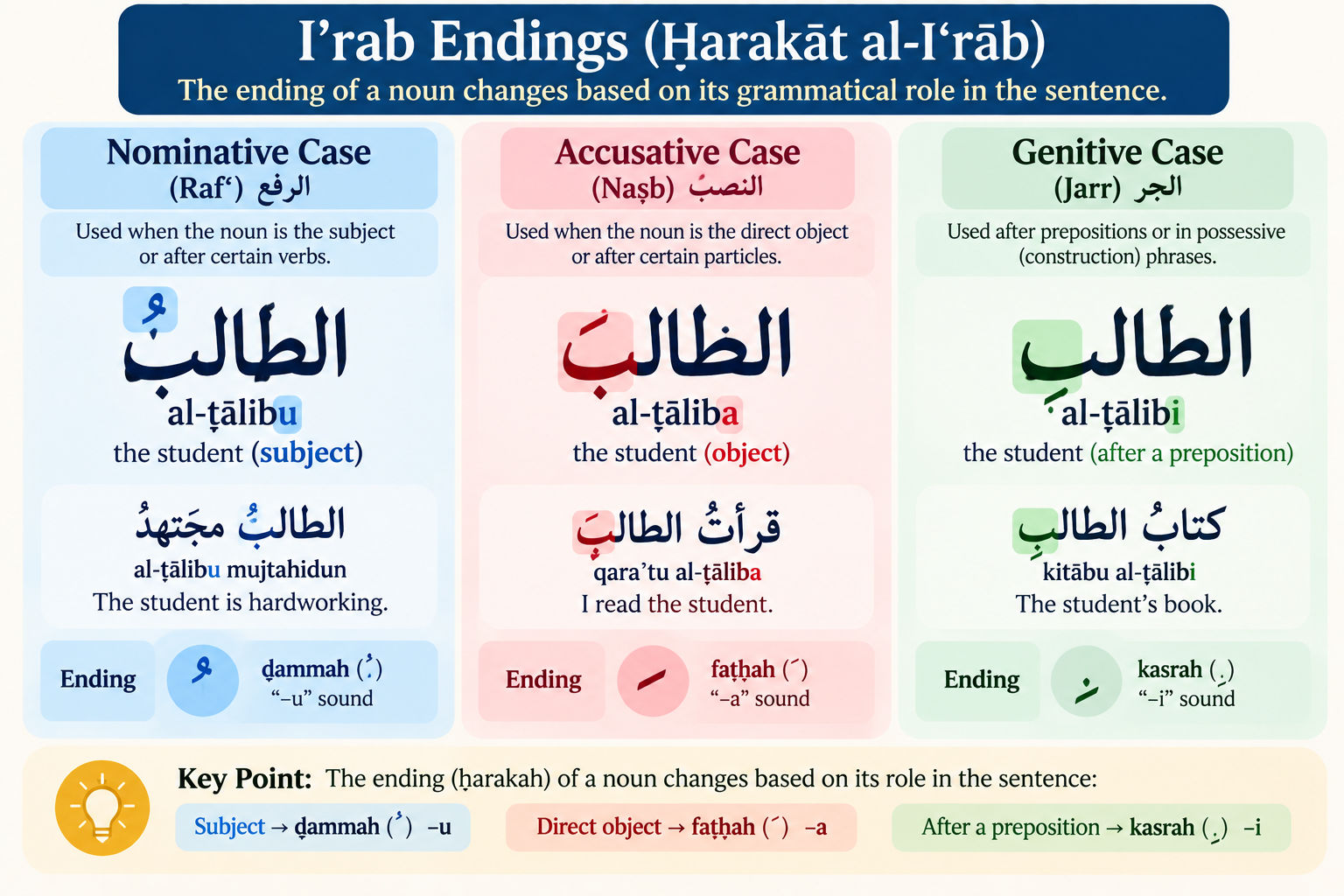
Arabic words can change their final vowel depending on their role in the sentence. This system is called الإعراب (I'rab), and the three main cases are:
مرفوع (marfu'): typically the doer or subject (ـُ / ـٌ)
منصوب (mansub): typically the object (ـَ / ـً)
مجرور (majrur): typically after a preposition or as the second term of an Idafah (ـِ / ـٍ)
One noun, three roles (shown fully vowelled for this lesson):
جَاءَ الطَّالِبُ: the student came (ـُ, doer)
رَأَيْتُ الطَّالِبَ: I saw the student (ـَ, object)
ذَهَبْتُ إِلَى الطَّالِبِ: I went to the student (ـِ, after a preposition)
The noun الطالب is the same each time, but its ending shows its job. The marks ـٌ ـً ـٍ (tanwin) appear on indefinite nouns.
You do not need to master every case-ending rule before you start understanding Arabic. Case marking is richer than three vowels, especially with duals, sound plurals, the "five nouns," diptotes and other structures. Those come later.
Everyday modern Arabic usually omits these final vowels in writing, and readers infer them. That's why you may not see them in news or novels. But it doesn't mean case endings are irrelevant. They remain central in the Quran, Classical Arabic and formal grammatical analysis, where full vowelling is standard.
Common beginner mistake: trying to master I'rab in week one and abandoning Arabic from overload.
Notice next time: when you see fully vowelled text, glance at the last letter's vowel and ask what role the word is playing.
What About Verb Conjugation?
Verbs deserve their own lesson, which is why they aren't one of the eight. Arabic verbs change according to person, number, gender, tense/aspect, and (in more advanced study) mood. A tiny preview:
كَتَبَ: he wrote
كَتَبَتْ: she wrote
كَتَبْتُ: I wrote
يَكْتُبُ: he writes
تَكْتُبُ: she writes / you write
The goal now is recognition, not mastery. Notice that endings and prefixes change the meaning.
What About Roots?
Many Arabic words are built on a root of consonants, with patterns added. Take ك ت ب (k-t-b):
كَتَبَ: wrote
كِتَاب: book
كَاتِب: writer
مَكْتُوب: written
مَكْتَب: office/desk (depending on context)
Seeing these connections helps you learn vocabulary faster. Two cautions:
Not every root has three letters. Triliteral roots are very common, but four-letter roots exist too (e.g., ترجم, "to translate").
A root doesn't automatically reveal the exact meaning of every derived word. Meanings can drift, and the same root can produce words with quite different senses (كتيبة, a military battalion, comes from the same root).
Use roots as a memory aid, not a decoding machine.
Putting It Together: Quranic Examples
We'll look at three short examples, not forcing all eight concepts into one verse.
1. Surah Al-Ikhlas (112:1)
قُلْ هُوَ اللَّهُ أَحَدٌ
"Say: He is Allah, One."
قُلْ: fi'l (command: "say")
هُوَ: independent pronoun ("he")
اللَّهُ: ism
أَحَدٌ: ism (indefinite, "one")
Pattern: هو الله أحد is a nominal sentence with no word for "is."
2. Surah Al-Fatihah (1:2): الْحَمْدُ لِلَّهِ رَبِّ الْعَالَمِينَ
"All praise is for Allah, Lord of the worlds."
الحمد: definite ism (with ال)
لِ: harf ("for")
رَبِّ الْعَالَمِينَ: Idafah ("Lord of the worlds")
3. Surah Al-Baqarah (2:201, opening): رَبَّنَا آتِنَا فِي الدُّنْيَا حَسَنَةً
"Our Lord, give us good in this world…"
رَبَّنَا: ism + attached pronoun ـنا ("our Lord")
آتِنَا: fi'l (command) + ـنا ("give us")
فِي: harf
الدُّنْيَا: definite ism
حَسَنَةً: indefinite ism ("good")
An important limit. Recognizing grammar does not make someone qualified to interpret the Quran independently. Interpretation also requires vocabulary, morphology, syntax, context, rhetoric, the circumstances of revelation where relevant, Hadith, Tafsir and broader Islamic scholarship. Grammar is a tool for understanding the language, not an independent authority on meaning.
10 Sentences Every Beginner Should Be Able to Analyze
Here I show the sentences without vowel marks, as in everyday modern writing, to train real reading. (Concept 8 was vowelled because it demonstrates endings.)
1. هذا كتاب.
hadha kitab, "This is a book."
هذا (this) · كتاب (book, indefinite). Concepts: 1, 3, 4 (nominal).
2. الطالب جديد.
at-talib jadid, "The student is new."
Definite subject, indefinite adjective predicate. Concepts: 2, 3, 4, 7.
3. هذه مدرسة كبيرة.
hadhihi madrasa kabira, "This is a big school."
هذه (this, f.) · مدرسة · كبيرة (f. adjective). Concepts: 2, 4, 7.
4. أنا طالب.
ana talib, "I am a student."
Pronoun + indefinite ism. Concepts: 1, 4, 5.
5. هي معلمة.
"She is a teacher."
Concepts: 2, 4, 5.
6. كتابي جديد.
"My book is new."
كتاب + ـي (my) · جديد. Concepts: 4, 5.
7. باب البيت كبير.
"The door of the house is big."
باب (mudaf) · البيت (mudaf ilayh) · كبير (khabar). Concepts: 3, 4, 6.
8. يكتب الطالب الدرس.
"The student writes the lesson."
Fi'l · fa'il · maf'ul bihi. Concepts: 1, 3, 4 (verbal).
9. الكتاب الجديد في البيت.
"The new book is in the house."
الكتاب الجديد is a phrase (both definite) used as subject, في البيت is the predicate. Concepts: 1, 3, 4, 7.
10. ذهبت المعلمة إلى المدرسة الكبيرة.
"The teacher went to the big school."
ذهبت (went, with ـت showing feminine subject) · المعلمة (doer) · إلى (harf) · المدرسة الكبيرة (definite noun + adjective). Concepts: 1, 2, 3, 4, 7.
Mini Arabic Grammar Quiz
Ism, fi'l or harf? (a) مدرسة (b) يقرأ (c) على
Make definite: بيت and سيارة.
Which is feminine? كتاب / شمس / باب
Phrase or sentence? (a) السيارة الجديدة (b) السيارة جديدة
What does the suffix in كتابها mean?
Why is "الكتاب الطالب" wrong for "the student's book"? How would you write it?
Nominal or verbal? (a) الطالب في البيت (b) كتب المعلم الدرس
Complete: معلمة ___ (جديد / جديدة)
Translate كتاب المعلمة and name the mudaf.
In جاء الطالبُ, what does the ـُ on الطالب show?
Answers and Explanations
(a) ism, (b) fi'l (present tense verb), (c) harf ("on").
البيت and السيارة: add ال to each.
شمس. Sun is grammatically feminine despite lacking ة.
(a) is a phrase ("the new car," both definite). (b) is a sentence ("the car is new").
ـها means "her": "her book."
In an Idafah the first noun doesn't take ال. Write كتاب الطالب.
(a) nominal (starts with an ism, no verb), (b) verbal (starts with a fi'l).
جديدة, to match the feminine noun.
"The (female) teacher's book." The mudaf is كتاب.
The damma shows the word is marfu' here, the doer of the verb.
The Biggest Mistake: Learning Grammar Without Enough Examples
A student memorizes "the mubtada' is marfu'." But if they can't spot a mubtada' in a simple sentence, the rule has no practical value yet. Prefer this sequence:
Example → Pattern → Rule → More Examples → Practice
over this one:
Terminology → terminology → terminology → confusion.
8 Arabic Grammar Mistakes Beginners Make
Trying to memorize every rule at once. Learn one concept, practice it, then add the next.
Translating word-for-word into English. البيت كبير is not "the house big." It means "the house is big."
Assuming English word order. قرأ الطالب الكتاب starts with the verb.
Thinking every feminine word ends in ة. Remember شمس.
Confusing a phrase with a sentence. البيت الكبير ≠ البيت كبير.
Ignoring attached pronouns. Check the last letters of words.
Trying to master I'rab too early. Awareness first, mastery later.
Studying rules without reading real Arabic. Grammar only sticks when you see it working.
Do You Need Arabic Grammar to Understand the Quran?
You can understand the Quran's meanings through reliable translations without knowing Arabic grammar. But if you want to understand the Arabic of the Quran directly, grammar becomes increasingly important. It helps you see who did an action, who received it, who owns what, what describes what, what a pronoun refers to, and how a sentence is built.
Grammar alone does not qualify anyone to interpret the Quran independently. Interpretation depends on the wider scholarly disciplines listed above.
Quranic Arabic vs. Modern Standard Arabic Grammar
They share a substantial grammatical foundation, so an MSA student will recognize many Quranic structures. But Quranic Arabic can be more classical, more rhetorically complex, more morphologically rich, and less common in everyday modern prose. They aren't separate languages, and they aren't perfectly identical either.
Do You Need to Learn I'rab?
Eventually, yes, if you're a serious student of formal, Classical or Quranic Arabic. But beginners don't need to master the whole case system before learning vocabulary, sentence patterns, pronouns, verbs and reading. Stage it: awareness first, then gradual depth.
How Much Grammar Should a Beginner Study?
Not 100% of your time. A healthy mix includes vocabulary, reading, listening, grammar, sentence practice, speaking (if conversation is your goal) and Quranic application (if Quranic Arabic is your goal). There is no single "scientifically optimal" ratio, so adjust to your goals and watch what is working.
A 30-Day Beginner Arabic Grammar Plan
This builds a foundation. It does not mean mastering Arabic grammar in 30 days.
Week 1: Words
Day 1: ism (كتاب), fi'l (كتب), harf (في)
Day 2: more isms: طالب، بيت، مدرسة
Day 3: verbs: يكتب، يقرأ، اذهب
Day 4: particles: من، إلى، على
Day 5: masculine/feminine: طالب/طالبة
Day 6: definite/indefinite: كتاب/الكتاب
Day 7: review and classify 20 words
Week 2: Sentences
Day 8: nominal: البيت كبير
Day 9: more nominal: الطالب جديد
Day 10: predicates with harf: الكتاب في البيت
Day 11: verbal: قرأ الطالب الكتاب
Day 12: verbal: يكتب المعلم الدرس
Day 13: compare nominal vs verbal
Day 14: review and write 5 sentences
Week 3: Relationships
Day 15: pronouns: أنا، هو، هي
Day 16: more pronouns: أنت، أنتِ، نحن
Day 17: attached pronouns: كتابي، كتابك، كتابه
Day 18: Idafah: باب البيت
Day 19: more Idafah: كتاب المعلم
Day 20: agreement: الكتاب الجديد / السيارة الجديدة
Day 21: review phrase vs sentence
Week 4: Apply
Day 22: I'rab awareness: جاء الطالبُ / رأيت الطالبَ
Day 23: I'rab: ذهبت إلى الطالبِ
Day 24: verbs: كتب، كتبت، يكتب، تكتب
Day 25: roots: كتب، كتاب، كاتب، مكتوب
Day 26: read a short simple passage
Day 27: Quranic phrase (for Quran learners): قل هو الله أحد
Day 28: Quranic phrase: رب العالمين
Day 29: analyze the 10 sentences from this article
Day 30: review, retake the quiz, plan next steps
A 20-Minute Daily Routine
5 min: Vocabulary. Review a small set of words.
5 min: Grammar. Learn or review one concept.
5 min: Reading. Find the pattern in real Arabic sentences.
5 min: Application. Write or analyze 2–3 simple sentences.
Quran-focused learners can periodically use a short Quranic passage with reliable guidance.
How to Study Grammar Without Getting Overwhelmed
Learn one concept at a time.
Use many examples.
Write your own sentences.
Revisit rules regularly.
Keep a small grammar notebook.
Highlight recurring patterns.
Connect grammar to vocabulary.
Use teacher feedback.
Don't obsess over advanced exceptions early.
The guiding principle: learn the rule that explains the Arabic you are currently encountering.
Should You Learn Arabic Grammar by Yourself?
Self-study works well for reviewing rules, building vocabulary, doing exercises, basic sentence analysis and reading practice. A teacher helps most when terminology gets confusing, when you can't see why an answer is wrong, when pronunciation also needs correction, when several rules interact, when Quranic Arabic is your goal, when you need structured progression, or when motivation and consistency are hard. Not everyone needs paid instruction.
Arabic Grammar for Children
Children generally shouldn't start by memorizing long grammatical definitions. Parents can focus on meaningful vocabulary, patterns, pictures, simple sentences, repetition, reading, and conversation where relevant, letting grammar emerge from examples. Terminology can be introduced gradually as children mature. Avoid turning their Arabic education into university-style lectures.
From Grammar Rules to Real Arabic
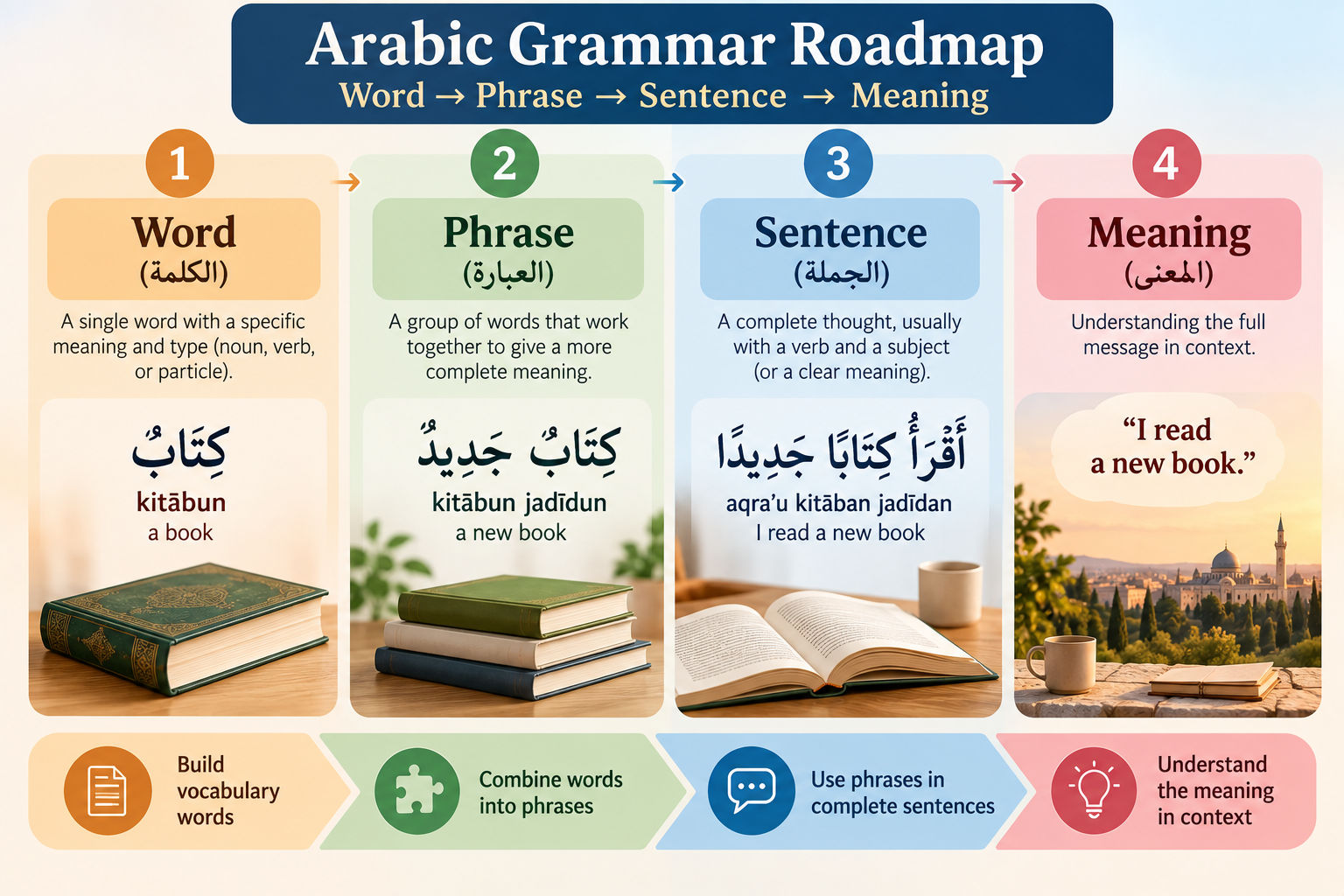
Progress runs from word → phrase → sentence → paragraph → text:
كتاب
كتاب جديد
هذا كتاب جديد
Each step adds a grammar idea, and grammar becomes meaningful as you watch the pieces combine.
What to Learn After These 8 Concepts
One reasonable sequence (not the only valid one):
Pronouns in more depth
Past and present verb conjugation
Demonstratives
Prepositions
Question words
Plurals
The dual
Negation
Relative pronouns
Object pronouns
More Idafah
I'rab
Verb forms
Derived nouns
More advanced sentence structures
Quranic Arabic learners can eventually add morphology (Sarf), weak verbs, attached pronouns in depth, particles, Quranic vocabulary, advanced Nahw, and rhetorical features where appropriate.
How Araby Academy Can Help
Grammar becomes much easier when it's taught inside a structured language system rather than as isolated rules. A teacher can identify your current level, explain difficult concepts, give fitting examples, correct misunderstandings, connect grammar with reading, adapt lessons to MSA or Quranic goals, and give immediate feedback. Araby Academy offers one-to-one Arabic and Quranic Arabic lessons for non-native speakers.
How to Learn Salah When You Don't Speak Arabic
Frequently Asked Questions
1. Is Arabic grammar difficult for beginners?
It can feel difficult when taught as abstract terminology. Learned gradually through examples, the first layer is very manageable.
2. What should I learn first in Arabic grammar?
Start with ism/fi'l/harf, masculine and feminine, and definite and indefinite. Then move to sentence patterns, pronouns, Idafah and agreement.
3. What are Ism, Fi'l and Harf?
They are the three traditional word categories: ism (nouns, adjectives and similar naming/describing words), fi'l (verbs) and harf (particles such as في and من).
4. What is a nominal sentence in Arabic?
A sentence that typically begins with an ism, such as البيت كبير ("the house is big"). It often needs no word for "is."
5. What is a verbal sentence in Arabic?
A sentence that typically begins with a verb, such as قرأ الطالب الكتاب ("the student read the book").
6. What is Idafah in Arabic?
A construction that expresses "X of Y" by placing two nouns together, such as كتاب الطالب ("the student's book").
7. What is I'rab?
The system of grammatical endings (marfu', mansub, majrur) that show a word's role in a sentence.
8. Do I need grammar to understand the Quran?
Not to understand translated meanings. But grammar helps you understand the Arabic directly. It is not, by itself, a basis for independent interpretation.
9. Is Quranic Arabic grammar different from Modern Standard Arabic?
They share a substantial foundation, but Quranic Arabic can be more classical, rhetorically complex and morphologically rich.
10. Should I learn vocabulary or grammar first?
Do both together. Vocabulary gives grammar something to work on, and grammar helps vocabulary make sense in sentences.
11. Can I learn Arabic grammar by myself?
Yes, for many foundations. A teacher helps most with confusing rules, feedback, pronunciation and Quranic goals.
12. How long does it take to learn Arabic grammar?
There's no fixed answer. You can build a beginner foundation in weeks, but full command takes sustained study over a long time.
Conclusion: You Don't Need All of Arabic Grammar to Start Arabic
Remember the overwhelmed learner who saw مبتدأ، خبر، مضاف، مجرور and assumed they needed to understand everything first? Arabic grammar for beginners doesn't work that way. It's a system you learn gradually.
First recognize ism, fi'l, harf. Then gender and definiteness. Then sentence patterns. Then pronouns and Idafah. Then agreement. Then gradually I'rab and more advanced grammar.
Don't try to memorize Arabic grammar. Learn to see Arabic grammar working inside real Arabic.
Pick one concept from this article and try to spot it in real Arabic today.
If Arabic grammar has always felt like a collection of confusing terminology, structured one-to-one lessons at Araby Academy can help you learn each concept through real Arabic examples, at a pace that matches your goals.