A New Year Begins. What Does Islam Actually Ask From Us?
The first of Muharram approaches, and your phone fills up.
“Happy Islamic New Year.” “1448 Hijri.” A graphic with a special Dua. “Read this before Maghrib.” “Pray these Rak’ahs tonight.” “Fast the first day and receive years of forgiveness.” “Share with ten people.”
Some Muslims celebrate. Others insist any recognition of the date is forbidden. Some treat Muharram mainly as a month of mourning. And many know almost nothing about it except that Ashura is somewhere in it.
If you are new to Islam, or returning to it, or raising children who ask questions, you may reasonably wonder: what am I actually supposed to do?
This guide answers from four sources, in order:
The Quran
Authentic Sunnah
Reliable Islamic history
Recognized scholarly understanding (Fiqh and Tafsir)
Two principles run through the whole article:
Honor Muharram through what Islam actually teaches, not by inventing a Muslim version of a secular New Year celebration.
A new Hijri year can be a useful moment for reflection, but a useful reflection is not automatically a prescribed act of worship.
We will keep four categories separate:
Prescribed worship (established by evidence)
Permissible personal reflection (useful, but not Sunnah)
Cultural custom (neither forbidden nor prescribed by default)
Unsupported religious ritual (claims of special worship without evidence)
We will also keep three things apart, because they overlap on the calendar without being the same concept:
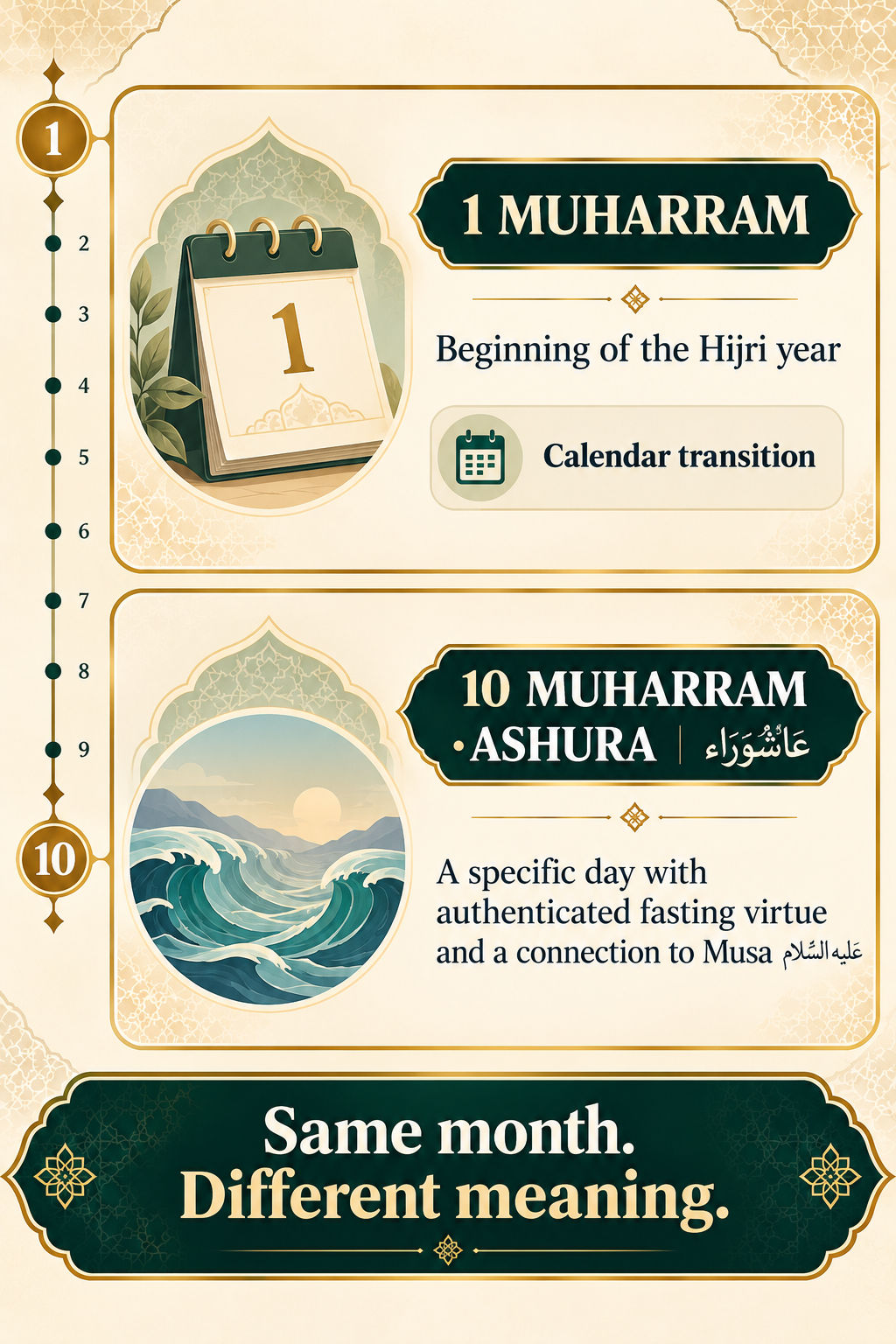
The Islamic New Year (1 Muharram) is a calendar transition.
Muharram is a sacred month.
Ashura (10 Muharram) is a specific day with authentic fasting virtue.
Calendar Change Does Not Mean a New Festival
The Hijri calendar has a first day of the year. That does not automatically mean Islam established:
a third Eid
a New Year Salah or Khutbah
a midnight countdown
a first-night Dhikr formula
a special first-day fast
a special New Year Dua
In worship, specificity requires evidence. A Muslim cannot decide that a particular prayer, number, or reward belongs to a date. It has to come from the Quran or the authentic Sunnah. As we’ll see, Muharram does have real, evidenced virtue. It just isn’t the kind people often assume.
What Is the Hijri Calendar?
The Hijri calendar (التقويم الهجري, al-Taqwim al-Hijri) is a lunar calendar. Its months follow the moon’s cycle, and its years are counted from the Hijrah, the Prophet’s ﷺ migration from Makkah to Madinah.
The Quran establishes the count of months:
إِنَّ عِدَّةَ الشُّهُورِ عِندَ اللَّهِ اثْنَا عَشَرَ شَهْرًا فِي كِتَابِ اللَّهِ يَوْمَ خَلَقَ السَّمَاوَاتِ وَالْأَرْضَ مِنْهَا أَرْبَعَةٌ حُرُمٌ
“Indeed, the number of months with Allah is twelve in Allah’s decree, since the day He created the heavens and the earth; of them, four are sacred.” (Quran 9:36)
The Quran also ties the moon to human timekeeping. Surah al-Baqarah 2:189 says the crescents are “measurements of time for the people and for Hajj.” Surah Yunus 10:5 says Allah made the moon in determined stages “so that you may know the number of years and the calculation (of time).”
So tracking time by the moon isn’t an arbitrary custom. It is built into the worship calendar, which governs Ramadan, Eid, Hajj, and the sacred months.
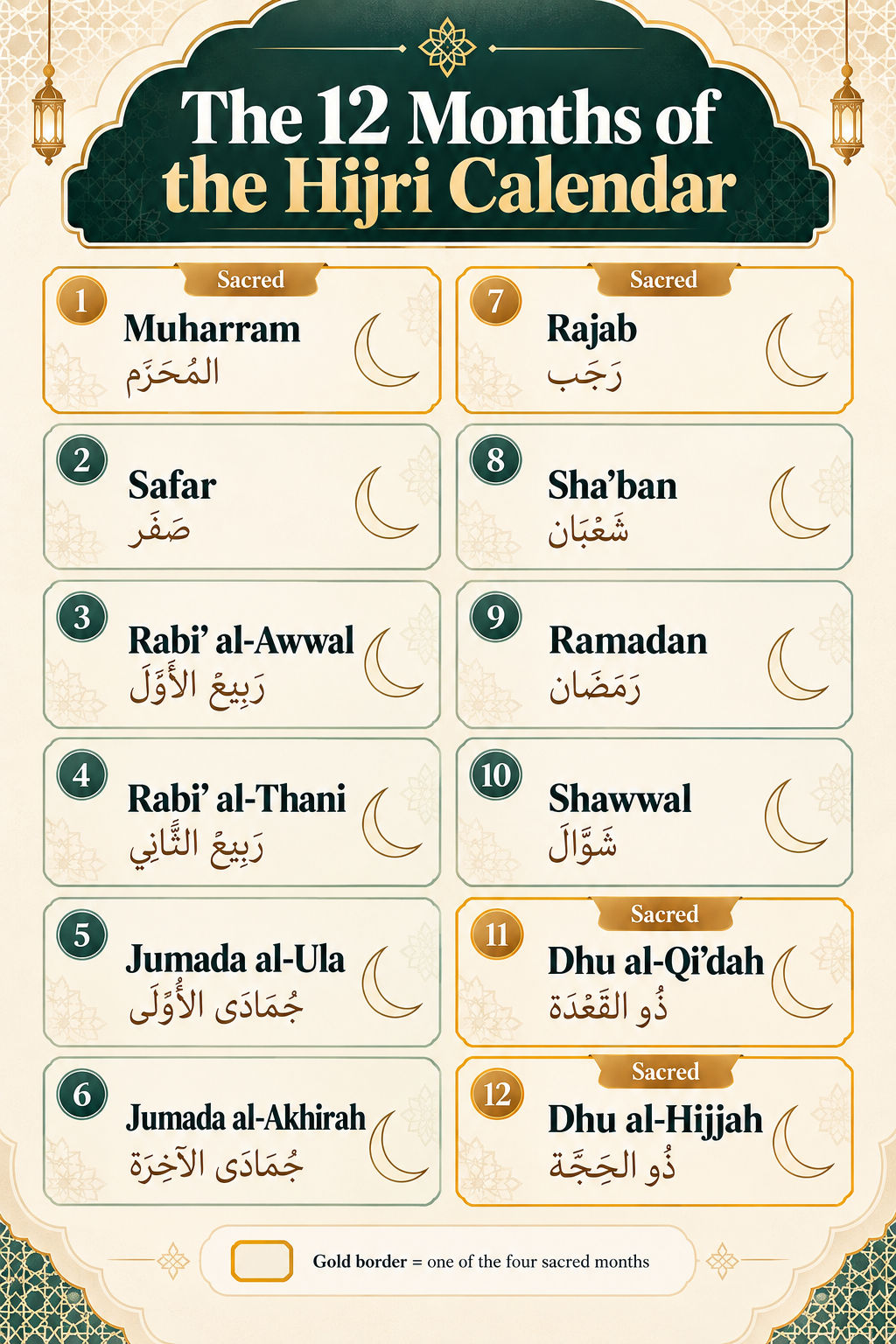
The 12 months
# | Month | Arabic | Note |
|---|---|---|---|
1 | Muharram | المُحَرَّم | Sacred month |
2 | Safar | صَفَر | |
3 | Rabi’ al-Awwal | رَبِيع الأَوَّل | |
4 | Rabi’ al-Thani (also Rabi’ al-Akhir) | رَبِيع الثَّاني / الآخِر | Both names are used |
5 | Jumada al-Ula | جُمَادَى الأُولَى | |
6 | Jumada al-Akhirah (also al-Thaniyah) | جُمَادَى الآخِرَة | |
7 | Rajab | رَجَب | Sacred month |
8 | Sha’ban | شَعْبَان | |
9 | Ramadan | رَمَضَان | Obligatory fasting |
10 | Shawwal | شَوَّال | |
11 | Dhu al-Qi’dah | ذُو القَعْدَة | Sacred month |
12 | Dhu al-Hijjah | ذُو الحِجَّة | Sacred month; Hajj |
Spellings vary across languages (“Dhul Qa’dah,” “Dhul Hijjah,” and so on). Month names are not a ranking of importance, and we won’t attach invented virtues to months the evidence doesn’t single out.
Lunar, not solar
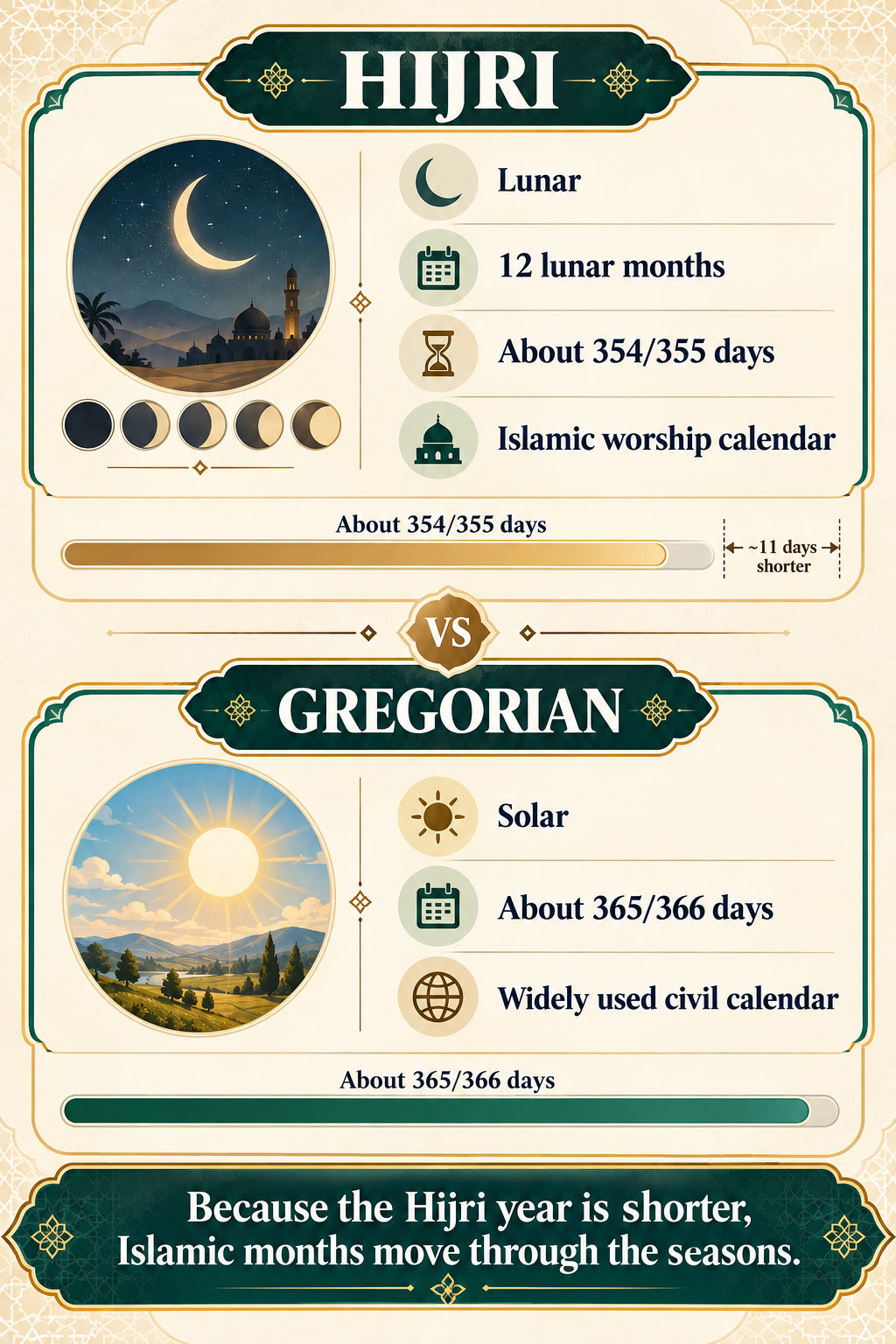
Twelve lunar months add up to roughly 354 or 355 days. The Gregorian solar year is 365 or 366. The Hijri year is about 11 days shorter, so Islamic dates drift earlier against the Gregorian calendar each year. That is why Ramadan, Hajj, and Muharram move through summer and winter over about 33 years. A Muslim in Cairo, Toronto, or Jakarta eventually fasts Ramadan in every season.
When does the day begin?
Traditionally, the Islamic date changes at sunset (Maghrib), not at midnight. So 1 Muharram begins at Maghrib on the evening before the Gregorian date shown on many calendars. No midnight countdown is part of this.
How is the new month determined?
Communities use moon sighting, astronomical calculation, or an official calendar. This produces real differences between regions, and the article won’t settle that debate. For practical dates, follow a reliable local authority or your community’s mosque.
Who Established the Hijri Era? (Not the Prophet ﷺ)
You will often read: “Prophet Muhammad ﷺ created the Islamic calendar.” This is imprecise.
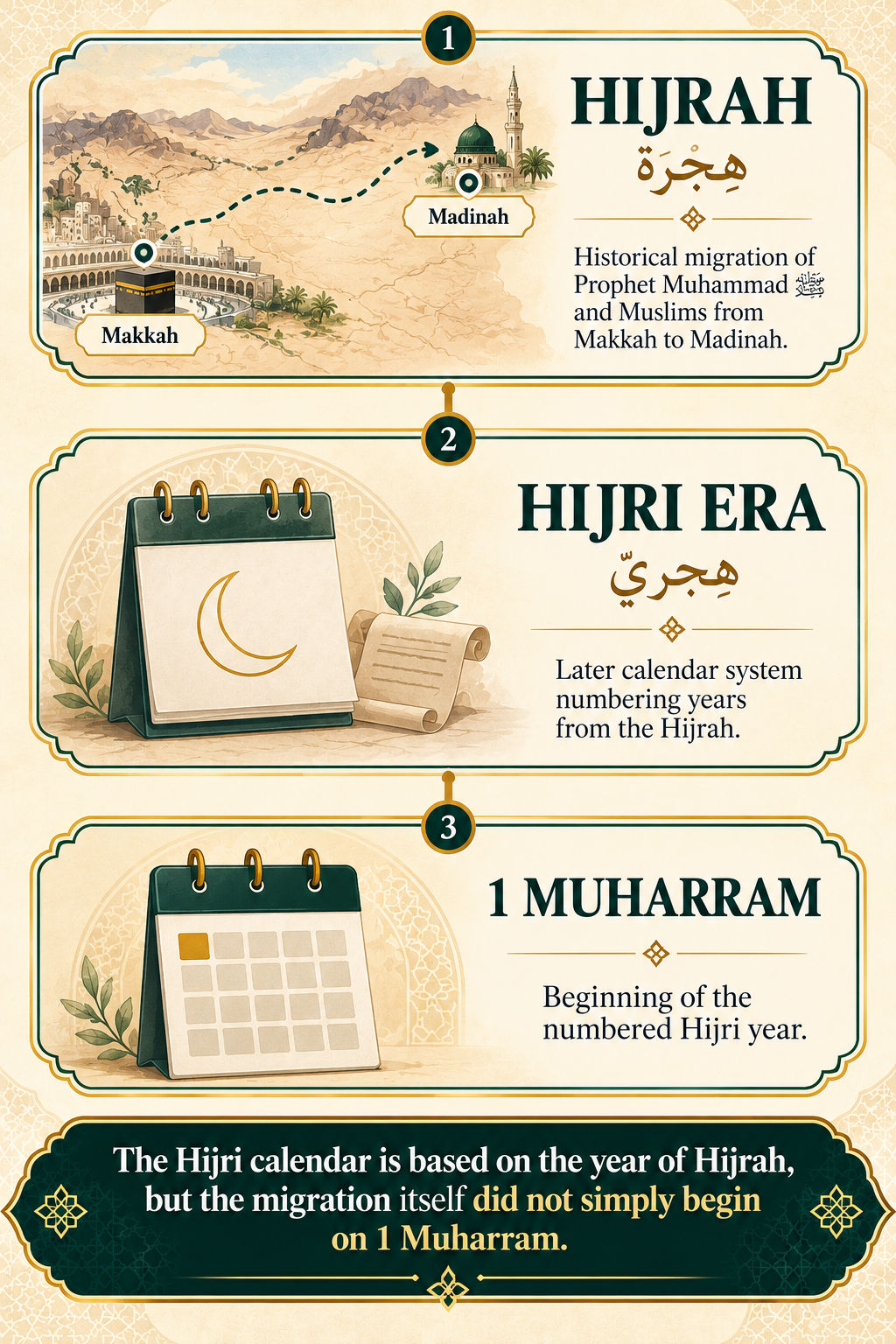
Arabs already counted lunar months, and the Quran confirms the twelve-month structure. What came later was the numbering of years from the Hijrah, formally adopted during the caliphate of Umar ibn al-Khattab رضي الله عنه, commonly dated around 17 AH.
Why a numbered era was needed
Historical sources report an administrative problem. Governors received official letters with no clear year. A frequently cited report attributes a letter on the subject to Abu Musa al-Ash’ari رضي الله عنه: a document due in “Sha’ban” left it unclear which Sha’ban was meant. Umar consulted the Companions.
A note on source quality: this account comes from classical historical reports, not Prophetic Hadith. The details differ between sources, and some chains are debated. It is a reasonable account of why the era was introduced, but it should not be presented as a “Sahih Hadith.”
A stronger anchor is a narration in Sahih al-Bukhari from Sahl ibn Sa’d رضي الله عنه. It says the Companions counted from the Prophet’s arrival in Madinah, not from his mission or his death. That supports the Hijrah as the chosen starting point.
Why the Hijrah?
Reports mention proposed starting points such as the Prophet’s birth, the first revelation, the Hijrah, and his death. The Hijrah was chosen because it marked a decisive transition. It was the moment the Muslim community gained a place of safety and could develop as a community with its own social order.
Be careful here. This does not mean “Islam began at the Hijrah.” Revelation began years earlier in Makkah, and Muslims existed before the migration. The Hijrah marks a major turning point in communal history, which is exactly why it suited an era.
Did the Hijrah happen on 1 Muharram?
No, and this is one of the most common misconceptions.
The Hijri era is numbered from the year of the Hijrah. But the Prophet ﷺ did not simply set out on 1 Muharram. The pledge of Aqabah took place in Dhu al-Hijjah of the preceding year, and the departure and journey occurred months later. The Prophet’s ﷺ arrival in the Madinah area is commonly associated with Rabi’ al-Awwal. Some precise day-counts are reported differently, so we won’t give a “Hijrah anniversary” date.
Calendar epoch ≠ exact anniversary date of the migration journey.
Think of a country that starts its “Year 1” at the beginning of a calendar year that included a founding event. The year’s first day and the event itself are not the same moment.
Why Muharram as the first month?
Reports say Umar consulted the Companions. Several explanations appear in the sources. Muharram follows the completion of Hajj, when people have returned home. It is a sacred month, and it fit the existing sequence of months. Some reports attribute the suggestion of Muharram to Uthman رضي الله عنه. Because these are historical reports with varying chains, the careful statement is that Muharram was chosen by consultation among the Companions for reasons transmitted in historical sources, not by a Prophetic instruction.
So did the Prophet ﷺ celebrate “Islamic New Year”?
The formal Hijri year-numbering was standardized after his lifetime. So there is no Prophetic annual “Hijri New Year celebration.” This does not mean Muharram lacks virtue. Muharram has authentic virtue independent of any New Year observance, as the next sections show.
What Is Muharram?
المُحَرَّم (al-Muharram) comes from the root ح ر م (h-r-m), which carries ideas of sacredness, inviolability, and prohibition. A haram thing is forbidden; a haram place, like the Sacred Mosque in Makkah, is inviolable.
So “Muharram” shouldn’t be lazily translated as “the forbidden month.” It means the month made sacred or inviolable, a time that carries heightened respect, especially regarding wrongdoing and bloodshed.
“The Month of Allah”
In Sahih Muslim, Abu Hurayrah رضي الله عنه reports that the Prophet ﷺ said:
أَفْضَلُ الصِّيَامِ بَعْدَ رَمَضَانَ شَهْرُ اللَّهِ الْمُحَرَّمُ، وَأَفْضَلُ الصَّلَاةِ بَعْدَ الْفَرِيضَةِ صَلَاةُ اللَّيْلِ
“The best fasting after Ramadan is the month of Allah, Muharram, and the best prayer after the obligatory prayers is the night prayer.”
Shahru Allah (“Allah’s month”) is an honorific attribution, like “the House of Allah” for the Ka’bah. It does not mean other months don’t belong to Allah; everything does. It marks Muharram as especially honored. This is the clearest authentic text on Muharram’s virtue, and it is about voluntary fasting.
The Four Sacred Months
الأَشْهُرُ الحُرُم (al-Ashhur al-Hurum)
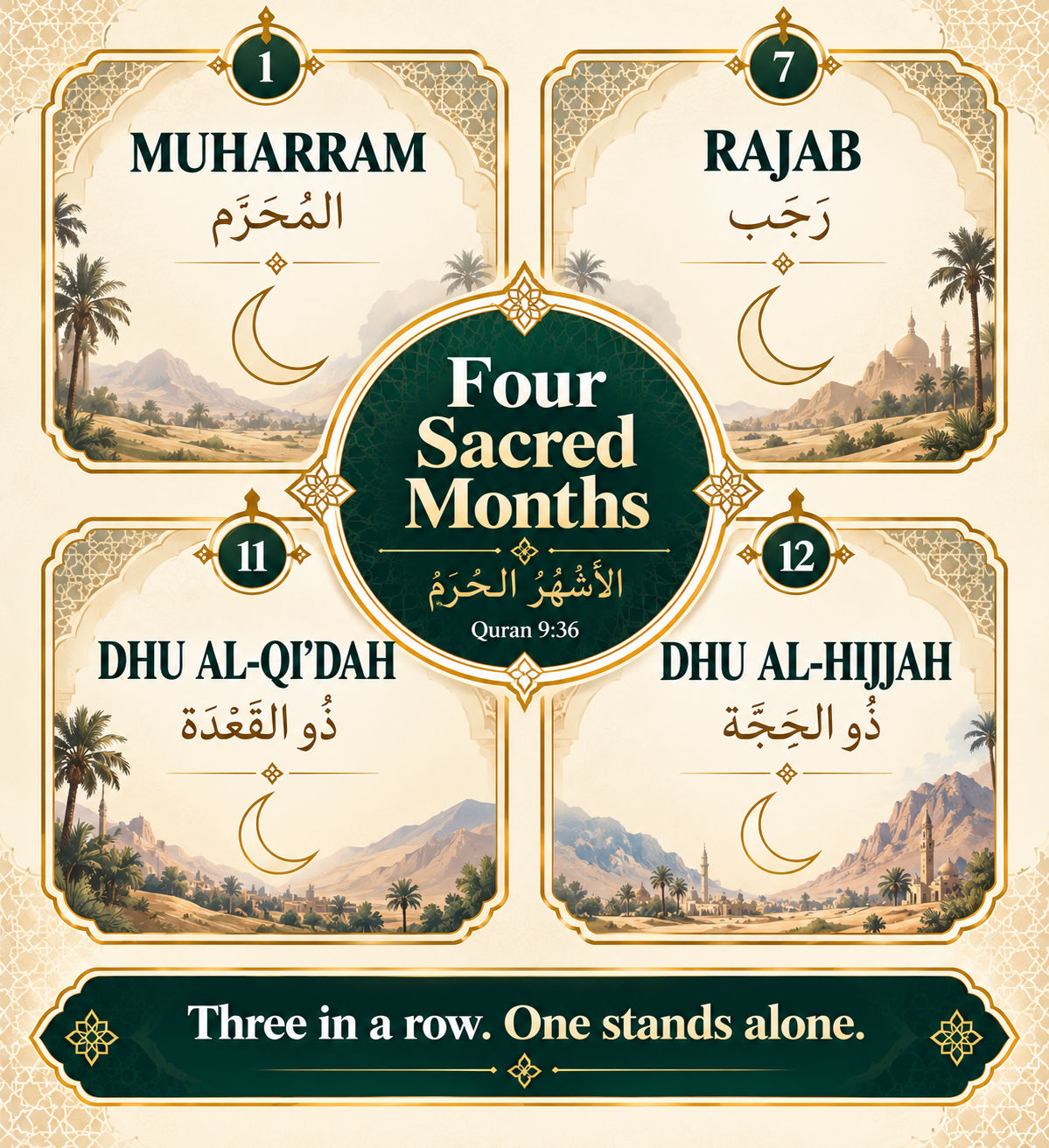
Quran 9:36 says four of the twelve months are sacred but does not name them. The Sunnah identifies them. In Sahih al-Bukhari and Sahih Muslim, Abu Bakrah رضي الله عنه reports the Prophet ﷺ said that the year is twelve months, four of them sacred: three consecutive, Dhu al-Qi’dah, Dhu al-Hijjah, and Muharram, and Rajab, which stands between Jumada and Sha’ban.
So three are consecutive and one stands alone. Notice that the Quran gives the number and the Sunnah supplies the names. That is a good small illustration of how the two sources work together.
What does “sacred” mean?
It is not just “good deeds count extra.” The word points to:
Sanctity: these months carry a special inviolability.
Greater gravity of wrongdoing. The same verse continues: “So do not wrong yourselves during them” (فَلَا تَظْلِمُوا فِيهِنَّ أَنفُسَكُمْ).
Restrictions on fighting, which Arab society had long respected.
Heightened respect for Allah’s limits.
Classical commentators such as Qatadah explained that wrongdoing is always serious, but in the sacred months it is graver.
Are sins numerically multiplied?
Be careful. Scholars generally speak of sin being greater in gravity and severity in sacred months. That is not the same as claiming a specific multiplication factor, as with the rewards of certain good deeds elsewhere. We don’t invent arithmetic. Likewise, good deeds are rewarded generously by Allah, but any claim like “every good deed in Muharram is multiplied X times” needs evidence, and none is established. Explain the sanctity without fake math.
Fighting in the sacred months
This is a nuanced legal and historical question, so we keep it brief. Surah al-Baqarah 2:217 discusses fighting in the sacred month as a grave matter. Scholars discussed whether this restriction continues, with many holding it was superseded by later revelation and the Prophet’s subsequent campaigns. Others held the sanctity continues in some form. In all views, defensive fighting is permitted. So “Muslims can never fight in Muharram” is too simple, and so is the opposite claim. The point for this article is that the sanctity of these months concerns restraint and respect, not only ritual.
What Should Muslims Actually Do in Muharram?
Here is a practical priority list, separating what is specific to Muharram from what is always good.
Specific to Muharram (with evidence):
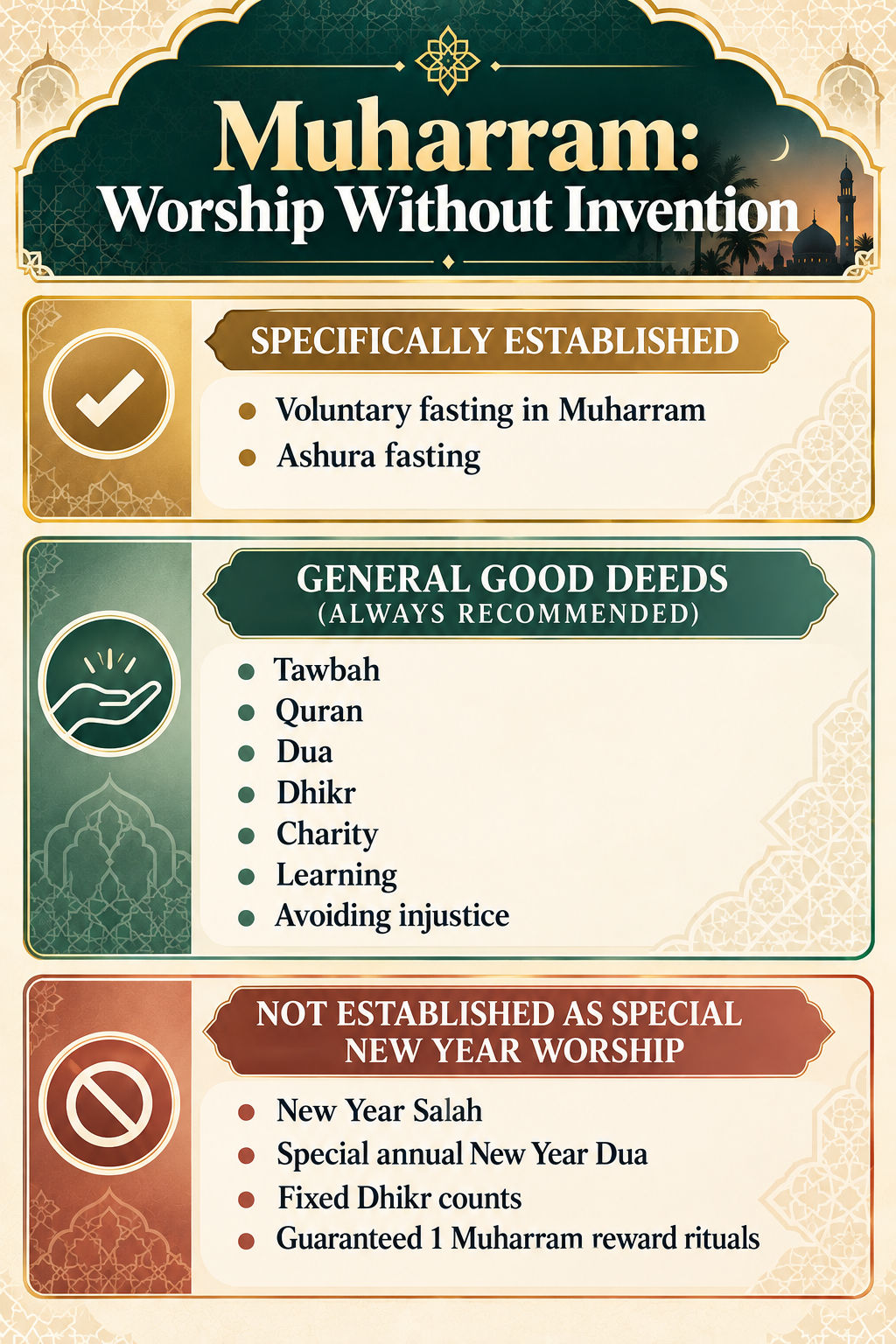
Voluntary fasting in Muharram (the Sahih Muslim Hadith above).
Fasting Ashura (10 Muharram).
Always recommended, and especially fitting in a sacred month:
3. Protect your obligatory worship, especially Salah.
4. Avoid sin and injustice, in line with 9:36.
5. Repent (Tawbah).
6. Read the Quran.
7. Make Dua.
8. Practice Dhikr.
9. Give charity and do good to family.
10. Learn Islamic history responsibly.
Important: Quran reading is always virtuous, but don’t claim a special “Muharram Quran reward” without evidence. The same goes for Dua, Dhikr, and charity. Their value is real but not date-specific. Use Muharram as a time to take them seriously, not to attach invented numbers to them.
Fasting in Muharram
The Hadith says fasting in Muharram is the best voluntary fasting after Ramadan. This establishes the broad virtue of voluntary fasting in this month.
Does it mean fasting every day?
No. And did the Prophet ﷺ fast the entire month? Here is the reconciliation. Aisha رضي الله عنها reported that the Prophet ﷺ never completed a full month of fasting other than Ramadan (the wording appears in the major collections). Scholars harmonize the two texts like this: Muharram is the most excellent month for voluntary fasting, and a person may fast many days in it as they are able. But the Prophet’s ﷺ practice shows that completing a whole month of voluntary fasting was not his habit. So fast as much as you can sustain, without turning it into an obligation or a strain.
How much should I fast? Flexible options
Ashura-centered fasting (see below)
Mondays and Thursdays, if you already keep them
The White Days (13th, 14th, 15th of the lunar month), if you keep them
Additional voluntary days according to your ability and health
We don’t present a fixed “Muharram fasting plan” as Sunnah. The evidence gives a virtue, not a schedule. Never fast in a way that harms your health or duties.
Is fasting on 1 Muharram a special Sunnah?
This is a critical correction. There are reports circulating about a special fast on the first day of Muharram, or on the last day of Dhu al-Hijjah combined with the first of Muharram, with promised rewards (for example, forgiveness for fifty years). Scholars of Hadith do not consider these authentic. Several are weak or have no sound basis.
So keep these apart:
The general virtue of fasting in Muharram → authentic.
A special, guaranteed reward for fasting 1 Muharram → not established.
You may fast on 1 Muharram, since it is a day in Muharram. Just don’t claim a specific reward for it.
Ashura: A Brief Orientation
عَاشُورَاء (Ashura) is the tenth of Muharram. A full guide will follow in our next article, [Ashura Explained: Why Muslims Fast the 10th of Muharram]. Here is just enough to orient you.
Why is Ashura important?
In Sahih al-Bukhari and Sahih Muslim, Ibn Abbas رضي الله عنهما reports that when the Prophet ﷺ came to Madinah, he found the Jews fasting on Ashura. They said it was a righteous day, the day Allah saved the Children of Israel from their enemy (Pharaoh), and Musa عليه السلام fasted it in gratitude. The Prophet ﷺ said, in effect, that he and the Muslims had a greater claim to Musa, and he fasted it and instructed people to fast it.
The lesson is continuity in the message of the Prophets, and gratitude for Allah’s deliverance. We say this respectfully, with no comparison meant to belittle anyone.
Before and after Ramadan
Aisha رضي الله عنها reported that the Quraysh used to fast Ashura in the pre-Islamic period, and the Prophet ﷺ fasted it too. When Ramadan became obligatory, Ashura became voluntary. Whoever wished fasted it and whoever wished left it. Its status is a strongly recommended Sunnah, not an obligation.
What does it expiate?
In Sahih Muslim, Abu Qatadah رضي الله عنه reports the Prophet ﷺ said he hoped Allah would accept the Ashura fast as expiation for the previous year. The mainstream scholarly understanding is that this refers to minor sins. Major sins require sincere Tawbah, and the rights of other people (money owed, harm done) are not erased by a fast. It is not “one fast wipes out everything no matter what.”
The ninth
In Sahih Muslim, Ibn Abbas رضي الله عنهما reports the Prophet ﷺ said that if he lived to the next year he would fast the ninth too. He passed away before that. The common practice is to fast the 9th and 10th. The detailed discussion of those combinations, including what is said about the 11th, is reserved for our full Ashura article. A narration recommending a day before or after is graded weak by many scholars, so we do not treat every combination as equally established.
Husayn ibn Ali رضي الله عنهما and Ashura
This section is written with care and respect.
Husayn ibn Ali رضي الله عنهما was the grandson of the Prophet Muhammad ﷺ, son of Ali ibn Abi Talib رضي الله عنه and Fatimah رضي الله عنها. He was killed at Karbala on the 10th of Muharram, 61 AH.
His killing was a profound tragedy
Sunni scholarship does not call for indifference. Love and respect for the family of the Prophet ﷺ (Ahl al-Bayt) is part of Muslim religious consciousness, and the killing of the Prophet’s grandson is remembered with grief across the Muslim world.
But Ashura did not become sacred because of Karbala
This is the chronology that matters:
The Prophet ﷺ fasted Ashura and encouraged it, in Makkah and in Madinah.
That was decades before Karbala.
So the religious virtue of Ashura, and its link to Musa عليه السلام, were not created by Karbala.
And yet Karbala is a major tragedy that occurred on that date.
Both truths can be held together. Holding one does not require denying the other.
Is Muharram a month of mourning?
Muslim communities differ in how they remember Karbala. In mainstream Sunni practice, there is no general Prophetic command making the whole month an annual mourning period. At the same time, Muslims should remember Husayn’s martyrdom with respect, and should not mock communities whose historical traditions differ.
On practices of grief, there are authentic limits. The Prophet ﷺ said that one who strikes the cheeks, tears the garments, and calls with the call of pre-Islamic times is not of us (Bukhari and Muslim, narrated by Ibn Mas’ud رضي الله عنه). Scholars across schools understand harming oneself in grief as impermissible, and wailing (niyahah) is warned against in authentic Hadith. We won’t dwell on graphic details, and we don’t use labels that insult anyone.
But this is not a call for emotional suppression. The Prophet ﷺ wept when his son Ibrahim died, and said that the eyes shed tears and the heart grieves, and we say only what pleases our Lord. Sadness, tears, and remembrance are natural. What is warned against is the pre-Islamic style of protest against Allah’s decree.
Can Muslims be happy in Muharram? Can they marry?
Don’t force a binary. Muharram is a sacred month of worship, fasting, and historical reflection. Islam doesn’t command a month-long emotional state of sadness, and Muslims shouldn’t trivialize historical tragedy either.
Weddings are not forbidden in Muharram. There is no general Islamic prohibition on Nikah or marriage in this month. Some local cultures avoid weddings during Muharram, and where this is a community sensitivity, being considerate is a matter of courtesy. But it should not be presented as an Islamic ruling.
Is the Islamic New Year an Eid?
No. Islam establishes two annual Eids: Eid al-Fitr and Eid al-Adha. In a Hadith in Abu Dawud and al-Nasa’i, Anas رضي الله عنه reports that when the Prophet ﷺ came to Madinah, the people had two festival days of play, and he said Allah had replaced them with two better days: Eid al-Adha and Eid al-Fitr. This is widely graded sahih.
So 1 Muharram is not established as a third annual Eid.
Does that mean we must ignore the date?
No. A Muslim can know the Hijri year and date, teach children, reflect on the passing of time, plan goals, and learn about the Hijrah. What we avoid is converting optional reflection into prescribed worship.
Can Muslims say “Happy Islamic New Year”?
Contemporary scholars have differed here, and there is no universal consensus to claim. Some regard it as an ordinary social greeting that is permissible, particularly when responding politely. Others discourage it, or discourage treating the day as a celebration, because they see no precedent from the early generations. The helpful distinctions:
Initiating or responding to a greeting as ordinary courtesy is different from
Treating the greeting as a religious Sunnah, which it is not.
There is no established Prophetic annual New Year greeting. The common Arabic phrase كل عام وأنتم بخير (kull ‘am wa antum bikhayr, “may you be well every year”) is a cultural greeting. It is not a Prophetic formula. If you use it, use it as a courtesy. If you prefer not to, follow the guidance of a scholar you trust.
Is There a Special Dua, Prayer, or Dhikr for the New Year?
This is where viral content does the most damage, so let’s audit it.
Special Dua
Graphics circulate titled “Dua for the end of the year” and “Dua for the beginning of the year,” often attributed to the Prophet ﷺ. No authentic Prophetic Dua specifically prescribed for entering the new Hijri year is established. Do not attribute these texts to him. You can make any sincere Dua, in any language, at any time.
The new-moon Dua is a different matter
There is a narration for seeing the new crescent:
اللَّهُمَّ أَهِلَّهُ عَلَيْنَا بِالْيُمْنِ وَالْإِيمَانِ وَالسَّلَامَةِ وَالْإِسْلَامِ، رَبِّي وَرَبُّكَ اللَّهُ
“O Allah, bring it over us with blessing, faith, safety, and Islam. My Lord and your Lord is Allah.”
This is reported in al-Tirmidhi from Talhah ibn Ubaydillah رضي الله عنه, who graded it hasan gharib. Scholars differ in how they grade the various routes of this and related narrations, so present it with that caveat. Whatever its grading, it is a new-moon (monthly) supplication, not a special annual New Year Dua. The Prophet ﷺ saw a new moon every month, so this is no evidence for a yearly ritual.
Special prayer on 1 Muharram
Claims of 2, 4, or 100 Rak’ahs, with specific Surahs and repetitions, have no authentic basis. We won’t reproduce them. Voluntary prayer is always welcome, but a specific New Year prayer should not be invented.
Special Dhikr counts, “write Bismillah 113 times,” special charity rewards
Dhikr and charity are excellent anytime. But a claim like “say this phrase 360 times on 1 Muharram for protection all year” needs evidence, and none is established. The same applies to special New Year charity rewards and to circulated “Bismillah” writing practices. We classify these as unsupported religious specifications.
Resolutions, Muhasabah, and a Better “Reset”
Are New Year resolutions allowed?
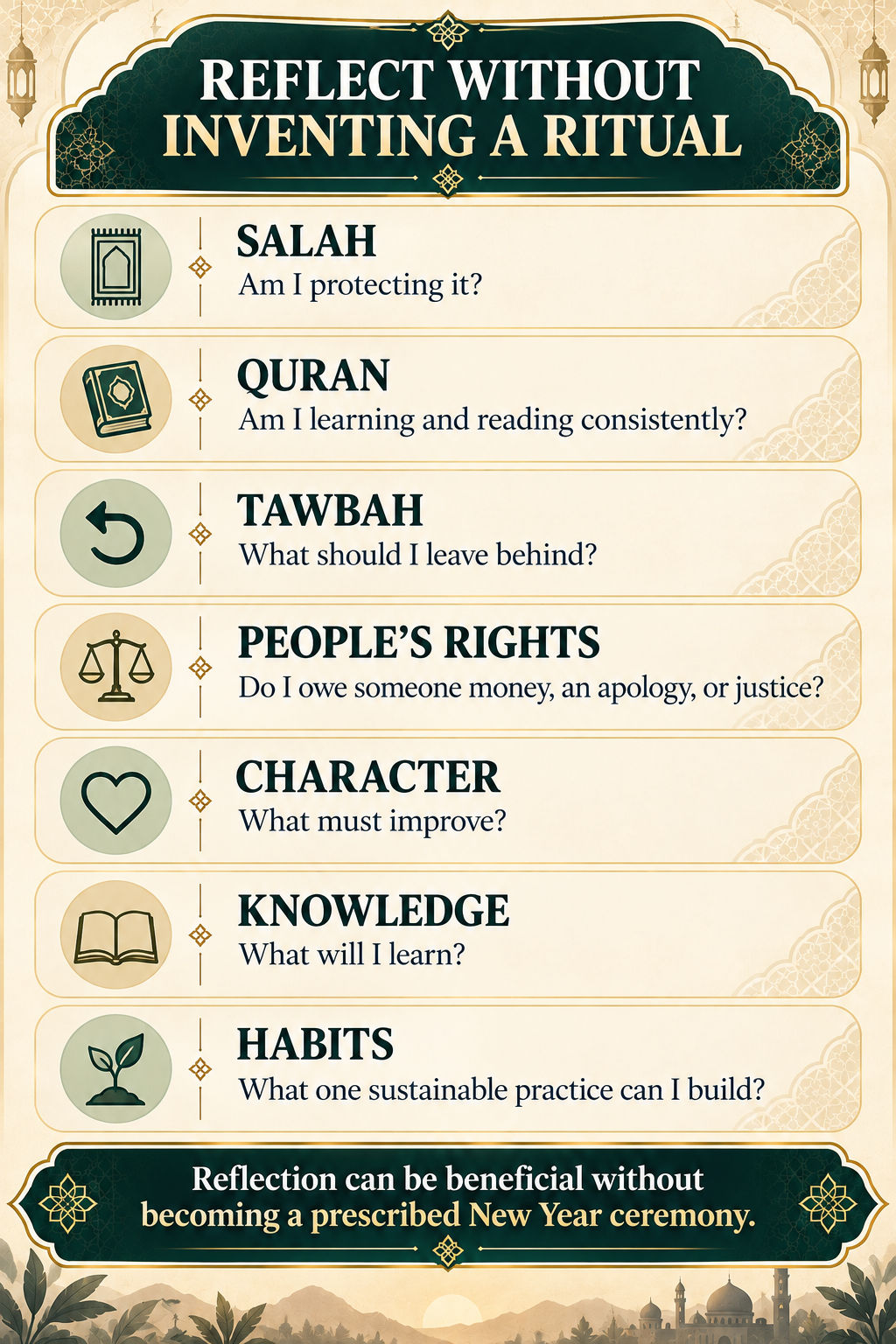
There is no Prophetic ritual called “Islamic New Year resolutions.” But setting beneficial goals is permissible. A Muslim can use any reasonable milestone to review Salah, Quran, character, learning, finances, family, health, debts, and habits.
A useful planning practice does not need to be turned into a Sunnah.
Muhasabah (self-accounting)
مُحَاسَبَة (muhasabah) means taking account of yourself. A statement widely attributed to Umar رضي الله عنه says, in essence, “Take account of yourselves before you are taken to account.” It appears in classical sources as a statement of Umar but with chain concerns, so don’t quote it as a Prophetic Hadith. The concept itself is well supported by the Quran, which calls on every soul to look to what it has sent forward for tomorrow (59:18).
Hijrah as personal transformation
It’s popular to say, “Make your own Hijrah from sin to obedience.” There is an authentic basis, in Sahih al-Bukhari, where the Prophet ﷺ said:
وَالْمُهَاجِرُ مَنْ هَجَرَ مَا نَهَى اللَّهُ عَنْهُ
“The muhajir is the one who abandons what Allah has forbidden.”
Use this sincerely, but don’t reduce the historical Hijrah to a metaphor. The historical migration was a real event with real sacrifice.
A better reset
Instead of invented rituals:
Review your five daily prayers.
Review your relationship with the Quran.
Repent from persistent sins.
Return people’s rights and address debts.
Repair family relationships where it is safe.
Learn Quran or Arabic.
Set one sustainable Islamic habit.
Make ordinary, sincere Dua.
Fast the days Sunnah recommends.
Tawbah does not wait for New Year
تَوْبَة (tawbah) is repentance, and it is due when needed, not when the calendar turns. Don’t wait for 1 Muharram to repent, and don’t wait for it to start a good habit. If you can begin today, begin today.
Time as responsibility
Surah al-‘Asr (103) opens with وَالْعَصْرِ, “By time.” It describes the human being as in loss, except those who believe, do righteous deeds, and advise one another to truth and patience. This surah is not about the Islamic New Year. It is a general reminder about time, and that is how to use it.
A year closer to Allah, or just older?
A reflective question, asked calmly: Did my Salah improve? My character? My connection to the Quran? Did I reduce debts, repair relationships, increase knowledge, or reduce harm? But avoid spiritual scorekeeping or obsessive self-doubt. Muhasabah is meant to move you toward Allah with hope, not weigh you down.
Families, Children, and New Muslims
Teaching children the calendar
Twelve months; Muharram first
The four sacred months
Ramadan is the ninth; Dhu al-Hijjah the twelfth
Ashura is the tenth of Muharram
A wall calendar activity works well. Avoid turning 1 Muharram into a birthday-style festival.
A family learning night
Can a family sit together and learn about the Hijri calendar, the Hijrah, Muharram, Musa, Ashura, and Husayn? Yes, as general Islamic education. But don’t label a specific annual family ceremony as Sunnah. Learning is encouraged; a prescribed “New Year ceremony” is not established.
For new Muslims
You do not need special clothes, special food, a party, a New Year Salah, an Arabic greeting, or a midnight ritual. A simple approach: learn the month, protect your obligations, fast according to your ability, learn about Ashura, make normal Dua, reflect, repent, and continue.
Cultural foods and customs
Many communities prepare special dishes in Muharram or on Ashura. Food customs are not automatically forbidden or prescribed. The question is whether it is ordinary culture, or whether a specific dish is believed to carry guaranteed religious reward. Don’t condemn culture merely for being culture, and don’t turn culture into Sunnah.
Spending on family, kohl, and special reports
You may hear that whoever is generous to his family on Ashura will be given ample provision all year. Reports with this meaning are transmitted through several chains, but most scholars consider the chains weak. Some strengthen them through multiple routes, and the matter is disputed. So it is not responsible to present it as Sahih. Generosity to family is good always. Reports about kohl, special baths, special foods, and similar Ashura-specific rewards are mostly weak or fabricated. The full audit belongs in our Ashura article.
Clearing Up Other Misunderstandings
“Muharram is Allah’s month, so Ramadan matters less.” “Month of Allah” is honorific. Ramadan remains unique: obligatory fasting, the revelation of the Quran, and Laylat al-Qadr. Virtues in Islam are not a simplistic ranking contest.
“Muharram is the most sacred month.” Avoid unsupported hierarchies. Dhu al-Hijjah has extraordinary days, Ramadan has unique status, and Muharram has sacred-month status and exceptional voluntary fasting virtue. Each stands on its own evidence.
“The first ten days of Muharram are like the first ten of Dhu al-Hijjah.” The authentic virtue of the first ten days of Dhu al-Hijjah (Sahih al-Bukhari, Ibn Abbas) must not be transferred to Muharram. Ashura is special. There is no established “ten sacred days of Muharram” doctrine.
“The ten nights of Surah al-Fajr (89:2) are Muharram’s.” Most classical commentators associate “wa layalin ‘ashr” with the first ten of Dhu al-Hijjah, though other views are recorded. Don’t repurpose it for Muharram New Year content.
“The Ark landed on Ashura; Adam was forgiven then; Yunus, Ayyub, and others were saved on this day.” Lists like these circulate widely. Reports of this type are generally weak, and the authentic connection established in Sahih Hadith is Musa and the deliverance of Bani Isra’il. We don’t present the broader lists as established fact.
“Muharram is unlucky for marriage, business, or travel.” Islam rejects superstition. The Prophet ﷺ said there is no omen (tiyarah) and no contagion by itself (Bukhari and Muslim). Believing a month is unlucky has no place.
“Using the Gregorian calendar is haram.” No. Muslims can use civil calendars for work, school, contracts, and travel. The Hijri calendar remains essential for worship dates: Ramadan, Eid, Hajj, Ashura, and the sacred months. Knowing it is valuable.
“Mosques must give a New Year Khutbah.” A mosque may teach about time, Hijrah, Muharram, and Tawbah. That is an educational choice, different from claiming a prescribed annual New Year Khutbah ritual.
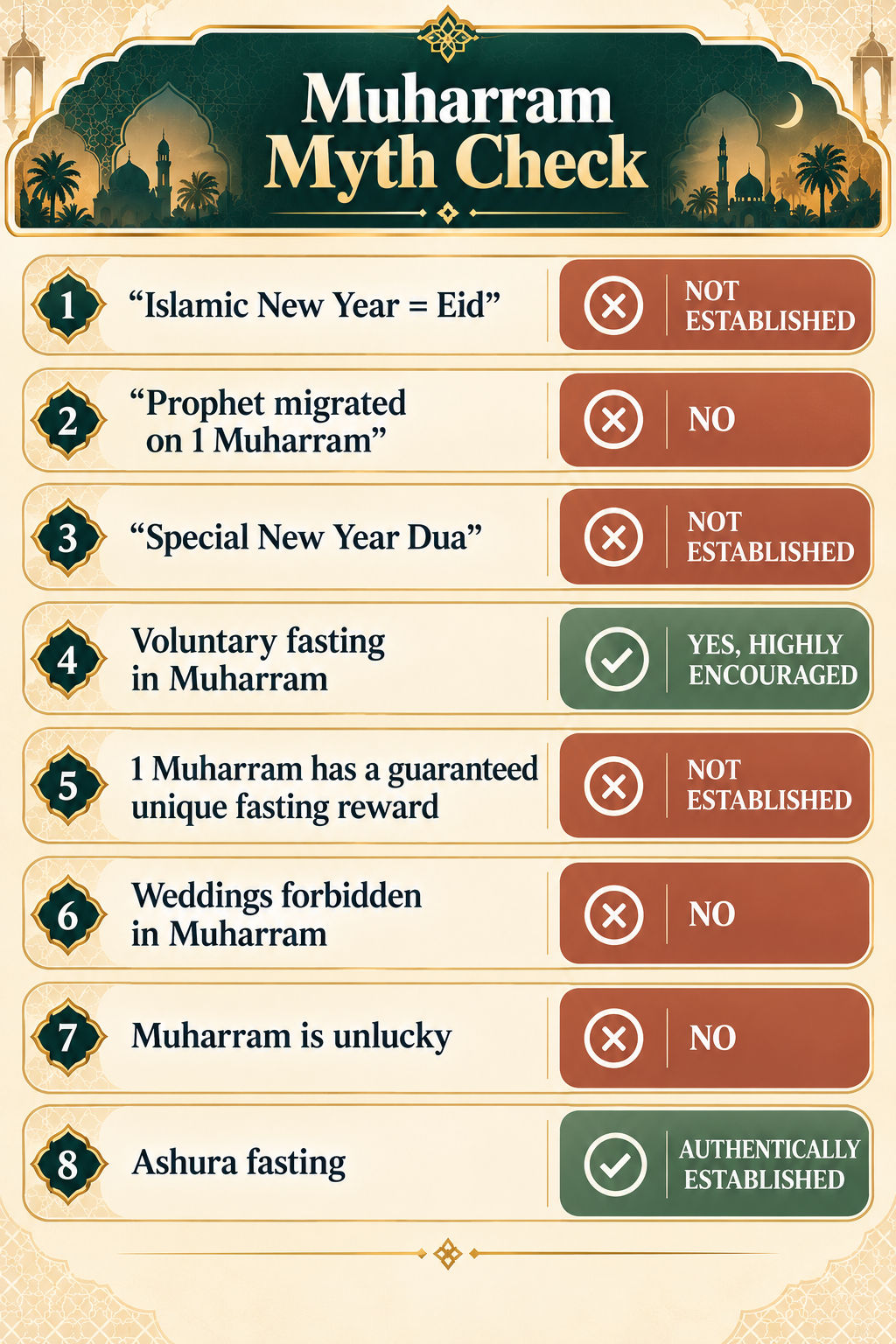
Myth Check
Myth | Reality |
|---|---|
Islamic New Year is one of the Eids. | Only Eid al-Fitr and Eid al-Adha are established. |
The Prophet ﷺ celebrated Hijri New Year yearly. | The formal era was instituted under Umar. |
The Prophet ﷺ migrated on 1 Muharram. | The era is based on the year of Hijrah; the journey did not simply begin on 1 Muharram. |
There is a special authentic New Year Dua. | None is established; the new-crescent Dua is a separate matter. |
There is a special New Year Salah. | None is established. |
Fasting 1 Muharram has a guaranteed reward. | Fasting in Muharram is virtuous; a specific first-day reward isn’t established. |
Muslims must celebrate the new year. | No prescribed festival exists. |
Muslims may not notice the new year at all. | Knowing the calendar and reflecting is different from inventing worship. |
Muharram must be a month of sadness. | No general Prophetic command makes it a mourning period. |
Weddings are forbidden in Muharram. | No general prohibition exists. |
Ashura became important because of Husayn. | Its virtue and Musa connection predate Karbala. |
Karbala doesn’t matter to Sunnis. | Husayn is beloved and his killing a profound tragedy. |
Every good deed is multiplied a fixed amount in Muharram. | Don’t invent numbers. |
All sins are multiplied by a fixed amount. | Sacred months increase gravity; no arithmetic is established. |
First ten days of Muharram equal first ten of Dhu al-Hijjah. | Don’t transfer evidence between months. |
Muharram is unlucky. | Islam rejects this superstition. |
The Gregorian calendar is forbidden. | Civil calendars are fine for ordinary purposes. |
Prescribed, Permissible, or Unsupported?
Practice | Status | Evidence / Note |
|---|---|---|
Knowing the Hijri date | Permissible and useful | Worship dates depend on the lunar calendar |
Learning about the Hijrah | Beneficial learning | General Islamic education |
Repenting | Always prescribed | Quran and Sunnah |
Reading Quran | Always recommended | Not date-specific |
General Dua | Always recommended | Not date-specific |
Voluntary fasting in Muharram | Specifically encouraged | Sahih Muslim |
Fasting Ashura | Specifically established | Bukhari and Muslim |
A special 1 Muharram fast | No special virtue established | Reports are weak or baseless |
New Year resolutions | Permissible planning | Not a Sunnah ritual |
New Year party as a religious festival | Not established | Only two Eids |
Special New Year Salah | Unsupported | No authentic basis |
Special New Year Dua attributed to the Prophet ﷺ | Unsupported | No authentic chain |
Greeting others | Scholars differ | Cultural courtesy vs. religious practice |
Marriage in Muharram | Permissible | No prohibition |
Month-long ritual mourning | Not prescribed in mainstream Sunni practice | No general command |
Begin the Year With Evidence, Worship, and Intention
A new Hijri year begins. You do not need fireworks, a countdown, a special ritual, a forwarded Dua, an invented Salah, or a viral reward chart. Nor do you need to pretend the calendar change means nothing.
You can notice time passing. You can thank Allah for life, repent, review your habits, learn your Islamic calendar, teach your children, protect your Salah, read Quran, make sincere Dua, fast the recommended days, prepare for Ashura, and begin again.
But do it with an important distinction: personal reflection can be beneficial without becoming prescribed worship.
Islam does not need us to invent a New Year ritual to make Muharram meaningful. Allah has already given the month its dignity. The best way to honor a sacred month is not to add to the religion, but to take more seriously what Allah has already taught.
So the question changes. Not “What special New Year ritual should I perform?” but “What authentic worship can I strengthen as another year of my life begins?”
Key Arabic Vocabulary
Arabic | Transliteration | Root | Meaning and what to remember |
|---|---|---|---|
مُحَرَّم | Muharram | ح ر م | “Made sacred/inviolable.” First month; a sacred month |
هِجْرَة | Hijrah | ه ج ر | Migration/leaving. The Prophet’s ﷺ move to Madinah; the calendar’s starting point |
هِجْرِيّ | Hijri | ه ج ر | “Relating to the Hijrah.” The lunar calendar counted from it |
شَهْر | Shahr | ش ه ر | Month. Twelve in the Quran (9:36) |
سَنَة | Sanah | س ن و | Year |
الأَشْهُر الحُرُم | Al-Ashhur al-Hurum | ح ر م | The four sacred months |
عَاشُورَاء | Ashura | ع ش ر | The tenth of Muharram; an authentic fasting day |
صِيَام / صَوْم | Siyam / Sawm | ص و م | Fasting. Voluntary fasting in Muharram is encouraged |
تَوْبَة | Tawbah | ت و ب | Returning to Allah in repentance; never waits for a date |
مُحَاسَبَة | Muhasabah | ح س ب | Self-accounting; supported as a concept, not a New Year ritual |
FAQ
1. What is the Islamic New Year?
It is the first day of Muharram, the first month of the Hijri lunar calendar. It marks the start of a new numbered year counted from the Hijrah. It is a calendar transition, not a prescribed festival.
2. When does the Islamic New Year begin?
On 1 Muharram, which begins at sunset (Maghrib). Because the Hijri year is about 11 days shorter than the Gregorian, the date shifts earlier each year. Exact dates depend on moon sighting or your local authority’s calendar.
3. What is Muharram?
The first Islamic month and one of the four sacred months. The name comes from the root h-r-m, meaning sacred or inviolable. The Prophet ﷺ called it “the month of Allah.”
4. Why is Muharram important in Islam?
It is a sacred month, and authentic Hadith in Sahih Muslim says voluntary fasting in it is the best after Ramadan. It also contains Ashura, a day with authentic fasting virtue.
5. What are the four sacred months?
Dhu al-Qi’dah, Dhu al-Hijjah, Muharram, and Rajab. Quran 9:36 establishes that four are sacred, and the Sunnah (a Hadith in Bukhari and Muslim) names them. Three are consecutive; Rajab stands alone.
6. Did Prophet Muhammad ﷺ celebrate Islamic New Year?
No. The Hijri year-numbering was formalized after his lifetime, so there is no Prophetic New Year celebration. Muharram’s virtue, however, comes from authentic Prophetic teachings.
7. Who established the Hijri calendar?
Muslims already used lunar months. The numbering of years from the Hijrah was instituted during the caliphate of Umar ibn al-Khattab رضي الله عنه, after consultation with the Companions.
8. Why does the Hijri calendar begin with the Hijrah?
The Hijrah marked a decisive turning point: the establishment of the Muslim community in Madinah. It does not mean Islam began then, as revelation and Muslims existed earlier.
9. Did the Prophet ﷺ migrate on 1 Muharram?
No. The era is numbered from the year of the Hijrah, but the migration took place months later. The arrival near Madinah is commonly associated with Rabi’ al-Awwal.
10. Is Islamic New Year an Eid?
No. Islam establishes two annual Eids, Eid al-Fitr and Eid al-Adha. 1 Muharram is not established as a third.
11. Can Muslims say “Happy Islamic New Year”?
Scholars differ. Some see it as a permissible social courtesy; others discourage it. There is no established Prophetic New Year greeting, so it should not be treated as a religious Sunnah.
12. Is there a special Dua for Islamic New Year?
No authentic Prophetic Dua specific to the new year is established. The new-crescent supplication in al-Tirmidhi relates to the monthly moon, not an annual ritual. Any sincere Dua is welcome.
13. Is there a special prayer for 1 Muharram?
No authentic basis exists for a special New Year prayer with fixed Rak’ahs or Surahs. Voluntary prayer is always welcome, but a specific ritual should not be invented.
14. Is fasting on 1 Muharram Sunnah?
Fasting in Muharram is highly virtuous, so you may fast that day. But reports promising a special reward for fasting 1 Muharram are not authentic.
15. Should Muslims fast during Muharram?
Voluntary fasting is strongly encouraged, according to your ability. The Prophet ﷺ is not reported to have completed a full month other than Ramadan, so it is not required to fast every day.
16. What is Ashura?
Ashura is the tenth of Muharram, a day on which fasting is authentically established as a voluntary Sunnah.
17. Why do Muslims fast Ashura?
Authentic Hadith report that it is the day Allah saved Musa عليه السلام and the Children of Israel from Pharaoh. The Prophet ﷺ fasted it and encouraged it. It is hoped to expiate the previous year’s minor sins.
18. What does Husayn’s martyrdom have to do with Muharram?
Husayn ibn Ali رضي الله عنهما, the Prophet’s grandson, was killed at Karbala on 10 Muharram, 61 AH. It is a profound tragedy, but Ashura’s virtue predates it.
19. Are weddings forbidden in Muharram?
No. There is no general Islamic prohibition on marriage in Muharram. Some local customs avoid it, but that is cultural, not a religious ruling.
20. What should Muslims actually do during Muharram?
Protect obligatory worship, avoid injustice, repent, fast voluntarily according to ability including Ashura, and increase general good deeds like Quran, Dua, and charity. Do not invent special New Year rituals.