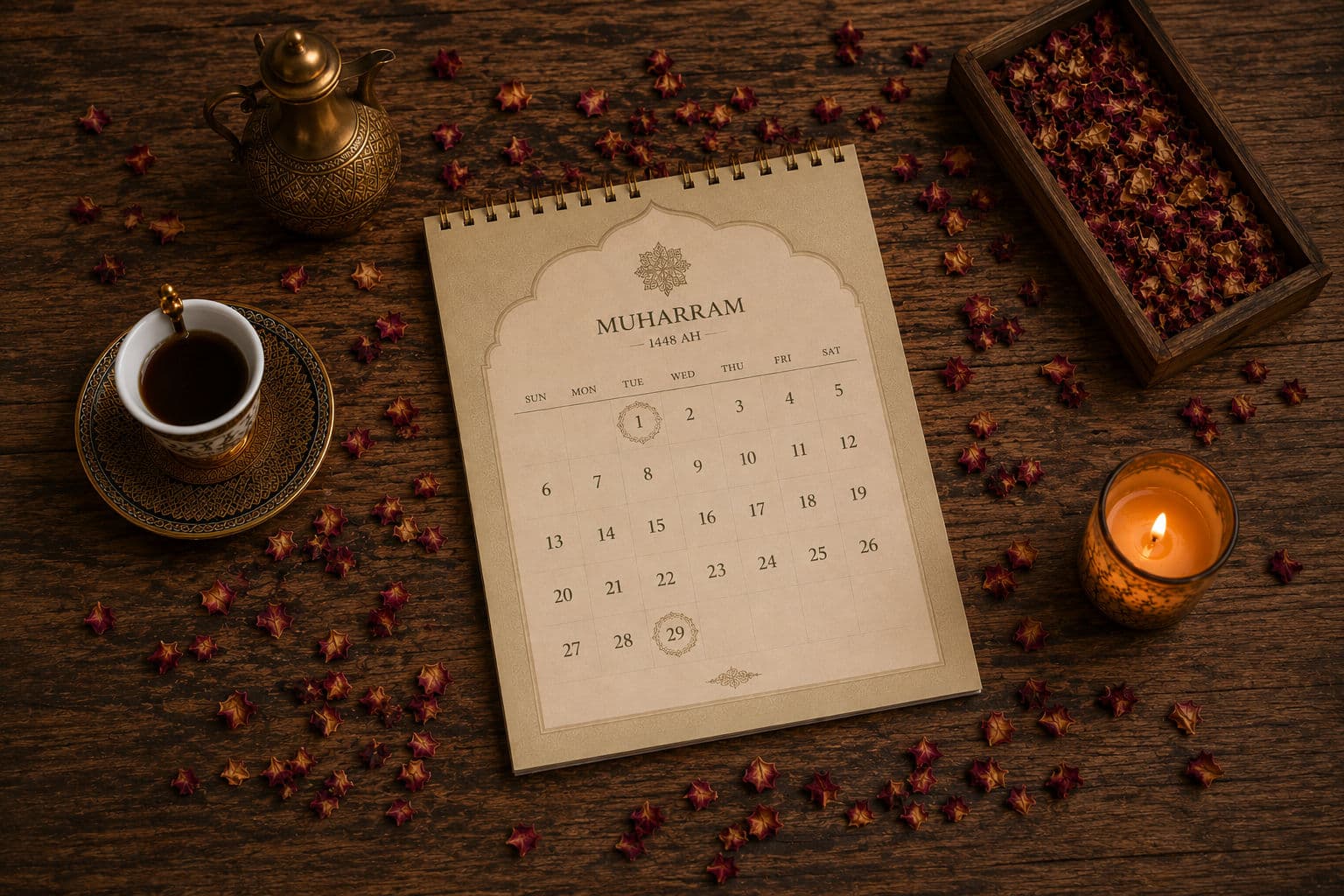
There are moments in time that Allah ﷻ has chosen to make sacred — windows of divine mercy that, if we recognize them and enter them with sincerity, can reshape the course of our lives.
Muharram is one of those windows.
As the first month of the Islamic Hijri calendar, Muharram carries a weight that most Muslims sense but few fully understand. It is more than a date on the calendar. It is an invitation — from Allah ﷻ Himself — to begin again.
The Prophet Muhammad ﷺ called it Shahr Allah, the Month of Allah. He described its fasting as the best voluntary fast after Ramadan. And within it lies a single day — the Day of Ashura — that changed the course of history and continues to inspire believers more than fourteen centuries later.
If you have ever wanted a clean slate, a meaningful reset, or a new beginning rooted in faith rather than wishful thinking, then Muharram is your moment.
This article is your complete guide to understanding, honoring, and making the most of this extraordinary month.
What Is Muharram? Understanding Its Name and Position in Islam
The Linguistic Meaning
The word Muharram (مُحَرَّم) comes from the Arabic root h-r-m, which carries the meaning of something sacred, forbidden, or inviolable. The same root gives us words like haram (sacred sanctuary) and ihram (the state of pilgrimage). When something is muharram, it is elevated, protected, and deserving of reverence.
The very name of this month is a reminder: what happens in this time is not ordinary. It is sanctified.
Its Place in the Islamic Calendar
The Islamic Hijri calendar is a lunar calendar consisting of twelve months. Muharram is the first of those twelve, making it the beginning of the Islamic year. The calendar itself takes its name from the Hijra — the migration of the Prophet Muhammad ﷺ from Makkah to Madinah — an event that marked a turning point in Islamic history and became the reference point from which Muslims count their years.
So Muharram is not only the first month of the year in a numerical sense. It carries within it the memory of one of Islam's greatest moments of faith, sacrifice, and new beginnings.
Why It Is Called the Month of Allah
The Prophet Muhammad ﷺ referred to Muharram uniquely. In an authentic hadith reported by Imam Muslim, he said:
"The best fasting after Ramadan is fasting in Allah's month of Muharram." (Sahih Muslim)
Notice: he did not call it the month of the Prophet, the month of the Ummah, or the month of the pilgrimage. He called it the month of Allah. Scholars have noted that this special attribution to Allah Himself is a sign of the immense honor and virtue this month holds. Just as the Kaaba is called the House of Allah (Baytullah) to signify its elevated status among all buildings, Muharram's attribution to Allah signals its elevation among all months.
The Four Sacred Months in Islam
The Quranic Foundation
Allah ﷻ declares in the Quran:
"Indeed, the number of months with Allah is twelve months in the register of Allah from the day He created the heavens and the earth. Of these, four are sacred." (Surah At-Tawbah, 9:36)
These four months are Dhul Qa'dah, Dhul Hijjah, Muharram, and Rajab — three consecutive months and one standing alone. This is not a human tradition or cultural practice. It is a divine arrangement, written into the architecture of creation from the very beginning of time.
Why Allah Made Certain Times Sacred
There is profound wisdom in the fact that Allah has made certain times more sacred than others. This is part of what scholars call tafaddul al-azminah wa al-amkinah — the grading of times and places in terms of spiritual significance. Just as Masjid al-Haram is more sacred than any other mosque, and Laylatul Qadr is more sacred than any other night, Muharram and the other sacred months carry a spiritual gravity that ordinary months do not.
The practical implication? Sins committed during sacred months are graver. But equally — and this is the hopeful truth — acts of worship, repentance, and goodness are more impactful. The scales are elevated. The mercy is amplified.
How Muslims Should Honor Sacred Months
The Companions of the Prophet ﷺ understood that sacred months called for sacred conduct. This means:
Increasing voluntary worship — extra prayers, fasting, dhikr, and Quran recitation
Avoiding sins with greater vigilance than usual
Making sincere repentance and turning back to Allah
Spending more in charity and acts of generosity
Prioritizing family and community acts of worship
Honoring Muharram is not about elaborate rituals or cultural festivities. It is about responding to the divine invitation with awareness and sincerity.
Muharram and the Islamic New Year: A Time for Honest Reflection
What Does a New Year Really Mean?
The Islamic New Year is not marked by fireworks or countdowns. There is no hadith encouraging celebrations, parties, or specific rituals to usher it in. And yet, it is a deeply meaningful moment for the conscious Muslim.
Why? Because the passage of time is itself a lesson. Every year that passes is a year closer to our meeting with Allah. Every Muharram is both an ending and a beginning — an invitation to ask ourselves honestly: Who have I become? And who do I want to be?
The famous scholar and Companion Ibn Mas'ud (may Allah be pleased with him) reportedly said that he never regretted any day passing as much as a day on which his provision was increased but his deeds did not increase alongside it. This kind of self-accounting — muhasaba — is the spirit of the Islamic New Year.
Reflection and Self-Accountability
One of the most transformative practices a Muslim can undertake at the start of Muharram is genuine muhasaba — an honest reckoning of the self.
Ask yourself:
In the past year, did my relationship with Allah grow closer or more distant?
Did I pray with presence and consistency?
Did I treat those around me — my family, my neighbors, my colleagues — with the conduct Allah asked of me?
Did I keep promises? Maintain ties of kinship? Give to those in need?
Did I spend time with the Quran — not just reciting words, but truly trying to understand them?
This is not an exercise in guilt. It is an exercise in awareness. The purpose of muhasaba is not to drown in regret but to use honest self-knowledge as fuel for genuine growth.
Spiritual Goal Setting at the Start of Muharram
A new Hijri year is the perfect moment to set intentional goals — goals rooted in your spiritual life, not just your career or fitness. Consider writing down answers to these questions:
What is one quality of character I want to develop this year?
What is my relationship with the Quran going to look like?
What act of worship do I want to make consistent?
How do I want to serve my family, my community, and my faith?
Goals driven by faith tend to be more sustainable because they are connected to something greater than personal achievement. They are acts of worship themselves.
Repentance and Renewal as the True Islamic New Year
Perhaps the most powerful gift Muharram offers is the opportunity for sincere tawbah — repentance. Islam teaches that the door of repentance is always open, and Allah ﷻ says in the Quran:
"Say, O My servants who have transgressed against themselves — do not despair of the mercy of Allah. Indeed, Allah forgives all sins. Indeed, it is He who is the Forgiving, the Merciful." (Surah Az-Zumar, 39:53)
No sin is too great, no distance too far, no past too dark for the mercy of Allah to reach. Muharram is the time to approach that open door and walk through it with a sincere heart.
The Day of Ashura: A Day That Changed History
What Is Ashura?
Ashura falls on the 10th of Muharram. It is one of the most significant days in the Islamic calendar, and its importance is rooted not in cultural tradition but in divine history.
The Story of Prophet Musa (Peace Be Upon Him)
When the Prophet Muhammad ﷺ arrived in Madinah, he observed that the Jewish community was fasting on a particular day. He asked about it and was told that it was the day on which Allah saved Musa (Moses, peace be upon him) and the Children of Israel from Pharaoh — the day the sea was parted, the army of Pharaoh was drowned, and the truth triumphed over tyranny.
The Prophet ﷺ responded with something profound. He said:
"We have more right to Musa than you." (Sahih Bukhari and Muslim)
And he fasted that day and commanded the Muslims to fast it as well.
This moment reveals something essential about how Islam views history. The story of Musa (peace be upon him) is not just a story for the Jewish people. It is the story of every believer who has ever stood at a point of helplessness and found that Allah was sufficient. It is the story of tawakkul — trust in Allah — proven by miraculous deliverance.
The Reward of Fasting Ashura
The Prophet Muhammad ﷺ spoke clearly about the reward of fasting on the day of Ashura. He said:
"Fasting on the day of Ashura, I hope Allah will expiate the sins of the previous year." (Sahih Muslim)
One day of fasting — a single act of sincere worship — and a full year of minor sins may be erased. This is the generosity of Allah, and Muharram is the time He has placed this gift within our reach.
Which Days Should You Fast?
The recommended practice, following the example and guidance of the Prophet ﷺ, is to fast two days — either the 9th and 10th, or the 10th and 11th of Muharram. The reason for adding a neighboring day is to distinguish the Muslim's fast from that of other communities, a principle the Prophet ﷺ expressed in the final year of his life.
So the sunnah is:
Best: Fast the 9th and 10th of Muharram
Also acceptable: Fast the 10th and 11th
Minimum: Fast the 10th alone, though adding a day is preferred
Spiritual Lessons Muslims Can Draw From Ashura
Lesson One: Gratitude Changes Everything
Musa (peace be upon him) and his people had been enslaved, oppressed, and pursued. And yet when Allah delivered them, their response was gratitude and worship. The Day of Ashura teaches us that gratitude is not reserved for times of abundance. It is the posture of the believer who recognizes that every rescue, every ease after hardship, every moment of clarity — is a gift from Allah.
Ask yourself this Muharram: what has Allah delivered you from this past year that you have not yet properly thanked Him for?
Lesson Two: Patience Is Always Rewarded
The Children of Israel waited decades for their deliverance. Generations suffered under Pharaoh. But sabr — patient endurance — is never wasted in Allah's accounting. The Quran says:
"Indeed, Allah is with the patient." (Surah Al-Baqarah, 2:153)
Whatever you are waiting for — healing, clarity, marriage, children, relief from debt or anxiety — Ashura is a reminder that divine timing is always perfect.
Lesson Three: Tawakkul — Real Reliance on Allah
When Musa and his people reached the sea with Pharaoh's army behind them, the people cried out in fear. Musa's response is one of the most powerful statements of faith in the entire Quran:
"No! Indeed, with me is my Lord; He will guide me." (Surah Ash-Shu'ara, 26:62)
He had no plan. He had no boat. He had no army. He had Allah. And that was enough.
This is the essence of tawakkul: not passivity, but complete trust rooted in action. We do what we can, and we leave the rest to Him.
Lesson Four: Truth Always Prevails
Pharaoh was the most powerful man in the world. And yet Allah submerged him and his entire army in a matter of moments. The lesson is timeless: no matter how entrenched injustice appears, no matter how powerful oppression seems, the ultimate victory belongs to those on the side of truth.
Lesson Five: Great Faith Doesn't Require Perfect Circumstances
Musa (peace be upon him) was human. He made mistakes. He was afraid. He doubted himself. Yet Allah chose him, spoke to him, and used him to demonstrate divine power to the world. The Day of Ashura reminds us that Allah does not need us to be perfect — He needs us to be sincere.
Muharram as a Spiritual Reset: Rebuilding From Within
Repentance That Is Real
Not all repentance is equal. Islam describes sincere repentance (tawbah nasuha) as repentance that meets three conditions: stopping the sin, regretting it genuinely, and resolving firmly not to return to it. This is the kind of repentance that Muharram calls us to.
It is not enough to feel vaguely bad about the past. True repentance is active. It says: I am sorry, I am stopping, and I am choosing differently from this moment forward.
Renewing Your Intention for the Year Ahead
The Prophet Muhammad ﷺ said:
"Actions are but by intentions, and every person shall have only what they intended." (Sahih Bukhari and Muslim)
At the start of Muharram, take time to renew your niyyah — your intention. Before you set goals, clarify your purpose. Are you learning Quran to impress others, or to draw closer to Allah? Are you fasting Ashura out of habit, or out of sincere devotion? Purified intentions multiply the reward of every action.
Abandoning Bad Habits
The sacred months, including Muharram, carry an implicit call to elevate our conduct. If there is a habit — a behavior, a pattern, a relationship — that you know is distancing you from Allah, Muharram is the moment to cut it. The Prophet ﷺ said:
"Leave what causes you doubt for what does not cause you doubt." (Tirmidhi, authenticated)
Strengthening Your Acts of Worship
Use Muharram to audit your worship: How consistent is your salah? Are all five prayers being offered with presence and on time? When did you last recite Quran with reflection rather than speed? How long since you prayed two optional rak'ahs just because you wanted to be close to Allah?
The beauty of Islam is that its worship is designed to be woven into ordinary life. Muharram is the moment to re-weave.
Strengthening Your Relationship With the Quran During Muharram
Why Muharram Is a Perfect Time for Quran Goals
The Quran is not a book that belongs only in Ramadan. It is, as Allah describes it, "a healing for what is in the breasts" (Surah Yunus, 10:57) — a source of guidance, comfort, and spiritual sustenance for every day of the year. Muharram, as the opening of the Islamic year, is the ideal time to establish — or re-establish — your relationship with the Book of Allah.
Setting Meaningful Quran Goals
Rather than vague resolutions, set specific Quran goals for the new Hijri year:
Recitation: How many pages or juz' will you complete each week?
Memorization: Which surah will you commit to heart by year's end?
Understanding: Will you study the meaning of one juz' this year?
Consistency: What time of day will you sit with the Quran, and for how long?
Small, consistent actions outperform grand, unsustained efforts every time. Ten minutes of Quran every day is worth more than four hours once a month.
The Importance of Tajweed
The Quran was revealed with a specific sound — a precise, beautiful pattern of pronunciation that the Angel Jibril (peace be upon him) taught to the Prophet Muhammad ﷺ who taught it to his Companions, who passed it down through unbroken chains of transmission to this day. Reciting the Quran with Tajweed is not just aesthetically beautiful — it is fulfilling the command of Allah:
"And recite the Quran with measured recitation." (Surah Al-Muzzammil, 73:4)
If your Tajweed needs work — and most of us have room to improve — Muharram is the time to commit to learning it properly. This is one of the most rewarding investments you can make in your spiritual life.
Understanding the Quran's Meanings
The Quran was not revealed simply to be recited. It was revealed to be understood, internalized, and acted upon. Allah asks:
"Then do they not reflect upon the Quran?" (Surah An-Nisa, 4:82)
This Muharram, consider adding a layer of understanding to your Quran practice. Even if you study just one ayah per day with reflection — what it means, what it is asking of you, how it applies to your life — by the end of the year you will have engaged meaningfully with over 360 ayat.
Building Consistency That Lasts Beyond Muharram
The Prophet Muhammad ﷺ was asked about which deeds were most beloved to Allah. He replied:
"Those that are consistent, even if small." (Sahih Bukhari)
Whatever Quran habit you begin this Muharram, build it to last. Start smaller than you think you need to. Make it non-negotiable. And when you miss a day — because you will, because you are human — return the next day without guilt or drama. Consistency is not perfection. It is return.
Why Learning Arabic Can Be a Transformative Muharram Goal
The Language of the Quran
The Quran was revealed in Arabic — not arbitrarily, but because Arabic is a language of unmatched precision, depth, and expressiveness. Allah says:
"Indeed, We have sent it down as an Arabic Quran so that you might understand." (Surah Yusuf, 12:2)
When you read a translation of the Quran, you are reading an approximation — a sincere attempt to convey meaning across a linguistic divide that cannot be fully crossed. But when you begin to read in Arabic, something shifts. You encounter the Quran as Allah revealed it. You notice nuances, patterns, and depths that translations cannot capture.
The Spiritual Impact of Understanding Directly
Imagine standing in salah and actually understanding what you are reciting. Imagine hearing an imam recite Al-Fatihah and feeling every phrase settle into your heart because you know exactly what it means. Imagine reading the story of Musa (peace be upon him) in Surah Ta-Ha in the original Arabic and sensing the power and precision of Allah's words directly.
This is not a dream reserved for scholars. With the right guidance and consistent effort, any motivated Muslim can develop meaningful Arabic comprehension. And it begins with a single step — the decision to start.
Long-Term Spiritual Growth Through Arabic
Learning Arabic is a long-term investment, and like all investments, it compounds over time. Every word you learn opens another door of understanding. Every grammatical concept you grasp allows you to read with greater clarity. And every year of study moves you closer to a relationship with the Quran that is direct, personal, and transformative.
Muharram is the perfect moment to make that commitment.
Muharram and the Family: Building Faith Together
Teaching Children About Ashura
Children have a natural capacity for wonder and story. The narrative of Musa (peace be upon him) — his rescue from the river as an infant, his confrontation with Pharaoh, the parting of the sea — is one of the most compelling and spiritually rich stories in the Quran. Ashura is the perfect occasion to bring this story to life for your children.
Tell it with passion. Let them feel the fear of the chase and the miraculous calm of the sea parting. Connect it to the fast: "We fast this day because we are grateful to Allah for saving Prophet Musa." This is how Islamic history becomes alive in a child's heart.
Family Quran Circles During Muharram
One of the most powerful things a Muslim family can do in Muharram is sit together with the Quran. Whether it is reading together after Fajr, listening to recitation after dinner, or studying the meaning of a single surah over the weekend — family Quran time creates bonds that are both worldly and eternal.
The Prophet Muhammad ﷺ said:
"No people gather in one of the houses of Allah, reciting the Book of Allah and studying it together, but tranquility descends upon them, mercy envelops them, the angels surround them, and Allah mentions them to those who are with Him." (Sahih Muslim)
Imagine bringing that tranquility into your home this Muharram.
Islamic Storytelling as Worship
Stories are how human beings make sense of the world. The Quran itself is full of stories — of prophets, of nations, of people who trusted Allah in impossible moments and were not let down. This Muharram, make storytelling a family act of worship. Read from a children's Quran stories book together. Watch a thoughtfully produced Islamic history series. Discuss the lessons over a meal.
Children who grow up knowing these stories have an anchor that will hold them through the storms of adolescence, doubt, and the pressures of modern life.
Worship Together, Grow Together
Encourage family members to fast together on the 9th and 10th of Muharram — even children who are able. Pray together. Make dhikr together. Set collective family goals for the new Islamic year. When worship is shared, it becomes a source of mutual accountability, encouragement, and joy.
Family Goal Setting for the New Hijri Year
Just as a business sets its priorities at the start of a fiscal year, a Muslim family can set its spiritual priorities at the start of the Hijri year. Consider gathering as a family and asking:
What is one thing we want to do together for Allah this year?
Which surah does each family member want to memorize?
How will we help each other be better Muslims?
Goals spoken aloud, made in community, and revisited regularly are goals that get achieved.
Common Mistakes Muslims Make During Muharram
Treating Muharram Like an Ordinary Month
The greatest mistake is simply not knowing — or not caring — that Muharram is sacred. Many Muslims let the month pass without a single additional act of worship, a moment of reflection, or an intention renewed. The antidote is knowledge, which is why articles like this one matter.
Neglecting the Day of Ashura
Some Muslims are aware of Muharram but miss Ashura entirely — either because they forget the date, lack motivation, or don't appreciate the magnitude of its reward. Mark your calendar. Set a reminder. Fast the 9th and 10th. This is a sunnah-backed opportunity that comes only once a year.
Focusing Only on Cultural Practices
In some communities, Muharram has become associated with cultural traditions — some of which have no basis in the Quran or authentic sunnah, and some of which are actively discouraged. Muslims should anchor their observance of Muharram in the Quran, the authenticated sunnah, and the practice of the Companions — not in regional custom or inherited habit.
Misunderstanding the Sacred Nature of the Month
Muharram is not a time for parties, celebrations, or entertainment. Nor is it a time for excessive mourning, grief displays, or self-punishment. It is a time for worship, reflection, gratitude, and renewal. Holding to this understanding — and gently educating others — is itself an act of service to the community.
Delaying Spiritual Change
Perhaps the most human of all mistakes: waiting. "I'll start next week. I'll make tawbah next month. I'll begin learning Quran after things calm down." The time will never be more perfect than now. Muharram is the moment Allah has placed in front of you. Use it.
A 10-Step Muharram Action Plan
Here is a practical, achievable plan you can begin immediately to make the most of this blessed month:
Step 1: Repent Sincerely
Set aside a quiet moment — perhaps after Fajr on the first day of Muharram — to make a heartfelt tawbah. Be specific with Allah. Name what you regret. Ask for forgiveness. And make a genuine resolve to change.
Step 2: Set Quran Goals
Write down your Quran intentions for the new Hijri year. How much will you recite daily? Which surah will you memorize? Will you study meaning or improve your Tajweed? Be specific. Write it down. Display it somewhere you'll see it.
Step 3: Fast Ashura
Mark the 9th and 10th of Muharram in your calendar right now. Prepare yourself — sleep well, eat a light suhoor, make the intention the night before. The Prophet ﷺ promised that this fast expiates the sins of the previous year. That is not a small thing.
Step 4: Increase Your Dhikr
Add a daily dhikr practice to your mornings or evenings this Muharram. Even ten minutes of SubhanAllah, Alhamdulillah, Allahu Akbar, La ilaha illa Allah — said with presence and awareness — will shift the texture of your entire day.
Step 5: Learn New Arabic Vocabulary
Commit to learning five Arabic words per day this month. By the end of Muharram, you'll know 150 new words. Over a year, that becomes 1,825 words — a meaningful foundation for Quranic understanding. Start with the most frequently occurring words in the Quran.
Step 6: Improve Your Salah
Choose one element of your prayer to focus on this month. Perhaps it is praying all five on time. Perhaps it is slowing down your ruku' and sujud. Perhaps it is learning the meaning of what you recite. Small, focused improvements in salah compound over time into profound transformation.
Step 7: Study a Quran Surah in Depth
Choose one surah — perhaps Surah Al-Mulk, Surah Al-Kahf, or Surah Yasin — and commit to studying it deeply this month. Read its tafsir. Understand its context, its themes, its lessons. By the end of Muharram, you'll have a surah that lives in your heart rather than just on your tongue.
Step 8: Teach Your Children About Muharram
Don't let Muharram pass through your household without your children knowing what it is. Tell them the story of Musa (peace be upon him). Explain why we fast Ashura. Let them fast with you if they are able. Plant the seeds of Islamic identity in them during moments like these — they will bear fruit for decades.
Step 9: Give Charity
The sacred months are seasons of elevated generosity. Find a cause you believe in — an orphan sponsorship, a local food bank, a Quran distribution initiative — and give this month with the specific intention of honoring the sanctity of Muharram. What you give for Allah's sake is never lost.
Step 10: Build Consistency for the Year Ahead
The greatest gift you can give yourself at the end of Muharram is a set of habits you intend to carry through the entire year. Choose three practices — however small — and commit to them. Review your goals at the start of every month. Adjust, renew, and persist. Consistency is the most underrated form of worship.
Frequently Asked Questions About Muharram
1. Why is Muharram called the Month of Allah?
The Prophet Muhammad ﷺ attributed Muharram specifically to Allah, calling it Shahr Allah — the Month of Allah. Scholars note that this special attribution signals its elevated status among all months, similar to how the Kaaba is called the House of Allah to distinguish it from all other buildings.
2. Is the Islamic New Year celebrated in Islam?
There is no specific celebration or ritual prescribed for the Islamic New Year in the Quran or authentic sunnah. However, Muharram is a time for reflection, spiritual renewal, increased worship, and sincere repentance. It is honored through acts of devotion, not festivity.
3. What is the significance of fasting on Ashura?
Fasting on the 10th of Muharram (Ashura) is a highly recommended sunnah. The Prophet Muhammad ﷺ informed us that fasting on this day expiates the sins of the previous year. It is also an act of gratitude for Allah's deliverance of Prophet Musa (peace be upon him) from Pharaoh.
4. Can children fast on Ashura?
Children who are old enough to observe fasting without harm can fast Ashura, and it is encouraged to introduce children to fasting gradually during such occasions to build their connection with worship and Islamic history. Parents should use wisdom and not compel children if it would harm them.
5. What are the four sacred months in Islam?
The four sacred months are Dhul Qa'dah, Dhul Hijjah, Muharram, and Rajab. Their sanctity is established in the Quran (Surah At-Tawbah, 9:36) and they are considered times of elevated spiritual significance in which worship is amplified and sins carry greater weight.
6. How is Ashura different from other Islamic observances?
Unlike Eid, which is a day of celebration, or Ramadan, which is a month of obligatory fasting, Ashura is a voluntary act of gratitude and spiritual discipline. It connects Muslims to the history of Prophet Musa (peace be upon him) and reminds us of Allah's power, mercy, and deliverance.
7. How can I make the most of Muharram if I haven't prepared?
Start wherever you are, right now. Make a sincere intention. Fast Ashura. Recite some Quran today. Repent sincerely. Give even a small amount in charity. The door of mercy is always open, and Allah ﷻ responds to sincere hearts regardless of how late they arrive at the door.
8. Is it true that sins are worse in the sacred months?
Yes. Islamic scholars have long taught — based on the Quranic verse in Surah At-Tawbah — that wrongdoing during the sacred months carries greater moral weight. This is one reason these months are occasions of heightened spiritual vigilance and increased worship.
9. Can I learn Arabic or Quran online during Muharram?
Absolutely. In fact, beginning or renewing your Quran or Arabic learning journey at the start of Muharram is one of the most meaningful spiritual goals you can set for the new Islamic year. Online platforms like Araby Academy offer structured, personalized instruction that can help you build real, lasting skills from wherever you are in the world.
A Final Word: The Year Belongs to Those Who Begin It With Allah
Every year, Muharram arrives quietly. No commercials. No countdowns. No widespread cultural fanfare. It comes in the way of true gifts — without noise, without pressure, and without expiration.
But it does not last forever.
The scholars of Islam have always understood that the believers who thrive are those who recognize the value of sacred time and respond to it. They are the ones who enter Muharram with an intention, fast Ashura with humility, sit with the Quran with consistency, and close out the month having genuinely moved closer to Allah than they were when it began.
You can be that person.
The new Hijri year is a door. Muharram is the key. And sincere intention — backed by action, sustained by du'a, and anchored in the Book of Allah — is the force that will move you through it.
May Allah grant you a Muharram full of tawbah, barakah, and closeness to Him. May He accept your fasting, your prayers, and your intentions. May this new Islamic year be the year your relationship with the Quran becomes what you have always wanted it to be.
Ameen.