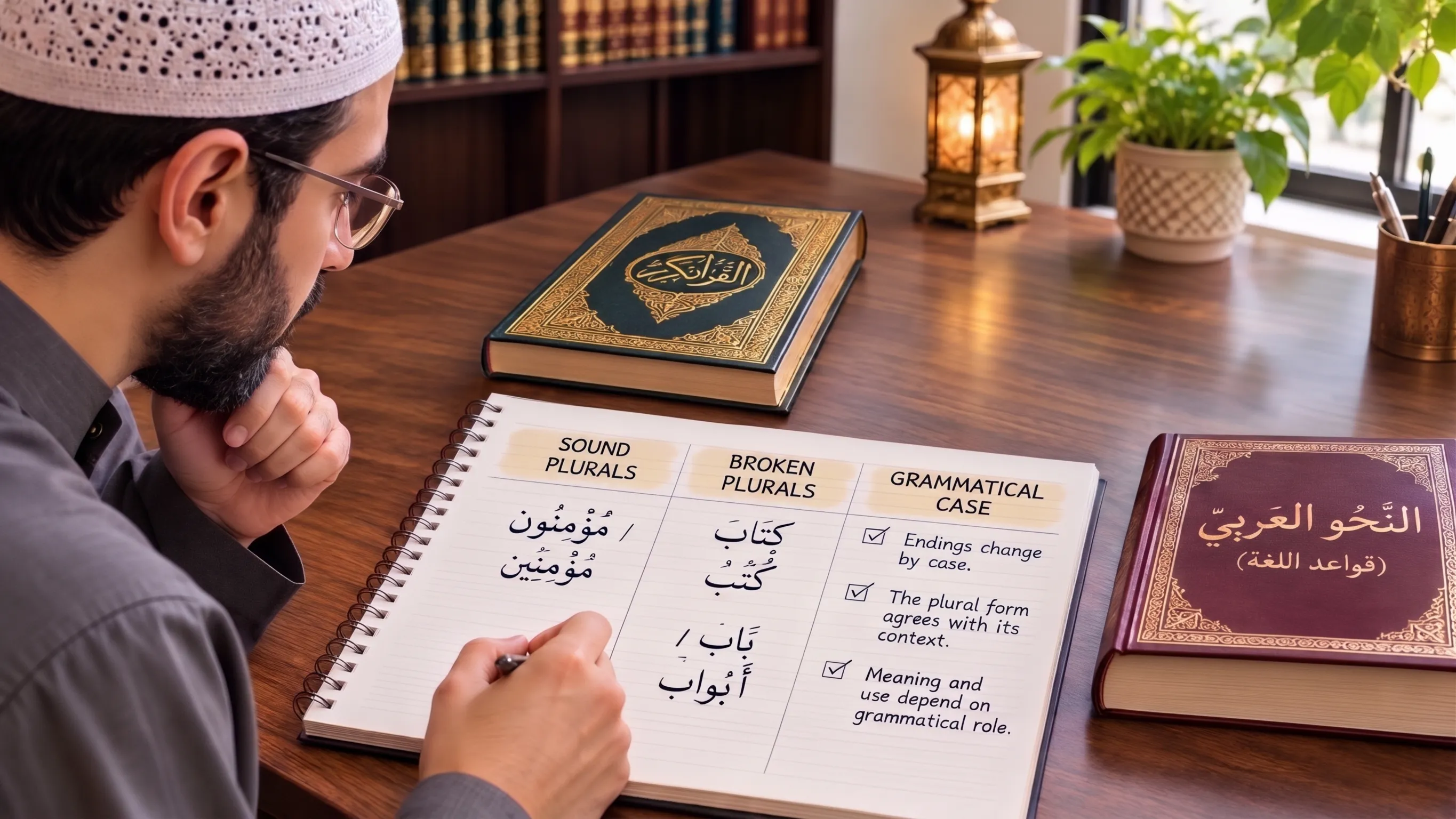
Open a Mushaf at Surat al-Mu’minun and read:
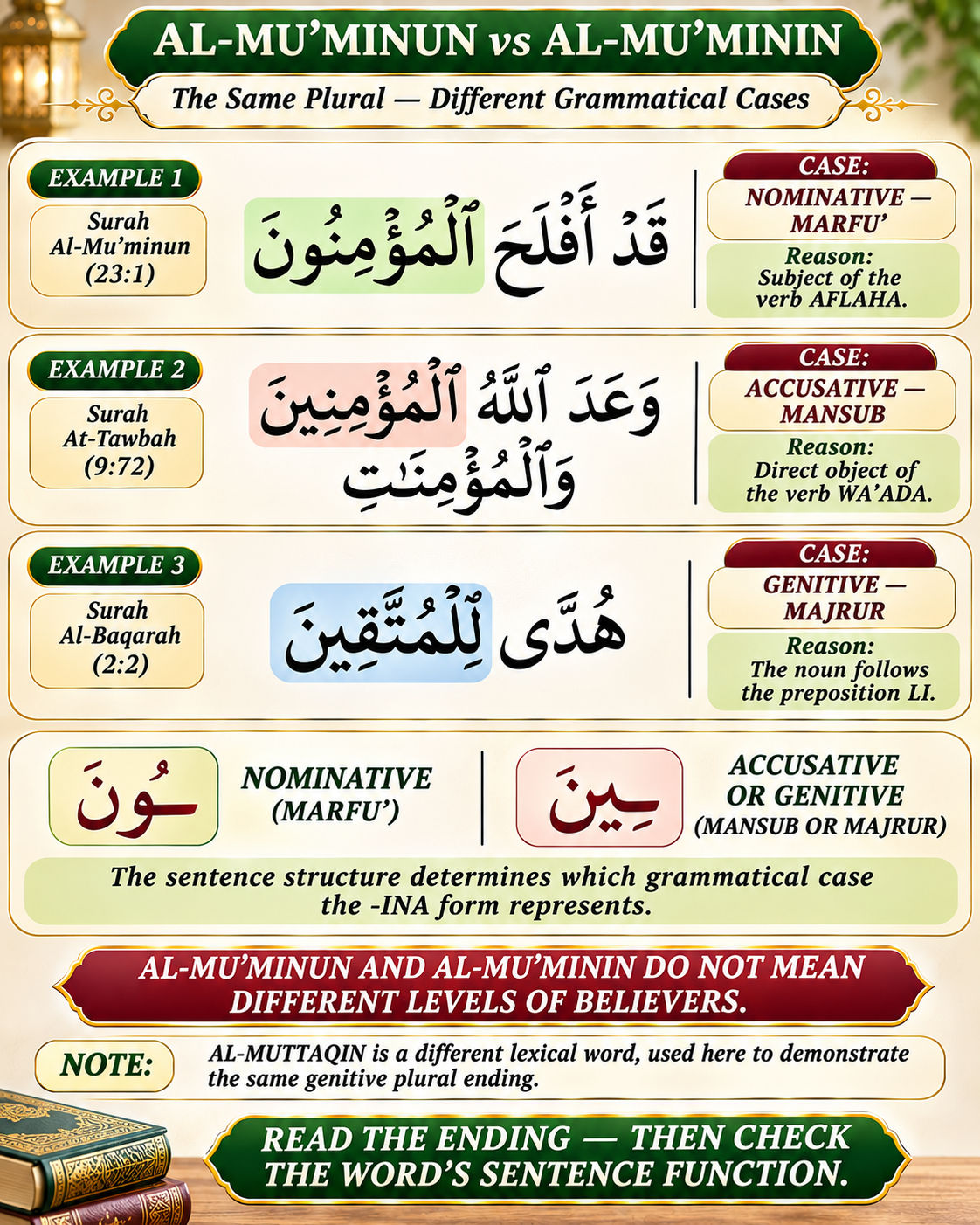
قَدْ أَفْلَحَ الْمُؤْمِنُونَ (23:1)
Then turn to Surat al-Tawbah:
وَعَدَ اللَّهُ الْمُؤْمِنِينَ وَالْمُؤْمِنَاتِ (9:72)
The same word for “believers” appears as al-Mu’minun in one verse and al-Mu’minin in the other. Does the Quran mean a different kind of believer? Or is Arabic grammar changing the form? Grammatical case is a key part of the answer.
Other questions follow. Why is the plural of kitab not kitabun but kutub? Why can al-Jibal (“the mountains”) be followed by a feminine singular pronoun? What happens when the Quran speaks of one east, two easts, and many easts?
Quick answer: Quranic Arabic forms plurals in several ways. Sound masculine plurals shift between -una and -ina according to grammatical case, while sound feminine plurals use -at with their own case rules. Broken plurals, such as kutub from kitab, change the word’s internal pattern. Plural nouns can also affect pronouns, adjectives, and verbs in ways English translation rarely shows. These forms help readers see sentence relationships, but context and reliable Tafsir remain essential for explaining an Ayah’s meaning.
This article offers ten practical studies.
Why Quranic Arabic Plurals Are More Than “Adding an S”
Readers who are new to these distinctions can begin with the foundations of Quranic Arabic and how its words form sentences, because recognizing a plural is easier when the basic language structure is familiar.
Two traditional disciplines frame everything below. نَحْو (Nahw) is syntax: how words function in a sentence. صَرْف (Sarf) is morphology: how words are formed. To understand why plural stems and endings both matter, learners should distinguish [ Nahw from Sarf in Quranic Arabic], since morphology explains word formation while syntax helps explain a word’s role in the sentence. The two overlap, and both are needed.
Key terms:
مُفْرَد (Mufrad): singular, such as كِتَاب (kitab). Finding the singular often helps recognize a plural, though some words, such as collectives, resist this.
مُثَنَّى (Muthanna): the dual, a separate number category for two.
جَمْع (Jam’): plural. It has several types, so it is not simply the English “-s.”
الْجَمْعُ السَّالِم (Al-Jam’ al-Salim): the sound plural, where the singular stem is largely preserved and an ending is added. It includes جَمْعُ الْمُذَكَّرِ السَّالِم (ـُونَ / ـِينَ) and جَمْعُ الْمُؤَنَّثِ السَّالِم (ـَات). Not every noun takes these endings.
جَمْعُ التَّكْسِير (Jam’ al-Taksir): the broken plural, formed by changing the word’s internal pattern. “Broken” is a traditional label, not a criticism of the form.
وَزْن (Wazn): a morphological pattern, written with the placeholders ف ع ل (as in فَعَل). They mark structural positions and are not letters inserted into the word.
جَذْر (Jadhr): the root. A root, a lexeme, a pattern, an inflection, and the meaning in context are five different things, and a root alone does not fix a word’s meaning in an Ayah.
إِعْرَاب (I’rab): case analysis. رَفْع (nominative), نَصْب (accusative), and جَرّ (genitive) depend on a word’s function, not on English word order.
Two cautions. Final vowels in a printed Mushaf may not be pronounced when a reciter pauses, so analyze the connected, underlying form rather than inferring syntax from pausal sound. Agreement (مُطَابَقَة) also varies by construction, so no single rule covers every verb, adjective, and pronoun.
10 Quranic Plural Patterns at a Glance
These ten lessons are not ten subtypes of one category. Some concern morphology, some I’rab, some agreement, and some number.
Pattern | Example | Verse | What changes | Main lesson |
|---|---|---|---|---|
1 | الْمُؤْمِنُونَ | 23:1 | -una ending | Nominative sound masculine plural |
2 | الْمُؤْمِنِينَ | 9:72 | -ina ending | Case, not rank |
3 | الْمُؤْمِنَاتِ | 9:72 | -at + Kasra | Accusative with Kasra |
4 | كِتَاب / كُتُب | 2:2, 2:285 | Internal pattern | Broken plural |
5 | بَاب / أَبْوَاب | 12:67 | Internal pattern | Singular and plural in one verse |
6 | أَشْهُر / شُهُور | 9:2, 9:36 | Two plural patterns | Paucity, abundance, numerals |
7 | الْجِبَالَ تَحْسَبُهَا | 27:88 | Agreement | Feminine singular reference |
8 | الْمُسْلِمِينَ وَالْمُسْلِمَاتِ | 33:35 | Gender pairing | Form versus scope |
9 | مَشْرِق / مَشْرِقَيْن / مَشَارِق | 73:9, 55:17, 70:40 | Number | Dual is not plural |
10 | قَوْمٌ ... يَكُونُوا | 49:11 | Reference | Collective noun |
1. Al-Mu’minun: Why a Sound Masculine Plural Ends in -una
Verse: 23:1, قَدْ أَفْلَحَ الْمُؤْمِنُونَ. In my paraphrase: “The believers have indeed succeeded.”
The singular is مُؤْمِن (mu’min), “a believer.” Adding ـُونَ gives مُؤْمِنُونَ, the nominative sound masculine plural. The verb aflaha (“has succeeded”) is a verbal sentence, and al-Mu’minun is its subject, so it takes the nominative form.
A verb placed before its subject is normally singular in Classical Arabic even when the subject is plural, so aflaha is correct. Do not teach the false rule that a verb must be plural whenever its subject is.
The nominative ending in Al-Mu’minun is a practical example of Quranic I’rab and how case endings reveal grammatical roles, because the form helps identify the subject rather than simply adding a plural meaning.
What English misses: the ending signals grammatical status, not only “more than one.”
Limitation: not every -una word is a subject. The ending marks nominative case, and the sentence decides the role. The following verses (23:1–11) describe the believers’ character, so the grammar clarifies structure without replacing that ethical content.
Practice: What is the singular? Which ending marks the nominative? Which verb precedes the noun?
2. Al-Mu’minin: Why the Same Plural Changes from -una to -ina
Verse: 9:72, وَعَدَ اللَّهُ الْمُؤْمِنِينَ وَالْمُؤْمِنَاتِ. In my paraphrase: “Allah has promised the believing men and believing women...”
Allah is the subject of wa’ada, and al-Mu’minin is its object, so it is accusative. The ending ـِينَ marks both accusative and genitive in the sound masculine plural. Genitive appears in 2:2, هُدًى لِّلْمُتَّقِينَ, where al-muttaqin follows the preposition li-. The two -ina forms look identical, so the sentence structure must tell you which case you have.
The shift from -una to -ina is not a shift in the kind of person described. These examples differ in grammatical case, not in belief level or rank. Do not build a semantic formula on a vowel-letter ending.
What English misses: “believers” appears identically in both verses.
Limitation: the visible ending narrows the case to accusative or genitive but cannot choose between them.
Practice: Which form is in 23:1, and which in 9:72? What case is each? What evidence in the sentence shows it?
3. Al-Mu’minat: Why a Feminine Plural Can Be Accusative with Kasra
Verses: 9:72 and 33:35.
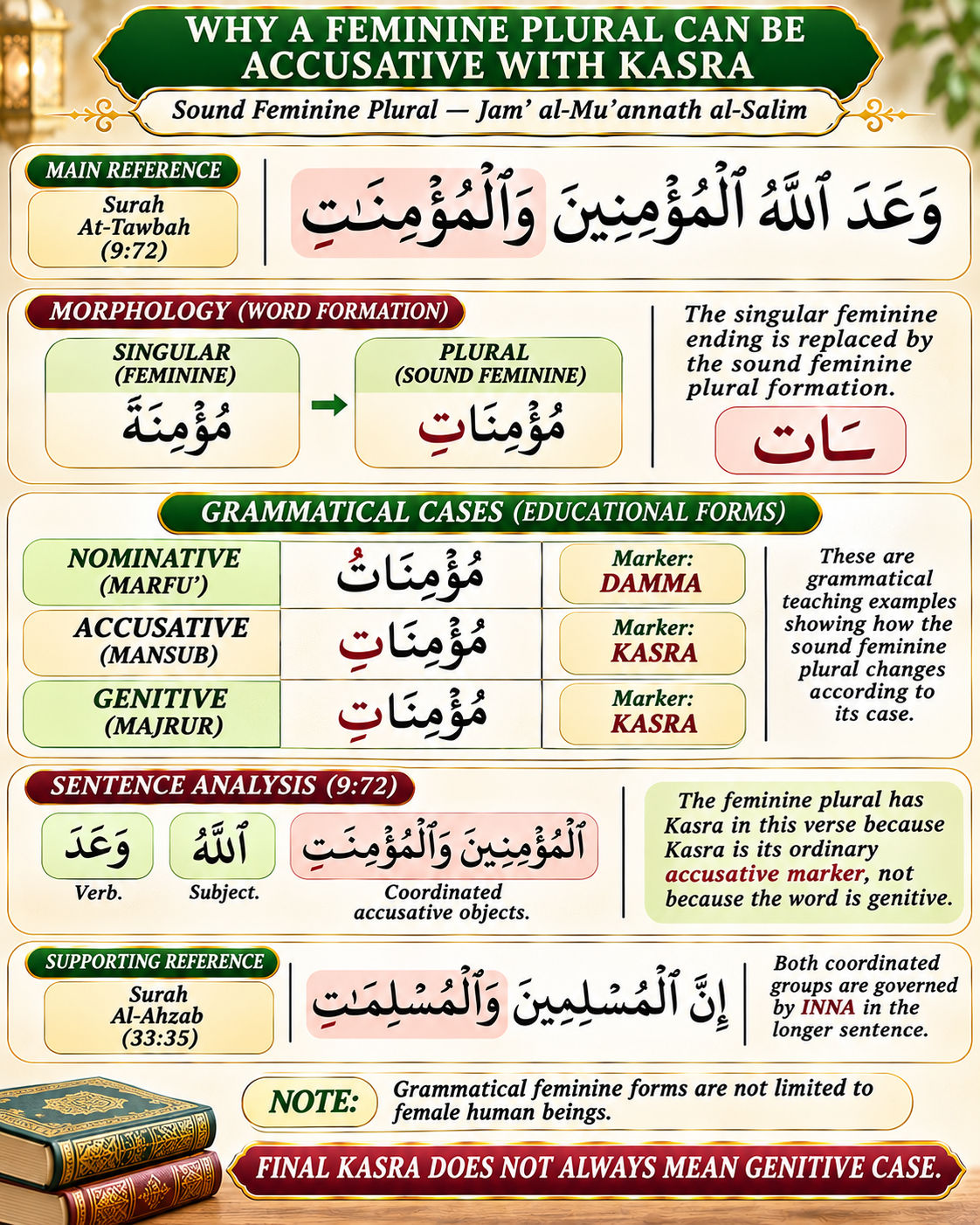
The singular مُؤْمِنَة (mu’minah) becomes مُؤْمِنَات (mu’minat) by dropping the ta’ marbutah and adding ـَات. This is the sound feminine plural.
An essential rule: in ordinary inflection this plural takes Damma in the nominative and Kasra in both accusative and genitive. So a final Kasra does not always mean genitive.
In 9:72, الْمُؤْمِنَاتِ is coordinated with the accusative object al-Mu’minin. The Kasra is therefore its accusative marker. If an automated parser disagrees, check an authoritative I’rab al-Quran source rather than copying the tag.
In 33:35, إِنَّ الْمُسْلِمِينَ وَالْمُسْلِمَاتِ introduces a long coordinated list governed by inna. Both groups are accusative, and the predicate arrives much later. Do not oversimplify that syntax.
What English misses: the case marker of the feminine plural.
Limitation: the -at pattern is grammatical, not biological. It also appears on nouns for things, places, and abstractions, and not every feminine noun pluralizes this way.
Practice: What is the singular of mu’minat? Why does the Kasra not prove genitive? What is its role in 9:72?
4. Kitab and Kutub: How Arabic Can Change a Word’s Internal Pattern
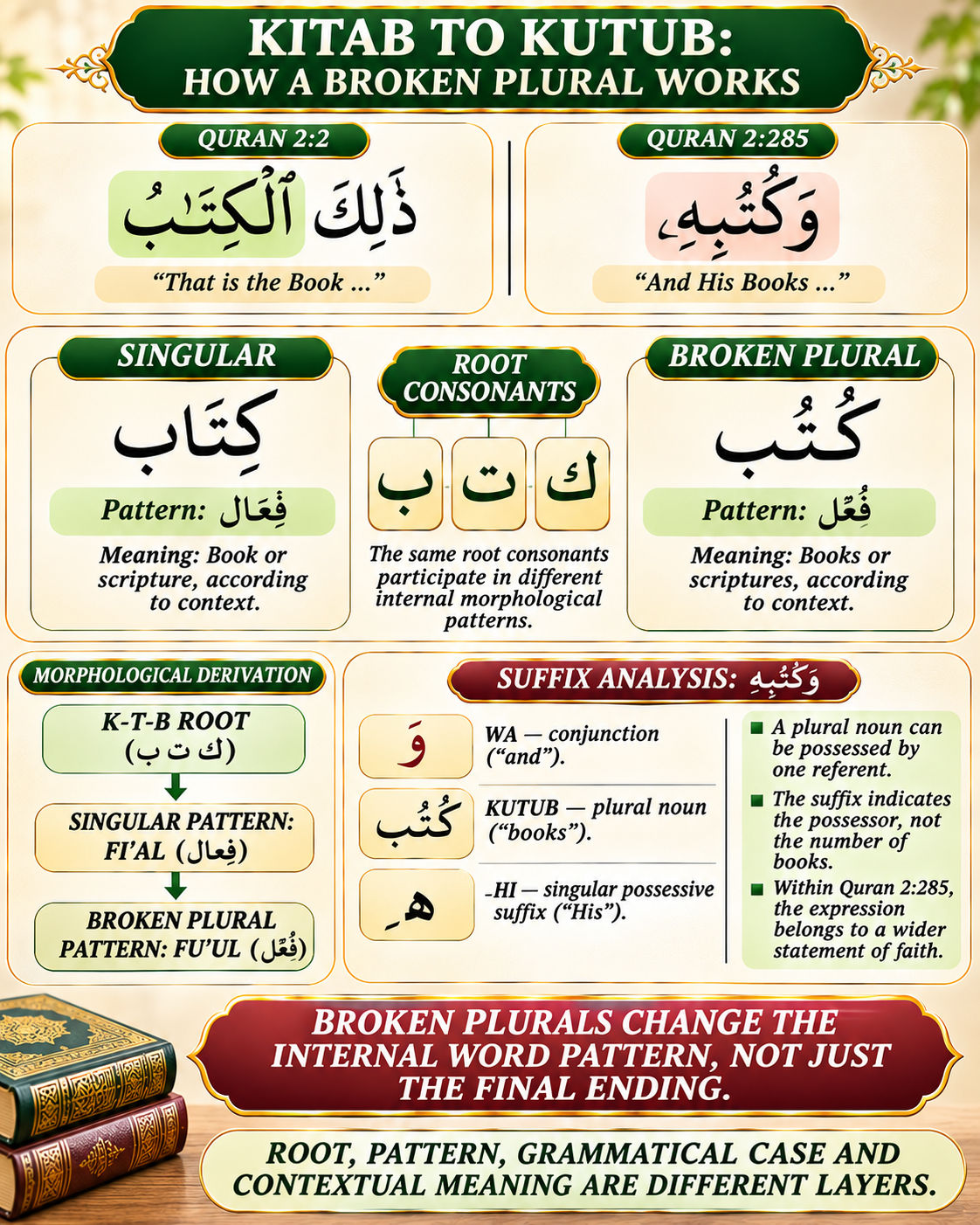
Verses: 2:2, ذَٰلِكَ الْكِتَابُ, and 2:285, وَكُتُبِهِ.
The singular كِتَاب has the pattern فِعَال. Its broken plural كُتُب has the pattern فُعُل. Short vowels and structure change, and no simple suffix is added.
In 2:2, al-Kitab is the Book addressed in its own context. In 2:285, within a statement of belief, the believers affirm faith in Allah, His angels, His books, and His messengers. The words do not necessarily denote the same thing in every occurrence, and kutub need not mean modern printed volumes.
In بِكُتُبِهِ (the 2:285 phrase appears with the conjunction as وَكُتُبِهِ), bi- is a preposition, so kutub is genitive. The suffix -hi is a possessive pronoun meaning “His,” and it refers to the possessor, not to the number of books. A plural noun with a singular possessive suffix is not a contradiction.
The relationship between Kitab and Kutub becomes clearer through [ Arabic roots and word patterns that help Quran students recognize related vocabulary], while the surrounding Ayah still determines the word’s contextual meaning.
Limitation: the root k-t-b links the forms, but root alone does not give contextual meaning.
Practice: Name the singular and plural. Which vowels change? What does -hi indicate?
5. Bab and Abwab: How One Quranic Verse Shows a Broken Plural
Verse: 12:67, لَا تَدْخُلُوا مِن بَابٍ وَاحِدٍ وَادْخُلُوا مِنْ أَبْوَابٍ مُّتَفَرِّقَةٍ. In my paraphrase: “Do not enter through one gate, but enter through separate gates.”
Both forms occur in one Ayah: the singular بَاب and the broken plural أَبْوَاب, on the pattern أَفْعَال. Both are genitive after min. The adjective مُتَفَرِّقَةٍ is feminine singular, an agreement pattern for nonhuman plurals that Study 7 explains. It need not be plural just because English says “different.”
Comparing Bab with Abwab also strengthens the habit of examining related Quranic words whose English translations can hide important Arabic distinctions, although singular-to-plural formation is different from comparing two independent lexical meanings.
Three levels of analysis stay separate here: the morphology shows abwab is plural, the phrase describes separate gates, and the Yusuf narrative gives the instruction its setting. Grammar does not reveal a hidden architectural plan or motive. Consult Tafsir for that.
Limitation: a noun matching the singular template does not necessarily take this plural.
Practice: Which word is singular? Which is plural? Which word describes the gates?
6. Ashhur and Shuhur: Why Arabic Has More Than One Plural Pattern for “Month”
Verses: 9:2, أَرْبَعَةَ أَشْهُرٍ, and 9:36, إِنَّ عِدَّةَ الشُّهُورِ عِندَ اللَّهِ اثْنَا عَشَرَ شَهْرًا.
The singular is شَهْر. Two broken plurals exist. أَشْهُر has the pattern أَفْعُل, a traditional جَمْعُ قِلَّة (paucity) pattern, usually associated with smaller numbers. شُهُور has the pattern فُعُول, a traditional جَمْعُ كَثْرَة (abundance) pattern. These are real categories, but they are not rigid numerical laws, and ashhur does not mean “only three to ten” everywhere.
Two separate questions arise. The first is morphological: why two plurals? The second is syntactic: why does the number twelve take shahran?
In 9:2, the numerals three to ten take a genitive plural counted noun, so arba’ata is followed by the genitive ashhurin. In 9:36, numerals eleven to ninety-nine take a singular accusative tamyiz (specifier), so ithna ‘ashara is followed by shahran. A large number does not require a plural noun.
The distinction between Ashhur, Shuhur, and Shahran also helps explain [ why Quran translations may render different Arabic grammatical constructions with similar English words], even when the Arabic forms reveal distinct number and case relationships.
Limitation: the plural pattern alone does not tell you which months are sacred or what a ruling is. Context and Tafsir do.
Practice: Name the two plurals. How does “four” shape the phrase? Why is shahran singular?
7. Al-Jibal and Jamidah: Why a Plural Can Take a Feminine Singular Description
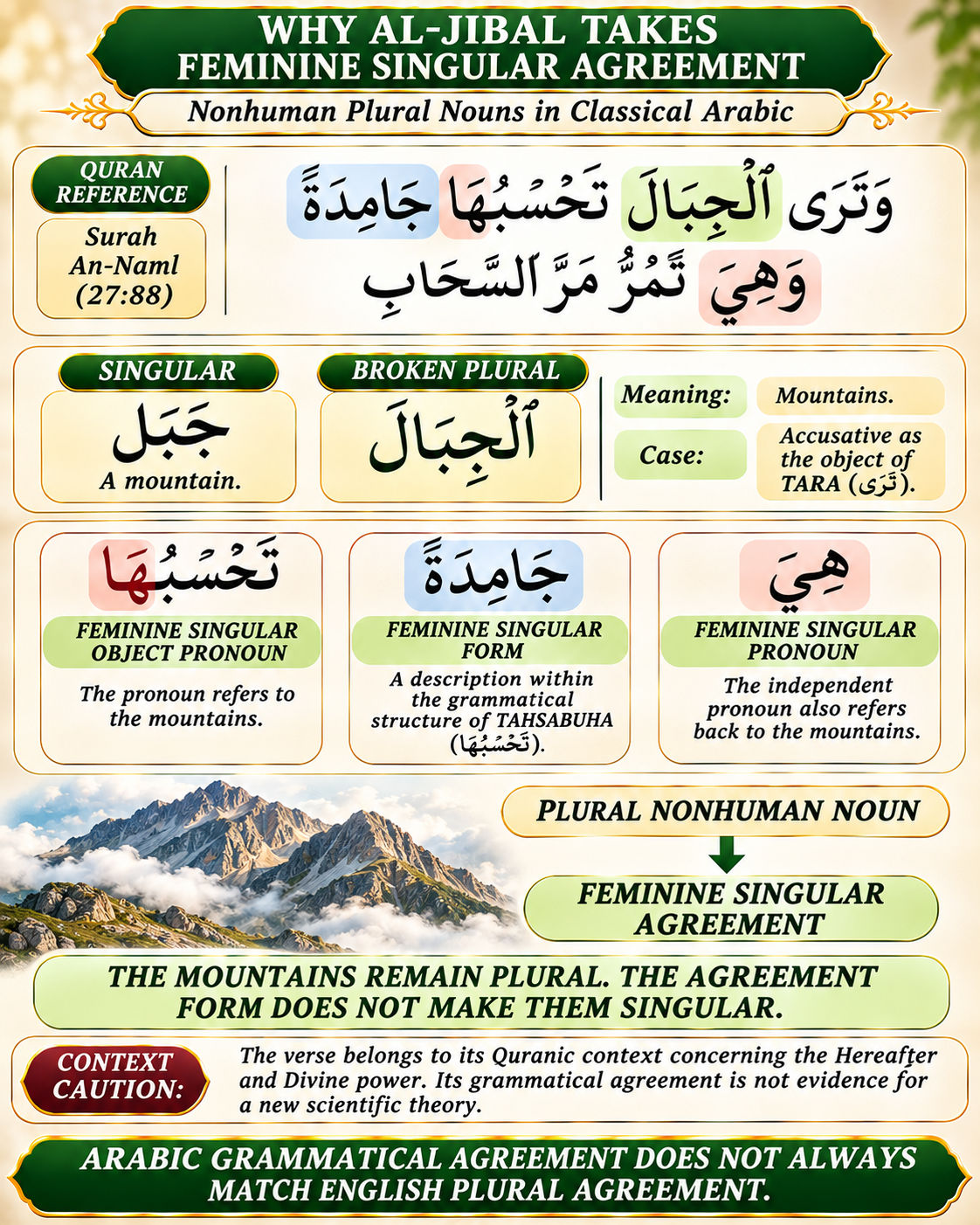
Verse: 27:88, وَتَرَى الْجِبَالَ تَحْسَبُهَا جَامِدَةً وَهِيَ تَمُرُّ مَرَّ السَّحَابِ. In my paraphrase: “You see the mountains, thinking them firmly fixed, while they pass like clouds.”
The singular جَبَل has the broken plural جِبَال, here accusative as the object of tara. Then three feminine singular forms follow: the pronoun in تَحْسَبُهَا, the adjective جَامِدَةً, and the independent pronoun هِيَ. They do not make the mountains singular or refer to a single mountain. Classical Arabic commonly gives nonhuman plurals feminine singular agreement, and jamidatan completes the verb tahsabu (some parse it as a hal).
The relationship between Al-Jibal, Tahsabuha, and Jamidatan is a memorable example of Quranic Arabic grammar clues that are easy to miss in English, because plural meaning and feminine singular agreement can coexist.
What English misses: English says “mountains... they,” so the Arabic agreement pattern disappears.
Limitation: this is a standard pattern, not an exceptionless one. Other constructions exist, so check each verse. The verse concerns the Hereafter and divine power, and the agreement supports no scientific theory.
Practice: Which word is plural? Which pronoun refers back to it? Which adjective is feminine singular?
8. Al-Muslimin and Al-Muslimat: How the Quran Pairs Masculine and Feminine Plurals
Verse: 33:35, which pairs الْمُسْلِمِينَ وَالْمُسْلِمَاتِ, الْمُؤْمِنِينَ وَالْمُؤْمِنَاتِ, الصَّادِقِينَ وَالصَّادِقَاتِ, الصَّابِرِينَ وَالصَّابِرَاتِ, and more. The verse continues with ten pairs in total, including the devout, the humble, those who give charity, those who fast, those who guard their chastity, and those who remember Allah often. Do not summarize it as four pairs.
After inna, each noun is accusative: masculine with -ina, feminine with -at plus Kasra. The parallel morphology makes the pairing visible, but the two endings are different case markers, not equivalents. The verse closes with أَعَدَّ اللَّهُ لَهُم, where the plural pronoun lahum refers back to all the listed groups.
In 2:183, يَا أَيُّهَا الَّذِينَ آمَنُوا, the plural verb amanu is grammatically masculine. Scholars discuss how such addresses encompass men and women according to context and interpretive principles, and they do not treat every masculine form as excluding women or every obligation as identical.
The pairing of masculine and feminine forms in Quran 33:35 becomes clearer alongside Quranic pronouns and the ways Arabic identifies speakers and addressees, because grammatical form and the people included in an address are not always the same question.
Limitation: grammatical gender is a formal category. The scope of an address is an interpretive question, and one suffix cannot settle legal rulings.
Practice: Which forms are paired? What does inna do? Which plural pronoun appears near the end?
9. One East, Two Easts, and Many Easts: Why Arabic Number Matters
Singular | Dual | Plural | |
|---|---|---|---|
East | الْمَشْرِق | الْمَشْرِقَيْن | الْمَشَارِق |
West | الْمَغْرِب | الْمَغْرِبَيْن | الْمَغَارِب |
Verses: 73:9, رَّبُّ الْمَشْرِقِ وَالْمَغْرِبِ; 55:17, رَبُّ الْمَشْرِقَيْنِ وَرَبُّ الْمَغْرِبَيْنِ; 70:40, بِرَبِّ الْمَشَارِقِ وَالْمَغَارِبِ.
The dual is not a “small plural.” It is its own number category. Its genitive ending is -ayni, as in 55:17. The plurals mashariq and maghARib are broken plurals, and in 70:40 they are genitive after bi-.
Classical commentators are commonly cited as relating the dual to the two extreme sunrise and sunset points of summer and winter, and the plural to the many points across the year (editor to verify exact attributions). The singular does not assert one fixed sunrise point. None of these forms is a contradiction, since each occurs in a different context. They do not encode a precise astronomical model.
Limitation: the grammatical forms are clear. Their referents require Tafsir.
Practice: Which verse uses singular, dual, plural? How is the dual marked?
10. Qawm and Yakunu: How a Singular-Looking Noun Can Refer to a Group
Verse: 49:11, لَا يَسْخَرْ قَوْمٌ مِّن قَوْمٍ عَسَىٰ أَن يَكُونُوا خَيْرًا مِّنْهُمْ وَلَا نِسَاءٌ مِّن نِّسَاءٍ عَسَىٰ أَن يَكُنَّ خَيْرًا مِّنْهُنَّ. In my paraphrase: “Let no people mock another people; perhaps they may be better than them.”
قَوْم is a collective noun, usually classed as ism jam’ (اِسْمُ الْجَمْع). It is grammatically singular in form (qawmun) but refers to a people. It is not a sound masculine plural, a broken plural, or the plural of one assumed singular. A related category is ism al-jins al-jam’i (اِسْمُ الْجِنْسِ الْجَمْعِيّ), and the two are not identical.
The reference then shifts to plural: يَكُونُوا (plural verb) and مِنْهُمْ (plural pronoun). This is agreement by meaning. The women’s clause uses يَكُنَّ and مِنْهُنَّ, the feminine plural forms. Notably, nisa’ is also commonly treated as a collective-type noun.
The movement from Qawm to Yakunu and Minhum is another reason to study what Tafsir and Arabic grammar reveal beyond an English Quran translation, since the English word “people” does not explain every agreement choice.
Limitation: this is an ethical verse about mockery, name-calling, and offensive nicknames, not just a grammar puzzle.
Practice: Does qawm refer to one person? Why is yakunu plural? How does the women’s clause differ?
The 10 Patterns Compared
# | Form | Base | Class | Function | Caution |
|---|---|---|---|---|---|
1 | مُؤْمِنُونَ | مُؤْمِن | Sound masc. plural | Subject, nominative | Not a status marker |
2 | مُؤْمِنِينَ | مُؤْمِن | Sound masc. plural | Object / after preposition | Ending alone can’t pick case |
3 | مُؤْمِنَاتِ | مُؤْمِنَة | Sound fem. plural | Accusative with Kasra | Kasra ≠ always genitive |
4 | كُتُب | كِتَاب | Broken | Genitive | Root ≠ meaning |
5 | أَبْوَاب | بَاب | Broken (أَفْعَال) | Genitive | No gate plan |
6 | أَشْهُر / شُهُور | شَهْر | Two broken patterns | Counted nouns | Not rigid numbers |
7 | جِبَال | جَبَل | Broken | Object; fem. sing. agreement | Not one mountain |
8 | مُسْلِمِينَ / مُسْلِمَاتِ | مُسْلِم | Sound masc. and fem. | After inna | Form ≠ scope |
9 | مَشْرِقَيْن | مَشْرِق | Dual (not plural) | Genitive | Not “small plural” |
10 | قَوْمٌ | none assumed | Collective noun | Subject | Not a regular plural |
How Quranic Plurals Affect English Translation
Five things English often hides: (1) nominative versus accusative or genitive sound masculine endings; (2) the accusative Kasra of sound feminine plurals; (3) different broken-plural patterns; (4) feminine singular agreement with nonhuman plurals; (5) collective reference versus true plurals. Grammar and Tafsir are different levels. Grammar says al-mashriqayn is dual, and Tafsir identifies the referents. Grammar says al-Jibal takes feminine singular agreement, and Tafsir explains the passage. Grammar says ashhur and shuhur are different patterns, and Tafsir explains why a verse discusses a given number of months.
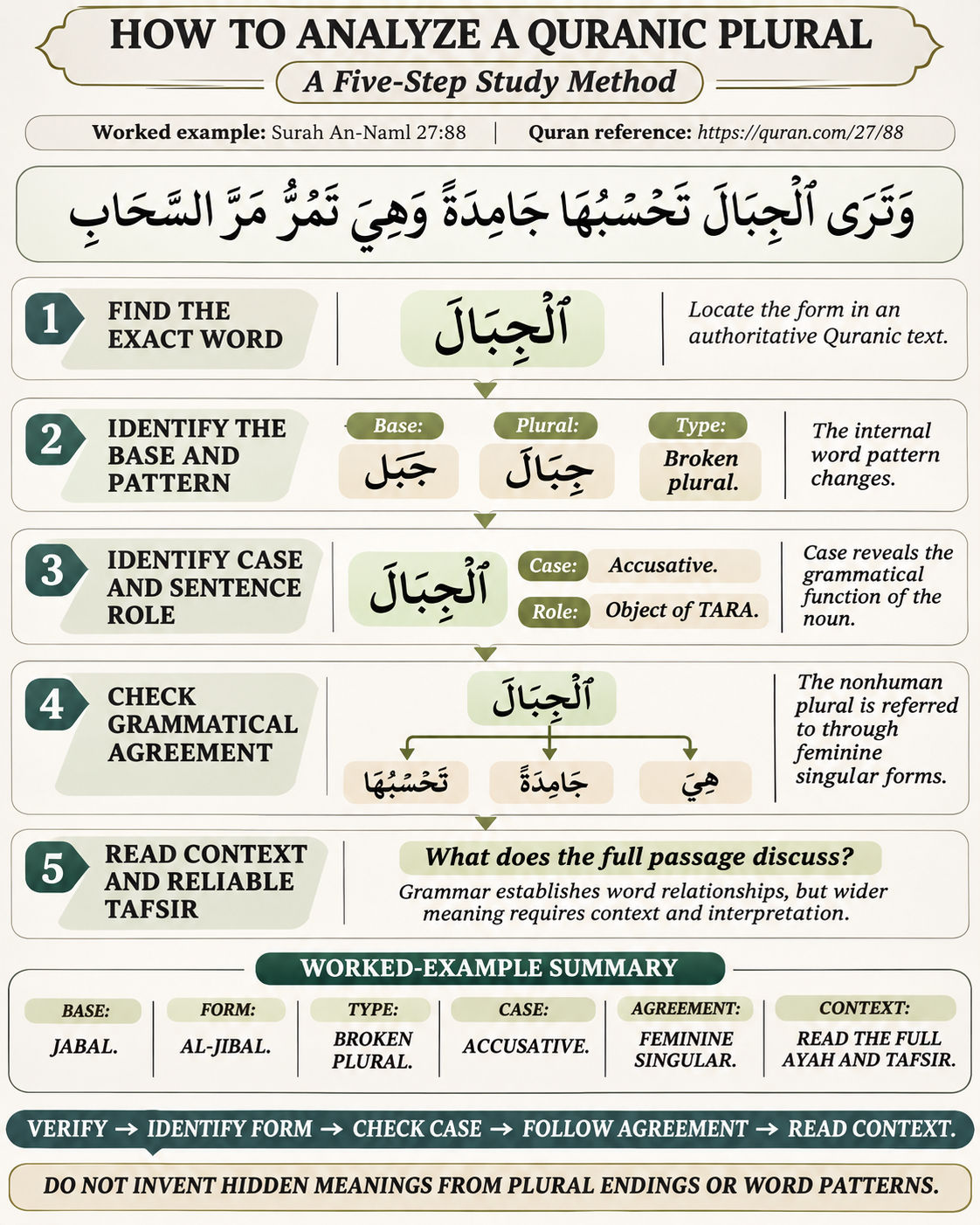
How to Analyze a Quranic Plural in Five Steps
Find the word in a verified Quran text.
Identify its singular or base and its pattern.
Check its case or sentence function.
Examine agreement with adjectives, verbs, numerals, and pronouns.
Read the context and reliable Tafsir before making interpretive claims.
Worked example (27:88): al-Jibalu → base jabal, broken plural → object of tara → feminine singular agreement in tahsabuha, jamidatan, hiya → check Tafsir for meaning.
To practice these patterns systematically, beginners can follow [ a step-by-step roadmap for learning Quranic Arabic from scratch], combining roots, morphology, I’rab, and contextual Quran reading.
Worksheet
Verse | Form | Base | Type | Case/Agreement |
|---|---|---|---|---|
23:1 | الْمُؤْمِنُونَ | مُؤْمِن | Sound masc. | Nominative subject |
9:72 | الْمُؤْمِنَاتِ | مُؤْمِنَة | Sound fem. | Accusative, Kasra |
12:67 | أَبْوَابٍ | بَاب | Broken | Genitive |
27:88 | الْجِبَالَ | جَبَل | Broken | Fem. sing. agreement |
49:11 | قَوْمٌ | n/a | Collective | Plural reference |
___ | ___ | ___ | ___ | ___ |
Exercise A: Compare al-Mu’minun, al-Mu’minin, al-Mu’minat. Two are masculine sound plurals (differing in case), and one is feminine (Kasra marks accusative in 9:72).
Exercise B: Jibal is an actual (broken) plural with feminine singular agreement, and qawm is a collective with plural reference.
Seven days: sound masculine plurals; sound feminine plurals and I’rab; Kitab/Kutub and Bab/Abwab; Ashhur/Shuhur and numerals; nonhuman agreement; gender forms and number; collectives and review. This builds familiarity and does not promise mastery.
Ten-minute routine (2 minutes each): read a verified example, find the base, mark pattern and case, inspect agreement, check Tafsir and write one observation.
Common Mistakes in Quranic Plural Grammar
Myth | Reality |
|---|---|
All plurals add -un or -at | Many use broken patterns |
Mu’minun/Mu’minin mean different believers | Case differs |
-ina is always accusative | Accusative or genitive |
Final Kasra means genitive | Sound feminine plurals take Kasra in the accusative |
Every -at word is female | Grammatical form; also nonhuman nouns |
Plural of kitab is kitabun | Kutub |
All broken plurals share one pattern | There are numerous patterns |
Ashhur means only 3–10 | Not a universal restriction |
Twelve requires a plural | 9:36 uses shahran |
A plural needs a plural adjective | Nonhuman plurals often take feminine singular |
Tahsabuha makes mountains singular | The noun stays plural |
Masculine forms mean men only | Scope needs context |
Dual equals plural | Dual has its own inflection |
Easts must contradict | Different number categories in different contexts |
Qawm is a sound plural | It is a collective noun |
Frequently Asked Questions
1. What are the main types of plurals in Quranic Arabic? Sound masculine, sound feminine, and broken plurals. Dual and collective nouns are related number and reference categories.
2. What is a sound masculine plural? A plural that keeps its singular stem and adds -una or -ina, as in mu’minun.
3. Why does the Quran use both Al-Mu’minun and Al-Mu’minin? Because grammatical case changes the ending, not the lexical word.
4. What does -una indicate? The nominative case of a sound masculine plural, often a subject.
5. What does -ina indicate? Accusative or genitive; the sentence structure decides which.
6. What is a sound feminine plural? A plural formed by adding -at to the stem, such as mu’minat.
7. Why can a feminine plural be accusative with Kasra? Sound feminine plurals take Kasra for both accusative and genitive.
8. What is a broken plural? A plural formed by changing the word’s internal pattern, such as kutub. “Broken” is a traditional term, not a flaw.
9. What is the plural of Kitab? Kutub, on the pattern fu’ul.
10. Why is Abwab the plural of Bab? It follows the af’al template. Both forms occur in Quran 12:67.
11. What are Jam’ al-Qillah and Jam’ al-Kathrah? Traditional plural categories of paucity and abundance, associated with smaller and larger quantities but not rigid numerical limits.
12. What is the difference between Ashhur and Shuhur? They are two plural patterns of shahr, traditionally classed as paucity and abundance. Usage and context matter.
13. Why is Shahran singular after twelve in Quran 9:36? Numerals eleven to ninety-nine take a singular accusative specifier (tamyiz).
14. Why do nonhuman plurals take feminine singular agreement? It is a standard Classical Arabic convention, though other constructions exist.
15. Why does Quran 27:88 use Tahsabuha for mountains? The pronoun -ha follows that convention. Al-Jibal remains plural.
16. Do masculine plural forms always refer only to males? No. Grammatical masculinity is formal, and the scope of an address depends on context and interpretation.
17. Why does Quran 33:35 list masculine and feminine plurals together? The verse explicitly pairs them, and the closing pronoun lahum refers to all the groups.
18. What is the difference between singular, dual, and plural? Singular is one, dual is a dedicated form for two (-ayni in the genitive), and plural covers more than two.
19. Why can Qawm be followed by plural reference? It is a collective noun, so verbs and pronouns can agree with its meaning, as in 49:11.
20. How can beginners study Quranic plural grammar correctly? Identify the base, pattern, case, and agreement, then check context and reliable Tafsir.
Conclusion: Read the Form, Understand the Sentence
The next time an English Quran translation uses the word “believers,” “books,” “gates,” or “mountains,” look at the Arabic form behind it. Is the noun a sound plural or a broken plural? Does its ending reveal grammatical case? Does an adjective or pronoun agree with it in a way English does not show? From al-Mu’minun to kutub and al-Jibal, these small grammatical observations can make Quranic sentences easier to understand. The strongest approach combines morphology, syntax, context, and reliable Tafsir rather than assigning hidden meanings to plural patterns alone.
If you would like to study Quranic Arabic, Nahw, Sarf, and Tafsir with qualified teachers, Araby Academy would be glad to guide you.