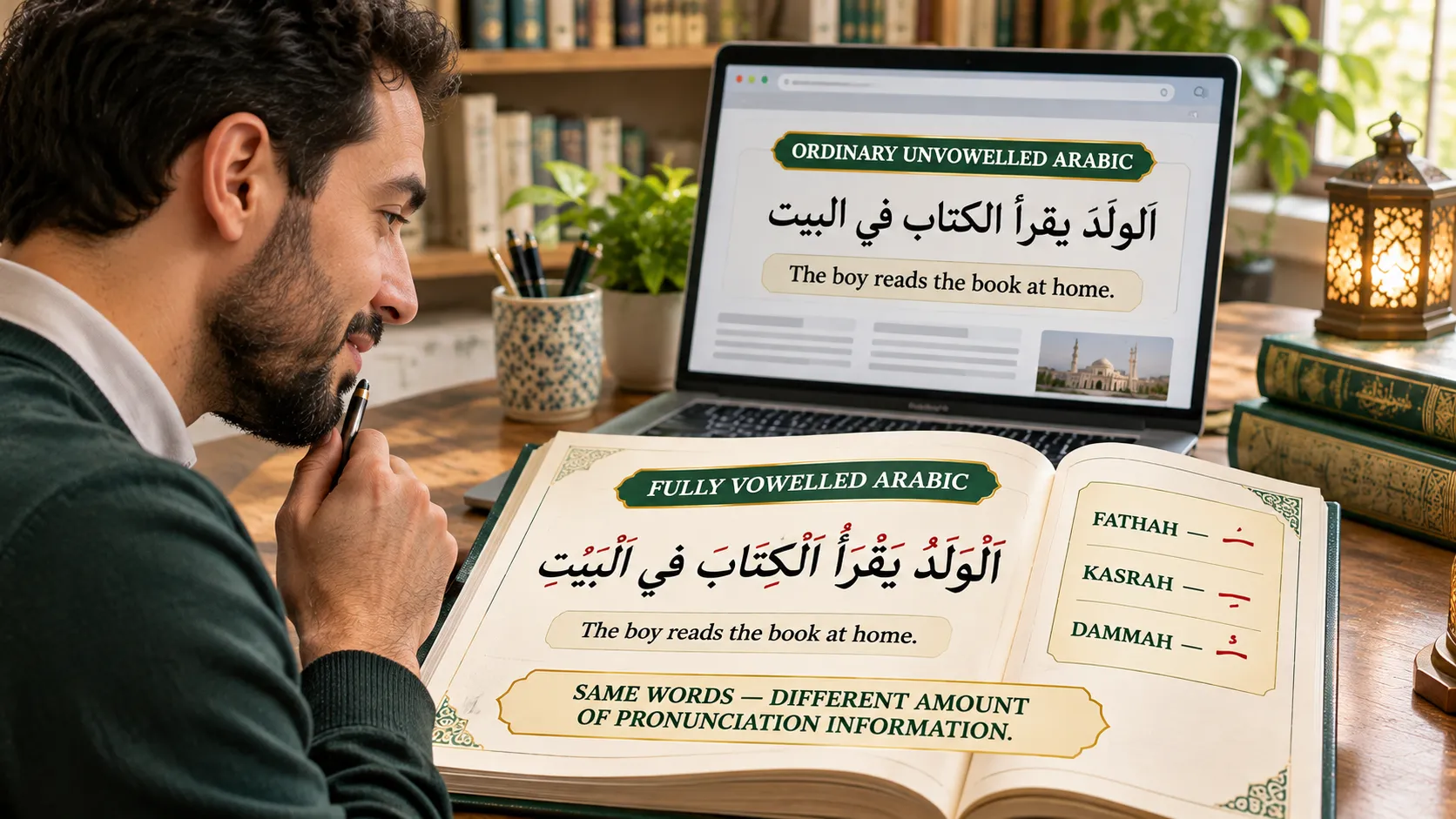
An English-speaking student opens an Arabic children's textbook. Small marks sit above and below almost every letter. Later, the same student opens an Arabic news website, and most of those marks have vanished. The questions come quickly. Where did all the vowels go? How can anyone read this? Am I supposed to guess every word?
Short answer: Arabic still has vowels, and speakers pronounce them. Ordinary Arabic spelling writes the consonants and represents long vowels through its established spelling conventions, but it often leaves out the short-vowel marks. Experienced readers recognize the words and use grammar and context to decide how they should be read. This is a normal convention of the writing system, not a defect. It is also not magic: some unvowelled words have more than one possible reading, and even fluent readers sometimes need extra clues.
This article explains how the system works, how readers recover the missing information, why the Quran is printed differently, and how beginners can move from fully vowelled texts to ordinary Arabic.
How the Arabic Writing System Works
Does Arabic Have Vowels?
Yes. Spoken Arabic has vowels, and it helps to separate four things:
Vowel sounds in speech.
Letters used in spelling.
Short-vowel marks (diacritics) added above or below letters.
Long-vowel spelling, which uses certain letters.
The three short-vowel marks taught in Classical Arabic and Modern Standard Arabic (MSA) are:
Mark | Name | Usual value | Example |
|---|---|---|---|
ـَ | Fathah | /a/ | بَ ba |
ـِ | Kasrah | /i/ | بِ bi |
ـُ | Dammah | /u/ | بُ bu |
These values are conventional labels. The actual sound shifts with neighboring consonants and across spoken varieties.
The three long vowels are usually written with ا (alif), و (waw), and ي (ya): ā, ū, ī. But these letters are not limited to that job. Waw and ya are often consonants (w and y), as in وَلَد walad "boy" and يَد yad "hand." Alif also works as a carrier for hamzah. Some long vowels are spelled differently still: the final long ā in على ʿalā is written with alif maqṣūra (ى), and words like هذا hādhā "this" contain a long ā that standard spelling does not write with alif.
You do not need every exception at the start. The key point is that long vowels are normally written, while short vowels normally are not.
What Is an Abjad?
Linguists often call Arabic an abjad: a script whose basic letters represent consonants, with vowel information supplied partly by long-vowel letters and partly by optional marks. The term comes from the traditional order of the first four letters (أ ب ج د). It is a typological label, not a claim that Arabic carries no vowel information.
Useful contrasts:
Alphabet: consonants and vowels normally have their own full letters (English, Greek, Spanish).
Abjad: consonants are basic, and vowel information is partial or optional.
Fully vowelled Arabic: an abjad plus the complete set of marks, as in beginner books and Mushafs.
Ordinary unvowelled Arabic: the standard spelling used in most newspapers, books, and websites.
Arabic is not the only abjad. Hebrew is another, and it too has an optional pointing system (niqqud) that appears in contexts such as children's books, prayer books, and poetry, while much everyday Hebrew text is unpointed. Classifications like these are useful, but real scripts do not fit them rigidly.
What Are Harakat and Tashkeel?
Tashkeel (تَشْكِيل) is the system of marks added to letters. Harakat (حَرَكَات) is used strictly for the short-vowel marks, though teachers often use it for the whole set. Araby Academy's guide to Arabic Harakat covers each sign in depth. The key point here is that these marks do different jobs:
Fathah, Kasrah, Dammah: the three short vowels.
Sukun (ـْ): shows that a consonant has no short vowel after it. It is not a vowel.
Shaddah (ـّ): marks a doubled consonant (gemination). It is not a vowel.
Tanween (ـً ـٍ ـٌ): marks nunation, an added "-n" sound at the end of certain nouns in relevant contexts.
So calling every diacritic a "vowel" is inaccurate. Together they give a reader precise pronunciation instructions.
Why Short Vowels Are Often Omitted
Why Doesn't Arabic Write Every Short Vowel?
In ordinary writing, short-vowel marks are left out by convention. Several factors support that convention:
Historical development: the script grew up as a consonantal system, and marks were added later for specific purposes (see the history section below).
Established convention: generations of writers and readers have treated unvowelled spelling as the standard form.
Reader familiarity: readers know the vocabulary.
Morphological patterns: word shapes predict many vowels.
Grammatical expectations: syntax constrains what can follow what.
Context: the surrounding sentence narrows the options.
There is no single universally accepted explanation for how this convention first arose, and writers do not compose a vowelled text and then strip it. Unvowelled spelling is simply what the written word looks like in most modern Arabic text.
Is Arabic Writing Incomplete Without Tashkeel?
No. Writing systems differ in how much pronunciation they spell out. It helps to separate:
Orthographic completeness: does the system have a conventional, consistent way to spell words? Ordinary Arabic spelling does.
Phonetic explicitness: how much of the pronunciation is on the page? Unvowelled Arabic gives less than vowelled Arabic.
Reader knowledge: what the reader brings to the page.
Context: what the text supplies around the word.
English also leaves much to the reader: read (present) and read (past) share one spelling, as do lead the metal and lead the verb. Arabic is neither superior nor inferior; it distributes information differently. The cost is that some unvowelled forms can be genuinely ambiguous, as we will see.
Does Leaving Out Vowels Make Reading Faster?
Not universally. Skilled readers can recognize familiar unvowelled words efficiently, and some studies report that adding vowel marks gives little benefit to skilled readers reading connected text with plenty of context. But the research (including work by Salim Abu-Rabia and others) generally points the other way for beginners and poorer readers, who tend to read more accurately with vowel marks. Results depend on the reader's proficiency, the task, and the text, so it is safest to say that diacritics help in some situations and not in others. Researchers also describe Arabic as relatively "shallow" in orthographic depth when fully vowelled and "deep" when unvowelled, which fits this picture.
How Readers Know Which Vowels to Use
The Role of Vocabulary
Fluent readers do not decode letter by letter. They recognize whole words, much as English readers recognize yacht or colonel without sounding them out. A reader who knows مدرسة as madrasa "school" supplies the vowels from memory.
This is why beginners struggle: a word they have never heard gives them nothing to recognize, so they must decode it without the marks. Recognizing known words and decoding unfamiliar ones are different skills, and the second is much harder in unvowelled text.
The Role of Root-and-Pattern Morphology
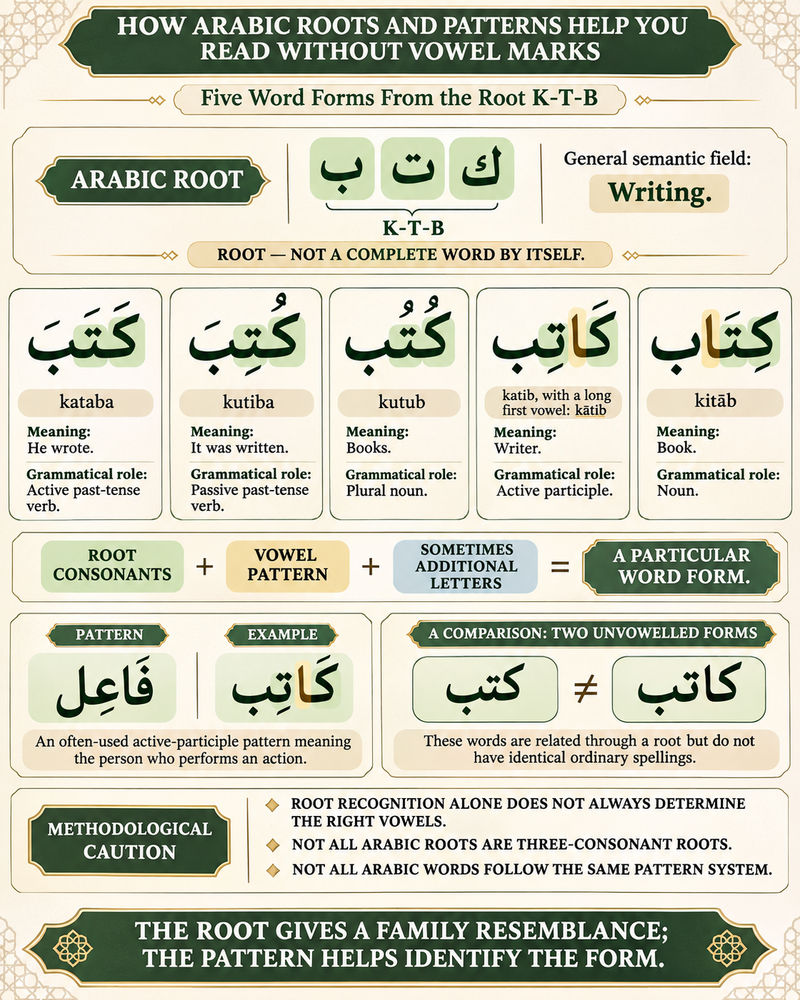
Many Arabic words are built from a root (جَذْر jidhr), usually a set of three consonants, combined with a pattern (وَزْن wazn) that supplies vowels and sometimes extra letters. Take the root ك ت ب, associated with writing:
Vocalized | Transliteration | Meaning |
|---|---|---|
كَتَبَ | kataba | he wrote |
كُتِبَ | kutiba | it was written |
كُتُب | kutub | books |
كَاتِب | kātib | writer |
كِتَاب | kitāb | book |
Patterns help readers because certain shapes signal certain forms. A word of the shape فَاعِل (like كَاتِب) is typically an active participle, "one who does." Knowing this narrows the possibilities.
Two cautions. First, words from the same root do not always share an unvowelled spelling: كاتب has an alif, while كتب does not. Second, root recognition alone does not fix pronunciation, and Arabic morphology is richer than a simple three-letter model, since some roots have four letters and some words are not built this way at all. Our guide to Arabic roots that unlock Quranic vocabulary shows how roots work in practice.
The Role of Grammar
Grammar tells readers which forms are possible. Is a verb needed here? Does this noun act as subject or object? I'rab (الإِعْرَاب) is the system of case endings on nouns and mood endings on verbs, and it is central to Classical Arabic and formal MSA.
Consider this sentence, unvowelled: أكرم الأستاذ الطالب. Two vocalizations are grammatical:
أَكْرَمَ الأُسْتَاذُ الطَّالِبَ akrama l-ustādhu ṭ-ṭāliba: "The teacher honored the student."
أَكْرَمَ الأُسْتَاذَ الطَّالِبُ akrama l-ustādha ṭ-ṭālibu: "The student honored the teacher."
Here the case endings (Dammah for the subject, Fathah for the object) change who did what. In ordinary writing, word order (verb, then subject, then object) usually points to the first reading, and context settles the rest. A writer who really needs the second reading might add the endings.
One more caution: formal case endings are not pronounced in every situation. Speakers often drop them when pausing, and everyday dialects do not use them at all. MSA and Classical Arabic differ from spoken varieties, and no one should assume that all Arabic speakers pronounce full case endings in conversation.
The Role of Context
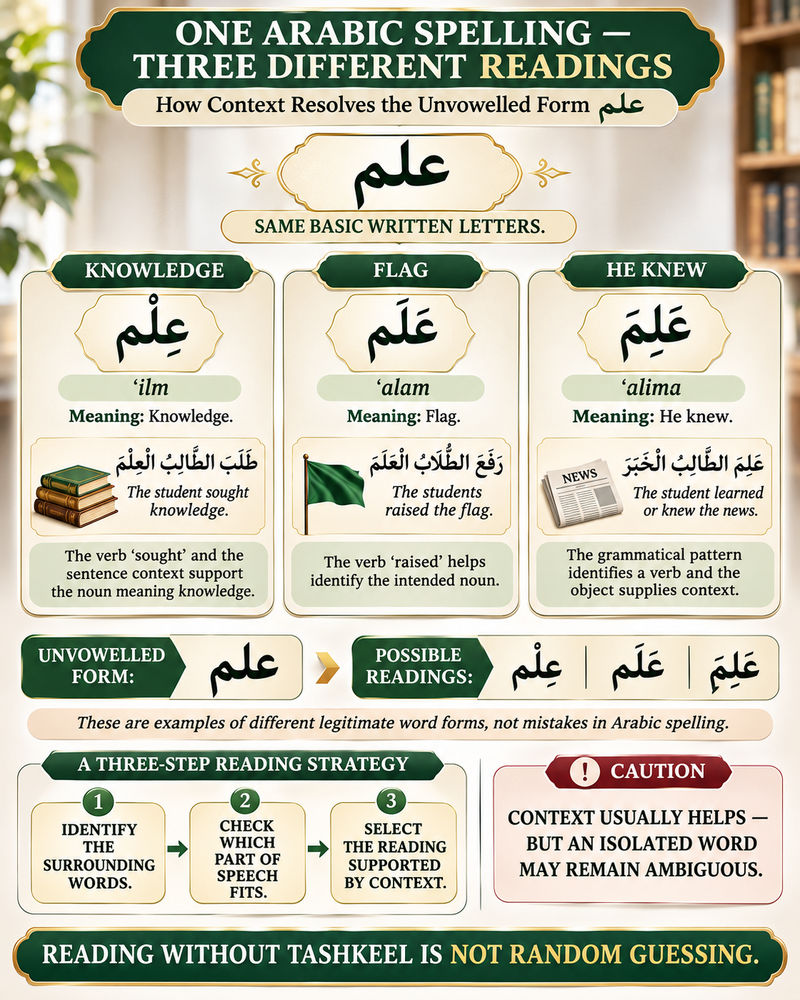
Take the unvowelled form علم. It has several valid readings:
عِلْم ʿilm: knowledge
عَلَم ʿalam: flag
عَلِمَ ʿalima: he knew
Now put it in sentences:
طلب الطالب العلم → طَلَبَ الطَّالِبُ الْعِلْمَ: "The student sought knowledge."
رفع الطلاب العلم → رَفَعَ الطُّلَّابُ الْعَلَمَ: "The students raised the flag."
علم الطالب الخبر → عَلِمَ الطَّالِبُ الْخَبَرَ: "The student learned/knew the news."
The verbs sought, raised, and the sentence structure make each reading obvious. Not every reading is equally likely in every sentence, and in a well-written text the competing readings rarely compete at all.
What Happens When Context Is Not Enough?
Sometimes it is not enough. Ambiguity can remain in:
Short headlines and isolated words.
Poetry, where meter and compression leave fewer clues.
Unfamiliar personal and place names.
Technical vocabulary.
Classical texts with dense or unusual style.
Any sentence that gives too little information.
Native speakers do not always know the intended reading without uncertainty. Writers handle this by adding selective diacritics where needed: one Shaddah, one Kasrah on a critical word. Dictionaries, textbooks, and religious and poetic texts routinely add more. Names also show another convention: عمر (ʿUmar) and عمرو (ʿAmr) are distinguished by an extra written waw in the second, which is silent.
Five Examples of How Tashkeel Changes Reading
1. Different short vowels, different words
Unvowelled: علم
عِلْم ʿilm "knowledge" / عَلَم ʿalam "flag"
The marks distinguish two unrelated nouns. Context (an article, a verb like raised) picks one.
2. Active versus passive verb
Unvowelled: كتب
كَتَبَ kataba "he wrote" / كُتِبَ kutiba "it was written"
The vowels carry the voice of the verb. Context decides: if a subject follows (كتب المعلم), the active is expected; with no agent, the passive may be intended.
3. Verb versus noun
Unvowelled: درس
دَرَسَ darasa "he studied" / دَرْس dars "lesson"
Same consonants, different parts of speech. The word's place in the sentence (after a subject, or after an article or preposition) points to the answer.
4. Shaddah changing the word
Unvowelled: درس (again) and علم
دَرَسَ darasa "he studied" / دَرَّسَ darrasa "he taught"
عَلِمَ ʿalima "he knew" / عَلَّمَ ʿallama "he taught"
Doubling the middle consonant produces a different verb form with a different meaning, here a causative sense. Context and the objects involved often show which is meant.
5. Grammatical endings
Unvowelled: أكرم الأستاذ الطالب
The two readings above differ only in their endings, which swap subject and object.
Word order usually decides, but endings are the formal mechanism.
These examples show different phenomena: lexical difference, voice, part of speech, derivational form, and grammatical function. Not all ambiguity is the same kind.
Why the Quran Is Different
Why Is the Quran Usually Printed With Vowel Marks?
Most modern printed Mushafs are fully marked because accuracy matters. Marking helps readers with:
Precise recitation, including correct short vowels.
Vowel distinctions that could otherwise be confused.
Consonant doubling (Shaddah).
Recitational guidance, such as small signs for lengthening.
Learning support for students at every level.
Editorial standardization within a given edition.
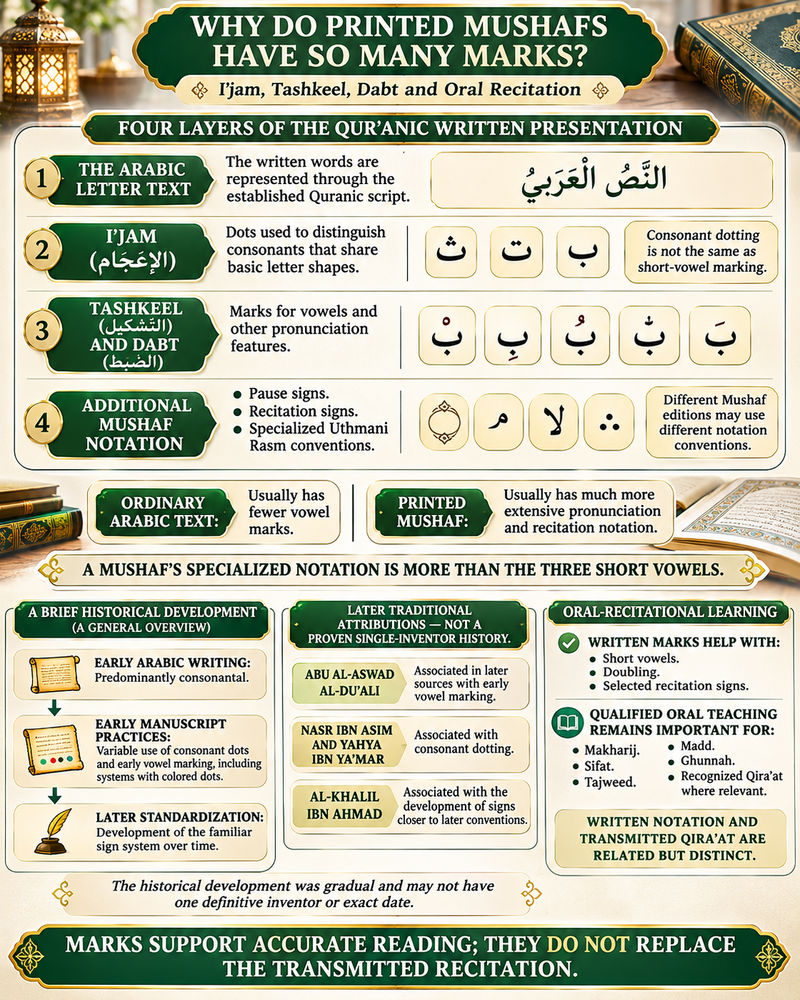
Mushaf notation covers more than short vowels. It can include Tashkeel, Tajweed-related signs, pause marks, and the specialized spelling conventions of the Uthmani script (rasm). These are separate layers, and different Mushafs do not all look identical or mark every detail in the same way. For a wider view of the subject, see our introduction to Quranic Arabic.
Were Early Quran Manuscripts Written Without Modern Vowel Marks?
The history is gradual and varied, so it needs careful wording. The Arabic script is generally traced by scholars to the Nabataean script, and early Arabic writing was primarily consonantal. Two developments need to be kept apart:
I'jam (الإِعْجَام): using dots to tell apart consonants that share a basic letter shape, such as ب ت ث ن ي.
Tashkeel / Dabt (التَّشْكِيل / الضَّبْط): marking vowels and other pronunciation features.
These are not the same development. Surviving early manuscripts vary: some have sparse dotting or none, others show some dots, and some show early systems of vowel marking, such as colored dots. We should not say that all early manuscripts were entirely undotted or unvocalized.
Later Arabic sources name figures associated with these developments. Abu al-Aswad al-Du'ali is reported to be linked to early vowel marking, Nasr ibn ʿĀsim and Yahya ibn Yaʿmar to dotting, and al-Khalil ibn Ahmad to the system of signs closer to those used today. These accounts come from later tradition, and scholars treat them with caution, since a gradual process may have been compressed into a few famous names. There is no universally agreed single inventor and no secure date for each individual mark. For Khalil's wider legacy in lexicography, see our article on the beginnings of Arabic dictionaries.
What notation did not do was alter the revealed text. Marks record how the text is recited, and the recitation itself has always been transmitted orally from teacher to student. That is why written notation and established recitation traditions (qira'at) are not the same thing, and why variation between recitation traditions should never be confused with ordinary spelling variation.
Why Quran Recitation Still Requires More Than Reading the Marks
Marks give valuable information, but they do not encode everything about accurate recitation. Learners also need:
Makharij: where each sound is articulated.
Sifat: the qualities of each letter.
Tajweed rules: the transmitted rules governing recitation.
Madd: lengthening, which has rules beyond the presence of a long-vowel letter.
Ghunnah: nasalization in certain contexts.
Qira'at: the canonical readings, where relevant to the student.
A Mushaf is an essential resource, but it does not replace a teacher. Being able to read Arabic does not automatically mean being able to recite with correct Tajweed, which is why many students, including native speakers, study it deliberately. Our guide on learning Quran online explains how teacher-guided study works.
Standard Arabic, Dialects, and Children's Books
Are Short Vowels Missing in Both Standard Arabic and Dialects?
Short-vowel marks are omitted in ordinary writing across many contexts, but the varieties themselves differ. It helps to distinguish Classical Arabic, MSA, spoken dialects, and informal written dialect.
Dialects have their own vowel systems, grammar, and pronunciation. The same written word may be pronounced differently: كتاب is kitāb in MSA, while many Levantine speakers say ktāb. MSA is the formal written and broadcast standard, not the everyday mother tongue of most speakers, and dialects should not be treated as identical to each other. The written form of a word does not always reveal how a particular speaker says it.
Why Children's Books and Beginner Textbooks Use More Tashkeel
Vowel marks support developing readers by making letter-sound relationships explicit. They help with:
Decoding unfamiliar words.
Learning correct pronunciation.
Building vocabulary.
Noticing grammatical patterns.
Gaining reading confidence.
The amount varies with publication, age group, and educational purpose, and not all children's books are fully vowelled. Many gradually reduce marks as readers advance.
How to Learn to Read Without Tashkeel
A Step-by-Step Transition
This sequence is flexible, and no fixed timeline is promised.
Master letters and basic vowel marks. A reliable foundation comes first.
Learn common vocabulary with accurate pronunciation. Link the written form to the sound.
Recognize frequent morphological patterns. Noun and verb shapes recur constantly.
Study basic sentence structure. Grammar narrows ambiguity.
Read short texts with partial tashkeel. Use graded materials.
Compare vowelled and unvowelled versions. Train your eye on the same words both ways.
Use context to test your interpretation. Check readings against the sentence instead of making isolated guesses.
Gradually read authentic materials. Move toward articles and stories.
Our roadmap for learning Quranic Arabic from scratch provides a complementary overall pathway.
Five Practical Exercises
Exercise 1: Add the missing vowels
Task: vocalize ذهب الولد إلى المدرسة.
Answer: ذَهَبَ الْوَلَدُ إِلَى الْمَدْرَسَةِ dhahaba l-waladu ilā l-madrasati: "The boy went to the school."
Skill: connecting patterns and grammar to vowels. (Case endings may be dropped in everyday speech.)
Exercise 2: Choose the reading from context
Task: in كتب المعلم الدرس على السبورة, choose between كَتَبَ and كُتِبَ.
Answer: كَتَبَ الْمُعَلِّمُ الدَّرْسَ عَلَى السَّبُّورَةِ: "The teacher wrote the lesson on the board." The passive would need a subject without المعلم acting as agent, so it does not fit.
Skill: using sentence structure to resolve ambiguity.
Exercise 3: Identify root and pattern
Task: find the root and pattern of مَكْتَبَة.
Answer: root ك ت ب; pattern مَفْعَلَة, a pattern often used for places. مَكْتَبَة maktaba is "library." Compare مَدْرَسَة madrasa "school" (root د ر س) with the same pattern.
Skill: recognizing pattern families.
Exercise 4: Read with and without tashkeel
Task: compare الْوَلَدُ يَقْرَأُ الْكِتَابَ فِي الْبَيْتِ with الولد يقرأ الكتاب في البيت. Read the vowelled sentence aloud, then the unvowelled one, aiming for the same pronunciation.
Answer: "The boy reads the book at home" (al-waladu yaqraʾu l-kitāba fī l-bayti).
Skill: moving from marks to memory.
Exercise 5: Listen, read, and verify
Task: read the unvowelled sentence from Exercise 1 aloud, then listen to a native or teacher reading it and mark every difference.
Answer: your reading should match the vowelled form in Exercise 1; note any vowel or ending that differs.
Skill: linking text to sound and correcting yourself.
Seven Mistakes Beginners Make
Difficulty with unvowelled text is a normal part of learning a system that relies heavily on linguistic knowledge. Common pitfalls:
Assuming Arabic has no vowels. It has them; many are simply unwritten.
Treating alif, waw, and ya as short-vowel marks. They can mark long vowels, but waw and ya are often consonants.
Guessing without learning vocabulary. Words are recognized, not invented.
Ignoring morphological patterns. Patterns predict many vowels.
Ignoring grammar and context. They resolve many ambiguities.
Relying permanently on transliteration. It is a temporary aid and only approximate.
Expecting every unvowelled word to have one obvious reading. Some do not.
A Four-Week Starting Plan
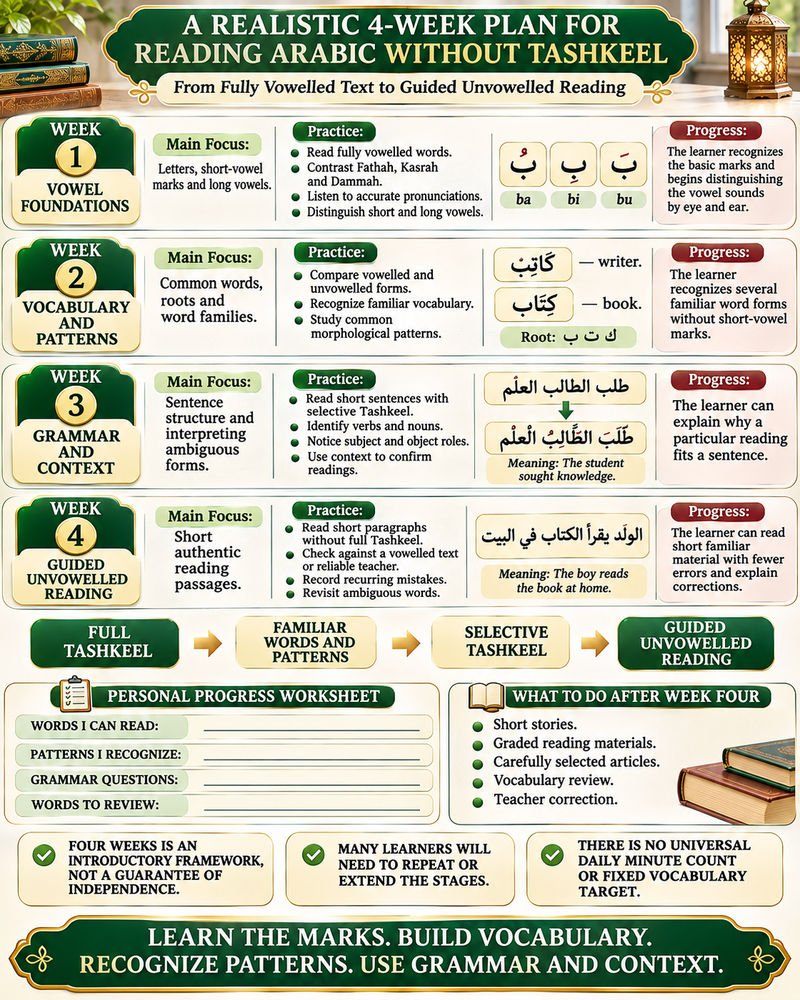
This is an introduction, not a promise of independence. Many learners will need to repeat or extend it.
Week | Main focus | Practice activity | Progress indicator |
|---|---|---|---|
1 | Vowel foundations | Read fully vowelled words; contrast long and short vowels; check audio | You distinguish Fathah, Kasrah, Dammah, and long vowels by ear and eye |
2 | Vocabulary and patterns | Learn common word families; compare vowelled and unvowelled forms | You recognize several patterns and familiar words without marks |
3 | Grammar and context | Read simple sentences with partial tashkeel; identify word roles | You can explain why a reading fits a sentence |
4 | Guided unvowelled reading | Read short passages; check against a vowelled version or teacher; review errors | You read a short text with few corrections and can explain the ones you make |
Frequently Asked Questions
Why are short vowels usually missing in written Arabic?
By convention. The script developed as a consonantal system, and ordinary spelling relies on readers' knowledge of vocabulary, patterns, grammar, and context to supply the vowels.
Does Arabic have vowels?
Yes: three short and three long in the standard description, though realization varies by variety and context.
What is the difference between Harakat and Tashkeel?
Strictly, Harakat are the short-vowel marks, while Tashkeel is the whole system of marks, including Sukun, Shaddah, and Tanween. In practice the terms overlap.
What is the difference between I'jam and Tashkeel?
I'jam is dotting that distinguishes consonants of similar shape. Tashkeel marks vowels and related features. They are separate developments.
Can one Arabic word have multiple pronunciations?
Yes. Unvowelled علم can be ʿilm, ʿalam, or ʿalima, among other readings. Context usually settles which is meant.
Are Arabic vowel marks optional?
In ordinary modern writing they are usually optional, but they are expected in many settings, such as the Quran, children's books, and dictionaries, and writers add them selectively when meaning could be unclear.
Do Arabic dialects use the same vowels as MSA?
No. Dialects have their own vowel systems and pronunciation patterns, and they differ from each other as well.
Conclusion
Arabic does have vowels, even when short-vowel marks are not written. Ordinary reading depends on vocabulary, morphology, grammar, context, familiarity with written Arabic, and sound pronunciation knowledge. That is not guessing; it is applying what you know about the language, though it sometimes leaves real ambiguity that writers resolve with a few well-placed marks.
Beginners can build this ability step by step by moving from fully vowelled texts to partial marking and then to authentic materials. If you would like guided practice, Araby Academy offers live one-to-one Arabic and Quranic Arabic lessons.