Three short openings begin three different Surahs:
وَالْعَصْرِ (103:1)
وَالشَّمْسِ وَضُحَاهَا (91:1)
وَالنَّجْمِ إِذَا هَوَىٰ (53:1)
In my paraphrase: “By time.” “By the sun and its brightness.” “By the star when it falls.”
Why time? Why the sun? Why a star? And what is the Quran trying to confirm?
Short answer: The Quran uses oaths to emphasize important statements about guidance, human responsibility, revelation, and the Hereafter. The thing sworn by (time, the sun, a star) is not necessarily the main message. In Arabic rhetoric, the statement being affirmed is often called Jawab al-Qasam. Understanding a Quranic oath means reading the whole passage, identifying its grammar, and consulting reliable Tafsir, especially where scholars differ about an oath’s referent or answer.
These verses do not teach worship of time, the sun, or the stars. They are Arabic oath constructions, and each one points to a statement that follows.
What Are Quranic Oaths and Why Are They Used?
In Arabic, an oath is قَسَم (qasam). English “swearing” here means making a solemn, emphatic assertion, not using offensive language. The study of oaths in the Quran is al-Qasam fi al-Quran, and traditional works on Quranic Sciences treat it under أَقْسَامُ الْقُرْآن (Aqsam al-Quran). Scholars such as al-Zarkashi and al-Suyuti discuss it in their Ulum al-Quran books, and Ibn al-Qayyim wrote a dedicated work on it. These classical discussions are broader than any single modern literary explanation.
An oath adds weight to a statement. It also draws the listener’s attention, gathers familiar images, and leads toward a message about guidance, accountability, or the Hereafter. Quranic oaths are not all identical. Some are short and direct. Others are long sequences, and some have answers that scholars discuss.
Qasam, Muqsam Bihi, and Jawab al-Qasam Explained
Every oath has two parts that must be kept apart:
الْمُقْسَمُ بِهِ (al-Muqsam bihi): that by which the oath is made, such as time.
الْمُقْسَمُ عَلَيْهِ (al-Muqsam ‘alayhi): the matter being affirmed. It is often expressed in the جَوَابُ الْقَسَم (Jawab al-Qasam), the oath’s answer clause.
In 103:1–2, the object is time (al-‘Asr). The affirmed statement is إِنَّ الْإِنْسَانَ لَفِي خُسْرٍ, a statement about human loss. The Surah’s message is not simply “time exists.”
To understand the purpose of a Quranic oath, readers need more than an isolated English phrase, which is why tafsir explains important details beyond a Quran translation is an essential companion to this topic. Different English renderings of words such as Al-‘Asr and Ad-Duha also illustrate why Quran translations can express the same Arabic wording differently, especially when the Arabic word has a broader contextual range.
The grammar toolkit:
وَاوُ الْقَسَم (Waw al-Qasam): the Waw of oath, as in وَالْعَصْرِ. It works like a preposition, so the noun after it is genitive. Not every Waw is an oath. The conjunctive Waw merely connects words or clauses (“and”), and the two can look identical on the page. Only grammar and context decide which one you have.
بَاءُ الْقَسَم (Ba’ al-Qasam): oath by Ba’, as in وَأَقْسَمُوا بِاللَّهِ (16:38). Ba’ has other uses, so it must be analyzed.
تَاءُ الْقَسَم (Ta’ al-Qasam): as in تَاللَّهِ (12:85). The speakers there are Yaqub’s sons addressing their father, not Allah. Characters’ oaths in the Quran are not Divine oaths.
إِنَّ (Inna) and لَامُ التَّوْكِيد (Lam al-Tawkid): common emphatic markers in answers, as in لَفِي (103:2), لَشَتَّىٰ (92:4), and لَكَنُودٌ (100:6). Neither appears in every answer, and not every Lam in the Quran is emphatic.
لَقَدْ (Laqad): an emphatic opener, as in لَقَدْ خَلَقْنَا الْإِنْسَانَ فِي أَحْسَنِ تَقْوِيمٍ (95:4). It does not always introduce an oath answer.
Oath is not simile. Qasam is an oath. Mathal is a parable. Tashbih is a comparison, and isti’arah is a metaphor. A vivid object in an oath is not automatically figurative.
Labels used here: text explicitly present, scholarly grammatical reconstruction, interpretive possibility, and unverified speculation. I avoid the last.
10 Quranic Oaths at a Glance
Passage | Oath object | Answer / confirmed message | Caution |
|---|---|---|---|
103:1–3 | Time | Human loss, with stated exceptions | Read verse 3 |
91:1–10 | Sun, moon, day, night, sky, earth, soul | Success for those who purify the soul (v. 9), failure for those who corrupt it (v. 10) | No fixed symbol per object |
92:1–4 | Night, day, male and female | Human efforts differ | Night ≠ evil |
93:1–5 | Morning brightness, night | Your Lord has not abandoned you | Not a universal worldly guarantee |
53:1–4 | The star | The Prophet ﷺ is neither astray nor mistaken | Not an astronomy lesson |
89:1–5 | Dawn, ten nights, even and odd, passing night | Answer debated | Do not force one answer |
86:1–4 | Sky, the Tariq | Every soul has a guardian (v. 4) | Reading-sensitive grammar |
95:1–4 | Fig, olive, Tur Sinin, secure city | Humans created in the best form | Referents discussed |
100:1–6 | The charging runners | Human ingratitude | Horses/camels discussed |
51:1–6 | Scatterers, carriers, sailers, distributors | What is promised is true; judgment will occur | Referents reported in Tafsir |
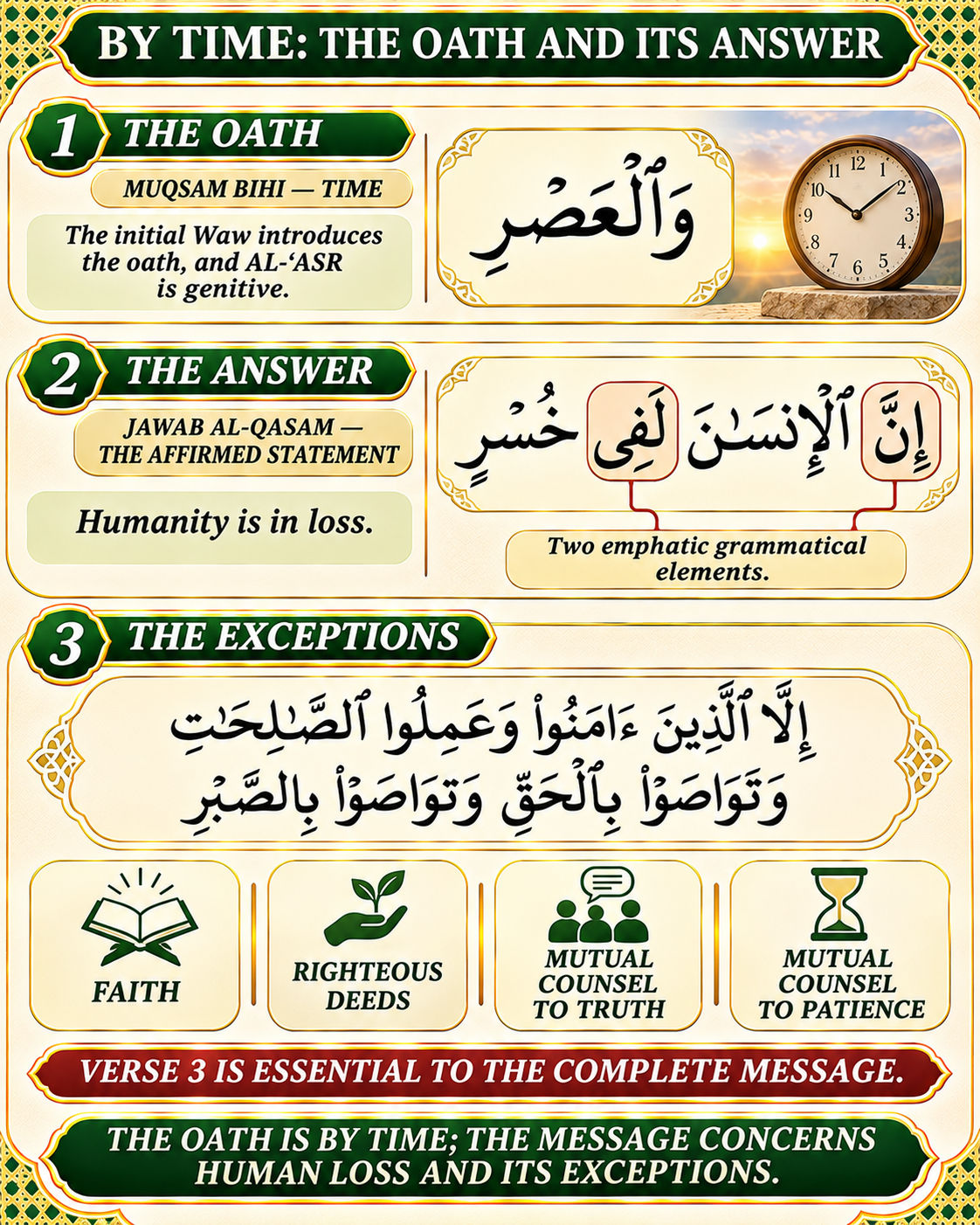
1. By Time: Why Surah Al-‘Asr Begins with a Single Powerful Oath
Quran 103:1–3
وَالْعَصْرِ إِنَّ الْإِنسَانَ لَفِي خُسْرٍ إِلَّا الَّذِينَ آمَنُوا وَعَمِلُوا الصَّالِحَاتِ وَتَوَاصَوْا بِالْحَقِّ وَتَوَاصَوْا بِالصَّبْرِ
Paraphrase: By time, humankind is in loss, except those who believe, do righteous deeds, and urge one another to truth and to patience.
Oath object: al-‘Asr. Particle: Waw, with al-‘Asr in the genitive.
Answer: 103:2. Inna adds emphasis, and la- on fi khusr adds more. Together they make the statement strongly affirmed.
Key vocabulary: khusr means loss. Al-‘Asr has a lexical range around time or an era. Some commentators discussed in classical Tafsir also mention the late afternoon, so a preferred contextual reading is not the same as the word’s whole range. The word is not a scientifically defined unit.
Context: Verse 3 supplies four exceptions (faith, righteous deeds, mutual counsel to truth, mutual counsel to patience). Quoting verse 2 alone distorts the Surah.
The opening Waw and the emphatic particles in the answer demonstrate [ how small Arabic words and particles shape Quranic meaning], even when the Surah contains only three short verses.
Misconception: “The oath just says time passes.”
Note-taking method: write two lines. Sworn by: time. Affirmed: human loss, with exceptions.
Practice: Which word is the object? What does the Waw introduce? Where does the answer begin? What exceptions follow?
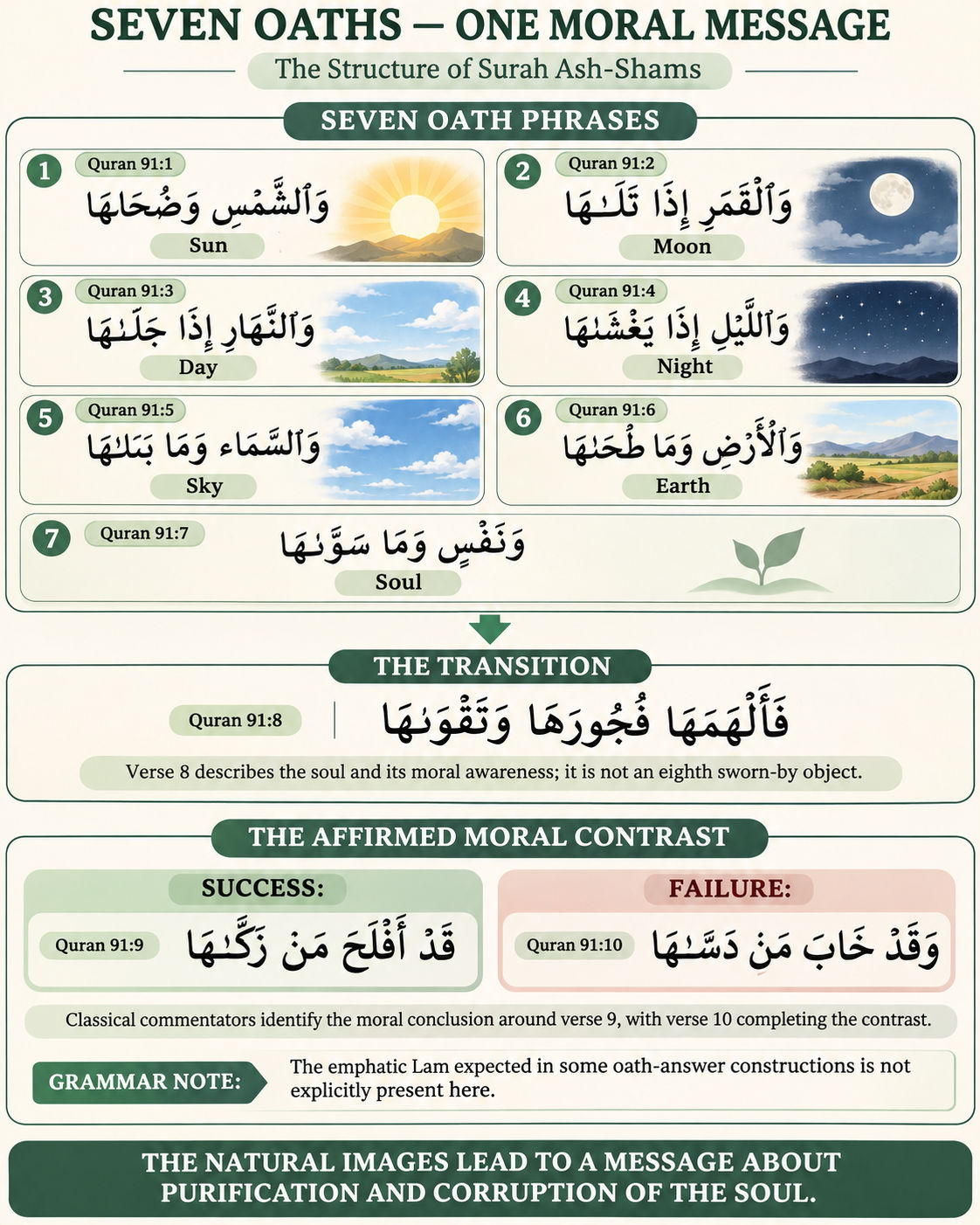
2. By the Sun and the Moon: How Surah Ash-Shams Builds a Long Oath
Quran 91:1–10
وَالشَّمْسِ وَضُحَاهَا وَالْقَمَرِ إِذَا تَلَاهَا وَالنَّهَارِ إِذَا جَلَّاهَا وَاللَّيْلِ إِذَا يَغْشَاهَا وَالسَّمَاءِ وَمَا بَنَاهَا وَالْأَرْضِ وَمَا طَحَاهَا وَنَفْسٍ وَمَا سَوَّاهَا فَأَلْهَمَهَا فُجُورَهَا وَتَقْوَاهَا قَدْ أَفْلَحَ مَنْ زَكَّاهَا وَقَدْ خَابَ مَنْ دَسَّاهَا
Oath objects: seven phrases in 91:1–7 (sun, moon, day, night, sky, earth, soul). Verse 8 describes the soul being inspired with its wrongdoing and its God-consciousness.
Answer: commentators including Ibn Kathir treat 91:9 as the answer, with 91:10 completing the contrast. The expected emphatic Lam of la-qad is absent, and a commonly cited grammatical explanation is that the length of the oath sequence accounts for this.
Wa ma: in wa-ma banaha, wa-ma tahaha, and wa-ma sawwaha, grammarians discuss whether ma means “that which/He who” or acts as a verbal-noun particle. The analysis is not automatically identical in each case.
Vocabulary: aflaha means succeeded. Zakkaha is from tazkiyah, purification or growth. Khaba means failed. Dassaha means corrupted or buried it. I avoid inventing a narrow psychological definition from the root alone.
The extended build-up before the central statement is a useful reminder that Quranic Arabic word order and sentence structure can direct emphasis, so readers should examine where the oath ends and the answer begins.
Readers may notice a relationship between the natural examples and the moral conclusion. But assigning one fixed human trait to each object requires evidence, and I give none. The oath gives the sun no independent power, and it offers no basis for predicting individual fate.
Practice: How many categories are named? Where is the moral assertion? Which words express success and failure? Which interpretations need Tafsir rather than imagination?
3. By the Night and the Day: Why Contrasting Oaths Lead to Different Human Efforts
Quran 92:1–4
وَاللَّيْلِ إِذَا يَغْشَىٰ وَالنَّهَارِ إِذَا تَجَلَّىٰ وَمَا خَلَقَ الذَّكَرَ وَالْأُنثَىٰ إِنَّ سَعْيَكُمْ لَشَتَّىٰ
Paraphrase: By the night as it covers, by the day as it appears, and by Him who created male and female: your efforts are diverse.
Objects: night, day, and the creation of male and female (verse 3). The ma in verse 3 is again a grammatical discussion in the commentaries.
Answer: 92:4. Inna and the emphatic la- appear again.
Vocabulary: sa’y means striving or effort, not necessarily running. Sa’yakum is plural and addressed to people generally. Shatta means diverse or divergent.
Context: 92:5–11 develop the contrast. One person gives, is mindful of God, and affirms the best; the other withholds, feels self-sufficient, and denies it. The consequences differ, and wealth will not help the latter.
The phrase Inna Sa’yakum La-Shatta also shows how a short Quranic expression can carry grammatical emphasis beyond its simple English rendering, making it worth studying word by word.
Misconception: “Night means evil and day means good.” The Surah makes no such equation. The pairing prepares a contrast in human conduct.
Practice: What contrasts appear? What is the answer? What does sa’y mean here? How do verses 5–11 develop the theme?
4. By the Morning Brightness: How Surah Ad-Duha Moves from Oath to Reassurance
Quran 93:1–5
وَالضُّحَىٰ وَاللَّيْلِ إِذَا سَجَىٰ مَا وَدَّعَكَ رَبُّكَ وَمَا قَلَىٰ وَلَلْآخِرَةُ خَيْرٌ لَّكَ مِنَ الْأُولَىٰ وَلَسَوْفَ يُعْطِيكَ رَبُّكَ فَتَرْضَىٰ
Objects: ad-duha (morning brightness or forenoon) and the night idha saja, commonly understood as becoming calm or still. The Surah’s name is separate from the discussion of Salat al-Duha.
Answer: 93:3, a negated statement. Your Lord has not abandoned you, wada’aka, nor disliked you, qala. It addresses the Prophet ﷺ.
Continuation: 93:4–5 promise that the Hereafter is better for him and that he will be given until he is pleased. This is Divine address to the Prophet ﷺ, not a guaranteed worldly outcome for every reader.
Context: a report in Sahih al-Bukhari and Sahih Muslim (from Jundub) connects the revelation to a pause in the Prophet’s ﷺ night prayer and a taunt. [EDITOR TO VERIFY exact wording.] I give no duration or added scene.
The memorable endings in Surah Ad-Duha also provide a useful connection to the Quranic science of Fawasil and the sounds of verse endings, while the oath itself must still be understood through meaning and grammar.
Practice: What two phenomena appear in the oath? Where does the reassurance begin? What do verses 4–5 say? Which historical details require authentic sources?
5. By the Star: Why Surah An-Najm’s Oath Leads to a Statement About Revelation
Quran 53:1–4
وَالنَّجْمِ إِذَا هَوَىٰ مَا ضَلَّ صَاحِبُكُمْ وَمَا غَوَىٰ وَمَا يَنطِقُ عَنِ الْهَوَىٰ إِنْ هُوَ إِلَّا وَحْيٌ يُوحَىٰ
Paraphrase: By the star when it falls: your companion has not gone astray nor erred, and he does not speak from desire. It is only revelation revealed.
Object: al-najm. Tafsir reports several explanations: a star or stars, a particular star such as the Pleiades (reported by some), and the Quran being revealed in stages. Al-Tabari’s commentary is a good place to see them. There is no single agreed celestial referent.
Hawa: here it is generally explained as falling or setting. It is not a black hole, a meteor strike, or a scientific prediction.
Answer: 53:2, continued in 53:3–4. Sahibukum (“your companion”) refers, in context, to the Prophet ﷺ, addressed to the people he was calling.
Dalla and ghawa: dalla is to go astray and ghawa is to err or follow a wrong course. Lexicons and commentators often link them, but I do not claim a rigid distinction in every occurrence.
The expressions Dalla and Ghawā invite the same careful attention to Quranic Arabic words that can look similar in English while differing in usage, without assuming that every apparent synonym has a rigid meaning in all contexts.
Practice: What is sworn by? What follows immediately? Who is Sahibukum? Why is this oath not an astronomy lesson?
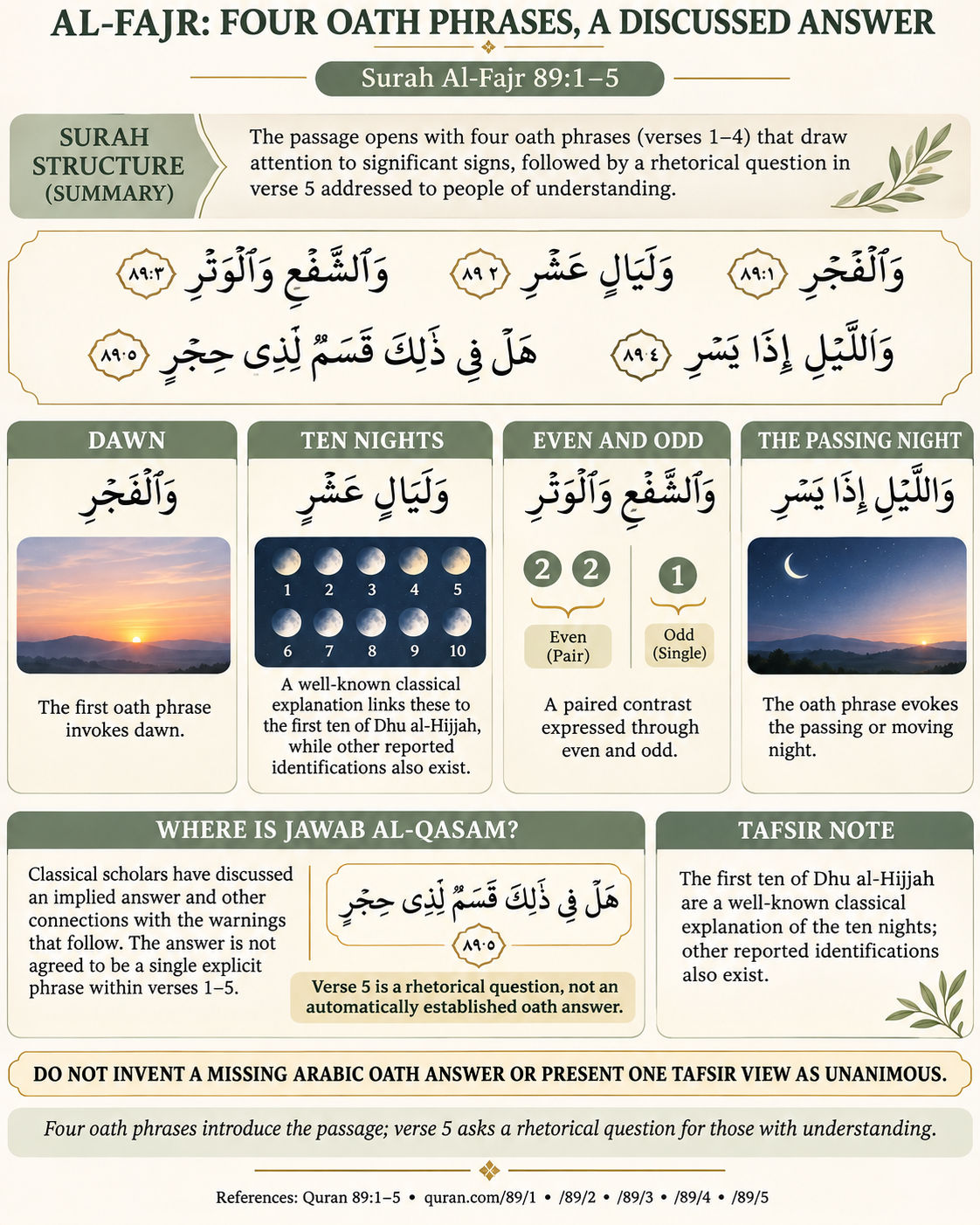
6. By the Dawn and Ten Nights: Why Surah Al-Fajr Requires Careful Tafsir
Quran 89:1–5
وَالْفَجْرِ وَلَيَالٍ عَشْرٍ وَالشَّفْعِ وَالْوَتْرِ وَاللَّيْلِ إِذَا يَسْرِ هَلْ فِي ذَٰلِكَ قَسَمٌ لِّذِي حِجْرٍ
Paraphrase: By the dawn, by ten nights, by the even and the odd, and by the night as it passes. Is there in that an oath for one with intellect?
Four oath phrases: dawn, ten nights, al-shaf’ (even) with al-watr (odd), and the passing night.
Ten nights: classical Tafsir (including al-Tabari, Ibn Kathir, al-Qurtubi, and al-Baghawi) reports the first ten of Dhu al-Hijjah as a well-known identification, and Ibn Kathir is often cited for it. Other reported views include the last ten of Ramadan and the first ten of Muharram. [EDITOR TO VERIFY attributions.]
Even and odd: the words mean even and odd, but their referents are discussed (for example, relating to ritual days or to creation in general). I claim no single referent.
The answer: this is the critical nuance. Verse 5 is a question and is not itself the answer. Some grammarians and commentators discuss an omitted answer implied by the context, and others link the emphasis to the warning in later verses (some point to 89:14). Scholars do not all locate it in the same place. I give no reconstructed Arabic wording.
Context: 89:6–14 recall earlier peoples and the consequences of their conduct, which is why the surrounding warning matters. I add no archaeological detail.
The references to earlier peoples after the oaths in Al-Fajr also connect with [ why the Quran presents prophetic and historical narratives in different contexts], because the surrounding stories help readers understand what the passage emphasizes.
Practice: Which four oath phrases appear? What interpretations of the ten nights are reported? Why is Jawab al-Qasam a scholarly discussion here? What historical material follows?
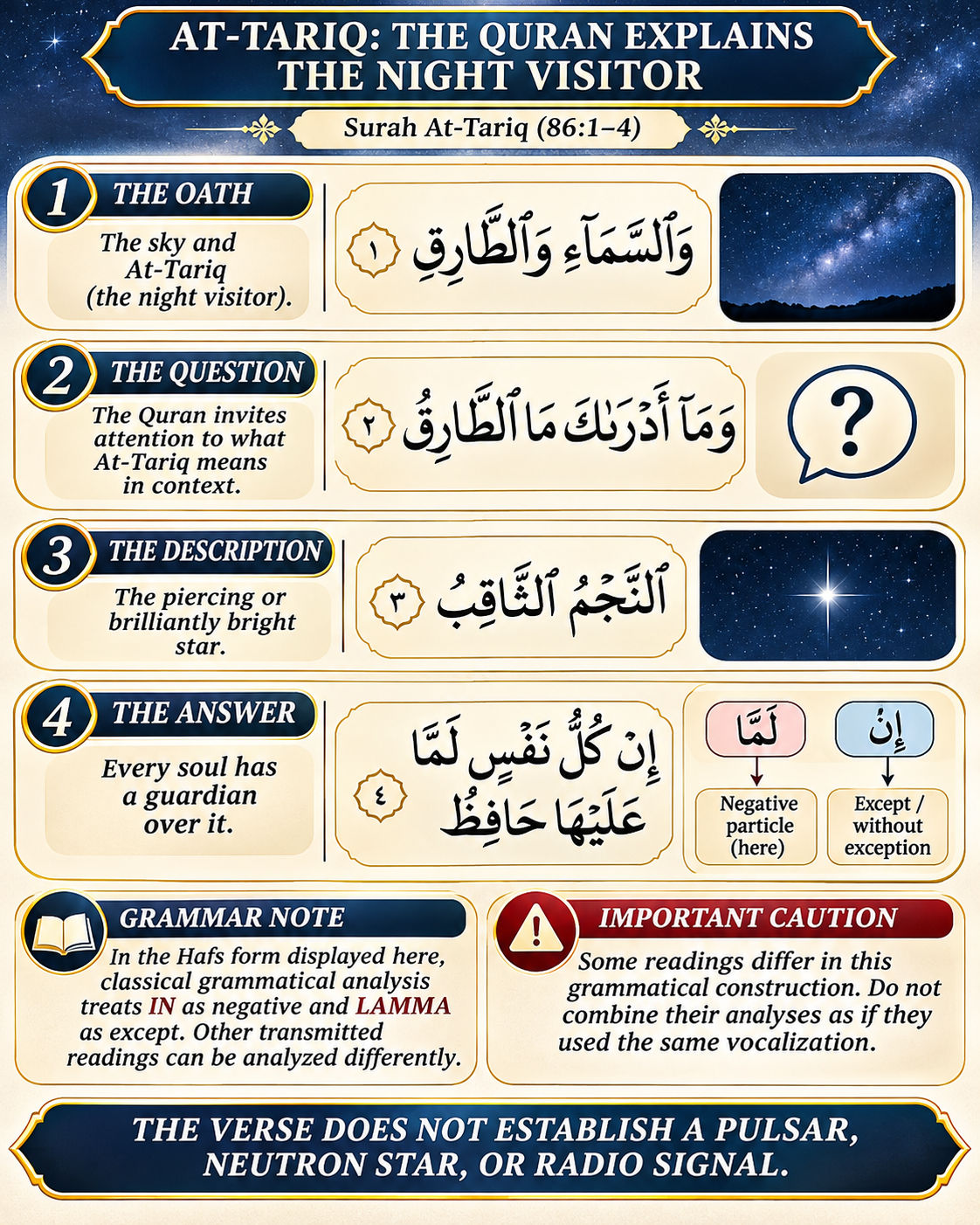
7. By the Sky and the Night Visitor: Why Surah At-Tariq Explains Its Own Image
Quran 86:1–4
وَالسَّمَاءِ وَالطَّارِقِ وَمَا أَدْرَاكَ مَا الطَّارِقُ النَّجْمُ الثَّاقِبُ إِن كُلُّ نَفْسٍ لَّمَّا عَلَيْهَا حَافِظٌ
Objects: the sky and at-Tariq, a night visitor (from the sense of coming or knocking at night).
Structure: oath, then a question (wa-ma adraka ma at-Tariq), then the Quran’s own explanation, an-najm ath-thaqib, then the answer. The question draws attention, and the text then supplies a description. That is different from translating one word in isolation.
Thaqib: piercing or penetrating, in the traditional explanation of a brilliantly bright star. The verse does not establish a pulsar, neutron star, or radio signal. Those require interpretive steps the text does not supply.
The answer: 86:4, that every soul has a guardian over it. Reading-sensitive grammar: this is the Hafs ‘an ‘Asim text, with lammā shadda’d, where in is understood as negation and lammā as “except.” Readings that lighten lamā are analyzed differently (an emphatic Lam). I give only the default reading here. [EDITOR TO VERIFY the Qira’at attribution.]
Practice: What two things are sworn by? How does the Quran explain at-Tariq? Where is the answer? Why should a modern astronomical theory not be presented as established Tafsir?
8. By the Fig and the Olive: Why an Oath Object Can Have More Than One Tafsir Explanation
Quran 95:1–6
وَالتِّينِ وَالزَّيْتُونِ وَطُورِ سِينِينَ وَهَٰذَا الْبَلَدِ الْأَمِينِ لَقَدْ خَلَقْنَا الْإِنسَانَ فِي أَحْسَنِ تَقْوِيمٍ ثُمَّ رَدَدْنَاهُ أَسْفَلَ سَافِلِينَ إِلَّا الَّذِينَ آمَنُوا وَعَمِلُوا الصَّالِحَاتِ فَلَهُمْ أَجْرٌ غَيْرُ مَمْنُونٍ
Objects: at-tin (fig), az-zaytun (olive), Tur Sinin, and “this secure city,” which the traditional interpretation takes to be Makkah.
Tafsir difference: many commentators take the fig and olive literally, as fruits. Others, reported in classical works, associate them with places or regions. I do not present any geographic reading as established translation.
Answer: 95:4. Laqad adds emphasis, and ahsan taqwim is generally explained as the best form or constitution. It is not a biological claim. Verses 5–6 continue the passage: a downward turn, except for believers who do righteous deeds, who receive unending reward.
The fig and olive opening also helps learners distinguish [ Quranic oaths from metaphors, parables, and other powerful Arabic images], because mentioning a vivid object in an oath is not automatically a figurative comparison.
Practice: What are the oath objects? Which interpretations concern fruits, and which concern places? Where does Laqad introduce the affirmed statement? Why must verses 5–6 be read too?
9. By the Charging Runners: How Surah Al-‘Adiyat Uses a Vivid Sequence Before Its Answer
Quran 100:1–6
وَالْعَادِيَاتِ ضَبْحًا فَالْمُورِيَاتِ قَدْحًا فَالْمُغِيرَاتِ صُبْحًا فَأَثَرْنَ بِهِ نَقْعًا فَوَسَطْنَ بِهِ جَمْعًا إِنَّ الْإِنسَانَ لِرَبِّهِ لَكَنُودٌ
Sequence (verses 1–5): charging, panting (dabh), striking sparks, raiding at morning, raising dust, and entering a group. The Fa links the descriptions as a rhetorical sequence and does not give a precise timeline. Dabh is the panting sound of running.
Horses or camels: classical Tafsir commonly identifies horses, a view reported from Ibn ‘Abbas. A report from ‘Ali, discussed in works such as al-Tabari’s, identifies camels in a pilgrimage context. Commentators weigh textual clues like sparks and the morning raid. I name no consensus and no specific battle.
Answer: 100:6. Kanud is ungrateful. The Surah’s point is human ingratitude, not praise of warfare.
Continuation (7–11): the human is a witness to this, is intense in love of wealth, and will face the raising of what is in graves and the disclosure of what is in hearts. Their Lord is fully aware of them on that Day.
Practice: How many opening verses describe the runners? Where does the answer begin? What does kanud mean? Why must classical interpretation be consulted before identifying the animals definitively?
10. By the Scatterers and Carriers: How Several Oaths Lead to a Statement About the Hereafter
Quran 51:1–6
وَالذَّارِيَاتِ ذَرْوًا فَالْحَامِلَاتِ وِقْرًا فَالْجَارِيَاتِ يُسْرًا فَالْمُقَسِّمَاتِ أَمْرًا إِنَّمَا تُوعَدُونَ لَصَادِقٌ وَإِنَّ الدِّينَ لَوَاقِعٌ
Four oath phrases: all feminine plural active participles. The traditional explanation, reported from ‘Ali and cited by al-Tabari and Ibn Kathir, is winds, clouds, ships, and angels who distribute commands. Alternatives are reported for individual phrases, so these are reported referents, not a single “scientific sequence.”
The Fa: it joins the clauses in sequence and does not prove that these events always occur in that order.
Answer: 51:5–6. What you are promised is true, and ad-Din will occur. Here ad-Din is understood as recompense or judgment, not “religion” in the modern English sense.
The participial words in Adh-Dhariyat are also an opportunity to study [ Arabic roots that help readers recognize connected Quranic vocabulary], while remembering that roots alone do not settle a verse’s Tafsir.
Practice: Which four expressions open the Surah? What are their reported referents? Where does the answer begin? What does verse 6 confirm?
The 10 Quranic Oaths and Their Answers at a Glance
Surah | Oath object | Qasam phrase | Answer / analysis | Main message | Caution |
|---|---|---|---|---|---|
Al-‘Asr | Time | وَالْعَصْرِ | 103:2 | Loss, with exceptions | Read v. 3 |
Ash-Shams | Seven objects | وَالشَّمْسِ… | 91:9 (with 91:10) | Success and failure of the soul | No fixed symbols |
Al-Layl | Night, day, male and female | وَاللَّيْلِ إِذَا يَغْشَىٰ | 92:4 | Efforts differ | Night ≠ evil |
Ad-Duha | Morning brightness, night | وَالضُّحَىٰ | 93:3 | Reassurance | Read 93:4–5 |
An-Najm | The star | وَالنَّجْمِ إِذَا هَوَىٰ | 53:2 | Guidance and revelation | Referent debated |
Al-Fajr | Dawn, ten nights, even and odd, night | وَالْفَجْرِ | Debated | Warning, context | No forced answer |
At-Tariq | Sky, Tariq | وَالسَّمَاءِ وَالطَّارِقِ | 86:4 | Every soul has a guardian | Reading-sensitive |
At-Tin | Fig, olive, Tur Sinin, city | وَالتِّينِ… | 95:4 | Created in best form | Referents discussed |
Al-‘Adiyat | Runners | وَالْعَادِيَاتِ | 100:6 | Human ingratitude | Horses/camels |
Adh-Dhariyat | Four participles | وَالذَّارِيَاتِ | 51:5–6 | Promise true, judgment real | Referents reported |
What the ten teach together: oaths can be short or long, and answers can be explicit or discussed. Natural images lead to moral lessons, such as human responsibility, revelation, and the Hereafter. Grammar, context, and scholarly disagreement all matter.
A note on “La Uqsimu.” In لَا أُقْسِمُ بِيَوْمِ الْقِيَامَةِ (75:1) and فَلَا أُقْسِمُ بِمَوَاقِعِ النُّجُومِ (56:75), classical scholarship discusses the role of La. It is not simply “I refuse to swear” in every case, and the matter has more than one analysis.
Not every oath uses nature. وَالْقُرْآنِ الْحَكِيمِ (36:2) swears by the Quran, and 36:3 gives the affirmed message: إِنَّكَ لَمِنَ الْمُرْسَلِينَ.
Can Allah Swear by Creation While Humans Should Not?
Divine oaths are not equal to human oaths. Allah swears by what He wills, and this does not make created things deities, objects of worship, or equals of the Creator. Human oaths are a separate legal topic. Hadith reports, such as one in Sahih al-Bukhari and Sahih Muslim from Ibn ‘Umar, forbid swearing by anything but Allah, for instance by one’s fathers. [EDITOR TO VERIFY wording.] This article gives no personal rulings. Consult a qualified scholar for a specific case.
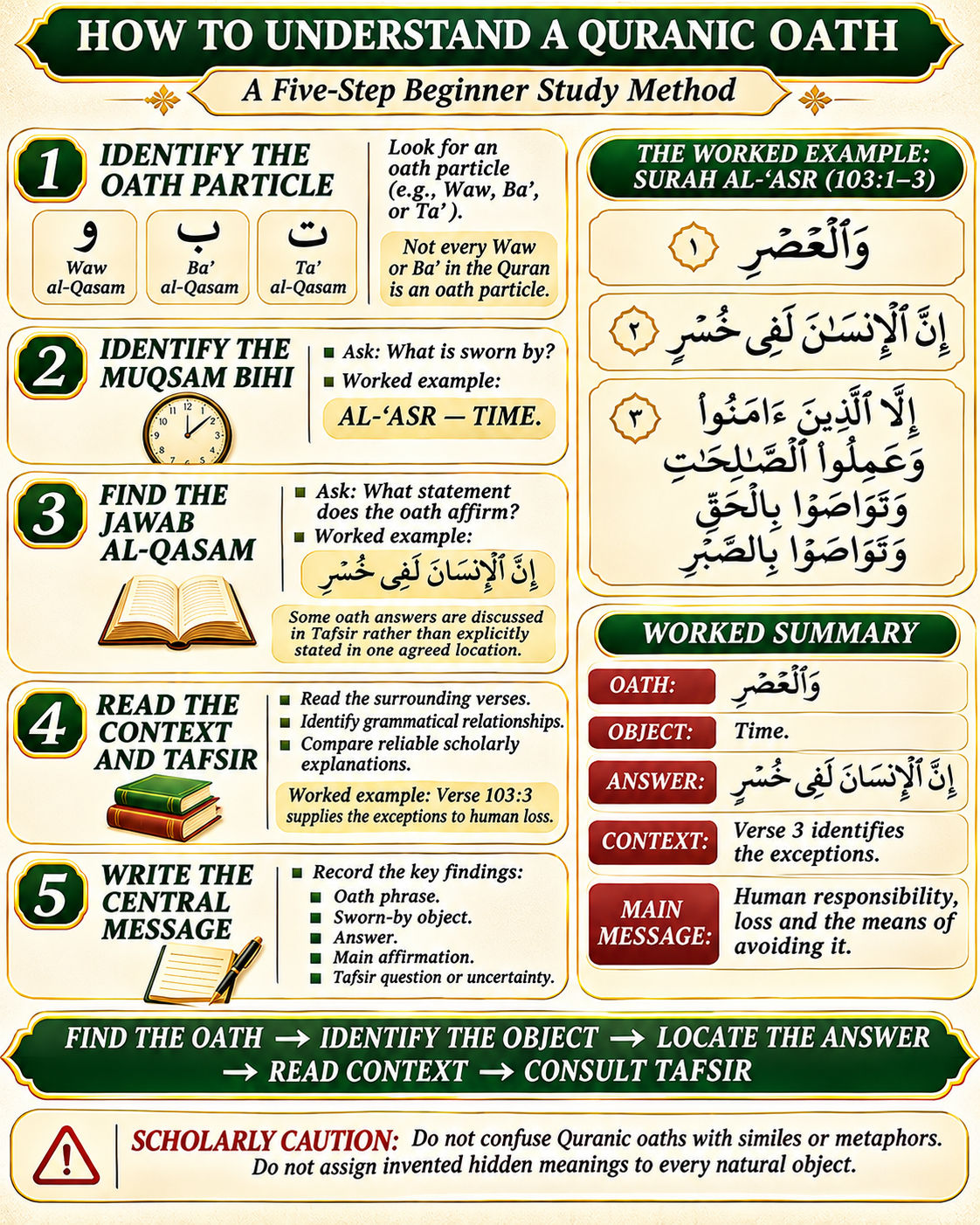
How to Understand a Quranic Oath in Five Steps
Find the oath phrase and its marker (Waw, Ba’, or Ta’).
Identify the Muqsam bihi.
Locate the Jawab al-Qasam, or check Tafsir if it is disputed.
Read the surrounding verses and compare scholarly explanations.
Summarize the central affirmation, separate from speculation about the object.
Worked example (Al-‘Asr): Waw marks the oath. The object is time. The answer is 103:2, with exceptions in 103:3. The message is human loss, and the way out is faith, righteous deeds, truth, and patience.
Second worked example (At-Tin): the oath objects are in 95:1–3, the answer is 95:4, and verses 5–6 continue. Finding the grammatical answer is far easier than inventing hidden correspondences for each object.
Surah | Particle | Muqsam bihi | Jawab | Main meaning | Tafsir question |
|---|---|---|---|---|---|
Al-‘Asr | Waw | Time | 103:2 | Human loss, exceptions | What is ‘asr here? |
Al-Layl | Waw | Night, day, male and female | 92:4 | Diverse efforts | What does ma mean in v. 3? |
At-Tin | Waw | Fig, olive, Tur Sinin, city | 95:4 | Best creation | Fruits or places? |
Al-Fajr | Waw | Dawn, ten nights… | Debated | Warning | Where is the answer? |
(blank) |
Seven-day plan (introductory): Day 1: definitions and Al-‘Asr. Day 2: Ash-Shams. Day 3: Al-Layl and Ad-Duha. Day 4: An-Najm and At-Tariq. Day 5: Al-Fajr. Day 6: At-Tin and Al-‘Adiyat. Day 7: Adh-Dhariyat and review. It does not promise mastery of Balaghah in a week.
Ten-minute method: 2 minutes reading, 2 on the particle and object, 2 finding the answer, 2 reading one reliable Tafsir, 2 writing the assertion and one question. It has no measured guaranteed outcome.
Common Mistakes About Quranic Oaths
Treating every Waw as an oath.
Confusing the object with the answer.
Reading only the first verse of a sequence.
Assuming every answer is immediate and explicit.
Treating the sun or stars as objects of worship.
Equating Divine and human oath rules.
Turning natural images into scientific miracles (for example, claiming An-Najm predicts a black hole or At-Tariq is a pulsar).
Presenting a disputed Tafsir view as unanimous (the ten nights, horses/camels).
Using a root gloss as a full interpretation.
Ignoring the verses after the answer.
Frequently Asked Questions
1. What are Quranic oaths? Emphatic statements, usually introduced by an oath particle, that affirm an important message about guidance, responsibility, revelation, or the Hereafter.
2. What does Qasam mean in Arabic? Qasam means an oath or solemn swearing, an emphatic assertion, not offensive language.
3. What is Jawab al-Qasam? The answer clause: the statement the oath affirms. Sometimes it is explicit, and sometimes scholars discuss where it is or whether it is implied.
4. What is the difference between Muqsam bihi and Muqsam ‘alayhi? Muqsam bihi is what is sworn by. Muqsam ‘alayhi is what is affirmed.
5. Why does Allah swear by created things? Commentators discuss this in different ways, including drawing attention to signs of creation and emphasizing the message. It never makes creation divine.
6. Can Muslims swear by the sun, moon, or stars? Divine oaths and human oaths are distinct. Authentic Hadith forbid swearing by other than Allah. Ask a qualified scholar about specific cases.
7. What does Waw al-Qasam mean? A Waw introducing an oath (“by”), with the following noun genitive. Other Waws are conjunctions.
8. Why does Surah Al-‘Asr begin with an oath by time? It prepares a weighty statement about human loss and its exceptions. Scholars discuss the word’s range, from time in general to a specific period.
9. What is the answer to the oath in Surah Al-‘Asr? 103:2: humankind is in loss. Verse 3 provides the exceptions: faith, righteous deeds, and mutual counsel to truth and patience.
10. Why are there so many oaths in Surah Ash-Shams? Seven oath phrases build toward 91:9–10 on success and failure of the soul. Fixed symbolic mappings need evidence.
11. What does the oath in Surah Al-Layl emphasize? That human efforts differ, with verses 5–11 describing different paths and outcomes.
12. Why does Surah Ad-Duha swear by morning and night? The oath is followed by the statement that the Prophet’s ﷺ Lord has not abandoned him. Commentators explain the pairing in context.
13. What does the oath by the star mean in Surah An-Najm? The star is the sworn-by object, with several reported referents. The affirmed statement concerns the Prophet’s ﷺ guidance and revelation.
14. What are the ten nights in Surah Al-Fajr? Classical Tafsir commonly reports the first ten of Dhu al-Hijjah, and other views are also reported.
15. Is the answer to the oath in Al-Fajr omitted? Some grammarians and commentators discuss an implied answer, and others connect it to surrounding warnings. Scholars differ.
16. What is At-Tariq, the night visitor? The Quran explains it as an-najm ath-thaqib, the piercing star, per traditional Tafsir.
17. Does At-Tariq refer to a pulsar? The verse does not establish that. Modern identifications are not Tafsir.
18. Why does the Quran swear by the fig and olive? They open an oath whose answer is 95:4. Commentators discuss fruits, places, or both.
19. What is the oath’s answer in Surah Al-‘Adiyat? 100:6: humanity is ungrateful to its Lord. Scholars discuss whether the runners are horses or camels.
20. How can beginners identify Quranic oaths and their answers? Look for the oath particle, name the sworn-by object, find the emphatic answer, read the surrounding verses, and consult reliable Tafsir.
Read the Oath, Find the Message
Return to Al-‘Asr, Ash-Shams, and An-Najm. Time can be the object of an oath. The sun can be one object among several. A star can be invoked before a statement about revelation. The object and the affirmed statement are different elements, some answers are explicit, and some need careful analysis.
The next time you hear the Quran swear by time, the sun, the night, or the stars, do more than identify the natural image. Ask what the Arabic oath introduces, where its answer appears, and what the surrounding verses affirm. From Al-‘Asr’s warning about human loss to An-Najm’s statement about revelation, the meaning becomes clearer when the oath and its answer are studied together. Arabic grammar and reliable Tafsir help readers appreciate these passages without inventing hidden scientific or symbolic meanings.
If you would like to read passages like these with confidence, Araby Academy’s qualified teachers can guide you through Quranic Arabic and Tafsir.